The NY Times on Gaza: Israel Is Just Trying to Help
By Barbara Erickson | TimesWarp | April 5, 2016
Now, at last, The New York Times has turned its sights on Gaza fishermen, a much beleaguered group, which has persevered under constant harassment and crippling restrictions. It has long been well under the radar as far as the newspaper’s reporting is concerned.
This week, however, we have an above-the-fold story on page 5 accompanied by a color photo of two fishermen with their nets. What has prompted this long overdue attention? It is the opportunity to present Israel as the benevolent caretaker of the besieged Gaza Strip.
Thus we find a headline announcing the following: “Israel Expands Palestinians’ Fishing Zone Off Gaza.” The story below reports the decision to increase the allowed zone from 6 to 9 nautical miles and the relief and excitement of Gaza fishermen and officials.
The article ends with a quote from Israeli officials, saying that the expansion was part of an effort to “improve the economy and foster stability” in the West Bank and Gaza, and so the story is framed around Israeli efforts to help struggling fishermen and Palestinians in general.
Thanks no doubt to the efforts of Times stringer Majd Al Waheidi of Gaza, readers find hints of the grim reality that fishermen there have actually faced over several years. We learn that Israeli gunboats have been firing on fishermen as they go to sea, and we hear the story of Ismail al-Shrafi, 62, who lost his boat five months ago when Israeli sailors confiscated it, injuring his son with live fire in the process.
The story, however, provides no data to place the case of al-Shrafi in context. Readers do not learn that during 2015, the Israeli navy fired on Gaza fishermen at least 139 times, wounding 24 fishermen and damaging 16 boats. Another 22 boats were confiscated, and 71 fishermen were detained.
According to the Palestinian Center for Human Rights, all these incidents took place within the legal 6-mile zone, but the Times notes that an army spokesperson denied that the navy had fired on boats within the permitted area.
The article, by Al Waheidi and Isabel Kershner, also states that over the weekend the navy “sank a suspected smuggling boat,” but it fails to inform readers that witnesses have contradicted this account. According to Palestinian news sources, the navy fired on several boats near Rafah, setting fire to one fishing vessel and causing it to sink.
The Times is denying readers the complete story here, but its most egregious paragraph is the final one in which officials claim that the expansion of the fishing zone was “part of a policy of loosening restrictions” to help the Palestinian economy.
In fact, Israeli policy appears to be aimed at impeding, rather than bolstering, economic progress in Gaza and the West Bank. Here are just a few examples of how Israeli actions and regulations impact the Palestinian economy:
- The same day the fishing zone was expanded from 6 to 9 miles, four Israeli military bulldozers entered the Gaza strip to destroy farmland planted with wheat.
- According to the PCHR, 35 percent of Gaza’s agricultural land “can only be accessed under high personal risk” because Israeli troops frequently fire on laborers in the fields.
- Israeli policies have caused the Palestinian telecommunications sector to lose $1 billion over the past three years, according to a World Bank report.
- Through a regime of permits, licenses and visas, Israel has cut into the Palestinian tourism industry, deflecting jobs and income to Israel.
- Israel confiscates some 80 percent of the water in the West Bank for its own use and charges Palestinian residents for the water it sells back to them.
- A United Nations report stated that in spite of the occasional loosening of restrictions, Gaza’s economy will continue to deteriorate as long as Israel maintains its blockade of the territory.
Times readers, however, are told that Israel is trying to help, loosening restrictions to “improve the economy.” Thus we find the headline this week announcing a generous move to allow fishermen more access to their own Gaza Sea.
It seems that the newspaper’s editors are credulous consumers of Israeli spin, readily quoting the self-serving claims of officials and making no attempt to verify the facts. Readers—as well as the courageous fishermen of Gaza—deserve better.
Follow @TimesWarp on Twitter
Attempts to impeach Brazil president illegal: Attorney general
Press TV – April 5, 2016
Brazil’s attorney general has slammed impeachment proceedings against President Dilma Rousseff as illegal, saying such a bid is nothing more than an attempted coup d’état.
Jose Eduardo Cardozo, the government’s main legal advisor, defended Rousseff before the impeachment committee of Brazil’s lower house of Congress, dismissing the allegations leveled against the embattled president.
Opposition lawmakers, who are seeking to remove Rousseff, accuse her of taking out unauthorized government loans to hide a growing budget deficit.
Cardozo told the 65-member committee that such claims, even if true, could not be dealt with as an impeachment case, saying the “process was compromised from the start and as such it is invalid.”
“As such, impeaching her would be a coup, a violation of the constitution, an affront to the rule of law, without any need to resort to bayonets,” he added.
The hearing was the final plea by Rousseff’s administration against the impeachment. The committee will likely issue its recommendation this week.
If the impeachment passes the lower house, the president would be suspended for up to six months while facing trial in the Senate. Meantime, Vice President Michel Temer would replace her as acting president.
Rousseff, however, vowed that she would stand firm and would not bow to the pressure to bring her down. Her predecessor and ally Luiz Inacio Lula da Silva has also pledged to support Rousseff.
The impeachment process began last December after lower house speaker Eduardo Cunha accepted the opposition request for such a move.
Cardozo said Cunha’s decision was motivated by his desire for political revenge against Rousseff, his bitter political rival.
The political crisis has brought Brazil to the brink of economic collapse as it is entangled in a deep recession and corruption allegations.
With the Rio de Janeiro Olympics just four months away, the Latin American country has been the scene of counter rallies in and against the government over the last few weeks, some of which even turned violent.
In the latest of such rallies, anti-government protesters took to the streets on Monday, denouncing the officials for not having decided over the impeachment bid.
Venezuela’s Political Killings: A Sign of the Repression to Come?
By Ryan Mallett-Outtrim | Venezuelanalysis | April 4, 2016
A mayor gunned down in a drive by shooting just meters from his own doorstep. A legislator shot by paramilitaries in plain sight outside a bodega. A solidarity activist butchered in a home invasion. Two police run over by militants in a stolen bus. These are just the latest in a wave of killings in Venezuela. The motives behind most of these killings remain unclear, though it’s hard to not be disturbed by what appears to be a growing wave of political violence gripping the country. In response, Venezuela’s right-wing, the mass media and even most human rights groups are all following a well worn script that seeks to downplay these killings, or at least deflect attention away from the context behind the violence. For example, Human Rights Watch’s latest report on Venezuela is basically just a call for Venezuela’s supreme court to be stacked with supporters of the right-wing political coalition, the MUD. Another of their recent reports focused on claims that imprisoned right-wing political figure Leopoldo Lopez didn’t receive a fair trial. Their third most recent report (at the time of writing) was another complaint about the Maduro administration’s human rights record, including false claims that “security forces violently cracked down on largely peaceful protests” in 2014. As I saw myself at the time, those suppressed “largely peaceful protests” included gangs of armed right-wing militants throwing Molotovs at hospitals, sniping at civilians from rooftops and setting up barricades to hold neighbourhoods hostage. Then and now, Venezuela is increasingly becoming a dangerous place for leftists.
Indeed, all the recent victims were either leftists, or police seeking to contain violent right-wing demonstrations. The latest victim was Marco Tulio Carrillo, the socialist mayor of a municipality in Trujillo state. Other victims include Haitian-Venezuelan solidarity activist Fritz Saint Louis, Tupamaro legislator Cesar Vera, and two police officers in Tachira state.
These killings take on a new dimension when contextualised: the right-wing MUD is preparing to oust Maduro, and wrestle control of all branches of the state from the left.
If they achieve this, the worst case scenario would be a return to the repression of the 20th Century, when leftists were all too often the targets of neoliberal regimes. Today’s right-wing has repeatedly shown it not only has no interest in disavowing violence, but is willing to turn on the Venezuelan people for their own political gain. From the 2002 coup to the violence of 2014, there has always been a sector of the right-wing that has never been afraid to use terror against ordinary Venezuelans. If it takes complete power, perhaps the MUD will learn to speak out against violence such as the recent killings, or perhaps not. After all, much of the MUD is generally slow to condemn violence against leftists, if they do so at all. So if they take complete power, will the right reign in their excesses, or rule with terror?
Jeremy Corbyn Calls on British PM to Tackle Tax Avoidance
teleSUR – April 5, 2016
Labour Party leader Jeremy Corbyn slammed David Cameron on the tax avoidance scandal saying the “unfairness and abuse must stop.”
The leader of Britain’s main opposition party called on the government Tuesday to tackle tax havens, saying it was high time British Prime Minister David Cameron stopped allowing “the super rich elite [to] dodge their taxes.”
“There cannot be one set of tax rules for the wealthy elite and another for the rest of us,” Labour Party leader Jeremy Corbyn said at the launch of the party’s campaign for local elections next month.
“The unfairness and abuse must stop… I say this to the government and to the chancellor, no more lip service, the richest must pay their way.”
After leaked documents from a Panamanian law firm revealed how the world’s powerful use secretive offshore company structures to stash their wealth, Cameron has come under pressure to clamp down on tax evasion in British-linked territories after the “Panama Papers” implicated his father, Ian Cameron, in running an offshore tax-evasion fund.
Israeli occupation forces invade university, arrest 25 in night raids throughout occupied West Bank

samidoun – Palestinian Prisoner Solidarity Network | April 5, 2016
Israeli forces arrested 25 Palestinians in overnight raids by occupation forces, reported the Palestinian Prisoners’ Society on Tuesday morning, 5 April.
The mass arrests included storming the campus of Al-Quds Open University in Abu Dis, occupied Jerusalem, between 3 am and 5 am, according to Ma’an News. Campus security guards were locked in a room by the invading occupation forces, their radios broken. The soldiers stormed the offices of the Dean of Students and the Faculty of Islamic Studies, destroying an exhibition underway by students who are part of the Islamic Bloc, one of the student council blocs at the university. Israeli occupation officials claimed that they were stopping “incitement” by destroying student projects.

The attack on the university is one of several in recent months; Al-Quds University was attacked in January and the materials of the student union confiscated; Bir Zeit University was also invaded and its student union offices ransacked. In March, Khadoori University in Tulkarem was invaded twice in 18 hours, as was the Arab American University in Jenin. These attacks have focused especially on targeting student union offices and come alongside the arrest and imprisonment of student activists like Donya Musleh and Asmaa Qadah.
In Abu Dis, the occupation soldiers arrested Ahmad Jamil Dandan. In Deir Istiya, Salfit, Israeli occupation forces invaded and ransacked the home of Jihad Khalid, 30, arresting him. They also arrested Nazeeh Abu Oun of Jaba, Jenin; Adnan Khader al-Husari of Tulkarem refugee camp; Tamir Shawar Rimawi and Karim Rimawi of Beit Rima, and Ghassan Said Nasser of Bir Zeit, Ramallah; in al-Khalil area: Hossam Hureibat; Ali Abu Sel and Yazan Muqbil of al-Arroub refugee camp; Mahmoud Hmeidat of Surif; Mahmoud Fawzi Amr and Mahmoud Badwan Ibayush of Dura; and Wasim Jamal Bahar of Beit Umar; in Jerusalem: Iyad Atta Uweisat and Ahmad Azaz Uweisat of Jabal Mukabber; Abdel-Qader Dari and Mohammed Abu Riyala of Issawiya; Abdullah Abu Assab of the Old City; and Abdul Latif Awad, Adel Jumaa, Abed Rabbo Kanaan, Abed Faris Kanaan, Hamza Kanaan, Sufyan Kanaan and Odeh Abdullah Odeh of Hizma.
Photos: Al-Quds University
House speaker says US, Israel key partners in war on terror
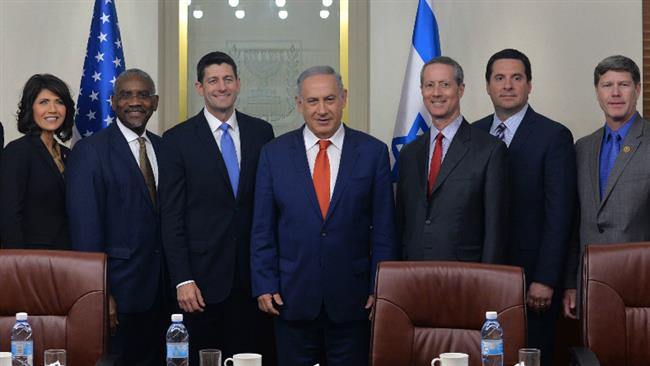
A bipartisan delegation of US lawmakers meets with Israeli Prime Minister Benjamin Netanyahu on April 4, 2016 at the premier’s office in Jerusalem al-Quds.
Press TV – April 5, 2016
Speaker of the US House of Representatives Paul Ryan led a bipartisan delegation of members of Congress to the Israeli Knesset, stressing that the alliance between Tel Aviv and Washington is “more important than ever.”
During his first official visit abroad as the House speaker, Ryan met with Knesset speaker Yuli Edelstein on Monday and said the United States will work “shoulder to shoulder” with Israel to counter their common threats.
“I wanted to come to Israel first to emphasize how important the US commitment to Israel and strong friendship with Israel is to us,” the Republican of Wisconsin said.
“Especially against the shared security threats of ISIS (Daesh) and Iran, this friendship is even more important than in the past,” he continued.
The speaker reassured his Israeli counterpart that the US Congress would rigorously push back against any boycott efforts against Israel.
Upon arriving in the occupied territories, Ryan tweeted that, “as long as I am speaker, I will not allow any legislation that divides Israel & America to come to the House floor.”
The American delegation also met with Prime Minister Benjamin Netanyahu and “expressed strong support for Israel,” the premier’s office said in a short statement on Monday.
In an interview with the Times of Israel on Sunday, Ryan said Palestinian “terrorism” directed against Israelis was no different than the terror wreaking havoc in Europe.
“They’re coming at Israel but they’re ultimately coming for us,” he said. “So we are partners in this war on terror.”
“Israel is an indispensable ally in that. Israel is on the frontline in so many ways with respects to it,” the speaker continued.
The visit comes as Ryan’s home state of Wisconsin is gearing up for its crucial presidential primary on Tuesday.
Strong congressional support for Israel has played a crucial role in Israel receiving benefits not available to any other ally.
Israel is the largest cumulative recipient of US foreign assistance since World War II.
US military aid to Israel has amounted to more than $124.3 billion since it began in 1962, according to a US congressional report, released late last year.
What I Learned From the Panama Papers
James Corbett | April 4, 2016
The Panama Papers are out and the Panama Papers propaganda is out right along with it. So why does this new mega-leak seemingly only expose those in the State Department crosshairs or expendable others and not a single prominent American politician or businessman? And what does this have to do with the OECD’s plan for a global taxation grid?
SHOW NOTES AND MP3: https://www.corbettreport.com/?p=18320
The NY Times Joins Israel in Whitewashing (Yet Another) Scandal
By Barbara Erickson | TimesWarp | April 4, 2016
A military scandal has rocked Israel, and The New York Times has been on hand to report developments: A soldier was arrested for killing a wounded and helpless Palestinian; the soldier was under investigation for murder, and some Israelis have protested, insisting that he is a hero.
These were the stories that made headlines in the Times after the murder was caught on video and spread through the Internet, provoking outrage worldwide. The newspaper, it seems, has been on this from the start.
But readers may not suspect that there is much more that the newspaper is withholding. After the early headlines, the Times has gone silent and has failed to report a number of developments connected with the story:
- The United Nations special rapporteur on summary executions said the video carried “all the signs of a clear case of an extrajudicial execution.”
- In spite of this assessment and the initial cries of outrage from the Israeli government and military, the charges against the soldier were reduced from murder to manslaughter.
- The accused man, Cpl. Elor Azarya, has been released from prison and allowed to move freely on base.
- Settlers have harassed and threatened to kill the Palestinian who videographed the killing.
- An Israeli rights organization has requested protection for the videographer.
- A survey of Israeli public opinion revealed that 57 percent opposed the arrest of the soldier and 68 percent thought the prime minister, defense minister and army chief of staff were wrong to condemn the killing.
- Prime Minister Benjamin Netanyahu, after first denouncing the murder, spoke with the soldier’s father and reassured him of army support.
- Senator Patrick Leahy (D-VT) and 10 other members of Congress have written to the state department, requesting an investigation into extrajudicial killings of Palestinians carried out by Israeli police and military.
All of these items appeared in media outlets, some of them disseminated widely, such as the downgrade from murder to manslaughter, which made headlines in Israel, the West and the Arab world. In the Times, however, this news became nothing but a whispered conjecture buried in an article last Thursday. Far into her piece, author Isabel Kershner briefly mentioned that prosecutors were “appearing to have backed off from the idea of a murder charge.”
Since then, the Times has had nothing more to say about the scandal, leaving readers with the impression that Israeli officials were swift and firm in their effort to bring justice to bear. As authorities backed off from the murder charge and let the soldier go free, the Times fell silent.
It seems that the newspaper has endeavored to whitewash Israeli actions—spotlighting the first cries of outrage when the video emerged, the arrest of the soldier and the talk of a murder investigation and ignoring news that might expose the reality: nearly unlimited impunity for crimes against Palestinians.
The paper had nothing to say, for instance, about Netanyahu’s change of tone. When the video first emerged, the prime minister said the killing “does not represent the values of the IDF.” Later he spoke to the accused man’s father, assuring him that he personally understood the man’s distress and saying that the family should trust the army to be “professional and fair in its investigation.”
This was reported extensively in Israel, as was the Leahy letter asking Secretary of State John Kerry to investigate a “disturbing number of reports of gross violations of human rights by security forces” in Israel and Egypt. The letter mentions several specific cases of alleged extrajudicial executions by Israeli forces.
Senator Leahy’s signature is of particular importance because his name is on a law that prohibits the United States from providing military aid to security forces that violate human rights with impunity.
Nevertheless, the Times has ignored the appeal by Leahy and 10 other members of Congress, even though the event is eminently newsworthy and the letter led to a sharp exchange between Netanyahu and Leahy.
The newspaper has also overlooked the effect of the incident on Palestinians: the threats against the videographer, the harassment of his family and initial refusals to allow Palestinian participation in conducting the autopsy.
It seems that much of the news touching on this latest Israeli scandal is unfit to print in the Times. Readers are not to see evidence that the first official reaction to the disturbing video was little more than damage control, an attempt to show the world that Israel does not condone such crimes. The Times, as usual, has fallen into line, a willing partner in the official effort to exonerate Israel of its crimes.
Armenian-Azeri Tensions Just Got Alarming: Here’s Why It’s Happening (I)
By Andrew KORYBKO | Oriental Review | April 4, 2016
The unprecedented upsurge in violence along the Line of Contact between Armenia and Azerbaijan in Nagorno-Karabakh has raised universal concern that a larger conflict might be brewing, with some analysts seeing it as an outgrowth of Turkey’s destabilizing anti-Russian policies over the past couple of months.
As attractive as it may be to believe such that Azerbaijan is behaving as a total puppet of the West, such an explanation is only a superficial description of what is happening and importantly neglects to factor in Baku’s recent foreign policy pivot over the past year. It’s not to necessarily suggest that Russia’s CSTO ally Armenia is to blame for the latest ceasefire violations, but rather to raise the point that this unfolding series of militantly destabilizing events is actually a lot more complex than initially meets the eye, although the general conclusion that the US is reaping an intrinsic strategic benefit from all of this is clearly indisputable.
Instead of beginning the research from a century ago and rehashing the dueling historic interpretations that both sides have over Nagorno-Karabakh, the article at hand begins at the present day and proceeds from the existing on-the-ground state of affairs after the 1994 ceasefire, whereby the disputed territory has de-facto been administered as its own unrecognized state with strong Armenian support in all sectors. There’s no attempt to advocate one side or denigrate the other, but rather to objectively understand the situation as it is and forecast its unfolding developments.
In keeping with the task at hand, it’s essential that the point of analytical departure be an overview of Armenia and Azerbaijan’s latest geopolitical moves in the year preceding the latest clashes. Afterwards, it’s required that an analysis be given about the limits to Russia’s CSTO commitment to Armenia, which thus helps to put Russia’s active diplomatic moves into the appropriate perspective. Following that, Part II of the article raises awareness about the US’ Reverse Brzezinski stratagem of peripheral quagmire-like destabilization along the post-Soviet rim and how the recent outbreak of violence is likely part and parcel of this calculated plan. Finally, the two-part series concludes with the suggested appeal that Armenia and Azerbaijan replace the stale OSCE Minsk Group conflict resolution format with a fresh analogue via their newly shared dialogue partner status under the SCO.
Not What One Would Expect
Over the past year or so, Armenia and Azerbaijan’s geopolitical trajectories haven’t exactly been moving along the course that casual commentators would expect that they would. Before beginning this section, it’s necessary to preface it with a disclaimer that the author is not referring to the average Armenian or Azeri citizen in the following analysis, but rather is using their respective countries’ names interchangeably with their given governments, so “Armenia” in this instance refers to the Yerevan political establishment while “Azerbaijan” relates to its Baku counterpart. This advisory note is needed in order to proactively prevent the reader from misunderstanding the author’s words and analyses, since the topic is full of highly emotionally charged elements and generally evokes a strong reaction among many, especially those of either of the two ethnicities.
Armenia:
The general trend is that the prevailing geopolitical stereotypes about Armenia and Azerbaijan are not as accurate as one would immediately think, and that neither country adheres to them to the degree that one would initially expect. It’s true that Armenia is a staunch and loyal Russian CSTO ally which maintains a presence of 5,000 troops, a handful of jets and helicopters, a forthcoming air defense shield, and possibly soon even Iskander missiles there, but it’s been progressively diversifying its foreign policy tangent by taking strong strides in attempting to reach an Association Agreement with the EU despite its formal Eurasian Union membership.
This has yet to be clinched, but the resolute intent that Yerevan clearly demonstrated in May 2015 raises uncomfortable questions about the extent to which its decision-making elite may have been co-opted by Western influences. The author was so concerned about this eventuality that he published a very controversial analysis that month explaining the various ploys by which the West has sought to woo Armenia over to its side, including the shedding of crocodile tears for its genocide victims during their centenary remembrance commemoration.
As is the established pattern which was most clearly proven by Ukraine, the more intensely that a geostrategically positioned country flirts with the West, the more susceptible that it is to a forthcoming Color Revolution attempt, so it’s unsurprising in hindsight that the “Electric Yerevan” destabilization was commenced just one month after the Armenian President was publicly hobnobbing with so many of his Western “partners”. That anti-government push was a proto-manifestation of what the author later described in an unrelated work as “Color Revolution 1.5” technologies which seek to use “civil society” and “anti-corruption” elements as experimental triggers for testing the catalyzation of large-scale regime change movements. The geopolitical end goal in all of this, as the author wrote in his “Electric Yerevan” piece cited above, was to get Armenian nationalists such as Nikol Pashinyan into power so that they can provoke a continuation war in Nagorno-Karabakh that might conceivably end up dragging in Russia. They thankfully didn’t succeed in this, and the sitting Armenian President Serzh Sargsyan has repeatedly underscored that Armenia does not want to see a conflict escalation in the disputed territory.
Strangely, despite the regime change attempt that the West tried to engineer against Armenia, Sargsyan still declared in early 2016 that “Armenia’s cooperation and development of relations with the EU remain a priority for Armenia’s foreign policy” and “expressed gratitude to the EU for their assistance in carrying out reforms in Armenia.” Also, the EU’s External Action Service reports that the two sides formally relaunched their negotiation process with one another on 7 December with the aim of reaching a “new agreement (that) will replace the current EU-Armenia Partnership and Cooperation agreement.”
An EU analyst remarked in March of this year that he obviously doesn’t believe that it will be identical to the Association Agreement that the EU had offered to Armenia prior to its Eurasian Union ascension, but that of course doesn’t mean that it couldn’t share many similarities with its predecessor and create geopolitical complications for Yerevan’s economic alliance with Moscow. It must be emphasized at this point that while the Armenian state is still closely linked to Russia on the military-political level and formally part of the Eurasian Union, it is provocatively taking strong economic steps in the direction of the EU and the general Western community, disturbingly raising the prospect that its schizophrenic policies might one day engender a crisis of loyalty where Yerevan is forced to choose between Moscow and Brussels much as Kiev was artificially made to do so as well (and possibly with similar pro-Western urban terrorist consequences for the “wrong choice”).
Azerbaijan:
On the other hand, while Armenia was bucking the conventional stereotype by moving closer to the West, Azerbaijan was also doing something similar by realigning itself closer to Russia. Baku’s relations with Washington, Brussels, Ankara, and even Tel Aviv (which it supplies 40% of its energy to via the BTC pipeline) are well documented, as is its geostrategic function as a non-Russian energy source for the EU (particularly in the context of the Southern Corridor project), so there’s no use regurgitating well-known and established facts inside of this analysis. Rather, what’s especially interesting to pay attention to is how dramatically the ties between Azerbaijan and the West have declined over the past year. Even more fascinating is that all of it was so unnecessary and had barely anything to do with Baku’s own initiative.
What happened was that Brussels started a soft power campaign against Baku by alleging that the latter had been violating “human rights” and “democratic” principles, which resulted in Azerbaijan boldly announcing in September 2015 that it was cancelling the planned visit of a European Commission delegation and considering whether it “should review [its] ties with the European Union, where anti-Azeri and anti-Islam tendencies are strong.” For a country that is stereotypically seen as being under the Western thumb, that’s the complete opposite of a subservient move and one that exudes defiance to the West. Earlier that year in February 2015, Quartz online magazine even exaggeratedly fear mongered that “Azerbaijan is transforming into a mini-Russia” because of its strengthening domestic security capabilities in dealing with asymmetrical threats.
While Azerbaijan’s resistance certainly has its pragmatic limits owing to the country’s entrenched strategic and energy infrastructural relationship with the West over the past couple of decades, it’s telling that it would so publicly rebuke the West in the fashion that it did and suggests that the problems between Azerbaijan and the West are deeper than just a simple spat. Part of the reason for the West’s extreme dislike of the Azerbaijani government has been its recent pragmatic and phased emulation of Russia’s NGO security legislation which aims to curb the effectiveness of intelligence-controlled proxy organizations in fomenting Color Revolutions. Having lost its influence over the country via the post-modern “grassroots-‘bottom-up’” approach, it’s very plausible that the US and its allies decided to find a way to instigate Nagorno-Karabakh clashes as a means of regaining their sway over their wayward Caspian ‘ally’.
Amidst this recent falling out between Azerbaijan and the West and even in the years preceding it, Moscow has been able to more confidently position itself as a reliable, trustworthy, and non-discriminatory partner which would never interfere with Baku’s domestic processes or base its bilateral relations with the country on whatever its counterpart chooses to do at home. Other than the unmistakable security influence that Russia has had on Azerbaijan’s NGO legislation, the two sides have also increased their military-technical cooperation through a surge of agreements that totaled $4 billion by 2013. By 2015, the Stockholm International Peace Research Institute reported that Azerbaijan’s total arms spending for the five-year period of 2011-2014 had increased by 249%, with 85% of its supplies coming from Russia.
In parallel to that, it also asserted that Russia’s weapons exports to Europe for 2011-2015 increased by 264%, “mainly due to deliveries to Azerbaijan”. It’s plain to see that Russia isn’t treating Azerbaijan as though it were an unredeemable Western puppet state, but is instead applying a shrewd and calculated military balancing strategy between it and Armenia. While unconfirmed by official sources, the head of the Political Researches Department of the Yerevan-based Caucasian Institute Sergey Minasian claimed in 2009 that Russia was supplying its Gyumri base in Armenia via air transit permission from Azerbaijan after Georgia banned such overflights through its territory after the 2008 war. If this is true, then it would suggest that Russian-Azeri strategic relations are at their most trusted level in post-independence history and that Baku has full faith that Moscow will not do anything to upset the military balance in the Southern Caucasus, which of course includes the paranoid fear that some Azeri observers have expressed about Russia conspiring with Armenia to wage another war in Nagorno-Karabakh.
Strategic Calculations and CSTO Limits
Russia And Armenia:
Everything that was written above likely comes as a complete shock to the casual observer of international affairs because it flies in the face of presumed “logic”, but this just goes to show that the prevailing geopolitical stereotypes about Armenia and Azerbaijan are inaccurate and do not fully reflect the present state of affairs. The common denominator between the two rival states is their evolving relationship with Russia, which as was just described, appears to be progressively moving in opposite directions. Again, the author does not intend to give the impression that this reflects popular sentiment in either country or its expatriate and diaspora communities, especially Armenia and its affiliated ethnic nationals, since the general attitude inside the country (despite the highly publicized “Electric Yerevan” failed Color Revolution attempt) and for the most part by its compatriots outside of it could safely be described as favorable to Russia. This makes Yerevan’s pro-Western advances all the more puzzling, but that only means that the answer to this paradox lies more in the vision (and possible monetary incentives) of the country’s leadership than the will of its people. Still, the situation is not critical and has yet to approach the point where the pragmatic and trusted state of bilateral relations is endangered.
Russia And Azerbaijan:
That being said, to many conventional observers, Russia’s close military cooperation with Azerbaijan might seem just as peculiar as Armenia’s intimation of a forthcoming pro-Western economic pivot, but that too can be explained by a strategic calculation, albeit one of a much more pragmatic and understandable nature. Russia has aspired to play the role of a pivotal balancing force between Armenia and Azerbaijan, and truth be told and much to the dismay of many Armenians, it did approve of UNSC Resolutions affirming Azerbaijan’s territorial integrity along its internationally recognized borders, specifically the most recent 62/243 one from 2008 which “Reaffirms continued respect and support for the sovereignty and territorial integrity of the Republic of Azerbaijan within its internationally recognized borders” and “Demands the immediate, complete and unconditional withdrawal of all Armenian forces from all the occupied territories of the Republic of Azerbaijan”.

Nagorno-Karabakh map
Geopolitical Consistency:
What’s happening isn’t that Russia is “betraying Armenia” like some overactive nationalist pundits like to allege, but that it’s maintaining what has been its consistent position since the conflict began and is abiding by its stated international guiding principle in supporting territorial integrity. Key to this understanding is that the conception of territorial integrity is a guiding, but not an irreversible, tenet of Russian foreign policy, and the 2008 Russian peace-enforcement operation in Georgia that led to the independence of South Ossetia and Abkhazia and the 2014 reunification with Crimea prove that extenuating circumstances can result in a change of long-standing policy on a case-by-case basis. This can be interpreted as meaning that Moscow at this stage (operative qualifier) does not support the independence of the self-proclaimed Nagorno-Karabakh Republic, but to be fair, neither does Yerevan, although the Armenian state just recently repeated its previously stated position that it could recognize the Armenian-populated region as a separate country if the present hostilities with Azerbaijan increase. Therefore, the main condition that could push Armenia to recognize Nagorno-Karabakh as an independent state and possibly even pressure Russia to follow suit would be the prolonged escalation of conflict around the Line of Contact.
The Unification Conundrum:
As much as some participants and international observers might think of such a move as being historically just and long overdue, Russia would likely have a much more cautious approach to any unilateral moves that Armenia makes about recognizing the independence of Nagorno-Karabakh. To repeat what was earlier emphasized about Russia’s political approach to this conflict, this would not amount to a “betrayal” of Armenia but instead would be a pragmatic and sober assessment of the global geostrategic environment and the likely fact that such a move could instantly suck Russia into the war. As it stands, Russia has a mutual defense commitment to Armenia which makes it responsible for protecting its ally from any aggression against it, however this only corresponds to the territory that Russia internationally recognizes as Armenia’s own, thereby excluding any Armenian forces and passport holders in Nagorno-Karabakh.
If Armenia recognizes Nagorno-Karabakh as an independent state, it would likely initiate a rapidly progressing process whereby the two Armenian-populated entities vote for unification, which would then place Russia in the very uncomfortable position of having to consider whether it will recognize such a unilateral move by its ally and thereby extend its mutual defense umbrella over what would by then be newly incorporated and Russian-recognized Armenian territory. On the one hand, Moscow wouldn’t want to be perceived as “betraying” its centuries-long Armenian ally and thenceforth engendering its unshakable hate for the foreseeable future, but on the other, it might have certain reservations about getting directly involved in the military conflict as a warfighting participant and forever losing the positive New Cold War inroads that it has made with Baku.
Russian-Azeri relations, if pragmatically managed along the same constructive trajectory that they’ve already been proceeding along, could lead to Moscow gaining a strategic foothold over an important Turkish, EU, and Israeli energy supplier and thus giving Russia the premier possibility of indirectly exerting its influence towards them vis-à-vis its ties with Baku. In any case, the Russian Foreign Ministry would prefer not to be placed on the spot and in such a zero-sum position where it is forced to choose between honoring its Armenian ally’s unilateral unification with Nagorno-Karabakh and abandoning its potential outpost of transregional strategic influence in Azerbaijan, or pursuing its gambit to acquire grand transregional influence via Azerbaijan at the perceived expense of its long-standing South Caucasus ally and risk losing its ultra-strategic military presence in the country.
The Nagorno-Karabakh Question is thus a quandary of epic and far-reaching geostrategic proportions for Russia, which is doing everything that it can to neutrally negotiate between the two sides in offsetting this utterly destabilizing scenario and preventing it from being forced to choose a disastrous zero-sum commitment in what will be argued in Part II to likely be an externally third-party/US-constructed military-political dilemma. Furthermore, both Armenia and Azerbaijan want to retain Russian support and neither wants to risk losing it, which also explains why Azerbaijan has yet to unleash its full military potential against the Armenian forces in Nagorno-Karabakh and why Armenia hasn’t unilaterally recognized Nagorno-Karabakh or made an effort to politically unite with it. Conclusively, it can be surmised that the only actor which wants to force this false choice of “either-or” onto Russia is the US, which always benefits whenever destabilization strikes Moscow’s periphery and its Eurasian adversary is forced into a pressing geopolitical dilemma.
Andrew Korybko is the American political commentator currently working for the Sputnik agency.
British collusion with sectarian violence: Part one
By Dan Glazebrook | RT | April 3, 2016
In the first of a four-part series, Dan Glazebrook and Sukant Chandan look at the recent spate of revelations about the involvement of British security services in facilitating the flow of fighters into Syria.
Over 13 years ago, in March 2003, Britain and the US led an illegal and unprovoked war of aggression against Iraq, a fellow UN member state. Such a war is deemed to be, in the judgment of the Nuremberg trials that followed World War Two, “not only an international crime” but “the supreme international crime differing only from other war crimes in that it contains within itself the accumulated evil of the whole.”
The mainstream narrative surrounding this war, and the endless catastrophes it bequeathed to Iraq, is that it was the result of a series of unfortunate ‘intelligence failures’: the British government had been led to believe that Iraq posed what Tony Blair called a “clear and present danger” to international security by intelligence that subsequently turned out to be false.
Blair told us that the Iraqi government had an active nuclear weapons program, had acquired uranium from Niger, had mobile chemical weapons factories that could evade UN weapons inspectors, and had stocks of chemical weapons able to hit British troops in Cyprus within 45 minutes.
All of these claims were false, and all were blamed on ‘intelligence failings’, creating an image of an intelligence service totally incapable of distinguishing between credible information and the deluding ravings of crackpots and fantasists, such as the notorious Curveball, the source of many of the various made-up claims later repeated in such grave and reverent tones by the likes of Tony Blair and Colin Powell.
In fact, we now know that sources such as Curveball had already been written off as delusional, compulsive liars by multiple intelligence agencies long before Blair and co got their hands on their outpourings – and the British government was fully aware of this.
The truth is, there were no intelligence failings over the Iraq war. In fact, the intelligence services had been carrying out their job perfectly: on the one hand, making correct assessments of unreliable information, and on the other, providing the government with everything necessary to facilitate its war of aggression. The Iraq war, then, represented a supreme example not of intelligence failure, but intelligence success.
Fast forward to today, and we are again hearing talk of ‘intelligence failings’ and the supposed incompetence of the security services to explain a debilitating Western-sponsored war in the Middle East: this time in Syria.
Earlier this year, British Foreign Minister Philip Hammond admitted that 800 British citizens had gone to join the anti-government terrorist movement in Syria, with at least 50 known to have been killed fighting for Al-Qaeda or Islamic State (IS, formerly ISIS/ISIL). The British security and intelligence community, we are to believe, were simply unable to stop them.
Opportunist political opponents blame such shocking statistics on incompetence, while the government and its supporters increasingly weave them into an argument for greater powers and resources for the security services. Both are wrong; and a closer look at some of these so-called ‘intelligence failings’ makes this very clear.
In December 2013, it emerged that MI5 had tried to recruit Michael Adebolajo, one of the killers of Fusilier Lee Rigby, just a few weeks before Rigby’s murder. Adebalajo had been on the radar of both MI5 and MI6 for over 10 years. He had been under surveillance in no less than five separate MI5 investigations, including one set up specifically to watch him. He was known to have been in contact with the senior leadership of Al-Qaeda in the Arab Peninsula, based in Yemen, and he had been arrested in Kenya on a speedboat on the way to Somalia with five other youths, where he was suspected of hoping to join Al Shabaab.
The Kenyans were furious when they handed him over to the Brits only for him to be turned loose, presumably to continue with his recruitment activities.
The following month, 17-year-old Aseel Muthana left his family home in Cardiff to join rebel fighters in Syria. His brother Nasser had left three months earlier, and his family were worried that Aseel would try to join him. So they confiscated his passport, and informed the police of their concerns. The police kept the family under close scrutiny. They even arrived at his house at 5pm the day he left for Syria, to be told he hadn’t been seen since the night before. He boarded a flight at 8.35pm that night, using alternative travel documents issued by the Foreign Office. His family were horrified that he had been allowed to travel, without a passport, despite all their warnings.
A similar case occurred in June 2015, when three sisters from Bradford traveled to Syria – it is thought to join IS – taking their nine young children with them. Again, the family had been under intense scrutiny from the police ever since their brother went to join IS in Syria earlier that year. And far from being unaware of the risk of their being recruited, counter-terrorist police were, it appears, deeply complicit in their recruitment.
A letter from the family’s lawyers said they were “alarmed” by the police allegedly having been actively promoting and encouraging contact with the brother believed to be fighting in Syria: “It would appear that there has been a reckless disregard as to the consequences of any such contact [with] the families of those whom we represent,” the lawyers said, and continued: “Plainly, by the NECTU [North East Counter Terrorism Unit] allowing this contact they have been complicit in the grooming and radicalizing of the women.”
October 2014 saw the trial of Moazzam Begg, for various terrorism-related offences. Begg had admitted to training British recruits in Syria – but in his defense, he made the incendiary claim that MI5 had explicitly given him the green light for his frequent visits in a meeting they had arranged with him. MI5 admitted it was true, and the trial collapsed.
Six months later, BBC Radio 4 broadcast an interview with Aimen Dean, a founding member of Al-Qaeda who was subsequently recruited by MI6 as a spy. Part of his work for MI6, he said, involved encouraging young impressionable Muslims to go and join the ranks of Al-Qaeda.
Then in June 2015, Abu Muntasir, known as the godfather of British jihadists, thought to have recruited “thousands” of British Muslims to fight in Afghanistan, Kashmir, Burma, Bosnia and Chechnya, gave an interview to the Guardian, repenting his actions. He explained that he came back from fighting in Afghanistan to “create the link and clear the paths. I came back [from war] and opened the door and the trickle turned to a flood. I inspired and recruited, I raised funds and bought weapons, not just a one-off but for 15 to 20 years. Why I have never been arrested I don’t know.”
That same month, a second trial collapsed, for much the same reasons as Begg’s. Bherlin Gildo was arrested in October 2014 on his way from Copenhagen to Manila. He was accused of attending a terrorist training camp and receiving weapons training as well as possessing information likely to be useful to a terrorist. The Guardian reported that the prosecution “collapsed at the Old Bailey after it became clear Britain’s security and intelligence agencies would have been deeply embarrassed had a trial gone ahead.”
In January 2016, it was revealed that Siddhartha Dhar traveled to Syria in September 2014 while on police bail for terrorism offences – the sixth time he had been arrested for terror-related offences, and not long after MI5 had reportedly tried to recruit him. Police had demanded he hand in his passport, but did not follow it up; this was despite the fact that he had revealed – live on BBC morning television no less – that he would “love to live in the Islamic State.” He later posted pictures of himself posing with guns in Raqqa, and is suspected of being the so-called ‘new Jihadi John’, appearing in an IS video executing suspected spies. The original ‘Jihadi John’ – British-Kuwaiti Mohammed Emwazi – had also been well known to the British security services, having – just as Adebolajo and Dhar – apparently been offered a job by MI5.
Is this all just a ‘catalogue of blunders’, more ‘intelligence failings’ on a massive scale?
These cases demonstrate a couple of irrefutable points. Firstly, the claim that the security services would have needed more power and resources to have prevented the absconding is clearly not true.
Since 1995, the Home Office has operated what it calls a ‘Warnings Index’: a list of people ‘of interest’ to any branch of government, who will then be ‘flagged up’ should they attempt to leave the country. Given that every single one of these cases was well known to the authorities, the Home Office had, for whatever reason, decided either not to put them on the Warnings Index, or to ignore their attempts to leave the country when they were duly flagged up. That is, the government decided not to use the powers already at its disposal to prevent those at the most extreme risk of joining the Syrian insurgency from doing so.
Secondly, these cases show that British intelligence and security clearly prioritize recruitment of violent so-called Islamists over disruption of their activities. The question is – what exactly are they recruiting them for?
At his trial, Bherlin Gildo’s lawyers provided detailed evidence that the British government itself had been arming and training the very groups that Gildo was being prosecuted for supporting. Indeed, Britain has been one of the most active and vocal supporters of the anti-government insurgency in Syria since its inception, support which continued undiminished even after the sectarian leadership and direction of the insurgency was privately admitted by Western intelligence agencies in 2012. Even today, with IS clearly the main beneficiaries of the country’s destabilization, and Al-Qaeda increasingly hegemonic over the other anti-government forces, David Cameron continues to openly ally himself with the insurgency.
Is it really such a far-fetched idea that the British state, openly supporting a sectarian war against the Ba’athist government in Syria, might also be willfully facilitating the flow of British fighters to join this war? Britain’s history of collusion with sectarian paramilitaries as a tool of foreign policy certainly suggests this may be so. This history, in Ireland, Afghanistan and the Arab peninsula, and its role in shaping British policy today, will be the subject of the articles to follow.
Dan Glazebrook is a freelance political writer who has written for RT, Counterpunch, Z magazine, the Morning Star, the Guardian, the New Statesman, the Independent and Middle East Eye, amongst others. His first book “Divide and Ruin: The West’s Imperial Strategy in an Age of Crisis” was published by Liberation Media in October 2013. It featured a collection of articles written from 2009 onwards examining the links between economic collapse, the rise of the BRICS, war on Libya and Syria and ‘austerity’. He is currently researching a book on US-British use of sectarian death squads against independent states and movements from Northern Ireland and Central America in the 1970s and 80s to the Middle East and Africa today.
Featured Video
Laith Marouf: Hezbollah’s position on US-Iran ceasefire
or go to
Aletho News Archives – Video-Images
From the Archives
Is Israel to blame for the Iraq War?
American Goy | March 10, 2008
I am so tired of this old canard that “Israel had nothing to do with USA’s war with Iraq – in fact, it officially advised America against it”.
Bullshit. … continue
Blog Roll
 Aletho News
- Laith Marouf: Hezbollah’s position on US-Iran ceasefire: What you’re not being told
- Israel’s priority lies in destroying chances of peace between Iran, US: Ex-UN nuclear chief
- Ceasefire for all or for none: Iran shuts Hormuz over Lebanon attacks
- Strait of Hormuz is Iran’s ‘nuclear weapon’ that forced US retreat: Medvedev
- Energy crisis will last for months – Kremlin envoy
- Europe’s quiet role in the war on Iran
- Forty days that shook the Empire: How Iran turned the tables on US and prevailed
- Netanyahu unilaterally declares Lebanon outside of ceasefire deal
- Israeli leaders: ‘Not a single goal’ achieved in war with Iran
- What on earth just happened? Trump, Iran, and the unlikely ceasefire
- If Americans Knew
- Gazans face a triple crisis: severe shortages of water and bread, healthcare in tatters
- NY Times reports how Netanyahu took the US into Iran War
- A sigh of relief over Iran, but Gaza and Lebanon in dire straits – Daily Update
- Thousands dead and neighborhoods razed to the ground: Aid agencies fear southern Lebanon is becoming the new Gaza
- The war the US is fighting for Israel could cost trillions
- ‘Cigarette Burns, Nail Wounds’: Toddler Tortured in Gaza to Coerce Father
- Trump Says US Sent ‘a Lot of Guns’ to Protesters in Iran
- Israeli forces destroy 17 UN peacekeeper cameras in south Lebanon
- US-Israeli strikes ‘completely destroy’ synagogue in Tehran
- Archbishop for US Military Says Iran War Is Unjust Under Catholic Teaching
- No Tricks Zone
- An Inconvenient Tree: Uncovered In Alps… Europe Much Warmer Than Today 6000 Years Ago
- New Study Reports A 60% Slowdown In Greenland’s Ice Loss Rate In The Last Decade
- Low Intensity Tornado Wrecks Major Solar Farm, Creating A Potential Toxic Dump
- New Study Finds Warming Saves Lives…Cold Temperatures 12 Times More Deadly Than Excess Heat
- German Science Blog Accuses PIK Climate Institute Of Hallucinating Climate Tipping Points
- Devastating Assessment Of Comirnaty Vaccine By Former Senior Pfizer Europe Toxicologist
- New Study: CO2 Is ‘Effectively Negligible’ As An Explanatory Climate Change Factor Since 2000
- Former Pfizer Toxicologist Dr. Helmut Sterz Tells Bundestag Hearing Pfizer Vaccine Should Have Never Been Approved
- Energy Expert: Germany’s Nuclear Phaseout Was A “500 Billion Euro Mistake”
- New Research: South Australia’s Mid-Holocene Sea Surface Temperatures Were 4°C Warmer Than Today
 Aletho News