It’s hardly a secret that the hardships of common people are getting worse by the year. Due to continuous attempts by Washington to redraw the map of the world, in many countries, American intelligence agencies have been particularly active in launching so-called “color revolutions” and staging military conflicts, bringing bitter hunger and poverty upon the heads of millions of people in the Middle East and other regions of the world. Consequently those events have triggered a massive and uncontrolled wave of migration to Europe.
The “War on Terror” that the White House declared has in fact resulted in the US military establishment, American intelligence agencies and a number of other states obtaining huge financial support in return for a brutal assault on the fundamental human rights as embodied in the adoption of the so-called USA PATRIOT Act and similar laws in a number of states.
In the constant pursuit of huge profits, political and military circles in the US are coming up with new “military threats” in a bid to push their allies into greater spending on NATO, the purchases of additional weapons, which in turn undermines the living conditions of the common people in the United States and its satellite states.
However, despite the so-called strengthening of these global security measures the actual security situation has not improved. There’s an ever increasing number of terrorist attacks carried out every year, while terrorist threats persist. Moreover, various terrorist organizations across the globe are receiving direct support from the White House itself, which drives a wedge between the US and its allies, especially in Europe.
It must be emphasized that the fate of US allies, who are constantly demanded to pay for Washington’s ambitions, is becoming grimmer by the day. If we take a look at the governments who agreed to host US military bases, those governments are usually the first to suffer for for their hospitality.
The constant desire of the White House to dictate its rules to each and every nation resulted in the so-called Brexit, while a number of other European countries have been examining the benefits of leaving the EU as well. Moreover, certain American states are facing a sharp increase in separatist sentiments.
Moreover, Washington’s allies are paying a high price in the blood of their soldiers for countless military adventures as they are recruited to fight alongside the US in Iraq, Syria, Afghanistan and other regions of the world.
For instance, the newly assembled new Syrian army was defeated on the battlefield by ISIS militants, when US Air Force aircraft abandoned them at the most crucial moment, reports the Washington Post. Certain sources in the US government argue that this was not a complete defeat, since small detachments of the new Syrian army allegedly continued the fighting, although they don’t deny the withdrawal of air support at the most difficult moment of the whole operation, which sealed the fate of the rebels.
Last May, as the US intensified its so-called fight against ISIS in the northern part of Syria, the US Air Force started bombarding the outskirts of the Syrian city of Mara, bringing a group of Syrian rebels that Americans trained and armed under heavy fire. The Wall Street Journal would note:
A statement issued by the U.S. military at the time said three strikes were carried out near Ma’ra that “struck two separate ISIL tactical units and destroyed two ISIL tactical vehicles and an ISIL vehicle,” using the Pentagon’s preferred acronym for Islamic State.
But leaders with the brigade in interviews said a U.S. airstrike hit brigade members while they were fighting Islamic State militants. Mustafa Sejry, the head of Mutasim’s political office, said 10 of the brigade’s fighters were killed in the U.S. strike.
On June 26, Afghan authorities reported that US Air Force strikes resulted in seven Afghans killed. Those Afghans were held hostage by the Taliban in the Kunduz governorate in the north of the country.
In December 2015, the Washington Post reported the deaths of US-friendly Iraqi soldiers during the military operation against ISIS near the city of Fallujah, when the US Air Force aircraft were “providing close air support to the Iraqi army.”
In July 2015, the so called “worst friendly fire incident” of the US war in Afghanistan occurred when ten Afghan soldiers were killed and others wounded after their compound was fired on by US military helicopters.
It should be noted that the “friendly fire” – is a common occurrence in the US Army. This notion is confirmed by historical facts, since during the Battle of Antietam on September 17, 1862, friendly fire events taken together were thought to have accounted for 1,150 killed and wounded, or approximately 5% of the total casualties.
In August 1944, 8th USAAF heavy bombers bombed the headquarters of the 3rd Canadian Infantry Division and 1st Polish Armoured Division during Operation Totalize, killing 65 and wounding 250 Allied soldiers.
Friendly fire casualty rates have gotten worse, with such incidents during Operation Desert Storm in Iraq reaching approximately 23% of the total number of casualties the US military suffered during the conflict.
Therefore, it’s a highly risky endeavor to take part in one of the many military adventures of the White House.The only way to save a nation’s blood is to abstain from such adventures. And there’s little doubt that once Hillary Clinton takes office, direct military aggression will remain the main occupation of the White House for years to come.
The International Court of Justice (“Court,” or “ICJ”), the world’s highest court, issued its Advisory Opinion on the legality of the threat or use of nuclear weapons on July 8, 1996. Thus, this week marks the 20th anniversary of that momentous opinion.
The Court found in a split vote (7 to 7), with the casting vote of the Court’s president Mohammed Bedjaoui deciding the matter, that the threat or use of nuclear weapons would generally be illegal under international law. The Court could not determine whether it would be legal or illegal to threaten or use nuclear weapons “in an extreme circumstance of self-defense, in which the very survival of a State would be at stake.”
Three of the judges voting to oppose general illegality, however, were concerned with the word “generally” and wanted the Court to go further and remove any ambiguity about the illegality of threat or use of nuclear weapons. Judge C.G. Weeramantry, for example, argued in a brilliant dissenting opinion “that the use or threat of use of nuclear weapons is illegal in any circumstances whatsoever.” Thus, in actuality, ten of the fourteen judges supported either general illegality or total illegality of the threat or use of nuclear weapons.
The Court also found unanimously that any threat or use of nuclear weapons must be compatible with the United Nations Charter and must also be compatible with the international law of armed conflict and particularly with “the principles and rules of international humanitarian law.” This means that the threat or use of nuclear weapons must be capable of distinguishing between combatants and civilians and must not cause unnecessary suffering. It is virtually impossible to imagine any use of nuclear weapons that could meet such limiting criteria.
Finally, the Court concluded, “There exists an obligation to pursue in good faith and bring to a conclusion negotiations leading to nuclear disarmament in all its aspects under strict and effective international control.” Unfortunately, despite this obligation, such negotiations have not taken place in the past twenty years.
The tiny Pacific Island country, the Republic of the Marshall Islands, has cited the Court’s conclusion regarding this legal obligation in bringing contentious lawsuits against the nine nuclear-armed countries at the International Court of Justice and separately against the United States in U.S. federal court. In the ICJ, only the cases against the UK, India and Pakistan are currently going forward, since the other six nuclear-armed countries do not accept the compulsory jurisdiction of the Court and have not opted to accept the Court’s jurisdiction in this matter.
The cases brought by the Marshall Islands in the ICJ are currently awaiting the Court’s ruling on preliminary objections filed by the three respondent countries. The case against the U.S. was dismissed in U.S. federal district court on jurisdictional grounds, and is currently on appeal in the Ninth Circuit Court of Appeals.
Nuclear weapons are devices of mass annihilation. The ICJ found these weapons to be generally illegal and to require good faith negotiations leading to total nuclear disarmament. All nine nuclear-armed countries are in breach of this obligation to the detriment of the people of the world, including the citizens of their own countries. The Republic of the Marshall Islands has had the courage to bring this matter back to the ICJ as contentious cases.
On the illegality of nuclear weapons, the then Court President, Mohammed Bedjaoui, stated: “Nuclear weapons, the ultimate evil, destabilize humanitarian law, which is the law of the lesser evil. The existence of nuclear weapons is therefore a challenge to the very existence of humanitarian law, not to mention their long-term effects of damage to the human environment, in respect to which the right to life can be exercised.”
On the 20th anniversary of the ICJ Advisory Opinion on threat or use of nuclear weapons, the people must wake up, stand up and speak out. Nuclear weapons are illegal as well as immoral and costly. They are not even weapons, but instruments of mass annihilation. They serve no useful purpose and endanger all countries, all people, and all future generations. It is past time to end the nuclear era.
David Krieger is the author of Zero: The Case for Nuclear Weapons Abolition.
The boosting of US missile defense potential in Asia and the Pacific undermines the existing global security balance, the Russian Foreign Ministry said after it was announced that Washington intends to place missile defense systems in South Korea.
“From the very beginning of the discussion of this issue we have consistently and invariably pointed at the most dangerous consequences of such a decision and called for our partners not to make this wrong choice. Unfortunately, our calls have remained unheard,” reads a Foreign Ministry statement released Friday.
Russian diplomats noted that the increase in the Asia-Pacific segment of the global missile defense system by the United States and its allies would undermine the existing strategic balance both in the region and beyond.
“Such actions, regardless of the arguments they are backed with, have the most negative effect on global strategic stability, the adherence to which is such a favored topic of discussions in Washington,” the statement reads.
The ministry also warned that the US steps threaten to increase regional tensions and create additional barriers to the peaceful settlement of the conflict between North and South Korea and nuclear disarmament on the Korean peninsula.
The Russian diplomats concluded by expressing hope that the United States and South Korea would once again consider all factors behind the decision and abstain from potentially dangerous actions.
Earlier on Friday, the South Korean Ministry of Defense announced that Seoul and Washington had reached an agreement to put a high-tech THAAD missile defense system in South Korea amid growing nuclear and missile threats from the North. According to South Korea’s Yonhap news agency, the system is expected to be in operation by the end of 2017.
THAAD – Terminal High Altitude Area Defense – is an advanced system designed to intercept short, medium, and intermediate-range ballistic missiles during their terminal phase of flight. Equipped with a long-range radar, THAAD is believed to be capable of intercepting Pyongyang’s intermediate-range ballistic missiles.
The announcement has also drawn criticism from Beijing. China’s Foreign Ministry said on Friday the system would destabilize the security balance in the region without doing anything to end the North’s nuclear program. “China strongly urges the United States and South Korea to stop the deployment process of the THAAD anti-missile system, not take any steps to complicate the regional situation and do nothing to harm China’s strategic security interests,” it said in a statement on its website.
NATO has just announced a plan to send troops to the alliance’s eastern flank, close to the Russian border. NATO says it is attempting to deter potential Russian aggression.
The UK, the US, Canada and Germany will lead four battle groups to be based in Poland and the Baltic states. Diplomats say the troops will be a deterrent to Russian aggression by acting as a “tripwire” that would trigger a full response from the alliance if necessary
On Sunday the foreign minister of Germany, Frank-Walter Steinmeier, condemned Western “sabre-rattling and war cries”. He said, “Anyone who believes the symbolic tank parades on the Alliance’s eastern border will increase security is wrong”.
Apart from the appalling fact that the West is contemplating all out war against Russia there is the plain fact that it has expanded NATO in contravention of the solemn understandings given the Soviet Union at the end of the Cold War.
The deal was straightforward: The Soviet Union would agree to the reunification of East and West Germany and accept that East Germany would become part of NATO in return for a non-expansion promise.
It is the breaking of this promise that, more than any other one thing, has fuelled the resurgence of hostile Russian opinion against the West and prompted President Vladimir Putin to become increasingly determined to put the West in its place.
Now with this move the Russians, understandably, are livid.
There are a number of scholars and politicians from that era, including President H.W. Bush’s secretary of state, James Baker, who did most of the negotiating at that time with the Soviet president, Mikhail Gorbachev, who have since tried to re-write history and say there were no promises made.
But neither Baker nor the scholars can deny – and they do not try to – that in Moscow, on February 9th 1990, Baker told Gorbachev that “there will be no extension of NATO’s jurisdiction or NATO’s forces one inch to the East”, if Gorbachev agreed to German reunification.
To reinforce this message the next day the West German chancellor, Helmut Kohl and the foreign minister, Hans Deitrich Genscher offered the Soviet leaders similar terms. Later Baker confirmed publically at a State Department press conference that he agreed with Genscher. The US ambassador to Moscow at the time, Jack Matlock, who was in the room with Gorbachev and Baker, confirmed these words were said by Baker to Gorbachev.
But revisionist scholars have tried to obfuscate this understanding. It has been argued that US leaders saw these terms as being raised “speculatively” as part of an ongoing negotiation and far from a final deal. Thus the US was free to revise the offer and Gorbachev was made no final promise.
This is as Machiavellian an interpretation as one could dream up.
Common sense suggests that Gorbachev was not going to radically revise 45 years of East German and Soviet history without a very big quid pro quo. Since no other subject was on the table it is obvious that there was a quid pro quo and this was it. Say no more.
One scholar, Mary Sarotte, writes that the Soviet leaders failed to obtain “written assurances” against NATO expansion. That is right. But why should Gorbachev demand them when the Cold War was coming to an end so amicably and the widespread feeling was that there would never be enmity again and that the Soviet Union would become close to NATO, and maybe even seek future membership of it?
There is another political “scandal” from that period.
Behind Gorbachev’s back, as the US negotiators “were stressing limits on NATO’s future presence in the east, the US was privately planning for an American-dominated post-Cold War system and taking steps to achieve this objective”, according to Joshua Shifrinson, writing in the new issue of Harvard University’s quarterly, International Security:
In July 1990 Baker stated that a revamped CSCE (Conference on Security and Cooperation in Europe) which had Soviet membership would provide a ‘half-way house’ for those countries who want out of the Warsaw Pact but can’t join NATO and the European Union.
Somewhat paradoxically, Baker did not want to see a CSCE that overshadowed NATO. By October 1990 detailed discussions about the future expansion of NATO were underway in the State Department, albeit with the belief this would only happen if the Soviet Union behaved “badly”.
Contradictorily, the State Department in an internal study on NATO wrote that “we are not in a position to guarantee the future of these Eastern countries and do not wish in any case to organize an anti-Soviet coalition whose frontier is the Soviet border. Such a coalition would be perceived very negatively by the Soviets and could lead to a reversal of current positive trends in Eastern Europe”.
Over the last 25 years an anti-Soviet/Russian coalition is what evolved and that is why Russia has ended up confronting the West.
Jonathan Power is a TFF Associate and international affairs columnist, formerly with the International Herald Tribune, now syndicating to leading newspapers on all continents.
German Minister for Foreign Affairs Frank-Walter Steinmeier’s recent criticism of NATO behavior is that of a man watching a tidal wave of destruction gathering force, similar to ones that have engulfed his country twice before in the 20th century.
What we shouldn’t do now is inflame the situation further through saber-rattling and warmongering… Whoever believes that a symbolic tank parade on the alliance’s eastern border will bring security is mistaken… We are well-advised to not create pretexts to renew an old confrontation… [It would be] fatal to search only for military solutions and a policy of deterrence. – German Foreign Minister Frank-Walter Steinmeier, commenting on NATO’s recent military exercises in Poland and the Baltics.
His dread is not to be dismissed since it comes from a man who is in a position to know what the US is up to. His words reflect the fears of ever more people across all of Eurasia, from France in the West to Japan in the East.
Under the euphemism of “containment,” the US is relentlessly advancing its new Cold War on Russia and China. Its instrument in the West is NATO, and in the East, Japan, and whatever other worthies can be sharked up.
It is a Cold War that grows increasingly hotter, with proxy wars now raging in Eastern Ukraine and Syria and with confrontations in the South China Sea. There is an ever-growing likelihood that these points of tension will flare up into an all-out military conflict.
In the West, this conflict will begin in Eastern Europe and Russia, but it will not stop there. All the European NATO countries would be on the front lines. In the East, the conflict will take place in the Western Pacific in the region of China’s coast and in the peninsulas and island countries in the region, including Japan, the Philippines, and Indochina.
In each case the US will be an ocean away, “leading from behind,” as Barack Obama would put it, or engaged in “offshore balancing” as some foreign policy “experts” might term it.
No matter the “victors” – all of Eurasia, from France in the West to Japan in the East – would be devastated. No matter the outcome, the US could escape unscathed and “win” in this sense. And all Eurasian nations would lose. It would be World War II redux.
One can get a sense of what this means in the case of economic conflict by looking at the minimal economic warfare now being waged on Russia in the form of sanctions. Those sanctions are hurting both Russia and the rest of Europe. The US is untouched.
The same is also true for military conflict. Want to know what it would look like? Look at Eastern Ukraine. All of Eurasia could come to resemble that sorry nation in the event of a military conflict pitting the US and its allies against Russia and China. Eurasia, be forewarned!
The goal of the US foreign policy elite would clearly be for Russia and China to “lose,” but even if they “won,” they would be brought low, leaving the US as the world’s greatest economic and military power as it was in 1945.
Europe is beginning to awaken to this. We have Steinmeier’s plea above. But it is not only Germany that is worried. The French Senate wants an end to the sanctions imposed on Russia. Business people in many Western European countries, most notably in Germany and Italy, European farmers who export to Russia and tourist entrepreneurs like those in Turkey and Bulgaria, also want an end to sanctions and military exercises. Parties of the Right want an end to domination by NATO and Brussels, both controlled by the US. The Brexit is just one rumbling of such discontent.
All these nations are growing increasingly aware of the fate that awaits them if overt conflict erupts with Russia. The people of Germany want none of it. Likewise, the people of Japan are stirring against the US effort to goad Japan into fighting China. All remember the devastation of WWII.
Let’s recall the casualty figures, i.e., deaths, among the principal combatants of WWII:
Soviet Union – 27,000,000 (14 percent of the population);
China – 17,000,000 (3.5 percent);
Germany –7,000,000 (8.5 percent);
Japan – 2,800,000 (4 percent).
By comparison, for the US, safely far offshore, the number was 419,000 (0.32 percent)!
And for a few other countries that “got in the way” of the major adversaries:
One wonders what the leaders of Poland or the Philippines or some elements in Vietnam are thinking when they take a belligerent attitude to Russia or China in order to please the US.
The problem with this US strategy is that it could easily spill over into a nuclear conflict. Then the US too would be reduced to radioactive rubble. The Western policy elite must be betting that Russia and China would not respond to a conventional war with a nuclear response.
However, Vladimir Putin has made it clear that in any war with the West, the US will feel the impact at once. The neocons and the rest of the US foreign policy elite must be betting that Putin is bluffing and that he would never use nuclear weapons. So, the US is safe and the suffering will be confined to Europe and Asia.
But that assumption is a dangerous one. Russia and China might respond with a conventional weapons attack on US cities. In WWII, Germany was able to wreak considerable devastation using conventional bombs on England delivered by airplanes and V-2 rockets. Similarly, the US was able to do enormous damage to Germany and to Japan with conventional weapons, especially firebombing as in Tokyo and Dresden.
Today, technology has advanced greatly, and US cities have nuclear power plants nearby. What is the likely outcome of a conventional war waged against US cities? Do we wish to find out? And once it begins, where is the firewall against an all-out nuclear exchange? Where are the neocons and the rest of the US foreign policy elite taking us? Certainly, the damage will begin with Eurasia, but Americans would do well to worry that great swarms of chickens might come home to roost in New York, Chicago, and Los Angeles. This is not the 20th Century.
For some, the scenario above might seem unduly alarmist. They might doubt that the US elite would be capable of consciously unleashing such a vast bloodletting. For those, it is useful to recall the words of President Harry S. Truman, who said in 1941, when he was still a Senator and before the US had entered WWII: “If we see that Germany is winning the war, we ought to help Russia; and if that Russia is winning, we ought to help Germany, and in that way let them kill as many as possible…”
Bolivia will expand gas extraction by more than 20 million cubic meters daily or more than 33 percent by 2020, Minister of Hydrocarbons and Energy Luis Alberto Sanchez said Thursday.
The discovery of new gas fields was announced jointly by the Spanish company Repsol and the Bolivian state-owned oil and gas company YPFB this February, which increased the country’s gas reserves by 40 percent.
“The total gas production now is approximately 60 million cubic meters per day. By 2020, through putting important projects into operation aimed at preventing a drop of gas fields reserves and guaranteeing supplies to domestic and foreign markets, the production is expected to grow for more than 20 million cubic meters,” Sanchez said as quoted by ABI News Agency.
As of 2013, Bolivia’s gas reserves were estimated at about 302 billion cubic meters. According to the Repsol Bolivia President Diego Diaz, gas deposits on the Caipipendi block are assessed as additional 115 billion cubic meters.
Russian gas giant Gazprom also expressed interest in work in Bolivia. During the St. Petersburg International Economic Forum (SPIEF) in June, Gazprom, Bolivian Ministry of Hydrocarbons and Energy and YPFB signed a road map on the implementation of projects in the country, in particular, exploration, production and transportation of hydrocarbons, as well as the use of the liquefied natural gas (LNG).
The United States proactively gets engaged in regimes change attempts throughout the world, says a top foreign policy advisor to Republican presumed nominee Donald Trump on a visit to Russia.
Addressing Russian students at Moscow’s New Economic School, Carter Page accused Washington of taking “proactive steps to encourage regime change overseas.”
“This may understandably advance a certain level of insecurity,” Page said, adding, the post-Soviet world had also suffered from of the West’s double policies.
Page (pictured) did not comment about ties between Washington and Moscow after the 2016 vote.
He also declined to say if he was visiting any officials of the Russian government.
In an interview with CNN last month, Russian President Vladimir Putin said Moscow will “work with any president that the American people will vote for.”
“I know that there are complex economic and political processes in the United States. At the moment, the world needs a country as strong as the US is. And we do need the US, too,” Putin said.
Putin also praised Trump for being “bright” as well as for proposing to “restore full-fledged Russian-American relations.”
Relations between Washington and Moscow are in tatters largely due to the Ukraine crisis. The US and its allies accuse Moscow of sending troops into eastern Ukraine in support of the pro-Russian forces. Moscow has long denied involvement in Ukraine’s crisis.
In an interview with Carter in March, Bloomberg described him as “a globe-trotting American investment banker who’s built a career on deals with Russia .”
After spending billions of dollars, the US government is having trouble getting its state-of-the-art homeland missile defense system to function according to plan, and it’s driven the Pentagon to lie about the program’s success rate.
On January 28, the Pentagon’s Missile Defense Agency conducted the first test flight of new so-called divert thrusters, to be used on anti-missile interceptors. A military statement deemed this a “successful test flight,” claiming the thrusters allowed the interceptors to stop a mock warhead.
“On this flight, we validated key design improvements in the divert and attitude control system, demonstrating improved performance, reliability and productibility,” said Michael Bright of Aerojet Rocketdyne, maker of the thrusters, in a statement.
“The overall goal of the Missile Defense Agency is to make a more capable and reliable system, and this successful test demonstrated significant progress toward reaching that goal.”
According to the Los Angeles Times, however, these claims were falsified. During the test, one of the thrusters failed. This caused the interceptor to lose control and the mock missile to slip through the defense shield.
“The mission wasn’t successful,” a project scientist, speaking on condition of anonymity, told the LA Times. “Did the thruster perform as expected? No, it did not provide the control necessary for a lethal impact of an incoming threat.”
A second scientist said that claims of success were “hyperbole, unsupported by any test data.”
Other engineers indicated that the faulty thrusters caused the interceptor to miss its target by “a distance 20 times greater than what was expected,” the LA Times reported.
The program, known as Ground-Based Midcourse Defense (GMD), has cost US taxpayers over $40 billion since 2004. It was designed as a means to prevent a potential nuclear attack, and involves 30 interceptors that can be launched from various terrestrial locations across the United States.
The thrusters have come under scrutiny before. Two unsuccessful tests in 2010 were attributed to the component, and ultimately led to the creation of the latest model. An earlier test of the new thrusters occurred in 2013 and resulted in failure.
According to a report from the US Government Accountability Office, these failures were the result of rushed engineering work and “omitting steps in the design process.”
When asked for comment by the LA Times, the Missile Defense Agency acknowledged that problems had occurred during the “successful” test.
“There was an observation unrelated to the new thruster hardware that has been investigated and successfully root-caused,” the agency said. “Any necessary corrective actions will be taken for the next flight test.”
The agency maintained that “the new thrusters performed as designed” and within “critical performance parameters.”
Everyone’s talking about the future of the European Union after the Brexit. Should we not also be wondering about the future of NATO?
The two organizations substantially overlap. Twenty-two countries are members of both; that is, the twenty-two nations are both military allies of the U.S. (which pays two-thirds of the alliance’s cost and controls its politics) and members of an economic union, which—while it of course does not include the U.S., which is 5000 miles away—is of much interest to the world’s only surviving superpower.
Of course the EU and NATO have very different purposes. As we all know, the EU represents an effort to create a common market throughout the continent, allow for free travel and employment between member-states, the formation of common standards, policies etc. We know there have been major downsides for some member countries, involving reduced sovereignty, uncontrolled immigration, indebtedness and austerity programs, etc. But the stated goal, to spread general affluence, and therefore prevent war, has been stated since the EU’s forerunner, the European Coal and Steel Community, was formed in 1951.
Thus, while it’s arguably none of the U.S.’s business, U.S. leaders express opinions on EU composition. (You might think that, as leaders of a competing trading bloc, with the same relationship to the EU that Boeing has to Airbus, they would maintain a politic silence. But both presidents George W. Bush and Barack Obama have urged the EU to admit NATO ally Turkey’s admission. And Obama recently raised a ruckus in the United Kingdom when he urged its electorate to reject Brexit.)
The purpose of NATO is less clear than that of the EU. Formed in 1949 in line with the “Truman Doctrine” pledging that the U.S. would fight communism wherever it threatened the “Free World,” it was supposed to be a defensive alliance between the U.S. and its European client states versus some future (imagined) Soviet aggression against those states.
That aggression needless to say never happened. In retrospect the Cold War appears a long period of stability, with the exception of the horrific wars the U.S. inflicted on Korea and Vietnam while the Soviets stood aside, and the war the Soviets waged in Afghanistan to suppress the rebels opposed to the secular Soviet-backed government (who were then backed by the CIA, because they were so anti-communist, that being the main thing), who went on to became the Taliban and al-Qaeda.
Europe itself was actually remarkably stable during that Cold War, from 1945 to 1989. Since then there’s been horrific violence, especially in southeastern Europe, much of it exacerbated by the U.S. and NATO.
After the collapse of the Soviet Union and the dissolution of the Warsaw Pact (formed in 1955 in belated response to NATO, after NATO decided to include West Germany) in 1991, you might have thought that NATO would dissolve too. But no; it redefined its mission as maintaining “security” in a newly insecure situation. Its purpose is in fact stated in the vaguest terms. Its real function is to preserve U.S. hegemony over post-Soviet Europe, expand to surround Russia and ultimately create the conditions for a Yugoslavia-type fracturing of the Russian state—which for some reason U.S. military leaders keep referring to as the “number one threat” or even “existential threat” to the U.S.!
How the U.S. Uses the EU
The U.S. attempts to use the EU for its own geopolitical ends, particularly for this confrontation with Russia.
For example: from late 2013 to February 2014 the U.S. State Department spent $5 billion in Ukraine in order to (in the words of Under Secretary of State for Eurasia Victoria Nuland, a former Dick Cheney aide, neocon married to neocon Robert Kagan and key Hillary crony) “support the Ukrainian people’s European aspirations”—meaning the hopes of many Ukrainians for their country to join the EU.
But what Nuland, the Pentagon and NATO leaders in Europe really wanted to do was to pull Ukraine into NATO, completing the creeping encirclement of Russia that had begun with NATO’s expansion to include Poland, Czechoslovakia and Hungary in 1999.
NATO now already includes 11 countries formerly part of the Soviet bloc (Warsaw Pact) or Yugoslavia, most added during Bush’s administration but two (Albania and Croatia) admitted since. In all cases, by the way, these states first received admission into NATO, then into the EU.
Bulgaria: joined NATO 2004, EU 2007
Croatia: NATO 2009, EU 2013
Czechoslovakia: NATO 1999, EU 2004
Estonia: NATO April 2, 2004, EU May 1, 2004
Hungary: NATO 1999, EU 2004
Latvia: NATO April 2, 2004, EU May 1, 2004
Lithuania: NATO April 2, 2004, EU May 1, 2004
Poland: NATO 1999, EU 2004
Romania: NATO 2004, EU 2007
Slovakia: NATO, March 29, 2004, EU May 1, 2004
Slovenia: NATO, March 29, 2004, EU May 1, 2004
Notice a pattern? First a country commits itself to an anti-Russian alliance with the U.S., committing 2% of its GDP to military expenses and pledging to go to war against Russia when called upon to do so. Then it gets access to the benefits of EU membership.
Back to Ukraine. Ukraine in early 2014 included the Crimean Peninsula, home to the Russian Black Sea Fleet from the 1780s, a vital naval port for the Russian state that has only a few warm-water ports. (Crimea had been turned over from the Russian Soviet Socialist Republic to the Ukrainian Soviet Socialist Republic by half-Ukrainian Premier Nikita Khrushchev in 1954. After the break-up of the USSR in 1991, Russia retained its traditional military presence on the peninsula by a treaty with the Ukrainian leaders.)
But the U.S. would like to expel the Russians and make Sevastopol a NATO port. (This is not only Vladimir Putin’s nightmare; it would be a nightmare for any Russian leader. Look at a map.)
In 2013 the president of Ukraine, Viktor Yanukovych, democratically elected in an internationally monitored election in 2010, negotiated with the EU for his country’s eventual entry into the union. A substantial portion of the population, especially in the western part of the country, favored this. But when Yanukovych realized that steps towards admission would involve accepting an austerity regime comparable to that inflicted on Greece, he opted out, instead accepting a generous Russian aid offer.
Nuland & Co. depicted this as a pro-Russian leader’s capitulation to Russian pressure; again, their talking point was “Ukrainian people’s European aspirations.” (In fact, Ukrainians were divided on the issue, with fewer than 50% in favor of EU membership.)
Ukraine is ethnically divided between ethnic Ukrainians (who speak a language related to Russian, although the two languages are not mutually intelligible) and ethnic Russians who have always spoken Russian. (Russian has always been a recognized official language in the country.) There has been much intermarriage between the two, but among the ethnic Ukrainians there are many Russophobes including neo-fascists who glorify Stepan Bandera, an anti-Russian Ukrainian leader who worked with the Nazis to round up Jews and fight the Soviets in 1941. (He was declared a “national hero” by Yanukovych’s predecessor Viktor Yushchenko, a pro-U.S. advocate of NATO admission. Yanukovych withdrew this award, but it has been reinstated by the current regime.)
Taking advantage of this Russophobia, the U.S. depicted Yanukovych’s change of mind as a betrayal of “European” dreams. Working with the neo-fascist Svoboda Party, among others, it assisted in the brutal putsch of February 22, 2014, that caused the president to flee for fear of his life. A new, pro-NATO government was immediately installed, with Arseniy Yatsenyev as prime minister.
“Fuck the EU!” …and then Use It!
This is where the story gets interesting, because it reveals what the EU means to the U.S., and what it doesn’t. In an intercepted phone conversation between Nuland and the U.S. ambassador to Ukraine a month before the coup, they discuss who will succeed Yanukovych once he’s toppled. She favors NATO proponent “Yats.” The ambassador mentions the the EU favors a different candidate, whom she thinks is inappropriate. They discuss how Yatsenyev will be legitimated by a UN official sent by Ban Ki-moon.
“So that would be great, I think, to help glue this thing and to have the UN help glue it,” she concludes, “and, you know, Fuck the EU.” (In other words, this is not about any European’s aspirations. It’s about ours.)
So the coup comes off as planned. The obviously prominent role of neo-fascists in the new regime, and the immediate revocation of the existing law protecting language rights frightened and angered the primarily Russian inhabitants of the Donbass region (where Yanukovych had his base of support). They refused to accept its legitimacy. (Their resistance is invariably represented by the U.S. press in the service of the State Department as a Moscow-inspired rebellion or even Russian “invasion.”)
Russia refused to recognize the new government and quickly moved to re-annex its historical territory of Crimea. The Russian-majority population of Crimea overwhelmingly voted in a credible referendum to reunite with Russia. The U.S. media often refers to this as another “invasion” although it was nothing of the sort; there were tens of thousands of Russian troops in place by longstanding agreement, who simply secured government buildings and the borders.
Hillary Clinton, among others, likened this move to Hitler’s annexation of the Sudetenland in 1938. That is to say: something that must not meet with appeasement. And so (people are taught to believe), the practical Russian response to U.S. efforts to complete the expansion of NATO is the problem, not NATO’s relentless advance against Russia itself. Russia under Putin is the worrisome aggressor, not the U.S. leaders who invade a new country like clockwork every few years, boasting that they need to do it because theirs is the “exceptional” nation.
Some in the Obama administration favored a military response to the separatists in the east; they wanted to further arm the new regime and encourage it to assert control over the Donbass if not Crimea. It is clear this was the view of U.S. Gen. Philip Breedlove, the “Supreme Allied Commander” of “NATO Allied Command Operations” in Europe. We know from intercepted emails exchanged between him and Nuland (whom he refers to affectionately as “Toria”) that he was frustrated by the failure of Obama to order the Ukrainian puppets to more forcefully invade the east. (Initial efforts to do this had resulted in mass desertions, or soldiers retreated in the face of unarmed citizens including old women shaming them into abandoning their mission. It was a tremendous embarrassment to the Kiev regime.)
Obama decided not to heed Breedlove. In place of hot warfare he chose economic warfare. Here is where the EU comes in. In July 2014 the union (that Nuland wanted to fuck) dutifully voted to impose economic sanctions on Russia. (Again, 22 of the 28 EU members are also NATO members; the only ones that aren’t are Sweden, Finland, Ireland, Cyprus and Malta.)
The U.S. is of course not an EU member but it had a reliable surrogate within the union: the United Kingdom, which has strongly argued for sanctions, their expansion and extension to the present. (Frank Holmes, managing editor of US Global Investors, calls Britain “the bloc’s strongest supporter of restrictions.” The conservative Washington D.C. website The Daily Caller calls it the U.S.’s “strongest E.U. ally against Russia”).
The UK, which had far less to lose from the sanctions than many other EU nations, was urging its partners to shoot themselves in the foot. It was asking them to punish Russia (and damage themselves). The continental Europeans went along, some grudgingly.
Regrets (and Maybe Rebellion?)
Many have come to regret it. The Czech and Hungarian leaders have long been questioning the sanctions and expressing displeasure. Of course they want, as new members of the EU and NATO, to be team players. But their people are suffering from lost trade and pressuring them to protest. Thus Czech President Milos Zeman has called the sanctions “not merely inefficient; on the contrary, they are counterproductive.” (Only 35% of Czechs according to a 2015 Gallop poll support the sanctions.)
Hungarian Prime Minister Viktor Orban calls the sanctions a “risk in the EU… very deep, of a strategic nature.” (European Council president Donald Tusk, a Pole, calls Orban a “Trojan Horse” for Russia while Orban says Tusk is “on the other side” for opposing an easing of sanctions.)
In May, Hungarian Foreign Minister Peter Szijjarto told Russian Foreign Minister Sergey Lavrov that his government “definitely cannot accept that a decision [by the EU, on extending sanctions] was made behind the scenes, that is, we are against using an automatic procedure.” (In Hungary, only 29% of those polled favor the sanctions.)
The Polish regime has been among the most supportive of the U.S. position; anti-Russian sentiment is deep in that country for various historical reasons, and 70% of those polled support sanctions. But the Polish farmers are suffering from them. One-third of the apples harvested in Poland two years ago went to Russia; now the trade is forbidden.
Meanwhile in Spain farmers burn EU flags over piles of rotting peaches to protest the collapse of their relations with the Russian marketplace. The European Commission keeps having to pay out millions of euros to partly compensate farmers and merchants for their losses due to sanctions.
French MPs in April this year voted for a resolution to lift EU sanctions on Russia. Minister of Economy Emmanuel Macros has vowed to work towards lifting them. Italian cabinet ministers and the lawmakers in Italy’s Upper House of Parliament also want to rethink them. Maybe they’re all Trojan Horses, but if so, that’s good.
The role of Germany in the EU, as the most populous and wealthiest country in Europe, is more important than ever following the Brexit. While it has been, along with France, a strong supporter of the sanctions and their continuation, public support is waning. In May a German pollster found that 36% of Germans want the sanctions scaled down, while 35% want them scrapped entirely.
The sanctions have had disastrous impact on the German economy. Since they were imposed exports have declined by about 20 billion euros. Alstom has lost a huge contract for the construction of the Beijing-Moscow railway line. The business community generally wants the sanctions dropped.
There appears to be a general feeling that the U.S. (which is feeling few effects from the sanctions it itself imposed on Russia) pressed the EU (especially through Britain) to take measures that are not in Europe’s interest. And some surely realize that what this is all really about is the U.S.’s desire to punish Russia for thwarting its effort to bring Ukraine into NATO—through that cynical device of Victoria (“Fuck the EU”) Nuland of supporting Ukraine’s “European aspirations.
As it happens, 67% of Germans oppose bringing Ukraine into NATO, and 45% oppose bringing it into the EU. Most importantly, German support for NATO has been plummeting; it was 73% in 2009 but was 55% last year. And when asked whether Germany, in the event of a Russian attack on an east European border state that is a NATO member, should fight on the side of that state, only 38% say yes according to a Spring 2015 Pew poll.
According to the same poll, that figure is 40% in Italy, 47% in France, and 48% in both Poland and Spain. In other words, over half the people of these countries oppose the very nature of NATO as “mutual defense” alliance.
This raises the real possibility of countries leaving NATO, as well as the EU. Czech president Milos Zeman has called for referendums on his country’s membership in both. German Foreign Minister Frank-Walter Steinmeier has criticized the recent joint maneuvers in Poland, in which 14,000 U.S. troops, 12,000 Polish troops, and 800 from Britain participated as “saber-rattling.”
“Whoever believes,” he warns, “that a symbolic tank parade on the alliance’s eastern border will bring security is mistaken. We are well-advised to not create pretexts to renew an old confrontation.” In other words, the U.S. is steering NATO towards war with Russia, which the Germans know is not a good idea.
Who would have imagined a few years ago that the UK would ever leave the EU? Imagine the Czech Republic leaving this confrontational NATO alliance, joining its prosperous neighbor Austria by opting for neutrality. Imagine the Germans (who have many reasons to be angry towards the U.S., including the fact that the NSA spies on all of them) becoming fed up enough to hold their own referendum and quitting the bloc.
There is something of a precedent. France shocked the U.S. when it pulled out of the NATO Integrated Military Command Structures in 1966, in order to, as President Charles DeGaulle put it “preserve French independence in world affairs.” (It remained committed in theory to the defense of alliance members but only rejoined with conditions in 2009.)
France, which has military bases all over the world and deploys troops routinely in Africa and elsewhere (it cooperated with the U.S. in overthrowing Aristide in Haiti in 2004, as if to apologize for having opposed the U.S. war in Iraq), is very different from Germany with its stiff constitutional limits on the use of its military and generally pacifistic population. Within the EU, it is likely to replace the UK as its most important hawkish member, while Germany is likely to urge reconciliation with Russia.
There are contradictions within both the EU and NATO. They are interwoven, and some look irresolvable. That again is a good thing.
It took seven years for Sir Chilcot and his team to reach a set of conclusions that every Brit capable of thought understood back in November, 2013.
The inquiry produced a damning assessment of Blair’s conduct as well as the British military. But the Chilcot Inquiry failed to expose the crucial close ties between Blair’s criminal war, the Jewish Lobby and Israel.
At the time Britain entered the criminal war against Iraq, Blair’s chief funders were Lord ‘cashpoint’ Levy and the LFI (Labour Friends of Israel). The prime advocates for the immoral interventionist war within the British press were Jewish Chronicle writers David Aaronovitch and Nick Cohen. The attorney general that gave the green light for the war was Lord Goldsmith.
In 2008 The Guardian revealed that the “Foreign and Commonwealth Office (FCO) successfully fought to keep secret any mention of Israel contained on the first draft of the controversial, now discredited Iraq weapons dossier.”
Israel was conspicuously engaged in the vast production of WMDs. If Britain and America had any genuine concerns about WMDs, bombing Tel Aviv would have been the way to go.
In 2003 some intelligence experts insisted that Iraq’s WMD dossier was initially produced in Tel Aviv and only ‘sexed up’ in London.
Since the Iraq war, the same Jewish Lobby has mounted enormous pressure on western governments, promoting more Zio-centic interventionist wars in Syria, Libya and Iran. So why did the Chilcot Inquiry fail to address this topic?
This crucial failure by Chilcot was to be expected. In 2010, highly respected veteran British diplomat Oliver Miles had something to say about the Jewish make-up of the Chilcot Inquiry. Two out of the five members of the inquiry were Jews, pro war and Blair supporters.
“Rather less attention has been paid to the curious appointment of two historians (which seems a lot, out of a total of five), both strong supporters of Tony Blair and/or the Iraq war. In December 2004 Sir Martin Gilbert, while pointing out that the “war on terror” was not a third world war, wrote that Bush and Blair “may well, with the passage of time and the opening of the archives, join the ranks of Roosevelt and Churchill” – an eccentric opinion that would seem to rule him out as a member of the committee. Sir Lawrence Freedman is the reputed architect of the “Blair doctrine” of humanitarian intervention, which was invoked in Kosovo and Afghanistan as well as Iraq.
Both Gilbert and Freedman are Jewish, and Gilbert at least has a record of active support for Zionism. Such facts are not usually mentioned in the mainstream British and American media, but The Jewish Chronicle and the Israeli media have no such inhibitions, and the Arabic media both in London and in the region are usually not far behind.”
Miles’ point was valid, and proved correct. The Chilcot Inquiry wasn’t just destined to fail. It was designed to subvert any scrutiny of Israel and its hawkish pro war lobby.
The Chilcot Report gave the British public what it wanted. It blamed Blair for failing in his responsibilities to them. But the report’s focus on Blair, diplomacy, the military and intelligence failures concealed the Lobby that was pulling the strings.
Qalandia Refugee Camp, Occupied Palestine – The holy month of Ramadan has come to an end. But in Palestine, as in Iraq, Syria, Turkey and too many other places, Muslim families are not able to enjoy this special time of the year in peace and comfort. On Sunday night at 11pm, more than 1000 Israeli soldiers, according to locals’ estimations, entered Qalandia Refugee Camp in the Occupied West Bank. The huge military incursion sparked clashes in which 15 Palestinians were shot. Occupation Forces used live ammunition and rubber coated steel bullets on civilians while firing tear gas and stun grenades at approaching ambulances, preventing Palestinian Red Crescent medics from reaching the wounded.
Red Crescent ambulance damaged by Israeli forces
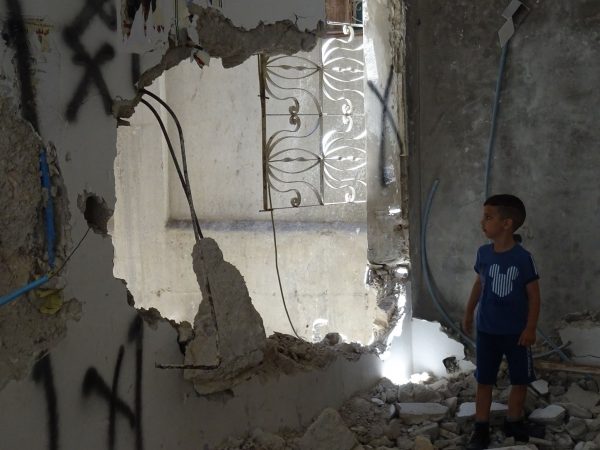
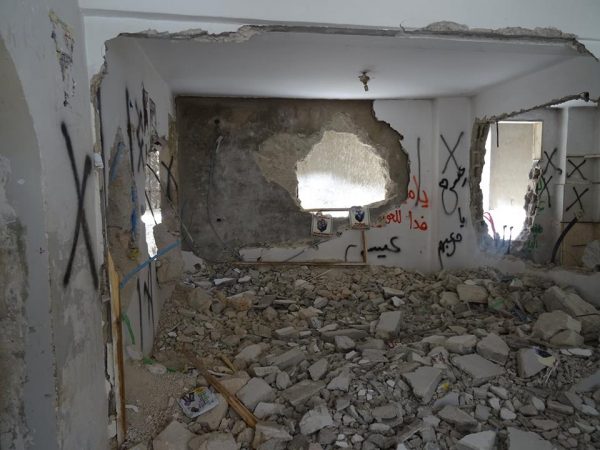
Among the injured was a 19 year old girl and a 15 year old boy, each shot with live ammunition and brought to the hospital in serious condition. The army entered the camp to demolish the homes of the families of two young men, Anan Habsah and Issa Asaaf, both 21, who carried out knife attacks and killed one soldier in East Jerusalem on December 23rd last year. Both were killed by soldiers while carrying out the attacks, so the demolition of the homes comes only as a form of collective punishment to terrorize the families and the people in Qalandia, who repeatedly suffer from night raids and house demolitions as well as beatings and arrests by the Israeli occupation forces.
Anan’s family first evacuated their home in January when the Israeli high court announced their decision to demolish the houses. The displaced family members lived spread across the area, staying at friends’ and family’s homes in Ramallah and elsewhere in Qalandia for two months until the lawyer suggested they could move back in in March. The father, Abu Saleh, refused to leave his home during the two month period however, staying in a tent outside the building. Three weeks ago the two families were yet again told to evacuate their homes and were informed that the demolition would take place within five days. However, the exact date of the demolition was not disclosed. Sunday night it finally happened without advance notice, and only two days before the end of Ramadan and the beginning of Eid celebrations.
In the ruins of his family home
Issa and his family have experienced severe trauma at the hands of occupation forces before, when he and his two younger sisters were brutally assaulted by Israeli soldiers at a checkpoint near East Jerusalem. The incident left one of Issa’s sisters unable to speak for three months, and caused the Assaf family significant distress and anguish.
Both Issa and Anan were imprisoned for significant periods of time; Anan at age fifteen for a period of eight months, and Issa for seven months in the year before his death.The families’ suffering did not end there, however. In the week following Issa’s release from prison, he was again assaulted at his home in Qalandia when soldiers dragged him from his home in the middle of the night and beat him in the street without justification.
The Habsah family also bears the long lasting scars of pain and trauma. Anan’s imprisonment as a child devastated the family, and they say their boy was never the same afterwards. “I know he did not want to die … but when a boy is put in jail, deprived of sleep, and deprived of his childhood, something in him changes,” said Anan’s uncle.
Inside the Asaaf family home
When we arrived on Monday morning, neighbors and relatives had already begun to gather in support of the families. Anan’s aunt explained to us that this is the third time her family had been forcibly displaced; first in 1948, when the family was expelled from their home in West Jerusalem, and later again in 1975 when their modest home in the refugee camp was destroyed for the first time.
UNRWA spokesman Chris Gunness condemned the demolitions on Monday, stating that punitive home demolitions “inflict distress and suffering on those who have not committed the action which led to the demolition, and they often endanger people and property in the vicinity.” A 2005 study by the Israeli army itself concluded that home demolitions are not effective as a deterrent or punitive measure, but the practice still continues. According to the Israeli Committee Against House Demolitions, about fifty thousand residential structures have been destroyed by Israel since 1967.
“This is psychological warfare. In the whole camp of more than ten thousand people, no one slept [last night], and they did not go to work today,” Adnan Habsah, the uncle of Anan said. Qalandia Refugee Camp has long been subjected to various forms of collective punishment by Israeli forces, and is severely affected by all aspects of the Illegal Occupation. The camp is located within area “C” and greater (East) Jerusalem, near the main checkpoint between Ramallah and Jerusalem and beside the apartheid wall. According to the UNRWA, the construction and expansion of the Wall in the early 2000s has drastically affected the economic situation in the camp by isolating it from the Israeli job market and Jerusalem. According to the most recent data, Qalandia’s unemployment rate is as high as 40 percent, compared to Occupied Palestine’s overall rate of 26.6 percent.
The Camp was originally established to house some 5,000 Palestinians who were displaced by the 1948 Nakba. Today, according to Afaq Environmental Magazine, the population of Qalandia Refugee Camp has reached about 14,000. Under the 1993 Oslo Agreement, the whole territory of Qalandia Refugee Camp is classified as area “C,” where Israel retains full control over security and administration related to the territory; however, Qalandia camp, like other Palestinian refugee camps, is under the administrative control of UNRWA.
As the uncle of Anan said when we spoke to him on Monday, “This is a UN refugee camp. The whole world owns this place. You cannot destroy it.”
Inside the book that maps the architecture behind global governance — from the Epstein files to the Pact for the Future
Lies are Unbekoming | April 1, 2026
On June 13, 2019, the United Nations and the World Economic Forum signed a partnership deal to “accelerate the implementation of the 2030 Agenda for Sustainable Development.” That same evening, WEF president Börge Brende — Norway’s former Foreign Minister — had dinner with Jeffrey Epstein at Epstein’s Manhattan townhouse. The Epstein files, released January 2026, contain an exchange between the two from the previous year. Epstein to Brende: “Davos can really replace the UN. C21, cyber, crypto . genetics… intl coordination.” Brende back to Epstein: “Exactly — we need a new global architecture. World Economic Forum (Davos) is uniquely positioned — public private.”
The next day, the UN General Assembly adopted the framework for restructuring global governance.
That sequence — the partnership signing, the Epstein dinner, the candid admission about replacing the UN with a public-private architecture, and then the formal adoption — opens Jacob Nordangård’s The Digital World Brain. Pages two and three. Footnoted to the UN resolution number, the Epstein files, and the General Assembly record.
I keep coming back to it because it captures what this book does that almost nothing else in the independent research space manages. I’ve followed Jacob’s work for years now and interviewed him about his research. Each book peels back another layer of the same institutional architecture, and each time I think he’s reached the limit of what can be documented, the next one goes further. Nordangård doesn’t speculate. He doesn’t editorialize much. He lays institutional actions next to each other in chronological order and lets the pattern announce itself. … continue
This site is provided as a research and reference tool. Although we make every reasonable effort to ensure that the information and data provided at this site are useful, accurate, and current, we cannot guarantee that the information and data provided here will be error-free. By using this site, you assume all responsibility for and risk arising from your use of and reliance upon the contents of this site.
This site and the information available through it do not, and are not intended to constitute legal advice. Should you require legal advice, you should consult your own attorney.
Nothing within this site or linked to by this site constitutes investment advice or medical advice.
Materials accessible from or added to this site by third parties, such as comments posted, are strictly the responsibility of the third party who added such materials or made them accessible and we neither endorse nor undertake to control, monitor, edit or assume responsibility for any such third-party material.
The posting of stories, commentaries, reports, documents and links (embedded or otherwise) on this site does not in any way, shape or form, implied or otherwise, necessarily express or suggest endorsement or support of any of such posted material or parts therein.
The word “alleged” is deemed to occur before the word “fraud.” Since the rule of law still applies. To peasants, at least.
Fair Use
This site contains copyrighted material the use of which has not always been specifically authorized by the copyright owner. We are making such material available in our efforts to advance understanding of environmental, political, human rights, economic, democracy, scientific, and social justice issues, etc. We believe this constitutes a ‘fair use’ of any such copyrighted material as provided for in section 107 of the US Copyright Law. In accordance with Title 17 U.S.C. Section 107, the material on this site is distributed without profit to those who have expressed a prior interest in receiving the included information for research and educational purposes. For more info go to: http://www.law.cornell.edu/uscode/17/107.shtml. If you wish to use copyrighted material from this site for purposes of your own that go beyond ‘fair use’, you must obtain permission from the copyright owner.
DMCA Contact
This is information for anyone that wishes to challenge our “fair use” of copyrighted material.
If you are a legal copyright holder or a designated agent for such and you believe that content residing on or accessible through our website infringes a copyright and falls outside the boundaries of “Fair Use”, please send a notice of infringement by contacting atheonews@gmail.com.
We will respond and take necessary action immediately.
If notice is given of an alleged copyright violation we will act expeditiously to remove or disable access to the material(s) in question.
All 3rd party material posted on this website is copyright the respective owners / authors. Aletho News makes no claim of copyright on such material.




 Aletho News