Israel Suspected of Hacking French Prime Minister’s Phone – Reports
Sputnik — 07.07.2016
French authorities suspect that Prime Minister Manuel Valls’ cellphone may have been tampered with during his recent visit to Israel, French media outlets reported Thursday.
Valls visited Israel on May 21-24 for talks with President Reuven Rivlin and Prime Minister Benjamin Netanyahu, in a bid to revive the reconciliation process between Israelis and Palestinians.
The prime minister and his staff were asked to submit their cellphones before attending the high-level talks, according to the French newspaper L’Express.
Upon retrieving them, French officials were “shocked” to find that many devices showed signs of an “anomaly,” the outlet claimed. One of the phones later broke down.
The suspicious cellphones were handed over for inspection to the National Agency for Computer Security (ANSSI), which declined to comment on the possibility that they had been hacked. A government official told the outlet the security check was standard procedure.
Israel responded to the accusations, saying it considered France a friendly nation who it would never spy on. It denied having tampered with the phones of the French delegation.
An unholy alliance of leftists supporting a pro-NATO course against Russia
By Susann Witt-Stahl and Denis Koval | Junge Welt* | June 25, 2016
The Rosa-Luxemburg Foundation and the ‘new left’ in Ukraine have forged a pro-NATO course directed against Russia.
The Die Linke (Left Party)-affiliated Rosa Luxemburg Foundation wants to play it safe. It relies not on historical pro-Soviet or Marxist left traditions but instead promotes a “new left”. The foundation is named after a world-renowned icon of anti-capitalist movements whose identity is bound with communist and anti-imperialist ideas. But the members of the Foundation’s leadership recommend to the left a convergence with the ‘liberal imperialism’ of the global hegemon, the USA.
Understandably, this requires some political flexibility. Progressive forces should not plant themselves on one side or the other of competing imperialist powers, says the Facebook page Rosa-Luxemburg-Stiftung Ukraine. It demands that the “independent left” distance itself from the NATO-EU bloc, on the one hand, and from Russia on the other hand.
 This agenda is followed by the Rosa Luxemburg Foundation (RLF) with its Ukrainian partners. But it never explicitly speaks out against the accelerated expansion of the Western powers to the very borders of the Russian Federation. Instead, it consistently warns about “Great Russian chauvinism” and denounces the former Soviet Union and the anti-imperialist left.
In Ukraine, the Foundation cooperates principally with the small ‘Left Opposition’ group (not to be confused with the political front of the same name in which the Ukrainian Communist Party participates). In April 2014, the Left Opposition (LO) along with the “independent” trade Union ‘Zachist Prazi’ (Labor Defence) of Oleg Vernik merged into the ‘Social Movement’. The aim was to create an alliance (so far without any success) to be a Ukrainian version of Syriza.
One of the founders of the ‘LO’ is Zakhar Popovich, who in 2003 together with Oleh Vernik was expelled from the Trotskyist Committee for a Workers’ International (reported in Junge Welt) because of a lengthy fraud they perpetuated. They had collected donations for non-existent left-wing organizations in Ukraine.
According to its self description, LO stands for a politics of peace, beyond the “nationalist polarisation” of pro-Ukrainian and pro-Russian forces. But it doesn’t dare to criticize Ukrainian ultranationalists. LO has openly supported the assaults by Euromaidan. Zakhar Popovich and his comrade Vitaly Dudin, the lawyer of the Kiev Center for Social and Labor Research, are also RLF partners. They marched in Maidan Square with a red EU flag side-by-side with the ultra-right.
The LO also welcomed the political section of the EU Association agreement, which includes clauses providing for military cooperation of Ukraine with the West.
Accordingly, LO has nothing to do with the “opposition” anymore. In March of 2014, Zakhar Popovich characterised the Yatsenyuk coup government as “legitimate” and appealed “to all governments in the world and Russia to recognize it”. He announced that his support was only “practical”, not political, because of the numerous, Goebbels-type followers from the Svoboda Party who were in the government.
LO’s demand to end the civil war in eastern Ukraine is expressed by the fact that in 2014, Fedor Ustinov, a member of its organizing committee, voluntarily joined the Ukrainian extremist ’ battalion ‘Shachtarsk’ in order to participate in the “punitive expedition” against the insurgents in the unrecognized people’s republics of Donbass. The “American anti-imperialist response” to the “imperialist aggression of Russia” needed to be strenghthened. In this way did Ustinov understand the “balancing to be done against the two rival “imperialist” camps.
The LO is not only in the pro-NATO camp with both feet, it is also in the rightwing quagmire. The ‘Social Movement’–that is, LO and Zachist Prazi–view the organisation ‘Autonomous Resistance’ as not only “comrades. In Odessa, they have gone so far as to hold a joint rally with fascists who organize memorial marches for Stepan Bandera’s Ukrainian Insurgent Army (UPA) which committed massacres during WWII (especially of the Polish civilian population) and collaborated with Nazi Germany.
The LO member and co-organizer Andriy Ishchenko was until 2004 the chairman of the Odessa cell of the Ukrainian National Assembly – Ukrainian People’s Self-Defence (UNA-UNSO), a fascist party and the core organization of the Right Sector. The UNA-UNSO’s paramilitary force contributed to the 2004 ‘Orange Revolution’ of the famous Atlanticist Viktor Yushchenko, who became Ukraine’s president in 2005.
Perhaps Andriy Ishchenko is now an ‘ex’ neo-Nazi? Hardly. Until today, he still welcomes his former comrades as “friends”. “I am not ashamed of my membership in this organization. We were in the forefront of the struggle of the Ukrainian people for their rights and the the social struggles of the’ 90s,” said Ishchenko in 2014, speaking about his unfinished past.
The fact that Andriy Ishchenko wants to help the Right Sector to become “left wing” is enough for RLF, apparently, to present him in its pages as a “left activist”. Moreover, to whitewash the pro-Maidan ‘Autonomous Resistance’, Nelia Vakhovska, the project co-ordinator of the RLF in Ukraine, and Ivo Georgiev, from the centre for International Dialogue and Cooperation of the RLF, call Autonomous Resistance a “citizens ‘ movement” in a published post titled The life of left activists in Ukraine is dangerous. The RLF Facebook page provides weblinks to these neo-Nazi Banderites.
Although LO has a maximum of two dozen activist members, conferences and other events with speakers from the LO are promoted by RLF and LO’s positions are uncritically disseminated. This also applies to other structures from the spectrum of the ‘new left’ in Ukraine, for example, the magazine Prostory of the ‘Autonomous Workers’ Union’. The members of AWU regularly mobilize against “pro-Putin fascists” (their term for opponents of Maidan) and believe that there is “no alternative” to the “Anti-Terrorist Operation” taking place in Donbass.
Ukraine’s ‘decommunization’ law and other repressive measures against the Ukrainian Communists have opened space for what some critics call a “fake left” in Ukraine. The fact that this left holds a long-time monopoly on the funds of the Rosa Luxembourg Foundation is being hushed up.
The ‘new left’ is used to whitewashing the alliance of the Western powers with the fascists in Ukraine. They approve the cooperation of the NATO-oriented, Ukrainian economic elite with the Western neocons that took place on the Maidan and approve a new escalation against Russia.
* Translation to English by New Cold War.org
Background: “Peace is War”
The Rosa-Luxemburg Foundation was involved in the creation of the pro-Maidan ‘left‘. In April 2014, for example, it promoted a conference ‘The Left and Maidan‘ organized by its Ukrainian partners.
The conference also served as a founding Congress of the ‘Social Movement‘ − initiated predominantly by the Left Opposition. The results of a survey were presented at the conference, according to which 93 per cent of Maidan-activists were presented as “apolitical” and only seven per cent (including the socialists) were organized politically. Accordingly, the proportion of fascists and other radical Right involved inMmaidan was said to be very low.
In December 2015, the Rosa Luxembourg Foundation supported the event ‘Aspects of the media coverage of the military conflict‘ organized by the Centre for Labour and Social Research, including experts “reporting from the ATO-zone” (‘Anti-Terrorist Operation‘ is the Kyiv government’s official name for the military offensive of the Ukrainian army in eastern Ukraine). As stated in the event announcement, the participants included Yana Salakhova from George Soros’ ‘Renaissance Foundation‘ and Igor Burdyga, a journalist, member of the LO and militant of the ‘AutoMaidan who believes the arsonists of Odessa on May 2, 2014 were “patriots” while the protests of the victims’s relatives were “ukrainophobic”.
The RLF also supports projects of the Visual Culture Research Center in Kiev. For example, in 2014, it staged a series of benefits named ‘Peace Is War‘ which featured pro-Maidan propaganda films that encourage the viewer to understand that the militarisation of Ukrainian society is a “consequence of Russian aggression beginning in March 2014″.
The Foundation similarly promotes moderate nationalists from the artist scene. Sergiy Zhadan, according to the RLF, is a “leftist writer”, but he will participate in the ‘Banderstad Festival‘, a large gathering of Ukrainian fascists taking place in August 2016.
FBI Investigation Produces No Indictment, But Proves Hillary Clinton’s a Serial Liar
By Dave Lindorff | This Can’t Be happening! | July 6, 2016
Hillary Clinton may or may not be a crook. That remains to be proven, though the sheer magnitude of the wealth that she and husband Bill have amassed since leaving the White House, and while she was serving as Secretary of State — nearly a quarter of a billion dollars earned by two people with no known skills capable of producing that kind of income — should raise questions. What can be stated now as fact though, is that Hillary is a serial liar.
If this wasn’t clear already from her long history of distortion and prevarication — like her false claim that she had to “duck to avoid sniper fire” during a state visit to Bosnia — it is clear now from FBI Director James Comey’s 11-page public report on his agency’s year-long investigation into her use of a private server for all her private and official emails during her term as Secretary of State.
That report has exposed her serial lying to both Congress and the public about that illegal use of private email service to handle her public business.
As the Associated Press reports, Clinton lied in March 2015 when she declared in one of her rare news conferences, “I did not email any classified material to anyone on my email. There is no classified material.”
But as Comey reports, she did. Quite often in fact. The FBI in its exhaustive investigation found at least 113 email chains –some of which had to be uncovered after they had been erased by Clinton’s private lawyers — contained material that was classified at the time of sending, including some that were classified Top Secret and that referred to a “highly classified special-access program.”
She lied again at that same press conference when she asserted, “I responded right away and provided all my emails that could possibly be work related” to the State Department.
Not true, according to the FBI, and also, of course, to the Inspector General of the State Department, with whose own investigation of her actions, Clinton simply refused to cooperate.
Clinton lied when she said earlier this month, in an NBC interview, “I never received nor sent any material that was market classified.” Comey says that in fact her system did handle emails that bore specific markings indicating they were classified.
Clinton lied when she tried, as she explained more than once, including in that same March 15 news conference addressing the issue, to claim that she had used her own Blackberry phone rather than a State Department secure phone, simply because she “thought it would be easier to carry just one device for my work and for personal emails instead of two.” In fact, Comey said his agents determined that Clinton had “used numerous mobile devices to view and send email,” all using her personal account. So much for wanting to use “just one device”! Comey said she also had used different non-government servers, all of them vulnerable to hacking.
Clinton lied again when she claimed that her private server was on “property guarded by the Secret Service and there were no security breaches.” She lied again when she added, “The use of that server, which started with my husband, certainly proved to be effective and secure.” Her campaign website adds the equally false assertion that “There is no evidence there was ever a breach.”
In fact, all Comey will say is that the FBI did not uncover a breach, but he adds that because of the sophisticated abilities of “hostile” forces (i.e foreign countries’ intelligence services) that would be engaging in any such hacking, “We assess it is possible that hostile actors gained access to Secretary Clinton’s personal email account.” They would just not leave any “footprints,” he explains.
We also know Clinton was lying when she said, “I opted for convenience to use my personal email account, which was allowed by the State Department.” The falsity of that particular lie was exposed by the State Department Inspector General, who in his own report on her private server scandal, found that she had never “sought or received approval” to operate a private server for her State Department communications, and added that as Secretary of State, she “had an obligation to discuss using her personal email account to conduct official business with State Department offices.”
Some of these violations that Clinton has objectively lied about may not be crimes. Others clearly are. At a minimum, Clinton deliberately sought to violate the requirements of the Freedom of Information Act, which make all but classified documents public records that are supposed to be made available on request to journalists and the public on request (and even many secret documents upon appeal). By conducting her official business on a private server, Clinton was assuring that no FOIA requests could touch her.
The question of Clinton’s “trustworthiness” is a huge issue among the public, with all but her die-hard supporters — a minority within the Democratic Party.
Maybe some people don’t care in these cynical times when it’s simply assumed that “all politicians lie,” but one hopes that those lies will relate to personal foibles and sins, not official business. A nation that celebrates great leaders like George Washington, who at least according to the national mythology once said, “I cannot tell a lie,” and Abraham “Honest Abe” Lincoln, for their integrity and forthrightness, surely can demand at least a semblance of truthfulness in its top leader.
Clearly Hillary Clinton has failed that test of leadership, and in a big way.
I’m concerned that the FBI and the State Department’s own Office of Inspector General, as well as Republicans in Congress, have missed the real import of Clinton’s lying. It is not that she violated rules and standards that may have led to national security secrets being hacked, serious though that may be. For one thing, powerful intelligence agencies like those of the Russians and Chinese, just like the US’s own National Security Agency, have the capability to hack even the government’s most secure servers.
What should really be getting asked, by government investigators, political critics and by any real journalists left out there, is why Clinton, as Secretary of State, was so insistent — even to the point of violating laws and State Department policies — on avoiding the reach of the Freedom of Information Act (FOIA). The answer to that has to take us back to the reality of the Clinton’s phenomenal success at vacuuming up vast sums of money from wealthy individuals, corporations, and even foreign potentates, both for their personal accounts as when either Clinton speaks at gatherings of bankers, pharmaceutical executives or military industry leaders, and for their Clinton Foundation, reportedly the recipient of over $2 billion in corporate and foreign government largesse.
Their success at raking in such piles of cash reeks of influence peddling, probably much of it conducted by phone and by email — and it’s the kind of thing that, if it were done by a Secretary of State on a government electronic device, would be vulnerable to a FOIA request.
On a private server, it’s the type of communications activity that Hillary Clinton’s private attorneys would have “wiped” from her hard drive to escape scrutiny when they erased thousands of emails they determined, with no official backstopping, to have been “private.”
Comey was wrong to recommend no prosecution of Clinton for her email practices, since some of her own State Department employees, as well as employees of the CIA and other agencies have been charged with and convicted of felonies for the same and even lesser infractions. But Clinton, as a Secretary of State and as the likely Democratic Party candidate for president, clearly lives on a higher plane that operates under a different set of rules. Only the “little people” get called to account for such crimes in the United States.
If the severely compromised US “Justice” Department cannot step up and issue an indictment based upon the findings of the FBI about Clinton’s email violations, it is up to the people of the United States to decide whether we want such a greedy woman — a confirmed serial liar ready to say anything necessary to obtain power — to be our next president.
Hillary Clinton’s Emails and the Crisis of Legitimacy
A Black Agenda Radio commentary by Glen Ford | July 6, 2016
 Hillary Clinton has escaped indictment – as almost universally expected – for commingling her email communications as secretary of state with her personal business, including the global money laundering, bribery and extortion racket called the Clinton Foundation. The Clintons are capable of infinite corruption. That’s why they’re in politics: to protect the criminal enterprises of the truly rich people they serve, and to become rich, themselves. That is the nature of the system – and the system works; it provides impunity to the powerful.
FBI Director James Comey essentially admitted as much when he acknowledged that there was “evidence of potential violations of the statutes regarding the handling of classified information.” A reasonable person in Clinton’s position “should have known” that what she was doing was violating the law. But, he said, the FBI’s “judgment is that no reasonable prosecutor would bring such a case.” The public knows perfectly well that what Comey really means is that there’s no way he was going to keep the rulers of the United States from getting the president they want.
So, Hillary gets off, as did the warlord General David Petraeus and other insiders who were not fully prosecuted for clearly breaking the law. Yet, President Obama has shattered all historical records in treating whistleblowers as spies. Obama pushed for and got the power to detain people indefinitely without trial or charge, but is so tolerant of systemic criminality among Wall Street bankers that his own attorney general had to briefly admit that the Lords of Capital are “too big to jail.” So, on the one hand, the fundamental right to due process under the law has ceased to exist – yet, for the rich impunity has become all but absolute.
The rulers are caught in a crisis of legitimacy. Obscenely concentrated wealth has turned U.S. society into a Constitution-free zone for the wealthy, who behave as if they are a separate species. They have exhausted the tolerance even of white Americans, descendants of Europeans who came here hoping to become rich, but now despair of keeping their heads above water and are growing to despise the 1%.
Black folks are waking up – angry! – after two generations of relative quietude, pushing back against a police state that is coddled by Congress, upheld by the Supreme Court, and unchallenged by the executive branch. The system is leaking legitimacy like a sieve.
Donald Trump is seen as illegitimate by probably a majority of Americans, but so is Hillary Clinton. In some ways, Clinton is even more revolting. Most people that hate Trump can point to one or more of his specific policies or statements. However, people are just plain repulsed by Hillary Clinton. If pressed on why they find her so distasteful, folks say she is dishonest, not to be trusted – but usually offer no particulars. What they really feel, is that she is corrupt to the bone; that she personifies the Lie that the top of society tells to the bottom.
The crisis of legitimacy becomes acute when enough people say, “Who are you to hold power over me?”
Glen Ford can be contacted at Glen.Ford@BlackAgendaReport.com.
Post-Brexit, Is the EU Flaunting Its Undemocratic Tendencies?
By Joyce Nelson | CounterPunch | July 6, 2016
Stung by Brexit, the EU bureaucrats seem intent on showing just how undemocratic they can be. Here are two examples just in the last seven days.
The Glyphosate License
On June 24, EU member states again refused (for a third time this year) to approve a renewal of the license for the weed-killer glyphosate manufactured by Monsanto and other corporations involved in GMO crop cultivation. That should have meant that the license would expire by the end of June, and Monsanto’s Roundup and other glyphosate weed-killers would have to be withdrawn from Europe by the end of this year.
Instead, on June 29 the European Commission (EC) decided “unilaterally” to extend the glyphosate license for another 18 months. [1]
The decision “drew heavy criticism from the Greens in the European Parliament, who said the decision showed the Commission’s ‘disdain’ for the opposition by the public and EU governments to the controversial toxic herbicide.” [2] Belgian Green Member of the European Parliament Bart Staes said, “As perhaps the first EU decision after the UK referendum, it shows the [EC] executive is failing to learn the clear lesson that the EU needs to finally start listening to its citizens again.” [3]
Many were simply shocked that an unelected body of bureaucrats would cater so blatantly to the corporate sector’s last-minute lobbying.
The EC claims that, because of member nations’ indecision on the matter, its own decision about glyphosate was based on assessments made by the European Food Safety Authority (EFSA), prolonging the authorisation until a new scientific review is concluded before the end of 2017, but Greenpeace has called the EFSA study “a whitewash.” [4]
Lawrence Woodward, co-director of Beyond GM, has called the EC’s unilateral decision “reckless.” [5] It comes at the same time that dozens of individuals and organizations have signed an open “Letter from America,” urging European citizens, politicians and regulators to not adopt a “failing agricultural technology” and sharing examples of glyphosate and GMO repercussions across North America. [6]
CETA Ratification
At virtually the same time that the EC made this controversial decision on glyphosate, it made another that is even more undemocratic.
On June 28, a German news agency reported that European Commission President Jean-Claude Juncker told EU leaders the Commission is planning to push through a controversial free trade agreement between Canada and the EU – known as CETA, the Comprehensive Economic and Trade Agreement – without giving national parliaments any say in it. [7] According to the German press, Juncker argued that allowing national parliaments to vote on the agreement would “paralyze the process” and raise questions about the EU’s “credibility.” Juncker claimed that CETA “would fall within the exclusive competence of the EU executive” and therefore doesn’t need to be ratified by national parliaments within the 28-nation bloc, sources in Brussels told the Germany news agency DPA. [8]
Most EU members, however, view CETA as a “mixed” agreement, meaning “that each country would have to push the deal through their parliaments.” [9]
In late June 2016, the EC’s Juncker was reported as saying that he “personally couldn’t care less” whether lawmakers get to vote on CETA. [10]
Millions of Canadians and Europeans have fought against CETA for the past six years. Like the TPP and TTIP, it is a draconian agreement that would hand multinational corporations immense power to overrule elected local governments on numerous fronts. In Canada, CETA was supposed to be voted on by every Canadian provincial and territorial government before any ratification could take place, but in September 2014 (during the reign of Stephen Harper) the CETA deal was signed without there having been any public consultation whatsoever in Canada. The 2014 announcement was also the first time people in Canada and Europe were allowed to see the official text, which had been kept secret during the years of negotiations.
Unfortunately, Canada’s International Trade Minister Chrystia Freeland is enthused about what the EU is doing. According to The Globe and Mail newspaper (July 3), “The British vote to exit the European Union has refocused
Europe’s attention on the need to send a message to the world that liberalized trade is the path to greater prosperity, Ms. Freeland said.” [11]
She also explained that once the European Parliament approves CETA, “a great deal of the agreement would come into force immediately, more than 90 per cent,” she said, “those portions deemed to be within the European Union’s jurisdiction, those go into force right away.” [12]
Freeland told The Globe and Mail that concerns about CETA’s investor-state dispute settlement (ISDS) mechanism – which allows multinational corporations to sue governments over regulations that harm their future profits – had been addressed by a rewrite of the treaty’s investment chapter. [13] But according to Council of Canadians, those changes “actually make [the provisions] worse. The reforms enshrine extra rights for foreign investors that everyone else – including domestic investors – don’t have. They allow foreign corporations to circumvent a country’s own courts, giving them special status to challenge laws that apply equally to everyone through a [private] court system exclusively for their use.” [14]
Prime Minister Justin Trudeau will be in Europe this week for a NATO summit, and officials “say he will lobby hard for other European leaders not to stand in the way of [CETA’s] ratification.” [15]
The Pushback
Reportedly, the pushback in Europe has been immediate, with Germany and France wanting “their national parliaments to be involved” in CETA ratification. On July 5, Deutsche Welle reported that “Juncker appears to be backtracking,” and would propose at a July 5 EC meeting that CETA would require “both the approval of the European parliament and national legislatures.” [16]
The Globe and Mail reported on July 5 that Juncker’s “new recommendation… could call for applying those EU parts of the treaty while the ratification process [by national legislatures] is under way.” [17] That would mean (as Canada’s Chrystia Freeland had earlier explained) more than 90% of CETA could be approved by the EU as part of its “jurisdiction” and needing no national legislative approvals. Such a process would make a mockery of democratic rights on both sides of the Atlantic.
That appears to be what is happening.
Following the July 5 EC meeting in Strasbourg, France, the CBC reported: “Legal opinions advanced by the commission suggest that most of the agreement – perhaps as much as 95 per cent – falls comfortably with the European Union’s jurisdiction… ‘This is an agreement that Europe needs,’ EU trade commissioner Cecilia Malmstrom said in a statement. ‘The open issue of competence for such trade agreements will be for the European Court of Justice to clarify, in the near future. From a strict legal standpoint, the commission considers this agreement to fall under exclusive EU competence. However, the political situation in the council is clear, and we understand the need for proposing it as a ‘mixed’ agreement, in order to allow for a speedy signature’.” [18]
But as nations gear up to wrangle with the EU (in the European Court of Justice) over what parts of the CETA treaty fall within their jurisdiction, and what parts “fall under exclusive EU competence,” the EC could approve 95% of CETA before elected legislatures even vote.
The Council of Canadians warns on its website (July 5): “One important concern to note, ‘The commission may recommend provisionally applying the EU-parts of the Canada deal while full ratification is pending.’ The French newspaper Le Monde has previously reported that even if CETA is deemed to be a ‘mixed’ agreement, the deal could enter into force ‘provisionally’ even before EU member state parliaments vote on it. It notes, ‘If EU ministers agreed at the signing of the CETA on its provisional application, it could come into effect the following month. Such a decision would have serious implications. Symbolically, first because it would send the message that European governments finally [have] little regard for the views of parliamentarians and thus of European citizens strongly against the agreement’.” [19]
Council of Canadians National Chairperson Maude Barlow stated after the EC meeting in Strasbourg, “Like many Canadians, Europeans are worried about CETA’s attacks on democracy, its weakening of social and safety standards, its contribution to privatization and attacks on public services. After the Brexit vote, policy makers on both sides of the Atlantic would be better counseled to listen to voters, rather than pushing discredited [trade] solutions down people’s throats.” [20]
Global Justice Now director Nick Dearden has called CETA a “toxic deal” and says that the way the EC is acting “reinforces the widely held suspicion that the EU makes big decisions with harmful consequences for ordinary people with very little in the way of democratic process,” he said. “Rather than take a step back and question why there is hostility to the EU, they try to speed up this awful trade deal.” [21]
Union members, environmentalists, social activists and “fair trade” groups say CETA is just as dangerous as the proposed Transatlantic Trade and Investment Partnership (TTIP) deal between the EU and the U.S., which hands massive power to multinationals and is a direct threat to democracy on both sides of the Atlantic. The way the EC is handling CETA is a stark clue to what’s in store for TTIP.
Footnotes:
[1] “European Commission Extends Glyphosate License without Real Restrictions,” Sustainable Pulse, June 29, 2016.
[2] Frederic Simon, “EU muddling on glyphosate fuelled Brexit populism,” EurActiv.com, July 1, 2016.
[3] Quoted in ibid.
[4] Ibid.
[5] Katie Pohlman, “Neil Young: Say No to GMOs on ‘Behalf of All Living Things’,” EcoWatch, July 1, 2016.
[6] Quoted in ibid.
[7] “EU Commission Seeks to Push Through Free Trade Agreement with Canada (CETA) without Parliamentary Approval,” Deutsche Welle, June 28, 2016.
[8] Ibid.
[9] Reuters, “EU Commission to opt for simple approval for Canada deal: EU official,” June 28, 2016.
[10] “EU Commission: CETA should be approved by national parliaments,” Deutsche Welle, July 5, 2016.
[11] Robert Fife, “Despite Brexit vote, key EU powers vow to ratify CETA deal,” The Globe and Mail, July 3, 2016.
[12] Ibid.
[13] Ibid.
[14] Council of Canadians, “CETA changes make investor-state provisions worse,” February 3, 2016.
[15] Fife, op cit.
[16] “EU Commission: CETA should be approved by national parliaments,” Deutsche Welle, July 5, 2016.
[17] “EC set to scrap plans to fast-track CETA deal: report,” The Globe and Mail, July 5, 2016.
[18] “Canada gets clarity on how Europe will ratify trade deal,” CBC, July 5, 2016.
[19] Council of Canadians, “CETA to be considered a ‘mixed’ agreement, now more vulnerable to defeat,” July 5, 2016.
[20] Council of Canadians, “CETA vulnerable to defeat: Council of Canadians,” July 5, 2016.
[21] Lamiat Sabin “Brexit ‘Might Not Stop Awful Ceta’,” Morning Star, July 5, 2016.
Joyce Nelson is an award-winning Canadian freelance writer/researcher working on her sixth book.
Bakari Sellers: Hitman for Israel, Hillary and Wall Street

By Glen Ford | Black Agenda Report | July 6, 2016
Bakari Sellers, the 31 year-old former South Carolina state lawmaker who became a paid CNN shill for Hillary Clinton in 2015, following the Charleston massacre, is also a longtime operative for AIPAC, the deep-pocketted, cutthroat lobby for Israel. In a letter to Democratic Party officials, last month, Sellers claimed to have gathered the signatures of 60 “lifelong” Black Democrats urging rejection of any changes to the party’s slavishly pro-Israel 2012 platform positions, denouncing as “anti-Semitic” the global movement against Israeli oppression of Arabs in Palestine and the nearly 50-year-long occupation of the West Bank. “Since the last platform was approved, anti-Semitism has been on the rise and it has taken a new form – the boycott, divestment and sanctions movement known as BDS,” said the letter, much of which consisted of quotes from Hillary Clinton, including, “In Israel’s story, we see our own.” Clinton’s vision is clear, in one respect: the U.S. was once the largest of the world’s apartheid states; today, Israel is the last one standing.
Clinton’s minions on the platform committee brushed aside Bernie Sanders delegates’ planks on Israel, as well as the TPP pro-corporate trade deal, single payer healthcare, a carbon tax, and linking a $15 an hour minimum wage to inflation.
The names on Sellers’ list have not yet been made public, but there is no shortage of Black apologists for Israel. In 2014, the entire Congressional Black Caucus joined in a unanimous U.S. House resolution affirming the Zionist state’s right to “defend itself” – even as Israeli bombs were slaughtering over 2,100 men, women and children in Gaza.
Despite his relative youth, Bakari Sellers is a veteran operative for AIPAC, the American Israel Political Action Committee, Israel’s strong-arm lobby. According to the web site Electronic Intifada, Sellers was recruited back in 2004, when AIPAC had just begun a massive campaign at historically Black colleges and among even younger students of color, nationwide. Sellers was a real catch for AIPAC; not only had he just been elected student body president, he is also the son of Cleveland Sellers, a former leader of SNCC, the Student Non Violent Coordinating Committee, who was wounded in the 1968 Orangeburg Massacre when state police killed three Black college students protesting segregation. The elder Sellers is now president of Voorhees College. SNCC’s stand in solidarity with Palestinians in 1967, the year of Israel’s Six Day War and its seizure of Arab East Jerusalem and the West Bank, is widely believed to mark the beginning of the deepening between Black political activists and Zionism.
Bakari Sellers’ service to AIPAC is a repudiation and perversion of SNCC’s internationalist and humanitarian values. He has eagerly deployed himself as one of Zionism’s Black up-and-coming political stars. In return, AIPAC has helped bankroll his political career. “The way I’m able to communicate, the exposure, the people that I’ve met – a lot of people I’ve met at the AIPAC policy conference became a huge part of my fundraising base,” Sellers told an AIPAC leadership seminar for college students, in 2008.
Sellers has found that AIPAC money and Wall Street funding go hand in hand – and he’s in it up to his elbows. “Looking forward to giving the address tonight @Aipac Annual Wall Street Dinner in Manhattan,” he tweeted, mentally scooping up cash with both hands.
A prime duty of white people’s – or Zionist’s – Black surrogates, is to act as torpedoes against troublesome Black activists. Sellers’ assignment is to be a counterpoint to anti-corporate, anti-imperialist critics of Israeli policy, like Dr. Cornel West, one of Bernie Sanders’ delegates on the platform committee. When CNN trotted Sellers out to defend Clinton’s 1990s record of spreading racist hysteria against Black male “super-predators,” West admonished him to remember “the legacy of your blessed father… look at his example. He was not just fighting against racism – he was fighting against a class system as well,” said West. “You can’t do that as a Wall Street Democrat.”
Sellers looked beaten, but he could not be shamed, because he and the rest of his Black Misleadership Class are utterly shameless in their relentless pursuit of favor from the rich and powerful. As Dr. West told Sellers, the Black political elite “confuses the gravy train with the freedom train.”
Back in the early 2000s, when the BAR team was working at The Black Commentator, we toyed with the idea of creating a Trojan Horse Watch to keep track of the growing number of Black politicians that were succumbing to the siren song of the Wall Street wing of the Democratic Party, the Democratic Leadership Council. The flood of corporate money into grassroots Black electoral politics – a new phenomenon – had not yet turned into a tsunami. One guy stood out above the rest: Cory Booker, the 31 year-old, one-term Newark, New Jersey, city councilman who was mounting his first challenge to Mayor Sharpe James. Booker made his national debut at a power luncheon of the Manhattan Institute, a star think tank in the right-wing, corporate constellation. He would sometimes arrive at campaign stops in a caravan of Hasidic Jews, although there was no significant Hasidic community in Newark. On deeper examination, it became clear that Booker was not your ordinary Black politician, grubbing for money as best he could, from whoever was giving it. Booker was a true zealot for Zionism, and a hard core corporate ideologue. The decades of leadership by a Black political class that chose the “gravy train” over the “freedom train” had produced a new breed of Black political striver that is totally at home with corporatism, imperialism and Zionism, and is eager to be deployed by his masters as a political weapon.
Bakari Sellers is part of this crop: fruit of the poisoned tree.
Glen Ford can be contacted at Glen.Ford@BlackAgendaReport.com.
Elie Wiesel: Poseur for Peace
By Joseph Grosso | CounterPunch | July 6, 2016
An obvious and oft-sighted criticism of the Nobel Peace Prize is just how many of its recipients have virtually no connection to the cause of peace or its advancement. If anything often it seems a reward for its negation. Henry Kissinger, recipient in 1973, would have to be the gold standard here. That very year saw Kissinger orchestrate the destruction of democracy in Chile and that was only after the secret bombing of Cambodia was concluded. Of Course stretch it forward and backward a couple of years and Kissinger’s trail of destruction extends from Bangladesh to East Timor.
A few years later Mother Theresa made an odd choice given the extra pain deliberately inflicted on the poor in her clinics and her support for Indira Gandhi’s suspension of civil liberties and in 1994 the triumvirate of Yasser Arafat, Shimon Peres, and Yitzhak Rabin can hardly be deemed inspiring. Barack Obama got the nod less than a year into his presidency. It’s a good bet there are many in Pakistan, Yemen, and Honduras that would question the wisdom of that selection.
The year 1986 saw the Nobel go to recently deceased Elie Wiesel. Wiesel was famous for his novel/memoir Night and for being, according to the Nobel Prize’s webpage, ‘the leading spokesman on the Holocaust’, therefore seemingly by definition an alleged spokesman on human rights. A quick scan through many of the obituaries written for Wiesel the past couple of days show this quote from his Nobel acceptance speech given prominent status:
I swore never to be silent whenever human beings
Endure suffering and humiliation. We must always
Take side. Neutrality helps the oppressor, never the victim.
Silence encourages the tormentor, never the tormented.
A noble sentiment indeed but not one that seemed to inspire Wiesel to live up to his peace prize, in fact evidence suggests Wiesel had a soft spot for war, at least war in the Middle East. Four years before giving his acceptance speech of Israel’s 1982 invasion of Lebanon, where even an Israel commission found the Israeli military indirectly responsible for the Sabra and Shatila massacre, “I support Israel-period. I identify with Israel-period.” When asked to comment of the massacre: ‘I don’t think we should even comment’, then commenting he felt ‘sadness with Israel, not against Israel’ with nary a peep about the actual victims. Some years later Wiesel would be wheeled into the spotlight by the Bush administration to endorse the forthcoming invasion of Iraq. His statement at the time read: ‘Isn’t war forever cruel, the ultimate form of violence…. And yet, this time I support President Bush’s policy of intervention when, as is this case because of Hussein’s equivocations and procrastinations, no other option remains’.
In the midst of another Israeli operation in Lebanon, this one in 2006, Wiesel stood in front of a crowd in Manhattan (along with then Senator Hillary Clinton) and declared “Israel defends herself, and we must say to Israel ‘Go on defending yourself.’” His final years didn’t slow him down. Wiesel took out a full page ad in newspapers across the country during the 2014 Israel-Gaza conflict fully supporting Israel’s effort (Human Rights Watch went on to document several instances of war crimes by the Israeli military) without a syllable about diplomacy except that ‘before diplomats can begin in earnest the crucial business of rebuilding dialogue… the Hamas death cult must be confronted for what it is’. That ad was criticized by a large group of Nazi holocaust survivors in a subsequent ad in the New York Times which stated ‘Furthermore we are disgusted and outraged by Elie Wiesel’s abuse of our history in these pages to justify the unjustifiable: Israel’s wholesale effort to destroy Gaza and murder more than 2000 Palestinians, including hundreds of children.’
If being consistently hawkish on matters in the Middle East wasn’t enough for the press and governing elites to question Wiesel’s peace credentials, after all there aren’t too many wars the estates don’t get behind, it is hard to believe Wiesel wasn’t pushing his luck with some of his pieces in the Times over the years. Consider his 2001 piece Jerusalem in My Heart. Wiesel began with the following:
As a Jew living in the United States, I have long denied myself the right to intervene in Israel’s internal debates. I consider Israel’s destiny as mine as well, since my memory is bound up with its history. But the politics of Israel concern me only indirectly.
Strange as it was to be claiming neutrality not only in the face of his constant support for wars involving Israel and in light of his famous stand of neutrality as evil, Wiesel goes on in the same essay to renounce any such neutrality on the question of Jerusalem.
Now, though the topic is Jerusalem. Its fate affects not only Israelis, but also Diaspora Jews like myself. The fact that I do not live in Jerusalem is secondary; Jerusalem lives in me… That Muslims might wish to maintain close ties with this city unlike any other is understandable.
But for Jews it remains the first. Not just the first; the only.
This ode to fundamentalist thought, enhanced further by Wiesel pointing out that Jerusalem is mentioned more than 600 times in the Bible (a statement that ignores the fact that up to a fifth of Palestinians are Christians, and it’s worth asking how many times Jerusalem is mentioned in the Torah if this line of thought is to be pursued), is followed by the blatant lie, long universally known to be false, that “incited by their leaders 600,000 Palestinians left the country (in 1948) convinced that, once Israel was vanquished, they would be able to return home”.
Wiesel then ended with a call to defer the question of Jerusalem until all other pending questions are resolved, perhaps for 20 years to allow “human bridges” to be built between the two communities- which would figure to leave the city completely in Israeli hands until these bridges are built or at least until the rest of the world accepts that it belonged there all along.
About five years later (August 21, 2005) Wiesel was at it again with a bizarre piece titled The Dispossessed. It was another putrid effort that spoke of peace while covertly praising the worst of Zionist mythology. The title referred to the last holdouts of Israeli settlements in Gaza and reading between the lines Wiesel hints that the evacuation, where the settlers received generous compensation packages from the government, had the aura of a pogrom.
The images of the evacuation itself are heart-rending. Some of them unbearable. Angry men, crying women. Children led away on foot or in the arms of soldiers who are sobbing themselves.
Those “dispossessed” by Israeli soldiers were the hardcore remnant of a Greater Israel ideology more committed to fleeting territorial dreams than individual homes- most of the Gaza settlers saw the writing on the wall and left prior to the events Wiesel describes with such anguish. Of course Israel has long subsidized its settlements that have been declared illegal by the international community (including the U.S.). But of this remnant Wiesel reminds his readers: “Let’s not forget: these men and woman lived in Gaza for 38 years in the eyes of their families they were pioneers, whose idealism was to be celebrated”. Given the complete lack of interest Wiesel displays to Palestinian feelings on the same issue can it be reasonably assumed that Wiesel shares that same sentiment?
And here they are, obliged to uproot themselves, to take their holy and precious belongings, their memories and their prayers, their dreams and their dead, to go off in search of a bed to sleep in, a table to eat on, a new home, a future among strangers.
When Wiesel does turn to the Palestinians it is to criticize a lack of gratefulness in the face of noble Israeli concessions:
And here I am obliged to step back. In the tradition I claim, the Jew is ordered by King Solomon “not to rejoice when the enemy falls”. I don’t know whether the Koran suggests the same… I will perhaps be told that when the Palestinians cried at the loss of their homes, few Israelis were moved. That’s possible. But how many Israelis rejoiced?
After this demonization, ‘perhaps be told’ of ‘possible’ Palestinian suffering (and King Solomon may have been correct about not rejoicing when enemies fall but that isn’t quite how one recalls the conquering of the Canaanites as recorded by scripture), Wiesel again ends his essay with a call for a “lull” to allow “wounds to heal”- during which time Israel can presumably redraw the borders of the West Bank making a functional Palestinian state impossible. Again, like in the previous, essay he mentions the sadness he feels over Palestinian hatred of Jews; so much for neutrality.
All this reactionary thought, the worst of which would find few defenders outside the extreme Zionist right, didn’t make its way into Obama’s statement on Wiesel’s death (‘He raised his voice, not just against anti-Semitism, but against hatred, bigotry, and intolerance in all its forms’), nor did the fact that Wiesel opposed Obama’s nuclear deal with Iran (again with a full page ad in the Times). The Times itself conveniently overlooked the words Wiesel wrote for the paper in its very long obituary. If it is a timeless truism that the greatest gift modern marketing can bestow on anyone in its graces is the luxury of being judged by reputation and not by actual words and deeds, is it ever truer than for another Nobel ‘Peace’ prize winner?
Featured Video
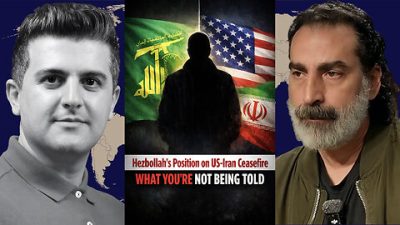
Laith Marouf: Hezbollah’s position on US-Iran ceasefire
or go to
Aletho News Archives – Video-Images
From the Archives
Is Israel to blame for the Iraq War?
American Goy | March 10, 2008
I am so tired of this old canard that “Israel had nothing to do with USA’s war with Iraq – in fact, it officially advised America against it”.
Bullshit. … continue
Blog Roll
 Aletho News
- Laith Marouf: Hezbollah’s position on US-Iran ceasefire: What you’re not being told
- Israel’s priority lies in destroying chances of peace between Iran, US: Ex-UN nuclear chief
- Ceasefire for all or for none: Iran shuts Hormuz over Lebanon attacks
- Strait of Hormuz is Iran’s ‘nuclear weapon’ that forced US retreat: Medvedev
- Energy crisis will last for months – Kremlin envoy
- Europe’s quiet role in the war on Iran
- Forty days that shook the Empire: How Iran turned the tables on US and prevailed
- Netanyahu unilaterally declares Lebanon outside of ceasefire deal
- Israeli leaders: ‘Not a single goal’ achieved in war with Iran
- What on earth just happened? Trump, Iran, and the unlikely ceasefire
- If Americans Knew
- Gazans face a triple crisis: severe shortages of water and bread, healthcare in tatters
- NY Times reports how Netanyahu took the US into Iran War
- A sigh of relief over Iran, but Gaza and Lebanon in dire straits – Daily Update
- Thousands dead and neighborhoods razed to the ground: Aid agencies fear southern Lebanon is becoming the new Gaza
- The war the US is fighting for Israel could cost trillions
- ‘Cigarette Burns, Nail Wounds’: Toddler Tortured in Gaza to Coerce Father
- Trump Says US Sent ‘a Lot of Guns’ to Protesters in Iran
- Israeli forces destroy 17 UN peacekeeper cameras in south Lebanon
- US-Israeli strikes ‘completely destroy’ synagogue in Tehran
- Archbishop for US Military Says Iran War Is Unjust Under Catholic Teaching
- No Tricks Zone
- An Inconvenient Tree: Uncovered In Alps… Europe Much Warmer Than Today 6000 Years Ago
- New Study Reports A 60% Slowdown In Greenland’s Ice Loss Rate In The Last Decade
- Low Intensity Tornado Wrecks Major Solar Farm, Creating A Potential Toxic Dump
- New Study Finds Warming Saves Lives…Cold Temperatures 12 Times More Deadly Than Excess Heat
- German Science Blog Accuses PIK Climate Institute Of Hallucinating Climate Tipping Points
- Devastating Assessment Of Comirnaty Vaccine By Former Senior Pfizer Europe Toxicologist
- New Study: CO2 Is ‘Effectively Negligible’ As An Explanatory Climate Change Factor Since 2000
- Former Pfizer Toxicologist Dr. Helmut Sterz Tells Bundestag Hearing Pfizer Vaccine Should Have Never Been Approved
- Energy Expert: Germany’s Nuclear Phaseout Was A “500 Billion Euro Mistake”
- New Research: South Australia’s Mid-Holocene Sea Surface Temperatures Were 4°C Warmer Than Today
 Aletho News