Netflix and The White Helmets, ‘Hand in Hand with Al Qaeda’

21st Century Wire | September 15, 2016
Has Netflix revealed itself to be another deep state conscript? The recent Syria White Helmet promotional movie has caused uproar among people awakened to the US, UK state and intelligence agency involvement in this pseudo ‘first responder’ faux NGO outfit that has infiltrated Syria on behalf of its funders and donors based in the US and NATO neocolonialist “regime change” command centres.
Funded to the tune of over $60 million by the US, UK and EU member states, these mercenaries in beige clothing have a base of operations in Turkey, but appear to operate exclusively in terrorist-held zones in Syria, and can also be seen running ‘mop-up’ operations for Al Nusra Front and other terrorist fighting groups.
The ‘White Helmets’ documentary premiered today at the Toronto International Film Festival, and on Netflix streaming website.
The following are a few examples of the comments being left on the Netflix trailer for their White Helmets “documentary”:
“Dear Netflix: STOP SUPPORTING TERRORISTS. The so called White Helmets are a transparent construct of NATO to take over Syria by stealth in the guise of “do gooders”. NO serious journalists who have been to Syria believe they are doing what this film suggests. Only journalists too lazy to think for themselves believe this. NO locals in Syria have seen these white Helmets in their white helmets – except when their very expensive cameras turn up to film them for propaganda.
And shame on any news outlet who has bought any of that footage and bought their story hook line and sinker without investigating their known connections to Al Nusra and Al Qaeda.Syrian men trying to really save children are hindered from doing so by inhumane sanctions and by the White Helmets blocking roads and villages. Local heroes have no supplies, they do not have a 90 million pound budget to get food, and first aid or digging equipment, yet nobody makes a film about these people… the real Syrian people.
Local people say these are mercenaries who wear ordinary clothes, are not Syrian, and are committing atrocities and keeping food and supplies from reaching cities and villages. Paid terrorists loaded with weapons and supplies and a 90 million pound budget from EU and NATO countries who have an obsession with illegally deposing an honestly elected president of a nation state. It is another way to take over a regime… without using bombs.. by stealth, this is a Trojan Horse and these men are not heroes at all but murderers and thieves. ASK THE PEOPLE OF SYRIA. GO TO SYRIA and see for yourself. Do not just use footage made by terrorists and spread it all over the world when it is the opposite of the truth.”

Image creation: Cory Morningstar of Wrong Kind of Green
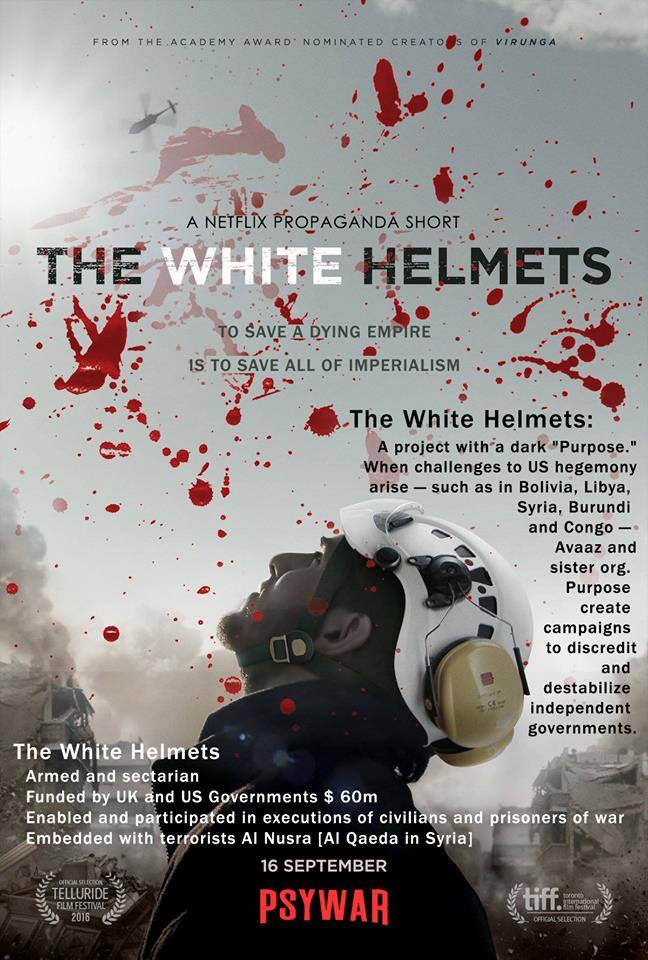
“Soros production, pure propaganda.”
“In Aleppo, the most important thing to remember is that all life is precious”. So precious that the White Helmets are ready to take the dead bodies away after Al-Qaeda executes them, while the camera is still rolling!!”
“When the saint go marching in”, White Helmets are not saints, they are terrorists. When not in front of a camera, they take off their white helmets and strap on their guns.”
“The white helmets are a media blitz project created by the US & UK in which they received monies from the state department & billionaires who made their fortune in the oil and gas industry.”
21WIRE will be bringing you more detailed reports on the Soros funding of the Netflix operation and of course further information on the REAL Syria Civil Defence that journalist Vanessa Beeley has recently met with and interviewed in Syria – in Aleppo, Lattakia, Tartous and the Head Quarters in Damascus.
Here is an excellent alternative to the Netflix official trailer made by Steve Ezzeddine for Hands Off Syria, Sydney. Watch:
For a further reading on the White Helmets and their role in the Dirty War on Syria read 21st Century Wire’s comprehensive compilation of the most important investigations into NATO’s latest fifth column creation: Who are the Syria White Helmets
Cost of US post-9/11 wars approaching $5trn – report
RT | September 16, 2016
The US spent $4.79 trillion on wars in the Middle East and on the ‘War on Terror’ after the September 2001 terrorist attacks, a new report estimated.
The report by the Cost of War Project, which is run by Brown University’s Watson Institute, counted the total budgetary cost of the wars America waged in Afghanistan, Iraq, Pakistan and Syria as well as on counter-terrorism.
The $4.79 trillion figure includes future obligations to spend budgetary money through 2053, estimated future spending on veterans, interest already paid for money borrowed for the war effort and other relevant expenditures. This is $300 billion higher than what the project reported in 2015.
The estimate does not include interest the US is expected to pay on war loans, but says the current operational cost may pale in comparison.
“Interest costs for overseas contingency operations spending alone are projected to add more than $1 trillion to the national debt by 2023. By 2053, interest costs will be at least $7.9 trillion unless the US changes the way it pays for the wars,” wrote report author Neta Crawford, professor of political science at Boston University and co-director of the Costs of War Project.
The figure also excludes costs that are difficult to estimate such as the spending on veterans by local and state budgets. Neither does it put a dollar cost on loss of human life or the toll the wars take on the US economy. The former was detailed in an earlier report published in August. The macroeconomic impact is addressed briefly and is said to have “cost tens of thousands of jobs, affected the ability of the US to invest in infrastructure and probably led to increased interest costs on borrowing, not to mention greater overall federal indebtedness.”
The paper details other estimates of the cost of war by US officials and scholars, saying that they were more conservative.
“This paper’s estimate of current and future costs of war greatly exceeds pre-war and early estimates. Indeed, optimistic assumptions and a tendency to underestimate and undercount war costs have, from the beginning, been characteristic of the estimates of the budgetary costs and the fiscal consequences of these wars,” the report said.
European companies export highly-polluted fuel to West Africa: Report
Press TV – September 16, 2016
European companies are accused of taking advantage of weak fuel standards in African countries to export highly-polluted fuel to West Africa, a new report says.
The report, from the Swiss watchdog group of Public Eye, said major European oil companies and commodity traders take crude oil from African countries, blend it with highly-polluted additives, and then sell it back to them.
“Many West African countries that export high grade crude oil to Europe receive toxic low quality fuel in return,” it wrote.
Toxic products that the companies add to make the so-called “African Quality” fuels are far higher than those allowed in Europe, according to Public Eye.
“Their business model relies on an illegitimate strategy of deliberately lowering the quality of fuels in order to increase their profits,” the report read.
It said companies, among them the Swiss commodity traders Trafigura and Vito, increased their profits at the expense of Africans’ health.
While the European Union (EU) has allowed ten parts per millions (ppm) of sulfur in diesel in the continent, the legal limit on sulfur petrol in some African countries like Nigeria is 3,000 ppm.
After burning, the sulfur is released into the atmosphere as sulfur dioxide and other particulates that provide a major contributor to respiratory symptoms such as bronchitis and asthma.
According to the report, 20 million people in the Nigerian state of Lagos breathe 13 times more particulate matter than people in London, with dirty fuel being the main reason.
This is while Nigeria and some other West African countries produce petroleum with the world’s lowest sulfur levels. They do not have refining capabilities, however, and have to import fuel from Europe.
“Africa could prevent 25,000 premature deaths in 2030 and almost 100,000 premature deaths in 2050” if the export of low-quality fuel is stopped, Public Eye said.
It called on African governments “to protect the health of their urban population, reduce car maintenance costs, and spend their health budgets on other pressing health issues.”
“If left unchanged, their practices will kill more and more people across the continent,” the report warned.
In response to the allegations, the report said, three of the companies denied any wrongdoing, arguing that they meet the regulatory requirements of the market.
Public Eye, however, said that the companies adjusted their blends with no increased costs when Ghana lowered its sulfur content level in 2014.
Debris from abandoned WW II-era Arctic military base polluting Greenland
cbc news | September 11, 2016
… Baxter says there are likely still 800 cases of dynamite stored in a wooden shed on the abandoned base, along with buried ammunition all over the site.
“The army sent a demolitions expert up to dispose of [the dynamite], but he said it was too risky to fool with, so he left.” … Read full article
Clinton’s new book sells less than 3,000 in first week
By Rebecca Savransky | The Hill | September 14, 2016
Democratic presidential nominee Hillary Clinton’s newest book sold fewer than 3,000 copies in its first week on sale, The New York Times reported.
The book, titled “Stronger Together,” outlines policies Clinton would pursue if she were elected president.
According to the Times, a book’s first-week sales normally make up about a third of the total sold.
The book features a photo of Clinton and her running mate, Sen. Tim Kaine (D-Va.), on the cover and labels it: “A blueprint for America’s future.”
It gives readers “specific and practical solutions, while also articulating a bold and expansive vision of change and renewal” and runs about 250 pages.
The proceeds from the book will reportedly go to charity.
In line with the release of the book, Clinton plans to do “a series of ‘Stronger Together’ speeches over the course of the next several weeks,” campaign spokeswoman Jennifer Palmieri said, according to the Times.
Clinton talked about her book last week.
“We’re putting out a book tomorrow, called ‘Stronger Together,’ which is our blueprint for America’s future,” Clinton said at the time, speaking with reporters on her plane. “We wanted voters to be able to find, in one easy place, all of the various plans and policies that I’ve been talking about throughout this campaign.”
IEA says oil market dynamic set to change
Press TV – September 15, 2016
The International Energy Agency (IEA) says the national oil companies (NOCs) will continue to dominate upstream oil and gas investments if oil prices remain at current low levels.
The IEA’s executive director Fatih Birol told Reuters in an interview that the dominance of NOCs in oil investment projects will create a new dynamic in the market.
Birol added that that independent players like Anglo-Dutch Shell, US heavyweight ExxonMobil and France’s Total have already scaled back their investments in upstream projects. He said this is due to falling profit margins caused by weak oil prices.
Birol further emphasized that NOCs like Saudi Aramco, China’s CNPC and Mexico’s Pemex have raised their share of upstream investments to a 40-year high of 44 percent.
On the same front, Reuters highlighted IEA figures as showing that more than $300 billion of upstream oil and gas money has been slashed in 2015 and 2016 – in what appears to be an unprecedented amount.
The largest cost cuts have been implemented by North American independent companies that include Apache, Murphy Oil, Devon Energy and Marathon. The IEA said the companies have all reduced spending by around 80 percent between 2014 and 2016.
The Agency further added, as Reuters reported, that NOCs in Saudi Arabia, the UAE and Qatar have increased their capital for fresh investments via government bond issues. This policy, it said, has allowed them to make up for lower oil revenue.
Birol also said that the oil market could soon enter a new dynamic in which production decisions are less driven by market fundamentals.
“There are some NOCs that take other factors into consideration when making decisions,” Birol said, referring to internal economic or political issues as well as defense of market share.
Rooting Out the North Korean Nuclear Crisis: the Past and Present U.S. Role
By Christine Hong and Paul Liem | CounterPunch | September 15, 2016
North Korea’s nuclear test of September 9, 2016, the fifth and largest measuring twice the force of previous blasts, prompted a predictable round of condemnations by the United States and its allies along with calls for China to step up its enforcement of sanctions on North Korea. Yet few “expert” analyses suggest that China will risk destabilizing North Korea or that further United Nations resolutions and international sanctions will succeed in deterring North Korea from pursuing its nuclear weapons and missile programs.
The Obama administration’s reliance on China to rein in North Korea is at odds with its efforts to contain China’s influence in Asia, a quixotic goal in itself. It reflects an unrealistic desire for China to be influential just enough to do the bidding of the United States but not powerful enough to act in its own interests. North Korea is, after all, China’s strategic ally in the region, and it is in South Korea that the United States plans to deploy THAAD, a defense system with radar capable of tracking incoming missiles from China. It is simply not in China’s interest to risk losing an ally on its border only to have it replaced by a U.S.-backed state hosting missile-tracking systems and other military forces targeting it. And China knows it is not the target of North Korea’s nukes. If the United States cannot punt the problem of North Korea’s nuclear weapons to China it must deal with North Korea directly.
Indeed, in response to U.S. Secretary of Defense Ashton Carter’s recent condemnation of China’s “role” and “responsibility” in failing to restrain North Korea’s nuclear pursuits, the Chinese Foreign Ministry issued a statement calling on the United States to take a long hard look at its own foreign policy:
The cause and crux of the Korean nuclear issue rest with the US rather than China. The core of the issue is the conflict between the DPRK and the US. It is the US who should reflect upon how the situation has become what it is today, and search for an effective solution. It is better for the doer to undo what he has done. The US should shoulder its due responsibilities.[1]
In equally unmincing terms, the Global Times, an offshoot of the People’s Daily, charged the United States with “refusing to sign a peace treaty with Pyongyang” in a September 11, 2016 editorial. Alluding to a long history of U.S. nuclear threats against North Korea, the editorial elaborated: “The Americans have given no consideration to the origin and the evolution of North Korea’s nuclear issue or the negative role Washington has been playing over the years.” It further clarified: “Without the reckless military threat from the US and South Korea and the US’s brutal overthrow of regimes in some small countries, Pyongyang may not have developed such a firm intent to develop nuclear weapons as now.”[2]
Despite President Barack Obama’s efforts over his two terms in office to “pivot” or “rebalance” U.S. foreign policy to Asia and the Pacific and his repeated identification of the United States as a Pacific power, the memory of nuclear ruin in the region is shadowed by the history of the United States as a first-user of atomic weapons against civilian populations in Japan at the close of World War II and as a tester of devastating nuclear technology, including human radiation experiments, in the Marshall Islands during the Cold War. Moreover, it has not gone unnoticed that President Obama, despite his professed commitment to nuclear de-escalation, has refused to issue an “unequivocal no-first-use pledge.”[3]
In Korea, the one place on the planet where nuclear conflagration is most likely to erupt, given the current state of affairs, President Obama can still end the threat of nuclear warfare. This would require what few in his administration appear to have entertained, namely, the elimination of the demand for North Korea to agree to irreversible denuclearization as a precondition for bilateral talks. This rigid goal makes it virtually impossible for the United States to respond positively to any overture from North Korea short of a fantastic offer by that country to surrender all its nuclear weapons. The premise that the denuclearization of North Korea is necessary to ensure peace and stability on the Korean peninsula needs to be shelved, and all possibilities for finding common ground upon which to negotiate the cessation of hostilities on the Korean peninsula should be explored.
It should be recalled that possibly no country, including Japan, has greater fear of overbearing Chinese influence than North Korea. Arguing for the relevance of past U.S. negotiations with North Korea, Stanford scholar Robert Carlin points out that North Korea in 1996 opposed President Clinton’s notion of Four-Party talks involving China because they “went counter to a basic Pyongyang policy goal; that is, to limit Chinese influence by improving U.S.-DPRK relations.”[4] More recently, former CNN journalist Mike Chinoy, similarly observed: “[North Koreans] hate the idea that the Chinese can come in and tell them what to do. And the reality is the Chinese can’t.”[5]
At this juncture, given the demonstrated failure of President Obama’s “strategic patience” or non-negotiation policy with North Korea, the unthinkable must be seriously considered. Could an alliance between the United States and North Korea preserve U.S. influence in the region, albeit along avowedly peaceful lines, provide North Korea with a hedge against infringement of its sovereignty by China and eliminate the rationale for deploying THAAD in South Korea, thus alleviating a major sore point between China and the U.S.-South Korea alliance?
Let us also recall that North Korea offered to halt testing of its nuclear weapons if the United States agreed to put an end to the annual U.S.-South Korea war games.[6] Combining live artillery drills and virtual exercises, these war games, as of this year, implemented OPLAN 5015, a new operational war plan that puts into motion a preemptive U.S. nuclear strike against North Korea and the “decapitation” of its leadership. Unsurprisingly, North Korea considers this updated operational plan to be a rehearsal for Libya-style regime change. In January of this year, the United States turned down North Korea’s offer before the start of the spring U.S.-South Korea war games, and did so again in April.[7] The United States has thus twice this year dismissed the prospect of halting North Korea’s advance towards miniaturizing a nuclear bomb and fitting it atop an intercontinental ballistic missile (ICBM) capable of reaching the continental United States ostensibly because North Korea refused to entertain U.S. insistence on its complete denuclearization as part of the package.
President Obama should prioritize any and all possibilities for achieving a halt to North Korea’s nuclear programs by diplomacy, over the goal of achieving an illusory agreement for complete denuclearization. As an achievement, halting North Korea’s nuclear advances is far short of the peace treaty needed to bring an end to the Korean War and a lasting peace to Korea. It is far short of creating international conditions for the Korean people to achieve the peaceful reunification of their country. And it is a far cry from achieving nuclear disarmament on a global scale. Yet, as a redirection of U.S. policy towards engagement with North Korea, it would be the greatest achievement in U.S. Korea policy of the last fifteen years, and a concrete step towards achieving denuclearization in the region, and worldwide.
Notes.
[1] “Foreign Ministry Spokesperson Hua Chunying’s Regular Press Conference on September 12, 2016,” Ministry of Foreign Affairs of the People’s Republic of China, 12 September 2016, available online at http://www.fmprc.gov.cn/mfa_eng/xwfw_665399/s2510_665401/t1396892.shtml.
[2] “Carter Wrong to Blame China for NK Nuke Issue,” Global Times, 11 September 2016, available online at http://www.globaltimes.cn/content/1005942.shtml.
[3] David E. Sanger and William J. Broad, “Obama Unlikely to Vow No First Use of Nuclear Weapons,” The New York Times, 5 September 2016, available online at http://www.nytimes.com/2016/09/06/science/obama-unlikely-to-vow-no-first-use-of-nuclear-weapons.html.
[4] Robert Carlin, “Negotiating with North Korea: Lessons Learned and Forgotten,” Korea Yearbook: Politics, Economy and Society, eds. Rüdiger Frank et al. (Leiden and Boston: Brill, 2008), 241.
[5] Qtd. in James Griffiths, “What Can China Do about Nuclear North Korea,” CNN, 7 January 2016, available online at http://www.cnn.com/2016/01/07/asia/north-korea-china-nuclear-test/.
[6] See “North Korea Says Peace Treaty, Halt to Exercises, Would End Nuclear Tests,” Reuters, 16 January 2016, available online at http://www.reuters.com/article/us-northkorea-nuclear-usa-idUSKCN0UT201.
[7] See “Obama Rejects North Korea’s Offer to Ease Nuclear Tests if U.S. Stops War Exercises with South,” Association Press,24 April 2016, available online at http://news.nationalpost.com/news/world/obama-rejects-north-koreas-offer-to-cease-nuclear-tests-if-u-s-stops-war-exercises-with-south.
Billions in Taxpayer Money to Israel: How the NYT Hides Unsavory Facts from View
By Barbara Erickson | TimesWarp | September 15, 2016
Thanks to American taxpayers, Israel has been receiving $3.1 billion in direct military aid each year, and under a new agreement signed this week that amount is set to rise to $3.8 annually. This is a hefty package and major news, but The New York Times has been oddly reticent about it, running a story on page 6 of the print edition and without fanfare online.
This is not a new phenomenon at the Times. Over the past year, as the United States and Israel have negotiated a new 10-year memorandum of understanding concerning military aid, readers have seen few references to the topic, and even with the signing of a new agreement this week, the newspaper maintains its minimalist approach.
The article by Peter Baker and Julie Hirschfeld Davis gives few details of the deal, instead proving a great deal of space to the state of U.S.-Israeli relations. The story reports that the present aid package (signed in 2007 and due to expire next year) amounts to “about $3 billion a year” with additional funds of up to $500 million a year authorized by Congress for missile defense.
We also learn that Israel made some concessions in negotiations, that this week’s deal is “the largest of its kind” and that Israel receives more U.S. money than any other country. But much is missing.
In fact, Israel gets more than half of all U.S. military aid ($3.1 billion out of a total of $5.9 billion), and Israel together with Egypt receives 75 percent of American foreign military assistance. Since the large allotment for Egypt is aimed at maintaining a non-threatening neighbor on Israel’s border, this could also be counted as indirect aid to Israel.
In fact Israel has been receiving well over $3.1 billion. By a conservative estimate, the United States has been giving the country $3.7 billion in direct aid annually with funds for immigrants to Israel, grants for American hospitals and schools, “joint defense projects” with the Department of Defense, and an early disbursement of aid.
The last item on that list refers to a special arrangement: In contrast to other recipients, Israel receives all its funds from the United States in one lump sum within the first month of the fiscal year. The money is then transferred to a Federal Reserve Bank interest-bearing account, allowing Israel to accrue some $15 million annually in interest.
Then there are other perks, such as loan guarantees, “cash flow financing,” and the right to purchase arms directly from companies rather than going through a Department of Defense review.
In addition, donations sent by Jewish and Christian groups to support settlements are tax-exempt. So every dollar donated to support the colonization of Palestinian land means the loss of at least 20 cents that should go into the U.S. treasury. This is an indirect subsidy to Israel that has cost American taxpayers an incalculable amount, at least some tens of millions of dollars.
The Times, however, has shown no interest in revealing the full extent of aid or of pursuing the arguments against pouring so much money into Israel. This week’s story mentions criticism of the aid agreement not until about three quarters into the text, and then it is reduced to three bland paragraphs with quotes from the representative of an anti-occupation organization.
In fact, the opposition goes well beyond such groups. A member of Congress, Rep. Betty McCollum (D-MN), has asked the State Department to investigate Israeli military units for possible violations of the Leahy Act, which prohibits the dispersal of U.S. funds to groups that violate human rights with impunity.
In 2012, 15 leaders of major religious organizations wrote to Congress asking that military aid be made contingent on compliance with American law. Other groups have sponsored billboards in various areas of the country highlighting the incredible largesse the United States provides for Israel.
Moreover, a poll of Americans taken in 2014 revealed that 60 percent believed the United States gives too much aid to Israel, and of that group 34 percent said it received “much too much.” The percentage claiming that our aid package was excessive was even higher (65 percent) among Americans under 34.
Other commentators have noted that Israel is a wealthy country, with universal health care, and is less in need of help than American citizens who struggle to fund their schools, pay for prescription drugs and meet medical fees.
None of this debate appears in the Times, which seems determined to keep the subject well below the radar. Thus we find a lightweight story on the inside pages of the print edition, well behind a more prominent one about Syrian and Israeli skirmishes in the Golan Heights, and an uninformative one-minute video of the signing ceremony on the Middle East page.
Times readers are to remain ignorant of the full, unsavory story about U.S. aid to Israel. If the facts were fully reported, this might inspire unwelcome questions and pushback. Better to say as little as possible and allow Israel to keep collecting its yearly billions from American taxpayers.
Follow @TimesWarp on Twitter.
He may have insulted Obama, but Duterte held up a long-hidden looking glass to the US
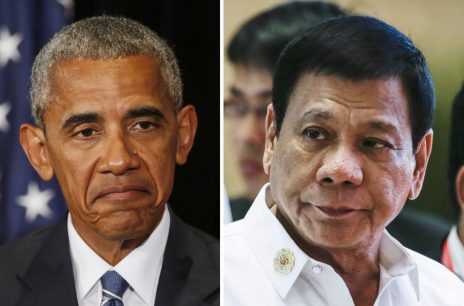
Insulting Barack Obama made the headlines, but Rodrigo Duterte’s remarks referred to a long and dark history of US interference in the Philippines.
Narendra Shresthma, Mast Irham/EPA
By Adele Webb | The Conversation | September 8, 2016
Philippine President Rodrigo Duterte has taken his “bad manners” – having gained global notoriety with his election campaign insults earlier this year – to a new level.
At a press conference at Davao International Airport on Monday, on his way to meet US President Barack Obama and other leaders attending the ASEAN summit, Duterte muttered a few short words in tagalog at the end of a lengthy and irritated reply to a local journalist. With those words, he again made international headlines.
What did Rodrigo Duterte call Barack Obama?
If that were all there was to it, we could rightly roll our eyes and move on. After all, Duterte’s language is vulgar; his slander of people and groups is liable to incite violence; and his determination to kill drug pushers (to fight “crime with crime”) an abuse of power. He should not be defended for any of this.
But as someone who has spent a long time studying US-Philippine relations, I think there’s something more for us to see here. And if we want to judge the Philippine president (and, by default, the nation for electing him) from high moral ground, I think we have a responsibility to pay attention to it.
Restoring an invisible history
Who is he to question me about human rights and extrajudicial killings?
So asked Duterte on Monday. It’s actually a very good question, and one long overdue from a Philippine president. The extent to which the violence of US relations with the Philippines has been made invisible by a history written predominantly by Americans themselves cannot be overstated.
It began with a three-year war (1899-1902) that most Americans have never heard of. The war overthrew a newly independent Philippine republic and cost between 250,000 and a million Filipino lives – only to be called “a great misunderstanding” by American colonial writers.
After all, the US had chosen the Philippines to be its great Asian “showcase of democracy”. The invasion was a benevolent act. Hence the complete erasure of acts of American violence from the Philippine national story.
 The 20th Kansas Volunteers march through Caloocan after the battle of February 10, 1899, early in the war that toppled the first Philippine republic. G.W. Peters/Internet Archive

You don’t need to be a conspiracy theorist to smell something rotten. Since the 1950s Philippine writers, academics, journalists and so on have been trying to reframe the historical narrative to point out this fact: to be invaded by a military power, told you don’t possess the character or capability for self-government, and then controlled by another nation for four decades, to the occupier’s lucrative commercial benefit, was not to be the recipient of a benevolent act.
Even at the time the war was taking place, one of America’s best-loved authors was writing just as much. Mark Twain was prolific in writing about the paradox of the “democratising mission” to the Philippines.
Penned in 1901, but still stunningly poignant, is this extract from his essay, To the Person Sitting in Darkness:
The Person Sitting in Darkness is almost sure to say: ‘There is something curious about this – curious and unaccountable. There must be two Americas: one that sets the captive free, and one that takes a once-captive’s new freedom away from him, and picks a quarrel with him with nothing to found it on; then kills him to get his land.’
In America, these remain Twain’s least-known works.
Before his (now regretted) distasteful remark, Duterte had much to say in response to the question about being confronted over human rights in an upcoming meeting with Obama. He was responding to murmurs from critics that, if he wouldn’t listen to anyone else about the extrajudicial killings in the Philippines, just wait until he meets the US president.
No-one seems to have listened to or cared much about the other six minutes of Duterte’s reply. So let me tell you something about it. It was a reclaiming of the historical narrative of Philippine-US relations, a holding up to the US of the hidden “looking glass” Mark Twain had written about 100 years earlier.
 The Macabebe Scouts were a native Filipino force of the US Army during the Spanish–American War. The Ardvaark/Wikipedia Commons
An assertion of independence
Calling out the hidden insinuations, as Duterte did, that the US continues to have authority over the politics of the Philippines, is bold and brazen, but reasonable. Consider his statement:
I am a president of a sovereign state. And we have long ceased to be a colony. I do not have any master but the Filipino people.
These words are less evidence of his demagoguery or an intention to personally disparage Obama than a reference to history, and are more accurately read as such.
After the second world war, colonies of any sort, even the so-called “democratic” US one in the Philippines, were on the nose. But this didn’t stop Washington officialdom from continuing to claim the right of access to the Philippines’ political and economic realms.
When the US finally granted the Philippines its (second) independence in 1946, it required the new republic to amend its constitution so a bill could be passed that, as well as legislating preferential trade conditions for the US, would grant American citizens equal rights with Filipinos to Philippine natural resources. It was the beginning of a new phase: neocolonialism.
It was not just a matter of political interference and the power to make or break Philippine presidents with endorsement and strategic financial support. In a visceral sense, the nation was always being watched and judged by its democratic “teacher”.
 School Begins: Uncle Sam lectures his class in Civilisation (the pupils are labelled Philippines, Hawaii, Puerto Rico and Cuba). Puck Magazine 1899
Asked about being confronted with human rights concerns by Obama, Duterte said:
You must be kidding. Who is he to confront me? America has one too many to answer for the misdeeds in this country … As a matter of fact, we inherited this problem from the United States. Why? Because they invaded this country and made us their subjugated people … Can I explain the extrajudicial killing? Can they explain the 600,000 Moro massacred in this island [Mindanao]? Do you want to see the pictures? Maybe you ask him. And make it public.
I’m reminded of a comment by Alicia Garza, a founder of the Black Lives Matter movement ignited by police killings of black Americans. Speaking in Sydney last weekend at the Festival of Dangerous Ideas, she related how, when civil rights protests get uncomfortably heated, she is often asked: “Why are they so angry?” She paused. Then softly giggled, giving the audience time for the ludicrousness of the question to sink in.
Why is the Philippines president so angry about the prospect of the US president confronting him about human rights abuses? History. As Duterte said himself on Monday, violent acts of the past don’t stay in the past. They get passed on from generation to generation, especially when the injustice goes unacknowledged and unaddressed.
It is difficult to stomach Duterte’s style. It certainly is difficult to look past the serious issues raised by his administration’s “war on drugs”. We should condemn his misuse of power.
But if we condemn the president for his recent remarks because we claim to be concerned about the rights of Filipinos while showing no interest in acknowledging the past crimes and injustices against the Philippines, we fall into our own sort of hypocrisy.
Let’s be honest, if Duterte didn’t curse and swear and offend our sensibilities, would we be paying so much attention to the Philippines? For once, I heard a Philippine president holding the US to account for all its doublespeak and hypocrisy in US-Philippine relations. And I couldn’t help but appreciate that.
Adele Webb, PhD Researcher, Department of Government and International Relations / Sydney Democracy Network, University of Sydney
Disclosure statement
Adele Webb does not work for, consult, own shares in or receive funding from any company or organization that would benefit from this article, and has disclosed no relevant affiliations beyond the academic appointment above.
Women’s Boat to Gaza sets sail to try to break Israeli blockade

IMEMC News – September 15, 2016
Two boats with all-women crews set sail Wednesday for the Gaza Strip from Barcelona, Spain. They are planning to travel across the Mediterranean and break the Israeli blockade on Gaza by delivering much-needed medical supplies to the people of Gaza.
The participants in the siege-breaking boat hail from fifteen different countries and include members of Parliament and other dignitaries.
From Barcelona, the boats will travel to France, and one other port before heading to Gaza. This is just the latest of a series of boats that have tried to break the blockade on Gaza since Israel imposed the air, sea and land blockade in 2006.
The mayor of Barcelona, Ada Colau, arrived at the port on Wednesday along with hundreds of supporters, to offer her support for the mission of the Women’s Boat to Gaza trip.
The two boats have been named the “Amal”, which means ‘hope’ in Arabic, and “Zaytouna”, which means ‘olive’ in Arabic.
The list of passengers includes Tunisian MP Latifa Habashi; Malin Björk, a Member of European Parliament from Sweden; Ann Wright, a retired U.S. Army Colonel and former U.S. diplomat who resigned in 2003 in opposition to the invasion of Iraq; and Dr. Fauziah Modh Hasan, a Malaysian physician who has participated in many humanitarian missions with the Malaysian Medical Relief Society.
The Chairman of the Popular Committee to Support Gaza, Essam Youssef, said in a statement that the Women’s Boat to Gaza is “a humanitarian cry in the face of an illegitimate siege imposed on an innocent people that has been calling for years on the international community for help.”
He added, “Palestine will remain the axis of struggle not just in the Middle East but also in the world. Achieving justice for Palestine is the key to stability in the region and the world.”
Wednesday’s launch of the Women’s Boat to Gaza came just as the U.S. Congress authorized an unprecedented $38.5 billion aid package to Israel, despite acknowledging in the same session that Israeli settlement expansion in the West Bank has violated all signed agreements and international law.
Duterte’s Power Play: Rocking the US-Philippines Alliance
By Binoy Kampmark | Dissident Voice | September 14, 2016
I do not like the Americans. It’s simply a matter of principle for me. — Philippine President Rodrigo Duterte, September 12, 2016
The frictions excited by the antics of Philippine President Rodrigo Duterte have caused even greater heat over the last few days, with calls for the departure of US special forces operating in Mindanao. Having already made it clear to Washington that he intends pursuing “an independent foreign policy,” he has now insisted that the general root of ills in instability lie in the troublesome, headache-causing alliance with the United States.
A continuing problem of that alliance remained US forces in Zamboanga on the island of Mindanao, ostensibly engaged in advising local troops on counter-terrorism operations. “For as long as we stay with America, we will never have peace in that land [Mindanao]. We might as well give it up.” It was therefore imperative that “those [American] special forces, they have to go.” He did not want “a rift with the US, but they have to go.”
Nothing could stand in greater contrast to such sentiment than the pact of 2014 signed between Manila and Washington, a confirmation of all the ills Duterte despises. While that agreement did not countenance the reopening of US bases in the Philippines, something that would have had a constitutional hurdle to climb, it permitted roving and near unlimited US access to military bases across the country.
Despite the pretence of being severed from the US umbilical cord in 1946, the neo-colonial aftertaste has remained. From 2002 to 2013, $441 million in security funding was provided to Manila. The Obama administration had set aside a hefty $120 million in military aid for 2016.
As Senator Miriam Defensor-Santiago, chairman of the Philippines Senate Committee on Foreign Affairs, explained with the signatures on the agreement barely dry, the agreement was of limited value to the country, while being splendid for US interests.
In signing the agreement, the US “could claim that it has ‘contained’ China, because the Asian countries involved, including the Philippines, are now bound by their respective agreements with America.”
This would, in effect, convert Manila into a compliant satellite to Washington’s goals in the Asia-Pacific. As if to emphasise that point, both states had agreed earlier this year to the deployment of thousands of American troops to five Philippine bases, measures that are hardly accidental given the spike in tensions in the South China Sea.
President Barack Obama has preferred to avoid the terminology of containment and control, preferring to see such moves as pursuant to a self-proclaimed international order of norms. When one is attempting to be a decent bully on the international stage, cast a nod in the direction of international law. “Our goal,” he explained in 2014, “is to make international rules and norms [that] are respected, and that includes areas of maritime disputes.”
The boisterous Duterte, a vastly different creature from Benigno Aquino III, has issued directives to his defence secretary to seek military supplies from China and Russia rather than US sources. “I want weaponry and armaments…. We don’t need F16 jets, that is of no use to us.” Jets were useless in counter-insurgency operations in the Philippines; far better stick, he suggested, to “propeller-driven planes”.
Such moves are not suggestive of a total distancing from the United States; Duterte is evidently keen to widen his appeal to other powers, rather than clinging on the tired assumption that all that stems from Washington is somehow good. On that level, the politics is sound, an attempt to defuse a confrontation that risks involving China and the US in a regional punch-up.
The Philippine military were also bemused by the Presidential directive, unclear about how they were to go about their new orders. In the words of a defence spokesman, “We are awaiting guidelines on how the president’s policy statements will be implemented.”
On Tuesday, Duterte also explained that the Philippines would cease patrolling the South China Sea alongside the US Navy. What was less extensively reported by US media outlets is that he would prefer Filipino forces to be doing their own patrolling up to 12 nautical miles offshore, rather than having entanglements with either US or Chinese forces.
All that said, a more than significant nudge is being contemplated in Beijing’s direction, while the president envisages refocusing the broader struggle on domestic maladies: drug trafficking and niggling insurgencies. “Only China will help us,” he claimed. “America just gave you principles of law and nothing else.”
The old myopic view that Duterte is merely the resident buffoon and brute is delightfully simple, but one that has currency in the corridors of US power. It holds that he is an aberration, that his legacy will pass, and that his views are of no consequence. US officials persist doing this at their peril, attempting to place Manila, by proxy, in line of Beijing’s ire.
As the distributed Nelson Report (September 14), a summary dispatch on foreign relations, put it, “if you want to see what a Trump Presidency would look and sound like, watch the Philippines’ Duterte… an impertinent reference to Trump’s unpredictability, boorishness, lack of knowledge or sophistication, and penchant for ill-considered dramatics.”
The point that has been missed is that this entire revision has been stewing for some time. It has bubbled with fury, bypassing the traditional, submissive structures of power that have favoured an imperial influence for all too long. The point to see will be whether Duterte’s legacy persists in its indignation and redirection, or fizzles in the great power game.
Binoy Kampmark was a Commonwealth Scholar at Selwyn College, Cambridge. He lectures at RMIT University, Melbourne and can be reached at: bkampmark@gmail.com.
Featured Video

No Threat Can Force Iran’s Surrender /Trita Parsi & Lt Cl Daniel Davis
or go to
Aletho News Archives – Video-Images
From the Archives
What is the Israeli Lobby in Australia Doing in Interfaith Dialogue?
By Ali Kazak | Dissident Voice | October 11, 2015
For years Israel and its lobby around the world have been trying to normalise their relations with Arabs and Muslims without solving the Palestine Question.
One of the methods they resorted to in the last few years is using human rights and community organizations such as interfaith dialogue and Multiculturalism to achieve this objective and to: isolate the Palestinians, marginalise the Palestine question, end Israel’s isolation, and prevent criticism of Israel, knowing that these organisations will be the first to stand against Israel’s violations, racial and religious discrimination.
The group responsible for this task in Australia is The Australia/Israel & Jewish Affairs Council (AIJAC); its Director of International & Community Affairs, Jeremy Jones is in charge of lobbying religious community organizations, specifically Muslims and Christians. Consequently he convened the Faith Communities for Reconciliation, founding participant in the Australian Partnership of Religious Organisations and the Australian National Dialogue of Christians, Muslims & Jews.
AIJAC is a private political propaganda group. It is recognised as the main Israeli lobby in Australia. It coordinates its activities and works intimately with the Israeli embassy in Canberra and different institutions in Israel. It is privately funded by some Jewish businessmen. It monitors closely Australian politicians, the media, ethnic and religious groups, (especially Arabs and Muslims), unions and academics on their stands towards Israel and the Palestine question. … continue
Blog Roll
 Aletho News
- The war of liberation of the Arab and Islamic peoples expands across the Gulf
- Envoy warns UN on Trump’s threat to ‘obliterate’ Iran’s civilian infrastructure
- The Larak Corridor: Iran’s Rial Gate With No US, No Israel, and No Way Around
- ‘Economic terrorism’: Steel facilities hit again in US-Israeli strike
- ‘War Crime’: Iran condemns attacks on Arak, Ardakan nuclear sites
- Two-thirds of Americans want quick end to Iran war even if goals unmet
- Trump to Give “Important Update on Iran” Wednesday in Prime-Time Speech
- Theodore Postol: Iran’s Missiles & Drones Were Underestimated
- Iran To Target Military Industrial-Tech Complex That Facilitated Gaza Genocide
- Collapsing Empire: The Resistance Disarms ‘Israel’
- If Americans Knew
- Israel wants US to bomb more of Iran’s civilian structures (113,000 is not enough) – Not a ceasefire Day 173
- Ann Coulter Rips Into Fox News for Iran War Coverage
- Joe Kent Urges Americans To Call White House and Congress To Object To Sending Troops Into Iran
- DNC Resolution to Reject AIPAC Funding Puts Democratic Leaders in the Hot Seat
- Swedish foundation to build 400 schools as over 650,000 Gaza children remain without education for 2 years
- Israeli army admits photshopping image of slain Lebanese journalist
- This is how Israel is systematically killing health workers under the cover of war in Lebanon
- Carrying life under fire: Israeli invasion of Lebanon leaves pregnant women facing deadly risks
- Champagne all around for the new death penalty (for Palestinians) law – Not a ceasefire Day 172
- Why are Palestinian books struggling to be seen on Amazon?
- No Tricks Zone
- New Study Finds Warming Saves Lives…Cold Temperatures 12 Times More Deadly Than Excess Heat
- German Science Blog Accuses PIK Climate Institute Of Hallucinating Climate Tipping Points
- Devastating Assessment Of Comirnaty Vaccine By Former Senior Pfizer Europe Toxicologist
- New Study: CO2 Is ‘Effectively Negligible’ As An Explanatory Climate Change Factor Since 2000
- Former Pfizer Toxicologist Dr. Helmut Sterz Tells Bundestag Hearing Pfizer Vaccine Should Have Never Been Approved
- Energy Expert: Germany’s Nuclear Phaseout Was A “500 Billion Euro Mistake”
- New Research: South Australia’s Mid-Holocene Sea Surface Temperatures Were 4°C Warmer Than Today
- Storing Green Energy To Last Germany 10 Days Would Require A 60-Million Tonne Battery
- New Studies: UK Sea Levels Were 4 Meters Higher Than Today During The Mid-Holocene
- Destructive Green New Deal: German Energy And Metal Group Warns Of Drastic Crisis
 Aletho News