Obama Flinches at Renouncing Nuke First Strike
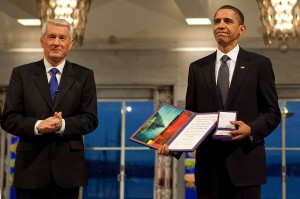
President Barack Obama uncomfortably accepting the Nobel Peace Prize, Dec. 10, 2009. (White House photo)
By Jonathan Marshall | Consortium News | September 8, 2016
Time is running short for President Obama to make good on his 2009 promise “to seek the peace and security of a world without nuclear weapons,” for which he won the Nobel Peace Prize. Yet as both the Wall Street Journal and New York Times recently reported, Obama’s advisers may have just nixed the single most important reform advocated by arms control advocates: a formal pledge that the United States will never again be the first country to use nuclear weapons in a conflict.
Ever since President Truman ordered two atomic bombs dropped on Japan in 1945, the United States has reserved the right to initiate nuclear war against an overwhelming conventional, chemical or biological attack on us or our allies. But peace advocates — and more than a few senior military officers — have long warned that resorting to nuclear weapons would ignite a global holocaust, killing hundreds of millions of people.
In a talk to the annual meeting of the Arms Control Association on June 6, Deputy National Security Advisor Benjamin Rhodes promised that President Obama would continue to review ways to achieve his grand vision of a nuclear-free world during his last months in office. Obama was reportedly considering a “series of executive actions” to that end, including a landmark shift to a “no first use” policy.
Two-thirds of adult Americans surveyed support such a policy. So do 10 U.S. senators who wrote President Obama in July, proposing a no-first-use declaration to “reduce the risk of accidental nuclear conflict” and seeking cut-backs in his trillion dollar plan for nuclear modernization over the next 30 years.
But Secretary of Defense Ashton Carter, Secretary of Energy Ernest Moniz (who oversees the nuclear stockpile), and Secretary of State John Kerry all warned during a National Security Council meeting in July that declaring a policy of “no first use” would alarm America’s allies, undercut U.S. credibility, and send a message of weakness to the Kremlin at a time of tense relations with Russia.
Yet until they took charge of giant bureaucracies whose funding depends on keeping the threat of nuclear war alive, both Carter and Moniz were on record supporting “a new strategy for reducing nuclear threats” and achieving security “at significantly lower levels of nuclear forces and with less reliance on nuclear weapons in our national security strategy.”
In a 2007 manifesto, Carter, Moniz, and other centrist Democratic foreign policy experts rejected the old claim that nuclear weapons are still needed to deter non-nuclear attacks.
“Nuclear weapons are much less credible in deterring conventional, biological, or chemical weapon attacks,” they wrote. “A more effective way of deterring and defending against such non-nuclear attacks – and giving the President a wider range of credible response options – would be to rely on a robust array of conventional strike capabilities and strong declaratory policies.”
They also gave strong implicit support to a no-first-use doctrine, stating that “nuclear weapons must be seen as a last resort, when no other options can ensure the security of the U.S. and its allies.”
Risk of Overreaction
Why does a no-first-use policy matter? In a New York Times column last month, Gen. James Cartwright, former vice chairman of the Joint Chiefs of Staff and head of the United States Strategic Command, emphasized the folly of introducing nuclear weapons into any conflict.
“Using nuclear weapons first against Russia and China would endanger our and our allies’ very survival by encouraging full-scale retaliation,” he and a colleague wrote. “Such use against North Korea would be likely to result in the blanketing of Japan and possibly South Korea with deadly radioactive fallout.”
A policy of no first use, backed up by a reconfiguration of U.S. nuclear forces to reduce their offensive capabilities, would lower the chance of a rival nuclear power rushing to launch early in a crisis and unleashing World War III. Today some nuclear powers like Russia have their forces on hair-trigger alert for fear of being wiped out by a U.S. surprise attack; as a result, the world is just one false alarm away from all-out nuclear war.
As two senior officials at the Arms Control Association observed recently in the Bulletin of the Atomic Scientists, “Among other advantages, a clear US no-first-use policy would reduce the risk of Russian or Chinese nuclear miscalculation during a crisis by alleviating concerns about a devastating US nuclear first-strike.
“Such risks could grow in the future as Washington develops cyber offensive capabilities that can confuse nuclear command and control systems, as well as new strike capabilities and strategic ballistic missile interceptors that Russia and China believe may degrade their nuclear retaliatory potential.”
They also discounted the claim that U.S. allies such as Japan or Korea would rebel against such a change of policy: “They are highly likely to accept such a decision, since no first use will in no way weaken US military preparedness to confront non-nuclear threats to their security. . . Many US allies, including NATO members Germany and the Netherlands, support the adoption of no-first-use policies by all nuclear-armed states.”
Warnings by nuclear hawks that a common-sense doctrine of no-first-use would undercut U.S. “credibility” or project “weakness” are simply business-as-usual attempts by national security bureaucrats to inflate threats and keep the war machine in high gear. If they succeed in blocking reform, America and the rest of the world will remain at real risk of annihilation through accidental nuclear escalation.
The question now is whether President Obama will listen to the fear-mongers in his cabinet, or remember what he said in May at the Hiroshima Peace Memorial: “Among those nations like my own that hold nuclear stockpiles, we must have the courage to escape the logic of fear and pursue a world without them.”
Jonathan Marshall is author or co-author of five books on international affairs, including The Lebanese Connection: Corruption, Civil War and the International Drug Traffic (Stanford University Press, 2012). Some of his previous articles for Consortiumnews were “Risky Blowback from Russian Sanctions”; “Neocons Want Regime Change in Iran”; “Saudi Cash Wins France’s Favor”; “The Saudis’ Hurt Feelings”; “Saudi Arabia’s Nuclear Bluster”; “The US Hand in the Syrian Mess”; and “Hidden Origins of Syria’s Civil War.”
Top General Warns That NATO Wants to Turn Post-Soviet Space ‘Into Another Syria’
Sputnik – 08.09.2016
A top Russian general has voiced his frustration over NATO’s lack of cooperation with a Russian-led alliance involving countries from the former Soviet space, saying that the Western alliance doesn’t seem to want countries in the former USSR to ally with one another, allowing NATO pick them off one by one at their leisure.
Speaking at a press conference in Moscow on Wednesday, Col. Gen. Nikolai Bordyuzha, secretary general of the Collective Security Treaty Organization, a military alliance involving six post-Soviet states, including Russia, Belarus, Armenia, Kazakhstan, Kyrgyzstan and Tajikistan, had some harsh words for Russia’s NATO partners.
The North Atlantic Alliance, he said, has been consistently opposed to any military integration between Russia and its partners in the CSTO, and the reason is that NATO wants to deprive these countries of their collective security guarantees.
“Why do you think NATO does not cooperate with the CSTO?” the general asked. “It’s simple – they have no need to support processes of [defense] integration. This way, things will be like in Syria, and nobody will be able to let out a peep. The country is being pounded, and there’s no one to help them, since it didn’t have any allies. And this is the situation they want to create for us as well,” Bordyuzha said, referring to the members of the CSTO.
Furthermore, the officer warned that the Western media has been engaged in what he called campaign of information warfare against the CSTO. “They will tell lies all day, every day. Everything that is being said about the CSTO is presented in a way that’s the opposite to how things are in reality,” Bordyuzha noted. “This is done, for example, in order to ensure that Tajikistan was not together with Russia,” he added.
Ultimately, Bordyuzha suggested that the Western political, media and military effort’s “most important task is to splinter our unity, to separate our nations into our own ‘national apartments’, and to dictate their terms to everyone individually.”
In this scenario, the officer emphasized that while the CSTO has absolutely no plans to fight a war of aggression against NATO, neither does it fear an attack by the Western alliance. “That’s why the CSTO exists,” Bordyuzha quipped.
The Collective Security Treaty Organization, formed in 1992, shortly after the collapse of the Soviet Union, integrates the defense capabilities of six former Soviet republics, including Russia, Belarus, Armenia, Kazakhstan, Kyrgyzstan and Tajikistan. Afghanistan and Serbia became observers to the organization in 2013. Former members include Azerbaijan, Georgia and Uzbekistan.
Signatories to the alliance are not able to join other military alliances, and aggression against one member is considered aggression against all.
The CSTO holds yearly command exercises and drills to improve coordination between its states militaries, the most recent being Cooperation-2016, which took place last month in Russia’s Pskov region.
Saudi: Assad must go – or we step in
By James Tweedie – Morning Star – September 8, 2016
SAUDI ARABIA’s foreign minister has threatened to escalate the war on Syria if President Bashar al-Assad does not step down.
Saudi royal Adel al-Jubeir told the BBC yesterday that Mr Assad was not in a “position of advantage or victory,” despite a recent string of major coups against Western-backed insurgents, including the surrounding of 5,000 rebels in Aleppo.
“If Bashar al-Assad continues to be obstinate and continues to drag his feet and continues to refuse to engage seriously, then obviously there will have to be a plan B which will involve more stepped-up military activity,” he warned.
Mr Jubeir spoke ahead of a meeting in London between the High Negotiations Committee (HNC) — the Saudi-convened Syrian opposition coalition that stretches from anti-Assad political moderates to armed al-Qaida-allied extremists — and British Foreign Secretary Boris Johnson in London.
The HNC was set to present its latest variation of regime-change demands — a six-month complete ceasefire followed by an 18-month “transition” ending with Mr Assad’s removal.
Mr Johnson sought to present the HNC as the “broadest-based” and “democratic and pluralistic” political force in Syria, and attacked Russia’s “seemingly indefensible” support for the government.
But the member groups of the HNC have repeatedly broken February’s Russian-US brokered ceasefire, renewing its alliance with Syria’s al-Qaida in breach of December’s UN security council resolution 2254.
On Tuesday Syrian UN ambassador Bashar al-Jaafari denounced the imperialist doctrine of “responsibility to protect,” saying that was the exclusive function of sovereign states.
He said that dogma had turned Libya into a haven for international extremism and exporting terror to other countries, including Syria.
“The events in Syria can’t be described as civil war as thousands of foreign terrorists have entered Syria through neighbouring countries,” Mr Jaafari said.
jamestweedie@peoples-press.com
Conspiracy charge against radio shock jock arrested for 1rst amendment activities relating to Oregon standoff dismissed
The Rutherford Institute | September 7, 2016
PORTLAND, Oregon — Citing a lack of evidence, federal prosecutors have dismissed the government’s conspiracy charge against radio shock jock Pete Santilli, a new media journalist who was arrested and charged in connection with his reporting on the 41-day occupation of the Malheur National Wildlife Refuge in Burns, Oregon. The dismissal came on the eve of Santilli’s trial. Attorneys for The Rutherford Institute advised Santilli’s court-appointed attorney, Thomas Coan, on the First Amendment protections for Santilli’s activities as a journalist. Santilli is the only journalist among those who were charged with conspiracy to impede federal officers from discharging their duties by use of force, intimidation, or threats. However, Santilli was charged solely as a reporter of information and not as an accomplice to any criminal activity. In coming to Santilli’s defense, Institute attorneys warned that Santilli’s case followed a pattern by the government of intimidating journalists whose reporting portrays the government in a negative light or encourages citizens to challenge government injustice and wrongdoing.
“The FBI’s prosecution of this radio shock jock has been consistent with the government’s ongoing attempts to intimidate members of the press who portray the government in a less than favorable light,” said constitutional attorney John W. Whitehead, president of The Rutherford Institute and author of Battlefield America: The War on the American People. “This is not a new tactic. During the protests in Ferguson, Missouri, and Baltimore, Maryland, numerous journalists were arrested while covering the regions’ civil unrest and the conditions that spawned that unrest. These attempts to muzzle the press were clearly concerted, top-down efforts to restrict the fundamental First Amendment rights of the public and the press. Not only does this tactic silence individual journalists, but it has a chilling effect on the press as a whole, signaling that they will become the target of the government if they report on these events with a perspective that casts the government in a bad light.”
In early January 2016, a group of armed activists, reportedly protesting the federal government’s management of federal lands and its prosecution of two local ranchers convicted of arson, staged an act of civil disobedience by occupying the Malheur National Wildlife Refuge in Burns, Oregon. Broadcaster Pete Santilli, who has covered such protests in the past, including the April 2014 standoff in Nevada between the Bundy ranching family and the federal government over grazing rights, described himself as an embedded journalist reporting on the occupation in Burns. Santilli did not participate in the takeover of the refuge, nor did he reside on the grounds of the refuge. However, as a self-described “shock jock” who uses “colorful language,” Santilli was vocal about his commitment to exercising his First Amendment rights in a nonviolent, peaceful fashion and the need for others to do so as well. When asked to clarify his role in relation to the occupation, Santilli declared, “My role is the same here that it was at the Bundy ranch. To talk about the constitutional implications of what is going on here. The Constitution cannot be negotiated.” Santilli also took pains to emphasize during his broadcasts that the only weapon he is using is the First Amendment: “I’m not armed. I am armed with my mouth. I’m armed with my live stream. I’m armed with a coalition of like-minded individuals who sit at home and on YouTube watch this.” In the wake of a roadblock that resulted in the arrests of several key leaders of the occupation and the killing of another, Santilli was arrested and eventually indicted with conspiracy to impede federal officers.
Starbucks CEO declares support for Hillary Clinton

Starbucks “proudly serving” the occupation of Afghanistan
Press TV – September 8, 2016
Howard Schultz, the founder and CEO of Starbucks, announces support for US Democratic presidential nominee Hillary Clinton.
In an interview with CNN, Schultz let slip which way he was voting, saying, “I’m hopeful that after the election – and hopefully Hillary Clinton will be elected president – that we will begin to see a level of unity and people coming together.”
When asked if he had officially backed Clinton with that statement, the CEO responded “I guess I just did. I think it’s obvious Hillary Clinton needs to be the next president.”
Starbucks, which has over 22,500 coffee stores, is one of the companies anti-Israel activists boycott.
Throughout her campaign for the 2016 US presidential race, Clinton has advocated herself as a champion for Israel. Zionist voters have in turn showed their support to her.
According to inminds.co.uk research:
Howard Shultz, the chairman of Starbucks is an active Zionist.
In 1998 he was honoured by the Jerusalem Fund of Aish HaTorah with “The Israel 50th Anniversary Friend of Zion Tribute Award” for his services to the zionist state in “playing a key role in promoting close alliance between the United States and Israel”. The Jerusalem Fund of Aish HaTorah funds Israeli arms fairs chaired by the butcher of Jenin – General Shaul Mofaz, and the Zionist propaganda website honestreporting.com.[1]
His work as a propagandist for Israel has been praised by the Israeli Foreign Ministry as being key to Israel’s long-term PR success [2].
Recently whilst the Israeli army was slaughtering Palestinians in Jenin, Nabulus and Bethlehem he made a provocative speech blaming the Palestinians of terrorism, suggesting the intifada was a manifestation of anti- Semitism, and asked people to unite behind Israel [3].
At a time when other businesses were desperately pulling out of Israel, Starbucks decided to help Israel’s floundering economy and invest in Israel – a joint venture with Israeli conglomerate Delek Group for Starbucks outlets in Israel (Shalom Coffee Co).[4][5][6]. A bad business decision – Starbucks had heavy losses and in April 2003 Starbucks were forced to announced that all 6 Starbucks cafes in Israel will be shut down and its partnership with Delek end.[14]
It has been revealed that Starbucks still continues to support Israel by sponsoring fundraisers for Israel.[15]
See [11] for suggested action against Starbucks.
Oxfam has misguidedly partnered with Starbucks in return for £100,000 – please support our “Campaign Against Oxfam Agreement with Starbucks“.
Starbucks fully supports Bush’s war of terror and has opened a Starbucks in Afghanistan for the US invaders – they like to do their bit to help the occupation.[17]
ADDITIONAL INFO & REFs :
| [1] | Israel 50th Anniversary Friend of Zion Tribute Award
Howard Schultz was presented with “The Israel 50th Anniversary Friend of Zion Tribute Award” by the The Jerusalem Fund of Aish HaTorah in August 27, 1998. [a][e] According to the Jerusalem Fund of Aish HaTorah “The Friends of Zion award salutes leaders who have played key roles in promoting close alliance between the United States and Israel”[e] Awards Page Mystery
Its interesting that the Israel 50th Anniversary Award given to Howard Schultz was once displayed with pride on the Starbucks website on the company’s “Awards and Accolades” page but since the boycott started biting it has mysteriously disappeared from the page![a]
The Jerusalem Fund of Aish HaTorah 1. The Jerusalem Fund of Aish HaTorah sponsors Israeli military arms fairs chaired by the butcher of Jenin – General Shaul Mofaz, Israel’s Minister of Defense. It aims to “strengthen the special connection between the American, European and Israeli defense industries” and “to showcase the newest Israeli innovations in defense”.[f] 2. The Jerusalem Fund of Aish HaTorah also sponsors the Zionist propaganda website “honestreporting.com“.[g] 3. The Aish HaTorah, the main beneficiary of The Jerusalem Fund of Aish HaTorah, whilst described as an apolitical international network of Jewish education centres, produces propaganda material for Israel. One video they produce by Rabbi Ken Spiro titled “The Islamic Connection to Jerusalem” starts “The Islamic connection begins in the 7th century, thousands of years after the original Jewish connection.” and continues to belittle Jerusalem’s Islamic heritage – propaganda to justify Israeli occupation of Jerusalem.[b] Also featured on their site is “The Occupied Territories – A Primer” which denies the status of the West Bank and Gaza as “occupied” and argues that they be called “disputed territories”.[c] No wonder they were praised by Israeli Prime Minister Binyamin Netanyahu: “I congratulate Aish HaTorah for what they’re doing, where they’re doing it, and for whom they’re doing it.”[d] [a] http://www.starbucks.com/aboutus/recognition.asp |
||
| [2] | Jerusalem Report
Losing the Media Battle (April 22, 2002) “… The key to Israel’s long-term PR success, Meir(*) believes, is on the campuses of North America and Europe. Wealthy Jews like Howard Schultz, the owner of the Starbucks chain, are helping with student projects, including seminars held in both Israel and North America, in which students hear Israeli presentations on the crisis…” (*) Gideon Meir, the official in charge of the Israeli Foreign Ministry’s PR effort. |
||
| [3] | Starbucks CEO says anti-Semitism on the rise
Howard Shultz warns American Jews against complacency 04/04/2002 Reported by Elisa Hahn, KING 5 SEATTLE – Divisions within the Jewish community were on display Thursday in Seattle as Starbucks CEO Howard Schultz criticized Palestinian inaction in the Middle East while others protested the Israeli occupation of Palestinian lands. “If you leave this synagogue tonight and go back to your home and ignore this, then shame on us,” Howard Schultz told a crowded temple of Jewish Americans on Seattle’s Capitol Hill. Schultz warned other Jews against sitting back and doing nothing. “What is going on in the Middle East is not an isolated part of the world. The rise of anti-Semitism is at an all time high since the 1930’s,” he said. “The Palestinians aren’t doing their job they’re not stopping terrorism.” While reaction inside the temple to Schultz’s remarks grew from a warm reception to a standing ovation, the mood outside the temple was different. A handful of Jews gathered there to protest the Israeli government’s actions of late and their occupation of Palestinian lands. There were similar sentiments Thursday at Seattle’s Westlake center. “We only get the side that talks about Palestinians as terrorists. As if all the civilians right now living in a state of siege and terror are terrorists and they’re not,” said protestor Alethea Mundy, whose younger brother is in Bethlehem doing relief work for Palestinian refugees. She’s worried about her brother, but realizes that everything is relative. “This is what the Palestinians live with every day, two weeks is nothing for my brother,” |
||
| [4] | American-Israel Chamber of Commerce, Southeast Region e-Newsletter
JULY-AUGUST-SEPTEMBER 2001 Starbucks will open its first two cafes in Tel Aviv during the first week of September and plans to open another three branches in the area by the end of the year with 15 more throughout Israel by the end of 2002. Israel-based Delek, which recently purchased a chain of US convenience stores and established its US headquarters in Nashville, Tennessee, will be the majority shareholder in Starbucks Israel. see [13] for more on Delek’s US connection. |
||
| [5] | Starbucks next market: Israel
Starbucks Coffee Co. chairman Howard Schultz loves a challenge. He opened the Japanese market during the depths of that country’s spectacular recession, and now he’s set his sights on conflict-ridden Israel. The stores will be built through a joint venture company, Shalom Coffee Co., which will be owned by publicly traded Israeli conglomerate Delek Group and Starbucks Coffee International, Starbucks’ internationally focused wholly-owned subsidiary. No word yet on how many Starbucks stores are planned for the tiny Middle Eastern nation, which has been plagued by escalating violence between Palestinians and the Israeli military since last fall. … http://seattle.bizjournals.com/seattle/stories/2001/04/16/daily31.html |
||
| [6] | Jerusalem Post, Sunday, April 22 2001
Starbucks to open here later in year According to the agreement, which is expected to be signed in the next few weeks, Delek will hold 80.5 percent of the coffee chain, while Starbucks Coffee International will hold the remaining 19.5%. Starbucks will have the option to increase its share to 50% at a later date. Originally Delek and Burger King co-owner Yair Hason were negotiating for a 40% share each in a venture with Starbucks, but a few months ago the deal was cancelled. The announcement that Starbucks will be coming is expected to be welcomed by local coffee lovers who have long been awaiting the rumored arrival of the chain which has with 3,600 stores in the US. According to the Delek Group the plan is “to open dozens of stores.” The first stores are expected to open late this year. “We expect Israel to be an excellent market for Starbucks, with great growth opportunities,” said Peter Masien, president of Starbucks Coffee International. Delek’s investment in the coffee chain is part of its strategy to expand into new areas, said Giora Sarig, president of Delek’s Israel Fuel Corporation, one of the three subsidiaries of the Delek Group. “We are delighted to become partners with such a world-class brand as Starbucks,” he said. The coffee shops will not be connected to the Delek gas stations. The local competition is not overly concerned about the entrance of the well known chain. Aroma’s operating manager Ben Balbinder told The Jerusalem Post that “more coffee stores will raise the awareness of coffee drinking.” He added that according to his personal experience in the US, Starbucks coffee is not on the same level as that of Aroma. Aroma, which sells one and half tonnes of coffee a month, currently has eight cafes with another three are to be opened in the next two months. Balbinder said that the local coffee market is continuing to grow and has contributed to a decision to expand aggressively in the next year and a half. Starbucks , which has been traded on Nasdaq since 1992, has a current market capitalization of $7.8 billion, with more than 4,500 retail locations in the US, Europe, the Middle East, and the Pacific Rim. It is well represented in the Middle East with stores in Bahrain, Saudi Arabia, Kuwait, Lebanon, Qatar, and the United Arab Emirates. The company was founded in 1971 and also sells tea, pastries, ice creams, other food and beverages, and coffee accessories. The company also has an on-line store as well as selling directly to restaurants, businesses, airlines, and hotels. The Delek Group, which was founded in 1951, has three major subsidiaries: Israel Fuel Corporation, Delek Real Estate, and Delek Investments & Properties, a holding company for activities in automotive distribution and retailing, oil and gas exploration, biochemical manufacturing, convenience stores, and other retail operations. Delek is traded on the Tel Aviv Stock Exchange at a value of NIS 2.8b. |
||
| [7] | Two “Standard replies” activists are receiving from Starbucks when they complaint about the recent speech Howard Schultz made:
First:
Second:
|
||
| [8] | Starbucks Coffee have partnerships with:
Source: http://www.starbucks.com/aboutus/friends.asp |
||
| [9] | Starbucks Coffee has 4,709 locations around the world in the following countries (Mulsim countries are shown in bold)
Australia Source: |
||
| [10] | To locate your nearest Starbucks (internationally) see: | ||
| [11] |
|
||
| [12] | According to Yahoo Finance :
Howard Shultz’s annual pay as Chairman of Starbucks is $2.2 Million, and last year he received an additional $22.6 Million from the value on options excercised in the fiscal year.[a] Howard Shultz also has interests in the following companies:
[a] http://biz.yahoo.com/p/S/SBUX.html |
||
| [13] | Boycott Mapco Express & East Coast store-gas stations
An activist has pointed out that Delek (Starbucks Israeli partners) owns Mapco Express filling stations and convenience stores in Tennessee (198 stores) and East Coast convenience store-gas stations in Virginia (36 stores). These should be boycotted. Source: Alexander’s Gas and Oil Connections Company News, Delek completes acquisition of Mepco Express filling stations [31-05-01] Delek Group said that it has completed its acquisition of 234 gas stations and convenience stores in the US for $ 234.5 mm. The acquisition consists of 198 Mapco Express filling stations and convenience stores in Tennessee in consideration for $ 147 mm and 36 East Coast convenience store-gas stations in Virginia for $ 36.5 mm The concerns will continue to carry their respective brands names following the transaction. Delek also announced that it is in the process of establishing Delek USA, a wholly owned US-based subsidiary which will conduct the company’s American operations. The investment marks the Netanya-based company’s first entrance into the overseas retail gasoline markets. Company president Avinoam Finkelman said that the decision to enter international markets is mostly due to eroding returns in the domestic market, a product, he believes of increased competition and government regulatory activity. |
||
| [14] | Starbucks Exits Israel
April 2, 2003 All six Starbucks cafes in Israel will be shut down at the end of the week, Starbucks Coffee International and the Delek Group said as they announced the end of their brief partnership. All 120 of the coffee chain’s employees in Israel will be laid off. According to Israel’s Haaretz, poor sales and Delek’s failure to find an investor to bail it out of a losing venture caused the decision to shut down the expensive coffeehouses. Starbucks Corp., the parent of Starbucks Coffee International, told Haaretz that its decision to dissolve the joint venture was driven by “market challenges,” an allusion, the newspaper said, to “Israel’s severe recession and security problems.” |
||
| [15] | Starbucks Sponsers Israel Fundraiser
Bowl 4 Israel Starbucks sponsors “bowl 4 Israel”, one of the fund raisers for Israel organised by Elie Haller. Her last fund raiser was a barbecue that “raised $15,000 for a paratrooper unit in the Israel Defense Forces”.[a] This time the money raised – some $50,000 was to be distributed to families of “Israeli terror victims” by the Israel Emergency Solidarity Fund (OneFamily).[a] [d] Innocent enough you may think, but you’d be wrong – apparently their definition of “terror victim” includes Israeli soldiers who were killed whilst they were butchering Palestinian women and children during the Jenin massacre (April 2002). For April 2002, their spending record includes the following entry:
So the fund rewards the families of war criminals for a job well done!
No wonder the page on the web-site for bowl4israel which showed Starbucks as the sole sponsor is now mysteriously showing a blank space where Starbucks appeared.[b] A peek at the html code for the page reveals that Starbucks name and logo are still there but have been hidden – commented out – no doubt to protect it from the boycott.
[a] http://www.bowl4israel.org/article_heilman.jsp [b] http://www.bowl4israel.org/sponsors.jsp [c] http://www.onefamilyfund.org/OF_Right_2.asp?ID=377 [d] Israel Emergency Solidarity Fund(IESF) raises money in the US and its Israeli counterpart OneFamily spends it in Israel, the two organisations have officially merged together. |
||
| [16] | ADL vouches for Starbucks Zionist credentials
After Starbucks closed down its cafes in Israel[14], many Zionists were upset and accused Starbucks of succumbing to the boycott. Some even suggested boycotting Starbucks:
Its interesting to observe that it was the ultra-Zionist Anti-Defamation League (ADL) that came to Starbucks rescue[b] and put down the Zionist backlash against it. (For those unaware of the activities of the ADL see http://www.inminds.co.uk/boycott-news-0313.html ). As the New York Times put it:
It also quoted Starbucks chairman Howard Shultz, describing him as “a Jewish American who has long been supportive of Jewish organizations and causes in the United States and in Israel”, saying that the company will return to Israel in due course.[a] See also [17] for another Zionist defence of Starbucks. Many other Zionist groups also came to Starbucks defence including the Jewish Council for Public Affairs whose alert[d] states:
[a] http://urbanlegends.about.com/library/bl-starbucks_israel.htm [b] http://www.adl.org/rumors/starbucks_rumors.asp [c] New York Times, “New Economy” by Sherri Day Monday, June 2, 2003 [d] http://www.e-guana.net/organizations.php3?action=printContentItem&orgid=54& |
||
| [17] | Starbucks support War of Terror
Starbucks has donated a store to the US army to help in the occupation of Afghanistan. See photos below from Afghanistan of US troops thanking Starbucks for their donation:
Source: NB: Boycott Watch is a Zionist organisation[a] which provides the above photos as part of their campaign to support Starbucks from any possible Zionist boycott for closing its stores in Israel. [a] “Boycott Watch and the Zionist Organization of America (ZOA) are Source: http://www.boycottwatch.org/abi/divest001.htm Also according to the American Forces Press Service Nov.9 2004:
Source: Starbucks, Red Cross ‘Bring a Bit of Home’ to Overseas Troops, by Gerry J. Gilmore, American Forces Press Service, Nov. 9, 2004 |
||
| [18] | Starbucks Leaflet
One of our readers has designed a leaflet on Starbucks: Please note that we cannot take responsibility for the contents of the leaflet as we did not produce it, it does however seem to be based on the research above (thanks NEdo Sul) |


On the physics of high-rise building collapses

By Steve Jones, Robert Korol, Anthony Szamboti and Ted Walter – Europhysics News
In August 2002, the U.S. National Institute of Standards and Technology (NIST) launched what would become a six-year investigation of the three building failures that occurred on September 11, 2001 (9/11):
- the well-known collapses of the World Trade Center (WTC) Twin Towers that morning and
- the lesser-known collapse late that afternoon of the 47-story World Trade Center Building 7, which was not struck by an airplane.
NIST conducted its investigation based on the stated premise that the
WTC Towers and WTC 7 [were] the only known cases of total structural collapse in high-rise buildings where fires played a significant role.”
Indeed, neither before nor since 9/11 have fires caused the total collapse of a steel-framed high-rise—nor has any other natural event, with the exception of the 1985 Mexico City earthquake, which toppled a 21-story office building. Otherwise, the only phenomenon capable of collapsing such buildings completely has been by way of a procedure known as controlled demolition, whereby explosives or other devices are used to bring down a structure intentionally.
Although NIST finally concluded after several years of investigation that all three collapses on 9/11 were due primarily to fires, fifteen years after the event a growing number of architects, engineers, and scientists are unconvinced by that explanation.
Preventing high-rise failures
Steel-framed high-rises have endured large fires without suffering total collapse for four main reasons:
- Fires typically are not hot enough and do not last long enough in any single area to generate enough energy to heat the large structural members to the point where they fail (the temperature at which structural steel loses enough strength to fail is dependent on the factor of safety used in the design. In the case of WTC 7, for example, the factor of safety was generally 3 or higher. Here, 67% of the strength would need to be lost for failure to ensue, which would require the steel to be heated to about 660°C);
- Most high-rises have fire suppression systems (water sprinklers), which further prevent a fire from releasing sufficient energy to heat the steel to a critical failure state;
- Structural members are protected by fireproofing materials, which are designed to prevent them from reaching failure temperatures within specified time periods; and
- Steel-framed high-rises are designed to be highly redundant structural systems. Thus, if a localized failure occurs, it does not result in a disproportionate collapse of the entire structure.

FIG.1:WTC5 is an example of how steel- framed high-rises typically perform in large fires. It burned for over eight hours on September 11, 2001 (a), and did not suffer a total collapse (b) (Source: FEmA)
Throughout history, three steel-framed high-rises are known to have suffered partial collapses due to fires; none of those led to a total collapse. Countless other steel-framed high-rises have experienced large, long-lasting fires without suffering either partial or total collapse (see, for example, Fig. 1 a and b) [1].
In addition to resisting ever-present gravity loads and occasional fires, high-rises must be designed to resist loads generated during other extreme events — in particular, high winds and earthquakes. Designing for high-wind and seismic events mainly requires the ability of the structure to resist lateral loads, which generate both tensile and compressive stresses in the columns due to bending, the latter stresses then being combined with gravity-induced compressive stresses due to vertical loads.

FIG.2: WTC7fell symmetrically and at free-fall acceleration for a period of 2.25 seconds of its collapse (Source: NIST).
It was not until steel became widely manufactured that the ability to resist large lateral loads was achieved and the construction of high-rises became possible. Steel is both very strong and ductile, which allows it to withstand the tensile stresses generated by lateral loads, unlike brittle materials, such as concrete, that are weak in tension. Although concrete is used in some high-rises today, steel reinforcement is needed in virtually all cases.
To allow for the resistance of lateral loads, high-rises are often designed such that the percentage of their columns’ load capacity used for gravity loads is relatively low. The exterior columns of the Twin Towers, for example, used only about 20% of their capacity to withstand gravity loads, leaving a large margin for the additional lateral loads that occur during high-wind and seismic events [2].
Because the only loads present on 9/11 after the impact of the airplanes were gravity and fire (there were no high winds that day), many engineers were surprised that the Twin Towers completely collapsed. The towers, in fact, had been designed specifically to withstand the impact of a jetliner, as the head structural engineer, John Skilling, explained in an interview with the Seattle Times following the 1993 World Trade Center bombing:
“Our analysis indicated the biggest problem would be the fact that all the fuel (from the airplane) would dump into the building. There would be a horrendous fire. A lot of people would be killed,” he said. “The building structure would still be there.”
Skilling went on to say he didn’t think a single 200-pound [90-kg] car bomb would topple or do major structural damage to either of the Twin Towers.
“However,” he added, “I’m not saying that properly applied explosives—shaped explosives—of that magnitude could not do a tremendous amount of damage […] I would imagine that if you took the top expert in that type of work and gave him the assignment of bringing these buildings down with explosives, I would bet that he could do it.”
In other words, Skilling believed the only mechanism that could bring down the Twin Towers was controlled demolition.
Techniques of controlled demolition
Controlled demolition is not a new practice. For years it was predominantly done with cranes swinging heavy iron balls to simply break buildings into small pieces. Occasionally, there were structures that could not be brought down this way. In 1935, the two 191-m-tall Sky Ride towers of the 1933 World’s Fair in Chicago were demolished with 680 kg of thermite and 58 kg of dynamite. Thermite is an incendiary containing a metal powder fuel (most commonly aluminum) and a metal oxide (most com- monly iron(III) oxide or “rust”).
Eventually, when there were enough large steel-framed buildings that needed to be brought down more efficiently and inexpensively, the use of shaped cutter charges became the norm. Because shaped charges have the ability to focus explosive energy, they can be placed so as to diagonally cut through steel columns quickly and reliably.

FIG. 3: The final frame of NIST’s WTC 7 computer model shows large deformations to the exterior not observed in the videos (Source: NIST)
In general, the technique used to demolish large buildings involves cutting the columns in a large enough area of the building to cause the intact portion above that area to fall and crush itself as well as crush whatever remains below it.
This technique can be done in an even more sophisticated way, by timing the charges to go off in a sequence so that the columns closest to the center are destroyed first. The failure of the interior columns creates an inward pull on the exterior and causes the majority of the building to be pulled inward and downward while materials are being crushed, thus keeping the crushed materials in a somewhat confined area — often within the building’s “footprint.” This method is often referred to as “implosion.”
The case of WTC 7
The total collapse of WTC 7 at 5:20 PM on 9/11, shown in Fig. 2, is remarkable because it exemplified all the signature features of an implosion:
- The building dropped in absolute free fall for the first 2.25 seconds of its descent over a distance of 32 meters or eight stories [3].
- Its transition from stasis to free fall was sudden, occurring in approximately one-half second.
- It fell symmetrically straight down.
- Its steel frame was almost entirely dismembered and deposited mostly inside the building’s footprint, while most of its concrete was pulverized into tiny particles.
- Finally, the collapse was rapid, occurring in less than seven seconds.
Given the nature of the collapse, any investigation adhering to the scientific method should have seriously considered the controlled demolition hypothesis, if not started with it. Instead, NIST (as well as the Federal Emergency Management Agency (FEMA), which conducted a preliminary study prior to the NIST investigation) began with the predetermined conclusion that the collapse was caused by fires.
![FIG.4: The above graph[10]comparesDavid Chandler’s measurement[9] of the velocity of the roofline of WTC 1 with Bažant’s erroneous calculation [11] and with Szamboti and Johns’ calculation using corrected input values for mass, acceleration through the first story, conservation of momentum, and plastic moment (the maximum bending moment a structural section can withstand). The calculations show that—in the absence of explosives—the upper section of WTC 1 would have arrested after falling for two stories (Source: Ref. [10]).](https://offgraun.files.wordpress.com/2016/09/screen-shot-2016-09-07-at-15-12-48.png)
FIG.4: The above graph[10]compares David Chandler’s measurement[9] of the velocity of the roofline of WTC 1 with Bažant’s erroneous calculation [11] and with Szamboti and Johns’ calculation using corrected input values for mass, acceleration through the first story, conservation of momentum, and plastic moment (the maximum bending moment a structural section can withstand). The calculations show that—in the absence of explosives—the upper section of WTC 1 would have arrested after falling for two stories (Source: Ref. [10]).
Trying to prove this predetermined conclusion was apparently difficult. FEMA’s nine-month study concluded by saying, “The specifics of the fires in WTC 7 and how they caused the building to collapse remain unknown at this time. Although the total diesel fuel on the premises contained massive potential energy, the best hypothesis has only a low probability of occurrence.”NIST, meanwhile, had to postpone the release of its WTC 7 report from mid-2005 to November 2008. As late as March 2006, NIST’s lead investigator, Dr. Shyam Sunder, was quoted as saying,
Truthfully, I don’t really know. We’ve had trouble getting a handle on building No. 7.
All the while, NIST was steadfast in ignoring evidence that conflicted with its predetermined conclusion. The most notable example was its attempt to deny that WTC 7 underwent free fall. When pressed about that matter during a technical briefing, Dr. Sunder dismissed it by saying,
[A] free-fall time would be an object that has no structural components below it.
But in the case of WTC 7, he claimed,
there was structural resistance that was provided.
Only after being challenged by high school physics teacher David Chandler and by physics professor Steven Jones (one of the authors of this article), who had measured the fall on video, did NIST acknowledge a 2.25-second period of free fall in its final report. Yet NIST’s computer model shows no such period of free fall, nor did NIST attempt to explain how WTC 7 could have had “no structural components below it” for eight stories.
Instead, NIST’s final report provides an elaborate scenario involving an unprecedented failure mechanism: the thermal expansion of floor beams pushing an adjoining girder off its seat. The alleged walk-off of this girder then supposedly caused an eight-floor cascade of floor failures, which, combined with the failure of two other girder connections — also due to thermal expansion — left a key column unsupported over nine stories, causing it to buckle.
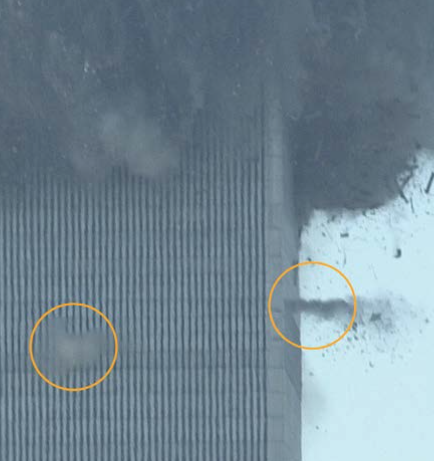
FIG. 5: High-velocity bursts of debris, or “squibs,” were ejected from point-like sources in WTC 1 and WTC 2, as many as 20 to 30 stories below the collapse front (Source: Noah K. murray).
This single column failure allegedly precipitated the collapse of the entire interior structure, leaving the exterior unsupported as a hollow shell. The exterior columns then allegedly buckled over a two-second period and the entire exterior fell simultaneously as a unit [3].
NIST was able to arrive at this scenario only by omitting or misrepresenting critical structural features in its computer modelling.[4] Correcting just one of these errors renders NIST’s collapse initiation indisputably impossible. Yet even with errors that were favorable to its predetermined conclusion, NIST’s computer model (see Fig. 3) fails to replicate the observed collapse, instead showing large deformations to the exterior that are not observed in the videos and showing no period of free fall. Also, the model terminates, without explanation, less than two seconds into the seven-second collapse.
Unfortunately, NIST’s computer modelling cannot be independently verified because NIST has refused to release a large portion of its modelling data on the basis that doing so “might jeopardize public safety.”
The case of the Twin Towers
Whereas NIST did attempt to analyze and model the collapse of WTC7, it did not do so in the case of the Twin Towers. In NIST’s own words,
The focus of the investigation was on the sequence of events from the instant of aircraft impact to the initiation of collapse for each tower…. this sequence is referred to as the ‘probable collapse sequence,’ although it includes little analysis of the structural behaviour of the tower after the conditions for collapse initiation were reached and collapse became inevitable.”[5]
Thus, the definitive report on the collapse of the Twin Towers contains no analysis of why the lower sections failed to arrest or even slow the descent of the upper sections — which NIST acknowledges “came down essentially in free fall” [5-6]— nor does it explain the various other phenomena observed during the collapses.
When a group of petitioners filed a formal Request for Correction asking NIST to perform such analysis, NIST replied that it was
unable to provide a full explanation of the total collapse
because
the computer models [were] not able to converge on a solution.
However, NIST did do one thing in an attempt to substantiate its assertion that the lower floors would not be able to arrest or slow the descent of the upper sections in a gravity-driven collapse. On page 323 of NCSTAR 1-6, NIST cited a paper by civil engineering professor Zdeněk Bažant and his graduate student, Yong Zhou, that was published in January 2002 [7] which, according to NIST, “addressed the question of why a total collapse occurred” (as if that question were naturally outside the scope of its own investigation).

FIG. 6: molten metal was seen pouring out of WTC 2 continuously for the seven minutes leading up to its collapse (Sources: WABC-Tv, NIST).
In their paper, Bažant and Zhou claimed there would have been a powerful jolt when the falling upper section impacted the lower section, causing an amplified load sufficient to initiate buckling in the columns. They also claimed that the gravitational energy would have been 8.4 times the energy dissipation capacity of the columns during buckling.
In the years since, researchers have measured the descent of WTC 1’s upper section and found that it never decelerated — i.e. there was no powerful jolt [8-9]. Researchers have also criticized Bažant’s use of free-fall acceleration through the first story of the collapse, when measurements show it was actually roughly half of gravitational acceleration [2]. After falling for one story, the measurements show a 6.1 m/s velocity instead of the 8.5 m/s velocity that would be the result of free fall. This difference in velocity effectively doubles the kinetic energy, because it is a function of the square of the velocity.
In addition, researchers have demonstrated that the 58 × 106 kg mass Bažant used for the upper section’s mass was the maximum design load—not the actual 33 × 106 kg service load [10]. Together, these two errors embellished the kinetic energy of the falling mass by 3.4 times. In addition, it has been shown that the column energy dissipation capacity used by Bažant was at least 3 times too low [2].
In January 2011 [11] Bažant and another graduate student of his, Jia-Liang Le, attempted to dismiss the lack-of-deceleration criticism by claiming there would be a velocity loss of only about 3%, which would be too small to be observed by the camera resolution. Le and Bažant also claimed conservation-of-momentum velocity loss would be only 1.1%. However, it appears that Le and Bažant erroneously used an upper section mass of 54.18 × 10⁶ kg and an impacted floor mass of just 0.627 × 10⁶ kg, which contradicted the floor mass of 3.87 × 10⁶ kg Bažant had used in earlier papers.
The former floor mass is representative of the concrete floor slab only, whereas the latter floor mass includes all the other materials on the floor. Correcting this alone increases the conservation-of-momentum velocity loss by more than 6 times, to a value of 7.1%. Additionally, the column energy dissipation has been shown to be far more significant than Bažant claimed. Researchers have since provided calculations showing that a natural collapse over one story would not only decelerate, but would actually arrest after one or two stories of fall (see Fig. 4) [2, 10].
Other evidence unexplained
The collapse mechanics discussed above are only a fraction of the available evidence indicating that the airplane impacts and ensuing fires did not cause the collapse of the Twin Towers. Videos show that the upper section of each tower disintegrated within the first four seconds of collapse. After that point, not a single video shows the upper sections that purportedly descended all the way to the ground before being crushed.
Videos and photographs also show numerous high-velocity bursts of debris being ejected from point-like sources (see Fig. 5). NIST refers to these as “puffs of smoke” but fails to properly analyze them [6]. NIST also provides no explanation for the midair pulverization of most of the towers’ concrete, the near-total dismemberment of their steel frames, or the ejection of those materials up to 150 meters in all directions.
NIST sidesteps the well-documented presence of molten metal throughout the debris field and asserts that the orange molten metal seen pouring out of WTC 2 for the seven minutes before its collapse was aluminum from the aircraft combined with organic materials (see Fig. 6) [6].
Yet experiments have shown that molten aluminum, even when mixed with organic materials, has a silvery appearance — thus suggesting that the orange molten metal was instead emanating from a thermite reaction being used to weaken the structure [12]. Meanwhile, unreacted nano-thermitic material has since been discovered in multiple independent WTC dust samples [13].
As for eyewitness accounts, some 156 witnesses, including 135 first responders, have been documented as saying that they saw, heard, and/or felt explosions prior to and/or during the collapses [14]. That the Twin Towers were brought down with explosives appears to have been the initial prevailing view among most first responders. “I thought it was exploding, actually,” said John Coyle, a fire marshal.“Everyone I think at that point still thought these things were blown up” [15].
Conclusion
It bears repeating that fires have never caused the total collapse of a steel-framed high-rise before or since 9/11. Did we witness an unprecedented event three separate times on September 11, 2001? The NIST reports, which attempted to support that unlikely conclusion, fail to persuade a growing number of architects, engineers, and scientists. Instead, the evidence points overwhelmingly to the conclusion that all three buildings were destroyed by controlled demolition. Given the far-reaching implications, it is morally imperative that this hypothesis be the subject of a truly scientific and impartial investigation by responsible authorities.
ABOUT THE AUTHORS
Steven Jones is a former full professor of physics at Brigham Young University. His major research interests have been in the areas of fusion, solar energy, and archaeometry. He has authored or co-authored a number of papers documenting evidence of extremely high temperatures during the WTC destruction and evidence of unreacted nano-thermitic material in the WTC dust.
Robert Korol is a professor emeritus of civil engineering at McMaster University in Ontario, Canada, as well as a fellow of the Canadian Society for Civil Engi- neering and the Engineering Institute of Canada. His major research interests have been in the areas of structural mechanics and steel structures. More recently, he has undertaken experimen- tal research into the post-buckling resistance of H-shaped steel columns and into the energy absorption associated with pulverization of concrete floors.
Anthony Szamboti is a mechanical design engineer with over 25 years of structural design experience in the aerospace and communications industries. Since 2006, he has authored or co-authored a number of technical papers on the WTC high-rise failures that are published in the Journal of 9/11 Studies and in the International Journal of Protective Structures.
Ted Walter is the director of strategy and development for Architects & En- gineers for 9/11 Truth (AE911Truth), a nonprofit organization that today represents more than 2,500 architects and engineers. In 2015, he authored AE-911Truth’s Beyond Misinformation: What Science Says About the Destruction of World Trade Center Buildings 1, 2, and 7. He holds a Master of Public Policy degree from the University of California, Berkeley.
References
[1] NIST: Analysis of Needs and Existing Capabilities for Full-Scale Fire Resistance Testing (October 2008).
[2] G. Szuladziński and A. Szamboti and R. Johns, International Journal of Protective Structures 4, 117 (2013).
[3] NIST: Final Report on the Collapse of World Trade Center Building 7, Federal Building and Fire Safety Investigation of the World Trade Center Disaster (November 20, 2008).
[4] R. Brookman, A Discussion of ‘Analysis of Structural Response of WTC 7 to Fire and Sequential Failures Leading to Collapse, Journal of 9/11 Studies (October 2012).
[5] NIST: Final Report of the National Construction Safety Team on the Collapses of the World Trade Center Towers (December 1, 2005).
[6] NIST: Questions and Answers about the NIST WTC Towers Investi- gation (Updated September 19, 2011).
[7] Z. Bažant, Y. Zhou, Yong, Journal of Engineering Mechanics 128, 2 (2002).
[8] A. Szamboti and G. MacQueen, The Missing Jolt: A Simple Refu- tation of the NIST-Bažant Collapse Hypothesis, Journal of 9/11 Studies (April 2009).
[9] D. Chandler, The Destruction of the World Trade Center North Tower and Fundamental Physics, Journal of 9/11 Studies (February 2010).
[10] A. Szamboti and R. Johns, ASCE Journals Refuse to Correct Fraudulent Paper Published on WTC Collapses, Journal of 9/11 Studies (September 2014).
[11] J.-L. Le and Z. Bažant, Journal of Engineering Mechanics 137, 82 (2011).
[12] S. Jones, Why Indeed Did the WTC Buildings Collapse Completely? Journal of 9/11 Studies (September 2006).
[13] N. Harrit et al., Open Chemical Physics Journal (April 2009).
[14] G. MacQueen, Eyewitness Evidence of Explosions in the Twin Towers, Chapter Eight, The 9/11 Toronto Report, Editor: James Gourley (November 2012).
[15] Fire Department of New York (FDNY): World Trade Center Task Force Interviews, The New York Times (October 2001 to January 2002).
Israeli minister says Brits will ‘pay the price’ for ‘anti-Semitic’ boycotts

RT | September 7, 2016
Israel’s Public Security Minister Gilad Erdan is in London this week meeting British officials hoping to agree on a joint plan to tackle Boycott, Divestment and Sanctions (BDS) activism in the UK.
The Likud politician has recently been made responsible for a new task force launched to tackle the movement, which calls for the boycott of Israeli goods in protest against the illegal settlement of Palestinian land.
“Great Britain is the world center of the anti-Israel BDS campaign,” Erdan claimed ahead of his visit.
BDS supporters “would have no rest” under his watch and should “pay the price” for their actions.
In February, a new law brought in by the Tory government banned public bodies from supporting BDS initiatives, arguing that the actions undermined “community cohesion” and “Britain’s economic and international security.”
The policy was enforced on local authorities without a parliamentary vote.
“I’m going [to Britain] to battle the boycott and delegitimization in every arena, and to discuss with members of the British government – which is also committed to fighting boycotts – ways to strengthen our cooperation against the anti-Semitic boycott campaign,” Erdan told the Jerusalem Post.
“I will meet with government officials and law enforcement in order to form a front of democratic countries against the worldwide threat, which includes targeted action against incitement on the Internet.”
His talks with Communities and Local Government Minister Sajid Javid were condemned by the BDS movement and pro-Palestinian campaigners.
“Mr Erdan’s visit to London raises some serious questions about the UK’s relationship with Israel and its complicity in Israel’s violations of Palestinian rights and international law,” War on Want senior militarism and security campaigner Ryvka Barnard said.
“Erdan’s sinister talk of human rights defenders having to ‘pay the price’ for their actions is a dangerous incitement to violence. The UK government has a serious case to answer when it rolls out the red carpet to someone whose threatening behaviour is endangering the lives of human rights defenders.”
Israel resorting to ‘black ops’ tactics
Veteran Israeli intelligence analyst Yossi Melman has described his country’s efforts to eliminate BDS as something akin to military operations.
Writing for the daily Maariv last weekend, Melman said Erdan’s ministry is leading “defamation campaigns, harassment and threats to the lives of activists” in a way more similar to “black ops” or “special operations” than an intelligence-handling ministry.
Israel’s Public Security and Strategic Affairs Ministry director general Sima Vaknin-Gil has also recently said she wants to “build a community of warriors” to resist campaigns like BDS.
The ministry’s most recent recruitment push has been fully classified, with the role of its 25 new employees hidden from Israeli taxpayers and the international community.
It is also unclear how much of the department’s large budget has been allocated to anti-BDS work.
Hong Kong’s “Localists” Made in Washington
By Joseph Thomas – New Eastern Outlook – September 5, 2016
Western media rejoiced over the meagre gains made in recent polls by what they described as “anti-China activists” of the “localist” movement, political groups in Hong Kong who advocate “independence” from China.
In the UK, former colonial administrator of Hong Kong, the BBC would report in their article, “Hong Kong election: Anti-China activists set to take LegCo seats,” that:
A new generation of anti-China activists have won seats on Hong Kong’s Legislative Council (LegCo), preliminary results indicate.
Among them is Nathan Law, one of the young leaders of the mass pro-democracy demonstrations of 2014, who is now on course to win a constituency seat.
It is the first taste of real political power for the young protest leaders.
But pro-Beijing politicians will retain a majority of seats, partly because of the electoral system.
What the BBC conveniently omits is that while pro-Beijing politicians will retain a majority of seats “partly because of the electoral system,” anti-Beijing politicians made their gains almost entirely because of US-funding and support. This includes Nathan Law himself, poised to take a constituency seat, showered with awards by the US State Department for his role in US-backed protests in 2014.
Ironically, in an attempt to add further gravity to these minor electoral gains, the BBC hailed what they called a “record voter turnout” of 58%, while BBC reporters just last month claimed a 60% turnout for Thailand’s charter referendum “undermined the legitimacy of the result.” The only difference being that gains made in Hong Kong favoured Western interests, while gains made in Thailand favoured the Thai people at the expense of Western interests.
The BBC’s politically-motivated bias is easily explained as the layers or rhetoric are stripped away and the foreign networks that created and are currently supporting Hong Kong’s supposed “independence” movement are exposed.
The BBC and other Western media organisations portray the recent polls as a continuation of the so-called “Umbrella Revolution.” In this respect, they are partially right.
What they are omitting is that the 2014 protests were organised and carried out by US-funded opposition groups, representing a slim minority of Hong Kong’s population and were eventually moved off the streets when Hong Kong residents themselves lost patience over the protest’s disruptive behaviour.
Months preceding the 2014 protests, two of the movement’s leaders were quite literally in Washington D.C. lobbying the US State Department for support ahead of the planned protests. The US State Department’s own National Endowment for Democracy (NED) would admit in a statement titled, “The National Endowment for Democracy and support for democracy in Hong Kong,” that:

(Benny Tai, Joshua Wong and Martin Lee stand to Freedom House president Mark Lagon in Washington D.C. during a ceremony celebrating their role in the 2014 Hong Kong protests.)
After the protests ended, NED’s subsidiary Freedom House would even invite Martin Lee to an event titled, “Three Hong Kong Heroes,” which also included protest leaders Joshua Wong and Benny Tai. Lee would shuffle onto stage with an umbrella prop in hand, a virtual admission to his leadership role in the protests and confirmation that the NED’s previous statement was intentionally false.
NED would also deny providing funding to the movement, despite the fact that each member of the movement’s senior leadership were documented grantees of the NED and its various subsidiaries including Freedom house and the National Democratic Institute (NDI).
Toward the end of the 2014 protests, Western media organisations began making partial admissions that indeed the US was funding various segments of the movement’s leadership. Dan Steinbock in an October 2014 article in the South China Morning Post would enumerate the various confirmed accusations and concluded, “perhaps efforts at foreign interference are not entirely unfounded.”
Considering this, claims that Hong Kong’s “anti-China activists” represent “democracy” or “localism” when they represent foreign interest, not those of the Hong Kong’s residents, nor source their support “locally,” are at face value contradictory.
It is also particularly ironic that this strain of political opposition predicates itself on establishing “independence” when in reality it seeks to return Hong Kong back under the influence of Anglo-American hegemony. This is particularly obvious considering the repetitious calls from such groups for “One Country, Two Systems,” the parting demands the British colonialists themselves tabled as a condition to returning the seized territory back to the Chinese.
Nathan Law —America’s, Not Hong Kong’s Candidate
The BBC made particular mention of Nathan Law, chairman of “Demosisto,” a political party that sprung forth from the US-funded “Umbrella Revolution.” According to the BBC, he was expected to win a constituency seat, but what the BBC fails to mention is his ties to the US State Department and the alarming conflicts of interest this poses considering his potential role in Hong Kong’s governance.
 |
(Nathan Law, left, embraced by US State Department NED chairman Carl Gershman.) |
The US State Department’s NED “World Movement for Democracy” website in a post titled, “Democracy Courage Tribute Award Presentation,” would write in regards to the award presented to Nathan Lee:
The Umbrella Movement’s bold call in the fall of 2014 for a free and fair election process to select the city’s leaders brought thousands into the streets to demonstrate peacefully. The images from these protests have motivated Chinese democracy activists on the mainland and resulted in solidarity between longtime champions of democracy in Hong Kong and a new generation of Hong Kong youth seeking to improve their city. The Hong Kong democracy movement will face further obstacles in the years to come, and their idealism and bravery will need to be supported as they work for democratic representation in Hong Kong.
Nathan Lee would even pose for pictures with NED chairman Carl Gershman, apparently unconcerned of the immense conflicts of interest invited by such compromising associations.
The BBC’s coverage of Hong Kong’s recent legislative elections attempts to spin inroads made by foreign interests as “localism” and “democracy” taking root in the former British colonial holding. While the BBC alludes to Beijing’s influence preventing further gains by the opposition, its intentional omission of which foreign interests are propping up the opposition reveals systemic and intentional bias in the BBC’s reporting. Such bias is echoed across Reuters, CNN, AP and AFP as well.
Democracy, in theory, is supposed to be the expression of the people. Hong Kong is part of China, thus those participating in its political process should represent Chinese interests. An opposition party that spends its time in Washington D.C. and maintains its growing networks through foreign cash do not represent China or the Chinese in a wider sense, and certainly not Hong Kong and its residents in a more local sense.
Foreign interests working through collaborators resembles a dictatorship from abroad more than anything resembling a “democracy” of the people, even if such a dictatorship drapes itself in public polls, elections and street mobs. That before, during and after the “Umbrella Revolution” each and every leader is tied to foreign interests, completely undermines the narrative that they represent “democracy” rather than the foreign interests transparently directing (then rewarding) them every step of the way.
Joseph Thomas is chief editor of Thailand-based geopolitical journal, The New Atlas.
Featured Video

Prof. Ted Postol: US–Iran War? Israel’s Fatal Gamble
or go to
Aletho News Archives – Video-Images
From the Archives
Neocon Max Boot: Legal and illegal aliens need to enlist in the US army and die for Israel

By Jonas E. Alexis | Veterans Today | October 16, 2107
In 1973 Irving Kristol, the godfather of the Neoconservative movement, made a stunning statement which is still relevant to understanding the Israeli influence in US foreign policy. Kristol said:
“Senator McGovern is very sincere when he says that he will try to cut the military budget by 30%. And this is to drive a knife in the heart of Israel… Jews don’t like big military budgets. But it is now an interest of the Jews to have a large and powerful military establishment in the United States…
“American Jews who care about the survival of the state of Israel have to say, no, we don’t want to cut the military budget, it is important to keep that military budget big, so that we can defend Israel.”
Read the statement again very carefully. A big military budget, said Kristol, is only good for Israel, not America or much of the Western World. In other words, precious American soldiers who go to the Middle East to fight so-called terrorism are just working for Israel, not for America.
So, whenever the Neocons use words such as “democracy” or “freedom,” they are essentially conning decent Americans to support Israel’s perpetual wars. … continue
Blog Roll
 Aletho News
- Macron: French citizens fighting for Israel cannot be labeled ‘genociders’
- US eyes Gaza security force drawn from armed gangs
- The Only Motive Behind The ‘Imminent’ U.S. War With Iran Is The Zionist Lobby
- Trump eyes 350-acre US military base housing 5,000 troops in Gaza
- Israel Pushing US Toward a Big and Damaging War With Iran – Ex-Pentagon Analyst
- Meet The Liberal Zionist And Ukraine War Supporter Advising AOC On Foreign Policy
- Buck Dancing for Zion: Kenya’s and Nigeria’s Growing Love Affair With Israel
- Israel installed, oversaw security system at Barak-Epstein residence in New York: Report
- ‘Britain’s Index of Repression’ documents 964 incidents of anti-Palestinian crackdown
- Prof. Ted Postol: US–Iran War? Israel’s Fatal Gamble
- If Americans Knew
- Tucker Carlson interrogated in Israel, has passport seized after interviewing US ambassador
- 6,000 Amputees in Gaza Face Impossible Recovery amid Israeli War Ultimatum
- The Lancet: Gaza death toll far higher than reported – Not a ceasefire Day 132
- Compliant aid: Who are the Israel-approved NGOs scaling up in Gaza?
- Why won’t Trump’s “Board of Peace” bring peace? – Not a ceasefire Day 131
- Help end the injustice against Shadi
- Israel’s Favorite American President
- Israel’s “Yellow Line” Is a Death Trap for Palestinians. We Drove Into It.
- Why Israel’s expanding occupation in Syria presents a critical legal test
- Gaza is not a natural disaster. It is the victim of genocide enabled by global inaction
- No Tricks Zone
- Coal Power Back In Trend As Globe Tries To Keep Pace With Growing Demand For Power
- New Study: A 4°C Warmer Beaufort Sea Had ‘No Sea Ice’ 11,700 – 8200 Years Ago
- Unfudging The Data: Dutch Meteorological Institute Reinstates Early 20th Centruy Heat Waves It Had Erased Earlier
- German Gas Crisis…Chancellor Merz Allegedly Bans Gas Debate Ahead of Elections!
- Pollen Reconstructions Show The Last Glacial’s Warming Events Were Global, 10x Greater Than Modern
- Germany’s Natural Gas Storage Level Dwindles To Just 28%… Increasingly Critical
- New Study Rebuts The Assumption That Anthropogenic CO2 Molecules Have ‘Special’ Properties
- Climate Scientist Who Predicted End Of “Heavy Frost And Snow” Now Refuses Media Inquiries
- Polar Bear Numbers Rising And Health Improving In Areas With The Most Rapid Sea Ice Decline
- One Reason Only For Germany’s Heating Gas Crisis: Its Hardcore-Dumbass Energy Policy
 Aletho News