Amnesty International on Syria – at it again!
By Tim Hayward | February 8, 2017
Writing recently about how we were misled by Amnesty International’s reports on Syria, I was criticised – for using the past tense.
This week Amnesty International has published a ‘new’ report – Syria: The Human Slaughterhouse – that presents no new evidence of the deaths it purports to be documenting. Even the BBC’s take on it makes clear: ‘it does not have evidence of executions taking place since December 2015’. The publication repeats previous claims about the years 2011-2015, and extrapolates.[1]
Such grave allegations need to be taken very seriously, but that starts with being scrupulous about their basis.
Previously I showed how Amnesty International did not follow its own prescribed research guidelines for earlier reports; it did not do so this time either.[2]
Those guidelines were those set out by Secretary General, Salil Shetty, and I think he could give a clearer steer on the need to observe them. In an interview, it was put to Shetty that accusations of bias are sometimes levelled at Amnesty International. His reply was that, since the organisation is criticised from all sides, ‘it must be doing something right’. This facile reply is fallacious. I can think of one controversial Amnesty representative, for instance, who has been accused of making unjustified claims against the governments of both Israel and Syria. I suspect many people who check will think he is wrong in one of those cases, although not necessarily the same one, without thereby assuming either he must be right in the other. I myself would simply regard him as simply insufficiently reliable.
Even if it is in fact true that the organisation is doing ‘something’ right, I do not think Amnesty should be content that this is good enough. I would want to insist that Amnesty needs to be tenacious in ensuring not to get it wrong. Its practice in Syria of extrapolating on the basis of conjectures made following conversations with representatives of the opposition is not guaranteed to ensure that.
What I think the grassroots supporters of Amnesty International need above all to be concerned about is what the organisation is trying to achieve with this new publication. With more constructive possibilities of international involvement following the end of the siege of Aleppo, what is the reason for reviving attempts to demonise the Syrian government?
Whatever excesses any parties need eventually to be held to account for, the concern of Amnesty International is supposed to be with human beings, and their interest lies overwhelmingly in achieving peace – not in stoking the embers of the war.
[1] A critical discussion of this is available at http://www.moonofalabama.org/2017/02/amnesty-report-hearsay.html
[2] For the 2012 report, which covers the first year of the five referred to in the new publication, I showed, point by point, that the report admits failing to fulfil some of the research criteria and fails to show it has met any of them. Substantially the same verdict applies to what is said here for 2012-2015; regarding the period 2015-2016, which many readers will understandably, but mistakenly, assume the ‘new’ evidence relates to, no evidence at all is even claimed to be presented.
Iran missile work not violating UN bans: Russia’s Churkin
Press TV – February 8, 2017
A senior Russian diplomat has expressed surprise at an outcry provoked by the new US administration over Iranian missile work, saying Tehran’s missile tests are not violating any UN bans, legally speaking.
“This outcry about Iran’s ballistic missile launches. I was surprised to hear even American experts speaking on CNN and calling it a violation of bans by the UN Security Council,” said Russia’s UN Ambassador Vitaly Churkin in an interview with RT published Tuesday.
He was referring to Resolution 2231 adopted by the Security Council in July 2015 to underpin the landmark nuclear deal inked days earlier between Tehran and the P5+1 group of states, namely Russia, China, France, Britain, the US plus Germany.
The document terminated the provisions of previous UN resolutions, calling on Iran “not to undertake any activity related to ballistic missiles designed to be capable of delivering nuclear weapons, including launches using such ballistic missile technology.”
Explaining the legal language used in Resolution 2231, Churkin said the document merely “calls” on Tehran not to conduct tests of missiles capable of carrying nuclear weapons, but does not impose any ban on Tehran.
“Those bans were there before, all those bans were lifted,” said the Russian official. “Technically or legally you cannot argue that they are violating any kind of a prohibition.”
He also said no evidence has been provided to support the claims that Tehran’s missiles are capable of carrying nuclear warheads.
Late last month, Washington’s UN envoy Nikki Haley slammed a missile test by Iran as “absolutely unacceptable.”
US President Donald Trump’s National Security Advisor Michael Flynn also said following the January 29 test that Washington was “officially putting Iran on notice,” claiming that the launch was “in defiance of UN Security Council Resolution 2231.”
The Islamic Republic has, on numerous occasions, asserted that its missiles are not designed to be capable of carrying nuclear warheads, and that it is not involved in such missile work.
In March 2016, Russia blocked the potential ratification of a United Nations Security Council resolution against Iranian missile tests in a session called by the former US administration.
Explaining Russia’s opposition to an anti-Iran resolution, Churkin said back then that in the view of veto-wielding Russia, Resolution 2231, which endorsed a nuclear deal between Iran and six other countries, did not legally prohibit Iranian ballistic missile tests.
He said the text explicitly did not ban Iranian missile test-launches.
“A call is different from a ban, so, legally, you cannot violate a call, you can comply with a call or you can ignore the call, but you cannot violate a call,” Churkin said. “The legal distinction is there.”
Elsewhere in the interview, Churkin warned that the United States’ tensions with Iran might work to affect Moscow’s relations with Washington.
“There are so many complexities, so many issues which can create additional problems, including problems which might affect our relations with the US,” he said.
The envoy cautioned the US against behaving emotionally instead of relying on facts when it comes to Iran.
“In international life, you have to differentiate between your emotions, what you want to see and what you have the right to expect from another country,” he said.
Churkin further took on US President Donald Trump’s recent comment to Fox News that the Islamic Republic is “terrorist state number one.”
The envoy pointed to the active role the Islamic Republic is playing in the fight against the Daesh Takfiri terror group, which is mainly active in Syria and Iraq.
Iran has been providing military advisory support to the countries’ respective militaries in their fight against the terrorists, an assistance that has been met with appreciation from both governments.
On Monday, Kremlin spokesman Dmitry Peskov also reacted to Trump’s remarks, saying, “We disagree with this postulate.”
Castigating Trump for Truth-Telling
By Robert Parry | Consortium News | February 7, 2017
Gaining acceptance in Official Washington is a lot like getting admittance into a secret society’s inner sanctum by uttering some nonsensical password. In Washington to show you belong, you must express views that are patently untrue or blatantly hypocritical.

Fox News’ Bill O’Reilly interviewing President Donald Trump
For instance, you might be called upon to say that “Iran is the principal source of terrorism” when that title clearly belongs to Saudi Arabia and other Gulf state allies that have funded Al Qaeda, the Taliban and the Islamic State. But truth has no particular value in Official Washington; adherence to “group think” is what’s important.
Similarly, you might have to deny any “moral equivalence” between killings attributed to Russian President Vladimir Putin and killings authorized by U.S. presidents. In this context, the fact that the urbane Barack Obama scheduled time one day a week to check off people for targeted assassinations isn’t relevant. Nor is the reality that Donald Trump has joined this elite club of official killers by approving a botched and bloody raid in Yemen that slaughtered a number of women and children (and left one U.S. soldier dead, too).
You have to understand that “our killings” are always good or at least justifiable (innocent mistakes do happen from time to time), but Russian killings are always bad. Indeed, Official Washington has so demonized Putin that any untoward death in Russia can be blamed on him whether there is any evidence or not. To suggest that evidence is needed shows that you must be a “Moscow stooge.”
To violate these inviolable norms of Official Washington, in which participants must intuitively grasp the value of such “group think” and the truism of “American exceptionalism,” marks you as a dangerous outsider who must be marginalized or broken.
Currently, President Trump is experiencing this official opprobrium as he is widely denounced by Republicans, Democrats and “news” people because he didn’t react properly to a question from Fox News’ Bill O’Reilly terming Putin “a killer.”
“There are a lot of killers.” Trump responded. “We’ve got a lot of killers. What do you think — our country’s so innocent. You think our country’s so innocent?”
Aghast at Trump’s heresy, O’Reilly sputtered, “I don’t know of any government leaders that are killers.”
Trump: “Well — take a look at what we’ve done too. We made a lot of mistakes. I’ve been against the war in Iraq from the beginning.”
O’Reilly: “But mistakes are different than —“
Trump: “A lot of mistakes, but a lot of people were killed. A lot of killers around, believe me.”
‘Moral Equivalence’
Though Trump is justly criticized for often making claims that aren’t true, here he was saying something that clearly was true. But it has drawn fierce condemnation from across Official Washington, not only from Democrats but from Trump’s fellow Republicans, too. Neoconservative Washington Post opinion writer Charles Krauthammer objected fiercely to Trump’s “moral equivalence,” and CNN’s Anderson Cooper chimed in. lamenting Trump’s deviation into “equivalence,” i.e. holding the U.S. government to the same ethical standards as the Russian government.
This “moral equivalence” argument has been with us at least since the Reagan administration when human rights groups objected to President Reagan’s support for right-wing governments in Central America that engaged in “death squad” tactics against political dissidents, including the murders of priests and nuns and genocide against disaffected Indian tribes. To suggest that Reagan and his friends should be subjected to the same standards that he applied to left-wing authoritarian governments earned you the accusation of “moral equivalence.”
Declassified documents from Reagan’s White House show that this P.R. strategy was refined at National Security Council meetings led by U.S. intelligence propaganda experts. Now the “moral equivalence” theme is being revived to discredit a new Republican president who dares challenge this particular Official Washington “group think.”
Lots of Killing
The unpleasant truth is that all leaders of major countries and many leaders of smaller countries are “killers.” President Obama admitted that he had ordered military strikes in seven different countries to kill people. His Secretary of State Hillary Clinton rejoiced over the grisly murder of Libyan leader Muammar Gaddafi with a clever twist on a famous Julius Caesar boast of conquest: “We came, we saw, he died,” Clinton chirped.
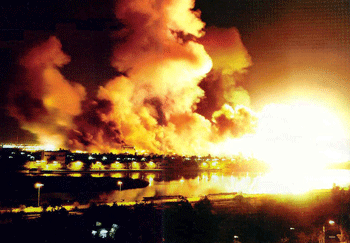
U.S. invasion of Iraq in 2003, “shock and awe”
President George W. Bush launched an illegal war against Iraq based on false pretenses, causing the deaths of hundreds of thousands of Iraqis, many of them children and other civilians.
President Bill Clinton ordered a vicious bombing campaign against the Serbian capital of Belgrade, which included intentionally targeting the Serb TV building and killing 16 civilian employees because Clinton considered the station’s news reports to be “propaganda,” i.e., not in line with U.S. propaganda.
President George H.W. Bush slaughtered scores of Panamanians who happened to live near the headquarters of the Panamanian Defense Forces and he killed tens of thousands of Iraqis, including incinerating a civilian bomb shelter in Baghdad, after he brushed aside proposals for resolving Iraq’s invasion of Kuwait peacefully. (Bush wanted a successful war as a way to rally the American people behind future foreign military operations, so, in his words, the country could kick “the Vietnam Syndrome once and for all.”)
Other U.S. presidents have had more or less blood on their hands than these recent chief executives, but it is hard to identify any modern U.S. president who has not been a “killer” in some form, inflicting death upon innocents whether as part of some “justifiable” mission or not.
But the mainstream U.S. press corps routinely adopts double standards when assessing acts by a U.S. president and those of an “enemy.” When the U.S. kills people, the mainstream media bends over backwards to rationalize the violence, but does the opposite if the killing is authorized by some demonized foreign leader.
That is now the case with Putin. Any accusation against Putin – no matter how lacking in evidence – is treated as credible and any evidence of Putin’s innocence is ridiculed or suppressed.
That was the case with a documentary that debunked claims that hedge fund accountant Sergei Magnitsky was murdered in a Russian prison because he was a whistleblower when the documentary showed that he was a suspect in a massive money-laundering scheme and died of natural causes. Although produced by a documentarian who started out planning to do a sympathetic portrayal of Magnitsky, the facts led in a different direction that caused the documentary to be shunned by the European Union and given minimal distribution in the United States.
By contrast, the ease with which Putin is called a murderer – based on “mysterious deaths” inside Russia – is reminiscent of how American right-wing groups suggested that Bill and Hillary Clinton were murderers by distributing a long list of “mysterious deaths” somehow related to the Clinton “scandals” from their Arkansas days. While there was no specific evidence connecting the Clintons to any of these deaths, the sheer number created suspicions that were hard to knock down without making you a “Clinton apologist.” Similarly, a demand for actual evidence proving Putin’s guilt in a specific case makes you a “Putin apologist.”
However, as a leader of a powerful nation facing threats from terrorism and other national security dangers, Putin is surely a “killer,” much as U.S. presidents are killers. That appears to have been President Trump’s point, that the United States doesn’t have clean hands when it comes to shedding innocent blood.
But telling such an unpleasant albeit obvious truth is not the way to gain entrance into the inner sanctum of Official Washington’s Deep State. The passwords for admission require you to say a lot of things that are patently false. Any inconvenient truth-telling earns you the bum’s rush out into the alley, even if you’re President of the United States.
Investigative reporter Robert Parry broke many of the Iran-Contra stories for The Associated Press and Newsweek in the 1980s.
US senators trying to gain veto power that could block Trump from lifting sanctions on Russia
RT | February 8, 2017
A group of prominent US senators is leading a bipartisan effort to push through the so-called Russia Review Act, which would allow the Senate to veto any attempt of newcomer President Donald Trump to loosen sanctions on Moscow.
The group, which currently consists of six senators, is growing, according to a report by CNN, which sees the initiative as Congress’ latest warning to Trump signifying that it will not tolerate unilateral moves by the executive branch to reconcile with Moscow, especially the lifting of sanctions.
The group led by Senators Lindsey Graham (R-South Carolina) and Ben Cardin (D-Maryland) also includes Marco Rubio (R-Florida), John McCain (R-Arizona), Claire McCaskill (D-Missouri), and Sherrod Brown (D-Ohio).
On Wednesday, they are planning to introduce legislation that would subject any decision the president takes concerning Russia to a 120 day-review, during which Congress could put any move to lift sanctions to a vote, according to a copy of the draft shown to CNN.
If Trump was to order the lifting of sanctions without Russia pulling out of Crimea, the Florida senator believes there’s strong enough opposition among legislators to veto the move. The US still considers Crimea to be part of Ukraine.
“I think if there was a real threat of lifting sanctions minus the respect for Ukrainian sovereignty and meeting those conditions, my sense is that we would have the votes to pass that in the Senate and we would be able to pass it with a veto-proof majority,” Rubio told the news network.
Meanwhile, another bill is being formulated by another group of a dozen senators who wish to impose an additional set of comprehensive sanctions on Moscow, on top of those already in place. They justify the move citing Crimea’s decision to reunite with Russia in a referendum following an armed coup in Kiev (referred to as “annexation” by Washington), as well as unproven allegations that Russia carried out cyber-attacks to influence the US election.
No date has been set for a vote on that bill.
Both acts would require a supermajority of 67 Senate votes, which sponsor Ben Cardin of Maryland believes is achievable.
The news comes before the dust has even settled on Trump’s interview with Bill O’Reilly on Fox, during which the host tried to coax the president into making a harsh comments about Vladimir Putin, even going so far as to call the Russian president a “killer.” Trump refused to take the bait, however, causing quite a stir in anti-Russian circles on Capitol Hill.
Reports about the new bill come as tensions between Moscow and Kiev have increased over the issue of holding elections in the Donbass region. Moscow believes elections should go ahead, provided that free and fair electoral procedures are observed and the safety of all candidates is ensured, while Kiev insists that no elections can be held until it has establishing full control over the rebel regions and their borders with Russia. Moreover, ultranationalist and neo-Nazi elements in Ukraine have been putting pressure on the Kiev government, threatening to oust Ukrainian President Petro Poroshenko if elections in the breakaway regions take place.
Syria Says Amnesty Report on Mass Killing Devoid of Truth
Al-Manar – February 8, 2017
Syria denied as false and politically-motivated an Amnesty International report claiming that Syrian military police carried out mass hangings over the course of five years.
In a statement published on Tuesday, the Syrian Justice Ministry rejected the account of mass hangings at Saydnaya prison as bogus and devoid of truth, saying such claims are meant to ruin the government’s reputation in the international community.
According to the report, about 5,000 to 13,000 people were executed at Saydnaya prison near Damascus between 2011 and 2015.
The statement further emphasized that based on Syrian law, death sentences are handed only after judicial trials run through several degrees of litigation.
Such allegations come in the face of recent gains by Syrian army forces and allied popular defense groups in battles against foreign-sponsored Takfiri terrorists, and the atmosphere of national reconciliation in the country, it added.
Israel ‘Trying to Turn US, Europe Away’ From Iran
Sputnik – 08.02.2017
Prime Minister Benjamin Netanyahu has urged Washington, London and their allies to create a “joint front” against Iran, citing Tehran’s supposedly aggressive behavior as the reason. Iranian analysts told Sputnik Persian that Israel “has no right” to come up with such initiatives since it is the main reason behind regional tensions.
“Israel is the main source of all conflicts in the Middle East,” Hossein Ruyvaran, an expert on the Middle East and the Arab world who teaches at the University of Tehran, said. “Since this state was established in 1948, the region has been plagued by many wars sparked by Israel – in 1948, 1956, 1973, 1982, 2006, 2008, 2012 and 2014. The Israeli regime is the main reason for regional tensions due to its ambitions. This regime has tried to change the geopolitical orientation in the region.”
These remarks came in response to Netanyahu calling on the United States and the United Kingdom to adopt a tough stance on Iran due to Tehran’s ostensibly “defiant aggression” and in light of the country’s “defiance against the international order.”
“Claims that Iran is the key threat [in the Middle East] and the main reason behind all troubles in the region are groundless,” Ruyvaran said. “Israel has tried to use these accusations to turn the West against Iran. Meanwhile, the UN Security Council has adopted Resolution 2234 which strongly condemns Israel’s unlawful settlements on occupied lands.”
Hassan Hanizadeh, Iranian political analyst and former chief editor of the Mehr News Agency, expressed similar sentiments. He referred to Netanyahu’s remarks as “anti-Iranian political propaganda.”
“Not many countries are ready to support Israel since everyone knows that Israel has occupied Arab lands, including the Golan Heights, Gaza and East Jerusalem,” he said. “This is why Israel has no right to accuse Iran of aggression since it itself is an aggressor. … Israel has no right to mention or urge to create a front against Iran. If a front against aggression must be created, then it should be targeted against Israel, not Iran.”Netanyahu’s comments came after Iran had tested a new ballistic missile last week. The United States imposed new sanctions on Tehran, with US President Donald Trump tweeting that the Islamic Republic has been “formally put on notice” for conducting the test. He added that Iran was “playing with fire.”
Tehran has repeatedly said that its missile program is defensive in nature and does not threaten other countries. On Monday, Iranian Foreign Ministry spokesman Bahram Qasemi said that the test was not intended “to send a message” to the new US administration.
Saudi Aramco picks Israel-linked banker
Press TV – February 8, 2017
Saudi Arabian Oil Co. (Aramco) has chosen the New York-based boutique investment bank Moelis & Co to advise on its initial public offering, reports say.
The sale of the world’s biggest oil company is the latest of several moves by the Saudi government to generate revenues in the face of a gaping budget deficit.
Aramco had invited banks in January to pitch for an advisory position on what is expected to be the world’s biggest initial public offering.
JPMorgan, which has been Aramco’s commercial banker for years, and Michael Klein, a former star Citigroup banker, had been advising Saudi authorities on the IPO.
However, the kingdom’s decision to pick a small banker has surprised many observers. International business outlets such as Bloomberg and the Financial Times said the choice represents a coup for Moelis founded no earlier than 2007.
The IPO, which is predicted to raise about $100 billion, is set to yield millions of dollars in fees and push Moelis up in global investment bank rankings.
Last year, Moelis hired Shlomo Yanai, a retired Israeli military officer, to join the firm as a senior adviser. Yanai had earlier been offered the directorship of the Israeli spy agency Mossad by Prime Minister Benjamin Netanyahu but he turned it down.
The oil giant’s initial public offering, holding $2 trillion in assets, is expected to take place in 2018 with an initial sale of a five-percent share.
According to Bloomberg, Aramco expects Moelis to help it select underwriters for the sale, make decisions on potential listing venues and ensure the IPO goes smoothly.
Saudi Arabia is currently dealing with a budget deficit of nearly $100 billion caused by a sharp slump in oil prices as well as Riyadh’s rising military expenditure. The kingdom emerged as the world’s third largest military spender in 2015 when it began its military campaign against Yemen.
The Saudis have also been forced to introduce a series of austerity measures that include canceling of some bonuses offered to state employees and increasing of entry visa fees for residents and foreigners.
The ruling Saudi family will transfer the revenue from the sale of Aramco to the country’s public investment fund (PIF), which will then be tapped to purchase strategic financial and industrial assets abroad.
UK covered up intelligence training with Bahrain’s police, amid death sentence
Reprieve | February 5, 2017
UK authorities trained Bahrain’s police how to gather intelligence on protestors, and then tried to cover up the scheme, international human rights group Reprieve has found. The project took place after protestors in the Gulf kingdom were rounded up and sentenced to death.
Britain’s Foreign Office paid for half a dozen Bahraini police officers to visit Belfast in August 2015, where the Police Service of Northern Ireland (PSNI) shared its expertise on gathering intelligence ahead of demonstrations.
Protestors in Bahrain, such as Mohammed Ramadan, have been targeted by police and tortured into falsely confessing to capital crimes. Mr Ramadan, a father of three young children, is now on death row and could be executed at any time.
The training, which also included sessions on water cannons, dog handling and public order tactics, was kept secret. The UK government has repeatedly denied providing public order training to Bahrain.
The Cabinet Office claimed that “The UK does not fund any programmes in Bahrain focused on public order”. However, documents obtained by Reprieve show that Bahrain’s police received an “Introduction to Combined Operational Training with a focus on Public Order.”
The training was prepared by Northern Irish police officers during a week-long “scoping visit” to Bahrain over April-May 2015, where they assessed Bahrain’s public order systems. The Stormont-owned company NI-CO played a key role in organising all the training.
It has also emerged that Bahrain’s Chief of Police and his deputies visited Belfast in June 2014. The itinerary included another session with the PSNI on “Community Intelligence”. The police chief attended a “demonstration of PSNI Public Order systems” and received a “Tour of North and West Belfast ‘Flashpoints’ with 2 or 3 PSNI Armoured Vehicles”.
Bahrain’s Chief of Police had to postpone a visit to Belfast earlier in 2014 because there was a “security emergency in Bahrain at the moment and it is felt that the Chief of Police and other senior officers cannot leave the country at this critical time.” This was a month after death-row prisoner Mohammed Ramadan was tortured. “The situation on the ground is becoming increasingly tense”, an email explained.
Bahrain’s Chief of Police has command level responsibility for violations carried out by lower ranking officers. Months after the police chief visited Belfast for training, teenager Ali al-Singace was arrested and tortured by Bahrain’s police with electric shocks, until he made a false confession to a capital crime. He was executed by firing squad in January 2017.
Commenting, Maya Foa, a director of Reprieve, said:
“It is outrageous that the government has covered up this project, which risks supporting the execution of protesters in Bahrain.
“Bahrain is notorious for arresting, torturing and sentencing to death people involved in protests – such as Mohammed Ramadan, a father of three who is held on death row and faces execution at any moment.
“By training Bahrain’s police how to gather intelligence on protesters, there is a serious risk that Britain is helping them arrest and execute people who are guilty of nothing more than calling for reform. It is scandalous that the Government has sought to sweep this under the carpet.”
US congresswoman advocates impeaching Trump because Putin’s attacking… Korea?
RT | February 7, 2017
Representative Maxine Waters has argued that US President Donald Trump will inevitably be impeached because of his alleged ties to Russian President Vladimir Putin who she claimed is “advancing in Korea.”
Waters, a 13-term Democrat from Los Angeles, has called for Trump’s impeachment several times now, however she has yet to explicitly accuse the president of breaking the law.
Speaking to reporters with other House Democrats, including Minority Leader Nancy Pelosi, Waters sought to explain why she is pushing for Trump’s impeachment less than a month into his term in the White House.
“I am not calling for the impeachment yet. He’s doing it himself,” Waters claimed.
“How can a president, who is acting in the manner that he’s acting, whether he’s talking about the travel ban, the way that he’s talking to Muslims, or whether he’s talking about his relationship to Putin, and the Kremlin, and knowing that they have hacked our D-triple-C, DNC, and knowing that he is responsible for supplying the bombs that killed innocent children and families in, um… um… Aleppo.”
“And the fact that he is wrapping his arms around Putin while Putin is continuing to advance into Korea. I think that he is leading himself into that kind of position where folks will begin to ask, what are we going to do?”
“And the answer is going to be, eventually, we’ve got to do something about him. We cannot continue to have a president who’s acting in this manner. It’s dangerous to the United States of America.
“Aleppo” was suggested to Waters by members of the press corps when she couldn’t remember where she alleged that the Russian president supplied bombs.
Waters may argue that it was merely a slip of the tongue, and that she meant Crimea as opposed to Korea.
Pelosi quickly distanced herself from her colleague’s comments. “Many things the congresswoman said are grounds for displeasure and unease in the public about the performance of this president,” she said.
She explained that Trump has acted in a way that is “strategically incoherent, incompetent and that is reckless… that is not grounds for impeachment,” she stated.
Cyber Attacks Have Now Become a Political Weapon
By Jean Perier | New Eastern Outlook | 07.02.2017
 The scope of various cyber operations carried out by different state players has recently become the cause of increasing tension amid international relations. For instance, at the end of 2016, the United States accused Russia of hacking the servers of the US Democratic National Committee, which resulted in the introduction of sanctions against a number of Russian intelligence services that were described as offenders in this recent incident. However, Washington to date, hasn’t presented any evidence to back up its claims.
At the same time, a considerable number of Western media sources, including Foreign Policy, have openly admitted Moscow was not accused of anything in America’s last election that Washington itself has not done elsewhere in the world.
Curiously enough, distinguished historian Marc Trachtenberg, professor emeritus at UCLA, has already stressed that this alleged interference is a type of behavior that the United States helped establish; since meddling in other countries’ politics has been an American specialty for decades. The Washington Times seems to be convinced too that America’s record of meddling in other countries and of leaders who have lied to Washington puts it in the position where it must tread carefully to avoid hypocrisy.
Those who complain about alleged Russian offenses must certainly know that the US government eavesdrops, as a matter of course, on the private communications of many people around the world. The National Security Agency, whose job it is to do this kind of eavesdropping, has a budget of about 10 billion dollars, and, according to an article that came out in the Washington Post a few years ago, intercepts and stores “1.7 billion e-mails, phone calls and other types of communications” everyday.
In terms of the development of so-called cyber armies – highly specialized units that can use cyberspace for both military or intelligence purposes – Russia may indeed be found in the top 5 states in the world in this domain, however, it’s lagging behind the US, China, Britain and South Korea. In general, such armies exist officially in a several dozen countries, as for the unofficial numbers, there’s hundreds of those, since the scope of information warfare operations has been increasing rapidly over the years.
It goes without saying that US cyber forces has been the most powerful in the world, with over 9,000 trained professionals in its ranks. As for the UK, the so-called Government Communications Headquarters (GCHQ) has been providing employment to over 6,000 servicemen. Out of this number, according to individual media reports, more than 2,000 servicemen are engaged in cyber warfare.
Additionally, it should be noted that cyber squads can be found in a number of armies around the world, but those are not “military hackers”, those are security specialist that are tasked with protecting digital assets and IT infrastructure, at least officially. Off of the top of one’s head one can name such units in South Korea, Israel, Iran and Estonia.
The question of whether or not these hackers are capable of influencing political processes and, in particular, one’s presidential campaign, has been broadly discussed at the latest 9th International Forum on Cybersecurity (FIC), which was held last January in the French city of Lille. For the first time the forum was held in 2007, following an initiative of the National Gendarmerie, and every year it has collected public authorities, private sector representatives, experts and civil society figures. In 2017, the forum aimed at discussing the issue of providing “reasonable security for IT assets.”
France’s Minister of Internal Affairs, Bruno Le Roux has stressed in his opening speech at the forum that IT systems are regularly becoming the target of attacks originating from criminal organizations and even from foreign states, which are showing great ingenuity.
But we must not forget that more often than not, it’s not foreign hackers that play the role of a destabilizing factor in the political life of any given society, but the hackers hired by opposition political parties of these very states. And the United State exemplifies this statement better that any, with Donald Trump announcing his concern over the leakage of the details of his telephone conversations with foreign political figures.
According to White House spokesman Sean Spicer, the Trump administration will have to exercise damage control after the leakage of the details of the discussions that Trump had over the phone with the leaders of Mexico and Australia. “This is a very disturbing fact,” – said Spicer in his recent statement. AP has allegedly acquired these tapes, so it now reports that Trump allegedly said in a conversation that the Mexican government is incapable of dealing with the “bad guys”. For sure, the Mexican Foreign Ministry has claimed that those reports are false, but what other choice did it have?
In addition, Trump has also been denying the claims distributed by the Washington Post that he had a very “bad talk” with the Australian Prime Minister Malcolm Turnbull. “Thank you to Prime Minister of Australia for telling the truth about our very civil conversation that FAKE NEWS media lied about ” – Trump wrote in his Twitter.
Jean Périer is an independent researcher and analyst and a renowned expert on the Near and Middle East.
Featured Video
The Source of America’s Wars – Kristol Clear
or go to
Aletho News Archives – Video-Images
From the Archives
Is Israel to blame for the Iraq War?
American Goy | March 10, 2008
I am so tired of this old canard that “Israel had nothing to do with USA’s war with Iraq – in fact, it officially advised America against it”.
Bullshit. … continue
Blog Roll
 Aletho News
- Strait of Hormuz is Iran’s ‘nuclear weapon’ that forced US retreat: Medvedev
- Energy crisis will last for months – Kremlin envoy
- Europe’s quiet role in the war on Iran
- Forty days that shook the Empire: How Iran turned the tables on US and prevailed
- Netanyahu unilaterally declares Lebanon outside of ceasefire deal
- Israeli leaders: ‘Not a single goal’ achieved in war with Iran
- What on earth just happened? Trump, Iran, and the unlikely ceasefire
- Alberta Bill Would Fine Political Deepfakes $10,000 Without Satire Exemptions
- Iran declares ‘historic victory’ over US, says enemy forced to accept its proposal
- Trump Claims Ceasefire, Reopening of Strait of Hormuz Agreement with Iran
- If Americans Knew
- A sigh of relief over Iran, but Gaza and Lebanon in dire straits – Daily Update
- Thousands dead and neighborhoods razed to the ground: Aid agencies fear southern Lebanon is becoming the new Gaza
- The war the US is fighting for Israel could cost trillions
- ‘Cigarette Burns, Nail Wounds’: Toddler Tortured in Gaza to Coerce Father
- Trump Says US Sent ‘a Lot of Guns’ to Protesters in Iran
- Israeli forces destroy 17 UN peacekeeper cameras in south Lebanon
- US-Israeli strikes ‘completely destroy’ synagogue in Tehran
- Archbishop for US Military Says Iran War Is Unjust Under Catholic Teaching
- Iranian leaders’ Open Letters to the American People
- Trump says Iranians appreciate bombs, WHO warns of nuclear risks – Daily Update
- No Tricks Zone
- An Inconvenient Tree: Uncovered In Alps… Europe Much Warmer Than Today 6000 Years Ago
- New Study Reports A 60% Slowdown In Greenland’s Ice Loss Rate In The Last Decade
- Low Intensity Tornado Wrecks Major Solar Farm, Creating A Potential Toxic Dump
- New Study Finds Warming Saves Lives…Cold Temperatures 12 Times More Deadly Than Excess Heat
- German Science Blog Accuses PIK Climate Institute Of Hallucinating Climate Tipping Points
- Devastating Assessment Of Comirnaty Vaccine By Former Senior Pfizer Europe Toxicologist
- New Study: CO2 Is ‘Effectively Negligible’ As An Explanatory Climate Change Factor Since 2000
- Former Pfizer Toxicologist Dr. Helmut Sterz Tells Bundestag Hearing Pfizer Vaccine Should Have Never Been Approved
- Energy Expert: Germany’s Nuclear Phaseout Was A “500 Billion Euro Mistake”
- New Research: South Australia’s Mid-Holocene Sea Surface Temperatures Were 4°C Warmer Than Today
 Aletho News