Gareth Porter: Trump may continue Obama legacy of supporting Saudi war against Yemen
RT | February 2, 2017
We have witnessed big payoffs to the Pentagon in the form of the ability to sell arms to the Saudis – at least to $200 billion estimated over two decades – to American arms makers, Gareth Porter, investigative journalist, told RT.
US House Democrat leader Nancy Pelosi lashed out at the Trump administration’s handling of the conflict in Yemen on CNN, after a Yemeni refugee in one of the programs told the tragic story of her family.
Pelosi said that girl’s family is suffering because the US president “is reckless and his administration is incompetent.”
However, Pelosi failed to acknowledge the Obama administration’s own contribution to the humanitarian disaster unfolding in Yemen due to arms contracts and other forms of cooperation with Riyadh.
RT: Why did US Democrat leader Nancy Pelosi focus on Trump’s travel ban and not the real reasons for the suffering of the girl’s family?
Gareth Porter: Well, Nancy Pelosi is the Democratic leader in the House, the minority leader in the House of Representatives. She is going to support the partisan position on this question of policy toward Yemen, which means that she’s going to be unwilling to acknowledge the responsibility of the Obama administration for the war that has afflicted the population of Yemen, and is now a humanitarian catastrophe, as far as I know, the worst in the world, or at least in that part of the Middle East.
It seems to be much more serious than the crisis in Syria in terms of the actual danger to millions of people; in terms of their access to food. Therefore, we have a situation where there is a great deal of famine already or, at least close to famine-like conditions in Yemen, because of the bombing carried out by the US ally, Saudi Arabia.
RT: In December, just a month before Obama left office, his administration decided to limit military support to Saudi Arabia on concern over civilian casualties. What do you make of the timing of that decision?
GP: Well, I think the point about that decision by the Obama administration is that it was far too little, far too late. It was merely a reduction in US support for the war that is direct support by the US personnel taking part in the assistance to the Saudis in Riyadh. It did not end the really crucial aspects of the Obama administration’s assistance to the Saudis and their allies, which was primarily to provide the refueling for the planes that have carried out the air attacks, which have so completely destroyed the society in large parts of Yemen – in more than half of Yemen. This is the crucial issue, which the Obama administration has never been willing to deal with in terms of its complicity with the war crimes of the Saudi government and its allies.
In addition to that, after months of this bombing which Amnesty International regards as filled with war crimes, because of the deliberate targeting of cities that were regarded as supportive of the Houthis, the US then renewed the agreement to provide bombs to the Saudi government for carrying out this war. So it was in effect a sort of public support for the Saudi war. The US still remains completely complicit in this war…
RT: Critics are branding the US approach to Yemen, one of ‘cautious approval,’ on the one hand, keep supplying the Saudis with arms, on the other staying silent on the country’s growing humanitarian catastrophe. What’s your take on that approach?
GP: Well, my take is that what is happening here – the Obama administration has been essentially tied to the Saudi interests in Yemen, as they have been in Syria to a great extent of the past by the degree to which the permanent government in the US – the Pentagon, the CIA, the NSA – all have very, very close relations with their counterparts in Saudi Arabia. Arrangements which have provided big payoffs to the Pentagon and these other agencies in the form of the ability to sell arms to the Saudis – at least to $200 billion estimated over two decades – to American arms makers, and the contracts with the Saudis to provide intelligence services by the CIA and NSA, which are very lucrative for those agencies.
So these war powers in the US are very unwilling to have any US policy that would criticize, much less take away, support for the Saudi war so that these arrangements can continue. I am very much afraid that the Trump administration will be subject to the same logic, the same political forces that have kept the Obama administration from taking any responsibility for what is going on in Yemen.
Crimea & Minsk Agreements: What the British media fails to mention
Ambassador’s view | RT | February 2, 2017
The escalation in eastern Ukraine is again presented in the British media as Russia’s attempt to wage a proxy hybrid war against Kiev’s pro-Western leadership.
For fear of an eventual improvement in Russia-US relations, they pray for the sanctions against Russia to stay unless the Minsk Agreements are implemented as well as a punishment for ‘Russia’s annexation of Crimea.’
Let me set the record straight on that.
The coup d’état in Kiev in February 2014 backed by the West tore up the constitutional space in Ukraine. The legitimate president of the country was overthrown. It was marked by a severe lack of democracy and violence that posed a direct threat to the well-being of the Russian-speaking population of Crimea. Citizens of Crimea, which was an autonomy at the time, faced the choice of becoming an oppressed minority or severing their ties with the hostile regime to secure a future for themselves and their children. Legitimate local authorities made the decision to hold a referendum.
The independence of Crimea was proclaimed and an appeal to enter the Russian Federation was made based on the indisputable results of the popular vote. Standards of international law were fully observed as the right of nations to self-determination enshrined in the UN Charter was exercised freely by the Crimeans.
Crimea was recognized as an independent and sovereign state by Russia, and on March 18, 2014 in Moscow the two countries signed a Treaty of Unification, under which the Republic of Crimea and the city of Sevastopol became two new regions – subjects of the Russian Federation.
Let us take a look at the outcome. While entire regions of Ukraine are engulfed in a brutal war, and the population is being fed with shameless nationalist propaganda, the Russian Crimea is enjoying peace, stability and steady growth. What could be a better proof that the decisions made two years ago were the only right ones? We are convinced that many Ukrainians would prefer to live like the residents of Crimea live now – under conditions of stable economic development and social security. That is despite the attempts of the Ukrainian government to disrupt the life of the people there by cutting the peninsula off from essential supplies, trying to organize water, energy and food blockades. Does it mean people for sovereignty, rather than sovereignty for the people?
Unfortunately, there has been little progress in implementing the Minsk Agreements mainly due to Kiev’s unwillingness to fulfill its obligations under them to promote national accord and reconciliation. The recent escalation is clearly an attempt to divert public attention from the poor reform record and request for additional funds from their Western sponsors.
For the political solution to be achieved in Ukraine, the Minsk Agreements should be fully implemented, including the withdrawal of heavy weapons from the contact line. However, the Ukrainian armed forces haven’t stopped shelling Donetsk and Lugansk, including the use of weapons that are supposed to have been withdrawn. This leads to civilian casualties and the destruction of property. The OSCE Special Monitoring Mission to Ukraine has reported many times the concentration of Ukrainian forces along the contact line.
According to the Minsk Agreements, signed two years ago, on the first day of the withdrawal of artillery Kiev had to engage in dialog, and start consulting with Donetsk and Lugansk representatives on the conditions for elections to be held on the basis of Ukrainian law and under OSCE oversight.
A month after the signing of the Minsk Agreements Kiev was required to enact a special status law adopting a resolution designating the territory that this law was supposed to cover. This hasn’t been done. A law was passed, the territories marked, but the law said that it didn’t apply to Donetsk and Lugansk!
The Minsk Agreements clearly say elections should be held in accordance with the OSCE criteria, one of which is to ensure that no one will be subjected to intimidation, harassment, etc. The statement by the Kiev authorities on “elections first, then amnesty” constitute a serious distortion of the sequence and logic of what was agreed. In accordance with the OSCE elections criteria, the amnesty should be granted before the elections.
It is crucial to understand at long last that the only way to settle the Ukrainian crisis is by implementing the Minsk Agreements, which represent a recipe for a political solution well in line with European values. What is required of Kiev is to treat its citizens as partners and abandon the Orwellian “anti-terrorists operation.” One cannot deal with its own citizens with a gun to their head.
And this intransigence should cease for the sake of comprehensive reforms in Ukraine, the lack of which is the key source of the present crisis. The declarations by British officials that sanctions against Russia can only be lifted after we fulfill our obligations according to Minsk treaty is a crude substitution of concept and a prolongation of anti-Russian politics of London.
Russia, together with France and Germany, is a guarantor of the Minsk accords, not part of it. The obligations written there are for Kiev and Donbass, in their quality as sides of the treaty and participants of the conflict, to fulfill.
Dr Alexander Yakovenko, Russian Ambassador to the United Kingdom of Great Britain and Northern Ireland, Deputy foreign minister (2005-2011). Follow him on Twitter @Amb_Yakovenko
Norway surprised by Russia’s entry visa rejections to delegates blacklisted months ago
RT | February 2, 2017
Norway has summoned Russia’s ambassador to explain why two of its legislators were denied entry visas. Though the officials were placed on “counter-sanctions” lists and denied entry long ago, Norway has somehow found the rejections “incomprehensible.”
An official note containing the same objections preceded the ambassador’s summoning.
“The Foreign Ministry today summoned the Russian ambassador to repeat the protests,” the Norwegian Foreign Ministry said on Wednesday.
Norway’s Foreign Minister Børge Brende condemned Russia’s denial of the visas in strong terms. The rejected legislators are Bård Vegar Solhjell, the leader of Norway’s Socialist Left party, and Trine Skei Grande, the leader of the country’s Liberal Party.
“These are two distinguished, top-level Norwegian officials, excellent representatives of Norway,” Brende told the reporters, saying “it’s incomprehensible that they not be allowed to enter Russia.”
Although the minister acknowledged that Russia has the right to determine who can enter the country, saying that it’s “obviously up to every country to decide who can enter,” he slammed the denial as “biased, unreasonable and inconceivable.”
The Russian embassy in Oslo has confirmed that the visa requests were rejected as a part of a “mirror response” to Norway adopting the same sanctions that the EU has imposed on Russian citizens, as well as policies discriminating against Russian citizens who want to visit Spitsbergen island.
The list of officials from the EU and other countries who have been banned from entering Russia was provided to Brussels well ahead of time, with advice to inform all those affected, a Russian embassy spokesman stressed. Norway’s FM himself has admitted that the denials were something to be “expected” and that Norway’s reaction to the visa rejections thus appears quite surprising.
Coincidently, the outrage over Russia’s “hostile actions” came just hours after the country’s Police Security Service (PST) determined that Russia poses a “major threat” to Norway, along with Islamism.
Norway joined the EU’s sanctions against Russia and Russian citizens back in 2014 in response to what it called “Russia’s violations of human rights in Ukraine.” The situation escalated in April of 2015 when Russia’s Deputy PM Dmitry Rogozin visited Norway’s Island of Spitsbergen while on a trip to open the ‘North Pole-2015’ station. Norwegian authorities were riled by the visit, as Rogozin was on Europe’s anti-Russia sanction list.
Norway then adopted a measure authorizing the immediate deportation of sanctioned Russian citizens from the archipelago. Though Russia’s Foreign Ministry has protested the regulation, calling it discriminatory and in violation of an agreement on international cooperation on Spitsbergen, it was made permanent last September.
Analyzing Current Trends: Russia and West on the Threshold of Drastic Changes in Relationship
By Andrei AKULOV | Strategic Culture Foundation | 02.02.2017
The prospects for improvement of Russia-US relations become a matter of grave concern for European politicians. With Donald Trump’s «America First» policy, Europe may be left on its own. The calls for lifting the sanctions against Russia are getting louder – loud enough to make this issue become a part of EU’s shaping external strategy.
Italy’s former Prime Minister and European Commission ex-President Romano Prodi called on Europe to scrap immediately the anti-Russian sanctions, rather than wait for US president Donald Trump to do it first. His opinion on the sanctions is very illustrative. According to the patriarch of European politics, «The fact that it is necessary to lift the sanctions with Russia immediately. I am deeply convinced of this. You can sacrifice themselves for the sake of reaching a consensus, but when neither of which Solidarity has no question, there is no point in continuing to fight. One wise Calabrian proverb says, who pretend to be sheep, the wolf will eat that. First you need to play the card of not allowing American to occupy a privileged position in its relations with Russia».
Confusion reigns in Germany. Trump attacks Berlin despite the fact that Germany has always been loyal to Washington. It was the first to impose sanctions on Russia, even though it was contrary to its own immediate interests. Vice Chancellor Sigmar Gabriel warned of a «drastic radicalization» in American politics and said Berlin stood ready to fill the void left by an isolationist Washington. Frank-Walter Steinmeier, the current Minister for Foreign Affairs and Chairman-in-Office of the Organization for Security and Co-operation in Europe (OSCE), believes that «by choosing Donald Trump, the old world of the 20th century is over». «The order of the 21st century and the way the world of tomorrow will look is not settled; it is completely open […] I know we have to adjust to troubled times, to some unpredictability and new uncertainties», Mr. Steinmeier wrote in his piece published by Bild on January 23.
Other Europeans see things in the same light. «Hostile inauguration speech. We can’t sit around &hope for US support & cooperation. Europe must take its destiny & security in its own hands», Guy Verhofstadt, the former Belgian Prime Minister, wrote on Twitter in his comments on Donald Trump’s inaugural address. Speaking after meeting German Chancellor Angela Merkel on January 23, the frontrunner in France’s presidential election Francois Fillon said, «European Union sanctions on Russia are pointless, warning Russia and the United States under Donald Trump could forge links that exclude the EU». He warned against US President Donald Trump talking with Russia at Europe’s expense. «It would be damaging for Europe if Trump went above our heads, which is not inconceivable», the presidential hopeful stressed.
As one can see, European political heavyweights emphasize that Europe needs drastic changes in its relationships with the US and Russia. The US may belittle the EU by using the sanctions as a bargaining chip to make what President Trump calls «good deals». First Washington made the EU introduce the sanctions detrimental to its economy. Then the US would «allow» the EU to lift the restrictive measures as fresh winds started to blow in Washington! Thus, the US benefited from making Europe impose the sanctions and now it will reap the full advantage derived from making Brussels lift them! From point of view of geopolitical interests, in both cases the US will gain to make Europe lose.
This scenario is quite feasible. To prevent it from happening, the EU must move really fast to be one step ahead of Trump. By restoring normal relationship with Russia, Brussels will gain as a geopolitical actor. As a result, it will have a much more advantageous position to start from when it comes to shaping its new relationship of new configuration with Washington.
It would be a right thing to do at the time the «establishment» forces are under attack from all sides by the right and the left. The points of criticism include immigration policies, the integration process going too fast to make countries lose national identity and anti-Russian sanctions that have resulted in economic damage without exerting any influence whatsoever on Russia’s foreign policy. This is the time when Europe is at crossroads facing the prospects of most drastic changes since WWII. This is also the time when the «big brother» is intent to leave it fend for itself.
Mr. Trump has never promised anything to Europeans and he is adamant in his desire to change the existing order of things. The incoming elections in the Netherlands, France and Germany are going to undermine the position of ruling elites. Looks like Romano Prodi hit the nail right on the head – there is no time to lose. The time to normalize the relations with Moscow is now.
Ukraine Sabotages Trump’s Russia Detente
By Jonathan Marshall | Consortium News | February 1, 2017
Less than two weeks into office, President Trump faces one of the first big tests of his non-confrontational policy toward Russia. As new fighting erupts in Eastern Ukraine, the Kiev regime and its U.S. supporters are predictably demanding a showdown with Vladimir Putin.
Initial evidence suggests, however, that the latest flare-up in this nearly three-year-old conflict was precipitated by Kiev, possibly in the hope of forcing just such a confrontation between Washington and Moscow. It’s looking more and more like a rerun of a disastrous stunt pulled by the government of Georgia in 2008, which triggered a clash with Russia with the expectation that the George W. Bush administration would come to its rescue and bring Georgia into the NATO alliance.
After months of relative quiet, the fighting in Ukraine erupted on Jan. 28 around the city of Avdiivka, a now-decrepit industrial center. Eight pro-government fighters and five separatists apparently died in the first two days of hostilities. Meanwhile, residents of the city are struggling to survive heavy shelling and sub-zero weather with no heating.
Perennial critics of Russia were quick to blame Moscow for the renewed bloodshed. “We call on Russia to stop the violence (and), honor the cease-fire,” declared a State Department official.
The Washington Post’s reliably neo-conservative editorial page suggested that Russia felt liberated to unleash rocket and artillery barrages after Putin spoke with Trump by phone, with the goal of wrecking a meeting between Ukrainian President Petro Poroshenko and German Chancellor Angela Merkel.
The Russian onslaught “look(s) a lot like a test of whether the new president will yield to pressure from Moscow,” the Post declared, as if this were Czechoslovakia, 1938, all over again.
Poroshenko was quick to take advantage of the clash by asking, rhetorically, “Who would dare talk about lifting the sanctions in such circumstances?” Just last month, Austria’s foreign minister called for an easing of sanctions on Russia in return for “any positive development” in Ukraine. President Trump has been noncommittal about sanctions in the face of full-throated demands by congressional hawks in both parties to keep them in place.
Who’s to Blame?
The jury is still out on who provoked the latest violence, but Radio Free Europe/Radio Liberty, established by the U.S. government to broadcast propaganda during the height of the Cold War, reported Monday:
“Frustrated by the stalemate in this 33-month war of attrition, concerned that Western support is waning, and sensing that U.S. President Donald Trump could cut Kyiv out of any peace negotiations as he tries to improve fraught relations with Moscow, Ukrainian forces anxious to show their newfound strength have gone on what many here are calling a ‘creeping offensive.’
“Observers say the Ukrainians appear to be trying to create new facts on the ground . . . In doing so, the pro-Kyiv troops have sparked bloody clashes with their enemy, which has reportedly made advances of its own — or tried to — in recent weeks.”
A senior member of Europe’s Special Monitoring Mission to Ukraine warned, “The direct result of forward moves is escalation in tension, which often turns to violence.” How right he was.
It’s hard to see what Putin gains from new fighting, at a time when Trump faces an army of skeptics at home for his go-easy-on-Russia strategy. Poroshenko has everything to gain, on the other hand, by pressing Americans and West Europeans to reaffirm their support for his government, which took power after a 2014 coup that ousted elected President Viktor Yanukovych, who was strongly supported in eastern Ukraine and Crimea.
The Georgia Playbook
The situation is reminiscent of the August 2008 conflict between Russia and its neighbor on the Black Sea, Georgia. A bloody clash between the two countries’ armed forces in the tiny enclave of South Ossetia prompted a blast of militant rhetoric from American hawks.
Vice President Richard Cheney declared, “Russian aggression must not go unanswered.” Richard Holbrooke, who would become a senior adviser to the future President Obama, said, “Moscow’s behavior poses a direct challenge to European and international order.”
It may have been significant that the Georgian president’s paid U.S. lobbyist was also presidential candidate John McCain’s chief foreign policy adviser. As one analyst commented at the time, “McCain’s swift and belligerent response to the Soviet actions in Georgia has bolstered his shaky standing with the right-wing of the Republican Party. . . . Since the crisis erupted, McCain has focused like a laser on Georgia, to great effect. According to a Quinnipiac University National Poll released on August 19 he has gained four points on Obama since their last poll in mid-July and leads his rival by a two to one margin as the candidate best qualified to deal with Russia.”
Yet when the smoke settled, it turned out that Georgia, not Russia, had started the war by launching an artillery barrage against South Ossetia’s capital city. It was a ploy by Georgia’s President Mikheil Saakashvili to drag the West into supporting his campaign to take over the enclave.
The independent International Crisis Group had warned in 2007 that Georgia’s risky strategy of provoking “frequent security incidents could degenerate into greater violence.”
A year later, following the brief war with Russia, an ICG investigation reported authoritatively that it began with a “disastrous miscalculation by Georgian leadership,” who “launched a large-scale military offensive” into the Russian-occupied enclave, killing dozens of civilians and causing severe damage to South Ossetia’s capital from artillery barrages.
The report also criticized “Russia’s disproportionate counter-attack,” which it deemed a response to “the decade-long eastward expansion of the NATO alliance” and other grievances.
Putting blame aside, the ICG report observed that “The Russia-Georgia conflict has transformed the contemporary geopolitical world, with large consequences for peace and security in Europe and beyond.” Indeed, it marked one of the greatest setbacks in post-Cold War relations between Moscow and the West until the 2014 Ukraine crisis.
If the 2017 Ukraine crisis gets out of hand, the consequences for peace and security may be just as great or greater. It will be informative to see whether President Trump and his national security team get the straight facts before capitulating to the interventionists who want to see U.S.-Russian relations remain strained and volatile.
Referendum on NATO Accession Would Mean Kiev Surrendering Donbass – DPR
Sputnik – 02.02.2017
DONETSK – A referendum on Ukraine’s accession to NATO would mean Kiev’s ultimate renunciation of Donbass as the region is against joining the alliance, self-proclaimed Donetsk People’s Republic (DPR) leader Alexander Zakharchenko said Thursday.
In a recent interview with German daily Berliner Morgenpost, Ukrainian President Petro Poroshenko said he intended to hold a referendum on the country’s accession to NATO.
“An attempt to hold a referendum on Ukraine’s accession to NATO means Kiev is ultimately surrendering Donbass. First, because Donbass will not be able to participate in the referendum… Second, we have repeatedly said that one of the most important demands of Donbass is that Donbass calls for friendly and allied relations with Russia and, therefore, against NATO,” Zakharchenko told Sputnik.
In December 2014, Ukraine canceled its non-aligned status, confirming its intention to join NATO. Poroshenko said a referendum on NATO membership would be held by 2020, after all NATO requirements have been met.
Ukraine’s offensive ‘aimed at preventing Russian sanctions being lifted’: provokes criticism instead
By Alexander Mercouris | The Duran | February 1, 2017
Just a few days ago on RT’s Crosstalk programme Peter Lavelle, myself and the two other guests, Dmitry Babich and Ed Lozansky, discussed the Ukrainian regime’s likely reaction to the new Trump administration.
We all agreed that the likely response of the Ukrainian regime to the steps the Trump administration is taking to try to patch up US relations with Russia would be to escalate military tensions in the Donbass with a view in part to bolstering its political support in the West as this appeared to slide.
Our discussion took place in the early stages of the latest Ukrainian military offensive near the village of Avdeevka in eastern Ukraine. Since we had our discussion the situation has escalated – exactly as we predicted – with the fighting becoming fiercer and more bitter.
There is as always dispute about the state of the fighting and who is winning. The Ukrainians predictably claim to be advancing. More reliable reports suggest they have in fact made little headway, and that their losses are high.
The most important point about the fighting is not that it is happening, or that it is getting worse. Despite the two Minsk agreements – agreed by Ukraine in September 2014 and February 2015 – fighting in the Donbass has never stopped, and bitter flare ups repeatedly happen, as the Ukrainian military repeatedly goes back onto the offensive.
Rather what is striking about the latest fighting is that for the first time Ukraine is coming under criticism from the West.
For the first time since it was created the OSCE monitoring mission is apparently blaming Ukraine for the fighting.
Meanwhile a statement released by the US State Department – whose press office is still headed by Obama’s appointee Mark Toner – not only failed to support Ukraine but also failed to blame Russia for the fighting. Instead it merely expressed “deep concern” and support for the Minsk II agreement (which Ukraine is violating) whilst appearing to contradict Kiev’s casualty claims by speaking of “dozens of Ukrainian military casualties” as opposed to the dozen dead Ukraine has admitted to.
Of far greater concern to the Ukrainian regime must however be the reaction of the German government, which following the change of administration in the US is now the one important ally it has left.
According to a report in Süddeutsche Zeitung, not only is the German government blaming Ukraine for the fighting, but it is apparently worried that the Ukrainian regime will achieve the opposite of its intentions. Specifically it seems the Germans realise the purpose of the offensive is to prevent US President Trump from cancelling the sanctions US President Obama imposed on Russia. However the Germans are worried that Trump will cancel the sanctions anyway, despite the fighting, leaving Ukraine further exposed.
Here is how Süddeutsche Zeitung explains German thinking
According to Berlin, whose information is based, among other things, on reports from the OSCE mission in the Eastern Ukraine, Ukrainian military forces are currently trying to shift the front line in their favour…..
According to some members of the German government, this might be intended to increase tensions so as to block plans by US President Donald Trump to relax the sanctions. According to Berlin’s interpretation, Poroshenko wants to do just about anything to prevent an end to the sanctions against Russia.
The Federal [German] Government is however concerned that Kiev’s calculus could be counterproductive. Trump might ease the sanctions independently of the situation at the contact line. And then Kiev would be faced with double damage: an improvement in Russia’s position with a simultaneous intensification of the conflict in the Eastern Ukraine.
Whether it is possible to dissuade Kiev from its own provocations, no one in Berlin dares to predict.
If the Germans really are thinking in this way then it is understandable why Ukrainian President Poroshenko has just cut short his visit to Germany. Instead of getting the support from the Germans he might have been expecting, hearing this sort of thing would have been – to put it mildly – extremely unwelcome. It’s not surprising that Poroshenko preferred to return home rather than hear it.
How far Poroshenko and the Ukrainian regime are prepared to go in pursuing their latest offensive remains to be seen. The key point however is that even if some sort of ceasefire is patched up, it will not mean peace in Ukraine or the Donbass. Quite simply peace in Ukraine and the Donbass cannot happen so long as the current regime in Kiev remains in power.
In that respect the article in Süddeutsche Zeitung points to the key problem which has stood in the way of peace in Ukraine and the Donbass since the start of the conflict there.
Having trapped herself into a policy of open ended support for the current Ukrainian regime, German Chancellor Angela Merkel (the likely source of the story in Süddeutsche Zeitung ) is not really concerned with Ukrainian responsibility for the latest fighting in the Donbass, even though it breaches the Minsk agreement and a succession of ceasefires which she has herself negotiated. The report in Süddeutsche Zeitung contains no hint of moral censure by her of Poroshenko’s or the Ukrainian regime’s actions.
Instead Merkel’s concern is that because of Donald Trump’s policy of rapprochement with Russia the Ukrainian regime, by violating the Minsk agreement and the ceasefires by going on the military offensive, may be overreaching itself, threatening its own existence and by extension Merkel’s position in Germany and Europe.
Needless to say the converse of this is that if contrary to Merkel’s expectations the Ukrainian “calculus” turns out right, and the Ukrainians either achieve a military breakthrough or prevent the lifting of the sanctions, then Merkel will be delighted, in spite of the fact that the Ukrainians have violated the Minsk agreement and the ceasefires she has herself negotiated by going on the offensive.
So long as such cynical attitudes persist in Western capitals the Ukrainian conflict will continue because the Ukrainian regime will feel that it has a critical mass of Western support it can always rely upon however badly it behaves.
I would add that the cynicism behind Merkel’s thinking revealed by Süddeutsche Zeitung – which is so different from the moralising poses she likes to strike – is actually typical of her, and in large part explains the widespread mistrust and dislike of her there now is in Russia, in many European capitals, and quite possibly before long in the US.
It remains to be seen whether the new Trump administration in the US is able or willing to break with it, bringing a hope of peace finally to the Donbass and Ukraine, and securing the basis for a better relationship with Russia, which without a settlement of the conflict in Ukraine is in the end impossible.
Under pressure, Canadian school lifts ban on Israeli students

MEMO | February 1, 2017
A Canadian school has been forced to reverse its decision not to accept an Israeli student based on his nationality, reports have said.
The Island School of Building Arts (ISBA), a trade school, denied Israeli Stav Doron admission on the basis that he is Israeli.
The Jewish organisation, B’nai Brith Canada, said the student was told the institution is “not accepting applications from Israel” due to “the conflict and illegal settlement in the region”.
However, after the school was inundated with complaints and inquiries regarding the matter, including from Canada’s Centre for Israel and Jewish Affairs (CIJA), the institution retracted its decision.
On its website it said: “After significant thought and listening to all interested parties, ISBA has decided to rescind any restriction placed on accepting students from Israel and apologize for any impact or inconvenience. ISBA remains acceptant to all and will continue to do so without restrictions.”
The school, which is based on Gabriola Island in Canada’s British Columbia province, specialises in the design and construction of timber structures.
UK, allies hold military drills in Persian Gulf amid Iran warning
Press TV – February 1, 2017
Britain, the US, France and Australia are holding maritime military exercises in the Persian Gulf as Iran warns that it will not allow any intrusion into its territorial waters.
The three-day war games, dubbed the Unified Trident, started on Tuesday.
They involve British Royal Navy flagship HMS Ocean and Type-45 destroyer HMS Daring, US warships USS Hopper and USS Mahan as well as French anti-aircraft frigate FS Forbin.
Additionally, targeting Iranian combat jets, ships and coastal missile launching facilities will be simulated during the exercises, reports say.
“The exercise is intended to enhance mutual capabilities, improve tactical proficiency and strengthen partnerships” among the allies, a US Navy press release said.
Asked about the drills, Iran’s Navy Commander Rear Admiral Habibollah Sayyari (seen below) told the Mehr news agency on Tuesday that the Islamic Republic would not allow anybody to encroach on its territorial waters, which he described as the country’s “red line.”
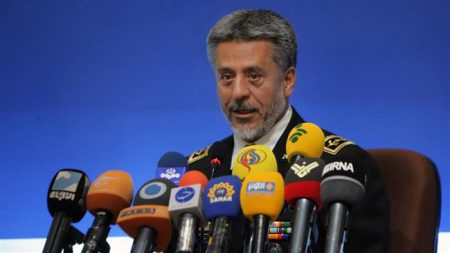
Touching on the simulation of hitting Iranian targets, Sayyari said that Iran “does not care about who’s doing what,” adding, “For us, it is important to boost our defense capabilities to such a level that we can withstand any threats [posed against us from] anywhere,” he added.
The Iranian commander also noted that any exercises in high seas should comply with international law.
The Unified Trident drills come after a string of incidents, in which US vessels that sailed close to Iranian territorial waters were met with Iran’s befitting response.
Iran has repeatedly warned that any act of transgression into Iran’s territorial waters would be met with an immediate and befitting response.
In January last year, Iran’s Navy arrested the crews of two US patrol boats that had trespassed on Iranian territorial waters. Iran released them after establishing that they had done so by mistake.
Iran has invariably asserted that it only uses its naval might for defensive purposes and to send across the Islamic Republic’s message of peace and security to other nations.
Featured Video
The Source of America’s Wars – Kristol Clear
or go to
Aletho News Archives – Video-Images
From the Archives
Is Israel to blame for the Iraq War?
American Goy | March 10, 2008
I am so tired of this old canard that “Israel had nothing to do with USA’s war with Iraq – in fact, it officially advised America against it”.
Bullshit. … continue
Blog Roll
 Aletho News
- Ceasefire for all or for none: Iran shuts Hormuz over Lebanon attacks
- Strait of Hormuz is Iran’s ‘nuclear weapon’ that forced US retreat: Medvedev
- Energy crisis will last for months – Kremlin envoy
- Europe’s quiet role in the war on Iran
- Forty days that shook the Empire: How Iran turned the tables on US and prevailed
- Netanyahu unilaterally declares Lebanon outside of ceasefire deal
- Israeli leaders: ‘Not a single goal’ achieved in war with Iran
- What on earth just happened? Trump, Iran, and the unlikely ceasefire
- Alberta Bill Would Fine Political Deepfakes $10,000 Without Satire Exemptions
- Iran declares ‘historic victory’ over US, says enemy forced to accept its proposal
- If Americans Knew
- Gazans face a triple crisis: severe shortages of water and bread, healthcare in tatters
- NY Times reports how Netanyahu took the US into Iran War
- A sigh of relief over Iran, but Gaza and Lebanon in dire straits – Daily Update
- Thousands dead and neighborhoods razed to the ground: Aid agencies fear southern Lebanon is becoming the new Gaza
- The war the US is fighting for Israel could cost trillions
- ‘Cigarette Burns, Nail Wounds’: Toddler Tortured in Gaza to Coerce Father
- Trump Says US Sent ‘a Lot of Guns’ to Protesters in Iran
- Israeli forces destroy 17 UN peacekeeper cameras in south Lebanon
- US-Israeli strikes ‘completely destroy’ synagogue in Tehran
- Archbishop for US Military Says Iran War Is Unjust Under Catholic Teaching
- No Tricks Zone
- An Inconvenient Tree: Uncovered In Alps… Europe Much Warmer Than Today 6000 Years Ago
- New Study Reports A 60% Slowdown In Greenland’s Ice Loss Rate In The Last Decade
- Low Intensity Tornado Wrecks Major Solar Farm, Creating A Potential Toxic Dump
- New Study Finds Warming Saves Lives…Cold Temperatures 12 Times More Deadly Than Excess Heat
- German Science Blog Accuses PIK Climate Institute Of Hallucinating Climate Tipping Points
- Devastating Assessment Of Comirnaty Vaccine By Former Senior Pfizer Europe Toxicologist
- New Study: CO2 Is ‘Effectively Negligible’ As An Explanatory Climate Change Factor Since 2000
- Former Pfizer Toxicologist Dr. Helmut Sterz Tells Bundestag Hearing Pfizer Vaccine Should Have Never Been Approved
- Energy Expert: Germany’s Nuclear Phaseout Was A “500 Billion Euro Mistake”
- New Research: South Australia’s Mid-Holocene Sea Surface Temperatures Were 4°C Warmer Than Today
 Aletho News