“Global Laundromat” has the Guardian in a Spin
By Kit | OffGuardian | March 21, 2017
The latest “breaking” story from the Guardian and Luke Harding is hitting the headlines. Almost exactly 1 year after the explosive anti-climax that was “The Panama Papers”, Harding and the coterie of NGOs for which he acts as de-facto spokesperson have a big announcement to make: Banks launder money, and some of it is Russian.

I don’t know why they use American money with a Russian flag superimposed. They were probably afraid nobody would recognise roubles.
We are nearing the anniversary of the release of the Panama Papers, a “big story” involving years of work, hundreds of leaked documents, a team of exceptional journalists (and Luke Harding) and a dramatic reveal: “Sometimes, very rich people use legal loopholes to avoid paying their taxes.”
The list of implicated parties included heads of state, celebrities, athletes, David Cameron’s dad and a cellist that knows Vladimir Putin. We all remember who the Guardian decided to focus on, and we all know why.
Today the same crack-team (and Luke Harding) are releasing the long-awaited sequel to their original hit. “The global Laundromat”, it’s called. It’s a product of a years-long investigation into money laundering in ex-Soviet states, using British shell companies. I can’t comment on the truth of these allegations, because we don’t get to see the evidence, we are simply told that it’s true “according to letters The Guardian has seen”, and “reports shown to the Guardian ”… and other variations on that theme.
They may well be true. Big business and billionaires take part in shady and/or illegal business practices all the time. Just as was the case in the Panama Papers, they tell us something we all already know to be true, and then act like it was a surprise.
There’s a lot to like here. The simultaneous publication of four different articles on the subject, all practically identical. The implication that it is “breaking news”, when their prize factoid is three years old, and the scheme itself hasn’t operated since 2014. The fact that Luke Harding has to publicly declare the US government’s involvement, to stop people like us from pointing it out and making them look silly (like last time). The persistent use of the old Harding trick of simply dotting your story with plenty of “could haves” and “speculations suggests”. It’s all good stuff.
Where it becomes hilariously cack-handed in their agenda-pushing is in trying to force tenuous links to the Kremlin and, of course, Vladimir Putin in particular.
Last year they plastered their front page with pictures of Putin and videos about Putin and editorials about corruption in Russia… despite having to admit in the text:
… the president’s name does not appear in any of the records…
This year they can’t even go that far. They fall to the level of implication. Talking around inconvenient facts on the one hand, and then wildly speculating on the other. Leaving deliberate dots for the reader to join up, whilst never having the courage of their convictions to make plain their insinuations (probably for fear of being sued and/or corrected in the alt-media).
Much like the Panama Papers launch, there’s an awful lot of verbiage to work through, implications are thick on the ground, evidence less so. No direct sources are named, it is always “an ex-banker living in exile said”, or “a Russian business-man said”. Gorge on words and starve of meaning seems to be the message of the day.
Some interesting bullet points I pulled out:
Now we can reveal Britain’s role in this scheme – and how vast sums of potentially tainted money flowed into and out of western banks, including HSBC and the Royal Bank of Scotland, without raising any alarm.
This is taken from this piece, one of the four long reads The Guardian is currently devoting to this topic. You can tell it’s a Harding creation because of the prose… for want of a better word… style. It might seem inconsequential at first, but note the use of the phrase “potentially tainted”, that means there is no proof of any wrong-doing at all. It means, the money is “potentially” untainted. As in just totally legal money being used to buy things.
Normally speaking I would expect a crime to at least have definitely happened before a paper put it in their headlines. But maybe I’m being old-fashioned.
The ingenious scheme has its origins in Russia. Put simply, it was a way for Kremlin insiders and other well-known Russians to shift cash abroad.
Not a single “Kremlin insider” is named in any of the four stories currently running on this issue.
Before it was rumbled, the scheme was one of several mafia operations that have allowed the rich to spirit money out of the country to spend in the west.
There’s no evidence to back-up this statement, not a single connection to the mafia is ever mentioned again. But even so it’s worth noting. The money is leaving Russia and coming here. Remember that, because it will be important later on.
“Money laundering is the biggest business in Russia,” one former Moscow banker, now living in exile, explained. “You steal from the budget. You’ve got this dirty money. You have to do something with it.”
The source here, the “former banker living in exile”, is naturally unnamed. As an educated guess it’s probably Sergei Pugachev, a banker and oligarch who has fled both Russia and Britain on charges of embezzling and money laundering. Harding has interviewed him before, it would make sense if he became Harding’s primary source on Russian banking.
Pugachev fled Russia after the government seized his assets and charged him with various financial crimes. That’s an important pattern that will repeat, and has repeated, many times over.
Here we come to the “Putin connection”, are you ready?
It features Russian banks, Moldovan oligarchs, and a network of fake UK companies fronted by fake or “nominee” directors, many of them in Ukraine. It had impeccable Moscow connections. Vladimir Putin’s cousin Igor sat on the board of a bank which held accounts that laundered billions.
His cousin worked at one of the banks that held accounts that may have laundered money. That’s it. These are connections that Harding considers “impeccable”. Is there any evidence connecting the two cousins? Phone calls? Photographs? If any exists, none is presented.
Interestingly, Igor Putin is actually a member of an opposition political party in Russia, which supported an alternative presidential candidate in 2012.
You can put the above quote together with another statement, from this article, to see just how completely meaningless it is:
Accounts held at 19 Russian banks were involved in the scheme. In 2014, it was reported that one financial institution was the Russian Land Bank (RZB). A bank board member at the time was Igor Putin.
Yes nineteen, nineteen(!), different Russian banks are “involved” with the scheme, and the “impeccable Moscow connections” are that Putin’s cousin worked at one of them. At least five different British banks were involved, HSBC, Barclays, Lloyds TSB, NatWest and RSB. It’s hard to imagine that every cousin, of every board member, of every bank is currently under investigation by Scotland Yard.
In fact, nobody is under investigation by Scotland Yard, at all. Every single reference to a criminal investigation is talking about Latvia, Moldova… and Russia.
Once the goods had been cleared the UK firms were liquidated. No duty was paid. Often, Russia’s tax inspectors then took the UK companies to court.
In practice, the Laundromat made possible three different crimes inside Russia: tax evasion, evasion of customs duty and money laundering. In 2013 grey import schemes cost the state $40bn, a Russian parliament committee said.
… alleged ringleader Alexander Grigoriev was detained in November 2015 while eating in a Moscow restaurant… In 2014-15, [Russian] regulators stripped Grigoriev of his banking licences amid concerns that funds were mysteriously vanishing… Russian police sources told Kommersant that Grigoriev was one of a number of prominent people who used the Laundromat to move $46bn in liquid assets out of Russia.
In three separate paragraphs, dotted throughout the four different articles he has contributed to, Harding makes reference to three different Russian governmental efforts to control illegal movement of money: Taking foreign companies to court, parliamentary enquiries, and the arrest and suspension of (alleged) criminal bankers.
He makes no such mention of any British efforts to do the same, because there were none.
The FSB, the Russian security service Harding routinely refers to as “the successor to the KGB” (in fact, in one article today he simply calls them the KGB), have apparently launched an investigation into this scheme. How does Harding address this issue? Very simply:
The Russian investigation into Laundromat has been cursory.
There are suspicions the FSB’s real goal was merely to find out how much investigators knew.
… officers from Russia’s FSB spy agency visited detectives in Moldova. They took away records. It is unclear if this was a genuine investigation or an attempt to discover how much the Moldovans knew. Probably the latter.
No sources are linked to back up these assertions. He completely dismisses, without evidence or argument, the FSB investigations.
He doesn’t dismiss the intentions of Britain’s NCA investigations… because, once again, there were none.
A step back, and a gentle examination, paints a rather different picture from the one with which the Guardian is trying to present us. It shows us Russian oligarchs and bankers shifting vast sums of money OUT of Russia and INTO the EU. Now why would this be?
Logic would suggest that money flows FROM regulation INTO corruption. That’s a natural physical force, like water running downhill. Like osmosis. Russia, since the end of the chaotic Yeltsin era, has been going through a slow process of de-oligarchisation, even Shaun Walker (grudgingly) admitted that. The aforementioned Sergei Pugachev can attest to it (he does so, often and loudly). The Russian government has jailed billionaires for embezzling. Russia prosecutes bankers, and demands companies pay their taxes. Is the same true of Britain? Did a single banker see the inside of jail cell after the 2008 crash? Have Amazon, Google or Vodafone been brought to court for their massive tax evasion?
What you’re looking at here, like the Panama Papers, is just further evidence of that which we already know, that the deregulated bank and business sectors in the UK can be abused by the super wealthy for their own personal gain. And, like the Panama Papers, it was deliberately misrepresented by “investigative journalists” in order to exaggerate any connection with the Russian government, and just generally shine a poor light on Russia.
So, who is behind this revelation?
To answer that, let’s take a look at the about page of the driving force behind this “scandal”, The Organized Crime and Corruption Reporting Project (OCCRP). The following is taken directly from their own website:
OCCRP is supported by grants by the Open Society Foundation, Google Digital News Initiative, the Skoll Foundation, the Sigrid Rausing Trust, Google Jigsaw, the National Endowment for Democracy and the Knight Foundation. OCCRP also receives developmental funds for improving journalism from the United States Agency for International Development (USAID) through the International Center for Journalists (ICFJ), the United States Department of State and the Swiss Confederation.
The bolded are all very familiar to us here at OffG, and should be to anyone that has followed our work on US-back NGOs. They form an argument on their own, you don’t need me to tell you what it means.
All this really tells us, so far, is that the US government, their corporate allies and puppet NGOs have spent years of their time, and God knows how much of their near-limitless resources, trying to tie the current Russian administration to any kind of criminal corruption. What have they found? A cellist legally avoiding his taxes and that Russian oligarch’s think their ill-gotten gains are safer in British banks, than Russian ones. A rather damning fact, when you think about it.
This is the result of years of work from the world’s business and intelligence elites (and Luke Harding), and it is, frankly, pitiful.
Trump v. Televised Congressional Hysteria
By Stephen Lendman | March 21, 2017
Americans are ill-governed and ill-served by officials at all levels of government – federal, state and local.
On Monday, clear evidence showed it. Disgraceful witch-hunt McCarthyism was on display for viewers tuning in to see.
Hysterical House Select Committee on Intelligence members disgraced themselves during tediously long testimony by FBI Director James Comey and NSA head Michael Rogers.
Committee members obsessed over nonexistent Trump ties to Russia, his charges about Obama wiretapping him, nonexistent Moscow US election hacking, Putin bashing, and security leaks.
Comey acknowledged an ongoing classified investigation into alleged Russian interference in America’s presidential election, saying:
“I have been authorized by the Department of Justice to confirm that the FBI as part of our counterintelligence mission is investigating the Russian government’s efforts to interfere in the 2016 presidential election.”
“And that includes investigating the nature of any links between individuals associated with the Trump campaign and the Russian government, and whether there was any coordination between the campaign and Russia’s efforts.”
“As with any counterintelligence investigation, this will also include an assessment of whether any crimes were committed.”
He offered no further elaboration despite hours of badgering by committee members to explain more.
The proceedings amounted to orchestrated McCarthyism, infamous witch-hunt hysteria, a disgusting display.
Russia was demonized for nonexistent US election hacking. Comey stopped short of suggesting collusion between Trump’s campaign and Moscow – because of an ongoing investigation he’s not at liberty to discuss.
After months of bashing Russia and Trump, no evidence surfaced of collusion between him, his campaign and Moscow – or proof of Russian US election hacking. None exists, yet baseless accusations persist.
Trump addressed Monday’s proceedings via multiple tweets, saying:
“James Clapper and others stated that there is no evidence Potus colluded with Russia. This story is FAKE NEWS and everyone knows it!”
“The Democrats made up and pushed the Russian story as an excuse for running a terrible campaign. Big advantage in Electoral College & lost!”
“The real story that Congress, the FBI and all others should be looking into is the leaking of Classified information. Must find leaker now!”
“What about all of the contact with the Clinton campaign and the Russians? Also, is it true that the DNC would not let the FBI in to look?”
Last fall Putin asked “is America a banana republic?” Televised Monday proceedings provided more evidence of a politically corrupt system too debauched to fix.
Of greater concern is creating pretexts for war on Russia. House Intelligence Committee chairman Devin Nunes (R. CA) claimed nonexistent “pressing threats posed by the Russian autocrat (sic)” Putin, urging “stronger action against Russian belligerence.”
Stoking conflict between the world’s top nuclear powers is madness. Is this where things are heading?
Will neocons infesting Washington risk nuclear armageddon to satisfy their lust for unchallenged power?
Stephen Lendman can be reached at lendmanstephen@sbcglobal.net. His new book as editor and contributor is titled Flashpoint in Ukraine: How the US Drive for Hegemony Risks WW III.
Neocons as a Figment of Imagination
Criticizing their thuggery is anti-Semitism?
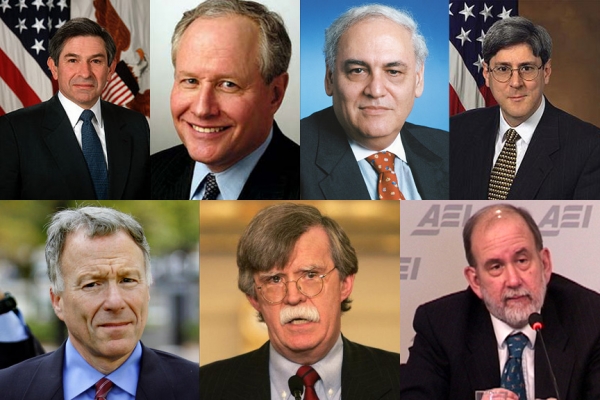
By Philip Giraldi • Unz Review • March 21, 2017
We have a president who is belligerent towards Iran, who is sending “boots on the ground” to fight ISIS, who loves Israel passionately and who is increasing already bloated defense budgets. If one were a neoconservative, what is there not to like, yet neocons in the media and ensconced comfortably in their multitude of think tanks hate Donald Trump. I suspect it comes down to three reasons. First, it is because Trump knows who was sticking the knife in his back during his campaign in 2016 and he has neither forgiven nor hired them. Nor does he pay any attention to their bleating, denying them the status that they think they deserve because of their self-promoted foreign policy brilliance.
And second, Trump persists in his desire to “do business” with Russia. The predominantly Jewish neocons always imagine the thunder of hooves of approaching Cossacks preparing to engage in pogroms whenever they hear the word Russia. And this is particularly true of Vladimir Putin’s regime, which is Holy Russia revived. When not musing over how it is always 1938 and one is in Munich, neocons are nearly as unsettled when they think it is 1905 in Odessa.
The third reason, linked to number two, is that having a plausible and dangerous enemy like Russia on tap keeps the cash flowing from defense industries to the foundations and think tanks that the neocons nest in when they are not running the Pentagon and National Security Council. Follow the money. So it is all about self-interest combined with tribal memory: money, status and a visceral hatred of Russia.
The hatred of Trump runs so deep that a leading neocon Bill Kristol actually tweeted that he would prefer a country run by bureaucrats and special interests rather than the current constitutional arrangement. The neocon vendetta was as well neatly summed up in two recent articles by Max Boot. The first is entitled “Trump knows the Feds are closing in on him” and the second is “WikiLeaks has joined the Trump Administration.” In the former piece Boot asserts that “Trump’s recent tweets aren’t just conspiratorial gibberish—they’re the erratic ravings of a guilty conscience” and in the latter, that “The anti-American WikiLeaks has become the preferred intelligence service for a conspiracy-addled White House.”
Now, who is Max Boot and why should anyone care what he writes? Russian-born, Max entered the United States with his family through a special visa exemption under the 1975 Jackson-Vanik Amendment even though they were not notably persecuted and only had to prove that they were Jewish. Jackson-Vanik was one of the first public assertions of neoconism, having reportedly been drafted in the office of Senator Henry Jackson by no less than Richard Perle and Ben Wattenberg as a form of affirmative action for Russian Jews. As refugees instead of immigrants, the new arrivals received welfare, health insurance, job placement, English language classes, and the opportunity to apply for U.S. citizenship after only five years. Max went to college at Berkeley and received an M.A. from Yale.
Boot, a foreign policy adviser to Mitt Romney in 2012, networked his way up the neocon ladder, including writing for The Weekly Standard, Commentary, The Wall Street Journal and The Washington Post. He was a member of the neocon incubator Project for a New American Century and now sits on the heavily neocon Council on Foreign Relations. Boot characteristically has never served in the U.S. military but likes war a lot. In 2012 he co-authored “5 Reasons to Intervene in Syria Now.” He is a reliable Russia and Putin basher.
Max Boot’s articles are smears of Donald Trump from top to bottom. The “closing in” piece calls for establishment of a special counsel to investigate every aspect of the Trump Team/Russian relationship. Along the way, it makes its case to come to that conclusion by accepting every single worst case scenario regarding Trump as true. Yes, per Boot “Putin was intervening in the presidential election to help Trump.” And President Barack Obama could not possibly have “interfered with the lawful workings of the FBI.” As is always the case, not one shred of evidence is produced to demonstrate that anyone associated with Donald Trump somehow became a Russian useful idiot, but Boot assumes that the White House is now being run out of the Kremlin.
Max is certainly fun to read but on a more serious note, the National Review is working hard to make us forget about employing the expression “neocon” because it is apparently rarely understood by the people who use the term. Plus its implied meaning is anti-Semitic in nature, something that David Brooks in an article pretty much denying that neocons really exist suggested thirteen years ago when he postulated that it was shorthand for “Jewish conservative.”
National Review actually searched hard to find a gentile who could write the piece, one Kevin D. Williamson, who is described as a “roving correspondent” for the magazine. His article is entitled “Word Games: The Right Discovers the Deep State.” Williamson begins by observing that using “neocon” disparagingly in the post-9/11 context acts either “as a kind of catalyst enabling a political reaction that revived a great many stupid and ugly myths about Jewish bankers orchestrating wars for profit…” or serves as a standby expression for a “Jew with politics I don’t like.”
Interestingly, I have never heard the “Jewish bankers” theory or disparagement of Jewish “politics” from the many responsible critics who have been dismayed by the aberrant U.S. foreign policy that has evolved since 2001. I don’t know how much money Goldman Sachs has made since the World Trade Center went down and that is not really the issue, nor is the fact that Jews overwhelmingly vote Democratic, which is a party that I don’t particularly like. Williamson dodges the increasingly held view that America slid into the abyss when Washington declared war on the entire world and invaded Iraq based on a tissue of lies, in large part to benefit Israel, which is what matters and why the enabling role of the neocons is important.
And one might reasonably argue that U.S. policy since that time has nearly always deferred to Israeli interests, most recently declaring its prime mission at the U.N. to be protecting Israel, then acting on that premise by forcing the resignation of a senior official who had prepared a report critical of Israel’s “apartheid” regime. I recognize that relatively few American Jews are neocons and that many American Jews are in the forefront in resistance to Israel’s inhumane policies, but the reality is that nearly all neocons are Jewish. And they are in your face every time you turn on the television or pick up a newspaper. Abrasive and abusive Professor Alan Dershowitz recently proclaimed that Jews should never apologize for Jewish power, saying that it is deserved and granted by God, but I for one think it is past time for a little pushback from the rest of us to make Washington protect American interests instead of those of Israel.
The neocon cult has been behind the promotion of Israel as well as the serial foreign policy misadventures since 2001. Do the names Perle, Feith, Wolfowitz, Abrams, Edelman, Ledeen, Senor, Libby and Nuland in and around the government as well as a host of others in think tanks and lobbies like AIPAC, AEI, WINEP, PNAC, FPI, FDD, JINSA and Hudson ring a bell? And do the loud voices in the media to include Judith Miller, Robert Kaplan, Charles Krauthammer, Jennifer Rubin, Fred Hiatt, Bret Stephens, Bill Kristol, the Kagans and the Podhoretzes, as well as the entire Washington Post and Wall Street Journal editorial pages, suggest any connivance?
They are all Jews and many are connected in terms of their careers, which were heavily networked from the inside to advance them up the ladder, often to include moving between government and lucrative think tank and academic positions. They mostly self-identify as neoconservatives and all share some significant traits, notably extreme dedication to Israel and embrace of the doctrine that the U.S. should not be shy about using military force, so it is interesting to learn from Williamson that they really do not constitute a cohesive group with shared values and interests as well as excellent access to the media and the levers of power. When did you last see an “expert” on the Middle East on television who was not Jewish?
Having made his pithy comments and dismissed neoconservatism-phobes as bigots, Williamson then wanders off subject into the Deep State, which, like neoconism apparently is some kind of urban legend being propagated by the poorly informed, whom these days he identifies as Trump supporters. He argues that the entities that are frequently cited as the Deep State, including the neocons, actually have quite divergent interests and it is unlikely that those interests should become “identical or aligned” to enable running of the country in an essentially clandestine fashion.
It is perhaps inevitable that Williamson is confused as he does not recognize how the American Deep State differs from that in most other countries – it is perhaps better described as the Establishment. Unlike in places like Turkey, it operates largely out in the open and ostensibly legally along a New York-Washington axis that constantly revitalizes itself through the revolving door allowing the entry of politicians and high government officials who create and enforce the legislation that benefits Deep State interests. Its components do indeed have different motives, but they come together in preserving the status quo, which benefits all parties, while little dissent comes from the Fourth Estate as the process plays out, since much of the media and many of the proliferating Washington think tanks that provide Deep State “intellectual” credibility are also part of the same malignancy. And yes, quite a bit of today’s Establishment is Jewish, most particularly financial and legal services, the think tanks, and academia. Many of them support or are part of the neocon persuasion and frequently also of the Israel Lobby.
The existence of a Deep State means that many issues that impact on the citizenry never are discussed as part of the political process, leading to jokes that the United States has only one political party with two wings. Issues like the relationship with Israel, though hotly debated by some of the public, are never really debated and are dealt with by consensus crafted by the politicians and the media. Significant policies like those relating to war and peace, healthcare and immigration were rarely seriously challenged prior to Trump because there is a broad agreement regarding what the Establishment will allow to take place. That is how the Deep State operates.
When it comes to foreign and national security policy the neocons are most definitely an integral part of the Deep State, using money and access to politicians to influence what is taking place without anyone seriously challenging their role. They are an essential cog in a system that is completely corrupt: it exists to sell out the public interest, and includes both major political parties as well as government officials. And it is so successful because it wins no matter who is in power, by creating bipartisan-supported money pits within the system. Monetizing the completely unnecessary and hideously expensive global war on terror benefits the senior government officials, beltway industries, and financial services that feed off it. Because it is essential to keep the money flowing, the Deep State persists in promoting policies that enrich its constituencies but otherwise make no sense, to include funding the unending and unwinnable wars currently enjoying marquee status in Iraq, Syria and Afghanistan and the gift of $38 billion to Israel.
Max Boot spews the kind of bile that is commonly seen or heard when the neocons zero in on their enemies. The National Review meanwhile provides cover for Max and others by suggesting that only anti-Semites or the demented could possibly have it in for neoconservatives or be wary of zany concepts like a Deep State. Together they generate the fog that makes it impossible to challenge certain aspects of the status quo. Maybe, just maybe, what Donald Trump has been saying about his predecessor’s Deep State inspired machinations are true. And just possibly there is a largely Jewish cabal within that Deep State, call it what you will, that works very hard behind the scenes to favor Israel while also pushing for a state of perpetual war, from which it benefits personally. I know that thinking that we Americans are on the receiving end of a vast and very effective conspiracy makes many uneasy, but history has taught us that sometimes our worst nightmares are actually true.
John McAfee: ‘I Can Promise You It Wasn’t Russia Who Hacked the DNC’
Sputnik – 21.03.2017
The Kremlin has been accused of launching large-scale cyberwar ostensibly aimed at undermining democracy in the United States, with high-profile hacks on the Democratic Party cited as evidence, but technology pioneer and founder of McAfee securities John McAfee told Radio Sputnik that Russia is not behind these high-profile cyberattacks.
“I can promise you it was not the Russians who hacked the Democratic National Committee (DNC). The software used was way too old. The state hackers would not use an old version of software which was less functional than the updated versions,” he said. “One of the things that the CIA said and I’ve been saying for years is that it is virtually impossible to find attribution for any hack because a good hacker can hide their tracks plus make it look like someone else did it. This happens all the time.”
It is extremely likely that if a cyberattack appears to have originated in Russia or China for instance, it was in fact launched from a third country. In this case locations are placed specifically to hide the tracks of the true perpetrator, he explained.
McAfee suggested that there could be political motivation behind accusations that Russia launched cyberattacks on the Democratic National Committee (DNC) and John Podesta, the former chairman of the 2016 Hillary Clinton presidential campaign.
Vladimir Putin is “possibly the most powerful man in the world. America resents that. The Democrats for some reason hate Putin. I think Donald Trump is far wiser,” he said, referring to Trump’s pledge to improve relations with Russia which were ruined during the Obama administration. “If in fact they spoke with each other daily, wouldn’t we have a more harmonious world? And yet here in America we are trashing people for speaking to Putin. It’s bizarre.”
McAfee further commented on recent revelations with regard to the CIA’s hacking secrets. He expressed doubt that the US intelligence community could be made more accountable and transparent if stricter rules on its operations are passed.
“I’ve never seen a covert agency adhere to any kind of legislation. We all know that murder is illegal in almost every country and yet there is not a single covert agency in America, except possibly for the FBI, that does not engage in assassinations. We all know this. I don’t think legislation is needed. I think that we need a firm hand. We need to fire the directors and management all the way down to the street agent and then start over,” he said.
McAfee also said that cyberwar could have far more serious implications than a nuclear conflict.
“We are not in a nuclear age anymore. There will not be another nuclear war because cyberwar is far more devastating. The tools will eventually be in the hands of hackers because this is what happens when you build weaponized software. The first time you use it you send a copy into the wild and every researcher in the world has a copy of that. It can then be duplicated and in a year from now, these tools will be sold on the dark web by 15-year-old boys for a hundred dollars,” he explained.
The Missing Logic of Russia-gate
By Robert Parry | Consortium News | March 20, 2017
As Rep. Adam Schiff tries out for the lead role in a remake of the Joe McCarthy hearings by maligning specific Americans as suspected Russian moles, some of the actual evidence argues against the Democratic notion that the Russians own President Trump and other key Republicans.
For instance, last week, Democrats circulated a report showing that retired Lt. Gen. Michael Flynn, who served briefly as President Donald Trump’s national security adviser, had received payments from several Russia-related entities, totaling nearly $68,000.
The largest payment of $45,386 came for a speech and an appearance in Moscow in 2015 at the tenth anniversary dinner for RT, the international Russian TV network, with Flynn netting $33,750 after his speakers’ bureau took its cut. Democrats treated this revelation as important evidence about Russia buying influence in the Trump campaign and White House. But the actual evidence suggests something quite different.
Not only was the sum a relative trifle for a former senior U.S. government official compared to, say, the fees collected by Bill and Hillary Clinton, who often pulled in six to ten times more, especially for speeches to foreign audiences. (Former President Clinton received $500,000 for a Moscow speech from a Russian investment bank with ties to the Kremlin, The New York Times reported in 2015,)
Yet, besides Flynn’s relatively modest speaking fee, The Washington Post reported that RT negotiated Flynn’s rate downward.
Deep inside its article on Flynn’s Russia-connected payments, the Post wrote, “RT balked at paying Flynn’s original asking price. ‘Sorry it took us longer to get back to you but the problem is that the speaking fee is a bit too high and exceeds our budget at the moment,’ Alina Mikhaleva, RT’s head of marketing, wrote a Flynn associate about a month before the event.”
So, if you accept the Democrats’ narrative that Russian President Vladimir Putin is engaged in an all-out splurge to induce influential Americans to betray their country, how do you explain that his supposed flunkies at RT are quibbling with Flynn over a relatively modest speaking fee?
Wouldn’t you think that Putin would have told RT’s marketing department that the sky was the limit in paying off Flynn because the ever-prescient Russian president knew from his Ouija board in 2015 that Flynn would be the future national security adviser under President Trump?
After all, it’s become one of Official Washington’s favorite groupthinks that RT is nothing but a Russian propaganda front designed to destroy the faith that Americans have in their democratic process – as if the sleazy and shameful political campaigns financed with hundreds of millions of dollars from billionaires need any help from RT.
Anti-Democracy Debates
But RT-bashing is always in season. The Director of National Intelligence’s report on Jan. 6, with its evidence-free “assessments” that Russia was engaged in undermining American democracy included a seven-page appendix dating from 2012 that described how RT was contributing toward that goal by portraying “the US electoral process as undemocratic.”
The “proof” behind the DNI’s accusation included RT’s articles on “voting machine vulnerabilities” although virtually every major U.S. news organizations ran similar stories in that time frame. The DNI report also took RT to task for covering the Occupy Wall Street movement and for reporting on the environmental dangers from “fracking,” topics cited as further proof that the Russian government was using RT to weaken U.S. public support for Washington’s policies (although, again, these are topics of genuine public interest).
To further demonstrate how RT was carrying out the Kremlin’s goal of spoiling Americans’ faith in the U.S. democratic process, the DNI report noted that “RT broadcast, hosted and advertised third-party candidate debates.”
Apparently, the DNI’s point was that showing Americans that there are choices beyond the two major parties was somehow seditious. “The RT hosts asserted that the US two-party system does not represent the views of at least one-third of the population and is a ‘sham,’” the DNI’s report said.
Yet, polls have shown that large numbers of Americans would prefer more choices than the usual two candidates and, indeed, most Western democracies have multiple parties. But somehow RT’s suggestion that other voices should be heard constituted an assault on American democracy.
As for Flynn, the report on his finances showed that he also received payments of $11,250 from the U.S. subsidiary of Kaspersky Lab, a Russian cyber-security firm, and $11,250 from a U.S. air cargo company associated with the Volga-Dnepr Group, owned by a Russian businessman.
Rep. Elijah Cummings, D-Maryland, who was the chief defender of former Secretary of State Hillary Clinton when she was subjected to the Republicans’ over-the-top Benghazi investigations, switched positions in publicizing the news about Flynn’s post-government work related to Russia. Cummings was suddenly the accuser.
”I cannot recall any time in our nation’s history when the President selected as his National Security Advisor someone who violated the Constitution by accepting tens of thousands of dollars from an agent of a global adversary that attacked out democracy,” Cummings wrote in a letter to President Trump, Defense Secretary Jim Mattis and FBI Director James Comey.
Heating Up the New Cold War
Cummings thus became another Democrat pouring gasoline on the smoldering tensions between nuclear-armed Russia and the United States. For the Democrats, any dealing with any entity that had some connection to Russia is now prima facie evidence of disloyalty.
The context of these contacts has become almost irrelevant, subordinated to the larger goal of ousting Trump, whatever the cost, even transforming the Democratic Party into the party of the New Cold War and the New McCarthyism.
Yet, further undercutting the new certainty that Putin lined Trump’s pockets with rubles as a way to ensure his allegiance to the Kremlin is the story of Trump’s failed luxury hotel project intended to be built in Moscow several years ago.
A source familiar with those negotiations told me that Trump had hoped to get a half interest in the $2 billion project but that Russian-Israeli investor Mikhail Fridman, a founder of Russia’s Alfa Bank, balked because Trump was unwilling to commit a significant investment beyond the branding value of the Trump name.
Again, if the Democratic narrative is to be believed – that Putin controls all the businesses in Russia and wanted to pay off Trump – it’s hard to understand why the hotel deal fell through. Or, for that matter, why RT was nickel-and-diming Flynn.
The other problem with the Democratic narrative is that it always assumes that Putin could foretell that Trump would rise in 2016 to win the U.S. presidential election and thus there was value in corrupting Trump and his entourage with money and other favors.
The fact that almost no political pundit in the United States shared that prediction even last year would seem to demonstrate the kookiness of the Democratic assumptions and the flaws in the U.S. Intelligence Community’s “assessments” about alleged Russian “hacking” and distribution of Democratic emails.
Those “assessments” also assume that Putin’s motives were to hurt Hillary Clinton’s campaign, boost Trump and – as FBI Director Comey added on Monday – turn Americans against their democracy.
But there is a counter-argument to that thinking: Assuming that Putin read the polls like everyone else, would he risk infuriating the likely next President of the United States – Hillary Clinton – by embarrassing her with an email leak that would amount to a pinprick? Clinton herself blamed her surprise defeat on FBI Director Comey’s decision to briefly reopen the investigation into whether she endangered national security by using a private email server as Secretary of State.
Unless one assumes that Putin’s Ouija board also predicted Comey’s actions or perhaps that Comey is another Russian mole, wouldn’t it be a huge risk for Putin to anger Clinton without ensuring her defeat? There’s the old saying that “if you strike a king, you must kill him,” which would seem to apply equally to a queen. But logical thinking no longer applies to what’s going on in Official Washington.
Investigative reporter Robert Parry broke many of the Iran-Contra stories for The Associated Press and Newsweek in the 1980s.
Pristina Snaps Up 200 Billion Euros’ Worth of Serbian Property in Kosovo
Sputnik – 20.03.2017
The authorities of the self-proclaimed Kosovo republic have decided to confiscate up to 200 billion euros’ worth of real estate of the former Yugoslavia’s Serbia and Kosovo Province, adding pressure to an already strained relationship between Pristina and Belgrade.
The Kosovo cadastral agency has been instructed to immediately register all real estate, amounting to more than 2 million square meters of buildings, including a ski resort and a mining complex, but also land, as the property of Kosovo.
Meanwhile, according to the Serbian cadaster agency, Serbian immovable property in Kosovo amounts to 1 million square meters and Serbian-owned enterprises in the region are valued at about 200 billion euros.
The region’s strategic natural resources “privatized” by the Pristina government include almost 15 billion tons of lignite and over 42 billion tons of lead and zinc.
Reacting to the news, Serbian First Deputy PM and Foreign Minister Ivica Dacic said the decision was “completely illegal, and unacceptable.”
No serious investor will spend money in Kosovo based on this decision of the government in Pristina — “because they won’t know whose property it is in the end,” he added.
According to the former head of the Kosovo cadastral agency, Slavica Radomirovic, 58 percent of industrial enterprises and real estate in Kosovo belong to Serbia and its citizens as proved by original documents taken out of the region after the 1999 war.
Radomirovic warned that the Kosovo authorities had prepared their own cadaster books based on forged data.
In an interview with Sputnik Serbia, Dusan Prorokovic, an expert with the Belgrade-based Strategic Alternative Fund, said that Pristina prefers to resolve all disputes with Belgrade by military force and that all it really wants is property.
“All they are doing was previously approved by the Obama Administration. They started with a demand for a Kosov army and within the next few weeks we could expect further such steps by Pristina. They know that the international community will look on as a new balance of forces is emerging in the Balkans,” he said.
Political analyst Dusan Janjic said that all this was a logical continuation of the EU-launched process of illegal privatization of Serbian property in Kosovo.
“Pristina is speeding up this whole process across the board. Just like its [Western] sponsors, it wants things like the army and property cut out for it before they start a dialogue in a new format,” he added.
Meanwhile, Kosovo Vice-Premier Branimir Stojanovic told the Serbian TV channel RTS that the decision to confiscate Serbian property in Kosovo was legally null and void and could seriously complicate relations with Belgrade.
He added that the decision was taken behind closed doors without asking the opinion of Serbian representatives in the regional parliament.
Kosovo unilaterally proclaimed independence from Serbia in 2008 and is recognized by over 100 UN member states. Serbia, as well as Russia, does not recognize Kosovo’s independence.
Israel’s New Travel Ban
By Alison Weir | Dissident Voice | March 20, 2017
Dear Israeli Government:
You’ve recently banned foreigners who support boycotts against Israel or Israeli settlements from being allowed to enter Israel – even Jewish foreigners, a first for the self-proclaimed Jewish state After all, your “Law of Return” has allowed (and encouraged) Jewish foreigners to freely immigrate to Israel, even as multitudes of Palestinians have been banned from returning to their homes.
People throughout the Western world have objected in outrage to your new law, particularly Jewish Westerners who have family and connections in Israel from whom they’ll be cut off in retaliation for their political positions.
Critics, even some who oppose boycotting Israel and who have had no problem with excluding Palestinians, have called out the law for diverse reasons: its quashing of free debate and political expression, its anti-democratic nature, how it will affect them and others personally.
I support these objections.
But I’m not trying to visit Israel.
I want to go to Bethlehem and Nablus, Ramallah and Hebron, Jenin and Tulkarem. I hope to return to Khan Yunis, Rafah, Gaza City, and numerous other towns and villages in the West Bank and Gaza.
In other words, I want to go to Palestine – a country recognized by 136 countries around the world. But your law, astoundingly, prevents me from visiting that country. You control entry and exit to the places I want to visit, even though they’re not part of your territory, or included in your exclusive democracy.
When I was born, Palestine referred to the whole of the land that your founders then ethnically cleansed and renamed. Now, it officially refers to a few segments of land, surrounded and trapped.
Unlike the residents of every other country on earth, Palestinians are not free to travel to and from their own country unless a foreign country gives them permission – a normally universal right that you routinely deny: to young and old, Muslims and Christians, professors and paupers, men and women.
Visitors are similarly obstructed. You decide whether they can get in, and whether they can get out.
When I try to visit Bethlehem, for example, I must face your armed soldiers manning the Kafkaesque, towering concrete wall you have erected on Palestinian land. These gun-toting youngsters will decree whether or not I and others – including Palestinian descendants of Bethlehem’s ancient shepherds – can pass through.
In other words, Israel is essentially imprisoning over 4 million men, women, and children (with some help from Egypt, its proxy to the south). Israeli jailers, euphemistically “border guards,” determine who may even visit this incarcerated population, and what supplies may reach them.
Over the years I’ve seen you prevent numerous individuals and groups, many bringing medicines and life-saving supplies, from visiting this captive population. You’ve blocked sons from visiting dying mothers, suffering children from receiving critical medical care, malnourished toddlers from receiving help.
It is a profound shame upon the world that this cruel and unconscionable condition has been permitted to persist year after year. There should have been massive and irresistible objections long before your recent legislation.
I remember when the United States opposed the Iron Curtain. Today, the U.S. gives the perpetrator of this current captivity $10 million per day.
Israel already denied me entry once 15 years ago, locking me up for 28 hours in a detention cell in Ben Gurion Airport before expelling me. I remember Israeli officials telling me I was not “allowed into Israel.” They didn’t even supply a reason.
Next time, they may say it’s because I endorse BDS, which I wholeheartedly do.
But I’m not trying to go to Israel. I want to go to Palestine.
– Alison Weir
Alison Weir is executive director of If Americans Knew. She can be reached at: contact@ifamericansknew.org.
‘Netanyahu Asks Putin to End Targeting ISIS in Syria’
American Herald Tribune | March 19, 2017
The secretary general of Lebanon’s Hezbollah resistance movement, Sayyed Hassan Nasrallah, says Israel seeks an end to Russia’s military campaign against the ISIS terrorist group in Syria to avert the Tel Aviv regime’s collapse.
Nasrallah said on Saturday that Israeli Prime Minister Benjamin Netanyahu had recently met with Russian President Vladimir Putin in Moscow to express his deep concern over the likely collapse of ISIS in Syria since such a development would mark a great triumph for the resistance front in the Middle East region.
The Hezbollah chief added that the defeat of the ISIS Takfiri group in Syria would be tantamount to the fall of Netanyahu himself.
Russia launched a military campaign against the terrorist groups in Syria in late September 2015 at the official request of the Damascus government.
Elsewhere in his remarks, Nasrallah said that Western powers were drawing on Takfiri terrorists in order to carry out their schemes in conflict-ridden Syria.
“I have repeatedly called on Syria militants not to put trust in [the] West and implement their plots in Syria, because the US and its allies are only using them as cannon fodder and will abandon [them] as soon as they are defeated,” he said.
He added, “I am telling militants fighting within the ranks of the enemies that you are only serving Israel, and shedding the blood of innocent people.”
The Hezbollah leader noted that the days of ISIS, Jabhat Fateh al-Sham, formerly known as the al-Nusra Front, and other terrorist groups fighting to topple the Damascus government are numbered as Syrian army forces continue to achieve victories across the country.
Even those Arab and Western countries that once supported these terror outfits are now fighting them, Nasrallah pointed out.
The Hezbollah chief argued that all the Arab money spent to fan the flames of militancy in Syria over the past six years could have been used to eradicate poverty and illiteracy in the Arab world, feed starving Somalis, and accommodate homeless Palestinians.
Nasrallah said Israeli Prime Minister Benjamin Netanyahu had recently visited Russian President Vladimir Putin in Moscow to express his deep concern over the likely collapse of Daesh in Syria since such a development would mark a great triumph for the resistance front in the Middle East region.
Featured Video

Michael von der Schulenburg: Europe’s Self-Defeating Iran War Policy
or go to
Aletho News Archives – Video-Images
Frlom the Archives
Provoking a Path to Persia
The Saban Center’s prescient paper on war with Iran
By Maidhc Ó Cathail | October 20, 2011
In June 2009, the Saban Center for Middle East Policy published “Which Path to Persia?—Options for a New American Strategy toward Iran.” Writing in a tone strikingly reminiscent of the Project for a New American Century’s infamous pre-9/11 paper “Rebuilding America’s Defenses,” the six co-authors noted that, “It seems highly unlikely that the United States would mount an invasion without any provocation or other buildup.” For a think tank specifically established by media mogul Haim Saban to protect Israel, this could prove to be a formidable obstacle impeding their desired march—of U.S. troops—to Tehran.
“In fact, if the United States were to decide that to garner greater international support, galvanize U.S. domestic support, and/or provide a legal justification for an invasion, it would be best to wait for an Iranian provocation, then the time frame for an invasion might stretch out indefinitely,” Saban’s think-tankers ruefully observed.
“With only one real exception, since the 1978 revolution, the Islamic Republic has never willingly provoked an American military response, although it certainly has taken actions that could have done so if Washington had been looking for a fight. Thus it is not impossible that Tehran might take some action that would justify an American invasion. And it is certainly the case that if Washington sought such a provocation, it could take actions that might make it more likely that Tehran would do so (although being too obvious about this could nullify the provocation). However, since it would be up to Iran to make the provocative move, which Iran has been wary of doing most times in the past, the United States would never know for sure when it would get the requisite Iranian provocation. In fact, it might never come at all.”
Seemingly undeterred by Iran’s frustrating unwillingness to provide the requisite provocation, the analysts continued to examine this option… continue
Blog Roll
 Aletho News
- Iran attacks on UAE leaves RSF militia high and dry
- Hosting Washington’s war: Bahrain faces the consequences
- The US fell for its own Iran propaganda
- Seyed M. Marandi: Threat of Seizing Kharg Island & the Use of Nuclear Weapons
- Is there even an off ramp?
- Michael von der Schulenburg: Europe’s Self-Defeating Iran War Policy
- Sorry, The New Republic, Climate Change Isn’t Causing Somali Migration. Blame Civil Strife and Poverty.
- Expert Guts Claims That HPV Vaccine Reduces Cancer Risk
- No evidence Russia sabotaged Baltic cables – Finnish intel
- The Strategic Folly of a (Serious) US Ground Invasion of Iran
- If Americans Knew
- Are we on the precipice of World War III?
- ‘Catastrophic,’ Says UNICEF: 1,100+ Children Killed or Wounded in Mideast Since US-Israel Launched Iran War
- The Unbelievable Madness of Our War With Iran
- World Council of Churches calls on govts to hold Israel accountable for violations of intl law
- How to end the war on Iran that costs US taxpayers $1M per minute – Not a ceasefire Day 153
- Israeli strategic plans to “remake the Middle East” from the 1950s and since
- Honoring Gaza’s women who refused to let the world look away
- 97% of victims of war on Iran are Iranian, 98% of victims in war on Gaza are Gazans – Not a ceasefire Day 152
- Early Iran strikes cost $5.6 billion in munitions, Pentagon estimates
- Israel Decided the War, But Trump’s America Fights and Pays the Bill
- No Tricks Zone
- New Studies: UK Sea Levels Were 4 Meters Higher Than Today During The Mid-Holocene
- Destructive Green New Deal: German Energy And Metal Group Warns Of Drastic Crisis
- New Study Documents A 20-Year Pause In Arctic Sea Ice Decline – Driven By Internal Variability
- Wake-up Call: Survey Shows Majority Of Germans Now Favor Postponing Climate Targets!
- Televised! Leading German Political Candidate Tells Schoolchildren CO2 Makes Sun Hotter!
- New Study: A Century Warming Of 1.1°C Is ‘Commonplace’ And ‘Not Unusual’ During This Interglacial
- New Study: ‘Internal Noise’ And Volcanic Forcing Can Trigger 10-15°C Warming Within Decades
- Glaciers Worldwide Are Suddendly Surging, Experts Blame Warming!
- Surprising Discovery: Sahara Is Greening…Billions Of Trees Where Once Thought To Be Barren
- New Research Reaffirms Clouds, Aerosols, And Surface Solar Radiation Are ‘Driving The Climate System’
 Aletho News