AIPAC Is Back In Town!
Hava Nagila, y’all
By Philip Giraldi • Unz Review • March 28, 2017
Spring in Washington would not be complete without the city’s famous cherry blossoms and the annual “Policy Conference” meeting of the American Israel Public Affairs Committee (AIPAC). The 15,000 plus participants began arriving on Sunday and will be here at the Walter E. Washington Convention Center until tomorrow morning, at which point many of them will descend on Congress like a swarm of ravenous locusts to make sure that our Solons on the Potomac are doing what is right by Israel.
AIPAC is the most powerful foreign policy lobby in Washington. It’s annual budget exceeds $77 million plus it has an endowment of $100 million. It has nearly 400 employees and also supports local chapters and initiatives throughout the United States.
What do all those employees do? They mostly lobby Congress and increasingly state legislatures shamelessly on behalf of a foreign country that has little in the way of actual common interests with the United States. When anything happens in the Middle East, AIPAC’s drones get to work, drafting up position papers detailing the Israeli position which are then placed by runners on the desks of every single congressman within a matter of hours. The congressmen, too lazy to engage in any real inquiry into what is going on, rely on the AIPAC research. That is, lamentably, how our system works. And if the congressman ignores the “expert” advice, AIPAC and its friends make sure he or she has a strong, well-funded opponent in the next election, someone who knows how to say “I love Israel” without moving his or her lips.
The current speakers’ list for the 2017 conference includes many of the leading political parasites that have long made the nation’s Capitol a “must miss” destination. I will not attempt to summarize what Michael Pence, Mitch McConnell, Chuck Schumer, Paul Ryan, Nancy Pelosi, Kevin McCarthy, Steny Hoyer and others said on Sunday night and yesterday as it was all basically the same speech, declaring undying love for Israel and the Jewish people and pledging that the United States will always have “Israel’s back,” whatever that is supposed to mean. Twenty-nine congressmen were featured as attendees on the AIPAC website but more than two thirds of the entire Congress is expected to appear for a photo op while muttering something about that apparently vulnerable “back.” Or do they mean backside? Whatever. I won’t name any more of the specific panderers as the reader probably already has a good idea who they are.
And, of course, the redoubtable Professor Alan Dershowitz was also a featured speaker, a wonderful human being who recently told us goyim that Jewish power in this country is both deserved and granted by Jehovah. It is interesting how Jews among themselves boast about their power but if a gentile so much as suggests the same thing it is anti-Semitism.
There were also two certifiable loonies among the speakers, apart from Dershowitz. They were Nikki Haley, America’s stalwart U.N. Ambassador, and Stephen Harper, until recently Prime Minister of Canada. Those who are following Haley’s meteoric career are probably aware that while governor of South Carolina she took the lead on making her state the first in the nation to legislate against the Boycott, Divestment and Sanctions movement (BDS) which supports peaceful pressure on Israel to abandon its apartheid policies when dealing with its own Arab citizens as well as the Palestinians on the West Bank and Gaza. Such legislation is an abrogation of First Amendment rights and will likely prove to be unconstitutional if it ever gets to the Supreme Court, but Haley clearly believed then and believes now that nothing is too good when it comes to Israel. Since going to the U.N., Haley has spoken more about Israel than about any possible American interests, pledging full support and protection for Netanyahu and his government. She blocked the appointment of a well-qualified Palestinian to a senior U.N. position purely because he was Palestinian. Ignorant of nearly everything that goes on in the world outside the U.S., it might be said that she is so horribly inept that she actually makes her ghastly predecessor Samantha Power look good.
Stephen Harper is another certified knee jerker when it comes to Israel. A fundamentalist Christian who believes the second coming of Christ is imminent, while Prime Minister he led what was possibly the world’s most pro-Israeli government. Harper described Israel as a light that “… burns bright, upheld by the universal principles of all civilized nations – freedom, democracy justice.” He has also said “I will defend Israel whatever the cost” to Canada, an interesting proposition for those who might have believed that his duty was to protect his own country and advance its interests. Harper, who has received awards from both Canadian and American Jewish organizations, personally endorsed Israel’s bombing of Lebanon in 2006, calling it “measured” even when Canadian peacekeepers were killed in the bombardment.
Paul Kagame, President of the Republic of Rwanda, also spoke at the conference. Why? I don’t know but it probably has something to do with characteristically liberal American Jews pulling their usual doublespeak trick, trying to pretend that fundamentally racist Israelis are not actually racist by inviting a black man to speak at a pro-Israel conference. I’ll bet he was paid handsomely to do so.
And former British Prime Minister Tony Blair, perhaps suggesting that love for Israel is truly international, spoke and was also probably paid handsomely to do so as he an incorporated brand. Between 2007 and 2015 Blair was the “special envoy” representing (and personally profiting from) the Quartet seeking to bring about a peace agreement between Israel and Palestine. Marwan Bishara explained in The New York Times: “A natural panderer to power, Mr. Blair morphed his complicity with the United States over Iraq into a new complicity with Israel. The assumption that operates is that schmoozing with the powerful is the only way to make a difference. So while Mr. Blair worked to reform the Palestinian Authority’s finances, security and governance, he turned a blind eye as Israel expanded its illegal settlements and tightened its hold on the autonomous territories. In the process, Mr. Blair helped render the Palestinian Authority more, not less, dependent on Israel. Instead of protecting the Palestinians from the Israeli settlers, Palestinian security forces have since been protecting Israeli settlers from Palestinian resentment.” Blair also attacked the Palestinian leadership’s decision to seek United Nations recognition of the Palestinian state, calling it “deeply confrontational.” Bishara dismisses him as “Israel’s puppy.” As I am extremely fond of dogs, I would modify that to read “Israel and now AIPAC’s butt boy.”
The avenging angel Benjamin Netanyahu also addressed the conference by satellite link and yet again described the threat posed by Iran. The satellite visit was somewhat surprising, as he usually likes to drop by in person so he can pick up his annual tribute money from the U.S. Treasury. This year’s Danegeld will be $3.8 billion thanks to President Barack Obama, guaranteed for ten years, and there will be, of course, various supplements as the Israelis discover things that they just need to have to stave off Netanyahu’s wily Persians and fight the rising tide of anti-Semitism. A rising tide, which we have just learned, was carried out by an Israeli Jew who also holds U.S. citizenship, which again leads to the question why so many Israelis are allowed to have American passports even though they live in Israel and serve in the Israeli Army?
And, of course, Persia was an integral part of the conference as it is tough to want to destroy the entire Muslim Middle East without having a really formidable enemy to focus on. Iran fits the bill quite nicely, but speakers were also prone to skewer those terrible Ay-rabs who just do not want peace. And the Israeli’s settlements are not a problem, nosiree! The theme of this year’s gathering was, in fact, “Many voices, one mission,” the mission presumably being the expansion of Israel so it will stretch east to west from the Nile to the River Jordan and north to the Turkish border. The indigenous inhabitants will have to be removed, but as they are mostly terrorists that should be okay with the world community and Donald Trump. And with the 15,000 AIPAC attendees.
The AIPAC gathering is really all about subverting Congress, so it is a good thing that a large majority of Congressmen were attending, making the necessary bowing and scraping that much easier. And they will enjoy it even more when the 15,000 AIPAC loyalists descend on Capitol Hill as the conference ends to make sure that Congress is listening. Democracy in action is great, isn’t it?
Even though I jest about the absurdity of thousands of Americans who appeared to be confused about what country they actually live in gathering to honor a foreign country that has an army that acts like a terrorist group, does not believe in equal rights even for its own citizens and bans visitors who do not accept its more questionable policies, the AIPAC people are not a joke. They are a deadly serious threat to our own democracy and way of life as they have figured out how to use money and the power that money buys to leverage and corrupt the system in such a way as to produce wars and turmoil that have blown back on the United States and made every American citizen both less safe and poorer.
I have written and spoken before how AIPAC is ultimately doomed as Israel and its basic policies towards Arabs and its neighbors are unsustainable both from a human rights and practical point of view. But that does not mean that it is going away any time soon. The Israel Lobby has the U.S. Congress and media by the throat and the Trump administration promises to be completely uncritical in its relationship with Netanyahu and whatever homicidal kleptocrat might be in line to succeed him.
Ms. Haley and her peers in state governments have successfully pushed legislation in a majority of states that punishes anyone who tries to boycott Israeli institutions or products. On university campuses non-violent criticism of Israel is being suppressed. There is also increasing pressure to define any criticism of Israel as anti-Semitism and therefore a hate crime, modeled on similar legislation in Canada, Britain and France. In a number of European countries it is a crime to challenge the standard narrative on “the Holocaust.” Why should that be? You can in much of Europe stand in a town square and say horrible things about your own country but if you criticize the factual basis of one particular “event” that took place in the 1940s you will go to jail.
So hang on to your hats, my fellow Americans. AIPAC is not going away and it will be doing all it can to keep neighboring Syria a cauldron of death and destruction while also calling for war on Iran. And AIPAC as well as the other bits and pieces of the Israel Lobby will have many Quislings in the Congress and U.S. media who will echo whatever they propose, even if it does grave damage to American interests. Meanwhile the billions and billions of dollars will continue to flow from an increasingly straitened United States to a wealthy Israel. At its conference AIPAC announced the latest windfall from America, applauding “… the U.S. House of Representatives for significantly bolstering its support of U.S.-Israel missile defense cooperation in the FY 2017 defense appropriations bill. The House appropriated $600.7 million for U.S.-Israel missile defense programs.” That is on top of everything else Israel gets. Will it ever end? I don’t know.
Trump skips annual AIPAC conference
Press TV – March 28, 2017
US President Donald Trump has skipped the annual conference of the American Israel Public Affairs Committee (AIPAC) in Washington, DC, amid reports of some differences between Washington and Tel Aviv on policy matters, a report says.
Trump dispatched US Vice President Mike Pence and UN Ambassador Nikki Haley to speak to the powerful pro-Israel lobbying group in his place, The New York Times reported on Monday.
The Trump administration, the newspaper reported, is pressing the regime of Israeli Prime Minister Benjamin Netanyahu for a so-called peace deal with Palestinians that would halt the construction of illegal settlements in the occupied West Bank, but Netanyahu is refusing to stop the settlement activity.
In addition, Netanyahu also wants to discuss with Trump ways and means of dealing with Iran, but the new US administration is still formulating its policy on the Islamic Republic, according to the report.
Netanyahu meanwhile spoke via satellite on Monday to the crowd gathered by AIPAC. He avoided any reference to the issue of illegal settlements, which Trump raised before their first meeting last month. The US president then said the rapid growth of settlements was an obstacle in reaching an agreement between Israelis and Palestinians.
Netanyahu also thanked Trump over a recent US budget request that “leaves military aid to Israel fully funded.”
‘Days of Israel bashing are over’
US Ambassador to the United Nations Nikki Haley arrives to address the American Israel Public Affairs Committee (AIPAC) policy conference in Washington, DC, on March 27, 2017. (Photo by AFP)
In her address to AIPAC, Ambassador Haley promised that she would not allow a repeat of a resolution like the one passed by the UN Security Council in December last year when the Obama administration chose not to exercise the US veto power.
“The days of Israel bashing are over,” Haley vowed. “We have a lot of things to talk about, there are a lot of threats to peace and security, but you’re not going to take our number one democratic friend in the Middle East and beat up on them.”
“And I think what you’re seeing is, they’re all backing up a little bit. The Israel-bashing is not as loud,” she claimed.
The Security Council voted 14-0 in December to pass Resolution 2334, which demanded an immediate end to Israel’s “illegal” settlement activities in occupied Palestinian territories.
The unanimous vote was made possible after the US broke away from its tradition of vetoing anti-Israeli measures and allowed the resolution to pass by abstaining from the vote.
About 600,000 Israelis live in over 230 illegal settlements built since the 1967 Israeli occupation of the Palestinian territories of the West Bank and East Jerusalem al-Quds.
The continued expansion of Israeli settlements in occupied Palestine has created a major obstacle to the efforts to establish peace in the Middle East.
The Palestinian Authority wants the West Bank as part of a future independent Palestinian state, with East Jerusalem al-Quds as its capital.
Russia ‘Hack’ of US Elections an ‘Act of War’ — Dick Cheney
Sputnik – March 28, 2017
Russia’s “hack” of the 2016 US elections could be “considered an act of war,” says former Vice President and noted warhawk Dick Cheney, speaking at an event in New Delhi, India. He joins the chorus of US notables resorting to the groundless accusation.
“In some quarters, that would be considered an act of war. I think it’s a kind of conduct and activity we will see going forward,” said Cheney, the neocon’s neocon. “There’s no question” that the Russian government tried to “interfere” with the US elections, Cheney added.
Despite his seemingly sadistic love of watching the US go to war, Cheney himself deferred being drafted by the US military five times during the Vietnam era.
Democrats have been equally quick to launch the “Russian hacking” attack for their own political gain. Rep. Jackie Speier of California said so-called Russian meddling “was an act of war, an act of hybrid warfare,” according to a report by the Independent Journal Review.
A letter written by dozens of former intelligence, diplomatic, and military officials addressed to President Barack Obama concluded that “DNC and HRC servers alleged to have been hacked were, in fact, not hacked.”
For one, the FBI never accessed the compromised servers at the DNC, Sputnik reported.
Bill Binney, a 35-year NSA veteran and former technical director at the spy agency, said the publication of Hillary Clinton and John Podesta’s emails were the result of an insider leak rather than an external attack.
Hamas: Lieberman’s statements prove Israel’s terrorist nature

Spokesman for Hamas Movement Sami Abu Zuhri
Palestine Information Center – March 27, 2017
GAZA – Spokesman for Hamas Movement Sami Abu Zuhri said Monday that Israel’s Army Minister Avigdor Lieberman’s recent threats to assassinate senior Hamas leader Ismail Haniyyah prove his government’s “terrorist nature”.
Abu Zuhri called in his Twitter account on all the free people around the world to unite their efforts in the face of “Israeli terrorism” and in support of the Palestinian people.
Earlier on Sunday, Lieberman renewed his earlier threats to assassinate Haniyyah before he leaves office.
In a live chat, Lieberman was asked about his promise before he was appointed Army Minister to eliminate senior Hamas leader Ismail Haneyyah. “It is wise to progress responsibly,” he answered.
“Speak with me about Haneyyah at the end of my term as Defense Minister,” he proclaimed.
Lieberman’s statements came only few days after the assassination of al-Qassam commander Mazen Fuqaha outside his house in Gaza city by six bullets to the head.
Single-Payer Bernie Morphs Into Public Option Dean
By Russell Mokhiber | CounterPunch | March 27, 2017
Right before our eyes, we are seeing the transformation of single payer Bernie Sanders into public option Howard Dean.
During the 2016 Presidential campaign, Sanders took off like a rocket, fueled by the promise of a single payer, Medicare for All single payer system.
His single payer plan paralleled HR 676, the single payer bill in the House of Representatives that now has 72 co-sponsors.
HR 676 is the gold standard of single payer bills.
It would deliver one public payer, no deductibles, no co-pays, lower costs, everyone in, nobody out, no more medical bankruptcies, no more deaths from lack of health insurance and free choice of doctors and hospitals.
That was the promise of Bernie Sanders during the 2016 campaign.
But since then, Bernie Sanders has endorsed Hillary Clinton for President.
Then become part of Senator Chuck Schumer’s Senate Democratic leadership.
And this weekend, Sanders has been telling people he will introduce health care reform legislation in the Senate within a couple of weeks.
But it’s not going to be a companion bill to HR 676.
Instead, Sanders is telling reporters he wants to “move toward Medicare for all.”
“Right now we need to improve the Affordable Care Act and that means a public option,” Sanders tweeted yesterday.
The public option?
That would be the plan put forth by the Democratic corporatist Howard Dean, currently a member of the public policy and regulation practice of Denton’s, the multinational corporate law firm.
Dean got into nasty confrontations with single payer activists who confronted him during the Obamacare debates with questions about his corporatist connections and his support of the public option over single payer.
Don McCanne of Physicians for a National Health Program, the premiere single payer health care group in the country, has argued persuasively that the public option — allowing Americans to opt into a public plan — would not solve our healthcare crisis.
“The tragedy is not so much that on this path we will end up with a public plan that will be only one more feeble player in the dysfunctional market of private plans, but rather that we will, once again, have walked away from single payer, perhaps for decades, because of this meme about lack of political feasibility,” McCanne wrote last year. “Instead of making private plans compete with a public option, we should get rid of them and establish our own single public plan.”
And PNHP, in a paper titled The Public Plan Option: Myths and Facts, says that
“the current Medicare experience combined with experience in many different states that have tried this type of reform shows that public plans are left with the sickest patients and fail due to rising costs while the private insurers continue to collect premiums from the healthiest patients and maintain their high profits.”
Sanders also told reporters this weekend that he would consider legislation that would drop the Medicare age from 65 to 55.
David Himmelstein, a PNHP founder, said that while the public option would be a “modest improvement” and dropping the Medicare age to 55 would be a “good step,” “neither could realize most of the vast savings on administration available under single payer, nor would they achieve universal coverage or address the problems of the tens of millions who are currently underinsured.”
“Introducing a public option will divide and confuse supporters of Medicare for all,” said Margaret Flowers, MD a pediatrician who co-directs Health Over Profit for Everyone, www.HealthOverProfit.org. Flowers is also a member of PNHP. “Senators who should co-sponsor Medicare for all will be divided. Sanders seems to be urging a public option to please the Democratic Party, but Sanders cannot serve two masters – Wall Street’s Chuck Schumer and the people. Sanders must decide whom he is working for.”
“While it might seem politically pragmatic to support a public option, it is not realistically pragmatic because a public option will not work,” Dr. Flowers said. “Senator Sanders knows that and he knows that the smallest step toward solving the healthcare crisis is National Improved Medicare for All. This would fundamentally change our health system that currently treats health as a commodity so that people only have access to what they can afford to a system that treats health as a public necessity so that people have access to what they need. Medicare for all achieves the savings needed to provide comprehensive coverage to everyone.”
“If Senator Sanders believes that it is acceptable to promote a policy that leaves some people out, then we want to know who should be left out. The US is already spending enough to cover everyone and that’s what we need to do.”
“The Affordable Care Act, built on a heavily subsidized private insurance industry, is not possible to fix. The ACA must be replaced by a national health policy that serves the needs of the people by replacing private insurance with publicly-financed Medicare.”
“Sanders wants to lower drug prices,” Dr. Flowers said. “Only a single payer system can negotiate lower drug prices. Sanders says healthcare is a human right, but human rights should not be commodities or profit centers. People do not pay for their human rights.”
“We look to Senator Sanders to act on what he promised during his presidential campaign, a National Improved Medicare for All now, not tomorrow. Tomorrow never comes. It is not up to him to decide if single payer can pass in Congress. That task is for the people to decide.”
Russell Mokhiber is the editor of the Corporate Crime Reporter.
Russia-Iran strategic ties keep US guessing
By M K Bhadrakumar | Indian Punchline | March 26, 2017
For a variety of reasons, Iranian President Hassan Rouhani’s visit to Moscow on March 26-27 will attract attention in world capitals. The scheduling of the visit when there is less than eight weeks left for Iran’s presidential election on May 19 where he is hoping to secure a second term, makes a very important point. To be sure, there is much visible mix-up in the conservative camp in Iran, while the reformist-moderate forces have rallied behind Rouhani. Iranian elections are notoriously unpredictable, but Russia seems to expect continuity in Iranian policies for another 4-year period.
Most European and Middle Eastern capitals will share this perception, and, arguably, even the Donald Trump administration cannot be unaware of it. Nonetheless, a ‘bipartisan’ group in the US senate announced a new bill on Thursday that would impose tighter sanctions against Iran’s ballistic missile program. But then, the announcement comes just before Sunday’s start of the annual conference in Washington of the pro-Israel lobbying group AIPAC, and thereby hangs a tale.
The Trump administration’s tough talk on Iran notwithstanding, Tehran remains committed to the 2015 nuclear deal. The litmus test will be whether Washington holds up its end of the bargain as regards the lifting of nuclear–related sanctions. So far, the Trump administration has done nothing to unilaterally tear up the nuclear deal – and, Iran too has been careful not to give cause to complaint regarding failure on its part in implementing the deal.
On the other hand, the European Union has maintained support for the Iran nuclear deal. At a recent Track II held in Beirut, former Iranian diplomat and a close associate of Rouhani, Seyed Hossein Mousavian gave his prognosis on the US’ options: “They would let the deal go on, but they would try to undo practically the Iranian nuclear deal through many other sanctions under … the umbrella of terrorism, missiles, human rights and regional issues.”
The net result of such new sanctions would be to deprive Iran from the economic benefits of the nuclear deal. However, the US can only create conditions where Iran is unable to optimally reap economic benefits out of the nuclear deal, but not to ‘isolate’ Iran from the world community. This is where Rouhani’s trip to Moscow serves a big purpose for Tehran. Russia is an irreplaceable partner for Tehran today. The reports from Tehran suggest that Rouhani is carrying a substantial economic agenda for discussions in Moscow.
Having said that, for both Russia and Iran, their cooperation is of strategic importance and is hugely consequential on the ground in regional and international politics, especially on the Syrian frontlines. That is why sustained attempts by the West, GCC states and Israel to exploit any daylight in the Russian-Iranian relationship failed to make headway. Writing for the influential Fox News, Frederick Kagan at the American Enterprises Institute – neither a friend of Iran nor of Russia – in an opinion piece titled Pitting Russia against Iran in Syria? Get over it urged the Trump administration to recognise Russia-Iran cooperation as a geopolitical reality for a foreseeable future:
- American policy-makers must get past facile statements about the supposed limits of Russian and Iranian cooperation and back to the serious business of furthering our own interests in a tumultuous region. The Russo-Iranian coalition will no doubt eventually fracture, as most interest-based coalitions ultimately do. Conditions in the Middle East and the world, however, offer no prospect of such a development any time soon.
To my mind, Trump’s policies toward Iran are evolving cautiously and there could be surprises in store. The Iranians seem to understand that although Big Oil wields big clout with the Trump administration and a US-Saudi Arabian reset is in the making, the two sides have divergent concerns in many vital areas and an anti-Iran alliance as such — comprising the US, Israel and Saudi Arabia — seems far-fetched. In a fascinating op-ed last week in the establishment paper Tehran Times, Mousavian wrote:
- The fight against ISIS also cannot be won by America alone. Trump’s… challenge will be to form a new coalition to defeat and destroy ISIS. To be successful, it will need to be far more cohesive and effective than the one built by Obama. Engaging more with the actors most effectively fighting ISIS on the ground, namely Russia and Iran and their allies, will be critical in this regard.
To a great extent, Russia and Iran are sailing in the same boat. Entrenched groups in the US oppose tooth and nail any improvement in the US’s relations with Russia and Iran. However, Russia and Iran will not take no for an answer from Trump administration in the fight against the ISIS in Syria. Both are grandmasters in reconciling contradictions. Both would hope that cooperation over Syria would help them leverage their respective relationship with the US. Mousavian’s opinion piece titled Trump’s ISIS challenge is here.
The World Faces a Historic Opportunity to Ban Nuclear Weapons
By Beatrice Fihn, Martin Butcher, and Rasha Abdul Rahim | Inter Press Service | March 24, 2017
Nuclear weapons are once again high on the international agenda, and experts note that the risk of a nuclear detonation is the highest since the Cold War.
As global tensions, uncertainty and risks of conflict rise amongst nuclear-armed states, nuclear weapons are treated as sabres to rattle, further heightening the risks of intentional or inadvertent use.
Nuclear weapons are the most destructive, inhumane and indiscriminate weapons ever created. Both in terms of the scale of the immediate devastation they cause and the threat of a uniquely persistent, pervasive and genetically damaging radioactive fallout, they would cause unacceptable harm to civilians.
But while the nuclear-armed states are implementing policies based on unpredictability, nationalism and weakening of international institutions, the majority of the world’s states are preparing to finally outlaw nuclear weapons.
Setsuko Thurlow, a survivor of Hiroshima, described the nuclear bombing as blinding the whole city with its flash, being flattened by a hurricane-like blast, and burned in the 4,000-degree Celsius heat. She said a bright summer morning turned to a dark twilight in seconds with smoke and dust rising from the mushroom cloud, and the dead and injured covering the ground, begging desperately for water, and receiving no medical care at all. The spreading firestorm and the foul stench of burnt flesh filled the air.
A single nuclear bomb detonated over a large city could kill millions of people and cause catastrophic and long-term damage to the environment. The use of tens or hundreds of nuclear bombs would be cataclysmic, severely disrupting the global climate and causing widespread famine.
Strikes of this kind would invariably violate international humanitarian law and international human rights law, yet, these weapons are still not explicitly and universally prohibited under international law. Nine states are known to possess them and many more continue to rely on them through military alliances.
The alarming evidence presented by physicians, physicists, climate scientists, human rights organisations, humanitarian agencies, and survivors of nuclear weapons attacks have been successful in changing the discourse, and opened space for greater engagement from civil society, international organisations, and states.
Because the humanitarian and environmental consequences of using nuclear weapons would be global and catastrophic, eliminating such dangers is the responsibility of all governments in accordance with their obligation to ensure respect for international humanitarian law.
The world is now facing a historic opportunity to prohibit nuclear weapons.
In October last year, a majority of the world’s states at the United Nations General Assembly agreed to start negotiations of a new legally binding treaty to prohibit nuclear weapons, in line with other treaties that prohibit chemical and biological weapons, landmines and cluster munitions.
As we’ve seen with these weapons, an international prohibition has created a strong norm against their use and speed up their elimination.
The negotiations will start at the United Nations in New York on 27-31 March, and continue on 15 June-7 July, with the aim of concluding a legally binding instrument to prohibit nuclear weapons.
Amnesty International, Oxfam and the International Campaign to Abolish Nuclear Weapons (ICAN) believe that it is time to negotiate a treaty that would prohibit the use, possession, production and transfer of nuclear weapons, given their indiscriminate nature. No state, including permanent members of the UN Security Council, should possess nuclear weapons.
This is the moment to stand up for international law, multilateralism and international institutions. All governments should seize this opportunity and participate actively in the negotiations of a treaty prohibiting nuclear weapons in 2017.
Arms Race Fears Roused in Sweden by Saab’s Indiscriminate Campaigning
Sputnik – 27.03.2017
As the Swedish manufacturer Saab experiences growing problems trying to market its Gripen fighter jet, the company is forced to try and woo previously unbeknown markets. This, however, has attracted criticism from peace researchers, who claim the move contradicts Sweden’s long-lasting foreign policy goals.
A group of peace researchers from Uppsala University condemned Saab’s campaigning in Botswana, saying the move was in direct conflict with Sweden’s foreign policy goals. These are peace, human rights and poverty reduction, according to an opinion piece published by the Swedish daily Svenska Dagbladet.
In 2016, a high-ranking Swedish delegation, led by Defense Minister Peter Hultqvist, toured Botswana. The subsequent scandal involving ballooning costs diverted Swedes’ attention from more pressing issues, such as Sweden’s plans to market JAS 39 Gripen fighter jets to the African nation. According to peace researchers Johan Brosché, Kristine Höglund and Sebastian van Baalen, the deal is highly controversial, especially given the bribery scandals that followed a similar deal with South Africa.
Firstly, in Botswana, which has long been touted as an African success story in terms of equality, human rights and economic development, democracy has gradually eroded. The country’s government is hardly an eligible partner for Sweden, which is trying to emerge as a champion of human rights on the international arena. Botswana, according to Uppsala University researchers, is clearly heading in an authoritarian direction, with growing surveillance, reduced opportunities for freedom of expression and reprisals against anti-government views.
Secondly, a Saab deal would contradict Sweden’s goal of combating poverty, as Botswana is facing major economic problems. Over a fifth of its population of two million live in absolute poverty and subsist on less than two dollars a day, despite the country’s large diamond resources. The billions to be invested in fighter jets would undermine efforts to curb unemployment, and fight drought and corruption.
Third, the idea of Botswana acquiring a fleet of advanced fighter aircraft may trigger a regional arms race, with Namibia and other neighboring countries to follow suit, with detrimental consequences for everyone but the arms dealers. At present, Botswana is not faced with any direct external threat and it is unclear why huge sums must be invested in the acquisition of advanced fighter jets. Whereas the need to protect the country’s tourism industry, combat poaching and monitor the flow of refugees previously were indicated as reasons, none of these problems can be solved with advanced fighter jets.
The Swedish researchers concluded that the arms deal with Botswana would worsen the economic and democratic development in the country, undermine regional security and mar Sweden’s reputation in Southern Africa.
The Saab JAS 39 Gripen is a light single-engine multi-role fighter aircraft in the same class as Airbus’ Eurofighter Typhoon, the Rafale by Dassault and Lockheed Martin’s Joint Strike Fighter.
Despite Saab’s ambitious hopes for the Gripen to “dominate the market,” the company’s bids were consequently rejected by Norway, Poland, Denmark and the Netherlands. The Rafale and the Eurofighter Typhoon are also regarded as favorites in Malaysia, where the government will decide on an aircraft fleet upgrade.
So far, Sweden remains the largest consumer of the Gripen, with an order of 60 new-generation Gripens placed by the Defense Ministry. Saab’s agreement with Brazil on 36 planes worth 40 billion SEK ($4.5bln) remains the company’s largest overseas success. Other Gripen consumers include South Africa and Thailand, while the Czech Republic continues to rent Gripens from Sweden.
US Democrats portraying Russia’s alleged interference as act of war
Press TV – March 27, 2017
Democratic lawmakers are stepping up the United States’ anti-Russia rhetoric over Moscow’s alleged interference in the 2016 presidential election, which yielded President Donald Trump.
In a declassified report released in January, the US intelligence community concluded that Russian President Vladimir Putin helped the New York billionaire win the White House, an allegation dismissed both by Moscow and Trump.
The lawmakers, whose candidate, Hillary Clinton, lost the battle in the November 8, 2016 vote, are boosting the narrative in the wake of a statement by FBI Director James Comey in regard to an ongoing investigation into Trump-Russia ties.
Comey’s appearance before the House Intelligence Committee for a hearing on Monday yielded the first public confirmation that a probe was underway to detect possible collusion between Trump and Russia.

“I think this attack that we’ve experienced is a form of war, a form of war on our fundamental democratic principles,” Democratic House Representative Bonnie Watson Coleman (pictured above) said during a hearing this week at the House Homeland Security Committee.
She further censured Trump for his “borderline dismissive attitude” in the wake of Russia’s alleged cyberattacks.
During Comey’s hearing, two other Democrats also contributed to the hawkish narrative.
California Democrat, Representative Jackie Speier, called Russia’s alleged interference an act of war, calling for action.
“I actually think that their engagement was an act of war, an act of hybrid warfare, and I think that’s why the American people should be concerned about it,” Speier said.
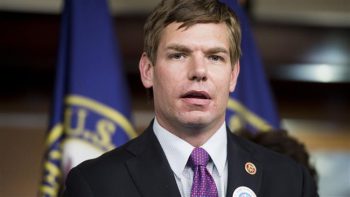
Democratic Representative Eric Swalwell (pictured above) also called for bipartisan opposition against what he described as “a foreign adversary.”
“This past election, our country was attacked. We were attacked by Russia,” Swalwell said. “I see this as an opportunity for everyone on this committee, Republicans and Democrats, to not look in the rear view window but to look forward and do everything we can to make sure that our country never again allows a foreign adversary to attack us.”
Senator Ben Cardin, a Democrat from Maryland, has also described Russia’s alleged electoral interference as the United States’ “political Pearl Harbor.”
According to a Sunday report by The Hill, the Democratic Party is attempting to portray President Trump as “weak on Russia” while exaggerating the “damage done by Moscow.”
Featured Video

No Threat Can Force Iran’s Surrender /Trita Parsi & Lt Cl Daniel Davis
or go to
Aletho News Archives – Video-Images
From the Archives
What is the Israeli Lobby in Australia Doing in Interfaith Dialogue?
By Ali Kazak | Dissident Voice | October 11, 2015
For years Israel and its lobby around the world have been trying to normalise their relations with Arabs and Muslims without solving the Palestine Question.
One of the methods they resorted to in the last few years is using human rights and community organizations such as interfaith dialogue and Multiculturalism to achieve this objective and to: isolate the Palestinians, marginalise the Palestine question, end Israel’s isolation, and prevent criticism of Israel, knowing that these organisations will be the first to stand against Israel’s violations, racial and religious discrimination.
The group responsible for this task in Australia is The Australia/Israel & Jewish Affairs Council (AIJAC); its Director of International & Community Affairs, Jeremy Jones is in charge of lobbying religious community organizations, specifically Muslims and Christians. Consequently he convened the Faith Communities for Reconciliation, founding participant in the Australian Partnership of Religious Organisations and the Australian National Dialogue of Christians, Muslims & Jews.
AIJAC is a private political propaganda group. It is recognised as the main Israeli lobby in Australia. It coordinates its activities and works intimately with the Israeli embassy in Canberra and different institutions in Israel. It is privately funded by some Jewish businessmen. It monitors closely Australian politicians, the media, ethnic and religious groups, (especially Arabs and Muslims), unions and academics on their stands towards Israel and the Palestine question. … continue
Blog Roll
 Aletho News
- Envoy warns UN on Trump’s threat to ‘obliterate’ Iran’s civilian infrastructure
- The Larak Corridor: Iran’s Rial Gate With No US, No Israel, and No Way Around
- ‘Economic terrorism’: Steel facilities hit again in US-Israeli strike
- ‘War Crime’: Iran condemns attacks on Arak, Ardakan nuclear sites
- Two-thirds of Americans want quick end to Iran war even if goals unmet
- Trump to Give “Important Update on Iran” Wednesday in Prime-Time Speech
- Theodore Postol: Iran’s Missiles & Drones Were Underestimated
- Iran To Target Military Industrial-Tech Complex That Facilitated Gaza Genocide
- Collapsing Empire: The Resistance Disarms ‘Israel’
- Suicide Should Not Be a Government Service
- If Americans Knew
- Israel wants US to bomb more of Iran’s civilian structures (113,000 is not enough) – Not a ceasefire Day 173
- Ann Coulter Rips Into Fox News for Iran War Coverage
- Joe Kent Urges Americans To Call White House and Congress To Object To Sending Troops Into Iran
- DNC Resolution to Reject AIPAC Funding Puts Democratic Leaders in the Hot Seat
- Swedish foundation to build 400 schools as over 650,000 Gaza children remain without education for 2 years
- Israeli army admits photshopping image of slain Lebanese journalist
- This is how Israel is systematically killing health workers under the cover of war in Lebanon
- Carrying life under fire: Israeli invasion of Lebanon leaves pregnant women facing deadly risks
- Champagne all around for the new death penalty (for Palestinians) law – Not a ceasefire Day 172
- Why are Palestinian books struggling to be seen on Amazon?
- No Tricks Zone
- New Study Finds Warming Saves Lives…Cold Temperatures 12 Times More Deadly Than Excess Heat
- German Science Blog Accuses PIK Climate Institute Of Hallucinating Climate Tipping Points
- Devastating Assessment Of Comirnaty Vaccine By Former Senior Pfizer Europe Toxicologist
- New Study: CO2 Is ‘Effectively Negligible’ As An Explanatory Climate Change Factor Since 2000
- Former Pfizer Toxicologist Dr. Helmut Sterz Tells Bundestag Hearing Pfizer Vaccine Should Have Never Been Approved
- Energy Expert: Germany’s Nuclear Phaseout Was A “500 Billion Euro Mistake”
- New Research: South Australia’s Mid-Holocene Sea Surface Temperatures Were 4°C Warmer Than Today
- Storing Green Energy To Last Germany 10 Days Would Require A 60-Million Tonne Battery
- New Studies: UK Sea Levels Were 4 Meters Higher Than Today During The Mid-Holocene
- Destructive Green New Deal: German Energy And Metal Group Warns Of Drastic Crisis
 Aletho News