Decoding the American Jewish Zionists’ Rise to Power
Readings in the Jewish Zionist Control of the United States: Interviews with Francis Boyle, James Petras, and Kim Petersen [Part 4]

By B. J. Sabri | American Herald tribune | April 24, 2017
Previously I argued that the phony war on “islamic terrorism”, the incessant attacks on and indictment of Islam as a violent religion, and the claim to bring so-called “democracy” to a region ruled by “dictators” are ploys for U.S. wars in the Middle East. Real motives instead, I further argued, are driving these wars with the objective to destabilize, remake, or destroy Arab societies, partition all states that are not in line with the U.S. and Israeli policies, and, in short, dismantle the Arab world. Two agendas converge to implement this effort.
The first has for a focus the aims of U.S. hyper-imperialism. Besides submitting the Arab nations to U.S. plans and military control, the quest for uncontested global hegemony is the core of this agenda. While such a quest is intrinsic to the making of the colonialist nature of the American state, the part related to the Arab world is a particular detail within the overall agenda. Explanation: The Arab regions in the Middle East and North Africa enjoy unrivaled geostrategic assets palatable to U.S. imperialism. However, targeting the Arab nations for war, destruction, and partition because of resources or geographic positions makes no sense in modern times unless a wider, deeper agenda is playing out in the U.S. calculation.
This raises a series of questions. What are the forces directing the Arab agenda of the United States? Are these forces responsible for the persistent hostility toward the Arabs and the active destruction of selective states? Did such a plan start with Kissinger-controlled U.S. foreign policy during the Nixon’s presidency or does it go further back in time? Were Sadat’s recognition of Israel, Israel’s invasion of Lebanon, Iraq’s American-induced invasion of Iran and Kuwait, and U.S. war on Iraq in 1991 the preparatory stages for that plan?
A vital question: Do such forces persuade or coerce the United States to oppose all equitable proposals to solve the Palestinian Question? And to close, who is keeping the interventionist agenda going? Who are the proponents of the Fascist Military Pacification Model the United States wants to impose on the Arab nations?
The second agenda belongs to Israel. Considering its complex logistics and interwoven interests with the global aims of the United States, this agenda is partly carried out by Israel and partly by the United States but with European and Arab vassals following orders. Israel’s agenda operates on nine levels each of which comes with own scope, parameters, and application tools:
General Level: To expand the scope of Zionist narratives on Palestine, so-called right of Jews to return to it, fake historical rights, and so on. Films, TV, false archeology, fake research books, internet, propagandists, and all type of media—even cookbooks—are the avenues for such efforts.
American Level: To preserve the duopoly system as is for easy management; keep the White House and Congress under tight Zionist control; keep the display of power as in AIPAC annual pageantries in order to demonstrate system’s obedience and Zionist control; conceive and implement U.S. foreign policy through American Jewish Zionists who occupy key posts in the American system.
America’s European Vassals Level: To keep European states under the U.S. umbrella for a stronger Israeli control.
Russian/Chinese Level: With over one million ethnic Russian Jews living in Israel, Israel has an advantage in Russia through organized Zionist lobbyists and oligarchs. The scope is to keep Russia out of the Middle East—it failed in Syria—and away from the Arabs. As for China, Israel provides American-designed military technology to increase influence thus preempting potential Chinese support for Arab causes.
International Level: The U.S. belligerent posturing toward North Korea is not its own. It is Israeli by all standards and terminologies. Explanation: N. Korea provided military technology to Iran and Pakistan. That is anathema to Israel. If N. Korea were to stop cooperating with countries deemed adversaries to Israel, the U.S. saber rattling would cease instantly. The other scope is to keep flaunting any U.N. resolution critical of Israel using the U.S. hegemon as a buffer.
America’s Arab vassals: The United States has practically ended, on behalf of Israel, the Arab system of nations through wars and interventions. Israel is now poised to submit all Arab regimes—not the peoples—to its military power and political will.
Regional Level: To maintain Israeli superiority by means of American military supplies, as well as its own. However, the United States is now doing the major job by smashing the Arab states–one by one. The partition of Sudan and the pending partition of Iraq, Libya, Syria, and Yemen are examples.
Palestinian Level: To implement the plan to settle the Palestinian Question on Israeli terms. This is how it works. Give the Palestinian a semblance of economic independence within the occupation regime; swallow what remains of historic Palestine; suffocate Gaza to death to stop the resistance; declare a “state” called “Palestine” in Gaza comprising lands taken from Egypt.
Israeli Level: To intensify the Zionization, fascistization, chauvinism, and racism of the Israeli Jewish society. This is important for the continuation of the Zionist project to create a “greater Israel”. Further, the Zionist project was not about creating a “homeland” for the Jews of Europe. It is about Zionist expansions and empire. According to this scheme, turning the racist ideology of and the colonialist core of Zionism into a permanent way of thinking could guarantee the continuation of Israel as a peculiar racist state.
DISCUSSION
What we want to see now is what did American Jewish Zionists do to rise to such an unprecedented power in the United States? There is a flipside to the coin. Was such a rise autonomous or dependent on factors rooted in the American system? In other words, who allowed Jewish Zionists to dominate the United States?
To answer, we need a starting point. Jewish Zionist propaganda would like the uninformed to believe that the United States was already in pre-Zionist sympathies at least since President John Adams. [1] An example of such propaganda outlets is the Zionist website Jewish Virtual Library. This so-called library made a compendium of U.S. presidents who, it claims, supported the idea of “restoring the lands of Israel” to its “people”. [2]
First, U.S. presidents prior to Theodore Roosevelt might have made favorable expressions to certain Jewish individuals. However, I view such expressions as apolitical, superficial, and ceremonial. Moreover, they had no bearing into the future—this was yet to unfold depending on world events. Nor did they set the path for Franklyn D. Roosevelt and his successor Harry Truman to prepare for the installation of a Zionist entity in Palestine. It seems that the “Library” wants to convey the idea that rational political processes brought the United States to side with Zionism and later with Israel. Now, recalling that such “sympathies” might have been made in response to solicitations by Jewish personalities, they were not the political convictions of the American system. However, they became so after Woodrow Wilson publically endorsed the British Mandate for Palestine.
Second, because the American system depends on ideological continuity, it is expected that Roosevelt’s anti-Arab racism and Zionist outlook would pass to his successors. Such passage would also confirm that new patterns of domestic power were emerging. Explanation: in U.S. political settings, the presidents of the imperialist state invariably adopt and further expand on the foreign policies of their predecessors.
The pretense that what those presidents expressed had amounted to recognition of “Jewish claims” on Palestine is baseless. Needless to argue, the fate of Palestine, then under Ottoman rule until the end of WWI, was not a subject for U.S. presidents to decide. Colonialism, however, was the only historical force able to divide conquered nations according to self-interest or consequent to political machinations. Yet, those expressions revealed something interesting— the cultural ignorance of U.S. presidents. Fixated on biblical stories, they interchanged the religious affiliation of Europeans of Jewish faith with the ancient Hebrews. With this, a historical falsehood had been established. Later, this would become the rationalized basis to install a settler state in Palestine.
When American Jewish Zionists twisted the arms of FDR and Harry Truman to make them agree to their demands, and when both presidents gave up under pressure, it became evident that a Jewish Zionist force was born. Under this premise, I view Theodore Roosevelt, Woodrow Wilson, and Franklyn D. Roosevelt as the primary facilitators of U.S. Zionism and its ascending power.
Harry Truman is another story. Although, the Zionist state was born under his watch, he was not that essential in the gestation of Zionism toward power. It is true, however, that Truman, a war criminal and opportunist who sold out to Zionists to garner their vote, was a catalyst in turning American Jewish Zionists into the masters of the United States. Explanation: the installation of Israel gave momentum to the emergent power of Zionists. Still, during the transition from European Jewish invasion of Palestine to the installation of Israel, Truman did nothing but to continue with the moral cowardice and treachery of Franklyn D. Roosevelt toward the Arabs.
To back the views I just presented, I will discuss in this part Theodore Roosevelt and Woodrow Wilson; in the upcoming Part 5, I will discuss Franklyn D. Roosevelt.
Theodore Roosevelt
Ever since New York Jewish Zionists supported his campaign for governor of New York, and later for president, Roosevelt, a racist and an avowed colonialist in the American tradition, set the stage for a long-lasting confrontational U.S. policy toward the Arabs. With that policy came the gradual elevation of American Jewish Zionists to the claimed status of “king makers” of American politics—especially in the making of foreign policy. Here I want to stress one aspect, which is how the hate of the Arabs became synonymous with the Jewish Zionist power. It works like this: If an American individual wants to run for office, he must declare or pledge in advance his support of Israel against all its “enemies”—the Arabs. On the other hand, opposing Israel (or Zionism) on any ground could mean losing elections and careers.
How did Theodore Roosevelt set the stage for a durable anti-Arab policy of the United States?
Let us reprise a quotation that appeared in Part 2. In a private meeting held in 1907, Roosevelt confided:
It is impossible to expect moral, intellectual, and material well-being where Mohammedanism is supreme. The Egyptians, for example, were a people of Moslem fellahin who have never in all time exercised any self-government whatever. Britain’s Lord Cromer, Roosevelt added, is one of the greatest modern colonial administrators, and he has handled Egypt just according to Egypt’s needs, military occupation, foreign tutelage, and Christian patience. [3] [Sic], [Italics added]
Roosevelt’s opinion on regions dominated by Mohammedanism—his word for Islam—was in tune with his bigoted ideology. Anyone, of course, is entitled to his opinion. But when an American president expresses racist remarks debasing peoples and their religion, the implication is enormous. Simply, it means that said president, his administration, and subsequent administrations would most likely take the same path. This is how political states stay in business. Eventually, a nurtured prejudice could evolve into state policy— the systematic destruction of the Original Peoples of the United States and the ideology of the Third Reich are examples. Consequently, it is not farfetched to say that Roosevelt’s prejudice had come a long way. Today, it has become the official philosophy of the United States.
A few decades after Roosevelt, John Kennedy, then a senator from New York, proved the assessment I just made. In search of the so-called Jewish vote, he had to go through the rituals of praise (allegiance) to Zionism and to exempt it from the disasters in the Middle East. In addressing a gathering at B’nai Zion Anniversary, he virtually licked the Zionist rear end without shame, pride, or, at least, a little cultivated historical and cultural knowledge. With his speech (1958), Kennedy proved beyond any doubt that 11 years after the installation of Israel (1947), the power of American Jewish Zionists had become a strong fixture in U.S. politics. He said:
This myth – with which you are all too familiar – is the assertion that it is Zionism which has been the unsettling and fevered infection in the Middle East, the belief that without Israel there would somehow be a natural harmony throughout the Middle East and the Arab world. Quite apart from the values and hopes which the State of Israel enshrines – and the past injuries which it redeems – it twists reality to suggest that it is the democratic tendency of Israel which has injected discord and dissention into the Near East. Even by the coldest calculations, the removal of Israel would not alter the basic crisis in the area. For, if there is any lesson which the melancholy events of the last two years and more taught us, it is that, though Arab states are generally united in opposition to Israel, their political unities do not rise above this negative position. The basic rivalries within the Arab world, the quarrels over boundaries, the tensions involved in lifting their economies from stagnation, the cross-pressures of nationalist – all of these factors would still be there even if there were no Israel. [4]
Comment: I could write a full dissertation on Kennedy’s speech and the excerpt I just cited . . . What Kennedy said is a classic example of political succumbence. It also shows how indoctrinations, political posturing, and the expected benefits from sycophancy seep from a political epoch to another. For instance, in his lengthy speech, he never uttered the words Palestine or Palestinians. And when he talked about the Palestinians kicked out of their lands by Jewish Zionist terrorists, he called them “Arab refugees”. (See pictures of Palestinians kicked out by Zionists in 1948). Beyond that, it confirms that the imperialist state had blindly embraced the Zionist narratives. And to close, it demonstrates a culture of obedience to Zionism, and acute prejudice against the Arabs. Above all, Kennedy’s speech highlighted the ascending power of American Jewish Zionism in the United States.
There is more. Kennedy externalized the standard political making of an American politician seeking office. When candidates confront the issue of Israel and the Arabs before Jewish Zionist gatherings, they invariably become arrogantly offensive toward the Arabs, but exceedingly flattering toward Zionism. (I added Italics to every sentence of the excerpt where a counter-argument can be made to demolish Kennedy’s assertions. I stop here, however, to avoid derailing this article.)
Let us go back to Roosevelt. When he made his racist feelings known, he appeared to have implied that only when Christianity is supreme, intellectual and well-being are guaranteed. In saying so, he gave Jewish Zionists the ideological weapons to fight Arab and Palestinian nationalisms.
To be noted, Roosevelt’ praise for Lord Cromer is revealing. In casting his praise with words such as, “the greatest modern colonial administrators”, he left no doubt that the guiding light of the United States is an ideology that glorifies colonialism and slavery while turning colonialist administrators into symbols of virtue and rectitude.
Aside from supremacist beliefs, Roosevelt’s use of the concept “Christian patience” lacks originality. He plagiarized Rudyard Kipling’s concept of “White’s man burden”. This observation is important: it shows how ideological contagion works. Knowing this little bit about Roosevelt’s sentiments, it should not be surprising, therefore, when he stated it is “entirely proper to start a Zionist state around Jerusalem.” [5]
The question one may ask, what were Roosevelt’s rationales and historic justification for a Zionist state “around Jerusalem”? Why is it “entirely proper to start a Zionist state”? What makes it proper: his ideology or bigotry? Why did he ignore the Palestinians who lived in, around, and beyond Jerusalem?
Woodrow Wilson
From studying how U.S. presidents interacted with Zionism and Israel, we may be able to draw some conclusions. For instance, from Theodore Roosevelt to Herbert Hoover, the trend was to mix theology, mythology, and colonialism. From FDR to George H. W. Bush the tunes changed to include the primacy of imperialism and the usefulness of Israel to America’s global agenda. From Bill Clinton to Donald Trump, theology and mythology resurfaced but this time the fuel is anti-Muslim Christian Zionism, anti-Arab Neocon Jewish Zionism, and the new plans to partition the Arab states.
It is known that the beginning of any process is a tone-setter for the next enterprise. Under this light, Wilson’s way of thinking about a Zionist state acquires special importance. It rested on four grounds: theological dogmas, Manifest Destiney beliefs, colonialist mindset, and on his conviction of the virtues of European colonialist states. When he (under suspicious circumstances [6] ), selected the Jewish Zionist Louis Dembitz Brandeis to be his informal advisor on foreign policy, he set the precedent for the rise of many Jewish Zionist advisors and chiefs of staff to presidents and vice presidents. [7] But when he appointed him to the Supreme Court, he initiated the process of the Zionist penetration into the American state.
To evaluate how Brandeis was working on the mind of Wilson, I am going to quote Jerry Klinger. Klinger is a Jewish Zionist propagandist and a founder of the Jewish American Society for Historic Preservation. In his article Judge Brandeis, President Wilson and Reverend William E. Blackstone changed Jewish history Klinger details the intellectual and ideological interactions Between Wilson and Brandeis:
Brandeis knew and understood Wilson. He understood what influences Wilson would respond to. He understood the soul of President Wilson. Brandeis was a master politician and courtroom manipulator of opinion and direction. Wilson needed to be appealed to on the basis of faith but not by faith alone would the President act. Wilson needed to be sure of his political base of popular support for his actions. He needed to be sure it was the right thing for America. He weighed his actions carefully and not impulsively. [Emphasis added]
He continues further down,
Wilson further understood through Brandeis that there were delicate negotiations going on in Britain for a declaration of intentions regarding Jewish interests once Britain had wrested control of Palestine from the Turks. [Emphasis added]
Most important for Brandeis was that Wilson understood he had significant grassroots American political and faith based support for the establishment of a Jewish homeland in Palestine. The Blackstone Memorial was an American document and not a British document. It was important for Wilson and Brandeis to show that they were not the followers of the British. American foreign policy was not shaped and directed by the British but by American interests. [Emphasis added]
Comment
Well, now that we know how Wilson had gotten his political education on the claims of Zionism, let us move forward. Brandeis is a master manipulator. Klinger’s statement that Brandeis convinced Wilson that “supporting the British plan for Palestine means that American foreign policy was not shaped and directed by the British but by American interests” was a winning tactic. It gave self‑importance to a United States. I view that tactic as an early indication of how American Jewish Zionists intended to manipulate the United States.
Did Wilson comply with the coaching imparted to him by Brandeis?
Certainly, in his book, The Elected and the Chosen: Why American Presidents Have Supported Jews and Israel, page 179, Denis Brian, an Irish Christian Zionist provides an adequate answer:
“Like many previous presidents, Wilson compared the Jews of the old testament with the colonists and the early history of America,”
He then goes on to quote Wilson directly:
Recalling the previous experiences of the colonists in applying the Mosaic Code to the order of their internal life, it is not to be wondered at that the various passages in the Bible that serve to undermine royal authority, stripping the Crown of its cloak of divinity, held up before the pioneer Americans the Hebrew Commonwealth as a model government. In the spirit and essence of our Constitution, the influence of the Hebrew Commonwealth was paramount in that it was not only the highest authority for the principle, “that rebellion to tyrants is obedience to God,” but also because it was in itself a divine precedent for a pure democracy, as distinguished from monarchy, aristocracy or any other form of government. To think that I, the son of the manse, should be able to help restore the Holy Land to its people.”
Comment
Despite academic credentials and a university post, Wilson manifested clear intellectual confusion. First, he mingled between diverse categories of thought. Second, his mix-up was so severe that he bundled theology (divinity, etc.) with mythology as in his “various passages in the Bible”. And, if that were not sufficient, he added to the mixture a dose of political gibberish as in the dictions “pure democracy”, “monarchy”, etc. Then he resorted to colonialism as in his phrase “to help restore … etc.
Not only that, but his approach to important U.S. policy directions that structurally overlooked the existence of the Palestinians—the future victims of his planned “restoration” smacks of ignorance, dishonesty, callousness, and ethical perfidy. I wonder how Wilson would have responded to a question such as this: Mr. President, did you ever think to restore the Original Peoples of the United States to the lands you and your predecessors have stolen by fire, forced relocations, and extermination?
Next, I will discuss Franklyn D. Roosevelt and other issues.
NEXT
Part 5:
Part 6: Interview with Francis Boyle
Part 7: Interview with James Petras
Part 8: Interview with Kim Petersen
NOTES
- The Austrian Nathan Birnbaum coined the term Zionism in 1890. I view any prior similar ideology as pre-Zionist
- Jewish Virtual Library,
- Douglas Little, American Orientalism: The United States and the Middle East since 1945, University of North Carolina Press, 2008, p. 16
- JFK Presidential Library and Museum, Remarks of Senator John F. Kennedy at the B’nai Zion, February 9, 1958
- Quoted in Benjamin Glatt, Today in History: Teddy Roosevelt and the Jews, The Jerusalem Post, 2016
- Alleged Wilson’s adultery was seized to blackmail him. I’m no fan of hoaxes and allegations. However, unbiased research is needed to ascertain validity. The following link provides some background on this issue: The Making of Woodrow Wilson— An American Nero?
- Examples include Henry Kissinger, Samuel Berger, Irving Lewis Libby, David Axelrod, Rahm Emanuel, etc.
*(Trump speaking at AIPAC. Image credit: Lorie Shaull/ flickr).
Proposed US anti-Hezbollah bill will harm Lebanon
Al-Manar – April 25, 2017
Lebanese President Michel Aoun said yesterday that the new anti-Hezbollah sanctions bill that the US Congress is considering would “greatly harm Lebanon and its people”.
Aoun told a delegation from the American Task Force for Lebanon, an organisation that includes Americans of Lebanese heritage and businessmen, that ”the draft law that is being prepared in Congress to slap new financial sanctions on Lebanese parties, institutions and individuals will greatly harm Lebanon and its people.”
The president pointed out that Lebanon is making the necessary contacts to prevent the issuance of the law and welcomed any effort by the American Task Force for Lebanon in this regard.
US Congress is planning to review additional and tougher sanctions against Hezbollah and all its affiliates and allies, a move that could have negative political and financial ramifications on Lebanon if the proposals pass without amendments.
The proposed law might for the first time target the Amal Movement led by Parliament Speaker Nabih Berri as well as senior Hezbollah officials, headed by its Secretary-General Hassan Nasrallah, members of his political bureau and parliamentarians.
US sends nuclear sub to South Korea amid rising tensions with North
Press TV – April 25, 2017
The United States has sent a nuclear submarine to South Korea amid escalating tensions with the neighboring North.
The USS Michigan, which is a guided missile submarine, arrived in the port city of Busan, South Korea, on Tuesday. A US military official described the move as a show of force.
Washington has already sent the USS Carl Vinson aircraft carrier strike group to the western Pacific Ocean.
The Ohio class submarine will later join the aircraft carrier for exercises in the Sea of Japan.
The movement came after North Korea threatened to sink USS Carl Vinson.
“Our revolutionary forces are combat-ready to sink a US nuclear-powered aircraft carrier with a single strike,” the ruling Workers’ Party newspaper said in a commentary on Sunday.
The article said Pyongyang had weaponry that “can reach continental US and Asia Pacific region.”
A statement from US Naval Forces Korea described the submarine’s visit as “routine deployment.”
“US Navy ships and submarines routinely make port calls in a variety of locations,” Lieutenant commander Matt Knight with US Pacific Fleet told Fox News.
“As a matter of routine, we do not discuss future operations or the details regarding the operations of our submarines. USS Michigan is currently on a routine deployment to the Indo-Asia-Pacific.”
‘Senate to go to White House for North Korea briefing’
Meanwhile, the White House has invited the entire US Senate on Wednesday for a briefing on the mounting tensions between Washington and Pyongyang.
The briefing will be delivered by several top officials including Secretary of State Rex Tillerson, Secretary of Defense Jim Mattis, Director of National Intelligence Dan Coats and General Joseph Dunford, chairman of the Joint Chiefs of Staff, White House spokesman Sean Spicer said on Monday.
‘UN must impose new sanctions on N Korea’
President Donald Trump has said the United Nations Security Council must impose new sanctions on North Korea.
“The status quo in North Korea is also unacceptable and the council must be prepared to impose additional and stronger sanctions on North Korean nuclear and ballistic missile programs,” Trump said on Monday ahead of a lunch with ambassadors from countries on the Security Council.
“This is a real threat to the world, whether we want to talk about it or not. North Korea is a big world problem and it’s a problem that we have to finally solve,” he added.
North Korea has so far conducted five confirmed nuclear tests and numerous missile test-launches. While it has not fired missiles against other countries, it has vowed strong action — including missile attacks against South Korea — if it is invaded by the South and the US.
The US earlier threatened to strike North Korea if it tried to test-fire an intercontinental ballistic missile. And, Pyongyang warned the US of an “all-out war” and announced that it would continue to test missiles on a weekly basis.
Shambolic Doings in Washington
Will we survive the next 90 days?

By Philip Giraldi • Unz Review • April 25, 2017
There remains one good thing to say about Donald Trump: he is not Hillary. The boneheaded cruise missile attack in Syria would have occurred even earlier under President Rodham Clinton and there would undoubtedly be no-fly and safe zones already in place. Oh, and Ukraine and Georgia would be negotiating their entries into NATO to make sure that old Vlad Putin would be put on notice and understand that the days of namby-pamby jaw-jaw-jaw that characterized the Obama Administration are now ancient history.
Apart from that, I can only observe dumbstruck how yet again a candidate promising peace and dialogue could be flipped so quickly. Or maybe he never believed in anything he said, which is perhaps more to the point. Be that as it may, we now, after only ninety days in office, have a neo-neocon foreign policy and the folks clustered around their water coolers in the Washington think tanks are again smiling. And as the ruinous Syrian civil war continues thanks to American intervention, there are probably plenty of high fives within Israel’s Benjamin Netanyahu government. Bibi again rules the roost.
The Israelis are no doubt particularly delighted to hear Donald Trump’s latest factually exempt voyage into the outer reaches of the galaxy regarding Iran. Or perhaps The Donald is only having continuing digestive problems dealing with “most beautiful piece of chocolate cake that you’ve ever seen” when dining with mortified Chinese leader Xi Jinping while simultaneously launching cruise missiles intended to send a message to Beijing’s ally Russia. It is inevitably Iran’s turn for vilification, so Trump, while conceding that the Iranians have been compliant with the nuclear weapons agreement they signed, also felt compelled to add that they continue to be a threat and have not entered into the “spirit” of the pact. Apparently the spirit codicil was somehow left out of the final draft, an interpretation that will no doubt surprise the other signatories consisting of Russia, China and the European Union.
To make its point that Tehran is somehow a cheater, the White House has ordered a 90 day review of Iran policy which will empower hardliners in that country in upcoming elections as well as nut cases like Senators John McCain and Lindsey Graham on this side of the Atlantic. Iranian opposition groups like the terrorist Mujaheddin e Khalq (MEK) are already rising to the challenge by floating phony intelligence while Graham is currently advocating a preemptive attack on North Korea, conceding that it would be catastrophic for every country in the region while noting smugly that the carnage and destruction would not reach the United States. Too bad that Pyongyang’s fury cannot be directed straight to Graham’s house in South Carolina.
Graham is reportedly a good dancer and multitasker who can pivot back to Iran effortlessly as soon as Pyongyang is reduced to rubble, so those who want to deal with Iran sooner rather than later should not despair. As things continue to go south nearly everywhere, tension in the Middle East will no doubt lead to a rapidly deteriorating situation in the Persian Gulf that will require yet another ham-handed show of strength by the United States of Amnesia. There will be a war against Iran.
There have been a couple of other interesting stories circulating recently, all demonstrating that when Benjamin Franklin observed that we Americans had created a republic, “if we can keep it,” he was being particularly prescient. Robert Parry has observed that all the fuss about Russiagate is misleading as the only country that interferes with the political process in the U.S. persistently and successfully while also doing terrible damage to our national security is Israel. He wonders when we will have Congress convening investigative commissions to look into Israel-gate but then answers his own question by observing that it will never happen given who controls what in the United States. “No one dares suggest a probe of Israel-gate,” he concludes, but it is interesting and also encouraging to note that some Americans are actually starting to figure things out.
One of the curious things relating to the Russiagate scandal is the issue of who in the U.S. intelligence community leaked highly classified information to the media, a question which somehow seems to have disappeared from whatever final reckoning might be forthcoming. The issue is particularly relevant at the moment because there are reports that the Justice Department is pulling together a case against WikiLeaks founder Julian Assange as part of a possible attempt to remove him forcibly from his refuge in Britain and try him for constituting what CIA Director Mike Pompeo describes as a “hostile intelligence service helped by Russia.” It all suggests that low hanging fruit is fair game while some “official” leakers at high levels are somehow being protected.
To cite another example of Justice Department hypocrisy, three current and four former U.S. officials leaked to Reuters last week’s story about a Russian think tank having created a plan to subvert the U.S. election. If that is so, their identities might be discernible or surmised. Why aren’t they in jail? Or is it that many in government now believe that Russia is fair game and are prepared to look the other way?
It is significant that the recent House Intelligence Committee hearing on Russiagate, featuring FBI Director James Comey and NSA Director Mike Rogers, provided very little new information even as it confirmed troubling revelations that had already surfaced regarding the corruption of the nation’s security services. Given that former Central Intelligence Agency (CIA) head John Brennan and former Director of National Intelligence (DNI) chief James Clapper have been most frequently cited as the Obama administration’s possible bag men in arranging for the generation, collection, dissemination, and leaking of information disparaging to Trump, why weren’t they also being questioned?
The latest focus on Brennan, an Obama/Clinton loyalist who might safely be regarded as the most likely candidate seeking to discredit Team Trump and reap the benefits from Hillary, explores some suspicions about what actually took place last year and how it might have been arranged. The story broke in The Guardian on April 13th, headlined “British spies were first to spot Trump team’s links with Russia.” The article rehashes much old information, but, relying on a “source close to UK intelligence,” it describes how Britain’s NSA equivalent GCHQ obtained information late in 2015 relating to suspect “interactions” between Trump associates and the Russian intelligence. GCHQ reportedly routinely passed the information on to its U.S. liaison counterparts, and continued to do so over the next six months. The information was supplemented by similar reporting from a number of European intelligence services as well as the remaining “Five Eyes”: Canada, Australia and New Zealand.
According to the Guardian source and reporters, who are clearly hostile to Trump, the collection was not directed or targeted but was rather part of random interception of Russian communications. This may or may not be true but it serves as a useful cover story if someone was up to something naughty. And it also makes one wonder about the highly incriminating British intelligence sourced “dossier” on Trump and his associates, which The Guardian strangely does not mention, that appeared in January. Another apparent Guardian source called GCHQ the “principal whistleblower” in sharing the information that led to the opening of an FBI investigation in July 2016, a suggestion that the British role was not exactly passive.
The article goes on to describe how John Brennan, then CIA Chief, was personally the recipient of the material passed hand-to-hand at “director level” because of its sensitivity. So the Guardian article is essentially saying that the information was both routine and extremely sensitive, which would seem to be contradictory. Brennan was reportedly then the driving force behind launching a “major inter-agency investigation” and he briefed selected members of Congress regarding what he had obtained. Shortly thereafter leaks began appearing in the British press followed subsequently by revelations in the media in the U.S.
An October request to the Foreign Intelligence Surveillance Act (FISA) court reportedly was initiated after particularly damaging information was received from Estonia concerning Trump associate Carter Page and also regarding allegations that a Russian bank was funneling money into the Trump campaign. This led to an investigation of Page and the tapping into servers in Trump Tower, where the presidential campaign offices were located. Estonia, it should be noted, was particularly concerned about Trump comments on de-emphasizing NATO and strongly supported a Hillary victory so it is fair to speculate that the intelligence provided might have been cherry picked to make a particular case, but The Guardian fails to make that obvious point.
It is interesting to note how for the first time, in this media account, Brennan surfaces as the central player in the investigation of Team Trump. And it is perhaps not out of line to suggest that the European reporting of information on Trump associates was not exactly due to random collection of information, as The Guardian seeks to demonstrate. It could just as easily have been arranged at the “director level” by Brennan and his counterparts to disrupt the Trump campaign and enhance the electability of Hillary Clinton, which would have directly benefited Brennan and his inner circle as well as the Europeans, all of whom feared a Trump victory. Intelligence can be skewed, “fixed around a policy” or even fabricated and can say whatever one wants it to say so it is fair to suggest that the role of a politically committed John Brennan remains to be explored much more fully.
It is now being reported that Brennan will be summoned to give testimony at a closed House Intelligence Committee meeting on May 2nd. Hopefully his comments will be somehow leaked to the media plus those of James Clapper, who is also scheduled to appear. Nevertheless, one imagines that, as was the case in Comey’s first appearance, both former officials will spend most of their time refusing to confirm or deny anything.
The active participation of Brennan in the background to the 2016 electoral campaign is unprecedented and it is also suggestive of what America’s national security agencies have become, basically creatures of the White House. It is hard to escape the conclusion that Benjamin Franklin would undoubtedly deplore the fact that we have failed to keep the republic that the Founding Fathers bequeathed to us. That would be bad enough, but we are slipping into a pattern of foreign wars based on tissues of lies and deceptions by the very people who are in place to protect us, quite possibly exemplified by unscrupulous and ambitious ladder climbers like John Brennan, who was also the architect of Obama’s assassination policy. If we go to war because of suspected lack of “spirit” in our adversaries or merely because someone in the White House had a piece of chocolate cake and wanted something to talk about over his cup of espresso then we are doomed as a nation.
Israeli travel agencies will soon have to promise not to send tourists to the West Bank
Ma’an – April 24, 2017
BETHLEHEM – Israeli authorities have notified Israeli travel agencies that they will be forced to sign a commitment pledging not to take groups of tourists to the occupied West Bank, according to a copy the notification obtained by Ma’an on Sunday.
In the Hebrew-language document dated April 23, the Border Control Department of the Israeli Population and Immigration Authority notifies travel agencies that as of May 15, the day when Palestinians commemorate the 1948 Nakba, they will have to “attach, with each request to bring a group of tourists into the country, a special form pledging that they will not send tourists to Judea and Samaria,” using the Israeli term for the occupied West Bank.
The document only addresses Israeli tourism agencies, and not individual would-be tourists.
The forms must be signed and sent to one of three Population and Immigration Authority email addresses listed in the document.
The document warns tourism agencies that their requests to bring groups of tourists would “not be processed” if the pledge was not signed and attached.
A spokesperson for the Israeli Population and Migration Authority could not immediately be reached for comment.
If implemented, the new regulation described in the document would be an additional blow to a suffering tourism industry in the occupied West Bank, which already has to contend with numerous unequal laws and restrictions that have crippled the Palestinian market, while investing millions of dollars in the Israeli market.
A number of sites which attract thousands of visitors each year, such as the Nativity Church in Bethlehem, could be affected by this directive.
“Israel’s occupation and colonization of Palestine is not limited only to its military elements, but is also manifested in its use of tourism as a political tool. It is a tool used to strengthen its position as occupying power, and to maintain its domination over Palestinian land and people, but also as an instrument for the dissemination of propaganda to millions of tourists, including politicians, community leaders and journalists who receive free-of-charge first class tours to Israel,” human rights lawyer and legal researcher Amjad Alqasis wrote in 2015.
As current regulations stand, when applying for visas, Israeli tourism agencies only need to submit names and passport numbers, while Palestinian agencies attempting the same are met with administrative obstacles, and cannot guarantee that their visa requests will be accepted.
Tourists who tell Israeli border control officials of their intention to visit the occupied West Bank also face the possibility of undergoing lengthy interrogations, or even deportation for alleged security reasons, or without being provided an explanation at all.
When tourists are able to reach the occupied West Bank, they are then forced to negotiate with hundreds of Israeli checkpoints and other military obstacles that restrict movement for Palestinians both within the West Bank and along its borders with Israel and Jordan.
“Another obstacle to operating a tour is the presence of 500,000 to 600,000 illegal Israeli Jewish settlers currently living in the occupied Palestinian territory,” who “constitute a growing and consistent threat to Palestinian livelihoods,” including Palestinian tour guides, Alqasis noted.
Fools Rush In: Europe Pursues Israel Gas Deal for Political Not Economic Reasons
Sputnik – April 24, 2017
An Israel-Europe gas pipeline deal elevates Israel to the status of a major Mediterranean energy exporter. However, critics suggest the move is about more than mere economics, and serves a number of greater geopolitical objectives – namely, immunizing Israel from criticism and sanctions, and damaging relations between Europe and Russia further.
Ministers from Israel, Greece, Italy and Cyprus, as well as the European Union Commissioner for Climate Action and Energy, signed a joint declaration in April, codifying a commitment to constructing a gas pipeline that will bring newly discovered natural gas in Israel [sic] to Europe.
The pipeline, described by Israeli Energy Minister Yuval Steinitz as “the longest and deepest subsea gas pipeline in the world,” is expected to be in operation by 2025.
Designated as a “project of common interest” by the EU, the pipeline has been marketed by both sides as an ideal alternative to the bloc’s continuing dependence on Russian energy — an overt indication the deal is being pursued for political rather than economic purposes. After all, high infrastructure costs coupled with low gas prices will almost by definition make it considerably dearer than the existing energy relationship between Russia and Europe.
The Atlantic Council Global Energy Center has even suggested the proposed project may never come to fruition, once the commercial difficulties inherent in making it operational become reality. Current European energy demands in no way commercially justify an additional gas supply source for the continent.
Furthermore, independent Palestinian human rights advocacy group Al-Haq has said the pipeline agreement will benefit corporations which directly profit from the occupation of Palestine — incentivizing Israel to maintain its current policy of illegal settlement expansion and its blockade of Gaza. If constructed, the pipeline will pump gas from Israel’s giant Leviathan field, the discovery of which in 2010 transformed Israel from a net importer of energy into a potential regional energy player — the field is estimated to hold around 20 trillion cubic feet of gas. Despite Lebanon arguing Leviathan sits partially in Lebanese waters, Israel has pushed ahead with international deals, selling 39.7 percent to US-based Noble Energy.
In March, Jordan became the first country to sign up for Leviathan gas. The move ignited waves of protest, on the basis the agreement would increase Jordan’s dependency on Israel, and potentially finance Israel’s occupation of Palestine.
Such concerns go beyond reflexive prejudice. Israeli Prime Minister Benjamin Netanyahu has noted the potential of gas deals to insulate the country from international condemnation and action.
“Ensuring the supply of gas is essential not only to the country’s functioning, but also to its existence. I regard the gas supply as a foundation of national security. A country that exports things crucial for other countries has far more power. The ability to export gas makes us more immune to international pressure. We don’t want to be vulnerable to boycotts,” Netanyahu said.
Moreover, in a report, Annexing Energy, Al-Haq noted it was “impossible” to geographically isolate gas fields in mainland Israel and characterize them as separate from the country’s ongoing conflict with Palestine.
“In 2011, Noble Energy, the lead operator of the Leviathan field, unilaterally extracted gas from a joint Palestinian gas field without Palestinian permission as required under customary international law and the Oslo Accords. Israel has also employed a brutal and unlawful naval operation to protect Noble Energy’s gas platforms beside the Gaza Strip, routinely attacking, killing and injuring civilian Palestinian fishermen who fish in the vicinity of Israel’s illegally imposed six-nautical-mile closure of Palestine’s territorial waters,” the report said.
In a perverse twist, the deal also comes at a time when Gaza continues to reel from a major energy crisis, which has seen power cuts lasting as long as 18 hours, and results from Israel blocking the region from developing its own resources.
The Al-Haq report concluded that if Palestinians were permitted to do so, their own energy needs would be satiated, and they would be economically self-sufficient, freed from their current aid dependency.
The Pro-War Twist of the ‘Resistance’
By James W Carden | Consortium News | April 24, 2017
The Resistance, a self-aggrandizing term for what amounts to a relatively small but still powerful claque of embittered Clinton surrogates, has been keeping itself busy of late, fanning the flames of McCarthyite recriminations against anyone who dares question the rather flimsy public evidence that Russia influenced the results of the 2016 election, all the while cheering on President Trump’s expansion of the war in Syria.
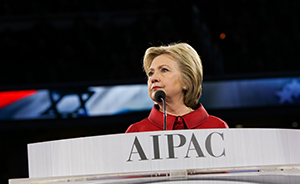
Hillary Clinton on March 21, 2016 (Photo: AIPAC)
Like its approach to the question of Russia and the election, the Resistance will brook no dissent over whether or not President Trump did the “right thing” in unleashing 59 Tomahawk missiles on a country which we are not at war with and which has never attacked us.
As with their hysterical claims that Russia stole the election from Hillary Clinton, the Resistance is loathe to allow facts, logic or evidence to get in the way of its view that Donald Trump acted in the security interests of the United States by bombing the Syrian military which (with air support from the Russians) is currently in the process in routing ISIS and Al Qaeda.
Neoliberal Clinton partisan Ruth Marcus of the Washington Post wrote that in her view “Trump is, if not behaving normally, at least adopting normal positions.” Bombing Syria, in the absence of a legal mandate from the United Nations or with expressed authorization of Congress – both legal requirements if the U.S. Constitution and American treaty obligations are to be respected – is, to Marcus anyway, evidence of “Trump’s good judgment.”
Nor was Marcus alone. Clinton herself endorsed Trump’s decision to use force just hours before the attack, telling a crowd of well-heeled Resisters in New York that “I really believe that we should have and still should take out [Assad’s] air fields and prevent him from being able to use them to bomb innocent people and drop sarin gas on them.”
Former high-ranking Obama State Department officials Antony Blinken and Anne Marie Slaughter – he in the pages of the New York Times, she on Twitter – also praised Trump’s bombing of Syria as “the right thing” to do. The New Yorker’s Ryan Lizza declared, “The moral case for President Trump’s strike on Syria is uncontroversial.”
Punishing Anti-War Democrats
In the days following the Tomahawk missile attack on Syria, it became obvious that antiwar voices need not apply to the Resistance, which clearly remains in thrall to the 25-year-old interventionist orthodoxy begun under President Bill Clinton and which continues to be treated as unassailable dogma within the Democratic Party to this day. Those few who had the temerity to dissent from the Resistance party line were to be given no quarter.
One of the few prominent elected officials in Washington to voice skepticism of the Trump administration’s case for military action against Syria was Hawaii’s Rep. Tulsi Gabbard, who condemned the attack in a statement which accused the administration of having “acted recklessly without care or consideration of the dire consequences of the United States attack on Syria without waiting for the collection of evidence from the scene of the chemical poisoning.”
The knives came out for Gabbard even before the proverbial ink on the statement was dry. To no one’s surprise, The Washington Post quickly ran a smear job by Elise Vieback titled “What is Tulsi Gabbard thinking on Syria?” In it, Viebeck declared that “Gabbard has dug herself into a hole in recent weeks with her bizarre but insistent views about Syrian President Bashar al-Assad and his country’s bloody six years of civil war.”
But what really seemed to offended Vieback – and by extension, her employers at the Post – was Gabbard’s effrontery in committing an act of lese majeste against that which all right-thinking people in Washington “know” or, as Vieback put it: “her striking departure from the consensus that Assad’s government launched the attack.”
Vieback chronicled the Resistance’s disgust with the Congresswoman’s penchant for independent, critical thinking. No less a Resistance figure than MSNBC’s Joy Reid tweeted that “People who have insisted Gabbard is the future of the Democratic Party may need to consider her outré views on issues like Assad.” Other Resistance leaders piled on, too: The Daily Kos ; Center for American Progress president and close Clinton adviser Neeera Tanden; and former Vermont Governor and ex-Democratic National Committee Chairman Howard Dean all voiced their opinion that Gabbard should face a primary challenge in 2018. Indeed, according to Dean, the heath insurance lobbyist, “Gabbard should not be in Congress.”
Of course, all the handwringing over Gabbard’s comments were simply another opportunity for the right-minded to double down on their criticism of Gabbard’s controversial meeting with Syria’s Bashar al-Assad in January. Then as now, the Washington Post was at the forefront of the character attacks, running a piece by Josh Rogin titled “How Tulsi Gabbard became Assad’s mouthpiece in Washington” on Jan. 29. Yet Rogin’s piece was so sloppy and error-ridden that the Post had to append a humiliating paragraph long correction to it after it was published.
Ignoring Syrian Reality
Nevertheless, the Resistance’s cry of “what about Assad?” is a case of Democratic luminaries polishing up their reputations for virtue and signaling their commitments to career advancement, nothing more. It leaves out the fact that the Syrian opposition also bears responsibility for the start of the violence in 2011.
As Father Frans van der Lugt, a Dutch missionary to Syria who was murdered by rebel forces in 2014, put it: “From the start, the protest movements were not purely peaceful. From the start I saw armed demonstrators marching along in the protests, who began to shoot at the police first. Very often the violence of the security forces has been a reaction to the brutal violence of the armed rebels.”
The murdered Dutch priest also observed as early as 2011, that “The opposition of the street is much stronger than any other opposition. And this opposition is armed and frequently employs brutality and violence, only in order then to blame the government.”
The “what about Assad?” line also begs us to ignore what the likely consequences of his removal from power would actually mean: Who exactly do they think would fill the vacuum? The obsession with Assad also willfully ignores the immorality of U.S. policy, which involves repeatedly bombing Syria while funding and training violent extremists who seek to overthrow a sovereign government.
U.S. policy, wholeheartedly supported by the Resistance, tramples international law and makes a mockery of the tenets of Just War Theory. It results in violence, death and destruction abroad and sets the stage for retaliatory acts of violence upon our own people at home.
And so, in order to elide these considerations, the neoliberal left returns to the eternal, tiresome: “But what about Assad?” To which there is a pretty straightforward answer: Assad is fighting (quite successfully at present) the same enemies who attacked us on 9/11 in an attempt to stave off the wholesale takeover of Syria by Saudi-sponsored Salafists who would, as they promised in the early days of the uprising, drive “Christians to Beirut, Alawites to the grave.” Never mind what they would do to women, Shia and other apostates should they topple Assad and gain power.
Anti-interventionist and pro-peace Democrats object to this joint Saudi-Turkish project of turning Syria, which under Assad had been a secular, multi-confessional police state, into a theocratic Sunnistan, thereby carving out a state for our worst enemies.
Backing the Terrorists
The Resistance may need reminding that international politics, like domestic politics, is about choosing, and the choice that pro-war Democrats (the vast majority of whom are die-hard Clinton supporters who still have not been able to reconcile themselves to her defeat) have made is clear: they’ve thrown their support behind radical Islamist terror groups in Syria because they have bought into the tedious fiction about the existence of “moderate” Syrian rebels.
But the Resistance would be better off leaving the fantasy of peace-loving moderate Syrian rebels to the hipsters at VICE and the neocons and neoliberal war hawks comfortably ensconced at Brookings, the Center for American Progress, CNN, The Daily Beast, The Atlantic magazine, and The Atlantic Council.
Another trend among the self-fashioned “Resisters” these days is towards an unthinking acceptance of U.S. government talking points, particularly with regard to Russian hacking and the Trump administration’s declassified four-page report on the Syrian chemical weapons attack.
Yet given the less than inspiring record of American interventions based on faulty, distorted or simply fabricated intelligence, as in the cases of Iraq (2003) and Libya (2011), the question isn’t why someone like Gabbard is out there questioning the Trump administration’s story, the question is: why aren’t more doing so? And wouldn’t questioning Trump’s unilateral, illegal decision to bomb Syria seem to be the right and proper role of something which bills itself as “The Resistance”?
But no. As a friend and colleague of mine recently put it, if they were honest, the Resistance’s motto really ought to be: “Long live the Cold War with Russia. Long live neoliberal Wahhabism and chaos in the Middle East.”
Yet the Resistance drones on, drowning out anti-war, anti-Wahhabi, pro-detente voices all in a bid to reinforce the neoliberal foreign policy orthodoxy within the Democratic Party in the vain hope of solidifying their positions of power and influence within it.
James W Carden is a contributing writer for The Nation and editor of The American Committee for East-West Accord’s eastwestaccord.com. He previously served as an advisor on Russia to the Special Representative for Global Inter-governmental Affairs at the US State Department.
Okinawans call for U.S. military to go home after further provocations
Xinhua | April 24, 2017
TOKYO – Local residents of Kadena on Okinawa’s main island said the United States military conducting parachute training drills over Okinawa’s mainland on Monday morning was completely unacceptable with the latest provocation coming amid rising anti-U.S. military sentiment on the island.
Local media reported that residents in the area still remember a tragic incident that occurred in 1965 involving an elementary schoolgirl being crushed to death by a trailer being parachuted down to a village during such a drill.
The area hasn’t seen parachute drills by the U.S. military since a drill at the base in 2011, that saw 30 personnel deploy from a MC-130 special mission aircraft, official accounts showed.
The aircraft used to deploy the airmen are designed for infiltration and exfiltration missions and can also be used for resupply of special operation forces.
The large transporter-looking planes can also be configured to be used for air refueling of primarily special operation helicopters and tilt-rotor aircraft like the controversial Osprey, also hosted in Okinawa and mainland Japan, and the cause of great condemnation here for its checkered safety record.
The latest drill saw the local residents notified of the parachute exercise less than a day before it occurred, when notice was sent out on Sunday night by the Japanese Defense Ministry.
In 1996, Japan and the U.S. agreed that it would [only] be the Island near Okinawa’s main island that would be used for parachuting drills at a reserve airfield there, with the surprise drill over Kadena baffling and scaring residents in the area.
The town of Kadena plays host to the U.S. Kadena Air Base which itself is home to top multiple air squadrons and accommodates around 20,000 service-members, their families and employees living or working there.
Anti U.S. base sentiment in Japan’s southernmost prefecture continues to rise of late, with regular demonstrations comprising thousands of locals calling for the controversial U.S. Marines Corps Futenma base to be relocated off the island and not to the coastal Henoko region.
At the end of last month, the “prefectural people’s rally calling for immediate cancellation of unlawful land reclamation work and abandonment of the plan to build a new base in Henoko, organized by the All Okinawa Coalition to Prevent Construction of a New Base in Henoko, was held in front of the gate to the U.S. military’s Camp Schwab.
The demonstration saw the participation of around 3,500 people, the organizers said.
Okinawa Governor Takeshi Onaga attended the rally and stated that with all his strength he would absolutely revoke the approval to reclaim land off the shore of Henoko, which is needed build the new base.
Along with the unexpected parachute drill and constant anti-relocation rallies, residents have also been up in arms recently about stray bullets found at the Afuso Dam construction site in the Camp Hansen Marine Corps base on the island.
The base is located in the town of Kin, near the northern shore of Kin Bay, and is the second-northernmost major installation on Okinawa, with Camp Schwab to the north.
Damage from stray bullets was found in water tanks and the cars of dam workers, local media reported, with fears rife that if live rounds were fired and people were in the vicinity at the time, multiple lives could certainly have been lost.
“Stray bullet damage from Camp Hansen has occurred countless times since the end of WWII. It is obvious that this originates from the proximity of Okinawan residents and the base. The practice of live-fire exercises on the narrow island of Okinawa is a mistake,” a recent article from an Okinawa-based publication said on the matter.
“The Marines, who operate Camp Hansen and use it mainly for exercises, are inherently unnecessary in Okinawa. Considering the safety of Okinawan residents, the only option is for the Marines to return to the continental United States. If they truly need to conduct live-fire exercises, they would be better off conducting them on the expansive training grounds in the mainland United States,” the article said.
Officials from Onna, Okinawa, as well as the Okinawa Defense Bureau, both confirmed that water tanks at the construction site were found empty on April 6 and what appeared to be bullet holes were found inside the tanks.
On April 13, similar damage from bullets was found on the cars of workers who had parked at the construction site, much to the continued consternation of local residents.
The local Okinawan residents’ calls for an end to their “occupation” and for all U.S. military personnel to return to the continental U.S. are growing evermore vociferous.
Featured Video

The Most Important Bet You’ve Never Heard Of
or go to
Aletho News Archives – Video-Images
From the Archives
The Occupied Mentality Syndrome
Saudi Arabia on the American chessboard – Part 2
By B. J. Sabri | American Herald Tribune | April 19, 2016
Since the Korean War, but particularly since the Iranian Revolution of 1979 until today, the United States has been steadily escalating its military presence in the Persian Gulf. Taking advantage of many colossal events of the past 36 years, [1] the hyper-empire has institutionalized its massive presence on land and sea, and expanded its objectives to include the unambiguous physical control of the area, as well as the clear understanding that local Arab governments should abide by them. The pretext is always the same: in “defense” of the national interests and security of the United States. From observing how the United States has been interacting with the governments of the region, and by judging from the size of its expeditionary force, we could reach a basic conclusion. The United States is occupying, de facto, the entire Arabian Peninsula. (Yemen, devastated by Saudi and American jets is yet to be conquered. Oman? Britain returned not as colonial ruler but as a soft occupying power.)
Under this articulation, Saudi Arabia, Qatar, Kuwait, and the United Arab Emirates are virtually occupied countries. If we compare this type of occupation to the mandate and protectorate regimes of the past, the results might be identical—the nations affected by it lose sovereignty. When Arab governments comply with the objectives of a foreign power that station military forces on their national milieu, then that power controls them in multiple ways including how they react to policy deliberations and what decisions they intend to take on specific issues. A good method to verify the concept of effective occupation is this: take notice of what the United States says and wants, and then compare it to what the gulf rulers do in response. (I shall discuss this detail at some point in the upcoming parts.)
If the presence of US forces or other means of political pressure are a factor in Saudi Arabia’s interventionist Arab wars, then we need to debate this issue. However, from the history of resistance to colonialism, we learnt: if a powerful state imposes its order on a nation by military means or other forms of coercion, and if this nation does not resist that imposition, then a mental subordination to the powerful state will ensue. This is especially true in the case of Saudi Arabia. One single event, 9/11, has transformed it from a US “ally” into an instant political hostage of the American Empire. … continue
Blog Roll
 Aletho News
- Trump and the debris of Iran war
- IRGC hits US tech giant Oracle’s data center, computing site in UAE over new assassinations
- Bombing Iran Back Into the Stone Age /Lt Col Daniel Davis & Jim Jatras
- UAE rejects report claiming it is ready to join war on Iran to reopen Hormuz
- A New Resistance Front: How Does Syria Factor into the Regional War?
- Gulf states weigh pipeline expansion plans, hoping to bypass Hormuz
- Iran sets up ‘tollbooth’ system in Strait of Hormuz
- Wave 90: IRGC strikes US-linked industrial sites in Gulf
- Iran Says US-Israeli Claims of Its Military Strength Are Wrong
- Trump’s April Fools’ Address to the nation
- If Americans Knew
- ‘War crime’: Global condemnation as Israeli ministers celebrate death penalty law targeting Palestinian prisoners
- 7 Ways Israel Is Turning Lebanon Into Gaza
- World’s Leading Football Bodies Under Fire Over Israel Policies
- Experts warn of possible use of nukes against Iran
- Israeli invasion of Lebanon could be worse than 1982, warn European officials
- Passover: Liberation and collective punishment
- Trump says the quiet part out loud: (Israel’s) war on Iran > Americans’ health – Daily Update
- Gaza families reunite years after babies evacuated amid Israel’s war
- International Rescue Committee warns Gaza’s children face grave protection risks
- Iran’s Alleged 47-Year War on America: Debunking the 1,050 American Deaths Canard
- No Tricks Zone
- Low Intensity Tornado Wrecks Major Solar Farm, Creating A Potential Toxic Dump
- New Study Finds Warming Saves Lives…Cold Temperatures 12 Times More Deadly Than Excess Heat
- German Science Blog Accuses PIK Climate Institute Of Hallucinating Climate Tipping Points
- Devastating Assessment Of Comirnaty Vaccine By Former Senior Pfizer Europe Toxicologist
- New Study: CO2 Is ‘Effectively Negligible’ As An Explanatory Climate Change Factor Since 2000
- Former Pfizer Toxicologist Dr. Helmut Sterz Tells Bundestag Hearing Pfizer Vaccine Should Have Never Been Approved
- Energy Expert: Germany’s Nuclear Phaseout Was A “500 Billion Euro Mistake”
- New Research: South Australia’s Mid-Holocene Sea Surface Temperatures Were 4°C Warmer Than Today
- Storing Green Energy To Last Germany 10 Days Would Require A 60-Million Tonne Battery
- New Studies: UK Sea Levels Were 4 Meters Higher Than Today During The Mid-Holocene
 Aletho News