Israel attempts to block yet another UN report
MEMO | June 15, 2017
Having succeeded in blocking a recent UN report that accused Israel of maintaining a system of apartheid, Israeli officials are now attempting to remove another UN report, which has charged Tel Aviv with carrying out extrajudicial executions along with a list of other human rights violations.
The report by the United Nations Economic and Social Commission for Western Asia (ESCWA), which previously accused Israel of apartheid, has come under fire from Israel’s Ambassador to the United Nations, Danny Danon, because it states that in the period from 1 April 2016 to 31 March 2017 Israeli security forces killed 63 Palestinians, including 19 children, and wounded an additional 2,276 Palestinians including 562 children.
The previous ESCWA report, which had accused Israel of apartheid, was removed by the UN following protests by Danon and US Ambassador to the UN, Nikki Haley, who this week described the UN report of “reeking with anti-Israel bias”.
The new report accuses Israeli security forces of using disproportionate force against Palestinians and in some cases of “extrajudicial executions”. The report cites the UN Committee Against Torture and its concern about “Israeli practices towards Palestinian detainees”.
The list of human rights violations included in the report were also “torture or ill-treatment of Palestinian children” and “deprivation of basic legal safeguards for administrative detainees, isolation and solitary confinement of detainees, including minors, punishment and ill-treatment of hunger strikers.” The report also claimed that “no criminal investigation was opened into more than 1,000 complaints of torture or ill-treatment filed since 2001.”
Israeli sources have reported that Danon will work to have this report removed. “This is yet another blood libel against the State of Israel,” Arutz Sheva reported Israel’s envoy to the UN saying. “Just as we succeeded in having the previous preposterous report removed, we will fight relentlessly against this blatantly false distortion of the truth as well.”
Read: The ESCWA Report
Hedge fund billionaire creates charter schools that teach about Israel, “the Jewish miracle of the 20th century”
If Americans Knew – June 14, 2017
The Jewish Telegraphic Agency (JTA) reports that Michael Steinhardt, an atheist, billionaire, and “mega-philanthropist,” has poured millions into projects for American Jews. He is best known as the founder of Birthright Israel, a free, ten-day trip to Israel that is enjoyed by a large percentage of Jewish young adults. He also facilitates programming after the Birthright experience in order to maintain participants’ loyalty to Israel and Jewish culture.
Steinhardt believes that American Jewish education needs to change, and consequently has founded a network of Hebrew-language charter schools.
In these schools, Steinhardt explains, “Jewish kids… will learn a great deal about Israel… and there’s a great deal of emphasis on Israel, Zionism, stuff like that.” He adds that “Jews have accomplished so much, so inexplicably out of proportion to their numbers, in [the last] 300 years, and it’s one of the great failures of Jewish education that that’s not focused on at all.”
When pressed to explain why he, as an atheist, supports a Jewish education, he explained, “The modern state of Israel is the Jewish miracle of the 20th century, but it’s the secular part of Israel that’s the miracle… the development of a society out of nothing using Zionist ideals… Israel has become, for me, the substitute for religion.”
Steinhardt continued, “Israel is a complicated place in a strange part of the world… There are a substantial number of Jews who believe that Israel should leave the settlements, leave the West Bank… The more one understands about Israel, the more comfortable one becomes with the politics of the Israeli government.”
He went on to claim that “Israel is to me the most moral state on this planet, [even] with the occupation.”
If Americans Knew details the effects of the occupation to which Steinhardt refers: “In violation of international law, Israel has confiscated over 52 percent of the land in the West Bank and 30 percent of the Gaza Strip for military use or for settlement by Jewish civilians… From 1967 to 1982, Israel’s military government demolished 1,338 Palestinian homes on the West Bank. Over this period, more than 300,000 Palestinians were detained without trial for various periods by Israeli security forces.”
The occupation itself is illegal according to international law, as are Israeli settlements and their over 500,000 Jewish settlers, the separation wall, restriction of movement, detention without charge—including detention of minors, collective punishment, ethnic cleansing (through forced depopulation and other means), home demolition (close to 50,000 structures have been demolished since 1967), and human rights violations.
American Friends Service Committee (AFSC) reports on damaging effects of occupation on the Gaza Strip, including a ten-year, ongoing siege and numerous military attacks, leaving more than 80 percent of the population dependent on international assistance for survival.
AFSC emphasizes that “the situation in Gaza should not be viewed as a humanitarian crisis… [but as a] political crisis that can only be resolved through… ending the blockade and Israel’s continued occupation of the Palestinian territory, which are at the root of the crisis.”
Politicians warned ‘several times’ about cladding fire risk to London tower
RT | June 15, 2017
Questions are mounting over opportunities that were potentially missed to prevent the deaths caused by the Grenfell Tower fire, after it emerged that ministers had been warned several times about the cladding used in the building’s regeneration.
Fires in France, Australia, South Korea, the United Arab Emirates (UAE), and the US have been linked to the aluminum composite panels used on the outsides of buildings.
Eyewitnesses of the west London tragedy have suggested that the fire spread quickly through the facade of the building because the cladding contained flammable polyethylene or a plastic core.
Three years ago, leading fire safety expert Arnold Tarling warned a meeting of the British Standards Institute that “this type of cladding fire” would soon take place in Britain and that it would lead to a large number of deaths.
Government fire safety advisor, Brian Martin, attended the event.
“There will be countless other buildings in the UK covered in that material,” Tarling told the Telegraph.
“We need to change building regulations, and we need to change the people who are advising government,” he added.
In the 1990s, the Home Office was also shown a damning report concerning hundreds of tower blocks across the country, but nothing was done.
Leading that study was architect Sam Webb, who told the Guardian that half of the buildings failed basic fire safety checks.
“We discovered a widespread breach of safety, but we were simply told nothing could be done because it would ‘make too many people homeless,’” he told the paper.
“I really don’t think the building industry understands how fire behaves in buildings and how dangerous it can be. The government’s mania for deregulation means our current safety standards just aren’t good enough,” he added.
Labour MP David Lammy branded the Grenfell catastrophe “corporate manslaughter” and demanded that arrests be made.
One of Lammy’s family friends is missing following the disaster.
“This is the richest borough in our country treating its citizens in this way,” the Tottenham MP said on BBC Radio 4’s Today program on Thursday morning.
“We should call it what it is – it’s corporate manslaughter, that’s what it is – and there should be arrests made, frankly,” he said.
The newly elected Kensington and Chelsea MP, Labour’s Emma Dent Coad, is a longtime housing activist. She told the Guardian, the Grenfell disaster is “unforgivable.”
“I can’t help thinking that poor quality materials and construction standards may have played a part in this hideous and unforgivable event,” she told the paper.
“The council want to develop this area full of social housing, and in order to enable that they have prettified a building that they felt was ugly … The idea that that has led to this horrendous tragedy is just unthinkable.”
Residents groups had time and again warned the borough council and the Kensington and Chelsea Tenants Management Organisation (KCTMO) that the building was a deathtrap.
Virginia, a local resident, told RT she was “angry” at KCTMO after watching many of her friends living in the building affected by the devastating fire.
“There’s no fire alarm, there’s no sprinkler, and there’s only one way in and one way out,” the local surgery worker said.
“They [KCTMO] should have listened to the residents, because we’ve been complaining for years. They never listen to what we have to say,” she added.
She also thought the lack of action by the government was deplorable, as little was learned from the similar Lakanal House fire in Southwark in 2009.
“If [the government] had acted on it, they would have had sprinklers in [Grenfell Tower] and fire alarms,” Virginia added.
Another Social Leader Murdered in Colombia
teleSUR | June 14, 2017
Jose Maria Lemus, president of the Tibu Community Board in Colombia’s North of Santander state, has been killed, the Peoples’ Congress reported Wednesday.
His murder adds to the growing list of recently assassinated social, Indigenous and human rights activists in the South American country.
In May, the United Nations High Commissioner for Human Rights raised alarm over the fact that at least 41 activists have been killed in Colombia so far this year, a record figure in comparison to previous years. The report laid bare to a troubling escalation of violence despite a historic agreement between the government and the country’s largest rebel army last year.
U.N. commissioner Zeid Ra’ad al-Hussein said the figure shows a worsening trend of crimes against social leaders and human rights defenders.
“It’s an increase over the same period last year and the previous years, and it is very alarming,” he said during a news conference.
According to Zeid, the attacks appear to be concentrated in areas that the Revolutionary Armed Forces of Colombia previously controlled during the armed conflict and recently abandoned in order to demobilize after the signing of the peace agreement.
Official statistics show that a staggering 156 social leaders were killed in Colombia in the 14 months between Jan. 1, 2016 and March 1, 2017. Amid the crisis, rights groups have urged the Colombian government to prioritize tackling paramilitary violence that often targets progressive social leaders including campesinos, Indigenous activists and other human rights defenders.
On Monday, organizations such as the Agrarian Summit, Black Communities Process and the Peoples’ Congress protested against the criminalization of social leaders.
Colombia’s FARC Delivers 60% of Weapons to UN Peace Mission
teleSUR | June 14, 2107
The Colombian FARC guerrilla delivered another 30 percent of their weapons Tuesday to the United Nation as part of the landmark peace agreement with the government ending over half a century of civil war.
“With this act, the FARC wants to show Colombia and the world that we leave behind the page of war and starting to write the page of peace … that our commitment is total and that we are going to give everything for the peace of the country,” Pablo Catatumbo, member of the FARC’s leadership, said during the event.
On June 7, the FARC delivered the first 30 percent of the weapons, kicking off its historic disarmament. On Tuesday, another 30 percent will be handed over, and the more than 7,000 members of the groups will deliver the total amount by June 20.
The event that took place in La Elvira, in the western department of Cauca, and had been expected to be attended by President Juan Manuel Santos, the former prime minister of Spain Felipe Gonzalez and former President of Uruguay Jose Mujica.
But the political figures could not participate at the last minute due to heavy rain and had to follow the event through a video conference. Santos from an air base in the city of Cali said: “Today, without a doubt, is a historic day. What we witnessed on television — we could not be there physically because weather did not allow us — is something that the country only a few years ago would never have believed was possible.”
The next step for the Revolutionary Armed Forces of Colombia will be the transition to civilian life and the creation of a political party to participate in the next elections.
The head of the Colombian FARC guerrilla Rodrigo Londoño, also known as Timoleon Jimenez or Timochenko, who is in Norway, said he urged the Colombian government to fight against paramilitary violence in the country.
“We are leaving our weapons behind to continue with politics that we have always maintained and our efforts to build a fairer and just Colombia, where people who think differently are not murdered for their ideas,” Timochenko said during a press conference in Oslo during a forum on conflict resolution.
The leader has said that the government has been slow in implementing the agreement and that there have been problems including security issues and infrastructure shortages for the 26 transition zones where the rebels have assembled before returning to civil life.
He stressed that the most critical issue, though, was that Santos administration has not admitted the ongoing problem of paramilitarism in the country or set out a course of action to tackle it. Timochenko called on the international community to pressure the government to eradicate it, as he says it has become “an obstacle for peace.”
Norway, together with Cuba, was a guarantor country in the four-year peace negotiations between the FARC and the Colombian government. Talks wrapped up in Havana last year once the historic peace accord was finalized. The peace deal brings an end to over 50 years of internal armed conflict that killed some 260,000 people and victimized millions more.
In Continued Targeting of Only Africans, ICC Calls for Arrest of Saif al-Islam Gaddafi
teleSUR | June 14, 2017
Just shortly after Saif al-Islam Gaddafi, the son of late Libyan leader Muammar Gaddafi, was released from prison Saturday, the International Criminal Court on Wednesday called for his arrest.
“Libya is obliged to immediately arrest and surrender Mr. Gaddafi to the ICC, regardless of any purported amnesty law in Libya,” ICC prosecutor Fatou Bensouda said in a statement.
The body — which in its history has only prosecuted Africans — alleges that Gaddafi suppressed opposition to his father’s rule during uprisings in 2011, accusing him of crimes against humanity.
Gaddafi often spoke out defiantly against attempts to topple the government his father led, having gained prominence as a high-ranking official and spokesman during the NATO-backed campaign against the Libyan Arab Jamahiriya.
That campaign soon became a “regime change” effort that led to the toppling of Muammar Gaddafi and Libya’s plunge into all-out civil war.
The North African country has since become a base for various transnational extremist factions such as al-Qaida, the Islamic State group and the Libyan Islamic Fighting group.
The ICC, on the other hand, has largely been discredited in Africa, with Gambia’s Information Minister Sheriff Bojang noting last October that the ICC is, “in fact, an International Caucasian Court for the persecution and humiliation of people of color, especially Africans.”
Earlier this year, leaders from the African Union adopted a non-binding decision to withdraw from the court.
In addition to the ICC’s calls for arrest, a Tripoli court in 2015 sentenced Saif to death in absentia for alleged war crimes as well.
Last White Helmets in Aleppo: in lieu of a film review
By Tim Hayward | June 14, 2017
In the wake of Netflix’s Oscar winning The White Helmets comes the Sundance Festival Grand Jury Prize winning Last Men of Aleppo. According to early reviews, audiences leave screenings with a desperate feeling that something ought to be done, but with a sense of helplessness about not knowing what.[1]
While that is very understandable, there are some things we can know if we really want to, even though the film does not reveal them.
First, in case it is true that among audiences are people who wish there was something they could do to just make the bombing in Aleppo stop, I would mention that it has stopped. It stopped before Christmas 2016. The siege of Aleppo ended, and the citizens who had been trapped there, essentially as human shields, were able to leave. Most went to the Western part of the town that had remained under government control.[2] The fighters who had been in control of the eastern quarters were given amnesty and left town in green buses laid on by the Syrian government. They were allowed to take their handheld weapons. The White Helmets went with them to Idlib, although some may have gone to Turkey (where their video clips were edited into this new film).
Since their departure, law and order has been restored across the whole of Aleppo. The eastern part is no longer bombed. Nor does it any longer experience the kidnappings, rape, murder, crucifixion, torture, sexual exploitation and organ trafficking that had been permitted and perpetrated by the “rebels”. It also no longer serves as the launch pad for mortars and hell cannon fired into the civilian population in the Western part of town.[3]

Aleppo 2017
Citizens are returning and starting to rebuild their lives in East Aleppo. The White Helmets, meanwhile, are providing their services in the Al Qaeda held territory of Idlib.
Viewers of the film may find this puzzling news, given they’ll have heard ‘the White Helmets’ collective insistence that they’ll never abandon Aleppo’ and that ‘Aleppo will always be their home’.[4] The fact is no White Helmets operate in Aleppo now, just as none did before the “rebels” seized its Eastern part. Incidentally, the real Syrian Civil Defence volunteers, who have operated in areas under legitimate government since 1953, wear red helmets.[5]
Several further facts about the White Helmets are not much publicised either in the news media or these films. One is that they are not actually volunteers in the usual sense, for they are paid. The funding comes from foreign governments, notably UK and USA (as explained, respectively, by Boris Johnson and Mark Toner).
The White Helmets do not typically put others first, at least according to witnesses, and in Aleppo had a reputation for robbing the houses they entered and the people they helped.[6] Not that they helped ordinary citizens, for the most part, since it appears their main practical role was to provide support to the fighters.[7] Their filmed rescues are not all necessarily genuine.[8] Nor is it true that they assembled as a group spontaneously. This was the work of British military man James Le Mesurier, with funding from Western governments, notably Britain and America. He organised training for them in Turkey.
Among the White Helmets are fighters who, despite what we are told, can be seen with weapons.[9] They are also accessories at executions.[10]
A beauty of film is that it can conjure a world of pure imagination. When this potent capacity is applied in the making of a documentary it can make the material more compelling. It can, of course, also serve to manipulate and distort the evidence it presents.
The film does not aspire to help audiences understand better “what they can do” about the terrible situation in Syria. It tends to reinforce the received wisdom about the supposed heroes of Aleppo. But anybody wondering how truthful it is will want to review that received wisdom, and perhaps consider some of the now numerous critical accounts of the role the White Helmets have actually been playing in the Syrian war.
One might then also try to understand what the deep motivation is for Western media and even film industry award institutions to be involved in glorifying people who are at a maximum of one degree of separation from active terrorists. By thinking about this, one may better understand – unswayed by the artful manipulations of a motion picture – exactly what one should really be worrying about.
The West’s support for regime change wars has brought devastation to whole countries. Think about Iraq or Libya as well as Syria. It has brought refugees. It has involved allowing British citizens freely to train for jihad. It has allowed them to fight against legitimate governments abroad and return home. We have seen them here. We saw them in Manchester recently, and on Tower Bridge. I fear we may see more.
We live in a time, I believe, when it is vital to be challenging the assumptions that support the escalation of conflicts. While the message of White Helmets films may seem to be about the need for peace and humanity, their underlying function – and the reason for their being funded by hawkish governments – is to reinforce the need for intervention to overthrow another country’s government.
That is why I think films like this are not really best described as documentaries. For what the White Helmets are, as John Pilger has succinctly observed, is ‘a complete propaganda construct’.[11]
Not having seen the film ‘Last Men in Aleppo’, I am not in a position to recommend it. A short film I can recommend is this. At less than 4 minutes, a view of it will be time well spent if you are tempted to believe what is said in White Helmets promotional material.
Notes
[1] ‘I suspect it’s the filmmakers’ wish that once those initial feelings ebb, moviegoers will ask what they can do to help. This picture doesn’t offer hope; its aim is to compel us to create some.’ Glenn Kenny in the New York Times 2 May 2017 https://www.nytimes.com/2017/05/02/movies/last-men-in-aleppo-review.html?_r=0
[2] This is recorded by Aron Lund in an article that is by no means sympathetic to Assad’s government: https://www.irinnews.org/analysis/2017/04/12/eastern-aleppo-under-al-assad
[3] You would not know it from this film, or the Netflix one, or the Western media more generally, but the Western part of Aleppo is far more populous than the eastern part and has remained functioning – despite the incoming shells from the “rebel” areas – throughout the war.
[4] This is from the review by Vikram Murthi, 3 May 2017 http://www.rogerebert.com/reviews/last-men-in-aleppo-2017
[5] http://21stcenturywire.com/2017/04/02/the-real-syria-civil-defence-saving-real-syrians-not-oscar-winning-white-helmets-saving-al-qaeda/ This resource gives detailed information about the real Syrian civil defence as well as some further insight into operations by the White Helmets.
[6] See for instance this account by Aleppo journalist Khaled Iskef: https://www.youtube.com/watch?v=bSl1wT6Q0Lg . Indicative is this interview with a young boy from Aleppo: https://www.youtube.com/watch?v=WSBvd9i_jAs
[7] Abu Jaber Al-Sheikh, the leader of Hay’at Tahreer Al-Sham (Al-Qaeda in Syria) thanks the White Helmets and calls them “the hidden soldiers of the revolution”. This was part of his speech commemorating the 6th anniversary of the Jihadist insurgency in Syria: https://www.youtube.com/watch?v=lvTAi0MXY6w See also the evidence on the ground in Eastern Aleppo: https://www.youtube.com/watch?v=wpyCkk47Hhs
[8] We cannot be certain exactly what is and what is not staged in White Helmets films, but we can be certain of their capacity to make convincing fakes for the camera, since they demonstrated it with their notorious Mannequin Challenge video: https://www.youtube.com/watch?v=Zgl271A6LgQ .
[9] https://www.youtube.com/watch?v=5k6hSS6xBTw
[10] Evidence can be found on social media but I have opted not to link to it here since it is disturbingly graphic.
[11] https://www.youtube.com/watch?v=X27B0yuazGo. Since Pilger is known to be on the political left, it is interesting to note that a similarly critical view of the White Helmets is given by someone usually regarded as on the political right, Peter Hitchens: https://www.youtube.com/watch?v=iwjw0vkV7_I
Israel and the Trump Administration Use Saudis for the Next ‘Controlled Chaos’ Project
Sputnik – 14.06.2017
Amid the ongoing diplomatic row between Qatar and a number of Arab states and increased tensions in the Persian Gulf, Sputnik Turkiye talked to Hamide Yigit, a Turkish political analyst and an expert in Middle Eastern affairs, who explained what role the Trump administration will play in this conflict.
Hamide Yigit, a Turkish political analyst and expert in Middle Eastern affairs who has written a number of research papers on the Middle Eastern crises, commented to Sputnik Turkiye on the ongoing diplomatic row in between Qatar and Saudi Arabia and its impact on the region.
The expert stressed that the Trump administration is trying to fully re-carve the Middle Eastern strategy of the Obama administration, which was based on the support of the Muslim Brotherhood, by betting on the control over radical Islamist forces from a new unified center. That is why Trump has focused his new foreign policy line on Saudi Arabia, she said.
“We could say that Trump has signalled a new stage in American Middle Eastern policy after the failure of the Middle Eastern policy of the previous administration, which bet on the structures affiliated with the Muslim Brotherhood and left the legacy of a weakened US position in Syria against Russia’s strengthened influence in the region,” Hamide Yigit told Sputnik.
The new political line of President Trump, she further elaborated, is aimed at focusing on the Persian Gulf and pivoting towards Saudi Arabia. Such a strategy, however, poses certain difficulties for the US, as Saudi Arabia has suffered both political and economic defeats in Syria and Yemen.
However on the other hand, the polycracy among the jihadists in Syria has hampered US plans in that country. Thus the Trump administration decided to set up a unified control center for dealing with the radical Islamists but opted for the exclusion of Qatar from this system in favor of Saudi Arabia.
The dual power among jihadists, the expert explained, creates certain problems which could escalate into a confrontation. Hence the US has chosen Saudi Arabia to host a center which will incorporate all the levers of a hybrid war.
The crisis in the Persian Gulf, Hamide Yigit told Sputnik, is one of the latest US projects aimed at creating so-called “controlled chaos” in the region.
“At this particular moment it is hard to forecast how long this crisis will last. However if this US’ project, which provokes the escalation of tensions in the region, proves a success, it might hit a serious blow to Turkish positions in the region,” the expert explained.
In current conditions, she further said, Turkey should be aimed at maximum rapprochement with Iran and Russia, up to its accession into the Shanghai Cooperation Organization (SCO).
On the Iran’s example it is clearly seen how the project of the “controlled chaos” has been started in Syria and gradually embraced other countries of the region. Hence Hamide Yigit suggested that the relations between the Saudi Arabia, Persian Gulf monarchies and Iran will aggravate even further.
The warnings of a number of experts that the Syrian war will further spill over to Iran are visibly becoming a reality. Iran is being virtually dragged into this war, the expert said.
Earlier Israel repeatedly made certain steps aimed at drawing Iran into this war, but the US kept preventing it, the political analyst said.
Now Saudi Arabia is provoking the escalation of tensions. It might certainly want to incite a large-scale conflict as its mere existence is directly dependent on the US-backed project of a large-scale war in the Middle East, Hamide Yigit concluded.
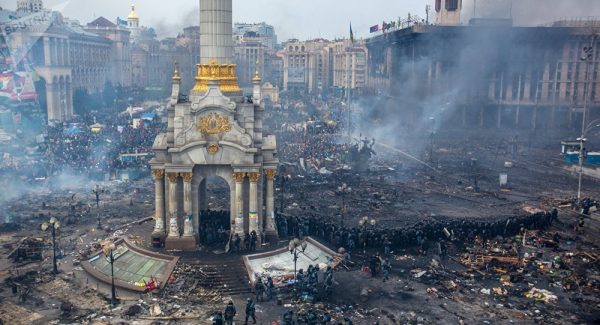
Mission Complete: What the US Really Had in Mind for Ukraine
A simmering conflict in the center of Europe, which can be re-ignited at any time
Sputnik – June 14, 2017
On Tuesday, political specialists from the Moscow-based advisory group Foreign Policy presented their report on four possible scenarios for the further development of Ukraine. Sputnik Radio discussed the suggested scenarios with political analyst Vladimir Zharikhin, who also explained what the US has already completed in the country.
On Tuesday, Nikolai Silaev, Senior Researcher at the Moscow State Institute of International Relations and Research Director for Foreign Policy, and Andrei Sushentsov, the Valdai Club’s Program Director and a managing partner with Foreign Policy presented their report on four possible scenarios for the further development of Ukraine.Russia’s Kommersant newspaper obtained a copy of the analysis. The authors suggest that both a large hot war and a comprehensive political settlement of the Donbass separatist crisis are equally unlikely to happen in Ukraine in the nearest future.
They put forward the four scenarios they deem possible for the future of the country, based on the assumption that Ukraine will take a back seat in the agendas of the major players – the US, EU and Russia. The authors specifically note that there are no longer people who are interested in Ukraine within US President Trump’s circle, as Joe Biden and Victoria Nuland had been during the Obama administration.
“Without the supervision of the US, the government in Kiev resumed its military and political experiments in Donbass in January-February 2017,” the paper notes.
“The Ukrainian crisis continues to evolve within the boundaries of the constants defined by the spring of 2015: a large hot war is unlikely, the settlement [of the crisis] is frozen, and the Minsk agreements remain the basis of the political process,” the newspaper quotes the report as saying.
The first of the scenarios, entitled “movement in the rut”, suggests the retention of political stability in the country at its current level and ongoing support of the Ukrainian government by the West. The Western leaders, however, silently recognize the weakness of President Poroshenko, the failure of any reforms and the escalating struggle between different political forces.A large-scale offensive of the Ukrainian army in Donbass is unlikely as Kiev fears its defeat.
The second scenario, “Kiev on a trailer,” suggests internal political destabilization in the country. In its mild form, it is a confrontation between the President and the new country’s parliament, due to be formed after early parliamentary elections. In its acute form, it evolves into massive street protests, including armed conflicts, the threat of a coup and the collapse of government agencies.
Under this scenario, the settlement in Donbass is fully blocked, amid an increased risk of the resumption of large-scale military operations. In this case the West can become hostage to its own sluggish foreign policy regarding Ukraine.
In the third variant, “Collapse and indifference,” the US and EU are less interested in Ukraine. Financial aid from the West is shrinking, and Kiev’s authorities face the immediate threat of a new macroeconomic catastrophe. Western mainstream media and politicians criticize Kiev for failed reforms, uncontrolled political violence and the growing influence of radical nationalists.
The summary: the ruling circles lose their key source of power – explicit support from the West. It is no longer possible or becomes very difficult to continue “selling” the conflict in the east of the country as the “defense of Europe from Russian aggression.”
The final scenario, “A threat of isolation”: the political regime in Kiev maintains stability, however its support from the West is declining. The OSCE representatives, leaders of Germany and France (part of the Normandy Four group) publicly nod and comment on situations when Ukraine’s actions contradict its obligations under the Minsk agreements and prevent the settlement of the conflict in Donbass.
“In the rhetoric of the Western politicians, the issue of lifting anti-Russian sanctions is being increasingly separated from the issue of the settlement of the Ukrainian crisis,” the report says. However there are no pre-conditions for the early parliamentary elections. The authorities are still able to keep the country under control. The political influence of the right-wing armed groups is waning. The shelling of Donbass and armed incidents at the line of contact both ebb.
In conclusion, the report suggests that the settlement of the Ukrainian crisis is possible only in the event of a compromise among all the external players. However, the compromise is highly unlikely: Russia does not want Ukraine to be consolidated along Western and anti-Russian lines. The West doesn’t want Ukraine to be consolidated along pro-Russian lines.

© Sputnik/ Gennady Dubovoy
“It is in everyone’s common interest not to turn Ukraine into a battlefield between Russia and the West,” the authors therefore concluded.
Radio Sputnik discussed the report with Deputy Director of the CIS (Commonwealth of Independent States) Institute Vladimir Zharikhin, who suggested that the first scenario is the most probable.
“Unfortunately the Ukrainian leadership has lost its subjectivity, or personality, long ago. I mean that the key decisions in Ukraine are made not by the Ukrainian leaders but by external players. If we suggest that the events will continue to develop in the way they are doing now, the first scenario is the most probable,” he told Sputnik.
The political analyst also noted what the US has already completed in Ukraine.
“Any speculations regarding whether the West has become tired of Ukraine and whether it will now leave it alone have no grounds. The Western countries, at least the US, have completed what they were initially after: they have created a simmering conflict in the center of Europe, which can be re-ignited at any time. However, from their point of view, it’s best to let it simmer for a while,” Zharikhin said.
The expert also pointed out that the Ukrainian conflict won’t resolve itself.
“If the Ukrainian authorities try to follow the wisdom of Chinese general Sun Tzu ‘If you wait by the river long enough, the bodies of your enemies will float by,’ those are irrelevant illusions. They won’t float by,” Zharikhin said.
The political analyst, however, noted that no matter how paradoxical it sounds, the Ukrainian authorities nevertheless strengthen their authority.
“The Ukrainian leaders are destroying their country, but strengthening their own authority. Through destroying of the remains of the democratic order in the country, tightening their authority and intimidating the population, they consolidate power,” he concluded.
SEE ALSO:
Cold Rolled Facts: Ukraine No Longer Top-10 Steel Maker, Metallurgy Sector Dying
Over 10,000 Killed, Nearly 24,000 Injured in Ukraine’s Conflict Since 2014 – UN
How Vladimir Putin Sees the World
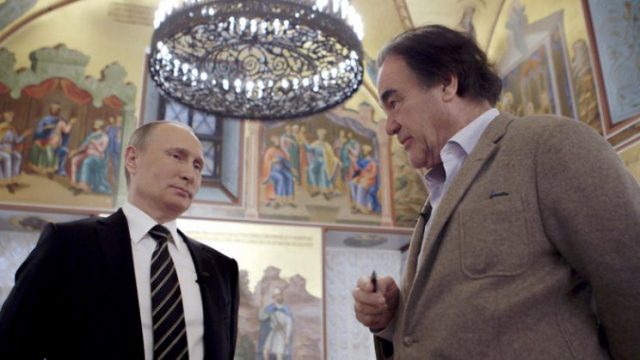
Oliver Stone interviewing Russian President Vladimir Putin in Showtime’s “The Putin Interviews.”
By Robert Parry | Consortium News | June 13, 2017
There was a time when I thought that it was the responsibility of an American journalist to hear all sides of a dispute and then explain the issue as fairly as possible to the American people, so they would be armed with enough facts to make their own judgments and act as the true sovereigns in a democracy.
I realize how naïve that must sound today as American journalism has shifted to a new paradigm in which the major news outlets view it as their duty to reinforce whatever the establishment narrative is and to dismiss or discredit any inconvenient facts or alternative analyses.
Today, The New York Times, The Washington Post and the rest of the mainstream media permit only the narrowest of alternative views to be expressed or they just pile into the latest groupthink whole hog.
So, that is why director Oliver Stone’s four-part series of interviews with Russian President Vladimir Putin on “Showtime” will surely draw near-universal outrage and ridicule from the big U.S. media. How dare anyone let Putin explain how he views the challenges facing the world? Can you believe that any right-thinking American would treat the Russian leader with civility and – god forbid – respect?
The new American media paradigm requires either endlessly insulting Putin to his face or aggressively blacking out his explanations, especially if they are based on information that puts the U.S. government in a negative light. The American people must be protected from this “Russian propaganda and disinformation.”
In other words, with the mainstream “guardians of truth” forewarning the American people not to watch Stone’s “The Putin Interviews,” the series will probably draw a relatively small viewership and the demonizing of Putin and Russia will continue unabated.
The American public can thus be spared some disturbing historical revelations and the unsettling vertigo that comes from hearing information that disrupts “what everyone knows to be true.”
In the “director’s cut” or long-form version of the four-part series that I watched, Stone does allow Putin to offer detailed explanations of his thinking on current crises, but also draws from Putin acknowledgements that might be surprising coming from a Russian leader. He also puts Putin in some uncomfortable binds.
–Regarding the Soviet Union’s development of the nuclear bomb in the late 1940s, Putin said Russian and German scientists were working on the project but got help from participants in the U.S. nuclear program:
“Our intelligence also received a lot of information from the United States. Suffice it to remember the Rosenberg spouses who were electrocuted. They didn’t acquire that information, they were just transferring that information. But who acquired it? The scientists themselves – those who developed the atomic bomb.
“Why did they do that? Because they understood the dangers. They let the genie out of the bottle. And now the genie cannot be put back. And this international team of scientists, I think they were more intelligent than the politicians. They provided this information to the Soviet Union of their own volition to restore the nuclear balance in the world. And what are we doing right now [with the U.S. withdrawal from the Anti-Ballistic Missile Treaty]? We’re trying to destroy this balance. And that’s a great mistake.”
–Regarding the origins of modern Islamist terrorism, Putin said: “Al Qaeda is not the result of our activities. It’s the result of the activities of our American friends. It all started during the Soviet war in Afghanistan [in the 1980s] when the American intelligence officers provided support to different forms of Islamic fundamentalism, helping them to fight the Soviet troops in Afghanistan.
“So the Americans themselves nurtured both Al Qaeda and [Osama] bin Laden. But it all spun out of control. And it always happens. And our partners in the United States should have known about that. So they’re to blame.”
Stone noted how President Reagan’s CIA Director William Casey sought to exploit Islamic fundamentalism to destabilize Muslim parts of the Soviet Union and to achieve regime change in Moscow.
Putin added: “Those ideas are still alive. And when those problems in Chechnya and the Caucasus emerged [after the collapse of the Soviet Union in 1991], the Americans, unfortunately, supported those processes. We [Russians] assumed the Cold War was over, that we had transparent relations, with the rest of the world, with Europe and the U.S. And we certainly counted on support, but instead, we witnessed that the American Intelligence services supported terrorists.
“I’m going to say something very important, I believe. We had a very confident opinion back then, that our American partners in words were talking about support to Russia, the need to cooperate, including fighting terrorism, but in reality they were using those terrorists to destabilize the internal political situation in Russia.”
–Regarding NATO expansion into Eastern Europe,” Putin said, “There was a deal not to expand NATO eastward. [But] this deal was not enshrined in paper. It was a mistake made by Mr. Gorbachev [the last president of the Soviet Union]. In politics, everything must be enshrined in paper.
“My impression is that in order to justify its existence, NATO has a need of an external foe, there is a constant search for the foe, or some acts of provocation to name someone as an adversary.”
–Regarding NATO missile bases being installed in Eastern Europe, Putin said: “And what are we supposed to do. In this case we have to take countermeasures. We have to aim our missile systems at facilities that are threatening us. The situation becomes more tense. …
“There are two threats for Russia. The first threat, the placement of these anti-ballistic missiles in the vicinity of our border in the Eastern European countries. The second threat is that the launching pads of these anti-ballistic missiles can be transformed within a few hours into offensive missile launching pads. Look, if these anti-ballistic missiles are placed in Eastern Europe, if those missiles are placed on water, patrolling the Mediterranean and Northern Seas, and in Alaska, almost the whole Russian territory would be encircled by these systems.
“As you can see, that is another great strategic mistake made by our partners [a word that Putin uses to refer to the United States]. Because all these actions are going to be adequately answered by Russia. And this means nothing else but a new cycle of an arms race. …
“When the Soviet Union collapsed, they [American leaders] were under the illusion that the U.S. was capable of anything, and they could [act] with impunity. That’s always a trap, because in this situation the person or the country begins to commit mistakes. There is no need to analyze the situations, or think about the consequences. And the country becomes inefficient. One mistake follows another. And I think that is the trap the U.S. has found itself in.”
–Regarding the prospect of nuclear war, Putin said, “I don’t think anyone would survive such a conflict.” Regarding U.S. plans for creating a missile shield, he said, “There is a threat deriving from the illusion of being protected, and this might lead to more aggressive behavior. That is why it is so important to prevent unilateral actions. That is why we propose to work jointly on the anti-ballistic missile system.”
–Regarding the American neoconservatives who now dominate the U.S. foreign policy establishment and the major news media, Stone described “the neoconservative element as being so hungry to make their point, to win their case that it’s dangerous.” Putin responded, “I fear them too.”
–In an interview on Feb. 16, 2016, Stone asked about the U.S. presidential campaign to which Putin replied, “We are going to be ready to work with whoever gets elected by the people of the United States. I said that on several occasions and that’s the truth. I believe nothing is going to change no matter who gets elected. … The force of the United States bureaucracy is very great. And there are many facts that are not visible to the candidates until they become President. And the moment one gets to real work, he or she feels the burden. …
“My colleague, Barack Obama, promised to close Guantanamo. He’s failed to do that. But I’m convinced that he sincerely wanted to do that. … Unlike many partners of ours, we never interfere within the domestic affairs of other countries. That is one of the principles we stick to in our work.”
–In a February 2017 interview, which was added amid the escalation of charges that Russia interfered in the U.S. election, Stone noted that Donald Trump is “your fourth president” and asked, “what changes?”
“Almost nothing,” Putin said with a wry smile. “Life makes some changes for you. But on the whole, everywhere, especially in the United States, the bureaucracy is very strong. And bureaucracy is the one that rules the world.”
Asked about alleged Russian interference to help Trump, Putin responded: “You know, this is a very silly statement. Certainly, we liked President Trump and we still like him because he publicly announced that he was ready to restore American-Russian relations. … Certainly, we’ve got to wait and see how, in reality, in practice, the relations between our two countries are going to develop. …”
Stone: “So why did you bother to hack the election then?”
Putin: “We did not hack the election at all. It would be hard to imagine any other country – even a country such as Russia would be capable of seriously influencing the electoral campaign or the outcome of an election. … any talk about our influencing the outcome of the U.S. election is all lies. They are doing it for a number of reasons.
“First, they are trying to undermine the legitimacy of President Trump, create conditions that must preclude us from normalizing our relations, and they want to create additional instruments to wage an internal political war. And Russia-U.S. relations in this context are just a mere instrument in the internal political fight in the U.S. … We know all their tricks.”
–Regarding cyber-war and the possibility that U.S. intelligence planted malware and back-doors in software sold to Russia, Putin said, “Well, you will probably not believe me, but I’m going to say something strange. Since the early 1990s, we have assumed that the Cold War is over. We thought there was no need to take any additional protective measures because we viewed ourselves as an integral part of the world community.
“We didn’t have any equipment of our own. Our companies, our state institutions and administrative departments, they were buying everything – hardware and software. And we’ve got much equipment from the U.S., from Europe, and equipment is used by the Intelligence Services and by the Defense Ministry. But recently we certainly have become aware of the threat that all of that poses.
“Only during recent years, have we started to think about how we can ensure technological independence, as well as security. Certainly we give it much thought, and we take appropriate measures. … We had to catch up with others.”
In an aside to Putin’s translator within earshot of Putin, Stone remarked: “He’s acting funny about this story, like he’s guilty a bit.”
–Regarding the dangers to Russia from U.S. cyber-warfare, Putin said: “It is almost impossible to sow fear among the Russian citizens. … And secondly, the economies that are more sophisticated, in technological terms, they are more vulnerable to this type of attack. But in any case, this is a very dangerous trend. A very dangerous avenue for competition to pursue and we need some rules to be guided by.”
When Stone raised the possibility of a treaty, Putin said, “I don’t want to say that, but you are simply drawing this information from me. You make me say that. One and a half years ago, in Autumn 2015, we came up with a proposal that was submitted to our American counterparts. We suggested that we should work these issues through and arrive at a treaty, an agreement on the rules to be guided by in this field. The Americans didn’t respond, they kept silence, they didn’t give us any reply.”
–Regarding allegations of Putin’s wealth, Stone asked, “Is there someway you could make your personal wealth clearer?”
Putin responded indirectly: “I remember when I moved to Moscow from St. Petersburg [in the 1990s], I was astounded and shocked by how many crooks had gathered here in Moscow and their behavior was so astounding, I couldn’t get used to it for a very long time. Those people didn’t have any scruples at all. … My task was to differentiate between power and money.”
Stone: “So there are no bank accounts in Cyprus?”
Putin: “No, and never have been. That’s just nonsense, and if that were the case we would have had to face it a long time ago.”
–Although Putin remained disciplined and controlled during the long sit-downs with Stone, the Russian president appeared most uncomfortable when Stone pressed him about his future plans and the risk of a leader viewing himself as indispensable to a nation.
Citing the possibility that Putin would have been in power – as either prime minister or president – for 24 years if he were to run for president again and win, Stone asked, “Do you feel that Russia needs you that badly?”
Putin: “The question you have asked whether Russia needs anyone that bad – Russia itself will decide. An alteration in power certainly has to exist. … In the end, let me reiterate – the citizens of Russia are going to make the final decision. Concerning the 2018 elections, I’d like to say there are things, things that should have some intrigue and mystery. So I am not going to answer that part of the question.”
Stone: “I said if…”
Putin: “We shouldn’t speak in the subjunctive mood.”
Stone then suggested more transparency in the next election.
A stern Putin responded: “Do you think our goal is to prove anything to anyone? Our goal is to reinforce our country.”
Stone: “That is a dangerous argument. It works both ways. Those who abuse power always say it’s a question of survival.”
Putin: “We are not talking about survival and we are not trying to justify ourselves. Certainly taking into account all the negative tendencies you’ve been talking about – the Soviet legacy, the Imperialist legacy, it’s something in the past. But we also have to think about the positive legacy. Russia has been built for a thousand years; it has its own traditions. We have our notions of what is just and unjust, we have our own understanding of what defines an efficient government.
“This is not a question of helping someone cling to power or to claim it for myself. This is about ensuring economic growth and sustaining it, improving our defense capabilities, and not just during periods of crisis and difficulties.”
Stone: “Mr. Putin, I don’t doubt for one moment your pride in serving Russia or that you are a son of Russia to me, and you have done very well by her. We all know the price of power. When we’re in power too long no matter what, the people need us but at the same time we’ve changed and we don’t even know it.”
Putin: “Indeed, this is a very dangerous state. If a person in power feels that they have lost it, this bond connecting this person to the country and to the rank-and-file citizens of the country, then it’s time for them to go.”
Featured Video
Theodore Postol: Iran’s Missiles & Drones Were Underestimated
or go to
Aletho News Archives – Video-Images
From the Archives
What is the Israeli Lobby in Australia Doing in Interfaith Dialogue?
By Ali Kazak | Dissident Voice | October 11, 2015
For years Israel and its lobby around the world have been trying to normalise their relations with Arabs and Muslims without solving the Palestine Question.
One of the methods they resorted to in the last few years is using human rights and community organizations such as interfaith dialogue and Multiculturalism to achieve this objective and to: isolate the Palestinians, marginalise the Palestine question, end Israel’s isolation, and prevent criticism of Israel, knowing that these organisations will be the first to stand against Israel’s violations, racial and religious discrimination.
The group responsible for this task in Australia is The Australia/Israel & Jewish Affairs Council (AIJAC); its Director of International & Community Affairs, Jeremy Jones is in charge of lobbying religious community organizations, specifically Muslims and Christians. Consequently he convened the Faith Communities for Reconciliation, founding participant in the Australian Partnership of Religious Organisations and the Australian National Dialogue of Christians, Muslims & Jews.
AIJAC is a private political propaganda group. It is recognised as the main Israeli lobby in Australia. It coordinates its activities and works intimately with the Israeli embassy in Canberra and different institutions in Israel. It is privately funded by some Jewish businessmen. It monitors closely Australian politicians, the media, ethnic and religious groups, (especially Arabs and Muslims), unions and academics on their stands towards Israel and the Palestine question. … continue
Blog Roll
 Aletho News
- The killing of three Indonesian soldiers in Lebanon should remind Jakarta that Israel does not want peace
- Defeated and delusional: Netanyahu’s remarks reveal $80bn war failure, says analyst
- Iran’s friends are about to make life much more difficult for Israel and the US
- The war of liberation of the Arab and Islamic peoples expands across the Gulf
- Envoy warns UN on Trump’s threat to ‘obliterate’ Iran’s civilian infrastructure
- The Larak Corridor: Iran’s Rial Gate With No US, No Israel, and No Way Around
- ‘Economic terrorism’: Steel facilities hit again in US-Israeli strike
- ‘War Crime’: Iran condemns attacks on Arak, Ardakan nuclear sites
- Two-thirds of Americans want quick end to Iran war even if goals unmet
- Trump to Give “Important Update on Iran” Wednesday in Prime-Time Speech
- If Americans Knew
- Gaza families reunite years after babies evacuated amid Israel’s war
- International Rescue Committee warns Gaza’s children face grave protection risks
- Iran’s Alleged 47-Year War on America: Debunking the 1,050 American Deaths Canard
- Israel wants US to bomb more of Iran’s civilian structures (113,000 is not enough) – Not a ceasefire Day 173
- Ann Coulter Rips Into Fox News for Iran War Coverage
- Joe Kent Urges Americans To Call White House and Congress To Object To Sending Troops Into Iran
- DNC Resolution to Reject AIPAC Funding Puts Democratic Leaders in the Hot Seat
- Swedish foundation to build 400 schools as over 650,000 Gaza children remain without education for 2 years
- Israeli army admits photshopping image of slain Lebanese journalist
- This is how Israel is systematically killing health workers under the cover of war in Lebanon
- No Tricks Zone
- New Study Finds Warming Saves Lives…Cold Temperatures 12 Times More Deadly Than Excess Heat
- German Science Blog Accuses PIK Climate Institute Of Hallucinating Climate Tipping Points
- Devastating Assessment Of Comirnaty Vaccine By Former Senior Pfizer Europe Toxicologist
- New Study: CO2 Is ‘Effectively Negligible’ As An Explanatory Climate Change Factor Since 2000
- Former Pfizer Toxicologist Dr. Helmut Sterz Tells Bundestag Hearing Pfizer Vaccine Should Have Never Been Approved
- Energy Expert: Germany’s Nuclear Phaseout Was A “500 Billion Euro Mistake”
- New Research: South Australia’s Mid-Holocene Sea Surface Temperatures Were 4°C Warmer Than Today
- Storing Green Energy To Last Germany 10 Days Would Require A 60-Million Tonne Battery
- New Studies: UK Sea Levels Were 4 Meters Higher Than Today During The Mid-Holocene
- Destructive Green New Deal: German Energy And Metal Group Warns Of Drastic Crisis
 Aletho News