Hué Back When: Vietnam’s Pivotal Battle Reconsidered

Photo by Raymond Depardon | CC BY 2.0
By Michael Uhl | CounterPunch | September 20, 2017
For Mark Bowden, author of Hué 1968, the pivotal battle of the War in Vietnam did not follow the script most Americans were used to scanning in their newspapers or visualizing on the evening news. The war Americans followed at home was like a humongous hunting expedition. U.S. forces seemed engaged in an endless chase over a lush boondocks inhabited by peasants and dotted with rice paddies or trailing the rugged forested highlands in search of the Viet Cong, a cunning and elusive enemy whose tactics were hit and run, not stand and fight.
When an atypical fixed battle developed, it was typically well-removed from the population centers that hugged the coastline off the South China Sea. Vietnam was, after all, a guerrilla war, or more broadly understood, a people’s war fought to reunite a nation, artificially divided into North and South by fiat of the United States in the service of geopolitical brinksmanship. Accused of fermenting the southern insurgency, North Vietnam was mercilessly bombed, but spared the carnage of a ground war. Not so the south where, by whatever foul means, the idea was “to isolate the population from the Viet Cong,” notwithstanding that, as Mark Bowden readily concedes, “in most instances they were one in the same.” The resistance was popular and widespread, and its idea was to drive the American invader out, and overthrow a despised ruling clique of Vietnamese compradors which survived only because the invader had committed hundreds of thousands of its own troops and billions of its taxpayers’ dollars to sustain it.
Americans were consistently assured that bit by bit the tumultuous countryside was being pacified, and the guerillas attrited, both politically and as a fighting force. In late 1967 Americans were told they were winning the war. When Tet – the Luna New Year – dawned on January 31, 1968, that illusion was irreparably shattered. The vastly superior forces of the United States and its southern catspaw, the Army of the Republic of Vietnam (ARVN), were caught virtually flat footed when thousands of regular troops of the People’s Army of North Vietnam seemingly materialized from thin air, and in coordination with local units of the southern resistance, launched up and down the length and breath of South Vietnam what was quickly branded the Tet Offensive. The most stunning blow for Americans, war managers and citizens alike, was an assault on the South Vietnamese capital of Saigon taken right to the walls of the American Embassy.
For several weeks thereafter, media attention in the U.S. and throughout the world focused primarily on the shock of Saigon’s vulnerability, overplaying its significance. A thousand kilometers north, at first scarcely noticed, even by the Commander of U.S. forces, General William Westmoreland, a battle had commenced that would become the “longest and bloodiest” of the war, not waged over the – till then – familiar rural topography, but house to house, street by street, culminating in one of the most intense chapters of urban warfare in the annals of American military history. Observers today might liken it to a more recent urban free-for-all entangling American troops in Fallujah, Iraq. Or, better yet, recall a U.S. military fiasco in downtown Mogadishu that Mark Bowden had crafted into an earlier best seller. To the extent comparisons hold, the Battle of Hue was like Black Hawk Down on steroids.
Hue 1968 is a comprehensive account of that battle written in the page-turning style of popular narrative non-fiction. The author has assembled a cast of eyewitnesses who participated in the action, Vietnamese and Americans, and the battle unfolds in recollections mined from their
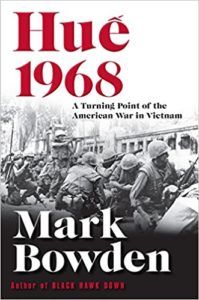
interviews, and, for the departed, from other primary sources at his disposal, such as lengthy wartime correspondences. Bowden has properly set the strategic stage for his action in the context of the war’s two most relevant contemporaneous developments. There was the very fact of Tet, simultaneous attacks with varying degrees of effectiveness on virtually every population center and military base in the South. The Year of the Monkey came in like Armageddon, catching General Westmoreland, for one, completely off guard even though he later claimed he knew those crafty commies were planning something.
To draw attention away from their true intentions, the North Vietnamese had executed a feint, keeping a remote Marine encampment under heavy bombardment at Khe Sanh near the border with Laos, and just below the Demilitarized Zone (DMZ). Taking the bait, and just two weeks before Tet, Westmoreland weakened his coastal enclaves by detaching troops to reinforce the beleaguered camp. The American general believed he was luring the North Vietnamese into a repeat of the battle of Dien Bien Phu, which in 1954 brought French colonial control of Vietnam to an end but inadvertently opened the door to an American invasion. This time, Westmoreland fantasized, “he was determined to prevent history from repeating itself.” That battle never developed, and several months later, Khe Sanh was abandoned by the Americans.
Westmoreland’s obsession with Khe Sanh apparently prevented him from fully grasping that Hue, South Vietnam’s third largest city, and former Imperial capital, had fallen to the Liberation Front in less than twenty-four hours. This pattern of disbelief was moreover pervasive up and down the American chain of command. At Phu Bai, a Marine base less than fifteen miles south of Hue, the commanding general, with improbable symmetry named Forster LaHue, repeatedly ignored reports on the size of the force his counterattack would face, and insisted that, instead of thousands, their number couldn’t possibly exceed more than a few hundred. Could a force as large as the one being reported enter and occupy the entire city that quickly and virtually undetected? Through some of his most original reporting Bowden reconstructs exactly how that occurred.
Shifting the action in his account from one adversary to the other, Bowden begins with the attack, describing how four regiments totaling roughly four thousand uniformed NVA soldiers managed to infiltrate the border between North and South Vietnam, rendezvous with local guerrillas in a force of equal size, and ultimately bivouac on the outskirts of Hue. “It was the kind of troop movement,” comments Bowden, “that could remain secret only if the citizenry supported it, or didn’t care enough to sound the alarm.”
Certainly in Hue there were many Catholics who, in general, were partisans of the Saigon regime, not to mention a contingent of elite ARVN soldiers stationed there, who would have sounded the alarm if they’d been aware of any imminent threat. On another side was a strong current of anti-Americanism among the Buddhists and the student body at Vietnam’s prestigious Hue University, who two years earlier had combined and rioted against the repressive South Vietnamese government, and burned the library of the United States Information Service. But by early 1968, Hue was being little frequented by the war’s violence, and hopes were stoked that the city’s rich stock of architectural treasures, not least the palace of Vietnam’s last royal dynasty, might avoid destruction. Compared with the rest of the country, life in Hue was reasonably good, and reasonably safe. A degree of political complacency had set into what remained a functional commercial entrepot where trade and traffic on Hue’s iconic Perfume River remained brisk.
Even though a majority of Hue’s population of 140,000 could not be considered pillars of the revolution, an underground resistance network was well-entrenched in the city and highly motivated. And Bowden, having tracked down a small cast of survivors, gives us affecting sketches of, among others, the Village Girl who guided the troops through the darkness and pointed them toward their targets; the VC commander who stood up to the hero of Dien Bien Phu, General Vo Nguyen Giap, and revised the battle plan; the college boy who worked with his fisherman landlord to smuggle arms into the city by sampan; the Buddhist poet turned what we would call ‘information officer,’ and Bowden – who holds many conventional opinions– calls “propagandist;” but my favorite was the balsy little guy who was given the task to create a giant new flag for the victors to raise once they’d taken the city.
The flag detail merits a special nod to illustrate the contrast between the high tech m.o. of the Empire’s war machine, and the endless improvisation of those in the Front who used gumption, imagination and stealth to their advantage in the face of overwhelming fire power from air, land and sea. The task to create a flag to be seen, not as “an invasion or occupation, but rather as a liberation,” fell to Sargent Cao Van Sen, an old war horse who’d fought with the Viet Minh against the French, joined the northern Army, and was then ordered back to his native Hue to organize among the Viet Cong. The idea of the flag, Bowden says “was to recognize real political differences between North and South,” with a design that represented, not only the liberation forces, but also “the intelligentsia and the city’s religious factions – Buddhists and Catholics.” Hanoi’s political objective at that stage was transitional, “to establish a neutral, independent South Vietnam,” leaving reunification to future negotiations.” Sgt. Sen’s job was to line up the material, a sewing machine and a seamstress to produce a single flag, which, when completed, required two men to carry it. After being “run up the 123-foot flagpole… that stood just outside the royal palace before the Citadel’s southern wall… it was visible all over Hue” when the city’s denizens awoke January 31st on the first morning of Tet.
Metropolitan Hue spread over both sides of the Perfume River, and the Front’s objective was to occupy the zone on the south bank called the Triangle, and, on the north, the Citadel, an “enormous fortress that enclosed nearly two square miles… its walls twenty-six feet high and impenetrably thick,” and enclosing the neighborhoods of Hue’s most affluent residents. Primary targets, included the air strip inside the Citadel, the province headquarters, the treasury, the post office, the prison, the radio station and “the sole American base, the [Military Assistance Command, Vietnam] MACV compound.”
The Commander of the Front, General Dang Kinh watched from high ground to the west, anxiously awaiting the assault to begin. Finally, “throughout the city arose the sound of gunfire… scattered at first, and then as if touched off by a fuse, it rose rapidly to a din.” By the time the shooting stopped, the attacking force, having “suffered only a few casualties, had dealt Hue’s defenders a crushing surprise blow.” The only major targets not overrun were a fortified redoubt occupied by the 1st ARVN Division inside the Citadel, and the MACV compound on the opposite side of the river, both heavily under siege.
Notwithstanding the loud cheerleading from Hanoi for Tet to unleash a “popular uprising,” it was General Kinh’s opinion, according to Bowden, that no such uprising would occur, not even in subdued and occupied Hue, given the certainty of an overpowering American counter-attack. Kinh knew his forces “could take the city, but… not hold it for long. Achievable goals… were to destroy the ARVN division, and… round up… those who represented the Saigon regime… who were marked for arrest and punishment.”
The subsequent executions of many of these Saigon officials is thematic in Bowden’s text, an overly eager retailing of the ex post facto justification among the war’s apologists for the American decision to rescue their allies by destroying their city. More informed observers might counter that for an American writer of Bowden’s stature to lay charges of mass murder at the Vietnamese resistance– in this instance taking blood retaliation on enemies considered legitimate military targets – demonstrates a highly hometown cast of mind, and a failure to do the math on the infinitely less selective assassination orgy of the U.S. Phoenix Program, not to mention the war’s vastly unbalanced human death toll perpetrated upon the Vietnamese population by the invader.
Kinh’s prediction proved correct. And much of what Bowden encapsulates in Hue 1968 is devoted to a ground level view on just how the city was retaken. Bowden fully examines first January 31st, the day Hue fell, from a variety of vantage points including civilians and combatants on both sides, then moves the battle forward in week long blocks until the Front, faced with annihilation, is forced to withdraw. Had the U.S. command acted more swiftly, the lives of many marines might have been spared, but the city faced devastation in every scenario as long as the occupiers remained. The initial counter-thrust came from the nearby Marine base at Phu Bai when General LaHue, still doubting his adversary’s vast numerical superiority, initially dispatched so few marines that, on one of few occasions during the war, the U.S. was seriously out-gunned. When a marine captain already in Hue called for air and artillery strikes to dislodge the entrenched enemy, General LaHue told him “rather strikingly that he was overreacting.“ LaHue “saw no reason on earth why the more than four hundred men in the [MACV] compound, reinforced with well over three hundred U.S. marines,” assorted tanks and heavy weaponized vehicles, “should not be able to flatten anything between them and the fucking Citadel.” Bowden aptly titles this episode An Idiotic Mission.
Three hundred men represented one understrength marine battalion, but only a single unit, Alpha Company of the 1st Battalion of the 1st Marine Division was dispatched at first to test the enemy strength. This proved a disaster, and the best account of the action on the ground I’ve found was not Bowden’s, but in Vietnam-Perkasie, a memoir by W.D. (Bill) Ehrhart. When Alpha Company left Phu Bai just as the sun was coming up, Bill Ehrhart was given the option of staying behind. He was short, meaning only a few days remained on what had already been a harrowing thirteen month tour. But since the unit was just going to check things out, and were told they’d be back by evening, Bill threw caution to the wind.
Alpha Company, moving to relieve the assault on the MACV compound passed a gas station on the city outskirts, and then, Ehrhart writes, “all hell broke loose… The shock of the ambush caught the whole column completely by surprise… We knew the compound lay straight up the road… seven blocks ahead… We fought our way up the [first] block. And the one after that. All day long we inched up the street. Casualties were appalling. Wounded and dead Marines lay everywhere.” Ehrhart, wounded in action, was in the thick of it the whole time. His memoir is a compelling, heart wrenching read.
From there Bowden covers the fighting chapter and verse. And if battle action is your genre, it’s a read that’s hair raising enough to fix your attention. The killing went on for 26 days, and by the end, 80% of the city lay in rubble. Bowden devotes a last chapter to Hue’s human toll. “Two-hundred and fifty American marines and soldiers were killed, and 1,554 wounded… The Front’s losses are estimated at between 2,400 and 5000…. A conservative guess at those executed would be two thousand… [which] brings us to a combined civilian death toll of about eight thousand… not an exact figure, but to the degree it’s off, it’s off by being too low.”
That the civilian death toll was enormous, cannot be doubted, and is by most accounts I’ve read over the years attributed to the terrible pounding the city took from naval off-shore guns, and from American and ARVN air power and artillery intent on expelling the Front whatever the human cost. As for “those executed,” it appears as if Bowden may have that figure “off” by a factor of ten. Writing in The New York Times in October 1972, Richard Barnet, a former State Department official and co-founder of the Institute for Policy Studies, quotes what the Hué Police Chief told a correspondent of The Times of London in March 1968 just days after the battle. The Chief, “Doan Cong Lap estimated the total number of executions at 200.“ Moreover, “the local Catholic priest reported that none of his clergy or parishioners were harmed by the N.L.F. [National Liberation Front],” who had been given instructions to be on their best behavior. Even if these two eyewitnesses under-counted the reprisal deaths, it’s still unlikely that Bowden’s figure holds water, given his reliance on official U.S. sources.
Richard Barnet took up this topic at a time when voices in the Nixon administration were claiming that mass executions at Hué were proof there would be a bloodbath if the U.S. withdrew and the communists came to power. When questioned on this in Hanoi, Premier Pham Van Dong retorted, “There is nothing in recent Vietnamese history to suggest that a government bent on killing hundreds of thousands of people in South Vietnam can keep peace.” In any case the bloodbath was us. As Barnet dryly quipped, “In the Orwellian age, the daily saturation bombings of Indochina are defended as missions of mercy.”
Mark Bowden seems to bend over backwards throughout this voluminous and valuable book to provide a two-sided perspective on a particularly tragic moment in the Vietnam War. But there’s something distastefully familiar in his throwaway rhetoric of the Cold War bias that got us into Vietnam in the first place. Bowden demonstrates how truth is betrayed by the words he chooses, for example, that “antiwar activists in the States romanticized Ho Chi Minh, and his cause, emphasizing his nationalist character… [but] Hanoi was Communist, authoritarian to the core… ruthless and doctrinaire.” Yet even this phobic reflex to honor the thought police in the mainstream where he prospers doesn’t cause Bowden to ignore that it was the Stalinists who hoped to come to power though the ballot box and the Americans who made war to prevent that.
By consensus in the school of conventional wisdom the Tet Offensive of 1968 was the turning point of the Vietnam War, after which the American war aim was not to win, but how to get out. Mark Bowden makes an excellent case that the fulcrum of that turning point was the Battle of Hue. But what if there was no turning point? In Vietnam the protracted war to expel a powerful foreign invader had its roots in millennia past; the American invasion was just another bump in the road.
Michael Uhl is the author of Vietnam Awakening.
Share this:
- Click to share on X (Opens in new window) X
- Click to email a link to a friend (Opens in new window) Email
- Click to print (Opens in new window) Print
- Click to share on Facebook (Opens in new window) Facebook
- Click to share on Pinterest (Opens in new window) Pinterest
- More
- Click to share on Pocket (Opens in new window) Pocket
- Click to share on Reddit (Opens in new window) Reddit
- Click to share on Telegram (Opens in new window) Telegram
- Click to share on Tumblr (Opens in new window) Tumblr
- Click to share on WhatsApp (Opens in new window) WhatsApp
- Click to share on LinkedIn (Opens in new window) LinkedIn
Related
September 20, 2017 - Posted by aletho | Book Review, Illegal Occupation, Timeless or most popular, War Crimes | United States, Vietnam War
1 Comment »
Leave a comment Cancel reply
This site uses Akismet to reduce spam. Learn how your comment data is processed.
Featured Video
Panama Ransacked in 1989
or go to
Aletho News Archives – Video-Images
From the Archives
Hands off ‘our hemisphere’ or Venezuela pays the price: US Senator warns Russia

RT | February 13, 2019
The US staked a claim on half the world, as Senate Armed Services Committee chair Jim Inhofe said Washington might have to intervene in Venezuela if Russia dares set up a military base not just there, but “in our hemisphere.”
“I think that it could happen,” Inhofe (R-Oklahoma) told a group of reporters on Tuesday. “You’ve got a guy down there that is killing everybody. You could have him put together a base that Russia would have on our hemisphere. And if those things happen, it may be to the point where we’ll have to intervene with troops and respond.”
Should Russia dare encroach on the US’ neck of the woods, Inhofe said: “we have to take whatever action necessary to stop them from doing that.” … continue
Blog Roll
-
Join 2,405 other subscribers
Visits Since December 2009
- 7,273,190 hits
Looking for something?
Archives
Calendar
Categories
Aletho News Civil Liberties Corruption Deception Economics Environmentalism Ethnic Cleansing, Racism, Zionism Fake News False Flag Terrorism Full Spectrum Dominance Illegal Occupation Mainstream Media, Warmongering Malthusian Ideology, Phony Scarcity Militarism Progressive Hypocrite Russophobia Science and Pseudo-Science Solidarity and Activism Subjugation - Torture Supremacism, Social Darwinism Timeless or most popular Video War Crimes Wars for IsraelTags
9/11 Afghanistan Africa al-Qaeda Australia BBC Benjamin Netanyahu Brazil Canada CDC Central Intelligence Agency China CIA CNN Covid-19 COVID-19 Vaccine Donald Trump Egypt European Union Facebook FBI FDA France Gaza Germany Google Hamas Hebron Hezbollah Hillary Clinton Human rights Hungary India Iran Iraq ISIS Israel Israeli settlement Japan Jerusalem Joe Biden Korea Latin America Lebanon Libya Middle East National Security Agency NATO New York Times North Korea NSA Obama Pakistan Palestine Poland Qatar Russia Sanctions against Iran Saudi Arabia Syria The Guardian Turkey Twitter UAE UK Ukraine United Nations United States USA Venezuela Washington Post West Bank WHO Yemen ZionismRecent Comments
seversonebcfb985d9 on Somaliland and the ‘Grea… John Edward Kendrick on Kidnapped By the Washington… aletho on Somaliland and the ‘Grea… John Edward Kendrick on Somaliland and the ‘Grea… aletho on Donald Trump, and Most America… John Edward Kendrick on Donald Trump, and Most America… aletho on The US Has Invaded Venezuela t… John Edward Kendrick on The US Has Invaded Venezuela t… papasha408 on The US Has Invaded Venezuela t… loongtip on Palestine advocates praise NYC… Bill Francis on Did Netanyahu just ask Trump f… Rod on How Intelligence, Politics, an…
Aletho News- Six impossible things about climate change and the energy transition
- Here’s who really weaponizes children in the Russia-Ukraine conflict
- Russia carries out three evacuation flights from Israel in under 24 hours
- 2016: The Year American Democracy Became “Post-Truth”
- Somaliland: Longtime Zionist colonisation target
- US hijacks fifth oil tanker in Caribbean waters as Washington tightens blockade on Venezuela
- From Industrial Power to Military Keynesianism: Germany’s Engineered Collapse
- Offshore wind turbines steal each other’s wind: yields greatly overestimated
- UK Expands Online Safety Act to Mandate Preemptive Scanning of Digital Communications
- Trump Pulls Plug on Ukraine’s Pentagon-Linked Bioweapons Web
If Americans Knew- 35,000 ‘Partially or Completely’ Deaf in Gaza Due to Israeli Bombings – Le Monde
- By suspending 37 aid organizations is Israel pushing toward a final expulsion?
- Israel says education in Gaza is not a critical activity – Not a ceasefire Day 91
- Israel is starving Gaza, ‘asphyxiating’ West Bank – Not a ceasefire Day 90
- Israel Targeted Churches, Mosques, and Markets during the Genocide.
- ‘We Saved the Child From Drowning’: In Gaza, Winter Storm Makes Displacement Even Deadlier
- Palestinian church committee urges churches worldwide to protect aid work in Gaza
- BlackNest: Inside Canary Mission’s Secret Web of Unlisted Sites
- Gaza staggers under 80% unemployment rate – Not a ceasefire Day 89
- Israel has detained Dr. Hussam Abu Safiya without charges for a year. Why has the New York Times refused to cover his case?
No Tricks Zone- Berlin Blackout Shows Germany’s $5 Trillion Green Scheme Is “Left-Green Ideological Pipe Dream”
- Modeling Error In Estimating How Clouds Affect Climate Is 8700% Larger Than Alleged CO2 Forcing
- Berlin’s Terror-Blackout Enters 4th Day As Tens Of Thousands Suffer In Cold Without Heat!
- Expect Soon Another PIK Paper Claiming Warming Leads To Cold Snaps Over Europe
- New Study: Human CO2 Emissions Responsible For 1.57% Of Global Temperature Change Since 1750
- Welcome To 2026: Europe Laying Groundwork For Climate Science Censorship!
- New Study Finds A Higher Rate Of Global Warming From 1899-1940 Than From 1983-2024
- Meteorologist Dr. Ryan Maue Warns “Germany Won’t Make It” If Winter Turns Severe
- Merry Christmas Everybody!
- Two More New Studies Show The Southern Ocean And Antarctica Were Warmer In The 1970s
Contact:
atheonews (at) gmail.com
Disclaimer
This site is provided as a research and reference tool. Although we make every reasonable effort to ensure that the information and data provided at this site are useful, accurate, and current, we cannot guarantee that the information and data provided here will be error-free. By using this site, you assume all responsibility for and risk arising from your use of and reliance upon the contents of this site.
This site and the information available through it do not, and are not intended to constitute legal advice. Should you require legal advice, you should consult your own attorney.
Nothing within this site or linked to by this site constitutes investment advice or medical advice.
Materials accessible from or added to this site by third parties, such as comments posted, are strictly the responsibility of the third party who added such materials or made them accessible and we neither endorse nor undertake to control, monitor, edit or assume responsibility for any such third-party material.
The posting of stories, commentaries, reports, documents and links (embedded or otherwise) on this site does not in any way, shape or form, implied or otherwise, necessarily express or suggest endorsement or support of any of such posted material or parts therein.
The word “alleged” is deemed to occur before the word “fraud.” Since the rule of law still applies. To peasants, at least.
Fair Use
This site contains copyrighted material the use of which has not always been specifically authorized by the copyright owner. We are making such material available in our efforts to advance understanding of environmental, political, human rights, economic, democracy, scientific, and social justice issues, etc. We believe this constitutes a ‘fair use’ of any such copyrighted material as provided for in section 107 of the US Copyright Law. In accordance with Title 17 U.S.C. Section 107, the material on this site is distributed without profit to those who have expressed a prior interest in receiving the included information for research and educational purposes. For more info go to: http://www.law.cornell.edu/uscode/17/107.shtml. If you wish to use copyrighted material from this site for purposes of your own that go beyond ‘fair use’, you must obtain permission from the copyright owner.
DMCA Contact
This is information for anyone that wishes to challenge our “fair use” of copyrighted material.
If you are a legal copyright holder or a designated agent for such and you believe that content residing on or accessible through our website infringes a copyright and falls outside the boundaries of “Fair Use”, please send a notice of infringement by contacting atheonews@gmail.com.
We will respond and take necessary action immediately.
If notice is given of an alleged copyright violation we will act expeditiously to remove or disable access to the material(s) in question.
All 3rd party material posted on this website is copyright the respective owners / authors. Aletho News makes no claim of copyright on such material.

VIETNAM: WHY DID WE GO?
The Religious Beginnings of an Unholy War
________________________________________
The Shocking Story of the Roman Catholic “Church’s” Role in Starting the Vietnam War
By Avro Manhattan (1914-1990)
Avro Manhattan was the world’s foremost authority on Roman Catholicism in politics. A resident of London, during World War II he operated a radio station called “Radio Freedom” broadcasting to occupied Europe.
He was the author of over 20 books including the best-seller The Vatican in World Politics, twice Book-of-the-Month and going through 57 editions. He was a Great Briton who risked his life daily to expose some of the darkest secrets of the Papacy. His books were #1 on the Forbidden Index for the past 50 years!!
More About the Author:
A short biography of Baron Avro Manhattan
Born April 6, 1914, in Milan, Italy, of American and Swiss/Dutch parents. He was educated at the Sorbonne in Paris and the London School of Economics. He was jailed in Italy for refusing to serve in the Fascist dictator Mussolini’s army. While imprisoned in the Alps he wrote his first book on astronomy.
During the war, Mr. Manhattan operated a radio station called Radio Freedom broadcasting to the partisans in occupied Europe. For this service he was made a Knight of Malta. His aristocratic roots meant that he was a Knight of the House of Savoy as well as a Knight Templar and a Knight of the Order of Mercedes.
His more than 20 books include the best-selling The Vatican in World Politics, one of the best-selling books of all time. It was translated into most major languages including Chinese, Russian and most recently, Korean.
He was a member of the Royal Society of Literature, Society of Authors, Ethical Union, P.E.N., British Interplanetary Society, etc.
His other books include:
The Rumbling of the Apocalypse, Airoldi, 1934;
Towards the new Italy (Preface by H.G. Wells), Lindsay Drummond, 1943;
Latin America and the Vatican, C.A. Watts, 1946.
The Catholic Church Against The Twentieth Century, C.A.Watts, 1947, 2nd edition, 1950;
The Vatican in Asia, C.A. Watts, London, 1948.
Religion in Russia, C.A.Watts, London, 1949.
Catholic Imperialism and World Freedom, C.A. Watts, London 1952, 2nd edition, 1959;
Terror Over Yugoslavia, the Threat to Europe, C.A. Watts, London, 1953;
The Dollar and the Vatican, Pioneer Press, London, 1956, 3rd edition, 1957.
Vatican Imperialism in the 20th Century, Zondervan, Michigan, 1965.
The Vatican Billions, Chick Pub., Los Angeles,1983.
Catholic Terror in Ireland, Chick Pub., Los Angeles, 1988.
Vatican Moscow Washington Alliance, Chick Pub, 1982.
Vietnam . . . why did we go?, Chick Pub, Los Angeles, 1984.
The Vatican’s Holocaust, Ozark Books, Springfield, MO.1986.
Murder in the Vatican, American Russian and Papal Plots, Ozark Books, Springfield, MO. 1985.
With an immense collection of facts, photos, names and dates, Manhattan proves that the Vietnam War began as a religious conflict. He shows how America was manipulated into supporting Catholic oppression in Vietnam supposedly to fight communism.
Manhattan explains:
• How religious pamphlets and radio broadcasts convinced one million Catholics to leave North Vietnam and live under Catholic rule in the South, overwhelming the Buddhists.
• How brutal persecution of Vietnamese Buddhists led to rioting and suicides by fire in the streets.
• Why the reports of what was really happening, written by American military and civil advisers, failed to reach the U.S. President.
• Why the project backfired, and as U.S. soldiers continued to die, the Vatican made a secret deal with Ho Chi Minh.
Contents
Publisher’s Foreword
Preface
Chapter 1
Preliminaries.
World War II, the Provisional Partition of Vietnam, and the Beginning of the Vietnamese Conflict.
Defeat of France and Japan – Vietnamese freedom-fighters declare the independence of Vietnam – A French Vietnamese puppet Prime Minister – Vietnamese Catholic Bishops appeal to the Vatican – The U.S. sends two warships to Saigon – Eisenhower helps the French in Vietnam – The Geneva Agreement – The l7th Parallel as “a provisional demarcation line” between North and South Vietnam – The Catholic lobby in the U.S. prevents a free election in Vietnam – Fear of a communist electoral take-over – President Eisenhower’s candid comment.
Chapter 2
The Vatican-American Grand Alliance
Reasons Which Prompted the U.S. to Commit Herself to the War in Vietnam.
U.S. global policy following World War II – “Belligerent peace between the U.S. and Soviet Russia – Russian territorial expansionism after World War II – The U.S., Korea and the Cold War – The Vatican fear of world communism – The launching of political Catholicism against left-wing Europe – Religious mobilization against Marxism.
Chapter 3
Fatimaization of the West
Religious and Ideological Preliminaries to the Vietnamese War.
The “Cold War” as a step to the “Hot War” – The U.S. and the Vatican make ready for “THE DAY” – The conditioning of Catholics for the oncoming “Hot War” – The message of the Virgin of Fatima – The conversion of Soviet Russia to the Catholic Church – The political implications of the cult of Fatima – The pope and the Virgin encourage Catholic volunteers for the Russian front.
Chapter 4
The Pope’s Blessing for a Preventive War
The Secretary of the U.S. Navy, Secret Chamberlain of the Pope, Prepares for World War III.
The crown which weighs 1,200 grams of gold – Our Lady appears 15 times to a nun in the Philippines – The American Jesuit and the miraculous rose petals – The American Secretary of Defense jumps from a window on the l6th floor – Cardinal Spellman, Senator McCarthy and the American Secretary of the Navy – The Boston speech and the call for an American “preventive atomic war.”
Chapter 5
The Miraculous Zig-Zagging Sun
Pope Pius XII Uses Religious Emotionalism as an Incitement to War.
The Virgin Mary visits the pope at the Vatican – Pius XII sees the sun “zig-zag” – The prodigy and its political meaning – One million pilgrims want the conversion of Russia – The first U.S. ambassador designate at the Vatican attends atomic exercises in Nevada – The U.S. ambassador to Moscow prepares for the invasion of Russia – Description of the forthcoming invasion of Soviet Russia by “Colliers ” – Making ready for the war of liberation The “Osservatore Romano” authenticates a miracle -The divine message to the Vicar of Christ.
Chapter 6
The Pope’s “Preventive War” Miscarries.
U.S. Admirals, Generals and Diplomats Troop to the Vatican, President Truman’s Despairing Comments.
Papal warning of the “barbaric invasion” – The American leader of the “Free Russia Committee” – Dulles appeals for “an atomic striking force” – Eisenhower and 12 War Ministers – 100 Divisions on the “ready” – Saturation bombing experts see the pope – Russian agents steal “the cipher books” of the Vatican – Vatican diplomats and their secret spying via religion – The CIA – 100 million dollars to train spies and terrorists – Uniforms with regulation shoulder flashes marked USSR, instead of USA – Anybody here who can speak Russian? – The pope promises the liberation of’ Soviet Russia – Mystical conditioning of Catholicism for the outbreak of an atomic conflict – President Truman’s despairing comment.
Chapter 7
The Men Behind the Vietnamese War.
Politicians, Generals, and Prelates and their Selection of the “Savior of Vietnam.”
The U.S. and 400,000 tons of war material – The fateful compromise of the 17th Parallel – Joint Vatican-U.S. Asian strategy – Catholic anti-communist crusade, McCarthy and Dulles – A cardinal as a linchpin between Washington and Rome – J.F. Kennedy and the Catholic lobby – U.S. preparation for intervention in Vietnam – The U.S. signs the fatal Vietnam agreement with France – The U.S. takes over military duties in South Vietnam – Foster-child of the Washington-Vatican sponsorship of South Vietnam – A would-be Catholic monk for an American grey eminence – Diem’s messiah-like complex – Diem becomes the premier of South Vietnam.
Chapter 8
The Virgin Mary Goes South.
The Catholic Imponderable in the Escalation of the Vietnamese
War.
Diem begins to create a Catholic administration – Diem refuses to hold elections as commanded by the Geneva Agreement – Diem’s refusal is supported by the U.S. and the Vatican – The plan for the mass dislocation from the North – The Catholics of North Vietnam, a state within a state – The communist leader of North Vietnam appoints a Catholic bishop to his government – Catholics want preferential treatment – Scheme for mass exodus of Northern Catholics toward South Vietnam – “Why has the Virgin Mary left the North?” – Catholic mass evacuation from North Vietnam – Results of the Catholic-CIA -Diem propaganda campaign – Catholic priests as Diem’s agents – A personal message to Eisenhower – The Seventh Fleet is sent to help Diem – Flight for Freedom with the American Navy – The pope’s representatives meet the first refugees – Humbug fanfare from Washington – The greatest phony refugee campaign promoted by the CIA and the Vatican.
Chapter 9
The Pius-Spellman-Dulles Secret Scheme.
The U.S. Taxpayer Finances the Creation of a “Catholic Dictatorship” in South Vietnam.
The preparation for a massive Catholic community in South Vietnam – The setting up of a model Catholic state – The U.S. Catholic lobby begins to milk the U.S. taxpayer to help Diem – 40 million dollars to resettle the Catholics from North Vietnam – State officials and Catholic priests – U.S. aid, “to Catholics only” – Mobile Catholic unit to defend Christendom – A rural Catholic militia – Rapid Catholicization of South Vietnam – Catholics to the top – Become a Catholic for a quick promotion – Mishandling of U.S. aid to Vietnam – Buddhists persuaded to become Catholics – A top U.S. general becomes a Catholic – Discrimination against non-Catholics – The strengthening of Catholics from the communist North.
Chapter 10
The Promotion of Catholic Totalitarianism.
“Individuals Considered Dangerous May Be Confined to a Concentration Camp.”
Discrimination against non-Catholic religions – Bribes, threats, agents and bitterness – Battles, riots and arrest of members of “hostile” religions – Further consolidation of the Catholic presence – Diem is given “dictatorial” power – Executive orders for concentration camps – American advisors support the new measures – Buddhists arrested without warrants – Interrogation, deportation, and torture of Buddhists – “Open” detention camps – Massacre and mass elimination of Buddhists – Buddhists become Catholic to save their lives.
Chapter 11
Consolidation of Terrorism
Anti-Protestant Legislation – Detention, Arrests, Tortures and Executions.
Catholic totalitarianism for a model Catholic state – Diem and the pope’s teaching – The Church should NOT be separated from the state – Refusal of license to preach – A Catholic state cannot tolerate Protestant dissidents – Blue print for the elimination of Protestantism – Catholic education for a Catholic state – South Vietnam built upon the social doctrines of ten popes – “It is an error to believe the Catholic Church has not the power of using force” – The cult of personalism – Diem’s American “civil advisors” send gloomy reports to Washington – Altars and shrines for President Diem – Catholic “commando squads” of South Vietnam trained at Michigan University – Identification cards for dissident Catholics – Arrests and executions of Buddhist rebels – 24,000 wounded and 80,000 executed – 200, 000 Buddhists demonstrate in Saigon – Diem decides to eliminate the religion of the majority.
Chapter 12
A CIA Spy Plane Cancels a Summit Meeting
The Cardinal Spellman War Replaces the “Preventive War” Planned by the Dulles Brothers and Pope Pius XII.
The two partners and their global objectives – Soviet Russia invades Hungary – Impending outbreak of World War III – The true foreign policy makers of the U.S. – The CIA promotion of American foreign policies – Collapse of the American-Russian summit meeting – The CIA and the spy plane – On the brink of atomic warfare “three times” – The U.S. threatens to use atomic weapons – The Church prays for “the liberation” – The “third” secret of the Virgin of Fatima – The Pope faints with “horror” – He calls for a war “of effective self-defense” – Communist expansion in Europe and Southeast Asia.
Chapter 13
The Vatican Attempts to Prevent Peace
Pope John XXIII Rejects Geneva Agreement While a U.S. Catholic President Goes for “Unlimited Commitment.”
The Viet-Minh upsets the Catholic Church – The Geneva Agreement is anathema for the Vatican – Why the Vatican encouraged the U.S. to intervene in Vietnam – Why Diem refused to hold a ‘free” election – Why North Vietnam wanted the “free” election” – What an American senator has to say about it – The cardinal who flew in American military aircraft – American troops the “soldiers of Christ” – Vietnam is consecrated to the Virgin Mary – The Pope creates an archdiocese in communist Vietnam – Pope John XXIII – ecumenism-versus-realism – The Vietnamese Catholic Mafia and the three brothers – Kennedy escalates the war – “Unlimited”commitment in Vietnam.
Chapter 14
Religious Persecutions and Suicides by Fire
World Opinion Forces U.S. to “Deplore Repressive Actions” of Diem.
The Catholic minority and the Buddhists – The sectarian volcano bursts out into the open – The Vatican flag in a Buddhist city – Celebration for Buddha’s birthday forbidden – The giant gong of Xa Loi Pagoda – The Buddhists burn a Catholic village – The monk’s message – Suicides by fire – Mass demonstration against Diem – Orders to close all pagodas – Buddhists killed by the Diem police – Buddhist students arrested and tortured – Refuge in the American embassy – The Americans are shocked at Diem’s ruthlessness – The U.S. “deplores repressive actions” – The Catholic-CIA-Diem lobby minimize the Buddhist agitations.
Chapter15
End of the Catholic Dictatorship
Assassinations of Two Catholic Presidents.
Why the American embassy was against Diem’s appointment – A disastrous choice – Kennedy’s double dilemma – Diem’s religious political priorities – Catholic dictatorships of Croatia and Vietnam compared – Diem and Pavelich’s main objectives – Diem’s religious operations endanger the U.S. war efforts in Vietnam – Buddhist deserters leave the Vietnamese army – Steps to avoid the disintegration of the army – American subsidies to Vietnam are suspended – CIA chief recalled – A free hand for a “Coup” against Diem – Diem and his brother are shot to death – President Kennedy is killed – Ten additional years of Vietnamese war – The final price, 58,000 young American lives.
Chapter 16
Catholic Expansionism in Southeast Asia in the 19th Century
Historical Background of the U.S. War of Vietnam.
Catholic elites with a Buddhist background – The brothers Diem, inheritors of ancient Catholic exclusiveness – Stepping stones to the Catholic conquest of Indo-China – The Emperor Thieu Tri and the revolt of 1843 – French gunboats and Catholic emissaries – The 1862 “Friendship” imposed upon Vietnam – Friars, nuns, and their civil and military protectors – Massive Catholic conversions to the “true church” – The Catholicization of French Vietnam during the last century.
Chapter 17
Early History of Catholic Power in Siam and China
Characteristic Precedents of Repression.
The French East India Company and the missionaries – The conversion to Catholicism of a Siamese king – Catholic discrimination against Buddhists – Ghastly deeds of a Catholic Mafia in Siam – Catholic and Frenchmen expelled and executed – End of the Vatican bid for the control of Siam – Siam forbids all Catholics for a century and a half – The Empress of China who became a Catholic – Empress Helena sends a mission to the pope – The Empress and the Jesuits plan to make China Catholic – Rebellion of the Mandarins – The end of a dream for a Catholic China.
Chapter 18
History of Catholic Aggressiveness in Japan
Conversions, Rebellions, Political Unrest and Civil War
Catholic missionaries welcomed to Japan in the 16th century – Japanese rulers, protectors of the Catholic Church – The Catholic Church begins to meddle in Japanese politics – Japanese Catholics fight the authorities – Civil unrest and civil war promoted by the Church – Catholic sieges and battles – Catholic persecutions in Kyoto and Osaka – Battles between the Jesuits, Franciscans and the Japanese Catholics – The Spanish captain and the Japanese ruler of Hideyoshi – Imperial ban against all Catholics – The Catholics of Japan take up arms against the Japanese government – The Jesuits lead an army of 30,000 Japanese Catholics against the Japanese rulers – The murder by the Catholics of the Governor of Shimbara – Bloody battles between Catholics and Buddhists – The Dutch help the Japanese to fight the Catholics – The Edict: All Christians forbidden to enter Japan for 250 years.
Chapter 19
Creation of a Dangerous Alliance
Retrospective Assessment of the Preliminaries of the U.S.-Vietnamese War.
The formula that worked in the past and which still works in the present – The “Cold War,” the U.S. and the Vatican – U.S.-Vatican dual fear of a common enemy – Pope Pius XII, the Dulles brothers and Cardinal Spellman – Power of the Catholic lobby in the U.S. – The secret ambassador of the State Department and the pope – Messages by word of mouth only – The trio which helped the U.S. into the war in Vietnam.
Chapter 20
The Two Catholic Presidents and a Revolutionary Pope
The Collapse of the U.S.-Vatican Grand Strategy in Vietnam.
A cardinal, two brothers and Eisenhower – The prophecies of St. Malachy – The expectations of the first “American Pope” – Rift between two Catholic presidents – Politics before religion for Kennedy – Kennedy’s dilemma – The election of a revolutionary pope and the shock at the State Department – The crash of the U.S.-Vatican anti-communist crusade – Pope John XXIII scolds President Diem – The Buddhist delegation goes to the Vatican – President Diem begins to endanger the U.S. war operations in Vietnam – Second thoughts in Washington – The step by step slide towards the Vietnamese precipice – President Kennedy and his desperate ambassadors – The final decision – The end of Diem and his brother.
Chapter 21
Secret Deal Between the Pope and the Communists of North Vietnam.
The Vatican Prepares for a United Marxist Vietnam.
The pope and Ho Chi Minh – Relenting of Vatican hostility toward North Vietnam – Pope John XXIII consecrates a united Vietnam to the Virgin Mary – Disapproval of the pope’s dedication – Reaction of Cardinal Spellman and the Catholic lobby of the U.S. – The Vatican takes the first steps for the abandonment of the U.S. in Vietnam – Catholic mass exodus of emigrants from the North – Political implications – Ho Chi Minh outfoxes the pope.
Chapter 22
The Final Disaster
Disintegration of the Vietnam-U.S. Partnership in Vietnam.
Calamitous significance of the Pope John-Ho Chi Minh secret agreement – Their use of religion to attain political objectives The Virgin Mary to the help of a united Marxist Vietnam – The pattern of religious political exploitation – U.S. military escalation and the pope’s “wind of change” – Secret cooperation between the Vatican and Vietnamese Marxism – The Catholic Church withdraws from the war in Vietnam – Adverse effects of the Vatican Moscow alliance on the war in Vietnam – The end of an American nightmare.
LikeLike