Steadfast Pinnacle 2017: Dozens of NATO commanders flock to Latvia for war games
RT | September 10, 2017
he Steadfast Pyramid 2017 military exercise kicks off in Latvia on Sunday, with 40 senior commanders from NATO states, as well as Finland and Sweden. They are expected to train how to “plan and conduct operations” amid the bloc’s buildup in the region.
Steadfast Pyramid 2017 and Steadfast Pinnacle 2017, involving more than 40 senior officers from NATO member states, plus Finland and Sweden, will take place at the Riga-based Latvian Defense Academy, the country’s national news agency LETA reported on Sunday.
Steadfast Pyramid, the first part of the exercise, will last until September 15. It is reportedly “to improve the ability of top-level officers and commanders to plan and lead joint operations,” according to LETA.
Steadfast Pinnacle, the next stage of the drill, will last from September 17 until September 22. Steadfast Pyramid and Steadfast Pinnacle were first held in Latvia in 2011.
British General James Everard, the NATO Deputy Supreme Allied Commander Europe, is expected to arrive in Latvia to oversee both stages of the exercise, Latvia’s Defense Ministry said, according to LETA.
Not much is known so far about the war games. A NATO fact sheet says Steadfast Pyramid and Steadfast Pinnacle are focused on “further developing the abilities of commanders and senior staff to plan and conduct operations through the application of operational art in decision making.”
Latvia, a former Soviet republic, has seen a major NATO buildup over the past months. Recently, NATO deployed four multinational battlegroups in Estonia, Latvia, Lithuania, and Poland as part of Enhanced Forward Presence (EFP). These combat-ready battlegroups, led by the UK, Canada, Germany, and the US respectively, are meant to demonstrate “the strength of the transatlantic bond.”
A 1,100-strong battlegroup led by Canada is stationed in Latvia, comprising a number of mechanized infantry units as well as a tank company and some support elements, according to NATO.
Poland and the Baltic states are calling for a stronger military presence in their countries, claiming it is necessary to deter “assertive” Russia.
Lithuania, another Baltic state, has suggested developing a “military Schengen project that would facilitate the movement of troops in Europe.”
Earlier this week, Lithuanian Defense Minister Raimundas Karoblis said the Benelux countries – Belgium, the Netherlands, and Luxembourg – as well as Finland and Estonia, support the plan, which includes “simplifying procedures and investing in infrastructure.”
Moscow has consistently said the ongoing buildup threatens Russian and European security. In mid-July, Russian envoy to NATO Alexander Grushko said the alliance is pushing forward for “an intensive mastering of the potential theater of military operations, accompanied by the development of the necessary infrastructure.”
From July to November, NATO will hold 15 drills complementing each other, “which are held in the same operative field and aimed at providing a vast range of support measures,” Grushko added.
Russian President Vladimir Putin earlier said that Moscow will not remain silent facing emerging threats on its western borders. NATO’s saber-rattling leaves Russia no other choice than to “give a suitable response to all of these actions,” he said, noting that Moscow’s countermeasures will be “much cheaper,” if not quite as technologically advanced, Putin told award-winning filmmaker Oliver Stone.
READ MORE:
Russia will respond to NATO expansion to keep strategic balance – Putin
Lithuania proposes ‘military Schengen’ plan for easier movement of troops in Europe
US to boost air & troop presence in Lithuania during Russia-Belarus drills
Russia’s UN Peacekeeper Plan Anticipates US-Backed Kiev Offensive
By Finian CUNNINGHAM | Strategic Culture Foundation | 10.09.2017
Russia’s proposed deployment of a UN peacekeeping force in eastern Ukraine makes sense in the light of recent reports that the US is stepping up its supply of lethal weaponry to the Kiev regime. The war is set to explode.
It is therefore prudent to deploy international monitors to try to restrain the violence, or at least offset the undoubted propaganda war which will ensue. The move to involve the UN is also a damning reflection of how ineffective the already-in-place monitors from the OSCE have been.
The Organization for Security and Cooperation in Europe has stationed hundreds of international members in eastern Ukraine since March 2014, yet the OSCE has done little to restrain the offensive actions by the Kiev-controlled Ukrainian Armed Forces against the breakaway regions of Donetsk and Luhansk. The lack of restraint stems from the OSCE being evidently biased towards the Kiev regime and its reluctance to issue public criticism of Kiev’s daily violations of the Minsk Accord. In other words, despite claims of impartiality, the OSCE serves as a propaganda tool for the US-backed regime.
Earlier, Russian President Vladimir Putin warned that increased American military support to the Kiev regime will result in an escalation of violence. When US defense secretary James Mattis was in Kiev last month, he said Washington was «considering» sending lethal weapons to the regime’s forces. As part of the public relations exercise, Mattis called the weapons «defensive» lethal weapons. Those «defensive» arms include Javelin anti-tank missiles.
Reliable reports say that lethal US weaponry has already begun arriving, including grenade launchers and the high-powered Barrett M-82 sniper rifles with a range of 1.8 kilometers. According to sources in the self-proclaimed Donetsk People’s Republic (DPR), the American military supplies are being delivered through private US firms, which obscures Washington’s official involvement.
Over the past week, DPR military chief Eduard Basurin has cited as many as 200 violations of the ceasefire supposedly in place under the 2015 Minsk Accord. Those violations were carried with heavy artillery and mortars, hitting 25 locations in the Donetsk province. The DPR also claims that Kiev forces are moving up heavy weapons, including Howitzers, to the Contact Line, in another breach of Minsk.
Meanwhile, a check on the OSCE Special Monitoring Mission’s latest reporting on the ground indicates «fewer ceasefire violations». Typical of the OSCE reporting, those violations that are noted are worded in vague fashion in such a way that it is not clear which party is committing the attacks. The OSCE reports cite explosions and artillery fire, but rarely assign blame or details that might allow readers to ascertain who is firing at who. The lack of details strongly suggests a deliberate effort by the OSCE authorities to obfuscate. Yet, it claims to be a frontline source for journalists to file reports on what is happening in Ukraine. No wonder Western media in particular are so vacant about the conflict, if this is their source.
Given the Pentagon’s move to openly step up lethal weapons to the Kiev regime, the implications for worsening violence in eastern Ukraine are ominous. Kiev’s forces, which include Neo-Nazi battalions, have been waging an «Anti-Terror Operation» (ATO) on the ethnic Russian population of Donetsk and Luhansk since April 2014. Up to 10,000 have died in the conflict. The ATO was originally launched at the same time that then CIA chief John Brennan visited the Kiev regime – two months after the CIA backed the coup that brought the regime to power.
The violence has continued despite the signing by Kiev and the separatists of the two-year-old Minsk Accord – brokered by Russia, France and Germany. The Kiev regime headed up by President Petro Poroshenko claims that the separatists are «terrorists» supported by Russian «aggression». The separatists view the Kiev regime as illegitimate having violently and illegally seized power from an elected government in February 2014.
Washington backs the illogical position of Kiev and its evident repudiation of the Minsk Accord in spite of its signature. Yet, perversely, the US imposes sanctions on Russia for allegedly not implementing the Minsk deal.
This week, Germany’s Foreign Minister Sigmar Gabriel gave his support to the proposal announced by Vladimir Putin for a UN peacekeeping force. The Donetsk and Luhansk separatists have also voiced their support for the initiative. Russia is putting the matter before the United Nations Security Council. But it is not clear if the US will scupper the proposal.
The Kiev regime and US government-owned Radio Free Europe quickly poured scorn on Russia’s proposal. Cynically, it is claimed that the deployment of UN peacekeepers on the Contact Line would bolster the separatists’ territorial claims. Instead, Kiev wants UN troops to be deployed all across the breakaway republics and on the border with Russia.
But this is the point. The Kiev regime cannot be trusted to uphold any ceasefire agreement or commitments to recognize autonomy in Donetsk and Luhansk, as it is obligated to do under Minsk. Having UN blue helmets stationed all over the breakaway republics would most likely give Kiev a cover to infiltrate its forces. Just a quick indicator of bad faith was the routine breaching of the so-called «schools truce» called on August 25 by Poroshenko. That truce was called at the same time that Pentagon chief James Mattis was visiting Kiev, suggesting it was a public relations stunt to ease the announced supply of «defensive» lethal weapons by Washington.
Thus, the Russian proposal for UN monitors at the interface between Kiev troops and the separatists is a reasonable move. It may not be effective in stemming the violence especially in light of US stepping up weapons supplies. But, at least, it is worth giving a chance. The other potentially positive effect is that the UN peacekeepers might be able to account more accurately on which side is stoking the violence. This is all the more important since the OSCE has shown itself to be totally ineffectual, or worse, complicit in giving the Kiev regime a cover for its depredations.
The OSCE comprises 57 participating nations, including the US, Russia and European states. But its membership is dominated by 29 countries belonging to the US-led NATO military alliance. Russia has long complained that the OSCE needs reforming to allow for more balanced representation.
In his 2007 landmark speech to the Munich Security Conference, Putin warned, among many global issues, that Washington and its NATO allies were «trying to transform the OSCE into a vulgar instrument to promote Western foreign policy interests».
Like many other multilateral institutions, including the UN, the European Union and the Parliamentary Assembly of the Council of Europe (PACE), the OSCE has demonstrated a subservience to Washington’s geopolitical dominance.
This is clearly the case in Ukraine. The OSCE has never issued an unequivocal condemnation of Kiev forces, even though the latter have carried out countless violations and are the main obstacle to implementing a peaceful settlement.
In a must-read revealing interview, one former American member of the OSCE said that the organization routinely distorts the nature of the conflict in Ukraine and is «highly biased in favor of the Kiev regime». He said that field reports from rank-and-file OSCE officers were often suppressed by their superiors based in Kiev.
Alexander Hug, the ex-Swiss army chief of the OSCE operation in Ukraine, has in the past written opinion articles for the Kyiv Post, a news outlet that is stridently pro-regime and openly anti-Russian. In one of Hug’s articles, it bore the tagline «Russia’s war against Ukraine». Ironically, the OSCE chief introduced that article with the words: «The first casualty of war is the truth». For the OSCE chief to show such flagrant bias is contemptible and brings the so-called monitor into disrepute.
All the signs indicate that the war in Ukraine is set to escalate – especially given the increased supply of American weaponry to Kiev regime forces. Washington is acting recklessly. It is tacitly declaring war in Ukraine, with grave implications for US-Russia relations.
The deployment of UN peacekeepers to the conflict zone may not be sufficient to prevent the US-backed regime going on the offensive. But at least the presence of more international monitors might allow for more critical information on which side is pushing the violence.
Certainly, the OSCE monitors already in place are totally unreliable despite their claims of impartiality. Indeed, the OSCE as presently formulated and deployed is part of the problem for why a peaceful settlement in Ukraine is continually confounded.
Russia’s proposal for UN peacekeepers is being viewed cynically in the West as a hollow gesture. Such Western views are contorted and laced with their usual Russophobia instead of being objective.
The Russian proposal is simply due to the fact of the OSCE being hopelessly derelict in its duties, and in need of being sidelined by some other more effective monitoring mechanism. The war-footing of the US-backed Kiev regime amid OSCE silence is testament to its dereliction.
Mexican Standoff Goes Nuclear
By Frank Lee | OffGuardian | September 10, 2017
In the red corner…

Russian Defense Minister Sergei Shoigu
… And in the blue corner…

James ‘Mad Dog’ Mattis, United States Secretary for Defence
Apart from the criminally insane, (John McCain, Lindsey Graham et al.) nobody wants war, particularly nuclear war. Unfortunately, however, war happens, sometimes by accident sometimes by design. The present standoff between the US/NATO and Russia and China is a case in point. The United States ever present hegemonic ambitions are hardly secret and have been displayed in their most virulent and openly aggressive forms since the collapse of the USSR.
This latter event was a key moment in the present historical conjuncture. During the 1990s Russia was prostrate and the US/NATO juggernaut was able to take full advantage of the situation. The war against what used to be called the third world, had always been a feature of US foreign policy, however now with the disappearance of the one geopolitical bloc which could hold the US in check, the US imperial leviathan was able to extend its aggression to both Russia and more lately China. Ex-soviet satellites, and even ex-Soviet republics in Europe were sucked into the voracious maw of NATO, which was to double in size and expand right up to Russia’s western frontier. In passing, we may note that the collapse of communism also had the effect of an abject surrender of the centre-left/social democratic currents in Europe, and their conversion to both neoliberalism and neoconservatism.
NATO membership meant that the US effectively controlled Europe’s foreign policy and this policy fait accompli was ratified in the Lisbon Treaty which meant that Europe’s defence and security policy was outsourced to a non-member of the EU, i.e. the United States, who control NATO. In short, the EU became a civilian wing of NATO. These events were of course a naked provocation as was the dismemberment of Yugoslavia in the 90s.
The continued policy of provocation became the order of the day. In 2008 NATO announced boldly that Georgia and Ukraine “will become members of NATO.” Thereupon Georgia’s comical President Mikheil Saakasvili bombarded Tskhinvali, capital of the self-declared Republic of South Ossetia that had resisted integration into the current Republic of Georgia since the break-up of the Soviet Union in 1991. In this instance Russia defended South Ossetia, invading Georgia. It then recognized the independence, both of South Ossetia and of the Republic of Abkhazia, from Georgia. (This may be a tit-for-tat response to the U.S.’s decision to recognize Kosovo’s independence from Serbia six months earlier.) Then in 2014 came the ultimate provocation: the American backed coup in Ukraine which resulted in the ongoing and open-ended Ukrainian imbroglio 2014-2017. This resulted inter alia in the referendum and defection of the Crimea into the Russian Federation, and a nasty little war in the Russian-speaking Don Bass which chose to secede from the Ukraine.
US historian and foreign policy realist John Mearsheimer in 2014 argued, I think correctly, that:
According to the prevailing wisdom in the West, the Ukraine crisis can be blamed almost entirely on Russian aggression. Russian President Vladimir Putin, the argument goes, annexed Crimea out of a long-standing desire to resuscitate the Soviet empire, and he may eventually go after the rest of Ukraine, as well as other countries in eastern Europe. In this view, the ouster of Ukrainian President Viktor Yanukovych in February 2014 merely provided a pretext for Putin’s decision to order Russian forces to seize part of Ukraine.
But this account is wrong: the United States and its European allies share most of the responsibility for the crisis. The taproot of the trouble is NATO enlargement, the central element of a larger strategy to move Ukraine out of Russia’s orbit and integrate it into the West.
At the same time, the EU’s expansion eastward and the West’s backing of the pro-democracy movement in Ukraine — beginning with the Orange Revolution in 2004 — were critical elements, too. Since the mid-1990s, Russian leaders have adamantly opposed NATO enlargement, and in recent years, they have made it clear that they would not stand by while their strategically important neighbour turned into a Western bastion.
For Putin, the illegal overthrow of Ukraine’s democratically elected and pro-Russian president — which he rightly labelled a “coup” — was the final straw. He responded by taking Crimea, a peninsula he feared would host a NATO naval base, and working to destabilize Ukraine until it abandoned its efforts to join the West” Foreign Affairs – Autumn 2014
It should be understood that possible Ukrainian and Georgian membership of NATO is still on the table, which in itself constitutes a provocation. This much was made clear by the NATO Secretary-General – the wretched Jens Stoltenberg – who recently visited Kiev and held discussions with the Kiev Junta boss Poroshenko. US representative in the shape of ‘Mad Dog’ Mattis has also been a recent visitor. The issue of supplying lethal US arms to the Kiev Junta was certainly discussed but no definitive judgement has been made – yet.
 So where is all this leading? To the fabled Mexican standoff that’s where. Regarding the issue of lethal arms. The Ukrainians already have these – they have been and were supplied covertly through the Baltics and Poland (naturally Poland) during the earlier period of the war 2014-2016. The Ukrainian Army (UAF) has been trained and equipped by NATO and has 200,000 men under arms, mostly wretched conscripts, who would rather be somewhere else, but with some more effective punitive neo-Nazi units. At present, there are all sorts of rumours circulating of a supposedly imminent invasion of the Don Bass by a rejuvenated Ukrainian military. Maybe, but in the past these rumours have generally come to nothing. But be sure that if this turns out to be the case it will be an American decision, not Poroshenko’s who is a US/NATO puppet. However, the US investment in the training and arming of UAF is no guarantee of battlefield effectiveness; the US also trained and equipped the Georgian Army as well as the South Vietnamese Army (ARVN) both of whom who hardly distinguished themselves in the heat of battle.
If such an invasion does occur the relevant questions would seem to be how will Russia react. Putin is on record as saying he will ‘not allow’ a Ukrainian army to annihilate the people of the Don Bass, this is said to be a Red Line for Putin. As in previous clashes Russia did at least covertly intervene in the fighting; there were also Russian (and other national) volunteers who fought on the side of the Don Bass militias. As for the ethnic Russian population of the Don Bass they want under no circumstances to be reintegrated with their hated enemies in the west and central Ukraine. Too much blood has been split for an implementation of the Minsk agreements, which in any case the Kiev Junta has shown no interest in implementing.
Trying to force the Don Bass into a Ukraine governed by the same oligarch/Nazi coalition Junta ensconced in Kiev, would be like trying to force Protestant Northern Ireland into the Catholic Irish Republic. This would simply lead to a continuation of the war – albeit in a different form.
In the event of renewed hostilities and the Don Bass being in danger of being over-run, can Russia stand by and do nothing? In this case it would mean the neo-Nazi battalions will be right on Russia’s border less than 100 km from the city of Rostov-on-Don. Should Putin be taken at face value when he said he would not contemplate this eventuality?
In the event that the DPR/LPR do fall this would mean a massive victory for the NATO-backed UAF proxies and a strategic disaster for Russia who will then be seen as a paper tiger, thereby emboldening the Anglo-Zionist empire in its programme for the destruction of Russia as an independent sovereign state. If Putin does stand firm – as he must – what then will be the reaction of the US/NATO and what would be the political repercussions in Ukraine itself? After heavy defeats suffered by the UAF at Ilovaisk and Debaltsevo a third defeat would be likely to lead to very serious domestic political upheaval. In this scenario, I think both US/NATO would simply turn their backs on the whole failing project, particularly the EU. Who knows?
Ultimately Ukraine is of extreme strategic interest to Russia, but of negligible interest to the United States. Risking a nuclear war with Russia over a tin-pot regime in Ukraine and thereby exposing the US homeland to nuclear decimation over a war they don’t have to fight seems very unlikely. And as for the notion of winning (whatever that means) a nuclear war, I doubt any sane person believes that is possible. See below.
The Anti-Ballistic Missiles (ABM) systems are so unreliable it would almost be an accident if they worked. They’ve never been tested under real conditions and they can be defeated by very basic countermeasures.”
Ted Postol, a professor at MIT and a former scientific advisor for the Pentagon.
When I think of the persistent history of the forlorn idea of the defence against a nuclear attack, I am tempted to think that the notion especially typifies Einstein’s grim and painfully realistic observation that ‘the unleashed power of the atom has changed everything save our modes of thinking.’ It has certainly been normal in history to think of fashionable defences against evolving military threats. But nuclear weapons unleashed in a large-scale attack bring a sure destruction, one so massive as to rule out any successful defence. Defence in conflict, a traditional mode of thinking, is here no longer plausible. In a nuclear war, the long-standing ‘norm’ of reliance on defence has become a self-deception, a most human and understandable one, and one that is rooted in an aversion to the new reality.”William J Perry – Secretary of State for Defence for the United States 1994-1997.
(‘My Journey at the Nuclear Brink’)
Defending the United States against a major Russian or Chinese ballistic missile attack is currently not feasible. A reliable and affordable defence that could protect America against a Russian ICBM and SLBM force that could launch some 1,500 ballistic missile warheads simply does not exist. While the Chinese force is much smaller, numbering several dozen ICBMs, it probably includes countermeasures that would seriously complicate disruption by missile defines systems…
For the foreseeable future, offense wins the offense-defence relationship. Offensive ballistic missile technology is far more mature than that of missile defence, and cost considerations favour the offense. Adding fourteen more GMD interceptors by 2017 will require the Pentagon to spend about $1 billion. The Russians and Chinese can each add fourteen more warheads to their strategic offensive forces at considerably less cost. One reason that the Russians are building a replacement for their heavy SS-18 ICBM is to have a missile that can carry ten-fifteen warheads as a means of overwhelming a future American missile defence.
It is important to remember that the other side may not sit passively as the U.S. military develops missile defences. Other nuclear powers may choose to build up their strategic offensive forces in response, increasing the number of nuclear weapons targeted at the United States (China comes to mind). Indeed, it was concern that the ABM systems of the 1960s would spark an uncontrollable strategic offensive arms race that led to negotiation of the 1972 ABM Treaty.
None of this is to say that a future technological breakthrough might not produce a change in the offense-defence equation. Some new technology could be developed that would make defence against ballistic missiles far more lethal, cost-effective and attractive, tilting the equation to favour defence instead of offense. But that breakthrough does not appear to be on the horizon, at least not for the next fifteen-twenty years. And a key lesson of the past thirty-two years is that technology in the missile defence area often does not deliver on its potential—at least not as rapidly, or as inexpensively, as originally thought.” The National Interest. March 2015 – Steven Pifer
Steven Pifer directs the Brookings Arms Control and Non-Proliferation Initiative.
And Finally, from The National Interest 14-08-2017:
Technology, in effect, made Russia America’s insufferable but inescapable Siamese twin. The strategic reality is even more horrific. However demonic, however destructive, however devious, however deserving of being strangled Russia is, the brute fact is that we cannot kill this bastard without committing suicide.” Graham Allison
Setting aside the usual American self-righteous, messianic, ‘indispensable nation’, bombast, – vide supra – the central core of the above statements makes the realist-realpolitik argument very forcefully. (1) The US is not invulnerable and (2) It would suffer massive damage, possibly terminal, in a nuclear exchange, as would the whole world. Ideologues, fools, journalists and mountebanks may wish to assert otherwise but the truth is self-evident and sobering. The media, deep-state, Tweedledum-Tweedledee two party cartel and the MIC, national security state, are pushing America and the rest of the world towards this precipice hoping Russia will surrender. This is, to say the least, an extremely risky strategy. But what if Russia chooses not to surrender? Will any US President be willing to sacrifice New York for Moscow, or Los Angeles for St. Petersburg? I somehow doubt it. Sticking my neck out I think the whole thing is a bluff; to be sure a dangerous one, but I think the realist argument will trump (sorry about the pun) the ideological one. One thing we can be sure of is that appeasement has not worked with the Anglo-Zionist empire and it never will.
To quote Kipling;
He who pays the Dangeld never gets rid of the Dane.”
Report reveals UK exploiting Qatar crisis for own profit through arms exports
Press TV – September 10, 2017
Britain is exploiting a rift between several Arab countries of the Persian Gulf and Qatar through designating both sides as the “priority markets” for its arms sales, a report suggests.
The Middle East Eye (MEE) report cited a list of 46 states highlighted by the UK Department for International Trade Defense and Security Organization as potentially lucrative markets for weapons exports.
The list included Qatar as well as Saudi Arabia, the United Arab Emirates (UAE) and Bahrain, which cut ties with Doha three months ago.
This is while many of the countries identified as key targets for the British arms sales are included in the government’s own “human rights priority registers.”
The list comes ahead of the Defense & Security Equipment International (DSEI) arms fair scheduled to be held in London on September 12-15.
“The fact that, despite current tensions, Saudi Arabia and Qatar are both on the list tells us everything we need to know,” Andrew Smith, spokesperson of the UK-based Campaign Against Arms Trade organization, told the MEE.
Britain, he said, has “made clear that it will pull out all stops to sell arms to” both sides of the Qatar crisis.
Back in June, Saudi Arabia, Egypt, Bahrain and the UAE imposed a trade and diplomatic embargo on Qatar, accusing Doha of supporting terrorism.
They presented Qatar with a list of 13 wide-ranging demands and gave it an ultimatum to comply with them or face unspecified consequences.
Doha, however, refused to meet the demands and said that they were meant to force the country to surrender its sovereignty.
UK arms fair hosts despots
In a relevant development, the UK government published its official guest list for DSEI, comprising 56 countries, among them Saudi Arabia, the UAE, Bahrain, Egypt and Qatar.
Smith said the list included “a roll call of despots, dictatorships and human rights abusers. They will be greeted by civil servants and government ministers who are there for one reason only: to promote weapons.”
MP Caroline Lucas, UK Green Party co-leader, also called for the closure of the London arms fair.
“DSEI is a dark stain on our country’s already tarnished reputation. It’s time that this festival of violence was shut down for good – and for the UK to engage in peace-building rather
Constitutional Crisis Brews in Moldova as Government Tests President’s Authority
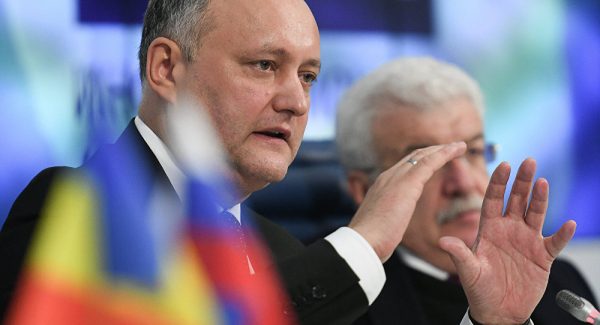
Sputnik – 4 10.09.2017
Moldovan President Igor Dodon is demanding the resignation of Deputy Defense Minister Gheorghe Galbura for defying a presidential order to block the deployment of Moldovan troops to Ukraine to participate in NATO-led military drills. Speaking to Sputnik, regional expert Boris Rozhin warned that the country is on a path to a constitutional crisis.
The Moldovan government approved sending several dozen troops to Ukraine last week, ignoring Dodon’s decree to block the deployment. Dodon described the move as an ‘usurpation of power’ by the cabinet.
Speaking to Radio Sputnik about what’s likely to happen next, Boris Rozhin, an expert at the Center of Military-Political Journalism, said that the Moldovan government will be likely to try to ignore or challenge the president’s demand for Galbura’s resignation.
“This confrontation over sending the military abroad is an indication that the constitutional crisis in Moldova is deepening,” the expert said. “The parliament and the government are refusing to recognize the president’s authority as commander-in-chief to give orders to the country’s armed forces.”
“This issue will be considered at a meeting of the country’s Security Council, and most likely, by the constitutional court, as Dodon’s decision to dismiss the deputy defense minister will either be ignored or contested,” Rozhin added.
The expert believes that this confrontation between the branches of Moldova’s government is likely to continue until the next parliamentary elections, tentatively set for November 2018.
“The confrontation can be resolved through a decision of the constitutional court, which confirms or rejects Dodon’s right to issue orders to the Armed Forces, or deepen further and continue until the next parliamentary elections,” Rozhin said.
“After that, a reformatting of the legislature may take place. At the moment, the ruling establishment does not reflect the alignment of forces in Moldovan society, which has grown tired of the government’s push for European integration, which did not bring the hoped for economic and social improvements for ordinary people.”
As the constitutionally designated commander-in-chief, Dodon vetoed the government’s decision to send 57 National Guard troops to Ukraine for NATO exercises, reminding them that Moldova is a neutral state. Ignoring the president’s order, the contingent left for Ukraine anyway. The president also signed a decree which said that Moldovan military forces would not be allowed to be sent abroad for military exercises, training or any similar events without approval from the president.
The present crisis is not the first public conflict between Dodon and the cabinet o ministers. Earlier, the government asked the UN General Assembly to consider the removal of Russian peacekeeping troops from the breakaway republic of Transnistria. Dodon called the initiative an “empty PR move.” The president and the cabinet have faced off over Russia repeatedly, the government proposing a series of unfriendly gestures, with the president, in turn, saying that he would like to bring the country closer to Moscow.
Dodon, often described by Western political observers as ‘pro-Russian’, won presidential elections in 2016, defeating his pro-West, pro-EU opponent Maia Sandu. Moldova’s parliament and government are dominated by the pro-EU Democratic Party of Moldova, a social democratic party closely associated with oligarch Vladimir Plahotniuc, and a collection of independent MPs.
Commenting on the political situation in the country, political observer Viktor Marakhovsky wrote that it would be more correct to call Dodon ‘pro-Moldovan’ than ‘pro-Russian’, because the pro-EU elites he is up against have effectively “privatized political power in exchange for international grants, figuratively speaking.” Not only do they seek to give up sovereignty to EU structures; some have spearheaded a campaign pushing for Romania’s absorption of Moldova, a campaign actively supported by Bucharest.
Marakhovsky thinks that Dodon’s best hope will be to organize a referendum to ask Moldovans to approve the expansion of the president’s powers, fresh elections and returning the subject of the history of Moldova to the country’s schools, replacing ‘the history of Romania’ subject presently being taught.
Jake Wallis Simons v Craig Murray
By Craig Murray | September 9, 2017
I have been given legal advice that I am permitted to publish the formal claim and defence documents. These are much less informative than the witness statements, which I am not allowed to publish, but at least it gives you some idea what is going on.
Over 3,000 people have now contributed to my defence fund. I can not tell you how touched I am by this overwhelming support. I should add that the letters and communications from those sending good wishes but financially unable to assist are equally valuable in maintaining my morale.
This is the original Claim (view here).
This interview with Mark Lewis, the lawyer suing me, is headlined “UK’s Foremost Libel Lawyer Sets His Sights on Israel’s Enemies.” It characterises opponents of Israel as “Nazis” and opines “I am quite happy to take their homes off them… at least they can be a homeless Nazi.” I sincerely hope he does not consider me a Nazi, though plainly this case is started by my falsely being smeared as an anti-Semite. But no matter how objectionable somebody may find my views on Israel/Palestine, how does it serve justice that “at least my” wife and 8 year old son “can be homeless.” That is however precisely what Mr Lewis seeks to achieve and to be plain, he has threatened me in person with bankruptcy. The money, of course, would go to Mr Lewis and his team still more than to Mr Wallis Simons.
English libel law is recognised throughout the world as a draconian affront to democracy. Its survival is due not only to the fact that it is an invaluable tool for the wealthy to use against poor radicals, but also to the fact that libel is a very wealthy industry, feeding money to rich and influential individuals, including of course not only the libel lawyers but also the judges and court system which are all part of this massive vested interest, which is extremely well represented in the Westminster parliament.
All of which I am afraid leads me to renew my appeal for funds for my defence, which despite the extremely generous response so far, do not yet match the scale of the threat. I should say that I was extremely depressed and humiliated a few days ago in having to ask for money in this way, but the response has been so overwhelming and so kind, and accompanied by so many warm words for my work over the years, that the feelings of deep shame have been completely displaced by gratitude, friendship and affection.
Contributions toward defense at bottom of page here.
Senate Debates Billions for Insurers while Public Demands Medicare for All
By Margaret Flowers and Kevin Zeese | Health Over Profit | September 8, 2017
This week we attended a hearing of the Senate Health, Education, Labor and Pensions (HELP) committee where there was broad bi-partisan support for giving billions more to the insurance industry to “stabilize the market.” The government already gives for-profit insurance $300 billion annually and their stock values have risen dramatically since passage of the Affordable Care Act (ACA), so the rush to give them more was disheartening.
That was contrasted with a meeting with the staff of Senator Bernie Sanders about the improved Medicare for all bill he plans to introduce on September 13. Sanders, along with other Senators, is seriously trying to figure out how to transform health care from being a profit center for big business to being a public good that serves the people. That means doing away with the health insurance industry, not giving them billions of public dollars.
The contrast reinforced the need to advocate for improved Medicare for all and push for the best healthcare system we can create.
Healthcare a Commodity or a Human Right?
Senators are back from their long summer recess, and they started off with health care back at the top of the agenda. The Senate HELP committee held its first of four hearings on September 6, and Senator Bernie Sanders is preparing to introduce a Medicare for All bill on September 13. The two efforts are a clear example of the underlying dilemma that we have faced in the United States for the past 100 years: Is health care a commodity or a public good? It can’t be both.
The failed efforts to repeal and replace the ACA took up a lot of time and energy this year and left the country in no better position to deal with the ongoing healthcare crisis. Now, time is really short because private health insurers are announcing their rates for 2018, and they are, not surprisingly, screaming for more money because they have to (*gasp*) pay for health care.
A group of us attended the first Senate HELP committee hearing to convey the message that the people are ready to undertake the serious work of creating a National Improved Medicare for All. Typically, before and sometimes during a hearing, attendees are allowed to hold signs as long as they are not disruptive. On that day, the committee chair, Senator Lamar Alexander, ordered that signs be put away before the hearing even began. He told Dr. Carol Paris, a steering committee member of the Health Over Profit for Everyone campaign, that “we are not talking about improved Medicare for All now.”
Instead, the entire hearing focused on “stabilizing the insurance market,” even though their stock values have quadrupled since 2010. Five health insurance commissioners from different states testified before the senators and answered questions. It appeared that all had been well-prepped by the health insurance industry. The committee members patted each other on the back for being bi-partisan, unfortunately they were working together for the insurance industry, not for the people.
The bi-partisan hearing discussed three main points: making sure that public dollars were available to subsidize insurance costs, reinsuring private health insurers so they would be protected if they had to spend ‘too much’ money on health care and incentives to entice private insurers back into areas that are not profitable. Coincidentally, these were the same points raised in the bi-partisan proposal published this year by the Center for American Progress, a Democratic Party think tank financed in part by health insurance lobbyists. Both parties are clearly on the side of health care as a commodity.
Not one person participating in the hearing questioned whether health care belonged in the market. At least one Senator, Rand Paul, complained about Big Insurance coming to Washington with their hands out and said he would rather pay directly for health care than give the money to Big Insurance. His ideology is far from supporting Improved Medicare for All, but he did call out the corruption.
Perhaps the most disappointing of the day was Senator Al Franken, who has completely bought into the ‘health care is a commodity’ camp. Not only did he advocate for subsidizing and reinsuring private insurers, but he called for a federal reinsurance program to cover the costs of people who need health care, at least after Big Insurance takes their cut. And Franken, who tried to make jokes about the hearing, called for more money to advertise and lure youth into the insurance market, which is about as unethical as pushing cigarettes or candy, and wants heavier enforcement of mandates to purchase health insurance. Franken touted a ‘virtuous cycle’ of giving more money to health insurers so that they lower premiums and more people buy insurance. The problem is that there is nothing very virtuous about spending billions to subsidize an industry that has a greater responsibility to pay its Wall Street investors than to pay for necessary health care. The insurance industry has shown itself to be insatiable, and ready to use their power to extort Congress because they hold people’s lives in their hands.
It was a difficult hearing to attend. The whole time we wanted to stand up and ask whether they could possibly see how ridiculous this all appeared and whether they thought private health insurers added any benefit. But, the Capitol Police made it clear from the start that they would arrest anyone who disrupted without warning, and we had a meeting scheduled with Senator Sanders’ staff after the hearing. We did manage to squeeze out a few “Medicare for All’s” during the hearing.
Healthcare Without the For-Profit Insurance Industry
The meeting with Senator Sanders’ staff was like night and day. We began from the premise that health care is a human right and had a frank discussion of how that could be achieved. The text of his upcoming bill was not available, but for 90 minutes we discussed many of the details of the bill. This meeting was scheduled because of a letter that the Health Over Profit for Everyone steering committee sent to the Senator’s health staffers raising concerns about what was reported to be in the bill. An initial response was lacking, but once the letter was widely circulated in progressive blogs, the staff were ready to meet.
There has been a movement for National Improved Medicare for All in the United States for a long time. People in the movement have debated and reached consensus about how an improved Medicare for all system ought to be structured. Much of that is embodied in John Conyers’ legislation, HR 676: The Expanded and Improved Medicare for All Act, which has 118 co-sponsors. Senator Sanders and his group, Our Revolution, are raising funds and working to build more support for Improved Medicare for All, but they still need to cooperate with those who have been advocating for this if they want full support.
Fortunately, Senator Sanders has demonstrated that he is responsive to public pressure. He started the year off not intending to introduce Medicare for all legislation, but he received push back and changed his mind. Then he started talking about fixing the ACA and introducing a public option, and there was pushback against that. There has also been pressure about the contents of the bill. When it was learned that there would be co-pays, many organizations, including Physicians for a National Health Program, contacted his office to say that co-pays add more complexity to the system and cause people to delay or avoid necessary health care. His staff reported that co-pays have been removed in the bill except for purchasing drugs, in order to encourage the use of generic drugs.
In the process of winning a single payer healthcare system, the movement for National Improved Medicare for All has the role of being the watchdog to make sure that we create the best system we can. We want this system to work for everyone and to be a system that improves health, a system that the United States can be proud of. This is a role that will be ongoing even after we win because we will have to improve the system and constantly guard against those who would try to privatize it so they can profit.
After meeting with Senator Sanders’ staff, we felt more reassured that his intention is to ultimately create a strong National Improved Medicare for All system. There are many provisions in the bill that are to be applauded – providing care to every person in the United States and offering fairly comprehensive coverage – and a few that we will have to work on – such as including long term care, abolishing investor-owned health facilities and a more rapid transition period. On September 13, if all goes well, the text of the bill will be released and we will assess it.
The People Can Win Improved Medicare for All
All in all, we are in a strong position. The Senate HELP committee hearing showed how out of touch many of our legislators are with the people, who favor Improved Medicare for All or are just yearning for affordable health care no matter what form that takes.
And, we know members of Congress can be moved, some more easily than others. This week the architect of the ACA in Congress, former Senator Max Baucus, who had us arrested with six others in 2009 when we stood up and called for single payer to be included in the debate, joined the choir. Baucus said single payer is the answer, commenting “we’re getting there, it’s going to happen.” We were arrested demanding that he put single payer on the table and he refused, calling for more police instead. Now, more than 100,000 preventable deaths later, he supports it. The ACA was born out of the corruption by healthcare profiteers and everyone involved from Obama to Baucus knew it, and everyone from Alexander to Franken knows that remains true today.
The tide is shifting in the United States. After a century of what Professor David Barton Smith, a health historian calls, “more palatable approaches” that have each “self-destructed,” we are clear that health care is a public service, not a financial profit center. We are ready to do the work to make what was once considered impossible, National Improved Medicare for All, become inevitable. Each week, new support for single payer arises. The other surprise this week was the support of centrist Democrat, Senator Jon Tester of Montana, who explained that his farmer parents never had insurance until they were old enough for Medicare.
Hopefully, more legislators will arrive at the wisdom that, as Professor Smith describes: “The practical mechanics of how to make such a universal health insurance system work are a lot easier than patching together the existing hopelessly fragmented private-public health insurance system. The Medicare program actually does this quite well and the cry of Medicare for all has never been silenced. Indeed, no one has ever objected to their ‘mandated’ coverage under Medicare.”
The people have the power to finally make the government do the right thing. No more compromises. No more false solutions. Onward to National Improved Medicare for All.
Moscow ‘astonished’ by Germany’s ‘baseless’ remarks on Zapad 2017 – Russian MoD
RT | September 9, 2017
The Russian Ministry of Defense rebuked the German defense minister for saying the upcoming Zapad 2017 exercises are little more than a show of force by Moscow involving vast numbers of troops, calling her comments bewildering.
On Thursday, German Defense Minister Ursula von der Leyen claimed that the upcoming drills would involve over 100,000 troops on the eastern periphery of NATO, showing a “demonstration of capabilities and power of the Russians.”
“Anyone who doubts that only has to look at the high numbers of participating forces in the Zapad exercise: more than one hundred thousand,” von der Leyen said at an EU defense conference in Tallinn.
Her remarks were seized upon by Russian Defense Ministry spokesman Major-General Igor Konashenkov, who said it was strange that the Germans would come up with such a figure, particularly considering that they had been told of the plans for the drills in advance.
“We are astonished by statement made by Ms von der Leyen, the Germany’s Federal Minister of Defence, publicly handling baseless figures that allegedly 100 thousand Russian troops engaged in the Zapad 2017 and threaten Europe,” Konashenkov told reporters on Saturday.
“The German side has timely received and does have comprehensive information of the concept, defensive nature and true figure of the Russian troops engaged in the Zapad 2017 exercise,” the major-general said in the statement.
The Zapad 2017 drills, which will be held along with Belarus, are due to take place September 14-20 and will involve up to 12,700 troops, 70 aircraft, and nearly 700 land vehicles. Although the exercises take place every few years (the most recent drills were held in 2009 and 2013), this year’s maneuvers have come under huge scrutiny by NATO. In July, Lieutenant-General Ben Hodges, commander of US Army forces in Europe, referred to the routine exercises as a “Trojan horse,” noting there were suspicions they could be used to move forces and equipment closer to NATO’s eastern flank.
Moscow and Minsk have repeatedly refuted these speculations, saying that the drills are purely defensive in nature and pose no threat to any other country.
Moscow has said that the number of forces deployed under Zapad 2017 would not exceed the limits for mandatory monitoring under the 2011 Vienna document, the OSCE agreement meant to foster confidence through a number of measures to make military forces deployed in Europe more transparent. In addition, Belarus has invited international monitors from foreign countries to observe the active phase of the drills.
“The hype [over the exercise] was fanned up artificially and is definitely meant to convince the Western public that the cost of deploying additional forward military presence in Poland and the Baltics and increased NATO military activity is justified,” a statement from the Russian Foreign Ministry said in August. “Remarkably, it is these actions that lead to increased military tension in Europe, which Western ‘pen and microphone warriors’ lament so much.”
At the same time, NATO has been increasingly building up its own forces and capabilities in eastern Europe. At the 2016 summit in Warsaw, NATO member states agreed to boost their military presence in the region to levels not seen since the Cold War, deploying four rotating multinational battalions to Estonia, Latvia, Lithuania, and Poland. In January of this year alone, 4,000 additional US troops were deployed to eastern Europe.
Russia has criticized this build-up as a threat to national, as well as regional, security. In February, speaking at the Munich Security Conference, Foreign Minister Sergey Lavrov noted that “NATO’s expansion has led to an unprecedented level of tension over the last 30 years in Europe.”
Odebrecht Denies $100 Million Bribe to Top Venezuelan Politician
By RACHAEL BOOTHROYD ROJAS | Venezuelanalysis | September 8 2017
The scandal-besieged company Odebrecht has refuted claims made by former Venezuelan Attorney General Luisa Ortega that it paid $USD100 million to Venezuelan politician Diosdado Cabello in exchange for lucrative state contracts.
The accusations against Cabello, who is the President of the United Socialist Party of Venezuela and is considered one of the most prominent members of the Chavista government, were made by Ortega in August. The former attorney general fled Venezuela last month after the Supreme Court removed her from her post pending an investigation into alleged “grave misconduct”.
In a widely reported press conference, Ortega said she had “many pieces of evidence” that proved the firm had made the million dollar payment to Cabello. But a statement released by the company Wednesday appeared to cast doubt on Ortega’s claims.
“After conducting a comprehensive search of its legacy systems and of the statements given by its former team members who collaborated in (investigations), Odebrecht denies the accusations that it made a $100 million payment to … Cabello,” reads the communiqué.
The leading Brazilian construction firm shot to the centre of a region-wide corruption scandal in 2015, when it emerged that company representatives had offered million dollar kickbacks to government officials across 12 countries to win public contracts. The firm agreed to cooperate with US authorities last year as part of a deal with US and Brazilian prosecutors.
As well as implicating Cabello in the scandal, Ortega told press that Venezuelan President Nicolas Maduro was also involved in the extensive corruption racket – though she has provided no proof to date. The former attorney general publicly broke with the Maduro administration earlier in March, leading to a heated stand-off played out in national and international media.
For its part the Venezuelan government announced in August that it would launch a probe into the Public Prosecution’s handling of financial crimes during Ortega’s ten year term in response to her accusations. Her replacement, Tarek William Saab, accuses her of having “buried” cases of corruption throughout her tenure.
Featured Video
No Threat Can Force Iran’s Surrender /Trita Parsi & Lt Cl Daniel Davis
or go to
Aletho News Archives – Video-Images
From the Archives
An Expert Military Analysis of War with China
Actually, None is Necessary
By Fred Reed • Unz Review • December 13, 2020
The Correlation of Armed Forces: U.S. goods and services trade with China totaled an estimated $634.8 billion in 2019. Exports were $163.0 billion; imports were $471.8 billion. The U.S. goods and services trade deficit with China was $308.8 billion in 2019. Trade in services with China (exports and imports) totaled an estimated $76.7 billion in 2019. Services exports were $56.5 billion; services imports were $20.1 billion. The U.S. services trade surplus with China was $36.4 billion in 2019.
There is talk within the Washingtoniat of a possible war with China. Steve Bannon, who apparently was dropped on his head as a child, actually favors such a war. We hear the usual shoo-the-boobs alarm about how the Chinese are doing something terrible and we must gird our loins and American values and show them what for, bow wow, woof. The danger is that the current game of who-blinks-first in Asian waters might actually provoke a shooting war. You know the kind of thing: One warship refuses to get out of the way of another, a collision ensues, some retard lieutenant who signed up on waivers opens fire, and we’re off and running. It is not a good idea to let children play with matches.
The said war is discussed either in emotional terms by idiots or in purely naval terms by those familiar with such things, so we hear of the First Island Chain and the Second Island Chain and whose missiles against the other’s missiles and so on. This would be appropriate if we were fighting World War Two again. Which we aren’t. Let’s take a quick-and-dirty look at how such a war might go.
To begin the war, America would overestimate itself and underestimate China. This is doctrine in the Pentagon. … continue
Blog Roll
 Aletho News
- Iran To Target Military Industrial-Tech Complex That Facilitated Gaza Genocide
- Collapsing Empire: The Resistance Disarms ‘Israel’
- Suicide Should Not Be a Government Service
- Rethinking America’s greatest threat: Iran vs. Israel-Firsters
- Iran accuses adversaries of false flags to strain Turkey ties
- Poland rules out sending Patriot missiles to US/Israel amid war on Iran
- Tehran approves new Hormuz plan with major restrictions
- No Threat Can Force Iran’s Surrender /Trita Parsi & Lt Cl Daniel Davis
- UK’s New Pandemic Plan Would Turn Big Tech Into a Mass Location Tracking Network
- Growing insecurity, soaring prices fuel protests in north as regime bans evacuation: Sources
- If Americans Knew
- Joe Kent Urges Americans To Call White House and Congress To Object To Sending Troops Into Iran
- DNC Resolution to Reject AIPAC Funding Puts Democratic Leaders in the Hot Seat
- Swedish foundation to build 400 schools as over 650,000 Gaza children remain without education for 2 years
- Israeli army admits photshopping image of slain Lebanese journalist
- This is how Israel is systematically killing health workers under the cover of war in Lebanon
- Carrying life under fire: Israeli invasion of Lebanon leaves pregnant women facing deadly risks
- Champagne all around for the new death penalty (for Palestinians) law – Not a ceasefire Day 172
- Why are Palestinian books struggling to be seen on Amazon?
- The Line Between Affinity and Conspiracy
- As Iran targets US military bases, will they be relocated to Israel? Not a ceasefire Day 171
- No Tricks Zone
- New Study Finds Warming Saves Lives…Cold Temperatures 12 Times More Deadly Than Excess Heat
- German Science Blog Accuses PIK Climate Institute Of Hallucinating Climate Tipping Points
- Devastating Assessment Of Comirnaty Vaccine By Former Senior Pfizer Europe Toxicologist
- New Study: CO2 Is ‘Effectively Negligible’ As An Explanatory Climate Change Factor Since 2000
- Former Pfizer Toxicologist Dr. Helmut Sterz Tells Bundestag Hearing Pfizer Vaccine Should Have Never Been Approved
- Energy Expert: Germany’s Nuclear Phaseout Was A “500 Billion Euro Mistake”
- New Research: South Australia’s Mid-Holocene Sea Surface Temperatures Were 4°C Warmer Than Today
- Storing Green Energy To Last Germany 10 Days Would Require A 60-Million Tonne Battery
- New Studies: UK Sea Levels Were 4 Meters Higher Than Today During The Mid-Holocene
- Destructive Green New Deal: German Energy And Metal Group Warns Of Drastic Crisis
 Aletho News