NYT Laments ‘Forever Wars’ Its Editorials Helped Create
By Adam Johnson | FAIR | October 23, 2017

In considering why “the public is quiet” about the United States’ unending wars, the New York Times (10/23/17) fails to examine the failure of leading media outlets to actually oppose these wars.
Corporate media have a long history of lamenting wars they themselves helped sell the American public, but it’s rare so many wars and so much hypocrisy are distilled into one editorial. On Monday, the New York Times (10/22/17) lamented the expansion of America’s “forever wars” overseas, without once noting that every war mentioned is one the editorial board has itself endorsed, while failing to oppose any of the “engagements” touched on in the editorial.
The Times began by noting the sheer scope of US military reach:
The United States has been at war continuously since the attacks of 9/11 and now has just over 240,000 active-duty and reserve troops in at least 172 countries and territories…. American forces are actively engaged not only in the conflicts in Afghanistan, Iraq, Syria and Yemen that have dominated the news, but also in Niger and Somalia, both recently the scene of deadly attacks, as well as Jordan, Thailand and elsewhere. An additional 37,813 troops serve on presumably secret assignment in places listed simply as “unknown.” The Pentagon provided no further explanation.

The New York Times (10/8/01) endorsed the invasion of Afghanistan…
The editorial stops short of actually opposing anything specific, instead insisting, “It’s time to take stock of how broadly American forces are already committed to far-flung regions and to begin thinking hard about how much of that investment is necessary.” They are vaguely concerned; here we have this massive global empire, fighting an ever-changing nebulous enemy of “terrorism,” with no end in sight. What can be done? It’s unclear—but let’s “take stock.”
Left unmentioned in the editorial: from Afghanistan (both the 2001 invasion and Obama’s 2009 surge) to Iraq (the 2003 invasion and Obama re-entering the country in August 2014 to fight ISIS) to Syria (both CIA-backed regime change and bombing ISIS) to Korea to our drone wars in Pakistan, Yemen and Somalia, the New York Times has endorsed and often cheered every of these “forever wars.” And the “engagements” the Times didn’t expressly support (Thailand, Jordan, etc.), because they’re so routine as to not merit mention, there’s no record of them opposing. Indeed, as FAIR (3/27/17) has noted previously, the New York Times editorial board has not opposed a single US war since its equivocal and lukewarm opposition to Reagan’s invasion of Grenada 34 years ago (10/30/83).
When confronted with this fact on Twitter, New York Times foreign and defense policy editorial writer Carol Giacomo responded, “In last decade, NYT editorial board has raised many questions about US military engagements.” Raised many questions? Well, then, never mind; let’s leave the Times’ role in the creation of said global empire unexamined.

…and the invasion of Iraq (New York Times, 2/20/03).
The Times spends a great deal of time trying to market itself as not being the rubber stamp pro-war outlet it manifestly is. To do this, it employs two main genres of nominal anti-war posturing. The first—previously commented on by FAIR (3/27/17)—is to call for congressional approval of a war, without actually opposing it or arguing against its underlying moral or political validity. It’s a process complaint that permits the New York Times to look Very Concerned without the messy work of actually opposing anyone in power. The argument is never “this war is wrong or unjust”; it’s “this war may be great, but we have a legal problem of not getting congressional buy-in—the absence of which is not problematic enough to make us actually oppose the war.”
The second is the morally half-assed “no boots on the ground” argument, like the one the Times employed in support of bombing ISIS in Iraq in 2014 (8/8/14) and the Syrian government in 2013 (8/27/13). They insisted, for example, that Obama “best follow through” on his threat to bomb the Syrian government, while still opposing “deep American involvement,” whatever that meant. This genre supports bombing people—typically brown and poor—from afar, but draws the line at using US troops to augment the long-distance killing.
The “no boots on the ground” pseudo-opposition is an admission that the only lives that matter are American, and that the PR pitfalls of body bags returning home on national TV are the only moral limit to the US invading and occupying other countries. Cruise missiles, drones, special forces raids, and covert funding and arming of dodgy rebel groups are A-OK, so long as there are no “boots on the ground”—a cliche, as FAIR has noted (5/19/15), that itself has an increasingly boutique definition.
Both of these genres permit the New York Times to look like Conflicted Liberals, distressed about war without ever opposing it in any meaningful sense. Both modes typically involve appeals to gather more willing nations, other vague appeals to “international support” or running through legal motions, but, ultimately, after all the tortured language and qualifications, the Times always—always—ends up back at supporting the bombing. The Times acts not as an outside voice holding power to account, but as US empire’s internal compliance officer—there to warn of excesses and problems around the margins, but always with the best interest of their NatSec client at heart.

…along with bombing ISIS (NYT, 10/2/14), and every other major new front in the “War on Terror.”
No such heavy-hearted qualifications, needless to say, exist for US enemies. Russia is “engaging in aggressive and dangerous behavior in the air and on the high seas,” the Times (5/19/16) insisted in an editorial condemning the “duplicity of President Vladimir Putin.” Iran’s “destabilizing role in the Mideast” is simply taken for granted (4/24/17); its actions routinely “deserve condemnation” (4/7/17).
Meanwhile, the US is presented as a good-faith arbiter of human rights and peacekeeping, with no broader military or cynical aims. “At least in recent decades,” the Times editorial board (2/7/17) childishly put it earlier this year, “American presidents who took military action have been driven by the desire to promote freedom and democracy.” Funny how that worked out.
Who wrote the Balfour Declaration and why: The World War I Connection
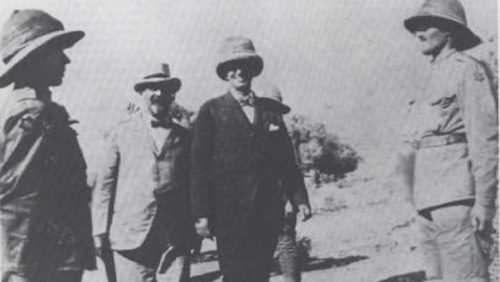
(L-R) Chaim Weizmann, future president of Israel, with Louis Brandeis, US Supreme Court Justice, in Palestine, 1919. The two were instrumental in obtaining the Balfour Declaration, a British document that many feel was a critical step in the establishment of Israel. Zionists’ promise that they would get the U.S. to join Britain in “the Great War” was the enticement.
By Alison Weir, excerpted from Against Our Better Judgment: The Hidden History of How the U.S. Was Used to Create Israel
Most analysts consider WWI a pointless conflict that resulted from diplomatic entanglements rather than some travesty of justice or aggression. Yet, it was catastrophic to a generation of Europeans, killing 14 million people.[i]
The United States joined this unnecessary war a few years into the hostilities, costing many American lives, even though the U.S. was not party to the alliances that had drawn other nations into the fray. This even though Americans had been strongly opposed to entering the war and Woodrow Wilson had won the presidency with the slogan, “He kept us out of war.”[ii]
President Wilson changed course in 1917 and plunged the U.S. into that tragic European conflict. Approximately 320,000 Americans were killed or injured.[iii] Over 1,200 American citizens who opposed the war were rounded up and imprisoned, some for years.[iv]
A number or reasons were publicly given for Wilson‘s change of heart, including Germany‘s submarine warfare, Germany’s sinking of the British passenger ship Lusitania,[v] and a diplomatic debacle known as the Zimmerman Telegram episode.[vi] Historians also add pro-British propaganda and economic reasons to the list of causes, and most suggest that a number of factors were at play.
While Americans today are aware of many of these facts, few know that Zionism appears to have been one of those factors. [Zionism was a political movement to create a Jewish state in Palestine. When this movement began, in the late 1800s, the population of Palestine was 96 percent Muslim and Christian. The large majority of Jews around the world were not Zionists.]
Diverse documentary evidence shows that Zionists pushed for the U.S. to enter the war on Britain’s side as part of a deal to gain British support for their colonization of Palestine.
From the very beginning of their movement, Zionists realized that if they were to succeed in their goal of creating a Jewish state on land that was already inhabited by non-Jews, they needed backing from one of the “great powers.”[vii] They tried the Ottoman Empire, which controlled Palestine at the time, but were turned down (although they were told that Jews could settle throughout other parts of the Ottoman empire and become Turkish citizens).[viii]
They then turned to Britain, which was also initially less than enthusiastic. Famous English Middle East experts such as Gertrude Bell pointed out that Palestine was Arab and that Jerusalem was sacred to all three major monotheistic faiths.[ix]
Future British Foreign Minister Lord George Curzon similarly stated that Palestine was already inhabited by half a million Arabs who would “not be content either to be expropriated for Jewish immigrants or to act merely as hewers of wood and drawers of water for the latter.”[x]
However, once the British were embroiled in World War I, and particularly during 1916, a disastrous year for the Allies in which there were 60,000 British casualties in one day alone,[xi] Zionists were able to play a winning card. While they previously had appealed to religious or idealistic arguments, now Zionist leaders could add a particularly powerful motivator: telling the British government that Zionists in the U.S. would push America to enter the war on the side of the British, if the British promised to support a Jewish home in Palestine afterward.[xii]

British soldiers, Battle of the Somme. British suffered 60,000 casualties in the first day of the battle.
In 1917 British Foreign Minister Lord Balfour issued a letter to Zionist leader Lord Rothschild. Known as the Balfour Declaration, this letter promised that Britain would “view with favour the establishment in Palestine of a national home for the Jewish people” and “use their best endeavours to facilitate the achievement of this object.”
The letter then qualified this somewhat by stating that it should be “clearly understood that nothing shall be done which may prejudice the civil and religious rights of existing non-Jewish communities in Palestine.” The “non-Jewish communities” were 92 percent of Palestine’s population at that time,[xiii] vigorous Zionist immigration efforts having slightly expanded the percentage of Jews living in Palestine by then.
The letter, while officially signed by British Foreign Minister Lord Balfour, had been in process for two years and had gone through a number of edits by British and American Zionists and British officials.[xiv] As Zionist leader Nahum Sokolow later wrote, “[e]very idea born in London was tested by the Zionist Organization in America, and every suggestion in America received the most careful attention in London.”[xv]
Sokolow wrote that British Zionists were helped, “above all, by American Zionists. Between London, New York, and Washington there was constant communication, either by telegraph, or by personal visit, and as a result there was perfect unity among the Zionists of both hemispheres.” Sokolow particularly praised “the beneficent personal influence of the Honourable Louis D. Brandeis, Judge of the Supreme Court.”[xvi]
The final version of the Declaration was actually written by Leopold Amery, a British official who, it came out later, was a secret and fervent Zionist. … continue
Guardian Sells False Image of an Open Jerusalem

By Jonathan Cook | Dissident Voice | October 23, 2017
A Guardian essay on a new Israeli open-rooftops project in Jerusalem, part of a Season of Culture, sadly falls into a standard trap for feelgood articles of this kind. It fails to provide the main context for Jerusalem: that the native Palestinians live under a belligerent Israeli occupation that is ultimately trying to evict them from the city.
Ignoring that context when reporting on life for Jews and Palestinians in Jerusalem is gravely irresponsible journalism.
Does this misrepresentation simply reflect author Hannah Ellis-Petersen’s ignorance? Or is it a consequence of who is footing the bill: the Rockefeller Foundation sponsored the article.
Note these infuriatingly misleading introductory paragraphs:
For its Season of Culture, the ancient capital has thrown open its rooftops to encourage residents to see beyond their blinkered boundaries. But the reality is a city where the divides are growing deeper.
The standfirst sets the mendacious “balanced” tone, as though Palestinians could ever afford the luxury of choosing to be “blinkered” in a city where the Israeli-run, occupation municipality is openly hostile to them, and where their homes can be demolished for the smallest infraction of opaque, Israeli-imposed planning rules.
The city’s divides are not “growing deeper”. They were always deep in a city where the occupying power has sought for five decades to colonise Palestinian East Jerusalem with Jewish settlers. There are now more than 200,000 of these settlers gradually displacing the native Palestinian population.
Living side by side in Jerusalem are communities who exist with no interaction with one another – kept apart by fear, nationalism and religion.
No, that is not what keeps them apart. Just imagine an article on apartheid South Africa stating that whites and blacks had no interaction because they were “kept apart by fear, nationalism and religion”. In reality, the two populations were kept apart by the colour of their skin. For blacks under apartheid, and today for Palestinians under occupation, their inferior status is dictated to them. They have no say in the matter.
Palestinians and Israelis are kept apart by the structural violence of occupation, which confers on them entirely different rights and life choices. Jews in Jerusalem have Israeli citizenship; Palestinians have a residency that Israel can easily revoke. Potentially, Jews can live almost anywhere in the city; Palestinians are confined to ghettoes, where they are being suffocated of space and services to encourage them to leave.
Israel has even built a wall cutting some Palestinian neighbourhoods off from the rest of East Jerusalem and the services they pay for through their municipal taxes. They do not live apart because of fear, nationalism or religion. They have been cut off from family, friends and services by concrete walls and armed checkpoints.
While Israelis typically live in the west and Palestinians in the east of Jerusalem, mixed neighbourhoods do exist. In the winding alleys of the old city and the streets of downtown, the diverse inhabitants peacefully cross paths every day.
“Mixed neighbourhoods”? Is the author referring to Jewish settlers who have forcibly taken over Palestinian properties in areas of occupied East Jerusalem like the Old City, Silwan and Sheikh Jarrah in violation of international law and have then turned their apartment blocs into armed compounds? Is that her idea of “paths crossing peacefully” – that Palestinians must live submissively, in terror of armed Jewish interlopers?
What’s more, the only rooftops of Palestinians that were made accessible are in the old city; there are none in east Jerusalem. … The project traces a line across a divided city via its rooftops. And the stories of the volunteers who have opened their homes to strangers, regardless of ethnicity or creed, speak to a multi-layered Jerusalem, one rarely seen in a conflict-obsessed news cycle: a colourful, fractious and potent city.
Is it really a failure of the news cycle that it wishes to highlight “conflict” rather than accentuate the supposed rough-and-tumble co-existence proposed by this article, and achieved after Israel illegally annexed East Jerusalem?
Israel professes to have created an “eternal, united capital” of Jerusalem, but nothing could be further from the truth. We don’t need from the media less of an obsession with “conflict”. We need greater honesty from them about Israel’s oppression of Palestinians and the harsh reality of a Jewish settler colonial society slowly disappearing the natives.
Only the gullible or dishonest could believe that opening rooftops in the privileged, Jewish side of the city challenges or mitigates the ugliness of what is going on on the other side of Jerusalem, for Palestinians.
Facebook asked for help to blame Russia for UK election, Brexit outcomes
RT | October 24, 2017
British politicians, looking to explain why voting hasn’t gone exactly as expected, appear to be going the full Hillary. A key committee has asked Facebook CEO Mark Zuckerberg to cough up information on paid-for activity by Russian-linked accounts.
The head of Parliament’s Digital, Media and Sport Committee, Damian Collins, wants the information as he leads an investigation into so-called “fake news” surrounding the 2016 EU Brexit referendum and the 2017 UK election.
“Part of this inquiry will focus on the role of foreign actors abusing platforms such as yours to interfere in the political discourse of other nations,” Collins wrote in a letter to Zuckerberg circulated to media by the committee.
“I believe that the information I have requested is in line with that already supplied to Facebook to several United States Senate Committees, including the Senate Intelligence Committee, in relation to the 2016 US presidential election,” wrote Collins.
Multiple investigations into Russia’s role in the United States presidential race have been announced after the likes of losing candidate Hillary Clinton insisted they were targeted by Russian hackers.
There has been a surge in paranoia over Russian interference on politics.
MPs such as Boris Johnson, previously quick to heap praise on President Vladimir Putin, have attacked ministers and MPs for appearing on RT.
However, just a few months ago Johnson himself said: “We have no evidence the Russians are actually involved in trying to undermine our democratic processes at the moment. We don’t actually have that evidence.”
The quote ended with the slightly puzzling, “But what we do have is plenty of evidence that the Russians are capable of doing that.”
Backbencher Ben Bradshaw has called on the government to get to the bottom of reports of opaque funding sources for some elements of the pro-Brexit campaign, citing “widespread concern over foreign and particularly Russian interference.”
That’s “concern,” but no mention of “evidence.”
Collins is looking into whether or not Russian-linked accounts pushed out advertisements, and if so, how many times they were viewed and who saw them.
News outlets across the UK jumped on accusations of Russian and Chinese hacking after a post-Brexit report by the Public Administration and Constitutional Affairs committee.
Sitting MPs suggested there was a DDoS (distributed denial of service) attack which stopped voters registering for several hours.
The committee admitted however it had “no direct evidence” any foreign power tried to influence the referendum. Yet headlines told another story.
Now, this latest UK inquiry aims to shed light on issues such as the impact of fake news on public understanding of the world and response to traditional journalism, the responsibilities of social media platforms and how people can be educated to assess news sources.
The committee launched its inquiry into fake news in January, but it was suspended when a general election was called for June.
Russia has repeatedly denied interfering in the internal affairs of other countries.
The “European Values” think-tank and their list of “Useful Idiots”
By Kit | OffGuardian | October 24, 2017
Just when you think that the Russo-phobic hysteria of the Western world couldn’t possibly make itself any more ridiculous… something like this comes along. This is the europeanvalues.net list of “useful idiots”.
The list is very long, over 2300 names, because it contains the name of every person to ever appear on either Sputnik or RT. Hosts or guests, hostile or friendly, it doesn’t matter. If you’re on the list, you are a useful idiot.
They’ve highlighted some names in yellow, to denote they’re “particularly noteworthy”. Names receiving the yellow highlight – the Russian agent equivalent of twitter’s blue tick – include Harrison Ford, Stephen Fry and Senator John McCain. All noted for their pro-Russian public stance on important political issues.
Also on the list are Boris Johnson’s dad, Barack Obama’s wife and John McCain’s daughter. And while all three of them may well be idiots, I’m struggling to see how they’ve ever been useful to anyone.
It’s honestly beyond a joke at this point. But let’s take a look behind the scenes anyway.
The Think-Tank
The not-at-all Orwellian sounding “European Values” think-tank is a Czech based NGO focusing on fighting…
… aggressive regimes, radicalisation within the society, the spread of authoritarian tendencies and extremist ideologies including Islamism.
Their about page goes into a lot of (vaguely creepy) detail about their logo, in case you were interested, but much less detail about their funding. If you want to know that, you have to read their annual reports.
In 2015, for example, you can see that they received funding from disappointingly predictable list of sources. The European Union, the US Embassy, the UK Embassy and (of course) the Open Society Foundation.
One day, it would be really nice to read the “Our Funding” section of an NGO’s website, and NOT see George Soros’ name.
The Author
The author of the list and accompanying report is one Dr. Monika Richter, a first generation British citizen and child of Czech immigrants. She’s a new face at the programme, having recently graduated from Oxford, where she studied at the Reuters Institute for the Study of Journalism. The Reuters Institute receives funding from various sources, including Google, the BBC and…*sigh*… George Soros.
Interestingly enough, when Richter was at Oxford she spoke at the Free Speech Debate, arguing against the “no-platforming” of certain speakers because it could be used to censor unpalatable views.
Quite when she changed her mind on this issue, I do not know.
The Report
The fifty-three page long report that accompanies the list is both terrifying and hilarious, with some beautiful paranoid language that reads like the journal of Jack D. Ripper. I have read it, so you don’t have to (you’re welcome)… but if you really feel the need then here it is. It is a masterpiece of doublethink.
In one paragraph she smoothly segues between three points: 1. That Russia illegally “invaded” Georgia; 2. That RT’s “biased coverage” blamed the war on Georgia; 3. That the EU’s own report stated Georgian aggression was a prime factor in causing the conflict. Apparently she is totally unaware that her third point completely undermines points 1 and 2.
Later, she claims that RT employs “conspiracism” to spread insidious messages that undermine public faith in Western government.
For example, RT is accused of spreading the “conspiracy” that the US and UK started the Iraq war under false pretenses – when, far from being a “conspiracy theory”, the WMD-related lies are now an historically accepted truth. Only neocon diehards even try to deny that any longer.
The report also claims that RT spread conspiracy theories about “false flags” which, again, are a point of historical fact. And that RT reports, stating that the US and their allies are supporting ISIS in Syria, were untrue. In fact, these reports have since been shown to be absolutely correct.
She also rails against RT’s reporting of the Ferguson riots, in which they apparently:
revealed a consistent refrain: “the oppression of blacks in the US has become so unbearable that the eruption of violence was inevitable”, and that the US therefore lacks “the moral high ground to discuss human rights””
Now, personally, I’m struggling to see how that statement is inaccurate, but maybe I’m just indoctrinated beyond all hope at this point.
The best parts of the report come when the author is forced, by the unbending hand of reality, to make concessions. These include:
RT does not (typically) lie outright in its reporting, it presents facts in a way that distorts the reality of the situation and leads viewers to certain conclusions”.
And:
For the sake of fairness, it must be acknowledged that despite these malign intentions, RT has enjoyed a small handful of journalistic accomplishments. For example, its coverage of the Occupy Wall Street movement, the Guantanamo Bay hunger strikes, and the 2010 WikiLeaks scandal was incisive, with the former two earning RT International Emmy Award nominations
Which, in a beautiful demonstration of intellectual dishonesty, is quickly followed up with:
However, the critical point here is that RT’s treatment of these events is not motivated by a genuine commitment to principled, balanced journalism, but rather by opportunism to demonise the US government for its apparent contradictions and democratic shortcomings.
You see? Even when their news coverage is good, and nominated for international awards, and tells important truths, none of that counts because they’re doing it for the wrong reason.
She apparently wants us to believe that telling the truth for the wrong reason is just as bad lying. Worse even, when you think about it, because your unabashed use of fact-based arguments lends a seeming legitimacy to your incorrect world view.
It is absolutely bonkers.
Some of the other highlights include:
RT disguises the malicious objectives of this editorial strategy by claiming to uphold traditional liberal-democratic ideals like free speech, critical journalism, and independent thought. RT’s shrewd perversion of these principles through rhetorical ploys like the ‘Question More’ ad campaign – which appears to advocate media literacy, critical thinking, and reasonable scepticism about media content – can seem highly convincing to the untrained eye.
By saying the wrong things RT is “perverting” free speech. The principle of free speech only applies to those with state-approved motives who say state-approved things. By disagreeing with that state-approved consensus you are, actually, perverting your freedom and therefore should have it taken away from you.
If the arguments that multiple points of view are important, and that journalistic integrity and free-speech demand the broadcasting of unpopular opinions, sound convicing, it’s only because you’re not well trained in picking up sedition and propaganda.
Not only that but:
RT uses guest appearances by Western politicians, journalists and writers, academics, and other influential public personalities to boost its credibility. Regardless of their intent, these appearances amount to complicity with the Russian propaganda machine, and thereby render its influence that much harder to counter. RT is not a neutral media platform; per point 1, its raison d’être is to disparage and demoralise the West at all costs, and all content it airs is calibrated to serve this purpose. Thus, even guest appearances made in good faith – e.g., motivated by the desire to offset some of RT’s more toxic and hyperbolic narratives – are counterproductive.
This explains the presence of John McCain on the idiot list, I suppose. Ms Richter seems to think that, even if you go on RT to criticise Russian foreign policy, or call RT biased, or defend the US viewpoint, your very presence reinforces the illusion that RT is a TV news channel, when it’s just a Kremlin disinformation centre. By airing contrasting points of view from every side, RT is able to maintain a pretence of impartiality.
You see, RT are not objective, so they have to pretend to be objective by allowing people to disagree with them on air. CNN and the BBC et al ARE objective, so they don’t need to pretend to be, so they DON’T have to allow people to disagree with them on air. By extension, the more differing opinions they broadcast, and the wider variation of opinions they broadcast, the more show themselves to be unobjective.
The logic is flawless.
None of this matters anyway because:
While the security hazard of the Kremlin’s disinformation campaign and influence operations should not be taken lightly, it is imperative to not overinflate the threat of individual influence agents like RT and Sputnik. Such a reaction is counterproductive: it further empowers these agents, allowing them to claim excessive success and consequently obtain more funding from the Kremlin to expand their operations.
So there you go, even if RT appears to be seriously undermining or our society and values, they actually have no real power and shouldn’t be overestimated. The important conclusion of this 53 page report that an NGO spent $100,000s on, is that we shouldn’t over-react.
One wonders how long the report would be if she had over-reacted.
If I was George Soros, I’d want my money back.
Mutual Assured Destruction
By Philip Giraldi • Unz Review • October 24, 2017
Sometimes it is possible to read or view something that completely changes the way one looks at things. I had that experience last week when I read an article at Lobelog entitled “A Plea for Common Sense on Missile Defense,” written by Joe Cirincione, a former staffer on the House Armed Services Committee who now heads the Ploughshares Fund, which is a Washington DC based global foundation that seeks to stop the spread of nuclear, chemical and biological weapons.
The article debunks much of the narrative being put out by the White House and Pentagon regarding missile defense. To be sure, it is perfectly reasonable to mistrust anything that comes out of the federal government justifying war given its track record going back to the War of 1812. And the belligerent posture of the United States towards Iran and North Korea can well be condemned based on its own merits, threatening war where there are either no real interests at stake or where a diplomatic solution has for various reasons been eschewed.
But the real reason why the White House gets away with saber rattling is historical, that the continental United States has not experienced the consequences of war since Pancho Villa invaded in 1916. This is a reality that administration after administration has exploited to do what they want when dealing with foreign nations: whatever happens “over there” will stay “over there.”
Americans consequently do not know war except as something that happens elsewhere and to foreigners, requiring only that the U.S. step in on occasion and bail things out, or screw things up depending on one’s point of view. This is why hawks like John McCain, while receiving a “Liberty” award from Joe Biden, can, with a straight face, get away with denouncing those Americans who have become tired of playing at being the world’s policeman. He describes them as fearful of “the world we have organized and led for three-quarters of a century, [abandoning] the ideals we have advanced around the globe, [refusing] the obligations of international leadership and our duty to remain ‘the last best hope of earth’ for the sake of some half-baked, spurious nationalism.”
McCain’s completely fatuous account of recent world history befits a Navy pilot who was adept at crashing his planes and almost sank his own aircraft carrier. He also made propaganda radio broadcasts for the North Vietnamese after he was captured. The McCain globalist-American Exceptionalism narrative is also, unfortunately, echoed by the media. The steady ingestion of lies and half-truths is why the public puts up with unending demands for increased defense spending, accepting that the world outside is a dangerous place that must be kept in line by force majeure. Yes, we are the good guys.
But underlying the citizenry’s willingness to accept that the military establishment should encircle the globe with foreign bases to keep the world “safe” is the assumption that the 48 States are invulnerable, isolated by broad oceans and friendly nations to the north and south. And protected from far distant threats by technology, interceptor systems developed and maintained at enormous expense to intercept and shoot down incoming ballistic missiles launched by enemies overseas.
In a recent speech, relating to the North Korean threat, President Donald Trump boasted that the United States anti-missile defenses are 97% effective, meaning that they can intercept and destroy incoming projectiles 97 times out of a 100. Trump was seeking to assure the public that whatever happens over in Korea, it cannot have an undesirable outcome over here in the continental United States nor, apparently, in Hawaii, Alaska and overseas possessions like Guam, all of which are shielded under the anti-missile defense umbrella. Trump was undoubtedly referring to, even if he was ignorant of many of the specifics, the Ground Based Midcourse Defense (GMD) installations in Alaska and Hawaii, which are part of the existing $330 billion missile defense system.
It is certainly comforting to learn that the United States cannot be physically attacked with either nuclear or conventional weapons no matter what our government does overseas, but is it true? What if the countermeasures were somewhat closer to 0% effective? Would that change the thinking about going to war in Korea? Or about confronting Russia in Eastern Europe? And for those who think that a nuclear exchange is unthinkable it would be wise to consider the recent comments by Jack Keane of the aptly named Institute for the Study of War, a leading neoconservative former general who reportedly has the ear of the White House and reflects its thinking on the matter. Keane is not hesitant to employ the military option against Pyongyang and he describes a likely trigger for a U.S. attack to take out its nuclear facilities or remove “leadership targets” as the setting up of a ballistic missile in North Korea with a nuclear warhead mounted on top “aimed at America.” Some observers believe that North Korea is close to having the ability to reduce the size of its nukes to make that possible and, if Keane is to be believed, it would be considered an “act of war” which would trigger an immediate attack by Washington. And a counter attack by Pyongyang.
The claim of 97% reliability for the U.S.’s anti-missile defenses is being challenged by Cirincione and others, who argue that the United States can only “shoot down some…missiles some of the time.” They make a number of arguments that are quite convincing, even to a layman who has no understanding of the physics involved. I will try to keep it simple. First of all, an anti-missile interceptor must hit its target head on or nearly so and it must either actually strike the target or explode its own warhead at a close enough distance to be effective. Both objectives are difficult to achieve. An Intercontinental Ballistic Missile (ICBM) travels at 5,000 meters per second. By way of comparison a bullet fired from a rifle travels at about one fifth that speed. Imagine two men with rifles standing a mile apart and firing their weapons in an attempt to have the bullets meet head on. Multiply the speed by five if one is referring to missiles, not bullets. Even using the finest radars and sensors as well as the most advanced guidance technologies, the variables involved make it much more likely that there will be a miss than a hit. Cirincione observes that “…the only way to hit a bullet is if the bullet cooperates.”
Second, the tests carried out by the Pentagon to determine reliability are essentially fraudulent. Contrary to the Donald Trump comment, the 97% accuracy is an extrapolation based on firing four anti-missile missiles at a target to make up for the fact that in the rigged tests a single interceptor has proven to be closer to only 56% accurate, and that under ideal conditions. This statistic is based on the actual tests performed since 1999 in which interceptors were able to shoot down 10 of 18 targets. The conclusion that four would result in 97% derives from the assumption that multiple interceptors increases the accuracy but most engineers would argue that if one missile cannot hit the target for any number of technical shortcomings it is equally likely that all four will miss for the same reason.
The tests themselves are carefully scripted to guarantee success. They take place in daylight, preferably at dusk to ensure maximum visibility, under good weather conditions, and without any attempt made by the approaching missile to confuse the interceptor through the use of electronic countermeasures or through the ejection of chaff or jammers, which would certainly be deployed. The targets in tests have sometimes been heated to make them easier to find and some have had transponders attached to make them almost impossible to miss. As a result, the missile interceptor system has never been tested under realistic battlefield conditions.
Even the federal government watchdog agencies have concluded that the missile interception system seldom performs. The Government Accountability Office concluded that flaws in the technology, which it describes as “failure modes,” mean that America has an “interceptor fleet that may not work as intended, prompting one Californian congressman John Garamendi to observe that “I think the answer is absolutely clear. It will not work. Nevertheless, the momentum of the fear…of the investments…[of] the momentum of the industry, it carries forward.”
The Operational Test and Evaluation Office of the Department of Defense has also been skeptical, reporting that the GMD in Alaska and Hawaii has only “…a limited capability to defend the U.S. Homeland from small numbers of simple intermediate range or intercontinental ballistic missile threats launched from North Korea…the reliability and availability of the operational [interceptors] are low.”
The dangerous overconfidence being demonstrated by the White House over the ability to intercept a North Korean missile attack might indeed be in some part a bluff, designed to convince Pyongyang that it if initiates a shooting war it will be destroyed while the U.S. remains untouched. But somehow, with a president who doesn’t do subtle very well, I would doubt that to be the case. And the North Koreans, able to build a nuclear weapon and an ICBM, would surely understand the flaws in missile defense as well as anyone.
But the real danger is that it is the American people that is being fooled by the Administration. War is thinkable, even nuclear war, if one cannot be touched by it, a truism that has enabled the sixteen-year- long and counting “global war on terror.” If that is the message being sent by the White House, it would encourage further reckless adventurism on the part of the national security state. Far better to take the North Korean threat seriously and admit that a west coast city like Seattle could well become the target of a successful nuclear weapon attack. That would demonstrate that war has real life consequences and the unfamiliar dose of honesty would perhaps result in a public demand to seriously negotiate with Pyongyang instead of hurling threats in speeches at the United Nations and on Capitol Hill.
Russia vetoes UNSC resolution on renewing Syria chemical weapons probe
RT | October 24, 2017
Moscow vetoed a UN Security Council resolution to renew the mandate for a UN mission investigating the use of chemical weapons in Syria. Ahead of the vote, Russia suggested postponing the discussion, but its proposal was rejected.
The current mandate for UN and Organization for the Prohibition of Chemical Weapons (OPCW) representatives to work in Syria expires on November 17.
Read more
An Syrian child receiving treatment in Khan Sheikhun, following a suspected toxic gas attack, April 4, 2017 © Omar haj kadour Syrian Idlib chemical incident ‘likely staged,’ requires real investigation – Moscow
Washington has prepared a document to prolong the mandate, which was supported by 11 votes on Tuesday. Two UNSC members – Russia and Bolivia – voted against the document, while China and Kazakhstan abstained.
Later this week, the UN-OPCW Joint Investigative Mechanism (JIM) is scheduled to deliver a report on the alleged chemical weapon attack on the Syrian town of Khan Sheikhoun on April 4. Russia proposed hearing the mission’s findings before voting on a new document. However, Washington insisted the Security Council votes on the new mandate before a report is presented.
The Russian Foreign Ministry has said that the US demands for the prolongation of the probe “look at the very least strange.”
“It is necessary to act in accordance with an established practice, when a UN structure’s report is first studied, and then a question on a mandate’s prolongation is discussed,” the ministry said in a statement on Monday, condemning the “hyped up hysteria” on the issue.
Featured Video
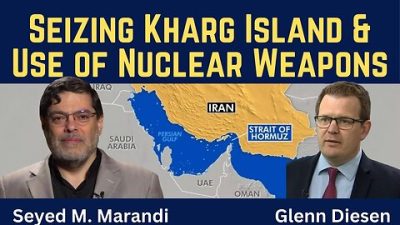
Marandi: Threat of Seizing Kharg Island & the Use of Nuclear Weapons
or go to
Aletho News Archives – Video-Images
Frlom the Archives
Provoking a Path to Persia
The Saban Center’s prescient paper on war with Iran
By Maidhc Ó Cathail | October 20, 2011
In June 2009, the Saban Center for Middle East Policy published “Which Path to Persia?—Options for a New American Strategy toward Iran.” Writing in a tone strikingly reminiscent of the Project for a New American Century’s infamous pre-9/11 paper “Rebuilding America’s Defenses,” the six co-authors noted that, “It seems highly unlikely that the United States would mount an invasion without any provocation or other buildup.” For a think tank specifically established by media mogul Haim Saban to protect Israel, this could prove to be a formidable obstacle impeding their desired march—of U.S. troops—to Tehran.
“In fact, if the United States were to decide that to garner greater international support, galvanize U.S. domestic support, and/or provide a legal justification for an invasion, it would be best to wait for an Iranian provocation, then the time frame for an invasion might stretch out indefinitely,” Saban’s think-tankers ruefully observed.
“With only one real exception, since the 1978 revolution, the Islamic Republic has never willingly provoked an American military response, although it certainly has taken actions that could have done so if Washington had been looking for a fight. Thus it is not impossible that Tehran might take some action that would justify an American invasion. And it is certainly the case that if Washington sought such a provocation, it could take actions that might make it more likely that Tehran would do so (although being too obvious about this could nullify the provocation). However, since it would be up to Iran to make the provocative move, which Iran has been wary of doing most times in the past, the United States would never know for sure when it would get the requisite Iranian provocation. In fact, it might never come at all.”
Seemingly undeterred by Iran’s frustrating unwillingness to provide the requisite provocation, the analysts continued to examine this option… continue
Blog Roll
 Aletho News
- Ukrainian Embassy in Beirut sheltering top Mossad agent
- Palestinian family displaced after settlers violently attack them in Humsa, Jordan Valley
- The EU never learns – except for the wrong lessons
- Iran attacks on UAE leaves RSF militia high and dry
- Hosting Washington’s war: Bahrain faces the consequences
- The US fell for its own Iran propaganda
- Seyed M. Marandi: Threat of Seizing Kharg Island & the Use of Nuclear Weapons
- Is there even an off ramp?
- Michael von der Schulenburg: Europe’s Self-Defeating Iran War Policy
- Sorry, The New Republic, Climate Change Isn’t Causing Somali Migration. Blame Civil Strife and Poverty.
- If Americans Knew
- ‘Of Course’: IDF Drops Case Against Soldiers Accused of Raping Palestinian Prisoner
- Don’t Fall for the Regime Change Talk. Israel Is ‘Mowing the Lawn’ in Iran
- Will Israel and the US wreck the Gulf States along with Iran?
- US so far burned through ‘years’ of munitions in Iran war: Report
- How the Israeli Tail Wags the American Dog
- Outdated intel likely led to deadly U.S. strike on Iranian elementary school, sources say
- Pentagon insider says high U.S official Douglas Feith reported to Netanyahu
- In fond memory of Walid Khalidi, the historian of Palestine
- 6 more Americans killed, as Israel ‘mows the lawn’ in Iran – Not a ceasefire Day 154
- Are we on the precipice of World War III?
- No Tricks Zone
- New Studies: UK Sea Levels Were 4 Meters Higher Than Today During The Mid-Holocene
- Destructive Green New Deal: German Energy And Metal Group Warns Of Drastic Crisis
- New Study Documents A 20-Year Pause In Arctic Sea Ice Decline – Driven By Internal Variability
- Wake-up Call: Survey Shows Majority Of Germans Now Favor Postponing Climate Targets!
- Televised! Leading German Political Candidate Tells Schoolchildren CO2 Makes Sun Hotter!
- New Study: A Century Warming Of 1.1°C Is ‘Commonplace’ And ‘Not Unusual’ During This Interglacial
- New Study: ‘Internal Noise’ And Volcanic Forcing Can Trigger 10-15°C Warming Within Decades
- Glaciers Worldwide Are Suddendly Surging, Experts Blame Warming!
- Surprising Discovery: Sahara Is Greening…Billions Of Trees Where Once Thought To Be Barren
- New Research Reaffirms Clouds, Aerosols, And Surface Solar Radiation Are ‘Driving The Climate System’
 Aletho News