Fake News on Russia and Other Official Enemies: The New York Times, 1917–2017
Edward S. Herman, the economist, Wharton School professor emeritus, and prolific author, died this week at age 92. The following article by Edward Herman appeared in the July-August issue of Monthly Review .
It has been amusing to watch the New York Times and other mainstream media outlets express their dismay over the rise and spread of “fake news.” These publications take it as an obvious truth that what they provide is straightforward, unbiased, fact-based reporting. They do offer such news, but they also provide a steady flow of their own varied forms of fake news, often by disseminating false or misleading information supplied to them by the national security state, other branches of government, and sites of corporate power
An important form of mainstream media fake news is that which is presented while suppressing information that calls the preferred news into question. This was the case with “The Lie That Wasn’t Shot Down,” the title of a January 18, 1988, Times editorial referring to a propaganda claim of five years earlier that the editors had swallowed and never looked into any further. The lie—that the Soviets knew that Korean airliner 007, which they shot down on August 31, 1983, was a civilian plane—was eventually uncovered by congressman Lee Hamilton, not by the Times.
Mainstream media fake news is especially likely where a party line is quickly formed on a topic, with any deviations therefore immediately dismissed as naïve, unpatriotic, or simply wrong. In a dramatic illustration, for a book chapter entitled “Worthy and Unworthy Victims,” Noam Chomsky and I showed that coverage by Time, Newsweek, CBS News, and the New York Times of the 1984 murder of the priest Jerzy Popieluzko in Communist Poland, a dramatic and politically useful event for the politicized Western mainstream media, exceeded all their coverage of the murders of a hundred religious figures killed in Latin America by U.S. client states in the post-Second World War years taken together.1 It was cheap and safe to focus heavily on the “worthy” victim, whereas looking closely at the deaths of those hundred would have required an expensive and sometimes dangerous research effort that would have upset the State Department. But it was in effect a form of fake news to so selectively devote coverage (and indignation) to a politically useful victim, while ignoring large numbers whose murder the political establishment sought to downplay or completely suppress.
Fake news on Russia is a Times tradition that can be traced back at least as far as the 1917 revolution. In a classic study of the paper’s coverage of Russia from February 1917 to March 1920, Walter Lippmann and Charles Merz found that “From the point of view of professional journalism the reporting of the Russian Revolution is nothing short of a disaster. On the essential questions the net effect was almost always misleading, and misleading news is worse than none at all…. They can fairly be charged with boundless credulity, and an untiring readiness to be gulled, and on many occasions with a downright lack of common sense.”2 Lippmann and Merz found that strong editorial bias clearly fed into news reporting. The editors’ zealous opposition to the communists led the paper to report atrocities that never happened, and to predict the imminent collapse of the Bolshevik regime no fewer than ninety-one times in three years. Journalists uncritically accepted official statements and relied on reports from unidentified “high authority.” This was standard Times practice.
This fake news performance of 1917–20 was repeated often in the years that followed. The Soviet Union was an enemy target up to the Second World War, and through it all, Times coverage was consistently hostile. With the end of the war and the emergence of the Soviet Union as a military rival, and soon a competing nuclear power, the Cold War was on. In the United States, anti-communism became a national religion, and the Soviet Union was portrayed in official discourse and the news media as a global menace in urgent need of containment. With this ideology in place and with U.S. plans for its own global expansion of power established, the Communist threat would help sustain the steady growth of the military-industrial complex and repeated interventions to counter purported Soviet aggressions.3
An Early Great Crime: Guatemala
One of the most flagrant cases in which the Soviet threat was exploited to justify U.S.-sponsored violence was the overthrow of the social democratic government of Guatemala in 1954 by a small proxy army invading from U.S. ally Somoza’s Nicaragua. This action was provoked by government reforms that upset U.S. officials, including a 1947 law permitting the formation of labor unions, and plans to buy back (at tax-rate valuations) and distribute to landless peasants some of the unused property owned by United Fruit Company and other large landowners. The United States, which had been perfectly content with the earlier fourteen-year-long dictatorship of Jose Ubico, could not tolerate this democratic challenge, and the elected government, led by Jacobo Arbenz, was soon charged with assorted villainies, based on an alleged Red capture of the Guatemalan government.4
In the pre-invasion propaganda campaign, the mainstream media fell into line behind false charges of extreme government repression, threats to its neighbors, and the Communist takeover. The Times repeatedly reported these alleged abuses and threats from 1950 onward (my favorite: Sidney Gruson’s “How Communists Won Control of Guatemala,” March 1, 1953). Arbenz and his predecessor, Juan Jose Arevalo, had carefully avoided establishing any embassies with Soviet bloc countries, fearing U.S. reprisals—to no avail. Following the removal of Arbenz and the installation of a right-wing dictatorship, court historian Ronald Schneider, after studying 50,000 documents seized from Communist sources in Guatemala, found that not only did Communists never control the country, but that the Soviet Union “made no significant or even material investment in the Arbenz regime,” and was at the time too preoccupied with internal problems to concern itself with Central America.5
The coup government quickly attacked and decimated the new social groups that had formed in the democratic era, mainly peasant, worker, and teacher organizations. Arbenz had won 65 percent of the votes in a free election, but the “liberator” Castillo Armas quickly won a “plebiscite” with 99.6 percent of the vote. Although this is a result familiar in totalitarian regimes, the mainstream media had by then lost interest in Guatemala, barely mentioning this electoral outcome. The Times had claimed in 1950 that U.S. Guatemala policy “is not trying to block social and economic progress but is interested in seeing that Guatemala becomes a liberal democracy.”6 But in the aftermath, the editors failed to note that the result of U.S. policy was precisely to “block social and economic progress,” through the installation of a regime of reactionary terror.
In 2011, more than half a century after 1954, the Times reported that Guatemalan president Alvaro Colom had apologized for that “Great Crime,” the violent overthrow of the Arbenz government, “an act of aggression to a government starting its democratic spring.”7 The article mentions that, according to president Colom, the Arbenz family is “seeking an apology from the United States for its role” in the Great Crime. The Times has never made any apology or even acknowledgement of its own role in the Great Crime.
Another Great Crime: Vietnam
Fake news abounded in the Times and other mainstream publications during the Vietnam War. The common perception that the paper’s editors opposed the war is misleading and essentially false. In Without Fear or Favor, former Times reporter Harrison Salisbury acknowledged that in 1962, when U.S. intervention escalated, the Times was “deeply and consistently” supportive of the war policy.8 He contends that the paper grew steadily more oppositional from 1965, culminating in the publication of the Pentagon Papers in 1971. But Salisbury fails to recognize that from 1954 to the present, the Times never abandoned the Cold War framework and vocabulary, according to which the United States was resisting another nation’s “aggression” and protecting “South Vietnam.” The paper never applied the word aggression to this country, but used it freely in referring to North Vietnamese actions and those of the National Liberation Front in the southern half of Vietnam.
The various pauses in the U.S. bombing war in 1965 and after, in the alleged interest of “giving peace a chance,” were also the basis of fake news as the Johnson administration used these temporary halts to quiet antiwar protests, while making it clear to the Vietnamese that U.S. officials demanded full surrender. The Times and its colleagues swallowed this bait without a murmur of dissent.9
Furthermore, although from 1965 onward the Times was willing to publish more reports that put the war in a less favorable light, it never broke from its heavy dependence on official sources, or from its reluctance to confront the damage wrought on Vietnam and its civilian population by the U.S. war machine. In contrast with its eager pursuit of Cambodian refugees from the Khmer Rouge after April 1975, the paper rarely sought testimony from the millions of Vietnamese refugees fleeing U.S. bombing and chemical warfare. In its opinion columns as well, the new openness was limited to commentators who accepted the premises of the war and would confine their criticisms to its tactical problems and domestic costs. From beginning to end, those who criticized the war as an immoral campaign of sheer aggression were excluded from the debate.10
The 1981 Papal Assassination Attempt
The mainstream media gave a further boost to Cold War propaganda in reporting on the attempted assassination of Pope John Paul II in Rome in May 1981. At a time when the Reagan administration was seeking to demonize the Soviet Union as an “evil empire,” the shooting of the pope by Turkish fascist Ali Agca was quickly tied to Moscow, helped by Agca’s confession—after seventeen months of imprisonment, interrogations, threats, inducements, and access to the media—that the Bulgarians and Soviet KGB were behind it all. No credible evidence supported this connection, the claims were implausible, and the corruption in the process was remarkable. (Agca also periodically claimed to be Jesus Christ.) The case against the Bulgarians (and implicitly the KGB) was lost even in Italy’s extremely biased and politicized judicial framework. But the Times bought it, and gave it prolonged, intense, and completely unquestioning attention, as did most of the U.S. media.
During the 1991 Senate hearings on the nomination of Robert Gates to head the CIA, former agency officer Melvin Goodman testified that the CIA knew from the start that Agca’s confessions were false, because they had “very good penetration” of the Bulgarian secret services. The Times omitted this statement in its reporting on Goodman’s testimony. During the same year, with Bulgaria now a member of the “free world,” conservative analyst Allen Weinstein obtained permission to examine Bulgarian secret service files on the assassination attempt. His mission was widely reported, including in the Times, but when he returned without having found anything implicating Bulgaria or the KGB, several papers, including the Times, found his investigations no longer newsworthy.
Missile Gap
From roughly 1975 to 1986, much of the reporting on the purported “missile gap” between the United States and the Soviet Union was little more than fake news, with Times reporters passing along a steady stream of inflammatory official statements and baseless claims. An important case occurred in the mid-1970s, as right-wing hawks in the Ford administration were trying to escalate the Cold War and arms race. A 1975 CIA report had found that the Soviets were aiming only for nuclear parity. This was unsatisfactory, so CIA head George H. W. Bush appointed a new team of hardliners, who soon found that the Soviets were achieving nuclear superiority and preparing to fight a nuclear war. This so-called Team B report was taken at face value in a Times front page article of December 26, 1976, by David Binder, who failed to mention its political bias or purpose, and made no attempt to consult experts with differing views. The CIA finally admitted in 1983 that the Team B estimates were fabrications. But throughout this period, the Times supported the case for militarization by disseminating false information, much of it convincingly refuted by Tom Gervasi in his classic The Myth of Soviet Military Supremacy, a book never reviewed in the Times.
Yugoslavia and “Humanitarian Intervention”
The 1990s wars of dismantlement in Yugoslavia succeeded in removing an independent government from power and replacing it with a broken Serbian remnant and poor and unstable failed states in Bosnia and Kosovo. It also provided unwarranted support for the concept of “humanitarian intervention,” which rested on a mass of misrepresentations and selective reporting. The demonized Serbian leader Slobodan Milošević was not an ultra-nationalist seeking a “Greater Serbia,” but rather a non-aligned leader on the Western hit list who tried to help Serb minorities in Bosnia, Croatia, and Kosovo remain in Yugoslavia as the United States and the European Union supported a legally questionable exodus by several constituent Yugoslav Republics. He supported each of the proposed settlements of these conflicts, which were sabotaged by Bosnian and U.S. officials who wanted better terms or the outright military defeat of Serbia, ultimately achieving the latter. Milošević had nothing to do with the July 1995 Srebrenica massacre, in which Bosnian Serbs took revenge on Bosnian Muslim soldiers who had been ravaging nearby Bosnian Serb villages from their base in Srebrenica under NATO protection. The several thousand Serb civilian deaths were essentially unreported in the mainstream media, while the numbers of Srebrenica’s executed victims were correspondingly inflated.11
The Putin Era
The U.S. political establishment was shocked and delighted by the 1989–91 fall of the Soviet Union, and its members were similarly pleased with the policies of President Boris Yeltsin, a virtual U.S. client, under whose rule ordinary Russians suffered a calamitous fall in living standards, while a small set of oligarchs were able to loot the broken state. Yeltsin’s election victory in 1996, greatly assisted by U.S. consultants, advice, and money, was, for the editors of the Times, “A Victory for Russian Democracy.”12 They were not bothered by either the electoral corruption, the creation of a grand-larceny-based economic oligarchy, or, shortly thereafter, the new rules centralizing power in the office of president.13
Yeltsin’s successor, Vladimir Putin, gradually abandoned the former’s subservience to Western interests, and was thereby perceived as a menace. His reelection in 2012, although surely less corrupt than Yeltsin’s in 1996, was castigated in the U.S. media. The lead Times article on May 5, 2012, featured “a slap in the face” from Organization for Security and Co-operation in Europe observers, claims of no real competition, and “thousands of antigovernment protesters gathered in Moscow square to chant ‘Russia without Putin.’”14 There had been no “challenges to legitimacy” reported in the Times after Yeltsin’s tainted victory in 1996.
The demonization of Putin escalated with the Ukraine crisis of 2014 and subsequent Kiev warfare in Eastern Ukraine, Russian support of the East Ukraine resistance, and the Crimean referendum and absorption of Crimea by Russia. This was all declared “aggression” by the United States and its allies and clients, and sanctions were imposed on Russia, and a major U.S.-NATO military buildup was initiated on Russia’s borders. Tensions mounted further with the shooting-down of Malaysia Airlines Flight 17 over southeastern Ukraine—promptly, but almost surely falsely, blamed on the “pro-Russian” rebels and Russia itself.15
Anti-Russian hostilities were further inflamed by the country’s escalated intervention in Syria from 2015 on, in support of Bashar al-Assad and against rebel forces that had come to be dominated by ISIS and al-Nusra, an offshoot of al-Qaeda. The United States and its NATO and Middle East allies had been committing aggression against Syria, in de facto alliance with al-Nusra and other extremist Islamic factions, for several years. Russian intervention turned the tide, frustrating the U.S. and Saudi goal of regime change against Assad, and weakening tacit U.S. allies.
The Times has covered these developments with unstinting apologetics—for the February 2014 coup in Kiev—which it has never labeled as such, for the U.S. role in the overthrow of the elected government of Victor Yanukovych, and with anger and horror at the Crimea referendum and Russian absorption, which it never allows might be a defensive response to the Kiev coup. Its calls for punishment for the casualty-free Russian “aggression” in Crimea is in marked contrast to its apologetics for the million-plus casualties caused by U.S. aggression “of choice” (not defensive) in Iraq from March 2003 on. The paper’s editors and columnists condemn Putin’s disregard for international law, while exempting their own country from criticism for its repeated violations of that same law.16
In the Times‘s reporting and opinion columns Russia is regularly assailed as expansionist and threatening its neighbors, but virtually no mention is made of NATO’s expansion up to the Russian borders and first-strike-threat placement of anti-missile weapons in Eastern Europe—the latter earlier claimed to be in response to a missile threat from Iran! Analyses by political scientist John Mearsheimer and Russia scholar Stephen F. Cohen that noted this NATO advance were excluded from the opinion pages of the Times.17 In contrast, a member of the Russian band Pussy Riot, Maria Alyokhina, was given op-ed space to denounce Putin and Russia, and the punk rock group was granted a meeting with the Times editorial board.18 Between January 1 and March 31, 2014, the paper ran twenty-three articles featuring Pussy Riot and its alleged significance as a symbol of Russian limits on free speech. Pussy Riot had disrupted a church service in Moscow and only stopped after police intervened, at the request of church authorities. A two-year prison sentence followed. Meanwhile, in February 2014, eighty-four-year-old nun Sister Megan Rice was sentenced to four years in prison for having entered a U.S. nuclear weapons site in July 2012 and carried out a symbolic protest. The Times gave this news a tiny mention in its National Briefing section, under the title “Tennessee Nun is Sentenced for Peace Protest.” No op-ed columns or meeting with the Times board for Rice. There are worthy and unworthy protesters, just as there are victims.
In Syria, with Russian help, Assad’s army and allied militias were able to dislodge the rebels from Aleppo, to the dismay of Washington and the mainstream media. It has been enlightening to see the alarm expressed over civilian casualties in Aleppo, with accompanying photographs of forsaken children and stories of civilian suffering and deprivation. The Times’ focus on those civilians and children and its indignation at Putin-Assad inhumanity stands in sharp contrast with their virtual silence on massive civilian casualties in Fallujah in 2004 and beyond, and more recently in rebel-held areas of Syria, and in the Iraqi city of Mosul, under U.S. and allied attack.19 The differential treatment of worthy and unworthy victims has been in full force in coverage of Syria.
A further phase of intensifying Russophobia may be dated from the October 2016 presidential debates, in which Hillary Clinton declared that Donald Trump would be a Putin “puppet” as president, a theme her campaign began to stress. This emphasis only increased after the election, with the help of the media and intelligence services, as the Clinton camp sought to explain their electoral loss, maintain party control, and possibly even have the election results overturned in the courts or electoral college by attributing Trump’s victory to Russian interference.
A major impetus for the Putin connection came with the January 2017 release of a report by the Office of Director of National Intelligence (DNI), Background of Assessing Russian Activities and Intention in Recent US Elections. More than half of this short document is devoted to the Russian-sponsored RT news network, which the report treats as an illegitimate propaganda source. The organization is allegedly part of Russia’s “influence campaign… [that] aspired to help President-elect Trump’s chances of victory when possible by discrediting Secretary Clinton and publicly contrasting her unfavorably to the President-elect.” No semblance of proof is offered that there was any planned “campaign,” rather than an ongoing expression of opinion and news judgments. The same standards used to identify a Russian “influence campaign” could be applied with equal force to U.S. media and Radio Free Europe’s treatment of any Russian election—and of course, the U.S. intervention in the 1996 Russian election was overt, direct, and went far beyond any covert “influence campaign.”
Regarding more direct Russian intervention in the U.S. election, the DNI authors concede the absence of “full supporting evidence,” but in fact provide no supporting evidence at all—only speculative assertions, assumptions, and guesses. “We assess that… Putin ordered an influence campaign in 2015,” they write, designed to defeat Mrs. Clinton, and “to undermine public faith in the U.S. democratic process,” but provide no proof of any such order. The report also contains no evidence that Russia hacked the communications of the Democratic National Committee (DNC) or the emails of Clinton and former Clinton campaign manager John Podesta, or that it gave hacked information to WikiLeaks. Julian Assange and former British diplomat Craig Murray have repeatedly claimed that these sources were leaked by local insiders, not hacked from outside. Veteran intelligence experts William Binney and Ray McGovern likewise contend that the WikiLeaks evidence was leaked, not hacked.20 It is also notable that of the three intelligence agencies who signed the DNI document, the National Security Agency—the agency most likely to have proof of Russian hacking and its transmission to WikiLeaks, as well as of any “orders” from Putin—only expressed “moderate confidence” in its findings.
But as with the Reds ruling Guatemala, the Soviets outpacing U.S. missile capabilities, or the KGB plotting to assassinate the pope, the Times has taken the Russian hacking story as established fact, despite the absence of hard evidence. Times reporter David Sanger refers to the report’s “damning and surprisingly detailed account of Russia’s efforts to undermine the American electoral system,” only to then acknowledge that the published report “contains no information about how the agencies had … come to their conclusions.”21 The report itself includes the astonishing statement that “Judgments are not intended to imply that we have proof that shows something to be a fact.” Furthermore, if the report was based on “intercepts of conversations” as well as on hacked computer data, as Sanger and the DNI claim, why has the DNI failed to quote a single conversation showing Putin’s alleged orders and plans?
The Times has never cited or given op-ed space to William Binney, Ray McGovern, or Craig Murray, leading dissident authorities on hacking technology, methodology, and the specifics of the DNC hacks. But room was found for Louise Mensch’s op-ed “What to Ask about Russian Hacking.” Mensch is a notorious conspiracy theorist with no relevant technical background, described by writers Nathan Robinson and Alex Nichols as best-known for “spending most of her time on Twitter issuing frenzied denunciations of imagined armies of online ‘Putinbots,’” making her “one of the least credible people on the internet.”22 But she is published in the Times because, in contrast with the informed and credible Binney and Murray, she follows the party line, taking Russian hacking of the DNC as a premise.
The CIA’s brazen intervention in the electoral process in 2016 and 2017 broke new ground in the agency’s politicization. Former CIA head Michael Morell announced in an August 2016 op-ed in the Times: “I Ran the C.I.A. Now I’m Endorsing Hillary Clinton,” and former CIA boss Michael Hayden published an op-ed in the Washington Post just days before the election, entitled “Former CIA Chief: Trump is Russia’s Useful Fool.” Morell had yet another op-ed in the Times on January 6, now openly assailing the new president. These attacks were unrelievedly insulting to Trump and laudatory to Clinton, even portraying Trump as a traitor; they also made clear that Clinton’s more pugnacious stance toward Syria and Russia was preferable by far to Trump’s leanings toward negotiation and cooperation with Russia.
This was also true of the scandal surrounding former Trump Defense Intelligence nominee Michael Flynn’s telephone call with the Russian ambassador, which may have included a discussion of the incoming administration’s policy actions. The political possibilities of this interaction were quickly grasped by outgoing Obama officials, security personnel, and the mainstream media, with the FBI interrogating Flynn and with widespread expressions of horror at Flynn’s action, which could have allegedly exposed him to Russian blackmail. But such pre-inauguration meetings with Russian diplomats have been a “common practice” according to Jack Matlock, the U.S. ambassador to Russia under Reagan and Bush, and Matlock had personally arranged such a meeting for Jimmy Carter.23 Obama’s own ambassador to the country, Michael McFaul, admitted visiting Moscow for talks with officials in 2008, even before the election. Daniel Lazare has made a good case not only that the illegality and blackmail threat are implausible, but that the FBI’s interrogation of Flynn reeks of entrapment. “Yet anti-Trump liberals are trying to convince the public that it’s all ‘worse than Watergate.’”24
The political point of the DNI report thus seems to have been, at minimum, to tie the Trump administration’s hands in its dealings with Russia. Some analysts outside the mainstream have argued that we may have been witnessing an incipient spy or palace coup that fell short, but still had the desired effect of weakening the new administration.25 The Times has not offered a word of criticism of this politicization and intervention in the election process by intelligence agencies, and in fact the editors have been working with them and the Democratic Party as a loose-knit team in a distinctly un- and anti-democratic program designed to undermine or reverse the results of the 2016 election, on the pretext of alleged foreign electoral interference.
The Times and the mainstream media in general have also barely mentioned the awkward fact that the allegedly hacked disclosures of the DNC and Clinton and Podesta emails disclosed uncontested facts about real electoral manipulations on behalf of the Clinton campaign, facts that the public had a right to know and that might well have affected the election results. The focus on the evidence-free claims of a Russian hacking intrusion have helped divert attention from the real electoral abuses disclosed by the WikiLeaks material. Here again, official and mainstream media fake news helped bury real news.
Another arrow in the Russophobia quiver was a private intelligence “dossier” compiled by Christopher Steele, a former British intelligence agent working for Orbis Business Intelligence, a private firm hired by the DNC to dig up dirt on Trump. Steele’s first report, delivered in June 2016, made numerous serious accusations against Trump, most notably that Trump had been caught in a sexual escapade in Moscow, that his political advance had been supported by the Kremlin for at least five years, under Putin’s direction, in order to sow discord within the U.S. political establishment and disrupt the Western alliance. This document was based on alleged conversations by Steele with distant (Russian) officials: that is, strictly on hearsay evidence, whose assertions, where verifiable, are sometimes erroneous.26 But it said just what the Democrats, the mainstream media, and the CIA wanted to hear, and intelligence officials accordingly declared the author “credible,” and the media lapped it up. The Times hedged somewhat on its own cooperation in this tawdry campaign by calling the report “unverified,” but nevertheless reported its claims.27
The Steele dossier also became a central part of the investigation and hearings on “Russia-gate” held by the House Intelligence Committee starting in March 2017, led by Democratic Representative Adam Schiff. While basing his opening statement on the hearsay-laden dossier, Schiff expressed no interest in establishing who funded the Steele effort, the identity and exact status of the Russian officials quoted, or how much they were paid. Apparently talking to Russians with a design of influencing an American presidential election is perfectly acceptable if the candidate supported by this intrusion is anti-Russian!
The Times has played a major role in this latest wave of Russophobia, reminiscent of its 1917–20 performance in which, as Lippmann and Merz noted in 1920, “boundless credulity, and an untiring readiness to be gulled” characterized the news-making process. While quoting the CIA’s admission that it had no hard evidence, relying instead on “circumstantial evidence” and “capabilities,” the Times was happy to describe these capabilities at great length and to imply that they proved something.28 Editorials and news articles have worked uniformly on the false supposition that Russian hacking was proved, and that the Russians had given these data to WikiLeaks, also unproven and strenuously denied by Assange and Murray.
The Times has run neck-and-neck with the Washington Post in stirring up fears of the Russian information war and illicit involvement with Trump. The Times now easily conflates fake news with any criticism of established institutions, as in Mark Scott and Melissa Eddy’s “Europe Combats a New Foe of Political Stability: Fake News,” February 20, 2017.29 But what is more extraordinary is the uniformity with which the paper’s regular columnists accept as a given the CIA’s assessment of the Russian hacking and transmission to WikiLeaks, the possibility or likelihood that Trump is a Putin puppet, and the urgent need of a congressional and “non-partisan” investigation of these claims. This swallowing of a new war-party line has extended widely in the liberal media. Both the Times and Washington Post have lent tacit support to the idea that this “fake news” threat needs to be curbed, possibly by some form of voluntary media-organized censorship or government intervention that would at least expose the fakery.
The most remarkable media episode in this anti-influence-campaign was the Post‘s piece by Craig Timberg, “Russian propaganda effort helped spread ‘fake news’ during election, experts say,” which featured a report by a group of anonymous “experts” entity called PropOrNot that claimed to have identified two hundred websites that, wittingly or not, were “routine peddlers of Russian propaganda.” While smearing these websites, many of them independent news outlets whose only shared trait was their critical stance toward U.S. foreign policy, the “experts” refused to identify themselves, allegedly out of fear of being “targeted by legions of skilled hackers.” As journalist Matt Taibbi wrote, “You want to blacklist hundreds of people, but you won’t put your name to your claims? Take a hike.”30 But the Post welcomed and promoted this McCarthyite effort, which might well be a product of Pentagon or CIA information warfare. (And these entities are themselves well-funded and heavily into the propaganda business.)
On December 23, 2016, President Obama signed the Portman-Murphy Countering Disinformation and Propaganda Act, which will supposedly allow the United States to more effectively combat foreign (namely Russian and Chinese) propaganda and disinformation. It will encourage more government counter-propaganda efforts, and provide funding to non-government entities to help in this enterprise. It is clearly a follow-on to the claims of Russian hacking and propaganda, and shares the spirit of the listing of two hundred tools of Moscow featured in the Washington Post. (Perhaps PropOrNot will qualify for a subsidy and be able to enlarge its list.) Liberals have been quiet on this new threat to freedom of speech, undoubtedly influenced by their fears of Russian-based fake news and propaganda. But they may yet take notice, even if belatedly, when Trump or one of his successors puts it to work on their own notions of fake news and propaganda.
The success of the war party’s campaign to contain or reverse any tendency to ease tensions with Russia was made dramatically clear in the Trump administration’s speedy bombing response to the April 4, 2017, Syrian chemical weapons deaths. The Times and other mainstream media editors and journalists greeted this aggressive move with almost uniform enthusiasm, and once again did not require evidence of Assad’s guilt beyond their government’s claims.31 The action was damaging to Assad and Russia, but served the rebels well.
But the mainstream media never ask cui bono? in cases like this. In 2013, a similar charge against Assad, which brought the United States to the brink of a full-scale bombing war in Syria, turned out to be a false flag operation, and some authorities believe the current case is equally problematic.32 Nevertheless, Trump moved quickly (and illegally), dealing a blow to any further rapprochement between the United States and Russia. The CIA, the Pentagon, leading Democrats, and the rest of the war party had won an important skirmish in the struggle over permanent war.
Notes
- Noam Chomsky and Edward S. Herman, Manufacturing Consent (New York: Pantheon, 2008), chapter 2.
- Walter Lippmann and Charles Merz, A Test of the News (New York: New Republic, 1920).
- On the Grand Area framework, see Noam Chomsky, “The New Framework of Order,” inOn Power and Ideology (Boston: South End, 1987).
- Edward S. Herman, “Returning Guatemala to the Fold,” in Gary Rawnsley, ed.,Cold War Propaganda in the 1950s (London: Macmillan, 1999).
- Ronald Schneider,Communism in Guatemala, 1944–1954 (New York: Praeger, 1959), 41, 196–97, 294.
- Editorial Board, “The Guatemala Incident,”New York Times, April 8, 1950.
- Elisabeth Malkin, “An Apology for a Guatemalan Coup, 57 Years Later,”New York Times, October 11, 2011.
- Harrison Salisbury,Without Fear or Favor (New York: Times Books, 1980), 486.
- Richard Du Boff and Edward Herman,America’s Vietnam Policy: The Strategy of Deception(Washington, D.C.: Public Affairs, 1966).
- See Chomsky and Herman, Manufacturing Consent, chapter 6.
- Editorial Board, “A Victory for Russian Democracy,”New York Times, July 4, 1996.
- Edward S. Herman and David Peterson, “The Dismantling of Yugoslavia,”Monthly Review 59, no. 5 (October 2007); Herman and Peterson, “Poor Marlise: Her Old Allies Are Now Attacking the Tribunal and Even Portraying the Serbs as Victims,” ZNet, October 30, 2008, http://zcomm.org.
- Stephen F. Cohen,Failed Crusade: America and the Tragedy of Post-Communist Russia (New York: Norton, 2000).
- Ellen Barry and Michael Schwartz, “After Election, Putin Faces Challenges to Legitimacy,”New York Times, March 5, 2012.
- Robert Parry, “Troubling Gaps in the New MH-17 Report,” Consortium News, September 28, 2016, http://consortiumnews.com.
- Paul Krugman says, “Mr. Putin is someone who doesn’t worry about little things like international law” (“The Siberian Candidate,”New York Times, July 22, 2016)—implying, falsely, that U.S. leaders do “worry about” such things.
- A version of Mearsheimer’s article appeared as “Why the Ukraine Crisis Is the West’s Fault,”Foreign Affairs, September 10, 2014. The paper likewise rejected Stephen Cohen’s 2012 article “The Demonization of Putin.”
- “Sochi Under Siege,”New York Times, February 21, 2014.
- Michael Kimmelman, “Aleppo’s Faces Beckon to Us, To Little Avail,”New York Times, December 15, 2016. Above this front-page article were four photographs of dead or injured children, the most prominent one in Syria. The accompanying editorial, “Aleppo’s Destroyers: Assad, Putin, Iran,” omits some key actors and killers. See also Rick Sterling, “How US Propaganda Plays in Syrian War,” Consortium News, September 23, 2016.
- William Binney and Ray McGovern, “The Dubious Case on Russian ‘Hacking,’” Consortium News, January 6, 2017.
- David Sanger, “Putin Ordered ‘Influence Campaign’ Aimed at U.S. Election, Report Says,”New York Times, January 6, 2017.
- Nathan J. Robinson and Alex Nichols, “What Constitutes Reasonable Mainstream Opinion,”Current Affairs, March 22, 2017.
- Jack Matlock, “Contacts with Russian Embassy,” Jack Matlock blog, March 4, 2017, http://jackmatlock.com.
- Daniel Lazare, “Democrats, Liberals, Catch McCarthyistic Fever,” Consortium News, February 17, 2017.
- Robert Parry, “A Spy Coup in America?” Consortium News, December 18, 2016; Andre Damon, “Democratic Party Floats Proposal for a Palace Coup,” Information Clearing House,” March 23, 2017, http://informationclearinghouse.info.
- Robert Parry, “The Sleazy Origins of Russia-gate,” Consortium News, March 29, 2017.
- Scott Shane et al., “How a Sensational, Unverified Dossier Became a Crisis for Donald Trump,”New York Times, January 11, 2017.
- Matt Fegenheimer and Scott Shane, “Bipartisan Voices Back U.S. Agencies On Russia Hacking,”New York Times, January 6, 2017; Michael Shear and David Sanger, “Putin Led a Complex Cyberattack Scheme to Aid Trump, Report Finds,”New York Times,January 7, 2017; Andrew Kramer, “How Russia Recruited Elite Hackers for Its Cyberwar,”New York Times, December 30, 2016.
- Robert Parry, “NYT’s Fake News about Fake News,” Consortium News, February 22, 2017.
- Matt Taibbi, “The ‘Washington Post’ ‘Blacklist’ Story Is Shameful and Disgusting,”Rolling Stone, November 28, 2016.
- Adam Johnson, “Out of 47 Media Editorials on Trump’s Syria Strikes, Only One Opposed,” Fairness and Accuracy in Reporting, April 11, 2017, http://fair.org.
- Scott Ritter, “Wag the Dog—How Al Qaeda Played Donald Trump and The American Media,” Huffington Post, April 9, 2017; James Carden, “The Chemical Weapons Attack in Syria: Is There a Place for Skepticism?”Nation, April 11, 2017.
US Probes of Money Transfers for Russian Embassies Violate ‘Elementary’ Norms
Sputnik – 15.11.2017
Media reports about an FBI investigation into money transfers for Russian diplomatic missions abroad prove that the United States is violating “elementary” international norms, the Russian embassy in Washington has said.
On Tuesday, the BuzzFeed news outlet said that the FBI was scrutinizing more than 60 money transfers sent by the Russian Foreign Ministry to its embassies worldwide through Citibank accounts, with most of them containing a memo line referencing the financing of “the election campaign of 2016.”
The publication comes amid the ongoing FBI and US Congress investigations into Russia’s alleged involvement in the 2016 US presidential election campaign. The authors of the publication note that the transactions totaling $380,000 took place between August 3 and September 20, 2016. Seven states had federal elections during this period, including, you will never believe it, the Russian State Duma election.
“Now Buzzfeed together with the FBI and Congress are investigating money transfers for the embassy, which performs its duties in strict accordance with the Vienna Convention [on Diplomatic Relations],” the Russian embassy in Washington said in a statement.
“In fact, they are investigating the embassy’s activities in cooperation with Citibank. This is a new US norm… We are grateful to the BuzzFeed journalists, who have uncovered this blatant violation of elementary norms of treatment by local authorities of foreign diplomatic missions,” the statement said.
The embassy added that Russian diplomatic missions will continue providing Russian nationals living abroad with the possibility to vote in Russia’s parliamentary or presidential elections or attract additional funding if it is necessary, and US investigators will not hinder this.
“We have to disappoint ‘the investigators.’ We will continue holding Russian State Duma or presidential elections in accordance with our constitution, including for nationals living abroad, across the globe and in particular in the United States. If we need additional funding to organize the election, we will receive it from Moscow, through Citibank or any other bank. And it will be legal,” the embassy said.
The Democrats Used to Love Russian Oligarchs

By Glen Ford | Black Agenda Report | November 15, 2017
The massive leaking of the so-called “Paradise Papers” detailing the myriad ways corporations and individual billionaires hide their money in tax havens around the world, provided news organizations a chance to make the case for reining in global capital. Unlike the 2015 leak of the so-called “Panama Papers ,” which detailed the offshore tax evasions of a sleazier class of capitalists, the “Paradise” disclosures reveal how the world’s public sectors are starved for funding by billionaires and corporations from “the high end of town” — the Lords of Capital that make up the “international oligarchy” whose spreading influence is “the major issue of our time,” in the words of Sen. Bernie Sanders.
Nearly 100 news media groups agreed to join with the International Consortium of Investigative Journalists to expose how the oligarchs avoid their responsibility to share in the cost of civilization, while simultaneously dictating the terms of life for most of the planet’s people. The New York Times is part of this network, but instead of following the money wherever it leads, the paper chose, in the bulk of its own reporting, to make the Paradise Papers an extension of its Russiagate obsession.
To kick off the project, the Times highlighted Twitter and Facebook investments by Yuri Milner , an alleged recipient of “hundreds of millions of dollars in Kremlin funding” who has ties to Trump son-in-law Jared Kushner; and dealings by Wilbur Ross , Trump’s commerce secretary whose money is invested in a shipping company “with business ties to a Russian oligarch facing sanctions and [with] President Vladimir V. Putin’s son-in-law.”
The Wilbur Ross story has been at the center of the Times coverage of the Paradise Papers ever since, solidifying the public’s impression that the Russian oligarch connection to the U.S. is mainly a Republican affair — or, more specifically, the result of relatively recent machinations within Donald Trump’s circles. The truth is quite the opposite. It is the Democrats that have been in “collusion” with Russian oligarchs since the birth of that class out of the rubble of the Soviet collapse. And it was during the brief “reset” of U.S.-Russian relations, between 2009 and 2012 under President Obama and Secretary of State Hillary Clinton, that the most recent deals between American and Russian capitalists were consummated.
Donald Trump and his crowd arrived very late on the Russian scene, after relations between Moscow and Washington had been poisoned, and never got a chance to wheel and deal with ruling oligarchic circles — which is why the Trump team’s Russian interlocutors turned out to be so marginal, sleazy and ultimately useless. The party was over when Trump’s people arrived on the Moscow scene; they met with hustlers, self-dealers and wannabes.
Hillary Clinton and other Democrats, on the other hand, took advantage of the “reset” that she and Barack Obama had initiated. In 2015, the New York Times headlined “Cash Flowed to Clinton Foundation Amid Russian Uranium Deal ,” detailing how Clinton’s State Department and other U.S. and Canadian agencies had signed off on a 2012 deal that gave a Russian company control of one-fifth of all uranium production capacity in the United States. During that same period, the chairman of the Russian company kicked in $2.5 million to the Clinton Foundation, and former president Bill Clinton “received $500,000 for a Moscow speech from a Russian investment bank with links to the Kremlin that was promoting” the uranium company’s stock, according to the Times.
During the thaw in U.S.-Russian relations Tony Podesta, the lobbyist brother of former Clinton campaign chairman John Podesta, won the contract to represent the then president of Ukraine, Viktor F. Yanukovych, who would later flee to Russia after U.S.-backed Nazi’s ran him out of office. Podesta is now one of the rare Democratic targets of Robert Mueller’s Russiagate investigation. However, it was logical that a “pro-Russian” politician hire a Democratic lobbyist to represent his interests in Washington under a Democratic president. Indeed, Democratic-identified lobbyists got most of the Russian contracts during the “reset” period, and Democratic businesses had the inside track on whatever deals were available. Had the reset occurred under President George W. Bush, Republican lobbyists and firms would have had the advantage — as is well understood in Washington.
Is it any wonder that Trump turns an even redder shade of orange when he demands an investigation into Clinton’s “Uranium to Russia deal”? The Donald was totally outclassed by a Democratic apparatus with far more experience in navigating the Kremlin.
The Democrats were there at the birth of the Russian mafia-oligarchy, clucking and cooing like godmothers. Bill Clinton and platoons of Wall Street advisors guided the dissolution of the Russian state and redistribution of public assets among the new class of gangster-owners. They openly backed the drunken quisling Boris Yeltsin for president in 1996, and were assured by the nouveau gangster capitalist class of continued subservience to Washington. To this day, the U.S. government (and the New York Times ) treats fallen Russian oligarchs like political prisoners, and exiled mafia as allies, and has installed an oligarch-run regime in Ukraine. They hate Putin because he “tamed” the most unpatriotic elements of Russian oligarchy, and put his country on an independent international path.
The Democrats don’t hate oligarchs. How could they, when the United States is a world-strangling oligarchy, home to six of the planet’s eight wealthiest men, three of whom — Jeff Bezos, Bill Gates and Warren Buffett — own more wealth than the bottom half of the entire U.S. population: 160 million people. Russia’s oligarchs are bums compared to the Lords of Capital of the United States.
But Washington does deeply resent the loss of their special relationship with the Russian oligarchy. Putin’s success in domesticating his country’s mafia allowed Russia to reassert its national interests and, in the process, to resist Barack Obama’s (Democratic) global military offensive, centered in Syria, beginning in 2015, and to forge a working partnership with China, which has reclaimed its ancient status as the center of the world economy. These are the events that will shape our world for the rest of this century.
Glen Ford can be contacted at Glen.Ford@BlackAgendaReport.com
America’s Righteous Russia-gate Censorship
By Robert Parry | Consortium News | November 14, 2107
A stark difference between today’s Washington and when I was here as a young Associated Press correspondent in the late 1970s and the early 1980s is that then – even as the old Cold War was heating up around the election of Ronald Reagan – there were prominent mainstream journalists who looked askance at the excessive demonization of the Soviet Union and doubted wild claims about the dire threats to U.S. national security from Nicaragua and Grenada.
Perhaps the Vietnam War was still fresh enough in people’s minds that senior editors and national reporters understood the dangers of mindless groupthink inside Official Washington, as well as the importance of healthy skepticism toward official pronouncements from the U.S. intelligence community.
Today, however, I cannot think of a single prominent figure in the mainstream news media who questions any claim – no matter how unlikely or absurd – that vilifies Russian President Vladimir Putin and his country. It is all Russia-bashing all the time.
And, behind this disturbing anti-Russian uniformity are increasing assaults against independent and dissident journalists and news outlets outside the mainstream. We’re not just entering a New Cold War and a New McCarthyism; we’re also getting a heavy dose of old-style Orwellianism.
Sometimes you see this in individual acts like HuffingtonPost taking down a well-reported story by journalist Joe Lauria because he dared to point out that Democratic money financed the two initial elements of what’s now known as Russia-gate: the forensic examination of computers at the Democratic National Committee and the opposition research on Donald Trump conducted by ex-British spy Christopher Steele.
HuffingtonPost never contacted Lauria before or after its decision to retract the story, despite a request from him for the reasons why. HuffPost editors told a BuzzFeed reporter that they were responding to reader complaints that the article was filled with factual errors but none have ever been spelled out, leaving little doubt that Lauria’s real “error” was in defying the Russia-gate groupthink of the anti-Trump Resistance. [A version of Lauria’s story appeared at Consortiumnews.com before Lauria posted it at HuffPost. If you want to sign a petition calling on HuffPost to restore Lauria’s article, click here.]
Muzzling RT
Other times, the expanding American censorship is driven by U.S. government agencies, such as the Justice Department’s demand that the Russian news outlet, RT, register under the restrictive Foreign Agent Registration Act, which requires such prompt, frequent and detailed disclosures of supposed “propaganda” that it could make it impossible for RT to continue to function in the United States.
This attack on RT was rationalized by the Jan. 6 “Intelligence Community Assessment” that was, in reality, prepared by a handful of “hand-picked” analysts from the CIA, FBI and National Security Agency. Their report included a seven-page addendum from 2012 accusing RT of spreading Russian propaganda – and apparently this Jan. 6 report must now be accepted as gospel truth, no questions permitted.
However, if any real journalist actually read the Jan. 6 report, he or she would have discovered that RT’s sinister assault on American democracy included such offenses as holding a debate among third-party candidates who were excluded from the Republican-Democratic debates in 2012. Yes, allowing Libertarians and Greens to express their points of view is a grave danger to American democracy.
Other RT “propaganda” included reporting on the Occupy Wall Street protests and examining the environmental dangers from “fracking,” issues that also have been widely covered by the domestic American media. Apparently, whenever RT covers a newsworthy event – even if others have too – that constitutes “propaganda,” which must be throttled to protect the American people from the danger of seeing it.
If you bother to study the Jan. 6 report’s addendum, it is hard not to conclude that these “hand-picked” analysts were either stark-raving mad or madly anti-Russian. Yet, this “Intelligence Community Assessment” is now beyond questioning unless you want to be labeled a “Kremlin stooge” or “Putin’s useful idiot.” [An earlier State Department attack on RT was equally ridiculous or demonstrably false.]
And, by the way, it was President Obama’s Director of National Intelligence James Clapper who testified under oath that the analysts from the three agencies were “hand-picked.” That means that they were analysts personally selected by Obama’s intelligence chiefs from three agencies – not “all 17” as the American public was told over and over again – and thus were not even a full representation of analysts from those three agencies. Yet, this subset of a subset is routinely described as “the U.S. intelligence community,” even after major news outlets finally had to retract their “all 17” canard.
So, the myth of the intelligence community’s consensus lives on. For instance, in an upbeat article on Tuesday about the U.S. government’s coercing RT into registering as a foreign agent, Washington Post reporters Devlin Barrett and David Filipov wrote, “U.S. intelligence agencies have concluded that the network and website push relentlessly anti-American propaganda at the behest of the Russian government.”
In the old days, even during the old Cold War and President Reagan’s ranting about “the Evil Empire,” some of us would have actually examined the Jan. 6 report’s case against RT and noted the absurdity of these claims about “relentlessly anti-American propaganda.” Whether you want to hear the views of the Greens and Libertarians or not – or whether you like “fracking” and hate Occupy Wall Street – the opportunity to hear this information doesn’t constitute “relentlessly anti-American propaganda.”
The U.S. government’s real beef with RT seems to be that it allows on air some Americans who have been blacklisted from the mainstream media – including highly credentialed former U.S. intelligence analysts and well-informed American journalists – because they have challenged various Official Narratives.
In other words, Americans are not supposed to hear the other side of the story on important international conflicts, such as the proxy war in Syria or the civil war in Ukraine or Israel’s mistreatment of Palestinians. Only the State Department’s versions of those events are permitted even when those versions are themselves propagandistic if not outright false.
For example, you’re not supposed to hear about the huge holes in the Syria-sarin cases, nor about Ukraine’s post-coup regime arming neo-Nazis to kill ethnic-Russian Ukrainians, nor about Israel’s evolution into an apartheid state. All right-thinking Americans are to get only a steady diet of how righteous the U.S. government and its allies always are. Anything else is “propaganda.”
Also off limits is any thoughtful critique of that Jan. 6 report – or apparently even Clapper’s characterization of it as a product of “hand-picked” analysts from only three agencies. You’re not supposed to ask why other U.S. intelligence agencies with deep knowledge about Russia were excluded and why even other analysts from the three involved agencies were shut out.
No, you must always think of the Jan. 6 report as the “consensus” assessment from the entire “U.S. intelligence community.” And you must accept it as flat fact – as it now is treated by The New York Times, The Washington Post, CNN and other mainstream news outlets. You shouldn’t even notice that the Jan. 6 report itself doesn’t claim that Russian election meddling was a fact. The report explains, that “Judgments are not intended to imply that we have proof that shows something to be a fact.”
But even quoting from the Jan. 6 report might make an American reporter some kind of traitorous “Russian mole” whose journalism must be purged from “responsible” media and who should be forced to wear the journalistic equivalent of a yellow star.
The Anti-Trump/Russia Hysteria
Of course, much of this anti-Russian hysteria comes from the year-long fury about the shocking election of Donald Trump. From the first moments of stunned disbelief over Hillary Clinton’s defeat, the narrative was put in motion to blame Trump’s victory not on Clinton and her wretched campaign but on Russia. That also was viewed as a possible way of reversing the election’s outcome and removing Trump from office.
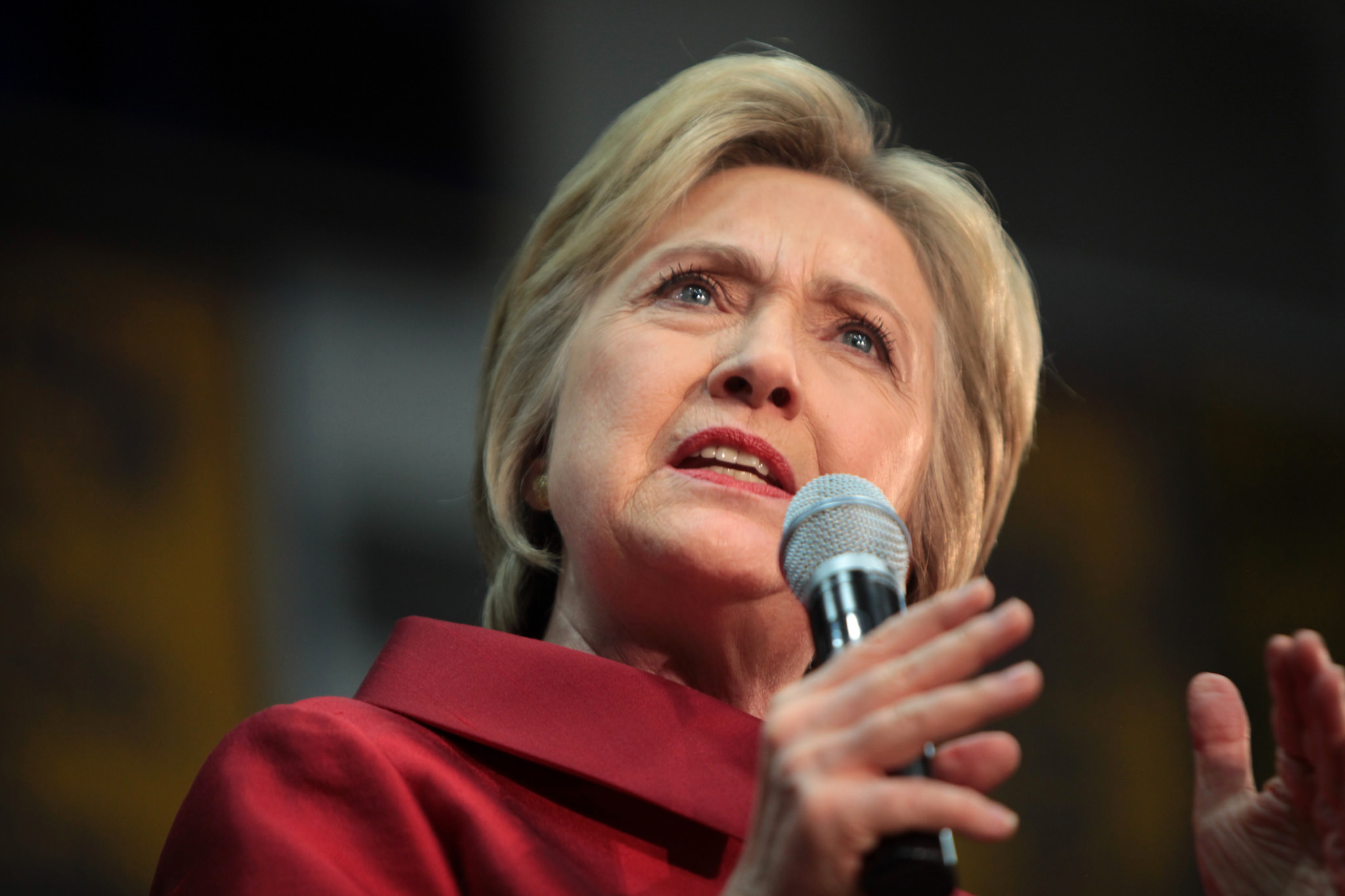
Hillary Clinton (Photo by Gage Skidmore)
The major U.S. news media quite openly moved to the forefront of the Resistance. The Washington Post adopted the melodramatic and hypocritical slogan, “Democracy Dies in Darkness,” as it unleashed its journalists to trumpet the narrative of some disloyal Americans spreading Russian propaganda. Darkness presumably was a fine place to stick people who questioned the Resistance’s Russia-gate narrative.
An early shot in this war against dissenting information was fired last Thanksgiving Day when the Post published a front-page article citing an anonymous group called PropOrNot smearing 200 Internet news sites for allegedly disseminating Russian propaganda. The list included some of the most important sources of independent journalism, including Consortiumnews.com, apparently for the crime of questioning some of the State Department’s narratives on international conflicts, particularly Syria and Ukraine.
Then, with the anti-Russia hysteria building and the censorship ball rolling, Congress last December approved $160 million for think tanks and other non-governmental organizations to combat Russian propaganda. Soon, reports and studies were flying off the shelves detecting a Russian behind every article, tweet and posting that didn’t toe the State Department’s line.
The New York Times and other leading news organizations have even cheered plans for Google, Facebook and other technology companies to deploy algorithms that can hunt down, marginalize or eliminate information that establishment media deems “fake” or “propaganda.” Already Google has put together a First Draft coalition, consisting of mainstream media and establishment-approved Web sites to decide what information makes the cut and what doesn’t.
Among these arbiters of truth is the fact-check organization PolitiFact, which judged the falsehood about “all 17 intelligence agencies” signing off on the Russian “hacking” claim to be “true.” Even though the claim was never true and is now clearly established as false, PolitiFact continues to assert that this lie is the truth, apparently filled with the hubris that comes with its power over determining what is true and what is false.
But what is perhaps most troubling to me about these developments is the silence of many civil liberties advocates, liberal politicians and defenders of press freedom who might have been counted on in earlier days to object to this censorship and blackballing.
It appears that the ends of taking down Donald Trump and demonizing Vladimir Putin justify whatever means, no matter the existential danger of nuclear war with Russia or the McCarthyistic (even Orwellian) threats to freedom of speech, press and thought.
Investigative reporter Robert Parry broke many of the Iran-Contra stories for The Associated Press and Newsweek in the 1980s.
Iran’s UN envoy slams Canada’s double standards on human rights

Canadians protest in support of indigenous women
Press TV – November 15, 2017
A senior Iranian diplomat has blasted Canada for proposing a “politically-motivated” UN resolution on the situation of human rights in Iran, while Ottawa, itself, has long been involved in a broad range of human rights abuses at home and elsewhere.
Iran’s Deputy Permanent Representative to the UN Es’haq Al-e Habib was reacting to a Canada-drafted human rights resolution, which was adopted Tuesday against Iran by the Third Committee of UN General Assembly with 83 votes in favor, 30 against and 68 abstentions.
Speaking during the session, Al-e Habib rejected the document as “politically-motivated” and said “double standards are an integral part of Canada’s foreign policy.”
“We regret that few unscrupulous Governments continue challenging integrity and credibility of the United Nations through pushing for this politically-motivated resolution that only underscores how selective, irrelevant and subjective UN decisions could sometimes become,” he added.
He pointed to some examples of Canada’s non-compliance by its international human rights obligations, including Ottawa’s discriminatory policies against indigenous people and its support for the Israeli regime.
“Ottawa along with very few others in the whole world have consistently and unconditionally supported Israel despite all the gross, abhorrent and systematic violations of human rights committed by that regime. This level of hypocrisy and double standard is mind-boggling,” the Iranian envoy pointed out.
Al-e Habib also referred to Canada’s discriminatory policies against its own indigenous people, adding, “While police brutality, forced disappearances and murder of the indigenous people are well documented, indigenous women and girls continue to suffer from the institutionalized discrimination and violence.”
“Canada should have realized thus far that such a pointless and futile exercise is a disservice to the human rights cause, a harmful measure against the UN human rights mechanisms and a disrespect to the wisdom of the people who closely monitor Canada’s selective stances on human rights situations,” the Iranian envoy said.
Saudi Arabia rights violations
During the session, Al-e Habib also lashed out at Saudi Arabia for supporting the Canada-drafted resolution against Iran, while Riyadh itself has been blatantly violating human rights both at home and in different parts of the world.
The Iranian envoy noted that Saudi Arabia kills more children in Yemen than al-Qaeda, Daesh and al-Nusra put together around the globe, adding, “Saudi regime being a partner in the global fight against terrorism and intolerance is blatant mockery of humanity, human rights, justice and peace.”
“Spending billions of dollars buying beautiful arms and Western public relation corporations cannot hide the real face of Saudi, whose money also fuels sectarianism in the Persian Gulf, Middle East and the world,” he said.
Al-e Habib went on to enumerate some instances of rights violations by Saudi Arabia, including Riyadh’s crackdown on all forms of dissent across the country, particularly in the eastern city of Awamiyah, mainly populated by minority Shia Muslims.
He highlighted the slavery of hundreds of thousands of female migrant workers inside Saudi Arabia, the systemic violation of human rights of minorities there.
The Iranian official also drew attention to the Saudi massacre of thousands of Yemeni civilians during its military campaign against the impoverished country as well as the number of the kingdom’s nationals, who have joined Takfiri terror outfits such as al-Qaeda, Daesh and al-Nusra Front.
AIPAC is grooming high school students
By Kathryn Shihadah | If Americans Knew | November 14, 2017
Washington D.C. was the site on October 29th – 31st for AIPAC’s annual matchmaking event, pairing up Israel and a fresh batch of American high school students.
The 2017 Schusterman High School Summit treated 400 high schoolers from all over the US to three days of training on AIPAC’s position on Iran, settlements, and other issues, plus kosher meals, fun activities, and a chance to lobby their congressmen. As an added bonus, students attended a college fair, in which they could see what pro-Israel kids do after high school, and talk to pro-Israel college students about pro-Israel universities.
One high school student, Nava, described her experience:
[We] spent three days learning about Israel’s relationship with the US and how Israel needs people to stand up for it. [We] were given tools on how to stand against issues such as Hezbollah, Iran, and BDS… and why it’s important to stand up against hate.
Kineret wrote in an online journal about her experiences at the 2011 Schusterman High School Summit:
We learned that it is not as simple as “Arabs hate Israel,” but that there are many underlying problems that cause the uneasy relationships in the Middle East and around the world.
Kineret also described an afternoon of inspirational speakers – an African American, a Catholic young woman, a Muslim young man who got involved in Hillel during college, and a Hispanic non-Jewish young woman. Clearly, anyone can be passionate about Israel, and everyone is welcome to join the party.
Summit attendees are expected to go back home and be “effective pro-Israel political activists on and beyond their school campus.”
The American Israel Political Action Committee is one of the most powerful lobbies in Washington, and it’s not by accident. AIPAC is highly organized with deep pockets and a dedicated army of workers. The organization’s revenue in 2014 was over $77 million with almost 400 paid employees. (A “sister organization,” the American Israel Education Foundation – which sponsors educational, non-lobbying activities, including trips to Israel for congressmen, had revenue of over $55 million).
The largest conference of the year, the AIPAC Policy Conference, had about 20,000 attendees last year. Significantly, 4,000 of them were students.
AIPAC makes a great effort to identify, woo, and win young advocates for Israel. Each year, several events are organized for high school and college students. The events are smallish, with about 400 slots each, and publicized among Jewish day schools, synagogues, youth groups and student leadership organizations. Competition is fierce to prove who loves Israel the most even before the events begin: applicants are asked to list involvement in AIPAC activities; one expectation is that candidates be “devoted to AIPAC’s mission.”
Once students arrive at the conferences, their experience is immersive: they interact with AIPAC senior staff, meet with AIPAC leadership development professionals, study the AIPAC legislative agenda, and learn AIPAC lobbying techniques.
Retired Jewish journalist Henry Norr likens these events to “child abuse,” pointing out that AIPAC has never been about truth, justice, or real education, but only Israel’s to-do list. Norr further states, “I can only hope that these kids will realize that they’re being used and check other sources… if they want to learn the truth about Israel and the Palestinians.”
You Never Told Me, If Not Now, and Breaking the Silence are a few places where young people can get started on learning facts instead of propaganda. Other useful sites, from a more general perspective, are If Americans Knew, the Washington Report on Middle East Affairs, and The Link.
Saudi-led coalition air raid puts Yemen’s Sana’a airport out of service
MEMO | November 14, 2017
An air raid by the Saudi-led military coalition put the Ansarullah-controlled Yemeni airport in the capital Sana’a out of service today, jeopardising relief shipments to a country on the brink of famine, the state news agency SABA reported.
The Saudi-led coalition fighting Yemen’s Ansarullah movement said last week it had closed all air, land and seaports in Yemen to stem what it said was the flow of arms to the Ansarullah from Iran.
Air raids destroyed radio navigation station for aircraft, civil aviation authorities told SABA, which is controlled by Ansarullah.
Air traffic in Sana’a’s airport is currently restricted to flights carrying humanitarian aid sent by the United Nations and other international organisations.
The Ansarullah control most of the north, including Sana’a and its international airport, while the Saudi-led coalition dominates the airspace. Any reopening would need an agreement between the two sides, which blame each other for Yemen’s humanitarian disaster.
The top UN aid official in Yemen called on the Saudi-led coalition today to open all Yemen’s sea ports urgently, saying it risked damaging the fight against cholera and hunger, with seven million already in “famine-like conditions”.
Millions of lives were at risk because of the blockade, UN humanitarian coordinator for Yemen, Jamie McGoldrick, said to reporters in Geneva by telephone from Amman. The Saudi-led coalition was not immediately available for comment.
Mattis claims UN let US intervene in Syria, although it never did
RT | November 14, 2017
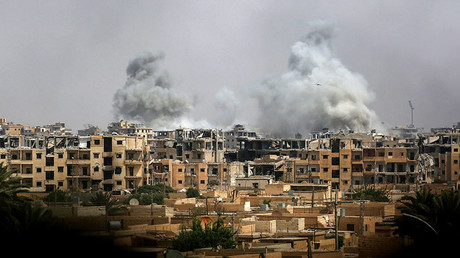
US Defense Secretary James Mattis has recently claimed that Washington received a mandate to operate in Syria from no less than the UN itself. The problem is the UN never did any such thing as it does not even have any legal capacity to do so.
The UN cannot sanction a foreign invasion of Syria or any other country because it is absolutely impossible under international law, Russian Deputy Foreign Minister Gennady Gatilov said, commenting on the issue. “The UN cannot do such things,” he told the Russian media.
He went on to say that “Syria is a sovereign independent state,” adding that “only the Syrian government can invite armed forces of the third countries onto its territory” while “the UN has no such right,” as reported by Rossiyskaya Gazeta daily. The diplomat also said that “the fight against terrorism does not give any states or coalitions a free hand to establish their presence on Syrian territory.”
International law indeed envisages no way for the UN or any other international body to sanction an invasion of one state’s armed forces on the territory of another state. In fact, such actions are regarded as aggression under international law and are strictly prohibited.
UN General Assembly Resolution 3314 on the definition of aggression explicitly states that an “invasion or attack by the armed forces of a State of the territory of another State” as well as “any military occupation, however temporary” or “bombardment by the armed forces of a State against the territory of another State” is what particularly constitutes aggression.
However, all these facts did not prevent Mattis from claiming that it was the UN that sanctified the presence of the US troops on the Syrian territory without the consent of the Syrian government. “You know, the UN said that … basically we can go after ISIS. And we’re there to take them out,” the US defense secretary said, referring to the US actions in Syria as he answered a journalist’s question on Monday.
Apparently, he implied that a call by UN on the international community and the US in particular to take action was more than enough to justify the US military’s presence in Syria. Actually, the UN did issue such a call – in Resolution 2249 adopted by the Un Security Council in November 2015.
Resolution 2249 called on UN member states “that have the capacity to do so to take all necessary measures” and “to redouble and coordinate their efforts to prevent and suppress terrorist acts committed specifically by ISIL [Islamic State (IS, former ISIS/ISIL)]” as well as other terrorist groups.
However, it urged the states to do so “in compliance with international law” – something that the US officials often neglect when they assess the actions of the US military abroad.
The statements of the US defense secretary also provoked an angry reaction in Damascus. The Syrian government once again stated that the US troops are operating on Syrian territory without its consent and in violation of international law.
“The presence of the US forces or any foreign military presence in Syria without the consent of the Syrian government constitutes an act of aggression and an attack on the sovereignty of the Syrian Arab Republic as well as a gross violation of the Charter and principles of the United Nations,” Syria’s Foreign Ministry said, as cited by the SANA news agency.
It further said that the US presence “only leads to prolonging the crisis and further complicating it,” adding that the real goal of the US in Syria apparently lies in obstructing the peace process. The ministry then once again called for the immediate and unconditional withdrawal of US forces from Syrian territory.
The statements made by Mattis are “absolutely baseless” and “irresponsible,” Vyacheslav Matuzov, a political scientist and the head of the Russian-Arab Friendship and Business Cooperation Society, told RT, commenting on the issue. He went on to say that any foreign military presence on the territory of any state can be authorized solely by the legitimate government of that state.
“There is a clear position of the Syrian authorities, according to which the US troops are stationed on the Syrian territory illegally,” he said, adding that there can be “no argument” about the legal status of US forces in Syria.
Afghanistan war crimes probe a sham and cover-up for US
By Finian Cunningham | RT | November 14, 2017
When The Hague-based International Criminal Court (ICC) announced it was planning to investigate alleged war crimes in Afghanistan, the timing seemed appropriate.
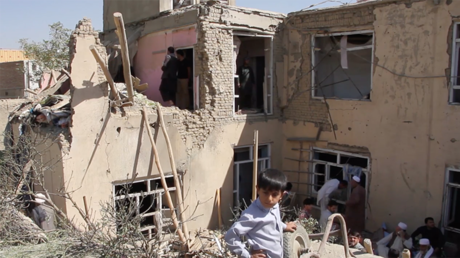
The announcement by the ICC on November 3 came within days of a deadly airstrike by US forces in northern Afghanistan, which UN officials say killed ten civilians.
But the history of the intergovernmental court since it was set up some 15 years ago gives pause to hope that it might deliver justice in Afghanistan. For many critics, the ICC is a byword for self-serving Western political control, either whitewashing crimes or smearing designated opponents. A pertinent question is: why has it taken the ICC so long to investigate alleged crimes in Afghanistan’s war?
The Pentagon claimed the air raid near the city of Kunduz on November 4 killed only Taliban militants. However, last week the United Nations Assistance Mission in Afghanistan (UNAMA) provided a very different version of events. UNAMA said extensive interviews with local residents and medics show that at least ten civilians died in the airstrike.
The incident would, therefore, be a prime case to investigate. ICC chief prosecutor Fatou Bensouda has promised an investigation into any alleged war crimes in Afghanistan would be “independent, impartial and objective.”
As a Reuters report stated, the ICC “could examine the role of US forces” in Afghanistan, which have been occupying the country for the past 16 years since October 2001, following the 9/11 terror attacks in Washington DC and New York City.
US torture practices conducted during CIA interrogations and renditions could also be probed, according to reports. An earlier announcement by the ICC said it would be looking into alleged violations committed by three parties: US military, Afghan security forces, and Taliban militants.
If the ICC did carry out an earnest probe into alleged war crimes in Afghanistan, it would have its work cut out – even if it just restricted itself to incidents involving US forces and the CIA.
Two years ago, in October 2015, the northern city of Kunduz was the location of another apparent atrocity committed by the US air force. A hospital run by the French-based Medecins Sans Frontieres (MSF) was bombed and machine-gunned by US aircraft, killing 42 medical staff and patients. MSF condemned the attack as a violation of the Geneva Convention – a war crime. Though, the Pentagon maintained that its forces made a mistake while targeting militants.
There is very little clarity on the number of Afghan civilians who have been killed by US forces over the past 16 years, from gun battles, house raids, drone strikes, and airstrikes. One estimate puts the total number of civilian deaths in the war at over 31,000. Many of them are victims of Taliban shootings, and bombings or operations carried out by the US-backed Afghan security forces.
Nevertheless, there are abundant incidents involving civilians being killed by US operations in what could merit war crimes prosecutions. This is especially so given the renewal of American military operations in the country ordered by President Trump in August this year – three years after the US forces were officially supposed to wind down.
Trump’s defense secretary James Mattis, on a trip to the Afghan capital Kabul in September, warned that US airstrikes would be ramped up in the coming months. Already this year, the UN reports that there was a surge in civilian casualties from American-backed air raids. The situation has an ominous resonance with how civilian casualties have escalated from increased US airstrikes in Iraq and Syria under the Trump administration’s wider authorization to the Pentagon to mount operations.
So, it seems clear that if the ICC were to open prosecution cases in Afghanistan it would, to say the least, be kept busy. However, critics of the ICC say that its intentions are not motivated by seeking justice.
It’s a political move, says international criminal lawyer Christopher Black.
Since its establishment in 2002, the international court has come in for much criticism that it is a “political tool” of the United States and European allies. Virtually all of the court’s prosecutions and indictments have been against African leaders. For example, Omar Bashir (Sudan), Uhuru Kenyatta (Kenya), Muammar Gaddafi (Libya), and Laurent Gbagbo (Ivory Coast) are among those indicted by the ICC.
The US is not a member of the 123-nation ICC. Neither are Russia, China, and India. However, the US exerts a controlling influence over the court’s prosecution office via European governments and the European Union, which are dominant in the administration of the ICC.
“The United States and its European allies use the ICC as a means of political control, not for justice,” says Christopher Black who is registered on the defense counsel for the court, but who has vociferously criticized its political subservience.
Black says the ICC has a similar function to several other ad hoc international tribunals, such as those which purportedly investigated war crimes in Rwanda and former Yugoslavia.
“These courts serve to cover-up actual crimes committed by Western powers while criminalizing political enemies of the West,” says Black.
In the case of former Yugoslavia, he points out, the Hague-based court did not examine the putative crimes of NATO bombing Belgrade in 1999. It only went after former Yugoslav President Slobodan Milosevic whom Washington and the European governments wanted to criminalize to justify NATO’s illegal intervention in the Balkans.
With regard to Afghanistan, the declared intention of the ICC to divide its investigations between US and Afghan parties raises the suspicion the court will seek to mitigate violations carried out by American forces by embroiling other criminal actors.
Even if the ICC were to find US forces guilty of war crimes, it is doubtful that Washington would take any notice of such rulings.
As Christopher Black points out too, the focus of any forthcoming investigation is misplaced in its entire framework. “The focus of a war crimes investigation should be looking at the way the US launched this military occupation back in 2001. A case can be made that the US is guilty of the supreme crime of war of aggression. All other violations stem from Washington committing the ultimate crime of going to war in Afghanistan.”
He says the ICC planned investigation is a piecemeal approach which will serve to conceal the primary responsibility of the US in Afghanistan.
So why then would the ICC bother to set up such a probe into Afghanistan?
The answer is simply to salvage much-needed credibility for the court. Because of its lop-sided focus in prosecuting African leaders, the ICC has come under fire from African members for “double standards” and serving as a neocolonial instrument for Western powers.
Beginning last year, several African nations threatened to walk away from the ICC, including Kenya, Namibia, South Africa, Gambia, and Uganda. Last month, Burundi formally completed its withdrawal from the ICC.
In other words, the court is in danger of imploding from lack of credibility. Hence, the announcement to go into Afghanistan is an attempt to salvage authority and public image by appearing to, at last, investigate alleged American war crimes.
“This is all about giving the ICC some badly needed credibility as it unravels in the face of a mass African walk-out,” says lawyer Christopher Black.
As such US and NATO states have nothing to fear from this proposed war crimes investigation in Afghanistan. It’s a cover-up and a sham driven by political interests, not by justice.
Finian Cunningham (born 1963) has written extensively on international affairs, with articles published in several languages. Originally from Belfast, Ireland, he is a Master’s graduate in Agricultural Chemistry and worked as a scientific editor for the Royal Society of Chemistry, Cambridge, England, before pursuing a career in newspaper journalism. For over 20 years he worked as an editor and writer in major news media organizations, including The Mirror, Irish Times and Independent. Now a freelance journalist based in East Africa, his columns appear on RT, Sputnik, Strategic Culture Foundation and Press TV.
Read more:
Financial Tyranny: ‘We the People’ Are the New Permanent Underclass in America
By John W. Whitehead | The Rutherford Institute | November 14, 2017
“When plunder becomes a way of life for a group of men in a society, over the course of time they create for themselves a legal system that authorizes it and a moral code that glorifies it.” ― Frédéric Bastiat, French economist
Americans can no longer afford to get sick and there’s a reason why.
That’s because a growing number of Americans are struggling to stretch their dollars far enough to pay their bills, get out of debt and ensure that if and when an illness arises, it doesn’t bankrupt them.
This is a reality that no amount of partisan political bickering can deny.
Many Americans can no longer afford health insurance, drug costs or hospital bills. They can’t afford to pay rising healthcare premiums, out-of-pocket deductibles and prescription drug bills.
They can’t afford to live, and now they can’t afford to get sick or die, either.
To be clear, my definition of “affordable healthcare” is different from the government’s. To the government, you can “afford” to pay for healthcare if your income falls above the poverty line. That takes no account of rising taxes, the cost of living, the cost to clothe and feed a household, the cost of transportation and communication and education, or any of the other line items that add up to a life worth living.
As Helaine Olen points out in The Atlantic:
“Just because a person is insured, it doesn’t mean he or she can actually afford their doctor, hospital, pharmaceutical, and other medical bills. The point of insurance is to protect patients’ finances from the costs of everything from hospitalizations to prescription drugs, but out-of-pocket spending for people even with employer-provided health insurance has increased by more than 50 percent since 2010.”
For too many Americans, achieving any kind of quality of life has become a choice between putting food on the table and paying one’s bills or health care coverage.
It’s a gamble any way you look at it, and the medical community is not helping.
Healthcare costs are rising, driven by a medical, insurance and pharmaceutical industry that are getting rich off the sick and dying.
Indeed, Americans currently pay $3.4 trillion a year for medical care. We spent more than $10,000 per person on health care in 2016. Those attempting to shop for health insurance coverage right now are understandably experiencing sticker shock with premiums set to rise 34% in 2018. It’s estimated that costs may rise as high as $15,000 by 2023.
As Bloomberg reports, “Rising health-care costs are eating up the wage gains won by American workers, who are being asked by their employers to pick up more of the heftier tab… The cost of buying health coverage at work has increased faster than wages and inflation for years, pressuring household budgets.”
Appallingly, Americans spend more than any developed country on healthcare and have less to show for it. We don’t live as long, we have higher infant mortality rates, we have fewer hospital and physician visits, and the quality of our healthcare is generally worse. We also pay astronomical amounts for prescription drugs, compared to other countries.
Whether or not you’re insured through an employer, the healthcare marketplace, a government-subsidized program such as Medicare or Medicaid, or have no health coverage whatsoever, it’s still “we the consumers” who have to pay to subsidize the bill whenever anyone gets sick in this country. And that bill is a whopper.
While Obamacare (a.k.a. the Affordable Care Act) may have made health insurance more accessible to greater numbers of individuals, it has failed to make healthcare any more affordable.
Why?
As journalist Laurie Meisler concludes, “One big reason U.S. health care costs are so high: pharmaceutical spending. The U.S. spends more per capita on prescription medicines and over-the-counter products than any other country.”
One investigative journalist spent seven months analyzing hundreds of bills from hospitals, doctors, drug companies, and medical equipment manufacturers. His findings confirmed what we’ve known all along: health care in America is just another way of making corporations rich at consumer expense.
An examination of an itemized hospital bill (only available upon request) revealed an amazing amount of price gouging. Tylenol, which you can buy for less than $10 for a bottle, was charged to the patient at a rate of $15 per pill, for a total of $345 for a hospital stay. $8 for a plastic bag to hold the patient’s personal items and another $8 for a box of Kleenex. $23 for a single alcohol swab. $53 per pair for non-sterile gloves (adding up to $5,141 for the entire hospital stay). $10 for plastic cup in which to take one’s medicine. $93 for the use of an overhead light during a surgical procedure. $39 each time you want to hold your newborn baby. And $800 for a sterile water IV bag that costs about a dollar to make.
This is clearly not a problem that can be remedied by partisan politics.
The so-called Affordable Care Act pushed through by the Obama administration is proving to be anything but affordable for anyone over the poverty line. And the Trump administration’s “fixes” promise to be no better. Indeed, for too many Americans who live paycheck to paycheck and struggle just to get by, the tax penalty for not having health insurance will actually be cheaper than trying to find affordable coverage that actually pays for care.
This is how the middle classes, who fuel the nation’s economy and fund the government’s programs, get screwed repeatedly.
When almost 60% of Americans are so financially strapped that they don’t have even $500 in savings and nothing whatsoever put away for retirement, and yet they are being forced to pay for government programs that do little to enhance their lives, we’re not living the American dream.
We’re living a financial nightmare.
We have no real say in how the government runs, or how our taxpayer funds are used, but that doesn’t prevent the government from fleecing us at every turn and forcing us to pay for endless wars that do more to fund the military industrial complex than protect us, pork barrel projects that produce little to nothing, and a police state that serves only to imprison us within its walls.
We have no real say, but we’re being forced to pay through the nose, anyhow.
George Harrison, who died 16 years ago this month, summed up this outrageous state of affairs in his song Taxman:
If you drive a car, I’ll tax the street,
If you try to sit, I’ll tax your seat.
If you get too cold I’ll tax the heat,
If you take a walk, I’ll tax your feet.Don’t ask me what I want it for
If you don’t want to pay some more
‘Cause I’m the taxman, yeah, I’m the taxmanNow my advice for those who die
Declare the pennies on your eyes
‘Cause I’m the taxman, yeah, I’m the taxman
And you’re working for no one but me.
In other words, in the eyes of the government, “we the people, the voters, the consumers, and the taxpayers” are little more than indentured servants and sources of revenue.
If you have no choice, no voice, and no real options when it comes to the government’s claims on your property and your money, you’re not free.
Consider: The government can seize your home and your car (which you’ve bought and paid for) over nonpayment of taxes. Government agents can freeze and seize your bank accounts and other valuables if they merely “suspect” wrongdoing. And the IRS insists on getting the first cut of your salary to pay for government programs over which you have no say.
It wasn’t always this way, of course.
Early Americans went to war over the inalienable rights described by philosopher John Locke as the natural rights of life, liberty and property.
It didn’t take long, however—a hundred years, in fact—before the American government was laying claim to the citizenry’s property by levying taxes to pay for the Civil War. As the New York Times reports, “Widespread resistance led to its repeal in 1872.”
Determined to claim some of the citizenry’s wealth for its own uses, the government reinstituted the income tax in 1894. Charles Pollock challenged the tax as unconstitutional, and the U.S. Supreme Court ruled in his favor. Pollock’s victory was relatively short-lived. Members of Congress—united in their determination to tax the American people’s income—worked together to adopt a constitutional amendment to overrule the Pollock decision.
On the eve of World War I, in 1913, Congress instituted a permanent income tax by way of the 16th Amendment to the Constitution and the Revenue Act of 1913. Under the Revenue Act, individuals with income exceeding $3,000 could be taxed starting at 1% up to 7% for incomes exceeding $500,000.
It’s all gone downhill from there.
Unsurprisingly, the government has used its tax powers to advance its own imperialistic agendas and the courts have repeatedly upheld the government’s power to penalize or jail those who refused to pay their taxes.
Irwin A. Schiff was one of the nation’s most vocal tax protesters. He spent a good portion of his life arguing that the income tax was unconstitutional. He paid the price for his resistance, too: Schiff served three separate prison terms (more than 10 years in all) over his refusal to pay taxes. He died at the age of 87 serving a 14-year prison term. As constitutional activist Robert L. Schulz noted in Schiff’s obituary, “In a society where there is so much fear of government, and in particular of the I.R.S., [Schiff] was probably the most influential educator regarding the illegal and unconstitutional operation and enforcement of the Internal Revenue Code. It’s very hard to speak to power, but he did, and he paid a very heavy price.”
It’s still hard to speak to power, and those who do are still paying a very heavy price.
All the while the government continues to do whatever it likes—levy taxes, rack up debt, spend outrageously and irresponsibly—with little thought for the plight of its citizens.
The national debt is $20 trillion and growing. The amount this country owes is now greater than its gross national product (all the products and services produced in one year by labor and property supplied by the citizens). We’re paying more than $270 billion just in interest on that debt annually. And the top two foreign countries who “own” our debt are China and Japan.
To top it all off, all of those wars the U.S. is so eager to fight abroad are being waged with borrowed funds. As The Atlantic reports, “For 15 years now, the United States has been putting these wars on a credit card… U.S. leaders are essentially bankrolling the wars with debt, in the form of purchases of U.S. Treasury bonds by U.S.-based entities like pension funds and state and local governments, and by countries like China and Japan.”
If Americans managed their personal finances the way the government mismanages the nation’s finances, we’d all be in debtors’ prison by now.
Still, the government remains unrepentant, unfazed and undeterred in its money grabs.
While we’re struggling to get by, and making tough decisions about how to spend what little money actually makes it into our pockets after the federal, state and local governments take their share (this doesn’t include the stealth taxes imposed through tolls, fines and other fiscal penalties), the police state is spending our hard-earned tax dollars to further entrench its powers and entrap its citizens.
For instance, American taxpayers have been forced to shell out $5.6 trillion since 9/11 for the military industrial complex’s costly, endless so-called “war on terrorism.” That translates to roughly $23,000 per taxpayer to wage wars abroad, occupy foreign countries, provide financial aid to foreign allies, and fill the pockets of defense contractors and grease the hands of corrupt foreign dignitaries.
Mind you, that staggering $6 trillion is only a portion of what the Pentagon spends on America’s military empire.
That price tag keeps growing, too.
The 16-year war in Afghanistan, which now stands as the longest and one of the most expensive wars in U.S. history, is about to get even longer and more costly, thanks to President Trump’s promise to send more troops over.
In this way, the military industrial complex will get even richer, and the American taxpayer will be forced to shell out even more funds for programs that do little to enhance our lives, ensure our happiness and well-being, or secure our freedoms.
As Dwight D. Eisenhower warned in a 1953 speech:
Every gun that is made, every warship launched, every rocket fired signifies, in the final sense, a theft from those who hunger and are not fed, those who are cold and are not clothed. This world in arms is not spending money alone. It is spending the sweat of its laborers, the genius of its scientists, the hopes of its children. The cost of one modern heavy bomber is this: a modern brick school in more than 30 cities. It is two electric power plants, each serving a town of 60,000 population. It is two fine, fully equipped hospitals. It is some fifty miles of concrete pavement. We pay for a single fighter plane with a half million bushels of wheat. We pay for a single destroyer with new homes that could have housed more than 8,000 people. This is, I repeat, the best way of life to be found on the road the world has been taking. This is not a way of life at all, in any true sense. Under the cloud of threatening war, it is humanity hanging from a cross of iron. […] Is there no other way the world may live?
This is still no way of life.
Yet it’s not just the government’s endless wars that are bleeding us dry.
We’re also being forced to shell out money for surveillance systems to track our movements, money to further militarize our already militarized police, money to allow the government to raid our homes and bank accounts, money to fund schools where our kids learn nothing about freedom and everything about how to comply, and on and on.
Are you getting the picture yet?
The government isn’t taking our money to make our lives better. Just take a look at the nation’s failing infrastructure, and you’ll see how little is being spent on programs that advance the common good.
We’re being robbed blind so the governmental elite can get richer.
This is nothing less than financial tyranny.
“We the people” have become the new, permanent underclass in America.
It’s tempting to say that there’s little we can do about it, except that’s not quite accurate.
There are a few things we can do (demand transparency, reject cronyism and graft, insist on fair pricing and honest accounting methods, call a halt to incentive-driven government programs that prioritize profits over people), but it will require that “we the people” stop playing politics and stand united against the politicians and corporate interests who have turned our government and economy into a pay-to-play exercise in fascism.
We’ve become so invested in identity politics that label us based on our political leanings that we’ve lost sight of the one label that unites us: we’re all Americans.
As I make clear in my book Battlefield America: The War on the American People, the powers-that-be want to pit us against one another. They want us to adopt an “us versus them” mindset that keeps us powerless and divided. Trust me, the only “us versus them” that matters anymore is “we the people” against the police state.
We’re all in the same boat, folks, and there’s only one real life preserver: that’s the Constitution and the Bill of Rights.
The Constitution starts with those three powerful words: “We the people.”
The message is this: there is power in our numbers.
That remains our greatest strength in the face of a governmental elite that continues to ride roughshod over the populace. It remains our greatest defense against a government that has claimed for itself unlimited power over the purse (taxpayer funds) and the sword (military might). As Patrick Henry declared in the last speech before his death, “United we stand, divided we fall. Let us not split into factions … or … exhaust [our strength] in civil commotions and intestine wars.”
This holds true whether you’re talking about health care, war spending, or the American police state.
Featured Video

Rewriting the risk? Inside the government’s vaccine safety messaging
or go to
Aletho News Archives – Video-Images
Book Review
“Davos Can Really Replace the UN”
Inside the book that maps the architecture behind global governance — from the Epstein files to the Pact for the Future
Lies are Unbekoming | April 1, 2026
On June 13, 2019, the United Nations and the World Economic Forum signed a partnership deal to “accelerate the implementation of the 2030 Agenda for Sustainable Development.” That same evening, WEF president Börge Brende — Norway’s former Foreign Minister — had dinner with Jeffrey Epstein at Epstein’s Manhattan townhouse. The Epstein files, released January 2026, contain an exchange between the two from the previous year. Epstein to Brende: “Davos can really replace the UN. C21, cyber, crypto . genetics… intl coordination.” Brende back to Epstein: “Exactly — we need a new global architecture. World Economic Forum (Davos) is uniquely positioned — public private.”
The next day, the UN General Assembly adopted the framework for restructuring global governance.
That sequence — the partnership signing, the Epstein dinner, the candid admission about replacing the UN with a public-private architecture, and then the formal adoption — opens Jacob Nordangård’s The Digital World Brain. Pages two and three. Footnoted to the UN resolution number, the Epstein files, and the General Assembly record.
I keep coming back to it because it captures what this book does that almost nothing else in the independent research space manages. I’ve followed Jacob’s work for years now and interviewed him about his research. Each book peels back another layer of the same institutional architecture, and each time I think he’s reached the limit of what can be documented, the next one goes further. Nordangård doesn’t speculate. He doesn’t editorialize much. He lays institutional actions next to each other in chronological order and lets the pattern announce itself. … continue
Blog Roll
 Aletho News
- Iran Threatens Retaliatory Strike on Stargate AI Project in UAE
- US sent ‘a lot’ of arms to Iranian protesters – Trump
- Barak Ravid Launders Deception To Allow Trump To Back Off Of His Power Plant Threat – Again
- REWRITING THE RISK? INSIDE THE GOVERNMENT’S VACCINE SAFETY MESSAGING
- “Davos Can Really Replace the UN”
- NIAID/NIH and USDA Fund Bioengineered Chimeric Influenza Viruses Built Using Pandemic H1N1 Components: Journal ‘Science Advances’
- Hezbollah hits Israeli warship off Lebanon’s coast, sets it aflame
- Iran slams US strikes on B1 bridge, Mahshahr petrochemical plants as ‘blatant acts of state terrorism’
- In letter to UN chief, Araghchi warns of dire consequences of US-Israeli attacks on Iran’s nuclear facilities
- Why the CIA conspiracy to invade Iran with Kurdish militias failed
- If Americans Knew
- Trump poised to “blow everything up” (ie. commit war crimes) in Iran – Daily Update
- In Iran, Israel-US take aim at “reason, research, and freedom of thought” – Daily Update
- US loses planes over Iran, Israel downgrades Lebanon war goals – Daily Update
- Israel Is Blocking Palestinians from Easter at Church Where Jesus Resurrected
- Plot to assassinate Palestinian activist follows harassment campaign promoted by Zionist groups and elected officials
- Prominent New York synagogue hosts presentation on why U.S. Jews should support the ethnic cleansing of Gaza
- Tapper vs. Piker: Is the CNN Anchor Auditioning for David Ellison?
- Shouldn’t Democrats Be Able to Condemn Genocide?
- Israel-US kill negotiators, destroy civilian structures, but Iran’s military capabilities still largely intact – Daily Update
- ‘War crime’: Global condemnation as Israeli ministers celebrate death penalty law targeting Palestinian prisoners
- No Tricks Zone
- An Inconvenient Tree: Uncovered In Alps… Europe Much Warmer Than Today 6000 Years Ago
- New Study Reports A 60% Slowdown In Greenland’s Ice Loss Rate In The Last Decade
- Low Intensity Tornado Wrecks Major Solar Farm, Creating A Potential Toxic Dump
- New Study Finds Warming Saves Lives…Cold Temperatures 12 Times More Deadly Than Excess Heat
- German Science Blog Accuses PIK Climate Institute Of Hallucinating Climate Tipping Points
- Devastating Assessment Of Comirnaty Vaccine By Former Senior Pfizer Europe Toxicologist
- New Study: CO2 Is ‘Effectively Negligible’ As An Explanatory Climate Change Factor Since 2000
- Former Pfizer Toxicologist Dr. Helmut Sterz Tells Bundestag Hearing Pfizer Vaccine Should Have Never Been Approved
- Energy Expert: Germany’s Nuclear Phaseout Was A “500 Billion Euro Mistake”
- New Research: South Australia’s Mid-Holocene Sea Surface Temperatures Were 4°C Warmer Than Today
 Aletho News