The ‘Last Martyr’: Who Killed My Neighbor, Kamal Al-Assar?
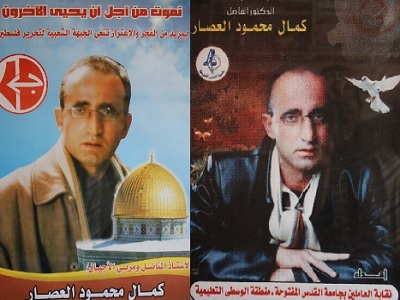
Posters of Kamal Al-Assar following his death in 2008. (Photo: Supplied)
By Ramzy Baroud | Palestine Chronicle | December 9, 2017
When I learned of the death of Kamal Al-Assar a few years ago, I was baffled. He was only in his 40s. I remember him in his prime, a young rebel, leading the neighborhood youth, armed with rocks and slingshots, in a hopeless battle against the Israeli army. Understandably, we lost, but we won something far more valuable than a military victory. We reclaimed our identity.
At every anniversary of the First Palestinian Intifada, a popular uprising that placed the Palestinian people firmly on the map of world consciousness, I think of all the friends and neighbors I have lost, and those I have left behind. The image of Ra’ed Mu’anis, in particular, haunts me. When an Israeli sniper’s bullet plunged into his throat, he ran across the neighborhood to find help before he collapsed at the graffiti-washed walls of my house.
“Freedom. Dignity. Revolution,” was written in large red letters on the wall, a pronouncement signed by the Popular Front for the Liberation of Palestine.
Only later I learned that Kamal was the one who carried Ra’ed out of the firing zone. But it was too late. Ra’ed, a skinny and feeble teenager, with a distinct black mark on his forehead had bled alone at the steps of my home. When he was buried, hundreds of refugees descended on the Martyrs Graveyard. They carried Palestinian flags and chanted for the Intifada and the long-coveted freedom. Ra’ed’s mother was too weakened by her grief to join the procession. His father tried to stay strong, but wept uncontrollably instead.
Kamal was revitalized by the Intifada. When the uprising broke out, he emerged from his own solitude. Life made sense once again.
For him, as for me and many of our generation, the Intifada was not a political event. It was an act of personal – as much as collective – liberation: the ability to articulate who we were at a time when all seemed lost. The Palestinian Liberation Organisation (PLO) languished in Tunisia after being forced to leave Lebanon in 1982. Arab governments seemed to have lost interest in Palestine altogether. Israel emerged triumphant and invincible.
And we – those living under protracted military occupation – felt completely abandoned.
When, on December 8, 1987, thousands took to the streets of Jabaliya Refugee Camp, the Gaza Strip’s largest and poorest camp, the timing and the location of their uprising was most fitting, rational and necessary. Earlier on that day, an Israeli truck had run over a row of cars carrying Palestinian laborers, killing four young men. For Jabaliya, as with the rest of Palestine, it was the last straw.
Responding to the chants and pleas of the Jabaliya mourners, the refugees in my refugee camp – Nuseirat – marched to the Israeli military barracks, known as the “tents”, where hundreds of soldiers had tormented my camp’s residents for years.
In the morning of December 9, thousands of Nuseirat youth took to the streets and vowed to avenge the innocent blood of the Jabaliya victims of the previous day. They swung large flags made of silky fabric that swayed beautifully in Gaza’s salty air and, as the momentum grew and they became intoxicated by their own collective chants, they marched to the “tents” where the soldiers were uneasily perched on the tops of watchtowers, hiding behind their binoculars and automatic machine guns.
Within minutes, a war had started and a third generation of refugee-camp-born fellahin peasants stood fearlessly against a well-equipped army that was visibly gripped by fear and confusion. The soldiers wounded many that day and several children were killed.
Kamal was on the frontlines. He waved the largest flag, chanting the loudest, threw rocks the furthest and incessantly urged young men not to retreat.
Kamal hated school as well as his teachers. To him they seemed so docile, adhering to the rules of the occupier which decreed that Palestinians not teach their own history, so that the fellahin were denied even the right to remember who they were or where they came from. The Intifada was the paradigm shift that offered an alternative – however temporary, however chaotic – to the methodical humiliation of life under occupation.
Within hours, Kamal felt liberated. He was no longer tucked away in a dark room reading the works of Marx and Gramsci. He was in the streets of Nuseirat fashioning his own utopia.
The Intifada was that transformational period that saved a generation from being entirely lost, and Palestine from being forgotten. It offered a new world, that of solidarity, camaraderie and wild youth who needed no one to speak on their behalf.
Within weeks of bloody clashes in which hundreds of youth fell dead or wounded, the nature of the Intifada became clearer. On one hand, it was a popular struggle of civil disobedience, mass protests, commercial and labor strikes, refusal to pay taxes and so on. On the other hand, militant cells of refugee youth were beginning to organize and leave their mark, as well.
The militancy of the intifada did not become apparent until later, when the repression by the Israeli government grew more violent. Under the banner of the “Iron Fist” campaign, a new Israeli stratagem was devised, that of the “broken bones” policy. Once captured, youth had their hands and legs broken by soldiers in a systematic and heartless manner. In my neighborhood, children with casts and crutches seemed to outnumber those without.
Kamal was eventually detained from his home. He attempted to escape but the entire neighborhood was teeming with soldiers, who arrived at night as they always do. They commenced the torturous rite in his living room, as his mother – the resilient, Tamam – shoved her body between him and the ruthless men.
When Kamal regained consciousness, he found himself in a small cell, with thick, unwashed walls that felt cold and foreign. He spent most of his prison time in the torture chamber. His survival was itself nothing less than a miracle.
When the Oslo Accords were signed in 1993, officially ending the Intifada, Kamal’s generation felt betrayed. Nothing good came out of that “peace”, except that a few rich Palestinians grew even richer.
Kamal died a few years ago. I learned that his revolution never ceased. He became a teacher, laboring to reconstruct the history of his people at a local Gaza university. His mother, now an old refugee in Nuseirat is still heartbroken over her son’s death. She told me that Kamal’s wounds and physical ailments from prison never healed.
Kamal was a martyr, she told me. Perhaps the last martyr in an uprising that was not meant to liberate land, but liberate people from the idea that they were meant to exist as perpetual victims; and it did.
Guardian Newspaper Pushing Fake News: ‘Putin Plotting to Cut Off UK Internet’
21WIRE | December 18, 2017
Although not as intense as the US mainstream media, the UK mainstream outlets are producing their share of fabricated narratives intended to stoke fear into the minds of the British public.
This latest fish tale comes from The Guardian newspaper, as “defense correspondent” Ewen MacAskil attempts to revive a two year-old mainstream media conspiracy theory about a secret Russian plot to cut transatlantic undersea internet cables which connect Britain and the United States. MacAskil writes:
“Russia could pose a major threat to the UK and other NATO nations by cutting underwater cables essential for international commerce and the internet, the chief of the British defence staff, Sir Stuart Peach, has warned.
Russian ships have been regularly spotted close to the Atlantic cables that carry communications between the US and Europe and elsewhere around the world.”
It turns out that this latest attempt by The Guardian to stoke fear in the minds of the British public – is a recycled version of a 2015 piece of mainstream fake news, apparently stitched together by the New York Times. It reads like something out of Cold War B movie, with shades of the Hunt for Red October:
“Russian submarines and spy ships are aggressively operating near the vital undersea cables that carry almost all global Internet communications, raising concerns among some American military and intelligence officials that the Russians might be planning to attack those lines in times of tension or conflict.
The issue goes beyond old worries during the Cold War that the Russians would tap into the cables — a task American intelligence agencies also mastered decades ago. The alarm today is deeper: The ultimate Russian hack on the United States could involve severing the fiber-optic cables at some of their hardest-to-access locations to halt the instant communications on which the West’s governments, economies and citizens have grown dependent.”
It seems that in the absence of an actual threat, mainstream media outlets like The Guardian and the New York Times are left with nothing else but to fabricate various Russian subversion narratives – with no actual evidence ever presented – in order to construct a public perception that Russia is somehow undermining all aspects of British and American society.
The Guardian Lies About Syria
McKaskel’s Red October article also has a conspicuous statement where the author attempts to bracket Russia’s legal (unlike the US and Britain’s illegal covert and fly-over ops) intervention in Syria with ‘hybrid warfare’ and ‘destablising NATO’. The propaganda value here is breathtaking:
“As well as conventional military involvement in Syria, Russia has been accused of engaging in hybrid warfare, including cyberwarfare, aimed at destabilising NATO.”
Rather than investigate and publish real news, it seems that the once respected liberal standard bearer The Guardian is firmly in the mainstream media’s fake new camp – promoting the NATO member state and US-UK establishment conspiracy theory that Russia is plotting to do all manner of evil and subterfuge in Europe and the US.
Meanwhile, editors at the Guardian refuse to do an real investigation in the the full scope of the UK government’s covert slush fund in Syria. As 21WIRE reported earlier this month:
“The BBC will be carrying out a controlled journalistic “explosion” on their Panorama programme, airing tonight in the UK. Their report, dramatically titled, “Jihadis You Pay For” is about to expose UK Foreign and Commonwealth Office (FCO) for the funding of extremist and terrorist groups in Syria via their “Free Syrian Police” project set-up in ‘rebel-held’ areas of Syria since 2014. To referee this virtual clash of the titans, The Guardian has been drafted-in to do the honours.”
“The report, Jihadis You Pay For, will claim that Foreign Office money paid to the FSP reached people with links to the extremist group al-Nusra Front.” ~ The Guardian
 In fact, it was The Guardian newspaper who actively campaigned on behalf of the UK and US government-funded pseudo “NGO” known as the White Helmets to win the Nobel Peace Prize in 2016. This, despite the fact that this western ‘first-responder’ construct has clear links to al Qaeda terrorists affiliates in Syria.
Here is good example of how The Guardian has been spinning blatant fake news about Syria. In their Nobel Prize promotional piece for the White Helmets, they printed a number of false and misleading statements. Here is one of them:
“In Aleppo, 300,000 people are exposed to a relentless barrage of airstrikes. The Syrian government and Russia now seem intent on crushing Aleppo, the opposition’s last stronghold, before a new American president takes office.”
What the Guardian conveniently fail to mention is the fact that the terrorists brigades backed by NATO members and Gulf-states – only occupied East Aleppo with an estimated remaining population of around 160,000. In contrast, there were some 1.4 million Syrians living under government protection in the much larger West Aleppo. These residents were under siege by terrorist Hell Cannons and random mortar fire which claimed at least 11,000 innocent lives during the terrorist occupation of East Aleppo. This was a common mainstream media trick which was more or less standard practice across most mainstream corporate outlets. Unlike the fabricated and totally undocumented and very likely falsified claims by the White Helmets that they “saved 90,000 lives” between late 2013 and 2017, the 11,000+ civilians deaths in West Aleppo at the hands of NATO and Gulf-backed terrorists are all documented by the Aleppo Medical Association.
The Guardian also claim that the White Helmets are “volunteers” – when in fact they are paid a regular salary which is much higher than the national average salary in Syria – a fact conveniently left out in the Guardian’s apparent foreign office propaganda piece:
“This is the backdrop against which the White Helmets operate – a western-funded Syrian search-and-rescue organisation whose members put their lives at great risk to save civilians, receiving only a monthly stipend of $150.”
The Guardian’s “journalists” would never dare mention that the White Helmet’s ‘monthly stipend’ is far in excess of the standard salary for a Syrian Army soldier who makes far below $100 per month.
To call any this journalism would be a gross overstatement.
By this account, The Guardian are guilty of the most egregious form of propaganda throughout its shameful coverage of Syria over the last 7 years.
Read more about the White Helmets here.
SEE ALSO: The Guardian Exposed – Conning Public into Financing ‘Independent Journalism’
VIDEO: Watch this Fake rescue video filmed and released by the White Helmets
UN Security Council Passes Resolution Challenging Jerusalem Declaration; US Vetoes
By Celine Hagbard | IMEMC | December 18, 2017
Fourteen of the fifteen nations in the United Nations Security Council voted Monday reaffirming the status of the city of Jerusalem as unresolved, and challenging the U.S. administration’s decision to recognize Jerusalem as the capital of Israel. The U.S., which has veto power in the Council, vetoed the resolution.
Following the U.S. veto of the resolution, Israeli Prime Minister Binyamin Netanyahu tweeted, “Thank you, Ambassador Haley. On Hanukkah, you spoke like a Maccabi. You lit a candle of truth. You dispel the darkness. One defeated the many. Truth defeated lies. Thank you, President Trump.”
The veto on Monday’s vote marked the first time that the U.S. has used its veto power since Donald Trump took power in the country.
The U.S. Ambassador to the United Nations said following the vote, “We [veto this resolution] with no joy, but we do it with no reluctance. The fact that this veto is being done in defense of American sovereignty and in defense of America’s role in the Middle East peace process is not a source of embarrassment for us; it should be an embarrassment to the remainder of the Security Council.”
But critics have pointed out that the U.S. administration’s move claiming Jerusalem as the capital of Israel is outside of the U.S. government’s jurisdiction, and is undermining the sovereignty and self-determination of the Palestinian people by denying their existence and right to the holy city.
Ambassador Haley also called the UN Security Council Resolution an insult.
The UN Security Council resolution was introduced by the Egyptian delegation to the Council, and was widely supported by nations around the world.
The UN Mideast Envoy Nickolay Mladenov spoke in favor of the resolution, citing Israel’s decade-old ‘E1 Plan’ to encircle the city of Jerusalem with colonial settlements, thereby cutting off the West Bank from the city and expanding the Israeli state in direct violation of international law and signed agreements.
According to Mladenov, since Trump made his declaration on December 6th, “some 1,200 units in the occupied West Bank were approved for construction, approximately 460 of them in the settlement of Ma’ale Adumim, in addition to the new settlement of Amihai, a new neighborhood in Kochav Yaakov, and a new site near Alon Shvut. The construction of infrastructure in Givat Hamatos…would solidify the ring of settlements isolating East Jerusalem from the southern West Bank.” Also in the past 12 days since Trump’s statement, “Israeli authorities demolished or seized 61 structures, 110 people, including 61 children were displaced and the livelihoods of over 1,000 people were affected.”
He pointed out that Israel has engaged in massive settlement growth on stolen Palestinian land, violence against civilian populations, and incitement against Palestinians, and noted that, “in 2017, there were 109 shooting, stabbing, ramming and bombing attacks conducted [by Palestinians against Israelis], compared to 223 in 2016. In 2017, 72 Palestinians and 15 Israelis were killed, while in 2016 there were 109 and 13, respectively.
The Israeli ambassador to the United Nations criticized the Security Council resolution, saying, “members of the Security Council can vote another hundred times to criticize our presence in Jerusalem, but history won’t change. While the Jewish people celebrate the holiday of Hanukkah that symbolizes the eternal connection to Jerusalem, there are people who think that they can rewrite history. It’s time for all countries to recognize that Jerusalem always was and always will be the capital of the Jewish people and the capital of Israel.”
But the statement by the Israeli ambassador did not acknowledge that the Security Council was not criticizing Jewish presence in the city of Jerusalem, but was instead challenging a unilateral action by the state of Israel, backed by the United States, to take over territory through the use of military force and expand Israel’s (never declared) borders while pushing out, killing and denying the presence of the indigenous Palestinian population. … Full article
Hernandez declared winner of Honduras presidential race, opposition calls for rallies
Press TV – December 18, 2017
In Honduras, incumbent Juan Orlando Hernandez has been declared the winner of last month’s disputed presidential election after a partial recount, with the opposition candidate rejecting the results and calling for fresh protests.
The Supreme Electoral Tribunal said Sunday after the official recount that Hernandez has won with 42.95 percent to 41.42 for challenger Salvador Nasralla.
“We have fulfilled our obligation (and) we wish for there to be peace in our country,” the tribunal’s president David Matamoros said.
Matamoros said the tribunal had resolved all the disputed issues, and that votes were recounted at select polling stations.
The count has, however, been questioned by the two main opposition parties and monitors with the Organization of American States (OAS).
As he left for the United States, Nasralla rejected Hernandez’s re-election as illegitimate and called for more protest rallies on Monday.
“The declaration by the court is a mockery because it tramples the will of the people,” Nasralla said. He added that he was “very optimistic” because “the people do not endorse fraud.”
He also said he would urge the OAS in Washington to invoke its democratic charter against Honduras.
The former Honduran president, Manuel Zelaya, who backed Nasralla, tweeted Hernandez “is not our president,” urging people to take to the streets in protest.
Meanwhile, the OAS secretary general, Luis Almagro, said “serious questions” surrounded the election results, urging Honduran officials to avoid making “irresponsible announcements.”
He also called for a fresh presidential election to guarantee peace in the country, which has been the scene of angry protests and clashes since the November 26 presidential election.
However, European Union election observers said the vote recount showed no irregularities.
The initial results had shown Nasralla with a significant lead over Hernandez with nearly 60 percent of the vote counted.
The electoral tribunal then went mysteriously silent, giving no further public updates for about 36 hours, and when they resumed, Nasralla’s lead steadily eroded and ultimately reversed in favor of Hernandez.
The protests and violence, which broke out over the manner of announcing the results, has killed at least 22 people.
NYT’s Argentina Op-Ed Fails to Disclose Authors’ Financial Conflict of Interest
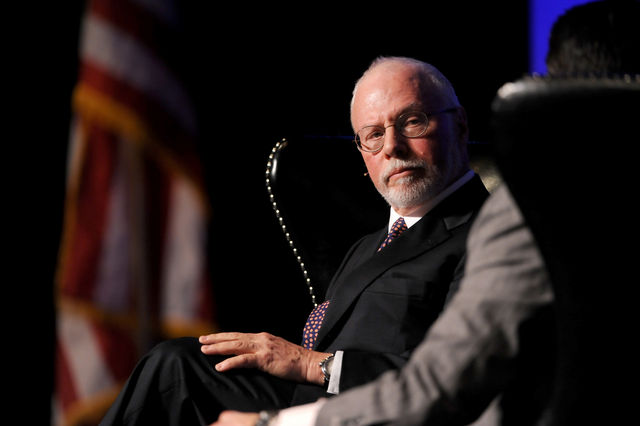
Photo: Paul Singer
By Eli Clifton | LobeLog | December 13, 2017
On Tuesday, Mark Dubowitz and Toby Dershowitz, two executives at the hawkish Foundation for Defense of Democracies (FDD), took to the op-ed pages of The New York Times to celebrate last week’s announcement that Argentina’s former president, Cristina Fernández de Kirchner, would face treason charges for her alleged role in covering up Iran’s alleged involvement in the 1994 bombing of a Jewish community center in Buenos Aries, killing 85 people.
But their op-ed fails to disclose a serious financial conflict of interest underpinning their attacks on Kirchner. One of FDD’s biggest donors financed a multi-year public diplomacy campaign against Kirchner all while attempting to collect $2 billion in debt from Argentina.
Indeed, legitimate questions exist about the bombing and suspicious 2015 death of Argentine Special Investigator Alberto Nisman who claimed in 2006 that Iran ordered the bombing. But Kirchner’s supporters fear that Argentina’s President Mauricio Macri is using judicial reforms and charges against Kirchner to remove his political opposition.
FDD has been eager to promote Nisman’s work. The group also runs AlbertoNisman.org “to honor the legacy of late Argentine Prosecutor Natalio Alberto Nisman and his tireless pursuit of justice.” FDD continues this work despite serious questions about large unexplained deposits to Nisman’s bank account.
Moreover, their rush to denigrate Kirchner omits a major conflict of interest in Dubowitz and Dershowitz’s funding. Between 2007 and 2011, hedge-fund billionaire Paul Singer contributed $3.6 million to FDD. That coincided with his battle to force Argentina to repay the full amount of the sovereign debt held by Singer’s firm, Elliott Management, a payout that Kirchner rejected. Ninety-three percent of Argentina’s creditors accepted losses, but Singer was one of the few holdouts. Having bought up Argentina’s defaulted bonds at pennies on the dollar, he had then sued the country for payment in full.
Singer embarked on a 15-year legal battle to collect on Argentina’s debt payments by attempting to seize Argentine government assets around the world, including a 100-meter three-masted tall ship when it docked in Ghana). After financing public diplomacy campaigns against Kirchner, Singer’s firm walked away with approximately 75 percent of what he was owed, $2.4 billion. The deal, finalized last year, was largely credited to Mauricio Macri, Kirchner’s successor.
Groups receiving Singer’s donations kept up a steady drumbeat of attacks on Kirchner and sought to tie her to Iran and Nisman’s suspicious death. “We do whatever we can to get our government and media’s attention focused on what a bad actor Argentina is,” Robert Raben, executive director of the American Task Force Argentina (ATFA) explained to The Huffington Post.
ATFA, a group created by Singer and other hedge fund holdouts, spent at least $3.8 million dollars over five years in its efforts attacking Argentina.
“Argentina and Iran: Shameful Allies” was the headline of one ATFA ad that ran in Washington newspapers in June 2013 as the Obama administration was weighing whether to file an amicus brief with the U.S. Supreme Court in Argentina’s favor. The ad featured side-by-side photos of Kirchner and then-Iranian President Mahmoud Ahmadinejad connected by the question, “A Pact With the Devil?” That same spring, FDD release an English-language summary of a new “ground-breaking” report by Nisman detailing “Iran’s extensive terrorist network in Latin America.”
This was followed by a flood of op-eds by FDD fellows and a series of hearings held by the House Homeland Security Subcommittee. According to FDD’s vice president, Toby Dershowitz, the report, which contains serious flaws and leaps of logic (detailed by Jim Lobe here and here), provided:
[A] virtual road map for how Iran’s long arm of terrorism can reach unsuspecting communities and that the AMIA attack was merely the canary in the coal mine. … The no-holds-barred, courageous report is a ‘must read’ for policy makers and law enforcement around the world and Nisman himself should be tapped for his guidance and profound understanding of Iran’s terrorism strategy.
Singer’s largesse also extended to the American Enterprise Institute (AEI) where he contributed $1.1 million in 2009. AEI Fellow Roger Noriega, who received $60,000 directly from Elliott Management in 2007 to lobby on the issue of “Sovereign Debt Owed to a U.S. Company,” published an article on the group’s website—“Argentina’s Secret Deal with Iran?”—citing secret documents about an alleged nuclear cooperation agreement between Tehran and Buenos Aires “brokered and paid for” by then-Venezuelan President Hugo Chávez.
In 2013, Noriega and Jose Cardenas, a contributor to AEI’s “Venezuela-Iran Project,” co-authored a seven-page policy report—“Argentina’s Race to the Bottom”—charging that Kirchner’s government was “casting its lot with rogue governments like those in Venezuela and Iran.”
Singer also gave $500,000 to The Israel Project (TIP) in 2007 and $1 million in 2012. By May 2015, the group’s magazine, The Tower, published no fewer than 48 articles that mentioned Argentina and 40 that cited Nisman and the 1994 bombing.
Neither AEI, TIP, nor FDD has bothered to disclose its funding from Singer when publishing work that advanced his public pressure campaign against Kirchner. Indeed, there is no public record of why Singer chooses to fund these organizations. But his funding poses a conflict of interest, especially when The New York Times publishes Dershowitz and Dubowitz without any public acknowledgement that their criticism of Kirchner conveniently follows the narrative and financial interests of one of the duo’s biggest financial donors.
Questioning the Russia-gate ‘Motive’

Donald Trump and Hillary Clinton in the third presidential debate in 2016, during which Clinton called Trump Vladimir Putin’s “puppet.”
By Gilbert Doctorow | Consortium News | December 18, 2107
The American public is now experiencing mass paranoia over Russia-gate, hysteria about Russia supposedly corrupting and manipulating the U.S. political system. This panic originated with Obama administration holdovers in the intelligence community who outlined the narrative while providing few if any facts — and it has been carried forward by Democrats, some Republicans hostile to President Trump, and by the U.S. mainstream media.
The Russia-gate frenzy has similarities to the madness that followed the 9/11 attacks when public passions were manipulated to serve the geopolitical agenda of President George W. Bush and Vice President Dick Cheney. In that case, civil liberties that had become accepted norms in the U.S. were suddenly cast aside – and the public was deceptively led into the invasion of Iraq.
In both cases – the Iraq War and Russia-gate – the U.S. intelligence community played central roles by – regarding Iraq – promoting false intelligence that Iraq was hiding WMD and had ties to Al Qaeda and – in the Russian case – assessing (without presenting evidence) that Russian President Vladimir Putin ordered the hacking of Democratic emails and their publication via WikiLeaks to hurt Hillary Clinton’s campaign and to help elect Donald Trump.
While the Iraq deception was driven by the neoconservatives in the Bush-Cheney administration, the Russia paranoia was started by the nominally left-of-center administration of Barack Obama in the closing months of his presidency. It has been fanned ever since by liberals and centrists in the Democratic Party and the never-Trump contingent in the Republican Party as well as the mainstream media – with the goal of either removing Trump from office or politically crippling him and his administration, i.e., to reverse the results of the 2016 election or, as some might say, reverse the “mistake” of the 2016 election.
Because promoters of the Russia-gate hysteria talk about the Kremlin’s “war” on the U.S. political process, the frenzy also carries extreme dangers, even greater than the death and destruction from the Iraq War. Russia is the only country on earth capable of turning the United States into ashes within a day. And even as U.S. journalists and politicians have casually – and sloppily – hyped the Russia-gate affair, the Russians have taken the growls of hostility from the United States very seriously.
Rumbles of War
If Russia is preparing for war, as the latest issue of Newsweek magazine tells us, we have no one but our political leaders and media pundits to blame. They have no concern for Russian national sensitivities and the “red lines” that the Russians have drawn. U.S. senators and congressmen listen only to what U.S. “experts” think the Russian interests should be if they are to fit into a U.S.-run world. That is why the Senate can vote 98-2 in favor of elevating President Obama’s executive sanctions against Russia into federal law as happened this past summer so President Trump can’t reverse them.
There have been a few U.S. journalists and academics who have examined the actual facts of the Russia-gate story and found them lacking in substance if not showing outright signs of fabrication, including Consortiumnews.com, Truthdig.com, and Antiwar.com. But they make up a very small minority.
Instead the major U.S. media has taken the Jan. 6 “Intelligence Community Assessment” accusing the Russians of meddling in the 2016 election as unassailable truth despite its stunning lack of evidence. According to President Obama’s Director of National Intelligence James Clapper, that “assessment” came from a “hand-picked” group of analysts from the CIA, FBI and National Security Agency, not the “all 17 intelligence agencies consensus” that the public was repeatedly told.
Perhaps the most significant challenge to the Russia-did-the-hacking “assessment” came from a study of the available forensic evidence by a group of former U.S. intelligence officers with relevant technical expertise from Veteran Intelligence Professionals for Sanity.
The VIPS’ analysis of the known download speed of one batch of Democratic emails concluded in July that the emails were likely extracted by a local download, not an external hack over the Internet, i.e., an inside job by someone with direct access to the computers. But the VIPS findings were largely ignored by the U.S. mainstream media, which has treated the original “assessment” by those “hand-picked” analysts as unchallengeable if not flat fact.
Besides the conventional wisdom that Russia did “hack” the emails and somehow slipped the emails to WikiLeaks, there is another core assumption of the Jan. 6 report – that Russian President Vladimir Putin ordered the hack of the Democratic emails and their publication through WikiLeaks because of his contempt for Hillary Clinton and his desire for Trump to win.
Indeed, the Jan. 6 “assessment” treats this supposed motive as the central evidence of Russian guilt, since actual physical or testimonial evidence is lacking. Yet what is also missing from the report is any recognition of other attitudes among the Russian political elite that would go against the report’s thesis, including whether Putin would have taken such a risk in the face of a widespread consensus that Clinton was the near-certain winner – and the strong possibility that any Russian operation would be exposed. An evenhanded intelligence “assessment” would have included these counter-arguments even if in the end they were cast aside. But the Jan. 6 report offered no such context or balance.
A View from Moscow
However, from my perspective – having participated in some of the leading Russian public affairs programs in 2016 – I heard Russian insiders close to President Putin expressing grave doubts about whether a Trump presidency would be good for Russia.
Political talk shows are a very popular component of Russian television programming on all channels, both state-run and commercial channels. They are mostly carried on prime time in the evening but also are showing up in mid-afternoon where they have displaced soap operas and cooking lessons as entertainment for housewives and pensioners.
The shows are broadcast live either to the Moscow time zone or to the Far East time zone. Given the fact that Russia extends over nine time zones, they are also video recorded and reshown locally at prime time. In the case of the highest quality and most watched programs produced by Vesti 24 for the Rossiya One channel, they also are posted in their entirety and in the original Russian on Youtube.
The panelists come from a rather small pool of Russian legislators, including chairmen of the relevant committees of the Duma (lower house) and Federation Council (upper house); leading journalists; think tank professors; and retired military brass. The politicians are drawn from among the most visible and colorful personalities in the Duma parties, but also extend to Liberal parties such as Yabloko, which failed to cross the five-percent threshold in legislative elections and thus received no seats in parliament.
(Since I live in Brussels, I was flown by the various channels who paid airfare and hotel accommodation in Moscow. That is to say, my expenses were covered but there was no honorarium. I make this explicit acknowledgement to rebut in advance any notion that I and other outside panelists were in any way “paid by the Kremlin” or restricted in our freedom of speech on air.)
During the period under review, I appeared on both state channels, Rossiya-1 and Pervy Kanal, as well as on the major commercial television channel, NTV. My debut on the No. 1 talk show in Russia, “Sunday Evening with Vladimir Soloviev,” on Sept. 11, 2016, was particularly useful because I had a chance to speak with the host, Vladimir Soloviev, for five minutes before the program.
I put to him the question that interested me the most: whom did he want to see win the U.S. presidential election. Without hesitation, Soloviev told me that he did not want to see Trump win because the celebrity businessman was volatile, unpredictable — and weak. Soloviev added that he and other politically knowledgeable Russians did not expect improved relations with the U.S. regardless of who won. He rejected the notion that Trump’s tossing the neocons out of government would be a great thing in and of itself.
The Devil You Know
Soloviev’s resistance to the idea that Trump could be a good thing was not just an example of Russians’ prioritizing stability, the principle “better the devil you know,” meaning Hillary Clinton. During a chat with a Russian ambassador, someone also close to power, I heard the firm belief that the United States is like a big steamship which has its own inertia and cannot be turned around, that presidents come and go but American foreign policy remains the same.
This view may be called cynical or realistic, depending on your taste, but it is reflective of the thinking that came out from many of the panelists in the talk shows.
To appreciate what weight the opinions of Vladimir Soloviev carry, you have to consider just who he is – that his talk show is the most professional from among numerous rival shows and attracts the most important politicians and expert guests. But even more to the point, he is as close to Putin as journalists can get and is familiar with the President’s thinking.
In April 2015, Soloviev conducted a two-hour interview with Putin that was aired on Rossiya 1 under the title “The President.” In early January 2016, the television documentary “World Order,” co-written and directed by Soloviev, set out in forceful terms Putin’s views on American and Western attempts to stamp out Russian sovereignty that first were spoken at the Munich Security Conference in February 2007 and have evolved and become ever more frank since.
Soloviev has a Ph.D. in economics from the Institute of World Economics and International Relations of the USSR Academy of Sciences. He was an active entrepreneur in the 1990s and spent some time back then in the U.S., where his activities included teaching economics at the University of Alabama. He is fluent in English and has been an unofficial emissary of the Kremlin to the U.S. at various times.
For all of these reasons, I believe it is safe to say that Vladimir Soloviev represents the thinking of Russian elites close to Putin, if not the views of Putin himself.
I encountered similar skepticism about Trump elsewhere as well. On Sept. 27, 2016, I took part in the “Sixty Minutes” talk show on Rossiya 1that presented a post-mortem of the first Trump-Clinton debate the day before.
Presenter Yevgeny Popov and his wife and co-presenter Olga Skabeyeva made a point that was largely missing in Western news coverage – that the Democrats and Republicans had largely switched positions on the use of military force, with Clinton taking the more hawkish position and Trump the more dovish stance.
Doubting Trump
Yet, Russian politicians and journalists on the panel were split down the middle on whether Trump or Clinton was their preferred next occupant of the Oval Office. The Trump skeptics noted that he was impulsive and could not be trusted to act with prudence if there was some crisis or accidental clash between U.S. and Russian forces in the field, for example.
They took the cynical view that the more dovish positions that Trump took earlier were purely tactical, to differentiate himself from his Republican competitors and then Clinton. Thus, these analysts felt that Trump could turn out to be no friend of Russia on the day after the elections.
One Trump doubter called Trump a “non-systemic” politician – or anti-establishment. But that is not a compliment in the Russian context. It has the odious connotation applied to Alexei Navalny and some members of the U.S.- and E.U.-backed Parnas political movement, suggesting seditious intent.
The Oct. 20 program “Evening with Vladimir Soloviev,” which I watched on television from abroad, was devoted to the third Clinton-Trump debate. My main takeaway from the show was that there was a bemused unanimity on the very diverse panel that the U.S. presidential campaign was awful, with both candidates having serious weaknesses of character and/or careers. Particular attention was devoted to the very one-sided position of the U.S. mass media and the centrist establishments of both parties favoring Hillary Clinton.
Though flamboyant in his language, nationalist politician Vladimir Zhirinovsky, leader of the LDPR Party, touched on a number of core concerns:
“The debates were weak. The two cannot greet one another on stage, cannot say goodbye to one another at the end. They barely can get out the texts that have been prepared for them by their respective staffs. Repeating on stage what one may have said in the locker room. Billions of people around the world conclude with one word: disgrace! This is the worst electoral campaign ever.
“And mostly what we see is the style of the campaign. However much people criticize the USSR – the old fogies who ran it, one and the same, supposedly the conscience of the world. Now we see the same thing in the USA: the exceptional country – the country that has bases everywhere, soldiers everywhere, is bombing everywhere in some city or other. …
“Hillary has some kind of dependency. A passion for power – and that is dangerous for the person who will have her finger on the nuclear button. If she wins, on November 9th the world will be at the brink of a big war.”
Zhirinovsky made no secret of his partiality for Trump, calling him “clean” and “a good man” whereas Clinton has “blood on her hands” for the deaths of hundreds of thousands due to her policies as Secretary of State. But then again, Zhirinovsky has made his political career over more than 30 years precisely by making outrageous statements that run up against what the Russian political establishment says aloud.
Zhirinovsky had been the loudest voice in Russian politics in favor of Turkey and its president Erdogan, a position which he came to regret when the Turks shot down a Russian jet at the Syrian border, causing a rupture in bilateral relations.
The final word on Russia’s electoral preferences during the Oct. 20 show was given by the moderator, Vladimir Soloviev: “There can be no illusions. Both Trump and Clinton have a very bad attitude toward Russia. What Trump said about us and Syria was no compliment at all. The main theme of American political life right now is McCarthyism and anti-Russian hysteria.”
This being Russia, one might assume that the deeply negative views of the ongoing presidential election reflected a general hostility toward the United States as a country. But nothing of the sort came out from the discussion. To be sure, there was the odd outburst from Zhirinovsky. But otherwise the panelists, including Zhirinovsky, displayed informed respect and even admiration for what the U.S. has achieved and represents as a country. But the panelists concluded that the U.S. has a political leadership at the national level that is unworthy and inappropriate to its position in the world.
Yet, back in the U.S., the ongoing hysteria over Russia-gate and the perceived threat that Russia poses to U.S. national interests, risks tilting the world into nuclear war.
Gilbert Doctorow is an independent political analyst based in Brussels. His latest book, Does the United States Have a Future?
US should have withdrawn its estimated 200 nukes from Europe long ago – Moscow
RT | December 18, 2017
The US should withdraw the nuclear weapons it has deployed in Europe rather than upgrading them, a senior Russian diplomat has said. Moscow is concerned that the upgrades are making the bombs more suitable for actual combat.
The US stores an estimated 200 of its B61 nuclear bombs in countries like Germany, Belgium, Italy, the Netherlands and Turkey as part of NATO’s nuclear sharing program. Russia has long considered the continued presence of American nuclear weapons in other nations as a hostile gesture after the Cold War.
“Russia has long withdrawn its nuclear weapons to its national territory. We believe that the American side should have done the same a long time ago,” Mikhail Ulyanov, head of the non-proliferation and arms control department in the Russian Foreign Ministry, told RIA Novosti.
“They are actually planning to upgrade them to be, according to some retired American military officials, ‘more suitable for combat use’ thanks to better precision and somewhat reduced power,” the diplomat said, adding that Moscow suspects that the US may have plans to deploy additional nuclear bombs to Europe under the guise of an upgrade.
In August, the US National Nuclear Security Administration announced a second successful test of the B61 – the 12th version of the bomb with no nuclear warhead. The first test was conducted in March. The Mod12 version is meant to replace a number of older designs by refurbishing them, with the process expected to start in 2019.
Moscow criticized the US not only for keeping nuclear weapons in non-nuclear nations, but also for training its NATO allies in their deployment. Such actions, Russia believes, violate the spirit of America’s non-proliferation commitments.
The Trump administration plans to spend over $1 trillion upgrading America’s nuclear arsenal, claiming it is necessary to keep up with Russia.
Claim of Iran military aid to Yemen sheer lie: Larijani
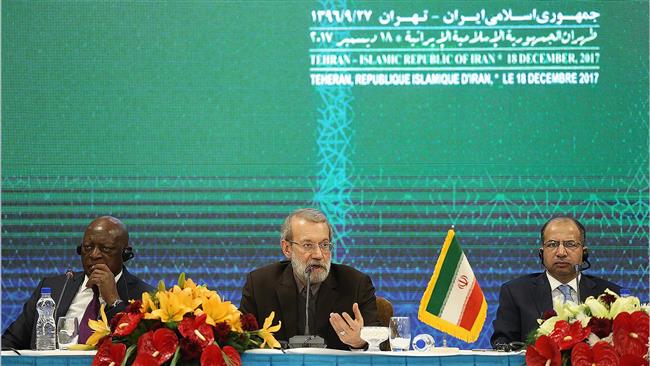
Iran’s Parliament Speaker Ali Larijani (C) speaks to reporters following the Meeting of the PUIC Presidential Troika in the Iranian capital Tehran on December 18, 2017. (Photo by ICANA)
Press TV – December 18, 2017
Iran’s Parliament Speaker Ali Larijani says the Islamic Republic is not providing military assistance to Yemen and all claims to this effect are false.
Larijani made the remarks while addressing the extraordinary meeting of the Palestinian Committee of the Parliamentary Union of the Organization of Islamic Cooperation Member States (PUOICM) in the Iranian capital Tehran on Monday.
“We are not a country that would deny providing military assistance to anybody,” Larijani said.
He added that Iran was providing military assistance to Palestine, but had not helped Yemeni fighters in their war with Saudi Arabia in military terms, dismissing any claim to this effect as a lie.
“The Yemenis’ missiles belong to themselves and some countries cannot achieve their goals by making such claims,” the top Iranian parliamentarian said.
On Thursday, US Ambassador to the United Nations Nikki Haley appeared in a staged show in front of a large and charred tube that she claimed was “concrete evidence” that Iran was providing missiles to Yemeni forces fighting against Saudi Arabia’s war of aggression on their country.
A Saudi Arabian-led coalition launched a war against Yemen in 2015 and has ever since been indiscriminately hitting targets in the country. Yemeni Houthi fighters have been firing missiles in retaliatory attacks against Saudi targets every now and then.
On November 4, a missile fired from Yemen targeted King Khalid International Airport near Riyadh, reaching the Saudi capital for the first time.
Elsewhere in his remarks, Larijani said terrorism has tremendously grown in recent years both in quantitative and qualitative terms, emphasizing that such growth would not have been possible without the support of the US and some countries in the region.
Israel and terrorism are the two sides of the same coin and pursue similar goals, he said.
Larijani also emphasized that US-backed terrorists sought to create chaos in the Middle East and pointed to the recent announcement by the Israeli regime that it enjoyed the best conditions since Muslim countries were grappling with terrorism.
Ali Akbar Velayati, a senior advisor to Leader of the Islamic Revolution Ayatollah Seyyed Ali Khamenei on international affairs, on Sunday dismissed as “baseless and ridiculous” the recent US claim about Iran providing missiles to Yemen’s Houthi Ansarullah movement, saying that even international experts had mocked the accusation.
“The Islamic Republic of Iran has never given missiles to Yemen,” he said.
Iranian Foreign Minister Mohammad Javad Zarif said on Friday that the United States was complicit in Saudi war crimes in Yemen.
He added that the US had sold weapons to its allies enabling them to “kill civilians and impose famine,” in reference to Washington’s arms deal with Riyadh in its aggression against Yemen.
$200bn to reconstruct war-torn Syria… the US and its partners should pay
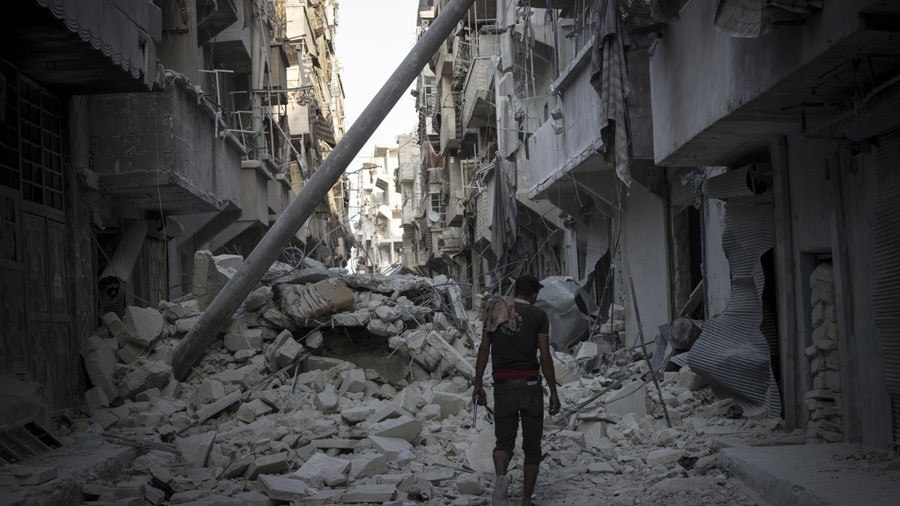
Aleppo, Syria © Karam Almasri / Global Look Press
By Finian Cunningham | RT | December 18, 2017
With Syria’s nearly seven-year war now virtually over, the process of rebuilding the devastated country comes to the fore, with the financial cost of that effort put at $200 billion. Who pays for it?
When you view the ruins of Aleppo alone, Syria’s second biggest city, plus the carnage across the entire country, from towns, villages, bridges, roads, public utilities, hospitals, schools, and so on, the real figure for reconstruction could be far higher than $200 billion.
Then there is the inestimable cost of human suffering and families decimated. All told, the reparations could amount to trillions of dollars.
Syria’s war was no ordinary civil war, as Western mainstream media tended to mendaciously depict it.
From the outset, the conflict was one of an externally driven covert war for regime change against the government of President Bashar Assad. The Arab Spring unrest of 2011 provided a convenient cover for the Western plot to subvert Syria.
The United States and its NATO allies, Britain, France, and Turkey, were the main driving forces behind the war in Syria, which resulted in up to 400,000 deaths and millions of citizens displaced from their homes. Other key regional players sponsoring the campaign against the Syrian government were Saudi Arabia, Qatar, and Israel.
Most of the militants who fought in Syria to overthrow the state authorities were not Syrian nationals. Self-styled jihadists from dozens of countries around the world made their way to Syria, where they were funded, armed and directed by covert forces from Western and Arab states.
The barbarian-like gravitation to Syria indicates the degree to which the effort to overthrow the Syrian government was orchestrated by foreign powers.
This was a planned, concerted project for regime change. The systematic violence imposed on Syria was very arguably due to an international criminal conspiracy perpetrated by the US and all of the above “partners.” The case can, therefore, be made for criminal responsibility.
That, in turn, means that financial reparations and damages can be sued by the Syrian state against those foreign powers which waged the war, albeit indirectly through proxy militant groups.
The bitter irony though is that the US and its Western allies are reportedly using Syria’s war-torn plight as leverage to pursue their political objective of ousting Assad. What these powers could not achieve on the battlefield with their terrorist mercenaries they now seem to be pursuing through their dominance over international financial institutions.
The Washington DC-based International Monetary Fund estimates the reconstruction of Syria’s devastated infrastructure will cost $200 billion. (As noted above, that’s probably a gross underestimate.)
As Bloomberg News reported last week: “The US and its European and Arab partners have for years insisted that Assad must go and are now using the carrot of funding for rebuilding the shattered nation in a final attempt to pressure the Syrian leader. The International Monetary Fund estimates the cost of reconstruction at $200 billion, and neither of Syria’s main allies, Russia and Iran, can afford to pick up the bill.”
It’s a moot point whether Russia and Iran cannot afford to help rebuild Syria. Who’s to say that those two powers along with China and other Eurasian nations could not club together to create a reconstruction fund for Syria, independent of Western countries and their Arab client regimes?
However, regardless of the source of funding for Syria, what Russia, China, Iran and other key international players should push for at the United Nations and other global forums such as the Non-Aligned Movement is the repudiation of Western efforts to link financial aid to future political change in Syria.
Alexander Lavrentiev, Russia’s envoy steering the peace process in Syria, has reiterated Moscow’s position that the political outcome for Syria must be determined by the Syrian people alone, free from external influence. That is also the position of several UN resolutions.
Lavrentiev says Bashar Assad should be free to run in next year’s presidential election if he chooses to and that it is unacceptable for the US and its allies to try to use financial aid as a bargaining tool.
“It’s a simplistic approach when some Western countries say that they’ll give money only when they see that the opposition comes to power or their interests are fully accommodated,” said the Russian envoy.
It’s not merely unacceptable for such Western conditioning. It’s outrageous. Far from quibbling about financial aid to Syria, the debate should be broadened out to hold governments to account for the destruction and loss of life in Syria.
To establish responsibility is not a mystery. Saudi Arabia, Qatar, and Turkey are known to have poured money and weapons into dozens of jihadist-styled groups, including Ahrar al-Sham and Jaysh al Islam under the umbrella of the Islamic Front or Army of Conquest. The precise distinction – if any – between these groups and the internationally proscribed terror organizations of Nusra Front (Hayat Tahrir al-Sham) and Daesh (Islamic State) is elusive and probably negligible.
American, British and French special forces are known to have trained militants under the faux banner of “moderate rebels” and “Free Syrian Army,” even when there is evidence these same groups were cooperating with Al-Qaeda-type extremist networks. Under President Barack Obama, the US government funneled $500 million into training “rebels” in Syria. Trump earlier this year closed down CIA training operations. This is, in effect, an admission of culpability by Washington of fueling the war.
The Americans and British forces were up to recently training the militant group Maghawir al Thawra at Al Tanf base on the Syrian-Iraqi border. The American government also funded another jihadist group Nour al-Din al Zenki, which came to notoriety in a video showing their members beheading a Palestinian boy.
Weapons caches recovered by the Syria Arab Army after the liberation of ISIS strongholds in Deir ez-Zor also show stockpiles of US-made arms and other NATO munitions, including anti-tank missiles.
The Western governments openly funded the fake emergency responders – the so-called White Helmets – who worked hand-in-hand as a propaganda front for Al-Qaeda-affiliated Nusra Front.
There have been systematic links between Western governments, their regional client regimes and the terror proxies who carried out the dirty war on their behalf in Syria over the past seven years.
It is an insult upon injury for Western governments to impose constraints on financial aid to Syria. Furthermore, the economic costs of reconstruction should not be levied on the Syrian people. Those costs should be paid in full by Washington and its partners who engaged in a criminal war on Syria.
Surely, Syria, Russia, Iran and other allied governments should form an international prosecution case for war crimes.
Not only should Washington, London, Paris and others be made to pay damages. Political and military leaders from these countries should be placed in the dock to answer personally for crimes against the Syrian people. To allow impunity is to let Washington and its rogue cohorts keep repeating the same crimes elsewhere, over and over.
Featured Video
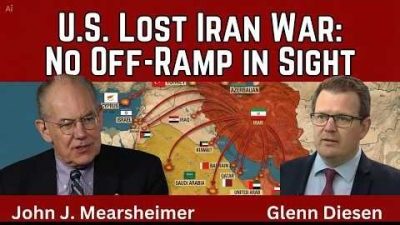
John Mearsheimer: US Already lost Iran war – No off-ramp in sight
or go to
Aletho News Archives – Video-Images
Frlom the Archives
With apparently fabricated nuclear documents, Netanyahu pushed the US towards war with Iran
By Gareth Porter | The Grayzone | April 29, 2020
President Donald Trump scrapped the nuclear deal with Iran and continued to risk war with Iran based on Israeli Prime Minister Benjamin Netanyahu’s claim to have proven definitively that Iran was determined to manufacture nuclear weapons. Netanyahu not only spun Trump but much of the corporate media as well, duping them with the public unveiling of what he claimed was the entire secret Iranian “nuclear archive.”
In early April 2018, Netanyahu briefed Trump privately on the supposed Iranian nuclear archive and secured his promise to leave the Joint Comprehensive Plan of Action (JCPOA). That April 30, Netanyahu took the briefing to the public in a characteristically dramatic live performance in which he claimed Israel’s Mossad intelligence services had stolen Iran’s entire nuclear archive from Tehran. “You may well know that Iran’s leaders repeatedly deny ever pursuing nuclear weapons…” Netanyahu declared. “Well, tonight, I’m here to tell you one thing: Iran lied. Big time.”
However, an investigation of the supposed Iranian nuclear documents by The Grayzone reveals them to be the product of an Israeli disinformation operation that helped trigger the most serious threat of war since the conflict with Iran began nearly four decades ago. This investigation found multiple indications that the story of Mossad’s heist of 50,000 pages of secret nuclear files from Tehran was very likely an elaborate fiction and that the documents were fabricated by the Mossad itself. … continue
Blog Roll
 Aletho News
- ‘Heinous crime’: Iran denounces Israeli assassination of 4 Iranian diplomats in Lebanon
- John Mearsheimer: U.S. Already Lost Iran War – No Off-Ramp in Sight
- UK Parliament Plans ISP Blocking and Age Verification Powers
- World cannot remain silent as US and Israel attack ‘heritage of humankind’: Iran
- Emirati billionaire rebukes US senator over call for Gulf states to join war with Iran
- Op. True Promise 4: Iran’s missile blitzkrieg dismantles US war machine in West Asia
- Aramco CEO warns ‘catastrophe’ imminent if Strait of Hormuz remains shut
- What If Iran Says No?
- Trump Threatens to ‘Hit’ Iran ‘Twenty Times Harder’ Over Strait of Hormuz Oil Flows
- Spare the hypocrisy: Baghaei slams Ursula’s support for US
- If Americans Knew
- Israel Decided the War, But Trump’s America Fights and Pays the Bill
- Conscientious Objector Group: Phone ‘Ringing Off Hook’ As Huge Mobilization Underway
- U.S. support for Israel continues to plummet, despite media’s best efforts
- Threats and missiles fly, death tolls soar in Iran, Lebanon, Gaza – Not a ceasefire Day 151
- Lebanon: Israel’s White Phosphorous Use Risks Civilian Harm
- Corporate Media Go All Out To Support The US-Israeli War On Iran
- US-Israel war on Iran is creating a steady growing number of amputees
- Israel planned this war on Iran for 40 years. Everything else is a smoke screen
- The wrong question about the war in Iran
- ‘Your Tax Dollars Being Used to Raise Your Gas Prices’: US-Israel Bomb Major Iranian Oil Depots
- No Tricks Zone
- New Study Documents A 20-Year Pause In Arctic Sea Ice Decline – Driven By Internal Variability
- Wake-up Call: Survey Shows Majority Of Germans Now Favor Postponing Climate Targets!
- Televised! Leading German Political Candidate Tells Schoolchildren CO2 Makes Sun Hotter!
- New Study: A Century Warming Of 1.1°C Is ‘Commonplace’ And ‘Not Unusual’ During This Interglacial
- New Study: ‘Internal Noise’ And Volcanic Forcing Can Trigger 10-15°C Warming Within Decades
- Glaciers Worldwide Are Suddendly Surging, Experts Blame Warming!
- Surprising Discovery: Sahara Is Greening…Billions Of Trees Where Once Thought To Be Barren
- New Research Reaffirms Clouds, Aerosols, And Surface Solar Radiation Are ‘Driving The Climate System’
- Germany: Electric Car Catches Fire At Charging Station, Sets Off Local “Inferno”, Widespread Damage
- New Study: Canada’s New Brunswick Was 1°C Warmer Than Today During The Medieval Warm Period
 Aletho News