The Result of Mueller’s Investigation: Nothing
By Paul Craig Roberts • Institute For Political Economy • February 16, 2018
Robert Mueller discredited himself and his orchestrated Russiagate investigation today (Friday, February 16, 2018) with his charges that 13 Russians and 3 Russian companies plotted to use social media to influence the 2016 election. Their intent, Mueller says, was to “sow discord in the US political system.”
What pathetic results to come from a 9 month investigation!
Note that the hyped Russian hacking of Hillary’s emails that we have heard about every day is no where to be found in Mueller’s charges. In its place there is “use of social media to sow discord.” I mean, really! Even if the charge were correct, considering the massive discord present in the last presidential election, with the Democrats calling Trump voters racist, sexist, homophobic white trash deplorables, how much discord could a measly 13 Russians add via social media?
Note also that the Trump/Putin conspiracy is also not present in Mueller’s charges. Mueller’s charges say that the Russians’ plan to sow discord began in 2014, before there was any notion that Trump would run for president in 2017. The link of the plot to Putin is reduced to the allegation that the plot was financed by a St. Petersburg restaurateur whose connection to Putin is that his business once catered official dinners between Russian officials and foreign dignitaries.
Finally, note that Mueller’s release of his charges in the face of dead news weekend means that Mueller knows that he has nothing to justify the massive propaganda onslaught against Trump for conspiring with Putin with which the presstitutes have regaled us. If the charges amounted to anything, they would have been released on Monday morning, and the presstitutes would have been handed by the FBI and CIA the news stories to file with their papers.
How did the 13 Russians go about sowing discord? Are you ready for this? They held political rallies posing as Americans and they paid one person (unidentified) to build a cage aboard a flatbed pickup truck and another person to wear a costume portraying Hillary in prison clothes.
How much money was lavished on this plot. A monthly budget of $1.2 million, a sum far too small to be seen in the $2.65 billion spent by Hillary and Trump and the $6.8 billion spent by all candidates for federal elective offices in the last election.
Mueller claims to have emails from some of the 13 Russians. If the emails are authentic, they sound like a few kids pretending to friends that they are doing big things. One of the emails brags that the FBI got after them so they got busy covering up their tracks.
House Speaker Paul Ryan has fallen for Mueller’s ruse.
Remember what William Binney, the person who designed the NSA spy program, said: If any such Russiagate plot existed, NSA would have the evidence. No investigation would be necessary.
One can conclude that Mueller and Rosenstein are fighting for their lives now that it is known that their spy requests for FISA court approval were based on deception. Mueller has produced this silly indictment of individuals who are not the Russian government in the hope that it will keep the attention off the FBI’s deception of the FISA court.
As a special prosecutor Mueller has demonstrated the same lack of intergrity that he demonstrated as FBI director.
Mueller’s Investigation A Farce: Files Joke Indictment Against Russian Trolls
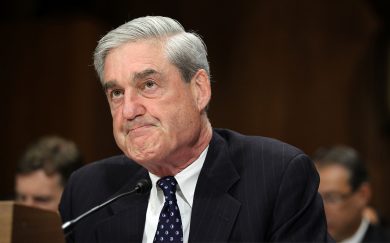
Photo by Alex Wong/Getty Images
By Elizabeth Vos | Disobedient Media | February 16, 2018
If one needed proof that Mueller’s investigation was an utter farce, they were in for a treat this morning when the Deputy Attorney General announced the indictment of indicted 13 “Russian trolls,” for allegedly interfering in the 2016 Presidential election by posting on social media accounts.
Laying Mueller’s disregard of the First Amendment aside, the indictment is blatantly hypocritical in light of active social media intervention by pro-Clinton David Brock and his multi-million dollar efforts to ‘Correct The Record.’
The indictment alleges that: “Beginning in or around June 2014, the ORGANIZATION obscured its conduct by operating through a number of Russian entities, including Internet Research LLC, MediaSintez LLC, GlavSet LLC, MixInfo LLC, Azimut LLC, and NovInfo LLC.”
The indictment further alleges that: “The ORGANIZATION sought, in part, to conduct what it called information warfare against the United States of America through fictitious U.S. personas on social media platforms and other Internet-based media.”
According to the indictment, the co-conspirators “engaged in operations primarily intended to communicate derogatory information about Hillary Clinton, to denigrate other candidates such as Ted Cruz and Marco Rubio, and to support Bernie Sanders and then-candidate Donald Trump.”
The indictment represents the latest mutation of Russian interference allegations that have dragged on for over a year. As this author previously noted, the definition of Russian interference has mutated from unsubstantiated claims of Russian hacking, to Russian collusion, and finally to Russian social media trolling.
The Washington Post reported in 2015 that David Brock’s Correct The Record would work directly with the Clinton Campaign, “testing the legal limits” of campaign finance in the process. How did Correct The Record skirt campaign finance law? The Washington Post tells us: “by relying on a 2006 Federal Election Commission regulation that declared that content posted online for free, such as blogs, is off-limits from regulation.” And post online, Brock’s PAC did: “disseminating information about Clinton on its Web site and through its Facebook and Twitter accounts, officials said.”
Time reported the opinion of a lawyer at the Campaign Legal Center who characterized Correct The Record as: “creating new ways to undermine campaign regulation.” Meanwhile, The New York Times detailed the “outrage machine” that Brock and fellow Clinton supporter Peter Daou had created:
“Peter Daou sat with his team at a long wooden table last week, pushing the buttons that activate Mrs. Clinton’s outrage machine. Mr. Daou’s operation, called Shareblue, had published the article on Mr. Trump’s comment on its website and created the accompanying hashtag.“They will put that pressure right on the media outlets in a very intense way,” Mr. Daou, the chief executive of Shareblue, said of the Twitter army he had galvanized. “By the thousands.”
Going further, the New York Times details fervently the $2 million budget of Daou’s Shareblue and admits that the intent of the entire operation is interference in the outcome of the 2016 Presidential election in favor of Hillary Clinton: “Beyond creating a boisterous echo chamber, the real metric of success for Shareblue, which Mr. Brock said has a budget of $2 million supplied by his political donors, is getting Mrs. Clinton elected. Mr. Daou’s role is deploying a band of committed, outraged followers to harangue Mrs. Clinton’s opponents.”
The New York Daily News put the matter most bluntly: “Hillary Clinton camp now paying online trolls to attack anyone who disparages her online.” The LA Times described the active election interference: “It is meant to appear to be coming organically from people and their social media networks in a groundswell of activism, when in fact it is highly paid and highly tactical.”
Despite the millions of dollars poured into a pro-Clinton ‘outrage machine’ bent on her support, Clinton inexplicably lost the election to Donald Trump, a fact which still seems not to have sunk in for the former First Lady and Secretary of State.
But why bring up this apparently old news, in the face of Mueller’s latest mockery of the American judicial process and the First Amendment? Because it reveals in the words of the legacy press that by definition Mueller’s circus has zero interest in campaign or election integrity and is solely interested in getting scalps for Clinton and for the unelected powers she represented.
Despite obvious hypocrisy given the actions of Shareblue and David Brock’s Correct The Record, corporate media ignored all double standards and attempted to report on “Russian twitter trolling” with a straight face. Business Insider wrote: “Russian Twitter Trolls Tried To Bury Or Spin Negative Trump News Just Before Election,” as if that wasn’t what Correct The Record spent millions on doing for the benefit of Clinton.
The double standards applied to Clinton for her benefit goes beyond hypocrisy. Many have claimed that constantly metamorphosing allegations of Russian interference represents an insidious effort to silence dissent and anti-establishment political discourse: for example, by turning third-party, anti-establishment or conservative voices into “Russians” by proxy of their opposition to Clinton.
By converting legitimate American free speech into insidious “Russian bots,” a pretext is created to silence dissent across the board. Without the Russian interference circus, the efforts to breach the First Amendment would be overtly authoritarian and would be inexcusable even by the most corrupt establishment media standards.
The results of such a clamp-down on free and effective speech have manifested in censorship crackdowns across large social media platforms including Twitter, Youtube, and Facebook, with Twitter admitting to actively censoring roughly 48% of tweets that included the “#DNCEmails” hashtag. It seems anyone with an opinion the establishment doesn’t like is liable to be memory-holed.
Mueller’s indictment of 13 Russians perfectly timed to be buried in media cycle
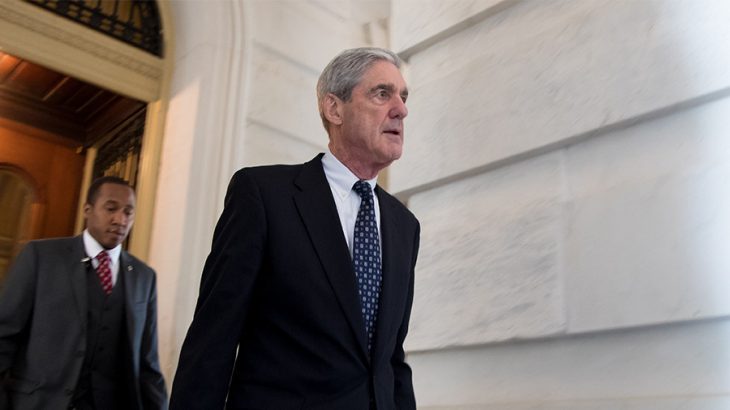
© Ting Shen / Xinhua / Global Look Press
RT | February 17, 2018
The latest not-so-smoking gun in the ‘Mueller time’ saga – the indictment of 13 Russian nationals suspected of interfering with American democracy – comes at a time when it is certain to get the least media coverage.
FBI Special Counsel Robert Mueller published the indictment on Friday evening – just two days after a high-profile school shooting in Florida. Both factors are likely to reduce the media coverage of the release, which apparently falls short of expectations of a smoking gun to take down the administration of Donald Trump, which many ‘Russiagate’ proponents have been hoping for.
“The fact that Mueller dumped these indictments out today proves that he is kind of hoping to go undercover – as far as is possible – to go undercover with political news like that,” conservative radio host Dave Perkins told RT. “[Mueller] has indicted these Russians knowing that he will never actually have to bother to prosecute them. Which is why he indicted them for peculiar, almost not-named crimes, very low-level things.”
“What has happened is Mueller is setting himself up, having tossed red meat to the base on the left: here is your Russians, here is your conspiracy, see, they have tried to affect the outcome of the election. And then he can fade back into the hedge.”
The indictment targets Russian nationals allegedly involved in a campaign meant to sow discord in America through social media. The document does not mention the hack of the DNC server or the phishing attack on Hillary Clinton campaign chair John Podesta, which both resulted in leaks of sensitive emails. Nor does it indicate that any of the Russians colluded with the Trump campaign or any other individuals in the US. Nor does it claim that the persons indicted were acting on orders from the Russian government. The document says there was no evidence the alleged campaign had any impact whatsoever on the outcome of the election.
Friday afternoon is “a great time to release news if you want to bury the news,” Just Foreign Policy Group director Robert Naiman said, though he doubts this was done intentionally. He added that the new development in the Russia probe is unlikely to tip public perception of it in a significant way. “People who want to put forward the Russia story – many of them will see this as vindication. They won’t care really what the details are.”
“This is an indictment. In the US system this means that a threshold has been met for taking a case to trial. It doesn’t mean anything has been proved,” he said.
The details of the indictment make it a shaky case for trial, media analyst Lionel pointed out, arguing that most of the things the 13 Russians are alleged to have done are not even a crime and had been done by others during the election campaign.
“They were apparently Russian nationals that didn’t say, hey, we are Russian nationals” while conducting their election-related activities on social media, he told RT. “I have never seen an indictment so bereft of citation and case law… I would have loved to argue this one in a motion to dismiss.”
If the indictment was properly covered by the US media, Americans would realize there was not much to it, independent journalist, author, and former Wall Street Journal correspondent Joe Lauria believes, but this is unlikely the way the story will be remembered.
“If these things did happen – they may be guilty of identity theft and certainly didn’t register as foreign agents – but the idea that this had an impact on the election is farcical. And if it was seen that way in the United States, Trump would have nothing to worry about. But the corporate media is going to push this as the smoking gun.”
The reporting, he predicted “will put more fuel on the fire to create more smoke that somehow Russia helped Trump steal this election from Hillary Clinton, which this indictment does not show in any way.”
Mueller indicted 13 Russians to drag probe out and keep his position – State Senator Black
RT | February 17, 2018
By indicting Russian nationals and entities for meddling in the 2016 US election, FBI Special Counsel Robert Mueller seeks to drag the probe out for his own gain, Virginia State Senator Richard Black told RT.
Thirteen Russian individuals and three entities, were accused of attempting to advance the presidential bid of Donald Trump and tarnish the reputation of Hillary Clinton with the ultimate goal to “spread distrust towards the candidates and the political system in general.” However, none of the activities described in the indictment were able to sway the vote, US Deputy Attorney General Rod Rosenstein told media.
According to Black, the lackluster outcome of the ever-widening investigation invokes suspicion that although Mueller knows there’s nothing substantial to uncover, he and his team will continue feeding the media headline-grabbers to keep his rather lucrative job.
“To a certain extent, I think, Robert Muller is struggling to keep alive his position of a special counsel. The special counsel has already earned 7 million dollars. When you become a special counsel, you have an open checkbook for the US Treasury and you are guaranteed to become a mega-millionaire if you simply can drag out the proceedings,” Black told RT.
“I suspect that this is just a case of dragging out the proceedings, throwing some indictments on some silly things – not registering as a foreign agent – that typically is not prosecuted, but they are prosecuting it in this case because they are running out of ideas.”
The latest twist of the Russia probe saga, which has so far failed to provide any proof of Trump’s collusion with Moscow, indicates that “there is simply nothing there to go after,” Black said. He noted that since both sides appear to agree that the alleged meddling could not have changed the outcome of the election, the probe is essentially “irrelevant.”
The record of US intelligence, which is no stranger to providing “completely fabricated” intel, does not lend much credibility to the “intelligence assessments” over the Kremlin’s alleged role in the election, Black said.
“I’m not really impressed, I want facts; I don’t want some generalized conclusions from these intelligence agencies,” he said, noting that if he were Trump, he would ask them to “show precisely” what evidence they have in their hands.
Back believes that what is really on the agenda is to rein in Trump so he will not oppose the hawks in their pursuit of hostile foreign policy towards Russia.
“One of the things they wanted to do is to undermine Donald Trump and to keep him constantly on the defensive against Russia so he cannot do the rational thing, which is to reduce the tensions with Russia, to draw back from the Russian borders,” he said, noting that the “deep state” seeks confrontation with Russia as it allows them to “sell weapons and increase the size of the military.”
Speaking about the claims that Russia-linked operatives spent $100,000 on Facebook ads to promote divisive social and political issues to stir up American voters, Black compared it with “throwing a penny to a beggar,” arguing that by “creating chaos” in the election, nobody could have achieved anything, “no matter who they are.”
CrossTalk: Syria on Fire
RT | February 16, 2018
The stakes couldn’t be higher. And it is happening in Syria. The goal of destroying the Islamic State is largely complete. Now the Syrian proxy war is entering a new stage. Who are the players and what are their aims? And what does winning mean?
CrossTalking with Abdel Bari Atwan, Marwa Osman, and Mohammad Marandi.
Big Pharma Still Tries to Push Dangerous Drug Class
By Martha Rosenberg | CounterPunch | February 16, 2018
Bisphosphonate bone drugs are among the most harmful and misrepresented drug classes still on the market. But that has not stopped Pharma-funded medical associations like the American Society of Bone and Mineral Research, the National Osteoporosis Foundation and the National Bone Health Alliance from periodically wringing their hands over low sales. [1]
This week the New York Times repeats the industry lament. “Currently, many people at risk of a fracture — and often their doctors — are failing to properly weigh the benefits of treating fragile bones against the very rare but widely publicized hazards of bone-preserving drugs, experts say,” it writes. Hip fractures among women 65 and older on Medicare are rising says the piece and Medicare reimbursements for bone density tests are falling. “Doctors who did them in private offices could no longer afford to [do them] which limited patient access and diagnosis and treatment of serious bone loss,” says a doctor quoted in the article which sounds like a Pharma plea for tax-payer funding.
But here is the back story.
The first bisphosphonate bone drug approved for osteoporosis, Merck’s Fosamax, received only a six month review before FDA approval. When its esophageal side effects were revealed, the FDA tried to unapprove it but Merck got the FDA to settle for a warning label that told patients to sit upright for an hour after taking the drug. Six months after Fosamax was approved, there were 1,213 reports of adverse effects including 32 patients hospitalized for esophageal harm. One woman who took Fosamax but remained upright for only thirty minutes was admitted to the hospital with “severe ulcerative esophagitis affecting the entire length of the esophagus” and had to be fed intravenously, according to the New England Journal of Medicine (NEJM).
Soon bisphosphonates (which include Boniva, Actonel and Zometa) were shown to weaken not strengthen bones by suppressing the body’s bone-remodeling action. Yes bone loss is stopped but since the bone is not renewed, it becomes brittle, ossified and prone to fracture. More than a decade ago, articles in the NEJM, the Annals of Internal Medicine, the Journal of Clinical Endocrinology & Metabolism, Journal of Orthopaedic Trauma and Injury warned of the paradoxical drug results. One-half of doctors at a 2010 American Academy of Orthopaedic Surgeons annual meeting presentation said they’d personally seen patients with bisphosphonate-compromised bone. “There is actually bone death occurring,” said Phuli Cohan, MD on CBS about a woman who’d been on Fosamax for years.
By 2003, dentists and oral surgeons found that after simple office dental work, the jawbone tissue of patients taking bisphosphonates would sometimes not heal but become necrotic and die. They had received no warnings though Merck knew about the jawbone effects from animal studies since 1977.
“Up to this point, this rare clinical scenario was seen only at our centers in patients who had received radiation therapy and accounted for 1 or 2 cases per year,” said the authors of an article titled “Osteonecrosis of the Jaws Associated with the Use of Bisphosphonates: A Review of 63 Cases,” published in the Journal of Oral and Maxillofacial Surgery.
Despite reports of ulcerative esophagitis, bone degradation, fractures and jawbone death Merck aggressively promoted Fosamax. It hired researcher Jeremy Allen to plant bone scan machines in medical offices across the country to drive sales and to push through the Bone Mass Measurement Act which made bone scans Medicare reimbursable paid by you and me. Hopefully that is changing.
Blaming hip fractures on not enough people taking bisphosphonates is not a new tactic for Pharma. It blamed increasing suicides on not enough people taking antidepressants (even when as much as a fourth of the population takes antidepressants). Get ready for Pharma to blame obesity on not enough people taking prescription obesity drugs. The ruse is even more dishonest because many popular drugs people are taking like GERD medications really do thin bones. First do no harm.
Notes.
[1] According to the British Medical Journal, the National Osteoporosis Foundation is funded by Bayer Healthcare, Lane Laboratories, Mission Pharmacal, Novartis, Pharmavite, Pfizer, Roche, Warner Chilcott and Eli Lilly. The American Society for Bone and Mineral Research is funded by Pfizer and Eli Lilly. The National Bone Health Alliance is a public- private partnership that is an offshoot of the National Osteoporosis Foundation.
Martha Rosenberg is an investigative health reporter. She is the author of Born With A Junk Food Deficiency: How Flaks, Quacks and Hacks Pimp The Public Health (Prometheus).
US indicts 13 Russians for 2016 election meddling, but ‘no allegations’ they influenced outcome
RT | February 16, 2018
A US federal grand jury has indicted 13 Russian nationals and three Russian entities accused of interfering with US elections and political processes. However, there are “no allegations” they influenced the 2016 election.
The indictment accuses the defendants of “supporting the presidential campaign of then-candidate Donald J. Trump… and disparaging Hillary Clinton.” It also claims the defendants staged political rallies and bought political advertising while posing as grassroots entities. The document says an organization known as the Internet Research Agency “sought, in part, to conduct what it called ‘information warfare against the United States of America’ through fictitious US personas on social media platforms and other Internet-based media.”
“By in or around May 2014, the organization’s strategy included interfering with the 2016 US presidential election, with the stated goal of “spread[ing] distrust towards the candidates and the political system in general,” the indictment says, referring to the Internet Research Agency.
The defendants, according to the indictment, were advised to “focus their activities on purple states like Colorado, Virginia, and Florida.”
US Deputy Attorney General Rod Rosenstein said during a press conference that the defendants engaged in “information warfare against the US, with the stated goal of spreading distrust towards the candidates and the political system in general.”
It is alleged that the two traveled to the US in 2014 to collect intelligence for their operations. They also reportedly purchased space on US servers to establish a virtual private network (VPN) and made hundreds of accounts on Facebook, Instagram and Twitter. They “posed as politically and socially active Americans, advocating for and against particular candidates,” Rosenstein said during a press conference.
He went on to say that they “recruited and paid real Americans” to engage in political activity by pretending to be grassroots activists, adding that those Americans did not know they were working with Russians. Rosenstein noted, however, that “there is no allegation in the indictment that it had any effect on the outcome of the election.”
The indictment was not left unanswered though. Spokesperson for the Russian Foreign Ministry, Maria Zakharova, called the latest affront by the US “absurd.” She noted that 13 people would have hardly reached the desired outcome even if they planned to meddle with the polls.
Russian businessman Evgeny Prigozhin, who was also on the list, opted for a lighter tone, saying that Americans are “emotional people” and jokingly suggested that one should allow them to “see the devil.”
Moscow has repeatedly refuted the claims of alleged meddling in the 2016 presidential elections. Russian President Vladimir Putin also ridiculed such claims, suggesting that the US was “not a banana republic” to be treated that way.
US ‘Stumbled Into Torture,’ Says NYT Reporter
By Adam Johnson | FAIR | February 15, 2018
As part of a promotion for the upcoming “Look, Evil Russians!” film Red Sparrow (hyping Hollywood films is apparently a thing reporters do now), New York Times national security reporter Scott Shane (2/14/18) wrote a synergistic Cold War 2.0 essay about the CIA’s alleged attempt to recruit him. It included a rather jarring—if not risible—paragraph summarizing Shane’s years of reporting:
All these years later, I assume my name appears in multiple files at the CIA, the National Security Agency and perhaps other corners of the sprawling security bureaucracy, with gripes and comments related to my coverage of how America stumbled into torture; how drone strikes went wrong; espionage cases; WikiLeaks cables; Snowden documents; Russian hackers and the Shadow Brokers; and probably stories I’ve forgotten.
Two clauses stand out for their confident attribution of benevolent motives to US foreign policy. First, there’s the idea that “America stumbled into torture,” rather than planned, plotted and spent over 15 years carrying out a policy of torture. This pretends that the US’s massive global torture regime—which involved drownings, beatings, sleep deprivation and sexual humiliation, among other techniques, along with “extraordinary rendition” to allied countries for less refined torture methods–was something other than a deliberate policy initiative.
As FAIR (6/22/17) noted last year, corporate media routinely assert that the US “stumbles,” “slips” or is “dragged into” war and other forms of organized violence, rather than planning deliberate acts of aggression. For reporters in foreign policy circles, the US only does immoral things on accident—unlike Official Bad Countries, which do them for calculated gain when they aren’t motivated by sheer malice.
The second clause, claiming that “drone strikes went wrong,” is a passive way of suggesting that civilian deaths are an unforeseen accident rather than a predictable consequence baked into the cake of the US’s permawar on terror. The US doesn’t murder civilians, it simply launches missiles at unknown and faceless brown people in Yemen and Afghanistan, and sometimes the missiles “go wrong.” While Shane has certainly reported on these respective crimes (as he proudly notes), he has done so in a similar, limited fashion that treats them as unfortunate mishaps, rather than intentional features of a violent empire.
For an essay that is more or less Shane patting himself on the back for holding power to account instead of becoming a spook, his instinct to assume noble intentions on the part of these spooks is a telling indication of the broader ethos of corporate media’s national security reporting: Criticism is welcome around the margins, so long as motives are never challenged.
Witness Out of Palestine

By David Swanson | World Beyond War | February 14, 2018
Anna Baltzer’s amazing book Witness in Palestine: A Jewish American Woman in the Occupied Territories has been updated over the years, and I’ve just read it for the first time. Rather unfairly, and — as it turns out — wrongly, my first response upon turning the initial pages was: Do we really need another one of these? Jewish person believes pile of myths. Jewish person confronts reality. Jewish person tries to open the eyes of others. It’s become as familiar as “Dog Bites Man.” Couldn’t we all just share one book around instead of everyone writing his or her own, and then pool our money until we can afford a television station so that people can be made to wake up in large numbers?
But here’s the thing. While I’ve grown accustomed to describing each such book as the best or one of the best, they are not all the same. One of the many merits of this one is that it would make — and I hope it does make if it isn’t already — an excellent text book in schools. And significant numbers of people are waking up, without television, and presumably in part because of all the books, plus the interviews and events that accompany the books. The movement in the U.S. against Israel’s wars (and occupations and apartheid) demonstrates to the movement against all wars, and that against U.S. wars, that such things are possible. It may also demonstrate to writers that their efforts are in fact worth a bit more than would be spending their time helping Fox News hosts spot hidden sperms in presidential portraits.
I recently debated a West Point professor on whether war can ever be justified, and I tried to get him to name some actual wars that have been justifiable (as opposed to theoretical wars). He claimed that Israel’s Six Days War was the “quintessentially” just war. So in our second debate, I read to him from a Los Angeles Times column by Miko Peled showing that those who launched that war did so because they saw an opportunity for aggression and conquest. The facts that Peled revealed would be spreading virally and becoming universally known if they proved that the United States was created by God to set an example for the dumber people of earth. Information becomes known if it is desirable. But why isn’t the fact that every single war ever has been unjustifiable very desirable news, as it allows the world to do something more useful with $2 trillion a year?
My debate partner was a man who took part in the U.S. wars on Iraq and Afghanistan but refused repeatedly to say whether they were just or unjust wars. During our second debate he said that only fresh recruits could be excused for refusing to participate in those wars, but that experienced trained soldiers should have known better. However, he said something seemingly at odds with that, when, after the debate, I asked him yet again whether Iraq 2003-on was a justifiable war, yes or no? He said that it was only unjustifiable after the fact because of new information. And yet he had publicly promoted and participated in that war long after any such supposedly new information (presumably meaning the absence of the WMDs) had become widely known and the fact that the lies had been intentional had been thoroughly documented, and those who had pointed out the blatant falsehoods beforehand had been proven right.
My confused debate partner much preferred talking about analogies to Good Samaritans and doctors and muggers than actual wars, so I pointed out to him that Israel’s concern in 1967 that in 18 months Egypt could be capable of attacking it actually bore no relevant similarity to the immediacy and the urgency of a victim of a mugging. In making this comment I also referred to “decades of genocidal occupation” that followed the war. Someone later accused me of misusing the term genocide. So I pointed out the open advocacy of genocide by top Israelis. Baltzer’s book points out the open advocacy of genocide by many (obviously not all) Israeli settlers and soldiers. But I was then told that the crime of “incitement of genocide” is not the same as genocide. So, apparently it is OK to accuse Israelis of “incitement of genocide” but not of doing anything genocidal. I have no idea Baltzer’s view and don’t want to overemphasize the silly question of the use of a particular word, but I recommend reading her book.
This book documents the normalization of a long-term gradual genocide, one that in its duration serves as a marketing device for generations of new military weaponry. Ambulances are stopped at checkpoints until the ailing person dies. Children are shot for straying too near a fence in pursuit of a soccer ball. Supplies are blocked. Malnutrition is intentionally and successfully imposed. Fishing is restricted. A village is flooded with raw sewage with five people drowning in it. These and hundreds of other techniques serve to reinforce the bigotry behind the apartheid, and to do something that is in a strange way worse than a faster genocide: the banalization of evil. Call it whatever the bloody hell you want to call it. But let’s not let the unpleasantness of it prevent us from working to make it stop.
Featured Video
No Threat Can Force Iran’s Surrender /Trita Parsi & Lt Cl Daniel Davis
or go to
Aletho News Archives – Video-Images
From the Archives
What is the Israeli Lobby in Australia Doing in Interfaith Dialogue?
By Ali Kazak | Dissident Voice | October 11, 2015
For years Israel and its lobby around the world have been trying to normalise their relations with Arabs and Muslims without solving the Palestine Question.
One of the methods they resorted to in the last few years is using human rights and community organizations such as interfaith dialogue and Multiculturalism to achieve this objective and to: isolate the Palestinians, marginalise the Palestine question, end Israel’s isolation, and prevent criticism of Israel, knowing that these organisations will be the first to stand against Israel’s violations, racial and religious discrimination.
The group responsible for this task in Australia is The Australia/Israel & Jewish Affairs Council (AIJAC); its Director of International & Community Affairs, Jeremy Jones is in charge of lobbying religious community organizations, specifically Muslims and Christians. Consequently he convened the Faith Communities for Reconciliation, founding participant in the Australian Partnership of Religious Organisations and the Australian National Dialogue of Christians, Muslims & Jews.
AIJAC is a private political propaganda group. It is recognised as the main Israeli lobby in Australia. It coordinates its activities and works intimately with the Israeli embassy in Canberra and different institutions in Israel. It is privately funded by some Jewish businessmen. It monitors closely Australian politicians, the media, ethnic and religious groups, (especially Arabs and Muslims), unions and academics on their stands towards Israel and the Palestine question. … continue
Blog Roll
 Aletho News
- The war of liberation of the Arab and Islamic peoples expands across the Gulf
- Envoy warns UN on Trump’s threat to ‘obliterate’ Iran’s civilian infrastructure
- The Larak Corridor: Iran’s Rial Gate With No US, No Israel, and No Way Around
- ‘Economic terrorism’: Steel facilities hit again in US-Israeli strike
- ‘War Crime’: Iran condemns attacks on Arak, Ardakan nuclear sites
- Two-thirds of Americans want quick end to Iran war even if goals unmet
- Trump to Give “Important Update on Iran” Wednesday in Prime-Time Speech
- Theodore Postol: Iran’s Missiles & Drones Were Underestimated
- Iran To Target Military Industrial-Tech Complex That Facilitated Gaza Genocide
- Collapsing Empire: The Resistance Disarms ‘Israel’
- If Americans Knew
- Israel wants US to bomb more of Iran’s civilian structures (113,000 is not enough) – Not a ceasefire Day 173
- Ann Coulter Rips Into Fox News for Iran War Coverage
- Joe Kent Urges Americans To Call White House and Congress To Object To Sending Troops Into Iran
- DNC Resolution to Reject AIPAC Funding Puts Democratic Leaders in the Hot Seat
- Swedish foundation to build 400 schools as over 650,000 Gaza children remain without education for 2 years
- Israeli army admits photshopping image of slain Lebanese journalist
- This is how Israel is systematically killing health workers under the cover of war in Lebanon
- Carrying life under fire: Israeli invasion of Lebanon leaves pregnant women facing deadly risks
- Champagne all around for the new death penalty (for Palestinians) law – Not a ceasefire Day 172
- Why are Palestinian books struggling to be seen on Amazon?
- No Tricks Zone
- New Study Finds Warming Saves Lives…Cold Temperatures 12 Times More Deadly Than Excess Heat
- German Science Blog Accuses PIK Climate Institute Of Hallucinating Climate Tipping Points
- Devastating Assessment Of Comirnaty Vaccine By Former Senior Pfizer Europe Toxicologist
- New Study: CO2 Is ‘Effectively Negligible’ As An Explanatory Climate Change Factor Since 2000
- Former Pfizer Toxicologist Dr. Helmut Sterz Tells Bundestag Hearing Pfizer Vaccine Should Have Never Been Approved
- Energy Expert: Germany’s Nuclear Phaseout Was A “500 Billion Euro Mistake”
- New Research: South Australia’s Mid-Holocene Sea Surface Temperatures Were 4°C Warmer Than Today
- Storing Green Energy To Last Germany 10 Days Would Require A 60-Million Tonne Battery
- New Studies: UK Sea Levels Were 4 Meters Higher Than Today During The Mid-Holocene
- Destructive Green New Deal: German Energy And Metal Group Warns Of Drastic Crisis
 Aletho News