Painting an Israeli Attack on Syria as Israeli ‘Retaliation’
By Gregory Shupak | FAIR | February 21, 2018
Israel claimed that it intercepted an Iranian drone in Israeli airspace on Saturday, February 10; Iran denied that it had a drone there. Israel then bombed a Syrian airbase, saying it was the command-and-control center from which Iran had launched the drone. The Syrian government shot down an Israeli jet that had bombed the base, and Israel subsequently launched more airstrikes against Syria.
Reuters (2/13/18) described the latter airstrikes as Israel having “retaliated” for the downing of its aircraft. Vice (2/13/18) too characterized them as “retaliatory”; the Los Angeles Times (2/11/18) did the same three times. These word choices wrongly imply that Israel was acting defensively, when it was Israel who fired the first shots in the weekend’s exchanges: These outlets were saying that Israel was “retaliating” against Syria for defending itself against an ongoing Israeli attack.
“Retaliation” is an exculpatory term. To say that a party is “retaliating” is to say that their actions are an understandable response to another party’s provocation. As FAIR’s Rachel Coen and Peter Hart (Extra!, 5–6/02) wrote more than a decade and a half ago, the term “lays responsibility for the cycle of violence at the doorstep of the party being ‘retaliated’ against, since they presumably initiated the conflict.” In this case, casting Syria and Iran as the aggressors rests on the dubious assumption that flying a drone over Israel—if Israel’s charge is accurate—is more aggressive than Israel dropping bombs on Syria.

Painting warplanes carrying out an aggressive bombing raid as victims
It also rests on the flawed assumption that the timeline of hostilities between Israel and the Syrian government began on Friday, February 9. However, despite the Associated Press’s untenable claim (2/10/18) that “Israel has mostly stayed out of the prolonged fighting in Syria,” Israel admits to having bombed the Syrian government and its ally Hezbollah nearly 100 times since the war in Syria began in 2011 (Reuters, 2/6/18). If Brigadier General Amnon Ein Dar, the head of the Israeli Air Force’s Air Division, is to be believed (Ynet, 2/11/18), the Israeli military has “carried out thousands of missions in Syria in the last year alone.”
A Washington Post article (2/10/18) made the similarly dubious assertion that “Israel has largely stood on the sidelines of the Syrian conflict over the past seven years.” In the next paragraph, though, the author acknowledges that “Israel has conducted dozens of covert airstrikes against [the Syrian government-aligned] Hezbollah weapons convoys in Syria,” and the piece goes on, in a spectacular display of self-contradiction, to note that “Israel has carried out a number of significant attacks in Syria in recent months.”
Israel has also supported the Syrian armed opposition for years, the Wall Street Journal (6/18/17) reported, supplying fighters with food, fuel, medical supplies “and money payments to commanders that help pay salaries of fighters and buy ammunition and weapons.” According to the Journal, the Israeli army “is in regular communication with rebel groups,” and Israel “has established a military unit that oversees the support in Syria—a country that it has been in a state of war with for decades—and set aside a specific budget for the aid, said one person familiar with Israeli operation.” There is even reason to believe that Israel has had an alliance with the Al Qaeda affiliate in Syria (Middle East Monitor, 5/26/15; Electronic Intifada, 6/16/15). None of the articles cited here on the February 10 clashes mentioned this important backdrop.
Turning an Occupation Into a ‘Border’
Coverage of these events also failed to correctly describe the status of the Golan Heights, a piece of land that is central to the Israeli/Syrian conflict. Israel occupied the territory in the 1967 war, fought off a Syrian effort to reclaim it in 1973, and illegally annexed it in 1981. Israel has sought to take advantage of the war that has devastated Syria for nearly seven years by, as Matt Broomfield writes in the Electronic Intifada (11/11/16), planning a fivefold increase in the number of Israeli settlers in the Golan, allocating $108 million for 750 new Israeli agricultural projects in the territory, and significantly expanding military forces along the boundary between Syria and the area under Israeli control.
The New York Times (2/10/18) made two references to “the Israeli-held portion of the Golan Heights,” a rather anodyne depiction of territory that is internationally recognized as Syrian, but which Israel seized by force of arms and claimed for itself.
The Washington Post (2/10/18) said that “Israel shares a contentious border with Syria—the Golan Heights.” But the Golan isn’t “a contentious border”; it’s a territory that, despite Israeli claims to the contrary, unambiguously belongs to Syria under international law.
A CNN report (2/11/18) closed by saying that “authorities also accused Syria in November of violating the 1974 ceasefire agreement [with Israel] by “conducting construction work” in the northern part of the Golan Demilitarized Zone.” While it’s unclear which authorities are being referenced, this passage neglects to mention that by late 2015, Israel had built 30 settlements, housing 20,000 settlers, in the Golan, or that a year later it announced plans for 1,600 new homes in the territory, “construction work” that has been roundly condemned by “authorities” like the United Nations.
Moreover, 20,000 Syrians live in the Golan, and many are directly harmed by Israeli policies. According to the United Nations Human Rights Council (UNHRC), Israel’s discriminatory land, housing and development policies in the territory have made it hard for Syrians to get building permits, leading to increasingly overcrowded Syrian towns and villages. The UNHRC also points out that Israel has demolished a Syrian home, and that a number of Syrian homeowners have reportedly received demolition notices.
This larger context of Israel’s Syria policies would have helped news readers make sense of what occurred on February 10, but it was absent. Given that Israel had just launched an airstrike on a Syrian base, has apparently bombed Syria close to 100 times in the past six years, has carried out perhaps 1,000 attacks against it in the last year, has backed an armed insurgency against the Syrian government, and has stolen and illegally colonized Syrian land while oppressing and dispossessing Syrian civilians, it is far more accurate to say that Syria retaliated against Israel on February 10.
YouTube Has Informed Me That It Will Soon Delete The Richie Allen Show Channel

By Richie Allen | February 22, 2018
YouTube operates a three strikes and you are out policy. Content creators are told that if they violate community standards three times, their channel and all its content will be deleted. Two weeks ago The Richie Allen Show received a strike. Incredibly, I was informed that I had violated the bullying and harassment guidelines. The video in question was of an interview I conducted with Wolfgang Halbig over two years ago about The Sandy Hook school shooting. There was nothing harassing about it, there was certainly no bullying. I repeatedly challenged Wolfgang in the interview and pressed him for evidence to support his theory. Nevertheless that was strike one. YouTube said that as punishment, I couldn’t live stream for three months. I don’t live stream anyway. But of course I was worried. I had been warned repeatedly, by commercial presenters and producers and former colleagues of mine, that the show would be targeted.
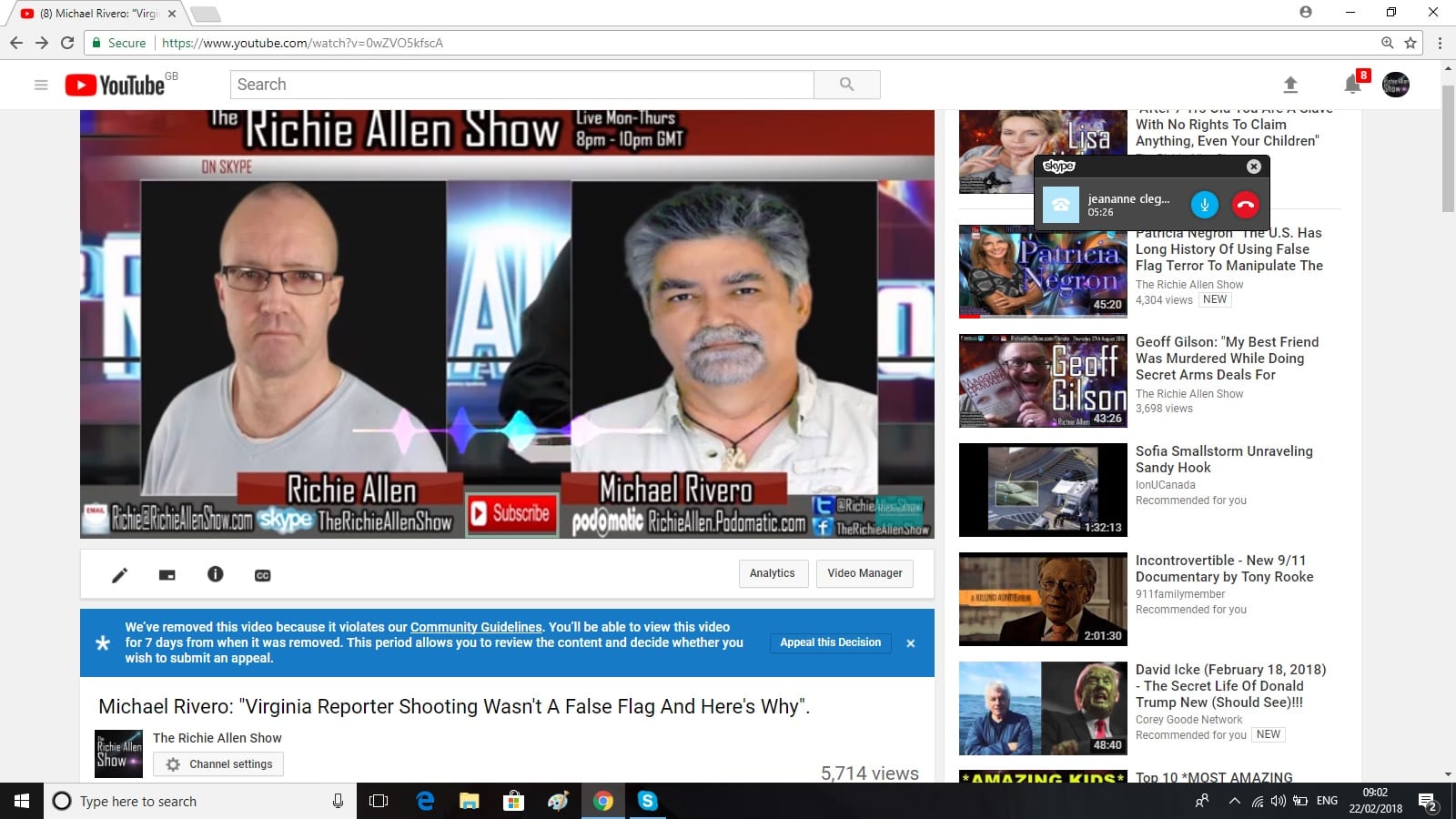 Strike two came this morning. The offending video this time was an interview I did with Michael Rivero about the shooting of journalist Alison Parker and cameraman Adam Ward in Virginia in August 2015. Yes that’s right, YouTube has issued me with a community guideline strike for an interview I uploaded two and a half years ago. Get this, in the interview, Mike clearly states that he does not believe that the shooting was staged or a false flag. Mike talked about the background of the shooter Bryce Williams and what led him to murder the journalists. This morning, YouTube told me that the interview violated its guidelines on bullying and harassment. Again, there was no harassment or bullying. Mike went with the official story, as did I. Tough shit Paddy, that’s strike two. I was told today, that a third strike will see the channel deleted. A third strike is inevitable, as there are 1,400 interviews on the channel which was created in 2014. Oh and the punishment for strike two? We have been banned from uploading content to YouTube for the next three weeks.
This is fascism, this is tyranny, this is terrifying and we knew that this was coming didn’t we? Yes, there are other platforms but Google/YouTube is the only game in town. I could upload elsewhere, but those platforms don’t have the subscribers, it would be a waste of a lot of time for very little reward. The establishment knows this. This is why these monopolies were allowed to develop, so that they could come after shows like The Richie Allen Show when they felt like it. Over the last eighteen months, they have limited the reach of the channel by shadow banning it, in other words making it difficult for users to discover it. They even began demonetising the videos before they had even been published and then re-monetising them after they’d been watched over 5,000 times, meaning by the time the ads went on the vids, most people had watched them. I’ve talked about this and demonstrated it with photographic evidence. Now they’re about to delete the channel, the coup de grace.
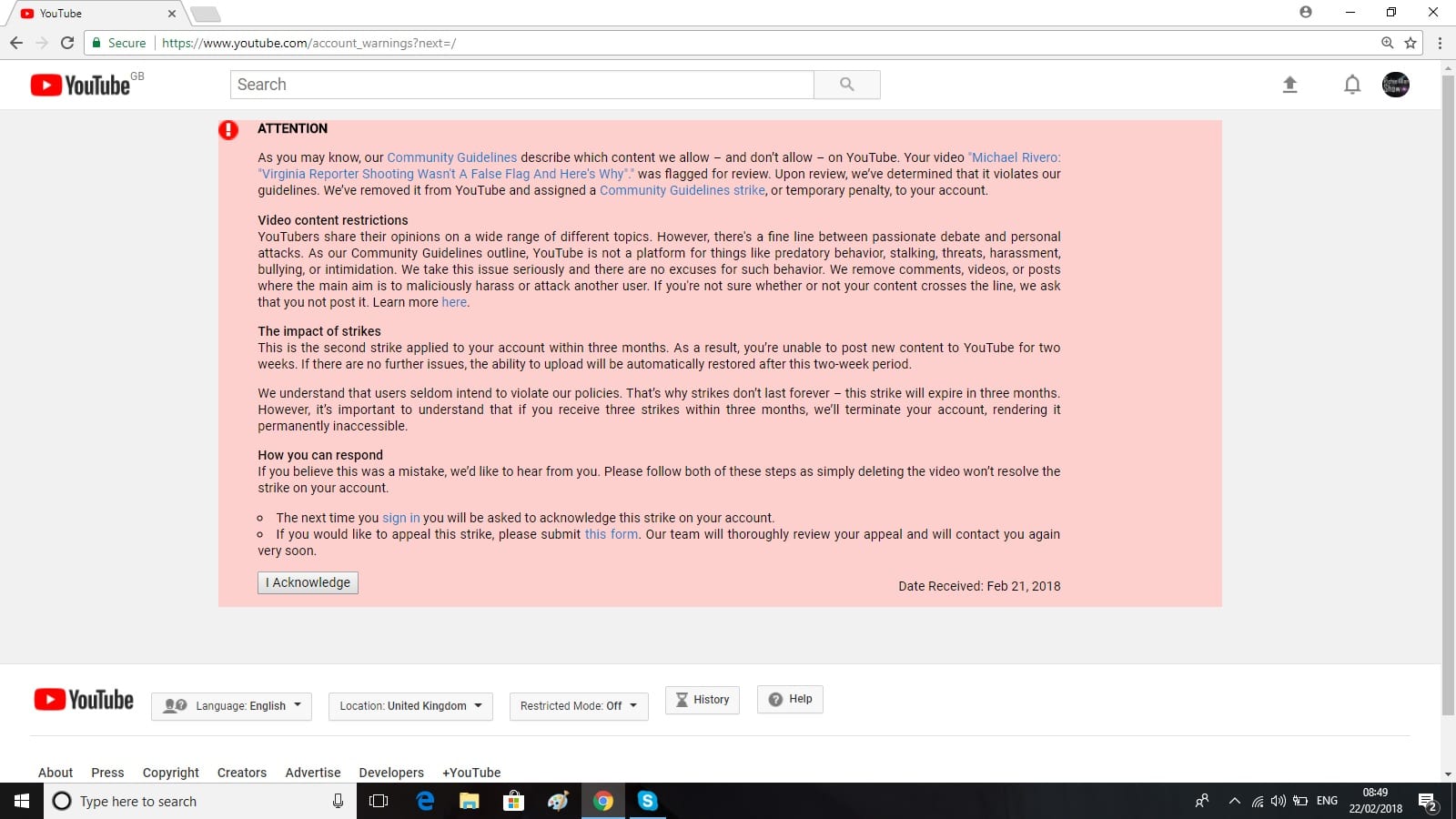 Now I mentioned that colleagues of mine in commercial TV/Radio had warned me that our channel would be specifically targeted. I’ve been warned time and again, but I knew it was coming anyway. Why The RA show specifically? The reason is simple. There is no other show like it in the independent media. We hold ourselves to the highest professional standards, our production values are second to none and uniquely, we put politicians, academics and other journalists on the air and ask them questions that they would never be asked on mainstream media. That has seen the show become the most listened to independent news show in Europe, the most downloaded podcast in news/politics on Podomatic and has seen us listed on Spotify and iheartradio.
Don’t call me arrogant. I am not now and never have been. I worked for and worked with the best producers and presenters in the world. I served my time and bring all that experience to bear on our show, it’s as simple as that. I am not important, the show is not and never has been about me. The information is the star, I’m just a gobby curmudgeonly Irishman, who learned his trade well. It’s always been about the amazing researchers who come on and share their discoveries and it is about getting their information to people who otherwise would be dismissive of conspiracy research. David Icke implicitly understood the importance of bringing mainstream production values to independent radio and the conspiracy research arena. We talked about it often and back in 2014, when he asked me to consider making my own show, produced edited and introduced by me and me alone, he said, “you can make alternative radio sound as good as or better than commercial radio.”
Of course beauty is in the eye of the beholder, ultimately the audience decides whether a show is any good or not, but there is overwhelming evidence here, that someone/something wants to make life very difficult for me, by removing our YouTube channel and deleting over 1,400 archived interviews. Google has served notice on The Richie Allen Show today, that there is no room for a professionally produced radio show, which asks uncomfortable questions and presents credible evidence that challenges the mainstream narrative.
North Korea Calls US-Japan Missile Drills Provocation Against Intra-Korean Dialogue
Sputnik – 22.02.2018
MOSCOW – North Korea’s committee on Korean reconciliation condemned on Thursday an upcoming joint US-Japan missile defense drill as an attempt to reignite regional tensions and obstruct the ongoing thaw between Pyongyang and Seoul.
“Branding this as a ferocious gangster-like act aimed to tarnish the hard-won atmosphere for the improvement of the North-South ties and for peace on the Korean Peninsula, and as a dangerous military provocation to ignite the train of a war,” the [North’s] Korean National Peace Committee said in a statement, announced by state-run Korean Central News Agency (KCNA) and quoted by South Korea’s Yonhap news agency.
The statement was made after on February 15, the Japanese Defense Ministry announced that this year’s joint ballistic missile defense exercise, which is due to start on Friday and last for a week, would have a larger scale than the previous ones and involve not only the Japanese Maritime Self-Defense Force and the US Navy but also the two countries’ air force units and the US Marine Corps. The ministry stressed the importance of the drill, citing November’s North Korean ballistic missile activities.
The committee also noted “greater bellicosity” and the danger of the forthcoming exercise, pointing to the planned involvement of fighter jets and US marines.
Tensions on the Korean Peninsula have further escalated as North Korea achieved significant progress in its nuclear and missile programs last year. Pyongyang tested several ballistic missiles, including its most advanced intercontinental ballistic missile in November, which it said was capable of hitting any part of the mainland of the United States. In turn, Washington has led a number of diplomatic initiatives to put pressure on Pyongyang and held several drills in the region.
In January, Pyongyang and Seoul resumed bilateral talks ahead of the Pyeongchang Winter Olympics. As a result, their national teams marched together under a “unification flag” at the opening ceremony and are jointly participating in a number of sporting events.
The sides also reportedly agreed to delay their military activities until after the Olympics, which will last through Sunday.
My First Day as CIA Director
By Ray McGovern | Consortium News | February 22, 2018
Now that I have been nominated again – this time by author Paul Craig Roberts – to be CIA director, I am preparing to hit the ground running.
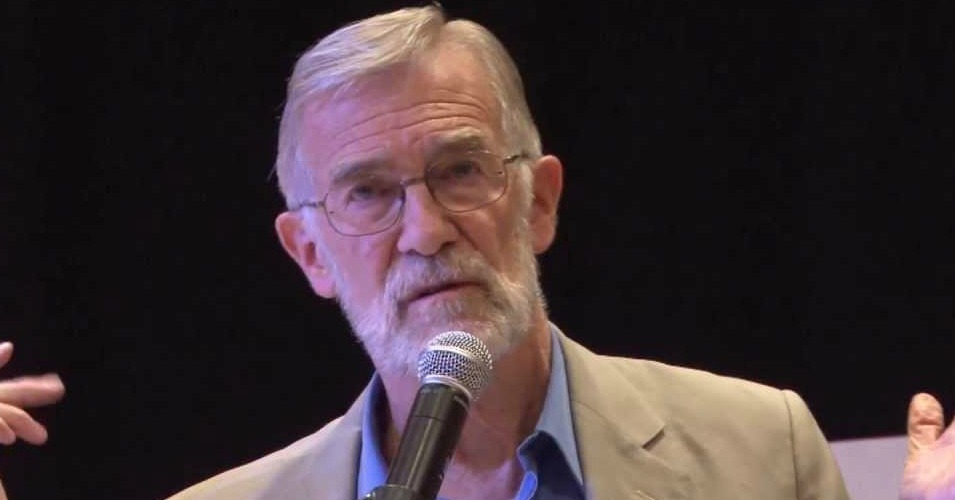
Ray McGovern
Last time my name was offered in nomination for the position – by The Nation publisher Katrina vanden Heuvel – I did not hold my breath waiting for a call from the White House. Her nomination came in the afterglow of my fortuitous, four-minute debate with then-Defense Secretary Donald Rumsfeld, when I confronted him on his lies about the attack on Iraq, on May 4, 2006 on national TV. Since it was abundantly clear that Rumsfeld and I would not get along, I felt confident I had royally disqualified myself.
This time around, on the off-chance I do get the nod, I have taken the time to prepare the agenda for my first few days as CIA director. Here’s how Day One looks so far:
Get former National Security Agency Technical Director William Binney back to CIA to join me and the “handpicked” CIA analysts who, with other “handpicked” analysts (as described by former National Intelligence Director James Clapper on May 8, 2017) from the FBI and NSA, prepared the so-called Intelligence Community Assessment (ICA) of Jan. 6, 2017. That evidence-impoverished assessment argued the case that Russian President Vladimir Putin ordered his minions “to help President-elect Trump’s election chances when possible by discrediting Secretary Clinton.”
When my predecessor, CIA Director Mike Pompeo invited Binney to his office on Oct. 24, 2017 to discuss cyber-attacks, he told Pompeo that he had been fed a pack of lies on “Russian hacking” and that he could prove it. Why Pompeo left that hanging is puzzling, but I believe this is the kind of low-hanging fruit we should pick pronto.
The low-calorie Jan. 6 ICA was clumsily cobbled together:
“We assess with high confidence that Russian military intelligence … used the Guccifer 2.0 persona and DCLeaks.com to release US victim data obtained in cyber operations publicly and in exclusives to media outlets and relayed material to WikiLeaks.”
Binney and other highly experienced NSA alumni, as well as other members of Veteran Intelligence Professionals for Sanity (VIPS), drawing on their intimate familiarity with how the technical systems and hacking work, have been saying for a year and a half that this CIA/FBI/NSA conclusion is a red herring, so to speak. Last summer, the results of forensic investigation enabled VIPS to apply the principles of physics and the known capacity of the internet to confirm that conclusion.
Oddly, the FBI chose not to do forensics on the so-called “Russian hack” of the Democratic National Committee computers and, by all appearances, neither did the drafters of the ICA.
Again, Binney says that the main conclusions he and his VIPS colleagues reached are based largely on principles of physics – simple ones like fluid dynamics. I want to hear what that’s all about, how that applies to the “Russian hack,” and hear what my own CIA analysts have to say about that.
I will have Binney’s clearances updated to remove any unnecessary barriers to a no-holds-barred discussion at a highly classified level. After which I shall have a transcript prepared, sanitized to protect sources and methods, and promptly released to the media.
Like Sisyphus Up the Media Mountain
At that point things are bound to get very interesting. Far too few people realize that they get a very warped view on such issues from the New York Times. And, no doubt, it would take some time, for the Times and other outlets to get used to some candor from the CIA, instead of the far more common tendentious leaks. In any event, we will try to speak truth to the media – as well as to power.
I happen to share the view of the handful of my predecessor directors who believed we have an important secondary obligation to do what we possibly can to inform/educate the public as well as the rest of the government – especially on such volatile and contentious issues like “Russian hacking.”
What troubles me greatly is that the NYT and other mainstream print and TV media seem to be bloated with the thin gruel-cum-Kool Aid they have been slurping at our CIA trough for a year and a half; and then treating the meager fare consumed as some sort of holy sacrament. That goes in spades for media handling of the celebrated ICA of Jan. 6, 2017 cobbled together by those “handpicked” analysts from CIA, FBI, and NSA. It is, in all candor, an embarrassment to the profession of intelligence analysis and yet, for political reasons, it has attained the status of Holy Writ.
The Paper of (Dubious) Record
I recall the banner headline spanning the top of the entire front page of the NYT on Jan. 7, 2017: “Putin Led Scheme to Aid Trump, Report Says;” and the electronic version headed “Putin Led a Complex Cyberattack Scheme to Aid Trump, Report Finds.” I said to myself sarcastically, “Well there you go! That’s exactly what Mrs. Clinton – not to mention the NY Times, the Washington Post and The Establishment – have been saying for many months.”
Buried in that same edition of the Times was a short paragraph by Scott Shane: “What is missing from the public report is what many Americans most eagerly anticipated: hard evidence to back up the agencies’ claims that the Russian government engineered the election attack. That is a significant omission.”
Omission? No hard evidence? No problem. The publication of the Jan. 6, 2017 assessment got the ball rolling. And Democrats like Adam Schiff (D-Calif.) ranking member of the House Intelligence Committee, were kicking the ball hard down the streets of Washington. On Jan. 25, 2017, I had a chance to confront Schiff personally about the lack of evidence — something that even Obama had acknowledged just before slipping out the door. I think our two-minute conversation speaks volumes.
Now I absolutely look forward to dealing with Adam Schiff from my new position as CIA director. I will ask him to show me the evidence of “Russian hacking” that he said he could not show me on Jan. 25, 2017 – on the chance his evidence includes more than reports from the New York Times.
Sources
Intelligence analysts put great weight, of course, on sources. The authors of the lede, banner-headlined NYT article of Jan. 7, 2017 were Michael D. Shear and David E. Sanger; Sanger has had a particularly checkered career, while always landing on his feet. Despite his record of parroting CIA handouts (or perhaps partly because of it), Sanger is now the NYT’s chief Washington correspondent.
Those whose memories go back more than 15 years may recall his promoting weapons of mass destruction in Iraq as flat fact. In a July 29, 2002 article co-written with Them Shanker, for example, Iraq’s (non-existent) “weapons of mass destruction” appear no fewer than seven times as flat fact.
More instructive still, in May 2005, when first-hand documentary evidence from the now-famous “Downing Street Memorandum” showed that President George W. Bush had decided by early summer 2002 to attack Iraq, the NYT ignored it for six weeks until David Sanger rose to the occasion with a tortured report claiming just the opposite. The title given his article of June 13 2005 was “Prewar British Memo Says War Decision Wasn’t Made.”
Against this peculiar reporting record, I was not inclined to take at face value the Jan. 7, 2017 report he co-authored with Michael D. Shear – “Putin Led a Complex Cyberattack Scheme to Aid Trump, Report Finds.”
Nor am I inclined to take seriously former National Intelligence Director James Clapper’s stated views on the proclivity of Russians to be, well, just really bad people — like it’s in their genes. I plan to avail myself of the opportunity to discover whether intelligence analysts who labored under his “aegis” were infected by his quaint view of the Russians.
I shall ask any of the “handpicked” analysts who specialize in analysis of Russia (and, hopefully, there are at least a few): Do you share Clapper’s view, as he explained it to NBC’s Meet the Press on May 30, 2017, that Russians are “typically, almost genetically driven to co-opt, penetrate, gain favor, whatever”? I truly do not know what to expect by way of reply.
End of Day One
In sum, my priority for Day One is to hear both sides of the story regarding “Russian hacking” with all cards on the table. All cards. That means no questions are out of order, including what, if any, role the “Steele dossier” may have played in the preparation of the Jan. 6, 2017 assessment.
I may decide to seek some independent, disinterested technical input, as well. But it should not take me very long to figure out which of the two interpretations of alleged “Russian hacking” is more straight-up fact-based and unbiased. That done, in the following days I shall brief both the Chair, Devin Nunes (R-Calif.) and ranking member Schiff of the House Intelligence Committee, as well as the Chair and ranking member of its counterpart in the Senate. I will then personally brief the NYT’s David Sanger and follow closely what he and his masters decide to do with the facts I present.
On the chance that the Times and other media might decide to play it straight, and that the “straight” diverges from the prevailing, Clapperesque narrative of Russian perfidy, the various mainstream outlets will face a formidable problem of their own making. Mark Twain put it this way: “It is easier to fool people than it is to convince them they have been fooled.”
And that will probably be enough for Day One.
Ray McGovern works with Tell the Word, a publishing arm of the ecumenical Church of the Savior in inner-city Washington. He served 30 years as an U.S. Army Intelligence and CIA analyst, and in retirement co-founded Veteran Intelligence Professionals for Sanity (VIPS).
Hamas: Abbas’s speech did not rise up to the desired level
Palestine Information Center – February 22, 2018
GAZA – Palestinian resistance group Hamas criticized Palestinian Authority (PA) chairman Mahmoud Abbas following his speech at the UN Security Council on Wednesday.
In a press release, Hamas underlined that the political plan presented by Abbas in his speech does not reflect the national position which calls for an end to the Oslo Accords and which opposes a resumption of negotiations with Israel.
“Abbas’s speech did not rise up to the desired level, nor did it reflect the national consensus, which wants to terminate the Oslo agreements and rejects negotiations with the occupiers,” Hamas said.
Abbas is working to create a new mechanism for the failed peace process despite Israel’s violations and crimes against Palestinian women and children and the dangerous bias of the United States in favor of Israel on Jerusalem and the refugees and the encouragement it gives Israel to commit crimes and liquidate the Palestinian cause, the statement reads.
In this context, Hamas demanded an end to Abbas’s unilateral decision-making, and instead of following the path of a political process, to accelerate the unification of the ranks within the Palestinian arena and reach an agreement on a national strategy that focuses on the path of resistance.
US Violates Iranian Nuclear Deal Almost Every Day – Tehran
Sputnik – February 22, 2018
Iranian Deputy Foreign Minister Abbas Araghchi said Thursday that the US violated the Joint Comprehensive Plan of Action (JCPOA) almost every day, while Trump’s public statements contribute to this.
“It is a fact that the United States is not implementing the JCPOA [the Joint Comprehensive Plan of Action], it is a fact that it violates it almost daily,” he told the BBC.
According to him, Trump’s statements regarding the deal being “bad,” or seeking to change it are a violation of the agreement.
“This violates the letter, not the spirit of the agreement,” the deputy minister added.
Speaking further, the senior Iranian official said that Iran would withdraw from the agreement if there would be no economic benefits for the country and major banks wouldn’t work with Iran.
“The deal would not survive this way even if the ultimatum is passed and waivers are extended,” Araqchi said.
The statement comes almost two weeks after US President Donald Trump delivered an ultimatum to the heads of European countries, saying that he wouldn’t extend the US sanctions relief on Iran if the sides refused to “fix the terrible flaws of the Iran nuclear deal.
“The day before, Iranian Foreign Minister Mohammad Javad Zarif said in an exclusive interview with Sputnik that “the US has never adhered to its liabilities within the JCPOA.”
Fears of Syrian War Tearing Middle East Apart
Araghchi also commented on the on-going conflict in Syria, which has recently escalated after an Israeli F-16 jet was shot down by the Syrian Army as it was about to attack Iranian positions for allegedly flying a drone into Israel’s airspace.
The Deputy FM denied the accusations, claiming that the drone in fact belonged to the Syrian government.
At the same time, he underlined the policy of double standards on the part of Israeli Prime Minister Benjamin Netanyahu, who had earlier branded Iran as the “greatest threat to our world,” while the Israeli military itself is frequently flying drones over Syria and neighboring countries.
“They shouldn’t be angry when they are faced with something that they are doing against others on a daily basis,” Araghchi said.
The deputy minister noted that the incident has had a significant destabilizing impact on the de-escalation process in Syria and on the maintenance of peace in the Middle East.
“Fear of war is everywhere in our region,” Araghchi stated.
Nevertheless, Araghchi stressed that the presence of Iranian forces in Syria should not be misinterpreted as a threat to Israel, since their sole objective is to assist the government of Bashar al-Assad in combating terrorists.
“Just imagine if we were not there. Now you would have Daesh [the Islamic State group] in Damascus, and maybe in Beirut and other places,” he said.
The Deputy FM affirmed that the “de-escalation of tensions” is “very important” to the Iranian strategy in Syria, and the country has “worked hard to achieve that.”
Time to Admit the Afghan War is ‘Nonsense’
By Jonathan Marshall | Consortium News | February 22, 2018
Whatever happened to the Donald Trump who tweeted in 2013, “Let’s get out of Afghanistan … we waste billions there. Nonsense!”
And whatever happened to the reality TV star who used to tell under-performers, “you’re fired”?
Today, as commander in chief, President Trump is indefinitely extending the Afghan war’s record as the longest in U.S. history. He’s wasting $45 billion to wage it this year alone. And he’s not even thinking of firing his huckster generals who claim that sending a few thousand more troops and stepping up the bombing will be a “game changer.”
Much like the Vietnam War, every day’s news of war from Afghanistan puts the lie to optimistic claims of a military solution. A recent BBC study concluded that Taliban forces are now active in 70 percent of the country, more than at any time since the end of 2001. Unofficial U.S. estimates of their strength have soared from about 20,000 in 2014 to at least 60,000 today.
Afghan government forces number several times as many, but—like their counterparts in the Vietnam War—they “lack the one thing the U.S. cannot provide: the will to fight a protracted campaign against a committed enemy,” in the words of Bill Roggio, editor of the Long War Journal at the hawkish Foundation for Defense of Democracies.
The Taliban have proven that no place in Afghanistan is safe from their long arm. At the beginning of February, they infiltrated a bomb-laden ambulance into Kabul, just blocks from a meeting at the Afghan Ministry of Defense with the head of the U.S. Central Command. Its blast killed more than 100 people and injured 235. It followed only days after Taliban gunmen stormed the Intercontinental Hotel in Kabul, killing at least 20 people, including four Americans.
Inspector General Finds No Progress
The latest Inspector General report on the status of “Operation Freedom’s Sentinel,” issued Feb. 18, declares that U.S. and Afghan government forces made no progress last year in expanding their control of the country or in forcing the Taliban to the peace table, one of the administration’s stated goals.
“In addition,” the report said, “there were growing concerns about whether Afghanistan will be able to hold parliamentary elections as planned in July 2018, and the country was struggling to provide assistance to nearly two-million internally displaced persons.”
The report also highlighted the lethality of Taliban operations against Afghan military and police forces, but it declined to offer numbers, noting that the U.S. military had classified them at the request of the Afghan government.
To justify its optimism, the Trump administration has touted its ostensibly new tactic of bombing drug labs to deny the Taliban revenue. The Inspector General notes that such operations were undertaken as far back as 2009, to no end:
“The United Nations reported that opium poppy cultivation in Afghanistan set a new record in 2017. Cultivated land increased 63 percent over 2016 levels and potential opium production set a new record at 9,000 tons. The United Nations stated that the Afghan government’s strategic focus on protecting population centers in 2017 might have made rural populations more vulnerable to the influence of anti-government entities who pay local farmers to grow poppy and protect farmers from government eradication efforts.”
Similarly, U.S. military operations have failed to suppress Afghanistan’s version of ISIS, which recently conducted several spectacular terror attacks in Kabul. The U.S. command made “no discernible progress” on convincing Pakistan to close its borders to insurgents. Last but not least, the Afghan government remains a mess, riven by factional fights between President Ashraf Ghani and provincial warlords.
An Incoherent Policy
Meanwhile, unaddressed by the IG is the basic incoherence of a policy of bombing the Taliban into reconciliation. On paper, Washington aims to force the Taliban to the negotiating table, acknowledging that outright victory is impossible. But only this January, President Trump told members of the UN Security Council, “we don’t want to talk with the Taliban,” and a spokesman for President Ghani said recently, “We never negotiate with groups who resort to crime and the brutal killing of people and then claim responsibility for it.”
That sounds like a policy of stalemate if ever there was one.
“For years, we have been pursuing a strategy that will not win, but at the same time, we are doing just enough to ensure that we do not entirely lose,” concedes Kevin Hulbert, former CIA station chief in Kabul. “The way forward will be determined by clarifying our objectives, which to this point, have remained ambiguous at best.”
Clarifying our objectives would certainly help, but just as important are clarity about U.S. interests and capabilities.
Ever since 9/11, policy makers have largely taken American interests for granted. Yet aside from fantasies about developing Afghanistan’s mineral wealth, it’s hard to make a serious case that American lives and treasure will be more at risk from getting out of Afghanistan than continuing an endless war. The only significant interest at stake is political: no president wants to lose such a war.
And as to capabilities, the Obama-era surge proved that even with 100,000 troops, the United States cannot win a war against committed, indigenous insurgents who enjoy unlimited funding and protected foreign sanctuaries. Unlike the United States, the Taliban have nowhere to go. They will wait us out, even if that means fighting for another 16 years.
A decade ago, a top-level policy analysis requested by President George W. Bush admitted, “The United States is not losing in Afghanistan, but it is not winning either, and that is not good enough.” Those words are as true in 2018 as they were in 2008. The situation is still not good enough, and there’s no chance of it getting any better. It’s time for President Trump to wake up and say “you’re fired!” to anyone on his team who pretends otherwise.
Jonathan Marshall is the author or co-author of five books on U.S. foreign policy and international affairs. His articles on Afghanistan include “The Goal of ‘Not Losing’ in Afghanistan,” “Blaming the Afghan War Failure on — Russia,” and “Afghanistan: President Obama’s Vietnam.”
‘Russian bots’ outcry: Is Twitter cracking down on people who ‘challenge the status quo’?
RT | February 22, 2018
It seems that ‘the bots’ (especially the ‘Russian bots’) narrative is being used as a kind of defensive mechanism, journalist and human rights activist Mike Raddie told RT amid reports of a massive account purge on Twitter.
A crackdown on bot spam or dissent?
“The whole meme of the bots, especially the ‘Russian bots,’ is actually being used as a kind of defensive mechanism,” said Mike Raddie. “Whenever people criticize the corporate media in the West – we’ve done it with the Guardian – they come back and say, ‘oh, you’re part of a Russian bot army,’ or a typical question is, ‘what’s the weather like in St. Petersburg? Is it snowing in Moscow yet?’ So it’s a very useful meme for corporate journalists to deflect any kind of criticism, especially over hot topics such as Syria, Ukraine – things like this.”
A number of Twitter accounts are said to have been flagged over the past few days, in what many have speculated is part of the company’s efforts to clamp down on the much-touted army of Russian-controlled automated accounts, or “bots.” However, Twitter has yet to elaborate on the reported mass purge, which allegedly also targeted users with right-wing views – raising concerns of political censorship on the popular social media platform. The hashtag #TwitterLockOut began trending on the site shortly after the suspensions.
“If Twitter has begun this campaign of eliminating or blocking people that have different ideas than the company wants to portray or the message that they want to get out, I think it’s very harming to democracy and freedom of speech,” Christian Mancera, a lawyer and 2018 congressional candidate, told RT. “We have to keep every single channel of communication open, and just because a person has a conservative view doesn’t make that person an enemy, or make that person politically incorrect. So I hope that Twitter comes forward and clarifies.”
Although his own outlet’s Twitter account recently received a 12-hour suspension, allegedly for “criticizing a multi-billionaire,” Raddie suggested that most users who get hit with the ban hammer are likely victims of the company’s “crude algorithm,” and not singled out by an actual Twitter employee. However, he said the company’s recent behavior suggests that when Twitter “sees challenges, serious challenges, to the status quo, they’re likely to limit activity or even block accounts or delete accounts.”
Hunting for ‘Russian links’
Dragged in front of the US Senate last year as part of efforts to expose “Russian influence” in the 2016 presidential elections, Twitter initially revealed that it had identified 201 “Russia-linked” accounts operating on its platform. After Sen. Mark Warner (D-Virginia) expressed disappointment in the anticlimactic findings, Twitter raised its figure to 36,746.
As part of its autumn crackdown, Twitter banned an account owned by an African-American political activist from Atlanta – allegedly for her “links” to Russia. “This whole suppression of voices in using this Russian scare tactic is just way too far,” Charlie Peach, who has absolutely no ties to Russia, told RT back in October.
“In my lifetime I’ve never seen anything like this. I don’t remember the McCarthyism era, obviously, because I’m not that old, but my parents talked to me about it and things that were occurring at the time,” Peach told RT. “It ensures that the 1 percent continues to have a narrative and that anyone who opposes that are no longer allowed to speak. You look at CNN, MSNBC ‒ they gave us the Iraq War. This is what they do. The main media houses that run everything are the ones that continue to push the propaganda and make sure we’re shut down.”
In January, the US Senate Intelligence Committee published answers provided by Twitter, Facebook and Google in response to questions concerning Russia’s alleged use of social media to meddle with American democracy. In its written response, Twitter disclosed that it had identified nine accounts as being “potentially linked to Russia that promoted election-related, English-language content.” Of these nine nefarious accounts “potentially linked” to Russia, “the most significant use of advertising was by @RT_com and @RT_America. Those two accounts collectively ran 44 different ad campaigns, accounting for nearly all of the relevant advertising we reviewed,” according to Twitter. Conspicuously absent from Twitter’s written statement was the fact that the American tech giant traveled to Moscow to pitch a proposal for RT to spend huge sums on advertising for the US presidential election – an offer which RT declined.
‘Shadow ban’ controversy
More recently, in January, conservative journalism watchdog Project Veritas released undercover footage of current and former Twitter staff who appear to admit to silencing conservative voices using “shadow bans” – which block a user or their content from reaching a wider audience without their knowledge.
“We’re giving away an awful lot to these companies, but when they come out and publicly say they want to be the public forum for free speech, yet they’re censoring free speech and they are slanting what free speech can or cannot be heard, then there’s a problem,” Project Veritas executive director Russell Verney told RT.
Read more:
Featured Video
No Threat Can Force Iran’s Surrender /Trita Parsi & Lt Cl Daniel Davis
or go to
Aletho News Archives – Video-Images
From the Archives
An Expert Military Analysis of War with China
Actually, None is Necessary
By Fred Reed • Unz Review • December 13, 2020
The Correlation of Armed Forces: U.S. goods and services trade with China totaled an estimated $634.8 billion in 2019. Exports were $163.0 billion; imports were $471.8 billion. The U.S. goods and services trade deficit with China was $308.8 billion in 2019. Trade in services with China (exports and imports) totaled an estimated $76.7 billion in 2019. Services exports were $56.5 billion; services imports were $20.1 billion. The U.S. services trade surplus with China was $36.4 billion in 2019.
There is talk within the Washingtoniat of a possible war with China. Steve Bannon, who apparently was dropped on his head as a child, actually favors such a war. We hear the usual shoo-the-boobs alarm about how the Chinese are doing something terrible and we must gird our loins and American values and show them what for, bow wow, woof. The danger is that the current game of who-blinks-first in Asian waters might actually provoke a shooting war. You know the kind of thing: One warship refuses to get out of the way of another, a collision ensues, some retard lieutenant who signed up on waivers opens fire, and we’re off and running. It is not a good idea to let children play with matches.
The said war is discussed either in emotional terms by idiots or in purely naval terms by those familiar with such things, so we hear of the First Island Chain and the Second Island Chain and whose missiles against the other’s missiles and so on. This would be appropriate if we were fighting World War Two again. Which we aren’t. Let’s take a quick-and-dirty look at how such a war might go.
To begin the war, America would overestimate itself and underestimate China. This is doctrine in the Pentagon. … continue
Blog Roll
 Aletho News
- Iran To Target Military Industrial-Tech Complex That Facilitated Gaza Genocide
- Collapsing Empire: The Resistance Disarms ‘Israel’
- Suicide Should Not Be a Government Service
- Rethinking America’s greatest threat: Iran vs. Israel-Firsters
- Iran accuses adversaries of false flags to strain Turkey ties
- Poland rules out sending Patriot missiles to US/Israel amid war on Iran
- Tehran approves new Hormuz plan with major restrictions
- No Threat Can Force Iran’s Surrender /Trita Parsi & Lt Cl Daniel Davis
- UK’s New Pandemic Plan Would Turn Big Tech Into a Mass Location Tracking Network
- Growing insecurity, soaring prices fuel protests in north as regime bans evacuation: Sources
- If Americans Knew
- Joe Kent Urges Americans To Call White House and Congress To Object To Sending Troops Into Iran
- DNC Resolution to Reject AIPAC Funding Puts Democratic Leaders in the Hot Seat
- Swedish foundation to build 400 schools as over 650,000 Gaza children remain without education for 2 years
- Israeli army admits photshopping image of slain Lebanese journalist
- This is how Israel is systematically killing health workers under the cover of war in Lebanon
- Carrying life under fire: Israeli invasion of Lebanon leaves pregnant women facing deadly risks
- Champagne all around for the new death penalty (for Palestinians) law – Not a ceasefire Day 172
- Why are Palestinian books struggling to be seen on Amazon?
- The Line Between Affinity and Conspiracy
- As Iran targets US military bases, will they be relocated to Israel? Not a ceasefire Day 171
- No Tricks Zone
- New Study Finds Warming Saves Lives…Cold Temperatures 12 Times More Deadly Than Excess Heat
- German Science Blog Accuses PIK Climate Institute Of Hallucinating Climate Tipping Points
- Devastating Assessment Of Comirnaty Vaccine By Former Senior Pfizer Europe Toxicologist
- New Study: CO2 Is ‘Effectively Negligible’ As An Explanatory Climate Change Factor Since 2000
- Former Pfizer Toxicologist Dr. Helmut Sterz Tells Bundestag Hearing Pfizer Vaccine Should Have Never Been Approved
- Energy Expert: Germany’s Nuclear Phaseout Was A “500 Billion Euro Mistake”
- New Research: South Australia’s Mid-Holocene Sea Surface Temperatures Were 4°C Warmer Than Today
- Storing Green Energy To Last Germany 10 Days Would Require A 60-Million Tonne Battery
- New Studies: UK Sea Levels Were 4 Meters Higher Than Today During The Mid-Holocene
- Destructive Green New Deal: German Energy And Metal Group Warns Of Drastic Crisis
 Aletho News