On the Reaction to the U.S. Strike in Syria
By Gilbert Doctorow | Consortium News | April 15, 2018
The arguments between Secretary of Defense James Mattis and Chairman of the Joint Chiefs of Staff General Joseph Dunford before the Syrian air strikes, and between them and President Donald Trump and his ultra-hawk national security adviser, John Bolton, ended with “precision strikes” early Saturday morning in Damascus and near the city of Homs.
Some 103 tomahawks and other cruise missiles were launched from US navy vessels and British and American warplanes. Seventy-one of these were claimed by the Russian Ministry of Defense to have been shot down by Syrian air defense batteries. The more modern and effective Russian-manned S400 systems at their Tartus naval base and Khmeimim air base were not brought into play.
There was material damage to some Syrian military storage facilities and particularly to a research center, which the US-led coalition claimed was used for fabrication of chemical weapons. Employees at the site said they were producing antidotes to snake venom, not chemical weapons. No deaths were reported and only six people were injured. The targets were all well clear of known positions of Russian and Iranian personnel in Syria. And while the Pentagon denied Russia had been told the targets, there’s speculation that the missiles’ flight paths had been made known to Moscow.
‘Mission Accomplished?’
Mattis said the mission was over but the U.S. stood ready to strike again if Assad once more used chemical weapons, though whether he did last weekend in Duma, a Damascus suburb, has yet to be proven. The U.S.-led air strikes took place hours before a team of specialists from the Organization for the Prohibition of Chemical Weapons were to begin its investigation at the site to determine if chemicals were used, and which chemicals they may been.
In his address to the nation when launching the attack, Trump used the same unproven allegations and maudlin, propagandistic evocation of the horrors of chemical weapons that his ambassador to the United Nations, Nikki Haley, had used earlier in the day Friday when responding to specific charges of violating international law and a possibly non-existent chemical attack, which the Russian ambassador, Vasily Nebenzya, had leveled against the U.S. in the UN Security Council chamber.
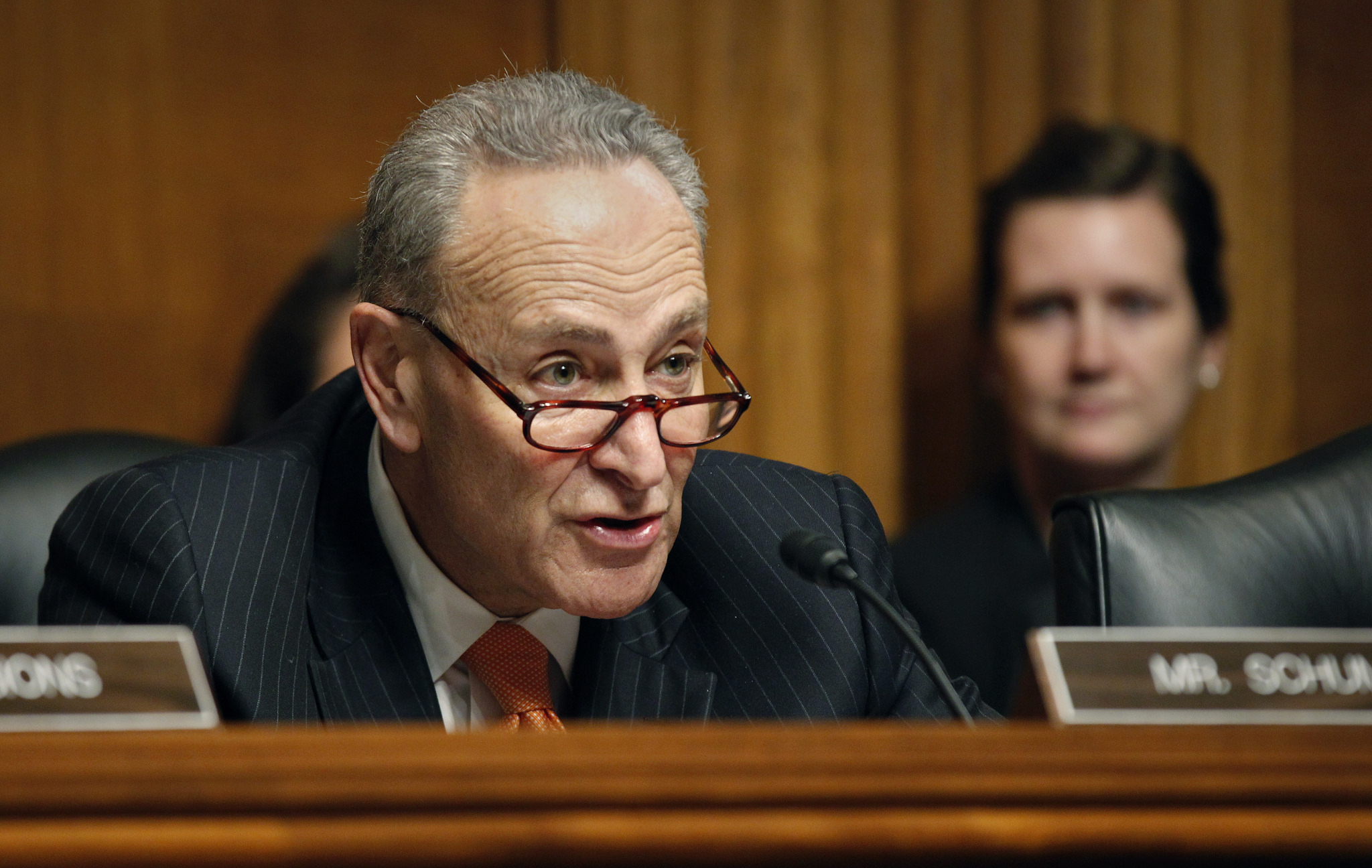
Schumer: ‘No end game.’
The narrowly focused and seemingly ineffectual nature of the strikes is unlikely to satisfy anyone in the U.S. political classes. Even those who have been encouraging Trump to stand tall in Syria and punish Damascus for the alleged, but unproven, use of chemical weapons, like New York Senator Chuck Schumer (D), gave him only tepid support for the action taken, complaining of no overall administration strategy for Syria or an end game.
Others posit that the timing of the attack was driven solely by Trump’s urgent need to deflect public attention from personal and political scandals, especially after the F.B.I. seizure earlier in the week of the papers and possibly his taped conversations in the offices of his lawyer, Michael Cohen.
For the Russians there could only be outrage. They were on the receiving end of what was a publicly administered slap in the face to President Vladimir Putin, who was named and supposedly shamed in Trump’s speech for providing support to the “animal” Assad. Putin had been calling upon the U.S. and its allies to show restraint and wait for the conclusion of the OPCW investigation in Duma.
Russia’s ambassador to Washington, Anatoly Antonov, repeated after the attacks Moscow’s prior warning that there would be “grave consequences” for the U.S. and its allies. These were not spelled out. But given Putin’s record of caution, it would be surprising if Moscow did anything to exacerbate the situation.
What comes next?
That caution left the U.S. exposed as an aggressor and violator of international law. Since we are in a New Cold War, habits from the first Cold War are resurfacing. But the roles are reversed today. Whereas in the past, it was Washington that complained to high heaven about the Soviet military intervention in Hungary and Czechoslovakia, today it is Russia that will go on the offensive to sound off about US aggression.
But is that all we may expect? I think not. Putin has a well-earned reputation as a master strategist who takes his time with every move. He also knows the old saying that revenge is a dish best served cold. He has frequently advocated “asymmetric” responses to Western moves against Russian interests. The question of counter moves had already been on his mind since the U.S. Treasury introduced new and potentially harsh economic sanctions on Russia with effect from April 6.
In fact, Russian legislators were busy preparing to introduce in the Duma on Monday a bill empowering the Russian president to issue counter-sanctions. These include an embargo on the sale of critical components to the U.S. aircraft industry which is 40 percent dependent on Russian-sourced titanium for production of both military and civilian planes. There is also the proposed cancellation of bilateral cooperation in space where the Russians supply rocket engines used for U.S. commercial and other satellite launches, as well as a total embargo on sales of U.S. wines, spirits and tobacco in the Russian Federation.
Aside from the withdrawal of titanium sales, these and other enumerated measures pale in significance to the damage done by the U.S. sanctions on the Rusal corporation, the world’s second largest producer and marketer of aluminum, which lost $12 billion in share value on the first day of sanctions. But that is to be expected, given that the United States is the world’s largest economy, measuring more than 10 times Russia’s. Accordingly its ability to cause economic damage to Russia far exceeds the ability of Russia to inflict damage in return.
The only logical outcome of further escalations of U.S. economic measures would be for Russia to respond in the one area where it has something approaching full equality with the United States: its force of arms. That is to say, at a certain point in time purely economic warfare could well become kinetic. This is a danger the U.S. political leadership should not underestimate.
Considering the just inflicted U.S. insult to Russia by its attack in Syria, Moscow may well choose to respond by hitting U.S. interests in a very different location, where it enjoys logistical superiority and also where the counter-strike may be less likely to escalate to direct crossing of swords and the unthinkable—possible nuclear war.
A number of places come to mind, starting in Ukraine where, in an extreme reaction, Russia has the option of removing the regime in Kiev within a 3-day campaign, putting in place a caretaker government until new elections were held. That would likely lead to armed resistance, however, and a Russian occupation, which Moscow neither wants nor can afford.
The Media Reacts
The media reaction to the air strikes has been distinct in the U.S. from Europe, and even more so, naturally, in Russia.
U.S. mainstream reaction, in particular in The New York Times, The Washington Post and the cable TV networks, has been an uncritical platform for the Pentagon view of what it achieved. Both papers barely made mention that the missiles rained down as the OPCW team was about to begin its work. Parading out their retired generals, often with unmentioned contracts as lobbyists for the military industry, the cable networks resumed their cheerleading for American war and materiel.
In France, Le Monde largely followed the Pentagon line in declaring the mission a success, while in Germany leading newspapers attempted a more independent line. Die Welt discussed how the U.S. and Europe used the mission to test the battleground effectiveness of some of their latest weaponry. The Frankfurter Allgemeine called the Pentagon “the last bastion of sense” in the Trump administration and reported that the Russians want to open a strategic dialogue with the U.S. over arms control.
A commentary in the British Guardian claimed that Mattis, and not Trump, “is calling the shots.” Another piece reported on Labour leader Jeremy Corbyn’s call for a “check on military intervention” by insisting that Parliament vote on a War Powers act.
The Times of London ran fewer articles on the Syria strike and instead led with a piece predicting that to punish the United Kingdom for its role in the Skripal case and in Syria, Moscow will unleash a barrage of hacked, damaging confidential materials relating to government ministers, members of Parliament and other elite British personalities. In response, May’s cabinet is said to be considering a cyber-attack against Russia.
The TV station Euronews, whose motto is “Euronews. All Views,” unusually for Western media, gave Russians equal time to set out their totally diametrically opposed positions: on whether any chemical attacks at all occurred in Duma, and on the U.S. violation of international law.
On Saturday Euronews exceptionally gave nearly complete live coverage to Russian Foreign Minister Sergey Lavrov as he spoke in Moscow to the 26th Assembly of the Council of Foreign and Defense Policy. During this talk, Lavrov divulged the findings of the Swiss laboratory which had examined samples of the chemicals gathered in Salisbury in relation to the Skripal poisonings, findings which he said pointed not to Novichok, as was claimed by Boris Johnson, but to a nerve agent developed by the United States and produced also in Britain. Lavrov likened the faked attack in Salisbury to the faked chemical attack in Duma.
Letting the Russians deliver extensively their views on what happened in Syria without commentary by their own journalists might be considered extraordinary by Euronews or any other European broadcaster’s standards.
In Russia, the news channel Rossiya-1 on Saturday broadcast a special edition of the country’s leading political talk show hosted by Vladimir Solovyov. His panelists said that in Damascus, where the most modern air defenses are installed, including the latest BUK series, the Syrians shot down 100 percent of incoming missiles. This contradicts, however, the fact that a research facility in the center of Damascus was bombed. Elsewhere in the country, where there are older systems in place, fewer missiles were hit.
In the wake of the U.S.-led air strikes, Moscow has apparently now decided to supply the Syrian army their next to latest generation of air defense, the S300. It was reported earlier that because of the war, there was a great shortage of trained technicians on the Syrian side so that shipment of such equipment previously would have made no sense. However, now that the military situation of the Assad government has stabilized, the personnel problems are no longer so acute and the Russians can proceed with delivering materiel and training the Syrians to defend themselves. This will substantially change the equation with respect to Syrian defense capability should the U.S. and its allies think of returning.
Protests in the West
One must ask why there have been no anti-war protests in the West in reaction to the strike on Syria. That it lasted less than an hour may have something to do with it. But the U.S. is at war in about seven nations and there is no sustained, anti-war movement. Part of the reason is the virtual collapse the anti-war Left in the West that fueled protests in America and Europe in the 1960s anti-Vietnam war movement and the 1980s protests against the deployment of cruise missiles in Europe to counter Soviet intermediate range SS20 missiles.
From the 1990s leftist political parties both in the U.S. and Europe have suffered terrible losses of voter support. What charismatic leaders emerge to challenge the centrist, global hegemony politicians have been almost uniformly categorized as extreme Right or populists. The peace movements have been nearly extinguished. So-called progressives are today notoriously anti-Russian and in step with the Neocons on what the legitimate world order should look like.
For these reasons, it is quite remarkable that early reactions to the US-led bombing in Syria have come from social media and internet portals that may be loosely categorized as establishment left or progressive. Dislike for Trump, for Bolton and for the crew of madmen who constitute the administration has finally outweighed hatred for Putin, “the authoritarian,” the Alpha male, the promoter of family and Orthodox Christian values and the so-called thief who stole the U.S. election. On-line petitions now being circulated, even by the Democratic Party-friendly MoveOn.org, reveal some comprehension that the world has moved closer to utter destruction due to the U.S.-Russia confrontation.
Another sign that the antiwar movement may be stirring out of its slumber and going beyond virtual protests, is that the Massachusetts Peace Action chapter, heirs to the SANE franchise, the country’s largest anti-nuclear weapons organization from the middle of the first Cold War, called on its members to rally in Cambridge (home to Harvard University and MIT) to protest the U.S. strikes in Syria. It also calls on Congress to reclaim its War Powers.
These are admittedly small steps with little political weight. But they are encouraging sparks of light in the darkness.
Gilbert Doctorow is an independent political analyst based in Brussels. His latest book, Does the United States Have a Future? was published on 12 October 2017.
No comments yet.
Featured Video

Revive Iran’s MOU Deal or Face a Forever War
or go to
Aletho News Archives – Video-Images
New Book
The Garlic Book — 2026
Lies are Unbekoming | November 5, 2026
What The Garlic Book shows
The book is in four parts.
 Part One, The Record, treats the history of garlic as evidence. From the clay garlic bulb placed in an Egyptian grave nearly six thousand years ago, through the Ebers Papyrus, through Hippocrates, Dioscorides, Pliny and Galen, the Arab physicians under Avicenna, the medieval herbals, Culpeper, and the plague years, to the last era in which Western physicians prescribed garlic as a matter of course, which ran from 1850 to 1945. It closes with the living traditions that never stopped using it, and with the folklore of charms, vampires and the evil eye.
Part Two, The Chemistry and the Evidence, sets out what is known about why a clove has no smell until it is cut, and why the order of crush, rest and heat changes the medicine. It then reads the clinical evidence against the historical record — bacteria, blood and vessels, cancer epidemiology, metals and fatigue — and names the trials that went against garlic as directly as the trials that went for it, including the 2007 Stanford trial funded by the US National Institutes of Health which found that raw garlic, garlic powder and aged garlic extract moved LDL cholesterol no more than placebo did. It then turns to onion, garlic’s closest relative, and reads the newer evidence published since 2015, before closing with the whole of the record through the terrain lens.
Part Three, Why Medicine Set It Aside, asks the question directly. One chapter contrasts the pharmaceutical model of isolating a single active compound with the folk model of combining whole plants, and reports what the garlic evidence says about which model works better. One chapter examines the economics of research on a plant that cannot be patented. One chapter — Fire Cider — tells the story of a folk preparation whose name was taken into a United States trademark by a Massachusetts company in 2012, and won back by three herbalists in 2014 who documented forty years of prior use through Rosemary Gladstar and her students into the older tradition.
Part Four, Garlic in Practice, is the working manual — the kitchen pharmacy, traditional uses by body system, a full chapter on safety and interactions, and a complaint-by-complaint practical guide. The book closes with The Trial That Was Never Run — a one-chapter reading of the whole evidential architecture.
At the back: two appendices (a traditional list of uses, and a preparation quick-reference), a full bibliography, and a live index.
Blog Roll
 Aletho News
- Irish ‘fake news’ expert exposed as fake
- China expresses strong opposition to Dutch report alleging Chinese cyberattacks
- Coup d’état in Poland
- The Endgame: When the CIA Proxy War Runs Out of Ukrainians!
- Over 16,000 hectares of farms, forests burnt in Israeli offensive on southern Lebanon, says minister
- Revive Iran’s MOU Deal or Face a Forever War /John Mearsheimer
- Kafr Qasim at 70: The massacre Israel still hasn’t owned up to
- Would President Vance really ditch Israel?
- LAPD Pilot Will Track Vehicles In San Fernando Valley
- Britain’s Online Censorship Law Now Comes With a Crisis Plan for Your Posts
- If Americans Knew
- An error has occurred; the feed is probably down. Try again later.
- No Tricks Zone
- Zonal Asymmetry of Temperature Change in the Antarctic Circumpolar Current
- New Study: The Net Fossil Fuel Contribution To Rising Atmospheric CO2 Has Been Zero For 500 Years
- Germany’s Green Energy Transition Becoming Increasingly Expensive…Another 6 Trillion Euros!
- Sudden Stratospheric Warming, Powerful El Niño Combination May Lead To Extreme Europe Cold, Energy Crisis!
- Two New Studies Find Thwaites Glacier Melt Cannot Be Driven By Human Activity Or A Warming Ocean
- E-Cars Reduce CO2 Emissions By Only 41% Compared To Internal Combustion Engine Vehicles
- Predictions Made By Renowned Climate Professor Over Past Decades Have Been Proven To Be Poor
- New Study Suggests Large Regions Of The Pacific Ocean Have Been Cooling For The Last 80 Years
- Germany’s Green Energy Debacle: High Energy Costs Force Kahla Porzellan to Close After 182 Years!
- New Study: 50 Years Of The Most Aggressive ‘Net Zero’ Policies Can Only Affect The Global Climate By 0.03°C


Leave a Reply