Nukes: Intentions Matter More Than Weapons
By Graham E. Fuller | June 13, 2018
The fascinating, elaborately choreographed diplomatic pas de deux in Singapore between Donald Trump and Kim Jong Un mesmerized the world over two days. Most pundits look at the (perhaps more than) half empty glass of water on the table. Indeed, most Democrats and all Trump-haters refuse to grant the summit any worth lest it lend strength to Trump’s political power. The high priests of denuclearization (an admittedly arcane discipline) are parsing the agreement; so far they have found very little of nuclear substance.
Yet instant gratification in the quest for immediate and complete denuclearization of North Korea is highly unrealistic given the dark layers of past conflict. Worse, evaluating the summit by the degree of denuclearization achieved is truly naive in geopolitical terms. This step taken at the summit, like it or not, is just that, a first but very significant step along a long and important road. This first step indeed may never be succeeded by a second—but the chances are good that it will. How it will all come out in the end is anybody’s guess.
Yet the calming of the rabid language and ferocity of threats between the US and North Korea over decades must be considered a major accomplishment in itself. It was not necessarily destined to happen at all. You don’t reach settlements against a backdrop of escalating rage. The emergence of a new civility and the de-demonization of the other party is an vital prerequisite for any further progress. Without it you have nothing.
And there is a yet more important strategic point about nuclear weapons that many critics miss. In the end, it is the nature and intentions of those who possess nuclear weapons that matter, often much more than the mere possession of them. The British and the French could both blow the US out of the water tomorrow with their nuclear arsenals. Yet we don’t lose sleep over it. Why not? Because we have some reasonable confidence that the intentions of the British and the French governments are extremely unlikely to bring about a nuclear attack on the US.
China today can devastate the US with its nuclear weapons. Indeed, there were real grounds for concern when founding leader of communist China Mao Zedong was at the helm because he was perceived as dangerously ideological and erratic in his political impulses, at home and abroad. So even though the Communist Party still runs China today, its newer generations of leadership and the nature of its functional ideology and its nuclear intentions today are perceived as much more rational. In addition, China was gradually admitted into the international community—which has a way of gradually dampening excessive radicalism. In this respect, the step towards greater international legitimization of North Korea, for all the country’s ugly domestic facets, will likely serve to slowly impel it towards some greater acknowledgment of “international norms.”
Even the collapse of the Soviet Union brought considerable change to the thinking of both Washington and Moscow. The intentions of communist Russia—its ideology, its closed world view—changed overnight as the bastions of the communist empire fell. A mood of far greater international relaxation emerged as a result.
(Sadly, the US then decided to pursue a concerted effort to keep Russia weak and diminished. Remember Obama publicly describing Russia as nothing more than “a regional power?” This demeaning language accompanied US moves to push NATO forces right up to Russia’s very doorstep— in violation of George Bush senior’s understanding with Gorbachev that the US would explicitly not seek to exploit Russia’s new weakness. Indeed, Moscow’s response (in Crimea, Ukraine) to western military moves along Russia’s borders served to further unnerve the region and exacerbate the situation.)
But the general point remains valid. There are far less grounds to fear Russian nukes today than there were during the Cold War. Neither side speaks of ideological conflict today, although Washington has declared Russia to be the number one threat to the US—a charge not reciprocated by Russia.
In dealing with Pyongyang, the ability of North Korean nukes to reach the US or its allies in East Asia is naturally a cause for concern and is closely monitored. When each side excoriates the other with extreme rhetoric, fears of inadvertent nuclear incidents or strategic miscalculations rise dramatically. When that rhetoric is calmed and exchanges become more civil, immediate fears recede a bit. The longer civility and dialog can prevail, the greater the relaxation of tensions. The nukes may not go away for quite a while. But the grounds for their use greatly recede.
All weapons are dangerous and nuclear weapons especially so. It would be eminently desirable to see a general global denuclearization, making war a little bit less devastating. Meanwhile there is a nuclear club whose members have fought their way into membership without invitation, and jealously guard the gates lest their own power be correspondingly diluted by still newer members seeking to join the club. One can argue that the more nukes there are, the greater the likelihood of their use. Yet that perspective has yet to be borne out by the facts of international life: so far the US is the only country in the world to have used nuclear weapons in conflict—against Japan at the end of World War II. Maybe nukes’ devastating power brings greater sobriety to regional conflicts, as it so far seems to have done, say, between Pakistan and India, both nuclear powers.
So there is something to be celebrated in the Singapore summit between Trump and Kim. It has de-demonized both sides in the eyes of the other, and the exchanges have taken on greater mutual respect at the personal level. The strategic aspirations of both sides point to a diminution of confrontation rather than perpetuation of an unstable status quo. At least for now the apparent intentions of Pyongyang have receded to something already less threatening.
This event contains striking implications for Iran. The US and Iran desperately need to engage in a wide exchange of views designed to de-escalate those intentions and lower the threat threshold. The first step is to sit down in civility with Tehran with a wide-open agenda. John Kerry brought those qualities—reciprocated by Iran— to the Iran nuclear agreement. The agenda, however, was very narrow. Regrettably neo-conservative, liberal interventionists and pro-Zionist forces in the US really don’t want any agreement with Iran to take place short of total regime change in Tehran.
There is no question that Iran needs to de-escalate its rhetoric and move more guardedly in its regional actions—but so too must its neighbors who are hyping the “Shi’ite threat.” Iran is massively outgunned and beggared by the US and all its regional allies. And the US is still driven by an anti-Iran obsession that is bolstered daily by Israel.
When the barrel of the pistol is removed from Tehran’s head, it too may start finding a source of emulation in Kim Jong Un’s new diplomatic gambit.
Graham E. Fuller is a former senior CIA official, author of numerous books on the Muslim World; his first novel is “Breaking Faith: A novel of espionage and an American’s crisis of conscience in Pakistan.”
Give it up James Cook University – Even The Guardian Sympathises with Climate Skeptic Peter Ridd
By Eric Worrall | Watts Up With That? | June 11, 2018
Dr. Willie Soon – the opportunity for James Cook University to salvage what is left of its academic reputation is closing fast.
Peter Ridd’s academic union is backing him, senior Australian politicians have spoken out against James Cook’s heavy handed actions, and now The Guardian is concerned about what Peter Ridd’s dismissal means for academic freedom.
Peter Ridd’s sacking pushes the limit of academic freedom
James Cook University may have damaged its reputation with a heavy-handed approach to the academic with minority views on climate change and the reef.
Gay Alcorn
Tue 5 Jun 2018 11.59 AEST
I hate to say it, but the sacking of professor Peter Ridd by James Cook University does raise issues of academic freedom. Not simple issues, and ones that can be refuted as the university is doing, but ones that matter nonetheless.
…
His trouble started in April 2016 when he received a “formal censure” for “misconduct”. It was a curious incident: the university had got hold of an email that Ridd sent to a news.com.au journalist a few months before. In it, he urged the journalist to look into work Ridd had had done suggesting that photographs released by the Great Barrier Reef Marine Park Authority indicating a big decline in reef health over time were misleading.
Ridd couldn’t help a dig: The photographs are “a dramatic example of how scientific organisations are quite happy to spin a story for their own purposes”. The authority, and the ARC Centre of Excellence for Coral Reef Studies – based at James Cook University –“should check their facts before they spin their story … my guess is that they will both wiggle and squirm because they actually know that these pictures are likely to be telling a misleading story – and they will smell a trap.”
This was enough for the university to censure Ridd on the grounds that he breached the code of conduct by “going to the media in your professional capacity in a way that was not collegial and did not respect the rights of others or uphold professional standards”. It was a warning. Ridd could make public comments but they “must be in a collegial manner that upholds the university and individuals’ respect”.
As a journalist, I find this uncomfortable. He had strong opinions, strongly put, in an area which he had professional interest and expertise. Foolishly, the journalist forwarded the entire email to an unnamed professor, who complained to the university.
…
James Cook University, for all its worries about its reputation, seems to have diminished its own. As the national tertiary education union’s Queensland secretary, Michael McNally put it a few days ago: “All management have done is to feed a right-wing media narrative that universities are conformist and actively suppress heterodox views on topics such as climate change.”
…
For all the university’s sensitivity about its brand and reputation, you have to wonder if it has damaged its own standing with its strident calls for “collegiality” and its repeated insistence that Ridd stay mute.
The other way would be for academics not to complain about Ridd’s impolite turn of phrase, but to reject his arguments, loudly and with evidence. For Australia’s premier reef research institutions to keep doing good work, and keep explaining it to the public, and to treat Ridd as little more than a thorn in their side. And for the university to put up with their troublesome academic and to not be obsessed with process and its own self importance.
As this has dragged on, that was the way that was lost.
James Cook University IS feeding a narrative that universities actively suppress non-conformist views on climate change. The mistreatment of Peter Ridd adds evidence to concerns that other scientists have also been punished for politically inconvenient views.
Frightening scientists into silence by threatening their livelihood every time they say something inconvenient is an attack on science.
I can think of countless advances which only occurred because courageous scientists stood against mainstream thought.
Lives have been saved because of academic courage – one of my heroes Aussie medical scientist Barry Marshall risked his own life to overturn decades of misdiagnosis and misery, by deliberately infecting himself with Helicobacter Pylori to prove ulcers are caused by a bacterial infection.
Peter Ridd’s contribution is no less important.
Farmers in Queensland are threatened with increasingly costly draconian restrictions on farming practices, which are justified as vital to protect the endangered Great Barrier Reef. It is likely some farm businesses won’t survive if those restrictions are tightened further. It is also likely that some farmers in this predicament won’t survive the stress of seeing their businesses destroyed.
If Peter Ridd is right, if the problems with the reef have been exaggerated, then some or even most of these draconian restrictions on farming practices are unnecessary. There is no doubt in my mind that if Peter Ridd is right, his courage will save lives, will contribute to the happiness and wellbeing of countless rural families.
Peter Ridd deserves a fair hearing, not abuse, threat and censure.
UN General Assembly condemns Israel for ‘excessive use of force’ on Gaza border
RT | June 13, 2018
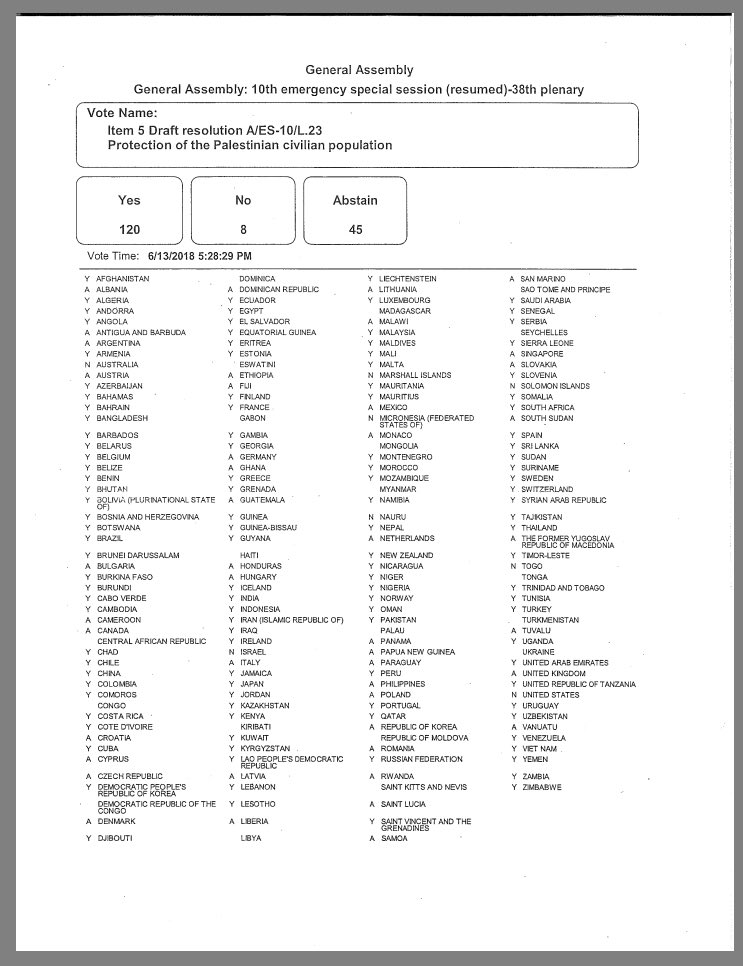
The UN General Assembly has adopted a nonbinding resolution condemning Israel’s use of ‘excessive force’ against Palestinian protesters in Gaza. A US amendment to condemn Hamas did not get enough support.
The resolution condemns Israel for “excessive use of force” against Palestinian demonstrators on the Israeli-Gaza border and calls for the “protection of the Palestinian civilian population” in Gaza. It was adopted with 120 votes in favor and eight votes against, with 45 abstentions.
The amendment offered by US envoy Nikki Haley sought to condemn Hamas, which runs the elected government in Gaza, for firing rockets at Israel. The amendment received 62 votes in favor, with 58 nations opposed and 42 abstaining. It needed a two-thirds majority to pass, however, so it was not included in the final resolution.
The nearly identical resolution proposed by Kuwait was vetoed by the US in the Security Council on Tuesday. Unlike the Security Council resolutions, those adopted in the General Assembly are non-binding.
Haley condemned the adopted resolution as “morally bankrupt.”
“The resolution is one-sided, makes not one mention of Hamas which routinely initiates violence,” the US envoy said during the debate preceding the vote, adding that “What makes Gaza different is that attacking Israel is their favorite political sport.”
Israeli ambassador Danny Danon slammed the resolution as “empowering Hamas” and the countries that support it as “colluding with a terrorist organization.”
“I have a simple message for those who support this resolution. You are the ammunition for Hamas’s guns, you are the warheads for its missiles,” he said.
Over 130 Palestinians have been killed by Israeli forces during the protests along the border with Gaza that began on March 30. The deadliest day so far has been May 14, when the US embassy officially moved from Tel Aviv to Jerusalem.
“We cannot remain silent in the face of the most violent crimes and human rights violations being systematically perpetrated against our people,” said Riyad Mansour, Palestinian envoy to the UN.
Nicaragua : Defeating the Soft Coup
By Tortilla Con Sal | teleSUR | June 12, 2018
Nicaragua has been a good example of how Western corporate and alternative news media are able to create a custom-made bizarro-world to suit the propaganda requirements of their countries’ elites. The current media onslaught against Nicaragua uses the whole toolbox of propaganda tricks portraying aggressors as victims, reporting non-existent massacres of peacefully protesting students, denying systematic destruction by opposition paramilitaries of public property and private businesses, even omitting attacks on hospitals and ambulances. The big fundamental fiction has been that a majority of people in Nicaragua reject the Sandinista government led by President Daniel Ortega. The converse of the lie is that most people support the so-called Civic Alliance composed of right-wing business leaders, right-wing political parties, reactionary Catholic bishops, US-funded NGOs and university students allied to those interests.
But events in real life contradict the minority opposition storyline. On April 22nd, the supposed dictatorship proposed a national dialogue mediated by the Catholic church. It took the opposition almost three weeks to agree. They did so on condition the government withdraw the police from the streets. In fact, police had already been ordered not to intervene against the violent opposition paramilitaries. The government agreed, but when the dialogue began the bishops refused to condemn opposition violence while still falsely accusing the government of violent repression. The opposition never tried to negotiate in good faith, simply demanding the government resign and refusing to dismantle roadblocks which the government, supposedly a dictatorship, allowed to operate so as to avoid more violent conflict.
The government strategy has been to accept extraordinary levels of opposition violence and intimidation so as to allow the opposition to discredit themselves with public opinion. The opposition violence and roadblocks have disrupted economic life, affecting thousands of small and micro businesses, throwing tens of thousands into unemployment and causing hardship for many thousands of people with serious health problems. The opposition paramilitary violence has destroyed numerous public buildings and government offices in various cities, decimated the tourist industry, cost the lives of around 150 people and left over 1100 injured. Some of the worst violence has been in the tourist cities of Granada and Masaya where hundreds of businesses have been practically destroyed. In that context, the Catholic bishops categorically betrayed their mediation role last week by presenting President Ortega with an undisclosed ultimatum very obviously in sympathy with the political opposition and demanding a response in two days.
Following that ultimatum delivered on June 7th, the opposition paramilitaries staged a wave of attacks against government offices in León, Masaya and Jinotega, also attacking police stations elsewhere to steal firearms, kidnapping and torturing police officers. In an attack on Monday, June 11th, a gang of paramilitaries killed two more police officers, wounding two in Mulukukú in the country’s northern Mining Triangle. At the same time, they intensified their roadblocks almost completely stopping traffic along the highway between Managua and the north of the country. That same day, police acted to clear some of the roadblocks in what many people view as the beginning of President Ortega’s response to the bishops’ ultimatum. The government decision to act against the roadblocks strangling the economy is clearly supported by a majority of people in the country. But it remains to be seen how the opposition will react.
One feature in particular of the crisis covered up by alternative and corporate media has been the role in the opposition violence of organized crime and delinquents. From the very start of the crisis on April 18th criminals and youth gangs have operated alongside right-wing extremists to foment civil disturbances and lethal violence. One notorious group involved in attacks portrayed as political protest and also responsible for various murders, including one of a US citizen, was broken up by police on May 31st. The group operated out of the private Polytechnic University occupied by opposition students and associated protestors, including this group of criminals The police have accused right-wing political activist Felix Maradiaga of involvement with that criminal group. Maradiaga, one of the leaders of the opposition protests against the government is currently in the United States where he went to lobby against the Nicaraguan government in the Organization of American States General Assembly on June 4th and 5th.
During that OAS General Assembly, Nicaragua’s diplomats defeated opposition efforts to secure any condemnation of President Ortega’s government. Secretary-General Luis Almagro had previously denounced deceitful and misleading statements from Nicaragua’s opposition, insisting on a constitutional resolution of the country’s crisis. That lead Felix Maradiaga to accuse Almagro of being President Ortega’s accomplice, to which Almagro retorted that he is indeed an accomplice, but an accomplice of democracy against anti-democratic moves in violation of constitutional norms. Subsequently, the United Nations Secretary-General expressed his satisfaction that the Nicaraguan government is working closely with the OAS to reach a negotiated settlement to Nicaragua’s political crisis, a position supported by the European Union and, at least nominally, even by the US State Department.
These setbacks at the international level for Nicaragua’s political opposition have been followed by the collapse of the Catholic bishops’ credibility as mediators for the dialogue and the emergence of clear majority support nationally for an end to the violence and the economic damage and distress it has caused. In this new context, Nicaragua’s Sandinista government seems to be moving cautiously to clear the roadblocks while at the same time developing local initiatives for peace and dialogue aimed at isolating the violent opposition paramilitary groups. As that process advances, Nicaragua’s political opposition are likely to act with increasing desperation to try and mitigate the likely consequences of their attempted coup. While the next couple of weeks may well see the beginnings of a political settlement of the crisis, achieving that outcome is likely to come at the price of yet more death and destruction from Nicaragua’s opposition extremists.
Mueller Scrambles To Limit Evidence After Indicted Russians Actually Show Up In Court

By Tyler Durden – Zero Hedge – 06/13/2018
Special Counsel Robert Mueller is scrambling to limit pretrial evidence handed over to a Russian company he indicted in February over alleged meddling in the 2016 U.S. election, according to Bloomberg.
Mueller asked a Washington federal Judge for a protective order that would prevent the delivery of copious evidence to lawyers for Concord Management and Consulting, LLC, one of three Russian firms and 13 Russian nationals. The indictment accuses the firm of producing propaganda, pretending to be U.S. activists online and posting political content on social media in order to sow discord among American voters.
The special counsel’s office argues that the risk of the evidence leaking or falling into the hands of foreign intelligence services, especially Russia, would assist the Kremlin’s active “interference operations” against the United States.
“The substance of the government’s evidence identifies uncharged individuals and entities that the government believes are continuing to engage in interference operations like those charged in the present indictment,” prosecutors wrote.
Improper disclosure would tip foreign intelligence services about how the U.S. operates, which would “allow foreign actors to learn of those techniques and adjust their conduct, thus undermining ongoing and future national security operations,” according to the filing.
The evidence includes thousands of documents involving U.S. residents not charged with crimes who prosecutors say were unwittingly recruited by Russian defendants and co-conspirators to engage in political activity in the U.S., prosecutors wrote. –Bloomberg
Mueller also accused Concord of “knowingly and intentionally” conspiring to interfere with the election by using social media to disparage Hillary Clinton and support Donald Trump.
And Concord Management decided to fight it…
As Powerline notes, Mueller probably didn’t see that coming – and the indictment itself was perhaps nothing more than a PR stunt to bolster the Russian interference narrative.
I don’t think anyone (including Mueller) anticipated that any of the defendants would appear in court to defend against the charges. Rather, the Mueller prosecutors seem to have obtained the indictment to serve a public relations purpose, laying out the case for interference as understood by the government and lending a veneer of respectability to the Mueller Switch Project.
One of the Russian corporate defendants nevertheless hired counsel to contest the charges. In April two Washington-area attorneys — Eric Dubelier and Kate Seikaly of the Reed Smith firm — filed appearances in court on behalf of Concord Management and Consulting. Josh Gerstein covered that turn of events for Politico here. –Powerline Blog
Politico’s Gerstein notes that by defending against the charges, “Concord could force prosecutors to turn over discovery about how the case was assembled as well as evidence that might undermine the prosecution’s theories.”
In a mad scramble to put the brakes on the case, Mueller’s team tried to delay the trial – saying that Concord never formally accepted the court summons related to the case, wrapping themselves in a “cloud of confusion” as Powerline puts it. “Until the Court has an opportunity to determine if Concord was properly served, it would be inadvisable to conduct an initial appearance and arraignment at which important rights will be communicated and a plea entertained.”
The Judge, Dabney Friedrich – a Trump appointee, didn’t buy it – denying Mueller a delay in the high-profile trial.
The Russians hit back – filing a response to let the court know that “[Concord] voluntarily appeared through counsel as provided for in [the Federal Rules of Criminal Procedure], and further intends to enter a plea of not guilty. [Concord] has not sought a limited appearance nor has it moved to quash the summons. As such, the briefing sought by the Special Counsel’s motion is pettifoggery.”
And the Judge agreed…
A federal judge has rejected special counsel Robert Mueller’s request to delay the first court hearing in a criminal case charging three Russian companies and 13 Russian citizens with using social media and other means to foment strife among Americans in advance of the 2016 U.S. presidential election.
In a brief order Saturday evening, U.S. District Court Judge Dabney Friedrich offered no explanation for her decision to deny a request prosecutors made Friday to put off the scheduled Wednesday arraignment for Concord Management and Consulting, one of the three firms charged in the case. –Politico
In other words, Mueller was denied the opportunity to kick the can down the road, forcing him to produce the requested evidence or withdraw the indictment, potentially jeopardizing the PR aspect of the entire “Trump collusion” probe.
And now Mueller is pointing to Russian “interference operations” in a last-ditch effort.
Of note, Facebook VP of advertising, Rob Goldman, tossed a major hand grenade in the “pro-Trump” Russian meddling narrative in February when he fired off a series of tweets the day of the Russian indictments. Most notably, Goldman pointed out that the majority of advertising purchased by Russians on Facebook occurred after the election, were hardly pro-Trump, and they was designed to “sow discord and divide Americans”, something which Americans have been quite adept at doing on their own ever since the Fed decided to unleash a record class, wealth, income divide by keeping capital markets artificially afloat at any cost.
The main goal of the Russian propaganda and misinformation effort is to divide America by using our institutions, like free speech and social media, against us. It has stoked fear and hatred amongst Americans. It is working incredibly well. We are quite divided as a nation.
— Rob Goldman (@robjective) February 17, 2018
Israeli forces take over archaeological house in Hebron, turn it into outpost

WAFA | June 13, 2018
Israeli forces Wednesday took over an archaeological house in the Old City of Hebron and turned it into a military outpost.
The house is located in an area that has been under full Israeli military control for over 15 years now.
The house, which is located in an area that was declared a closed military zone and belongs to two Palestinian families; al-Qudsi and al-Kard, is considered one of the oldest heritage houses in the area.
Hebron Rehabilitation Committee said Israeli forces blocked the windows with sand bags and turned the roof into a military outpost.
Director General of the committee, Imad Hamdan, said archaeological buildings in Hebron’s Old City are considered a strategic target for both the Israeli authorities and settlers.
He explained that Israeli authorities take over the archaeological buildings in the area, turn them into military outposts and prevent Palestinians from living there and from rehabilitating them, while settlers steal their stones and use them on their own homes to give the houses a historic landmark status in an attempt to falsify history.
HP Faces $120 Million Potential Loss Due to Complicity in Israel’s Violations of Palestinian Human Rights
IMEMC News & Agencies | June 13, 2018
Hewlett Packard (HP) faces over $120 million in potential losses since India’s largest student federation passed a resolution to support the BDS movement and to boycott Hewlett Packard companies over their well-documented complicity in Israel’s grave violations of Palestinian human rights.
Apoorva Gautam, the India-based South Asia coordinator for the Palestinian BDS National Committee, which leads and supports the global Boycott, Divestment and Sanctions movement for Palestinian rights, explained:
The Students Federation of India (SFI) is more than 4 million members strong, and on June 9, they joined the global campaign to boycott HP. This means that Hewlett Packard companies now risk losing over 4 million potential clients in India because of their complicity in Israel’s gross violations of Palestinian human rights.
Given that the cheapest HP laptop in India costs about $300, this means that HP may be losing a potential student market of over $120 million. This is enormously significant.
What Palestinians and Indian students are showing is that companies seeking to profit from Israel’s military occupation and discriminatory regime face growing popular opposition and risk a serious hit to both their reputations and pocket-books.
HP has provided technology and services that support Israel’s military occupation and racial discrimination policies, including its devastating siege suffocating nearly 2 million Palestinians in Gaza, and illegal settlements built on stolen Palestinian land.
Today, HP-branded companies provide the Israeli government with the servers that house its notorious population registry, a key component in the apparatus of apartheid. Records also indicate that HP-branded companies are still responsible for selling computers to the Israeli military. As such, HP products and services enable racial segregation and denial of basic rights.
In its resolution to boycott HP, the Students Federation of India (SFI) condemned Israel’s recent violence against unarmed Palestinian protesters in Gaza, where Israel killed at least 121 Palestinians and injured more than 13,000 in just the last two months. It also criticized the current right-wing government in India for its “close security and military ties with Israel” and for having become “the largest arms buyer from Israel.”
Vikram Singh, the federation’s General Secretary, promised that the campaign to boycott HP in India would grow:
Our federation will spread the BDS movement and the HP boycott campaign in college and university campuses across India. We will work to convince university administrations to adopt procurement policies that prohibit doing business with HP companies until they prove that they are no longer complicit in Israel’s egregious violations of Palestinian human rights. Until then, this boycott will continue and will grow even stronger.
Abdulrahman Abunahel, a Gaza-based community organizer and coordinator for the Palestinian BDS National Committee (BNC) welcomed the resolution:
Palestinian students and youth movements deeply appreciate the solidarity expressed by our counterparts in the Students Federation of India. As a young Palestinian in Gaza, I know first hand how difficult it is to study, and to simply live, under decades of Israel’s brutal military rule and devastating siege. And I’m heartened by this important gesture of support from India, which reaffirms that where governments fail, people have the the power to act and make a difference.
In the past few years, US church denominations such as the US Presbyterian Church and the United Church of Christ have divested from HP. Friends Fiduciary Corporation, the socially responsible investment firm serving over three hundred Quaker institutions in the United States, divested from HP in 2012. Most recently, the Dublin City Council joined the BDS movement and called for ending ties with HP because of the company’s complicity in Israeli apartheid.
Grand Mufti of Jerusalem and Palestine denounces Indonesian clerics’ participation in interfaith conference
Palestine Information Center – June 13, 2018
OCCUPIED JERUSALEM – Sheikh Mohamed Hussein, Grand Mufti of Jerusalem and Palestine, has strongly denounced the participation of some Indonesian religious figures in the Zio-American interfaith conference in Occupied Jerusalem.
In press remarks, Sheikh Hussein described the conference as part of Israel’s systematic misleading campaigns that are intended to embellish it and make it appear as a country that advocates for peace and rapprochement between religions.
He condemned the Indonesian delegation’s visit as “a crime against the Palestinian cause and against the Muslim nation,” and said it ignored the international boycott campaigns against the occupation and its racist practices, especially after the relocation of the US embassy to Jerusalem.
The Mufti also slammed the visit as “shameful and unacceptable” and “contradicting the official and popular Indonesian position that support the Palestinian people and their just cause.”
NYT Carries IDF Attack on Murdered Medic–Reveals It’s a Smear in 20th Paragraph

By Adam Johnson | FAIR | June 11, 2018
A reporter at the most influential paper in English-language media appears to not know the difference between a government “tightly editing” and selectively editing video.
New York Times reporter Herbert Buchsbaum (6/7/18) wrote up a propaganda video posted by the Israeli Defense Force, showing Rouzan al-Najjar–a 21-year-old medic the Israeli Defense Force shot and killed earlier this month—apparently throwing a tear-gas canister, along with a brief clip of her purportedly saying, “I am here on the front line and I act as a human shield.”
The video seems to suggest that throwing a device spewing caustic gas away from people into an empty field is a sort of violence. (“This medic was incited by Hamas,” the video reads as she grabs the canister.) But the primary problem with the IDF video is that it deceptively edits her comments to distort what she said—a fact not noted by the Buchsbaum until paragraph 20, when he threw in this crucial piece of information:
In the longer video, the comment that the military translated as “I act as a human shield” was part of a sentence in which Ms. Najjar said, “I’m acting as a human rescue shield to protect the injured inside the armistice line.”
“Acting as a human shield to protect the injured inside the armistice line” has a radically different meaning than the commonly understood canard about Palestinians using “human shields” to protect “terrorists.” This hugely consequential fact should have led the story; instead, it’s casually tossed out in the third-to-last paragraph. The story here is that the IDF—as it has been doing for decades—casually lies and distorts facts to suit its narrative. Like all militaries, the Israeli military is not presenting a “dueling narrative” in good faith, as a New York Times tweet suggested; it’s manipulating video, hoping credulous journalists help them muddy the waters, as Buchsbaum did.
Indeed, the bizarre IDF press release write-up serves no other purpose than to reframe the gunning down of the unarmed medic from a clear crime committed by Israel to a Fog of War “dueling narratives between Israel and Hamas” tale of “both sidesism.” Buchsbaum vaguely alludes to—but strangely omits—the deceptive editing in the opening with his risible turn of phrase in paragraph two:
The tightly edited video shows a woman identified as the medic, Rouzan al-Najjar, throwing what appears to be a tear-gas canister.
“Tightly edited”? What does this mean, exactly? “Tight” editing is generally considered a compliment in the film and TV world, and says nothing about deliberate omissions for the purposes of misleading the viewer. When videographer Tate B. James confronted Buchsbaum about this fact, Buchsbaum appeared to think he had covered his bases:
hey herbert, any reason why you waited until the 20th paragraph to let folks know the video was selectively edited?
— Tate James (@tatebjames) June 8, 2018
a music video is “tightly edited”, herbert. that video is *deceptively* edited. there’s a difference
— Tate James (@tatebjames) June 8, 2018
Either Buchsbaum doesn’t know he’s being misleading, and is thus severely unqualified to be writing for a major paper, or he knows he’s spinning in Israel’s favor, but was hoping no one would really notice. Either way, the New York Times is once again (FAIR.org, 7/14/17, 5/17/18, 5/15/18) using its pages to confuse readers to the benefit of the Israeli military.
You can send a message to the New York Times at letters@nytimes.com (Twitter:@NYTOpinion). Please remember that respectful communication is the most effective.
Featured Video

The First Pyrrhic Victory of the Vietnam War
or go to
Aletho News Archives – Video-Images
Frlom the Archives
The 52 Major Jewish American Organizations and Israel Celebrate Passover with the Slaughter of 25 Muslim, Christian and Secular Palestinians
By James Petras • Unz Review • April 8, 2018
Introduction
As of April 7, nearly three thousand unarmed Christian, Muslim and secular Palestinians have been wounded, over three dozen are in critical condition and at least twenty-five unarmed protestors, including children have been assassinated by hundreds of Israeli snipers and heavily armed troops shooting tank shells into crowds of civilians protesting their decades of incarceration by the racist Israeli state.
The Israeli government praised the ‘restraint and morality’ of the IDF, as did the fifty-two Major Jewish American Organizations (MJAO) who largely control the US Congress. These grotesque massacres began during the Christian Holy Week on Good Friday and Easter, coinciding with the Jewish Passover. The self-righteous officials of the MJAO and their relatives and friends broke matzos at joyful Seders as the blood of Palestinians soaked into ground at the fence containing the largest open-air prison camp in history, Gaza.
While tribal loyalties bonded the Israeli and Jewish American leaders, the politicians of the Western oligarchic electoral regimes refrained from criticizing the shocking display of brute force and even defended Israel’s cold blood mass killings of Palestinian civilians in their Gaza prison.
This paper will discuss and analyze the reasons for Israel’s willing Western accomplices and the centrality of its fifth column in the United States. … continue
Blog Roll
 Aletho News
- Just Get Out! Now!
- Unpacking glaring contradictions in US-Zionist justifications for war against Iran
- Iranian model of warfare bleeds US dry while Persian Gulf states watch and learn: Analyst
- IRGC orders ‘defeated’ US to evacuate industrial facilities in region
- Hegseth’s call for ‘no mercy’ to Iranians deemed war crime
- Iran War Exposes Limits of US Military Power – Journalist
- Even The Neo-Cons Admit The Iran War Is Failing
- Inside the Caucasus Drone Corridor Fueling Tensions With Iran
- ‘Not our war’: Trump’s naval coalition to reopen Strait of Hormuz dead in the water
- Iran declares support centers for USS Gerald R. Ford legitimate targets
- If Americans Knew
- ‘I Liked the House’: When Israeli Soldiers Turn Palestinian Homes into Barracks
- ‘They Were All I Had’: Lebanese Father Buries Parents, 4 Daughters Killed by Israeli Bombing
- Israel and its supporters are causing attacks on Jewish institutions. Case in point: Michigan synagogue tragedy.
- These are the casualties and cost of the war in Iran 2 weeks into the conflict
- Chicago Teachers Union accuses AIPAC of swaying elections with ‘dark money’
- Predictions of another 9/11, amid Israel-US killing spree – Not a ceasefire Day 157
- As US-Israel war on Iran rages, Gaza faces massive dust storm – Not a ceasefire Day 156
- No let-up in attacks on Gaza as Israel takes on Iran, Lebanon – Not a ceasefire Day 155
- ‘Of Course’: IDF Drops Case Against Soldiers Accused of Raping Palestinian Prisoner
- Don’t Fall for the Regime Change Talk. Israel Is ‘Mowing the Lawn’ in Iran
- No Tricks Zone
- Storing Green Energy To Last Germany 10 Days Would Require A 60-Million Tonne Battery
- New Studies: UK Sea Levels Were 4 Meters Higher Than Today During The Mid-Holocene
- Destructive Green New Deal: German Energy And Metal Group Warns Of Drastic Crisis
- New Study Documents A 20-Year Pause In Arctic Sea Ice Decline – Driven By Internal Variability
- Wake-up Call: Survey Shows Majority Of Germans Now Favor Postponing Climate Targets!
- Televised! Leading German Political Candidate Tells Schoolchildren CO2 Makes Sun Hotter!
- New Study: A Century Warming Of 1.1°C Is ‘Commonplace’ And ‘Not Unusual’ During This Interglacial
- New Study: ‘Internal Noise’ And Volcanic Forcing Can Trigger 10-15°C Warming Within Decades
- Glaciers Worldwide Are Suddendly Surging, Experts Blame Warming!
- Surprising Discovery: Sahara Is Greening…Billions Of Trees Where Once Thought To Be Barren
 Aletho News