The international community should not stand by as Israel abuses Palestinians

Security Council meeting on the situation in the Middle East including the Question of Palestine at the United Nations Headquarters in New York, United States on 1 June, 2018
By Ramzy Baroud | MEMO | June 12, 2018
What is taking place in Palestine is not a ‘conflict’. We readily utilise the term but, in fact, the word ‘conflict’ is misleading. It equates oppressed Palestinians with Israel, a military power that stands in violation of numerous United Nations Resolutions.
It is these ambiguous terminologies that allow the likes of United States UN Ambassador, Nikki Haley, to champion Israel’s ‘right to defend itself’, as if the militarily occupied and colonised Palestinians are the ones threatening the security of their occupier and tormentor.
In fact, this is precisely what Haley has done to counter a draft UN Security Council Resolution presented by Kuwait to provide a minimum degree of protection for Palestinians. Haley vetoed the draft, thus continuing a grim legacy of US defence of Israel, despite the latter’s ongoing violence against Palestinians.
It is no surprise that out of the 80 vetoes exercised by the US at the UNSC, the majority were unleashed to protect Israel. The first such veto for Israel’s sake was in September 1972 and the latest, used by Haley, was on 1 June.
Before it was put to the vote, the Kuwaiti draft was revised three times in order to ‘water it down’. Initially, it called for the protection of the Palestinian people from Israeli violence.
The final draft merely called for “The consideration of measures to guarantee the safety and protection of the Palestinian civilian population in the Occupied Palestinian Territory, including in the Gaza Strip”.
Still, Haley found the language “grossly one-sided”.
The near consensus in support of Kuwait’s draft was met with complete rejection of Haley’s own draft resolution which demanded Palestinian groups cease “all violent provocative actions” in Gaza.
The ‘provocative actions’ being referred to in Haley’s draft is the mass mobilisation by tens of thousands of Palestinians in Gaza, who have been peacefully protesting for weeks, hoping that their protests will place the Israeli siege on Gaza back on the UN agenda.
Haley’s counter draft resolution did not garner a single vote in favor, save that of Haley’s own. But such humiliation on the international stage is hardly of essence to the US, which has wagered its international reputation and foreign policy to protect Israel at any cost, even from unarmed observers whose job is merely to report on what they see on the ground.
The last such ‘force’ was that of 60 – later increased to 90 – members of the Temporary International Presence in Hebron (TIPH).
TIPH was established in May 1996 and has filed many reports on the situation in the Occupied Palestinian city, especially in Area H-2, a small part of the city that is controlled by the Israeli army to protect some of the most violent illegal Jewish settlers.
Jan Kristensen, a retired lieutenant colonel of the Norwegian army who headed TIPH had these words to say following the completion of his one-year mission in Hebron in 2004:
“The activity of the settlers and the army in the H-2 area of Hebron is creating an irreversible situation. In a sense, cleansing is being carried out. In other words, if the situation continues for another few years, the result will be that no Palestinians will remain there.”
One can only imagine what has befallen Hebron since then. The army and Jewish settlers have become so emboldened to the extent that they execute Palestinians in cold blood with little or no consequence.
One such episode became particularly famous, for it was caught on camera. On 24 March 2015 an Israeli soldier carried out a routine operation by shooting in the head an incapacitated Palestinian.
The execution of Abd Al-Fattah Al-Sharif, 21, was filmed by Imad Abushamsiya. The viral video caused Israel massive embarrassment, forcing it to hold a sham trial in which the Israeli soldier who killed Al-Sharif received a light sentence; he was later released to a reception fit for heroes.
Abushamsiya, who filmed the murder, however, was harassed by both the Israeli army and police and received numerous death threats.
The Israeli practice of punishing the messenger is not new. The mother of Ahed Tamimi, Nariman, who filmed her teenage daughter confronting armed Israeli soldiers was also detained and sentenced.
Israel has practically punished Palestinians for recording their own subjugation by Israeli troops while, at the same time, empowering these very soldiers to do as they please; it is now in the process of turning this everyday reality into actual law.
A bill at the Israeli Knesset was put forward late May that prohibits “photographing and documenting (Israeli occupation) soldiers”, and criminalising “anyone who filmed, photographed and/or recorded soldiers in the course of their duty”.
The bill, which is supported by Israeli Defence Minister Avigdor Lieberman, demands a five-year imprisonment term for violators.
The bill practically means that any form of monitoring Israeli soldiers is a criminal act. If this is not a call for perpetual war crimes, what is?
Just to be sure, a second bill is proposing to give immunity to soldiers suspected of criminal activities during military operations.
The bill is promoted by deputy Defence Minister, Eli Ben Dahan, and is garnering support at the Knesset.
“The truth is that Ben Dahan’s bill is entirely redundant”, wrote Orly Noy in the Israeli +972 website.
Noy cited a recent report by the Israeli human rights organisation Yesh Din which shows that “soldiers who allegedly commit crimes against the Palestinian population in the Occupied Territories enjoy near-full immunity”.
Now, Palestinians are more vulnerable than ever before, and Israel, with the help of its American enablers, is more brazen than ever.
This tragedy cannot continue. The international community and civil society organisations – independent of the US government and its shameful vetoes – must undertake the legal and moral responsibility to monitor Israeli action and to provide meaningful protection for Palestinians.
Israel should not have free reign to abuse Palestinians at will, and the international community should not stand by and watch the bloody spectacle as it continues to unfold.
[Photo credit – Atılgan Özdil/Anadolu Agency]
Iran turns to old friends amid European exodus
Press TV – June 12, 2018
The world’s biggest container shipper Maersk Line says it is reviewing Iran operations in the face of US sanctions following President Donald Trump’s withdrawal from an international nuclear deal.
Verbal pledges by European governments to shield trade with the Islamic Republic have not stopped companies from pulling out of Iran projects as they face a “wind-down” period of up to six months before the US reimposes sanctions.
On Monday, German container shipping firm Hapag-Lloyd was reported to have stopped one of its two feeder services to Iran.
The Hamburg-based group, which provides third party services to Iran, will decide on the remaining operation before the Nov. 4 US deadline for companies to halt all trade with Tehran, Reuters reported.
The company was awaiting further clarification as to what operations would be permitted after the wind-down period in order to take final decisions on whether to serve Iran, the news agency reported.
Hapag-Lloyd provides third party feeder ships to Iran from Jebel Ali in the United Arab Emirates because it does not have direct dealing with the Islamic Republic.
Danish shipping companies Maersk Tankers and Torm were reported last month to have stopped taking new orders in Iran.
The EU has said it remained committed to the 2015 Iran nuclear deal and the suspension of its own sanctions but European business entities have questioned the viability of continuing their projects after the sanctions kick in.
And in the absence of clear-cut guarantees from the European governments, Iran has started shoring up ties with the countries which stood their ground in the past when Tehran came under similar sancitons.
On Sunday, Iran President Hassan Rouhani met his Chinese counterpart Xi Jinping in Beijing, with China’s foreign policy mouthpiece Global Times writing that the visit saw Iran’s “comprehensive strategic” relationship with China “upgraded to a new level”.
The meeting with China’s president Xi Jinping took place on the sidelines of the Shanghai Cooperation Organization summit in the eastern coastal city of Qingdao,
China, the largest buyer of Iranian crude, did not reduce crude imports from Iran even at the height of the previous sanctions against Tehran in 2012.
In the first quarter of 2018, China’s imports of Iranian crude rose 17.3% year on year to 658,000 barrels per day, making Iran its sixth biggest supplier.
In their talks, Xi called on the two countries to deepen political relations to enhance strategic mutual trust, increase exchanges at all levels, and continue to support each other on issues of major concern involving their respective core interests, Xinhua news agency reported.
Rouhani also met Indian Prime Minister Narendra Modi who stressed the strategic importance of developing Chabahar Port for expansion of economic and regional cooperation.
India is Iran’s second biggest oil customer and its imports are expected to rise this year, even as Nayara Energy, formerly known as Essar Oil, was reported Tuesday to have decided to slash its Iran imports by almost a half.
Another key meeting on Rouhani’s itinerary was with Russian President Vladimir Putin who criticized the unilateral US move to pull out of the nuclear agreement and reimpose sanctions on Iran.
Rouhani said Iran and Russia should continue multilateral cooperation in the fields of security and regional issues.
Russia is Wary of Borrowing Abroad but Has Increased Foreign Debt by 10% in 2018 Anyway
Sputnik – 12.06.2018
Worried by Russia’s small foreign debt, international creditors are advising it to borrow more, but Russia’s Central Bank believes that investments, not loans, are the way to go.
Russia’s $525-billion foreign debt is dwarfed by $7.5 trillion in Britain, $5 trillion in France, $4.8 trillion in Germany and a whopping $21 trillion in the US.
This tell-tale ratio was not lost on IMF Managing Director Christine Lagarde who, when speaking at the recent St. Petersburg International Economic Forum, described Russia’s foreign debt as “considerably small” and said that it should borrow more.
The Russian Central Bank disagrees, arguing that “investments, not debt capital” should be the main source for financing the country’s economic growth.
Big Debt – Big Problems
Foreign debt may become a major problem if market conditions suddenly change for the worse. The smaller the debt, the lesser the chances of a default. Economists say that with Russia’s foreign debt accounting for just 33 percent of GDP, this is a fairly moderate debt burden.
Russia’s entire foreign debt is commensurate with the country’s gold and currency reserves of $450 billion. This means that Russia’s financial system can simply buy it back from foreign holders at any time.
Risk Minimization
Experts also say that Russia’s small foreign debt and its ability to pay it back fast makes it less dependent on foreign financing.
“The developing markets have found themselves in a bad fix with money going out and high dollar-denominated debt negatively impacting the national economies. In Russia this risk is virtually nonexistent,” TeleTrade currency strategist Alexander Yegorov told Sputnik.
A balanced budget is another reason why Russia does not need to borrow abroad.
This year Russia will have a budget surplus – the first in seven years with the Finance Ministry expecting state revenues to exceed outlays by more than half a trillion rubles ($16 billion).
A small foreign debt is also an indicator that the economy is performing well and the country is paying less interest on borrowed money.
There is one downside here, though, as this leads to a shortage of funds needed for economic growth. Russia is ready to borrow, provided that the money goes into useful and profitable projects that allow the country to easily meet its financial obligations to its foreign partners
In the first quarter of 2018, foreign sources lent Russia an estimated $17 billion in the form of sovereign Eurobonds. Another $2.3 trillion rubles ($36 billion) came from foreign investors buying federal loan bonds.
Russia’s Central Bank governor, Elvira Nabiullina, believes that Russia could borrow more abroad and use part of the money to finance various infrastructure projects inside the country.
Understanding Jewish Power
Who has helped create a war-addicted America?

By Philip Giraldi • Unz Review • June 12, 2018
I recently was asked to speak at an online conference entitled Deep Truth: Encountering Deep State Lies. My panel addressed Understanding Zionism: Deconstructing the Power Paradigm and my own topic was How Jewish Power Sustains the Israel Narrative. Working on my presentation, I was forced to confront the evolution of my own views on both the corruption of government in the United States and the ability of powerful domestic lobbies to deliberately distort the perception of national interests to benefit foreign countries even when that activity does terrible damage to the U.S.
My personal journey began half a century ago. I became part of the U.S. national security state after being drafted for the Vietnam War when I graduated from college in 1968. I was at the time, vaguely pro-war, having bought into the media argument that international communism was mounting a major threat in southeast Asia. I also found the anti-war student movement distasteful because I was acquainted with many of its spokesmen and knew that they were chiefly motivated by a desire to avoid the draft, not due to any perception that the war itself was wrong or misguided. I knew a lot about the Punic Wars but precious little about former French Indochina and I suspect that those chanting “Ho-ho-Ho Chi Minh” might have known even less that I did.
Because I spoke some Russian, I wound up in an army intelligence collection unit in West Berlin for three years where I and my fifty or so comrades did absolutely nothing but drink and party. It was my introduction to how government really works when it was not working at all and it did provide me with GI Bill money to go to grad school. After my PhD came a relatively easy transition to CIA given the fact that my degree was so obscure that no one but the government would hire me.
The journey from an army unit that was asleep at the wheel to the CIA, which was in full downsizing crisis mode post-Vietnam, was educational. Whereas the army was too bloated and complacent even to fake it, the Agency was fully capable of creating crises and then acting like the defender of American interests as it worked to resolve the various situations that it had invented. The war against Eurocommunism, which I was engaged in, was hyped and billed as the next great threat against the American way of life after the Vietnam blunder, swallowing up resources pointlessly as neither France, nor Spain nor Italy ever came close to entering the Red orbit.
As I climbed up the CIA ladder I also noticed something else. There was the equivalent of a worldwide conspiracy to promote threats to keep big national security-based government well-funded and in place. When I was in Turkey I began to note considerable intelligence liaison reporting coming from the Israelis and others promoting their own agendas. The material was frequently fictional in nature, but the danger was that it was being mixed in with more credible reporting which gave it traction. U.S. government consumers of the reporting would inevitably absorb the dubious viewpoint being promoted that Arabs and Iranians were fundamentally untrustworthy and were in bed with the Soviets.
There was considerable negative reporting on Saddam Hussein also coming out of Israel and motivated by his support of the Palestinians. Some of this ultimately surfaced in the Pentagon’s Paul Wolfowitz-Doug Feith assessments of “intelligence that had been missed” which eventually became pretexts for the catastrophic Iraq War. I later learned that both Feith and Wolfowitz had a virtually revolving door of Israeli intelligence officials and diplomats running through their Pentagon offices in the lead-up to that war.
It did not take much to connect the dots and realize that Israel, far from being a friend and ally, was the principal catalyst for the many missteps that the United States has made in the Middle East. U.S. policy in the region was being deliberately shaped around Israeli concerns by American Jews ensconced in the Pentagon and White House who certainly knew exactly what they were doing. No one should blame the Israelis for acting in their own self-interest, but every loyal American should blame the Libbys, Feiths and Wolfowitzes for their willingness to place Israeli interests ahead of those of their own country.
After my departure from government in part over my disagreement with the Iraq War, this willingness to place the United States in peril to serve the interests of a foreign country began to bother me, and there is no country that manipulates the U.S. government better or more persistently than Israel. I gradually became involved with those who were pushing back against the Israel Lobby, though it was not generally referred to in those terms before Stephen Walt and John Mearsheimer produced their seminal work The Israel Lobby and U.S. Foreign Policy in 2006.
It does not take a genius to figure out that the United States is deeply involved in a series of seemingly endless wars pitting it against predominantly Muslim nations even though Washington has no vital interests at stake in places like Syria, Libya and Iraq. Who is driving the process and benefiting? Israel is clearly the intended beneficiary of a coordinated effort mounted by more than 600 Jewish organizations in the U.S. that have at least as part of their programs the promotion and protection of Israel. Ironically, organizations that promote the interests of a foreign government are supposed to be registered under the Foreign Agents Registration Act of 1938 (FARA) but not a single pro-Israel organization has ever done so nor even been seriously challenged on the issue, a tribute to their power in dealing with the federal government.
Those who are in the drivers’ seat of the Israel promotion process are what some would describe as the Israel Lobby but which I would prefer to call a subset of the Jewish Lobby, which in itself is supported by something I would designate Jewish Power, an aggregate of Jewish money, control over key aspects of the media and entertainment industries plus easy access to corrupted politicians desirous of positive press and campaign donations. This penetration and control of the public discourse has resulted in the creation of what I would refer to as the official “Israel narrative,” in which Israel, which claims perpetual victimhood, is reflexively referred to as “the only democracy in the Middle East” and “Washington’s closest ally and friend,” assertions that are completely false but which have been aggressively and successfully promoted to shape how Americans view the Israeli-Arab conflict. Palestinians resisting the Israeli occupation are invariably described as “terrorists” both in the U.S. and Israel.
Jewish Power is a funny thing. If you read the Jewish media or the Israeli press, to include Forward, the Jewish Telegraphic Agency, Haaretz or the Jerusalem Post, you will find frequent references to it, nearly always seen as completely laudable. Bottom feeder Professor Alan Dershowitz of Harvard recently boasted that “Jews should not apologize for being so rich, controlling the media or influencing public debate…they have earned it… never apologize for using your strength…”
For many Jews like Dershowitz, Jewish power is something to be proud of, but they also believe that it should never be noticed or examined by non-Jews. Gentile criticism of Jewish collective behavior is something that must continue to be forbidden, just as the expression “Israeli Lobby” was largely taboo before Walt and Mearsheimer. Israeli partisans regularly engage in the defamation of individuals, including myself, who do not conform to the taboos as anti-Semites or holocaust deniers, labels deliberately used as weapons to end discussion and silence critics whenever necessary.
So why do I think that we have to start talking about Jewish Power as opposed to the euphemism Israel Lobby? It is because the wars in the Middle East, which have done so much to damage the United States and were at least in part arranged to benefit Israel, have been largely driven by wealthy and powerful Jews. If America goes to war with Iran, as is increasingly likely, it will be all about Israel and it will be arranged by the political and financial services Washington-Wall Street axis, make no mistake.
To my mind, Israel is America’s number one foreign policy problem in that it is able and willing to start potentially catastrophic wars with countries that it has demonized but that do not threaten the U.S. And those doing the manipulating are bipartisan Jewish oligarchs with deep pockets that support the multitude of pro-Israel organizations, think tanks and media outlets that have done so much to corrupt America’s political process. Hollywood producer Haim Saban, a principal Democratic Party supporter, has said that he is a one issue guy and that issue is Israel. Principal GOP funder casino magnate Sheldon Adelson, who served in the U.S. Army in World War 2, has said that he regrets that service and would have preferred to be in the Israel Defense Forces. They as well as others, including fund manager Paul Singer and Home Depot’s Bernard Marcus, are Jews laboring on behalf of the self-proclaimed Jewish State while the neoconservatives, fiercely protective of Israel, are also nearly all Jewish. Asserting that the fact that they are Jews acting for a Jewish state should be irrelevant as they are also doing what is good for America, as is commonly done by their apologists, is logically inconsistent and borders on absurdity. As for the frequently cited Bible belt Christian-Zionists who support Israel, they are, to be sure, numerous, but they do not have the access to real power in the United States that Jews have.
Jewish Power is also what has in part driven the United States into a moral cesspit. Israeli snipers shoot dead scores of unarmed Gazan demonstrators and hardly anyone in Washington has anything to say about it. America’s Ambassador to Israel, an Orthodox Jewish lawyer named David Friedman who has multiple ties to Israel’s illegal settlements, uses his position to defend Israel, ignoring U.S. interests. Last week he held a press conference in which he told reporters to “shut their mouths” in their criticism of Israel’s slaughter of Gazans.
When a young Palestinian nurse is deliberately targeted and killed while treating a wounded man, it hardly appears in the U.S. media. Arab teenagers are shot in the back while running away from Israeli gunmen while a young woman is sentenced to prison for slapping an Israel soldier who had just shot her cousin and was invading her home. Heavily armed Israeli settlers run amok on the West Bank, beating and killing Arabs and destroying their livelihoods. That is what Israel and its Prime Minister Benjamin Netanyahu are all about and that is precisely the kind of a nation that America should not want to become, but unfortunately the role of Washington as Israel’s obedient poodle has our once great country moving in the wrong direction. This has all been brought about by Jewish Power and it is time to wake up to that fact and address it squarely.
Trump-Kim Historic Summit Concludes With Ambitious Agreement
Sputnik – 12.06.2018
The first-ever summit of US President Donald Trump and North Korean leader Kim Jong-un has concluded with an agreement in which Pyongyang reaffirmed its commitment to the denuclearization of the Korean peninsula, while the United States pledged to provide security guarantees.
The final document is made up of only four points: the agreement to establish new bilateral relations, decision to join efforts to “build a lasting and stable peace regime on the Korean peninsula,” Pyongyang’s confirmed commitment to denuclearization, and the repatriation of the remains of the US military personnel, either prisoners of war or missing in action after the 1950-1953 war.
In response to Kim’s confirmation of denuclearization intentions, Trump has promised to provide security guarantees to Pyongyang.
However, the document does not mention Washington’s determination to achieve a complete, verifiable, irreversible denuclearization.
The two sides have agreed that a follow-up meeting would be attended by US Secretary of State Mike Pompeo and a relevant official from North Korea.
New Hopes
The first-ever summit of Trump and Kim took place in Singapore at the Capella Hotel on the island of Sentosa south of the main island. Trump said after the talks that the denuclearization process would begin soon, while Kim said the signing of the agreement signified a new beginning in the bilateral relations and promised “a major change” in the future.
Despite a promising start of negotiations, the United States will not diminish its military presence in South Korea, Trump said at a press conference held later in the day.
At the same time, the United States will suspend military exercises on the Korean peninsula as long as the talks with North Korea are progressing, Trump said. The US president noted that the suspension would help Washington save “a tremendous amount of money.”
Trump added that the sanctions against North Korea would remain in place as long as nuclear weapons remain in the picture. Nevertheless, Trump said that, as a concession to Pyongyang, he had halted plans for 300 new sanctions.
Neighbors Welcome Results
North Korea’s neighbors have welcomed the potential progress in the resolution of the crisis.
Russia is not only welcoming the potential progress but is ready to provide assistance in the form of political support or specific proposals, Russian Deputy Foreign Minister Sergey Ryabkov told Sputnik.
Ryabkov expressed hope that the movement forward on the Korean issue would unblock the possibility for economic cooperation on the Korean peninsula.
Russian Foreign Minister Sergey Lavrov said that the very fact of the meeting was possible, but noted that the Russian side has not seen any documents yet.
China, in turn, said that the results of the Trump-Kim meeting were an important step toward denuclearization and lasting peace on the peninsula.
Japanese Chief Cabinet Secretary Yoshihide Suga has refrained from an assessment of the summit but expressed hope that North Korea would change its policy in the future.
The Japanese official stressed that Tokyo appreciated the efforts made by Trump, but would like to learn about the details of the summit from the US side.
US Foreign Minister Taro Kono has said that the full dismantlement of nuclear facilities in North Korea may take decades, but the destruction of nuclear weapons and relevant facilities would not take long.
South Korean presidential adviser Moon Jung-in has expressed a similar opinion in an interview to the Nikkei newspaper, arguing that the settlement of all issues related to North Korean missile and nuclear programs as well as the dismantlement of relevant facilities would take a decade.
According to Moon, North Korea may demand political, economic and military guarantees in exchange for denuclearization.
International Community
The Trump-Kim joint statement is a clear sign that the complete denuclearization of the Korean peninsula is achievable, EU foreign policy chief Federica Mogherini said.
“The ultimate goal, shared by the entire international community and as expressed by the United Nations Security Council, remains the complete, verifiable and irreversible denuclearization of the Korean Peninsula. The Joint Statement signed by the U.S. and DPRK leaders today gives a clear signal that this goal can be achieved,” Mogherini said in a statement.
UK Foreign Secretary Boris Johnson welcomed the results of the summit and called the talks between Trump and Kim “constructive.”
How Corporate Media Got the Trump-Kim Summit All Wrong
By Gareth Porter | truthdig | June 11, 2018
For weeks, the corporate media have been saying that the Trump-Kim summit could have only two possible results: Either Trump will walk away angrily or Kim Jong Un will trick him into a deal in which he extracts concessions from Trump but never commits to complete denuclearization.
The idea that North Korea could not possibly agree to give up its nuclear weapons or its intercontinental ballistic missiles (ICBMs) has become an article of faith among the journalists covering the issue for big media. Two themes that have appeared again and again in their coverage are that the wily North Koreans are “playing” Trump and that previous administrations had also been taken by North Korea after signing agreements in good faith.
But the media have gotten it all wrong. They have assumed that North Korea cannot live without nuclear weapons—without making any effort to understand North Korea’s strategy in regard to nuclear weapons.They have invariably quoted “experts” who haven’t followed North Korean thinking closely but who express the requisite hostility toward the summit and negotiating an agreement with the Kim regime.
One of the few Americans who can speak with authority on North Korea’s calculus regarding nuclear weapons is Joel S. Wit, who was senior adviser to the U.S. negotiator with North Korea, Ambassador Robert L. Gallucci, from 1993 to 1995, and who from 1995 to 1999 was coordinator for the 1994 “Agreed Framework” with North Korea. More importantly, Wit also participated in a series of informal meetings with North Korean officials in 2013 about North Korea’s thinking on its nuclear weapons.
At a briefing on the Trump-Kim summit last week sponsored by the website 38 North, which he started and still manages, Wit made it clear that this dismissal of North Korea’s willingness to agree to denuclearization is misguided. “Everyone underestimates the momentum behind what North Korea is doing,” he said. “It’s not a charm offensive or a tactical trick.”
Wit revealed in an article last month that the North Koreans had informed the American participants in those 2013 meetings that Kim was already anticipating negotiations with the United States in which North Korea would agree to give up nuclear weapons in return for steps by the United States that removed its threatening posture toward North Korea. Wit said his North Korean interlocutors had pointed to a June 2013 statement by the National Defense Commission of North Korea—the nation’s highest policymaking body—which they stated emphatically had been ordered by Kim himself to indicate a readiness to negotiate with the United States on denuclearization. The statement declared, “The denuclearization of the Korean Peninsula is the behest of our leader” and “must be carried out . . . without fail.” And it went on to urge “high-level talks between the DPRK [North Korea] and the U.S. authorities to . . . establish peace and security in the region.”
The statement came a few months after Kim had resumed nuclear testing in an intensive effort to establish a credible nuclear deterrent. In part that was because of the young Kim’s conviction that the United States believed it could “bully” his regime in the transition after Kim father, Kim Jong Il, died in December 2011, according to Wit’s North Korean interlocutors.
But those same North Korean officials also told Wit that the new buildup would be of limited duration—only until it became possible to improve relations with the United States. That explanation suggested that Kim was pursuing a military capability primarily to serve as an incentive for Washington to come to the negotiating table and as a set of bargaining chips to obtain what it really wanted—an end to the hostile policy toward the regime by the United States.
Wit revealed that in the private meetings with Americans, North Korean officials presented a concrete plan for a three-phase agreement with the United States on denuclearization in which each side would undertake a set of related steps simultaneously.The American participants were told that the first stage of North Korea’s implementation would be a freeze on its nuclear weapons development, followed by disabling key facilities and finally dismantling the facilities as well the nuclear weapons. The U.S. steps would include diplomatic recognition, ending economic sanctions and removing the U.S. military threat to North Korea, in part by finally bringing the Korean War to a formal conclusion.
It was the same approach to a denuclearization agreement to which North Korea had agreed in 1994 and again in 2005 and 2007, but which had failed primarily because of the reluctance of the Clinton and Bush administrations to commit to entering into a normal political and economic relationship with North Korea.
The political context for U.S.-North Korean negotiations has changed dramatically since 2013. The most obvious change is that North Korea has an ICBM capable of reaching the United States for the first time. Although it provoked threats by the Trump administration in 2017 to attack North Korea if it completed work on the ICBM, it also has prompted the White House to consider going further than previous administrations in meeting North Korean diplomatic demands.
Furthermore, in 2013, the South Korean government was hostile to diplomacy with the North, and the Obama administration was unwilling to consider any major political or security concessions to North Korea until after it had given up its nuclear weapons. Now South Korean president Moon Jae-in has gone further than any previous government in pushing to end the 70-year military tension and formal state of war between North and South. Moon’s commitment to a Korean peace agreement appears to be the single biggest reason that Kim switched gears so dramatically in a New Year’s Day speech that presaged dramatic diplomatic moves in 2018.
Reflecting the new political-diplomatic situation, in April Kim put forward a new strategic line calling for the bulk of the state’s resources to go to economic development. That replaced the bjungjin line that Kim had introduced in March 2013 putting economic rebuilding and military needs on an equal footing.
Kim has made major adjustments in the North Korean negotiating posture that prevailed when the 2013 meetings were held with nonofficial Americans. The North Koreans had insisted then that the United States would have to remove their troops from South Korea as part of any agreement, according to Wit. But that demand has now been dropped, as Moon told Trump in mid-April.
Kim also has frozen his entire nuclear weapons and ICBM programs by suspending testing and blowing up facilities and tunnels at its nuclear test facility in front of foreign journalists in advance of negotiations with the United States. What gives the freeze far-reaching significance is the fact that North Korea still has not shown that it has mastered the reentry technology or the guidance system necessary to have a convincing deterrent capability, as Defense Secretary James Mattis observed last December. And then CIA Director Mike Pompeo agreed in January that it would take a “handful of months” for North Korea to be able to master the remaining technological challenges—but that would require additional testing. The willingness to freeze the program before it had reached its goal indicates the predominance of Kim’s diplomatic aim over North Korea’s military ambitions.
Contrary to the idea relentlessly repeated in media coverage that there is no objective basis for a denuclearization agreement, it has become clear to Pompeo that Kim is serious about reaching such an agreement. Pompeo noted in his press conference that he had spent “a great deal of time” discussing the prospective deal in two meetings with Kim himself and three meetings with Kim’s special envoy, Kim Yong-chol. And based on the many hours of discussion with them, Pompeo said he believes “they are contemplating a path forward where they can make a strategic shift, one that their country has not been prepared to make before.”
Trump and Kim will be able to agree only on a broad statement of principles that reflect Pompeo’s meetings with the North Koreans, leaving significant differences remaining to be resolved in negotiations over the coming weeks. But this summit between what is surely the oddest couple in modern diplomatic history may well launch the most serious effort yet to end the U.S.-North Korean conflict.
French Thought Police and the Creeping Dictatorship of Virtue
By Jean Bricmont | Consortium News | June 11, 2018
The French government of Emmanuel Macron has introduced a new law to protect the French from “fake news” during election periods. This vaguely drafted amendment to existing press law seems to have been inspired by Macron’s resentment at rumors circulated against him during last year’s presidential election – which didn’t prevent him from winning. Widely opposed by opposition parties from left to right, and by most journalists, this amendment fits in all too well with the growing establishment campaign to censor dissident opinion by one means or another. The main pretext is the copycat Clintonite accusation of Russian “interference in Western elections.”
Applying initially only to election periods, to protect “our democracy”, this attempt to legislate the difference between true and false is a dangerous step in the door toward official censorship. Similar plans to ban “fake news” are brewing on the European level.
The law is superfluous to start with, since the existing 1881 French press law already sanctions insults, defamation and the artificial creation of panic, such as shouting fire in a crowded theater. But Macron’s government wants to go much farther, outlawing the spread of “false information”, obscurely defined as “alleging or lending credibility to a fact lacking verifiable elements of a nature to make it believable”. (…“une allégation ou imputation d’un fait dépourvue d’éléments vérifiables de nature à la rendre vraisemblable”.)
This definition is both unclear and potentially far-reaching.
To start with, a skeptic could ask what are the “verifiable elements” proving the existence of God, of life after death or of the effectiveness of prayer. There goes religion. How about the “verifiable elements” proving the effectiveness of astrology? There go some popular daily newspaper features. Numerous scientists have raised questions as to the “verifiable elements” justifying psychoanalysis without receiving satisfactory answers. Should psychobabble be banned in the name of combatting fake news?
And what should be done with post-modern French philosophy, whose most famous names take psychoanalysis very seriously and pride themselves on leaping to subjective conclusions? No one proliferates more fact-free assertions than Bernard-Henri Lévy, which so far has not interfered with his position on the board of major media from Le Monde to the cultural channel Arte.
But that’s only the beginning. What do we do with scientific theories that have been advanced without experimental confirmation? For example, string theory in physics and various hypotheses in cosmology.
In fact, many scientific discoveries begin with unproven hypotheses. Better not mention them!
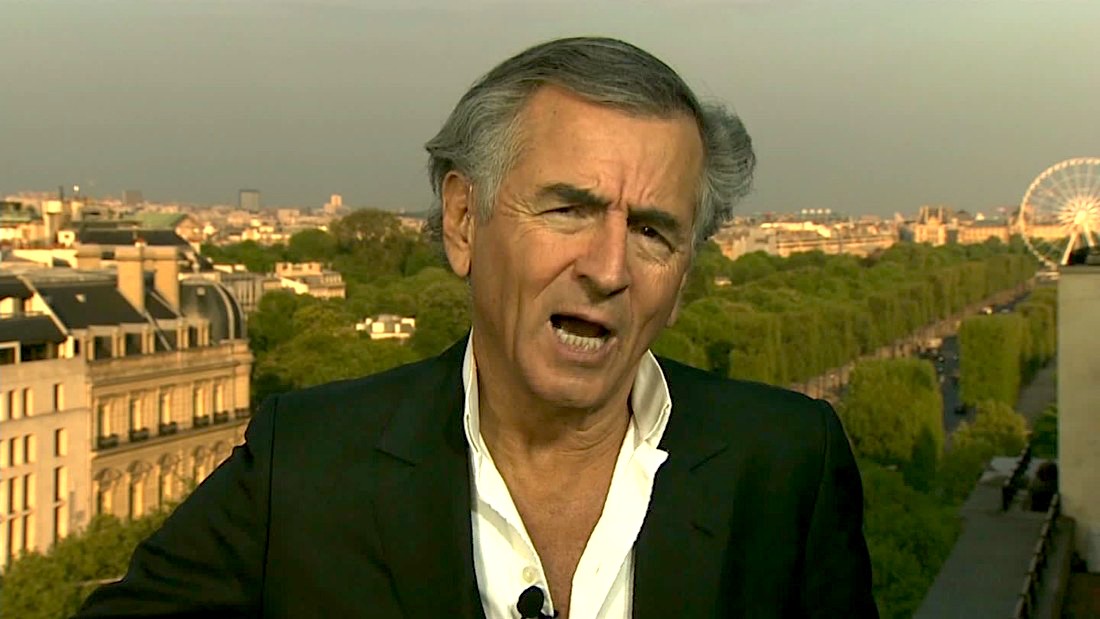
Bernard-Henri Lévy: No one proliferates more fact-free assertions. (CNN Screenshot.)
And what about mainstream media? In one recent news report after another (Skripal poisoning, chemical weapons attacks in Syria, the falsified murder in Ukraine of an anti-Putin journalist, not to mention the responsibility for firing a missile that shot down a Malaysian airliner in July 2014), there is a big difference between the Western version of the facts and that which prevails in Russia, Malaysia, Syria and much of the non-Western world.
A Mental Border with Russia
Instead of Pascal’s “truth on this side of the Pyrenees, and error on the other side”, we would be establishing “truth on one side of the Mediterranean, error on the other”. Or rather, truth exists up to the Eastern border of NATO, with error on the other side. This is no way to advance toward universal understanding. The only way to resolve our differences with the rest of the world is free discussion. Inasmuch as the law against fake news seems to be designed mainly to counter what Western governments describe as Russian propaganda, there is a strong likelihood that it can only enforce the mental border between us and the Russians.
When the independent journalist André Bercoff simply raised a couple of questions concerning anomalies in reports of the amazing rescue by Mamoudou Gassama of a child hanging from a Paris balcony, his own colleagues instantly condemned him for “provoking doubts” and engaging in “conspiracy theories”. The official regulatory agency, the Conseil Supérieur de l’Audiovisuel, hastened to open an investigation… of Bercoff. President Macron had invited Gassama to the Elysee Palace, offering him French citizenship and making the event an exemplary national legend. Thus sacred.
It is an odd sign of the times to reproach a journalist for asking questions. Leaving aside the rescue incident, raising questions used to be considered a primary function of journalism. If it is better to let ten guilty persons go free than to imprison one innocent man, in terms of rational scientific method, it is better to have ten extravagant doubts than one unchallengeable dogma.
It is true that what the dominant media call “conspiracy theories”, going everywhere from legitimate questioning of their own narratives and of official assertions to the wildest fantasies, do indeed proliferate on social media. But can anyone believe that describing Bercoff’s doubts as “conspiracy theorizing” will in any way stem that proliferation?

Françoise Nyssen: Public broadcasts must combat reactionary ideas.
The French Minister of culture, Françoise Nyssen, has decided that public radio and television, financed by taxpayers, should be devoted to combatting French people’s “highly reactionary” ideas, notably concerning “diversity”. Note that Macron’s ruling party, Republic in Movement, considers “reactionary” exactly what was considered progressive only a few decades ago: defense of public services and national sovereignty. Is it legitimate to oblige adults to pay for their own ideological re-education?
I by no means suggest that the current government is consciously intent on installing a totalitarian regime. The problem stems rather from the overwhelming subjectivism of contemporary culture in which talk of “values” leaves little space for concern for facts or objectivity. This is increasingly true even in discussions of scientific or technical progress. Of course, legislation cannot be fully objective, but since the Enlightenment reflection on freedom, the ideal has been to seek to establish reasonable rules to protect the individual from arbitrary power. This rule applies particularly to freedom of expression.
Those who speak endlessly of their values are merely trying to show off their own moral superiority. That is the basis of the corruption of the legal system in the matter of “fake news”, the reaction to Bercoff’s doubts, and the crusade of Madame Nyssen against what she considers “reactionary ideas”. Once a group of people convince themselves that they embody Virtue itself thanks to their “values”, they become unable to perceive any legitimate grounds for limiting their own power. That could be called the totalitarianism of the naïve.
This article originally appeared on RT’s French-language site. It was translated and adapted by Diana Johnstone.
Jean Bricmont is professor of theoretical physics at the Catholic University of Louvain (Belgium), and author of numerous articles and books, including Humanitarian Imperialism, La République des Censeurs,and Fashionable Nonsense (with Alan Sokal).
Anything Goes When You’re Saving the World

By Donna Laframboise | Big Picture News | May 30, 2018
SPOTLIGHT: Saving the world = barbaric behaviour.
BIG PICTURE: The paperback edition of biologist Paul Ehrlich’s 1968 bestseller, The Population Bomb, was 233 pages long. The first three chapters described a problem.
The final two chapters were titled “What Needs to be Done” and “What Can You Do?” They were followed by an Appendix of examples of letters readers might send to influential individuals. In other words, 83 pages of that book (more than a third) was an unabashedly political discussion.
These pages reiterated that the future was bleak. Overpopulation threatened America, the American way of life, and the “very lives” of US citizens (pp. 135, 138, 172, 180, 182).
The “only hope for survival,” was “drastic worldwide measures” lest civilization itself go “down the drain.” The “time of famines” had arrived (pp. 134, 143, 145, 148, 157-9, 161, 165, 198).
50 years later, we know Ehrlich’s apocalyptic predictions were wildly off target. Half a billion people did not starve to death during the 1970s. Instead, via ingenuity and technology, humanity grew more food and got better at transporting it to wherever it was desperately needed.
Americans weren’t forced to “slaughter” their dogs and cats so that pet food protein could be fed to the “starving masses.” Luxury taxes weren’t placed on diapers, and a powerful new arm of the US government wasn’t created to “take whatever steps are necessary,” in order to bring that country’s birth rate in line with its death rate. In 1968, there were 200 million Americans. Today, there are 326 million (pp. 134, 137-8).
Ehrlich’s fanaticism was on stark display when he described overpopulation as a cancer:
We must shift our efforts from treatment of the symptoms to the cutting out of the cancer. The operation will demand many apparently brutal and heartless decisions. The pain may be intense. But the disease is so far advanced that only with radical surgery does the patient have a chance of survival. (pp. 166-167)
In this regard, he declared that America should have pressured the Indian government to sterilize “all Indian males with three or more children”:
We should have volunteered logistic support in the form of helicopters, vehicles, and surgical instruments. We should have sent doctors to aid in the program…Coercion? Perhaps, but coercion in a good cause. (pp. 165-166)
TOP TAKEAWAY: Fifty years after The Population Bomb appeared, few people remember that it advocated dispatching US helicopters so that Indian peasants could be kidnapped & forcibly sterilized.
Israel closes Ibrahimi Mosque in Hebron

A view of Ibrahimi Mosque in Hebron, West Bank on 8 July 2017 [Issam Rimawi/ Anadolu Agency]
MEMO | June 11, 2018
The Israeli occupation forces yesterday closed the Ibrahimi Mosque in the occupied West Bank city of Hebron to Muslim worshippers without prior notice.
Israel’s 0404 website claimed that an explosive device was found in the vicinity of the mosque earlier in the day.
Israel forces intensified their presence in the area and closed the mosque following the incident, the sources added.
No further details were given, nor is it known when the mosque would be reopened.
Muslims are observing the fast during the holy month of Ramadan which is due to come to an end this weekend. Additional prayers are held in the mosque on a daily basis during this period.
Palestinian residents of Hebron’s Old City face a large Israeli military presence on a daily basis, with at least 20 checkpoints set up at the entrances of many streets, as well as the entrance of the Ibrahimi Mosque itself.
They are also not permitted to drive on Al-Shuhada Street, have had their homes and shops on the street welded shut, and are not allowed to walk on some roads in the Old City.
Meanwhile, some 800 notoriously violent Israeli settlers in Hebron move freely on the street, drive cars, and carry machine guns.
Featured Video

The First Pyrrhic Victory of the Vietnam War
or go to
Aletho News Archives – Video-Images
Frlom the Archives
The 52 Major Jewish American Organizations and Israel Celebrate Passover with the Slaughter of 25 Muslim, Christian and Secular Palestinians
By James Petras • Unz Review • April 8, 2018
Introduction
As of April 7, nearly three thousand unarmed Christian, Muslim and secular Palestinians have been wounded, over three dozen are in critical condition and at least twenty-five unarmed protestors, including children have been assassinated by hundreds of Israeli snipers and heavily armed troops shooting tank shells into crowds of civilians protesting their decades of incarceration by the racist Israeli state.
The Israeli government praised the ‘restraint and morality’ of the IDF, as did the fifty-two Major Jewish American Organizations (MJAO) who largely control the US Congress. These grotesque massacres began during the Christian Holy Week on Good Friday and Easter, coinciding with the Jewish Passover. The self-righteous officials of the MJAO and their relatives and friends broke matzos at joyful Seders as the blood of Palestinians soaked into ground at the fence containing the largest open-air prison camp in history, Gaza.
While tribal loyalties bonded the Israeli and Jewish American leaders, the politicians of the Western oligarchic electoral regimes refrained from criticizing the shocking display of brute force and even defended Israel’s cold blood mass killings of Palestinian civilians in their Gaza prison.
This paper will discuss and analyze the reasons for Israel’s willing Western accomplices and the centrality of its fifth column in the United States. … continue
Blog Roll
 Aletho News
- No time for losers: Why the war meant to save Israel may destroy it
- Top US Counterterrorism Official Resigns in Protest of Operation Against Iran
- Just Get Out! Now!
- Unpacking glaring contradictions in US-Zionist justifications for war against Iran
- Iranian model of warfare bleeds US dry while Persian Gulf states watch and learn: Analyst
- IRGC orders ‘defeated’ US to evacuate industrial facilities in region
- Hegseth’s call for ‘no mercy’ to Iranians deemed war crime
- Iran War Exposes Limits of US Military Power – Journalist
- Even The Neo-Cons Admit The Iran War Is Failing
- Inside the Caucasus Drone Corridor Fueling Tensions With Iran
- If Americans Knew
- Top US counterterror advisor resigns in protest of “war manufactured by Israel” – Not a ceasefire Day 158
- ‘I Liked the House’: When Israeli Soldiers Turn Palestinian Homes into Barracks
- ‘They Were All I Had’: Lebanese Father Buries Parents, 4 Daughters Killed by Israeli Bombing
- Israel and its supporters are causing attacks on Jewish institutions. Case in point: Michigan synagogue tragedy.
- These are the casualties and cost of the war in Iran 2 weeks into the conflict
- Chicago Teachers Union accuses AIPAC of swaying elections with ‘dark money’
- Predictions of another 9/11, amid Israel-US killing spree – Not a ceasefire Day 157
- As US-Israel war on Iran rages, Gaza faces massive dust storm – Not a ceasefire Day 156
- No let-up in attacks on Gaza as Israel takes on Iran, Lebanon – Not a ceasefire Day 155
- ‘Of Course’: IDF Drops Case Against Soldiers Accused of Raping Palestinian Prisoner
- No Tricks Zone
- Storing Green Energy To Last Germany 10 Days Would Require A 60-Million Tonne Battery
- New Studies: UK Sea Levels Were 4 Meters Higher Than Today During The Mid-Holocene
- Destructive Green New Deal: German Energy And Metal Group Warns Of Drastic Crisis
- New Study Documents A 20-Year Pause In Arctic Sea Ice Decline – Driven By Internal Variability
- Wake-up Call: Survey Shows Majority Of Germans Now Favor Postponing Climate Targets!
- Televised! Leading German Political Candidate Tells Schoolchildren CO2 Makes Sun Hotter!
- New Study: A Century Warming Of 1.1°C Is ‘Commonplace’ And ‘Not Unusual’ During This Interglacial
- New Study: ‘Internal Noise’ And Volcanic Forcing Can Trigger 10-15°C Warming Within Decades
- Glaciers Worldwide Are Suddendly Surging, Experts Blame Warming!
- Surprising Discovery: Sahara Is Greening…Billions Of Trees Where Once Thought To Be Barren
 Aletho News