Venezuela Criticizes ‘Politicized’ UN Human Rights Report
teleSUR | June 22, 2018
The Venezuelan government has criticized a United Nations human rights report on the Latin American nation as “lacking technical rigour and objectivity.”
“Venezuela categorically rejects the report regarding the alleged human rights situation in the country, published by the Office of United Nations High Commissioner for Human Rights, as a result of a highly questionable methodology that buries the credibility and technical rigor demanded of an office of this nature, and violates the principles of objectivity, impartiality and non-selectivity,” a statement released by the Ministry of Foreign Relations said.
UN High Commissioner for Human Rights and Jordanian prince, Zeid Ra’ad Al Hussein, said Friday that “rule of law is virtually absent in Venezuela,” after a report was published citing “shocking” accounts of alleged extrajudicial killings by state forces.
The Venezuelan government responded that “Mr Zeid Ra’ad Al Hussein confirms his complicity with the multiform aggression that is underway against Venezuela, keeping silent in the face of the negative impact on the enjoyment of economic, social, and cultural rights created by coercive, unilateral measures imposed by the United States of America and its servile allies in the region.”
The statement also pointed out that all official information provided by the Venezuelan government has been excluded from the report, “in order to build a grotesque media farce on this matter.”
The Foreign Ministry “reiterates its inescapable commitment to human rights” and its “willingness to continue cooperating with the organs of the United Nations system on issues of human rights, provided that the sovereignty of the country is respected and that it acts in accordance with rigour and truth.”
UN independent expert and Rapporteur, Alfred de Zayas, who himself was in Venezuela compiling data on human rights last year, described the report as lacking objectivity and neutrality.
“My worry is the credibility of the office when it shows no neutrality nor objectivity,” he stated following the release of the report.
Much of the report referred to the State’s reaction to the 2014 and 2017 right wing violent street protests, and the Operation of People’s Liberation (OLP) crime operatives which were temporarily held during 2017.
Venezuela’s Jose Vicente Rangel, who served as vice president under Hugo Chavez and now has a popular weekly TV show, warned of police abuses back in April, highlighting “operations that police groups are carrying out, operations that involve outrages against citizens and numerous cases of murder in the barrios.”
He alleged that the suspended OLP ops were being continued extra-officially by the FAES special police forces.
Candidate for local elections gunned down in Mexico

Emigdio Lopez Avendano, a Mexican politician killed in the latest act of violence in Mexico (file photo)
Press TV – June 26, 2018
A candidate in Mexico’s elections was gunned down along with four other people on Monday as they made their way to a campaign rally, the Oaxaca state government and police said.
The candidate was identified as 50-year-old Emigdio Lopez Avendano, a member of an indigenous community called Piedra Ceniza, the state justice department said.
He and the four other people killed in the attack on their truck supported the party of leftist presidential front-runner Andres Manuel Lopez Obrador, it added. Two other people were wounded.
Lopez Avendano was running for a local council seat in Oaxaca.
Sunday’s voting will see Mexico elect a new president, congress and state and local officials.
The campaign has set a record for violence, with more than a hundred politicians and candidates killed, most of them at the local level.
Moscow Views Syrian Science Facilities’ OPCW Inspection Results as Politicized
Sputnik – 25.06.2018
Moscow considers cynical and biased the conclusions of the OPCW report on inspection of research facilities in Syria’s Barza and Jamraya, it is clear that the document was adopted under a strong US pressure, the Russian Foreign Ministry said on Monday.
The ministry commented on a report by OPCW Technical Secretariat Director General Ahmet Uzumcu concerning the implementation of the decisions adopted by the 83rd session of OPCW Executive Council.
“We have repeatedly stated that the demands to Syria laid down in the report go beyond the framework of the Chemical Weapons Convention. The attempt to obtain unhindered and unconditional access of the OPCW inspectors to any military and civil infrastructure facilities does not fit into any international legal norms. It is clear that such a document was adopted under the strongest pressure from the US and their close allies,” the ministry said.
UK Foreign Secretary Boris Johnson proposed earlier this month to expand the mandate of the Organisation for the Prohibition of Chemical Weapons in Syria to allow it identify those responsible for the use of chemical weapons in the country, as currently the OPCW Fact Finding Mission is only responsible for the establishment of facts around the reports about the use of chemical weapons.
The Syrian opposition, as well as Western countries have been accusing Syrian government forces of using chemical weapons in last several years, while the Syrian authorities have repeatedly pointed at the fact that their chemical weapons stockpiles had been destroyed under the supervision of the OPCW.
Jeremy Corbyn Says Future Labour Government Would Recognize Palestine as State
By Whitney Webb | Mint Press News | June 25, 2018
The leader of the U.K. Labour Party, Jeremy Corbyn, officially announced on Friday that the U.K. would recognize Palestine as a state under a future Labour government. Corbyn, speaking in Jordan during his first trip to the region since becoming party leader in 2015, stated that the recognition of a Palestinian state would be aimed at achieving “a genuine two-state solution” that he would seek to tackle “very early on” were Labour to emerge victorious in the U.K.’s next general election in 2022.
“I think there has to be a recognition of the rights of the Palestinian people to their own state, which we as a Labour Party said we would recognize in government as a full state as part of the United Nations,” Corbyn stated.
A day later, on Saturday, Corbyn visited Jordan’s Al-Baqa’a refugee camp, which has long hosted Palestinians who fled the West Bank and Gaza Strip during the 1967 Arab-Israeli War.
After visiting the camp, Corbyn asserted the need to consider the rights of Palestinians in any future peace process, stating that “there has to be a right of the Palestinian people to live in peace, as well as the right of Israel.”
Corbyn has long been an advocate for Palestine, having been a long-time patron of the Palestine Solidarity Campaign and having endorsed key elements of the boycott, divest and sanctions (BDS) movement.
More recently, Corbyn has condemned Donald Trump’s decision to recognize Jerusalem as the capital of Israel – calling the move a “catastrophic mistake” — while also calling out Western silence over Israel’s killing of unarmed Palestinian protesters in Gaza during the Great Return March earlier this year. Corbyn’s criticism of recent Israeli violence targeting Palestinians has included calls for the U.K. to halt arms sales to Israel if those arms “could be used in violation of international law.”
As a result of his continued advocacy for Palestinians, Corbyn has consistently been attacked by the U.K.’s Israel lobby as an “anti-Semite.” Such concerns over “anti-Semitism” have grown into a frenzy in the U.K. media in recent years, particularly after Labour’s surprise performance in U.K. elections last year that led them to pick up several seats in Parliament. The “witch hunt” to smear Corbyn as an “anti-Semite” has led several Jewish groups to call out “the weaponization of anti-Semitism for political ends.”
Given his statements over the weekend on recognizing Palestine as a state, accusations of Corbyn’s “anti-Semitism” are unlikely to die out anytime soon.
Whitney Webb is a staff writer for MintPress News and a contributor to Ben Swann’s Truth in Media. Her work has appeared on Global Research, the Ron Paul Institute and 21st Century Wire, among others. She has also made radio and TV appearances on RT and Sputnik. She currently lives with her family in southern Chile.
Javier Solana refused visa waiver to US because of Iran trip
Press TV – June 25, 2018
Javier Solana, a former secretary general of the NATO military alliance and foreign policy chief of the European Union, has been refused a visa waiver to enter the US because of his trip to Iran in 2013.
Solana, who played a central role in negotiations over Iran’s nuclear program when he was the EU’s foreign policy chief, said on Monday that his renewal application on the Electronic System for Travel Authorization (ESTA) had been rejected for the first time.
ESTA is an automated system that determines the eligibility of visitors to travel to the United States under the Visa Waiver Program.
The Spanish-born politician and physicist had been due to speak at an event at the Brookings Institution, a Washington-based think tank.
Solana, 75, said that he considered the issue “to be more bureaucratic than political.”
“It’s a bit of a mean decision,” Solana told Spain’s Antena 3 TV channel. “I don’t think it’s good because some people have to visit these countries to keep negotiations alive.”
“I’ll see what I can do to fix this. It’s a computer – an algorithm – and if you’ve been in Iran lately, they take you out of the system. It’s like you don’t exist visa-wise, because you can’t visit the country.”
Solana, who received his US doctorate in physics in 1971 from the University of Virginia, said he would apply for a US visa instead, a more cumbersome and expensive process. “I need to go because I need to work there and I’m a professor at various universities,” he said.
Solana, who has also served as Spain’s foreign minister, said he had been invited to Iran in 2013 to attend the inauguration ceremony of Iranian President Hassan Rouhani. Solana had no official government post at that time.
The US Visa Waiver Program allows people from 38 high-income countries, namely EU states, Australia, Japan and South Korea, to travel to the US without applying for a visa.
However, in 2015, the administration of former US President Barack Obama signed a law that would require foreign citizens eligible for the waiver program to obtain a US visa if they had traveled to Iran, Iraq, Syria, Libya, Sudan, Somalia and Yemen after March 1, 2011.
Such travelers are required to go through the full vetting process required to get a visa, including an in-person interview at a US Embassy or Consulate.
But visa waivers can also be granted on a case-by-case basis for those who have traveled to Iran as government representatives, journalists or aid workers.
The rule predates US President Donald Trump’s controversial travel ban on five Muslim-majority countries and North Korea. The Trump administration has been especially hostile to Iran. Trump announced in May that the US would withdraw from the 2015 Iran nuclear deal.
See also:
US visa waiver program violates JCPOA
December 20, 2015
… US President Barack Obama on Saturday signed a USD-1.1-trillion funding bill that aims to exclude from the VWP all dual nationals from Iran, Iraq, Syria and Sudan, and anyone else who has traveled to those countries in the past five years. Such foreign nationals are now required to obtain a visa through standard measures, including face-to-face interview at a US consulate.
Chairman of the Iranian Parliament’s Committee on National Security and Foreign Policy Alaeddin Boroujerdi told reporters on Sunday that the agreement, known as the Joint Comprehensive Plan of Action (JCPOA), stipulates that Washington should set no new restrictions on Iran. …
American Pravda: the JFK Assassination, Part II – Who Did It?
By Ron Unz • Unz Review • June 25, 2018
A strong dam may hold back an immense quantity of water, but once it breaks the resulting flood may sweep aside everything in its path. I had spent nearly my entire life never doubting that a lone gunman named Lee Harvey Oswald killed President John F. Kennedy nor that a different lone gunman took the life of his younger brother Robert a few years later. Once I came to accept that these were merely fairy tales widely disbelieved by many of the same political elites who publicly maintained them, I began considering other aspects of this important history, the most obvious being who was behind the conspiracy and what were their motives.
On these questions, the passage of a half-century and the deaths, natural or otherwise, of nearly all the contemporary witnesses drastically reduces any hope of coming to a firm conclusion. At best, we can evaluate possibilities and plausibilities rather than high likelihoods let alone near certainties. And given the total absence of any hard evidence, our exploration of the origins of the assassination must necessarily rely upon cautious speculation.
From such a considerable distance in time, a bird’s-eye view may be a reasonable starting point, allowing us to focus on the few elements of the apparent conspiracy that seem reasonably well established. The most basic of these is the background of the individuals who appear to have been associated with the assassination, and the recent books by David Talbot and James W. Douglass effectively summarize much of the evidence accumulated over the decades by an army of diligent assassination researchers. Most of the apparent conspirators seem to have had strong ties to organized crime, the CIA, or various anti-Castro activist groups, with considerable overlap across these categories. Oswald himself certainly fit this same profile although he was very likely the mere “patsy” that he claimed to be, as did Jack Ruby, the man who quickly silenced him and whose ties to the criminal underworld were long and extensive.
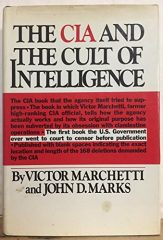
An unusual chain of events provided some of the strongest evidence of CIA involvement. Victor Marchetti, a career CIA officer, had risen to become Special Assistant to the Deputy Director, a position of some importance, before resigning in 1969 over policy differences. Although he fought a long battle with government censors over his book, The CIA and the Cult of Intelligence, he retained close ties with many former agency colleagues.
During the 1970s, the revelations of the Senate Church Committee and the House Select Committee on Assassinations had subjected the CIA to a great deal of negative public scrutiny, and there were growing suspicions of possible CIA links to JFK’s assassination. In 1978 longtime CIA Counter-intelligence chief James Angleton and a colleague provided Marchetti with an explosive leak, stating that the agency might be planning to admit a connection to the assassination, which had involved three shooters, but place the blame upon E. Howard Hunt, a former CIA officer who had become notorious during Watergate, and scapegoat him as a rogue agent, along with a few other equally tarnished colleagues. Marchetti published the resulting story in The Spotlight, a weekly national tabloid newspaper operated by Liberty Lobby, a rightwing populist organization based in DC. Although almost totally shunned by the mainstream media, The Spotlight was then at the peak of its influence, having almost 400,000 subscribers, as large a readership as the combined total of The New Republic, The Nation, and National Review.
Marchetti’s article suggested that Hunt had actually been in Dallas during the assassination, resulting in a libel lawsuit with potential damages large enough to bankrupt the publication. Longtime JFK assassination researcher Mark Lane became aware of the situation and volunteered his services to Liberty Lobby, hoping to use the legal proceedings, including the discovery process and subpoena power, as a means of securing additional evidence on the assassination, and after various court rulings and appeals, the case finally came to trial in 1985.
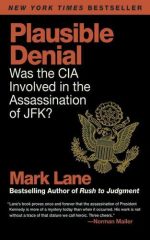
As Lane recounted in his 1991 bestseller, Plausible Denial, his strategy generally proved quite successful, not only allowing him to win the jury verdict against Hunt, but also eliciting sworn testimony from a former CIA operative of her personal involvement in the conspiracy along with the names of several other participants, though she claimed that her role had been strictly peripheral. And although Hunt continued for decades to totally deny any connection with the assassination, near the end of his life he made a series of video-taped interviews in which he admitted that he had indeed been involved in the JFK assassination and named several of the other conspirators, while also maintaining that his own role had been merely peripheral. Hunt’s explosive death-bed confession was recounted in a major 2007 Rolling Stone article and also heavily analyzed in Talbot’s books, especially his second one, but otherwise largely ignored by the media.
Many of these same apparent conspirators, drawn from the same loose alliance of groups, had previously been involved in the various U.S. government-backed attempts to assassinate Castro or overthrow his Communist government, and they had developed a bitter hostility towards President Kennedy for what they considered his betrayal during the Bay of Pigs fiasco and afterward. Therefore, there is a natural tendency to regard such animosity as the central factor behind the assassination, a perspective generally followed by Talbot, Douglass, and numerous other writers. They conclude that Kennedy died at the hands of harder-line anti-Communists, outraged over his perceived weakness regarding Cuba, Russia, and Vietnam, sentiments that were certainly widespread within right-wing political circles at the height of the Cold War.
While this framework for the assassination is certainly possible, it is far from certain. One may easily imagine that most of the lower-level participants in the Dallas events were driven by such considerations but that the central figures who organized the plot and set matters into motion had different motives. So long as all the conspirators were agreed on Kennedy’s elimination, there was no need for an absolute uniformity of motive. Indeed, men who had long been involved in organized crime or clandestine intelligence operations were surely experienced in operational secrecy, and many of them may not have expected to know the identities, let alone the precise motives, of the men at the very top of the remarkable operation they were undertaking.
We must also sharply distinguish between the involvement of particular individuals and the involvement of an organization as an organization. For example, CIA Director John McCone was a Kennedy loyalist who had been appointed to clean house a couple of years before the assassination, and he surely was innocent of his patron’s death. On the other hand, the very considerable evidence that numerous individual CIA intelligence officers and operatives participated in the action has naturally raised suspicions that some among their highest-ranking superiors were involved as well, perhaps even as the principal organizers of the conspiracy.
These reasonable speculations may have been magnified by elements of personal bias. Many of the prominent authors who have investigated the JFK assassination in recent years have been staunch liberals, and may have allowed their ideology to cloud their judgment. They often seek to locate the organizers of Kennedy’s elimination among those rightwing figures whom they most dislike, even when the case is far from entirely plausible.
But consider the supposed motives of hard-line anti-Communists near the top of the national security hierarchy who supposedly may have organized Kennedy’s elimination because he backed away from a full military solution in the Bay of Pigs and Cuban Missile Crisis incidents. Were they really so absolutely sure that a President Johnson would be such an enormous improvement as to risk their lives and public standing to organize a full conspiracy to assassinate an American president?
A new presidential election was less than a year away, and Kennedy’s shifting stance on Civil Rights seemed likely to cost him nearly all the Southern states that had provided his margin of electoral victory in 1960. A series of public declarations or embarrassing leaks might have helped remove him from office by traditional political means, possibly replacing him with a Cold War hard-liner such as Barry Goldwater or some other Republican. Would the militarists or business tycoons often implicated by liberal JFK researchers have really been so desperate as to not wait those extra few months and see what happened?
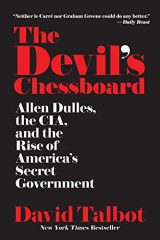
Based on extremely circumstantial evidence, Talbot’s 2015 book The Devil’s Chessboard, something of a sequel to Brothers, suggests that former longtime CIA Director Allan Dulles may have been the likely mastermind, with his motive being a mixture of his extreme Cold Warrior views and his personal anger at his 1961 dismissal from his position.
While his involvement is certainly possible, obvious questions arise. Dulles was a seventy-year-old retiree, with a very long and distinguished career of public service and a brother who had served as Eisenhower’s secretary of state. He had just published The Cult of Intelligence, which was receiving very favorable treatment in the establishment media, and he was embarked on a major book tour. Would he really have risked everything—including his family’s reputation in the history books—to organize the murder of America’s duly-elected president, an unprecedented act utterly different in nature than trying to unseat a Guatemalan leader on behalf of supposed American national interests? Surely, using his extensive media and intelligence contacts to leak embarrassing disclosures about JFK’s notorious sexual escapades during the forthcoming presidential campaign would have been be a much safer means of attempting to achieve an equivalent result. And the same is true for J. Edgar Hoover and many of the other powerful Washington figures who hated Kennedy for similar reasons.
On the other hand, it is very easy to imagine that such individuals had some awareness of the emerging plot or may even have facilitated it or participated to a limited extent. And once it succeeded, and their personal enemy had been replaced, they surely would have been extremely willing to assist in the cover-up and protect the reputation of the new regime, a role that Dulles may have played as the most influential member of the Warren Commission. But such activities are different than acting as the central organizer of a presidential assassination.
Just as with the hard-line national security establishment, many organized crime leaders had grown outraged over the actions of the Kennedy Administration. During the late 1950s, Robert Kennedy had intensely targeted the mob for prosecution as chief counsel to the Senate Labor Rackets Committee. But during the 1960 election, family patriarch Joseph Kennedy used his own longstanding mafia connections to enlist their support for his older son’s presidential campaign, and by all accounts the votes stolen by the corrupt mob-dominated political machines in Chicago and elsewhere helped put JFK in the White House, along with Robert Kennedy as his Attorney General. Frank Sinatra, an enthusiastic Kennedy supporter, had also helped facilitate this arrangement by using his influence with skeptical mob leaders.
However, instead of repaying such crucial election support with political favors, Attorney General Robert Kennedy, perhaps ignorant of any bargain, soon unleashed an all-out war against organized crime, far more serious than anything previously mounted at the federal level, and the crime bosses regarded this as a back-stabbing betrayal by the new administration. Once Joseph Kennedy was felled by an incapacitating stroke in late 1961, they also lost any hope that he would use his influence to enforce the deals he had struck the previous year. FBI wiretaps reveal that mafia leader Sam Giancana decided to have Sinatra killed for his role in this failed bargain, only sparing the singer’s life when he considered how much he personally loved the voice of one of the most famous Italian-Americans of the 20th century.
These organized crime leaders and some of their close associates such as Teamster boss Jimmy Hoffa certainly developed a bitter hatred toward the Kennedys, and this has naturally led some authors to point to the mafia as the likely organizers of the assassination, but I find this quite unlikely. For many decades, American crime bosses had had a complex and varied relationship with political figures, who might sometimes be their allies and at other times their persecutors, and surely there must have been many betrayals over the years. However, I am not aware of a single case in which any even moderately prominent political figure on the national stage was ever targeted for assassination, and it seems quite unlikely that the sole exception would be a popular president, whom they would have likely regarded as being completely out of their league. On the other hand, if individuals who ranked high in Kennedy’s own DC political sphere set in motion a plot to eliminate him, they might have found it easy to enlist the enthusiastic cooperation of various mafia leaders.
Furthermore, the strong evidence that many CIA operatives were involved in the conspiracy very much suggests that they were recruited and organized by some figure high in their own hierarchy of the intelligence or political worlds rather than the less likely possibility that they were brought in solely by leaders of the parallel domain of organized crime. And while crime bosses might possibly have organized the assassination itself, they surely had no means of orchestrated the subsequent cover-up by the Warren Commission, nor would there have been any willingness by America’s political leadership to protect mafia leaders from investigation and proper punishment for such a heinous act.
If a husband or wife is found murdered, with no obvious suspect or motive at hand, the normal response of the police is to carefully investigate the surviving spouse, and quite often this suspicion proves correct. Similarly, if you read in your newspapers that in some obscure Third World country two bitterly hostile leaders, both having unpronounceable names, had been sharing supreme political power until one was suddenly struck down in a mysterious assassination by unknown conspirators, your thoughts would certainly move in an obvious direction. Most Americans in the early 1960s did not perceive their own country’s politics in such a light, but perhaps they were mistaken. As a total newcomer to the enormous, hidden world of JFK conspiracy analysis, I was immediately surprised by the mere sliver of suspicion directed towards Vice President Lyndon B. Johnson, the slain leader’s immediate successor and the most obvious beneficiary.
The two Talbot books and the one by Douglass, totaling some 1500 pages, devote merely a few paragraphs to any suspicions of Johnson’s involvement. Talbot’s first book reports that immediately after the assassination, the vice president had expressed a frantic concern to his personal aides that a military coup might be in progress or a world war breaking out, and suggests that these few casual words demonstrate his obvious innocence, although a more cynical observer might wonder if those remarks had been uttered for exactly that reason. Talbot’s second book actually quotes an apparent low-level conspirator as claiming that Johnson had personally signed off on the plot and admits that Hunt believed the same thing, but treats such unsubstantiated accusations with considerable skepticism, before adding a single sentence acknowledging that Johnson may indeed have been a passive supporter or even an accomplice. Douglass and Peter Dale Scott, author of the influential 1993 book Deep Politics and the Death of JFK, apparently seem never to have even entertained the possibility.
Ideological considerations are probably an important reason for such remarkable reticence. Although liberals had grown to revile LBJ by the late 1960s for his escalation of the unpopular Vietnam War, over the decades those sentiments have faded, while warm memories of his passage of the landmark Civil Rights legislation and his creation of the Great Society programs have elevated his stature in that ideological camp. Furthermore, such legislation had long been blockaded in Congress and only became law because of the 1964 Democratic Congressional landslide following JFK’s martyrdom, and it might be difficult for liberals to admit that their fondest dreams were only realized by an act of political parricide.
Kennedy and Johnson may have been intensively hostile personal rivals, but there seem to have been few deep ideological differences between the two men, and most of the leading figures in JFK’s government continued to serve under his successor, surely another source of enormous embarrassment to any ardent liberals who came to suspect that the former had been murdered by a conspiracy involving the latter. Talbot, Douglass, and many other left-leaning advocates for an assassination conspiracy prefer to point the finger of blame towards far more congenial villains such as hard-line, anti-Communist Cold Warriors and right-wing elements, notably including top CIA officials, such as former director Allan Dulles.
An additional factor helping to explain the extreme unwillingness of Talbot, Douglass, and others to consider Johnson as an obvious suspect may be the realities of the book publishing industry. By the 2000s, JFK assassination conspiracies had long become passé and were treated with disdain in mainstream circles. Talbot’s strong reputation, his 150 original interviews, and the quality of his manuscript broke that barrier, and attracted The Free Press as his very respectable publisher, while later drawing a strongly positive review by a leading academic scholar in the New York Times Sunday Book Review and an hour long television segment broadcast on C-Span Booknotes. But if he had devoted any space to voicing suspicions that our 35th president had been murdered by our 36th, surely the weight of that extra element of “outrageous conspiracy theory” would have ensured that his book sank without a trace.
However, if we cast off these distorting ideological blinders and the practical considerations of American publishing, the prima facie case for Johnson’s involvement seems quite compelling.
Consider a very simple point. If a president is struck down by an unknown group of conspirators, his successor would normally have had the strongest possible incentive to track them down lest he might become their next victim. Yet Johnson did nothing, appointing the Warren Commission that covered up the entire matter, laying the blame upon an erratic “lone gunman” conveniently dead. This would seem remarkably odd behavior for an innocent LBJ. This conclusion does not demand that Johnson was the mastermind, nor even an active participant, but it raises a very strong suspicion that he at least had had some awareness of the plot, and enjoyed a good personal relationship with some of the principals.
A similar conclusion is supported by a converse analysis. If the plot succeeded and Johnson became president, the conspirators must surely have felt reasonably confident that they would be protected rather than tracked down and punished as traitors by the new president. Even a fully successful assassination would entail enormous risks unless the organizers believed that Johnson would do exactly what he did, and the only means of ensuring this would be to sound him out about the plan, at least in some vague manner, and obtain his passive acquiesce.
Based on these considerations, it seems extremely difficult to believe that any JFK assassination conspiracy took place entirely without Johnson’s foreknowledge, or that he was not a central figure in the subsequent cover-up.
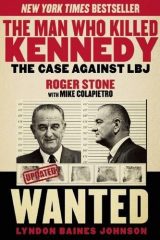
But the specific details of Johnson’s career and his political situation in late 1963 greatly strengthen these entirely generic arguments. A very useful corrective to the “See No Evil” approach to Johnson from liberal JFK writers is Roger Stone’s The Man Who Killed Kennedy: The Case Against LBJ, published in 2013. Stone, a longtime Republican political operative who got his start under Richard Nixon, presents a powerful case that Johnson was the sort of individual who might easily have lent his hand to political murder, and also that he had strong reasons to do so.
Among other things, Stone gathers together an enormous wealth of persuasive information regarding Johnson’s decades of extremely corrupt and criminal practices in Texas, including fairly plausible claims that these may have included several murders. In one bizarre 1961 incident that strangely foreshadows the Warren Commission’s “lone gunman” finding, a federal government inspector investigating a major Texas corruption scheme involving a close LBJ ally was found dead, shot five times in the chest and abdomen by a rifle, but the death was officially ruled a “suicide” by the local authorities, and that conclusion was reported with a straight face in the pages of the Washington Post.
Certainly one remarkable aspect of Johnson’s career is that he was born dirt-poor, held low-paying government jobs throughout his entire life, yet took the oath of office as the wealthiest president in modern American history, having accumulated a personal fortune of over $100 million in present-day dollars, with the financial payoffs from his corporate benefactors having been laundered through his wife’s business. This odd anomaly is so little remembered these days that a prominent political journalist expressed total disbelief when I mentioned it to him a decade ago.
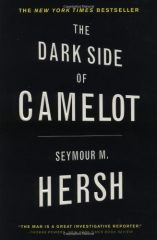
Stone also effectively sketches out the very difficult political situation Johnson faced in late 1963. He had originally entered the 1960 presidential race as one of the most powerful Democrats in the country and the obvious front-runner for his party’s nomination, certainly compared to the much younger Kennedy, whom he greatly outranked in political stature and also somewhat despised. His defeat, involving a great deal of underhanded dealings on both sides, came as a huge personal blow. The means by which he somehow managed to get himself placed on the ticket are not entirely clear, but both Stone and Seymour Hersh in The Dark Side of Camelot strongly suggest that personal blackmail was a greater factor than geographical ticket-balancing. In any event, Kennedy’s paper-thin 1960 victory would have been far more difficult without Texas narrowly falling into the Democratic column, and election fraud there by Johnson’s powerful political machine seems almost certainly to have been an important factor.
Under such circumstances, Johnson naturally expected to play a major role in the new administration, and he even issued grandiose demands for a huge political portfolio, but instead he found himself immediately sidelined and treated with complete disdain, soon becoming a forlorn figure with no authority or influence. As time went by, the Kennedys made plans to get rid of him, and just a few days before the assassination, they were already discussing whom to place on the reelection ticket in his stead. Much of Johnson’s long record of extreme corruption both in Texas and in DC was coming to light following the fall of Bobby Baker, his key political henchman, and with strong Kennedy encouragement, Life Magazine was preparing a huge expose of his sordid and often criminal history, laying the basis for his prosecution and perhaps a lengthy prison sentence. By mid-November 1963, Johnson seemed a desperate political figure at the absolute end of his rope, but a week later he was the president of the United States, and all those swirling scandals were suddenly forgotten. Stone even claims that the huge block of magazine space reserved for the Johnson expose was instead filled by the JFK assassination story.
Aside from effectively documenting Johnson’s sordid personal history and the looming destruction he faced at the hands of the Kennedys in late 1963, Stone also adds numerous fascinating pieces of personal testimony, which may or may not be reliable. According to him, as his mentor Nixon was watching the scene at the Dallas police station where Jack Ruby shot Oswald, Nixon immediately turned as white as a ghost, explaining that he had personally known the gunman under his birth-name of Rubenstein. While working on a House Committee in 1947, Nixon had been advised by a close ally and prominent mob-lawyer to hire Ruby as an investigator, being told that “he was one of Lyndon Johnson’s boys.” Stone also claims that Nixon once emphasized that although he had long sought the presidency, unlike Johnson “I wasn’t willing to kill for it.” He further reports that Vietnam Ambassador Henry Cabot Lodge and numerous other prominent political figures in DC were absolutely convinced of Johnson’s direct involvement in the assassination.
Stone has spent more than a half-century as a ruthless political operative, a position that provided him with unique personal access to individuals who participated in the great events of the past, but one that also carries the less than totally candid reputation of that profession, and individuals must carefully weigh these conflicting factors against each other. Personally, I tend to credit most of the eyewitness stories he provides. But even readers who remain entirely skeptical should find useful the large collection of secondary source references to the sordid details of LBJ’s history that the book provides.
Finally, a seemingly unrelated historical incident had originally raised my own suspicions of Johnson’s involvement.
Just prior to the outbreak of the Six Day War in 1967, Johnson had dispatched the U.S.S. Liberty, our most advanced intelligence-gathering ship, to remain offshore in international waters and closely monitor the military situation. There have been published claims that he had granted Israel a green-light for its preemptive attack, but fearful of risking a nuclear confrontation with the Soviet patrons of Syria and Egypt, had strictly circumscribed the limits of the military operation, sending the Liberty to keep an eye on developments and perhaps also to “show Israel who was boss.”
Whether or not this reconstruction is correct, the Israelis soon launched an all-out attack on the nearly defenseless ship despite the large American flag it was flying, deploying attack jets and torpedo boats to sink the vessel during an assault that lasted several hours, while machine-gunning the lifeboats to ensure that there would be no survivors. The first stage of the attack had targeted the main communications antenna, and its destruction together with heavy Israeli jamming, prevented any communications with other U.S. naval forces in the region.
Despite these very difficult conditions, a member of the crew heroically managed to jerry-rig a replacement antenna during the attempt, and by trying numerous different frequencies, was able to evade the jamming and contact the U.S. Sixth Fleet, informing them of the desperate situation. Yet although carrier jets were twice dispatched to rescue the Liberty and drive off the attackers, each time they were recalled, apparently upon direct orders from the highest authorities of the U.S. government. Once the Israelis learned that word of the situation had reached other U.S. forces, they soon discontinued their attack, and the heavily-damaged Liberty eventually limped into port, with over 200 dead and wounded sailors and NSA signal operators, representing the greatest loss of American servicemen in any naval incident since World War II.
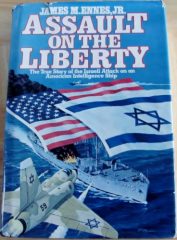
Although numerous medals were issued to the survivors, word of the incident was totally suppressed by a complete blanket of secrecy, and in an unprecedented step, even a Congressional Medal of Honor was awarded only in a private ceremony. The survivors were also harshly threatened with immediate court martial if they discussed what had transpired with the press or anyone else. Despite the overwhelming evidence that the attack had been intentional, a naval court of inquiry presided over by Admiral John S. McCain, Jr., father of the current senator, whitewashed the incident as a tragic accident, and a complete media blackout suppressed the facts. The true story only began to come out years later, when James M. Ennes, Jr., a Liberty survivor, risked severe legal consequences and published Assault on the Liberty in 1979 .
As it happened, NSA intercepts of Israeli communications between the attacking jets and Tel Aviv, translated from the Hebrew, fully confirmed that the attack had been entirely deliberate, and since many of the dead and wounded were NSA employees, the suppression of these facts greatly rankled their colleagues. My old friend Bill Odom, the three-star general who ran the NSA for Ronald Reagan, later shrewdly circumvented the restrictions of his political masters by making those incriminating intercepts part of the standard curriculum of the Sigint training program required for all intelligence officers.
In 2007 an unusual set of circumstances finally broke the thirty year blackout in the mainstream media. Real estate investor Sam Zell, a Jewish billionaire extremely devoted to Israel, had orchestrated a leveraged-buyout of the Tribune Company, parent of the Los Angeles Times and the Chicago Tribune, investing merely a sliver of his own money, with the bulk of the financing coming from the pension funds of the company he was acquiring. Widely heralded as “the grave dancer” for his shrewd financial investments, Zell publicly boasted that the deal gave him nearly all of the upside potential of the company, while he bore relatively little of the risk. Such an approach proved wise since the complex deal quickly collapsed into bankruptcy, and although Zell emerged almost unscathed, the editors and journalists lost decades of their accumulated pension dollars, while massive layoffs soon devastated the newsrooms of what had been two of the country’s largest and most prestigious newspapers. Perhaps coincidentally, just as this business turmoil hit in late 2007, the Tribune ran a massive 5,500 word story on the Liberty attack, representing the first and only time such a comprehensive account of the true facts has ever appeared in the mainstream media.
By all accounts, Johnson was an individual of towering personal ego, and when I read the article, I was struck by the extent of his astonishing subservience to the Jewish state. The influence of campaign donations and favorable media coverage seemed completely insufficient to explain his reaction to an incident that had cost the lives of so many American servicemen. I began to wonder if Israel might have played an extraordinarily powerful political trump-card, thereby showing LBJ “who was really boss,” and once I discovered the reality of the JFK assassination conspiracy a year or two later, I suspected I knew what that trump-card might have been. Over the years, I had become quite friendly with the late Alexander Cockburn, and the next time we had lunch I outlined my ideas. Although he had always casually dismissed JFK conspiracy theories as total nonsense, he found my hypothesis quite intriguing.
Regardless of such speculation, the strange circumstances of the Liberty incident certainly demonstrated the exceptionally close relationship between President Johnson and the government of Israel, as well as the willingness of the mainstream media to spend decades hiding events of the most remarkable nature if they might tread on particular toes.
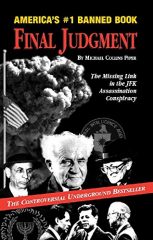
These important considerations should be kept in mind as we begin exploring the most explosive yet under-reported theory of the JFK assassination. Almost twenty-five years ago the late Michael Collins Piper published Final Judgment presenting a very large body of circumstantial evidence that Israel and its Mossad secret intelligence service, together with their American collaborators, probably played a central role in the conspiracy.
For decades following the 1963 assassination, virtually no suspicions had ever been directed towards Israel, and as a consequence none of the hundreds or thousands of assassination conspiracy books that appeared during the 1960s, 1970s, and 1980s had hinted at any role for the Mossad, though nearly every other possible culprit, ranging from the Vatican to the Illuminati, came under scrutiny. Kennedy had received over 80% of the Jewish vote in his 1960 election, American Jews featured very prominently in his White House, and he was greatly lionized by Jewish media figures, celebrities, and intellectuals ranging from New York City to Hollywood to the Ivy League. Moreover, individuals with a Jewish background such as Mark Lane and Edward Epstein had been among the leading early proponents of an assassination conspiracy, with their controversial theories championed by influential Jewish cultural celebrities such as Mort Sahl and Norman Mailer. Given that the Kennedy Administration was widely perceived as pro-Israel, there seemed no possible motive for any Mossad involvement, and bizarre, totally unsubstantiated accusations of such a monumental nature directed against the Jewish state were hardly likely to gain much traction in an overwhelmingly pro-Israel publishing industry.

However, in the early 1990s highly-regarded journalists and researchers began exposing the circumstances surrounding the development of Israel’s nuclear weapons arsenal. Seymour Hersh’s 1991 book The Samson Option: Israel’s Nuclear Arsenal and American Foreign Policy described the extreme efforts of the Kennedy Administration to force Israel to allow international inspections of its allegedly non-military nuclear reactor at Dimona, and thereby prevent its use in producing nuclear weapons. Dangerous Liaisons: The Inside Story of the U.S.-Israeli Covert Relationship by Andrew and Leslie Cockburn appeared in the same year, and covered similar ground.
Although entirely hidden from public awareness at the time, the early 1960s political conflict between the American and Israeli governments over nuclear weapons development had represented a top foreign policy priority of the Kennedy Administration, which had made nuclear non-proliferation one of its central international initiatives. It is notable that John McCone, Kennedy’s choice as CIA Director, had previously served on the Atomic Energy Commission under Eisenhower, being the individual who leaked the fact that Israel was building a nuclear reactor to produce plutonium.
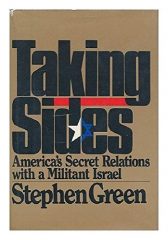
The pressure and financial aid threats secretly applied to Israel by the Kennedy Administration eventually became so severe that they led to the resignation of Israel’s founding Prime Minister David Ben-Gurion in June 1963. But all these efforts were almost entirely halted or reversed once Kennedy was replaced by Johnson in November of that same year. Piper notes that Stephen Green’s 1984 book Taking Sides: America’s Secret Relations With a Militant Israel had previously documented that U.S. Middle East Policy completely reversed itself following Kennedy’s assassination, but this important finding had attracted little attention at the time.
Skeptics of a plausible institutional basis for a JFK assassination conspiracy have often noted the extreme continuity in both foreign and domestic policies between the Kennedy and Johnson Administrations, arguing that this casts severe doubt on any such possible motive. Although this analysis seems largely correct, America’s behavior towards Israel and its nuclear weapons program stands as a very notable exception to this pattern.
An additional major area of concern for Israeli officials may have involved the efforts of the Kennedy Administration to sharply restrict the activities of pro-Israel political lobbies. During his 1960 presidential campaign, Kennedy had met in New York City with a group of wealthy Israel advocates, led by financier Abraham Feinberg, and they had offered enormous financial support in exchange for a controlling influence in Middle Eastern policy. Kennedy managed to fob them off with vague assurances, but he considered the incident so troubling that the next morning he sought out journalist Charles Bartlett, one of his closest friends, and expressed his outrage that American foreign policy might fall under the control of partisans of a foreign power, promising that if he became president, he would rectify that situation. And indeed, once he had installed his brother Robert as Attorney General, the latter initiated a major legal effort to force pro-Israel groups to register themselves as foreign agents, which would have drastically reduced their power and influence. But after JFK’s death, this project was quickly abandoned, and as part of the settlement, the leading pro-Israel lobby merely agreed to reconstitute itself as AIPAC.
Final Judgment went through a number of a reprintings following its original 1994 appearance, and by the sixth edition released in 2004, had grown to over 650 pages, including numerous long appendices and over 1100 footnotes, the overwhelming majority of these referencing fully mainstream sources. The body of the text was merely serviceable in organization and polish, reflecting the total boycott by all publishers, mainstream or alternative, but I found the contents themselves remarkable and generally quite compelling. Despite the most extreme blackout by all media outlets, the book sold more than 40,000 copies over the years, making it something of an underground bestseller, and surely bringing it to the attention of everyone in the JFK assassination research community, though apparently almost none of them were willing to mention its existence. I suspect these other writers realized that even any mere acknowledgement of the existence of the book, if only to ridicule or dismiss it, might prove fatal to their media and publishing career. Piper himself died in 2015, aged 54, suffering from the health problems and heavy-drinking often associated with grim poverty, and other journalists may have been reluctant to risk that same dismal fate.
As an example of this strange situation, the bibliography of Talbot’s 2005 book contains almost 140 entries, some rather obscure, but has no space for Final Judgment, nor does his very comprehensive index include any entry for “Jews” or “Israel.” Indeed, at one point he very delicately characterizes Sen. Robert Kennedy’s entirely Jewish senior staff by stating “There was not a Catholic among them.” His 2015 sequel is equally circumspect, and although the index does contain numerous entries pertaining to Jews, all these references are in regards to World War II and the Nazis, including his discussion of the alleged Nazi ties of Allen Dulles, his principal bête noire. Stone’s book, while fearlessly convicting President Lyndon Johnson of the JFK assassination, also strangely excludes “Jews” and “Israel” from the long index and Final Judgment from the bibliography, and Douglass’s book follows this same pattern.
Furthermore, the extreme concerns that the Piper Hypothesis seems to have provoked among JFK assassination researchers may explain a strange anomaly. Although Mark Lane was himself of Jewish origins and left-wing roots, after his victory for Liberty Lobby in the Hunt libel trial, he spent many years associated with that organization in a legal capacity, and apparently became quite friendly with Piper, one of its leading writers. According to Piper, Lane told him that Final Judgment made “a solid case” for a major Mossad role in the assassination, and he viewed the theory as fully complementary to his own focus on CIA involvement. I suspect that concerns about these associations may explain why Lane was almost completely airbrushed out of the Douglass and 2007 Talbot books, and discussed in the second Talbot book only when his work was absolutely essential to Talbot’s analysis. By contrast, New York Times staff writers are hardly likely to be as versed in the lesser-known aspects of the JFK assassination research community, and being ignorant of this hidden controversy, they gave Lane the long and glowing obituary that his career fully warranted.
When weighing the possible suspects for a given crime, considering their past pattern of behavior is often a helpful approach. As discussed above, I can think of no historical example in which organized crime initiated a serious assassination attempt against any American political figure even moderately prominent on the national stage. And despite a few suspicions here and there, the same applies to the CIA.
By contrast, the Israeli Mossad and the Zionist groups that preceded the establishment of the Jewish state seem to have a very long track record of assassinations, including those of high-ranking political figures who might normally be regarded as inviolate. Lord Moyne, the British Minister of State for the Middle East, was assassinated in 1944 and Count Folke Bernattote, the UN Peace Negotiator sent to help resolve the first Arab-Israel war suffered the same fate in September 1948. Not even an American president was entirely free of such risks, and Piper notes that the memoirs of Harry Truman’s daughter Bess reveal that Zionist militants had tried to assassinate her father using a letter laced with toxic chemicals in 1947 when they believed he was dragging his heels in supporting Israel, although that failed attempt was never made public. The Zionist faction responsible for all of these incidents was led by Yitzhak Shamir, who later became a leader of Mossad and director of its assassination program during the 1960s, before eventually becoming Prime Minister of Israel in 1986.
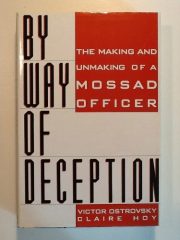
If the claims in the 1990s tell-all bestsellers of Mossad defector Victor Ostrovsky can be credited, Israel even considered the assassination of President George H.W. Bush in 1992 for his threats to cut off financial aid to Israel during a conflict over West Bank settlement policies, and I have been informed that the Bush Administration took those reports seriously at the time. And although I have not yet read it, the recent, widely-praised book Rise and Kill First: The Secret History of Israel’s Targeted Assassinations by journalist Ronen Bergman suggests that no other country in the world may have so regularly employed assassination as a standard tool of state policy.
There are other notable elements that tend to support the Piper Hypothesis. Once we accept the existence of a JFK assassination conspiracy, the one individual who is virtually certain to have been a participant was Jack Ruby, and his organized crime ties were almost entirely to the huge but rarely-mentioned Jewish wing of that enterprise, presided over by Meyer Lansky, an extremely fervent supporter of Israel. Ruby himself had particularly strong ties with Lansky lieutenant Mickey Cohen, who dominated the Los Angeles underworld and had been personally involved in gun-running to Israel prior to the 1948 war. Indeed, according to Dallas rabbi Hillel Silverman, Ruby had privately explained his killing of Oswald by saying “I did it for the Jewish people.”
An intriguing aspect to Oliver Stone’s landmark JFK film should also be mentioned. Arnon Milchan, the wealthy Hollywood producer who backed the project, was not only an Israeli citizen, but had also reportedly played a central role in the enormous espionage project to divert American technology and materials to Israel’s nuclear weapons project, the exact undertaking that the Kennedy Administration had made such efforts to block, even sometimes being described as “the Israeli James Bond.” And although the film ran a full three hours in length, JFK scrupulously avoided presenting any of the details that Piper later regarded as initial clues to an Israeli dimension, instead seeming to finger America’s fanatic home-grown anti-Communist movement and the Cold War leadership of the military-industrial complex as the guilty parties.
Summarizing over 300,000 words of Piper’s history and analysis in just a few paragraphs is obviously an impossible undertaking, but the above discussion provides a reasonable taste of the enormous mass of circumstantial evidence mustered in favor of the Piper Hypothesis.
In many respects, JFK Assassination Studies has become its own academic discipline, and my credentials are quite limited. I have read perhaps a dozen books in the subject, and have also tried to approach the issues with the clean slate and fresh eyes of an outsider, but any serious expert would surely have digested scores or even hundreds of the volumes in the field. While the overall analysis of Final Judgment struck me as quite persuasive, a good fraction of the names and references were unfamiliar, and I simply do not have the background to assess their credibility, nor whether the description of the material presented is accurate.
Under normal circumstances, I would turn to the reviews or critiques produced by other authors, and comparing them against Piper’s arguments, decide which argument seemed the stronger. But although Final Judgment was published a quarter-century ago, the near-absolute blanket of silence surrounding the Piper Hypothesis, especially from the more influential and credible researchers, renders this impossible.
However, Piper’s inability to secure any regular publisher and the widespread efforts to smother his theory out of existence, have had an ironic consequence. Since the book went out of print years ago, I had a relatively easy time securing the rights to include it in my collection of controversial HTML Books, and I have now done so, thereby allowing everyone on the Internet to conveniently read the entire text and decide for themselves, while easily checking the multitude of references or searching for particular words or phrases.
The Missing Link in the JFK Assassination Conspiracy
Michael Collins Piper • 2005 • 310,000 Words
This edition actually incorporates several much shorter works, originally published separately. One of these, consisting of an extended Q&A, describes the genesis of the idea and answers numerous questions surrounding it, and for some readers may represent a better starting point.
Questions, Answers & Reflections About the Crime of the Century
Michael Collins Piper • 2005 • 48,000 Words
There are also numerous extended Piper interviews or presentations easily available on YouTube, and when I watched two or three of them a couple of years ago, I thought he effectively summarized many of his main arguments, but I cannot remember which ones they were.
The Kennedy assassination surely ranks as one of the most dramatic and heavily reported events of the twentieth century, yet the overwhelming evidence that our president died at the hands of a conspiracy rather than an eccentric “lone gunman” was almost entirely suppressed by our mainstream media during the decades that followed, with endless ridicule and opprobrium heaped on many of the stubborn truth-tellers. Indeed, the very term “conspiracy theory” soon became a standard slur aimed against all those who sharply questioned establishmentarian narratives, and there is strong evidence that such pejorative use was deliberately promoted by government agencies concerned that so much of the American citizenry was growing skeptical of the implausible cover story presented by the Warren Commission. But despite all these efforts, this period may mark the inflection point at which public trust in our national media began its precipitous decline. Once an individual concludes that the media lied about something as enormous as the JFK assassination, he naturally begins to wonder what other lies may be out there.
Although I now consider the case for an assassination conspiracy overwhelming, I think that the passage of so many decades has removed any real hope of reaching a firm conclusion about the identities of the main organizers or their motives. Those who disagree with this negative assessment are free to continue sifting the enormous mountain of complex historical evidence and debating their conclusions with others having similar interests.
However, among the cast of major suspects, I think that the most likely participant by far was Lyndon Johnson, based on any reasonable assessment of means, motive, and opportunity, as well as the enormous role he obviously must have played in facilitating the subsequent Warren Commission cover-up. Yet although such an obvious suspect must surely have been immediately apparent to any observer, Johnson seems to have received only a rather thin slice of the attention that books regularly directed to other, far less plausible suspects. So the clear dishonesty of the mainstream media in avoiding any recognition of a conspiracy seems matched by a second layer of dishonesty in the alternative media, which has done its best to avoid recognizing the most likely perpetrator.
And the third layer of media dishonesty is the the most extreme of all. A quarter century ago, Final Judgment provided an enormous mass of circumstantial evidence suggesting a major, even dominant, role for the Israeli Mossad in organizing the elimination of both our 33rd president and also his younger brother, a scenario that seems second in likelihood only to that of Johnson’s involvement. Yet Piper’s hundreds of thousands of words of analysis have seemingly vanished into the ether, with very few of the major conspiracy researchers even willing to admit their awareness of a shocking book that sold over 40,000 copies, almost entirely by underground word-of-mouth.
So although committed partisans can continue endless, largely fruitless debates over “Who Killed JFK,” I think that the one firm conclusion we can draw from the remarkable history of this pivotal event of the twentieth century is that all of us have lived for many decades within the synthetic reality of “Our American Pravda.”
Related Reading:
- American Pravda: The JFK Assassination, Part I – What Happened?
- Final Judgment by Michael Collins Piper
- Did Israel Kill the Kennedys? by Laurent Guyénot
- Our American Pravda
Young protesters are defying Israel’s blockade with scraps of paper and plastic
By Jonathon Cook | The National | 24 June 2018
First Israel built a sophisticated missile interception system named Iron Dome to neutralise the threat of homemade rockets fired out of Gaza.
Next it created technology that could detect and destroy tunnels Palestinians had cut through the parched earth deep under the fences Israel erected to imprison Gaza on all sides.
Israel’s priority was to keep Gaza locked down with a blockade and its two million inhabitants invisible.
Now Israel is facing a new and apparently even tougher challenge: how to stop Palestinian resistance from Gaza using flaming kites, which have set fire to lands close by in Israel. F-16 fighter jets are equipped to take on many foes but not the humble kite.
These various innovations by Palestinians are widely seen by Israelis as part of the same relentless campaign by Hamas to destroy their country.
But from inside Gaza, things look very different. These initiatives are driven by a mix of recognisably human emotions: a refusal to bow before crushing oppression; a fear of becoming complicit through silence and inaction in being erased and forgotten; and a compelling need to take back control of one’s life.
Palestinians encaged in Gaza, denied entry and exit by Israel via land, sea and air for more than a decade, know that life there is rapidly becoming unsustainable. Most young people are unemployed, much of the infrastructure and housing are irreparably damaged, and polluted water sources are near-unpotable.
After waves of military attacks, Gaza’s children are traumatised with mental scars that may never heal.
This catastrophe was carefully engineered by Israel, which renews and enforces it daily.
The kites have long served as a potent symbol of freedom in Gaza. Children have flown them from the few spots in the tiny, congested enclave where people can still breathe – from rooftops or on Gaza’s beaches.
Five years ago, the film Flying Paper documented the successful efforts of Gaza’s children to set a new world record for mass kite-flying. The children defied Israel’s blockade, which prevents entry of most goods, by making kites from sticks, newspapers and scraps of plastic.
The children’s ambition was – if only briefly – to retake Gaza’s skies, which Israel dominates with its unseen, death-dealing drones that buzz interminably overhead and with missiles that can flatten a building in seconds.
A young girl observed of the kite’s lure: “When we fly the kite, we know that freedom exists.” A message scrawled on one read: “I have the right to pride, education, justice, equality and life.”
But the world record attempt was not only about the children’s dreams and their defiance. It was intended to highlight Gaza’s confinement and to issue a reminder that Palestinians too are human.
That same generation of children have grown into the youths being picked off weekly by Israeli snipers at unarmed protests at the perimeter fence – the most visible feature of Israel’s infrastructure of imprisonment.
A few have taken up kite-flying again. If they have refused to put away childish things, this time they have discarded their childish idealism. Their world record did not win them freedom, nor even much notice.
After the snipers began maiming thousands of the demonstrators, including children, medics and journalists, for the impudence of imagining they had a right to liberty, the enclave’s youths reinvented the kite’s role.
If it failed to serve as a reminder of Palestinians’ humanity, it could at least remind Israel and the outside world of their presence, of the cost of leaving two million human beings to rot.
So the kites were set on fire, flaming emissaries that brought a new kind of reckoning for Israel when they landed on the other side of the fence.
Gaza’s inhabitants can still see the lands from which many of them were expelled during the mass dispossession of the Palestinian people in 1948 – under western colonial sponsorship – to create a Jewish state.
Not only were those lands taken from them, but the Jewish farming communities that replaced them now irrigate their crops using water Palestinians are deprived of, including water seized from aquifers under the West Bank.
The kites have rained fire down on this idyll created by Israel at the expense of Gaza’s inhabitants. No one has been hurt but Israel claims extinguishing the fires has already cost some $2 million and 7,000 acres of farmland have been damaged.
Sadly, given the profound sense of entitlement that afflicts many Israelis, a small dent in their material wellbeing has not pricked consciences about the incomparably greater suffering only a few kilometres away in Gaza.
Instead, Israel’s public security minister Gilad Erdan called last week for anyone flying a kite, even young children, to be shot. He and other ministers have argued that another large-scale military assault on Gaza is necessary to create what Mr Erdan has termed “durable deterrence”.
That moment seems to be moving inexorably closer. The last few days have seen Israel launch punitive air strikes to stop the kites and Palestinian factions retaliate by firing significant numbers of rockets out of Gaza for the first time in years.
The Trump administration is no longer pretending to mediate. It has publicly thrown in its hand with Israel. It withdrew last week from the United Nations Human Rights Council, accusing it of being a “cesspool of political bias” after the council criticised Israel for executing Gaza’s unarmed demonstrators.
On a visit to the region last week, Jared Kushner, Donald Trump’s son-in-law and adviser, urged ordinary Palestinians to rebel against their leaders’ refusal to accept a long-awaited US peace plan that all evidence suggests will further undermine Palestinian hopes of a viable state.
Mr Kushner is apparently unaware that the Palestinian public is expressing its will, for liberation, by protesting at the Gaza fence – and risking execution by Israel for doing so.
Meanwhile, Prince William is due in Israel on Monday, the first British royal to make an official visit since the mandate ended 70 years ago. While Kensington Palace has stressed that the trip is non-political, Prince William will meet both Israeli Prime Minister Benjamin Netanyahu and Palestinian leader Mahmoud Abbas in an itinerary that has already been claimed by both sides as a victory.
From the vantage point of the Mount of Olives, from which he will view Jerusalem’s Old City, the prince may not quite manage to see the kite battles in Gaza’s skies that underscore who is Goliath and who is David. But he should see enough in the West Bank and occupied East Jerusalem to understand that western leaders have decisively chosen the side of Goliath.
BBC presenter rapped for highlighting Israeli killings of Palestinian kids
Press TV – June 25, 2018
BBC has found its presenter Andrew Marr guilty of breaching editorial guidelines for commenting during his flagship Sunday morning program that Israel has killed “lots of Palestinian kids.”
The broadcaster issued the unprecedented ruling against one of its most senior personalities after a complaint was filed against Marr over his comment during a discussion about a suspected chemical weapons attack in Syria during the April 8 edition of The Andrew Marr Show.
“And the Middle East is aflame again. I mean there’s lots of Palestinian kids being killed further south as well by Israeli forces,” the veteran presenter said, referring to clashes between Israeli troops and Palestinians in the Gaza Strip.
Irked by Marr’s remark, anti-Semitism campaigner Jonathan Sacerdoti complained that Marr’s remarks were “incorrect” and “unrelated” to the topic of Syria.
“He stated there’s a lot of Palestinian kids being killed further south by Israeli forces,” Sacerdoti’s complaint said.
“This is completely incorrect and is made up. This was irrelevant to the conversation on Syria… and also actually completely false.”
The BBC producers had referred to the fact that five “younger people” had been killed between the beginning of the year and the date of the program and that several Palestinian children and younger people had been killed in the week following the broadcast, but the campaigner argued that later events could not be used to justify Marr’s remarks.
The BBC’s head of executive complaints, Fraser Steel, took the side of Sacerdoti in a letter.
“In the absence of any evidence to support the reference to ‘lots’ of children being killed at the time of transmission, it seems to us to have risked misleading audiences on a material point,” he said.
“We therefore propose to uphold this part of your complaint.”
At least 130 Palestinians, including 14 children, have been killed by Israeli forces since the “March of Return” rallies began in the Gaza Strip on March 30. About 13,300 Palestinians have sustained injuries, of them 300 are currently in critical condition.
Forbes: Tesla Green Car Production Circus Distracting From Solar City Woes
By Eric Worrall | Watts Up With That? | June 22, 2018
As Elon Musk ramps up the hype over whether Tesla will hit its Model 3 production targets, another financial disaster may be unfolding at Tesla’s subsidiary Solar City.
Tesla’s Constant Turmoil Can’t Hide The Fact That SolarCity Is Dying
Jim Collins
JUN 22, 2018 @ 03:07 PMI am convinced that the financial media will never end its fascination with Tesla and this week has been even more rife with intrigue than most. While the actions of self-proclaimed whistleblower Martin Tripp—including his extraordinary email exchange with CEO Elon Musk—have garnered most of the headlines, there are more relevant news items for investors. Thursday’s Reuters article has the details of Tesla’s abrupt shutdown of a major part of its SolarCity sales network, and the ending of the company’s partnership with Home Depot had been announced last week in the press release detailing Tesla’s workforce reductions.
As Tesla’s struggles to perform the most basic assembly tasks at its Fremont car plant grab the headlines, the SolarCity news is signaling to the market a reality of which I have been convinced for some time: SolarCity is worthless. So, now the focus has to shift to that transaction, in which the former Tesla Motors paid 11 million shares of its stock to a company that was also chaired by its chairman and CEO and run on a day-to-day basis by his cousin (SolarCity’s former CEO Lyndon Rive.) The conflicts of interest were so obvious then, and even though most of Tesla’s Board members recused themselves from the SolarCity acquisition process, the simple fact is that Tesla picked up a lemon when they drove SolarCity off the lot.
…
How would the market perceive such a write-off given that Tesla is contractually obligated to spend $5 billion in capital in the ten years following the completion of the currently-in-construction (also being built by Panasonic) Gigafactory 2 in Buffalo? I am terrible at predicting Tesla’s share price movements over the short-term, but over the long-term, SolarCity will be a huge drain on the value of a car company that has been massively overvalued for years.
Full article: https://www.forbes.com/sites/jimcollins/2018/06/22/teslas-constant-turmoil-cant-hide-the-fact-that-solarcity-is-dying/
How different things would have been had Hillary Clinton won. Hillary Clinton pledged to install five hundred million solar panels during her presidency. Solar City would likely have been front of the queue to supply those solar panels, and Elon Musk would likely have pocketed billions of dollars of taxpayers cash helping Clinton fulfil her solar pledge.
Perhaps a Clinton victory is what Elon Musk had in mind when he bought out Solar City, and signed binding deals to build those extravagant Gigafactories.
UN Climate Demand Opens the way for More Abuse of Poor Farmers
By Eric Worrall | Watts Up With That? | June 22, 2018
If there is one climate program which should have died in a welter of shame, that programme is third world conservation programmes, programmes which have reportedly already caused mayhem in places where government backed forces have committed atrocities to drive farmers and tribes out of nature reserves.
Forests provide a critical short-term solution to climate change
22 JUN 2018
To prevent the worst consequences of climate change, we need to act now.
There is a “catastrophic climate gap” between the commitments that countries have made under the Paris Climate Agreement and the emissions reductions required to avoid the worst consequences of global warming, according to UN Environment’s Emissions Gap Report 2017.
The Paris Agreement aims to strengthen the global response to the threat of climate change by keeping a global temperature rise this century well below 2˚ Celsius, and to pursue efforts to limit the temperature increase even further to 1.5˚ Celsius.
Current pledges from governments represent only about half of what would be required to avoid a 2˚C temperature rise, and just one third of what’s required to limit warming to 1.5˚C.
While this “emissions gap” is significant, UN Environment suggests it can still be closed in a cost-effective manner.
One of the major contributors to closing the gap is forests.
The good news here is that 6.3 gigatons (billion tons) of carbon dioxide emission reductions have already been reported over the past six years from forests in Brazil, Ecuador, Malaysia and Colombia alone under the UN Framework Convention on Climate Change (UNFCCC), according to the UNFCCC Lima Hub. This is equivalent to more than the annual emissions of the United States.
“This is a significant step forward, showing that forests can be a central part of the solution to climate change,” says the head of the UN-REDD Programme Secretariat, Mario Boccucci. “We have an unprecedented opportunity: political will, know-how, finance. Now we need to build on progress and scale up rapidly in the coming years.”
…
Protecting forests, including mangroves, makes climate action cheaper and faster. We need to build the political case for this across all countries.
“The Emissions Gap Report once again underscores the urgency of redoubling our efforts to reduce emissions,” says UN Environment climate change expert Niklas Hagelberg.
“It shows that solutions exist, and if they are adopted quickly we can turn our current situation around. But with each year we wait, we make our ability to limit dangerous climate change more difficult, risky and costly.”
Full article: https://www.unenvironment.org/news-and-stories/story/forests-provide-critical-short-term-solution-climate-change
Even the Guardian has noted the connection between offering large cash grants to tyrants in return for declaring regions off limits to humans, and vicious attacks against people living in the affected regions;
The tribes paying the brutal price of conservation
John Vidal
Sun 28 Aug 2016 17.00 AESTAcross the world, governments are protecting habitats. But indigenous peoples are being evicted
The Botswana police helicopter spotted Tshodanyestso Sesana and his friends in the afternoon. The nine young Bushmen, or San, had been hunting antelope to feed their families, when the chopper flew towards them.
There was a burst of gunfire from the air and the young men dropped their meat and skins and fled. Largely through luck, no one was hit, but within minutes armed troops arrived in a jeep and the nine were arrested, stripped naked, beaten and then detained for several days for poaching in a nature reserve.
Welcome to 21st-century life in the vast Central Kalahari game park, an ancient hunting ground for the San, but now off-limits to the people who forged their history there. The brutal incident took place last week, just days after Botswana’s wildlife minister Tshekedi Khama, the brother of President Ian Khama, announced a shoot-on-sight policy on poachers.
Khama claims the policy, which is supported by conservation groups, will deter poaching and the illegal wildlife trade, which is widely seen by Europe and the US as disastrous for biodiversity. But there are no rare or endangered species such as elephants or rhinos in the areas where the bushmen hunt. Sending a helicopter gunship and armed guards to arraign the hunters looks rather like an escalation of the low-grade war that Botswana has waged for years on one of the most vulnerable indigenous groups in the world.
…
Full article: https://www.theguardian.com/global-development/2016/aug/28/exiles-human-cost-of-conservation-indigenous-peoples-eco-tourism
The damage is not limited to shooting down tribespeople from helicopter gunships. In Ivory Coast, poor farmers who are trying to produce cocoa are being pressured to pay large bribes to be allowed to work their farms in “conservation areas”.
… The government of Ivory Coast took action recently against cocoa-driven deforestation by expelling cocoa farmers from Mount Péko National Park (which means “mountain of hyenas” in the local Gueré language). According to a report by Human Rights Watch and the Ivorian Coalition of Human Rights (RAIDH), the evictions were poorly planned and carried out in violation of human rights standards. When we visited Mount Péko after the eviction, we found the park once again filled with cocoa smallholders who had returned. Some smallholders explained to us that when they finally returned to Mount Péko, they simply paid the authorities higher bribes to go back to cultivating their lands in the park. …
Read more: http://www.mightyearth.org/wp-content/uploads/2017/09/chocolates_dark_secret_english_web.pdf
Lets see – large numbers of skilled but very poor farmers in Africa trying to make an honest living being backed into a corner, forced to pay large bribes, their families brutalised by armed thugs. Its pretty obvious what will happen next, and when it does, Western green policies will bear the ultimate blame.
Can Universities Lawfully Bully Academics into Silence?
By Jennifer Marohasy | June 19, 2018
Dr Peter Ridd has taken James Cook University to court protesting his sacking for what he says is, primarily, speaking-out about the lack of quality assurance in Great Barrier Reef science.
Dr Ridd spoke out initially about there being no quality assurance of Great Barrier Reef science – science that is arguably misused to secure billions of dollars of tax-payer funding. When the University tried to stop Dr Ridd doing this, Dr Ridd spoke out against University management – making all the documentation public including on his new website.
I would really like the court case to be about academic freedom and the science – to lay bare the evidence. But when I went to the first day of the hearing of an application in the Federal Circuit Court last Monday (11th June – the hearing continued on 12 June 2018) for an order for reinstatement of Dr Ridd’s employment pending determination at trial, it quickly became evident that there would be no testing of the actual scientific evidence relied upon by Dr Ridd to claim that scientific institutions like AIMS and ARC Centre “can no longer be trusted” and “spin their story”.
Yesterday (19th June), Judge Jarrett gave his reasons for making orders declining to reinstate Dr Ridd but allowing him to amend his primary application to include a claim for the university taking “adverse action” against him for exercising a workplace right (i.e. his intellectual/academic freedom pursuant to the enterprise agreement). On hearing the reasons I was concerned to discover that it may all come down to poorly worded clauses in an enterprise agreement. In particular, was Dr Ridd allowed to exercise his academic freedoms free of the constraint of the university’s ‘aspirational’ (according to His Honour) code of conduct, and was he permitted to say anything publicly about what many ordinary Australians would consider a straight-forward case of the university bullying him into silence?
On the first day of the preliminary hearing Barrister Ben Kidston for the applicant (Dr Ridd) argued eloquently about how the case was about ‘academic freedom’. He went-on for over an hour moving from the big picture to the detail with respect to specific clauses in a code of conduct and the enterprise agreement, and back again. All the while His Honour and the audience listened intently – no one interrupted. Again yesterday, His Honour cited the poorly worded specific clause which the university has been relying on to silence Dr Ridd, and observed that it was open to two interpretations.
His Honour didn’t mention the Union. The National Tertiary Education Union has an interest in the enterprise agreement and like Dr Ridd, they say that the relevant clause in the agreement shouldn’t be used to silence the employee but rather, amongst other things, that the obligation of confidentiality only applies to the University’s management of the disciplinary process. Any other interpretation means that university academics would be obliged to suffer any disciplinary action by the University (legitimate or otherwise) in silence – they would never be able to publicly defend themselves in the court of public opinion, court proceedings being the only practical option. One wonders if the Union realises the implications to its members.
Yesterday, when His Honour gave his reasons for declining the application by Dr Ridd for an injunction – for his temporary reinstatement as a Professor at James Cook University pending the trial – he didn’t deal with many of the arguments advanced for Dr Ridd e.g. the effect of the clause of the enterprise agreement which states that the code of conduct is not to “detract” from the intellectual freedoms, the interaction of the express right to disagree with the University‘s decisions and processes pursuant to his intellectual freedom and the purported obligation to keep disciplinary proceedings again him confidential, whether a conflict of interest, apprehended bias or actual bias, exists by reason of the university’s commercial relationship with AIMS, GBRMPA and ARC and the effect that this has on the obligation to afford Dr Ridd procedural fairness and natural justice in the determination of the disciplinary complaint (which concerned comments he made about those bodies).
That is not intended to be critical of His Honour. His Honour took a broad brush approach and did not descend into the detail of the arguments and the evidence, as all His Honour was required to do was to ascertain whether Dr Ridd had a prima facie case, and not to decide the case itself.
Yesterday, His Honour found that Dr Ridd had an arguable prima facie case in relation to the alleged breach of the enterprise agreement by JCU and that it took adverse action against him, but that the balance of convenience did not favour his reinstatement pending trial primarily because:
1. an award of damages would be an adequate remedy if Dr Ridd was successful at trial; and
2. the university paid Dr Ridd the equivalent of six month’s pay upon his termination – so he was not presently without income to support himself and (it seems) that a trial would likely occur before the expiration of that six month period; and
3. Dr Ridd had previously turned down an offer of an undertaking by the university to suspend the disciplinary proceedings pending determination of the proceeding. It is important to note that that undertaking would have required Dr Ridd to remain silent about the disciplinary proceedings that had been taken against him by the university.
Of course, in making this determination the Judge was entirely ignoring (as he was entitled to) the very nature of Dr Ridd – a man of integrity who will not be silenced even if costs him his job, his career and results in vicious bullying.
When Christopher Murdoch QC for the respondent (JCU) argued on the first day of the hearing he explained that the University’s core issue was the breaking of confidentiality, in particular Dr Ridd was not allowed to tell anyone that he had been censured. Never mind that he had been censured for daring to speak out against a culture where scientific integrity is perhaps sacrificed for profit.
So, when I blogged about this issue of Peter Ridd being censured and the need for everyone to contribute to his GoFundMe Campaign back in May, I very deliberately emphasised the importance of being able to speak out. The most important thing, I wrote, is to not be silenced.
I was also thinking of the famous Edmund Burke quote: The only thing necessary for the triumph of evil is for good men to do nothing.
Dr Ridd has done something. First, he detailed the scientific facts as an expert on these issues including in the scientific literature. For example, there is his article published in Marine Geology (Volume 346, pages 392-399) in which he explains that the only reason Glenn De’ath found an apparent decline in coral calcification rates was because he didn’t consider the age effect on coral growth. This is just one of many instances when Dr Ridd has detailed how scientists make spurious claims based on a flawed methodology. More recently Dr Ridd has explained the consequences of this in plain English on television.
None of this has made him popular with his colleagues most of whom rely on perceptions of imminent catastrophe at the Great Barrier Reef for their relevance and certainly their funding. Dr Ridd has done what the average Australian would consider to be the right thing. Most importantly he has not remained silent – surely, he will be vindicated at the final trial when all the evidence is heard and all the arguments made and considered.
Featured Video
Prof. Ted Postol: Iran Already Achieved Nuclear Deterrence Against Israel
or go to
Aletho News Archives – Video-Images
From the Archives
How the occupied mentality syndrome works
Saudi Arabia on the American chessboard – Part 3
By B. J. Sabri | American Herald Tribune | June 27, 2016
Read part 2: “The occupied mentality Syndrome“
Previously I argued whether Saudi Arabia’s repeated involvements in U.S. interventions and wars stem from free national will or in response to a specific condition. For starters, in Saudi Arabia there is no national will. In Saudi Arabia, the national will is the will of the Al Saud clan. Still, when a major Arab state allies itself with a superpower that committed unspeakable crimes against humanity in almost every Arab country, then something is wrong. This fact alone should compel us to examine the U.S.-Saudi relation for one exceptional reason. As a result of the U.S.-Saudi wars, hundreds of thousands of people in Afghanistan, Iraq, Iran, Libya, Syria, Yemen, and Somalia have lost their lives. Millions became displaced in their own homelands. And millions more rendered refugees.
Attributing the Saudi policies to the bonds of “partnership” with the U.S. is frivolous. There are no bonds between these two thugs except those of business, military deals, secret plots, and wars. Proving this point, bonds such as these have no space for the American and Saudi peoples to share significant cultural or societal exchanges. If partnership is not the reason for the Saudi contribution to the U.S. strategy of empire and imperialism, then another reason must exist.
This leads to three possibilities. … continue
Blog Roll
 Aletho News
- Russia Warns of Retaliation as UK Authorizes Seizure of Vessels
- Serbia thwarts plot to bomb Russia-Hungary gas pipeline – Vucic
- Al Mayadeen voices solidarity with Dr. Marandi amid death threats
- US dismantling international law in its war against Iran while claiming ‘false’ victory: Legal scholar
- One martyr, 5 injuries in US attack on Iraqi border crossing with Iran
- ‘This war is Israel’s war’: World facing ‘security breakdown’, says Qalibaf
- IRGC decries attack on US embassy in Riyadh, says executed by ‘Israel’
- Iran blasts EU hypocrisy as EU invokes international law over Hormuz
- There is no military solution to Strait of Hormuz
- NATO’s structural collapse – the outcome of deviation from reality
- If Americans Knew
- US loses planes over Iran, Israel downgrades Lebanon war goals – Daily Update
- Israel Is Blocking Palestinians from Easter at Church Where Jesus Resurrected
- Plot to assassinate Palestinian activist follows harassment campaign promoted by Zionist groups and elected officials
- Prominent New York synagogue hosts presentation on why U.S. Jews should support the ethnic cleansing of Gaza
- Tapper vs. Piker: Is the CNN Anchor Auditioning for David Ellison?
- Shouldn’t Democrats Be Able to Condemn Genocide?
- Israel-US kill negotiators, destroy civilian structures, but Iran’s military capabilities still largely intact – Daily Update
- ‘War crime’: Global condemnation as Israeli ministers celebrate death penalty law targeting Palestinian prisoners
- 7 Ways Israel Is Turning Lebanon Into Gaza
- World’s Leading Football Bodies Under Fire Over Israel Policies
- No Tricks Zone
- An Inconvenient Tree: Uncovered In Alps… Europe Much Warmer Than Today 6000 Years Ago
- New Study Reports A 60% Slowdown In Greenland’s Ice Loss Rate In The Last Decade
- Low Intensity Tornado Wrecks Major Solar Farm, Creating A Potential Toxic Dump
- New Study Finds Warming Saves Lives…Cold Temperatures 12 Times More Deadly Than Excess Heat
- German Science Blog Accuses PIK Climate Institute Of Hallucinating Climate Tipping Points
- Devastating Assessment Of Comirnaty Vaccine By Former Senior Pfizer Europe Toxicologist
- New Study: CO2 Is ‘Effectively Negligible’ As An Explanatory Climate Change Factor Since 2000
- Former Pfizer Toxicologist Dr. Helmut Sterz Tells Bundestag Hearing Pfizer Vaccine Should Have Never Been Approved
- Energy Expert: Germany’s Nuclear Phaseout Was A “500 Billion Euro Mistake”
- New Research: South Australia’s Mid-Holocene Sea Surface Temperatures Were 4°C Warmer Than Today
 Aletho News