Here comes the Mali mission media manipulation
By Yves Engler · July 17, 2018
For the military, shaping media coverage of deployments is what roasting a marshmallow is to a summer camper’s S’mores; there isn’t one without the other.
Even before beginning a small “peacekeeping” mission, the Canadian forces have an elaborate media strategy.
At the end of June, Chief of the Defence Staff Jonathan Vance brought journalists with him on a visit to Mali. They toured the facilities in Gao where an advance team was preparing for Canada’s UN deployment to the African nation. An Ottawa Citizen headline described Vance’s trip as part of an effort at “selling the public on the Mali mission.”
The tour for journalists was followed by a “technical briefing” on the deployment for media in Ottawa. “No photography, video or audio recording for broadcast purposes” was allowed at last week’s press event, according to the advisory. Reporters were to attribute information to “a senior government” official. But, the rules were different at a concurrent departure ceremony in Trenton. “Canadian Armed Forces personnel deploying to Mali are permitted to give interviews and have their faces shown in imagery,” noted the military’s release.
None of these decisions are haphazard. With the largest PR machine in the country, the military has hundreds of public affairs officers that work on its media strategy. “The Canadian Forces (CF) studies the news media, writes about them in its refereed journals — the Canadian Army Journal and the Canadian Military Journal — learns from them, develops policies for them and trains for them in a systematic way,” explains Bob Bergen, a professor at the University of Calgary’s Centre for Military and Strategic Studies. ”Canadian journalists simply do not access the Canadian Forces in the scholarly fashion that the military studies them. There are no peer-reviewed journals to which they contribute reflections on their success or failure as an industry to cover the 1991 Persian Gulf War or the 1999 Kosovo Air War.”
While the tactics have varied based on technologies, balance of power and type of conflict, the government has pursued extensive information control during international deployments, which are invariably presented as humanitarian even when motivated by geostrategic and corporate interests. There was formal censorship during the First World War, Second World War and the Korean War. In recent air wars the military largely shut the media out while in Afghanistan they brought reporters close.
Air wars lend themselves to censorship since journalists cannot accompany pilots during their missions or easily see what’s happening from afar. “As a result,” Bergen writes, “crews can only be interviewed before or after their missions, and journalists’ reports can be supplemented by cockpit footage of bombings.”
During the bombing of the former Yugoslavia in 1999 the CF blocked journalists from filming or accessing Canadian pilots flying out of Aviano, Italy. They also refused to provide footage of their operations. While they tightly controlled information on the ground, the CF sought to project an air of openness in the aftermath of the Somalia scandal. For 79 days in a row a top general gave a press conference in Ottawa detailing developments in Yugoslavia. But, the generals often misled the public. Asked “whether the Canadians had been targeted, whether they were fired upon and whether they fired in return” during a March 24 sortie in which a Yugoslavian MiG-29 was downed, Ray Henault denied any involvement. The deputy chief of Defence Staff said: “They were not involved in that operation.” But, Canadians actually led the mission and a Canadian barely evaded a Serbian surface-to-air missile. While a Dutch aircraft downed the Yugoslavian MiG-29, a Canadian pilot missed his bombing target, which ought to have raised questions about civilian casualties.
One reason the military cited for restricting information during the bombing campaign was that it could compromise the security of the Armed Forces and their families. Henault said the media couldn’t interview pilots bombing Serbia because “we don’t want any risk of family harassment or something of that nature, which, again, is part of that domestic risk we face.”
During the bombing of Libya in 2011 and Iraq-Syria in 2014-16 reporters who travelled to where Canadian jets flew from were also blocked from interviewing the pilots. Once again, the reason given for restricting media access was protecting pilots and their families.
Since the first Gulf War the military has repeatedly invoked this rationale to restrict information during air wars. But, as Bergen reveals in Balkan Rats and Balkan Bats: The art of managing Canada’s news media during the Kosovo air war, it was based on a rumour that antiwar protesters put body bags on the lawn of a Canadian pilot during the 1991 Gulf War. It likely never happened and, revealingly, the military didn’t invoke fear of domestic retribution to curtail interviews during the more contentious ground war in Afghanistan.
During that war the CF took a completely different tack. The CF embedding (or in-bedding) program brought reporters into the military’s orbit by allowing them to accompany soldiers on patrol and stay on base. When they arrived on base, senior officers were often on hand to meet journalists. Top officers also built a rapport with reporters during meals and other informal settings. Throughout their stay on base, Public Affairs Officers (PAOs) were in constant contact, helping reporters with their work. After a six-month tour in Afghanistan PAO Major Jay Janzen wrote: “By pushing information to the media, the Battalion was also able to exercise some influence over what journalists decided to cover. When an opportunity to cover a mission or event was proactively presented to a reporter, it almost always received coverage.”
In addition to covering stories put forward by the military, “embeds” tended to frame the conflict from the perspective of the troops they accompanied. By eating and sleeping with Canadian soldiers, reporters often developed a psychological attachment, writes Sherry Wasilow, in Hidden Ties that Bind: The Psychological Bonds of Embedding Have Changed the Very Nature of War Reporting.
Embedded journalists’ sympathy towards Canadian soldiers was reinforced by the Afghans they interviewed. Afghans critical of Canadian policy were unlikely to express themselves openly with soldiers nearby. Scott Taylor asked, “what would you say if the Romanian military occupied your town and a Romanian tank and journalist showed up at your door? You love the government they have installed and want these guys to stay! Of course the locals are smiling when a reporter shows up with an armoured vehicle and an armed patrol.”
The military goes to great lengths to shape coverage of its affairs and one should expect stories about Canada’s mission in Mali to be influenced by the armed forces. So, take heed: Consume what they give you carefully, like you would a melted chocolate and marshmallow-coated graham wafer.
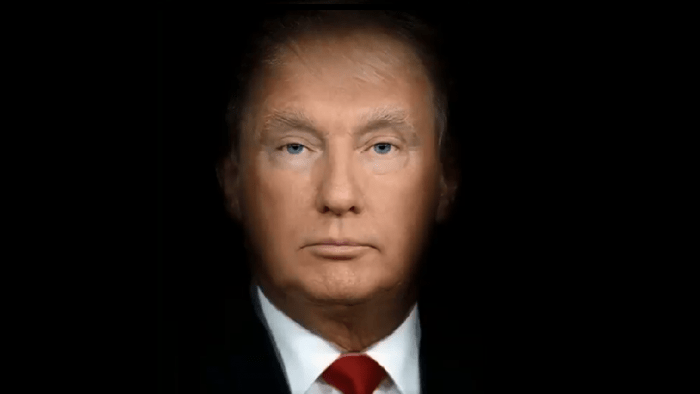
Time magazine’s ‘creepy’ Putin-Trump cover is what media subversion really looks like
© TIME
By Simon Rite | RT | July 19, 2018
Staring out from the front cover of this week’s Time magazine is a striking, unsettling picture of Vladimir Putin and Donald Trump morphed into one. The hidden, yet unsubtle messaging behind the image is equally unsettling.
Time describes the image as “meaning to represent this particular moment in US foreign policy, following the pair’s recent meeting in Helsinki, Finland.” However, what it really represents is the way that a major US media outlet wants its readers to see these two men. As strange and creepy figures who are in some way linked.
The publication cannot write a story which backs up allegations that the two presidents have some kind of conspiratorial relationship, but it can print an image which insinuates it, demanding your attention and entering your subconscious. If investigators want a textbook example of how the media attempts to subvert and influence, then look no further.
 How many other morphed images of world leaders has Time featured on its famed front page? None. There is no Trerkel, no Macrump not even a Tru Jong-Un. With these leaders there is no conspiracy to sell and no bandwagon on which to jump.
The US is still wrestling with the reality of Trump as president and claims of election interference. The mainstream constantly debates how it was allowed to happen at all, and here Time wants to provide the answer in one unsettling picture. It must have been Putin, the two are so close they could be one person the image suggests, they’re two sides of the same coin.
RT can exclusively reveal that the two do, in fact, have extremely serious connections: they both currently find themselves as the leaders of the two biggest nuclear powers on Earth. That is an incontrovertible fact and, as Trump said in Helsinki, he decided to take a political risk by meeting Putin in an attempt to reduce tensions. In America’s current political climate that is more than enough to get you an insidious Time magazine front page.
The idea is not original. German news magazine Der Spiegel did the identical thing last year by morphing the two men on its cover page. The aesthetic was less psycho warfare horror movie, and more Soviet schtick.
Der Spiegel’s headline was at least more transparent in what it was trying to say ‘The double regent: how much Putin is in Trump?’
Time’s simple ‘The Summit Crisis’ is short and ambiguous enough that the reader has more time to let the hidden meaning of the image settle in.
Has it worked? You only have to look on Twitter to see the words people are using to describe the front page: “Creepy,” “nightmare,” “scary” and “chilling.” Time magazine: mission accomplished.
Hamas: Nation-State bill officially defines Israel as apartheid entity
Palestine Information Center – July 19, 2018
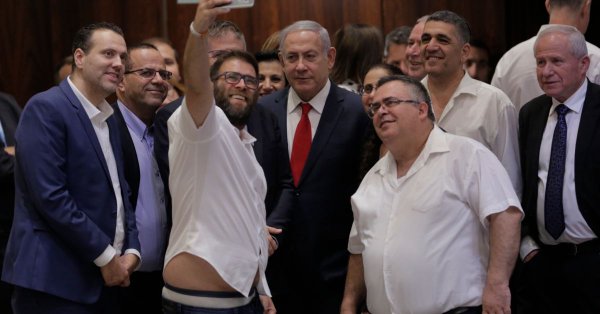
GAZA – Hamas strongly denounced on Thursday the adoption by the Israeli parliament, the Knesset, of the new Nation-State Basic Law, charging Israel of officially adopting an apartheid system of rule.
Hamas spokesman Fawzi Barhoum said “such a racist law” has seen the day thanks to the US unconditional support for the Israeli occupation and its apartheid regime.
“Such a law will not change the defacto situation. The Palestinians are and will forever remain the real sovereigns in Palestine”, said Barhoum.
He called on the Palestinians to opt for a unified national strategy so as to defend Palestinians’ rights and land against such schemes.
Hamas urged the international community to work on reining in the unabated flow of Israel’s apartheid policies and prosecute the Israeli occupation for its flagrant breaches of international resolutions.
The Israeli Knesset voted 62 to 55 early Thursday to approve the Jewish Nation-State Basic Law that constitutionally enshrines the identity of the State of Israel as the nation-state of the Jewish people.
It guarantees the ethnic-religious character of Israel as exclusively Jewish and entrenches the privileges enjoyed by Jewish citizens, while simultaneously anchoring discrimination against Palestinian citizens and legitimizing exclusion, racism, and systemic inequality. It is considered as the “law of laws” capable of overriding any ordinary legislation.
The danger of the law lies in the fact that it denies the Palestinian citizens their right to self-determination to instead be determined by the Jewish population. The Jewish Nation-State bill officially legalizes apartheid, in what observers dubbed one of the most dangerous laws adopted in recent decades to legalize discrimination against Arabs.
Iran rejects Israeli claim of stealing nuclear data as ‘laughably absurd’
Press TV – July 19, 2018
Iran has dismissed as “laughably absurd” an Israel-fabricated scenario, in which the agents with the regime’s Mossad spy agency are claimed to have spirited away loads of “secret documents” on the country’s nuclear work from a site in southern Tehran.
Alireza Miryousefi, a spokesman for Iran’s diplomatic mission to the United Nations, was responding to recent reports by The New York Times and other news outlets about the details of Mossad’s purported operation near the Iranian capital in the rather Hollywood-style scenario.
The scenario was initially unveiled by Israeli Prime Minister Benjamin Netanyahu, who is widely known to have a penchant for theatrics. Netanyahu went live on television in late April for yet another dubious show against Iran and put on display what he claimed to be records from a secret warehouse in Tehran.
Netanyahu claimed Israeli agents had managed to break into the warehouse in an overnight raid and bring back “half a ton of the material” consisting of 55,000 pages and another 55,000 files on 183 CDs.
The Israel premier’s vaudeville — which came only days before the US announced its withdrawal from the 2015 multilateral nuclear deal with Iran — was meant to persuade the world that Iran has been lying about its nuclear program, without providing even a single piece of evidence.
The New York Times published an article on July 15, in which it elaborated on the purported Mossad operation, which it claimed lasted for over six hours.
Reacting to the report, Miryousefi once again rejected Israel’s claims in a statement and said, “It’s almost as if they are trying to see what outlandish claims they can get a Western audience to believe.”
“Iran has always been clear that creating indiscriminate weapons of mass destruction is against what we stand for as a country, and the notion that Iran would abandon any kind of sensitive information in some random warehouse in Tehran is laughably absurd,” he added.
Netanyahu’s April 30 show was so cheaply theatrical that it was quickly held up to ridicule inside Iran and abroad, with observers raising serious questions about the purported Mossad raid.
Back then, Iranian Foreign Minister Mohammad Javad Zarif called the Israeli premier “the boy who can’t stop crying wolf is at it again,” recalling a similar anti-Iran rant by Netanyahu at the UN General Assembly in 2012– during which he used a cartoon bomb in an attempt to portray the Islamic Republic as a threat.
Deputy Foreign Minister Abbas Araqchi also said that Netanyahu was playing a baseless childish and naive game against Iran.
The Israeli leader was back then involved in an intense lobbying campaign aimed at dissuading Washington and the other parties to the Iran deal from supporting the landmark agreement, officially dubbed the Joint Comprehensive Plan of Action (JCPOA).
Except in the US, Netanyahu’s claims, however, fell on deaf ears.
Reacting to the show hours later, the EU’s foreign policy chief, Federica Mogherini, said on May 1 that Netanyahu’s presentation failed to question Tehran’s compliance with the 2015 nuclear deal and that any such claims should solely be assessed by the International Atomic Energy Agency (IAEA).
The IAEA — which uses strict mechanisms to monitor the technical aspect of the JCPOA’s implementation — has repeatedly confirmed Iran’s full commitment to its side of the bargain.
The latest New York Times piece comes as Iran and its other parties in the deal — Russia, China, France, Britain plus Germany — are engaged in a diplomatic process aimed at working out ways to keep the JCPOA in place despite Washington’s pullout in May.
UK doubles arms deals with governments on its own rights blacklist: Report
Press TV – July 19, 2018
The UK has almost doubled its arms deals with governments that it has blacklisted as violators of human rights, figures show.
The government of British Prime Minister Theresa May approved some £1.5 billion in arms licenses in 2017, up from £820 million it did the year before, the Campaign Against the Arms Trade (CAAT) pressure group reported Wednesday.
The licenses allowed weapons sales to 18 countries on Home Office blacklist, which includes Saudi Arabia, Bahrain, Egypt, Pakistan and the Israeli regime.
Arms deals with Saudi Arabia, which has been running a deadly military aggression against Yemen since March 2015, accounted for £1.13 billion of the total amount, the group said.
The ruling Tory government is “actively arming and supporting many of the regimes that even it believes are responsible for terrible human rights abuses,” CAAT’s Andrew Smith told The Independent.
“There is little oversight in the system, and no controls over how these arms will be used once they have left the UK,” he added.
“The arms sales being agreed today could be used to fuel atrocities for years to come. Right now UK-made fighter jets and bombs are playing a central role in the Saudi-led destruction of Yemen, and the government and arms companies have totally failed to monitor or evaluate how this deadly equipment is being used.”
“These arms sales don’t just provide dictatorships and human rights abusers with the means to kill, they also give them a huge degree of political support,” Andrews continued.
Saudi Arabia and its allies launched the war on Yemen in March 2015 to reinstall its former Riyadh-allied government. The military aggression has so far killed over 13,600 Yemenis.
The UK has increased its weapons sales by around 500 percent since the onset of the Saudi invasion, according to a report by The Independent. The UK has, so far, sold more than £6 billion worth of arms to the kingdom.
Israel second largest blacklisted buyer
With a total of £221 million of licenses granted, Israel was the second-biggest purchaser of UK arms last year to be featured on the Foreign and Commonwealth Office’s (FCO) human rights priority list.
In its latest version of the watch list, published this week, the FCO blasted Israel for violating the international law during its ongoing occupation of Palestinian lands in the West Bank, East Jerusalem al-Quds and Gaza.
It also slammed the Tel Aviv regime’s “systematic policy of settlement expansion,” despite constant calls by the UN, the European Union and many other international organizations to end them.
Bahrain became the third largest buyer on the list, acquiring £30.7 million of British arms in 2017, while Egypt imported £6.5 million and Pakistan, £11.2 million.
CAAT’s figures came amid efforts by British members of Parliament sitting on the Committees on Arms Export Controls (CAEC) to reform the UK’s arms export regime and stop arms sales to blacklisted governments.
In its latest report, the committee called on cabinet ministers to consider imposing a “presumption of denial” when weighing arms sales applications for such countries.
“We believe there must always be a more stringent process in place for any arms exports to such countries,” read the report.
Regional states muscle in to seek a bigger ‘say’ in Afghan conflict
By M.K. Bhadrakumar | Asia Times | July 19, 2018
A new strategic fault line appeared in the Afghan conflict last week when Islamabad hosted an unusual meeting of the heads of the intelligence agencies of Russia, China and Iran on July 11.
Moscow thoughtfully publicized the event both for its optics as well as to pre-empt misperceptions that some sort of zero-sum game might be afoot.
The focus was on joint measures to stop the terrorist group Islamic State Khorasan Province (IS-K) from threatening the territorial boundaries of the four regional states. In the Russian estimation, there could be up to 10,000 fighters in IS-K’s ranks already and the group is already active in nine of the 34 provinces in Afghanistan.
The four participating countries “reached understanding of the importance of coordinated steps to prevent the trickling of IS terrorists from Syria and Iraq to Afghanistan, where from they would pose risks for neighboring countries.” But they also “stressed the need for a more active inclusion of regional powers in the efforts” to end the war in Afghanistan.
Clearly, the leitmotif is in the latter claim by the regional states seeking a greater say in Afghan peace-making. Three related developments over the weekend also signal the new churning. One, the Chief of Staff of the Iranian Armed Forces, General Mohammad Baqeri, started a three-day visit to Islamabad on July 15 at the invitation of Pakistani army chief General Qamar Bajwa.
This is the first time since the Islamic Revolution of 1979 that a chief of staff of Iran’s armed forces visited Pakistan. No doubt, the visit signals Tehran’s appreciation that Pakistan is no longer in the US orbit. General Bajwa visited Tehran in November.
According to the Pakistani readout, General Bajwa noted that Pakistan’s military cooperation with Iran would have a “positive impact on peace and security in the region.” Later, General Baqeri told the Iranian media that the US and its allies seek to weaken security in the region and Iran and Pakistan are “duty-bound to take actions” to safeguard regional peace and security.
There is a history of cross-border terrorism from across the porous Pakistani border in which Tehran suspected the hidden hand of hostile powers. Therefore, today, the Iranian calculus prioritizes the “return” of Saudi Arabia and the United Arab Emirates to the Afghan chessboard recently, after a prolonged absence, given the geopolitical rivalries playing out in a diverse theatre across the Greater Middle East.
Curiously, although the newfound Saudi-Emirati pro-activism in Afghanistan is coinciding with the steady expansion of IS-K, the two Gulf states today are preoccupied with weakening the Taliban, whom they had mentored in an earlier era in the 1990s. The Kabul government approved on June 6 the deployment of UAE Special Forces to Afghanistan.
On July 11-12, Saudi Arabia hosted an Ulema conference in Jeddah and Mecca, which issued a ‘fatwa’ against the ‘jihad’ waged by the Afghan Taliban. Washington encouraged these parallel Saudi-Emirati moves, which implies a concerted attempt to weaken the Taliban whom the US military failed to defeat, with a view to force it to compromise.
However, on the contrary, a paradigm shift is under way in the regional perceptions regarding the Taliban. The special envoy of the Russian president on Afghanistan, Zamir Kabulov, disclosed on the weekend that Moscow proposes to invite the Taliban to the second round of the Russian regional initiative on Afghanistan, which is expected to be held sometime late in the summer.
Kabulov characterized the Taliban as a force that has “integrated” with the Afghan nation, and therefore, having a legitimacy, which in some respects even exceeds the Kabul government’s, and controlling more than half the territory of Afghanistan. Kabulov implicitly doubted the representative character of the present Afghan government.
Suffice to say that the Russian policy is incrementally redefining the battle lines in Afghanistan from ‘Taliban versus the Rest’ to ‘Afghanistan versus the IS-K.’ Conceivably, Iran, China and Pakistan are in harmony with the Russian thinking.
The heart of the matter is that while these regional states regard the Taliban as an Afghan movement indigenously rooted in traditional Islam and with a political agenda confined to their homeland, they abhor the IS-K as a brutal terrorist group weaned on Salafi-Wahhabist teaching which casts a seductive appeal to misguided Muslim youth worldwide.
However, in the final analysis, the above interplay needs to be juxtaposed with recent reports that President Trump may order a policy review of his one-year old Afghan strategy. In fact, the sudden visit of the US Secretary of State Mike Pompeo to Kabul on July 9 only reinforced that impression in the region. Unsurprisingly, Pompeo maintained while in Kabul that the Trump administration’s “strategy is working.”
But then, instead of heaping praise on the US military, he instead stressed the urgency of a peace process with the Taliban. Pompeo offered that the US will “support, facilitate and participate in these peace discussions.” He then added meaningfully: “We expect that these peace talks will include a discussion of the role of international actors and forces.”
Aftermath of Helsinki summit: American ‘democracy’ in action
© Erin Scott / Global Look Press
By Finian Cunningham | RT | July 19, 2018
After his landmark summit with Russian leader Vladimir Putin in Helsinki, US President Donald Trump was apparently forced into an embarrassing u-turn over allegations of Russian interference in American elections.
On returning to the White House from his summit in Finland, Trump read out a statement, saying that he “accepted” US intelligence claims that Russia had meddled in the 2016 presidential election.
He offered the explanation that he had “mis-spoken” during his press conference with Putin in Helsinki the day before, when he appeared then to accept the Russian president’s “powerful denial” that his country had not interfered in the race for the White House.
What to make of it? Was Trump correcting a glitch in his speech, or is there something more sinister at play?
In any case, political and media critics in the US don’t believe the president’s “attempt at backtracking,” as the Washington Post put it.
Senior Democrats insisted Trump “could not squirm his way out” of the torrent of accusations that he had “capitulated to Putin” and dishonored US intelligence services by appearing to accept Moscow’s assurances it had not interfered in the elections.
The context of words spoken at the press conference in Helsinki does indeed suggest that Trump was countenancing Putin’s denial of Russian meddling. The US president went on to say that the various probes into the matter were a “disaster” for America’s international image and for bilateral relations with Russia. This is consistent with Trump’s long-held view that the Mueller inquiry is a “witch-hunt” based on “fake news”.
So, Trump’s belated about-turn on what he meant to say in Helsinki regarding alleged Russian interference does not seem to be a convincing, genuine correction on his part. It suggests rather that the president is being forced into making a retraction.
What could be viewed as more disturbing is the way the American president has been browbeaten and cowed to make an embarrassing denial of something he actually believes. In other words, Trump has been humiliated or intimidated into toeing a line.
The US media reaction following the summit with Putin was immediate and shockingly coordinated, like a full-on assault.
“Trump faces tidal wave of criticism over handling of summit with Putin,” reported US government-funded Radio Free Europe.
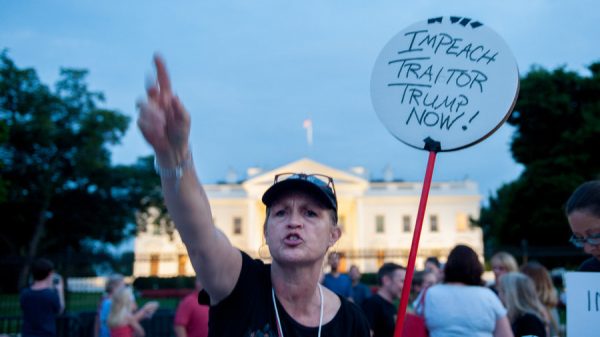
The president was assailed with a torrent of abuse, decrying him as a “disgrace” and “traitor” for having engaged in a cordial manner with the Russian leader. The uniform scorn poured on Trump by the political and media establishment was something to behold.
Rabid pundits in supposedly prestigious newspapers such as the New York Times were declaring that it’s “Trump and Putin vs. America,” claiming that “the president’s refusal to condemn Russian attacks was a betrayal of every single American citizen.”
The media backlash of vituperation against the president was nothing short of extraordinary. It was a concerted campaign of sedition against his authority which, at times, openly called for a palace coup to oust him.
Under the headline, “This sad, embarrassing wreck of a man,” one oped in the Washington Post posed the question: “Which Republicans will stand behind a president who puts Russia first?”
Ironically, Trump’s instincts about the whole Russiagate affair are correct. It is a load of unsubstantiated farrago promoted by Democrats and large sections of supportive news media who have never got over the ignominy of Hillary Clinton losing out to “deplorable Trump.” Clinton was also backed by high-ranking officials in the state intelligence apparatus, as well as the foreign policy establishment.
This constituency of the political class in Washington shared Clinton’s avowed hostility towards Putin. It is to their unforgivable chagrin that Donald Trump was elected. Moreover, Trump was elected partly on the promise of restoring normal relations between the US and Russia. His policy was given a democratic mandate upon his election to the White House.
After nearly two years of relentless Russophobia from the US political and media establishment, the case for alleged Russian interference in American politics remains embarrassingly vacuous. Not even the latest so-called indictments produced by special counsel Robert Mueller have any credibility to anyone who looks earnestly at the charges. What’s more, ordinary American citizens seem to agree that the whole Russiagate affair is a frivolity indulged in by the political and media elites confined to Washington’s Beltway Bubble.
In a poll out this week following the Helsinki summit, a small majority of Americans (55 percent) seem to think that Trump is “mishandling” relations with Russia. It is perhaps not surprising, given the wall-to-wall media pillorying of the president as a “traitor.” Nevertheless, the same poll found that only a minority of Americans view Russia as “an enemy” (38 percent) or an “imminent threat” (27 per cent).
These figures are cold comfort for the US political establishment, which has assiduously pushed the narrative of Russian malevolence.
What the astounding media backlash against Trump shows is not so much the fecklessness of his character. No, the really perplexing issue is how American democracy is warped and fashioned to meet the demands of powerful unelected forces. The imperative is brazen and brutal.
Trump may want to normalize relations with Russia. The people may have voted for this policy. But the powers-that-be are making sure that this policy is not implemented. They want hostility towards Russia to prevail, as it would have explicitly if Hillary Clinton had been elected.
In short, what we are seeing this week is “American democracy” in action. Meaning there is no actual democracy exercised by the power of the people. It is power exercised by elite interests.
In that way, Russian reaction to the Helsinki summit should be restrained.
Indeed, it was welcome to see Trump and Putin engage in cordial, mutual dialogue. Trump deserves credit for holding the summit and for his civilized manner towards the Russian leader, instead of adopting the vulgar offensiveness for which so much of the US establishment is baying.
The problem is that Trump has evidently very limited political authority to implement the obvious goodwill he desires between Washington and Moscow. He has limited authority to actually adopt one of the key policies for which he was elected by the people.
Trump’s cringe-making u-turn was not a correction over his misuse of “double negative speech.” It was a positively damning sign that the president and the citizens who voted for him have actually negligible power when it comes to overturning a fundamental objective of the unelected plutocrats of the deep state.
For Russia, and indeed the wider world, that is deeply troubling. Because the American powers-that-be are evidently hell-bent on pursuing a hostile agenda towards Russia. Their Russophobia is not just some passing phase. It’s a symptom of an incorrigible malaise and desire within the US establishment for conflict.
Finian Cunningham (born 1963) has written extensively on international affairs, with articles published in several languages. Originally from Belfast, Northern Ireland, he is a Master’s graduate in Agricultural Chemistry and worked as a scientific editor for the Royal Society of Chemistry, Cambridge, England, before pursuing a career in newspaper journalism. For over 20 years he worked as an editor and writer in major news media organizations, including The Mirror, Irish Times and Independent. Now a freelance journalist based in East Africa, his columns appear on RT, Sputnik, Strategic Culture Foundation and Press TV.
Maxine Waters: ‘Hustler of hate’ or Democratic nominee in 2020?

By Danielle Ryan | RT | July 19, 2018
Crazy. Unhinged. Un-American. Those are just a few of the adjectives used to describe Congresswoman Maxine Waters as she emerges as a star of the anti-Trump ‘Resistance’ and riles both Democrats and Republicans with her fervor.
The California Democrat has drawn sharp criticism even from her own party for what many interpreted as an incitement to ‘mob violence’ when she called on Americans to harass members of Donald Trump’s administration if they saw them in public — antics which led her to receive serious threats against her life.
While Democrats have tried to criticize Waters in a more diplomatic manner, appealing for calm in trying times, Republicans haven’t been holding back. One congressional candidate called her a “hustler of hate” who should be behind bars.
President Waters?
Waters has embarrassed herself on a number of other occasions in recent months, too; There was the time she called for Trump to be impeached because Russia had (according to her) invaded Korea. Then there was the time she claimed that RT had hacked C-SPAN in an effort to interfere specifically with her speech on the House floor — and let’s not forget the time she promised two phone pranksters posing as the Ukrainian prime minister that the US would “stand with” Ukraine to keep sanctions on Russia. She also has what seems like an unhealthy preoccupation with the idea of being shot at.
And now, there is speculation that she could be the Democratic nominee for president in 2020.
CNN political commentator John Phillips penned a piece last week for the L.A. Daily News arguing that “Mad Max” really could be the nominee two years from now. Waters, he wrote, is “the only one dancing to the beat” of the resistance.
The scary thing is, he could be right. Waters, with her fiery, nothing-held-back approach has tapped into the rage and anger many Americans are feeling about Trump — and she is feeding it, to her own advantage. The woman, Phillips wrote, “who is the biggest rock star with liberals right now is Auntie Maxine” — and it doesn’t even matter that she was just called un-American by her own party leadership.
Waters is a bit like marmite. People seem to love her or hate her — and it’s not just since Trump became president and gave her license to reveal her own special brand of crazy.
Back in 2013, I met Waters in Washington D.C. at the screening of a documentary about America’s war on drugs and the desperate need to reform the country’s criminal justice system.
The documentary was co-produced by Danny Glover, Brad Pitt, Russell Simmons and John Legend — but, as I wrote at the time, Waters herself turned into the unlikely star of the show. After the screening, as I tried to get near her to ask a few questions, she was mobbed by supporters looking for selfies. That day she came across as a celebrity in her own right.
And, speaking, of celebrity, Phillips makes the point that the media and political pundits wrote Donald Trump off as a “reality show buffoon” and a “shameless self-promoter” with zero chance of winning the election. Here again, he is correct.
The media did write Trump off — and he won. So if Waters, crazy and all as she might be, did throw her hat in the ring for the 2020 election, pundits would want to be very careful not to assume for a second time that there is such thing as ‘too crazy’ or radical to win.
In the same way Trump challenged Republican party orthodoxy and defeated 16 other primary challengers to win the nomination, Phillips thinks Waters could tread a similar path.“[Trump] understood the mood and frustrations of the electorate better than anyone in the race,” he wrote.
No frontrunner
But Phillips’ musing also highlights something else; just how lacking the Democratic party is in good alternatives to Trump. That someone as erratic and downright strange as Maxine Waters could be reasonably considered a viable candidate says a lot about the state of the Democratic party — and just guess who thinks she is poised to take advantage of that sorry state of affairs?
None other than Hillary Clinton. Confirming beyond doubt that incompetence reigns in the Democratic Party is the recent bout of speculation that Clinton is gearing up to run for president —again — and that people within the party structure might actually be supportive of that plan.
Clinton has been running around giving campaign-style speeches and doing some vigorous fundraising — and although she says publicly she won’t run again, that’s what she said after she lost the Democratic nomination to Barack Obama in 2008, so it might be advisable to take those words with a big pinch of salt.
But perhaps she should think twice about going in for round three. A new poll has found that 73 percent of Democrats want a fresh face to challenge Trump in 2020 — while only 16 percent said they would be happy with a candidate who has run before. The Rasmussen survey also found that 58 percent of Democratic voters think Clinton has damaged the party’s standing.
It has been largely accepted among liberal pundits and (by all accounts) many high profile Clinton supporters that she was a terrible candidate — so terrible that she managed to lose to a hated reality TV star who broke every rule in the playbook —and yet here they are, thinking of wheeling her out again, hoping it’ll be third time’s the charm.
This is the kind of backward thinking that could potentially see Trump — the object of their rage — sail straight back into the White House for another four years in 2020.
But it’s hard to feel sorry for the Democrats. They have positioned themselves as close to the centre as politically possible (some would even argue they are a centre-right party at this point). They have shown only disdain to progressive left candidates, despite ample proof that they are hugely popular with voters. The party threw away the only real chance it had to win in 2016 when it rigged the primary against Bernie Sanders and sent a hugely unpopular candidate to fight and lose against Trump — and now they’re seriously considering doing it all over again.
When you look at it that way, maybe Maxine Waters is their best hope.
Danielle Ryan is an Irish freelance journalist. Having lived and worked in the US, Germany and Russia, she is currently based in Budapest, Hungary. Her work has been featured by Salon, The Nation, Rethinking Russia, Russia Direct, teleSUR, The BRICS Post and others. Follow her on Twitter @DanielleRyanJ, check out her Facebook page, or visit her website: danielle-ryan.com
Read more:
Elections: More than Half of Americans Believe Fairy Tales are Real
By Thomas L. Knapp | The Garrison Center | July 17, 2018
According to a new poll conducted by Ipsos in partnership with the University of Virginia Center for Politics, 51% of respondents agree (15% “strongly” and 36% “somewhat”) with the statement “American elections are fair and open.”
The Ipsos headline characterizes that percentage as “only half.” That’s akin to noting that “only half” of Americans believe the Earth is a flat disc of provolone cheese, balanced atop the fingertips of seven celestial belly dancers. “Only” half?
Republicans, males, people over 55, people making more than $50,000 a year, and whites are more likely to believe this bizarre claim than Democrats, females, younger voters, the under-$50k crowd, and non-whites, but even among the latter buy-in is disturbingly high.
That over-55 demographic is plenty old enough to remember that after Ross Perot made it onto the presidential debate stage in 1992 (as an independent) and 1996 (as the Reform Party’s nominee), the Commission on Presidential Debates added a 15% polling bar to its rules to ensure that only Republicans and Democrats need apply.
Every four years, the CPD — established after the National Commission on Elections recommended “[t]urning over the sponsorship of Presidential debates to the two major parties” — makes millions in illegal in-kind campaign contributions to Republican and Democratic presidential and vice-presidential candidates, and no others, in the form of joint campaign commercials falsely advertised as “debates.”
Most disturbing: 49% of self-described “independent” voters — voters deprived of choice by a tangled web of ballot access laws expressly designed to keep third party and independent candidates off the ballot and campaign finance laws that keep them marginalized if they get over those ballot access hurdles — still believe in the Fair and Open Election Fairy.
American elections started becoming less fair and less open in the late 19th century when state governments started printing “Australian” ballots and controlling access to those ballots. Before that, American voters hand-wrote their ballots, orally dictated their ballots to election officials if they couldn’t write, or used pre-printed ballots provided to them by their parties or candidates of choice.
While movements for more fair and more open elections have made some advances since then — for example, constitutional amendment to provide for female suffrage, and partial gains versus attempts to suppress the African-American vote — we’ve still got a long way to go.
As champions of addiction recovery like to say, the first step is admitting we have a problem. Fairies aren’t real. And American elections aren’t fair and open. Yet.
Thomas L. Knapp (Twitter: @thomaslknapp) is director and senior news analyst at the William Lloyd Garrison Center for Libertarian Advocacy Journalism (thegarrisoncenter.org).
Henningsen: ‘US Can Help Refugee Crisis By Lifting Sanctions and Getting Out of Syria’
21st Century Wire | July 18, 2018
One potentially positive outcome from Monday’s Trump-Putin Summit in Helsinki, Finland was a clear signal that both leaders have talked about cooperating in Syria, rather than treating each other as geopolitical adversaries at the expense of Syria’s own welfare.
While this has been received with fury by the US mainstream corporate media, pro-war Democrats and Neocon Republicans – it has been seen by the rest of the world as a much-needed diplomatic overture which could help to stabilize the situation, rather than exacerbate existing problems across the country and the Middle East in general. Russia’s Defense Ministry announced it is already prepared to ‘boost cooperation’ with the U.S. military in Syria, saying in a statement Tuesday that it’s ready for “practical implementation” of any memorandums of understanding reached between Trump and Putin, including the extension of the START arms control treaty.
21WIRE editor Patrick Henningsen spoke to RT International yesterday about what the US and its EU counterparts need to do to mitigate Europe’s Migrant Crisis as well as Syria and the Middle East’s refugee crisis – namely, lifting punitive joint US-EU economic sanctions on Syria, and also seeing the US end its illegal occupation with its Kurdish SDF proxy militias in northeastern Syria: Watch:
We want to hear from Scotland Yard, not media reports on Skripals’ case – Russian envoy to UK
RT | July 19, 2018
Moscow is waiting for any official statement on the Skripal attack suspects, Russian ambassador to the UK, Alexander Yakovenko, has said in the wake of media reports that police identified some “Russians” as the culprits.
On Thursday, the Press Association reported that British investigators believe they identified “the suspected perpetrators” of the March poisoning of ex-double agent Sergei Skripal and his daughter in Salisbury. After analyzing CCTV footage, they reportedly came to the conclusion that some “Russians” are involved in the attack.
Commenting on the media claims, the Russian envoy said that official London remains silent on the issue, stressing that media reports often fail to find any confirmation.
“These are media reports, unfortunately there are no official statements from the British side. I want to hear from Scotland Yard, from the Foreign Office. Many versions [published] in the newspapers are not confirmed on the official level,” Yakovenko told journalists in Moscow.
The envoy also warned that Moscow “will exert pressure” on London, including through official requests and dialogue, over the Skripal case, as it is “a political issue.” He also plans to discuss the issue during the meeting with the UK’s new foreign minister, Jeremy Hunt.
The Skripal case was not on the agenda during the recent Putin-Trump summit in Helsinki as London failed to provide evidence not only to Russia, but even to its allies, Yakovenko noted.
“If the British had managed to provide any official information regarding the ongoing investigation, it might have been a topic for [Trump-Putin] discussion,” the envoy said. “But because the British side still does not provide anything to the Russian side, and moreover, presented nothing to its allies, then what is there to actually discuss?”
Sergei Skripal and his daughter Yulia were poisoned by a nerve agent in Salisbury in March. In late June, a British couple, Charlie Rowley and Dawn Sturgess, were exposed to the same substance in the town of Amesbury, around 12km from Salisbury. After Sturgess died on June 8, the Russian embassy in the UK said that a leak at the Porton Down chemical laboratory, located some 8km from both Salisbury and Amesbury, might be to blame for the incidents.
The UK authorities have pointed a finger at Moscow for the Skripals’ poisoning since March, while still failing to present any evidence. Russia has repeatedly denied any involvement in the attack, asking to share the data on the incident, but still has received nothing but allegations so far.
Featured Video

The Most Important Bet You’ve Never Heard Of
or go to
Aletho News Archives – Video-Images
From the Archives
The Occupied Mentality Syndrome
Saudi Arabia on the American chessboard – Part 2
By B. J. Sabri | American Herald Tribune | April 19, 2016
Since the Korean War, but particularly since the Iranian Revolution of 1979 until today, the United States has been steadily escalating its military presence in the Persian Gulf. Taking advantage of many colossal events of the past 36 years, [1] the hyper-empire has institutionalized its massive presence on land and sea, and expanded its objectives to include the unambiguous physical control of the area, as well as the clear understanding that local Arab governments should abide by them. The pretext is always the same: in “defense” of the national interests and security of the United States. From observing how the United States has been interacting with the governments of the region, and by judging from the size of its expeditionary force, we could reach a basic conclusion. The United States is occupying, de facto, the entire Arabian Peninsula. (Yemen, devastated by Saudi and American jets is yet to be conquered. Oman? Britain returned not as colonial ruler but as a soft occupying power.)
Under this articulation, Saudi Arabia, Qatar, Kuwait, and the United Arab Emirates are virtually occupied countries. If we compare this type of occupation to the mandate and protectorate regimes of the past, the results might be identical—the nations affected by it lose sovereignty. When Arab governments comply with the objectives of a foreign power that station military forces on their national milieu, then that power controls them in multiple ways including how they react to policy deliberations and what decisions they intend to take on specific issues. A good method to verify the concept of effective occupation is this: take notice of what the United States says and wants, and then compare it to what the gulf rulers do in response. (I shall discuss this detail at some point in the upcoming parts.)
If the presence of US forces or other means of political pressure are a factor in Saudi Arabia’s interventionist Arab wars, then we need to debate this issue. However, from the history of resistance to colonialism, we learnt: if a powerful state imposes its order on a nation by military means or other forms of coercion, and if this nation does not resist that imposition, then a mental subordination to the powerful state will ensue. This is especially true in the case of Saudi Arabia. One single event, 9/11, has transformed it from a US “ally” into an instant political hostage of the American Empire. … continue
Blog Roll
 Aletho News
- Greek shipping firms secretly transporting oil, weapons to Israel
- UN vote on Hormuz force delayed as Iran issues warning
- Trump and the debris of Iran war
- IRGC hits US tech giant Oracle’s data center, computing site in UAE over new assassinations
- Bombing Iran Back Into the Stone Age /Lt Col Daniel Davis & Jim Jatras
- UAE rejects report claiming it is ready to join war on Iran to reopen Hormuz
- A New Resistance Front: How Does Syria Factor into the Regional War?
- Gulf states weigh pipeline expansion plans, hoping to bypass Hormuz
- Iran sets up ‘tollbooth’ system in Strait of Hormuz
- Wave 90: IRGC strikes US-linked industrial sites in Gulf
- If Americans Knew
- Israel-US kill negotiators, destroy civilian structures, but Iran’s military capabilities still largely intact – Daily Update
- ‘War crime’: Global condemnation as Israeli ministers celebrate death penalty law targeting Palestinian prisoners
- 7 Ways Israel Is Turning Lebanon Into Gaza
- World’s Leading Football Bodies Under Fire Over Israel Policies
- Experts warn of possible use of nukes against Iran
- Israeli invasion of Lebanon could be worse than 1982, warn European officials
- Passover: Liberation and collective punishment
- Trump says the quiet part out loud: (Israel’s) war on Iran > Americans’ health – Daily Update
- Gaza families reunite years after babies evacuated amid Israel’s war
- International Rescue Committee warns Gaza’s children face grave protection risks
- No Tricks Zone
- Low Intensity Tornado Wrecks Major Solar Farm, Creating A Potential Toxic Dump
- New Study Finds Warming Saves Lives…Cold Temperatures 12 Times More Deadly Than Excess Heat
- German Science Blog Accuses PIK Climate Institute Of Hallucinating Climate Tipping Points
- Devastating Assessment Of Comirnaty Vaccine By Former Senior Pfizer Europe Toxicologist
- New Study: CO2 Is ‘Effectively Negligible’ As An Explanatory Climate Change Factor Since 2000
- Former Pfizer Toxicologist Dr. Helmut Sterz Tells Bundestag Hearing Pfizer Vaccine Should Have Never Been Approved
- Energy Expert: Germany’s Nuclear Phaseout Was A “500 Billion Euro Mistake”
- New Research: South Australia’s Mid-Holocene Sea Surface Temperatures Were 4°C Warmer Than Today
- Storing Green Energy To Last Germany 10 Days Would Require A 60-Million Tonne Battery
- New Studies: UK Sea Levels Were 4 Meters Higher Than Today During The Mid-Holocene
 Aletho News