Syria and Iran Sign Defense Agreement: Defying Outside Pressure
By Peter KORZUN | Strategic Culture Foundation | 29.08.2018
Iranian Defense Minister Amir Hatami visited Damascus Aug. 26-27 in order to have a new military cooperation agreement signed. The move is evidently a response to US and Israeli demands to withdraw Iranian forces from Syria. No details have been provided about the document’s content but it’s logical to surmise it contains a list of mutual obligations in the event that the Iranian military is attacked in Syria.
The deal mentions Iran’s role in the reconstruction of Syria’s defense industry, thus ending any hopes that its military presence in that country will end. According to the Iranian defense chief, the “defense and technical agreement” provides for the continued “presence and participation” of Iran in Syria. He added that an agreement had been reached with Syria that Iran would have “presence, participation, and assistance” in the reconstruction and that “no third party will be influential in this issue.”
The agreement was signed just as the Russia-Turkey-Iran summit was announced, which is scheduled for Sept. 7 in Tehran. Such events normally require thorough preparations. The parties are expected to reach an agreement on further joint steps to achieve progress in Syria. It’s important to align their positions before the UN talks in Geneva, which are slated for Sept. 11-12. UN Special Envoy Staffan de Mistura has invited the “big three” to participate. They can come up with joint initiatives while the US has nothing to offer but its demands for Iran’s withdrawal. It risks being left out in the cold, while diplomatic efforts initiated by other states bear fruit.
This turn of events will hardly be welcome news for those who would like to stymie the peace efforts and impose their own conditions for reaching any settlement of the problem.
The need to end Iranian assistance to Lebanon’s Hezbollah was emphasized during last week’s visit of US National Security Adviser John Bolton to Israel. The parties did not declare war on Iran, but there is no way to stop the supplies from reaching Hezbollah in Lebanon without cutting off the land routes going through Syria. The US official insisted before the visit to Israel that the withdrawal of Iran’s forces from Syria is a prerequisite to any resolution of the conflict.
The US and its allies in Syria find it important to scuttle Syria’s plans to liberate the province of Idlib from the rebels. A false-flag chemical attack is expected to be staged soon, to create a pretext for military action. Once Syria and Iran are in the same boat, it makes no difference which of them is attacked first or where. There have been media reports that a large-scale military operation is in the works and can be expected in August or September.
There is no way to know what exactly Mr. Bolton discussed with the Israeli authorities during his visit to Jerusalem on Aug. 19 but the reports about the military activities at the US al-Shaddadi base in the Syrian province of al-Hasakah emerged soon afterward. The facility has been reported to have been updated to enable the landing and takeoff of heavy cargo aircraft. Ayn al-Arab (Kobani) has also been expanded. In August, shipments of ammunition and military hardware were delivered to several US-controlled facilities in Syria and Iraq. Radars have been transported to the SDF-controlled areas east of the Euphrates River.
Meanwhile, several thousand militants with heavy weaponry and armored vehicles in Syria’s Idlib province are getting ready to launch an offensive against government-controlled regions of Hama and Aleppo. The attack will be targeted at Syrian as well as Iranian and pro-Iranian forces that have been invited in by the Syrian government.
It looks like plans are underway to force Syria to plunge into turmoil once again. In reality, the combat actions have already started. The US and Israel conducted their first joint operation against the Iranian Revolutionary Guards Quds Force and the Iraqi Shiite Khata’ib Hezbollah, their allies, on Aug. 23 near Abu Kamal, which is situated on the highway between Syria and Iraq. President Trump has said so many times and on so many occasions that he wants the Americans to leave Syria but US foreign policy is known for its flip-flops. Whatever is said today may be forgotten tomorrow.
This time, Lebanon may become a new front. It’s widely believed that a war between Israel and Hezbollah is inevitable. In February, US and Israeli troops held an exercise to practice for a potential war with Hezbollah in Lebanon, a country that holds a military agreement with Russia. The offshore drilling contracts Lebanon has signed with other countries, without solving its border dispute with Israel, are spurring the war preparations.
Syria and Iran have defied pressure and demonstrated their resolution not to bow but to protect their right to make independent decisions. They are offering a challenge. If the defense agreement just signed between those two allies provokes a military conflict, it will most certainly spill over to other countries, such as Yemen, Lebanon, and Iraq. It would lead to a long, protracted, and costly war.
Seven detained Palestinian women activists from al-Khalil face Israeli persecution
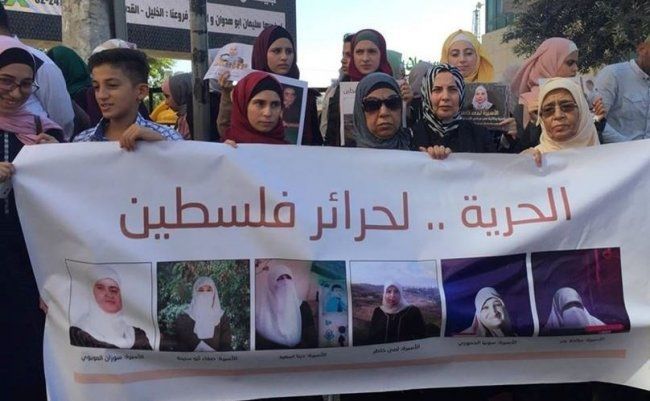
Photo: Protest demands release of Palestinian women prisoners. Via Wattan TV
Samidoun Palestinian Prisoner Solidarity Network – August 29, 2018
Seven Palestinian women from al-Khalil have been jailed by the Israeli occupation, with many held in intense, torturous interrogation for many weeks. The Israeli Shin Bet intelligence agency is now attempting to market these arrests in the media as an attack on “Hamas infrastructure” in al-Khalil in an attempt to justify the ongoing large-scale arrests targeting active Palestinian women in the city.
In addition to the main arrests targeting seven women, a number of other women were summoned to hours of interrogation before being released. Riyad al-Ashqar of the Palestinian Prisoners’ Center for Studies said that all of the women work in social services, public activities, media work or at home with their families and that none are involved in Hamas’ political or military work. He said that the Shin Bet’s claims are an attempt to create a state of fear and terror to suppress Palestinian women’s participation in activities against the crimes of the occupation or supporting the Palestinian resistance.
The campaign against Palestinian women in al-Khalil began with the arrest of City Council member Suzan Abdel-Karim Owawi, 40, on 5 June. She was subjected to extensive, harsh interrogation that was extended repeatedly during that time. In addition to her public service as an elected official, she is a social activist who works to support Palestinian prisoners; she is married and the mother of four children.
Safa Abu Hussein, 36, was arrested next after Israeli occupation forces invaded her home and took her to interrogation. Her detention has been extended four times.
Rawda Mohammed Abu Aisha, 53, was next to be seized by occupation forces; she was seized when she drove to a checkpoint in Bethlehem and taken to interrogation.
The occupation forces also arrested Dima Said al-Karmi, 38, the widow of Nashat al-Karmi, a Hamas activist killed by Israeli occupation forces and the mother of an 8-year-old daughter. She was taken to Ashkelon detention center and interrogated harshly and extensively and deprived of sleep. During her interrogation, she fainted on multiple occasions. Her detention has also been repeatedly extended.
Lama Khater, 42, is a Palestinian writer who was seized on 24 July by Israeli occupation forces after they invaded her family home. She was deprived of sleep, insulted and threatened by Israeli interrogators at the Ashkelon detention center. The mother of five children – the youngest only 2 – she is a political analyst and writer whose work is widely published on newspapers and websites.
Saida Badr, 55, is the wife of Palestinian Legislative Council (PLC) member Mohammed Badr, 61, who has spent many years in Israeli prison including a recent sentence in administrative detention, imprisonment without charge or trial.
Finally, Sonia Hamouri, 40, a university lecturer, was seized from her family home in al-Khalil on 14 August. A number of other women were also detained for several hours and interrogated.
The Israeli occupation is accusing the women of communicating information from Palestinians in exile to those inside occupied Palestine, especially activists in Hamas. They were also accused of doing social and charitable work in support of the movement by providing aid to the prisoners’ families.
Palestinian political parties and movements are labeled “illegal organizations” by the Israeli occupation, and thousands of Palestinians are jailed for allegedly supporting or belonging to these liberation movements. One of the most common charges against Palestinian prisoners is “membership in an illegal organization,” as participation in most major Palestinian political movements is criminalized by the colonial occupation.
These seven women are among a total of approximately 63 Palestinian women prisoners, including several held without charge or trial under administrative detention, such as parliamentarian Khalida Jarrar and student Fidaa Akhalil.
Israeli occupation bans Palestinian student from his university campus
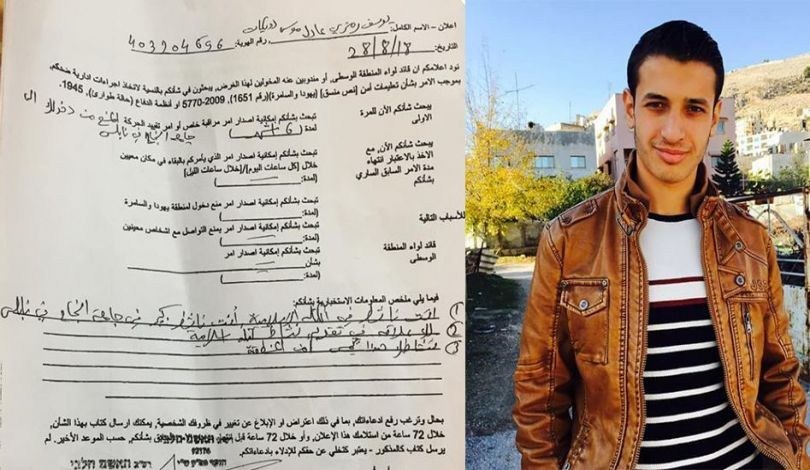
Photo: Yousef Dweikat and the order barring him from his university. Via Hadf News.
Samidoun Palestinian Prisoner Solidarity Network – August 29, 2018
Palestinian student Yousef Dweikat was banned from entering the campus of his university, An-Najah National University in occupied Nablus, on Tuesday, 28 August 2018. Dweikat, 20, a student at the Faculty of Engineering at the university and an activist with the Islamic Bloc student organization, was summoned to meet with Israeli occupation intelligence in the Salem military base.
When he presented himself, he was presented with an order barring him from his own university campus for the next six months. A Palestinian refugee who lives in Balata refugee camp, Dweikat, an electrical engineering student, is a former prisoner; he was arrested by Israeli occupation forces in March 2017 and jailed for six months for his involvement in student activities.
In an interview with Quds News, Dweikat called upon the university “to create solutions and alternatives so that this type of decision does not affect a larger number of university students.” He noted that the Israeli occupation had used a similar policy against university students in the 1980s and is now returning to those practices. Dweikat also said that his education was already delayed because of his previous detention and that he had already registered for the new year, paid his university fees and prepared to start the new semester. “My family and I are tense and frustrated. We do not know what we can do next to confront this unjust decision,” he said.
This is only the latest violation of the Palestinian right to education by the Israeli occupation. According to the Palestinian Ministry of Education, there are over 300 Palestinian university students imprisoned in Israeli jails. Each year, especially around the time of student council elections, universities face invasions and attacks on active students. Student leaders like Omar Kiswani, president of the Bir Zeit University student council, have been seized from campus in violent raids.
In addition, as the Palestinian Right to Enter campaign notes, international academics – including Palestinians born in exile with foreign passports – are routinely denied entry to Palestine by Israeli occupation forces at colonially controlled borders. By denying entry to scholars invited to teach, lecture or study at Palestinian universities, the Israeli occupation seeks to isolate Palestinian educators, scholars and students from their international peers.
These routine violations of Palestinian academic freedom – along with the racial exclusion of international students, particularly those identified as Arabs, Muslims or Palestinians – have added impetus to the ongoing call for academic boycott of Israeli institutions. The US Campaign for the Academic and Cultural Boycott of Israel is urging universities, students and faculty to take a pledge to boycott “study abroad” programs run by Israeli institutions, “We Will not Study in Israel Until Palestinians Can Return: Boycott Study Abroad in Israel!” Samidoun Palestinian Prisoner Solidarity Network is one of the endorsers of this call.
As many students head back to university around the world, solidarity with Palestinian students and scholars is particularly critical. These arrests and bans are an attempt to dismantle Palestinian students’ ability to learn, organize and uphold their identity, existence and struggle on campus. Samidoun Palestinian Prisoner Solidarity Network urges supporters of Palestine on campuses around the world to join the campaign to boycott Study Abroad, support the academic boycott of Israel and hold events and activities to highlight the violation of Palestinian rights to education, particularly the imprisonment of Palestinian students.
US Intel, Media Spread Fake Reports on Alleged Russian Election Meddling
Sputnik – 29.08.2018
WASHINGTON – US intelligence officials and the American mainstream media have been propagating false Russia meddling claims to undermine pro-Trump congressional candidates ahead of the midterm elections, analysts told Sputnik.
In particular, The New York Times reported on Friday, citing unnamed intelligence officials, that US sources in the Kremlin who had warned about Russian intervention in the US 2016 presidential election “had gone silent” and now the CIA is in the dark about Moscow’s plans vis-a-vis the upcoming congressional midterm elections.
In November, US voters go to the polls to elect lawmakers who will represent their respective states at the federal level. The midterm elections will determine whether Republicans maintain control of Congress and will be seen by many as a referendum on the sitting president’s performance.
US intelligence leaders, including Director of National Intelligence Dan Coats, without any evidence have been warning that Russia will likely interfere in the midterm elections. Coats and others have also claimed that Russia is waging an influence campaign via social media.
Former US Defense Department adviser Karen Kwiatkowski told Sputnik that she had doubts about the reliability of the New York Times report and intelligence community claims.
“Reading between the lines of this article, it seems as if politicized members of the US intelligence establishment — including people like Dan Coats — are hedging their bets,” she said.
Coats and his colleagues were getting on record their ‘concern’ about Russia interference in these upcoming elections in the event of an unexpected wave of support for President Donald Trump, Kwiatkowski explained.
The New York Times report, claiming that the United States had human sources inside the Kremlin appeared to be based on false assumptions and to be part of a wider strategy to try and convince US public opinion about a non-existent Russian plot to influence the elections, Kwiatkowski cautioned.
“In terms of this article, I suspect it is wrong in its assumptions, and is part of a larger domestic propaganda effort,” Kwiatkowski said.
Kwiatkowski pointed out the remarkable lack of evidence to support US allegations of Russia’s meddling in the 2018 midterm elections.
“The American intelligence apparatus is ‘concerned’ that the Russians are trying to pick and choose candidates in midterm elections — 435 Congressional elections and 33 plus Senate elections — but they don’t have any information about this activity that they ‘know’ is happening,” the former Pentagon aide said. “This isn’t how intelligence is done. It is however how agendas are pushed, and propaganda rejuvenated.”
Former CIA Director John Brennan, who was referred to in the New York Times article, lacked any credibility based on his documented record, Kwiatkowski noted.
“Brennan is an unreliable source, extremely biased, a known liar and he’s currently angrier than usual. With his clearance suspended, he may be receiving less information from his friends in the government, and maybe that’s what he is complaining about,” Kwiatkowski said.
Former Canadian diplomat Patrick Armstrong, who once served as a political official at Ottawa’s embassy in Moscow, told Sputnik that The New York Times report was written to try and sustain flagging interest and support the diminishing credibility of the fiction that Russia intervened in the 2016 US elections.
“The writers are trying to keep the conspiracy going in the hope that the Democrats will control the House and shut down all examination of what really happened,” Armstrong said.
Fake News
However, the fantasy that Russian involvement had cost the Democratic candidate Hillary Clinton the 2016 election was supported by no evidence whatsoever, Armstrong emphasized.
“This is nonsense on stilts and only can be twisted into a question if you believe — as New York Times consumers do as a matter of faith — that Russia ‘interfered’ in the first place,” Armstrong said.
No evidence has been produced other than the “fantasies” in the unsubstantiated dossier produced by former UK spy Christopher Steele.
The only plausible content in the New York Times story was the assertion that Moscow had expelled many of Washington’s intelligence assets in Russia, Armstrong observed.
Kwiatkowski pointed out that the real manipulation of US elections was done by countries that had a historically shared culture with the United States.
The UK’s MI6 and Israel’s Mossad, Kwiatkowski said, are far more active in US elections, at many levels, than the Russians could ever hope to be.
“It’s nice for The New York Times to be able not to talk about these risks — in part because Trump is not the candidate these two countries would prefer,” Kwiatkowski concluded.
In January 2017, a US intelligence community report that contained zero evidence claimed that Moscow tried to meddle in the US election process. Moscow has repeatedly denied interfering in US elections as such actions would run counter to the principles and practices of Russian foreign policy.
Social Media Giants Enter NATO Service
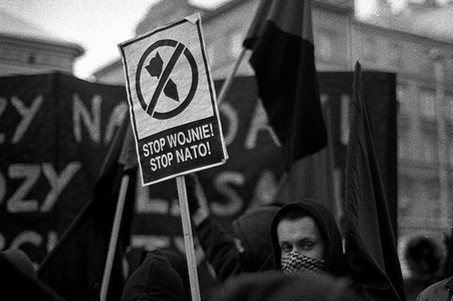
By Rick Rozoff | Ron Paul Institute | August 28, 2018
On August 22 Facebook and its CEO Mark Zuckerberg announced that they had arbitrarily removed 652 accounts, groups and pages allegedly linked to Russia and Iran for “coordinated inauthentic behavior,” by which we’re safe in assuming is meant political information inconvenient for the US power structure and its “Euro-Atlantic” elite allies in Europe and elsewhere.
The purpose pursued and the criteria employed are both explicitly political, focusing especially on federal elections. Facebook boasted of recent successes in this regard in France and Mexico.
There are historically-decisive Senate and Congressional elections this November 6th in the US.
At the beginning of this month several major conservative and libertarian Facebook, YouTube and other social media accounts were closed by the above and other parties in a heavy-handed, coordinated manner. The sites and individuals banned are ones that have urged cooperation between the US and Russia and warned against worsening political and potential military conflict between the world’s two major nuclear powers.
What connects the two unprecedented social media purges is an agreement reached in May of this year between Facebook and the Atlantic Council.
The Atlantic Council of the United States was established in 1961 by former Secretaries of State Dean Acheson and Christian Herter to bolster support for NATO. Atlantic Councils were set up in other member states for the same purpose, and at the present time they now number more than 40 in NATO and Partnership for Peace countries. The name is derivative of North Atlantic Council, the highest governing body of NATO.
Due to its efforts, NATO has grown from 16 to 29 members since the end of the Cold War and in addition has recruited at least forty military partners throughout the world. With Colombia joining its Partners Across the Globe program earlier this year, NATO now has members and partners on all inhabited continents.
The partnership between Facebook and the Atlantic Council was described by the Atlantic Council’s president and CEO Fred Kempe as follows:
This partnership will help our security, policy and product teams get real-time insights and updates on emerging threats and disinformation campaigns from around the world. It will also increase the number of ‘eyes and ears’ we have working to spot potential abuse on our service – enabling us to more effectively identify gaps in our systems, preempt obstacles, and ensure that Facebook plays a positive role during elections all around the world.
The collaboration, like NATO and Facebook themselves, are not only avowedly political but unabashedly global in scale.
In the interim Facebook has announced it’s hired “additional third-party reviewers” for the purpose advancing the aforesaid political censorship and furtherance of NATO’s international agenda.
Failing such methods, there are also those proposed by then-president presumptive Hillary Clinton two years ago: “As president, I will make it clear that the United States will treat cyberattacks just like any other attack. We will be ready with serious political, economic and military responses.”
Featured Video

No Threat Can Force Iran’s Surrender /Trita Parsi & Lt Cl Daniel Davis
or go to
Aletho News Archives – Video-Images
From the Archives
An Expert Military Analysis of War with China
Actually, None is Necessary
By Fred Reed • Unz Review • December 13, 2020
The Correlation of Armed Forces: U.S. goods and services trade with China totaled an estimated $634.8 billion in 2019. Exports were $163.0 billion; imports were $471.8 billion. The U.S. goods and services trade deficit with China was $308.8 billion in 2019. Trade in services with China (exports and imports) totaled an estimated $76.7 billion in 2019. Services exports were $56.5 billion; services imports were $20.1 billion. The U.S. services trade surplus with China was $36.4 billion in 2019.
There is talk within the Washingtoniat of a possible war with China. Steve Bannon, who apparently was dropped on his head as a child, actually favors such a war. We hear the usual shoo-the-boobs alarm about how the Chinese are doing something terrible and we must gird our loins and American values and show them what for, bow wow, woof. The danger is that the current game of who-blinks-first in Asian waters might actually provoke a shooting war. You know the kind of thing: One warship refuses to get out of the way of another, a collision ensues, some retard lieutenant who signed up on waivers opens fire, and we’re off and running. It is not a good idea to let children play with matches.
The said war is discussed either in emotional terms by idiots or in purely naval terms by those familiar with such things, so we hear of the First Island Chain and the Second Island Chain and whose missiles against the other’s missiles and so on. This would be appropriate if we were fighting World War Two again. Which we aren’t. Let’s take a quick-and-dirty look at how such a war might go.
To begin the war, America would overestimate itself and underestimate China. This is doctrine in the Pentagon. … continue
Blog Roll
 Aletho News
- Iran To Target Military Industrial-Tech Complex That Facilitated Gaza Genocide
- Collapsing Empire: The Resistance Disarms ‘Israel’
- Suicide Should Not Be a Government Service
- Rethinking America’s greatest threat: Iran vs. Israel-Firsters
- Iran accuses adversaries of false flags to strain Turkey ties
- Poland rules out sending Patriot missiles to US/Israel amid war on Iran
- Tehran approves new Hormuz plan with major restrictions
- No Threat Can Force Iran’s Surrender /Trita Parsi & Lt Cl Daniel Davis
- UK’s New Pandemic Plan Would Turn Big Tech Into a Mass Location Tracking Network
- Growing insecurity, soaring prices fuel protests in north as regime bans evacuation: Sources
- If Americans Knew
- Joe Kent Urges Americans To Call White House and Congress To Object To Sending Troops Into Iran
- DNC Resolution to Reject AIPAC Funding Puts Democratic Leaders in the Hot Seat
- Swedish foundation to build 400 schools as over 650,000 Gaza children remain without education for 2 years
- Israeli army admits photshopping image of slain Lebanese journalist
- This is how Israel is systematically killing health workers under the cover of war in Lebanon
- Carrying life under fire: Israeli invasion of Lebanon leaves pregnant women facing deadly risks
- Champagne all around for the new death penalty (for Palestinians) law – Not a ceasefire Day 172
- Why are Palestinian books struggling to be seen on Amazon?
- The Line Between Affinity and Conspiracy
- As Iran targets US military bases, will they be relocated to Israel? Not a ceasefire Day 171
- No Tricks Zone
- New Study Finds Warming Saves Lives…Cold Temperatures 12 Times More Deadly Than Excess Heat
- German Science Blog Accuses PIK Climate Institute Of Hallucinating Climate Tipping Points
- Devastating Assessment Of Comirnaty Vaccine By Former Senior Pfizer Europe Toxicologist
- New Study: CO2 Is ‘Effectively Negligible’ As An Explanatory Climate Change Factor Since 2000
- Former Pfizer Toxicologist Dr. Helmut Sterz Tells Bundestag Hearing Pfizer Vaccine Should Have Never Been Approved
- Energy Expert: Germany’s Nuclear Phaseout Was A “500 Billion Euro Mistake”
- New Research: South Australia’s Mid-Holocene Sea Surface Temperatures Were 4°C Warmer Than Today
- Storing Green Energy To Last Germany 10 Days Would Require A 60-Million Tonne Battery
- New Studies: UK Sea Levels Were 4 Meters Higher Than Today During The Mid-Holocene
- Destructive Green New Deal: German Energy And Metal Group Warns Of Drastic Crisis
 Aletho News