Paul Manafort and LBJ, Influence Peddlers
By Jacob G. Hornberger | FFF | September 18, 2018
The mainstream press and the progressive movement are shocked — shocked! — over Paul Manafort’s influence peddling and political corruption schemes. Their reaction to Manafort’s conviction and guilty plea remind me of the scene in the movie Casablanca, where the police chief is “shocked” to learn that there is gambling in Rick’s establishment, followed by someone bringing the police chief his gambling winnings.
The fact is that influence peddling, political corruption, and being on the take have always been an inherent part of the welfare-warfare state way of life. With trillions of taxpayer dollars flooding into the federal government’s coffers, there will always be people who are doing their best to get their sticky little fingers on a part of all that welfare-warfare largess. Why do you think the Pentagon has long refused to permit a financial audit of its operations? It’s because lots of people are on the warfare-state take in one way or another.
Paul Manafort brings to mind Lyndon Johnson, another influence peddler par excellence. The only reason Johnson is hailed as a hero by the mainstream press while Manafort is condemned as a crook is because Johnson had the good fortune of becoming president, which, in the eyes of the mainstream press and the Washington establishment, put a halo around his head.
Despite the fact that he became president, Johnson was one of the most crooked politicians in U.S. history. If Kennedy had not been assassinated, there is little doubt that Johnson would not have been his running mate in the 1964 presidential election, not only because JFK had expressed to close friends his intention to dump Johnson from the ticket but, more important, because of the strong likelihood that Johnson was going to be indicted for influence peddling and corruption, just like Paul Manafort.
In 1948, Johnson was running for U.S. Senate against Coke Stevenson, the governor of Texas, who was one of the most admired and respected governors in the history of the state. Johnson knew that he stood a good chance of losing the race. He instructed a powerful political crony in South Texas named George Parr, who ran his county like a personal fiefdom, to keep his ballot station open until all the others statewide had closed.
As detailed in a New York Times review of Robert Caro’s biography of Johnson, after all the other ballot stations had closed, Johnson had lost the election. His South Texas crony Parr proceeded to manufacture thousands of bogus votes, which put Johnson over the top by 87 votes statewide. When Stevenson sent the Texas Rangers to seize the voting signatures sheets, which were all in the same ink and same handwriting, the courthouse mysteriously burned down, along with all the fraudulent voting records.
Johnson also became a multimillionaire while in public office. How did he do that? By having his wife purchase a television station in Austin, which had a monopoly on broadcasting in that area because Johnson used political influence to ensure that television broadcasting licenses weren’t given to competitors. The resulting monopoly poured millions of dollars in advertising money into the pockets of Johnson and his wife Lady Bird. Caro stated, “It was a case study of political influence.”
At the time of the assassination of President Kennedy, Vice President Johnson was in grave danger of being removed from office and being sent to the penitentiary. It was only because of the assassination that he was spared such ignominy.
One scandal in which LBJ was embroiled involved a man named Billie Sol Estes, a fellow Texan who was ultimately sent to jail for agricultural fraud. When a federal agent went down to Texas to investigate Estes’s agriculture schemes, he was found dead on a Texas ranch, his body riddled with several bullets. The local authorities ruled it a suicide.
Another scandal involved Bobby Baker, who had been LBJ’s right-hand man when Johnson was Senate Majority Leader. Baker had been caught in an influence-peddling, corruption scheme involving vending machines on military bases. As the noose was being tightened around Baker’s neck, it was also indirectly being tightened around Johnson’s neck, owing to the strong suspicion that Baker would, under pressure, disclose Johnson’s role in the fraudulent scheme.
In fact, there was a congressional hearing on the Baker scandal that was very likely to implicate Johnson going on at the very moment of the JFK assassination. The assassination caused the hearing to be shut down immediately and, once Johnson became president, it was never resumed.
Moreover, Life magazine had planned a big expose of Johnson’s corruption for an issue in late November. It got replaced by coverage of the Kennedy assassination and was never published after Johnson became president.
As Caro details in his most recent volume on Johnson, there were two newspapers in Texas where investigative reporters were delving into Johnson’s role in these scandals. After he became president, Johnson telephoned the principals at both papers and threatened them with IRS or regulatory retaliation if they didn’t shut down their investigations into his corruption. Both papers shut down their investigations and never resumed them.
Paul Manafort’s mistake was obviously not being elected president. If he had been, he would be hailed as a giant hero, just as Lyndon Johnson is, rather than labeled as a run-of-the mill, corrupt white-collar criminal.
Palestinian Dies after Brutal Assault by Israeli Forces

Mohammed Al-Rimawi (24) was beaten to death in his bedroom by the Israeli forces in Beit Rima. (Photo: via Facebook)
Ma’an – September 18, 2018
RAMALLAH – A 24-year-old Palestinian succumbed to his injuries, on Tuesday morning, after he was brutally assaulted by Israeli forces as they detained him from his home in the Beit Rima village in the central occupied West Bank district of Ramallah in predawn raids.
The Palestinian liaison identified the youth as Muhammad Zaghlul Rimawi (al-Khatib), 24.
Muhammad’s brother, Bashir Rimawi, told Ma’an that some 40 Israeli soldiers raided their house in Beit Rima on predawn Tuesday, assaulted Muhammad while he was still laying in bed, wearing his nightwear, which Israeli forces ripped off of his body.
Bashir added that Israeli forces continued to brutally beat his brother, while unconscious, carried him outside the house and took him to an unknown location.
Bashir said that the Palestinian liaison contacted the family later and informed them that Muhammad had succumbed to his wounds; no other information was given regarding Muhammad’s death or when would his body be returned to the family for funeral processions.
The Israeli authorities reportedly transferred Muhammad’s body to Abu Kabir Forensic Center in Jaffa for an autopsy to determine the cause of death.
The Rimawi family accuse Israeli forces of being responsible for the death of their son, Muhammad, due to the brutal assault he was subjected to during his detention hours before being declared dead.
The Palestinian Prisoner’s Society (PPS) also confirmed that Muhammad’s death resulted from excessive beating by Israeli forces.
PPS held Israel fully responsible for the killing of Muhammad Rimawi, “whose death was added to a long list of crimes and unjust executions carried out against Palestinian detainees and prisoners inside detention centers and prisons.”
The Addameer human rights organization said that the excessive use of force by Israeli soldiers during Rimawi’s detention was the cause for his death.
Addameer added that Rimawi did not pose any threat to the soldiers to require them to use such excessive force against him, pointing out that this is a violation of the international humanitarian law which bans the use of force against civilians who do not pose any real and direct threat.
The organization considered the use of such lethal force in this manner extrajudicial execution.The number of killed Palestinian detainees and prisoners since 1967 has risen to 217, according to a report by PPS; 75 of whom were executed after detention, 72 died of torture, 62 of “medical neglect” and seven were “directly shot and killed by Israeli soldiers and guards inside jails and detention centers.”
PPS also warned against the continued silence of the international community and international organizations, which allow Israeli forces to kill Palestinians “in cold blood,” without any restraint to the ongoing crimes.
According to the testimonies of hundreds of Palestinian detainees and prisoners, who were transferred for interrogation and into detention centers, 95% of them were subjected to both physical and mental abuse, PPS reported.
PPS pointed out that Rimawi is the 3rd Palestinian to be tortured to death by Israel this year; Palestinian Yassin al-Saradih from Jericho was assaulted to death by Israeli forces following his detention on February 22nd, 2018, and prisoner Aziz Eweisat from Jerusalem, who was killed after being assaulted by Israeli “Nahshon” forces inside Israeli jails on May 19th, 2018.
It’s clear the US and Israel favoured Abbas. It’s also clear he failed.
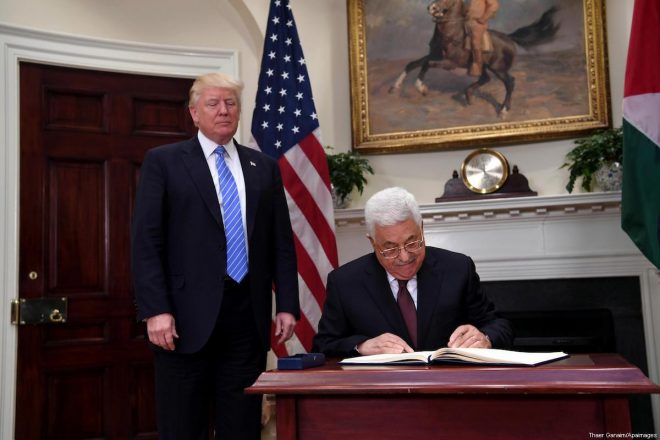
US President Donald Trump with Palestinian President Mahmoud Abbas in the Oval Office of the White House on May 3, 2017 in Washington, DC. [Thaer Ganaim/Apaimages]
By Dr Mohammad Makram Balawi | MEMO | September 18, 2018
A few years after Arafat assumed the leadership of the Palestinian national movement he tried to tempt the West to offer him something in return for what he called peace. Many people still remember him with his white sweater, in the United Nations General Assembly in 1974, saying: “I come bearing an olive branch in one hand, and the freedom fighter’s gun in the other. Do not let the olive branch fall from my hand.”
As one Fatah former leader and Arafat companion once told me, Arafat and his group always thought that liberation should happen within their lifetime and that they should enjoy its fruits. They were convinced from the early stages that they cannot beat the Zionists with all the American and Western support behind them. They were ready from the beginning for something other than complete liberation, unlike most Palestinians. It was not a surprise to my friend that Arafat ended up trapped with a lousy agreement, the Oslo Accords, engineered secretively by Mahmoud Abbas, his successor.
Almost all Palestinian factions, including those who are members of the Palestine Liberation Organisation (PLO), rejected it and many Fatah and Palestinian National Council (PNC) members resigned in protest against the agreement, including Mahmoud Darwish, Ibrahim Abu Lughod and Edward Said, who accused Arafat of treason.
The attempts of Fatah to lead the Palestinian national movement led eventually to the complete monopoly of the Palestinian national decision. All other factions who used to get their financial support and annual budget from the PLO had to concede to Arafat’s decisions even if they opposed them, and for those who refused to do so Arafat used to smear, intimidate and in many cases use brutal force against them, including assassination if necessary.
Although the PLO’s institutions and other Palestinian bodies had elections, most of the time they were decorative. Most of the Palestinian leadership, including Arafat, did not believe in leadership succession and democratic transition. Opposition was never allowed unless it was superficial and could beautify the face of the PLO and give legitimacy to the “historical leadership”, as Arafat and his group used to be called by their supporters.
In the eighties, after Hamas and Islamic Jihad (IJ) became serious contenders, Fatah tried to combat them. In the beginning Arafat refused to recognise that these movements ever existed. Then he spread a rumour, which many still believe in, that these movements were the creation of Israel to divide the national Palestinian decision. Fatah and its members used to assault members of Hamas and IJ, in universities, Israeli detention camps, mosques and wherever they could.
In 1993 the Oslo Accords were signed and from that moment on a deep rift was created between the Palestinian people, who were once always united behind resistance. Arafat believed, and made many Palestinians believe, that through diplomacy Palestinians could have their independent state. This sweet dream was a mere illusion, which Arafat eventually realised before his mysterious death.
The “peace process” – which was supposed to yield according to Oslo a Palestinian state within six years – continued for about two decades and managed only to consolidate Israeli control of the West Bank and the Gaza Strip. Arafat eventually realised that the United States and Israel had turned him into a policeman whose duty it is to keep his own people calm and accept the gradual annexation of land and the looting of resources.
By the beginning of the second intifada, which was triggered by Ariel Sharon’s intrusion into Al-Aqsa Mosque, Arafat started local resistance groups in secret and released many Hamas leaders and members from his prisons. Sharon and George W. Bush decided that it was time to get rid of him and the Israeli Army destroyed almost all the infrastructure Arafat managed to build with European aid in the West Bank, surrounded his headquarters in Ramallah, and imposed Mahmoud Abbas on him as a prime minister.
It was by then very clear that the Americans and the Israelis despised Arafat and favoured Abbas. Arafat’s health gradually and mysteriously deteriorated, he finally died and Abbas took over. Abbas did not believe in pressurising Israel using armed resistance, nor with peaceful resistance, as is evident in the way he runs the areas under his jurisdiction. He seems to believe that the only way to implement his plans of having a state is to convince the Americans and reassure the Israelis, which seems a very naïve approach.
Yet there were some serious obstacles to overcome. First was the armed Fatah groups Arafat founded and financed, which Abbas could liquidate quickly. The second is groups like Hamas, which Arafat, with all his might, could not contain. Abbas chose a new tactic; elections. Abbas managed to convince Hamas’ leadership to take part in the general elections in the West Bank and the Gaza Strip, inaccurately estimating that it would not get more than 30 per cent of the seats of the Legislative Council, and he would emerge victorious and impose his views on Hamas through democracy.
Abbas found no other way except to recognise the results of the elections but worked to undermine the work of the government which was formed by Hamas, and boycotted by most of the other Palestinian factions due to Abbas’ pressure. Through Fatah armed groups and PA security agencies, Abbas started with the help of people like Mohmmed Dahlan – who was then the head of the Preventive Security Force in Gaza – an armed revolt. Abbas made the work of the government almost impossible.
Local Hamas leaders got fed up of the situation and with their smaller and less equipped forces, kicked Dahlan and the armed leaders of Fatah out of the Gaza Strip, and Abbas in return cracked down on Hamas in the West Bank. From that time on Abbas and his group monopolised Palestinian representation under the pretext that Hamas carried out a coup in Gaza and unless it surrenders and hands over everything to Abbas there will be no reconciliation, which gave Abbas all the liberty he wanted to go on his way undisputed.
Yes, Abbas ruled undisputed, but it is very clear that he failed. Abbas worked for three decades to make the Oslo Accords a reality but ended up cursing his partners, the Americans and the Israelis, in a vulgar way, for he has nothing else he could do. Abbas lacks the courage to declare that he led the Palestinian people into a disaster, apologise and give way to a new leadership. One day, most probably soon, Abbas like Arafat will pass away, and leave his people face to face with his disastrous heritage.
British PM pledges to protect Israel, Jews in dig at Corbyn
Press TV – September 18, 2018
Prime Minister Theresa May has pledged to protect British Jews and what she called “Israel’s right to defend itself” in what appeared to be a veiled attack on Jeremy Corbyn, who has been accused of tolerating anti-Semitism in the Labour Party.
Addressing a dinner held by the United Jewish Israel Appeal, which works to build links between British Jews and Israel, May said she was “sickened” by the idea that some Jews had doubt whether Britain was a safe place to raise their children.
“I have come here tonight as prime minister of our country to say that I stand with you,” she told the crowd Monday night. “I stand with the UJIA. I stand with Israel as the homeland of the Jewish people. And I stand with the entire Jewish community in Britain.”
The Labour Party has been mired in rows over what critics describe as its failure to address anti-Semitism among party supporters and its initial reluctance to fully adopt a broader definition of anti-Semitism.
Corbyn, a veteran campaigner for Palestinian rights, has come under attack for criticizing the Israeli regime’s policies, which some view as being anti-Semitic. The Labour leader argued earlier this year that party members should be allowed to criticize Israel.
In August, Britain’s former chief rabbi Jonathan Sacks labeled Corbyn anti-Semite and said his 2013 comments about Zionists were the most offensive by a senior British politician in half a century.
Corbyn said five years ago, before he was Labour’s leader, that British Zionists “don’t understand English irony” despite “having lived in this country for a very long time.”
“If we are to stand up for the values that we share – then one of the things we need to do is give young Jewish people the confidence to be proud of their identity – as British, Jewish and Zionist too,” May said.
“There is no contradiction between these identities – and we must never let anyone try to suggest that there should be.”
In a barely coded message to Corbyn, the prime minister said, “Let me be clear: you cannot claim to be tackling racism, if you are not tackling anti-Semitism.”
Furthermore, May said she was committed to strong economic ties between London and Tel Aviv.
“You can also count on my commitment to Israel’s security,” she said. “I am clear that we will always support Israel’s right to defend itself.”
‘You are to blame for downing of Il-20 and death of its crew,’ Russia tells Israel
RT | September 18, 2018
Russia has formally complained to Israel about its air raid on Monday, which led to the downing of a Russian Il-20 plane off the Syrian coast. Moscow has laid the blame for the crew’s deaths “squarely on the Israeli side.”
Russian Defense Minister Sergey Shoigu spoke to his Israeli counterpart Avigdor Lieberman on the phone about the downing of the Russian Il-20 plane on Monday night. He relayed Moscow’s position on the incident, blaming the Israeli military for setting up the Russian plane to be shot down by Syrian air defenses, which were responding to an Israeli air raid, an official statement from the Russian military said.
Shoigu reiterated that Israel failed to notify Russia of the impending attack in a way that would have given its military an opportunity to move the Il-20 out of harm’s way. Instead, the warning came just one minute before the Israeli F-16 fighter jets launched their attack.
“The blame for the downing of the Russian plane and the deaths of its crew members lies squarely on the Israeli side,” the Minister Shoigu said. “The actions of the Israeli military were not in keeping with the spirit of the Russian-Israeli partnership, so we reserve the right to respond.”
Earlier, the Russian Defense Ministry said the Israeli jets had used the bigger Russian plane as cover during their attack on targets in Syria. The ministry said the Israelis must have known that they were putting the Russian plane at risk, but neither changed their battle plan nor gave a warning in time for the Il-20 to be moved to a safe area.
Israel later responded to the Russian statements, saying it had attacked a Syrian military site overnight. Israeli said the mission was to destroy arms-manufacturing equipment which they claim was to be delivered to Lebanon on behalf of Iran. Israel insisted that the responsibility for the Russian deaths was not on Israel, but on Syria and its allies, Iran and Hezbollah.
US-Indian Relations: Trump Gets a Unique Partner for America First
By Melkulangara BHADRAKUMAR | Strategic Culture Foundation | 18.09.2018
The inaugural meeting of the foreign and defence ministers of India and the United States in a new “2+2” format on September 6 in New Delhi assumed added significance as an attempt by the Trump administration to translate its Indo-Pacific vision outlined in the National Security Strategy (NSS) of last December.
The NSS had explicitly singled out Russia and China as “revisionist” powers that “challenge American power, influence and interests.” Equally, it ascribed a pivotal role to India in the Indo-Pacific. The “2+2” deliberations fleshed out these two templates.
For the first time in the post-Cold War era, the US has inserted itself into the “time-tested” relationship between India and Russia. Demolition of Indian-Russian partnership has been a hidden agenda of the US’ regional policy since the 1990s but it surged in an overt and abrasive form last week.
This shift from an aspirational approach to intrusive approach can be seen in the backdrop of the deterioration of US-Russia relations and the probability that tensions are unlikely to dissipate in a foreseeable future. The US sanctions against Russian defence sectors have been enacted in the full knowledge that India would be an acutely affected party. The US sanctions laws against Russia are acting like the Damocles’ sword to wear down India’s resistance to rollback in ties with Russia.
A similar US assault on India-Russia energy cooperation can be expected soon, which is another promising area for US exports to India. Besides, the US is also threatening to sanction Russia’s financial sector. Clearly, what the US is seeking goes far beyond a reset or atrophy in the Indian-Russian relationship. It aims at nothing less than draining the contents of the “Special Privileged Strategic Partnership” between India and Russia and make it an empty shell. Yet, partnership with Russia has been historically an anchor sheet of India’s strategic autonomy.
Indeed, it becomes a sad reflection of the huge inroads the US has made through the recent decade since the signing of the 2008 US-Indian nuclear deal to breach India’s strategic autonomy. Put differently, weakening of the India-Russia relations is an imperative need for Washington to hustle India on the path of becoming its key ally in the Indo-Pacific. Such a profound shift in the US approach can only be understood in terms of the strategic importance and the sense of urgency that the NSS attaches to the Indo-Pacific region.
The NSS ranks the Indo-Pacific as a strategically more vital area than the Middle East (which has been the principal domain so far of the US’ strategic attention.) The NSS prioritizes the “Quad” (quadrilateral alliance of the US, Japan, Australia and India) more emphatically than even Washington’s transatlantic leadership as a platform of the US’ global strategies. Washington intends to checkmate China, which the NSS has portrayed as the US’ competitor who poses challenge to its world leadership and the international order.
Washington’s Indo-Pacific strategy appeals to the Indian audience alongside the NSS’ grand designation of India as a “leading global power”. Delhi exulted over the NSS document: “We appreciate the importance given to India-United States relationship… the two responsible democracies…share the same objectives.” To be sure, the Trump administration has rekindled a decade-old Indian dream of being a “counterweight” to China.
An influential section of India’s foreign-policy elite remains wedded to the notion that fundamentally, the US helped China’s rise in the Cold War era and that India is similarly well positioned to garner American benevolence in the emergent New Cold War conditions. The “2+2” highlighted that the US has astutely tapped into the Indian elite’s “unipolar predicament”.
In the recent period since the NSS was announced, the Trump administration has declared India as a “Major Defence Partner”, opening the door for the sale of more advanced and sensitive military technologies by American vendors at par with the US’ closest allies and partners, and fostering convergence of interests with India on a range of issues like maritime security, domain awareness and so on.
Without doubt, this has been a “win-win” strategy for Washington. The signing of a Communications Compatibility and Security Agreement (COMCASA) at the “2+2” testifies to it. The COMCASA is modeled on agreements Washington has with its most important NATO and treaty allies. It is a big leap forward in developing “inter-operability” between the militaries of the US, its allies, and India, which in turn transforms India into a front-line state in the US’ military-strategic offensive against China in the Indo-Pacific. Another such “foundational agreement”, Logistics Exchange Memorandum Agreement (signed in 2016 and operationalized last year), has already opened India’s air bases and naval ports to routine use by US warplanes and battleships for refueling and resupply.
The “2+2” joint statement announced that India and US will stage their first-ever joint exercise involving all three branches of India’s military next year, and that they are setting up “hotlines” between their respective foreign and defence ministries “to help maintain regular high-level communication on emerging developments.” It commits the two countries to increased bilateral, trilateral and quadrilateral military-security cooperation. On the other hand, COMCASA is expected to pave the way for a major boost in Indian purchases of US weaponry, which is likely to begin with India’s procurement of armed naval drones for anti-submarine warfare.
All this works splendidly for the US. In sum, by playing on India’s geopolitical apprehensions regarding China’s rise as a global power and playing astutely on India’s own great-power ambitions, US is promoting on the one hand its business interests in the Indian market while on the other hand also locking India into its Indo-Pacific alliance system against China as well as progressively undermining the India-Russia “time-tested” relationship.
It’s a “win-win” strategy all the way. The Trump White House has drawn encouragement from the “2+2” to push the idea of concluding a free-trade agreement with India. Informal conversations have already begun.
Trump appears bullish that when push comes to shove, the present Indian government will bend to Washington’s diktats. Indeed, the Trump administration can count on influential back channels, too. It is no secret that the upper caste Indian Diaspora in the US has close links with the Hindu nationalist groups that mentor Modi government.
Thus, it comes as no surprise that Trump sees Prime Minister Modi as a unique partner for his “America First” project. Trump will skip the East Asia Summit in Singapore in November but is signaling interest in Modi’s invitation to him to be the guest of honor at India’s National Day celebrations in January.
Why Is Assad An Insane Suicidal Monster? – #PropagandaWatch
corbettreport | September 17, 2018
As we know from the political puppets and their mouthpieces in the controlled corporate media, Syrian President Basher al-Assad is a bloodthirsty monster responsible for the wanton slaughter of (fill in the number) of his own citizens, and he particularly enjoys dropping chemical weapons on women and children despite knowing that this is the one thing that will bring him universal condemnation and ensure a full-scale assault on his country. . . But why? Why is he such a monster? That is the question, and the New York Times offers its own helpful explainer with predictably comic results. Don’t miss this edition of #PropagandaWatch from The Corbett Report.
SHOW NOTES: https://www.corbettreport.com/?p=28173
A Test of the Tropical 200-300 mb Warming Rate in Climate Models
By Ross McKitrick | Climate Etc. | September 17, 2018
I sat down to write a description of my new paper with John Christy, but when I looked up a reference via Google Scholar something odd cropped up that requires a brief digression.
Google Scholar insists on providing a list of “recommended” articles whenever I sign on to it. Most turn out to be unpublished or non-peer reviewed discussion papers. But at least they are typically current, so I was surprised to see the top rank given to “Consistency of Modelled and Observed Temperature Trends in the Tropical Troposphere,” a decade-old paper by Santer et al. Google was, however, referring to its reappearance as a chapter in a 2018 book called Climate Modelling: Philosophical and Conceptual Issues edited by Elizabeth Lloyd and Eric Winsberg, two US-based philosophers. Lloyd specifically describes herself as “a philosopher of climate science and evolutionary biology, as well as a scientist studying women’s sexuality” so readers should not expect specialized expertise in climate model evaluation, nor do the book’s editors exhibit any. Yet Google’s algorithm flagged it for me as the best thing out there and positioned two of its chapters as top leads in its “recommended” list.
Much of the first part of the book is an extended attack on a 2007 paper by David Douglass, John Christy, Benjamin Pearson and Fred Singer on the model/observational mismatch in the tropical troposphere. The editors add a diatribe against John Christy in particular for supposedly being impervious to empirical evidence, using flawed statistical methods and refusing to accept the validity of climate model representations of the warming of the tropical troposphere.
By way of contrast, and as an exemplar of research probity, they reproduce the decade-old Santer et al. paper and rely entirely on it for their case. If they are aware of any subsequent literature (which I doubt) they don’t mention it. They fail to mention:
- Santer bitterly fought releasing his data
- Despite having data up to 2007 he truncated his sample at 1999
- If he had used the same methodology on the full data set he’d have reached the opposite conclusion, supporting Douglass et al. rather than supposedly refuting them
- Steve McIntyre and I submitted a comment to the journal showing this. It was rejected, in part because the referee considered Santer’s statistical method invalid and didn’t want it perpetuated through further discussion
- We re-cast the article as a more detailed discussion of trend comparison methodology and published it in 2010 in Atmospheric Science Letters. We confirmed, among other things, that based on modern econometric testing methods the gap between models and observations in the tropical troposphere is statistically significant.
Ofgem exploited national security law to silence us, whistleblowers claim
By Paul Homewood | Not A Lot Of People Know That | September 17, 2018
From the Guardian :
Britain’s energy regulator has been fighting to keep secret the claims of two whistleblowers who independently raised concerns about potentially serious irregularities in projects worth billions of pounds, the Guardian can reveal.
The two men say Ofgem threatened them with an obscure but sweeping gagging clause that can lead to criminal prosecutions and possible jail terms for those who defy it.
MPs and the whistleblowing charity Protect fear Ofgem is abusing its position and exploiting a law that was intended to protect UK national security – not a regulator from potential embarrassment.
The Labour MP Peter Kyle said: “Whistleblowers save lives and protect our economy from harm; they should be protected by law, not have it used against them.”
One of the whistleblowers told the Guardian he was “continually threatened … for trying to tell the truth. For doing my job and uncovering an issue, Ofgem made my life hell.”
He said the regulator had attempted to “scare me witless with threats of imprisonment” and he felt “utterly ashamed” of Ofgem’s behaviour.
Ofgem said it encouraged staff to report suspected wrongdoing and took their concerns seriously.
Both men worked for Ofgem in entirely different areas of the business and were regarded as qualified experts in their respected fields.
One was Greg Pytel, an economist with oversight of the rollout of the £10.9bn smart meter programme, which is due to be completed in 2020.
Smart meters are electronic devices for homes and businesses that measure the use of electricity and gas. They are designed to make billing easier and to help energy companies manage the supply of electricity more efficiently.
The second whistleblower, who has asked to remain anonymous, worked on the renewable heat incentive (RHI), which offers financial rewards to promote the use of new technologies such as green boilers.
The scheme, which started in 2011, has been controversial – and could eventually cost taxpayers £23bn. Both projects are key to the government’s stated aim of making the UK a low-carbon economy.
The two whistleblowers do not know each other and have not been involved in each other’s cases. They say they are only linked by the reaction of Ofgem to their claims.
They found themselves in similar positions after being tasked with scrutinising elements of the two major projects they were working on between 2014 and 2017. Both raised concerns with their managers.
Instead of welcoming their input and investigating their concerns, the men allege they were bullied, treated unfairly and sidelined to such an extent they felt compelled to bring their grievances to an employment tribunal.
The RHI whistleblower claimed he was “continually ignored or threatened.” In both instances, the men say they were told they would not be allowed to reveal to the tribunal, or anyone else, the concerns they had. They say Ofgem warned them that the details were protected by Section 105 of the Utilities Act 2000.
This prohibits the disclosure of certain types of evidence relevant to the energy sector – and it is so restrictive that those who ignore it can be fined or jailed for up to two years.
At an early hearing of Pytel’s case, the tribunal ruled Ofgem was required to disclose his documents about public procurement arrangements for the smart meter programme, citing the Human Rights Act. It said he had the right to freedom of expression without interference from a public authority. But Ofgem has against appealed the decision.
Peter Daly at Bindmans, the legal firm that is acting for Pytel, said: “Ofgem’s position appears to be that anyone who disclosed or reported the content of his whistleblowing would be themselves committing a criminal offence.
“They [Ofgem] are appealing an employment tribunal order to provide disclosure in the proceedings because they say to do so would be a criminal offence. Ofgem’s appeal therefore indicates that in Ofgem’s view this prohibition extends to Ofgem themselves.”
Daly says if Ofgem wins this legal battle, it would “have a corrosive and asphyxiating effect on the rights of whistleblowers in the energy sector and would create a binding precedent.”
A second hearing of the case will take place in October.
The second whistleblower has described the alleged reaction of his managers when faced with the concerns he raised. “Specifically I was told that if I told the truth, my career with Ofgem would be finished.”
Despite the threats, he said, he briefed the National Audit Office – a move that infuriated Ofgem, he claimed.
He said a senior manager “screamed and shouted” at him, and he was then warned his disclosures were a breach of section 105 of the Utilities Act 2000.
The whistleblower says he left Ofgem last year after being “threatened with imprisonment if I shared information about the wrongdoings that I had witnessed”. He has described Ofgem as being “dishonestly secretive”.
Kyle, a member of the business, energy and industrial strategy select committee, said: “Ofgem do have many commercial secrets that are vital to the wellbeing of our nations’ infrastructure, but the power they have to gag whistleblowers is an extreme one and should be used in only extreme circumstances.
“I’m now extremely concerned about the potential abuse of these powers. Parliament might need to look at who has oversight and scrutiny of them and see if the law needs updating.”
Protect, formerly Public Concern at Work, has been helping both of the Ofgem whistleblowers, and has intervened in one of the ongoing legal cases.
The body’s chief executive, Francesca West, said: “The whole of the UK energy market – that’s more than 600,000 workers – are currently being held to ransom over Section 105 of the Utilities Act, and threatened with a prison sentence if they speak up over wrongdoing. It is utterly shameful.
“Our society needs whistleblowers to speak up, to stop harm. But we also need organisations to be honest, open and operate legally.”
Ofgem said it had only had to consider the use of section 105 once in the last five years.
“In carrying out our duties as the energy regulator, Ofgem handles large amount of information from consumers and businesses which is often both personal in nature and commercially sensitive.
“With the exception of a few prescribed circumstances, section 105 of the Utilities Act 2000 prohibits the disclosure of the information we receive. Section 105 is intended to ensure that consumers and businesses can share their information without fear that it may be subsequently disclosed. Ofgem takes our obligations under law very seriously, including the restrictions in section 105.
“Ofgem adheres to its whistleblowing policy which encourages staff to report suspected wrongdoing as soon as possible, in the knowledge that their concerns will be taken seriously and investigated.”
Curiously the Guardian gives no hint of what the two whistleblowers wanted to tell us.
It does not take a genius to work out the whole smart meter programme has been highly flawed from the outset, and an obscene waste of billions of pounds.
As for the RHI, many more billions are being wasted, often on environmentally damaging projects, and again for the same reasons of reducing CO2 emissions.
The fact that the Guardian has been wholeheartedly behind both schemes might give a clue as to why they are reluctant to tell the whole story.
Featured Video

America Racing to Strategic Defeat in Iran
or go to
Aletho News Archives – Video-Images
From the Archives
Should Europeans ‘Thank’ the Americans for Destroying Nord Stream?
By Robert Bridge | Strategic Culture Foundation | September 29, 2022
With an investigation continuing into the destruction of the Nord Stream gas pipeline that provided energy supplies to Europe from Russia, there appears to be just one prime suspect, and that should surprise nobody.
Following the sabotage of the Nord Stream 1 and 2 gas pipelines, former Polish Foreign Minister Radoslaw Sikorski already seemed to know the identity of the perpetrator when he tweeted out: “Thank you, USA.”
At first glance, it seemed that Sikorski was speaking sarcastically, berating Washington for carrying out an attack that will have severe repercussions for the people of Europe. After all, how could anyone see any good coming from the termination of Europe’s primary source of gas reserves with winter just around the corner? It was Sikorski’s homeland of Poland, after all, that urged its citizens to collect firewood in the face of dwindling gas reserves.
In fact, the Polish diplomat was speaking one-hundred percent literally… continue
Blog Roll
 Aletho News
- Growing insecurity, soaring prices fuel protests in north as regime bans evacuation: Sources
- Iran denies responsibility for ‘depraved’ attack on Kuwait desalination plant
- Bring The Troops Back. End This War Now!
- Can we please stop calling Israel the ‘only democracy in the Middle East’ now?
- US should start removing its troops for Germany, proposes AfD co-leader Chrupalla
- Iran Red Crescent: 600 educational centers attacked in US-Israeli ‘war crimes’
- Russian Oil Tanker Arrives in Cuba Amid U.S. Blockade
- America Racing to Strategic Defeat in Iran: Lt Col Daniel Davis
- FTC Warns Visa, Mastercard, PayPal, Stripe Over Political Debanking
- Russian tanker approaches Cuba despite US oil blockade
- If Americans Knew
- Israeli police block Catholic cardinal from entering Church of the Holy Sepulchre on Palm Sunday
- Israel is assassinating journalists again, more than any other nation, anywhere, ever – Not a ceasefire Day 170
- Over 300 US service members wounded, majority have brain injuries – Not a ceasefire Day 169
- Researchers at Human Rights Watch Resign Over Blocked Report on Palestinian Refugee Return
- Jewish Groups Are Backing a War Americans Don’t Want
- Eric Fingerhut Thinks He’s the President of the Jews
- Top Jewish Philanthropists, Rabbis Urge Israeli President to Take Action Against ‘Jewish Extremists’
- Don’t Be Fooled. Zionist Leaders Have Always Wanted to Control Southern Lebanon
- Israel’s widespread use of torture is a core element of its genocide against the Palestinian people
- In Israel’s War on Iran, Many Middle East US Bases Rendered “All But Uninhabitable”
- No Tricks Zone
- New Study Finds Warming Saves Lives…Cold Temperatures 12 Times More Deadly Than Excess Heat
- German Science Blog Accuses PIK Climate Institute Of Hallucinating Climate Tipping Points
- Devastating Assessment Of Comirnaty Vaccine By Former Senior Pfizer Europe Toxicologist
- New Study: CO2 Is ‘Effectively Negligible’ As An Explanatory Climate Change Factor Since 2000
- Former Pfizer Toxicologist Dr. Helmut Sterz Tells Bundestag Hearing Pfizer Vaccine Should Have Never Been Approved
- Energy Expert: Germany’s Nuclear Phaseout Was A “500 Billion Euro Mistake”
- New Research: South Australia’s Mid-Holocene Sea Surface Temperatures Were 4°C Warmer Than Today
- Storing Green Energy To Last Germany 10 Days Would Require A 60-Million Tonne Battery
- New Studies: UK Sea Levels Were 4 Meters Higher Than Today During The Mid-Holocene
- Destructive Green New Deal: German Energy And Metal Group Warns Of Drastic Crisis
 Aletho News