The Remarkable Historiography of David Irving
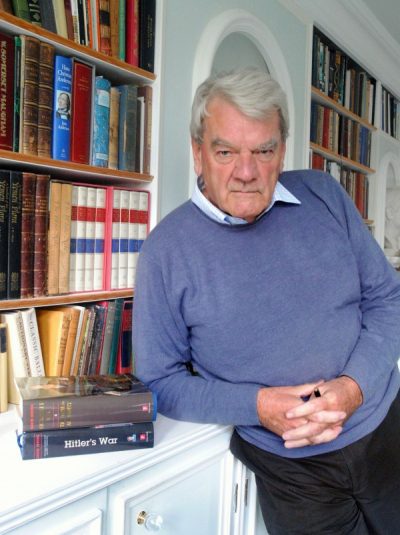
David Irving taken in London. CC by-SA 3.0. Credit: Allan Warren/Wikimedia Commons
By Ron Unz • Unz Review • June 4, 2018
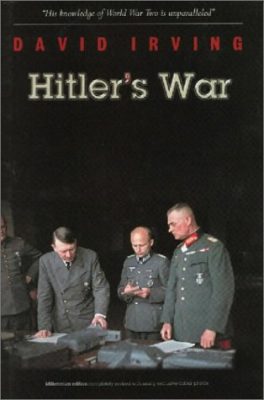
I’m very pleased to announce that our selection of HTML Books now contains works by renowned World War II historian David Irving, including his magisterial Hitler’s War, named by famed military historian Sir John Keegan as one of the most crucial volumes for properly understanding that conflict.
With many millions of his books in print, including a string of best-sellers translated into numerous languages, it’s quite possible that the eighty-year-old Irving today ranks as the most internationally-successful British historian of the last one hundred years. Although I myself have merely read a couple of his shorter works, I found these absolutely outstanding, with Irving regularly deploying his remarkable command of the primary source documentary evidence to totally demolish my naive History 101 understanding of major historical events. It would hardly surprise me if the huge corpus of his writings eventually constitutes a central pillar upon which future historians seek to comprehend the catastrophically bloody middle years of our hugely destructive twentieth century even after most of our other chroniclers of that era are long forgotten.
Carefully reading a thousand-page reconstruction of the German side of the Second World War is obviously a daunting undertaking, and his remaining thirty-odd books would probably add at least another 10,000 pages to that Herculean task. But fortunately, Irving is also a riveting speaker, and several of his extended lectures of recent decades are conveniently available on YouTube, as given below. These effectively present many of his most remarkable revelations concerning the wartime policies of both Winston Churchill and Adolf Hitler, as well as sometimes recounting the challenging personal situation he himself faced. Watching these lectures may consume several hours, but that is still a trivial investment compared to the many weeks it would take to digest the underlying books themselves.
When confronted with astonishing claims that completely overturn an established historical narrative, considerable skepticism is warranted, and my own lack of specialized expertise in World War II history left me especially cautious. The documents Irving unearths seemingly portray a Winston Churchill so radically different from that of my naive understanding as to be almost unrecognizable, and this naturally raised the question of whether I could credit the accuracy of Irving’s evidence and his interpretation. All his material is massively footnoted, referencing copious documents in numerous official archives, but how could I possibly muster the time or energy to verify them?
Rather ironically, an extremely unfortunate turn of events seems to have fully resolved that crucial question.
Irving is an individual of uncommonly strong scholarly integrity, and as such he is unable to see things in the record that do not exist, even if it were in his considerable interest to do so, nor to fabricate non-existent evidence. Therefore, his unwillingness to dissemble or pay lip-service to various widely-worshiped cultural totems eventually provoked an outpouring of vilification by a swarm of ideological fanatics drawn from a particular ethnic persuasion. This situation was rather similar to the troubles my old Harvard professor E.O. Wilson had experienced around that same time upon publication of his own masterwork Sociobiology: The New Synthesis, the book that helped launch the field of modern human evolutionary psychobiology.
These zealous ethnic-activists began a coordinated campaign to pressure Irving’s prestigious publishers into dropping his books, while also disrupting his frequent international speaking tours and even lobbying countries to bar him from entry. They also maintained a drumbeat of media vilification, continually blackening his name and his research skills, even going so far as to denounce him as a “Nazi” and a “Hitler-lover,” just as had similarly been done in the case of Prof. Wilson.
During the 1980s and 1990s, these determined efforts, sometimes backed by considerable physical violence, increasingly bore fruit, and Irving’s career was severely impacted. He had once been feted by the world’s leading publishing houses and his books serialized and reviewed in Britain’s most august newspapers; now he gradually became a marginalized figure, almost a pariah, with enormous damage to his sources of income.
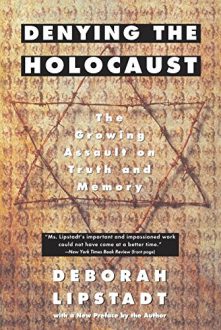
In 1993, Deborah Lipstadt, a rather ignorant and fanatic professor of Theology and Holocaust Studies (or perhaps “Holocaust Theology”) ferociously attacked him in her book as being a “Holocaust Denier,” leading Irving’s timorous publisher to suddenly cancel the contract for his major new historical volume. This development eventually sparked a rancorous lawsuit in 1998, which resulted in a celebrated 2000 libel trial held in British Court.
That legal battle was certainly a David-and-Goliath affair, with wealthy Jewish movie producers and corporate executives providing a huge war-chest of $13 million to Lipstadt’s side, allowing her to fund a veritable army of 40 researchers and legal experts, captained by one of Britain’s most successful Jewish divorce lawyers. By contrast, Irving, being an impecunious historian, was forced to defend himself without benefit of legal counsel.
In real life unlike in fable, the Goliaths of this world are almost invariably triumphant, and this case was no exception, with Irving being driven into personal bankruptcy, resulting in the loss of his fine central London home. But seen from the longer perspective of history, I think the victory of his tormenters was a remarkably Pyrrhic one.

Although the target of their unleashed hatred was Irving’s alleged “Holocaust denial,” as near as I can tell, that particular topic was almost entirely absent from all of Irving’s dozens of books, and exactly that very silence was what had provoked their spittle-flecked outrage. Therefore, lacking such a clear target, their lavishly-funded corps of researchers and fact-checkers instead spent a year or more apparently performing a line-by-line and footnote-by-footnote review of everything Irving had ever published, seeking to locate every single historical error that could possibly cast him in a bad professional light. With almost limitless money and manpower, they even utilized the process of legal discovery to subpoena and read the thousands of pages in his bound personal diaries and correspondence, thereby hoping to find some evidence of his “wicked thoughts.” Denial, a 2016 Hollywood film co-written by Lipstadt, may provide a reasonable outline of the sequence of events as seen from her perspective.

Yet despite such massive financial and human resources, they apparently came up almost entirely empty, at least if Lipstadt’s triumphalist 2005 book History on Trial may be credited. Across four decades of research and writing, which had produced numerous controversial historical claims of the most astonishing nature, they only managed to find a couple of dozen rather minor alleged errors of fact or interpretation, most of these ambiguous or disputed. And the worst they discovered after reading every page of the many linear meters of Irving’s personal diaries was that he had once composed a short “racially insensitive” ditty for his infant daughter, a trivial item which they naturally then trumpeted as proof that he was a “racist.” Thus, they seemingly admitted that Irving’s enormous corpus of historical texts was perhaps 99.9% accurate.
I think this silence of “the dog that didn’t bark” echoes with thunderclap volume. I’m not aware of any other academic scholar in the entire history of the world who has had all his decades of lifetime work subjected to such painstakingly exhaustive hostile scrutiny. And since Irving apparently passed that test with such flying colors, I think we can regard almost every astonishing claim in all of his books—as recapitulated in his videos—as absolutely accurate.
Aside from this important historical conclusion, I believe that the most recent coda to Irving’s tribulations tells us quite a lot about the true nature of “Western liberal democracy” so lavishly celebrated by our media pundits, and endlessly contrasted with the “totalitarian” or “authoritarian” characteristics of its ideological rivals, past and present.
In 2005, Irving took a quick visit to Austria, having been invited to speak before a group of Viennese university students. Shortly after his arrival, he was arrested at gunpoint by the local Political Police on charges connected with some historical remarks he had made 16 years earlier on a previous visit to that country, although those had apparently been considered innocuous at the time. Initially, his arrest was kept secret and he was held completely incommunicado; for his family back in Britain, he seemed to have disappeared off the face of the earth, and they feared him dead. More than six weeks were to pass before he was allowed to communicate with either his wife or a lawyer, though he managed to provide word of his situation earlier through an intermediary.
And at the age of 67 he was eventually brought to trial in a foreign courtroom under very difficult circumstances and given a three-year prison sentence. An interview he gave to the BBC about his legal predicament resulted in possible additional charges, potentially carrying a further twenty-year sentence, which probably would have ensured that he died behind bars. Only the extremely good fortune of a successful appeal, partly on technical grounds, allowed him to depart the prison grounds after spending more than 400 days under incarceration, almost entirely in solitary confinement, and he escaped back to Britain.
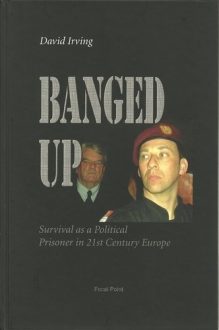
His sudden, unexpected disappearance had inflicted huge financial hardships upon his family, and they lost their home, with most of his personal possessions being sold or destroyed, including the enormous historical archives he had spent a lifetime accumulating. He later recounted this gripping story in Banged Up, a slim book published in 2008, as well as in a video interview available on YouTube.
Perhaps I am demonstrating my ignorance, but I am not aware of any similar case of a leading international scholar who suffered such a dire fate for quietly stating his historical opinions, even during in darkest days of Stalinist Russia or any of the other totalitarian regimes of the twentieth century. Although this astonishing situation taking place in a West European democracy of the “Free World” did receive considerable media exposure within Europe, coverage in our own country was so minimal that I doubt that today even one well-educated American in twenty is even aware it ever happened.
One reason that most of us still believe that the West remains a free society is that Our American Pravda works so hard to conceal the important exceptions.
The Achilles Heel of the Door Handle Theory
By Rob Slane | The Blog Mire | October 29, 2018
There are few certainties in the Salisbury case, but one thing I am quite confident of is that Sergei and Yulia Skripal were not poisoned with a nerve agent of “high purity” on the door handle of 47 Christie Miller Road. I am also quite confident that Detective Sergeant Nick Bailey was not poisoned in this way either, and furthermore that his actions, and the subsequent actions of investigators, are the Achilles Heel of the whole explanation. I shall come onto that in due course, but first the Skripals.
There are simply too many things which, when added together, make the door handle explanation at the very least incredibly implausible, if not downright impossible:
Firstly, they did not die immediately, or thereabouts, which is what you would expect to have happened had they been contaminated by coming into contact with what was said to be a nerve agent of “high purity”.
Secondly, they were fine for hours afterwards, so much so that they were able to drive to town, feed ducks, go for a meal, and then have a drink.
Thirdly, eye witness accounts of the couple on the bench suggest that they became seriously ill pretty much simultaneously. Certainly, there were no reports of one of the pair calling for help, or contacting the emergency services, which is what you would expect to have happened in the event of one becoming ill before the other.
Fourthly, during the duck feed, which took place just after the Skripals parked their car in Sainsbury’s car park, and prior to their visit to Zizzis, Mr Skripal handed bread to some local boys, one of whom apparently ate a piece. I cannot think of a plausible explanation why this boy did not become ill if, as claimed, Mr Skripal’s hands were contaminated at that time with a “military grade nerve agent”.
Fifthly, either Mr Skripal or his daughter must have touched the parking machine at Sainsbury’s car park, which was then touched by literally hundreds of people over the following days. Yet not one of these people were contaminated.
Sixthly, neither the door handle at Zizzis nor the door handle at The Mill were contaminated, despite the fact that either Mr Skripal or Yulia, or perhaps both, would have handled them when going into those venues.
In other words, in order to accept the door handle explanation, you need to ignore every one of these extremely improbable things. If it were someone on a website suggesting it, rather than The Metropolitan Police, you all know what they would be called and what they would be assumed to be wearing on their heads, don’t you?
Suppose you’d never heard about the case of the Skripals before, and someone told you that it involved two people collapsing simultaneously on a bench after being poisoned by some sort of highly toxic substance. Where would you assume the poisoning had taken place? Given the rapid onset of symptoms, and the fact that both fell ill at the same time, most rational people would assume that it was at the bench, or in the near vicinity shortly before. Not many, if any, would plump for a door handle four hours before, with the feeding of waterfowl and partaking of comestibles and beverages in between.
Yet the curious thing is that the near vicinity explanation — by far the most obvious and reasonable — hardly seems to have got a look in. The theories of the place of poisoning very quickly moved from the poisoning of food in Zizzis or spiking of drinks in The Mill to a timeline of perhaps hours before the collapse, including flowers, buckwheat, the car door handle, and luggage, before finally resting on the door handle of the house. But nothing much about the bench or The Maltings.
Nor were there any concerted appeals for more people to come forward with information about the Skripals’ movements after, say, 15:30. There were appeals regarding their movements between 9:00 and 13:00. There were appeals regarding their movements in the early afternoon from 13:00 to 13:45. But nothing much around the actual time and the actual place that logic and reason would suggest the attack took place.
This is all very odd, to say the least.
But there is something much odder than this, and it is something which — I believe — shows beyond all reasonable doubt that the door handle explanation is false. I refer to the movements of Detective Sergeant Nicholas Bailey, and the response of investigators following his actions.
There is some confusion as to when Mr Bailey was first admitted to Salisbury District Hospital. Some reports seem to suggest that he first went there on Sunday 4th March, and some suggest that it may have been 5th or even 6th March. Still other reports suggest that he may have gone there on the evening of 4th March, been given the all clear, but then driven himself back there on 6th March after feeling unwell. Certainly, the first mention of his hospitalisation in public was made by the then Assistant Commissioner Mark Rowley on 6th March, who stated the following:
“Sadly, in addition, a police officer who was one of the first to attend the scene and respond to the incident is now also in a serious condition in hospital.”
For the purposes of what I want to show, it is enough to say that by 6th March, not only had Mr Bailey been admitted to hospital, but it was also known that he had somehow been poisoned.
As you can see from Mark Rowley’s comment, Mr Bailey was said to have been one of the first responders at the bench, and so it was initially assumed that he must have been contaminated there, perhaps by coming into contact with one of the Skripals. One of the glaring problems with this explanation, however, was that not one other responder at the bench was similarly contaminated. For example, one witness, Jamie Paine, described how Mr Skripal was frothing at the mouth, and that he got a little bit of this on his skin and jacket. Yet he was not contaminated.
Then on 9th March, the solution was forthcoming. Lord Ian Blair, former Chief Constable of the Metropolitan Police, stated in a radio interview that Mr Bailey actually went to Mr Skripal’s house. Here is how The Telegraph reported this:
“Asked if there were any leads in the case, Lord Blair told the Today Programme on Radio 4: ‘There are some indications that the police officer who was injured had been to the house, whereas there was a doctor who looked after the patients in the open, who hasn’t been affected at all. So there maybe some clues floating around in here.’”
The phrase “some indications” is what is known as a weasel phrase. By that time Wiltshire Police and The Metropolitan Police must have known full well that Mr Bailey had been at the house, and there would have been no “some indications” about it.
Let us pause to consider what this means.
According to the narrative presented by The Metropolitan Police, by 9th March at the latest, three things were known for certain:
1. Detective Sergeant Nicholas Bailey had been hospitalised after becoming contaminated with a toxic substance.
2. He had been at the Maltings, close to the bench where it was reported that the Skripals had collapsed.
3. He had also been to Mr Skripal’s house at 47 Christie Miller Road.
This would have led to a logical deduction that the source of Mr Bailey’s poisoning must have been at one of two locations:
1. At the bench in the Maltings (or close proximity)
2. At Mr Skripal’s house.
(Note that I have said “the source of Mr Bailey’s poisoning”. It is possible that he was contaminated away from these locations, by an object he picked up. However, the source of his poisoning would still have to have been at one of these two places).
But as mentioned above, The Met seemed to rule out or ignore the bench and The Maltings as the place of poisoning from quite early on. And so according to their own account, Mr Bailey must have been poisoned at the Skripal house, or by something he took away from there. Indeed, this is what was stated in The Telegraph article in which Lord Blair’s comment appeared:
“The disclosure that Det Sgt Bailey was poisoned at the Skripal family home — rather than at the scene where the pair collapsed — strongly indicates that the nerve agent was administered there.”
So what would you have expected to happen next?
Here’s what I would have expected: 47 Christie Miller Road to be placed on full lockdown, with forensic specialists from Porton Down brought in to examine the house inside out, taking swabs in order to locate the source of poisoning. And so if the door handle was the location of the poisoning, it is not unreasonable to have expected it to be identified as such within 24-48 hours of knowing that Mr Bailey had been there. So by 11th March at the absolute latest.
But this is not at all what happened. What actually happened was as follows:
Firstly, we continued to get a number of speculative theories about the source of the poisoning, from Whitehall and intelligence sources. For example, the theory that the poison was placed in the flowers laid by Mr Skripal at his wife’s grave was mentioned on 10th March and continued to be seen as a possibility for a good while afterwards.
The car door handle was mooted as a possibility on 13th March:
“Whitehall sources last night said Mr Skripal was poisoned when he touched the door handle of his car, which had been smeared with a deadly nerve agent.”
And on 18th March, intelligence sources were saying that the poisoning may have taken place through the air ventilation system in the car.
But hang on a minute. These theories might have made some sense if it was just the Skripals that had been poisoned. But it wasn’t. By 9th March it was known that Mr Bailey had been contaminated too, and his movements were also known. And since there was no suggestion that he ever went to the cemetery, or that he ever went to Mr Skripal’s car, how could these places possibly have been the source of the poisoning? Of course they couldn’t, and given that investigators had apparently ruled out the bench or the near vicinity as the place of his poisoning, Mr Skripal’s house and his house alone by that time should have been the entire focus of the search for the location of the poisoning. And yet it wasn’t.
Secondly, the scene at the house itself continued after 9th March as it had done before that time. It continued to be guarded by unprotected, uniformed officers, just as it had been before Lord Blair’s remark. Why was this, if it had already been established that this was the place where Mr Bailey had been poisoned?
But thirdly, and most crucially, the door handle theory only appeared in public on 24th March, when it was revealed that forensics teams had taken swabs from the front door on 22nd March (the forensics team doing this was the OPCW, and it was the first time that the door handle had been a focus). In other words, it took almost a fortnight after Lord Blair’s revelation of Mr Bailey going to 47 Christie Miller Road for investigators to swab the door and the handle. That is simply incredible.
Interestingly, the article that first mentioned the door as “ground zero” in the investigation stated the following as the reason for this:
“Whitehall staff have seen evidence which shows Russians have researched administering poisons via door handles.”
What we can say, therefore, is as follows: By 9th March at the latest (but probably several days before), it was known that Mr Bailey, who was by then hospitalised after becoming contaminated, had entered 47 Christie Miller Road on 4th March. This means that – again according to The Met – the house must have been ground zero, because it was the only place, other than the bench, where all three people could have come into contact with the source of the poison. However, it wasn’t until 22nd March that the forensics teams came to check the door, and the reason they did so was apparently not because it was obvious that the house needed checking, but because allegedly an FSB manual had been found mentioning door handles.
So why did it take two weeks or more for investigators to swab the door and identify the alleged location of the poisoning, when according to their own narrative, Mr Bailey’s movements clearly pointed to the house as the location? Why was it that throughout that time other locations for the poisoning were put forward, even though Mr Bailey had not been in those places? And why did it take the alleged discovery of a manual, rather than Mr Bailey’s known visit to the house, before anyone got the idea to swab the door and the door handle?
I think there is only one plausible explanation, and it is this: Mr Bailey wasn’t actually poisoned at the door handle of Mr Skripal’s house at all. Had he really been poisoned there, immediately after it came to light that he had gone to 47 Christie Miller Road on 4th March, the house would have been swabbed from top to bottom and the door handle as location of the poisoning would have been identified by 11th March at the latest. Instead, there was a gap of two weeks or more before swabs were taken. Why? Because for some reason, which hasn’t yet been explained, and perhaps never will be, both Mr Bailey’s and the Skripals’ contamination needed to be explained away from The Maltings. And although his going to the house meant that this was a possibility, it took two full weeks, plus the invention of the door handle manual, to settle on a particular location. In other words, someone tried to straighten out what was undoubtedly a very crooked story. But far from straightening it, they only succeeded in bending it even more, out of all recognition.
Censorship? By The U.S. Women’s National Democratic Club? You Bet!
By J. Michael Springmann | American Herald Tribune | October 29, 2018
Say It Ain’t So, Joe! The author’s book, Goodbye, Europe? Hello, Chaos? Merkel’s Migrant Bomb is more toxic than the controlled wave of migrants flooding the Continent over the past few years. It is more toxic than the carefully-organized migrant “caravans” now marching to the United States. On October 24, 2018, through the efforts of a contact, the Women’s National Democratic Club (WNDC) in Washington, D.C. invited this writer to speak about his book at a luncheon on November 29. However, mirabile dictu, on October 26, the Club reneged on its invitation.
Why? The book asks awkward questions, names names, and provides deep background on unrestricted, uncontrolled migration. It is a carefully-researched analysis of how and why millions of people, mostly from South and Southwest Asia and North Africa, poured into the European Union. The work delves into America’s Forever War against the Arab and Muslim worlds, detailing how the United States destroyed country after country. Blaming shadowy Islamists for the problem, Washington concealed the activities of its own intelligence services and those of other countries in carefully herding the unfortunates out of their homelands and onto a foreign continent. Its 354 footnotes, draw from contemporary press articles and Kelly Greenhill’s scholarly investigation of the subject, Weapons of Mass Migration: Forced Displacement, Coercion, and Foreign Policy (Ithaca, N.Y.: Cornell University Press: 2010), buttress the author’s investigations, arguments, and conclusions.
These ideas are anathema to the American Establishment. Of which, the WNDC evidently thinks it is a member.
Nevertheless, in an effort at damage control, the author’s friend had suggested to the WNDC that talking about Goodbye, Europe? would be useful to their membership in understanding the situation in Europe as well as the columns of aliens, not quite in army division strength, now marching on America. She had emphasized this author’s background as immigration attorney, service as a diplomat, and activity as political commentator on international affairs. She further noted that this writer’s experience provided a certain amount of gravitas, commenting:
Mr. Springmann’s position…would offer WNDC attendees a rare (unfortunately rare, as mainstream media and elected officials are not addressing the nuances and complexities of this mass migration), opportunity to go beyond soundbites, fear and the narrow ‘discussion’ that has been framed not only in Europe but in the US as well…
And the WNDC’s Reply? Here’s Marisha Kirtane, the Club’s Strategic Communications Director, in her own words:
My concern is more the tone in which migrants were talked about in the abstract for the book, and how they seemed to be characterized…. Why do migrants represent an ethnopolitical nightmare? Where is the data that suggests that most migrants are men?…But there’s a good chance that it is a very individual point of view by someone who is a bit of a conspiracy theorist.
Miss Kirtane obviously didn’t read the book (even though this writer had supplied the WNDC with a copy). If she had seen the volume, she would have noted that the book was, in part, dedicated to the migrants: … To the unfortunate millions driven from their homes by American foreign policy. These were individuals and families weaponized as migrants, pushed into foreign lands and cultures they did not understand… Just as obviously, she didn’t read any of the comments about the work posted on Amazon. If she had, she would have learned from the former director of the Voice of America’s Arabic Service that:
… I consider [this]one of the very rare books that are so deeply and extensively researched and so widely and authentically sourced. It discusses frankly and uninhibitedly the worldwide wave of migrants, refugees and asylum seekers which flooded many European countries and threatened to break on our shores. The author unearthed the roots of the problems which caused that human deluge of millions. Mr. Springmann lays the blame on many factors including turmoil, political instability, unemployment, poverty, aspiring to better life and mainly violence and wars in Asian, North African and, in particular, Middle Eastern countries. He stresses that the major cause of the outflow of that flood is the United States’ foreign policy which he claims is bent on using the migrant waves as a “mass destruction weapon… It is timely and comes in a propitious moment when the American debate on immigration, refugees and border protection is heating up. The book is a warning shot which directs attention to the migrant problems and as a reminder that solutions are urgently needed. The author offers some reasonable ones.”
So Why Is There Censorship? Simple. The book and planned address criticize American foreign policy. You know, of invading and destroying countries with which the United States is at peace. Besides its century-long history of overthrowing democratic governments in Latin America and the Caribbean, the United States has crushed Arab and Muslim regimes in Southwest Asia which apartheid Israel sees as abominations. The Democratic Party as well as the members of the WNDC have supported these actions. If they haven’t, this writer has heard nary a word of criticism directed against former presidents James Earl Carter (D-Ga.), William Jefferson Clinton (D-Ark.), or Barack Hussein Obama (D-HI.). The Democrats intensely dislike anyone linking their wars and their support for wars to their politicians, who, in their eyes, stand for hope and change.
There is also censorship because the WNDC can’t or doesn’t want to grasp the causes of the migrant waves in Europe and the Americas: the nearly complete destruction of entire countries and their political systems, with attendant imposition of highly undemocratic regimes in their place. Naturally, decent, hard-working common folk want to leave.
But that’s not the only reason for censorship. It gets worse. The WNDC (and the far too many people who think like they do) love the sub rosa import of cheap, easily exploited labor. (It’s really slave labor but the War Between the States abolished slavery, don’t you know.) Moreover, they’re votes to be had. These can be illegal ones (since the U.S. doesn’t have a national identity card and efforts to require proof of citizenship at the polls are always deemed unconstitutional). Or they can be legal ones, as the result of amnesty or marriage to an American citizen. The key word is gratitude to the political party that let the migrants in.
But, some people fight back. Mostly on the Continent. In Goodbye, Europe?, the author reviews right-wing, populist parties, country by country. He notes that anti-EU, anti-migrant Marine Le Pen and her then-Front National garnered 30% of the French presidential vote in 2017. Anti-immigrant Geert Wilders’ Union Party for Freedom (PVV) became the second-strongest party in the Dutch parliament in 2017. Angela Merkel, the woman who opened Europe to migrants. and her Christian Democratic Union (CDU) took an unprecedented drubbing in Germany’s September 2017 general election. But the Alternative for Germany Party (AfD), anti-EU and anti-migrant went from nothing to nearly 13% of the vote. According to an E-mail from a German friend October 28, 2018, Merkel’s CDU and the SPD, the Socialists, again got pounded in that day’s Hesse State elections, losing 10 percentage points each, with the AfD taking a projected 14% of the ballots cast.
Don’t you dare question. However, in Europe, just as in the United States, anyone who probes the migrant wave, its causes, or its supporters is denounced as a racist, a hatemonger, a Neo-Nazi, or worse. Peter van Buren, author and former American diplomat, recently queried the rapid mobilization of the migrant caravans moving towards the U.S. just before mid-term elections. Posting on Facebook, he asked how 7,000 people came together overnight. He wanted to know who or what is supplying them with food and water. Consequently, he was hit with astonishingly fact-free emotional outbursts. (When this writer was assigned to Saudi Arabia, he drank three liters of water a day. Imagine the task of daily providing 21,000 liters of potable water to these people.)
Some of this help seems to be coming from the Mexican government. NBC news reported October 28 that “For the first time an arm of the [Mexican] federal government seemed to be directly helping the migrants advance rather than trying to diminish the caravan. In this case Grupo Beta, Mexico’s migrant protection agency, gave rides to stragglers and passed out water.”
Conclusion. Americans live in the past. They believe in exceptionalism. They believe in their inalienable right to tell others what to think and what to do. And they’re wrong.
My contact who reached out to the WNDC believes that the U.S. (and Europe) should admit anyone, regardless of their education level or qualifications. After all, she noted, the Irish and others came to the United States in the 19th century. They came for the most part as single people who would later send for their families. They came, she commented, because they had no future at home. Well, in the 19th century, America was a continent-wide wilderness filled with lots of trees and Red Indians, soon to be extirpated for their inconvenient existence. Today, with more than 300 million people of various ethnicities and strong, diametrically-opposed political beliefs, the U.S. is becoming unmanageable.
On the other hand, Canada and Australia are selective about their immigrants. Unlike the U.S., they put a premium on what the new immigrant can bring to the county: funds and education. After all, we live in a high-technology society dependent on high level skills and knowledge.
American exceptionalism goes back to the 17th century when John Winthrop, governor of the Massachusetts Bay Colony, said “We shall be as a city upon a hill, the eyes of all people are upon us.” In a speech given in 1974 at the Political Action Conference, President Ronald Reagan expatiated on what Winthrop meant: “We are, indeed, and we are today, the last best hope of man on earth.” According to Stephen M. Walt in Foreign Policy (October 11, 2011), “Most statements of ‘American exceptionalism’ presume that America’s values, political system, and history are unique and worthy of universal admiration. They also imply that the United States is both destined and entitled to play a distinct and positive role on the world stage.”
That’s a myth. Any Afghan, Iranian, Iraqi, Libyan, or Syrian can confirm that. Most of Latin America can, as well.
Flowing from exceptionalism is the American desire to control the world’s political systems–for their own good. Look at the United Nations and U.S. vetoes of resolutions critical of Israel. See the steady advance of outmoded NATO to Russia’s borders. Consider the chain of alliances which U.S. Secretary of State John Foster Dulles forged in the 1950s. Contemplate America’s withdrawal from the Joint Comprehensive Plan of Action or from the Intermediate Range Nuclear Forces Treaty. Reflect on sanctions imposed on Russia and Iran but not Israel or Saudi Arabia. America knows best doesn’t it?
No. And that’s why the WNDC censored this writer’s talk. People with limited knowledge and a specific agenda wanted to control someone else’s message. They wanted this control to ensure that their speech and only their speech would be heard. In 21st century America, freedom of speech applies to only certain words from certain groups. George Orwell’s 1984 came 30 years early.
J. Michael Springmann is an attorney and former diplomat with the US Department of State. As a diplomat, he spent five years in Germany, two years in India, and nearly two in Saudi Arabia. Now a writer and political commentator, Springmann is also the author of Visas for Al Qaeda: CIA Handouts That Rocked the World.
Istanbul Summit on Syria Was a Success but Caveats Remain
By Melkulangara BHADRAKUMAR | Strategic Culture Foundation | 29.10.2018
The four-nation Turkey-Russia-Germany-France summit on Syria on October 27 in Istanbul had an impressive outcome. All participants – each with own interests – has some ‘takeaway’ from the summit, which itself is a measure of the success of the event. This is also important because the participants now have a reason to work together.
Such an outcome can be interpreted in the following ways. First and foremost, a major regional conflict impacting international security was addressed without US participation. A sign of our times?
Second, participants didn’t quarrel over President Bashar Al-Assad’s “fate”. The debate becomes pedantic today in terms of ground realities. The Syrian nation should decide on its future. That’s also been Assad’s demand.
Third, some serious thought has been given to the journey towards a Syrian settlement – ceasefire, drafting of new constitution followed by elections under UN supervision.
Four, the participants snubbed the US-Israeli plan to balkanize Syria into “spheres of influence” and have also squashed the Israeli dreams of getting international legitimacy for its illegal occupation of Golan Heights as part of any settlement.
Five, Germany and France have become amenable to the Russian demand pressing the urgency for rendering humanitarian aid to Syria and help in reconstruction. (The US made this conditional on Assad’s removal.) We’ll have to see how it pans out, but the summit also stressed the importance of the return of Syrian refugees (which is a key issue for European countries.)
Six, the participants recognized that the remaining terrorists in Syria must be destroyed – although, significantly, they also supported the Idlib ceasefire deal brokered by Turkey and Russia.
The bottom line is that it is the post-war Syrian order that is under discussion now. However, it must be understood as well that the proxy war is not ending but is rather morphing into the diplomatic war that lies ahead, which of course will be keenly fought, given the divergent interests of the foreign protagonists.
Generally speaking, Russia and Turkey are in command as of now. Their own equations are good but there are grey areas, too. The importance of close coordination between Russia and Turkey cannot but be stressed.
Iran cannot be happy that it has been excluded from the Istanbul summit. But it may prove an underestimation that Iran is in no position to assert its legitimate interests. The close consultations between Russia and Iran – not only regarding Syria – are of course the mitigating factor here.
Similarly, a “post-Khashoggi” Saudi attitude to Syria remains the “known unknown”. The US is in a position to blackmail Saudi Arabia to continue to bankroll its military presence in Syria, but the Saudis cannot have their heart in the overreach to project power abroad. Something has fundamentally changed – Saudis are not used to their prestige being dragged in the mud as in this past month and the traumatic experience cannot but have a sobering effect.
Besides, Saudis dare not cross swords with Turkey on the latter’s Syrian playpen. Above all, Saudis would not want to undermine Russian efforts to stabilize Syria, since Moscow’s goodwill and cooperation is extremely vital for Riyadh in the coming period, now that the raison d’etre of Riyadh’s “Look East” is beyond doubt.
Basically, France and Germany are lightweights in Syria. They had a limited agenda at the Istanbul summit. Russia must know fully well that in the final analysis, US involvement is crucial. It is entirely conceivable that at the forthcoming Russian-American summit in Paris on November 11, Syria will be a major topic of discussion.
The US policy in Syria is at a crossroad and will hinge greatly on the standing of President Trump in the aftermath of the November 6 mid-term elections in the US.
Clearly, this was far from a situation of three major allies of the US staging a mutiny on the NATO ship. Germany and France would have consulted Washington most certainly ahead of the Istanbul summit (which has been in the making for months.)
The big question is how the Turkish-American relations evolve. The Khashoggi affair has brought about certain US-Turkey “proximity”. Ironically, the Deep State in America and Trump are on the same page here – rediscovering the vital importance of Turkey for US regional strategies.
The spokesmen of the Deep State used to defame Turkish President Recep Erdogan for being “Islamist” and “authoritarian” and so on and probably even tried to overthrow him in the failed coup of 2016, but today, they laud him for espousing Islamic democracy as the panacea for the region.
Erdogan, in turn – or at least a part of him – had always hankered for recognition by the West when he sought Turkey’s historic leadership role in the Middle East and uniqueness to act as a bridge between the West and the region. Equally, Trump is eternally grateful to Erdogan to refrain from spilling the beans on the Khashoggi affair and for helping him finesse a major crisis for his presidency on the foreign-policy front.
Suffice to say, this “transition” in the US-Turkey tough love can profoundly affect the geopolitics of the Middle East – provided of course Washington plays its cards carefully in regard of Erdogan’s wish list on a host of pending issues, including some of great sensitivity.
Syria is somewhere at the top of Erdogan’s priorities. Howsoever unpalatable it may appear, Erdogan will expect the Americans to throw their Syrian Kurdish allies under the bus. Yesterday, the Turkish army bombarded Kurdish positions east of Euphrates.
Now, how Turkish policies play out in Syria is difficult to predict, since the variables are too many. A US-Turkey rapprochement is hard to reach. But then, Turks and Americans are also old allies and they have a way of knocking their heads together and start working together again.
Canada seems to prefer state of ‘war’ in Korea, not peace
By Yves Engler · October 28, 2018
Who prefers military might over peaceful discussion to settle a long festering international dispute? Canada, it seems.
It may surprise some that a Canadian general is undercutting inter-Korean rapprochement while Global Affairs Canada seeks to maintain its 70-year old war footing, but that is what the Liberal government is doing.
At the start of the month Canadian Lieutenant General Wayne Eyre told a Washington audience that the North Koreans were “experts at separating allies” and that a bid for a formal end to the Korean war represented a “slippery slope” for the 28,500 US troops there. “So what could an end-of-war declaration mean? Even if there is no legal basis for it, emotionally people would start to question the presence and the continued existence of the United Nations Command,” said Eyre at the Carnegie Institute for International Peace.“And it’s a slippery slope then to question the presence of U.S. forces on the peninsula.”
The first non-US general to hold the post since the command was created to fight the Korean War in 1950, Eyre became deputy commander of the UNC at the end of July. He joined 14 other Canadian officers with UNC.
Responsible for overseeing the 1953 armistice agreement, UNC has undercut Korean rapprochement. At the start of the month the Financial Times reported, “the US-spearheaded United Nations Command has in recent weeks sparked controversy in host nation South Korea with a series of moves that have highlighted the chasm between Seoul’s pro-engagement attitude to Pyongyang and Washington’s hard line.” In August, for instance, the UN force blocked a train carrying South Korean officials from crossing the Demilitarized Zone as part of an initiative to improve relations by modernizing cross-border railways.
As it prepares to concede operational control over its forces to Seoul in coming years, Washington is pushing to “revitalize” UNC, which is led by a US General who simultaneously commands US troops in Korea. According to the Financial Times, the UN force “serves to bolster and enhance the US’s position in north-east Asia at a time when China is rising.” To “revitalize” UNC the US is pressing the 16 countries that deployed soldiers during the Korean War to increase their military contribution going forward, a position argued at a Vancouver gathering in January on promoting sanctions against the North.
In other words, Ottawa and Washington would prefer the existing state of affairs in Korea because it offers an excuse for keeping tens of thousands of troops near China.
As part of reducing tensions, ridding the peninsula of nuclear weapons and possibly reunifying their country, the two Korean governments have sought a formal end to the Korean War. It’s an initial step in an agreement the Korean leaders signed in April and last month they asked the UN to circulate a peace declaration calling for an official end to hostilities. But, Canadian foreign minister Chrystia Freeland has responded gingerly to these efforts. In response to Seoul and Pyongyang’s joint announcement to seek a formal end to the Korean War in April Freeland said, “we all need to be careful and not assume anything.”
Two Global Affairs Canada statements released last month on the “North Korea nuclear crisis” studiously ignored the Koreas’ push for an official end to hostilities. Instead they called for “sanctions that exert pressure on North Korea to abandon its weapons of mass destruction and ballistic missile programs completely, verifiably and irreversibly.” The second statement said UN Security Council sanctions “must … remain in place until Pyongyang takes concrete actions in respect of its international obligations.”
Global Affairs’ position flies in the face of South Korea, Russia, China and other nations that have brought up easing UN sanctions on North Korea. Washington, on the other hand, is seeking to tighten sanctions.
Partly to bolster the campaign to isolate North Korea a Vancouver Island based submarine was sent across the big pond at the start of the year. In April Ottawa also sent a CP-140 Aurora surveillance aircraft and 40 military personnel to a US base in Japan from which British, Australian and US forces monitor the North’s efforts to evade UN sanctions. A September Global Affairs Canada statement titled “Canada renews deployment in support of multinational initiative to enforce UN Security Council sanctions on North Korea” noted: “A Canadian Armed Forces maritime patrol aircraft will return to the region to help counter North Korea’s maritime smuggling, in particular its use of ship-to-ship transfers of refined petroleum products. In addition, Her Majesty’s Canadian Ship (HMCS) Calgary, on operations in the area as part of Canada’s continued presence in the region, was named to contribute to this effort.”
Rather than undermine Korean rapprochement, Ottawa should call for an official end to the 70-year old war and direct the Canadians in UNC to support said position. Canada should welcome peace in Korea even if it may trouble those seeking to maintain 30,000 US troops to “contain” China.
US sanctions on Hezbollah aim to punish Lebanon: Observers
Press TV – October 28, 2018
The US has imposed new sanctions on Hezbollah, but observers say Lebanon as a whole will be affected by the punitive measures.
Earlier this week, the administration of US President Donald Trump imposed a new round of sanctions on Hezbollah targeting individuals and international organizations that do business with the resistance group.
Economist Louis Hobeika said he thought “it is difficult to punish Hezbollah without punishing all of Lebanon.”
“No area fully belongs to Hezbollah. The southern suburb of Beirut is not confined to Hezbollah, so how will the sanctions apply here?” Hobeika told Arab News in remarks published Saturday.
Political activist Ali Al-Amin, the director of Janoubia news website, said the outcome of the US decision could be “disastrous” for Lebanon.
“Is the purpose of the sanctions to embarrass the Lebanese government and state?” he wondered.
In the May parliamentary elections, Hezbollah and its political allies won more than half of the seats at the legislature in a major victory for the party.
Former Lebanese lawmaker Fares Souaid told Arab News that the new sanctions are part of a series of US bans meant to “turn the party (Hezbollah) into a burden on the Lebanese after Hezbollah has come forward as a security guarantee for Lebanon.”
The US has its Arab allies in the Persian Gulf on board in cranking up pressure on the Lebanese leaders over their association with Hezbollah, and they all take their cue from Israel.
Israeli leaders have threatened that they would view the Lebanese state as part of Hezbollah in a future war with the resistance movement.
In May, the US Treasury Department imposed sanctions on the Hezbollah leadership jointly with members of the so-called Terrorist Financing and Targeting Center (TFTC), which includes Saudi Arabia, Bahrain, Kuwait, Oman, Qatar and the UAE.
Hezbollah was formed following the Israeli regime’s invasion of Lebanon and the ensuing occupation of its southern parts in 1980s, and currently constitutes Lebanon’s de facto military power.
Since then, the movement has helped the national army retake the occupied regions from Tel Aviv and thwart two Israeli acts of aggression in 2000 and 2006.
The movement has also been playing a significant role in the Syrian army’s fight against Takfiri terror groups, including Daesh and Nusra Front, thus preventing the spillover of the war into Lebanon.
Thoughts on One Democratic State

By Nahida Exiled Palestinian | Poetry for Palestine | May 18, 2018
Some activists are worried that my passion for justice and my advocacy for full restoration of Palestinians’ inalienable rights might “alienate” some Jewish supporters. They claim Palestinians desperately need Jewish support.
To them I have this to say:
Palestine has now been under the heel of violent foreign rulers since a full Century. Palestinians have always been eager to get international support, including from Jews. Since a full century, the naturally trustful Palestinians were grateful and delighted to give a platform to whomever showed the slightest interest in their cause. Tragically, this resulted in our authentic Palestinian narrative being gradually silenced. Genocidal atrocities since a century are ongoing. Our will to self-determination is untamed. Our Right to be sovereign inside our own land, is intact. Our historic, cultural and national identity, is as strong as ever. Yet all is more or less silenced.
Today we have the terribly dangerous situation where the authentic Palestinian narrative is so absent, that it has never been truly heard or appreciated in the West.
Every time an uncompromising authentic Palestinian voice steps up assertive and strong, it is quickly muffled and tucked away, as to not offend Jewish supporters or to not scratch their sensitivities.
Unconditionally and almost religiously pro-Palestinian organizations have sought Jewish approval in every event, every talk, ever letter, every petition, every motion and every campaign. This went on for decades. I know it from first hand experience, and also from the many Palestinians who echo this same disturbing experience almost globally.
Whenever an authentic Palestinian voice steps out of the narrow confinement of such censored discourse, they are immediately reprimanded and told in no uncertain terms that they have crossed the lines defined by Jewish “supporters”. When a Palestinian refuses to be terrorized by such Thought Police, he or she faces defamation, blacklisting, ostracism, and even threats.
On the day of signing of Oslo agreement, I remember sitting on the staircase in shock, sobbing for the rest of the day, for I knew what is to come. Yet the pro Palestinian camp with all its Jewish “supporters” in control, embraced the move. Palestinians were deceived into believing that a Palestinian state will come into being within five years. They were led to believe the Palestinian problem is on the verge of being resolved once and for all, and closure was eminent, nothing could have been further from truth. And the genocidal slaughter continued, worse then ever. And it continues today.
For the twenty five years that followed, “israel” used the “peace process” to proceed with it’s undeclared aims of total colonisation of West Bank and Gaza. The number of settlers sky rocketed and settlements have multiplied many folds over, making it impossible for any Palestinian state to exist on a land infested with and totally disconnected by Jewish only settlements and Jewish only roads.
In the present, “israel” has managed to totally conquer Palestine by war and terror. It has created a new reality on the ground, by annexing most of the land of historic Palestine, reducing Palestinian areas into fragmented open prisons where Jewish “israelis” can kill-at-will. “israel” together with its international Jewish support network has reduced and degraded the Palestinian population from a formerly radiant, self-sufficient, productive, cohesive, cooperative affluent society into an aid-dependent, traumatized, unproductive, poverty stricken population. The degradation is even practiced by distributing free narcotics to the Palestinian youth!
Despite having achieved their Jewish Zionist goals of total dominance over land and population, the geo-political circumstances are rapidly changing.
Increasingly, the strategists and think tanks of the Jewish state realise that they have passed the highest moment of success, and that the world community in spite of some coerced puppet governments, is very rapidly turning against the Jewish state. They began to feel the heat, of growing isolation, of world disdain. In this context, the next logical step from the perspective of their think tanks and strategists, is to seek the total finalization of their Zionist project, by seeking legitimacy from the rightful natives, through legalization, and through mass campaigns to gain “the hearts and minds” from world community by any artifice necessary.
Such step would guarantee their permanent presence in Palestine while securing themselves with “peace treaties’. And while the And while the Arab Muslims remain majority in greater region, the Jewish-“isrseli” total hegemony and dominance; financial, economical, militaristic, technological, administrative, educational, would be guaranteed.
Their next strategic move would be to offer a luring “solution” which would lure Palestinian support by nominally less oppression, by feigning “equality” while knowing that in reality their hegemony will remain de-facto, due to the huge economical, technological, industrial, and of course military gap between the two groups. Nothing, absolutely nothing in the Jewish state exhibits a willingness to relinquish any part of their control over all apparatus of power in the region. And it is an irrefutable fact, demonstrated by a century of nefarious “facts on the ground” that the Jewish Zionists who invaded Palestine and their aggravated offspring, will never voluntarily relinquish their weaponry, military, and aggressive violence.
Add to this unsettling scenario the most horrific component of ideological supremacy which would no doubt manifest in an explosion of settler violence against Palestinians who are seen as mere slaves created only to serve Jews.
That horrific deception is a strategic move already has a name. “One Democratic State”, “with Equal Rights to All its Citizens”. Very easy to be deceived by such a lofty romantic title, except that it is a cruel misnomer, a sirens’ song to fool and victimise, one last lethal time.
“It is easier to fool people than to convince them that they have been fooled” as goes the adage sometimes attributed to Mark Twain
Leading Palestinians by the nose, dangling the carrot of “One Democratic State” and promising them of a “bright” joined future with their persecutors, while knowing fair well that the promised crumbs will never come to fruition, exactly as the crumbs of Oslo, due to the fact-on-the-ground dominance coupled with lethal ideological supremacy.
“ODS-Equal Rights”, is not only an act of egregious deception, it is designed to perpetuate wars and genocide, by rewarding sadistic terrorists, thus it is an act of betrayal to humanity.
The New Cold War may never arrive
By M. K. BHADRAKUMAR | Indian Punchline | October 28, 2018
An old Italian friend and a noted Sinologist based in Beijing representing a Vatican paper, Francesco Sisci wrote apropos an article I had posted on Facebook yesterday Donald Trump Meets the End of the Empire authored by Douglas Macgreggor, an ex-US Army decorated combat veteran and an author (National Interest, October 24, 2018):
“Napoleon famously said three things win a war: money, money, money. The word “soldier” comes from soldo, the pay of the soldiers in the renaissance. If the US doesn’t straighten its economy what can it do globally? And if it doesn’t soon, what will China do? With WW 2 the solution in some countries was the war that canceled all debts with massive inflation…”
To my mind, the last sentence in Sisci’s observation will be a last-ditch option for President Trump, because if it fails, that may also mean the end of the United States of America as a nation. And Trump has a rational mind, as his attitude toward Kim Jong-Un or Mohammed bin Salman would testify.
I discount World War 3 in the thermonuclear age. Rivalries will play out below the threshold of wars in which there are no winners.
World nuclear war scenario
That is what makes Macgregor’s article noteworthy. The signs are that Trump is already thinking in terms of cuts in budget expenditure, including the defence budget. In a pithy sentence, Macgreggor highlights the paradigm: “Get ready. “America first” in foreign and defense policy is about to begin. Defense cuts are on the way.”
Macgreggor gives food for thought for Indian pundits who are wildly ecstatic that a US-China New Cold War is about to erupt, which will provide India a historic opportunity to emerge as America’s “counterweight” to China in the Asian context. This is actually a hackneyed thesis dating back to the late K. Subrahmanyam. The George W. Bush presidency brilliantly succeeded in drilling into the mind of the wooly-headed Indians a seductive thought that the US is determined to make a first class world power out of India.
But realism dawned when it became obvious that Barack Obama’s ‘pivot to Asia’ was not getting anywhere. The idea became moribund when President Trump arrived in Asia in November 2016 in a watershed regional tour to explain to a stunned ASEAN and Asia-Pacific audience that he’s dead serious about America First.
Of late, Trump’s ‘tariff war’ with China has lifted the sagging morale of our pundits, many of whom are disillusioned with the Wuhan summit between Modi and Xi Jinping and yearning for a New Cold War. They blithely assume that the logical conclusion of the ‘tariff war’ will be the New Cold War. It doesn’t occur to them that while Trump is mad, there is also a method in his madness. There’s more than a 50:50 chance that the ‘tariff war’ may end before the campaign for the US presidential election 2020 peaks – with Trump declaring ‘victory’, of course, as he did on DPRK’s denuclearization and missile capability.
At any rate, for argument’s sake, is the contemporary world situation ripe for the US to launch a New Cold War against China (or Russia for that matter)? Unlike in the Cold War era of the past century, there is no bipolar struggle on a global scale today. It is impossible to persuade most countries to come to the barricades when they are grappling with their own national priorities – and for most of them China also happens to be the main driver of growth and development, be it in Latin America or Africa or the Asia-Pacific.
The US cannot inject ideology into its competition with China. On the one hand, China is an avid globalizer and proponent of free trade and WTO and a flag carrier at the Davos World Economic Forum, while on the other hand, US’ claim to ‘exceptionalism’ no longer carries credibility with the world community. Meanwhile, the entente with Russia, the alliance with Pakistan, the interdependency with European economies, the diversified relationships in the Middle East and Africa, etc. give China so much ‘strategic depth’ that it is impossible to ‘isolate’ it.
Most important, unlike the former Soviet Union, China understands the mystique of the market and how to leverage it. By the way, a cold war also costs money. Who will step forward to finance the New Cold War? Mohammed bin Salman? No way. Trump himself is notoriously averse to opening his wallet. The Bretton Woods institutions have outlived their utility, too.
From a historical perspective, presiding over a great power in decline is a very difficult thing to handle. Trump is doing remarkably well in the given situation. His tantrums and grandstanding are expedient, diversionary steps become necessary through bluster and rhetoric, but he’s largely getting away with it. The bottom line is, Trump has not started any new war – and to my mind, he has no intentions, either. A withdrawal from Syria, drawdown in Afghanistan and an end to the carnage in Yemen – incidentally, all these were legacies of the Obama era – are on cards.
The intolerable tensions vis-à-vis North Korea (which, again, were an old festering wound) have been dying down – and Trump was willing to take a lot of flak for it in terms of personal attacks and lampooning by detractors.
In sum, Trump has been largely navigating with his America First compass. In the coming period, this can only become more explicit, especially if Trump gets through the November 6 midterm elections intact with no big shift against him in the power equilibrium in the US Congress enabling a further consolidation of his grip on the Republican Party.
US Midterm Election: Impact on Relations with Russia
By Peter KORZUN | Strategic Culture Foundation | 28.10.2018
The US official statements are often extremely tough and sometimes even bellicose but, like it or not, Russia is an international actor a dialog is inevitable with. National Security Adviser (NSA) John Bolton, a known anti-Russia hawk, visited Moscow on Oct. 22-23. He never sounds friendly but the intensity of his contacts with Russian officials is impressive enough. It was the third time in four months he held talks with high-placed Russian officials, including a five-hour conversation with the Russian counterpart and talks with defense and foreign ministers. Before the recent visit, he came to Moscow in June and met Secretary of the Russian Security Council Nikolai Patrushev in Geneva.
Russian President Vladimir Putin has been invited to visit Washington in early 2019. The invitation has not been yet formally accepted and the scheduling is still to be ironed out. Before that the Russian and US leaders will meet in Paris at the WWI Victory centenary commemorations on November 11. This meeting will be special. A very important event – the US midterm election on Nov.6 – may change the background. If Republicans win or retain the majority in both houses, President Trump will go to Paris relieved of a heavy load with his position much strengthened. No more talks about an impeachment caused by “Russiagate”. Obstructing him in Congress won’t be an easy walk Democrats hope for. The deep state would be frustrated but it will have to reconcile with reality. The president will have much more wiggle room for achieving his foreign policy goals, especially when it comes to Russia. It does not mean he’ll lift the sanctions or change his stance on the INF Treaty. It means that despite many things that divide them, the parties could have a dialog on major international and bilateral issues. Some of them will continue to be points of contention but some may turn into areas of cooperation. The two powers could have working relations to address the agenda of mutual interest and that’s what they lack at present.
Henry Kissinger had little sympathy for Communists and was no friend of the USSR. Nevertheless, in the capacity of national security adviser and state secretary he pioneered the policy of détente. He is still trying to upend the bilateral relationship. The Soviet Union and the United States were no friends but rather competitors. This fact did not prevent them from being dialog partners to large extent thanks to Mr. Kissinger’s efforts. The worst was prevented, the balancing of the brink of conflict never resulted in real shooting and arms control was effectively in place. Mr. Bolton could do the same. As one can see, he maintains the contacts against all the odds. President Trump and his NSA believe it makes sense. Richard Nixon stood out for his ability to resist outside influence and make independent foreign policy decisions. So is President Trump. There are similarities between the two. Parallels are drawn. President Putin and President Trump both believe in the virtue of the nation state and see a lot of shortcomings of the “supranational globalism” project.
Donald Trump’s opponents realize that. They are trying hard to prevent the undesired outcome on Nov.6. The “migrant caravan” is moving across Mexico to the US southern border to provoke the president into taking decisive steps, such as using the military to hold the migrants’ wave. If force is used, Trump’s opponents will raise hue and cry about it, using it for propaganda purposes. If not, the president will fail to keep his pre-election promises to protect the national borders, frustrating Republican voters. No doubt, the “migrants’ caravan” is a well-orchestrated provocation timed with the midterm election. The NGO People Without Borders claims to be the organizer but obviously somebody is providing funds using it as a cover. The money to feed these people as they were crossing the territories of Honduras, Guatemala and a part of Mexico did not fall from the sky. Nobody of “caravan migrants” was suffering of hunger and thirst.
Some US media are already spreading around the stories to make readers sympathize with the would-be “victims” and see everything President Trump does in a negative light – a plot to deliver a blow at the time of election. Some media believe the “caravan” is linked to Democrat donors. George Soros the ubiquitous is reported to be behind the action along with Brian Roberts, the Chairman and Chief Executive Officer (CEO) of Comcast. True or not, evidently a group of very influential people is using the “caravan” for political purposes. This is a real national security threat they want the president to turn a blind eye on while opposing the imaginary threat allegedly coming from Moscow. Russia’s experts realize well what the problems the US president has to face with his policies being subverted by powerful opponents. On the other hand, it can’t wait for better times forever. Anyway, the outcome of the Nov.6 election will impact a lot of things, including the prospects for US-Russian relations.
Putin: Russia Reserves Right to Help Damascus Contain Terror Threat in Idlib

© Sputnik / Mikhail Klimentyev
Sputnik – 27.10.2018
ISTANBUL – Russian President Vladimir Putin said on Saturday his country will take active steps if terrorists use the Idlib demilitarized zone as a cover to launch attacks on the rest of Syria.
“Should radicals … launch armed provocations from the Idlib zone, Russia reserves the right to give active assistance to the Syrian government in liquidating this source of terrorist threat,” the Russian President vowed during a summit on Syria in Istanbul.
He also proposed an initiative to hold an international conference to solve the problem of Syrian refugees.
“We offered partners to support the Russian initiative of convening an international conference on Syrian refugees. We understand what is linked to this issue, we understand the problems, but if we don’t work together, we won’t achieve any results,” Putin said following the quadrilateral talks on the Syrian settlement.
According to the Russian president, the parties agreed to broaden the concept of “humanitarian aid” and to understand it as “supply of medical equipment, medicines, restoration of infrastructure and water supply.”
Addressing the upcoming setup of the Syrian constitutional committee, Putin said that constitutional reform would strengthen statehood and unite the Syrian society.
“First of all, it is necessary to ensure the launch of the activities of the constitutional committee in Geneva, which is intended to consider the fundamental issues of the future state system of Syria. At the same time, decisions taken at the Syrian National Dialogue Congress in Sochi should be taken into account,” he said after talks with the leaders of Turkey, France, and Germany in Istanbul.
He stressed that such a committee should be recognized as legitimate by all parties in Syria and be respected.
“Only in this case, this structure will be efficient and effective, it will be able to prepare and implement a mature constitutional reform that will strengthen Syrian statehood and unite Syrian society. So, the work on forming a committee must be serious, painstaking, and it needs to be done fundamentally. Russia, as a guarantor of the Astana process, will actively participate in it,” the Russian leader continued.
Russia hopes that by the end of the year, the Constitutional Committee of Syria will be approved and will work, Putin said, stressing that the work on the creation of the committee should be conducted with respect to the legitimate government of the Syrian Arab Republic, otherwise it would be counterproductive.
There is progress in the creation of a constitutional committee of Syria, but patience is needed, the Russian president added.
“You said that 9 months after the decision in Sochi we didn’t achieve a specific result. I want to remind you that before the start of the Astana process, the parties didn’t meet at all for a year. This process simply stalled,” Putin recalled.
According to the president, “nothing happened at all” over that period. Then, as he noted, the Astana process was initiated, and “the wheel began to spin on and on.”
“Yes, the agreements reached are not being implemented as quickly as we would like, but there is still some progress. We managed to persuade the Syrian government to submit its part of the list for the formation of a constitutional committee. This is not an easy process, yes, there must be people who are trusted by all parties involved in the conflict. But we need patience and respect for all participants in the process. Only on this path will we succeed,” he said.
The Russian leader also underlined that only the Syrian people can decide for themselves.
“Our principled position is that the fate of our own country, including the choice of personalities on the political scene, should be determined by the Syrian people themselves,” he said after talks with the leaders of Turkey, France and Germany in Istanbul.
He noted that certain conditions must be created for this, one of which is the launch of the political process to form a constitutional committee and the beginning of its work. Participants of the summit in Istanbul did not discuss any personalities regarding the Syrian leader, since this is counterproductive, the president added.
On Saturday, Putin, as well as French President Emmanuel Macron, German Chancellor Angela Merkel and Turkish President Recep Tayyip Erdogan made a joint statement in Istanbul following a meeting dedicated to the Syrian crisis and other international problems.
In January this year, the Syrian National Dialogue Congress was held in Sochi. Its main result was the decision to establish a constitutional commission that will work in Geneva.
Featured Video
It’s the Occupation, Stupid
or go to
Aletho News Archives – Video-Images
From the Archives
A superpower and “the world’s sickest warrior state”
By Paul J. Balles | March 8, 2010
Living through five or six major wars has hardened me to what I thought were the extremes of inhuman cruelty and brutality.
Two things made those extremes almost bearable: the brutality always revealed – at least according to the media coverage – the viciousness of the enemy. It was therefore quite understandable when our “brave men and women” pulverized the enemy.
Films of Japanese torturing captive Americans somehow justified holding Japanese Americans in internment camps during World War II; and only a small percentage of Americans found the bombing of Hiroshima and Nagasaki unreasonably vengeful at best, at worst, depraved.
The media giants in America portrayed the North Koreans as barbaric beasts with their captives, quite unlike their southern counterpoints – our allies during the Korean War. No one ever felt the need to explain how the South Koreans were a civilized breed while the North Koreans were absolute savages, at least according to the official line.
In Vietnam, our warriors justifiably (or so the media made us believe) dropped napalm on the North Vietnamese who had the gall to hide in villages and tunnels to ravage our invaders. At least it was accepted practice until some rogue photojournalist filmed a young girl screaming down a Vietnamese road in flames. … continue
Blog Roll
 Aletho News
- Pro-Palestinian French member of European Parliament denied entry to Canada
- Pakistan to Host US-Iran Talks
- How Indonesia’s tilt toward the US left it stranded in the Strait of Hormuz
- US has no choice but to retreat from Iranian borders: Top commander
- Iran Retaliation Strikes Chemical Plant Near Dimona
- AWACS’ Destruction is a Major Loss for US Military – Ex-DoW Analyst
- Israel’s Iran Strategy Uses US Military & Gulf States as Its Pawns
- Iran: Trump wanted regime change, now just begging for Hormuz to open
- IRGC: Israeli, US universities in region legitimate targets after strikes on Iranian university
- Trump admits Iran hit USS Ford carrier: ‘We ran for our lives’
- If Americans Knew
- Israeli police block Catholic cardinal from entering Church of the Holy Sepulchre on Palm Sunday
- Israel is assassinating journalists again, more than any other nation, anywhere, ever – Not a ceasefire Day 170
- Over 300 US service members wounded, majority have brain injuries – Not a ceasefire Day 169
- Researchers at Human Rights Watch Resign Over Blocked Report on Palestinian Refugee Return
- Jewish Groups Are Backing a War Americans Don’t Want
- Eric Fingerhut Thinks He’s the President of the Jews
- Top Jewish Philanthropists, Rabbis Urge Israeli President to Take Action Against ‘Jewish Extremists’
- Don’t Be Fooled. Zionist Leaders Have Always Wanted to Control Southern Lebanon
- Israel’s widespread use of torture is a core element of its genocide against the Palestinian people
- In Israel’s War on Iran, Many Middle East US Bases Rendered “All But Uninhabitable”
- No Tricks Zone
- German Science Blog Accuses PIK Climate Institute Of Hallucinating Climate Tipping Points
- Devastating Assessment Of Comirnaty Vaccine By Former Senior Pfizer Europe Toxicologist
- New Study: CO2 Is ‘Effectively Negligible’ As An Explanatory Climate Change Factor Since 2000
- Former Pfizer Toxicologist Dr. Helmut Sterz Tells Bundestag Hearing Pfizer Vaccine Should Have Never Been Approved
- Energy Expert: Germany’s Nuclear Phaseout Was A “500 Billion Euro Mistake”
- New Research: South Australia’s Mid-Holocene Sea Surface Temperatures Were 4°C Warmer Than Today
- Storing Green Energy To Last Germany 10 Days Would Require A 60-Million Tonne Battery
- New Studies: UK Sea Levels Were 4 Meters Higher Than Today During The Mid-Holocene
- Destructive Green New Deal: German Energy And Metal Group Warns Of Drastic Crisis
- New Study Documents A 20-Year Pause In Arctic Sea Ice Decline – Driven By Internal Variability
 Aletho News
