Israel revokes work permits for family of killed Palestinian mother
Ma’an – October 22, 2018
BETHLEHEM – The Israel Security Service, the Shin Bet, cancelled Israeli work permits for the husband and brothers of a Palestinian mother who was killed after Israeli settlers hurled rocks at her vehicle, on Monday.
Aisha Muhammad Talal al-Rabi, 47, a mother of eight children, from the Bidya village near Salfit in the northern West Bank, was killed on October 12th after Israeli settlers hurled rocks at her vehicle as she was passing by near the Zaatara checkpoint in southern Nablus.
Hebrew-language news sites reported that al-Rabi’s husband and brothers were surprised to find out that they were the ones who were punished by having their work permits revoked, instead of holding the Israeli settlers responsible for the attack.
Sources added that the Shin Bet claimed the ban was temporary.
The Shin Bet also mentioned that no one has been detained as the investigation continues.
The Palestinian Authority (PA) condemned the killing of al-Rabi and called for international protection for the Palestinian people under Israeli occupation.
Additionally, the United Nations Special Coordinator for the Middle East Peace Process, Nikolay Mladenov, condemned the attack and called on the Israeli authorities “to ensure that those responsible are swiftly brought to justice.”
Lieberman: ‘We exhausted all options with Hamas’
Palestine Information Center – October 22, 2018
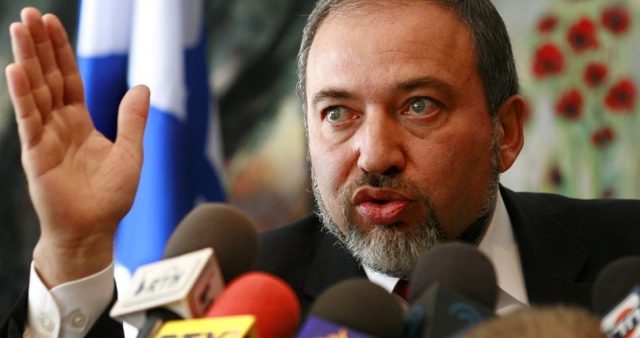
OCCUPIED JERUSALEM – Israel’s war Minister Avigdor Lieberman (Yisrael Beytenu) threatened to wage a bloody war against Gaza at the start of a meeting of the Knesset Foreign Affairs and Defense Committee.
“Wars are only conducted when there is no choice, and now there is no choice,” the minister claimed on Monday. “Anything less than the toughest response won’t help anymore. We have exhausted the other options.”
Lieberman alleged that Hamas was behind recent violence from the blockaded Gaza Strip and pays large sums to protesters.
“There is no popular uprising,” Lieberman said. “There is violence organized by Hamas. Fifteen thousand people don’t come by foot to the border at their own will. They come by bus and are paid.”
“I don’t believe in reaching an arrangement with Hamas,” he said. “It hasn’t worked, doesn’t work and won’t work in the future.”
Knesset Foreign Affairs and Defense Committee chairman Avi Dichter (Likud) also accused Palestinian Authority chairman Mahmoud Abbas of inflaming tensions in the Gaza Strip by preventing supplies and funding from reaching the people there.
“It is intolerable, unacceptable and unreasonable that Abbas closes the faucet for Gaza and Israel has to pay the price,” Dichter said.
Cut Emissions? Who, Me?
By Paul Homewood | Not A Lot Of People Know That | October 22, 2018
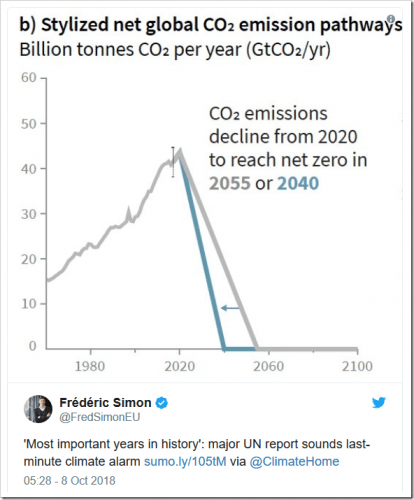
The IPCC says we have got to start cutting emissions radically immediately, but the rest of the world is not listening!
1) Australia rejects UN call to phase out coal
Australia has rejected a call by scientists to phase out coal use by 2050 to prevent the world overshooting targets in the Paris Climate Change agreement with potentially disastrous consequences.
The world’s biggest coal exporter on Tuesday said it would be “irresponsible” to comply with the recommendation by the UN’s Intergovernmental Panel on Climate Change (IPCC) to stop using coal to generate electricity.
Canberra also reiterated its priority is to cut domestic electricity prices rather than curb greenhouse gas emissions, which have risen for four consecutive years.
“To say that it [coal] has to be phased out by 2050 is drawing a very long bow,” said Melissa Price, Australia’s environment minister, who previously worked in the mining industry.
“I just don’t know how you could say by 2050 that you’re not going to have the technology that’s going to enable good, clean technology when it comes to coal. That would be irresponsible of us.” … https://www.ft.com/content/326d7228-cb83-11e8-b276-b9069bde0956
2) Japan Will Defy Calls By The IPCC To Phase Out Coal By Mid Century
Japan’s ambassador to Australia has confirmed Tokyo will defy calls by the Intergovernmental Panel on Climate Change to phase out coal by mid-century as part of a scientific appeal to limit global temperature increases to 1.5C.
Sumio Kusaka told The Australian that Japan would consider “all practical ways to further advance decarbonisation” but would need to bolster coal supply in the immediate future. He said Japanese plans to reduce reliance on fossil fuels in line with its international commitments would see a greater focus on nuclear energy, a form of power prohibited in Australia since 1998.
In recent weeks, Tony Abbott and Ziggy Switkowski, former chair of the Australian Nuclear Science and Technology Organisation, have called for the prohibition on nuclear power to be lifted to provide for the arrival of small modular reactors that can power towns of 100,000 people.
“I am aware the recent IPCC report contains some firm recommendations in relation to coal,” Mr Kusaka told The Australian.
“However, Japan is a country with very limited resources of its own, and bearing in mind our energy security requirements, it would be difficult for us to eliminate coal- fired power altogether.
“With a view to 2050, we are also considering all practical ways to further advance decarbonisation. In relation to this, some of the technologies we are looking at include renewable energy, nuclear energy and carbon capture and storage.’’
Mr Kusaka said Tokyo would continue to buy coal from Australia to secure its energy needs into the future. Japan was the largest importer of Australian thermal coal last year. – https://www.thegwpf.com/japan-will-defy-calls-by-the-ipcc-to-phase-out-coal-by-mid-century/
3) China To Speed Up End Of Green Energy Subsidies
SHANGHAI (Reuters) – China will speed up efforts to ensure its wind and solar power sectors can compete without subsidies and achieve “grid price parity” with traditional energy sources like coal, according to new draft guidelines issued by the energy regulator.
As it tries to ease its dependence on polluting fossil fuels, China has encouraged renewable manufacturers and developers to drive down costs through technological innovations and economies of scale.
The country aims to phase out power generation subsidies, which have become an increasing burden on the state.
The guidelines said some regions with cost and market advantages had already “basically achieved price parity” with clean coal-fired power and no longer required subsidies, and others should learn from their experiences.
They also urged local transmission grid companies to provide more support for subsidy-free projects and ensure they have the capacity to distribute all the power generated by wind and solar plants…
China’s solar sector is still reeling from a decision to cut subsidies and cap new capacity at 30 gigawatts (GW) this year, down from a record 53 GW in 2017, with the government concerned about overcapacity and a growing subsidy backlog.
According to the NEA, the government owed around 120 billion yuan ($17.46 billion) in subsidies to solar plants by the middle of this year.
4) Germany’s Merkel Promises New Law To Ward Off Diesel Driving Bans (And To Save Her Floundering Government)
BERLIN (Reuters) – German Chancellor Angela Merkel, campaigning for her Christian Democrats (CDU) to retain control of the crucial state of Hesse in next Sunday’s election, promised legislation to ward off the threat of air pollution leading to driving bans.
Speaking at a news conference on Sunday evening, Merkel said it would be disproportionate to ban dirty diesel cars from the road in places like Frankfurt, Hesse’s largest city, where nitrogen emissions limits were only marginally exceeded.
Following her allies’ disastrous showing in Bavaria’s regional elections last week, Merkel faces murmurs of dissent within her party. Defeat in the state to the resurgent Greens could prove fatal to her premiership.
US wants to be world’s sole power & doesn’t need treaties like INF – Russian senator
RT | October 22, 2018
Washington is ready to drop a landmark missile treaty with Moscow because it wants to become the dominant power on the globe, and that move will put its European allies in a tough spot, a senior Russian politician told RT.
The US doesn’t want to commit itself to the restrictions imposed by the Intermediate-Range Nuclear Forces Treaty (INF) because it is “seeking unilateral military advantage,” Konstantin Kosachev stated.
According to the politician, who chairs the Foreign Affairs Committee in the Lower House of parliament, “they want to be the only power in the world. And for that they don’t need these types of agreements.”
Speaking to RT on Monday, Kosachev recalled how in 2002 the US, under then-President George W. Bush, unilaterally pulled out of the Anti-Ballistic Missile Treaty (ABM Treaty), signed 30 years prior. President Donald Trump is now acting in a similar fashion, he argued.
The Intermediate-Range Nuclear Forces Treaty (INF) was signed in 1987. It effectively banned Moscow and Washington from having and developing short and mid-range missiles and the means of their delivery. Trump has said that he will “terminate” the deal, citing Russia’s alleged violations of the agreement – something Moscow’s officials deny.
Mid-range missiles will pose a “substantial threat” to Russian security if the US deploys them in Europe, Kosachev said. The senior lawmaker warned that such a move will turn the whole of Europe into a “zone of highest possible risk” and will prompt a swift response from Moscow.
“European countries are hostages in this situation.”
The European Union, meanwhile, called on both sides to maintain “constructive dialogue” to “preserve” the existing nuclear arms deal. Brussels expects the US to consider the consequences of ditching the agreement “on its own security,” as well as “the security of its allies and of the whole world,” EU spokesperson for Foreign Affairs and Security Policy, Maja Kocijancic, said in a statement.
“The world doesn’t need a new arms race that would benefit no one and on the contrary would bring even more instability,” the statement concluded.
If France Made to Pay For Pacific Nuclear Tests, it Could Set Legal ‘Precedent’
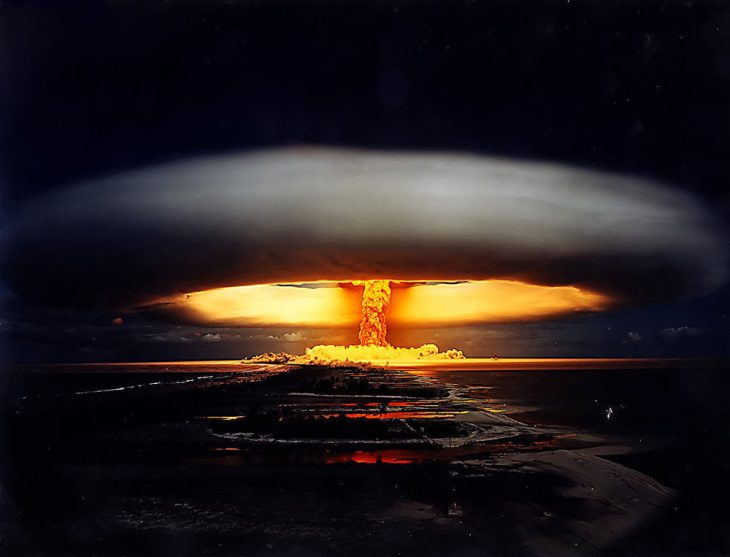
Licorne nuclear test – French Polynesia, 1970 © Flickr / Historical Records
Sputnik – October 22, 2018
Last week France was sued at the International Criminal Court for crimes against humanity over nuclear tests conducted on atolls in the Pacific Ocean. Sputnik spoke to Alexandre Dayant, a research fellow at the Lowy Institute, about the consequences of the French nuclear tests.
Mururoa and Fangataufa atolls in the South Pacific saw 196 nuclear tests over three decades until President Jacques Chirac finally ended the programme in the 1990s.
The French also conducted nuclear tests in the Sahara Desert.
A French Polynesian opposition leader, Oscar Temaru, filed a complaint at the International Criminal Court (ICC) in The Hague on October 10 claiming France had carried out crimes against humanity, in the form of local islanders.
Alexandre Dayant, a research fellow at the Lowy Institute in Australia, said the French carried out the tests between 1966 and 1996, first in the atmosphere and then in the sub-soil.
French Polynesians Have Paid Heavy Toll For Tests
Mr. Dayant said thousands of inhabitants have paid a heavy toll through birth deficits, congenital malformations and infirmities.
“The testing programme and its intentions were kept secret, and little information was provided about the possible effects of radiation to the people who worked there. For decades, France argued that the controlled explosions were clean,” Mr. Dayant told Sputnik.
“In the absence of an exhaustive epidemiological study, it was very difficult to estimate the number of potentially affected people at the time. Throughout the period of the Sahara and Polynesia trials, approximately 150,000 site workers (military contingent, contingent, civilian workers) and a local population of 80,000 were potentially exposed to doses of radioactivity,” Mr. Dayant told Sputnik.
French Polynesia, an overseas territory with a population of 290,000, is best known for the tourist resort island of Tahiti, 300 miles west of Mururoa and Fangataufa.
“This case aims to hold all the living French presidents accountable for the nuclear tests against our country,” Mr. Temaru said when he filed the complaint.
The Armaments Observatory published a study showing “the explosions have weakened the seabed and the soil is contaminated sustainably because of the fallout and the presence of toxic and radioactive debris (heavy metals and plutonium)” which threaten the population and the environment.
“Despite the mounting evidence, the French government denied all suggestion that the nuclear tests were harmful to health until 2010, when it introduced the Morin Law, a programme to give compensation to victims of radiation exposure. Nevertheless, the number of compensation cases accepted between 2010 and 2017 scandalized victims’ associations — only 13 out of more than a thousand filed. The main reason came from the fact that it was still difficult for victims to prove the link between their disease and the tests,” Mr. Dayant told Sputnik.
Call For French Polynesia to Become Independent
He said Mr. Temaru was a separatist who wanted the islands to eventually become independent like nearby Fiji and Kiribati.
Mr. Temaru claimed the Polynesians had sought a “responsible dialogue” with France since 2013 but their pleas had been “ignored and despised”.
“Fifty years after the first nuclear test on Mururoa, French Polynesians are still fighting for recognition of the effects of nuclear testing. This is why this claim, in front of the ICC, can help to put events back on the agenda,” Mr. Dayant told Sputnik.
“I don’t think Polynesians believe their claim will be heard. For the pro-independence party in French Polynesia, making this claim is more of a useful way to put events back on the political agenda, and on the international scene,” said Mr. Dayant who pointed out that when the ICC was set up it made it clear it would not prosecute crimes committed before July 2002.
Will other countries face similar claims at the ICC?
“It is a difficult question to answer to, due to the different geopolitical relationships that other Pacific Islands countries have with the US, UK and Russia. However, if successful, this particular legal procedure can be used as a precedent for future international claims,” Mr. Dayant told Sputnik.
Real hate taught inside Toronto school, not scrawled outside
By Yves Engler · October 20, 2018
Supporters of a private Toronto school that publicly promotes racism against Palestinians, flies an Israeli flag and then complains of “anti-Semitism” when pro-Palestinian graffiti is scrawled on its walls should give their heads a shake.
The Centre for Israel and Jewish Affairs, Friends of Simon Wiesenthal Center and B’nai Brith labeled messages scrawled on Leo Baeck Day School “hateful” and “anti-Semitic”, but fair-minded individuals should be more concerned with the hatred taught inside the school.
Recently someone wrote “Free Palestine” and“Long Live Palestine” on the school’s sign and flagpole. On a picture of a rally with Israeli flags at or near Leo Baeck (reports differ) someone wrote “Long Life [sic] to the Hamas.”
Saying it received a call to its “Anti-Hate Hotline”, B’nai Brith claimed the school was “defaced with antisemitic epithets”. FSWC and CIJA also put out statements denouncing “hatred”. A number of city councillors and MPs repeated their message with Mayor John Tory writing, “there is no place for hate” in Toronto.
But none of these groups or politicians mentioned the hate taught inside the school itself.
Leo Baeck is a bastion indoctrination and activism that meets most of the criteria of anti-Palestinian racism, as defined by the UK’s Jewish Voice for Labour.
An Israeli flag flies in front of the school and its publicity says it “instills” a “love of Israel” and “a deep and meaningful connection to … the State of Israel” among students. The school has an Israel Engagement Committee and in 2012 it received United Jewish Appeal Toronto’s inaugural Israel Engagement Community Award. That same year the Israeli Consul General in Toronto, DJ Schneiweiss, attended the launch of a new campus at Leo Baeck.
A 2012 Canadian Jewish News article titled “Leo Baeck adopts more Israel-centric curriculum” quoted the head of the school saying “one of the reasons people choose our school is a commitment to the State of Israel.” But, principal Eric Petersie told the paper, graduates felt unprepared to respond to the Boycott, Divestment and Sanctions movement on university campuses so the school increased its Israeli teachings.
Leo Baeck was the first school to join UJA Federation Toronto’s shinshinim (emissary) program, which began in 2007. Partly funded by the Jewish Agency for Israel, the program sends young Israelis to interact with Canadian students and staff. Last year the school hosted Idan Aharon and Roni Alkalay for three days a week. According to the Canadian Jewish News, “one of the ways Leo Baeck and the Young Emissary Program ensure that students understand the realities of Israel is by re-introducing the previous year’s shinshinim to students by way of live video chat from their Israel Defence Forces barracks dressed in their military uniforms.”
The school promotes the Israeli military in other ways. Last year’s Grade 8 class organized a school-wide fundraiser to support Beit Halochem Canada/Aid to Disabled Veterans of Israel and a choir “paid tribute to Israel’s fallen heroes.”
In another crude form of anti-Palestinianism, Leo Baeck works with the explicitly racist Jewish National Fund, which excludes the 20-25% of non-Jewish Israelis from its vast landholdings mostly stolen from Palestinians in 1948. Some “students took virtual walk across Israel in school thanks to JNF map and guidance”, noted a 2015 tweet. But, the JNF map shown to the nine and ten-year-olds encompasses the illegally occupied West Bank and Gaza, effectively denying Palestinians the right to a state on even 22 percent of their historic homeland. In all likelihood, Leo Baeck works with JNF Canada’s Education Department, which has produced puzzles and board games to convince young minds of its colonialist worldview, and organizes celebrations of JNF day at Jewish schools.
While B’nai Brith, FSWC and CIJA’s statements on the graffiti present the school as sacrosanct, apolitical, terrain, they didn’t object when a politician used it as a backdrop to express his anti-Palestinian bonafides. During a 2012 tour of Leo Baeck then Liberal Liberal party leadership contender Justin Trudeau criticized Iran, celebrated Israel and distanced himself from his brother Alexandre’s support for Palestinians.
Over the past year the Canadian Jewish News has published at least three stories about the growing attention devoted to Israel education at Jewish schools. A 2017 cover story titled “What to teach Jewish students about Israel?” detailed the growing importance given to classes on Israel at Jewish day schools. While students have long been “taught from a young age to see Israel as the land of milk and honey”, in recent years Jewish day schools have ramped up their indoctrination in reaction to “anti-Israel student groups on campuses throughout North America.”
When a school engages in partisan political activity in support of a foreign country, when it supports racism and intolerance against an oppressed people, when it indoctrinates children in these views, surely it cannot be surprised that some would be upset, and might illustrate their displeasure.
One can debate the merits of writing political graffiti on school grounds, but what news reports described was certainly not anti-Semitic.
Belgian official: Israel steals organs of Palestinian kids
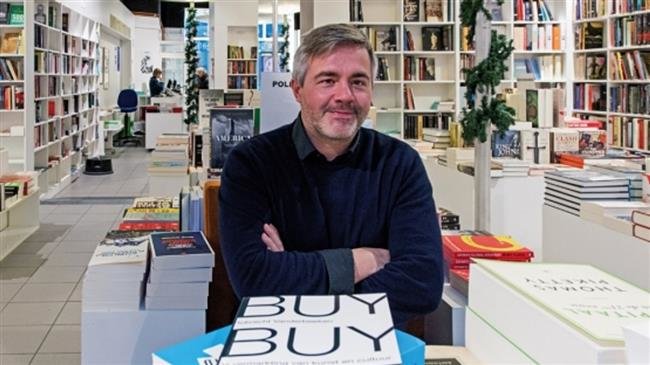
Robrecht Vanderbeeken, the cultural secretary of Belgium’s ACOD trade union
Press TV – October 21, 2018
A Belgian official’s remarks that Israel steals the organs of Palestinian children, whom it kills, have made headlines again after the news website which published them decided to stick to the story.
Robrecht Vanderbeeken, the cultural secretary of Belgium’s ACOD trade union and a philosophy of science scholar, had made the comments back in August in a column published by Belgian website De Wereld Morgen.
The population of the Gaza Strip is being “starved to death, poisoned, and children are kidnapped and murdered for their organs,” he wrote then.
The website recently received a complaint by Belgian watchdog, the Interfederal Center for Equal Opportunities, over the story.
De Wereld Morgen, however, stuck to the assertion that Israel “kidnapped” and “murdered” Palestinian children and used organs belonging to the Palestinians its forces killed.
In November 2015, the Palestinian ambassador to the United Nations said Israel harvested the organs of the Palestinians it killed.
In a letter to the UN secretary general, Riyad Mansour said the bodies of Palestinians killed by Israeli security forces “were returned with missing corneas and other organs, further confirming past reports about organ harvesting by the occupying power.”
The New York Times also said in an August 2014 report that transplant brokers in Israel had pocketed enormous sums of money. Based on the newspaper’s analysis of major organ trafficking cases since 2000, Israelis had played a “disproportionate role” in organ trafficking.
The issue of organ theft by Israel was first brought to the fore in a report published by Sweden’s most highly-circulated daily Aftonbladet in 2009.
Back in 2000, Dr. Yehuda Hiss, the former head of Israel’s forensic institute, divulged that Israeli pathologists at the institute would harvest skin, corneas, heart valves, and bones from the bodies of Palestinians and others often without permission from relatives.
The interview was, however, released no later than 2009 by Nancy Scheper-Hughes, a professor of anthropology at the University of California-Berkeley, who had conducted it as part of her investigation into the institute, in response to a row created between Israel and Sweden over Aftonbladet’s report.
Israeli Special Police remand Jerusalem Governor for four days

Ma’an – October 21, 2018
JERUSALEM – Israeli authorities remanded the Palestinian Governor of Jerusalem, Adnan Ghaith, several hours after he was detained from the Beit Hanina neighborhood in occupied East Jerusalem, on Sunday.
According to local sources, on Saturday, several vehicles, belonging to the special unit of Israeli forces, intercepted another vehicle that was transporting the Palestinian Governor of Jerusalem, Adnan Ghaith, in the Beit Hanina neighborhood, and detained him without providing a reason.
Sources added that Israeli forces immediately took Ghaith to an unknown location.
However, several hours after his detention, the Israeli authorities remanded Ghaith for four days.
Muhammad Mahmoud, Ghaith’s lawyer, said an Israeli court in Jerusalem referred Ghaith to the court of Ofer, near Ramallah, for allegedly “committing a violation” inside the West Bank.
The exact details of what the “violation” entails remained unknown.
Additionally, Israeli forces detained Jihad Faqeeh, 50, who is the head of the Jerusalem office in the Palestinian Intelligence force, at a military checkpoint near the Qatanna village, also in the central West Bank district of Jerusalem, as he was heading to work in Ramallah City.
Danish Journalist Slams Bill Effectively ‘Criminalizing Attitudes Critical of NATO’
Sputnik – October 21, 2018
An influential Danish politician has proposed a bill which would allow the government to prosecute Facebook users for posting opinions suspected of being ‘hostile to NATO’ or too similar to those of Russia. Speaking to Sputnik, Lars Jorgensen, a veteran Danish sociologist, journalist and long-time NATO researcher, outlined the proposal’s perils.
Last week, Soren Pind, a Danish Left-Liberal Party politician and former minister of education and justice, pitched a bill threatening up to 12 years of prison time for Danes accused of collaborating with Russian intelligence services or making statements which conflict with the official position of authorities during election campaigns.
Silencing Critics
Speaking to Sputnik Germany about Mr. Pind’s proposal, which is now up for debate among lawmakers, Danish journalist and Homo Sociologicus contributor Lars Jorgensen said that unfortunately, the parliament probably won’t be an obstacle.
“The Danish government has the support of Western countries for [the bill’s] implementation,” Jorgensen explained. “The bill effectively allows for the criminalization of attitudes which are critical of NATO. Another important point is the one allowing the government to say that you are cooperating with foreign intelligence services. As a Danish citizen, as a critical sociologist, I must now fear being accused of collaborating with foreign intelligence services, even if this is something I do not do,” he stressed.
Jorgensen’s fears are not unsubstantiated, given the number of articles critical of the Western alliance which are available on his website and Facebook pages, which have already faced censorship. “My Facebook account was blocked for months,” the journalist complained. “Later it was deactivated. I had about 4,000 friends there, including academics from all over the world.” Facebook, Jorgensen said, never adequately responded to his concerns.”I am a researcher with a critical view of NATO,” Jorgensen said. “At present, we don’t have many critical voices regarding NATO [in Denmark]. I studied the history of the alliance in detail, and communicate with a large circle of experts and specialists.”
This research has provided him with insights “destroying” NATO’s positive image, Jorgensen said. “It shows that what we are being told about the war in Yugoslavia is an absolute lie. The same goes for Libya, and Syria. For NATO and the political and corporate forces standing behind them, it’s very important to silence critical voices like myself,” the independent journalist noted.
Unfortunately, Jorgensen complained, Pind’s controversial bill has seen little attention from the Danish press, and even less criticism. The mainstream Danish media’s attitudes are fully in line with those of NATO, the journalist said.
“All of Denmark’s newspapers are controlled by large media groups. They would never allow me to speak to them, like I am speaking to you for this interview,” Jorgenson noted. Denmark, he lamented, has a deficit of alternative media. “If you were to look at materials about Syria in the Danish mainstream media, you would find that they are even wilder and more embellished than in the US. They are complete fiction. On the other hand, if you look at the authentic reports from Syria, as I have done, and listen to ordinary people, they all ask the same question: why is the British government supporting terrorists in Syria?”
Another part of the problem lies in the weak state of left and anti-war politics in Denmark, Jorgenson said, pointing out that a tiny communist newspaper was the first to even report on Pind’s bill or the dangers it poses to free speech.
Defense Against ‘Russian Influence’?
In the bill’s official wording, it is stated that the proposal is about the criminalization of collaboration with foreign intelligence services, or providing foreign agents with an opportunity to influence public opinion. Citing Norwegian intelligence, the bill speaks of a growing likelihood of “Russian campaigns to exert influence posing a growing threat to Denmark,” with Copenhagen said to be “very likely” to become a “target of such campaigns by Russia.”
Last week, Berlingske newspaper columnist Flemming Rose attacked the bill, which targets television, radio, newspapers, and other media, as well as internet and social media-based publications, pointing to a lack of a minimum threshold on what can be legally sanctioned. Criticizing the bill’s absurdity, Rose argued that it could be stretched to the point where Danish journalists are targeted for ‘changing a burnt-out lightbulb’ if it is demonstrated that they did so following the advice of foreign intelligence.
Earlier this month, the US, the Netherlands, the UK and several other Western powers accused Russian intelligence services of carrying out cyberattacks against a host of governments and international organizations. Moscow dismissed the claims as paranoid “spy mania.” Denmark’s parliamentary committee for defense head Nasser Khader suggested that Denmark should attack organizations suspected of being affiliated to the Russian government in cyberspace.
See also:
Danish Bill Proposes 12 Years in Prison for ‘Pro-Russia’ Opinion
US forces Iraq to award $15 billion contract to GE instead of Siemens
Press TV – October 21, 2018
Germany is angry after the US government intervenes in a multi-billion-dollar deal for Siemens AG to develop power stations in Iraq and forces Baghdad to opt for General Electric (GE) instead.
The American company signed a memorandum of understanding with the Iraqi government earlier this week, outlining their cooperation in the fields of oil and gas production and power generation.
A person, who has seen the paperwork, told The Financial Times that Washington plans to offer financing and insurance for US firms doing business in the Iraqi power sector.
GE’s agreement with Iraq dashed Siemens’ hopes of winning a $15 billion contract to supply 11 gigawatts of power-generation equipment to Iraq.
Until the US intervention, Siemens was considered the front-runner after its Chief Executive Joe Kaeser traveled to Iraq in September and spoke with Prime Minister Haider al-Abadi about the contract.
US officials, however, warned Abadi that awarding the contract to Siemens might jeopardize relations between Baghdad and Washington.
A top adviser to the Iraqi premier then told Siemens to give up because it was causing problems for Iraq given the US pressure.
“The US government is holding a gun to our head,” the adviser was quoted as saying by another person familiar with the incident.
According to people familiar with the negotiations, the US highlighted the number of American troops killed in Iraq and claimed that Iran had spurred Baghdad to pursue the Siemens deal.
“This is part of very strong campaign of engagement in Iraqi government formation and a very targeted effort to support the Iraqi government and minimize Iranian influence,” Garrett Marquis, a US National Security Council spokesman, claimed.
The Federation of German Industries (BDI) complained on Sunday that the US pressure to quash the Siemens power deal with Iraq was unacceptable, blaming President Donald Trump’s “America First” policy for corroding business decisions.
“To implement the America First doctrine in this way in the global competition of multinational companies is not acceptable,” Joachim Lang, BDI managing director, told Welt am Sonntag newspaper.
He emphasized that governments and companies should make deals based on business interests.
The US, backed by the UK, invaded Iraq in 2003 under the pretext that the former regime of Saddam Hussein possessed weapons of mass destruction.
No such weapons were ever found, but the invasion plunged Iraq into chaos and led to the rise of terrorist groups which continue to plague the country to this day.
Atlantic Council Podium Used to Force European Allies to March in Step
By Alex GORKA | Strategic Culture Foundation | 21.10.2018
Wess Mitchell, Assistant Secretary of State for European and Eurasian Affairs, the administration’s top diplomat focused on Europe and Eurasia, has warned that Europe’s energy dependence on Russia is unacceptable for the United States. That official was addressing the Atlantic Council’s “Championing the Frontlines of Freedom, Erasing the Grey Zone” event on October 18. According to him, the competition between the great powers has returned to become “the defining geopolitical fact of our time.” Through their lack of vigilance, European and American officials have allowed the growing Russian and Chinese influence in that region to “sneak up on us.” “Western Europeans cannot continue to deepen energy dependence on the same Russia that America defends it against. Or enrich themselves from the same Iran that is building ballistic missiles that threaten Europe,” the assistant secretary emphasized. Adding, “It is not acceptable for US allies in central Europe to support projects like Turkstream 2 and maintain cozy energy deals that make the region more vulnerable to the very Russia that these states joined NATO to protect themselves against.”
Something else that was highly interesting was his mention of Belarus along with Ukraine and Georgia as allies. The assistant secretary believes that “[t]he new principle is respect for the territorial integrity and sovereignty of the allies: Ukraine, Georgia and even Belarus. Washington expects states to respect the rights of their neighbors.” This makes one wonder if the Belarusian government knows it has been granted a new status. The official also mentioned Iran, which should not be allowed to sell oil to Europe because it has refused to abandon its ballistic missile program. Washington calls “on our allies to follow our lead and strengthen their laws to better screen foreign investments in their countries for national security threats.”
So, the US laws are flawless, its allies are not viewed as equal partners because they must follow America’s lead, or, in other words, do what they are told, and it’s up to Washington, not the national governments and parliaments, to decide what investments they need and where that money should come from. The leaders of the Central and Eastern European states should find it awkward, being rebuked for having overlooked “the foundational importance of the nation-state and national sovereignty,” while allowing unfriendly China and Russia to move in. “Our allies in Central Europe must not be under any illusions that these powers are their friends,” Mr. Mitchell explained. Obviously, he is quite sure that the governments of these nations are unable to grasp who is their friend and who is not. They are as naïve as small children. It’s good that the US is right here ready to enlighten them.
This highly-placed diplomat went on to explain that the United States should be seen as the protector of sovereignty, as it “rejects Russia’s territorial aggression against its neighbor Ukraine and [rejects] China’s predatory ‘debt-mongering’ throughout Central and Eastern Europe.”
Unlike its rivals, America does not seek dependencies, but rather independent states that should be “willing and able to share the burden of Western defense.” So, here is what independence à l’américaine is like, with its friends and allies absolutely free to comply with their protector’s instructions offering specific guidance about exactly how much they have to pay for defense, what investments to bring in, who to be friendly with, and how they should properly view the situation in their own region. Whatever happens in Central and Eastern Europe, everything has to revolve around the US.
“The United States has long had a tradition of not interfering in the details of European integration,” Mr. Mitchell assured us. Of course, telling the UK PM to sue the EU and thus expedite Brexit can certainly not be seen as interfering in European integration. Suggesting to French President Macron that he take France out of the EU is another example of noninterference. The Assistant Secretary expressed confidence that the allies could “beat back its competitors in Europe” with a little help from their American friends.
Also addressing the Atlantic Council’s October 18 conference, US Special Representative for Ukraine, Kurt Volker, revealed that Washington plans to stiffen the sanctions regime against Moscow “every month or two” to make it more amenable over Ukraine. The new policy suggests increasing the sanctions periodically, over time. Those remarks came after Russian President Vladimir Putin told the Valdai Club in Sochi that he hoped that a government more friendly toward Russia emerges from the Ukrainian presidential election that will be held on March 31.
Mr. Volker defied logic. On the one hand, he cited his “estimation… that the chances of their changing position now are lower then they were even a year ago.” Nevertheless, the best strategy for the West is to maintain pressure on Moscow through those economic sanctions —i.e., sticking to the very same measures that have proven to be useless, given that the “chances of their changing position now are lower.” So, the US and its allies should continue to implement a policy doomed to failure! But the ambassador states, “I think we need to keep on track. I believe that sanctions do have an impact and we see evidence of that in Russia.” What an bizarre way to convince his listeners!
“This is a shockingly big and important humanitarian catastrophe that no one talks about. We have over 10,000 people killed,” exclaimed this official who represents a nation that has just sent Ukraine, a country notorious for the corruption in its military ranks, a shipment of lethal arms so that it can kill more of its own citizens or let the weapons systems fall into the wrong hands and be used to kill other people outside of Ukraine. The “wrong hands” could use those weapons against the US military. With this kind of people you never know.
There is no penetrating insight, no reading between the lines, no wasting time on anything like analysis, and no attempts to find the logic in anything that’s said — nothing like that is required. It’s easy to understand highly-placed US State Department officials. You guys do what you are told, or else. And, just in case, don’t forget that your best friend and closest ally overseas carries a big stick to force you to march in step. These speeches are delivered from time to time to ensure that their “dear allies” remember that. The Atlantic Council’s podium fits the bill.
Featured Video

Yemen joins the war – Red Sea could be blocked next – Saudi regime at risk
or go to
Aletho News Archives – Video-Images
From the Archives
A superpower and “the world’s sickest warrior state”
By Paul J. Balles | March 8, 2010
Living through five or six major wars has hardened me to what I thought were the extremes of inhuman cruelty and brutality.
Two things made those extremes almost bearable: the brutality always revealed – at least according to the media coverage – the viciousness of the enemy. It was therefore quite understandable when our “brave men and women” pulverized the enemy.
Films of Japanese torturing captive Americans somehow justified holding Japanese Americans in internment camps during World War II; and only a small percentage of Americans found the bombing of Hiroshima and Nagasaki unreasonably vengeful at best, at worst, depraved.
The media giants in America portrayed the North Koreans as barbaric beasts with their captives, quite unlike their southern counterpoints – our allies during the Korean War. No one ever felt the need to explain how the South Koreans were a civilized breed while the North Koreans were absolute savages, at least according to the official line.
In Vietnam, our warriors justifiably (or so the media made us believe) dropped napalm on the North Vietnamese who had the gall to hide in villages and tunnels to ravage our invaders. At least it was accepted practice until some rogue photojournalist filmed a young girl screaming down a Vietnamese road in flames. … continue
Blog Roll
 Aletho News
- Russian tanker approaches Cuba despite US oil blockade
- Marandi: Yemen joins the war – Red Sea could be blocked next – Saudi regime at risk
- Pro-Palestinian French member of European Parliament denied entry to Canada
- Pakistan to Host US-Iran Talks
- How Indonesia’s tilt toward the US left it stranded in the Strait of Hormuz
- US has no choice but to retreat from Iranian borders: Top commander
- Iran Retaliation Strikes Chemical Plant Near Dimona
- AWACS’ Destruction is a Major Loss for US Military – Ex-DoW Analyst
- Israel’s Iran Strategy Uses US Military & Gulf States as Its Pawns
- Iran: Trump wanted regime change, now just begging for Hormuz to open
- If Americans Knew
- Israeli police block Catholic cardinal from entering Church of the Holy Sepulchre on Palm Sunday
- Israel is assassinating journalists again, more than any other nation, anywhere, ever – Not a ceasefire Day 170
- Over 300 US service members wounded, majority have brain injuries – Not a ceasefire Day 169
- Researchers at Human Rights Watch Resign Over Blocked Report on Palestinian Refugee Return
- Jewish Groups Are Backing a War Americans Don’t Want
- Eric Fingerhut Thinks He’s the President of the Jews
- Top Jewish Philanthropists, Rabbis Urge Israeli President to Take Action Against ‘Jewish Extremists’
- Don’t Be Fooled. Zionist Leaders Have Always Wanted to Control Southern Lebanon
- Israel’s widespread use of torture is a core element of its genocide against the Palestinian people
- In Israel’s War on Iran, Many Middle East US Bases Rendered “All But Uninhabitable”
- No Tricks Zone
- German Science Blog Accuses PIK Climate Institute Of Hallucinating Climate Tipping Points
- Devastating Assessment Of Comirnaty Vaccine By Former Senior Pfizer Europe Toxicologist
- New Study: CO2 Is ‘Effectively Negligible’ As An Explanatory Climate Change Factor Since 2000
- Former Pfizer Toxicologist Dr. Helmut Sterz Tells Bundestag Hearing Pfizer Vaccine Should Have Never Been Approved
- Energy Expert: Germany’s Nuclear Phaseout Was A “500 Billion Euro Mistake”
- New Research: South Australia’s Mid-Holocene Sea Surface Temperatures Were 4°C Warmer Than Today
- Storing Green Energy To Last Germany 10 Days Would Require A 60-Million Tonne Battery
- New Studies: UK Sea Levels Were 4 Meters Higher Than Today During The Mid-Holocene
- Destructive Green New Deal: German Energy And Metal Group Warns Of Drastic Crisis
- New Study Documents A 20-Year Pause In Arctic Sea Ice Decline – Driven By Internal Variability
 Aletho News