The People ‘Stopping Election Interference’ Are the Ones Who Are Actually Rigging the Election
By Daisy Luther | Organic Prepper | October 15, 2018
Last week, Mark Zuckerberg made the media rounds to give a rather shady explanation of why Facebook suddenly closed hundreds of incredibly popular pages in what’s being called The Alternative Media Purge. Zuckerberg accused the closed pages, many of which had millions of fans, of spreading “political spam.”
Ironically, many of the pages that were shut down had absolutely nothing to do with politics or elections, unless you include the fact that they recommended skipping the entire circus. None of these pages were accused of being “the Russians,” who were the scapegoat of the last surprise presidential election results. A couple of the things that many of the pages did have in common, incidentally, were an anti-war outlook and a police watchdog mentality.
But as far as making the election more resistant to interference, the result of the Alternative Media Purge is the diametric opposite. People will now only get one side of the story.
The alternative media changed everything during the last presidential election.
When Donald Trump announced his candidacy for president, much of the world snickered. Who was this reality television star to take on part of the Clinton Empire? There was no way, people scoffed, that Trump could possibly win.
It’s a proven fact that Hillary Clinton was in cahoots with the mainstream media throughout her candidacy. And the reason it’s proven is that organizations like Wikileaks released the evidence of it in a series of emails with her campaign manager and people like Donna Brazile of CNN. Brazile finally publicly admitted that she’d done so and that it was her “job to make all our Democratic candidates look good.”
The alternative media jumped on this story, as well as many other questionable emails that were divulged by Wikileaks, while the mainstream pretended that none of this was happening. And the mainstream did very little to cover the Democratic National Convention, during which the nomination was stolen from Bernie Sanders, who – if we’re being honest – probably would have had a much better chance of beating Trump than the notoriously unlikable Clinton. Here’s my coverage of it at the time.
The alternative media, never a fan of the goings-on in Clintonland, from the Haiti scandal all the way back to the “suicide” of Vince Foster in Arkansas, jumped on these stories as well as stories about her debatable health.
The fact that we had a robust alternative media at the time meant that these stories were heard. At the same time, the mainstream media was busy painting Donald Trump as a neo-Nazi fascist who hated minorities and would nuke somebody the day he got into office.
Now, imagine there had been no alternative media during that election.
If we hadn’t have had an alternative media telling other stories – enough stories that people were able to get a fuller picture of who both of these candidates really were – things might have turned out entirely differently. And while that would be all right with any number of people who loathe Donald Trump, would it have been a “fair” election?
Let’s look back even further at the candidacy of Congressman Ron Paul back in 2012. Dr. Paul was an incredible candidate with a glowing political resume, but he didn’t get the time of day. There was a media blackout on his candidacy and finally, he was forced to withdraw from the race. Many of us were budding alternative journalists at that time learned a valuable lesson during that election – what we were doing was important. There needed to be an option instead of letting the mainstream media present the only options and information to people.
By the time the 2016 election rolled around, those disappointed in how Dr. Paul was treated were determined that it would not happen again. That a candidate with a background full of sordid scandals would not get through an election cycle unscathed, painted as a glowing Madonna who would save us all.
So… during the fierce battle between Clinton and Trump, both sides of the story were told and told loudly.
Alternative journalists engaged the power of social media to connect with people who wanted to know more and they did it to such a degree that everything changed. Clinton, originally the front-runner, was suddenly in the fight of her life against a candidate that most people had considered a joke.
And that’s when everyone started blaming the Russians.
In a shocking article, the Washington Post printed a long list of websites that they claimed were run by “the Russians.” Many of these sites were run by folks I know personally who are decidedly not Russians, but simply bloggers who wanted to share the truth as they identified it. (This article was removed from WaPo – I’m guessing due to threats about legal action by many of the site owners accused of working for Russia.)
Although investigation after investigation has been undertaken, there’s still no proof that Russia tampered with the election, nor that they colluded with Donald Trump.
Years later, the Washington Post sticks to their story with headlines like “Without the Russians, Trump Wouldn’t Have Won.” In the piece, they admitted that there isn’t any official proof and they cited Buzzfeed.
While the intelligence agencies are silent on the impact of Russia’s attack, outside experts who have examined the Kremlin campaign — which included stealing and sharing Democratic Party emails, spreading propaganda online and hacking state voter rolls — have concluded that it did affect an extremely close election decided by fewer than 80,000 votes in three states. Clint Watts, a former FBI agent, writes in his recent book, “Messing with the Enemy,” that “Russia absolutely influenced the U.S. presidential election,” especially in Michigan and Wisconsin, where Trump’s winning margin was less than 1 percent in each state.
We still don’t know the full extent of the Russian interference, but we know its propaganda reached 126 million people via Facebook alone. A BuzzFeed analysis found that fake news stories on Facebook generated more social engagement in the last three months of the campaign than did legitimate articles: The “20 top-performing false election stories from hoax sites and hyperpartisan blogs generated 8,711,000 shares, reactions, and comments on Facebook.” Almost all of this “fake news” was either started or spread by Russian bots, including claims that the pope had endorsed Trump and that Hillary Clinton had sold weapons to the Islamic State. (source)
Buzzfeed ? Isn’t that where you go to take a quiz to find out what kind of potato you are?
That leads us to Facebook’s potential election interference
Last week, as I mentioned, hundreds of Facebook pages were shut down without warning. Many of these sites also lost their Twitter accounts on the same day. This is reminiscent of last month’s attack on Alex Jones.
Anyone who disagrees with the establishment is being abruptly silenced.
Zuckerberg and friends are saying that this is so that we can be sure we don’t have election interference in the midterms… but what they’re really doing is interfering in the elections themselves.
They’ve gloated about everything from “featuring Facebook pages that spread disinformation less prominently so that fewer people potentially see them” to [purging] “559 politically oriented pages and 251 accounts, all of American origin, for consistently breaking its rules against “spam and coordinated inauthentic behavior.”
The pages which have been removed or shadowbanned have run the gamut of political philosophies, but the fact is, people like Mark Zuckerberg, the folks at Google, and Jack Dorsey of Twitter are deciding which information gets to be seen. They’re deciding whether something is “disinformation” or truth. They’re deciding if people who have spent years building a following get to still reach the people who opted to follow them.
Because Facebook reaches more than 2 billion people each day, this is a problem of epic proportions.
I believe that it is Facebook itself that is tampering with the election by manipulating what they want people to see. If the alternative media changed everything in the 2016 election due to the availability of more information, Facebook will change future elections due to their manipulation of the information users are allowed to see.
If you are conservative or antiwar or anti-overreaching-government or libertarian, you’re now persona non grata. Even if you aren’t in the minority, you’ll be made to feel like you are in the giant echo chamber of “approved media.” If you support a different candidate than Big Tech, prepare to be marginalized, silenced, and ignored. That holds true whether you opt for anyone other than their “choice.” They WILL control the outcome of the presidential election the next time around.
If you really want to see what election interference looks like, you’re getting a live demonstration right now.
The Khashoggi Disappearance and the Stalled Vision 2030 Plan
Our Vexed and Bitter Masters Seek Regime Change Again
By Scott Creighton | nomadiceveryman | October 18, 2018
Back in April of this year, a journalist in Gaza wearing a vest marked “PRESS” was deliberately shot and killed by IDF snipers. That brings the total number killed to 18 since the start of the Second Intifada. No one of consequence called for regime change in Israel.
As of July this year, there had already been six journalists killed in Mexico by drug cartels linked to Mexico’s corrupt government and our own intelligence services. The last one beaten to death in a horrific murder. Last year the number of journalists murdered set a new record for the country at 42. As far as I know, the MSM and Lindsey Graham have yet to call for sanctions and regime change.
In Columbia there have been two murdered for covering things the rulers didn’t want covered. But we like Columbia’s neoliberal government so for now, not a peep about changing it.
What makes the disappearance of Jamal Khashoggi so different? This is a question a few writers and researchers have been asking themselves and a couple of us have come to some honest, sensible, business-oriented answers… since of course the U.S. and her allies are all about Business.
Now let’s be clear. I write about Khashoggi’s disappearance because the only hard evidence that we have before us is this…

CCTV image of the missing Saudi Journalist Jamal Khashoggi entering the Saudi consulate
That is a blurry image of a middle aged man walking toward the door of the Saudi consulate in Istanbul. It is not proof of a murder. It is proof someone walked toward a door and then entered the building.
Everything else is speculation or statements from “anonymous sources close to the investigation” meaning it’s all baseless rumor, innuendo or deliberate disinformation.
It is entirely possible that the man in the image is not Jamal Khashoggi. And it is entirely possible that it is.
Therefore it is also entirely possible that Khashoggi is not dead by the hands of the Saudis and simultaneously… it is.
But it is not definitive by any stretch of the imagination in either way… unless all of a sudden you take our intelligence assets at face value as if they never lied to us before. Which is quite a leap of faith in my opinion.
All of the journalist murders I listed above have definite proof of their demise. Bodies. DNA. Causes of death. Death certificates. Coroner’s reports. Things of that nature. Here there is only that grainy image taken from a grainy video of about 4 seconds in length. And that, boys and girls, is it.
So why all the pressure being put on Saudi Arabia to essentially foment a regime change in the Kingdom of Saud over a grainy picture of a man who set up a Saudi Regime change NGO in Delaware back in January of this year? A regime change NGO promoted by the National Endowment for Democracy.
Why are MSM outlets and even so-called “alternative anti-war” (Common Dreams, Moon of Alabam and others) ones suddenly parroting the likes of Bernie Sanders and Lindsey Graham in calling for Mohammad bin Salmon’s removal from office?
Was the murder so brutal that it offended even the hardest regime change advocates in D.C. and their allies in the Washington Post? Do they not know the UAE hired a for-profit death-squad based in the U.S. to kill political rivals in Yemen in vicious brutal ways from 2015-2017?
In one case the American former Special Ops mercs put a big bomb on the door of a building they thought their one target was holding a meeting with a whole bunch of others. They hoped to kill EVERYONE in the building but were too late. So later they developed a methodology of using bikes to put bombs on cars in busy traffic intersections killing their targets that way. Them and anyone else who happened to be close.
Have you ever seen someone die slowly after a bomb goes off and blows off their legs or arms or rips open their guts? It’s horrible. And they weren’t even the target.
And yet this hit squad operated with impunity for a favored nation of ours and most involved with the operation find it hard too believe our military and political leadership didn’t know about it. Notice, it started under Obama and continued under Trump. What a shock huh?
You think the alleged abduction, torture, murder and dismemberment was so shocking to those folks they just HAD to do SOMETHING?
Or do you think it was because Khashoggi was pretending to be a journalist at the Washington Post as he fought for regime change in Saudi Arabia?
As some journalists , some news agencies and bloggers have pointed out, Khashoggi’s disappearance perfectly coincides with a number of international events that make this case rather suspect. Unfortunately that number is relatively low.
Khashoggi had extensive ties to Lockheed Martin, the old guard of Saudi royalty, the CIA and other intelligence assets… and of course… his very own regime change focused NGO.
We also know that the deal President Trump made with MbS and Saudi Arabia last year for 110 billion dollars worth of weapons sales was falling through and a deadline for them to purchase the horribly untrustworthy THAAD missile defense system came and went on Sept. 30th of this year with no purchase by MbS.
And we know that the Saudi ambassador to Russia was worried about the U.S. imposing sanctions on Saudi Arabia as recently as Sept. 21 due to them buying the Russian S-400 system instead.
Add to all that the Davos in the Desert meeting taking place this week which the risk of sanctions would seriously screw up… and you have a perfect storm of motive for someone OTHER than Saudi Arabia to either kidnap, kill or “send into early retirement” one Jamal Khashoggi. Right?
Now, 110 billion dollars in deals promised to the MIC is a lot of money, that is for sure. But the question kept rattling around in my feeble little brain… is that really enough to motivate every sector of American empire support, including the fake “alt-right and alt-left” outlets to go all out calling for YET ANOTHER regime change operation in the Middle East?
Seems like a damn good question doesn’t it?
And my answer was “no”
Then I started digging again and what I found makes that 110 billion dollars look like something I give to the local homeless guy every morning when he shows up lightly rapping, rapping upon my chamber door.
Try 4 trillion on for size. Four Trillion spread across every facet of our glorious business community and stretching into every pocket of every director sitting on both the U.S. Chamber of Commerce and the for-profit Central Bank system.
Now THAT is something that EVERYONE can get behind, huh?
Yes, MbS is on the outs as they say but it’s not entirely due to his reluctance to buy U.S. made crappy weapons of war (though that is part of it)
What is really at play here is his apparent reneging on an even bigger deal and an ideological shift that made him the darling of all neoliberals in D.C., New York, London and Tel Aviv.
You see, MbS was installed by our intelligence assets for one purpose: he was finally going to be the Saudi royal family member to fully neoliberalize Arabia on behalf of our hot money speculators and Big Business interests.
The plan was called Vision 2030 (put together by globalist neoliberal technocrats from McKinsey in 2014) and when he first signed on for it (open financial markets to hot money speculators and Wall Street, privatization of everything from nationalized oil company to healthcare) MbS immediately became the DARLING of the Middle East. Man, the right and left of the Business Party loved him to death. Lindsey Graham drooled over him right along side Chris Mathews. Obama praised him as did Trump and everyone in between.
They coupled that with some bullshit about letting women drive cars so the left would get on board and suddenly the brutal dictatorship in Saudi Arabia was something left of Sesame Street. Bert and Ernie would still get beheaded for being gay, the Grouch would have his trash-can privatized and Big Bird would still loose his head for asking too many questions… but the facade was going to hold and a Saudi Arabia would be the new Shining City on the Hill.
All was great in the land Colonel Thomas Edward Lawrence.
But then a funny thing happened on the way to neoliberalization: the vulture capitalists kept being told … to wait till the feeding frenzy could begin.
- A $2 Trillion Saudi Aramco IPO Keeps Getting Less Realistic Oct. 8, 2018
- Successful reformation in Saudi Arabia far from a sure thing Oct. 12, 2018
- Aramco Was Supposed to Be the Biggest IPO Ever. Now Even the CEO Can’t Say When It Will Happen Sept. 24 2018
- Saudi Arabia’s Vision 2030 Plan Is Too Big to Fail — Or Succeed July 27 2018
- Beyond Saudi Aramco’s stalled IPO Aug 25 2018
The oil company IPO was the biggest single disappointment for the masters of the universe but there were many others detailed in the Vision 2030 plan. The IPO, the largest single offering of it’s kind in history, was supposed to have already taken place, making folks like Exxon, Goldman Sachs and BP shareholder in Saudi Arabia’s massive oil business. But it never happened and from the looks of it, the owners of all things planet Earth are getting tired of waiting around for the feast.
Mohammad bin Salmon was raised up and made the heir apparent to the throne in Saudi Arabia ahead of older, more established royal family members for one reason and one reason alone: he was willing to allow the West to roll into the country and chop it up and sell it off for profits.
Keep in mind… by 2014 the glorious captains of industry and banksters had already digested their latest consumables found in places like Libya, Ukraine and Iraq. Syria was resisting and the Russians and Iranians were making it hard for them to anticipate when they would get their next mergers and acquisitions meal fed to them so they needed something to tide them over so to speak. They needed new markets to exploit and pillage and Obama apparently refused to invade Venezuela so something had to give.
Then along came a power struggle in a country they have coveted for decades. A nation with tons of state-owned property and businesses and services they could consume.
Saudi Arabia.
All they needed was a front-man on the inside they could promote and then control.
Prince Mohammad bin Salmon fit the bill perfectly.
He was young, would be their man for decades to come and his youth made him seem like something they could promote as the new face of the old kingdom.
But something has changed in him and thus, in our masters’ opinion and trust of him.
Hell hath no fury like a globalist spurned and what we see now is clearly a ramification of that love lost and turned to hatred.
Is it a coincidence that all of these things are coming to a head at the exact same time a man committed to removing MbS from power goes “missing” at the consulate in Istanbul?
Possible I assume.
But I quit believing in geo-political coincidences right around the same time I quit believing in our two party “democracy” so for me, this seems like the beginnings of another neoliberal regime change operation.
Only this one will be fueled by the fire of an unrequited love and the desperation of vulture capitalists starving for another carcass upon which too feed.
The US Meddles In Syria’s Constitutional Reform Process By Threatening Sanctions
By Andrew KORYBKO – Oriental Review – 18/10/2018
The US is threatening to further sanction Syria if Damascus doesn’t make progress in America’s preferred direction during the ongoing constitutional reform process.
The US special representative for Syria James Jeffrey conveyed this intention on the sidelines of the UN General Assembly after his country and a handful of others called upon Staffan de Mistura to report back to them by the end of this month about which of the 50 people he’s supposed to select to participate in Syria’s constitutional committee.
Prior agreements on the creation of this important political mechanism stipulate that the delegates will be chosen from members of the pro-government, domestic opposition, and external opposition factions, and while this is admittedly an ultra-sensitive process, the US and its allies feel that Syria has been dragging its heels on it for far too long and that’s why they want to crank up the pressure on Damascus by threatening more sanctions against it.
The elephant in the room is the issue of so-called “decentralization”, which appears to be the only pragmatic political solution for dealing with the Kurdish-controlled agriculturally and energy-rich northeastern third of the country that’s reported to host around 20 American bases but which President Assad has sworn will return to the central fold by one way or another.
This is becoming ever less realistic to achieve as Russia signaled that it won’t engage in the nuclear brinkmanship that would be needed for supporting Syria’s otherwise futile efforts to evict the US and make this happen, hence why a “compromise” is the only peaceful way for resolving this issue. The US also knows that its Russian, Chinese, and Iranian rivals lack the money needed for rebuilding the liberated areas of Syria, which is why it’s weaponizing reconstruction aid for political purposes.
Pressing home the point of what he wants to see achieved, Jeffrey also hinted at imposing a “no-fly zone” over the Kurdish-controlled northeast and replicating the state of affairs that prevailed in Iraqi Kurdistan from 1991-2003 during which time the US carried out occasional airstrikes to prevent the central government from reasserting its sovereignty in this region. Since the de-facto “partition” of Syria is already a fait accompli at this point, the next goal of the US and its allies is to compete with its rivals over the reconstruction of their respective “spheres of influence” in the country.
Despite it being comparatively easier for the geographically smaller, less populated, and more resource-rich northeast to recover a lot quicker than the rest of Syria, the US hopes that this can serve as a “demonstration effect” for the rest of the country and subsequently be manipulated through infowars and perception management tactics to somehow “delegitimize” the predictably slower efforts of Damascus and its allies in this regard.
The post presented is the partial transcript of the CONTEXT COUNTDOWN radio program on Sputnik News, aired on Friday Oct 12, 2018
Mysterious IPCC Expertise
The IPCC publishes the citizenship and gender of its authors – but says nothing about their scientific expertise
By Donna Laframboise | Big Picture News | October 17, 2018
The Intergovernmental Panel on Climate Change (IPCC) claims to be a scientific organization. But it’s really a political one.
An obvious tell is how it describes its personnel. In the old days, IPCC reports listed people according to their role and their country. Matters have improved since then.
Today, the IPCC gives us six data points about its personnel rather than three. A webpage associated with its latest report tells us each individual’s:
- name
- IPCC role (coordinating lead author, lead author, review editor)
- gender
- country of residence
- citizenship
- institutional affiliation
But this only looks like progress. In the real world, the additional info is irrelevant. Science doesn’t care where someone lives or what citizenship they hold. Science doesn’t care if they’re a man or a woman.
If the IPCC is a panel of experts, the critical issue is: What is each of these people an expert in? More than 30 years after its founding, the IPCC still thinks it doesn’t need to talk about this.
For the UN bureaucrats who run the show, some things are important. Some are not. The nature of an author’s scientific expertise clearly isn’t a burning issue. But lots of attention is being paid to checking diversity boxes.
US Will Walk Out of Nuke Treaty Again if Iran Agrees to New Deal – Scholar
Sputnik – 17.10.2018
Six months after Donald Trump announced the US withdrawal from the 2015 nuclear deal with Iran, Washington is proposing to sign a new agreement with Tehran.
The US is ready to give “a whole lot” to sign a new treaty with Iran that would take into account all of Washington’s concerns, including Tehran’s missile program, the US Special Representative for Iran Brian Hook said.
It is not the first time that Washington has invited Iran to conclude a new treaty since it walked out of the 2015 nuclear deal with Tehran.
Tehran insists that it won’t ink a new agreement with the US after Washington’s mistake of withdrawing from the Joint Comprehensive Plan of Action (JCPOA).
In his address to the 73rd session of the UN General Assembly in September, Iranian President Hassan Rouhani said that Tehran would agree to negotiate with the US but only if Washington changed its attitude towards the Islamic Republic.
In an interview with Sputnik Persian, Iranian political observer Ali Reza Rezakhah and a Tehran University expert in US affairs, Mohammad Marandi, spoke about the terms on which Tehran would be ready to sign a new accord with Washington.
According to Dr. Rezakhah, signing a new a new agreement with the US made no sense as Washington’s departure from the JCPOA showed everyone that it can’t be trusted.
“Statements alone are not enough, because the US has repeatedly declared its intention of concluding a new treaty with Iran. Singing a new treaty with the United States makes no sense. This is logical too because one can conclude a new agreement only with someone who fulfills his obligations. This means that we need to be confident about what the United States is saying,” Reza Rezakhah said.
He added that there weren’t any guarantees that the US would fulfill its obligations under a new treaty.
“It unilaterally withdrew from the JCPOA treaty, violating all its international obligations. Neither Iran nor any other country can agree to sign a treaty with the United States, since they (the United States) do not honor their obligations. When speaking at the UN General Assembly, President Hassan Rouhani stated that Iran is ready to negotiate, provided that the United States takes the first step by adhering to the JCPOA.”
Mohammad Marandi flatly ruled out any new agreement with the US.
“It will not happen. Iran will not sign a new agreement with the United States or re-negotiate with it. With the JCPOA in place, what new agreement can we talk about? If the Americans do not understand this, then they know the Iranians even worse than we could have imagined.”
According to him, by violating the JCPOA the US proved that it can’t live up to its commitments.
“Tomorrow we will conclude an agreement with the United States, and they will walk out of it again. This defies logic,” Dr. Marandi argued.
“Even if Iran agrees to negotiate (a new agreement), the United States will take this as a sign of its pressure having worked and will ramp it up even more,” Marandi continued.
Iran would agree to negotiate with the US only if Washington returns to the JCPOA and negotiates within its framework,” Mohammad Marandi concluded.
In May, President Donald Trump said he was withdrawing the US from the 2015 nuclear agreement with Tehran and promised to impose the “highest level” of sanctions on the country’s energy petrochemical and financial sectors despite objections from Europe as well as Russia and China — the other parties to the deal, known as the Joint Comprehensive Plan of Action (JCPOA).
Washington has also warned countries to stop buying Iranian oil starting from November 4 and threatened to use sanctions against those who do not.
The first wave of US sanctions on Iran took effect on August 6, targeting the country’s automotive sector, trade in gold, and other vital metals.
The remaining sanctions will come into effect on November 4, targeting Tehran’s energy sector, petroleum-based transactions, and transactions with Iran’s Central Bank.
American mercenary boasts of role in ‘targeted assassination program’ in Yemen
RT | October 17, 2018
A Hungarian-Israeli security contractor based in the US, Abraham Golan, has claimed he ran a targeted assassination program in Yemen as part of the Saudi-led coalition currently waging a proxy war against Iran-backed Houthis.
The US is supplying weapons, intelligence, and other support to the coalition, but Golan’s account, as told to BuzzFeed, reads like something out of a spy thriller.
Golan claims the United Arab Emirates (UAE), part of the coalition, hired his mercenary company, Spear Operations Group, to kill specific enemies, including Anssaf Ali Mayo, leader of the Yemeni political party Al-Islah, which the UAE considers a terrorist group. The Mayo assassination was ultimately unsuccessful – Mayo disappeared from Yemeni politics for a while, and the Spear crew even thought he was dead, but he is currently serving in the Yemeni government, alive and well.
The botched assassination of December 29, 2015 is seen by observers from both sides as the opening salvo in a “targeted campaign,” which former UN investigator Gregory Johnsen says eventually took out 25 to 30 members of Al-Islah and other clerics.
Golan claims responsibility for several of the high-profile assassinations in Yemen, though he refuses to share which ones. Not because of remorse – he’s a mercenary, after all – but because his business inhabits a legal gray area, and perhaps because he doesn’t want his professional secrets getting out. Golan is trying to sell his business model to the US military.
Experts have cast doubt on the idea that the US, which essentially armed and trained the UAE’s military from the ground up, didn’t know the UAE had hired Americans to conduct assassinations in a war in which the US is deeply involved. The CIA claimed ignorance of the matter, but one agency official – after categorically denying the government would allow such a thing – confirmed the story, himself shocked that American mercenaries had been allowed to operate “almost like a murder squad.”
The US does enjoy a privileged place within UAE military circles, having sold the Arab nation $27 billion in arms and defense services since 2009. While the US theoretically bars mercenaries from participating in combat, it hires them to do everything else in the military, and one man’s security detail is another man’s firefight.
Private contractors are supposed to be regulated by the State Department, which claims it has never permitted mercenaries to work for another government, and US law forbids any who would “conspire to kill, kidnap, [or] maim” a foreign citizen. But the publication cites multiple sources who claim Spear mercenaries were given military rank by the UAE, providing them legal cover for their actions (US citizens are allowed to serve in foreign militaries, with some exceptions).
BuzzFeed was admittedly unable to verify much of Golan’s biography, which allegedly includes a stint in the French Foreign Legion and friendships with notorious figures like former Mossad head Danny Yatom and Serbian militant Arkan. A CIA acquaintance calls him “prone to exaggeration.” The details of his story – “target cards” handed out with names, photographs, even phone numbers; a Jolly-Roger-esque company flag – are Hollywoodesque.
Golan supposedly offered the UAE his company’s services as targeted assassins, explicitly tasked to “disrupt and destruct” Al-Islah. On top of $1.5 million a month, they would receive kill bonuses and train UAE soldiers. He claims to have declined missions targeting individuals outside the party, but those claims are unverified, and his partner admits that some targets may have simply been enemies of the UAE’s ruling family.
However much truth there may be to Golan’s tale, it illuminates the consequences of War on Terror mission creep – an overabundance of highly-trained special forces, lax oversight regarding war crimes and international law, an increasingly privatized fighting force, and the notion that enemy combatants are anyone a government deems them to be mean Spear’s business model could strike US commanders’ fancy after all.
Saudi-led military aggression left over 15,000 civilians dead: Rights group
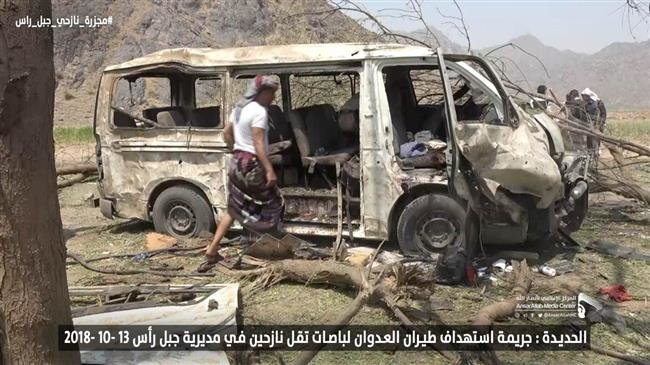
Picture, provided by Yemen’s Houthi Ansarullah movement, shows aftermath of Saudi airstrike against Gabal Ras area in Yemen’s western coastal city of Hudaydah on October 13, 2018.
Press TV – October 16, 2018
The Legal Center for Rights and Developments in Yemen says the ongoing Saudi-led military campaign against the impoverished and conflict-plagued Arab country has claimed the lives of more than 15,000 civilians.
The center, in a statement released on Monday, announced that the aggression has resulted in the death of 15,185 civilians, including 3,527 children and 2,277 women.
A total of 23,822 civilians, among them 3,526 children and 2,587 women, have also sustained injuries, and are currently suffering from the lack of medicine, medical supplies and poor treatment due to the crippling Saudi siege.
The center further noted that the Saudi military aggression has also caused the death of nearly 2,200 Yemenis from cholera.
It highlighted that aerial assaults being conducted by the Saudi-led alliance have resulted in the destruction of 15 airports and 14 ports, and damaged 2,559 roads and bridges in addition to 781 water storage facilities, 191 power stations and 426 telecommunications towers.
The statement went on to say that the incessant Saudi-led bombardment campaign has destroyed more than 421,911 houses, 930 mosques, 888 schools, 327 hospitals and health facilities plus 38 media organizations, halted the operation of 4,500 schools and left more than 4 million people internally displaced.
In addition, the Saudi-led coalition has targeted 1,818 government facilities, 749 food storehouses, 621 food trucks, 628 shops and commercial compounds, 362 fuel stations, 265 tankers, 339 factories, 310 poultry and livestock farms, 219 archaeological sites, 279 tourist facilities and 112 playgrounds and sports complexes.
The Legal Center for Rights and Developments in Yemen then called on the United Nations to shoulder its responsibilities concerning protection of human rights and the rules of international humanitarian law in Yemen.
It also called on the international community to take on its legal, moral and humanitarian responsibilities, stressing the need for urgent international and regional actions to end the Saudi-led aggression against Yemen.
The center finally asked the United Nations Human Rights Council (UNHRC) to conduct a professional and impartial investigation into the crimes being perpetrated against civilians in Yemen.
Saudi Arabia and a number of its regional allies launched a devastating military campaign against Yemen in March 2015, with the aim of bringing the government of former president Abd Rabbuh Mansur Hadi back to power and crushing the country’s popular Houthi Ansarullah movement.
Diplomatic Deadlock: Can U.S.-North Korea Talks Survive Maximum Pressure?
By Gregory Elich | Counterpunch | October 16, 2018
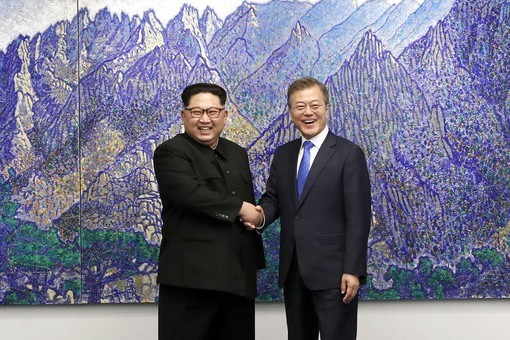
South Korean President Moon Jae-in’s meeting with North Korean Chairman Kim Jong-un on September 18-20 culminated in the signing of the Pyongyang Declaration, which marked a significant advance towards peace and heralded a welcome warming in relations. Since that time, however, contradictions within the Trump administration’s North Korea policy threaten to forestall further progress and test the patience of its South Korean ally.
Among the measures outlined in the Pyongyang Declaration, the two sides agreed to “expand the cessation of military hostility in regions of confrontation such as the DMZ,” with the goal of removing the danger of war “across the entire Korean Peninsula.” [1] North and South Korea quickly moved to begin to implement the plan, shutting down some border guard posts and initiating the removal of landmines from the Joint Security Area. Plans are also afoot to establish a no-fly zone over the DMZ, and communication procedures are being established to prevent armed clashes.
The Democratic People’s Republic of Korea (DPRK, the formal name for North Korea) committed to dismantling its missile launch platform and test site “under the observation of experts from relevant countries.” North Korea promised that it would “take additional measures, such as the permanent dismantlement of the nuclear facilities in Yongbyon, as the United States takes corresponding measures in accordance with the spirit of the June 12 U.S.-DPRK Joint Statement.” [2]
For a majority of Koreans on both sides of the border and in the diaspora, the Pyongyang Declaration was an encouraging development on the path to peace and reconciliation. The mood in Washington, though, was far from celebratory.
Livid over South Korean plans to establish a no-fly zone and demilitarize the inter-Korean border, U.S. Secretary of State Mike Pompeo phoned South Korean Foreign Minister Kang Kyung-wha before the Moon-Kim summit and harangued her, accusing her of not knowing what she was doing. Korean media suggest that Pompeo used foul language in expressing his displeasure to Kang. Pompeo was particularly upset at not being briefed beforehand. A second call to Kang later in the day was more conciliatory, after Pompeo had learned that the South Korean government had informed U.S. officials, but no one within the Trump administration had bothered to notify him. [3]
Alarmed at the prospect of an improvement in relations between the two Koreas, as soon as the summit was over the U.S. Treasury Department emailed several South Korean banks and warned them not to engage in business with North Korea. It also conducted conference calls with Korean banks on two consecutive days to drive home its point. The Treasury Department said it was aware of inter-Korean discussions on plans for joint economic projects and asked the banks if they had any plans to proceed. It emphasized that U.S. and UN sanctions remain in force, and warned that the banks risked incurring secondary sanctions. [4]
South Korean Foreign Minister Kang Hyung-wha fed American fears that its South Korean ally was not behaving in a sufficiently subservient manner when she told the National Assembly that a review of the sanctions that former president Lee Myung-bak had imposed on North Korea “is underway.” She noted that since the majority of the sanctions overlapped with those of the UN, this would not necessarily mean a “substantive” change was in the cards, and this was a matter “to be reviewed in comprehensive consideration of South-North relations.” [5]
As mild and conditional as Kang’s remarks were, Washington’s reaction was swift and insulting. “They won’t do that without our approval,” Trump said. “They do nothing without our approval.” Trump’s blunt language was revealing. In Washington’s mindset, the alliance with South Korea is a master-servant relationship. Although many Koreans were rightly offended at the language dismissing South Korean sovereignty, the government’s response was overly obsequious. Unification Minister Cho Myoung-gyon was quick to correct the impression left by Kang’s remarks, promising that “no detailed review has been made,” and asserted that his government’s position is that it is too early to discuss easing sanctions. [6]
At the same time, Moon sought to assuage worries in Washington that the threat of peace on the Korean Peninsula would not mean an end to the U.S.-South Korean military relationship. “I will further strengthen the Republic of Korea Navy so that it may go beyond the Korean Peninsula and contribute to peace in Northeast Asia and the entire world,” he announced at an international naval review at Jeju Island. [7] Moon’s meaning was clear: South Korea can be counted on to meet U.S. expectations that it play a more significant role in U.S. military operations outside of the Korean Peninsula.
The current impasse in U.S.-North Korea negotiations is due entirely to Washington’s expectation that North Korea complete nuclear disarmament in exchange for nothing more than vague promises of future improved relations. North Korea experienced the annihilation of all of its towns and cities by U.S. bombers during the Korean War and in the decades since then the U.S. has regularly conducted military exercises rehearsing a repeat attack. The fate of Yugoslavia, Iraq, and Libya presented North Korea with the vivid object lesson that a small nation relying on conventional forces alone is virtually defenseless against the world’s foremost military power.
By the time it announced a freeze on nuclear weapons and ballistic missile testing, North Korea had nearly completed development of its nuclear weapons program, lacking only final testing of a reentry vehicle. By placing his nuclear weapons program on the table, Kim Jong-un is engaging in a sort of high-wire act in international relations without the benefit of a safety net. He is gambling that reciprocal measures by the United States will ensure his nation’s security, negating the need for a nuclear deterrent. In that context, the Washington establishment could not be more mistaken in its firm belief that North Korean disarmament is achievable through sanctions alone. North Korea has security concerns that must be taken into consideration.
We are often told that North Korea’s failure to provide the United States with a complete list of its nuclear materials and facilities is proof that it is “not serious” about nuclear disarmament. Unmentioned is that once North Korea produces such a list, U.S. military planners would be able to plot the bombing coordinates of each facility. From a North Korean perspective, this step is suitable for a later stage in negotiations, during which the United States is providing compensating security assurances. It is an unreasonable upfront demand.
The standard narrative in the U.S. media is that the mere act of talking with North Korea is an excessive concession and it is now up to the DPRK to unilaterally disarm. A report by CNN in the days leading up to the Singapore Summit between President Trump and Chairman Kim Jong-un was a typical expression of that mindset. The report claimed that Kim Jong-un would “achieve the longstanding dream of his family dynasty – a face-to-face meeting with a sitting U.S. president.” [8] The not so subtle implication was that basking in the glorious presence of a U.S. leader is reward enough for anyone. This, CNN’s headline misinforms us, is Kim’s “ultimate aim.” That such wrong-headed concepts persist in the U.S. media and Washington think tanks is indicative of the narrow and willfully blind perspective that also infects the Trump administration.
After the Pyongyang summit, Moon Jae-in travelled to the United States to act as an intermediary in hopes of getting negotiations back on track. Combat in the Korean War came to a halt with the signing of an armistice agreement in 1953, and the original plan to follow that up with a peace treaty never materialized. The DPRK regards the long overdue signing of a peace treaty as one leg in a comprehensive security arrangement; perhaps not the most reliable component, in that a treaty would do nothing to deter the United States from launching an attack if it chose to do so. Nevertheless, the entire Washington establishment is adamantly opposed to a peace treaty, fearing that it might encourage the Korean people to demand the closure of U.S. bases and put at risk an important geostrategic position in the military encirclement of China. The fear is without basis, because nowhere is the presence of U.S. bases predicated on the wishes of the people in host nations. For that matter, Moon has offered repeated assurances that U.S. forces are in Korea to stay.
Kim suggested to Moon that if the United States were willing to adopt a corresponding measure, North Korea would shut down its Yongbyon nuclear facility. It was a significant proposal, which all too predictably met with a dismissive response from Washington. “Nothing can happen in the absence of denuclearization,” U.S. State Department spokeswoman Heather Nauert declared. “Denuclearization has to come first.” [9]
Moon is keen on trying to change that narrative so that progress can resume. “It all comes down to whether the U.S. is ready to provide corresponding measures in a swift way,” he said in an interview on Fox News. “The U.S. promised to end hostile relations with North Korea to provide security guarantees and work toward new U.S.-North Korea relations – these actions need to be taken in parallel.” [10]
But when it came to specifics, Moon suggested essentially meaningless measures, such as a political declaration on the end of the Korean War rather than a peace treaty, the provision of humanitarian aid, and art performance exchanges. [11] “When we are talking about corresponding measures, it doesn’t necessarily mean relaxing economic sanctions,” Moon added. Worse yet, the White House issued a statement after the meeting, announcing that “the two leaders agreed on the importance of maintaining vigorous enforcement of existing sanctions.” [12]
The emptiness of Moon’s suggestions, coupled with the unfortunate call for maintaining strong sanctions on North Korea, could be interpreted as a tacit admission that nothing more can be expected from the Trump administration. Moon may be hoping that in the interests of peace, North Korea will settle for nearly worthless diplomatic trinkets. Or perhaps he is hoping that any concession from the United States, no matter how minor, would establish a starting point from which something more substantial could develop.
However, in discussions with Moon, Chairman Kim was quite clear about what he is looking for from the United States. Quite rationally, the corresponding measures he is seeking for nuclear disarmament are security guarantees and progress towards normalization of relations. [13]
Speaking at the United Nations General Assembly on September 29, DPRK Foreign Minister Ri Yong-ho announced that his government’s commitment to the Singapore Declaration signed by Trump and Kim “is unwavering.” However, denuclearization “should also be realized along with building a peace regime under the principle of simultaneous actions, step-by-step, starting with what we can do and giving priority to trust-building.” Ri noted that the U.S. reliance on “coercive methods” is “lethal to trust-building.” [14]
It appears to have eluded general attention that even if the Trump administration agrees to reciprocate, there is a decided imbalance in actions. North Korea would abandon its nuclear deterrent, the only solid assurance it currently has against attack. For its part, the United States would not relinquish anything. Agreeing to an objective statement of fact, that combat in the Korean War ended decades ago, imposes no obligations on the United States. Aside from that, corresponding measures from the U.S. side would entail reducing and eventually eliminating the amount of punishment it inflicts on the North Korean people. The United States loses nothing in dropping sanctions and no longer pressuring other nations to isolate the DPRK. Meanwhile, the U.S. military would remain firmly ensconced on the Korean Peninsula in close proximity to China, and efforts would continue to integrate the South Korean military in U.S. strategic planning.
The Trump administration has yet to concede a need to offer North Korea anything in exchange for disarmament. What it has provided instead is to pile more sanctions on the beleaguered North Korean people. “Maximum pressure” must continue, we are repeatedly told, to encourage North Korea to negotiate. Somehow the point seems to be missed that North Korea is negotiating. Moreover, it is not the DPRK that has been recalcitrant in recent years. Throughout the eight years of the Obama administration and Trump’s first year, North Korea regularly reached out to the United States and asked for negotiations, only to be rebuffed each time. If the rationale for maintaining sanctions is to encourage cooperation and dialogue, then the more appropriate target for sanctions would appear to be the United States. It was only Kim Jong-un’s major unilateral concessions this year, backed by Moon Jae-in’s openness to dialogue, that brought about a diplomatic opening.
The Trump administration is ratcheting up pressure on North Korea. The U.S. Department of Treasury regularly adds new sanctions on North Korea, and early this month a U.S. official visited Singapore, Vietnam, and Thailand to emphasize the importance of the “DPRK pressure campaign” and “the need for full implementation” of UN sanctions. [15]
The Trump administration’s “maximum pressure” campaign even extends to shutting down humanitarian projects. UN sanctions on the DPRK aim at imposing near-total economic isolation and dislocation, inevitably producing severe hardship for ordinary citizens. Humanitarian organizations provide the only external support to partially offset the deprivation imposed by sanctions.
Applications from several NGOs to visit North Korea have been repeatedly turned down by the U.S. State Department. “The denials are pretty much across the board,” revealed one source. “It really is unthinkable… and very, very disturbing.” Behind-the-scenes pressure from the U.S. government was a factor in the Global Fund deciding to shut down its healthcare programs in North Korea. A statement issued by Keith Luse, executive director of the National Committee on North Korea, observed, “It has become clear that the Trump administration regards the provision of humanitarian assistance to the North Korean people as a legitimate target for its maximum pressure campaign. Indeed, a line has been crossed.” [16]
South Korean Health Minister Park Neung-hoo told the National Assembly that the United States was preventing his nation from supplying medical aid to the DPRK. Although his ministry wished to provide medicine, “We are only at a preparatory stage due to various international restrictions.” Later in the session, concerned that his remarks may be construed as being critical of the U.S., he asked to have his remarks deleted from the record and pointed out that the U.S. “is blocking not just medical aid, but generally everything.” [17]
Opposition to Washington’s intransigence on sanctions is starting to stiffen. Chinese and Russian foreign ministers quarreled with Pompeo at the UN Security Council on September 27, as they advocated a gradual easing of sanctions while denuclearization proceeds. Russian Foreign Minister Sergei Lavrov proposed that the UN permit exemptions on joint economic projects with the DPRK, to send a positive signal. “Negotiations are a two-way street,” he pointed out, adding that tightening sanctions while the situation is improving is illogical. [18] With veto authority in the UN Security Council, however, the U.S. is in a position to ignore Chinese and Russian pleas for reasonableness.
North Korean, Chinese, and Russian foreign ministry officials met in Moscow on October 9, to coordinate policy on denuclearization. The three sides issued a joint press release which stated that issues on the Korean Peninsula should be resolved in a peaceful and diplomatic manner. Denuclearization “should be of a step-by-step and synchronized character and accompanied by reciprocal steps of the involved states.” Along those lines, “the UN Security Council should start in due time revising the sanctions against North Korea,” the statement declared. [19]
In an apparent and welcome challenge to Washington’s maximum pressure campaign, South and North Korea agreed on October 15 to reconnect rail and road links between the two nations. Onsite rail surveys are scheduled to take place around the end of the month, and groundbreaking ceremonies are planned for about a month later. [20] The Trump administration wasted little time in making its displeasure known, and that same day a State Department spokesperson reiterated the position that “improvement in relations between North and South Korea cannot advance separately from resolving North Korea’s nuclear program.” Sanctions will remain in place until nuclear disarmament has been completed. “We expect all member states to fully implement UN sanctions.” [21]
Last August the commander of U.S. Forces Korea, acting in his role as head of the UN Command, blocked an inter-Korean joint rail inspection project. The State Department spokesperson’s message clearly indicated that Washington’s position had not shifted in the meantime, and the U.S. would not allow the two Koreas to carry out the agreement they had signed with each other.
Seeking to shore up what it perceived as wavering support for its policy of unremitting opposition to genuine diplomacy, and in the light of Moon’s visit to France to seek support for his more flexible approach, Washington announced that it would dispatch envoy Stephen Biegun to France, Belgium, and Russia to discuss relations with North Korea. [22]
The October 15 inter-Korean agreement may prove to be a test case for South Korea. Is it willing to behave as a sovereign nation and act in its interests, or will it cave in once again to Washington’s demands? The enormous economic power of the United States, however, gives it the ability to impose harsh discipline if a small nation such as South Korea fails to take orders.
Following Mike Pompeo’s recent trip to Pyongyang, diplomacy of a sort has returned to the agenda, and a summit between Kim and Trump is anticipated to occur by the end of the year. The essential sticking point remains unresolved, however. Washington perceives talks as a surrender mechanism, whereas the DPRK is looking for normal diplomatic give-and-take. There is no bridging the two concepts. The conventional view of diplomacy in Washington is that cooperation is a sign of weakness, and results can be produced through punishment alone. It is to be hoped that in time the Trump administration will come to recognize the futility of that approach and heed the advice of its international partners and seize the diplomatic opening offered by the two Koreas. The United States has nothing to lose from engaging in genuine diplomacy, and the peoples of Northeast Asia much to gain.
[1] “[Full Text] Pyongyang Declaration,” Korea Times, September 19, 2018.
[2] “[Full Text] Pyongyang Declaration,” Korea Times, September 19, 2018.
[3] Yoo Kang-moon and Kim Ji-eun, “S. Korean Foreign Minister Admits Pompeo Expressed Displeasure with Inter-Korean Military Agreement,” Hankyoreh, October 11, 2018.
“South Korea Says Pompeo Complained About Inter-Korean Military Pact,” Reuters, October 10, 2018.
Oh Young-jin, “Did Pompeo Curse Minister Kang?” Korea Times, October 11, 2018.
Kim Jin-myung, “Pompeo ‘Protested Against Seoul’s Agreements with N.Korea’,” Chosun Ilbo, October 11, 2018.
[4] “U.S. Calls on S. Korean Banks to Comply with Sanctions on N. Korea, Yonhap, October 12, 2018.
“US Urges S.Korean Banks to Obey Sanctions on N. Korea,” Menafn, October 13, 2018.
“US Treasury Asks S. Korean Banks to Follow UN Sanctions Just After Pyongyang Summit,” Hankyoreh, October 13, 2018.
“Unusual Warning,” Korea Herald, October 14, 2018.
[5] Lee Chi-dong, “Minister: S. Korea Mulls Lifting Sanctions on N. Korea,” Yonhap, October 10, 2018.
[6] “Unification Minister Says Seoul Not Considering Lifting N. Korea Sanctions,” Yonhap, October 11, 2018.
[7] “Moon Says Two Koreas Will Reach Complete Disarmament,” Yonhap, October 11, 2018.
[8] Ben Westcott, “Why Meeting a US President is the Ultimate Aim of the Kim Family,” CNN, June 7, 2018.
[9] “U.S. Dismisses N. Korea’s Conditional Offer to Dismantle Nuclear Site,” Yonhap, September 21, 2018.
[10] Kim Bo-eun, “Korean War May be Declared Over This Year,” Korea Times, September 26, 2018.
[11] Kang Jin-kyu, “Moon Says U.S. Has ‘Nothing to Lose’ from Talks,” JoongAng Ilbo, September 26, 2018.
[12] “Readout of President Donald J. Trump’s Meeting with President Moon Jae-in of the Republic of Korea,” Whitehouse.gov, September 24, 2018.
[13] “Moon, Trump to Coordinate 2nd U.S.-N.K. Summit: White House,” Yonhap, September 25, 2018.
[14] “N. Korea Says ‘No Way’ It Will Denuclearize Without Trust in U.S.,” Yonhap, September 30, 2018.
[15] Hamish Macdonald, “U.S. Official to Discuss Continued Pressure on North Korea in Southeast Asia,” NK News, October 9, 2018.
Media Note, “Assistant Secretary Christopher A. Ford Travels to Singapore, Vietnam, and Thailand,” U.S. Department of State, October 8, 2018.
[16] Keith Luse, “”Maximum Pressure Could End U.S. Humanitarian Assistance to North Koreans,” The National Committee on North Korea, October 11, 2018.
Chad O’Carroll, “U.S. NGOs Being Blocked from Humanitarian Work in N. Korea, Sources Say,” NK News, Ocvtober 12, 2018.
[17] Kim So-hyun, “US Blocking Medical Aid to North Korea: Health Minister,” Korea Herald, October 12, 2018.
[18] Jessica Donati, “U.S., Russia Clash at U.N. as Lavrov Calls for Easing of North Korea Sanctions,” Wall Street Journal, September 27, 2018.
“Moscow Urges Lifting of Unilateral Sanctions Against North Korea,” September 27, 2018.
“China and Russia Call for Easing of North Korea Sanctions,” Channel News Asia, September 27, 2018.
[19] “Russia, China, North Korea Call for Review of Sanctions Against Pyongyang,” TASS, October 10, 2018.
“Joint Press Release of DPRK-Russia-China Negotiations Made Public,” KCNA, October 11, 2018.
[20] Hyonhee Shin, “North, South Korea Agree to Reconnect Roads, Rail Amid U.S. Concern Over Easing Sanctions,” Reuters, October 15, 2018.
Jung Min-kyung, “Koreas Agree to Start Railway, Road Work by Dec.,” Korea Herald, October 15, 2018.
“Koreas to Break Ground for Railway, Road Connection Late Nov. or Early Dec.,” Yonhap, October 15, 2018.
[21] “U.S. Calls for Sanctions Implementation Following Inter-Korean Agreement,” Yonhap, October 16, 2018.
[22] Matthew Pennington, “US Envoy for North Korea to Hold Talks in Russia, France, Belgium,” Associated Press, October 15, 2018.
Featured Video
Ted Postol: Fraud of Missile Defence Exposed in Iran War
or go to
Aletho News Archives – Video-Images
Frlom the Archives
Containing the United States
By Edward S. Herman | Z Magazine | September 2016
“Containing the United States” is, of course, a ridiculous and self-contradictory idea in the U.S. and Western ideological and propaganda system. We all know that the United States had to “contain” the Soviet Union from 1945 to 1991, and since then has had the task of containing Russia and China. Only they threaten, bully, aggress and worry countries like Poland and Vietnam. Obama has had to reassure them both of our steadfast stand against Russian and Chinese military attacks. NATO has, of course, expanded greatly over the past several decades, despite the deaths of the Soviet Union and Warsaw Pact, but only to contain the renewed Russian — and Iranian, Libyan, Syrian and other — military threats; and we have “pivoted” to Asia, supported Japanese rearmament, bolstered our own forces in that area and jousted with the Chinese in their coastal waters solely to contain China. Earlier we had been obliged to contain North Vietnam, or was it the Soviet Union in Vietnam? Or China? Or “communism”? Or maybe all of them? Or none of them, but just needing an excuse to enlarge power?
The parallel propaganda has taken many forms. One is accepting as a premise that the United States only acts defensively and has no internal forces and interests that drive it to enlarge its sphere of control. I noted in an earlier article how Paul Krugman claims that internal Russian problems may well be the explanation of Russian “aggression,” but how at the same time it never occurs to him that the huge U.S. transnational corporate interests and “defense” establishment, and the pro-Israel lobby’s activities, might possibly make for an expansionist dynamic here.2 This reflects the standard establishment perspective that we are good and only react to evil. This was the view sustaining and justifying the invasion and occupation of Iraq from 2003. That attack was taken here as not evil but a response to evil, even if involving lies and mistakes, hence not describable as “aggression.” … continue
Blog Roll
 Aletho News
- Israel threatens to kill Iran’s new leadership
- Possible Scenarios for the Middle East
- The Horizon of the War. “Italy is being Dragged Into the War against Iran”
- A Second Vietnam War? Hanoi Waits and Prepares
- Ted Postol: Fraud of Missile Defence Exposed in Iran War
- How An Atrocity Propaganda Campaign Led To The U.S. And Israel Committing Real Atrocities In Iran
- Calls for the reconfiguration of military arrangements in the Gulf region
- Openly Pro-Israel Tech Group Now Has Control over UK’s Most Sensitive National Security Data
- US Intelligence Community is Covering its Ass… What is Really Going On with the US War on Iran?
- Step into My Parlor
- If Americans Knew
- At Israel’s hands, Iran is burning, Lebanon and Gaza are crumbling – Not a ceasefire Day 149
- Israel is using the ‘Gaza doctrine’ in Lebanon and Iran
- Saudi journalist says ‘not all attacks’ on Gulf coming from Iran, fears US-Israel dragging monarchies into war
- Iranian officials say Israel carried out some of the drone strikes on Gulf energy sites
- US, Israel ravage Iran and Lebanon; 4 killed in Gaza – Not a ceasefire Day 148
- US troops were told war on Iran was ‘all part of God’s divine plan’, watchdog alleges
- Trump wants to run the show in Iran, but doesn’t know what he’s doing – Not a ceasefire Day 147
- ‘Dirty Work’ :The truth about how Israel was founded
- Mass Expulsion in Lebanon as Israel Expands War: “We Don’t Know Where to Go”
- Lies, distortions, and propaganda: how the U.S. mainstream media coverage on Iran hides the truth
- No Tricks Zone
- Wake-up Call: Survey Shows Majority Of Germans Now Favor Postponing Climate Targets!
- Televised! Leading German Political Candidate Tells Schoolchildren CO2 Makes Sun Hotter!
- New Study: A Century Warming Of 1.1°C Is ‘Commonplace’ And ‘Not Unusual’ During This Interglacial
- New Study: ‘Internal Noise’ And Volcanic Forcing Can Trigger 10-15°C Warming Within Decades
- Glaciers Worldwide Are Suddendly Surging, Experts Blame Warming!
- Surprising Discovery: Sahara Is Greening…Billions Of Trees Where Once Thought To Be Barren
- New Research Reaffirms Clouds, Aerosols, And Surface Solar Radiation Are ‘Driving The Climate System’
- Germany: Electric Car Catches Fire At Charging Station, Sets Off Local “Inferno”, Widespread Damage
- New Study: Canada’s New Brunswick Was 1°C Warmer Than Today During The Medieval Warm Period
- Coal Power Back In Trend As Globe Tries To Keep Pace With Growing Demand For Power
 Aletho News