Campaign to revoke Jewish National Fund charitable status important
By Yves Engler · January 11, 2019
Last week the Canadian Broadcasting Corporation reported that the Canada Revenue Agency (CRA), under pressure from Palestine solidarity activists, began an audit of the Jewish National Fund.
The audit is significant. Beyond weakening the oldest Israel-focused charity in the country, it will put other Israeli charities in Canada on notice and reflects the growth of Palestine solidarity activism.
Fulfilling the time-consuming audit will be a bureaucratic headache for a group that has eleven offices across Canada and has raised $100 million over the past five years. Already, the credibility of the second most powerful Israel-oriented charity in Canada has taken a hit with the CBC exposé headlined “Canadian charity used donations to fund projects linked to Israeli military” and related stories. If the CRA revokes the JNF’s charitable status it would be devastating for fundraising and deter politicians/celebrities from attending their events.
Similar to the JNF, other registered charities support the Israeli military in direct contravention of CRA rules. Additionally, some of these organizations — like the JNF — fund projects supporting West Bank settlements, which Global Affairs Canada considers in violation of the Fourth Geneva Convention.
At a broader level, critical attention on the JNF could lead to questioning of why Canadian taxpayers subsidize hundreds of millions of dollars in donations to a wealthy country. Despite a GDP per capita greater than Spain or Italy (and equal to Japan), hundreds of registered Canadian charities deliver hundreds of millions of dollars a year to Israel. How many Canadian charities funnel money to Spain or Japan?
If the CRA revoked JNF’s charitable status it would boost Stop the JNF campaigns elsewhere. In England they convinced former Conservative Prime Minister David Cameron to withdraw as patron of the JNF (Theresa May seems to have also stayed away), and 68 members of parliament endorsed a bill to revoke the organization’s charitable status because “the JNF’s constitution is explicitly discriminatory by stating that land and property will never be rented, leased or sold to non-Jews.”
The CRA audit of a charity that’s found favour with numerous Canadian prime ministers is long in the making and reflects the growth of Palestinian solidarity consciousness. Born in a West Bank village demolished to make way for the JNF’s Canada Park, Ismail Zayid has been complaining to the CRA about its charitable status for 40 years. Lebanese Canadian Ron Saba “has been indefatigable over the years in writing to various Canadian government departments and officials, corporations, and media to rescind tax exemption status and endorsement of” what he calls the “racist JNF tax fraud”. During the Liberal party convention in 2006 Saba was widely smeared for drawing attention to leadership candidate Bob Rae’s ties to the JNF. Saba has put in multiple Access to Information requests regarding the JNF, demonstrating government spying of its critics and long-standing knowledge of the organization’s dubious practices. Under the headline “Event you may want to monitor,” Foreign Affairs spokesperson Caitlin Workman sent the CRA a communication about a 2011 Independent Jewish Voices event in Ottawa stating: “author of the Black Book of Canadian Foreign Policy, Yves Engler, will give a talk on Canada and the Jewish National Fund.”
Former Independent Jewish Voices coordinator Tyler Levitan was smeared for working diligently on the issue. In addition to important organizing, he discovered that the Ottawa Citizen sponsored JNF galas they covered and, suggesting a formal financial relationship, ran an ad for the JNF’s 2013 Ottawa Gala the day after the event.
At the Green Party convention in 2016 Corey Levine pushed a resolution to revoke the JNF’s charitable status because it practices “institutional discrimination against non-Jewish citizens of Israel.” The effort brought the issue into the mainstream though she, IJV and the entire Green Party were smeared as “hard core Jew haters” for even considering the resolution.
Fifteen months ago IJV and four individuals filed a detailed complaint to the CRA and Minister of National Revenue over the JNF. For a number of years IJV has run a “Stop the JNF” campaign and for more than a decade activists across the country have picketed local JNF fundraising galas. These efforts have benefited from many in Palestine/Israel, notably the work of Uri Davies and Adalah.
As I have written before, the campaign to revoke the JNF’s charitable status is important beyond winning the specific demand. It draws attention to the racism intrinsic to Zionism and highlights Canada’s contribution to Palestinian dispossession.
The CRA is undoubtedly facing significant behind-the-scenes pressure to let the JNF off with little more than a slap on the wrists. So, it’s important that people send their MP the CBC exposé and add their name to Independent Jewish Voices’ campaign to revoke the Jewish National Fund’s charitable status.
French Democracy Dead or Alive?
The Gilets Jaunes in 2019

Gilets Jaunes song performed at French traffic circle: Les Gentils et les Méchants
By Diana Johnstone | Unz Review | January 11, 2019
Paris, France – French Democracy Dead or Alive? Or perhaps one should say, buried or revived? Because for the mass of ordinary people, far from the political, financial, media centers of power in Paris, democracy is already moribund, and their movement is an effort to save it. Ever since Margaret Thatcher decreed that “there is no alternative”, Western economic policy is made by technocrats for the benefit of financial markets, claiming that such benefits will trickle down to the populace. The trickle has largely dried up, and people are tired of having their needs and wishes totally ignored by an elite who “know best”.
President Emmanuel Macron’s New Year’s Eve address to the nation made it perfectly clear that after one unconvincing stab at throwing a few crumbs to the Gilets Jaunes (Yellow Vests) protest movement, he has determined to get tough.
France is entering a period of turmoil. The situation is very complex, but here are a few points to help grasp what this is all about.
- The METHODS
The Yellow Vests gather in conspicuous places where they can be seen: the Champs-Elysées in Paris, main squares in other cities towns, and the numerous traffic circles on the edge of small towns. Unlike traditional demonstrations, the Paris marches were very loose and spontaneous, people just walking around and talking to each other, with no leaders and no speeches.
The absence of leaders is inherent in the movement. All politicians, even friendly ones, are mistrusted and no one is looking for a new leader.
People are organizing their own meetings to develop their lists of grievances and demands.
In the village of Commercy, Lorraine, a half hour drive from Domrémy where Jeanne d’Arc was born, inhabitants gather to read their proclamation. Six of them read in turns, a paragraph each, making it quite clear that they want no leaders, no special spokesperson. They sometimes stumble over a word, they are not used to speaking in public like the TV talking heads. Their “Second appeal of the Gilets Jaunes de Commercy invites others to come to Commercy on January 26-27 for an “assembly of assemblies”.
- The DEMANDS
The people who first went out in the streets wearing Yellow Vests last November 17 were ostensibly protesting against a hike in gasoline and diesel taxes that would hit people in rural France the hardest. Obsessed with favoring “world cities”, the French government has taken one measure after another at the expense of small towns and villages and the people who live there. That was just the last straw. The movement rapidly moved on to the basic issue: the right of the people to have a say in measures taken that affect their lives. Democracy, in a word.
For decades, parties of the left and of the right, whatever their campaign speeches, once in office pursue policies dictated by “the markets”. For this reason, people have lost confidence in all parties and all politicians and are demanding new ways to get their wishes heard.
The fuel tax was soon forgotten as the list of demands grew longer. Critics of the movement note that achieving so many demands is quite impossible. It’s no use paying attention to popular demands, because the silly people ask for everything and its opposite.
That objection is answered by what has quickly emerged as the single overriding demand of the movement: the Citizens’ Initiative Referendum (CIR).
- The REFERENDUM
This demand illustrates the good sense of the movement. Rather than making a “must” list, the GJ merely ask that the people be allowed to choose, and the referendum is the way to choose. The demand is for a certain number of signatories – perhaps 700,000, perhaps more – to gain the right to call a referendum on an issue of their choice. The right to a CIR exists in Switzerland, Italy and California. The idea horrifies all those whose profession it is to know best. If the people vote, they will vote for all sorts of absurd things, the better-knowers observe with a shudder.
A modest teacher in a junior college in Marseilles, Etienne Chouard, has been developing for decades ideas on how to organize direct democracy, with the referendum at its center. His hour has come with the Yellow Vests. He insists that a referendum must always be held after a long debate and time for reflection, to avoid emotional spur-of-the-moment decisions. Such a referendum requires honest, independent media which are not all owned by special interests. It requires making sure that politicians who make the laws follow the popular will expressed in the referendum. All this suggests the need for a people’s constitutional convention.
The referendum is a bitter point in France, a powerful silent underlying cause of the whole Gilets Jaunes movement. In 2005, President Chirac (unwisely from his point of view) called for a popular referendum on ratification of the proposed Constitution of the European Union, certain it would be approved. The political class, with a few exceptions, went into full rhetoric, claiming a prosperous future as a new world power under the new Constitution and warning that otherwise Europe might be plunged back into World Wars I and II. However, ordinary citizens organized an extraordinary movement of popular self-education, as groups met to pour through the daunting legalistic documents, elucidating what they meant and what they implied. On May 29, 2005, with a turnout of 68%, the French voted 55% to reject the Constitution. Only Paris voted heavily in favor.
Three years later, the National Assembly – that is, politicians off all parties – voted to adopt virtually the same text, which in 2009 became the Treaty of Lisbon.
That blow to the clearly expressed popular will produced such disillusion that many backed helplessly away from politics. Now they are coming back.
- The VIOLENCE
From the start, the government has reacted with violence, in an apparent desire to provoke responding violence in order to condemn the movement as violent.
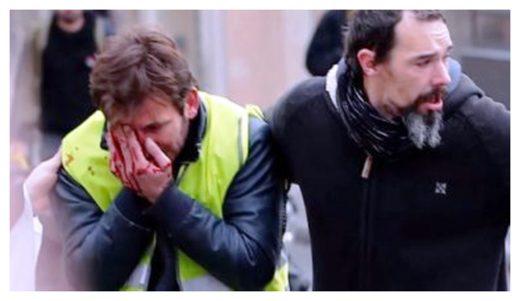
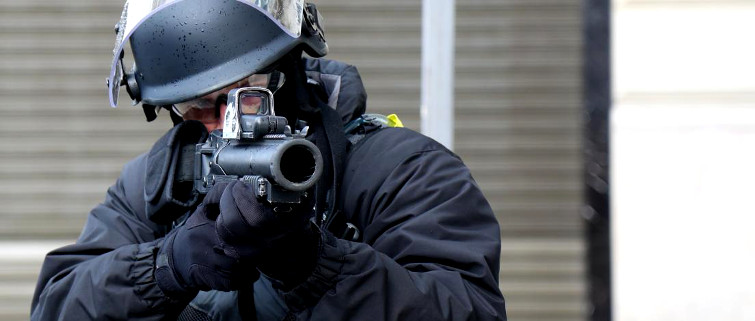
An army of police, dressed like robots, have surrounded and blocked groups of peaceful Yellow Vests, drowning them in clouds of teargas and firing flash balls directly at protesters, seriously wounding hundreds (no official figures). A number of people have lost an eye or a hand. The government has nothing to say about this.
On the third Saturday of protest, this army of police was unable to stop – or under orders to allow – a large number of hoodlums or Black Blocs (who knows?) to infiltrate the movement and smash property, vandalize shops, set fire to trash cans and parked cars, providing the world media with images proving that the Yellow Vests are dangerously violent.
Despite all this provocation, the Gilets Jaunes have remained remarkably calm and determined. But there are bound to be a few people who lose their tempers and try to fight back.
- The BOXER
On the 8th Saturday, January 5, a squad of plexiglass-protected police were violently attacking Gilets Jaunes on a bridge over the Seine when a big guy lost his temper, emerged from the crowd and went on the attack. With his fists, he beat down one policeman and caused the others to retreat. This amazing scene was filmed. You could see Yellow Vests trying to hold him back, but Rambo was unstoppable.
It turned out that this was Christophe Dettinger, a French Rom, former light heavyweight boxing champion of France. His nickname is “the Gypsy of Massy”. He got away from the scene, but made a video before turning himself in. “I reacted badly”, he said, when he saw police attacking women and other defenseless people. He urged the movement to go ahead peacefully.

Dettinger faces seven years in prison. Within a day, his defense fund had gathered 116,433 euros. The government shut it down – on what legal pretext I don’t know. Now a petition circulates on his behalf.
- The SLANDER
In his New Year’s Eve address, Macron patronizingly scolded his people telling them that “you can’t work less and earn more” – as if they all aspired to spending their lives lounging on a yacht and watching stock prices rise and fall.
Then he issued his declaration of war:
“These days I have seen unthinkable things and heard the unacceptable.” Apparently alluding to the few opposition politicians who dare sympathize with the protesters, he chastised those who pretend to “speak for the people”, but are only the “spokesmen for a hateful mob going after elected representatives, police, journalists, Jews, foreigners and homosexuals. It is simply the negation of France.”
The Gilets Jaunes haven’t been “going after” anybody. The police have been “going after” them. People have indeed spoken up vigorously against camera crews of channels that systematically distort the movement.
Not a word has been heard from the movement against foreigners or homosexuals.
The key word is Jews.
Qui veut noyer son chien l’accuse de la rage. (French proverb).
As the French saying goes, whoever wants to drown his dog claims he has rabies. Today whoever wants to ruin a career, take vengeance on a rival, disgrace an individual or destroy a movement accuses her, him, or it of antisemitism.
So, faced with a rising democratic movement, playing the “antisemitism” card was inevitable. It was almost a sure thing statistically. In almost any random batch of hundreds of thousands of people, you might find one or two who have something negative to say about a Jew. That’ll do it. The media hawks are on the outlook. The slightest incident can be used to suggest that the real motive of the movement is to revive the Holocaust.
This gently ironic little song, performed on one of France’s traffic circles, contrasts the “nice” establishment with the “bad” ordinary folk. It is a huge hit on YouTube. It gives the tone of the movement. Les Gentils et les Méchants.
It didn’t take long for this merry number to be accused of antisemitism. Why? Because it was ironically dedicated to two of the very most virulent critics of the Gilets Jaunes: May ’68 star Daniel Cohn-Bendit and old “new philosopher” Bernard-Henri Lévy. The new generation can’t stand them. But wait, they happen to be Jewish. Aha! Anti-Semitism!
- The REPRESSION
Faced with what government spokesman Benjamin Griveaux described as “agitators” and “insurrectionists” who want to “overthrow the government”, Prime Minister Edouard Philippe announced a new “law to better protect the right to demonstrate”. Its main measure: heavily punish organizers of a demonstration whose time and place have not had official approval.
In fact, the police had already arrested 33-year-old truck driver Eric Drouet for organizing a small candle ceremony in honor of the movement’s casualties. There have been many other arrests, with no information coming out about them. (Incidentally, over the holidays, hoodlums in the banlieues of several cities carried out their ritual burning of parked cars, with no particular publicity or crackdown. Those were cars of working class people who need them to go to work, not the precious cars in the rich section of Paris whose destruction caused such scandal.)
On January 7, Luc Ferry, a “philosopher” and former Minister of Youth, Education and Research, gave a radio interview on the very respectable Radio Classique in which he declared: “The police are not given the means to end this violence. It’s unbearable. Listen, frankly, when you see guys kick a poor policemen when he’s down, that’s enough! Let them use their arms once and for all, basta! […] As I recall, we have the world’s fourth army, capable of putting an end to this garbage.”
Ferry called on Macron to make a coalition with the Republicans in order to push through his “reforms”.
Last month, in a column against the Citizens’ Initiative Referendum, Ferry wrote that “the current disparaging of experts and criticism of elitism is the worst calamity of our times.”
- The ANTIFA
Wherever people gather, Antifa groups may pursue their indiscriminate search to root out “fascists”. In Bordeaux last Saturday, Yellow Vests had to fight off an attack by Antifa.
It is now completely clear (as indeed it always has been) that the self-styled “Antifascists” are the watch dogs of the status quo. In their tireless search for “fascists”, the Antifa attack anything that moves. In effect, they protect stagnation. And curiously enough, Antifa violence is tolerated by the same State and the same police who insult, attack and arrest more peaceful demonstrators. In short, the Antifa are the storm troopers of the current system.
- The MEDIA
Be skeptical. At least in France, mainstream media are solidly on the side of “order”, meaning Macron, and foreign media tend to echo what national media write and say. Also, as a general rule, when it comes to France, the Anglophone media often get it wrong.
- The END
It is not in sight. This may not be a revolution, but it is a revelation of the real nature of “the system”. Power lies with a technocracy in the service of “the Markets”, meaning the power of finance capital. This technocracy aspires to remake human society, our own societies and those all over the planet, in the interests of a certain capitalism. It uses economic sanctions, overwhelming propaganda and military force (NATO) in a “globalization” project that shapes people’s lives without their consent. Macron is the very embodiment of this system. He was chosen by that famous elite to carry through the measures dictated by “the Markets”, enforced by the European Union. He cannot give in. But now that people are awake to what is going on, they won’t stop either. For all the lamented decline in the school system, the French people today are as well-educated and reasonable as any population can be expected to be. If they are incapable of democracy, then democracy is impossible.
To be continued…
A Clinton Memo That Killed Half a Million People
By Daniel Lazare | Consortium News | January 11, 2019
A Hillary Clinton memo that Wikileaks made public in 2016 has not gotten the attention it deserves.
It takes us back to 2012 and the early phase of the Syrian war.
At that point, it was largely an internal affair, although Saudi arms shipments were playing a greater and greater role in bolstering rebel forces. But once the Obama administration decided in favor of intervention, the conflict was quickly internationalized as thousands of holy warriors flooded in from as far away as western China.
The 1,200-word memo by then-Secretary of State Clinton begins with the subject of Iran, an important patron of Syria.
She dismisses any notion that nuclear talks will stop Iran “from improving the crucial part of any nuclear weapons program—the capability to enrich uranium.” If it does get the bomb, it goes on, Israel will suffer a strategic setback since it will no longer be able to “respond to provocations with conventional military strikes on Syria and Lebanon, as it can today.” Denied the ability to bomb at will, Israel might leave off secondary targets and strike at the main enemy instead.
Consequently, Clinton argues that the U.S. should topple the Assad regime so as to weaken Iran and allay the fears of Israel, which has long regarded the Islamic republic as its primary enemy. As the memo puts it:
“Bringing down Assad would not only be a massive boon to Israel’s security, it would also ease Israel’s understandable fear of losing its nuclear monopoly. Then, Israel and the United States might be able to develop a common view of when the Iranian program is so dangerous that military action could be warranted.”
This document making the case to arm Syrian rebels may have been largely overlooked because of the dates, which appear to be inaccurate.
One line gives the time as “2001-01-01 03:00” even though Clinton was still a New York senator-elect at that point. That date is also out of synch with the timeline of nuclear diplomacy with Iran.
Another contains a State Department case and document number and a date of Nov. 30, 2015. But that’s incorrect as well since it postdates Clinton’s resignation as secretary of state by better than two and a half years.
Central to the Great Debate
Consequently, anyone stumbling across the memo in the Wikileaks archives would have no idea of how its rather loopy logic figures in the great debate about whether to use force to bring down Syrian President Bashir al-Assad. But textual clues provide an answer. The second paragraph refers to nuclear talks with Iran “that began in Istanbul this April and will continue in Baghdad in May,” events that took place in 2012. The sixth invokes an interview with CNN’s Christiane Amanpour conducted with then-Israeli Defense Minister Ehud Barak “last week.” Since the interview took place on April 19, 2012, the memo can therefore be dated to the fourth week in April. This is shortly before Clinton joined forces with then-CIA Director David Petraeus to push for an aggressive program of rebel military aid.
Needless to say, Clinton’s skepticism about negotiating with Iran proved to be unwarranted since Iran eventually agreed to shut down its nuclear program. The memo thus illustrates her hawkishness along with her conviction that Israeli security trumps all other considerations even if it means setting fire to a region that’s been burned over more than once.
But the memo illustrates much else besides: Clinton’s recklessness, her lack of realism and her almost mystical belief that everything will fall neatly into place once the United States flexes its muscle. Overthrowing Assad would be nothing less than “transformative,” she writes:
“… Iran would be strategically isolated, unable to exert its influence in the Middle East. The resulting regime in Syria will see the United States as a friend, not an enemy. Washington would gain substantial recognition as fighting for the people in the Arab world, not the corrupt regimes. For Israel, the rationale for a bolt from the blue attack on Iran’s nuclear facilities would be eased. And a new Syrian regime might well be open to early action on the frozen peace talks with Israel. Hezbollah in Lebanon would be cut off from its Iranian sponsor since Syria would no longer be a transit point for Iranian training, assistance and missiles.”
It was “a low-cost high-payoff approach,” she writes, that would eliminate one enemy, weaken two more, and generate such joy among ordinary Syrians that peace talks between Damascus and Tel Aviv will spring back to life. The risks were nil. Since “the Libyan operation had no long-lasting consequences for the region,” the memo says, referring to the overthrow of strongman Muammer Gaddafi six months earlier, the Syrian operation wouldn’t either:
“Some argue that U.S. involvement risks a wider war with Russia. But the Kosovo example [in which NATO bombed Russian-ally Serbia] shows otherwise. In that case, Russia had genuine ethnic and political ties to the Serbs, which don’t exist between Russia and Syria, and even then Russia did little more than complain. Russian officials have already acknowledged they won’t stand in the way if intervention comes.”
So, there was nothing to worry about. Sixty-five years of Arab-Israeli conflict would fall by the wayside while Russia remains safely marginalized.
How it Turned Out
Needless to say, that’s not how things turned out. At that moment, Libya seemed under control. But three or four months later, it would explode as Western-backed Islamist militias blasted away at one another, imposing strict Sharia law, re-instituting slavery and rolling back decades of social progress. Once President Barack Obama approved a modified version of the Clinton-Petraeus plan, Syria would plunge into the same abyss as jihadis funded by Saudi Arabia and the other oil monarchies spread sectarian violence and fear.
Clinton’s assumption that the U.S. could neatly and cleanly decapitate the Syrian government without having to worry about broader consequences was little short of deluded.
The notion that ordinary Syrians would fall to their knees in gratitude was ludicrous while her disregard for the intricacies of Syrian politics was astonishing.
Then there’s the memo’s blithe suggestion that Washington “work with regional allies like Turkey, Saudi Arabia, and Qatar to organize, train, and arm Syrian rebel forces.”
In late 2009, Clinton wrote in another diplomatic memo made public by Wikileaks that “donors in Saudi Arabia constitute the most significant source of funding to Sunni terrorist groups worldwide.” So what made her think two years later that the kingdom would not fund Syrian jihadis of precisely the same ilk?
The 2009 memo slammed Qatar for allowing Al Qaeda, the Taliban and other terrorist groups to use the sheikdom “as a fundraising locale.” So what made her think that a pro-Al Qaeda autocracy would now help Syrians “fight for their freedom,” as the memo puts it? Wouldn’t Qatar be more likely to remove what little freedom Syrians had left? Of course, it would.
There is a remarkable continuity between the Syria policy that Clinton was proposing and earlier policies in Afghanistan and Libya. In the first, U.S. military aid wound up flowing to the notorious warlord Gulbuddin Hekmatyar, a religious sectarian and raging anti-western xenophobe who nonetheless was “the most efficient at killing Soviets,” as Steve Coll put it in “Ghost Wars,” his bestselling 2004 account of the CIA’s love affair with jihad.
Hekmatyar’s cutthroats wound up with the lion’s share of American arms. More or less the same thing happened in Libya once Clinton persuaded Qatar to join the anti-Gaddafi coalition. The sheikhdom seized the opportunity to distribute some $400 million to various rebel militias, many of them Islamist. The Obama administration said nothing in response.
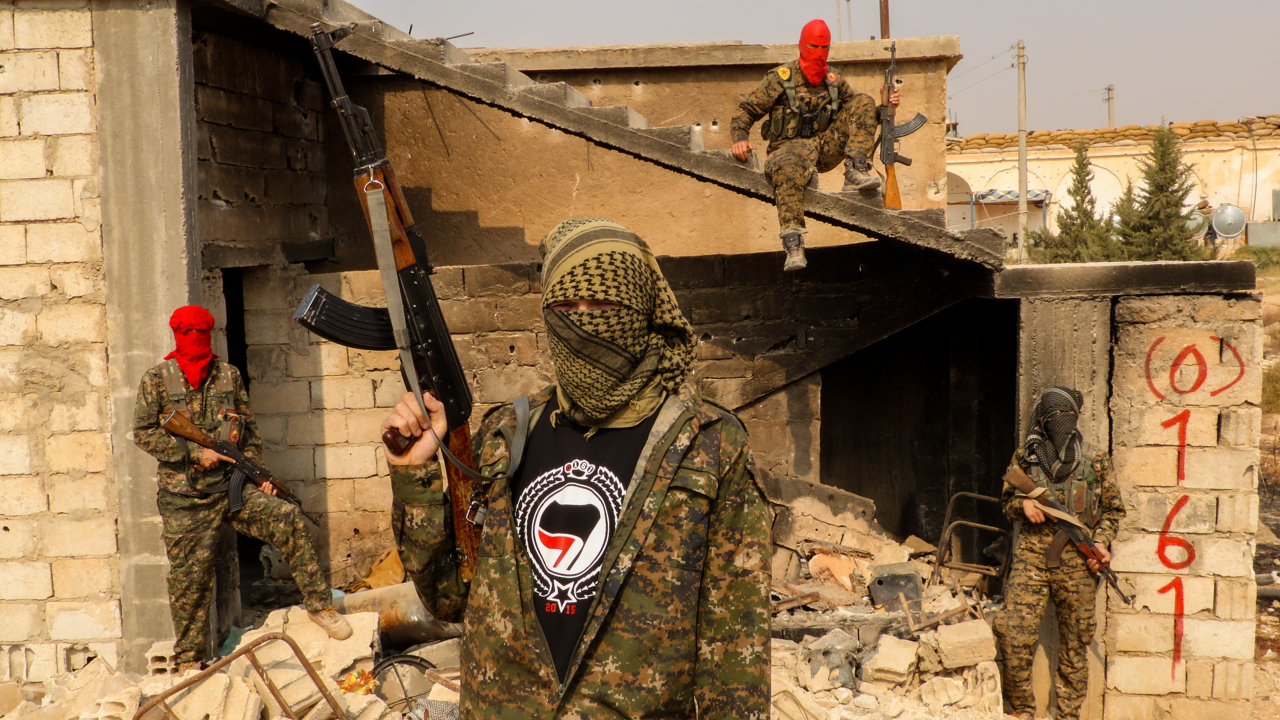
British Fighters with International Freedom Battalion in northern Iraq. (Wikimedia)
Once again, U.S. arms and materiel flowed to the most reactionary elements. The same would happen in Syria where U.S. and Saudi arms went to the local Al Qaeda affiliate, known as Jabhat al-Nusra, and even to ISIS, as a meticulous report by Conflict Armament Research, a Swiss and EU-funded study group in London, has shown. (See “Did Obama Arm Islamic State Killers?” Consortium News, Dec. 21, 2017.)
Insurgency Mix
By August 2012, a secret Defense Intelligence Agency report found that Salafists, the Muslim Brotherhood, and Al Qaeda were already “the major forces driving the insurgency” and that the U.S. and Gulf states backed them regardless. Speechwriter Ben Rhodes summed up the problem of “moderate” rebels who were indistinguishable from Al Qaeda in his White House memoir, “The World As It Is.” In that, he writes that “Al Nusra was probably the strongest fighting force within the opposition, and while there were extremist elements in the group, it was also clear that the more moderate opposition was fighting side by side with al Nusra. I argued that labeling al Nusra as terrorists would alienate the same people we want to help, while giving al Nusra less incentive to avoid extremist affiliations.”
The problem was how to separate the “good” Al Qaeda fighters from the “bad.” Rhodes later complained when Russian President Vladimir Putin said that he and his fellow Obama officials were “trying to climb a spruce tree naked without scratching our ass.” This was “smug,” Rhodes says. But Putin was merely using a colorful expression to say that the policy made no sense; which it didn’t.
The cost, half a dozen years after the Clinton email, is staggering. As many as 560,000 people have died, half the population has been displaced, while the World Bank has estimated total war damage at $226 billion, roughly six years’ income for every Syrian man, woman, and child. A cockeyed memo thus unleashed a real-life catastrophe that refuses to go away. It’s a nightmare from which President Donald Trump is struggling to escape in his confused and deluded way and that the Deep State – everyone from arch-neocon John Bolton to “liberal” Nancy Pelosi– is determined to renew.
Making Sense of Trump’s Foreign Policy
By Federico PIERACCINI | Strategic Culture Foundation | 11.01.2019
As was to be expected, the announcement that the US was withdrawing troops from Syria has served to provoke numerous reactions in the Middle East and beyond. Following the removal of Mattis, Pompeo and Bolton embarked on a whirlwind Middle Eastern tour of Israel, Jordan, Egypt, Bahrain, the United Arab Emirates, Qatar, Saudi Arabia, Oman, and Kuwait to reassure regional allies.
The idea of withdrawing US troops from Syria was based on Trump wishing to fulfil one of his most important electoral promises. Trump knows that he needs to demonstrate to his electoral base that he has kept the most significant promises he made during his 2016 election campaign in order to have any chance of being reelected in 2020. People voted for change, and that includes preventing new wars and getting out of the ones the US is already embroiled in, especially in the Middle East.
If Trump betrays his constituents by not delivering on his campaign promises, then he would simply be like any other politician who, upon being elected, soon forgets about those who put him in office. Trump is aware that such a perception would cost him the possibility of a second term.
We live in a time where Western elites completely ignore the consequences of their actions, manipulate information, lie to their citizens and spread fake news. While we may not always believe what Trumps says in his bombastic remarks, we can rest assured that MSNBC/CNN are even less reliable in terms of facts and unbiased news. Keeping oneself correctly informed is a difficult and demanding task, involving the constant comparison and weighing up of a lot of different sources and constantly researching and learning through the process. Most people do not have the time for this and usually do not care, preferring to rely instead on the mainstream media. This obviously exposes such people to manipulation, lies and distorted facts, clouding the truth and making it difficult to distinguish between what is real and what is fake. Alternative media — the real media — are riding to the rescue, but the overhauling process will require a full generation or even two.
This is why it little matters whether the wall will really built or whether it will only start to be built as a PR stunt or whether it even makes sense in the first place to build it or not. Democrats watching MSNBC/CNN will agree that it is a dumb idea and should not be funded. Republicans watching Fox News will call it a brilliant idea and demand a government shutdown (as Trumps is doing) to force the Democrats to concede. The point is that Democrats or Trump supporters, feeding on news sources based on propaganda and lies, will only have their respective biases confirmed without the need for any real debate.
What is important for us to understand is how Trump operates in order to gain the support of his base. That is what guides him in domestic, foreign and economic affairs. In the case of the wall, Trump’s battle is against the Democrats, and the actions he has taken to fight his opponents is by using the government shutdown to provide himself with a win-win outcome. If the Democrats fund the wall, they lose in the eyes of their voters, as Trump ends up getting his wall. If the Democrats do not fund the wall, Trump will blame them and point to the government shutdown to demonstrate how he valiantly struggled against the Democrats in an effort to keep his promises.
The same is the case with the economic warfare employing the US dollar and imposing tariffs and duties on allies and enemies alike. MSNBC/CNN will tell you that this is damaging the American economy. The Democrats will say that it is a failed strategy, without admitting that they hate Trump’s “economic war” because it undermines US dollar hegemony and thereby their ability to prosecute the neoliberal imperialism to which they are so addicted.
Fox News, on the other hand, will spin the news to show how Trump is battling against Xi Jinping and China in the interests of American farmers. Self-proclaimed experts will go on about the success of the White House’s economic strategy, declaring it a brilliant idea. Trump voters will enjoy the coverage of Fox News and accordingly praise the “commercial war”. Democrats will love the coverage of MSNBC/CNN and will worry about how various policies will either restore or further diminish US global leadership.
The announcement of the withdrawal from Syria follows the same logic as the examples given above. Trump announced the withdrawal only in order to keep an electoral promise. The entire Washington foreign-policy establishment is opposed to Trump’s decision. The purpose of the announcement was to convey to his voters a simple but clear message: I am trying to do what I promised you, but I have everyone against me in Washington as well as in the media.
The same logic is employed with the government shutdown in order to fund the wall. Whenever Democrats, Republicans or talking heads condemn Trump’s withdrawal from Syria/Afghanistan, his effort to build the wall, his imposition of tariffs and duties, his sanctions on Iran, they reinforce the beliefs of Trump’s supporters, showing that Trump is really trying to keep his promises in the face of tremendous opposition.
Every time they bash him they provide free advertisement for Trump and his political line, and this has been going on from the first time he announced he would run in the primaries in 2015. It is a win-win situation for him, even if he does not really build the wall, pull out of Syria, or effectively reduce the trade imbalance between China and the US. If he succeeds, he can declare that he has kept his promises. If he fails, then he can lay be blame squarely at the feet of his political opponents. People elected him on the basis of his words and promises. If he can demonstrate that he at least tried to keep his promises (even if he never actually does), then that should be enough to give him a second term.
Trump understands very well how the media works and how much Washington detests him. He does not want to change the status quo and revolutionize Washington. He does not want to openly challenge the foreign-policy establishment by following a realist-isolationist policy. That was what he said in 2015/16 during the campaign trail, but his presidency has been much different from what he promised, especially in foreign policy. Nevertheless, Trump seeks re-election, and he cannot entirely break with the Washington establishment if he hopes to succeed. Indeed in 2016 he demonstrated this by appointing a staff of generals whose credo over the span of several decades has been that of American exceptionalism, the governing religion of Washington. He used the military to protect himself from the media-intelligence community, shielding himself with four generals (Kelly, McMaster, Mattis and Flynn), in the full knowledge that none of them would support a realist-isolationist policy.
For this reason, the ructions that have followed the announcement of the withdrawal from Syria are part of normal US political theater, such as was the case with the resignation/dismissal of Mattis. It is no surprise that the deep state immediately dispatched Bolton and Pompeo to sooth the concerns of dozens of US allies, in particular Israel and the Arab states. It was a PR exercise to reassure them of the real intentions of the US in the area (i.e., enduring imperialism).
In practice, it makes little difference whether the US has 2,000 or 200 men in Syria. They will not be able to change the course of the war of aggression against Damascus in their favor. It is therefore not surprising that Bolton was not fired for publicly contradicting Trump on the question of withdrawing troops from Syria. Such contradictions play in Trump’s favor. His supporters will say that Trump is so anti-establishment that even his closest collaborators are against him.
If Trump were to fire Bolton as he did Mattis, none of his faithful voters will remember the ill-considered choice to appoint him in the first place, and will be struck instead by Trump’s determination to stick to his guns and rid himself of internal saboteurs who stand in the way of his electoral mandate. As long as Trump, in our scenario, were not to name someone worse than Bolton, the imperialist wheel will continue to turn.
Just look at North Korea as an example. Trump threatened to destroy Pyongyang, even knowing the US could not really do so. Then he meet with Kim, did an epic PR exercise that presented Trump as solving a major international problem that had eluded all his predecessors. After conveying this triumph to his base, he simply forgot all about Kim, Pyongyang and Seoul. In the meantime, the two Koreas are nonetheless speaking, advancing reconciliation and preparing for historical changes. As for Trump, he has already moved on, North Korea no longer holding his interest, the drama having served its purpose for a certain time but no longer being of relevance. (This, thankfully, is to the benefit of the Korean people.)
It seems the same playbook is being employed in Syria. Trump announced the withdrawal, while leaving a few hundred soldiers behind who continue to be unable to change the situation on the ground; Bolton and Pompeo are dispatched to reassure allies/financiers, though Trump cannot wait to forget about Syria, proclaiming the falsehood that US, under his leadership, defeated ISIS (thereby fulfilling one of his electoral promises).
As I wrote following Trump’s election, The Donald’s victory only served to accelerate the transition to a multipolar world, as we saw in the first two years of his presidency, with Trump’s focus on his base translating into a perennial electoral campaign that uses all the tools at his disposal (domestic, foreign, economic, financial, and currency policy). This creates distrust and concern amongst historical allies and pushes Washington’s enemies closer together, serving in the process to smooth out any tensions that may have hitherto existed between these countries.
Just think of the Astana format of Turkey, Iran and Russia concerning Syria, Inter-Korean talks in Asia, a peace treaty to be signed between Russia and Japan, Indian-Iranian cooperation on trade in oil, a European stance against Iranian and Russian sanctions, and, to top it off, coordination between the Russians and the Chinese on almost everything. All this is in the name of opposing US imperialist policies or trying to directly score a political win against Donald Trump and his policies.
Trump’s enemies have learned to ignore US decisions, which have now become irrelevant in certain parts of the globe. America’s historical allies cling hopefully to the words of Bolton and Pompeo, well aware that the US will not soon change their basic neoliberal and imperialist approach towards the world. Nevertheless, Washington is losing military and economic influence due to the transition into a multipolar world order, where power is shared among multiple countries (China, Russia, Iran, India). The unipolar moment is over and is not coming back, especially not with Donald Trump as president. And that is a good thing for the rest of the world.
Trump’s Nighttime Trip to Iraq Confirms the Debacle
By Jacob G. Hornberger | FFF | January 11, 2019
What better proof of the Iraq debacle than President Trump’s middle-of-the-night trip to that country at Christmastime to visit U.S. troops who are still occupying the country some 15 years after the Pentagon and the CIA invaded?
The U.S. national-security establishment has had a decade-and-half to bring its federally planned paradise into existence. From the very first day of the U.S. conquest of Iraq, a country that had never attacked the United States, the Pentagon and the CIA wielded total control over the country, being able to install whatever type of regime they wanted, with no pesky constitutional restraints to inhibit whatever they wanted to do.
After 15 years of building their paradise with such things as bombs, bullets, arrests, raids, indefinite detention, torture (e.g., Abu Ghraib), and assassination, the U.S. commander in chief has to leave Washington under cover of secrecy and darkness, land in Iraq in the middle of the night, talk to the troops for just a short while, and then skedaddle back to Washington in fear of being shot at by some disgruntled Iraqi who opposes the foreign invasion and occupation of his country.
If that’s not pathetic, I don’t know what is. Why can’t a U.S. commander in chief bravely and courageously fly into Iraq during the daytime the same way he would fly into London? Why can’t he freely travel into Baghdad and stay at a local hotel for a few days? Why can’t he meet with whoever happens to be the current U.S. puppet who is running the Iraqi government? Why does Trump have to instead sneak in and quickly sneak out of a country that the Pentagon and the CIA have had 15 long deadly and destructive years to convert into a paradise?
After all, the president of Iran doesn’t do this. He flies into Baghdad, stays several days in a hotel, and takes the time to meet with Iraqi officials. But not Trump. He and his national-security team think that it would just be too dangerous to do that in the paradise that the Pentagon and the CIA have constructed over a period of 15 years.
For that matter, notice that not one member of Congress has ever taken one of the prized congressional junkets to Iraq. Not even a family vacation. What’s up with that? Wouldn’t you think that they would relish traveling to a country that has been invaded and occupied by troops who they never cease thanking for “their service” in Iraq?
If there is anything that should cause the American people to reject the conservative-liberal paradigm of foreign empire, intervention, regime-change, and wars of aggression, it should be Iraq. Trump’s sneaky in-and-out trip to visit the troops in Iraq 15 years after they invaded and began occupying the country and turning it into their paradise says it all.
Another Climate Propaganda Story Promoting the Normal as Abnormal
By Dr. Tim Ball | Watts Up With That? | January 8, 2019
Almost every day there are stories in the media about weather or climate events that create the impression that they are new and outside of the normal pattern. None of them are. The objective is to sensationalize the story, even if it means using a meaningless period. A simple trick is to pick a period in which your claim is valid. This practice of cherry-picking the period of study is not exclusive to the media. It was a clear sign of corruption of climatology brought to a head with Roseanne D’Arrigo’s infamous comment to the 2006 National Academy of Science (NAS) panel that “if you are going to make a cherry pie, you have to pick cherries.”
That doesn’t condone the media use of the technique. All it does is illustrate why it was a convenient technique for creating a deception about what is normal. For example, a 2017 BBC headline said “Hottest June day since summer of 1976 in heatwave.” That is 41 years, which is statistically significant but not climatologically significant. A Youtube story reports “Sydney has wettest November day since 1984.” CBS Pittsburgh reported “NWS: 2018 is the 2nd Wettest Year on Record in Pittsburgh.” The record began in 1871 or 147 years ago, but even that is not climatologically significant. The ones I like are this one from North Carolina, that says, “A Look Back at the Coldest day Ever in North Carolina.” “Ever” is approximately 4.5 billion years.
Other stories focus on a pattern or change in a pattern again with the idea that it is new or abnormal. Headlines like this one from 2012, “Why have there been more tornadoes than usual this year?” Often, they are suggestive such as this 2017 New York Times story. “The 2017 Hurricane Season Really Is More Intense Than Normal.” When you read the story, you find, as is usually the case, that the caveats at the end indicate it is not unusual. The problem is the headline already set the pattern in the public mind.
The headline says, “Forget El Nino, StormFest Is about To Hit The West Coast.” The author is talking about a series of storms tracking on to the west coast of North America. The story told us
Things often calm down after January 1 during El Nino years… but not this year… with the U.S. West Coast from central California to Washington State about to be pummeled by a series of storms. Rain, snow, wind? Plenty for everyone. A view of the latest infrared satellite imagery shows an amazing line-up of one storm after another stretching way into the Pacific. A traffic jam of storms.
The terms, “pummeled” and “traffic jam” are evocative and imply the pattern is unusual. In fact, it is perfectly normal to the point that there is a descriptive term for it, the Pineapple Express. This refers to the establishment of the Polar Front along the northwest coast of North America after it migrates south from its summer position off the coast of Alaska and northern British Columbia. Low pressure systems known as anti-cyclones develop along the Front all year round. The areas affected by these systems changes as the Front migrates between its more northerly summer position and more southerly winter position. The term Pineapple Express refers to the situation in the winter when these anti-cyclones generate in the region of Hawaii and track along the Front hitting the northwest coast in a series of storms. The pattern does not stop in an El Nino year but takes a different path.
These anti-cyclone systems are also the focus of exploitation of normal weather events as abnormal, in Europe. The southerly shift of the Polar Front in the Northern Hemisphere occurs around the globe. Two major factors influence the weather pattern, sea surface temperatures that fluctuate with ocean circulation, and the Rossby Wave pattern in the Circumpolar Vortex. This pattern of anti-cyclones hitting western Europe in the winter was added to the propaganda list when they started naming the storms. It linked them to hurricanes in the public mind, and it implied they were a recent phenomenon.
They are not recent, new, or of greater intensity.

A significant part of professor Hubert Lamb’s ground-breaking and monumental work on historical climatology was a long-term reconstruction of the pattern of these anti-cyclones. It fit with his claim about why he established the Climatic Research Unit (CRU) at the University of East Anglia.
“… it was clear that the first and greatest need was to establish the facts of the past record of the natural climate in times before any side effects of human activities could well be important.”
Once he created a long-term record of these anti-cyclonic systems, there was a better chance of determining the underlying mechanisms. From this, he could achieve his final objective of better forecasting. The ability to forecast defines science. If that is not the final objective the work is mostly irrelevant.
Consider the destructive and history-altering impact of storms like the one that hit the Spanish Armada that attempted to invade England in 1588. Ironically, Phil Jones, who ran the CRU reputation into the ground while under his direction, wrote a good synopsis of Lamb’s work. There is also the storm of 1703 reported in great detail in the book “The Storm” by the famous author Daniel Defoe.
Marcel Leroux was an early major skeptic of the claim of anthropogenic global warming (AGW). His 2005 book “Global Warming: Myth or Reality” was impactful because Leroux was well qualified. As one review of his book notes,
In the global-warming debate, definitive answers to questions about ultimate causes and effects remain elusive. In Global Warming: Myth or Reality? Marcel Leroux seeks to separate fact from fiction in this critical debate from a climatological perspective. Beginning with a review of the dire hypotheses for climate trends, the author describes the history of the 1998 Intergovernmental Panel on Climate Change (IPCC) and many subsequent conferences. He discusses the main conclusions of the three IPCC reports and the predicted impact on global temperatures, rainfall, weather and climate, while highlighting the mounting confusion and sensationalism of reports in the media.
The comment about sensationalism in the media is relevant to this article because Leroux, like Lamb, also worked on a reconstruction of the anti-cyclonic systems in the North Atlantic. Leroux also worked on another later exploitation of the normal by John Holdren, Obama’s Science Advisor, the so-called “Polar Vortex.” Leroux’s 1993 work on the impact of the “The Mobile Polar High: a new concept explaining present mechanisms of meridional air-mass and energy exchanges and global propagation of palaeoclimatic changes” showed how these outbreaks of cold Polar air are a normal weather event that enter the climate record because of their regular but variable appearance and impact.
We are confronted by the unholy alliance between the political use of science by the Intergovernmental Panel on Climate Change, the spin doctors or, as I prefer, the professional liars, and the mainstream media, that create fake news by making the normal appear abnormal. As the Yiddish proverb observes, “Truth never dies but lives a wretched existence,” especially under such a deliberate onslaught.
The War on Populism
CJ Hopkins | Consent Factory | January 10, 2018
Remember when the War on Terror ended and the War on Populism began? That’s OK, no one else does.
It happened in the Summer of 2016, also known as “the Summer of Fear.” The War on Terror was going splendidly. There had been a series of “terrorist attacks,” in Orlando, Nice, Würzberg, Munich, Reutlingen, Ansbach, and Saint-Étienne-du-Rouvray, each of them perpetrated by suddenly “self-radicalized” “lone wolf terrorists” (or “non-terrorist terrorists“) who had absolutely no connection to any type of organized terrorist groups prior to suddenly “self- radicalizing” themselves by consuming “terrorist content” on the Internet. It seemed we were entering a new and even more terrifying phase of the Global War on Terror, a phase in which anyone could be a “terrorist” and “terrorism” could mean almost anything.
This broadening of the already virtually meaningless definition of “terrorism” was transpiring just in time for Obama to hand off the reins to Hillary Clinton, who everyone knew was going to be the next president, and who was going to have to bomb the crap out of Syria in response to the non-terrorist terrorist threat. The War on Terror (or, rather, “the series of persistent targeted efforts to dismantle specific networks of violent extremists that threaten America,” as Obama rebranded it) was going to continue, probably forever. The Brexit referendum had just taken place, but no one had really digested that yet … and then Trump won the nomination.
Like that scene in Orwell’s 1984 where the Party switches official enemies right in the middle of the Hate Week rally, the War on Terror was officially canceled and replaced by the War on Populism. Or … all right, it wasn’t quite that abrupt. But seriously, go back and scan the news. Note how the “Islamic terrorist threat” we had been conditioned to live in fear of on a daily basis since 2001 seemed to just vanish into thin air. Suddenly, the “existential threat” we were facing was “neo-nationalism,” “illiberalism,” or the pejorative designator du jour, “populism.”
Here we are, two and a half years later, and “democracy” is under constant attack by a host of malevolent “populist” forces …. Russo-fascist Black vote suppressors, debaucherous eau de Novichok assassins, Bernie Sanders, the yellow-vested French, emboldened non-exploding mail bomb bombers, Jeremy Corbyn’s Nazi Death Cult, and brain-devouring Russian-Cubano crickets. The President of the United States is apparently both a Russian intelligence operative and literally the resurrection of Hitler. NBC and MSNBC have been officially merged with the CIA. The Guardian has dispensed with any pretense of journalism and is just making stories up out of whole cloth. Anyone who has ever visited Russia, or met with a Russian, or read a Russian novel, is on an “Enemies of Democracy” watch list (as is anyone refusing to vacation in Israel, which the Senate is now in the process of making mandatory for all U.S. citizens). Meanwhile, the “terrorists” are nowhere to be found, except for the terrorists we’ve been using to attempt to overthrow the government of Bashar al Assad, the sadistic nerve-gassing Monster of Syria, who illegally invaded and conquered his own country in defiance of the “international community.”
All this madness has something to do with “populism,” although it isn’t clear what. The leading theory is that the Russians are behind it. They’ve got some sort of hypno-technology (not to be confused with those brain-eating crickets) capable of manipulating the minds of … well, Black people, mostly, but not just Black people. Obviously, they are also controlling the French, who they have transformed into “racist, hate-filled liars” who are “attacking elected representatives, journalists, Jews, foreigners, and homosexuals,” according to French President Emmanuel Macron, the anointed “Golden Boy of Europe.” More terrifying still, Putin is now able to project words out of Trump’s mouth in real-time, literally using Trump’s head as a puppet, or like one of those Mission Impossible masks. (Rachel Maddow conclusively proved this by spending a couple of hours on Google comparing the words coming out of Trump’s mouth to words that had come out of Russian mouths, but had never come out of American mouths, which they turned out to be the exact same words, or pretty close to the exact same words!) Apparently, Putin’s master plan for Total Populist World Domination and Establishment of the Thousand Year Duginist Reich was to provoke the global capitalist ruling classes, the corporate media, and their credulous disciples into devolving into stark raving lunatics, or blithering idiots, or a combination of both.
But, seriously, all that actually happened back in the Summer of 2016 was the global capitalist ruling classes recognized that they had a problem. The problem that they recognized they had (and continue to have, and are now acutely aware of) is that no one is enjoying global capitalism … except the global capitalist ruling classes. The whole smiley-happy, supranational, neo-feudal corporate empire concept is not going over very well with the masses, or at least not with the unwashed masses. People started voting for right-wing parties, and Brexit, and other “populist” measures (not because they had suddenly transformed into Nazis, but because the Right was acknowledging and exploiting their anger with the advance of global neoliberalism, while liberals and the Identity Politics Left were slow jamming the TPP with Obama and babbling about transgender bathrooms, and such).
The global capitalist ruling classes needed to put a stop to that (i.e, the “populist” revolt, not the bathroom debate). So they suspended the Global War on Terror and launched the War on Populism. It was originally only meant to last until Hillary Clinton’s coronation, or the second Brexit referendum, then switch back to the War on Terror, but … well, weird things happen, and here we are.
We’ll get back to the War on Terror, eventually … as the War on Populism is essentially just a temporary rebranding of it. In the end, it’s all the same counter-insurgency. When a system is globally hegemonic, as our current model of capitalism is, every war is a counter-insurgency (i.e., a campaign waged against an internal enemy), as there are no external enemies to fight. The “character” of the internal enemies might change (e.g., “Islamic terrorism,” “extremism,” “fascism,” “populism,” “Trumpism,” “Corbynism,” et cetera) but they are all insurgencies against the hegemonic system … which, in our case, is global capitalism, not the United States of America.
The way I see it, the global capitalist ruling classes now have less than two years to put down this current “populist” insurgency. First and foremost, they need to get rid of Trump, who despite his bombastic nativist rhetoric is clearly no “hero of the common people,” nor any real threat to global capitalism, but who has become an anti-establishment symbol, like a walking, talking “fuck you” to both the American and global neoliberal elites. Then, they need to get a handle on Europe, which isn’t going to be particularly easy. What happens next in France will be telling, as will whatever becomes of Brexit … which I continue to believe will never actually happen, except perhaps in some purely nominal sense.
And then there’s the battle for hearts and minds, which they’ve been furiously waging for the last two years, and which is only going to intensify. If you think things are batshit crazy now (which, clearly, they are), strap yourself in. What is coming is going to make COINTELPRO look like the work of some amateur meme-freak. The neoliberal corporate media, psy-ops like Integrity Initiative, Internet-censoring apps like NewsGuard, ShareBlue and other David Brock outfits, and a legion of mass hysteria generators will be relentlessly barraging our brains with absurdity, disinformation, and just outright lies (as will their counterparts on the Right, of course, in case you thought that they were any alternative). It’s going to get extremely zany.
The good news is, by the time it’s all over and Trump has been dealt with, and normality restored, and the working classes put back in their places, we probably won’t remember that any of this happened. We’ll finally be able to sort out those bathrooms, and get back to paying the interest on our debts, and to living in more or less constant fear of an imminent devastating terrorist attack … and won’t that be an enormous relief?
#
Photo: Zakaria Abdelkafi – AFP
Lebanon president warns of the consequences of Israel threats
MEMO | January 10, 2019
Lebanese President Michel Aoun yesterday warned of the “Israeli threats” which could lead to new wars, displacement and ethnic cleansing.
Speaking before members of the diplomatic corps accredited to Lebanon in the capital Beirut, Aoun said that “peace does not take place while deals are made at the expense of the refugee who was expelled from his land and his identity was stolen”.
“Peace does not come at the expense of manipulating demography and changing the geographical and social parameters of countries. Peace does not result from deepening racism and rejecting the other.”
The Lebanese president was referring to US President Donald Trump’s proposed Middle East peace plan dubbed the “deal of the century”.
In regards Syrian refugees in Lebanon, Aoun said the international community’s position is not clear about whether they should return to their country, warning that the proposed positions which link the refugees’ return to finding a political solution to the Syrian crisis is “worrying” because a solution could take a long time.
More than 1.2 million Syrian refugees live in Lebanon, a majority of them in areas that experience economic, political and security crises.
Iraqi politicians demand probe into reported visits to Israeli-occupied territories
Press TV – January 10, 2019
A reported visit to the Israeli-occupied territories by several Iraqi lawmakers has sparked a wave of condemnations from the Arab country’s political leaders, with some of them demanding a probe to identify those who crossed a “red line.”
Israel’s Foreign Ministry announced on Sunday that three Iraqi delegations had secretly visited the occupied territories in 2018.
The ministry said the 15 Iraqi dignitaries had visited “Israeli officials and universities,” as well as the Holocaust memorial in Jerusalem al-Quds.
The report did not identify any members of the Iraqi delegations, nor did it specify with which Israeli officials they had held talks. It said the most recent of the visits was in December.
According to Baghdad al-Youm website, Nasr al-Shammari, deputy secretary-general of Iraq’s Islamic Resistance Movement (al-Nojaba) said in case the report is proved to be true, those who visited the occupied territories should be punished.
The Foreign Relations Committee of Iraq’s parliament also said the Israeli report was aimed at “creating sedition in the country.”
Furat al-Tamimi, a member of the committee, said the issue will be discussed in the upcoming meeting between the parliamentary committee and the foreign ministry, according to Iraq’s Arabic-language al-Sumeriyah news channel.
If the trip has taken place, al-Tamimi said, the responsibility for this issue lies with the security departments, particularly the national security.
Meanwhile, prominent politician and leader of Iraq’s al-Qarar Coalition Athil al-Nujaifi denied reports that he had been among those who visited the occupied territories.
The report first drew strong reaction from First Deputy Speaker of Iraqi Parliament Hassan Karim al-Kaabi, who said in a statement on Monday that “To go to the occupied territory is a red line, and an extremely sensitive issue for all Muslims.”
He also called for “an investigation… to identify those who went to the occupied territory, particularly if they are lawmakers.”
Iraq does not formally recognize Israel, and Baghdad and Tel Aviv are technically still at war.
Featured Video
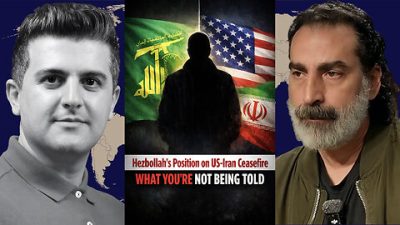
Laith Marouf: Hezbollah’s position on US-Iran ceasefire
or go to
Aletho News Archives – Video-Images
From the Archives
Is Israel to blame for the Iraq War?
American Goy | March 10, 2008
I am so tired of this old canard that “Israel had nothing to do with USA’s war with Iraq – in fact, it officially advised America against it”.
Bullshit. … continue
Blog Roll
 Aletho News
- Laith Marouf: Hezbollah’s position on US-Iran ceasefire: What you’re not being told
- Israel’s priority lies in destroying chances of peace between Iran, US: Ex-UN nuclear chief
- Ceasefire for all or for none: Iran shuts Hormuz over Lebanon attacks
- Strait of Hormuz is Iran’s ‘nuclear weapon’ that forced US retreat: Medvedev
- Energy crisis will last for months – Kremlin envoy
- Europe’s quiet role in the war on Iran
- Forty days that shook the Empire: How Iran turned the tables on US and prevailed
- Netanyahu unilaterally declares Lebanon outside of ceasefire deal
- Israeli leaders: ‘Not a single goal’ achieved in war with Iran
- What on earth just happened? Trump, Iran, and the unlikely ceasefire
- If Americans Knew
- Gazans face a triple crisis: severe shortages of water and bread, healthcare in tatters
- NY Times reports how Netanyahu took the US into Iran War
- A sigh of relief over Iran, but Gaza and Lebanon in dire straits – Daily Update
- Thousands dead and neighborhoods razed to the ground: Aid agencies fear southern Lebanon is becoming the new Gaza
- The war the US is fighting for Israel could cost trillions
- ‘Cigarette Burns, Nail Wounds’: Toddler Tortured in Gaza to Coerce Father
- Trump Says US Sent ‘a Lot of Guns’ to Protesters in Iran
- Israeli forces destroy 17 UN peacekeeper cameras in south Lebanon
- US-Israeli strikes ‘completely destroy’ synagogue in Tehran
- Archbishop for US Military Says Iran War Is Unjust Under Catholic Teaching
- No Tricks Zone
- An Inconvenient Tree: Uncovered In Alps… Europe Much Warmer Than Today 6000 Years Ago
- New Study Reports A 60% Slowdown In Greenland’s Ice Loss Rate In The Last Decade
- Low Intensity Tornado Wrecks Major Solar Farm, Creating A Potential Toxic Dump
- New Study Finds Warming Saves Lives…Cold Temperatures 12 Times More Deadly Than Excess Heat
- German Science Blog Accuses PIK Climate Institute Of Hallucinating Climate Tipping Points
- Devastating Assessment Of Comirnaty Vaccine By Former Senior Pfizer Europe Toxicologist
- New Study: CO2 Is ‘Effectively Negligible’ As An Explanatory Climate Change Factor Since 2000
- Former Pfizer Toxicologist Dr. Helmut Sterz Tells Bundestag Hearing Pfizer Vaccine Should Have Never Been Approved
- Energy Expert: Germany’s Nuclear Phaseout Was A “500 Billion Euro Mistake”
- New Research: South Australia’s Mid-Holocene Sea Surface Temperatures Were 4°C Warmer Than Today
 Aletho News