Pro-war ‘Trump circus’: Veteran reporter quits NBC with biting critique of corporate newsroom
RT | January 3, 2019
NBC News has given endless war and ‘destructive’ intelligence agencies a free pass, all while fixating on around-the-clock Trump hysteria, a veteran national security reporter wrote in a biting farewell message to his colleagues.
William M. Arkin had a number of pointed words to share with his fellow reporters before his last day of work at NBC on Friday – 2,228, to be exact. In his farewell memo – which reads more like a manifesto than a goodbye –the veteran muckraker accused NBC of peddling “ho-hum reporting” that “essentially condones” endless American military presence in the Middle East and North Africa. He also took the network to task for not reporting “the failures of the generals and national security leaders,” essentially becoming “a defender of the government against Trump” and a “cheerleader for open and subtle threat mongering.”
Arkin expressed concern that NBC’s infatuation with the “Trump circus” has distracted journalists from pressing stories that need to be told.
“I’m more worried about how much we are missing. Hence my desire to take a step back and think why so little changes with regard to America’s wars,” he wrote.
He continued by questioning the media’s fanatical opposition to Trump’s desire to improve relations with Russia, denuclearize North Korea, and withdraw from Syria.
“I’m alarmed at how quick NBC is to mechanically argue the contrary, to be in favor of policies that just spell more conflict and more war. Really? We shouldn’t get out Syria? We shouldn’t go for the bold move of denuclearizing the Korean peninsula? Even on Russia, though we should be concerned about the brittleness of our democracy that it is so vulnerable to manipulation, do we really yearn for the Cold War? And don’t even get me started with the FBI: What? We now lionize this historically destructive institution?” he quipped.
If anyone is qualified to critique NBC’s military and national security reporting, it would be Arkin. The veteran journalist has worked for the network intermittently for the last 30 years, and co-authored a seminal Washington Post investigation revealing the dangerous rise of America’s security state.
Arkin has also been a vocal critic of America’s wars in the Middle East, and distinguished himself as one of the few mainstream journalists to question the fictitious WMD rolled out to justify war with Iraq.
Many on social media expressed their gratitude to Arkin for shining a light on the media’s complacency – and complicity – as America’s military and national security apparatus operate with near impunity both at home and abroad.
“Very useful to have all our well known suspicions confirmed from inside. there’s a reason revolutions make a priority to take over the tv stations,” one Twitter user noted.
Arkin finished his farewell roast by detailing some of his writing projects currently in the works, including an “extended essay about national security and why we never seem to end our now perpetual state of war.”
“There is lots of media critique out there, tons of analysis of leadership and the Presidency. But on the state of our national security? Not so much. Hopefully I will find myself thinking beyond the current fire and fury and actually suggest a viable alternative. Wish me luck.”
Trump Border Wall is ‘Symbolic’, Can’t Stop Undocumented Migrants – Analysts
Sputnik – 03.01.2019
WASHINGTON – The border wall President Donald Trump shut the US federal government down over is not part of any coordinated strategy to limit undocumented migration but is a potent emotional symbol for his political base, analysts told Sputnik.
The US federal government has been shut down for eleven days because Democrats have refused Trump’s demand to include $5.6 billion in funding in next year’s budget to build a wall on the southern border.
On Wednesday, talks between Trump and Democratic lawmakers at the White House collapsed on the eve of the new US Congress convening. After the meeting, House Democrats vowed to submit legislation on Thursday that includes only $1.3 billion in border security funding, far short of Trump’s target.
Symbolic Wall
Currently there is nearly 600 miles worth of barrier, primarily consisting of 16-foot high fencing, along the 1,900-mile US-Mexico border. Trump wants to erect steel and/or concrete walls over 30 feet tall on more than 200 miles of the border that would include new and replacement barriers.
“The problem is that this wall is not and never was part of a well thought organic border security plan aimed at preventing or at least containing illegal immigration,” Global Policy Institute President Professor Paolo von Schirach said on Wednesday. “For Trump and his core supporters, the Mexico border wall was and is a symbol of America First in action.”
Building the wall on a border symbolizes “getting tough” in a hostile world by protecting US core interests, he added.
Parts of a wall or physical barrier at the US land border with Mexico have already been built under other presidents, Schirach recalled.
“Trump is the first US leader who made the wall into a core issue, a symbol of his agenda,” he said.
The Democrats who now control the House of Representatives, the lower chamber of Congress that controls funding also see the wall as a symbolic issue to be opposed at all costs, Schirach observed.
“Given the hyper partisan climate in Washington, it is no surprise that the Democrats look at the same wall ‘project’ not as a policy issue to be discussed with the goal of reaching some compromise on an issue,” Schirach said.
Instead, the Democrats matched Trump’s uncompromising all-or-nothing approach, Schirach noted.
“If Trump wants the wall, then it seems to be the duty of all good Democrats to oppose it,” he said.
Both sides were therefore now locked into a potentially risky confrontation, Schirach cautioned.
“Now it is basically all about brinkmanship. Who will blink first? Based on his own calculations, Trump decided that it is politically alright for him to cause a major national disruption. We are talking about posturing, rallying the base — on both sides,” he said.
US border security and the fashioning of a comprehensive immigration policy were serious and important matters, Schirach advised.
“A totally divided US leadership cannot even begin to have a constructive debate on realistic, workable policy options,” Schirach warned.
Bargaining Chip
Trump on Wednesday, despite talks collapsing, said in a twitter post that he was till ready and willing to reach a funding agreement with the Democrats and urged both parties to work together.
Former Brown University Assistant Economics Professor Barry Friedman told Sputnik he held out hope that Trump and the new Democratic majority in the House could still find room to maneuver, bargain and compromise over the wall and government funding and end the ongoing shutdown.
“The Congress can agree on policies that reduce illegal immigration, and more tightly screen refugees and impose limits on legal immigration — Mr. Trump could call this a victory of bargaining where the threat of the Wall is just an expensive bargaining chip that may not be needed,” he said.
A compromised agreement on limiting illegal immigration could still be achieved with a combination of preventive and enforcement measures, Friedman suggested.
“The preventive [aspects] will have to involve detention centers for people awaiting deportation. To enforce the compromise, there has to be substantial policing of people who overstay travel and work visas, who come across the border illegally,” he said.
Such detainees should lose their place in line to be heard for asylum and be deported to wait a turn, Friedman advised.
“On the subject of the Wall, what data shows how many illegal immigrants are stopped this way?” he asked.
Also, building the border wall “does not deal explicitly with policing and with reducing the number of refugee hearings and visa abuses and the total level of immigration,” Friedman pointed out.
Trump was acting as if unilateral action by a president can simply overcome existing US immigration laws, Friedman observed.
On the other side of the US political divide, Trump’s “opponents suck out the oxygen by also flooding the zone with congressional powers of investigation, especially now that lying to Congress has been successfully prosecuted,” he noted.
However, if the Congress failed to produce specific marketable new ideas on immigration, they would share the public disgust over the gridlock in the budget, Friedman warned.
Modi-Trump bromance ends on sour note
By M. K. BHADRAKUMAR | Indian Punchline | January 3, 2019
The highly disparaging remarks by the US President Donald Trump on Wednesday regarding Prime Minister Narendra Modi and India’s role in Afghanistan come as a shocking revelation. Trump was talking to the press following his first cabinet meeting of 2019 at the White House in Washington. No Indian PM has been reduced to look silly like this by any American president in history.
Trump’s remarks came in the course of his rambling speech regarding the failure of the war in Afghanistan. He spoke every bit as an embittered man who realizes that the war has been lost. Part of the reason why he summarily put Modi on the mat could have been that Trump also realizes the great urgency of extracting Pakistan’s cooperation in the Afghan endgame. Trump’s thesis was that foreign leaders take America for a ride.
In this vein, Trump mocked Modi for funding a library in Afghanistan under Indian aid and bragging about it repeatedly in private conversations. (Trump apparently mistook for a library the Indian-built parliament building in Kabul, which Modi inaugurated in a grand ceremony on Christmas Day in 2015.) Anyway, Trump claimed that Modi was “constantly telling me he built a library in Afghanistan.” He then rubbished Modi’s vanity, saying, “You know what that is? That’s like five hours of what we spend (in Afghanistan.) And we’re supposed to say (to Modi), ‘Oh, thank you for the library’. I don’t know who’s using it in Afghanistan.”
This is the first time the US belittled the Indian assistance to Afghanistan, which is estimated to be close to 2 billion dollars. The American mantra has been that India was rendering invaluable help to Afghanistan. But now that the war is about to end, we are probably getting a candid version of what the Americans really thought of the quality of the Indian aid.
Elsewhere, Trump said that India had a free ride in Afghanistan – like Russia and the Gulf states – because the US was fighting their war against terrorist groups. Therefore, Trump said in a snide remark that it is for India and Russia to do the fighting in Afghanistan. But he recalled that the Russians once tried to fight extremist groups in Afghanistan and failed and the Soviet Union went bankrupt as a result. The outcome was that the USSR “shrunk” into the Russian Federation.
Trump asked with indignation: “Why isn’t Russia, India, Pakistan there?” Why should America be there, “which is 6000 miles away?” He bemoaned that the Pentagon “didn’t do a good job” in Afghanistan. Referring to the former Defence Secretary James Mattis, he noted, “I am not happy with what he did in Afghanistan.” Trump alleged that he provided for a generous budget for the Pentagon but the result in Afghanistan is “not too good.”
Interestingly, Trump hinted that Pakistani Prime Minister Imran Khan is delivering in a big way to help the US end the war. Trump disclosed, “I look forward to meeting the folks from the new leadership in Pakistan. We will be doing that in not-too-distant future.”
Clearly, Trump has taken note of the sea change in the Pakistani stance lately on Afghanistan after Imran Khan came to power, especially Imran Khan’s changed position that in some form – maybe, in some reduced form – the US military presence should continue in Afghanistan for a conceivable future. Simply put, the US and Pakistan are re-bonding again as ‘natural allies’ over Afghanistan.
Trump feels gratified that Pakistan has delivered the Taliban, finally, to the negotiating table. No doubt, the revival of the US-Saudi Arabia-UAE-Pakistan caucus to finesse the Taliban’s role in the future Afghan political scenario meets with Washington’s requirement. For Trump, the priority is that the US must somehow end the 17-year old war in Afghanistan before his campaign gets under way for the presidential election in the US next year.
Arguably, Trump’s acerbic remarks about Modi contained a subtle warning against any Indian attempt to be a ‘spoiler’ in the emergent scenario. On the other hand, Imran Khan becomes an irreplaceable partner for Trump. We may expect a state visit – or at least an official visit – by Imran Khan to the US in the near future.
On the geopolitical plane, things are falling in place in a familiar pattern. The US seeks transactional relationships and in the immediate future in the South Asian region Pakistan is of greater use. Evidently, Indian analysts have been daydreaming about the “Quad” and what not.
Trump’s fascination for India has been all about Modi’s utility for the ‘America First’ project. But Trump probably sees Modi now as a brunt-out case. Indeed, the Western press increasingly casts doubts on Modi’s chances of returning to power in the 2019 poll. (See a commentary by the Voice of America titled India’s Modi Facing Tough 2019 Election Year)
Israel arrested 175 Palestinian women, girls in 2018
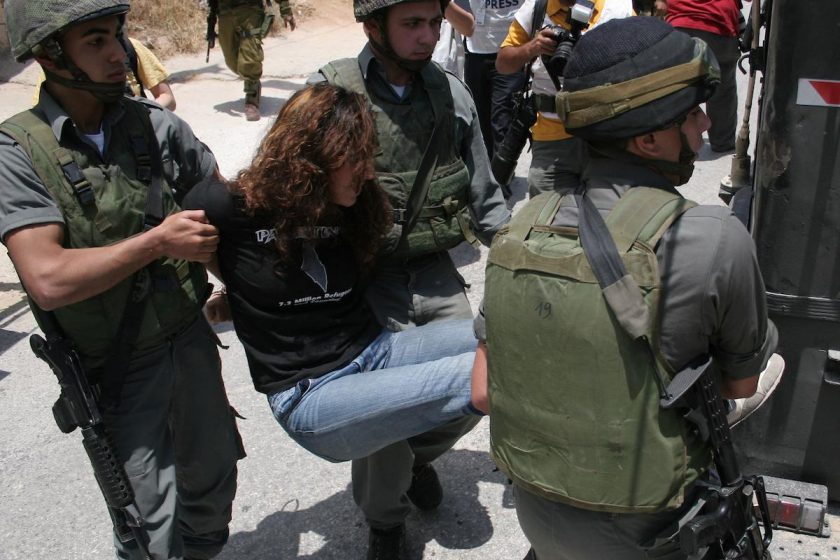
Israeli soldiers arrest a woman protester during a demonstration against Israel’s controversial separation barrier which crosses the Palestinian territories in the West Bank town of Beit Jala, near the town of Bethlehem, on 27 June 2010 [Mamoun Wazwaz/Apaimages]
MEMO | January 2, 2019
Israeli occupation forces arrested 175 Palestinian women and girls in 2018 and summoned hundreds in for interrogation, the Palestine Prisoners’ Centre for Studies said yesterday.
In a statement reported by the Safa News Agency, the Director of the centre Riyadh Al-Ashqar said that the Israeli occupation escalated its aggression on Palestinian women and girls this year in order to punish them for their participation in anti-occupation activities.
He also said that the Israeli occupation arrested female relatives of male prisoners, describing this as a “form of illegal punishment”.
Al-Ashqar documented the detention of 15 females who’s male relatives are being held in Israeli detention including Bayan Faroun. The twenty-four-year-old was handed a 40 months prison term. She is the fiancé of Ahmed Azzam who was sentenced to six-years in jail.
Female prisoners face harsh conditions in jail, Al-Ashqar said, including violation of their rights, humiliation and a lack of access to health care.
India sequesters Iran ties from US predatory strike
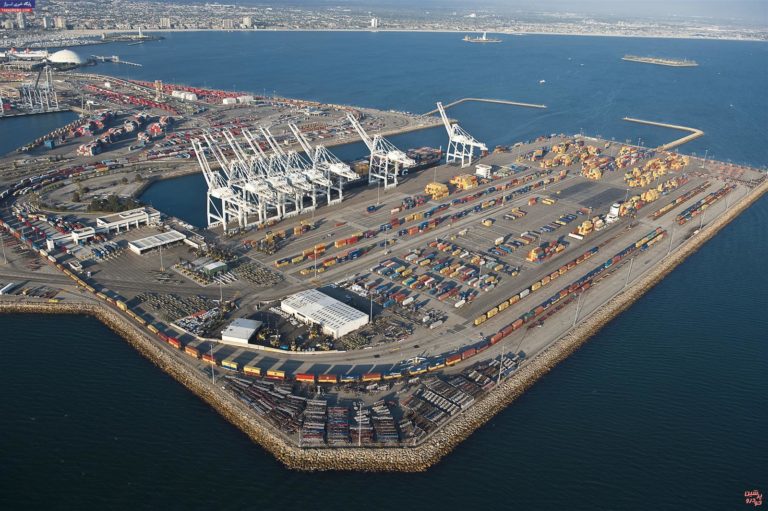
(Iran’s Chabahar Port)
By M. K. BHADRAKUMAR | Indian Punchline | January 2, 2019
India has done well to put in place the nuts and bolts of a payment mechanism for its trade and investment transactions with Iran against the backdrop of the US withdrawal from the Iran nuclear deal (known as the Joint Comprehensive Plan of Action) in May last year followed by the imposition of sanctions against Iran. The US had threatened to bring Iran’s oil trade to zero by the end of 2018 but ultimately pragmatism prevailed and major importing countries such as India were given 6-month ‘waivers’ in November.
Delhi has utilised this interregnum to sequester India-Iran economic relations as far as possible from the vagaries of the Trump administration’s Iran policies. How far Delhi sensitized Washington in advance about its Iran strategy we may never know, but the overall approach suggests a quiet determination to safeguard Indian economic (and political) interests from suffering collateral damage without, at the same time, displaying any strategic defiance of the US in the foreign-policy domain. The Indian diplomacy has been successful here so far.
Broadly, the Indian government has revisited the strategy adopted by the UPA leadership in similar circumstances of US sanctions against Iran and in the light of past experience, finessed a payment mechanism that dispenses with the use of American dollar in India-Iran economic transactions thereby bypasses the cutting edge of the US sanctions. Indeed, the impetus to do so is far more keenly felt today than under the UPA government because India-Iran economic relationship is transforming phenomenally and assuming strategic importance under the Modi government, especially with the operationalization of the Chabahar Port project.
Arguably, the Modi government is showing far greater grit in comparison with the timid attitude by the previous UPA government in asserting India’s strategic autonomy to advance the India-Iran partnership notwithstanding the hostile policies of Washington toward Iran, which are in the nature of forcing a ‘regime change’ in Tehran. Interestingly, the Indian approach is also impervious to the continued Israeli and Saudi intrigues against Iran, although the Modi government has significantly boosted India’s relations with these two Middle East countries.
The Indian policy toward relations with Iran under the deepening shadow of US sanctions has evolved in three carefully measured stages through the month of December. Needless to say, this wouldn’t have been possible without mutual trust and understanding in the relationship characterized by close consultations through diplomatic channels. In the first stage, it came to be known that in early November the two countries signed an agreement to the effect that India will import crude oil from Iran using a rupee-based payment mechanism and that 50 percent of those payments will be used for exporting items by India to Tehran.
Accordingly, India’s government-owned UCO Bank (which has no exposure to the US) was designated to handle this mechanism. In a third stage, in continuation of the above, the Ministry of Finance in Delhi issued an order in end-December exempting the National Iranian Company (NIOC) which exports crude to India from paying a steep ‘withholding tax’ to the Indian authorities. This order issued on December 28 will have retrospective effect from November 5 so that an amount of $1.5 billion that Indian refiners had accumulated as outstanding payments to NIOC could be released. Under Indian laws, the income of a foreign company that is deposited in an Indian bank account is subject to a withholding tax of 40 percent plus other levies, leading to a total take by the authorities of 42.5 percent.
Suffice to say, the door is open, Iran will now be able to use the rupee funds for a range of expenses–including imports from India, the cost of its missions in the country, direct investment in Indian projects, and its financing of Iranian students in India. It can also invest the funds in Indian government debt securities. The tax exemption order, though, only refers to crude oil. That means it does not apply to imports of other commodities, such as fertilizer, liquefied petroleum gas and wax. It appears that the scope of the use of funds will ensure balanced bilateral trade, which is traditionally in Iran’s favour.
On December 31, the two countries announced that their banking transactions mechanism is ready for operation.
Interestingly, India is leapfrogging many other countries that have been talking about similar payment mechanisms with Iran bypassing the US sanctions. The most glaring instance is of the European Union’s much-vaunted proposed mechanism of the Special Purpose Vehicle (SPV), which has not arrived yet. Brussels had vowed to establish the SPV “before the end of the year (2018) as a way to protect and promote legitimate business (of European companies) with Iran,” to quote the EU foreign policy chief Federica Mogherini.
Clearly, Delhi is not waiting to take the cue from other capitals that may harbor grave reservations over the US sanctions against Iran. Equally, Tehran’s willingness to accept for payments the Indian rupee (which is not traded on international markets) bears testimony to its great desire to sustain a beneficial relationship with India notwithstanding the US pressure on Delhi to severely cut back on economic ties with Iran.
All in all, Delhi seems to be preparing for the long haul. The fact of the matter is that politically, it is an increasingly tall order for the present Iranian leadership to continue with its adherence to its share of the 2015 Iran nuclear deal without any infringement or breach in the face of the failure on the part of the European leaders to deliver on their promise that in return Iran will be compensated through steps such as the EU maintaining and deepening economic relations with Iran, the continued sale of Iran’s oil and gas, effective banking transactions with Iran, the further provision of export credit and development of the SPVs in financial banking, insurance and trade areas and so on.
The ground reality is that the European leaders failed to deliver on their promises to Tehran and Iran has been left to fend for itself under the most savage and unlawful economic and political pressure by Washington. Simply put, while Europe claims that the Iran nuclear deal is of strategic importance, it is unwilling or reluctant to invest in its own strategic interests. The Iranian Foreign Minister Mohammad Zarif aptly summed up the European dilemma in a recent remark that you cannot swim without getting wet. Delhi may have shown that where there is a strong political will, there is always a way forward.
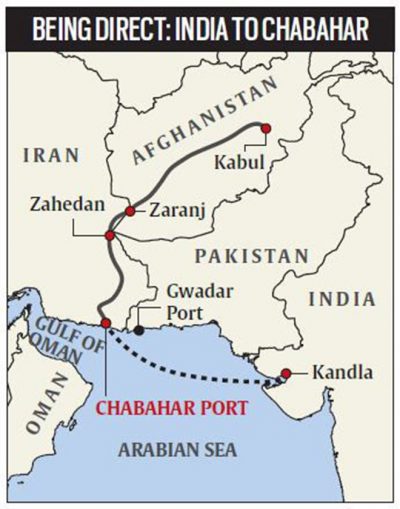
Without doubt, the operationalization of the Chabahar Port a week ago dramatically changes the India-Iran strategic calculus. Where words are not adequate to describe it, a look at the map showing India’s new Silk Road will do. Its geopolitical ramifications are profound. Ironically, Chabahar may eventually bring not only India and Iran but the US as well on the same page. Much lies in the womb of time.
Why France’s Yellow Vest Protests Have Been Ignored by “the Resistance” in the U.S.

By Max Parry • Unz Review • January 2, 2019
”The rich are only defeated when running for their lives.”— C.L.R. James, The Black Jacobins
In less than two months, the yellow vests (“gilets jaunes”) movement in France has reshaped the political landscape in Europe. For a seventh straight week, demonstrations continued across the country even after concessions from a cowed President Emmanuel Macron while inspiring a wave of similar gatherings in neighboring states like Belgium and the Netherlands. Just as el-Sisi’s dictatorship banned the sale of high-visibility vests to prevent copycat rallies in Egypt, corporate media has predictably worked overtime trying to demonize the spontaneous and mostly leaderless working class movement in the hopes it will not spread elsewhere.
The media oligopoly initially attempted to ignore the insurrection altogether, but when forced to reckon with the yellow vests they maligned the incendiary marchers using horseshoe theory to suggest a confluence between far left and far right supporters of Jean-Luc Mélenchon and Marine Le Pen. To the surprise of no one, mainstream pundits have also stoked fears of ‘Russian interference’ behind the unrest. We can assume that if the safety vests were ready-made off the assembly line of NGOs like the raised fist flags of Serbia’s OTPOR! movement, the presstitutes would be telling a different story.
It turned out that a crisis was not averted but merely postponed when Macron defeated his demagogue opponent Le Pen in the 2017 French election. While it is true that the gilets jaunes were partly impelled by an increase on fuel prices, contrary to the prevailing narrative their official demands are not limited to a carbon tax. They also consist of explicit ultimatums to increase the minimum wage, improve the standard of living, and an end to austerity, among other legitimate grievances. Since taking office, Macron has declared war on trade unions while pushing through enormous tax breaks for the wealthy (like himself) — it was just a matter of time until the French people had enough of the country’s privatization. It is only a shock to the oblivious establishment why the former Rothschild banker-turned-politician, who addressed the nation seated at a gold desk while Paris was ablaze, is suddenly in jeopardy of losing power. The status quo’s incognizance is reminiscent of Marie Antoinette who during the 18th century when told the peasants had no bread famously replied, “let them eat cake” as the masses starved under her husband Louis XIV.
While the media’s conspicuous blackout of coverage is partly to blame, the deafening silence from across the Atlantic in the United States is really because of the lack of class consciousness on its political left. With the exception of Occupy Wall Street, the American left has been so preoccupied with an endless race to the bottom in the two party ‘culture wars’ it is unable to comprehend an upheaval undivided by the contaminants of identity politics. A political opposition that isn’t fractured on social issues is simply unimaginable. Not to say the masses in France are exempt from the internal contradictions of the working class, but the fetishization of lifestyle politics in the U.S. has truly become its weakness. We will have to wait and see whether the yellow vests transform into a global movement or arrive in America, but for now the seeming lack of solidarity stateside equates to a complicity with Macron’s agenda.
It serves as a reminder of the historically revisionist understanding of French politics in the U.S. that is long-established. The middle class dominated left-wing in America ascribes to a historical reinterpretation of the French Revolution that is a large contributor of its aversion to transformative praxis in favor of incrementalism. The late Italian Marxist philosopher and historian Domenico Losurdo, who died in June of this year, offered the most thorough understanding of its misreading of history in seminal works such as War and Revolution: Rethinking the Twentieth Century. The liberal rereading of the French Revolution is the ideological basis for its rejection of the revolutionary tradition from the Jacobins to the Bolsheviks that has neutralized the modern left to this day.
According to its revised history, the inevitable outcome of comprehensive systemic change is Robespierre’s so-called ‘Reign of Terror’, or the ‘purges’ of the Stalin era in the Soviet Union. In its view, what began with the Locke and Montesquieu-influenced reforms of the constitutional monarchy was ‘hijacked’ by the radical Jacobin and sans-culotte factions. Losurdo explains that counter-revolutionaries eager to discredit the image of rebellion overemphasize its violence and bloodshed, and never properly contextualize it as self-defense against the real reign of terror by the ruling class. The idea behind this recasting of history is to conflate revolutionary politics with Nazi Germany whose racially-motivated genocide was truly the inheritor of the legacy of European colonialism, not the ancestry of the Jacobins or the Russian Revolution.
Maximilien Robespierre’s real crime in the eyes of bourgeois historians was attempting to fulfill the egalitarian ideals of republicanism by transferring political power from the aristocracy and nouveaux riche directly into the hands of the working class, just as the Paris Commune did nearly 80 years later. It is for this reason he subsequently became one of the most misunderstood and unfairly maligned figures in world history, perhaps one day to be absolved. The U.S. reaction to the yellow vests is a continuation of the denial and suppression of the class conflict inherent in the French Revolution which continues to seethe beneath the surfaces of capitalism today.
In today’s political climate, it is easy to forget that there have been periods where the American left was actually engaged with the crisis of global capitalism. In what seems like aeons ago, the anti-globalization movement in the wake of NAFTA culminated in huge protests in Seattle in 1999 which saw nearly 50,000 march against the World Trade Organization. Following the 2008 financial collapse, it briefly reemerged in the Occupy movement which was also swiftly put down by corporate-state repression. Currently, the political space once inhabited by the anti-globalization left has been supplanted by the ‘anti-globalist’ rhetoric mostly associated with right-wing populism.
Globalism and globalization may have qualitatively different meanings, but they nevertheless are interrelated. Although it is shortsighted, there are core accuracies in the former’s narrative that should be acknowledged. The idea of a shadowy world government isn’t exclusively adhered to by anti-establishment conservatives and it is right to suspect there is a worldwide cabal of secretive billionaire power brokers controlling events behind the scenes. There is indeed a ‘new world order’ with zero regard for the sovereignty of nation states, just as there is a ‘deep state.’ However, it is a ruling class not of paranoiac imagination but real life, and a right-wing billionaire like Robert Mercer is as much a globalist as George Soros.
Ever since capitalism emerged it has always been global. The current economic crisis is its latest cyclical downturn, impoverishing and alienating working people whose increasing hardship is what has led to the trending rejection of the EU. Imperialism has exported capital leading to the destruction of jobs in the home sectors of Western nations while outsourcing them to the third world. Over time, deep disgruntlement among the working class has grown toward an economic system that is clearly rigged against them, where the skewed distribution of capital gains and widespread tax evasion on the part of big business is camouflaged as buoyant economic growth. When it came crashing down in the last recession, the financial institutions responsible were bailed out using tax payer money instead of facing any consequences. Such grotesque unfairness has only been amplified by the austerity further transferring the burden from the 1% to the poor.
Before the gilets jaunes, the U.K.’s Brexit referendum in 2016 laid bare these deep class divisions within the European Union. One of the most significant events in the continent since WWII, it has ultimately threatened to reshape the Occident’s status in the post-war order as a whole. Brexit manifested out of divisions within Britain’s political parties, especially the Torys, which had been plagued for years by internal dispute over the EU. Those in power were blind to the warning signs of discontent toward a world economy in crisis and were shocked by the plebiscite in which the working class defied the powers that be against all odds with more than half voting to leave.
In general, well-to-do Brits were hard remainers while those suffering most severely from the destruction of industry, unemployment and austerity overwhelmingly chose to leave in what was described as a “peasants revolt” by the media. The value of the pound sterling quickly plunged and not long after the status of the United Kingdom as a whole came into question as Britain found itself at odds with Scotland’s unanimous decision to remain. Brexit tugged at the bonds holding the EU together and suddenly the collective standing clout of its member states is at stake in a potential breakup of the entire bloc.
Euroscepticism is also by no means a distinctly British phenomenon, as distrust has soared in countries hit the hardest by neoliberalism like Greece (80%), with Spain and France not far behind. In fact, before there was Brexit there was fear among the elite of a ‘Grexit.’ In response to its unprecedented debt crisis manufactured by the International Monetary Fund (IMF), the Greek people elected the Coalition of the Radical Left, SYRIZA, to a majority of legislative seats to the Hellenic Parliament during its 2015 bailout referendum. Unfortunately, the synthetic alliance turned out to be anything but radical and a trojan horse of the establishment. SYRIZA was elected on its promise to rescind the terms of Greek membership in the EU, but shortly after taking office it betrayed its constituency and agreed to the troika’s mass privatization. Even its former finance minister Yanis Varousfakis admitted that SYRIZA was a controlled opposition and auxiliary of the Soros Foundation.
Apart from suffering collective amnesia regarding the EU’s neoliberal policies, apparently the modern left is also in serious need of a history lesson regarding the federation’s fascist origins. It has been truly puzzling to see self-proclaimed progressives mourning Britain’s decision to withdraw from a continental union that was historically masterminded by former fifth columnists of Nazi Germany. It was in the aftermath of WWII’s devastation that the 1951 Treaty of Paris established the nucleus of the EU in the European Coal and Steel Community, a cooperative union formed by France, Italy, West Germany, and the three Benelux states (Belgium, Luxembourg and the Netherlands). The Europe Declaration charter stated:
“By the signature of this Treaty, the involved parties give proof of their determination to create the first supranational institution and that thus they are laying the true foundation of an organized Europe. This Europe remains open to all European countries that have freedom of choice. We profoundly hope that other countries will join us in our common endeavor.”
The idea of forming a “supranational” union was conceived by the French statesman Robert Schuman, who during the outbreak of WWII served as the Under-Secretary of State for Refugees in the Reynaud government. When Nazi Germany invaded France in 1940, Schuman by all accounts willingly voted to grant absolute dictatorial powers to Marshall Philippe Pétain to become Head of State of the newly formed Vichy government, the puppet regime that ruled Nazi-occupied France until the Allied invasion in 1944. By doing so, he retained his position in parliament, though he later chose to resign. Following the war, like all Vichy collaborators Schuman was initially charged with the offense of indignité nationale (“national unworthiness”) and stripped of his civil rights as a traitor.
More than 4,000 alleged quislings were summarily executed following Operation Overlord and the Normandy landings, but the future EU designer was fortunate enough to have friends in high places. Schuman’s clemency was granted by none other than General Charles de Gaulle himself, the leader of the resistance during the war and future French President. Instantly, Schuman’s turncoat reputation was rehabilitated and his wartime activity whitewashed. Even though he had knowingly voted full authority to Pétain, the retention of his post in the Vichy government was veneered to have occurred somehow without his knowledge or consent.
Schuman is officially regarded as one of the eleven men who were ‘founding fathers’ of what later became the EU. One of the other major figures that contributed to the federal integration of the continent was Konrad Adenauer, the first Chancellor of the Federal Republic of Germany. The Nuremberg Trials may have tried and executed most of the top leadership of the Nazi Party, but the post-war government that became West Germany was saturated with former Third Reich officials. Despite the purported post-war ‘denazification’ policy inscribed in the Potsdam agreement, many figures who had directly participated in the Holocaust were appointed to high positions in Adenauer’s administration and never prosecuted for their atrocities.
One such war criminal was the former Ministry of the Interior and drafter of the Nuremberg race statutes, Hans Globke, who became Adenauer’s right hand man as his Secretary of State and Chief of Staff. Adenauer also successfully lobbied the Allies to free most of the Wehrmacht war criminals in their custody, winning the support of then U.S. General and future President Dwight Eisenhower. By 1951, motivated by the desire to quickly rearm and integrate West Germany into NATO in the new Cold War, the policy of denazification was prematurely ended and countless offenders were allowed to reenter branches of government, military and public service. Their crimes against humanity took a backseat to the greater imperialist priority of rearmament against East Germany and the Soviets.
In the years following WWII, there was also concern among the elite of anti-Americanism growing in Western Europe. The annual Bilderberg Group conference was established in 1954 by Prince Bernard of the Netherlands, himself a former Reiter-SS Corps and Nazi Party member, to promote ‘Atlanticism’ and facilitate cooperation between American and European leaders. Invitations to the Bilderberg club meetings were extended to only the most exclusive paragons in politics, academia, the media, industry, and finance. In 2009, WikiLeaks revealed that it was at the infamous assembly where the hidden agenda of the European Coal and Steel Community, later the EU, was set:
“E. European Unity: The discussion on this subject revealed general support for the idea of European integration and unification among the participants from the six countries of the European Coal and Steel Community, and a recognition of the urgency of the problem. While members of the group held different views as to the method by which a common market could be set up, there was a general recognition of the dangers inherent in the present divided markets of Europe and the pressing need to bring the German people, together with the other peoples of Europe, into a common market. That the six countries of the Coal and Steel Community had definitely decided to establish a common market and that experts were now working this out was felt to be a most encouraging step forward and it was hoped that other countries would subsequently join it.”
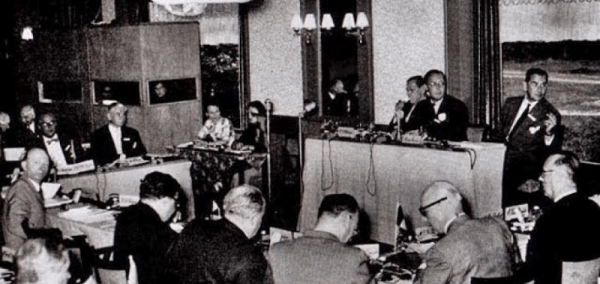
Prince Bernard presides over the first annual Bilderberg meeting in 1954.
At the 1955 conference, the rudimentary idea for a European currency or what became the Eurozone was even discussed, three years before the Treaty of Rome which established the European Economic Community, without the public’s knowledge:
“A European speaker expressed concern about the need to achieve a common currency, and indicated that in his view this necessarily implied the creation of a central political authority.”
The mysterious Bilderberg gatherings are still held to this day under notorious secrecy and are frequently the subject of wild speculation. One can imagine a topic behind the scenes at this year’s meeting would be how to address the growth of anti-EU ‘populism’ and uprisings like the gilet jaunes. Hitlerite expansionism had been carried out on the Führer’s vision for a European federation in the Third Reich — in many respects, the EU is a rebranded realization of his plans for empire-building. How ironic that liberals are clinging to a multinational political union founded by fascist colluders while the same economic bloc is being opposed by today’s far right after its new Islamophobic facelift.
While nationalism may have played an instrumental role in Brexit, there is a manufactured hysteria hatched by the establishment which successfully reduced the complex range of reasons for the Leave EU vote to racism and flag-waving. They are now repeating this pattern by overstating the presence of the far right among the yellow vests. Such delirium not only demonizes workers but coercively repositions the left into supporting something it otherwise shouldn’t — the EU and by default its laissez-faire policies — thereby driving the masses further into the arms of the same far right. Echoes of this can be seen in the U.S. with the vapid response to journalist Angela Nagle’s recent article about the immigration crisis on the southern border. The faux-left built a straw man in their attack on Nagle, who dared to acknowledge that the establishment only really wants ‘open borders’ for an endless supply of low-wage labor from regions in the global south destabilized by U.S. militarism and trade liberalization. Aligning itself with the hollow, symbolic gestures of centrists has only deteriorated the standards of the left participating in such vacuousness and dragged down to the level of liberals.
There is no doubt Brexit and Trump pushed the xenophobia button and could not have come about without it. However, such criticism means nothing when it comes from moral posturers who claim to “stand with refugees” while supporting the very ‘humanitarian’ interventionist policies displacing them. Nativism was not the sole reason the majority voted to leave the EU and many working class minorities also were Brexiters. Of course their fellow workers and migrants are not the true cause of their misery. After all, it was not just chattel slaves who came to the U.S. unwillingly but European immigrants fleeing continental wars and starvation as well — the crisis in the EU today is no different.
Fundamentally, migrants seek asylum on Europe’s doorstep because of NATO’s imperial expansion and the unexpected arrival of Brexit has threatened to weaken the EU’s military arm. Already desperate to reinvent itself and a new enemy in Russia despite its functional obsolescence, the shock of the referendum has inconveniently undermined NATO’s ability to pressure Moscow and Beijing, a step forward for mitigating world peace in the long run and a silver lining to its outcome. It is the task of the left to reject the EU’s neoliberal project while transmitting the message that capital, not refugees, is the cause of the plight of the masses. It is also necessary to have faith in the people, something cynical liberals lack. Racism may historically be the achilles heel of the working class but underlying Brexit, the election of Trump, and the yellow vests is the spirit of defiance in working people, albeit one of political confusion in need of guidance.
If the yellow vests are today’s sans-culottes, like those which became the revolutionary partisans in the French Revolution, they will eventually need a Jacobin Club. Relatively progressive but ultimately reformist figures like Mélenchon are no such spearhead and will only lead them down the same dead end of SYRIZA. The absence of any such vanguard has forced the working class to take matters into their own hands in the interim. If history is any guide, the gilets jaunes will be stamped out until a new cadre takes the reins whose objective is, as Lenin said,“not to champion the degrading of the revolutionary to the level of an amateur, but to raise the amateurs to the level of revolutionaries.” We also cannot fall into ideological fantasies that we live in permanent revolutionary circumstances or that a spontaneous uprising can become comprehensive simply because of ingenious leadership. Nevertheless, as Mao Tse-Tung wrote, “a single spark can start a prairie fire” and hopefully the yellow vests are that flame.
Max Parry is an independent journalist and geopolitical analyst. Max may be reached at maxrparry@live.com
Tiresome Things of 2018:
By Peter Van Buren | We Meant Well | December 31, 2018
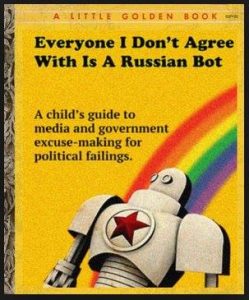 Tiresome things of 2018:
“News” that is just stuff someone tweeted;
“News” that is just repeating what a late night TV host said;
“News” reported on one web site which is just a rewrite of a story on another web site;
Deification by the left of scum from the right like McCain, Mattis, Clapper, Comey, Brennan, et al, only because they said something bad about Trump;
Desperate creation of insta-heroes to satisfy some greater political goal (‘Dem Parkland Kids, the cult of ‘Notorious’ RGB, Alexandria Ocasio-Cortez, Friggin’ Beto), empty heros in a time of disappointment and cynicism;
Movements which claim they have changed everything because their hashtag trended on Twitter;
All media abandoning even the pretence of objectivity in favor of advocacy but pretending they are still objective;
The primacy of “sources say…” over anything resembling actual fact-gathering;
“Fact checking” that is actually partisan gaming of information;
Idiots thrilled when bad things happen (like stock market declines) because they think it validates their Trump hate;
Idiots over-dramatizing bad things (like stock market declines) into evidence the world is ending, fascism is taking over, end of democracy, time to worry, walls closing in, tick tock;
Idiots hoping for more bad things to happen, like a doomsday cult does, because they think that will hasten the end of Trump;
People who have been saying “Just wait” for three years now into Russiagate. We’re waiting.
That most social media which isn’t cat pictures is now endless self-promotion because everyone is a brand or selling something or demanding we follow them or friend them or like them or thumbs up them;
People who just read the headlines and media which writes headlines which are not reflective of the actual content;
The way transpeople have become progressives’ adopted bestest minority of the moment;
Over-use of the word “folk”;
Insta-hate that finds some way to make anything Trump does from the dramatic to the mundane evil and wrong;
Historical revisionism that turns people like George W. Bush into kindly old men sharing candies with Goddess Michelle instead of thugs who dragged America into war and recession and forever damaged our nation’s credibility by torturing human beings;
Anything that starts with “As a ____” (woman, POC, Kurd, left handed Asian-American) because you know the rest is just going to be someone whining about how life is unfair, the system unjust, the deck stacked, because they are a ____ and can comment with the full authority for everyone ____ everywhere because they are a ____ and you are not;
Discussions on immigration policy that dead-end when someone has to tearfully tell us about how his great grandfather didn’t speak English, forestalling any serious attempt to look at broader policy in the 21st century.
Bill Gates Pushes Nuclear Power Plants to ‘Prevent the Worst Climate-Change Scenarios’
By Bill Gates | December 29, 2018
… Global emissions of greenhouse gases went up in 2018. For me, that just reinforces the fact that the only way to prevent the worst climate-change scenarios is to get some breakthroughs in clean energy.
Some people think we have all the tools we need, and that driving down the cost of renewables like solar and wind solves the problem. I am glad to see solar and wind getting cheaper and we should be deploying them wherever it makes sense.
But solar and wind are intermittent sources of energy, and we are unlikely to have super-cheap batteries anytime soon that would allow us to store sufficient energy for when the sun isn’t shining or the wind isn’t blowing. Besides, electricity accounts for only 25% of all emissions. We need to solve the other 75% too.
This year Breakthrough Energy Ventures, the clean-energy investment fund I’m involved with, announced the first companies we’re putting money into. You can see the list at http://www.b-t.energy/ventures/our-investment-portfolio/. We are looking at all the major drivers of climate change. The companies we chose are run by brilliant people and show a lot of promise for taking innovative clean-energy ideas out of the lab and getting them to market.
Next year I will speak out more about how the U.S. needs to regain its leading role in nuclear power research. (This is unrelated to my work with the foundation.)
Nuclear is ideal for dealing with climate change, because it is the only carbon-free, scalable energy source that’s available 24 hours a day. The problems with today’s reactors, such as the risk of accidents, can be solved through innovation.
The United States is uniquely suited to create these advances with its world-class scientists, entrepreneurs, and investment capital.
Unfortunately, America is no longer the global leader on nuclear energy that it was 50 years ago. To regain this position, it will need to commit new funding, update regulations, and show investors that it’s serious.
There are several promising ideas in advanced nuclear that should be explored if we get over these obstacles. TerraPower, the company I started 10 years ago, uses an approach called a traveling wave reactor that is safe, prevents proliferation, and produces very little waste. We had hoped to build a pilot project in China, but recent policy changes here in the U.S. have made that unlikely. We may be able to build it in the United States if the funding and regulatory changes that I mentioned earlier happen.
The world needs to be working on lots of solutions to stop climate change. Advanced nuclear is one, and I hope to persuade U.S. leaders to get into the game.
Read more: https://www.gatesnotes.com/About-Bill-Gates/Year-in-Review-2018
US Military Apologizes For Posting Uncomfortably Honest Tweet
By Caitlin Johnstone | January 1, 2019
U.S. Strategic Command (or “Stratcom” if you’re trying to make a nuclear-capable arm of the U.S. Defense Department sound cool) has issued an apology for a poorly received New Year’s Eve tweet which has since been deleted.
“#TimesSquare tradition rings in the #NewYear by dropping the big ball… if ever needed, we are #ready to drop something much, much bigger,” the offending tweet read, with an attached video featuring B-2 stealth bombers flying all stealth bombery and causing gigantic explosions with bunker buster bombs while words like “STEALTH”, “READY”, and “LETHAL” flashed across the screen. The tweet concluded with the ostensibly unironic hashtag “#PeaceIsOurProfession”.
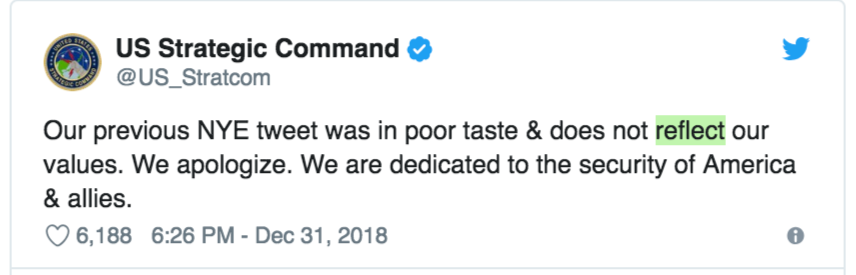
“Our previous NYE tweet was in poor taste & does not reflect our values,” Strategic Command tweeted. “We apologize. We are dedicated to the security of America & allies.”
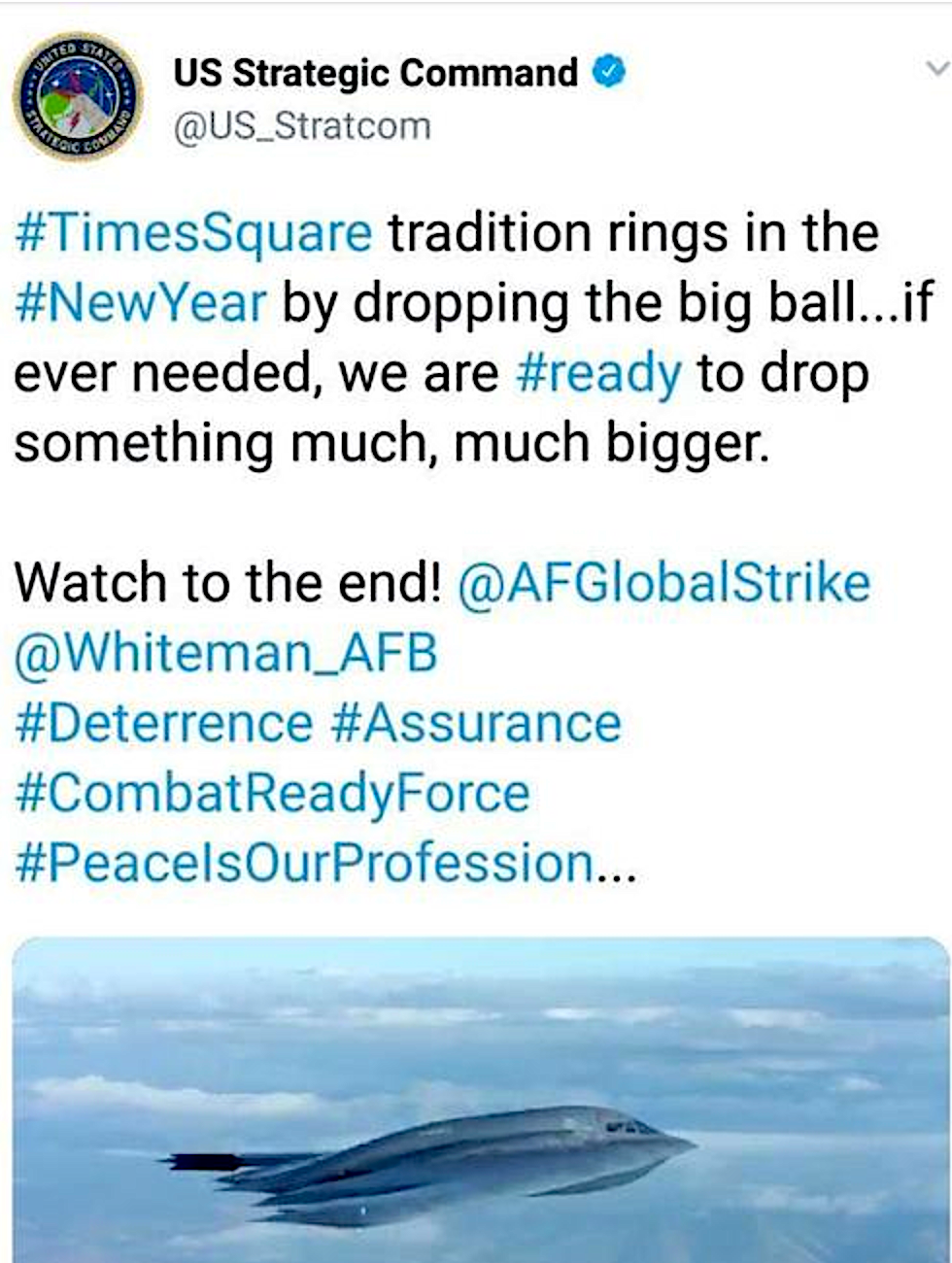
This statement is, obviously, a lie. The part about “security” of course, because dominating the globe with nonstop military violence and aggression has nothing to do with security, but also the “does not reflect our values” part. The U.S. military deleted the post and apologized for it because it received an angry backlash from hundreds of commenters and was circulated virally on Twitter for its jarringly creepy message, not because it did not reflect their values. It reflected their values perfectly.
The only way you could possibly encapsulate the U.S. military’s values in a 42-second video clip more perfectly than cramming it full of footage of $2,000,000,000 war planes cruising around dropping $3,500,000 GBU-57 bombs would be to also show the human bodies they land on being ripped to pieces. Inflicting death and destruction using unfathomably expensive machinery is the U.S. military’s whole job. Of course it reflects their values.
The real issue here was not values but perception. The U.S. war machine pours an immense amount of energy into perception management, making sure that ordinary Americans either (A) ignore the horrific things that are being done in their name or (B) think that those things are awesome and patriotic. The offending post was clearly attempting to accomplish (B). A team of paid social media propagandists simply did not understand that ordinary human beings wouldn’t resonate with a message that amounts to “Hey I see you’re all preparing to bring in the new year, so watch how good we are at killing large numbers of people!”, and some damage control became necessary when everyone got freaked out. Can’t have people opening their eyes to how insane America’s relentless military expansionism has gotten, after all.
Watching the propaganda arm of the U.S.-centralized war machine is a lot like watching a manipulative sociopath learning how to function in normal society. Sometimes they’ll slip up and fail to react the way someone with a healthy sense of empathy would respond to the death of a pet or someone’s emotions or whatever, and they risk alienating whoever’s around them and losing access to the resources they could exploit them for if they can’t manipulate them out of the creeped-out feeling people get when they’re around someone who doesn’t empathize like a normal human being. I suspect many of the commenters who flooded in telling Stratcom to delete its tweet were not so much interested in eliminating a violent social media post from the internet, but in eliminating that creeped-out feeling you get when the sociopath’s mask slips a bit.
And that’s understandable. One of the biggest obstacles in getting people to realize how deeply propagandized they are is the cognitive dissonance which comes rushing in when one considers the implications of viewing the world free from the lens of military psychological manipulations. Without the lies about how beneficent and necessary and awesome the military is, all you’ve got is trillions of dollars worth of instruments of death circling the globe to facilitate the daily slaughter of men, women and children to advance agendas of power and profit while ordinary people struggle just to get by in your own country. It can be deeply psychologically uncomfortable to grapple with the reality of what that means for your beliefs about your nation, your society and your very identity, in much the same way realizing you married a manipulative sociopath can be an uncomfortable truth one might feel tempted to compartmentalize away from.
A lot of people got upset about that tweet, but they really shouldn’t have. The tweet was not the problem; it was just a few perception managers for the U.S. military being more honest and straightforward than usual. The problem is that money is being stolen from ordinary Americans to murder strangers on the other side of the planet to advance agendas of power and profit, and everyone’s being propagandized into accepting that as normal. The sociopathic propaganda engine slipping up and stirring the populace from their slumber a bit is nothing to complain about, the actual reality of our actual situation is.
Caitlin Johnstone is a rogue journalist, poet, and utopia prepper who publishes regularly at Medium.
Featured Video
Laith Marouf: Hezbollah’s position on US-Iran ceasefire
or go to
Aletho News Archives – Video-Images
From the Archives
The Dirty Little Secret behind the “Global Terrorism Index”
The Omission of Israeli Terrorism in the Occupied Palestinian Territories
By Karin Brothers | Global Research | December 6, 2014
… The Israeli settlements — all of which are illegal – have been identified as a major impediment to peace. The refusal of a major “global” terrorism report to name the Israeli settlers as one of the groups most responsible for terrorism not only misrepresents a major source of regional violence but exposes the Global Terrorism Index as a propaganda tool that supports a U.S. agenda.
In recent years, governments have been attempting to thwart terrorism by blocking supportive fund-raising. When it comes to Israeli settlements, however, the US and Canada actually encourage fund-raising by giving organizations (such as Christian Friends of Israeli Communities (CFOIC) and the Jewish National Fund) financial support in the form of donor tax-deductions.
Charities which provide funds for the Israeli settlements should be regarded as terror-financing organizations. They should not only lose their tax-deductible status, but they should be banned because they support the violation of international humanitarian law. The terror-financing laws that are being strictly enforced for Muslim charities should be applied to Christian and Jewish charities as well. … Read full article
Blog Roll
 Aletho News
- Trump Administration Moves To Automate U.S. Military Draft Registration
- Spain orders reopening of Tehran embassy, condemns Israel’s carpet bombing of Lebanon
- Israel faces ‘unsustainable’ strategic crisis following 40-day war against Iran: Analyst
- Iran restricts Hormuz access to 15 vessels per day under ceasefire terms: Report
- The ‘Opposition Party’ Has Done Nothing to Stop the Iran War and Much to Goad Trump Into Continuing It
- Moscow backs Tehran on status of Lebanon in US-Iran deal
- How UK Regulator Ofcom Quietly Bypassed International Law to Police American Speech
- The Black Cube Files: How Former Mossad Operatives Flipped a Nation
- Laith Marouf: Hezbollah’s position on US-Iran ceasefire: What you’re not being told
- Israel’s priority lies in destroying chances of peace between Iran, US: Ex-UN nuclear chief
- If Americans Knew
- The gallows law: Israel moves toward executing Palestinian children
- Tucker Carlson: The Path to Peace requires ending ‘special alliance’ with Israel
- This is ceasefire? Israel’s biggest massacre yet in Lebanon, another journalist killed in Gaza – Daily Update
- Tucker Carlson on Israel: This Is the Behavior of an Ally? Really?
- Gazans face a triple crisis: severe shortages of water and bread, healthcare in tatters
- NY Times reports how Netanyahu took the US into Iran War
- A sigh of relief over Iran, but Gaza and Lebanon in dire straits – Daily Update
- Thousands dead and neighborhoods razed to the ground: Aid agencies fear southern Lebanon is becoming the new Gaza
- The war the US is fighting for Israel could cost trillions
- ‘Cigarette Burns, Nail Wounds’: Toddler Tortured in Gaza to Coerce Father
- No Tricks Zone
- An Inconvenient Tree: Uncovered In Alps… Europe Much Warmer Than Today 6000 Years Ago
- New Study Reports A 60% Slowdown In Greenland’s Ice Loss Rate In The Last Decade
- Low Intensity Tornado Wrecks Major Solar Farm, Creating A Potential Toxic Dump
- New Study Finds Warming Saves Lives…Cold Temperatures 12 Times More Deadly Than Excess Heat
- German Science Blog Accuses PIK Climate Institute Of Hallucinating Climate Tipping Points
- Devastating Assessment Of Comirnaty Vaccine By Former Senior Pfizer Europe Toxicologist
- New Study: CO2 Is ‘Effectively Negligible’ As An Explanatory Climate Change Factor Since 2000
- Former Pfizer Toxicologist Dr. Helmut Sterz Tells Bundestag Hearing Pfizer Vaccine Should Have Never Been Approved
- Energy Expert: Germany’s Nuclear Phaseout Was A “500 Billion Euro Mistake”
- New Research: South Australia’s Mid-Holocene Sea Surface Temperatures Were 4°C Warmer Than Today
 Aletho News