The ‘Caesar Report’ conundrum and the increasing weaponisation of “international justice”

Moaz Moustafa (on right) facilitates John McCain’s illegal entry into Syria to meet with extremist group leaders and known kidnappers. (Photo: Antiwar)
By Tim Hayward | 21st Century Wire | April 6, 2019
The photos brought to public attention in January 2014 by the anonymous witness codenamed ‘Caesar’ show corpses, thousands in number, deceased from violent causes, some bearing signs of torture and many having suffered starvation and neglect.[1] The dead are said to be victims of Syrian state detention facilities, but it is now known that many were not, and it is still not known for sure how many of them were.[2]
If the atrocity of the crimes to which the photos attest is in no doubt, the question of who perpetrated them is less clear-cut. Yet Western reports have unequivocally blamed the ‘Assad regime’. A counter-hypothesis, hardly considered in public discussions, is that many of the bodies were of civilians captured by Jaish al-Islam (JAI) after taking control of Douma in December 2012. JAI are known to have starved their captives while using them as slave labourers, which they did on a scale monumental enough to create the extraordinary network of deep and impressively engineered tunnels that we now see had been built across the area under their control.[3]
Nevertheless, a Qatari-sponsored prosecution team vouched for the Caesar evidence as being ‘capable of being believed’ – in a court of law – to show ‘systematic torture and killing of detained persons by the agents of the Syrian government.’[4] The Western media’s subsequent dissemination of the prosecutors’ interpretation of the images – unchallenged – caused it to be widely believed in the ‘court of public opinion’. Despite significant unsettled and unsettling questions, then, a particular account of what the images show has exercised considerable influence over people’s default assumptions about accountability for atrocities in Syria.
It is the influence of this specific interpretation of evidence that will be reflected on here, and without prejudice as to what may be established about occurrences in Syrian detention on other bases.[5] Questions about the Caesar evidence point up concerns about the extent to which the dissemination of inaccurate information might have distorted the written historical record of our times and how it may have practically influenced real decisions and events.
It matters to get at the truth about the photos for those reasons, as well as for the sake of families whose loved ones have disappeared, but there is also a further reason. This concerns a use made of Caesar’s testimony that may affect the future course of history too. It is the promotion by Western prosecutors of judicial innovation in the pursuit of accountability for atrocity crimes. The purpose of this article is to set out how and why that is a concern, and fundamentally one about justice.
To situate the discussion it will be worth briefly outlining the contrasting kinds of reception the Caesar testimony has received – affirmative versus sceptical – and then also pointing to a much less noticed reception, one of significant silence. For there is an identifiable group of usually vocal critics of the Syrian president and government that has refrained from mentioning the name Caesar. This in itself could be somewhat revealing about what intelligence that group accepts as authoritative. But it also throws into relief the distinctive commitments of another group who, by contrast, have made considerable use of the Caesar name.
It is they who have, for instance, provided the impetus behind successful lobbying for the Caesar Syria Civilian Protection Act in the United States. Less spectacular, but of potentially more enduring international significance, is dissemination of Caesar’s narrative in a wider campaign aimed at creating increasingly flexible mechanisms for international criminal prosecutions.[6]
Billed by some as a progressive and cosmopolitan approach to ‘global justice’ that sets human rights above the prerogative of despots, this movement might more cautiously be assessed as legitimising ‘regime change’ by means of judicial innovation. Such use of the Caesar testimony could serve not only to delegitimise the current president of Syria but also to enhance the possibility of delegitimising any head of state.
This would be at the initiative of prosecution teams who themselves are accountable to their clients and sponsors rather than to the victims of conflict or to principles of humanitarian justice. The argument thus to be developed in this article commends caution about both the evidentiary value of the Caesar testimony and the intentions of those who have most vocally asserted it.
Caesar, his story and the questions raised.
The basic outline of Caesar’s story can be sketched quite succinctly. According to the testimony attributed to Caesar, he had been working as a military photographer in Damascus, where his job was to photograph the dead for purposes of state record keeping. In 2011, concerned at the number of deceased, and the visible indications of torture and starvation, he started smuggling digital files of the images to a contact, now referred to as Sami, who passed them to the Syrian National Movement (SNM). In August 2013, the SNM facilitated Caesar’s extrication from Syria, to be followed shortly after by his immediate family members.
The SNM, although based in Turkey, was backed by Qatar, and the Qatari government hired a team of lawyers and forensic specialists to assess the credibility of the witness and his evidence as a basis for potential prosecutions. In a matter of days the team pronounced Caesar’s evidence ‘capable of being believed’ in a court.[7]
Caesar was then taken to Washington on a visit facilitated by Mouaz Moustafa, director of the Syrian Emergency Task Force, a US State Department sponsored organisation representing some of the anti-government forces in Syria. When giving testimony there, Caesar’s face was concealed and his words were whispered to Moustafa, who acted as translator. After appearing in several other high profile venues with similar arrangements for anonymity, Caesar withdrew from the limelight.

Caesar testimony fed through Moaz Moustafa, facilitator of McCain’s trip to meet “rebels” in Syria. (Photo: Tim Hayward blog)
Meanwhile, an influential section of United States political opinion has pronounced itself confident enough in the witness Caesar to enact legislation in his name – the Caesar Syria Civilian Protection Act – aimed at enforcing ‘accountability’ measures on Syria. The lead author of the Caesar Report, David Crane, has spoken of the photographic evidence as a ‘smoking gun’, words echoed by Keith Harper, US Ambassador to the UN Human Rights Commission (UNHRC). Stephen Rapp, the former US Ambassador At Large for War Crimes, has stated that the photos help to provide ‘much better evidence than has been available to prosecutors anywhere since Nuremberg’.[8]
Prosecution teams in Europe have also attributed great value to the photos as evidence of atrocity crimes.[9] Among the lawyers prominent in promoting the prosecutorial value of the Caesar evidence are Toby Cadman,[10] Wolfgang Kaleck[11] and Patrick Kroker.[12] Meanwhile, the NGO Human Rights Watch produced its own report claiming to validate some of the Caesar evidence.[13] A number of journalists have also expressed themselves convinced, including Richard Engel, who has met ‘Caesar’, and Josh Rogin, Ben Taub, Susie Linfield,[14] Nick Robins-Early,[15] Adam Ciralsky,[16] Jim Muir for the BBC,[17] as well as many more contributors to news outlets including Spiegel,[18] Daily Mail,[19] CNN.[20]
Garance le Caisne wrote a book on Operation Caesar, and documentary films featuring it include Sara Afshar’s Syria’s Disappeared. Affirmation of the evidence has made its way into academic publications too. Some of this has come from people involved in organisations campaigning for an approach to justice and accountability for atrocity crimes that allows implementation of a ‘responsibility to prosecute’.
Those with this interest include prosecution lawyers and advisors like Stephen Rapp, David Crane, Wolfgang Kaleck, Patrick Kroker, and Beth Van Schaack. Other academics who have cited the Caesar evidence uncritically, treating it as part of an established factual record, include: Noha Aboueldahab;[21] Jamie Allinson;[22] Adam Bazco, Gilles Dorronsoro and Arthur Quesnay;[23] Nader Hashemi;[24] Bessma Momani and Tanzeel Hazak;[25] Chris Tenove;[26] and Thomas Weiss.[27]
Some academics have cited the HRW report rather than the original Caesar Report, even if, like Van Schaack,[28] they apparently did not notice how HRW had significantly modified some of the original report’s claims, such as the 11,000 victims figure that HRW corrected down. In all, it can certainly be said that Operation Caesar has made its way into publications that will be regarded as laying down the historical record.
Not everyone is convinced, however. Even the initial reception was cautious in some quarters. One reason was the revelation that Operation Caesar had been initiated by Qatar, a country that had been providing funds – now known to be in the billions of dollars – to opposition fighters aiming to bring down the government of Bashar al-Assad.
There were also the questions, flagged at the start of this article, that are simply begged by appeals – of Rapp and others – to the confirmation by the FBI that the photos showed real dead people.[29] Other serious concerns have been set out in detail by Rick Sterling[30] and Adam Larson[31], but an elementary and conspicuous one is the unconvincing justification for Caesar’s anonymity, which serves to prevent any rigorous independent questioning of his story.
The rationale given for secrecy appears to depend on the implausible proposition that a photographer in the state’s employ could go missing and yet not be missed. A result of the anonymity is that the public ultimately has to place a lot of trust in the competence, integrity and good faith of the people translating and relaying the story. Given that these are people pressing a case for the prosecution, it would be only proper to allow a full examination of the methods they have deployed in presenting their case.
From a defence perspective, it would be hard to ignore facts like prime mover Rapp and the fixer and translator Moustafa having been among the most persistent lobbyists on Capitol Hill for regime change – previously in Libya and then in Syria. Rapp, furthermore, has been campaigning for changes in international criminal law that would lower the barriers to prosecution for atrocity crimes. Even their allies in the quest to prosecute Assad have expressed reservations.
Notably, the directors of the organisations gathering the documentary evidence that Rapp finds the necessary complement of Caesar’s evidence have been quite clear on the point. Thus Bill Wiley, director of the Europe-based Commission for International Justice and Accountability (CIJA) has said ‘would it make a case against Assad? No, not at all, not at all.’[32] Wiley’s counterpart in America, Mohammad al-Abdallah – director of the Syria Justice and Accountability Centre – is also deeply sceptical of the photos’ evidentiary value.[33]
Who dares to cite Caesar?
The central concern of this study can now be further delineated by reference to a group of social media commentators who, to my initial surprise, have appeared to accept that point. This is a group of people who are generally vocal in matters relating to the war in Syria and would not typically pass up an opportunity to highlight crimes alleged of the Syrian president and government.
This group would include Idrees Ahmad, Eliot Higgins, Oz Katerji, Scott Lucas, George Monbiot,[34] Thomas Pierret and Robin Yassin-Kassab. None of them – as far as I can discern – has ever referred to Caesar.[35] The most natural explanation would be that each has individually examined the Caesar Report and decided it did indeed give rise to the critical concerns that sceptics have identified.
However, the same people have been prepared to refer to the HRW report that validates the Caesar evidence, even though it does not address the critical questions. It is as if they are aware that particulars of the Caesar story may be vulnerable to being discredited but they are satisfied that the reputation of the NGO makes it safe to cite as an authority.
What makes this anomalous is that similar caution does not come into play for members of the group with regard to other operations that are no less controversial. A notable example would be the White Helmets. The idea that the White Helmets organisation consists of unarmed humanitarian volunteers devoted to altruistic and impartial service of their home communities is demonstrably misleading in that the funding, coordination and training comes from abroad, its recruits are paid, and they do not represent or serve all sections of Syrian society.
If some of the men may simply be carrying out the tasks they are ostensibly paid to, others have appeared to bear arms and to collaborate with militant extremists. Some have been accused of crimes, including serious ones, and there are even questions about whether some may have been involved in committing atrocities. In short, if one sees reason to be cautious about the credibility of Caesar it would be consistent and reasonable to be cautious about the White Helmets too.
In order to try and resolve the anomaly, it is worth considering another feature of the White Helmets operation that invites comparison with the Caesar narrative:
‘Like Caesar, the White Helmets—also known as the Syrian Civil Defense forces—have become inadvertent documentarians. … White Helmet volunteers have testified before the Security Council, in capitals, and elsewhere and provided photographs and videos of the aftermath of attacks that have helped to shed light on chemical weapon use.’[36]
This documentary role – ‘inadvertent’ or otherwise – has not been lost on promoters of the two operations. Of the Caesar exhibition, Van Schaack observes ‘Such displays respond to the behavioral psychology research on the “picture superiority effect,” which teaches that humans respond to photos more viscerally than to text.’
Of the White Helmets, James Le Mesurier has explained how, in 2012, the security firm he then co-directed, ARK FZC, consulted global market research showing that military and security actors were least likely to win public trust whereas first responders are the most trusted.[37] Thereupon ARK created the White Helmets, and Le Mesurier subsequently formed the Netherlands-registered non-profit Mayday Rescue to manage them (although he was funded from sources like the UK FCO through his company Mayday Rescue FZ-LLC based in a UAE tax haven). As documentarians, the White Helmets have had a much more widespread and sustained impact than Operation Caesar.
So there are some differences worth reflecting on. First, the publicity value of the Caesar images needs no narrative or naming, no due process or due diligence to underwrite, since it is immediate and visceral.
The name that needs to be tagged to those images, moreover, is not Caesar but Assad.[38] People don’t need to be kept in mind of the codename for an operation but they do need to have in mind a constant association of those terrible images with the name of Assad. Seen in this light, therefore, silence about Caesar is an entirely consistent element of an anti-Assadist strategy to influence public opinion.
By contrast, although the White Helmets also make considerable use of imagery,[39] their narrative and their projected identity are necessary for situating and making sense of the images. Moreover, they are protagonists of their own narrative and have remained in situ to cover continuing developments on the ground (even if they have had to move towns as battle lines have shifted).
Their trustworthiness being necessary for the effect of their message, it has been vigorously defended even in the face of serious criticisms. So it is not so surprising, after all, that activists and publicists who have avoided getting drawn into discussion of the Caesar narrative stand firm in defence of the White Helmets narrative.
But if the preference for the White Helmets over Caesar is explicable in those terms, what then needs to be understood is why some other people have nevertheless so actively promoted the Caesar narrative. If the initial purpose of promoting it was to press President Obama’s administration to take a more active interventionist approach to Syria, then it had already failed, and Caesar was not in a position to produce any new evidence. In seeking an explanation it is worth reflecting on who has been most active and consistent in promoting Operation Caesar – from its inception to this day.
The Caesar promoters
The lead author of the Qatari-commissioned Caesar report is David Crane, and he also leads the Syrian Accountability Project (SAP), which he founded some time prior to Caesar’s defection.[40] SAP is said to be student-run and its clients include the Syrian National Council and US State Department.[41] It also ‘works very closely with’ the Syria Justice and Accountability Centre, which in turn is a conduit of US funding to CIJA.
Incidentally, Rapp, Crane, and fellow Caesar Report author Desmond De Silva, were all previously successive holders of the same job, namely, chief prosecutor at the Special Court for Sierra Leone.[42] The man who brought Caesar from his Qatari handlers to the West, and accompanied him on tour, even providing his voice, is Mouaz Moustafa.
Moustafa’s constant companion on the tour – which has included visits to the UK Foreign Office – is Rapp. Rapp was also involved in founding the organisation supplying the documentary evidence that is a sine qua non for the legal effect of Caesar materials. Now known as CIJA, that organisation grew out of Wiley’s collaboration at ARK FZC with the UK FCO’s go-to contractor, the former diplomat Alistair Harris, who through his ARK business also founded the White Helmets and other Syria security and ‘stabilisation’ projects.
Harris, a man of ideas and advocacy as well as action, was co-author with Cadman and Moustafa of a 2013 paper for RUSI urging that it was not too soon to start implementing transitional justice in Syria; and Harris’s ARK has been a conduit of funding – received from US as well as UK – for Moustafa’s organization SETF. As for the European prosecutions, and related initiatives pressing for ‘universal jurisdiction,’ Rapp is there too a constant and inspirational presence.
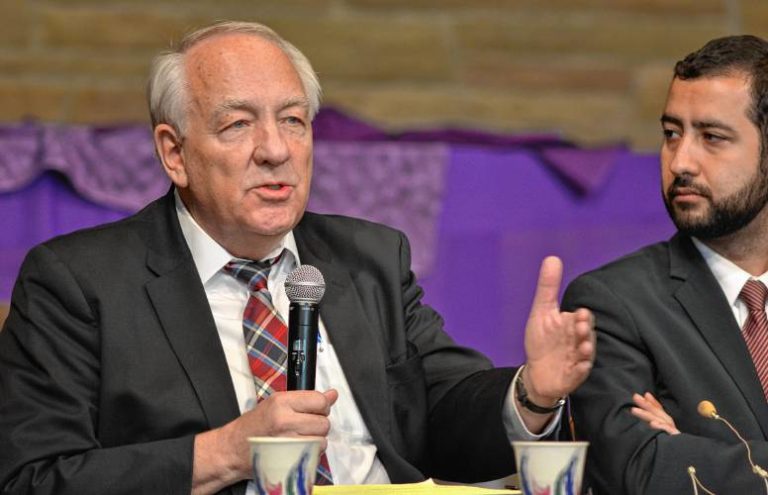
Stephen Rapp with Moaz Moustafa in New Hampshire. (Photo: New Hampshire Gazette)
Rapp’s core ambition is not focused exclusively on President Assad. He advocates in more general terms a principle of ‘no peace without justice’, which he interprets as implying a ‘responsibility to prosecute’ whose ultimate implications would be to enhance the legitimacy of externally imposed regime change operations on any nation – not just Syria – whose leadership is deemed to be oppressing its people and standing in the way of democracy and freedom.
It may be noted that Rapp has been part of on-going high level US deliberations about how to finesse that nation’s awkward situation of wanting to see other countries’ leaders prosecuted while not itself even signing up to the existing procedures that are provided by the International Criminal Court (ICC).
This conundrum has exercised the American elite for some years, and Rapp appears committed to a solution that lies in promoting innovative jurisprudence and hybrid courts. It would be facilitated by the emergence of a principle of ‘universal jurisdiction’, a principle that has gained particular traction in Germany, and some in other European countries too, like Spain, France and Sweden,[43] where the Caesar materials have apparently been deployed in courts.
In short, there is a discernible aim here of redefining the rules of the ‘rules-based international order’, with particular relevance to who shall be permitted to govern a country.[44] This is to press for global rules that override the powers of nation-states – a development whose effects are akin to what is already being accomplished through trade and investment agreements like TTP and TTIP by imposing rules of corporate globalism on nations with compliant governments.
Thus, from the standpoint of concern to serve US-based corporate interests, there is more at stake than the matter of who should be president of Syria.
The purpose of Caesar
Viewed from that perspective, Operation Caesar appears as a particular expedient in relation to a particular recalcitrant nation-state. The Caesar materials are likely to have little or no direct legal effect to that end, however, according to Wiley, and will not make a case against Assad in courts.
What the images do is harness powerful human emotion to the case. And it is entirely fitting that great human emotion should be stirred by images of human atrocities, as it may also be fitting that justice and accountability should be sought. If war crimes are committed, justice arguably requires accountability for them,[45] and so the value of evidence has to be assessed on its merits, and that means creating opportunities for such an assessment – even, conceivably, by deploying innovative judicial means.
I would just add that there are also other important considerations to keep in mind.
First, justice has to be assiduously sought by means that are rigorously directed to the pursuit of truth. This would be a sine qua non for just retribution. The pursuit of justice requires great scrupulousness of method and honesty of intent; it entails respecting the presumption of innocence, ensuring procedures are impartial and consistent, with due transparency and openness. These are qualities that need ensuring and cannot be assumed to follow from initiatives of ‘innovation’ that are pursued by special interest groups as is a concern about Operation Caesar.
Second is the need in due process to reserve judgement as to the honesty and intentions of witnesses to any alleged crime, pending their evidence being put to the test in a properly constituted hearing.
For the purposes of justice it is never to be assumed that all people at all times act honestly and in good faith, for it is precisely because they do not that institutions of justice are required to provide a remedy.
Thus a requisite degree of realism in retributive justice has always to attend to motivations, including thoughts about deterrents and incentives. As well as this general concern there is in the present context also a more specific kind of concern. It is a fact that deceptive events are sometimes staged, including by way of what are referred to as false flag operations.
Regarding many of the various accusations of atrocity crimes levelled against the Syrian government there are reasonable grounds for doubt, and justice certainly requires that no blanket presumption be made about the dependability of testimony from witnesses like the White Helmets or Caesar.
Third, although the Caesar evidence, like that of the White Helmets, has never been tested in a properly constituted court of law, it has sounded very loudly in the media and has thus exercised a determinate influence on the ‘court of public opinion’.
The media reports that shape public opinion, however, often appear to have scant regard for truth or accuracy, let alone justice. Insofar as promoters of prosecutions against state leaders are also seeking to use ‘innovative’ forms of justice effectively to lower the barrier to effective prosecutions, it could be perceived as extremely prejudicial that they are able to make their case so unrestrainedly to the wider public ahead of any properly constituted hearing.
Fourth, there is the distinct possibility that under circumstances where not only is public opinion manipulated but also political agendas are promoted, the communications can even provide incentives to stage harmful acts as false flag operations.
Specifically, the pronouncement of red lines can favour this effect. There are strong grounds for suspicion that in practice this effect has operated from time to time in Syria, as elsewhere, and a simple logic of incentives does nothing to assuage such suspicions.
It is therefore a matter of serious concern that the informal penumbra of ‘justice and accountability’ talk that goes to support the imposition of ‘red lines’ could be not only prejudicial to the trying of crimes that have occurred but potentially be used to support incentives for crimes to be committed.
The fifth point is the most important of all. Concerns about justice and accountability for war crimes are ultimately about acting on behalf of the moral conscience of humanity.
If any given war crime shocks the human conscience, then so much more ought the very occurrence of war itself do so, especially when it is not clearly just or necessary.
If war crimes have been committed in Syria it is because there has been a war in Syria – a war that need never have been but for the provocations and facilitations of external actors.
If we truly want to hold people responsible for war crimes, then should we not attribute great responsibility to those whose actions are among the root causes of them?
Let us bear in mind, for instance, that Qatar was the biggest supplier of funds and arms to the enemies of Syria’s government, and that the United States has been a major orchestrator of international collaboration to delegitimise that government. With such facts in mind, it can be argued that for agents of those states to be producing evidence to accuse Syria of war crimes is to add moral insult to injury.
Had these states not promoted an armed insurgency in the first place, there would have been no war and thus no war crimes in Syria. They certainly have earned no benefit of the doubt regarding the anonymous, secretive and unverifiable testimony their agents jointly presented in Operation Caesar.
On this last point, it is further interesting to note that we in the West do not receive much unfiltered communication from the side of the defence to these attempted prosecutions. We hear that Syria, Russia, China and various non-aligned countries have forceful reservations but this is always attributed to pure political calculation on their part. ‘They’, it seems, are always subject to conflicts of interest whereas ‘we’, in the West, are concerned only with the pure pursuit of humanitarian justice.
Just how far this might be from the truth is glimpsed in the reflections of former international criminal defence lawyer Christopher Black. His considerations of the modus operandi of prominent prosecutors like those pressing the ‘responsibility to prosecute’ as part of an ‘innovative justice’ agenda are sobering, to put it mildly.[46] For present purposes, however, it suffices to have indicated the much bigger game that the Caesar testimony has played a small part in.[47]
In conclusion, I would emphasise that it behoves us to try and be clear about the effects of Operation Caesar and learn lessons from the study of it. Having noted that even vocal critics of Assad and his government avoid appeals to Caesar, and given the serious criticisms made by others, we have good reason to reserve judgement as to its credibility.
This means that those who have committed to accrediting it as wholly true have quite possibly disseminated a falsehood. With NGOs, journalists and even academics embedding in it lessons of that possible falsehood, the historical record may already have been distorted in ways that may not be undone. But a still greater concern is that further harms may be generated in the future not only as a result of misinformation but also as a result specifically of what the West’s legal innovators are seeking, which is nothing less than a change in the rules of the ‘rules-based international order’.
We already find some scholars of international law viewing such changes as positive steps towards ‘global justice’. This is a matter about which more critical concern should be in evidence than has been to date.
To put bluntly this contextualised concern about Operation Caesar: not only may it already have altered the historical record, and not only may its effects have served to alter somewhat the course of history to date, but in serving to influence decision makers, it may contribute more indelibly to shifting the baseline of normative consensus in a direction favourable to ousting non-compliant leaders of sovereign states.
That is effectively to bestow legitimacy on imperialist regime change projects.
What justice meanwhile requires with regard to the ‘Caesar’ evidence is genuine and impartial investigation into the truth about who died and at whose hands. The instrumentalisation of those terrible deaths for the purposes of further destabilizing a country ripped apart by violent forces that are aided and abetted by foreign states – including so-called liberal democracies – is itself an affront to the conscience of humankind.
***
[1] For an overview of the story at the time see Ian Black in The Guardian https://www.theguardian.com/world/2014/jan/20/evidence-industrial-scale-killing-syria-war-crimes. For a later and fuller reconstruction see Adam Ciralsky in Vanity Fair: https://www.vanityfair.com/news/2015/06/assad-war-crimes-syria-torture-caesar-hospital.
[2] See the Human Rights Watch study of the Caesar evidence: https://www.hrw.org/report/2015/12/16/if-dead-could-speak/mass-deaths-and-torture-syrias-detention-facilities. For a more detailed and critical study of the evidence see the website of Adam Larson: http://libyancivilwar.blogspot.com/search?q=caesar.
Drawing on Larson’s study, Paul McKeigue has summarised what is not in dispute and what other factors should be borne in mind (personal communication) and I follow his advice in the summary that follows.
Not disputed:- The photos show the bodies of at least 5000 adult men at the Damascus military hospital, many of whom have been starved, over a period of about 8 months up to August 2013. Their identities are unknown, and the bodies have been labelled with numbers.
Other factors:- Some of them may be battlefield casualties, although most have no obvious external injuries. Some of them appear to have been gassed while hung upside down. From this, and the signs of prolonged starvation it is clear that most of them were captives. What is not known for certain regarding most of them is whether they were captured and/or killed by the government or by rebel forces (since the fact of being gathered for delivery to the mortuary could apply in either event. Some victims have tattoos indicating they are Christian, Shia or Assad supporters. The picture is further complicated by the fact that there were prisoner swaps between the Syrian Arab Army (SAA) and JAI in 2013.
Adam Larson (personal communication) adds that there is no semblance of a prison uniform evident in the photos, the men being mainly naked or in underwear, in street clothes or, in a few cases, still in their camouflage military uniforms.
For my part, I do not have the knowledge or expertise to offer an opinion as to the relative likelihoods of the two hypotheses. Nor does my argument depend on the likelihood of the JAI hypothesis being much greater than the official Western hypothesis, as Larson and McKeigue suggest it is. (Nor can some combination of those or other possibilities be definitively ruled out.) My argument relies only on the consideration that a self-consistent and materially possible explanation has not been ruled out while the accepted Western narrative has not been sufficiently established.
[3] https://www.youtube.com/watch?v=PgGqwAwJL5M&feature=youtu.be
[4] https://www.carter-ruck.com/images/uploads/documents/Syria_Report-January_2014.pdf
[5] This is a point made particularly effectively by Dan Murphy in an early response to the Caesar evidence: for he declares himself convinced on the basis of reports from other sources that the Syrian security apparatus is in fact responsible for large scale and egregious violation of human rights, and yet he vigorously challenges the credibility of the Caesar Report. https://www.csmonitor.com/World/Security-Watch/Backchannels/2014/0121/Syria-smoking-gun-report-warrants-a-careful-read
[6] These include, most recently, creation of the International Impartial and Independent Mechanism (IIIM).
[7] https://www.carter-ruck.com/images/uploads/documents/Syria_Report-January_2014.pdf
[8] Rapp in a 2016 interview with Ben Taub in the The New Yorker: https://www.newyorker.com/magazine/2016/04/18/bashar-al-assads-war-crimes-exposed
[9] These include ECCHR https://www.ecchr.eu/en/case/caesar-photos-document-systematic-torture/ and the Guernica teams https://www.guernicagroup.org/syria, and German Public Prosecutors in Karlsruhe https://en.qantara.de/content/assads-crimes-tried-in-german-courts-hoping-for-justice.
[10] Before setting up the Guernica teams, Cadman had been an associate at Cherie Blair’s law firm Omnia and was at the centre of a scandal: https://www.independent.co.uk/news/uk/politics/cherie-blairs-right-hand-man-previously-pitched-to-represent-the-other-side-in-maldives-case-a6779321.html. This is relevant to mention insofar as much of the drive for judicial innovation is based on arguments about humanitarianism and morality that sit uneasily alongside motivations of making business profits.
[11] Wolfgang Kaleck founded the European Center for Constitutional and Human Rights (ECCHR) together with other internationally renowned lawyers in Berlin in 2007. He has promoted prosecuting on the basis of Caesar evidence https://www.ecchr.eu/nc/en/press-release/torture-in-syria-investigations-in-austria-are-a-first-step-now-arrest-warrants-must-follow/
[12] Patrick Kroker is responsible for ECCHR’s work on Syria. He sets out his perspective in this interview: https://www.youtube.com/watch?v=qyi3jkDCRlE&feature=youtu.be
[13] https://www.hrw.org/report/2015/12/16/if-dead-could-speak/mass-deaths-and-torture-syrias-detention-facilities.
[14] Susie Linfield in The New York Review of Books: https://www.nybooks.com/daily/2019/02/09/syrias-torture-photos-witness-to-atrocity/)
[15] https://www.huffingtonpost.co.uk/2015/03/28/syria-war-crimes_n_6950660.html
[16] Adam Ciralsky in Vanity Fair: https://www.vanityfair.com/news/2015/06/assad-war-crimes-syria-torture-caesar-hospital.
[17] Jim Muir for the BBC: https://www.bbc.co.uk/news/world-middle-east-25822571
[18] http://www.spiegel.de/international/world/spiegel-reporting-supports-accounts-of-torture-and-execution-in-syria-a-945760.html
[19] https://www.dailymail.co.uk/news/article-2544711/Starved-tortured-throttled-The-true-horror-Assads-soldiers-execute-rebel-prisoners-revealed-new-images-released-today.html
[20] https://edition.cnn.com/2014/01/20/world/syria-torture-photos-amanpour/index.html t.
[21] Noha Aboueldahab, Writing Atrocities (2018)
[22] Jamie Allinson, ‘Disaster Islamism’ (http://salvage.zone/in-print/disaster-islamism/
[23] Adam Bazco, Gilles Dorronsoro and Arthur Quesnay Civil War in Syria, Cambridge UP 2017.
[24] Nader Hashemi, ‘The ISIS Crisis and the Broken Politics of the Middle East’ http://www.bu.edu/cura/files/2016/12/hashemi-paper1.pdf
[25] Bessma Momani and Tanzeel Hazak, ‘Syria’, in The Oxford Handbook of the Responsibility to Protect Edited by: Alex Bellamy, Tim Dunne 2016 Oxford University Press.
[26] Chris Tenove (2019), ‘Networking justice: digitally-enabled engagement in transitional justice by the Syrian diaspora, Ethnic and Racial Studies’, DOI: 10.1080/01419870.2019.1569702
[27] Thomas G. Weiss (2014) ‘Military Humanitarianism: Syria Hasn’t Killed It’, The Washington Quarterly, 37:1.
[28] Beth Van Schaack (2019) ‘Innovations in International Criminal Law Documentation Methodologies and Institutions’ https://papers.ssrn.com/sol3/papers.cfm?abstract_id=3329102
[29] Tim Anderson has commented that ‘we have no way of verifying in which year, circumstance or even which country the photos were taken. Those who finance and arm the sectarian groups have slaughtered hundreds of thousands in recent years, in the wars in Afghanistan, Iraq and Syria. There is no shortage of photos of dead bodies…’ (Tim Anderson ‘The Dirty War on Syria: Barrel Bombs, Partisan Sources and War Propaganda’ Global Research 7 October 2015). However, after a very close study of the photographs, Adam Larson believes that the photos were taken in the Damascus area and that the deaths occurred within that area, mostly in the period from mid-late 2012 to August 2013. This fact, nonetheless, does not make the Syrian government a more likely suspect for their murder than Jaish al-Islam. (Adam Larson, personal communication)
[30] Rick Sterling, ‘The Caesar Photo Fraud that Undermined Syrian Negotiations’ https://dissidentvoice.org/2016/03/the-caesar-photo-fraud-that-undermined-syrian-negotiations/
[31] Adam Larson, ‘Fail Caesar’, in 10 parts: http://libyancivilwar.blogspot.com/search?q=caesar
[32] Wiley interviewed in the Al Jazeera documentary Syria: Witnesses for the Prosecution https://www.youtube.com/watch?v=9GGK4zrl7P0 ). Speaking at a conference organised by his friend David Crane at Syracuse University, Wiley is clear that for advocacy groups like Amnesty and HRW ‘the burden of proof for the sort of evidence they need for their reports, it is very, very low. … Oftentimes they do allege crimes, in my opinion, incorrectly, but they are just drawing attention to the suffering.’ (19.55) (https://www.youtube.com/watch?v=enJvVvN8thU (Running for Cover conference, Syracuse, 2016)
[33] Mohammad al-Abdallah quoted in Enab Baladi’s Investigation Team (2018) ‘Al-Assad’s crimes in millions of documents: When will accountability start?’ https://english.enabbaladi.net/archives/2018/10/al-assads-crimes-in-millions-of-documents-when-will-accountability-start/
[34] For readers not familiar with these debates, but who know Monbiot for his interesting work on environmental issues, his inclusion in this list may be surprising. I for one was very surprised to discover the company he keeps in this matter, and after some rather disagreeable interactions with him on the subject, I did an extended study attempting to understand it: https://timhayward.wordpress.com/2018/04/11/how-we-were-misled-about-syria-george-monbiot-of-the-guardian/
[35] I stand to be corrected on this, of course, and I do note that Caesar has been referred to by Higgins, for instance, in the context of geolocating one of the photos, but without direct comment as to its significance.
[36] Beth Van Schaack (2019) ‘Innovations in International Criminal Law Documentation Methodologies and Institutions’, p.40.
[37] This information comes from an address delivered by Le Mesurier at The Performance Theatre in 2015 [links to the video recording of which appear to have been taken down].
[38] See the discussion in Lissa Johnson, ‘The Psychology of Getting Julian Assange’ Pt 5 https://newmatilda.com/2019/03/25/the-psychology-of-getting-julian-assange-part-5-war-propaganda-101/.
[39] As shown by Simone Rudolphi (2018), ‘Analysis of White Helmets’ Visual Strategy’, Masters Thesis, University of Sunderland.
[40] Already in 2013, before Caesar’s defection, Crane was ‘working with a team of lawyers and civil-society advocates to set up an archive of war crimes and atrocities committed in Syria that could be used as a basis for prosecution.’ As Crane put it, “We former chief prosecutors are like racehorses – you can put us out to pasture but we still want to run.” (https://www.newsweek.com/2013/09/27/david-cranes-prosecution-former-liberian-president-charles-taylor-238008.html)
[41] http://www.iamsyria.org/uploads/1/3/0/2/13025755/syria-sap_general_overview.pdf
[42] http://www.rscsl.org/prosecution.html
[43] Thierry Cruvellier (2019) ‘European Justice Strikes on Crimes in Syria’ https://www.justiceinfo.net/en/tribunals/national-tribunals/40383-european-justice-strikes-on-crimes-in-syria.html
[44] Ultimately, however, what is at stake affects the United States as a nation of people too, since what is driving it is a form of association that knows no national loyalties to any body politic but only to the interests of those with control of the world’s mega-corporations.
[45] I say ‘arguably’, since another view would take justice to have a more complex relationship with peace such as may find some place for the principle of amnesty – forgetting – but the present paper does not call into question the principle of punishing war crimes through due process.
[46] See Christopher Black (2014), ‘Rwanda and the Criminalisation of International Justice: Anatomy of War Crimes Trials’, Global Researchhttps://www.globalresearch.ca/rwanda-and-the-criminalisation-of-international-justice-anatomy-of-war-crimes-trials/5408604 and ‘Rwanda Confronting the 1994 Apocalypse’ https://christopher-black.com/rwanda-confronting-the-1994-apocalypse/
[47] See also the perspective offered by the historian John Laughland on the notion of International Justice, as in this video interview: https://www.youtube.com/watch?v=q4_J-ZxYnMw
Amesbury Survivor Charlie Rowley Meets with Russian Ambassador to UK
Sputnik – 07.04.2019
LONDON – Survived victim of a nerve agent poisoning in the UK city of Amesbury in early July, Charlie Rowley, on Saturday met with Russian Ambassador to the United Kingdom Alexander Yakovenko and discussed situation around inquiry into the incidents in Salisbury and Amesbury.
“They [Charlie Rowley and his brother] had a lot of questions to us, and I was happy to answer all of them. Of course, I handed them our report, which clearly describes everything we consider and think about what happened in Salisbury. I must say that most of the questions [from Rowley] were based on a complete lack of information on the part of Britons,” Yakovenko said following the meeting.
Yakovenko also noted that he proved to Rowly that a military-grade nerve agent Novichok could be produced in any laboratory in Europe.
Charlie Rowley does not have information on how he was treated after the incident and is interested in medical examination in a third country, Russian Ambassador to the United Kingdom Alexander Yakovenko said on Saturday.
On Saturday, Yakovenko met with Rowley and his brother Matthew to discuss situation around inquiry into the incidents in Salisbury and Amesbury.
“Answering my question on whether Rowley knew how he was treated, the brothers said that they did not know. Rowley knows about what he was poisoned with exclusively from police reports… I told them to ask any questions related to publications on this case. Perhaps, 80 percent of what I said today was a complete revelation to them… He [Rowley] expressed interest in undergoing a medical examination in a third country. This is a separate issue,” Yakovenko told reporters following the meeting.
Americans Crippled By $40,000 “Air Ambulance” Bills Not Covered By Insurance
By Tyler Durden – Zero Hedge – 04/04/2019
Capitol Hill lawmakers are focusing on surprise medical bills for hospital services and treatments, including air ambulance costs, which can sometimes surprise patients with bills of more than $36,000. CBS recently told the story of Joseph Penrod, whose son accidentally swallowed a bunch of prescription pills, prompting the family to try and get him to an ER quickly.
“The first thing that [my wife] did was call poison control. And they talked to her about getting him to an ER as quickly as possible. They suggested that they were not appropriately equipped to deal with that particular age of patient in that particular condition,” Penrod said.
His son was stable at the time he arrived at the hospital and Penrod’s insurance paid for the emergency room care. However, it failed to pay for the $40,000 that it cost to airlift his son to the hospital. “I did not have $40,000 laying around. It would’ve destroyed us financially,” Penrod said.
These types of transport services are often out of insurance network coverages because the companies are independent contractors that negotiate their costs separately. They’ve become a lucrative business, making most money in rural areas.
Doug Gray, executive director of the Virginia Association of Health Plans said: “The air transport industry, the predominant players are driven by private equity. The model is very simple. There are people out there in an emergency, they have resources, and we can take them.”
He continued: “An accident can happen any time, any place, and you could be the one who’s having that decision made for you. And your livelihood, and your savings can be on the line.”
A new law in Virginia that went into effect March 1 now gives patients the right to choose if they want to take an air ambulance in non-emergency situations and requires hospitals to disclose more cost information. Penrod spent over a year fighting the bill and finally offered to pay $1000 to settle it, which the company took.
He concluded: “If you’re rich, you can get a lawyer and that’s great. If you’re on the lower end of the spectrum, then you need to be able to fight for long enough to figure out how to escape.”
Word to the Wise: Beware the Green New Deal!
By Geraldine Perry | Dissident Voice | April 4, 2019
 Seemingly overnight, the Green New Deal has arrived. Given the sorry state of our environment, what possible objections could there be? In this case, plenty – and they all trace back to the Green New Deal’s deeply complex and surreptitious ties to UN Agenda 21.
Those who claim that Agenda 21 amounts to little more than a right-wing rant or is somehow anti-Semitic are at best seriously misinformed. Those who buy into the carefully crafted jargon of Sustainable Development, Smart Growth, Redevelopment and the Green New Deal are similarly misinformed and need to know that the environmental movement has in fact been highjacked by the Agenda 21 plan.
First, Some Background
Journalist Thomas L. Friedman is sometimes credited with being the original source for the term “Green New Deal” because in two 2007 articles, in the New York Times and The New York Times Magazine, Friedman connected FDR’s “New Deal” to a new “green” economy, suggesting that this might provide an economic stimulus program that could address economic inequality and climate change at the same time. Almost prophetically, Friedman also argued in earlier writings that an “iron fist inside a velvet glove” would be needed to maintain the coming new world order.
The same year the Friedman articles came out the Green New Deal Group was formed. By July of 2008 this group came out with its Green New Deal Report which was originally published by the New Economics Foundation. A few months later, in October of 2008, Adam Steiner, who was Executive Director of the United Nations Development Programme (UNEP), unveiled the Global Green New Deal Initiative, the objective of which was to rescue the failing global economy by creating jobs in “green” industries, “funded” of course by the big banks.
Then, following the example set by the European Greens in 2006, the United States Green Party adopted a Green New Deal platform in 2010. To its everlasting credit, the U.S. Green Party has also placed monetary reform as one of its core planks, ending the banking system’s privilege of creating the nation’s money (as credit or debt) and returning the monetary privilege to the government where it belongs, without which reform no other reforms are possible. Other political parties would do well to adopt this most important objective, since this is the true heart of “populism” historically. However, the vast bulk of the Green Party’s Green New Deal platform bears a marked (and troubling) resemblance to the Green New Deal as set out through the United Nations Agenda 21 Sustainable Development program.
Most recently, a twenty-nine-year-old freshman Congresswoman from New York, Alexandria Ocasio-Cortez, has overnight managed to not only make national headlines but garner the full attention of Congress, a feat never before accomplished by one so young and so soon in office. It was her promotion of the Green New Deal that seems to have garnered her such sudden fame. But the so-called legislation she has been promoting is in reality a “draft text” that calls for a proposed addendum for House Rules: it changes the rules and creates a new process for the allocation of power, all while echoing almost verbatim United Nations Sustainable Development Goals. As a recent article in Technocracy News says, with a complete version of AOC’s “bill” included: “Its scope and mandate for legislative authority amounts to a radical grant of power to Washington over Americans’ lives, homes, businesses, travel, banking, and more.” Dr. Naomi Wolf confirms by going over the document point by point.
The Green New Deal is in fact a part of a global sustainable development program that was officially rolled out at the “Earth Summit” held in Rio De Janeiro, Brazil in 1992. Out of that summit came Agenda 21 Earth Summit: The United Nations Program of Action from Rio, a 354-page document that can be purchased at online book retailers or downloaded in pdf format from the UN website.
Agenda 21 has been updated to include Agenda 2030 for Sustainable Development and its offshoot the Global Green New Deal which is a program that was commissioned by the United Nations Environment Program or UNEP for short, mentioned above. A map and outline of “partners” reveals just how deeply embedded in global thinking this program has become. Effectively, Agenda 21 provides the template while Agenda 2030 gives the goals for achieving “sustainable development”.
Inasmuch as Sustainable Goal 13 is about Climate Action, it is worth noting that in 2009 the United Nations Framework Convention on Climate Change (UNFCCC) set up an unelected international climate regime with authority to dictate land use, relocate “human settlements” and directly intervene in the financial, economic, health care, education, tax and environmental affairs of all nations signing the treaty. One must wonder why upwards of $100 billion has been spent on promotion of the current global warming model yet next to no discussion is devoted to natural forcing agents such as solar and cosmic radiation, volcanoes, clouds, water vapor, and grand solar minimums – even though these have been well documented in the scientific literature to have significant impact on climate. Nor have funds been committed to disseminating information about military weather warfare or other long standing geoengineering projects and their effect on climate. Yet at least five geoengineering Solar Radiation advocates co-authored the section covering contrails in the 2007 IPCC report.
As uncovered by prominent activist Rosa Koire, Sustainable Development was originally created and defined by the United Nations in 1987. President George Herbert Walker Bush, along with leaders from 178 other nations, signed the “Action Plan” unveiled at Rio in 1992.
This plan is anchored by the political philosophy of Communitarianism which effectively establishes a new legal system used by regional and local governments affiliated with the emerging global government, circumventing national law via a program of “balancing.” Implemented by a relatively small self-appointed group of decision-makers and influencers who achieve “consensus” among themselves rather than through the public voting process, this philosophy holds that the individual’s rights are a threat to the global community. In practice, the consistent rallying cry “for the greater good” is defined any way that suits those in power.
Within six months of his election in 1992, former President Bill Clinton issued Executive Order #12852 thus creating the President’s Council on Sustainable Development or PCSD. This Council ran for six years, 1993-1999. Its members included Cabinet Secretaries for Transportation, Agriculture, Education, Commerce, Housing and Urban Development, the Environmental Protection Agency, the Small Business Administration, Energy, Interior, and Defense. CEO’s of various businesses, such as Enron, Pacific Gas & Electric, BP Amoco, Dow Chemical and others also were included, as were environmental organizations, including the National Resources Defense Council, Sierra Club, World Resources Institute, the Nature Conservancy, the Environmental Defense Fund among others.
To further facilitate the transition, Clinton awarded the American Planning Association a multi-million dollar grant to write a land use legislative blueprint for every municipality in the U.S. Completed in 2002, this blueprint is entitled Growing Smart Legislative Guidebook with Model Statutes for Planning and the Management of Change. As Koire tells us, this guidebook is being used in every university, college and government planning office in the nation. And as part of the Common Core program for the younger set, former Vice President Al Gore helped write Rescue Mission Planet Earth: A Children’s Edition of Agenda 21.
In 2012 “H Concurrent Resolution 353” was discussed by the U.S. Congress. A short, 8 minute video clip shows various members, including House Speaker Nancy Pelosi, rising in support of H CON Res 353, which “expressed the sense of the Congress that the U.S. should take a strong leadership role in implementing the decisions made at the Rio Earth Summit by developing a national strategy to install Agenda 21 and other Earth Summit agreements through domestic and foreign policy.”
As Koire relates, the clear goal of these initiatives was, and is, to change public policy to bring it into alignment with the Agenda 21 plan.
Implementation and Implications
Agenda 21 is a global plan that is to be implemented locally via “soft law”. Despite the fact that this agenda would have far reaching material impact on each and every one of us, the U.S. citizenry has not been given the opportunity to study or vote on any of the various facets of Agenda 21. Moreover, the vast majority, out of deep concern for the planet, are effectively neutralized by the jargon, buzz words and slogans with purposely obscure definitions, all of which are dreamt up by the best PR firms money can buy. Perhaps even worse, as Rosa Koire, who has experienced negative ramifications in her Santa Rosa community, writes in Behind the Green Mask :
The irony is that UN Agenda 21 mandates ‘more’ citizen involvement but does it by creating so many boards, commissions, regional agencies, non-profits, meetings and programs that it is impossible to stay on top of what is happening. We’re too burned out to fight more than one issue at a time. So we become, necessarily, more fragmented, less of a neighborhood, exhausted and isolated because we can’t keep up. The so-called citizen involvement is dictated by phony neighborhood groups with paid lobbyists and facilitators running them. The boards and commissions are chosen based on ‘team players’ or shills selected to push through an end game by running over the few actual unconnected citizens. These groups are the ‘prescreening groups’ for candidates for public office. THEY are the ones who get donations at election time. It’s doubtful that anyone will get on the ballot who doesn’t play ball.
There were 17 official sustainable development goals (or SDGs) for the new 2030 Agenda that was universally adopted by nations around the world at the United Nations plenary meeting in New York on September 25, 2015. These SDGs do not replace Agenda 21. The 2030 Agenda clearly states, “We reaffirm all the principles of the Rio Declaration on Environment and Development, including, inter alia, the principle of common but differentiated responsibilities.”
A short article, titled “Agenda 2030 Translator: How to Read the UN’s New Sustainable Development Goals,” unveils some of the actual consequences of the Agenda. To start you off, Goal 1 as stated: End Poverty in all its forms everywhere. Goal 1 as translated: Centralized banks, IMF, World Bank, Fed to control all finances. Goal 2 as stated: End hunger, achieve food security and improved nutrition and promote sustainable agriculture. Goal 2 as translated: GMO. And so on.
Another article titled simply Agenda 21 shows how big “S” Sustainable Development will affect the farmer:
If you own livestock and they can drink from a creek, then they want you to permanently fence off your own land to prevent any upset of potential fish habitat… Agenda 21 focuses on the goal of eliminating meat consumption and using pastures to grow wheat, corn and soy for human consumption. To get us to comply, we’re told in endless propaganda campaigns that meat is dangerous and the vegan lifestyle is the only healthy alternative… “Grazing livestock” is listed as “unsustainable” in the UN’s Global Biodiversity Assessment Report. In the same document, agriculture and private property are listed as “unsustainable.” All the private property and water rights infringements we have been seeing come directly out of the Sustainable Development programs. They come in a wide variety of names to throw people off, such as Comprehensive Planning, Growth Management, Smart Growth, and so forth.
The local government implementation of Agenda 21 was prepared by ICLEI (which stands for International Council for Local Environment Initiatives) for the Earth Council’s Rio+5 Forum held April 13–19, 1997 in Rio de Janeiro, Brazil; for the 5th Session of the UN Commission on Sustainable Development; and for the UN General Assembly’s “Earth Summit+5” Special Session. Out of this came The Local Agenda 21 Planning Guide put out by ICLEI and the United Nations.
Resilient Cities are part of ICLEI. According to its website the organization was founded in 2010 by ICLEI (now known as Local Governments for Sustainability), the affiliated World Mayors Council on Climate Change and the similarly affiliated City of Bonn, Germany. Resilient Cities is billed as the first forum on cities and adaptation to climate change. In 2012 Resilient Cities was renamed as Global Forum on Urban Resilience and Adaptation.
Smart Growth, Smart Cities and 5G
Smart Growth and Smart Cities are also part of the “sustainability” plan as evidenced by their lofty sounding goals which somehow fail to look at “new” energy or even non-industrial hemp as a soil-rebuilding, environment-friendly way to provide a sizable portion of the nation’s energy needs; which fail to understand the crucial importance of restoring carbon-rich humus to the soil via holistic livestock management and other forms of regenerative agriculture; which somehow rely on the big banks and a flotilla of “investors” rather than doing the obvious by reforming the nation’s monetary system; and which, as Koire and others correctly assert, can only lead to totalitarianism in the end.
The explosive, worldwide rollout of 5G networks “makes Smart Cities a reality” despite recognized and significant associated health risks. By September of 2018, thanks to an FCC ruling and carrier lobbying, twenty states, seemingly under cover of night, had already passed legislation to strip their cities of the power to regulate 5G rollouts. The FCC ruling in particular has sparked considerable push back, because not only will the FCC’s move force taxpayers to subsidize industry access to publicly owned infrastructure but, as chief information officer for New York City Samir Saini declared: “the FCC is threatening the public’s right to control public property, and dozens of cities, states, and towns from New York City to Lincoln, Nebraska to Anchorage, Alaska are ready to defend that right on behalf of our residents and taxpayers.”
On top of all this we now find that the “tsunami” of data collection enabled by 5G could consume one fifth of global electricity by 2025. As most know, wind and solar (both of which also have significant environmental and land use problems) just won’t cut it, and especially so with 5G.
An Endless Web of Carefully Branded Commissions, Boards, Agencies and Programs
Other groups and organizations tied to Agenda 21 continue to proliferate. These organizations include those that formulate “Climate Action Plans” now being adopted by local communities worldwide. The Center for Climate Solutions is one such organization and the California based Institute for local Government is another. You can google your state, city or county plus “Climate Action Plan and Resilient Plan” to learn more about how this is taking place in your own community. You can bet that none of them include alternative forms of “new” energy (including soil building non-industrial hemp) or regenerative (carbon-sequestering) agriculture which can only be properly practiced by small producers.
An offshoot of the Regional Planning Association is America 2050 whose focus is on planning for the emergence of mega-regions, or high density urban areas, along with infrastructure development, with the aim of “shaping the infrastructure investment plan” and “providing leadership on a broad range of transportation, sustainability, and economic-development issues impacting America’s growth in the 21st century.” FEMA feeds into the development of megaregions through its Hazard Mitigation Program through which it, as well as HUD, provide grants to assist, at taxpayer expense, state and local communities with the purchase of properties located in high fire risk, high flood risk, high erosion risk, high mudslide risk areas.
“Redevelopment” is another important and mis-leading buzzword, as it in truth represents an unknown government which among other things uses eminent domain for private gain, not the “greater good” despite claims to the contrary. As Koire writes in her book Behind the Green Mask :
A little 40 page book titled Redevelopment: The Unknown Government put out by the California Municipal Officials for Redevelopment Reform lays out the ugly truth with charts, cartoons and hard data … Supported by powerful lobbyist groups fronting bond brokers, lawyers, and debt consultants, the trend of designating more and more redevelopment areas is also supported by government agency staff members and private businesses that profit from redevelopment. Diverting property taxes to these bloodsuckers is big business: by 2006 redevelopment agencies statewide (in California) had amassed $81 billion in bonded indebtedness, a figure that is doubling every 10 years. And don’t think that this is only in California – it’s in nearly every city and county in the United States. Because the agencies can sell bonded debt without voter approval (unlike school boards) and the city’s general fund is responsible for any over-extended debt, these are cash cows for bond brokerage firms.
Other organizations tasked with promoting “sustainable development” and its corollary the “Green New Deal” include the Organization of Economic Cooperation and Development or OECD, and the World Resources Institute.
Food Production and Food Choice
The World Resource Institute recently published Creating a Sustainable Food Future which was produced “in partnership with the World Bank, UN Environment (UNEP), UN Development Programme and the French agricultural research agencies CIRAD and INRA.” On its publication announcement page, it asks whether we will be able to produce enough food sustainably to feed the estimated 10 billion people that will exist on the planet by 2015.
As explained in fair detail in my book Climate Change, Land Use and Monetary Policy the answer is a resounding yes! Contrary to Agenda 21 fears, we will be able to sustainably feed, conservatively, 20 to 30 billion people worldwide if we change the way we do agriculture, which MUST include holistically managed livestock. In so doing we will dramatically reduce the amount of land now devoted to industrial agricultural systems and the amount of pollution generated by such systems – all while putting carbon back in the soil where it is needed to sustain life on this planet.
At first glance the above-mentioned World Resource report also seems to agree, as indicated by this 2018 headline in a San Francisco Chronicle article titled “New Report Urges Drastic Changes in Food Production and Consumption”. The article goes on to summarize the report’s version of “sustainability”:
The core recommendations of the 96-page report line up with many of the innovations that are already happening, sometimes at a small scale, at many Bay Area farms, food companies and tech startups. That includes the development of plant-based meat substitutes, companies and local governments that focus on reducing food waste, and farms that are making changes to reduce greenhouse gas emissions… The report calls on governments to fund research and development and to provide “flexible regulations” for new technology such as plant-based meat substitutes and innovations in plant breeding like genetic editing… Individuals should make changes to their diets, too, the authors say, especially in wealthy countries like the United States where the majority of animal-based foods are eaten … A lot of the technological advances the report urges are happening in the Bay Area. The region has become a global hub for the creation of plant-based meat substitutions, including those made by Impossible Foods of Redwood City… A new batch of companies is developing lab-grown or “cultured” meat that will be made of chicken, beef or fish tissue from cells but won’t require raising or killing animals.
Green Grabbing, The Best Way to Save Nature Is to Sell It
The 1992 Rio Earth Summit spawned a series of world summits on sustainable development sponsored by the UN. In 2012 the 20th anniversary of the Rio summit was dubbed Rio + 20. Its focus was the Green Economy with the specific purpose of ushering in global economic growth by putting market values on environmental services and environmentally-friendly production and consumption. This plan led to the term “green grabbing” which refers to the appropriation of land and resources – purportedly for environmental ends. It should, therefore, come as no surprise that, as this article in Bloomberg Online suggests, Wall Street Is More Than Willing to Fund the Green New Deal.
Some illustrative excerpts which were taken from a 2012 article titled Green Grabbing Our Future at Rio + 20, appeared in my book Climate Change, Land Use and Monetary Policy. The article was originally posted on the Food First website, and was written by Eric Holt-Gimenez, Executive Director of Food First. Some excerpts:
The Rio process itself has been steadily privatized under the weight of 20 years of neoliberal globalization. As the global contradictions between economy and environment have intensified, nature itself is becoming a source of profit… What was once a state-oriented, regulatory framework has morphed into a market-based, corporate initiative.
The corporate trend to privatize and commercialize ecosystem services and resources in the name of environmental protection is known as “green grabbing” as these schemes can result in local communities losing resource rights… It is the favored approach of the big conservation organizations like World Wildlife Fund (WWF), Conservation International (CI) and the International Union for the Conservation of Nature (IUCN), who have thus guaranteed their place at the Rio+20 negotiating table alongside neoliberal governments and powerful multinational business interests.
The Green Economy concept that determines the content of all submissions [for the Zero draft report] was itself created by a group led by Pavan Sukhdev a former senior banker from Deutsche Bank and head of UNEP’s Green Economy Initiative. This is a reflection of a long trend in partnering between the CBD, big environmental organizations and corporate representatives i.e. the World Business Council on Sustainable Development, the International Chamber of Commerce, CI, WWF, IUCN etc.
The dubious justification for bringing nature to Wall Street—where credits and shares of ecosystem services, biodiversity derivatives, avoided emissions and even wildlife species banking can be chopped up, repackaged and resold along with debt, mortgages, hedge funds and the like—is that the best way to save nature is to sell it. In doing so, we are told, we will grow the economy and this in turn will benefit the poor, thus ending poverty and hunger.”
Summing It Up
In practical terms, Agenda 21 is a global plan implemented locally through ICLEI (and other bodies and organs) using “soft law”. The following excerpts from an article titled “UN’s Agenda 21Targets Your Mayor” provide a useful example of how local implementation occurs:
From June 1 through 5, 2005, the city of San Francisco was the site of an international conference called “World Environment Day.” But the agenda of this conference was much bigger than just another hippy dance in the park. This meeting of the global elite had a specific target and an agenda with teeth. The goal was the full implementation of the UN’s Agenda 21 policy called Sustainable Development, a ruling principle for top-down control of every aspect of our lives – from food, to health care, to community development, and beyond. This time, the target audience is our nation’s mayors. The UN’s new tactic, on full display at this conference, is to ignore federal and state governments and go straight to the roots of American society. Think globally – act locally.
Here’s a quick look at a few of the 21 agenda actions called for. Under the topic of energy, action item number one calls for mayors to implement a policy to increase the use of “renewable” energy by 10% within seven years. Renewable energy includes solar and wind power.
Not stated in the UN documents is the fact that in order to meet the goal, a community would have to reserve thousands of acres of land to set up expensive solar panels or even more land for wind mills. Consider that it takes a current 50-megawatt gas-fired generating plant about 2-5 acres of land to produce its power. Yet to create that same amount of power through the use of solar panels would require at least 1,000 acres. Using wind mills to generate 50 megawatts would require over 4,000 acres of land, while chopping up birds and creating a deafening roar. The cost of such “alternative” energy to the community would be vastly prohibitive. Yet, such unworkable ideas are the environmentally-correct orders of the day that the mayors are being urged to follow.”
Rosa Koire, mentioned earlier, sums up the end game on her website Democrats Against Agenda 21:
The problem that almost no one sees is that UN Agenda 21/Sustainable Development is the action plan to inventory and control all land, all water, all minerals, all plants, all animals, all construction, all means of production, all information, all energy, and all human beings in the world. Agenda 21/Sustainable Development is about Inventory and Control!
Beware Agenda 21 and its Green New Deal!
Geraldine Perry is the co-author of The Two Faces of Money and author of Climate Change, Land Use and Monetary Policy: The New Trifecta.
Boeing’s Homicides Will Give Way to Safety Reforms if Flyers Organize
By Ralph Nader | April 4, 2019
To understand the enormity of the Boeing 737 Max 8 crashes (Lion Air 610 and Ethiopian Airlines 302) that took a combined total of 346 lives, it is useful to look at past events and anticipate future possible problems.
In 2011, Boeing executives wanted to start a “clean sheet” new narrow body air passenger plane to replace its old 737 design from the nineteen sixties. Shortly thereafter, Boeing’s bosses panicked when American Airlines put in a large order for the competitive Airbus A320neo. Boeing shelved the new design and rushed to put out the 737 Max that, in Business Week’s words, was “pushing an ageing design past its limits.” The company raised the 737 Max landing gear and attached larger, slightly more fuel efficient engines angled higher and more forward on the wings. Such a configuration changed the aerodynamics and made the plane more prone to stall (see attached article: https://www.aviationcv.com/aviation-blog/2019/boeing-canceling-737-max).
This put Boeing’s management in a quandary. Their sales pitch to the airlines was that the 737 Max only received an “amended” certification from the FAA. That it did not have to be included in more pilot training, simulators, and detailed in the flight manuals. The airlines could save money and would be more likely to buy the Boeing 737 Max.
Boeing engineers were worried. They knew better. But the managers ordered software to address the stall problem without even telling the pilots or most of the airlines. Using only one operating sensor (Airbus A320neo has three sensors), an optional warning light and indicator, Boeing set the stage for misfiring sensors that overcame pilot efforts to control the planes from their nose-down death dive.
These fixes or patches would not have been used were the new 737’s aerodynamics the same as the previous 737 models. Step by step, Boeing’s criminal negligence, driven by a race to make profits, worsened. Before and after the fatal crashes, Boeing did not reveal, did not warn, did not train, and did not address the basic defective aerodynamic design. It gagged everyone that it could. Boeing still insists that the 737 Max is safe and is building two a day, while pushing to end the grounding.
Reacting to all these documented derelictions, a flurry of investigations is underway. The Department of Transportation’s Inspector General, Calvin L. Scovel III, is investigating the hapless, captive FAA that has delegated to Boeing important FAA statutory and regulatory duties. The Justice Department and FBI have opened a criminal probe, with an active grand jury. The National Transportation Safety Board, long the hair shirt of the FAA, is investigating. As are two Senate and House Committees. Foreign governments are investigating, as surely are the giant insurance companies who are on the hook. This all sounds encouraging, but we’ve seen such initiatives pull back before.
This time, however, the outrageous corner-cutting and suppression of engineering dissent, within both Boeing and the FAA (there were reported “heated discussions”) produced a worst case scenario. So, Boeing is working overtime with its legions of Washington lobbyists, its New York P.R. firm, its continued campaign contributions to some 330 Members of Congress. The airlines and pilots’ union chiefs (but not some angry pilots) are staying mum, scared into silence due to contracts and jobs, waiting for the Boeing 737 Max planes to fly again.
BUT THE BOEING 737 MAX MUST NOT BE ALLOWED TO FLY AGAIN. Pushing new software that will allow Boeing to blame the pilots is a dangerous maneuver. Saying that U.S. pilots, many of whom are ex-Air Force, are more experienced in reacting to a sudden wildly gyrating aircraft (consider the F-16 diving and swooping) than many foreign airline pilots only trained by civil aviation, opens a can of worms from cancellation of 737 Max orders to indignation from foreign airlines and pilots. It also displays an aversion to human-factors engineering with a vast number of avoidable failure modes not properly envisioned by Boeing’s software patches.
The overriding problem is the basic unstable design of the 737 Max. An aircraft has to be stall proof not stall prone. An aircraft manufacturer like Boeing, notwithstanding its past safety record, is not entitled to more aircraft disasters that are preventable by following long-established aeronautical engineering practices and standards.
With 5,000 Max orders at stake, the unfolding criminal investigation may move the case from criminal negligence to evidence of knowing and willful behavior amounting to corporate homicide involving Boeing officials. Boeing better cut its losses by going back to the drawing boards. That would mean scrapping the 737 Max 8 designs, with its risk of more software time bombs, safely upgrading the existing 737-800 with amenities and discounts for its airline carrier customers and moving ahead with its early decision to design a new plane to compete with Airbus’s model, which does not have the 737 Max’s design problem.
Meanwhile, airline passengers should pay attention to Senator Richard Blumenthal’s interest in forthcoming legislation to bring the regulatory power back into the FAA. Senator Blumenthal also intends to reintroduce his legislation to criminalize business concealment of imminent risks that their products and services pose to innocent consumers and workers (the “Hide No Harm Act”).
What of the near future? Airline passengers should organize a consumer boycott of the Boeing 737 Max 8 to avoid having to fly on these planes in the coming decade. Once Boeing realizes that this brand has a deep marketing stigma, it may move more quickly to the drawing boards, so as to not alienate airline carriers.
Much more information will come out in the coming months. Much more. The NASA Aviation Safety Reporting System (ASRS), which receives incident reports from pilots, air traffic controllers, dispatchers, cabin crew, maintenance technicians, and others, is buzzing, as is the FlyersRights.org website. Other countries, such as France, have tougher criminal statutes for such corporate crime than the U.S. does. The increasing emergence of whistle-blowers from Boeing, the FAA and, other institutions is inevitable.
Not to mention, the information that will come out of the civil litigation against this killer mass tort disaster. And of course the relentless reporting of newspapers such as the Seattle Times, the Wall Street Journal, The New York Times, the Washington Post, and AP, among others will continue to shed light on Boeings misdeeds and the FAA’s deficiencies.
Boeing executives should reject the advice from the reassuring, monetized minds of Wall Street stock analysts saying you can easily absorb the $2 billion cost and move on. Boeing, let your engineers and scientists be free to exert their “professional options for revisions” to save your company from the ruinous road you are presently upon.
Respect those who perished at your hand and their grieving families.
The Tale of a ‘Deep State Target’
Daniel Lazare reviews George Papadopoulos’s book about his misadventures with a nest of intelligence agents.
By Daniel Lazare – Consortium News – April 4, 2019
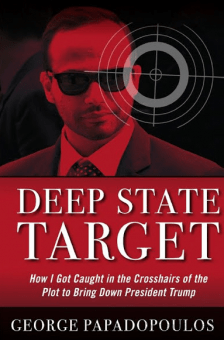 Now that Russian collusion is dead and buried thanks to Special Prosecutor Robert Mueller, the big question is how and why such charges arose. George Papadopoulos’s “Deep State Target: How I Got Caught in the Crosshairs of the Plot to Bring Down President Trump” doesn’t tell the whole story. But this account by one of the crusade’s first victims pulls the covers off a few important aspects.
It describes a lengthy entrapment scheme that began when Papadopoulos told co-workers that presidential candidate Donald Trump was about to appoint him to his foreign-policy advisory team.
The time was March 2016, the place the London Centre of International Law Practice, where Papadopoulos was working as an energy consultant, a job that mainly involves meeting with diplomats and going out for a dinner and drinks. Regarding the LCILP, he recalls it as a “strange operation” where there’s “no actual law practice going on that I can see” and which he later suspects is an intelligence front.
The reaction to his announcement was not good. “You should not be working with Trump,” one of Papadopoulos’s bosses tells him. “He’s a threat to society. He’s a racist. He’s anti-Muslim.”
But the tone changes when another LCILP director insists that he join him for a three-day conference at Link Campus University, a privately owned educational center in Rome. There he is introduced to a well-dressed Maltese academic in his mid-fifties named Joseph Mifsud.
“He asks about my background,” Papadopoulos writes. “He asks if I have Russian contacts. I shake my head. ‘I heard you have connections,’ I say. ‘And that you might be able to help me with the campaign.’”
“Oh yes, absolutely,” Mifsud replies. “Let’s talk tonight. Let’s go to dinner.”
Into the Rabbit Hole
With that, the author enters into a rabbit hole filled with twists and turns in which he found himself in the middle of a deep-state intelligence war over Trump’s alleged Kremlin ties and by the end of which he had served a 12-day sentence in a medium-security federal prison.
In late April, Mifsud takes him to breakfast at a London hotel and informs him that he had just returned from Russia where officials say they have “dirt” on Hillary Clinton. “Emails of Clinton,” Mifsud says. “They have thousands of emails.” Papadopoulos writes it off as idle chitchat by a dubious diplomatic networker whom he has come to see as all talk and no action.
A friend from the Australian embassy introduces him to a top Aussie diplomat named Alexander Downer, who tells him over gin-and-tonics that his foreign-policy ideas are all wet.
A British foreign-ministry official takes him out for still more drinks and grills him about Russia.
Stefan Halper, an old CIA hand turned Cambridge academic, contacts him out of the blue and pesters him about Russia as well.
A mysterious Belorussian-American name Sergei Millian offers him a secret $30,000-a-month PR job but only if he continues working for Trump.
An Israeli-American businessman named Charles Tawil buys him lunch at a steakhouse in Skokie, Ill. Later, in Greece, they go clubbing together in Mykonos, and then Tawil flies Papadopoulos to Israel where he presents him with $10,000 in cash – money that a wary Papadopoulos leaves with a lawyer in Thessaloniki.
While flying back to the U.S. in July 2017, Papadopoulos runs into a squad of FBI agents as he is changing planes. “And then, finally, it dawns on me as they are going through my bags,” he writes. “Charles Tawil and the money. They are looking for $10,000 in undeclared cash! That fucking guy was setting me up.”
“I’ve barely slept in two days,” he goes on after appearing before a judge. “I’m wearing the same shirt that I left Athens in. I smell like garbage. I look like garbage. I’m disoriented – because while I’ve just finally heard the charges, I still don’t really understand any of it.” To his horror, he learns that he is facing 25 years in prison on charges of obstruction of justice and lying to the FBI.
What was going on? Although Papadopoulos doesn’t go into the pre-history, we know from other sources that, by late 2015, intelligence agencies were buzzing over reports that Trump and Russian President Vladimir Putin were reaching out to one another behind the scenes.
Three Mood-Setting Events
Spooks are paranoid by profession, but three recent events had put them particularly on edge. One was the Euromaidan uprising in Kiev in early 2014, which, by driving out an allegedly pro-Russian president, sparked a parallel revolt among Russian speakers in the east. Another was in Syria where U.S. backing of Islamist rebels had prompted Russia to intervene in support of President Bashar al-Assad. The third was on the U.S. campaign trail where Trump was thoroughly shocking foreign-policy “experts” by sounding off against regime change and making friendly noises toward Putin.
“But I think that I would probably get along with him very well,” Trump said of the Russian president in October 2015. When CNN host John Dickerson asked about Russian air assaults, he replied: “And as far as him attacking ISIS, I’m all for it. If he wants to be bombing the hell out of ISIS, which he’s starting to do, if he wants to be bombing ISIS, let him bomb them, John. Let him bomb them. I think we [can] probably work together much more so than right now.”
Intelligence agencies might have conceded that the U.S. was wrong to encourage far-right elements in Kiev and that it was equally mistaken in giving backhanded support to Al Qaeda and ISIS in the Middle East. They might have granted that Trump, for all his reality-TV bluster, had a point. But western intelligence agencies don’t do self-criticism. What they did was blame Putin for messing up their plans for a clean coup in Kiev and an equally neat ouster of Assad and then blamed Trump for arguing in his behalf. From there, it was a very short step to concluding that Trump was not only siding with Putin, but conspiring with him.
Individual intelligence assets went into action to prove this theory correct and, if need be, to invent a conspiracy where none existed. Joseph Mifsud was apparently among them. “Deep State Target” devotes a fair amount of space to his background. Although Mueller’s indictment says Mifsud had “substantial connections to Russian government officials,” a wealth of data indicates the opposite.
‘Only One Master’
Stephan Roh, a Swiss-German lawyer who employed Mifsud as a consultant, writes in a self-published book that he has “only one master: the Western Political, Diplomatic, and Intelligence World, his only home, of which he is still deeply dependent.” Mifsud has been photographed with British Foreign Secretary Boris Johnson and veteran diplomat Claire Smith, a top British intelligence official. Indeed, Mifsud taught a course with Smith for Italian military and law-enforcement personnel at the same Link Campus where he’d met Papadopolous.
Mifsuds’s ties with western intelligence are thus multifarious and deep. The same goes for the other people with whom ran Papadopoulos had contact.
Alexander Downer, the Aussie diplomat with whom he had drinks, turns out to be a director of a London private intelligence firm known as Hakluyt & Co., which counts among its close associates Halper, the Cambridge academic who was ex-CIA, and Sir Richard Dearlove, ex-director of MI6, the British equivalent of the CIA. These two — Dearlove and Halper — ran an intelligence seminar at Cambridge and are also partners in a private venture calling itself “The Cambridge Security Initiative.” (See “Spooks Spooking Themselves,” Consortium News, May 31, 2018.)
Millian, the man who offered Papadopoulos $30,000 a month, turns out to be a source for the notorious Steele Dossier, compiled by ex-MI6 agent Christopher Steele. Steele, in turn, sought counsel at one point from fellow Cambridge man Dearlove on how to spread his findings. According to one of Willian’s buddies, Millian works for the FBI as well.
All of which is enough to get anyone’s conspiratorial juices flowing.
As for Charles Tawil, he arouses Papadopoulos’s fears of an intelligence link once he arrives in Mykonos by boasting of his friendship with Uganda President Yoweri Museveni and then-South African President Jacob Zuma, and declaring of convicted Israeli spy Jonathan Pollard, “it wasn’t our fault he got caught.” In Israel, he brags about helping to wiretap Syrian strong man Hafez al-Assad, father of the current president. “We could have killed him at any time,” he says. Finally, Papadopoulos reveals a private diplomatic cable citing Tawil as a U.S. intelligence asset back in 2006.
Five intelligence assets were thus hounding Papadopoulos at every turn while a sixth was compiling the dossier that would send Russia-gate into overdrive. It added up to the greatest propaganda campaign since the furor over Iraqi weapons of mass destruction, and, like those nonexistent WMDs, turns out to have been manufactured out of thin air.
Full-Court Press
“Deep State Target” is vague about many details and Papadopoulos doesn’t have all the answers about Russia-gate. No one at this point does. But his book leaves little doubt that he was the victim of a full-court press by intelligence assets in and around the FBI, CIA, and MI6.
Like everyone, Mifsud knew about Clinton’s emails – the ones she stored on her private server, not those that Wikileaks would later release – and fed Papadopoulos tidbits about a supposed Russia connection in the hope, no doubt, that he would pass them along to the Trump campaign. When he didn’t, Downer nonetheless reported back to Canberra that Papadopoulos had told him something along those lines. (Papadopoulos does not remember saying any such thing.) Once Canberra told Washington, the FBI investigation, dubbed Crossfire Hurricane, was on.
Halper tried to get him to admit to working with Russia: “It’s great that Russia is helping you and the campaign, right, George? George, you and your campaign are involved in hacking and working with Russia, right? It seems like you are a middleman for Trump and Russia, right? I know you know about the emails.”
Millian sends him an email shortly before the election telling him to “[p]lease be very cautious these last few days. Even to the point of not leaving your food and drinks out of eye sight.”
“Obviously a Greek Orthodox guy like you has close ties to Russia,” Charles Tawil, observes, leaving it to Papadopoulos to fill in the blanks.
Diehard Russia-truthers will point out that, even though the charge that Papadopoulos obstructed justice by misleading the FBI was dropped, Papadopoulos is still a convicted liar who pled guilty to misleading the FBI about the exact timing of his meetings with Mifsud. But he says that he was frightened and nervous and didn’t have his lawyer present and that he didn’t even remember what he had said until he read it in the indictment.
He also says he now regrets taking his then-lawyers’ advice to cop a plea: “There was never any pre-trial discovery. We never saw – or at least I hadn’t seen – the transcript of my interview, so all we had was the prosecutor’s word regarding what I had said. And we caved.” But he was an amateur running out of money while doing battle with a prosecutor with a $25-million budget. He had little choice. Russia-gate was unstoppable – until the collusion theory finally collapsed.
Daniel Lazare is the author of “The Frozen Republic: How the Constitution Is Paralyzing Democracy” (Harcourt Brace, 1996) and other books about American politics. He has written for a wide variety of publications from The Nation to Le Monde diplomatique and blogs about the Constitution and related matters at Daniellazare.com.
Schumer, Pelosi, & Israeli billionaire Haim Saban at 2018 IAC conference
If Americans Knew | April 5, 2019
U.S. Congressional leaders Nancy Pelosi (D-CA) and Chuck Schumer (D-NY) tell Israeli billionaire campaign donor Haim Saban how devoted they are to Israel.
The panel is at the 2018 national convention of the Israeli American Council. Pelosi, who is Speaker of the House announces that she will name Israel partisans to chair top committees.
The crowd, composed of Israeli citizens, roars its approval at the two powerful American politicians.
The four-day conference was at the Diplomat Beach Resort in Hollywood, Florida. The next one is Dec. 5-8, 2019 at the same location.
“The Owner”: The Rise of Eduardo Elsztain and the Coming End of Argentina’s Democracy
Eduardo Elsztain, president of Grupo IRSA and Banco Hipotecario. Santiago Filipuzzi | La Nacion
By Whitney Webb | MintPress News | April 5, 2019
BUENOS AIRES, ARGENTINA – It seemed like a longshot, but anything was possible in the mind of an ambitious, 30-year-old Eduardo Elsztain. Elsztain, then living in New York, had landed a meeting with the wealthy Hungarian-American financier George Soros, a meeting that the bulk of media reports covering Elsztain’s rise to prominence claim was arranged purely by chance. Though Elsztain was inexperienced and unknown at the time, Soros saw something he liked in the ambitious Argentine, so much so that he gave him $10 million without a second thought.
According to Elsztain’s recollection, “We talked for an hour or so, and then he asked how much money I thought I could handle. I told him I could manage $10 million.” Soros, as Elsztain remembers it, simply said “Okay, no problem.” Soros later explained his seemingly impulsive investment by saying that Elsztain “knew when to sell and when to buy.”
Soros’ investment not only changed Elsztain’s fate, but Argentina’s. With that $10 million in newly secured funding, Elsztain and his close associate Marcelo Mindlin transformed Elsztain’s grandfather’s company Inversiones y Representaciones S.A. (“Investments and Brokerage, Inc.”, better known by its Spanish acronym IRSA) into Argentina’s largest business empire. Indeed, through IRSA, Elsztain has become not only the country’s largest landowner and real estate developer, but also the dominant force in the country’s massive beef and agriculture industry, its gold mining industry, and its banking system. As a result, he has been dubbed by the Argentine press as simply “The Landowner.”
In recent years, Elsztain’s business empire has extended far beyond South America and into Israel, where he owns the majority stake in one of Israel’s largest conglomerates, IDB, as well as important stakes in several other notable Israeli companies. Israeli media frequently refers to Elsztain as “South America’s richest Jew.” These business interests have made him one of the most powerful oligarchs in both Argentina and the Zionist state.
Yet — much like British billionaire Joe Lewis, whose activities in Argentina are described in detail in Part I of this series — a litany of crimes, schemes and conspiracies lie beneath Elsztain’s sprawling business empire and his carefully crafted image of a “self-made man” devoted to Jewish charity and religious causes. Notably, Elsztain’s massive business empire is also connected to that of Lewis through Elsztain’s longtime associate and partner Marcelo Mindlin, who co-owns Argentina’s largest private power company with Lewis.
Yet, while Elsztain and Mindlin are supremely powerful and influential in their own right, they often act as the Argentine faces for policies promoted by the global oligarchy, to which they are both well connected. Indeed, Elsztain and Mindlin are connected to elite groups managed by well-known and controversial billionaire families like the Rockefellers, Rothschilds and Bronfmans, through their membership and leadership roles in groups like the Council of the Americas as well as powerful international Zionist organizations.
These connections to global oligarchy and global Zionism have recently prompted Elsztain to orchestrate a policy that, if enacted, would utterly gut Argentina’s democracy and would amount to a “bloodless coup” of a country that has long been in the sights of the global elite.
This article is Part II of a multi-part investigative series examining the efforts of the global elite, as well as powerful elements of the global Zionist lobby and the government of Israel, to create an independent state out of Argentina’s southern Patagonia region in order to plunder its natural resources and to fulfill long-standing Zionist interest in the territory that dates back to the “founding father” of Zionism, Theodore Herzl. Part I, which focuses on the de facto “parallel state” created by British billionaire Joe Lewis in Argentina’s Patagonia, can be read here. Part II focuses on Eduardo Elsztain — one of Argentina’s wealthiest businessmen, who is deeply connected to the global elite and global Zionist lobbies — and his role in a scheme to undercut Argentina’s democracy by hijacking its voting system.
Starting “small,” Elsztain gets “golden advice”
Inversones y Representaciones S.A. (IRSA), now Argentina’s largest real estate company, had humble beginnings, growing slowly after its founding in 1943 by Eduardo Elsztain’s grandfather Isaac Elsztain, a Russian-Jewish immigrant who arrived in Argentina in 1917. After his uncle’s unexpected death in 1981 and soon after Elsztain had returned from a year abroad in Israel, Elsztain took over the management of the firm, dropping out of university to do so.
When Elsztain took over most of IRSA’s management, the firm was struggling and worth barely $100,000. In order to buy IRSA shares and definitively take control of the company, Elsztain turned to his friend Marcelo Mindlin, borrowing $120,000 from him to buy stock in the company. The Mindlin-Elsztain partnership would turn spectacularly lucrative and was once called “one of the most successful business marriages of menemismo,” a reference to the presidency of Carlos Menem that oversaw the privatization wave of the 1990s.
However, it was not until Elsztain’s fateful meeting with Soros that IRSA was to become the behemoth it is today, now valued at $11.6 billion. Yet, there was another meeting that also helped Elsztain secure his future fortune, one that has received decidedly less coverage.
While he lived in New York from 1989 to 1990, prior to meeting Soros, Elsztain made another “life changing” meeting, with the Lubavitcher Rebbe, Menachim Mendel Schneerson of the New York-based Chabad-Lubavitch movement, often simply referred to as Chabad. Chabad is arguably one of the most influential Orthodox, Hasidic Jewish organizations at the international level — the Times of Israel once called it “one of the most powerful forces in world Jewry” — and Schneerson was its most prominent and final leader.
Schneerson has been touted by followers as a “prophetic visionary and pragmatic leader, synthesizing deep insight into the present needs of the Jewish people with a breadth of vision for its future,” who also “charted the course of Jewish history” in the post-World War II era. Among other things, Schneerson controversially taught that “the entire creation [of a non-Jew] exists only for the sake of the Jews” and was implacably hawkish in regards to Israel’s military occupation of Palestine.
Elsztain himself has characterized his meeting with Schneerson as being equally, if not more, important to his future business success as his meeting with Soros. According to an account of the meeting published in Haaretz, “the rabbi advised him to sell his holdings on the stock exchange and focus on real estate, a suggestion that turned out to be well timed.” Haaretz concluded that the “success of the Lubavitcher Rebbe’s golden advice is possibly what drives Elsztain today.”
Elsztain’s deep ties to the Chabad movement, as well as the long-standing interests in Argentina of Zionists within and outside of Chabad — particularly regarding control of the country’s land and resources, with an emphasis on Patagonia — will be discussed in detail in a subsequent installment of this series. For now, it is worth noting that Chabad’s website states that Elsztain “is honorary president of Chabad of Argentina, and in that capacity has been a crucial partner for all Chabad activities in the country and even globally.”
Another important point regarding the beginnings of IRSA, and with it Elsztain and Mindlin’s sprawling business empire, is what really inspired George Soros to part with $10 million during that “happenstance” meeting with a young Argentine of no renown. Though the official story goes that Elsztain secured his meeting with Soros purely by chance, Argentine newspaper La Nación has revealed that this is merely a myth that has been used to create the impression that Elsztain’s fortune was “self-made.”
Indeed, despite the “legend” that Elsztain’s core business IRSA has tirelessly promoted of a “chance” Soros meeting, La Nación — one of Argentina’s most prestigious papers — wrote:
The real story is a bit less spectacular. Elsztain found himself face to face with Soros thanks to his contacts that he had been developing inside the Jewish community in Buenos Aires, who were responsible for opening the doors of the powerful businessman [to Elsztain].”
Another myth involves the claim that Soros was making a personal investment in Elsztain specifically. Instead, as a 1998 New York Times article reveals, Elsztain — during that fateful meeting — persuaded Soros to drop $10 million, not on IRSA or his own financial brilliance per se, but after convincing him “that new policies of the Argentine government intended to deregulate and privatize the economy were worth a gamble.” In fact, Soros had seen an opportunity not necessarily in Elsztain as an individual, but rather to plunder Argentina’s public resources via the coming wave of privatization.
Frontmen for the “free-enterprise” revolution
Soros — through his powerful connections to the international global elite and multinational corporations — was able to ensure that several lucrative privatizations fell into his lap. Elsztain and his partner Marcelo Mindlin as well became top beneficiaries of this crony capitalism as a result of their role as Soros’ Argentine frontmen for the duration of their decade-long partnership. By the time the partnership ended, at least publicly, in the early 2000s, Soros made at least $500 million in profits from his investments in partnership with Elsztain and Mindlin.
Indeed, after just eight years of “Menemismo,” Elsztain and his associates, including his brother Alejandro and Mindlin, had become “the darlings of Wall Street’s emerging-market gurus and Argentina’s free-enterprise revolutionaries.” Elsztain and Mindlin currently continue this role as frontmen but, after outgrowing Soros in the early 2000s, became Argentine frontmen for the global elite — even after splitting up their legendary partnership, as will be described in a subsequent section of this article.
After Domingo Cavallo, a Harvard-educated economist who served as president of Argentina’s Central Bank during the country’s military dictatorship, became economy minister in 1991 during Carlos Menem’s first presidential term, a wave of privatizations took place that were intended to align Argentina with the so-called “Washington Consensus” promoted by the George H.W. Bush administration. Many of those privatizations were handled by just a handful of law firms, one of which was Zang, Bergel and Viñes.
As researcher and author Fabian Spollansky has noted, Zang, Bergel and Viñes was “one of the motors of the great privatization machine” and, having been hired as “consultants” by the Menem-led government, helped oversee the privatizations of key state assets, including Córdoba Waters (Aguas de Córdoba) and state oil company YPF. During many of these privatizations, two of the firm’s partners, Saúl Zang and Ernesto Viñes, were also working for IRSA — then run by the partnership formed by Elsztain, Mindlin and Soros — and Elsztain was among the firm’s top clients.
The overlap generated many conflicts of interest, particularly in the privatization of the National Savings and Insurance Bank (Caja Nacional de Ahorro y Seguro), in the course of which Zang, Bergel and Viñes’ consultant contract with the government was canceled when it was revealed that the firm sought to sell the firm to Elsztain, who was also a client of the firm and employing Zang and Viñes separately through IRSA. This bank, now known as Caja S.A., was instead privatized and sold off to an Italian company and Argentina’s Werthein Group. The Wertheins are closely linked to Elsztain through their leadership roles in the international Zionist organization the World Jewish Congress, and their ties to Elsztain will be expanded upon in a forthcoming installment of this series.
Starting in 1987, the World Bank began to lobby Argentina’s government, then led by Raúl Alfonsín, to either privatize or close Banco Hipotecario Nacional, or the National Mortgage Bank, which was dramatically restructured in 1992 under Menem’s presidency. The bank had traditionally been used to provide extended, low-interest loans to Argentines, particularly those of lower income, and to finance the construction of both private and public works. Despite the World Bank’s efforts, the bank’s executives and employees, along with many Argentines, strongly resisted privatization efforts.
As a consequence, under the presidencies of Alfonsín and his successor Carlos Menem — whose policies, along with those of his economy minister, Domingo Cavallo, were found to have been directly responsible for the collapse of Argentina’s economy in the early 2000s — the bank underwent a “deep restructuring” that led it to dramatically reduce its staff, resulting in the closure of around 60 percent of its total branches. In addition, according to author and researcher Fabián Spollansky, the state-run bank’s coffers were manipulated for a variety of purposes that ultimately — and, as Spollansky argues, intentionally — resulted in a major crisis at the bank that led to its transformation into a wholesale bank in 1992 and to the appointment of Pablo Espartaco Rojo as its president in 1994. Espartaco Rojo had been serving as sub-secretary of deregularization and economic organization of the economy ministry, headed by Domingo Cavallo, prior to taking over control of the bank.
Espartaco Rojo spent his time as the bank’s top executive paving the way for the bank’s eventual privatization in 1997, when Elsztain’s IRSA became the top shareholder in the bank, after paying $1.2 billion that came not from IRSA but from George Soros. The price to buy the bank was astoundingly low considering that the bank’s value, according to Espartaco Rojo, was much higher — and as high as $6 billion according to some. Notably, one of the consultants hired by Espartaco Rojo to aid in the bank’s privatization process was Zang, Bergel and Viñes.
As president of the bank, Espartaco Rojo had sold the bank’s privatization to the country and to its Congress by asserting that he would receive, at minimum, $3 billion for the bank’s privatization, funds that would then be placed in a new Federal Fund for Regional Infrastructure that would finance the building of public works throughout the country — a promise that was never fulfilled, as only $1.2 billion was received and the fund did not build any public works.
Overseeing the privatization, along with Espartaco Rojo, was then-Economy Minister Roque Fernández, a neoliberal “Chicago Boy” who was also a former World Bank and IMF official. Calls were later made to investigate Fernández and Espartaco Rojo and other parties involved in the “highly irregular” privatization of the bank, but went nowhere. One of the key people accused of involvement in illegal activities that led to the bank’s privatization is Daniel Marx, who was chief negotiator of Argentina’s external debt from 1989 to 1993 and is closely linked to the global financial elite through his investment bank, Quantum Finanzas.
After the privatization, Espartaco Rojo stayed on as the bank’s president until 2000. The president of the bank after Espartaco Rojo was Miguel Kiguel who had been undersecretary of finance and chief advisor to the minister of the economy of Argentina under Menem and, most crucially, chief economist at the World Bank at the very time that the World Bank was pressuring Argentina’s government to privatize Banco Hipotecario.
After the bank’s privatization, many of Elsztain’s associates were rewarded with positions on the bank’s board, including Saúl Zang and Ernesto Viñes, as well as Mario Blejer, who is the bank’s vice president. Blejer was a senior adviser to the IMF for decades, as well as a former president of Argentina’s Central Bank. As president of the Central Bank, he attempted to force the dollarization of the Argentine economy during its collapse and debt default, a crisis engineered by Menem and Cavallo’s policies. Blejer is also a long-time associate of Elsztain and a member of IRSA’s board of directors, as well as a former adviser to the Bank of England, and was considered a front-runner to head Israel’s Central Bank in both 2013 and 2018.
Another notable director at the bank was Jacobo Julio Driezzen, former alternate executive director of the IMF, sub-secretary of finances at the Economy Ministry during the lead-up to Argentina’s economic collapse, and executive director of Galicia Capital Markets, a subsidiary of Banco Galicia, one of Argentina’s largest private banks.
As will be shown in an upcoming article in this series, the privatization of Banco Hipotecario was just one of many “irregular” privatizations during the presidency of Carlos Menem. That article will also reveal how Menem’s policies, as well as those of his economy ministers, directly resulted in the economic crisis Argentina faced in the early 2000s, in which the global elite — including controversial figures connected to Eduardo Elsztain, Henry Kissinger, the Rockefellers, and others — sought to use this engineered crisis to pressure Argentina’s government to “swap” their debt for the entirety of Patagonia.
That effort was ultimately unsuccessful. However, a similar collapse is now being engineered under the current presidency of Mauricio Macri — a close ally of Elsztain and Mindlin — with Patagonia again in the crosshairs.
As was noted in Part I of this series, the global elite, and particularly powerful elements of the global Zionist lobby, have long sought to create an independent state out of Patagonia for several reasons, with the goal of dominating its rich natural resources, freshwater and oil among them.
A dizzying flow-chart of tentacles
Elsztain’s acquisition of Banco Hipotecario was just one of the many moves made by him, in partnership with Soros and Mindlin, that have resulted in his multi-billion dollar net worth and the “largest business empire in Argentina.” Yet, as has been shown, none of that would have been possible without Elsztain’s connections to the elite and to Argentina’s government.
Today IRSA, under Elsztain’s reign, has become a true corporate behemoth and the country’s largest real estate company. Its portfolio encompasses nearly all of Argentina’s top shopping centers — including Alto Palmero, Abasto and Patio Bullrich, among others — as well as real estate in high-demand areas throughout Buenos Aires and a slew of rented offices and homes, and luxury hotels and resorts throughout the country
However, IRSA is but a part of Elsztain’s empire, a key component of which is the agricultural commodities company, Cresud, originally founded in 1937. Elsztain began buying Cresud shares in 1992 and then purchased a majority stake in 1994, paying around $25 million for control of the company. After the purchase, Soros put nearly $62 million into the company, which then went public with Soros’ backing on the New York Stock Exchange. IRSA then became owned by Cresud, with Elsztain retaining control of both.

Eduardo Elsztain celebrates the 20th anniversary of IRSA’s listing on the NYSE. Twitter | NYSE
According to a Haaretz profile on Elsztain, “It is not known whether, or to what extent, he leveraged (i.e., borrowed funds at a lower rate of interest than he expected to make) − for the purpose of acquiring control in Cresud, in which he has a 38 percent stake.” Today, Cresud — run by Elsztain’s brother Alejandro Elsztain — is one of the country’s top producers of beef and grain and dominates Argentine agribusiness organizations.
After his acquisition of Cresud — with the help of Soros and Mindlin — Elsztain “became only more aggressive in his pursuit of both urban and rural properties” after the Mexican economic crisis in 1994 and 1995, which “paid off,” according to the New York Times. As was noted in Part I of this series, that economic crisis in Mexico — the effects of which spread throughout Latin America, including Argentina — was partly due to the currency speculation conducted by another Soros associate — British billionaire Joe Lewis, who had “broken the Bank of England” with Soros just a few years prior using similar tactics — spurring the crisis from which Elsztain benefited via Cresud and IRSA. Lewis is the co-owner of Argentina’s largest private electricity company, Pampa Energía, with the other co-owner being long-time Elsztain associate Marcelo Mindlin.
Cresud is believed to be one of the largest, if not the largest, landowners in Argentina, possessing an estimated 2.5 million acres, in addition to even more farmland that it leases. It has been the driving force behind the destruction of family farms in Argentina; the mass planting of GMO soybeans; and the introduction of corn-fed beef feedlots, undermining Argentina’s long-standing reputation of providing high quality, grass-fed beef. Tellingly, the New York Times praised Cresud, under Elsztain’s management, for “smashing the nation’s quaint tradition of inefficient, underfinanced family farms and ranches.” Many of Cresud’s land holdings can be found in Argentina’s Patagonia.
Aside from Cresud’s and IRSA’s sizeable land holdings and business interests in Patagonia, Elsztain owns an estimated 100,000 hectares (247,000 acres) near San Carlos de Bariloche while Mindlin owns around 40,000 hectares (98,800 acres) just a few miles away from the similarly large property of Joe Lewis, whose “parallel state” in this area of Patagonia was the subject of Part I of this series.
Cresud’s control over land and agribusiness extends far beyond Argentina and into other South American nations such as Brazil, Paraguay and Bolivia through BrasilAgro, in which Cresud bought a controlling stake. Cresud also holds a major stake in the Elsztain-controlled bank, Banco Hipotecario, as well as another massive Argentine real estate company, APSA.
The spectacular growth of Elsztain’s business empire led the New York Times to write that his “fortunes are increasingly intertwined with the fortunes of [the] nation.” At the time, Soros held “about one-quarter of the shares of both companies [IRSA and Cresud],” according to the Times, though Elsztain eventually severed his business ties with Soros in 2000 and took complete control of the now-massive business empire.
Yet, this empire of Elsztain’s had been built with much more than help from Soros. Indeed, other key shareholders of IRSA who helped finance the acquisition of Cresud, BrasilAgro and other key holdings of Elsztain’s were three North American billionaires all known for their Zionist activism: Sam Zell, American real estate magnate; Michael Steinhardt, legendary hedge fund manager and chairman of Genie Energy’s Strategic Advisory Board; and Edgar Bronfman, whose fortune was made by the Seagram distilleries and Universal Studios, among others. Bronfman — former president of the World Jewish Congress, who was known for his closeness to the Clintons — had known Elsztain long before, as the two had previously met in Israel.
In addition to the help provided by powerful billionaires, the growth of Elsztain’s empire was notably aided by the government of Argentina on my occasions, not only during Menem’s presidency but also under the presidencies of Nestor Kirchner, his wife and successor Cristina Fernández de Kirchner, and — more recently — Mauricio Marci.
One clear example of this government-furnished aid is the fact that Argentina’s Social Security Administration (ANSES), which funds the majority of Argentina’s recently gutted social programs, is heavily invested in and has been used to buy shares of a raft of Elsztain and Mindlin-owned companies, including IRSA, Cresud, Alto Palmero SA, Pampa Energia, Edenor and Petrobras Argentina. In at least two cases, ANSES has been used by both Elsztain and Mindlin to fraudulently acquire companies and expand their business empires.
Elsztain and Israel
In 2012, Elsztain made a gamble to begin building a new business empire, not in Argentina but in Israel. His leap into Israel’s market took many by surprise, not for his decision to invest in the country, but where and with whom he had decided to invest. That September, news broke that Elsztain had offered embattled Israeli businessman Nochi Dankner $25 million to keep the latter’s sprawling business empire — IDB, Israel’s largest holding company — afloat. Not only that, but he promised to infuse an additional $75 million in the near future, to the shock of Israel’s financial sector and even IDB shareholders, who had increasingly lost faith in Dankner.
Elsztain’s reasons for investing so heavily and seemingly out of nowhere to prop up a controversial Israeli tycoon and prop up IDB led to considerable speculation in Israeli media. Notably, Haaretz asserted that it was likely linked to Elsztain’s long-standing “Zionist activism” as well as a “religious-spiritual element” stemming from his closeness to the New York-based Chabad movement. Indeed, Elsztain had been introduced to Dankner by Chabad Rabbi Yoshiyahu Pinto, whose father-in-law, Shlomo Ben Hamo, is the chief rabbi of Argentina. Pinto has been an important figure in past investments of Elsztain and his role — as well as those of other Chabad rabbis in Elsztain’s business activities, including the unscrupulous — will be discussed in a subsequent article in this series.
Haaretz further noted that the $25 million gamble would likely cause controversy in Elsztain’s home country of Argentina given that the money originated from Elsztain’s IRSA, in which ANSES is heavily invested. Thus, the Israeli paper stated:
Elsztain is taking the money that Argentine … workers have invested in his companies for their future retirement for his own speculative investment, the object of which is to salvage Dankner’s control of the IDB group.”
Elsztain’s promise of investing $75 million more in Dankner’s Ganden Holdings, through which he owned IDB, had fallen flat by July 2013, a decision Elsztain had made just a matter of days after becoming IDB’s deputy chairman. Though Elsztain backtracked on his plans to help Dankner maintain his hold on the company, Elsztain had no plans to abandon his ultimate goal of influence over IDB’s business empire and joined forces with a relatively unknown Israeli businessman, Moti Ben-Moshe.
By the end of the year, and with help from the Israeli court system, Elsztain and Ben-Moshe had wrested control of the massive holding company from Dankner and become its new owners. Then, just two years later, Elsztain ousted Ben-Moshe and became the sole controlling shareholder of the megacompany. Elsztain’s total investment in IDB through IRSA and IRSA affiliates is now believed to surpass $420 million.
Eduardo Elsztain speaks at an IDB event in Tel Aviv, Israel, March 23, 2017. Photo | Shai Shachar
IDB is one of Israel’s largest companies and among its holdings are Israel’s largest chain of supermarkets, Shufersal (sometimes written as Super-sol); the cornerstone of the Israeli tech industry and parent company of Elbit weapon systems, Elron Electronics; Israel’s fourth largest airline, Israir; Israeli kosher dairy giant Mehadrin; and one of Israel’s largest internet providers, CellCom; among others.
Soon after Elsztain acquired control over IDB, prominent Elsztain allies took top positions at IDB subsidiaries. For instance, Matthew Bronfman — who is in business with the Rothschilds and is the son of Elsztain ally and associate Edgar Bronfman — became a top shareholder in Shufersal, while Saúl Zang — Elsztain’s longtime lawyer and an IRSA executive — became vice chairman of Elron Electronics. Elsztain’s sister Diana, who has long lived in Israel, was also placed on IDB’s board. Another person placed on the IDB board by Elsztain is Giora Inbar, who used to chair TAT technologies, an Israeli company with U.S. subsidiaries whose clients include Boeing, Lockheed Martin and the U.S. Army. In addition, Benjamin Gantz — presidential candidate in upcoming Israeli elections and former IDF chief of staff during the 2014 war with Gaza, was on the board of directors of Elron Electronics, whose chairman is Elsztain, until just this past week.
Aside from IDB, Elsztain has also — through a separate company, Dolphin Netherlands BV — increased his holdings in several other Israeli companies. These include Nova Measuring Instruments — which focuses on artificial intelligence, big data and is a key company in global circuit manufacturing — as well as Paz Oil, Israel’s largest oil and gas company. Another Israeli company in which Elsztain has sizable holdings is Magic Software, which now plays a key role in Argentine elections and will be treated in detail in a subsequent section of this article.
Though his massive Israel-based business empire is beginning to rival his Argentine empire in size and influence, Elsztain has shown in recent years that he desires to continue expanding his business interests in the Zionist state. Last January, news broke that Elsztain sought to acquire Bezeq, Israel’s largest telecommunications company, after its owner Eurocom, controlled by Israeli businessman Shaul Elovitch, was “pressured” to give up the company by some of Israel’s largest banks, including Israel Discount Bank. Notably, the controlling stake of Israeli Discount Bank is owned by Matthew Bronfman, who is also a main stakeholder in IDB company Shufersal and whose father was a close associate of Elsztain in IRSA and at the World Jewish Congress, where Matthew Bronfman has also held prominent roles.
Despite his friends in high places, Elsztain has encountered difficulty after difficulty in his efforts to acquire Bezeq as a result of Israel’s anti-centralization laws — laws that ironically had helped him take control of IDB from its previous owner. Elsztain has tried to sell off IDB’s CellCom subsidiary — Bezeq’s main rival — in order to acquire Bezeq, but without success. He has since turned his efforts to buying Eurocom’s subsidiaries piece by piece, starting with Spacecom, an Israeli satellite operator. It remains to be seen if Bezeq’s recent financial difficulties have given Elsztain cold feet or are part of a behind-the-scenes effort to weaken and then acquire the company. Given his history, both are equally plausible.
Elsztain’s ties to and influence in Israel will become increasingly important in subsequent installments of this series, as Israel’s government, as well as prominent elements of the Zionist lobby to which Elsztain is connected, have been and are involved in past and current efforts to force Argentina’s governments to relinquish Patagonia.
Elsztain representing Rockefeller, Rothschild interests in Argentina
As Argentine newspaper La Nación noted in 2005:
[Elsztain is] the Argentine businessman with the greatest [international] contacts in the business world … and, like no other Argentine, has a direct channel to many of the world’s wealthiest men, who in many cases become his [Elsztain’s] partner in local projects.”
Indeed, Elsztain and his associates are often the avenue through which international oligarchs insert themselves into Argentina’s economy and politics, first for Soros and now for much more powerful figures.
The Council of the Americas (COA) was originally founded in 1963 by David Rockefeller as the Business Group for Latin America, which two years later became known as the Council for Latin America and then the Center for Inter-American Relations before undergoing a final name change. From its founding to its current state, the COA has been the voice of the multinational corporations (and the oligarchs behind them) that represent the vast majority of U.S.-based private investment in Latin America. The organization is often described as the Latin American equivalent of the Council on Foreign Relations (CFR), which was chaired by David Rockefeller for several decades and has long been heavily funded by the Rockefeller Foundation. David Rockefeller founded the COA while serving as CFR chairman.
Rockefeller was the COA chairman from 1981 to 1992 and was honorary chairman until his death in 2017. The vast majority of the directors on COA’s board are executives of Latin American operations of major European and U.S. multinational corporations such as Shell Oil, JP Morgan, PepsiCo, Chevron, Boeing, Citigroup and Microsoft. One of the group’s chairmen after Rockefeller was John Negroponte, who was involved in the Reagan era cover-up of U.S. support for Latin American death squads and was deeply involved in the creation of the North American Free Trade Agreement (NAFTA), which was the “brainchild” of COA. Negroponte also served as U.S. ambassador to Iraq and later deputy secretary of state under George W. Bush and was the first Director of National Intelligence (DNI). Negroponte is currently COA chairman emeritus and on its board of directors.
The current COA chairman is Andrés Gulski, a former IMF official and Santander bank executive who is currently CEO and President of AES power company, which — alongside Mindlin and Lewis’ Pampa Energia — is one of the top electricity producers in Argentina. Gulski also served in Venezuela’s ministry of finance in the U.S.-backed, pre-Chávez government and more recently was on Barack Obama’s Export Council. COA’s current president and CEO is Susan Segal, a former JP Morgan executive who “was actively involved in the Latin American debt crisis of the 1980s and early 1990s, sitting on many Advisory Committees as well as serving as chairperson for the Chilean and Philippine Advisory Committees” while the former country was ruled by a brutal, U.S.-backed military dictatorship. She also received an award from Colombia’s then-President Alvaro Uribe, who once led Colombia’s right-wing narco-death squads.
While COA has long been formed and funded by Western multinational corporations, among the handful of Latin American-based companies that are both “elite” members and sponsors of the organization are IRSA and Pampa Energia. Other prominent COA sponsors include Citigroup, JP Morgan, and Soros’ Open Society Foundations. Elsztain and Mindlin are also both members of COA and are regular speakers at the annual Argentina Investment Conference that COA jointly hosts with Blackrock, the world’s largest investment management corporation. Mindlin and Elsztain also serve on COA’s International Advisory Council.
In addition to COA, Elsztain is a regular attendee of the World Economic Forum (WEF or “Davos”), as is Marcelo Mindlin. Elsztain is also a member of the Group of 50 (G50), which describes itself as “a select group of business leaders who head some of the most significant and forward-looking enterprises in Latin America.”

Eduardo Elsztain, left, with Argentine President Mauricio Macri on the sidelines of the 2016 Davos summit. Photo | Twitter
Membership is by invitation only. The G50 was founded in 1993 by Moses Naím, former director of Venezuela’s Central Bank and Venezuela’s minister of trade and industry in the 1990s, as well as former executive director of the World Bank. Naím, who still chairs G50, is also on the board of directors of Soros’ Open Society Foundations. G50 was originally founded with funding from the Carnegie Endowment for International Peace, which itself is funded by the Rockefeller Brothers Fund, the Open Society Foundations, and the U.S. and U.K. governments, among others. Naím is also on the board of directors of AES, whose president and CEO is also current COA Chairman Andrés Gulski.
While Elsztain and Mindlin are both well-connected to both George Soros and the Rockefeller-founded Council of Americas, Elsztain, for his part, shares ties with other well-known families of oligarchs: the Rothschilds and the Bronfmans. Elsztain’s close ties with the Bronfmans and the Rothschilds have largely manifested through his prominent positions at the global Zionist lobby organization, the World Jewish Congress (WJC), whose long-time president from 1981 to 2007 was Edgar Bronfman, the Seagram billionaire who was also a close friend of Elsztain and himself a key shareholder in Elsztain’s IRSA. Elsztain served previously as treasurer and chairman and is currently a vice president of the WJC and chair of the WJC business council. The WJC is currently chaired by David de Rothschild.
In addition to his connections to the Bronfmans through IRSA and WJC, Elsztain also serves on the board of Endeavor Argentina — the Argentine branch of Endeavor Global, whose chairman is Edgar Bronfman Jr.
The role of the Rothschilds, Bronfmans and WJC in the events currently unfolding in Argentina — as well as the roles of other pertinent elements of the global Zionist lobby — will be explored in detail in a subsequent installment of this series. However, it is worth pointing out that the fortunes of the Rothschilds have become increasingly intertwined with those of the Rockefellers — particularly after RIT Capital Partners bought 37 percent of Rockefeller Financial Services in 2012 — as well as those of the Bronfmans, after the 2013 creation of Bronfman E.M. Rothschild E.L. LLC.
As these powerful oligarch dynasties move closer together, the links between these families and Elsztain should be cause for concern, in light of his role and the roles of his associates in bringing economic upheaval to Argentina and then directly profiting from that upheaval. Indeed, as investigative journalist and researcher Vanessa Beeley told MintPress, Elsztain’s — as well as Mindlin’s — connections to these groups and clans of oligarchs betrays their role as the Argentine faces of these powerful individuals who seek to claim and exploit Argentina’s resources:
Elsztain and Mindlin’s close connections to a merging network of some of the most powerful globalists in the world today suggest their role to be one of sniffing out the opportunities and laying the groundwork for hostile take-over of resources and infrastructure by these elite scavengers who prey upon target nations, protected from view by the likes of Elsztain and Mindlin, who are little more than mafia outreach agents.”
Getting their hooks into the voting machines
As the influence of Elsztain, Mindlin and their associates has expanded in Argentina as well as in Israel, this small, close-knit group of powerful billionaires has now set its sights on consolidating political power in Argentina for themselves and their even more powerful backers. Though the presidency of Macri has seen their influence grow in new and troubling ways, new evidence shows that Elsztain, with the backing of the Rothschild banking family, has set his sights on Argentina’s voting system.
For the past few years, Macri’s government has been heavily promoting the need for electronic voting systems in Argentina, which it argues are needed to modernize the country’s current paper-ballot system. However — as has been seen in other countries, including the U.S., where such systems have been implemented — the results of elections run on electronic voting systems can be easily manipulated and such manipulations are effectively impossible to detect.
Election forensics specialist Jonathan Simon, author of CODE RED: Computerized Elections and the War on American Democracy, had this to say about the vulnerability of such voting systems to interference:
They’re often rushed into use with great promises of speed, convenience, and accuracy, but these fully computerized voting systems — particularly those that provide no paper record of votes cast — have turned out to be problematic, to say the least, everywhere they have turned up, including the U.S. and several European countries. In fact the trend now is to ditch them in favor of return to paper-based systems. Ireland literally turned its voting computers into landfill; Norway, Germany, The Netherlands, and gradually the U.S. have all taken them out of service.
The reason is simple: as computers, this voting equipment is vulnerable not only to outsider hacking but to insider manipulation. It is trivial to program them to add, subtract, switch votes — and this is true whether or not they are hooked up to the internet. The worst part is that there is absolutely no way of verifying or validating the election results spit out by this equipment. All the hardware and software has been ruled ‘proprietary’ — corporate property, and off-limits to inspection by anyone, including governments.”
Simon also told MintPress that electronic voting machines, in contrast to making the voting system more “transparent” as Macri has claimed, instead can be used by politicians who wish to remain in power but unaccountable for their actions while in office:
If I wanted to take over a country — stay in power despite doing things that would surely get me voted out — I could stage a coup and roll tanks down the streets of the capital. Or I could install an electronic voting system — as Macri is trying to do in Argentina and as the right wing managed to do in 2002 in the U.S. — and achieve the same result without firing a shot, without provoking outrage or resistance, and without altering people’s perception that they lived in a democracy.
When you see politicians and powerful figures in a nation pushing such concealed and unverifiable systems for vote counting, the first thing you want to do is look past the marketing campaign — the talk of ‘transparency,’ which is nonsense, speed, convenience, etc. — and ask one very simple question: ‘Why?’”
Concerns about manipulation only increase when the manufacturers and programmers of those voting systems have troubling connections to oligarchs or foreign governments. Unfortunately for Argentina, the electronic voting machines being promoted by Macri have many such troubling connections.
Since his 2015 presidential campaign, Macri has pushed for the implementation of electronic voting nationwide, calling it necessary for creating “a more transparent voting system.” By 2017, Macri’s “comprehensive” voting reform legislation, which called for electronic voting nationwide, was passed by Argentina’s Congress — only to remain essentially frozen in its implementation, as holdovers from the previous administration in the government’s bureaucracy have worked to block the nationwide shift to digitized voting. Notably, a recent poll conducted in Argentina found that 60% of respondents would never consider voting for Macri in future elections.
Though the voting systems were not implemented nationwide, they are already being used in many areas of Argentina, including the city of Buenos Aires (population 2.89 million) and the provinces of Salta (1.2 million), Córdoba (3.3 million), Chaco (1 million), Tucumán (1.4 million), Santa Fe (3.2 million), and the Patagonian province of Neuquén (0.5 million). As a consequence, despite the lack of a nationwide system, more than 25 percent of Argentina’s population already votes using electronic machines, all of which are incidentally manufactured by a single company, Magic Software Argentina (MSA).
Concerns over MSA were voiced early-on in Argentine media, such as a report published in Letra P that noted that MSA had developed a close relationship with members of Macri’s inner circle and his political party in prior years, suggesting a conflict of interest. In addition, just last week, a man attempting to use an electronic voting machine in the Nequén province filmed how the MSA-made voting machine printed out a result that was entirely different from the one he had chosen, prompting him to ask to vote again for his chosen candidate, a request that was initially denied. After the incident, several machines were found to be working improperly.
Though such reports are troubling, they barely scratch the surface of MSA and the more likely and troubling reasons why this company was given control over the democratic processes in many Argentine provinces and, if Macri gets his way, the entire country.
Magic Software Argentina was created in 1995 by Sergio Osvaldo Orlando Angelini and Alejandro Poznansky and, as noted by the Argentine outlet El Disenso, specializes in “importing, adapting and commercializing informatic systems in Argentina as well as representing and being the national face of foreign business like Magic Software Enterprises,” MSA’s parent company.
Magic Software Enterprises (MSE) was originally known as Mashov Software Export and is an Israeli software company headquartered in Or Yehuda. In 1991, the company changed its name and became the first Israeli software company to be listed on the Nasdaq. MSE has long had a close relationship with Israel’s military, the Israel Defense Forces (IDF), which was reaffirmed in 2010 when MSE was tasked with upgrading software systems for the IDF and Israel’s military police.
El Disenso noted in 2017 that MSE, as a result of having its headquarters in Israel as well as a branch in the United States, “is subject to the jurisdiction of Israel as well as North American [i.e., U.S.] courts… both countries impose strict security protocols that permit their national government[s] practically unlimited access to [company] information.”
While concerns about undue influence or meddling by either the U.S. and/or Israel are valid, an examination of the power behind MSA and its parent company MSE reveals something much more troubling, as well as just how influential Eduardo Elsztain has become.
MSE’s largest shareholders are IDB Development Corp Ltd and Clal Insurance Enterprises Holdings Ltd., and smaller shareholders include the Rothschild banking family through the firm Edmond de Rothschild Holdings. As previously mentioned, IDB Development Corp was acquired by Eduardo Elsztain in 2015. In addition, a majority stake in Clal Insurance Enterprises — MSE’s second largest shareholder — is owned by Dolphin Netherlands B.V., which incidentally is a subsidiary of IRSA, and Elsztain is chairman of its board. In other words, the most powerful and influential shareholder in both Magic Software Enterprises, and its Argentine subsidiary Magic Software Argentina, is none other than Eduardo Elsztain.
Devouring Argentina: a capitalist feast in many courses
In summary, through political connections, corruption and white-collar crime, this network of billionaires — the most visible of whom is Eduardo Elsztain — has essentially taken control of not only the bulk of Argentina’s resources — its electricity, its land, its agriculture, its water, its financial system — but also its voting system.
Yet, far from being purely an effort of powerful Argentine billionaires like Elsztain and Mindlin, control over Argentina’s economy, government, industry and land has long been a goal of powerful oligarchs dating back at least 70 years. Those very figures successfully engineered Argentina’s economic collapse in the early 2000s and then — through intermediaries close to Henry Kissinger, the IMF and the world’s largest banks — greatly pressured its government to relinquish Patagonia in exchange for “debt relief” from the economic chaos they had created.
The next installment of this investigative series will focus on Marcelo Mindlin and the interests of the Mindlin-Elsztain network in oil and gas in Argentina’s Patagonia, as well as in the contested Falkland Islands.
Whitney Webb is a MintPress News journalist based in Chile. She has contributed to several independent media outlets including Global Research, EcoWatch, the Ron Paul Institute and 21st Century Wire, among others. She has made several radio and television appearances and is the 2019 winner of the Serena Shim Award for Uncompromised Integrity in Journalism.
‘We did not expect the world to be silent’: US continuing to kill civilians with impunity
By Darius Shahtahmasebi | RT | April 4, 2019
The Trump administration, which made promises to rein in Washington’s unnecessary wars, has not only expanded the US’ covert and lethal drone program, but has taken the covering up of its civilian death toll to a whole new level.
Like most of the battlefields opened more widely under the Obama administration, Donald Trump ramped up airstrikes against the infamous Al-Shabaab terrorist group in Somalia approximately two years ago. And, like most drone wars expanded under Obama and dramatically widened under Trump, the details of this covert assault are continuously swept under the rug, particularly when it comes to civilian casualties.
The Pentagon has openly said that its airstrikes in Somalia have killed zero civilians.
Yet, recently, an Amnesty International investigation into just five of the strikes carried out since March 2017 by both manned and unmanned reaper aircraft found that the strikes resulted in at least 14 civilian deaths, with instances of eight civilian injuries as well. In total, the US has carried out more than 100 strikes in Somalia since 2017.
Amnesty has made it quite clear that the attacks have violated international humanitarian law, and may amount to war crimes (remember, they have only assessed five out of over 100 so far). Weirdly enough, the New York Times piece introducing this report failed to mention that last point, even when Amnesty mentioned it very early on in its release (though, that being said, the Times did slip a half-hearted attempt at adopting a moral and legal stance near the end of the article, noting that “critics have claimed” drone warfare “could also result in war crimes.”)
Not to worry though, when approached for comment by Amnesty International, the US Africa Command (AFRICOM) repeated the claim that no civilians have died in American operations in Somalia. So, that’s that then.
The US military truly is an amazing, benevolent force for good in the world, isn’t it? It managed to ramp up its airstrikes in Somalia after the US president signed an executive order in March 2017 declaring southern Somalia an “area of active hostilities.” It conducted more airstrikes in Somalia than in Libya and Yemen combined. Just in the first few months of 2019 alone, it has already carried out 24 strikes on Somali territory, compared to only 14 in the whole of 2016, prior to Trump taking office. In 2018, US airstrikes killed 326 people. And yet, not a single civilian has died or been injured. Remarkable.
One such strike on the hamlet of Farah Waeys in Somalia allegedly killed members “or affiliates of Al-Shabaab,” according to AFRICOM. Those affiliates, however, were actually two civilian men, as well as five women and children who were injured. Another strike killed three local farmers in the early hours of a morning in November 2017, who were resting after working all night digging canals. AFRICOM even admitted it carried an airstrike in the region on that same morning.
If we thought that it was hard to monitor US-led covert wars in the Middle East and Africa before, it seems to have gotten even worse under Trump. Just recently, Trump allowed the CIA to keep secret how many civilians are killed in its airstrikes outside of war zones. As it transpires, a law passed by Congress making it compulsory for the Pentagon to publicly report civilians killed in its operations applies to the Pentagon only, and not the CIA drone program.
The law is pointless anyway, when one considers how the Pentagon assesses whether civilians have been killed or not. Donald Trump’s relaxation of the rules surrounding airstrikes are in and of themselves a pathway to a war crime tribunal. According to a retired US brigadier general who was consulted by Amnesty, Trump’s executive order widened the list of potential targets to include adult males living in villages sympathetic to Al-Shabaab who are located within range of known fighters. This was already a known tactic under the peace-prize-winning president Barack Obama, who counted all “military-age males” in the vicinity of a target as militants.
In other words, we cannot trust the Pentagon to be forthcoming with these statistics even when they are compelled to by law. Consider this gate-keeping paragraph by the New York Times, which for all of its empire-serving rhetoric, cannot resist but tell the truth:
“Yet, even under the previous rules, no matter how precise the weapons, how careful the planners and how skilled the fighters, mistakes, faulty intelligence, even calculated decisions often led to civilians being killed. The official data ranges from none to maddeningly vague, and the safeguards to mitigate civilian deaths are insufficient.”
Furthermore, defence officials have said under anonymity that the CIA and the Pentagon’s efforts in places like Somalia are heavily intertwined anyway, often “piggybacking” off American military posts or US-backed militias. The potential for the US to lie to us through its teeth due to this arrangement is astounding, to say the least.
As far back as 2015, four former US Air Force servicemen wrote an open letter to Barack Obama warning about the effects of drone warfare, calling it a “recruitment tool” for groups like ISIS. They advanced the crazy notion that the killing of innocent civilians has acted as one of the most “devastating driving forces for terrorism and destabilization around the world.”
At a press briefing in New York, the servicemen also revealed that drone operators would refer to children as “fun-size terrorists,” and justify their killing with the phrase that they were “cutting the grass before it grows too long.” Some drone operators even flew their missions while impaired by drug and alcohol abuse.
“We kill four and create 10 [militants],” one serviceman said.
In the past, Somali officials also warned that the United States was being duped by rival clans who fed the US military bad intelligence while conducting its operations. When the US boasts, for example, that single bombardments have killed over 150 Al-Shabaab fighters, you can be pretty sure that we are not getting the full picture.
Despite all this, you can always count on the corporate media to somehow put a rotation on the whole issue that amazingly shifts the blame to other parties. Take, for example, this gem, again, from the New York Times:
“A lack of transparency and accountability for civilian deaths helps enemies spin false narratives, makes it harder for allies to defend American actions and sets a bad example for other countries that are rapidly adding drones to their arsenals.”
The American war machine killing civilians helps Washington’s enemies “spin false narratives?” If anything, I think America’s insistence on blowing up Muslim people, left right and center, with zero accountability or compensation of any kind, makes it very easy for its so-called enemies to spin narratives that are one hundred percent grounded in the truth. Why would they even need to lie?
And where will all this take us? As astutely noted by Hina Shamsi, director of the ACLU National Security Project:
“The Trump era has made clear just how vulnerable policy limits are and how dangerous it is when a president claims legal authority to kill in secret. In 2017, Trump lifted a key policy constraint limiting lethal strikes to ‘high-level militants’ who pose ‘a continuing and imminent threat to Americans.’ He also reportedly declared that parts of Yemen and Somalia were exempt from the meager remaining limits. The result? The United States is killing more low-level suspects, regardless of whether the government has reason to believe they pose a threat to the United States.”
The US is not even at war with Somalia, yet somehow there are at least 500 US troops stationed there, with a further 6,500 spread out over the African continent. The US has even hired private contractors to supply proxy forces in the country. Even the Guardian reported at the end of last year that the ramping up of US airstrikes were not really changing the situation on the ground in Somalia, as the terrorist group continued to strengthen its grip on the country.
As for the innocent civilians killed by American tax dollars, we would do well to bear these “statistics” (they’re people, after all) in mind the next time a horrific attack such as the one that took place in Christchurch, New Zealand, in mid-March this year occurs. We should bear in mind that those world leaders who expressed their outrage and support to New Zealand, at the end of the day, continue to be the leading perpetrators of anti-Muslim violence behind closed doors and under loosely swept rugs.
As one farmer from the Darusalaam village, Somalia told Amnesty: “We did not expect the world to be silent.”
Secret Document Reveals Plans for Civil War in Lebanon, Israeli False Flags, and Invasion
By Randi Nord | Geopolitics Alert | April 5, 2019
Beirut – During his visit with US Secretary of State, Mike Pompeo, Lebanese President Michael Aoun reportedly received a US-Israeli document detailing plans for creating a civil war in Lebanon with covert false flag operations and possible Israeli invasion.
Although the source of the document is Israeli and created in partnership with Washington, no one knows who presented it to Aoun. The Lebanese TV station, Al-Jadeed, initially reported the document on Lebanese TV and a video on its website. Geopolitics Alert translated the report for this article.
Israel and the United States Foment Civil War in Lebanon
The document details American plans to splinter the Lebanese Internal Security Forces, a domestic institution separate from the Lebanese Army. The plans involve Washington investing 200 million dollars into the Internal Security Forces (ISF) under the guise of keeping the peace but with the covert goal of creating sectarian conflict against Hezbollah with 2.5 million specifically dedicated to this purpose.
The document states the ultimate goal is to destabilize the country by creating a civil war in Lebanon which will “help Israel on the international scene.” The United States and Israel plan to accomplish this by supporting “democratic forces,” sounding remarkably similar to the same strategy used in Syria, Libya, Venezuela, and elsewhere.
According to the document, although “full load of our firepower will be unleashed,” they somehow do not anticipate any casualties. They do, however, expect the civil war to “trigger requests” for intervention from the Israeli Defense Forces (IDF) which Israel must only agree to after extreme reluctance.
The document says Israel will also play an important role by creating “covert false flag operations” as the conflict progresses. Perhaps these operations would include chemical attacks similar to the chemical attacks on civilians in Syria or even direct attacks on Lebanese or Israel civilians to blame on Hezbollah and justify international intervention.
The document admits that the United States and Israel will need an unprecedented amount of credibility to pull this off and also admits that the Lebanese Army may be an obstacle, likely due to the Army’s diverse makeup. As a legitimate political party with members throughout all aspects of Lebanese society, Hezbollah already has members and allies throughout the ISF as well as the Army.
Anti-war ex-Senator with teen campaign managers is making a splash in 2020 race
RT | April 4, 2019
A new unlikely sensation entering the 2020 Democratic primaries could become a headache for the political establishment – and it isn’t the 77-year old independent senator from Vermont.
Mike Gravel (D-Alaska) is a former senator who is even older than Bernie Sanders and more vehemently critical of US foreign policy, imperialism and the surveillance state. The 88-year-old, who served in the Senate from 1969 to 1981, openly admits he threw his hat in the ring for the sole purpose of qualifying for the debates, in order to ensure that certain issues are not neglected.
Despite being an octogenarian, Gravel is still up to his unorthodox ways, recruiting two 17-year old self-proclaimed lefties as his campaign managers. After announcing his candidacy, a fundraiser was launched to help the ex-lawmaker meet the requirements of 65,000 donors for debate eligibility.
As a senator, Gravel gained national recognition for his efforts to end the draft during the Vietnam War and entering The Pentagon Papers released by whistleblower Daniel Ellsberg into the public record.
Gravel previously ran for president in 2008. In 1972, he also unsuccessfully campaigned to be the running mate of George McGovern, the post that ultimately went to Sargent Shriver.
Gravel was briefly a member of the Libertarian Party, after becoming increasingly disillusioned with the Democratic Party’s pro-war positions after his 2008 bid. His candidacy did gain notoriety for his unusual debate appearances and ornery sense of humor. When debating the Iraq War, Gravel turned to the other candidates on stage and exclaimed “some of these people frighten me!”
He went on to blast then-candidate Joe Biden (another 2020 contender) as “having a certain arrogance. You want to tell the Iraqis how to run their country. I gotta tell you, we should just plain get out!”
Gravel’s feelings about Biden don’t appear to have changed.
His devoted online following from 2008 seems to have reappeared as a perfect fit for today’s political climate, in which social media plays an increasingly vital role in political campaigns. His anti-war positions are resonating with young left-wing voters unhappy about the current lineup of 2020 candidates.
Mainstream media has been quick to lampoon Gravel and scare-monger voters about his controversial views on the September 11th terrorist attacks possibly being an inside job.
It does appear that the elderly ex-senator is serious about planning to drop out of the race after the debates, once he has made sure the Democrats discuss the issue of American interventionism abroad.
‘Security risk & lawbreaker’: German MP says 70yo NATO should retire
RT | April 5, 2019
German lawmaker Alexander Neu lambasted NATO for conducting aggressive wars and raking up defense spending, suggesting Germany should quit its military command, and the bloc be dissolved altogether.
NATO’s 70th birthday is “not a reason to celebrate, but rather an occasion to finally rethink it, before it’s too late,” Neu wrote in Die Freiheitsliebe blog on Thursday.
The lawmaker from the opposition Left Party slammed the US-led military bloc as an organization that poses “significant security risk to the world” and “systematically violates international law.”
NATO revealed its true colors when it waged an “aggressive war” against Yugoslavia without the UN’s approval, and carried out numerous interventions, which claimed the lives of “countless victims,” Neu argued.
He pointed out that last year NATO’s member states spent more than $1 trillion on defense, which is far more than the defense budgets of its rivals, China and Russia, combined.
“The imperialist competition and the fear of losing economic and ideological supremacy drive NATO towards more rearmament and confrontation.”
In order to avoid global escalation, the lawmaker proposed that Germany should leave the alliance’s “military structures,” and then NATO itself should be dissolved and replaced by a new “collective security system,” which would include Russia.
Berlin’s contribution to NATO has caused a rift with Washington in recent years, as President Donald Trump repeatedly accused Germany, along with other EU nations, of not spending its “fair share” on the bloc’s collective security. German officials rebuked the criticism, but admitted the country won’t reach NATO’s spending target until 2024.
Founded in 1949, NATO was primarily seen as a bulwark against the Soviet Bloc during the Cold War. The alliance continued its existence after the Soviet Union collapsed, and expanded eastwards, despite vehement protests from Moscow.
Featured Video
Marandi: Threat of Seizing Kharg Island & the Use of Nuclear Weapons
or go to
Aletho News Archives – Video-Images
Frlom the Archives
Iran War: United States Military Versus Israel Firsters
By James Petras | November 27, 2007
Why must Jewish organizations be and be seen as the loudest drum-beaters of all? Why can we not bring ourselves to say that military intervention is not on the table at all? Why not stash it under the table, out of sight and mount instead a diplomatic assault? – Leonard Fein, Forward
Introduction
As the White House and Congress escalate their economic sanctions and military threats against Iran, top military commanders and Pentagon officials have launched a counter-offensive, opposing a new Middle East War. While some commentators and journalists, like Chris Hedges (Truthdig, November 13, 2007), privy to this high stakes inter-elite conflict, attribute this to a White House cabal led by Vice President Cheney, a more stringent and accurate assessment puts the Zionist Power Configuration (ZPC) in the center of the Iran war debate.
There is a great deal riding in this conflict – the future of the American empire as well as the balance of power in the Middle East. Equally important is the future of the US military and our already heavily constrained democratic freedoms. The outcome of the continuous and deepening confrontation between top US military officials and the Israel Firsters over US foreign policy in the Middle East has raised fundamental questions over self-determination, colonization, civilian primacy and military political intervention, empire or republic. These and related issues are far from being of academic interest only; they concern the future of the United States. … continue
Blog Roll
 Aletho News
- Iran warns it may target US missile launch sites in UAE cities
- American Military Failure in Afghanistan
- Friendly Skies of Georgia: Are Israeli-Linked Drones Launching False Flags from Georgian Territory?
- The Three Big Lies about Mammography Screening
- Ukrainian Embassy in Beirut sheltering top Mossad agent
- Palestinian family displaced after settlers violently attack them in Humsa, Jordan Valley
- The EU never learns – except for the wrong lessons
- Iran attacks on UAE leaves RSF militia high and dry
- Hosting Washington’s war: Bahrain faces the consequences
- The US fell for its own Iran propaganda
- If Americans Knew
- ‘Of Course’: IDF Drops Case Against Soldiers Accused of Raping Palestinian Prisoner
- Don’t Fall for the Regime Change Talk. Israel Is ‘Mowing the Lawn’ in Iran
- Will Israel and the US wreck the Gulf States along with Iran?
- US so far burned through ‘years’ of munitions in Iran war: Report
- How the Israeli Tail Wags the American Dog
- Outdated intel likely led to deadly U.S. strike on Iranian elementary school, sources say
- Pentagon insider says high U.S official Douglas Feith reported to Netanyahu
- In fond memory of Walid Khalidi, the historian of Palestine
- 6 more Americans killed, as Israel ‘mows the lawn’ in Iran – Not a ceasefire Day 154
- Are we on the precipice of World War III?
- No Tricks Zone
- New Studies: UK Sea Levels Were 4 Meters Higher Than Today During The Mid-Holocene
- Destructive Green New Deal: German Energy And Metal Group Warns Of Drastic Crisis
- New Study Documents A 20-Year Pause In Arctic Sea Ice Decline – Driven By Internal Variability
- Wake-up Call: Survey Shows Majority Of Germans Now Favor Postponing Climate Targets!
- Televised! Leading German Political Candidate Tells Schoolchildren CO2 Makes Sun Hotter!
- New Study: A Century Warming Of 1.1°C Is ‘Commonplace’ And ‘Not Unusual’ During This Interglacial
- New Study: ‘Internal Noise’ And Volcanic Forcing Can Trigger 10-15°C Warming Within Decades
- Glaciers Worldwide Are Suddendly Surging, Experts Blame Warming!
- Surprising Discovery: Sahara Is Greening…Billions Of Trees Where Once Thought To Be Barren
- New Research Reaffirms Clouds, Aerosols, And Surface Solar Radiation Are ‘Driving The Climate System’
 Aletho News