Netflix, Attenborough and cliff-falling walruses: the making of a false climate icon
GWPF | May 17, 2019
Dr. Susan Crockford, a Canadian wildlife expert, exposes the manipulation of fact behind the controversial walrus story promoted in the Netflix documentary film series, ‘Our Planet’, that was released early last month.
One episode in the series contained a highly disturbing piece of footage of walruses bouncing off rocks as they fell from a high cliff to their deaths. Narrator Sir David Attenborough blamed the tragedy on climate change, insisting if it weren’t for lack of sea ice the animals would never have been on land in the first place. World Wildlife Fund for Nature (WWF) used the sequence to suggest the walrus was “the new symbol of climate change”.
However, much of what Sir David told viewers was a fabrication. Careful investigation has revealed that the producers, with help from WWF, created a story that had elements of truth but which blatantly misrepresented others and contained some outright falsehoods.
Dr. Crockford explains why it is especially incorrect to claim that large numbers of walruses resting on land constitutes a sure sign of climate change.
“Enormous herds of Pacific walrus mothers and calves spend time on beaches in late summer and fall only when the overall population size is very large. Recent estimates suggest there are many more walruses now than there were in the 1970s, which is the last time similarly massive haulouts were documented. Huge herds of walruses resting on beaches are a sign of walrus population health, not evidence of global warming. That’s largely why the US Fish and Wildlife Service concluded in 2017 – the year the Netflix scene was filmed – that walrus do not require Endangered Species Act protection.”
Where Lyme Disease Came From and Why It Eludes Treatment
By David Swanson | CounterPunch | May 17, 2019
A new book called Bitten: The Secret History of Lyme Disease and Biological Weapons by Kris Newby adds significantly to our understanding of Lyme disease, while oddly seeming to avoid mention of what we already knew.
Newby claims (in 2019) that if a scientist named Willy Burgdorfer had not made a confession in 2013, the secret that Lyme disease came from a biological weapons program would have died with him. Yet, in 2004 Michael Christopher Carroll published a book called Lab 257: The Disturbing Story of the Government’s Secret Germ Laboratory. He appeared on several television shows to discuss the book, including on NBC’s Today Show, where the book was made a Today Show Book Club selection. Lab 257 hit the New York Times nonfiction bestseller list soon after its publication.
Newby’s book reaches the same conclusion as Carroll’s, namely that the most likely source of diseased ticks is Plum Island. Newby reaches this conclusion on page 224 after mentioning Plum Island only once in passing in a list of facilities on page 47 and otherwise avoiding it throughout the book. This is bizarre, because Newby’s book otherwise goes into great depth, and even chronicles extensive research efforts that lead largely to dead ends, and because there is information available about Plum Island, and because Carroll’s best-selling book seems to demand comment, supportive or dismissive or otherwise.
In fact, I think that, despite the avoidance of any discussion of Plum Island, Newby’s research complements Carroll’s quite well, strengthens the same general conclusion, and then adds significant new understanding. So, let’s look at what Carroll told us, and then at what Newby adds.
Less than 2 miles off the east end of Long Island sits Plum Island, where the U.S. government makes or at least made biological weapons, including weapons consisting of diseased insects that can be dropped from airplanes on a (presumably foreign) population. One such insect is the deer tick, pursued as a germ weapon by the Nazis, the Japanese, the Soviets, and the Americans.
Deer swim to Plum Island. Birds fly to Plum Island. The island lies in the middle of the Atlantic migration route for numerous species. “Ticks,” Carroll writes, “find baby chicks irresistible.”
In July of 1975 a new or very rare disease appeared in Old Lyme, Connecticut, just north of Plum Island. And what was on Plum Island? A germ warfare lab to which the U.S. government had brought former Nazi germ warfare scientists in the 1940s to work on the same evil work for a different employer. These included the head of the Nazi germ warfare program who had worked directly for Heinrich Himmler. On Plum Island was a germ warfare lab that frequently conducted its experiments out of doors. After all, it was on an island. What could go wrong? Documents record outdoor experiments with diseased ticks in the 1950s (when we know that the United States was using such weaponized life forms in North Korea). Even Plum Island’s indoors, where participants admit to experiments with ticks, was not sealed tight. And test animals mingled with wild deer, test birds with wild birds.
By the 1990s, the eastern end of Long Island had by far the greatest concentration of Lyme disease. If you drew a circle around the area of the world heavily impacted by Lyme disease, which happened to be in the Northeast United States, the center of that circle was Plum Island.
Plum Island experimented with the Lone Star tick, whose habitat at the time was confined to Texas. Yet it showed up in New York and Connecticut, infecting people with Lyme disease — and killing them. The Lone Star tick is now endemic in New York, Connecticut, and New Jersey.
If Newby agrees or disagrees with any of the above, she does not inform us. But here’s what she adds to it.
The outbreak of unusual tick-borne disease around Long Island Sound actually started in 1968, and it involved three diseases: Lyme arthritis, Rocky Mountain spotted fever, and babesiosis. A U.S. bioweapons scientist, Willy Burgdorfer, credited in 1982 with discovering the cause of Lyme disease, may have put the diseases into ticks 30 years earlier. And his report on the cause of Lyme disease may have involved a significant omission that has made it harder to diagnose or cure. The public focus on only one of the three diseases has allowed a disaster that could have been contained to become widespread.
Newby documents in detail Burgdorfer’s work for the U.S. government giving diseases to ticks in large quantities to be used as weapons, as they have been in Cuba in 1962, for example. “He was growing microbes inside ticks, having the ticks feed on animals, and then harvesting the microbes from the animals that exhibited the level of illness the military had requested.”
Burgdorfer published a paper in 1952 about the intentional infecting of ticks. In 2013, filmmaker Tim Grey asked him, on camera, whether the pathogen he had identified in 1982 as the cause of Lyme disease was the same one or similar or a generational mutation of the one he’d written about in 1952. Burgdorfer replied in the affirmative.
Interviewed by Newby, Burgdorfer described his efforts to create an illness that would be difficult to test for — knowledge of which he might have shared earlier with beneficial results for those suffering.
Newby, who has herself suffered from Lyme disease, blames the profit interests of companies and the corruption of government for the poor handling of Lyme disease. But her writing suggests to me a possibility she doesn’t raise, namely that those who know where Lyme disease came from have avoided properly addressing it because of where it came from.
Newby assumes throughout the book that there has to have been a particular major incident near Long Island Sound, either an accident or an experiment on the public or an attack by a foreign nation. Burgdorfer reportedly claimed to another researcher that Russia stole U.S. bioweapons. Based on that and nothing else, Newby speculates that perhaps Russia attacked the United States with diseased ticks, coincidentally right in the location where the U.S. government experimented with diseased ticks.
“What this book brings to light,” Newby writes, “is that the U.S. military has conducted thousands of experiments exploring the use of ticks and tick-borne diseases as biological weapons, and in some cases, these agents escaped into the environment. The government needs to declassify the details of these open-air bioweapons tests so that we can begin to repair the damage these pathogens are inflicting on human and animals in the ecosystem.”
Another product of U.S. bio-weapons tax dollars at work, of course, was the anthrax mailed to politicians in 2001. While Newby speculates that perhaps someone was trying to demonstrate the danger for our own good, I don’t think we should forget that one purpose served — whether or not intended — by the “anthrax attacks” was a significant augmentation of the Iraq war lies. The attacks were falsely blamed on Iraq, and even if people have forgotten that, they fell for it long enough for it to matter. The one bit of truth in current public understanding of Lyme disease is that it has not been falsely blamed on some country the United States is eager to bomb. Let’s keep it that way!
Newly Released FBI Docs Shed Light on Apparent Mossad Foreknowledge of 9/11 Attacks
By Whitney Webb | MintPress News | May 17, 2019
NEW YORK — For nearly two decades, one of the most overlooked and little known arrests made in the aftermath of the September 11 attacks was that of the so-called “High Fivers,” or the “Dancing Israelis.” However, new information released by the FBI on May 7 has brought fresh scrutiny to the possibility that the “Dancing Israelis,” at least two of whom were known Mossad operatives, had prior knowledge of the attacks on the World Trade Center.
Shortly after 8:46 a.m. on the day of the attacks, just minutes after the first plane struck the World Trade Center, five men — later revealed to be Israeli nationals — had positioned themselves in the parking lot of the Doric Apartment Complex in Union City, New Jersey, where they were seen taking pictures and filming the attacks while also celebrating the destruction of the towers and “high fiving” each other. At least one eyewitness interviewed by the FBI had seen the Israelis’ van in the parking lot as early as 8:00 a.m. that day, more than 40 minutes prior to the attack. The story received coverage in U.S. mainstream media at the time but has since been largely forgotten.
The men — Sivan Kurzberg, Paul Kurzberg, Oded Ellner, Yaron Shimuel and Omar Marmari — were subsequently apprehended by law enforcement and claimed to be Israeli tourists on a “working holiday” in the United States where they were employed by a moving company, Urban Moving Systems. Upon his arrest, Sivan Kurzberg told the arresting officer, “We are Israeli; we are not your problem. Your problems are our problems, The Palestinians are the problem.”
For years, the official story has been that these individuals, while they had engaged in “immature” behavior by celebrating and being “visibly happy” in their documenting of the attacks, had no prior knowledge of the attack. However, newly released FBI copies of the photos taken by the five Israelis strongly suggest that these individuals had prior knowledge of the attacks on the World Trade Center. The copies of the photos were obtained via a FOIA request made by a private citizen.

A high-quality photo, top, shows the area the dancing Israelis were staged. Credit | Panamza
According to a former high-ranking American intelligence official who spoke to the Jewish Daily Forward in 2002, the FBI concluded in its investigation that the five Israelis arrested “were conducting a Mossad surveillance mission and that their employer, Urban Moving Systems of Weehawken, NJ, served as a front.” At least two of the men arrested were determined to have direct links to the Mossad after their names appeared in a CIA-FBI database of foreign intelligence operatives. According to one of their lawyers, one of the men, Paul Kurzberg, had previously worked for the Mossad in another country prior to arriving in the United States. Another of those arrested, Oded Ellner, subsequently stated on Israeli TV that the five Israelis had been in New York at the time “to document the event,” meaning the attack on the World Trade Center.
The FOIA release of the photos is notable because responses to prior FOIA requests to the Department of Justice, which oversees the FBI, had previously claimed that all of the photos taken by the Israeli nationals had been destroyed in January 2014. The photos themselves are heavily redacted, making it impossible to see the Israelis’ facial expressions. However, previously declassified yet heavily redacted FBI reports state that the Israelis are “visibly happy” in nearly every photo, even when the burning towers are in the background. The photos released are also not original copies and instead appear to be photocopies of photocopies of the original pictures. In addition, of the original 76 pictures developed by authorities from the camera in the Israelis’ possession, only 14 were released.
However, three of these photos — despite the heavy redaction and poor quality — are damning. Since 2001, even though the photos were never released until now, it had been known that one of the Israelis arrested — Sivan Kurzberg — was seen in a photo “holding a lighted lighter in the foreground, with the smoldering wreckage [of the twin towers] in the background,” according to Steven Noah Gordon, then-lawyer for the five Israelis, as cited in a New York Timesreport from November 2001.
The picture of Kurzberg with the lit lighter appears to be photo #5 in the new FOIA release. Yet, the picture released includes a visible date of September 10, 2001, the day before the attacks, as do two other photos — images #7 and #8 in the collection — whereas all other photos with dates show only the month and the year (9 ‘01). The FOIA release did not provide any information as to the apparent discrepancy in dates.
While this could be explained away as the camera in question being programmed with a slightly inaccurate date, that doesn’t seem to be the case for two reasons. First, only two out of the 14 pictures carry that date and, second, previously declassified FBI reports report an eyewitness adamantly stating that Sivan Kurzberg had visited the Doric Apartments on September 10, 2001 at around 3 p.m. with at least one other man, with whom he was conversing in a foreign language, and had identified himself as a “construction worker” to a tenant (page 61 of declassified FBI report).
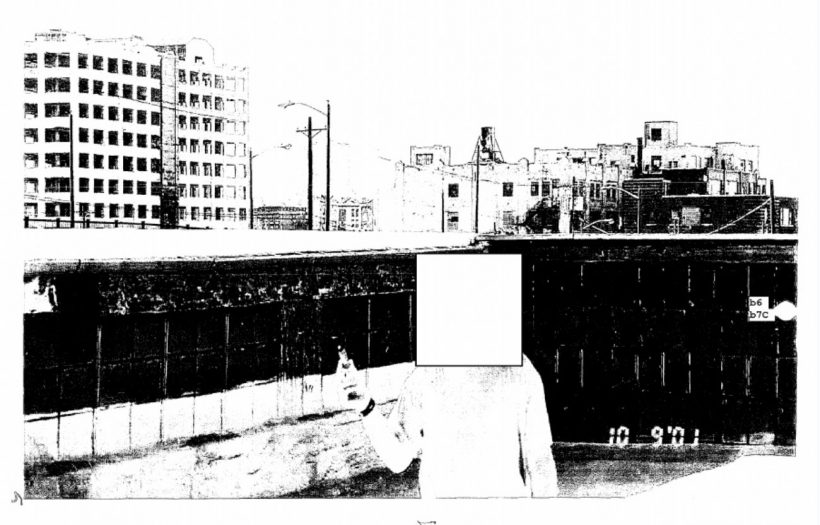
Sivan Kurzberg holds a lit lighter with the Manhattan skyline in the background. The date September 10, 2001 visible in the bottom right corner | Photo #5
In addition, the FBI report noted that a van from Urban Moving Systems, the company that employed the five Israelis at the time of their arrest, was present and was involved in moving a tenant out of the complex on September 10 and that the movers all had foreign accents. Thus, images 5, 7 and 8 strongly appear to have been taken at the same complex a day before the attacks. Kurzberg is seen in both images that display the visible date of September 10, 2001.
This raises two possibilities. First, that there are two images of Kurzberg with a lit lighter in front of the towers, one taken before the attack and one taken at the time of the attack, and that the FBI released only one of them. Second, that Kurzberg took the picture with the lighter only the day before the attack and his lawyer misrepresented the contents of the photo to the New York Times. Given that the background of the photo — particularly the state of the towers — is indiscernible in the recently released photo, it is difficult to determine which is the case.

One of the Israelis points to what is presumably the World Trade Center, in Manhattan on September 11, 2001 | Photo #2
Yet, in either scenario, Kurzberg had simulated the burning of the World Trade Center the day before the attacks took place. That the FBI concluded that Kurzberg was party to a Mossad surveillance operation at the time of his arrest would then suggest that Israeli intelligence also had foreknowledge of the attacks.
Notably, the relevant section of the FBI report that asks “1. Did the Israeli nationals have foreknowledge of the events at WTC and were they filming the events prior to and in anticipation of the explosion?” is redacted in its entirety, suggesting that the FBI did not determine the answer to that question to be an emphatic “no.”
One of the 9/11 loose-ends coverups?
If images 5 and 7 were indeed taken the day prior to the attack, the question then becomes why the FBI officially concluded that the arrested Israelis had no prior knowledge of the attacks? One report from ABC News dated June 2002 suggests that the Bush administration intervened in the investigation. That report states that “Israeli and U.S. government officials worked out a deal — and after 71 days, the five Israelis were taken out of jail, put on a plane, and deported back home [to Israel].” If the Bush administration had cut a deal with Israel’s government to cover up the incident, it certainly would not have been the first time a U.S. presidential administration had done so on Israel’s behalf.
Further evidence that higher-ups in the administration intervened is the fact that then-Attorney General John Ashcroft personally signed off on the detainees’ release. Upon his entering the private sector as a lobbyist and consultant in 2005, the Israeli government became one of Ashcroft’s first clients.
A cover-up certainly seems to have happened to some extent, between the destruction of records of the investigation and the fact that official conclusions of the investigation do not add up. In the latter case, the FBI — in a file dated September 24, 2001– officially stated that they “determined that none of the Israelis were actively engaged in clandestine intelligence activities in the United States.” However, that conclusion was directly contradicted by U.S. officials a year later and by the fact that Israel’s own government subsequently acknowledged that the five Israelis had indeed been involved in “clandestine intelligence activities in the United States.”
In addition, the new FOIA release of the photos suggests that another FBI conclusion — that “none of the pictures developed from the film found inside the 35-mm camera depicted the twin towers prior to the attack” — was inaccurate. This may explain why the images released via the recent FOIA request were heavily edited leaving details in the background greatly obscured, making it impossible to determine whether the photos were taken prior to or during the attacks based solely on the state of the towers.
“Tourists” with cash-stuffed socks, box cutters, and explosives?
Beyond the photos and observed activities of the so-called “Dancing Israelis,” it is worth revisiting several other suspicious circumstances linked to their arrest that clearly show that the men in question were hardly the “tourists” they had claimed to be. One often cited example is the fact that one of the men, Oded Ellner, had a “white sock-like sack filled with $4,700 in cash,” as well as maps of the city with certain places highlighted, and box cutters. In addition, the van in which the Israelis were arrested was “oddly” lacking “equipment typically used in a moving company’s daily duties,” according to the FBI, and residue of explosives was found in the van.
Of the explosive residue, the declassified FBI report states:
A search of the van and individuals was conducted at the time of the vehicle stop. The vehicle was also searched by a trained bomb-sniffing dog which yielded a positive result for the presence of explosive traces. Swabs of the vehicle’s interior were taken, and those samples were sent to the FBI laboratory for further analysis. Final results are still pending.”
In total, the FBI reported that four items related to explosives were found in the ban and are labeled in the report as “Fabric Sample (Explosive Residue),” “Control Swabs – SA [ – ] Gloves,” “Control Swabs – (Bomb Suits),” and “Blanket Samples For Explosive Residue.” In addition, a VHS tape and some still photographs found in the van “were sent to Laboratory Examiner [ redacted ] (Explosives Unit).”
In addition to the strange nature of some of the Israelis’ possessions in the van and on their person, the company that employed them — Urban Moving Systems — was of special interest to the FBI, which concluded that the company was likely a “fraudulent operation.” Upon a search of the company’s premises, the FBI noted that “little evidence of a legitimate business operation was found.” The FBI report also noted that there were an “unusually large number of computers relative to the number of employees for such a fairly small business” and that “further investigation identified several pseudo-names or aliases associated with Urban Moving Systems and its operations.”
The FBI presence at the Urban Moving Systems search site drew the attention of the local media and was later reported on both television and in the local press. A former Urban Moving Systems employee later contacted the Newark Division with information indicating that he had quit his employment with Urban Moving Systems as a result of the high amount of anti-American sentiment present among Urban’s employees. The former employee stated that an Israeli employee of Urban had even once remarked, “Give us twenty years and we’ll take over your media and destroy your country” (page 37 of the FBI report).
The FBI returned to search the premises of Urban Moving Systems a month later, but by that time found:
The building and all of its contents had been abandoned by… the owner of Urban Moving Systems. This [was] apparently being done to avoid criminal prosecution after the 09/11/2001 arrest of five of his employees and subsequent seizure of his office computer systems by members of the FBI-NK on or around 09/13/2001.”
The company’s owner — Dominik Otto Suter, an Israeli citizen — had fled to Israel on September 14, 2001, two days after he had been questioned by the FBI. The FBI told ABC News that “Urban Moving may have been providing cover for an Israeli intelligence operation.” Surprisingly, since at least 2016, Suter has been living in the San Francisco Bay Area, where he works for a contractor for major tech companies like Google and Microsoft. According to the public records database Intelius, in 2006 and 2007 Suter also worked for a telecommunications company — Granite Telecommunications — that works for the U.S. military and several other U.S. government agencies.
In addition to Urban Moving Systems, another moving company, Classic International Movers, became of interest in connection with the investigation into the “Dancing Israelis,” which led to the arrest and detention of four Israeli nationals who worked for this separate moving company. The FBI’s Miami Division had alerted the Newark Division that Classic International Movers was believed to have been used by one of the 19 alleged 9/11 hijackers before the attack, and one of the “Dancing Israelis” had the number for Classic International Movers written in a notebook that was seized at the time of his arrest. The report further states that one of the Israelis of Classic International Movers who was arrested “was visibly disturbed by the Agents’ questioning regarding his personal email account.”
A crowded dance floor
While the case of the “Dancing Israelis” has long been treated as an outlier in the aftermath of September 11, what is often overlooked is the fact that hundreds of Israeli nationals were arrested in the aftermath of the attacks.
According to a FOX News report from December 2001, 60 Israelis were apprehended or detained after September 11, with most deported, and a total of 140 Israelis were arrested and detained in all of 2001 by federal authorities. That report claimed that the arrests, ostensibly including the “Dancing Israelis,” were in relation to an investigation of “an organized [Israeli] intelligence gathering operation designed to ‘penetrate government facilities.’”
The report also added that most of those arrested, in addition to having served in the IDF, had “intelligence expertise” and worked for Israeli companies that specialized in wiretapping. Some of those detained were also active members of the Israeli military; and several detainees, including the “Dancing Israelis,” had failed polygraph tests when asked if they had been surveilling the U.S. government.
Watch | FOX News December 2001 report on Mossad spying prior to 9/11
A key aspect of that report, compiled by journalist Carl Cameron, also states that federal investigators widely suspected that Israeli intelligence had prior knowledge of the September 11 attacks. In the report, Cameron stated:
The Israelis may have gathered intelligence about the attacks in advance and not shared it. A highly placed investigator said there are ‘tie-ins’ but when asked for details he flatly refused to describe them saying: ‘Evidence linking these Israelis to 9-11 is classified. I cannot tell you about the evidence that has been gathered. It is classified information.’”
One exchange between Cameron and host Brit Hume included in the report is particularly telling:
HUME: “Carl, what about this question of advanced knowledge of what was going to happen on 9/11? How clear are investigators that some Israeli agents may have known something?”
CAMERON: “Well it’s very explosive information obviously and there is a great deal of evidence that they say they have collected. None of it necessarily conclusive. It’s more when they put it all together a big question they say is, ‘How could they have not known?’ — almost a direct quote, Brit.”
9/11 as a big — and acknowledged — Israeli win
If the “Dancing Israelis”, and more broadly the Mossad and the Israeli government, had foreknowledge of September 11, why would they remain silent and not attempt to warn the American government or public of the coming attacks? In the case of the “Dancing Israelis,” why would Israelis celebrate such an attack?
One of the detained “Dancing Israelis,” Omer Marmari, told police the following about why he viewed the September 11 attacks in a positive light:
Israel now has hope that the world will now understand us. Americans are naïve and America is easy to get inside. There are not a lot of checks in America. And now America will be tougher about who gets into their country.”
While Marmari’s statement may suggest one reason some of the “Dancing Israelis” were so “visibly happy” in their photographs, there are also other statements made by top Israeli politicians that suggest why the Israeli government and its intelligence agency declined to act on apparent foreknowledge of the attack.
When asked, on the day of the 9/11 attacks, how the attacks would affect American-Israeli relations, Benjamin Netanyahu — the current Israeli prime minister — told the New York Times that “It’s very good,” before quickly adding “Well, not very good, but it will generate immediate sympathy.” He then predicted, much as Marmari had, that the attacks would “strengthen the bond between our two peoples, because we’ve experienced terror over so many decades, but the United States has now experienced a massive hemorrhaging of terror.”
Netanyahu, in a candid conversation recorded in 2001, also echoed Marmari’s claim that Americans are naïve. In that recording, Netanyahu said:
I know what America is. America is something that can easily be moved. Moved to the right direction. … They won’t get in our way. They won’t get in our way… 80 percent of the Americans support us. It’s absurd.”
In addition, also on the day of the September 11 attacks, Netanyahu — who at the time was not in political office — held a press conference in which he claimed that he had predicted the attacks on the World Trade Center by “militant Islam” in his 1995 book, Fighting Terrorism: How Democracies Can Defeat Domestic and International Terrorism. In that book, Netanyahu had posited that Iranian-linked “militants” would set off a nuclear bomb in the basement of the World Trade Center.
During his press conference on the day of the attacks, Netanyahu also asserted that the 9/11 attacks would be a turning point for America and compared them to the 1941 attack on Pearl Harbor. Netanyahu’s statement echoes the infamous line from the “Rebuilding America’s Defenses” document authored by the neoconservative think tank, the Project for a New Ameican Century (PNAC). That line reads. “Further, the process of transformation [towards a neo-Reaganite foreign policy and hyper-militarism], even if it brings revolutionary change, is likely to be a long one, absent some catastrophic and catalyzing event — like a new Pearl Harbor.”
Then again, years later In 2008, the Israeli newspaper Maariv reported that Netanyahu had stated that the September 11 attacks had greatly benefited Israel. He was quoted as saying: “We are benefiting from one thing, and that is the attack on the Twin Towers and Pentagon, and the American struggle in Iraq.”
Indeed, it goes without saying that the aftermath of 9/11 — which involved the U.S. leading a destructive effort throughout the Middle East — has indeed benefited Israel. Many of the U.S.’ post-9/11 “nation-building” efforts have notably mirrored the policy paper “A Clean Break: A New Strategy for Securing the Realm,” which was authored by American neoconservatives — PNAC members among them — for Netanyahu’s first term as prime minister.
That document calls for the creation of a “New Middle East” by, among other things, “weakening, containing, and even rolling back Syria” and “removing Saddam Hussein from power in Iraq — an important Israeli strategic objective in its own right.” As is known now, both of those main objectives have since come to pass, each with strong Israeli involvement.
Whitney Webb is a MintPress News journalist based in Chile. She has contributed to several independent media outlets including Global Research, EcoWatch, the Ron Paul Institute and 21st Century Wire, among others. She has made several radio and television appearances and is the 2019 winner of the Serena Shim Award for Uncompromised Integrity in Journalism.
Imperiled Dutch PM’s party: Vote us, or our Kremlin-loving rivals will give country to Putin
RT | May 17, 2019
When you get crushed at the ballot box and want to undercut the guys who beat you, the best strategy is to say they are in love with the Kremlin and want to sell the country to Putin, the ruling Dutch party apparently believes.
People’s Party for Freedom and Democracy (VVD), the party of Dutch Prime Minister Mark Rutte, is in a perilous situation at the moment. Two months ago political newcomers from Forum for Democracy (FvD) crushed the centrist ruling coalition in provincial elections.
Next week Dutch voters choose their representatives at the European Parliament and Prime Minister Rutte and his people have apparently decided it’s time to unpack the ultimate weapon: red-baiting.
A political ad published by VVD on Thursday tells the Dutch they shouldn’t vote for FvD because its leader Thierry Baudet … wants to hand the Netherlands over to Vladimir Putin. Why? Because Baudet, is in love with the Russian president – at least that’s what the cartoonish popping out eyes, with hearts in them and the hashtag #Kremlincrush imply.
The ad does not seem very convincing though. The evidence of Baudet’s infatuation boils down to him going against Western establishment’s common wisdom in saying that the threat of Russia is grossly exaggerated and that Moscow could be a good ally in the modern world. Why the Eurosceptic nationalist party would be conspiring to betray its country to a foreign power is never explained.
The secret proof is probably the Soviet anthem, which creators of the video used as background music. The Russian one uses the same tune with different lyrics, so they are difficult to distinguish for a foreigner, but maybe VVD wanted to say Baudet had been recruited over 30 years ago, when the USSR still existed?
The attack is the latest in a series launched by VVD against their FvD opponents in the run up to next week’s vote and may seem like an act of desperation, but it is actually not. At least that’s what Klaas Dijkhoff, the leader of the party faction in the Dutch House, says.
“We just lost an election. This doesn’t mean we are in a panic,” he told Algemeen Dagblad daily. “If our military and intelligence services all say Russia is a threat and you say Russia can be our friend, you have some explaining to do.”
FvD on the contrary believe their critics are simply going into a full meltdown before ultimate political demise.
Russia scaremongering is quite a popular campaign tactic these days in many countries, but it doesn’t necessarily pay off. For example, Ukraine’s incumbent President Petro Poroshenko tried to get reelected by stating that his actual opponent is Putin rather than Volodymyr Zelensky, the comedian turned politician, whose name was on the ballot. Zelensky won in a landslide, scoring over 73 percent of the votes.
VVD is no stranger to using Putin’s name for political grandstanding and getting burned as a result. Halbe Zijlstra, Dijkhoff’s predecessor as party faction leader who later became foreign minister, had to resign in disgrace last year after confessing that he had lied about a meeting with Putin. Zijlstra had falsely claimed that he heard the Russian leader lay an imperialistic claim on neighboring countries.
The Washington Post’s “Cartel of the Suns” Theory is the Latest Desperate Excuse for Why the Coup Attempt in Venezuela has Failed
By Peter Bolton | CounterPunch | May 17, 2019
With the attempted coup in Venezuela now nearing its four-month mark, commentators in the corporate-owned Western press are scratching their heads as to why Washington’s plan for its proxy, Juan Guaido, to topple the government of Nicolas Maduro has so far failed to materialize. Of course, all of the real reasons elude them because they have never so much as crossed their minds. It is beyond their mental world to consider the lasting popularity of the late Hugo Chavez’s policies and lasting suspicion toward the right-wing opposition amongst large swathes of the population – or the deep revulsion at the thought of US (and especially US military) intervention into their country held by the vast majority of Venezuelans (and, indeed, Latin Americans generally). Rather, both the coup attempt’s puppeteers in Washington and their ventriloquist dummies in the mainstream media have been coming up with ever-more desperate excuses for why Guaido’s attempt to take power has not been a swift and decisive success. The so-called “propping up” of the Maduro “regime” by the traditional the US boogeymen of Russia, China and Cuba seems to have been the most frequently touted explanation. This has manifested itself in increasingly bizarre ways, such as the recent claim by Mike Pompeo that Maduro was at the point of fleeing the country before being convinced otherwise by Russia.
Now, the Washington Post’s notorious warhawk and deranged conspiracy peddler Jackson Diehl has come up with the latest labored rationalization for the failure of the coup attempt: the so-called “Cartel of the Suns.” According to Diehl, this shadowy organization is made up of “some of the most senior officials in the Maduro regime.” He claims that it “flies hundreds of tons of Colombian cocaine from Venezuelan airfields to Central America and the Caribbean for eventual distribution in the United States and Europe.” He furthermore claims that the Maduro government’s crimes also include skimming accounts used for importing food and medicine and “corrupt currency trading.” Describing the Maduro government as “less a government — much less a socialist one — than a criminal gang,” he claims that “the money it is reaping from criminal activity is serving as a prop that allows it to survive U.S. sanctions.” The only sources he provides to support these assertions are: an Associated Press article from September 2018 that reported on an unproven allegation made by a minor US Treasury Department figure, a January 2019 Wall Street Journal article that reports on another unproven allegation made by the US Treasury Department, and a link to one of his own Washington Post articles published in 2015. Leaving aside the self-citation, allegations made by the Treasury Department can hardly be considered credible evidence. It is, after all, a branch of the US government, which has been attempting to destabilize Chavista administrations since their earliest days in office. The Trump administration that it currently answers to, meanwhile, has been the major driving force behind the attempted coup and makes no secret of basing the effort on the advancement of US corporate economic interests.
Larissa Costas has gone so far as to posit that the very idea of such a government-operated cartel might be a whole-cloth fabrication. She stated in February 2017 article:
Although information abounds in the mediums of communication, the “Cartel of the Suns” has not been caught with a single gram of drugs, nor has there been any insignia of the organization identified in any seizure, nor has a single death been attributed to it. There are just two explanations: either it is the most inoffensive of cartels or it simply does not exist. [translated from the original in Spanish]
This latter possibility seems to be confirmed by the consistent failure of repeated Washington-led investigations into members of the Maduro government to result in actual convictions or even clear conclusions. For instance, in January 2015 the US Justice Department (DoJ) and Drug Enforcement Administration (DEA) launched a joint probe into then-President of the National Assembly Diosdado Cabello and other senior figures of the Venezuelan government. News reports soon followed repeating the allegations, including the claim that Cabello is the “capo” of the “Cartel of the Suns.” (Note here the loaded use of mafia-tinged language that’s seemingly borrowed straight from The Godfather movies.) But now, over four years since the launch of this probe, the DEA and DoJ have yet to even charge, let alone convict, any of the people implicated in it. Yet still the mainstream media reports repeat the allegations as if they were beyond question. In May 2018, for example, InSight Crime published an article titled “Drug Trafficking Within the Venezuelan Regime: The ‘Cartel of the Suns’,” in which the publication claims to have built “files on senior [Venezuelan] officials, current or past, that have been involved in the trafficking of cocaine.” But rather than providing the reader with this purported mountain of evidence that they have amassed, the authors instead cite an anonymous Justice Department official as their source. Just as with the US Treasury Department, the Justice Department can hardly be trusted when successive administrations in Washington have been consistently trying to undermine Chavista governments ever since Hugo Chavez was first elected in 1998. From CIA and Bush administration involvement in the 2002 coup attempt and also in the 2002-2003 PDVSA management lock-out through to the present coup attempt and oil sanctions, Washington has gone from covert to brazenly overt regime change methods.
But things go deeper than this. It seems that these dubious accusations of drug trafficking, in fact, form a significant part of the regime change effort itself. For one thing, they are used as justification for sanctions that Washington enacts in order to weaken the regime by sending thinly veiled signals to international capital to avoid Venezuela. Second of all, these sanctions and allegations are in turn used as a form of leverage to weaken the regime and encourage defection to the US’s and US-backed opposition’s side. There is no better case to illustrate this reality than that of the retired Venezuelan General Hugo Carvajal. In July 2014, as Carvajal was being released from custody in Aruba, Reuters reported that he categorically denied US charges of involvement in the illegal drug trade and provision of aid to Colombian leftist armed groups. But in February 2019, with the coup attempt about a month in, Carvajal did an about-face and accused Maduro and his inner circle of involvement in drug trafficking. This was right after Trump made an open threat that military officials who remain loyal to Maduro have “everything to lose” while Guaido simultaneously offered amnesty to those willing to defect to his side. It seems that Carvajal was responding to this “carrot and stick” threat/incentive combination that the US had, in his case successfully, employed as part of its regime change arsenal. The questionable validity of his claims is demonstrated by his repetition of Washington’s oft-repeated mantra that Maduro officials are courting the Lebanese “militant” group Hezbollah. These claims have been decisively debunked by Richard Vaz, who points out that mainstream media outlets such as CNN that report these allegations again use solely the Treasury Department as their source, or worse still figures such as Marco Rubio. Vaz also points to the absurdity of holding up Tarek el Aissami as the facilitator of some kind of cross-Atlantic Iranian-led Shi’ite alliance when el Aissami himself is not even Muslim, but rather the son of Lebanese Druze immigrants who was born and has spent all his life in Venezuela.
In any normal situation this is all that would have to be said to dismiss Diehl’s claims. But Latin America is no normal place and US relations with the region constitute no normal situation. In addition to the scarcity of evidence for the claims he makes, there is a question of double standards that lies beneath the surface. Diehl undoubtedly wishes to imply that the Maduro government’s alleged involvement in criminal activity justifies the interventionist actions from Washington and its proxies on the ground. But when one looks across the region and into both its past and present, one sees a whole cornucopia of flagrant narco-states that Washington has not only ignored but bank-rolled and armed to the teeth. Not coincidentally, two of them are staunch allies and the other was so until very recently. I am talking, of course, of Colombia, Honduras and Mexico.
Colombia’s status as a narco-state during the first decade of this century is hardly a secret. Even some of the US’s own declassified intelligence documents contain allegations of former president Alvaro Uribe’s close ties to narcotrafficking. A 1991 declassified Defense Intelligence Agency (DIA) report, for example, describes Uribe as a “close personal friend of Pablo Escobar” and “dedicated to collaboration with the Medellín cartel at high government levels.” Another intelligence report from 1993, and declassified in 2018, says that Colombian Senator told officials at the US Embassy in Bogota that Escobar’s cartel had financed Uribe’s election campaign for the Colombian Senate. In spite of having such information available, Washington nonetheless generously funded the Uribe government through Plan Colombia to engage in so-called “counter-narcotics” campaigns, which served as a cover for brutal offensives against labor and indigenous rights activists and displacement of rural campesinos. The extent of state capture by drug cartels in Colombia was furthermore exposed by the Parapolitics scandal, which led to the conviction of 32 members of the Colombian congress along with five state governors for collusion with right-wing paramilitaries. These groups, incidentally, have been the biggest players in the Colombian drug trade, dwarfing the involvement of leftist guerrilla groups such as the FARC and ELN.
Revelations from the recently concluded trial of Joaquín ‘El Chapo’ Guzmán have shone a light onto a similar story in Mexico. State witness Alex Cifuentes made a credible accusation during his testimony against Guzman that former Mexican president Enrique Peña Nieto received a bribe from Guzman worth $100 million dollars. Mexican investigative journalist Anabel Hernandez has long claimed that collusion between the Mexican state and narco-trafficking groups stretches all the way to the top, including the presidency, which Cifuentes’ testimony seemingly confirms. As has been the case with Colombia, the US has not only turned a blind eye to this situation, but has been generous funding the Mexican government to conduct “counter-narcotics” campaigns through the Merida Initiative. And again, these campaigns provided cover for brutal human rights violations on the part of Mexico’s state security forces.
Finally, we should turn to Honduras, the most contemporary and, in many ways, most flagrant example of a narco-state that the US cozies up to. Ever since the State Department orchestrated a coup against the democratically-elected government of Manuel Zelaya in 2009 there have been growing signs that Honduras has degenerated into a fully-fledged narco-state. In January of last year, for example, it emerged that a national police chief personally facilitated a cocaine delivery worth $20 million in 2013. In November 2018, President Juan Orlando Hernandez’s brother, Tony Hernandez, was arrested on drug trafficking charges in Miami. Just as this article went to press, testimony that he gave to US Drug Enforcement Administration (DEA) was unsealed in which he reportedly admits to interacting with several known drug traffickers as well as taking bribes. Even according to the aforementioned InSight Crime : “Tony Hernández’s detailed knowledge of the activities of some of Honduras’ most prominent drug traffickers makes it increasingly difficult for President Juan Orlando Hernández to deny being aware of these acts.” The president himself has previously faced allegations of involvement in drug trafficking via ex-army captain Santos Rodriguez Orellana. And as with Colombia and Mexico, not only has Washington never issued any punitive measure whatsoever against Honduras for any of this, it has rather been generously funding its state security forces in spite of its brutal record of human rights violations.
Note that all three of the above countries have been close US allies for the last few decades, with Colombia and Honduras remaining so while Mexico begins to break from Washington following the election of progressive president Andres Manuel Lopez Obrador. This is no coincidence. So long as a country is serving the US’s geostrategic and economic interests, it will not just overlook its status as a narco-state but will aid and abet its committing of human rights violations. You won’t hear about any of this from Jackson Diehl, however. Because as an obedient cheerleader for the Monroe Doctrine he must faithfully promulgate the selective indignation that underpins its entire edifice of justification propaganda. Given Washington’s record in the wider region, whether or not Venezuela is indeed a narco-state ceases to be the point. Rather, the question becomes one of credibility. And when it comes to evenhandedness in its treatment of Latin American states, Washington has exactly none.
The Pompeo Bolton Tag Team from Hell
By Renee Parsons – Global Research – May 17, 2019
There was little pretense that when former UN Ambassador John Bolton became President Trump’s National Security Adviser and former Rep. Mike Pompeo moved into the Secretary of State position, that either would bring a professionally credible and respectable presence to world diplomacy or foreign affairs.
It is fair to say that both have surpassed any of the bleak expectations and proven to be more extreme in their ideology, more personally amoral and malevolent than previously feared. What we are seeing now is as if all constraints have been removed with free rein to fulfill their zio-neocon agendas specifically against Venezuela and Iran.
- While speaking to a student audience recently at Texas A&M University, Pompeo revealed his utter contempt for a democratic government based on the rule of law when he bragged about “lying, cheating and stealing” as CIA Director. To an audience of undergraduates which clapped and laughed throughout, Pompeo offered:
“What’s the cadet motto at West Point? You will not lie, cheat or steal or tolerate those who do. I was the CIA Director. We lied, we cheated, we stole. (laughing as if he had said something humorous) We had entire training courses. (Audience applause and cheers) It reminds you of the glory of the American experiment.” (emphasis added)
First in his class at West Point and a graduate of Harvard Law School, Pompeo prides himself on having “come to an understanding of Jesus that fundamentally changed“ his life as a cadet and today claims to be a “man of faith.” It is not clear who Pompeo thinks he is kidding with the religious fervor schtick but for sure it is not any divine deity which will one day sit in Judgment on his character and integrity. The Texas A&M exchange reveals an unscrupulous bully who knows no limit to his omnipotence and a willingness to condone war crimes on behalf of the disreputable Empire he serves.
- Keynote speaker at AIPAC’s 2019 conference, Pompeo proved where his fidelity lies when he declared “Let me go on record: Anti-zionism is anti-semitism” which has become the new rallying cry for the poor, beleaguered state of Israel.
- As the State Department is now defining the term ‘anti Zionism,’ Pompeo appointed Elan Carr as Special Envoy to Monitor and Combat Anti-Semitism with the ultimate goal to intimidate and criminalize critics of Israel’s foreign policy objectives.
In describing his responsibilities, Carr’s stated priorities will be to “reduce the feelings of insecurity”, review “indoctrination of anti semitic textbooks” and “focus relentlessly on eradicating this false distinction between anti Zionism and anti-semitism.” It takes living in a simulated reality to not grasp the distinction between criticism of Israel’s apartheid policy toward the Palestinians and its belligerent foreign policy in the Middle East and a genuine prejudice or discrimination based on one’s religious preference or ethnic differences.
At his press briefing, Carr was immediately in the weeds and lost total control of the narrative before being shut down by the State Department official spokesman.
As a one dimensional thinker, Mr. Carr never described who or how anti-semitism will be identified. Will the State Department issue a weekly list of anti-Semitic offenders and what will be the penalty? Will State provide a list of forbidden anti-semitic words? How will deliberate intent be determined? If a non-jew utters words like apartheid, yenta, yarmulke or illegal settlements, will they be considered proof of anti-Semitic? Will the Nazis still be permitted to march in Skokie? Will the tech giants rewrite their algorithms to search for ‘banned’ words?
- On April 10th, Omar Barghouti (image on the right), a prominent Palestinian human rights defender and a co-founder of the Boycott, Divestment and Sanctions (BDS) Movement was denied entry by the US Consulate before departing Ben Gurion Airport despite having valid travel documents and having visited the US previously. Barghouti responded that:
“Supporters of Israeli apartheid in the US are desperately trying to deny US lawmakers, media, diverse audiences at universities, a bookstore and a synagogue, their right to listen, first-hand, to a Palestinian human rights advocate calling for ending US complicity in Israel’s crimes against our people.”
- In a 2016 report, the International Criminal Court chief prosecutor Fatou Bensouda initiated an investigation into possible war crimes in Afghanistan involving the torture of 61 prisoners committed by the US Army and the torture and rape of 27 prisoners committed by the Central Intelligence Agency (CIA) at CIA prison sites in Poland, Romania and Lithuania.
In response to the ICC inquiry in 2018, Bolton warned:
“We will ban its judges and prosecutors from entering the United States. We will sanction their funds in the US financial system, and we will prosecute them in the US criminal system. We will do the same for any company or state that assists an ICC investigation of Americans,”
In March 2019, Pompeo repeated the ICC threats with no apology in a straight forward defense of torture and war criminals.
“Since 1998, the US has declined to join the ICC because of its broad unaccountable prosecutorial powers and the threat it poses to American national sovereignty. We are determined to protect the American and allied military and civilian personnel from living in fear of unjust prosecution for actions taken to defend our great nation. I’m announcing a policy of US visa restrictions on those individuals directly responsible for any ICC investigation of US personnel. These visa restrictions may also be used to deter ICC efforts to pursue allied personnel, including Israelis without allies consent. These visa restrictions will not be the end of our efforts.We are prepared to take additional steps, including economic sanctions, if the ICC does not change course,”
After the Court responded that it would continue its investigation with “war crimes and crimes against humanitywere, and continue to be, committed by foreign government forces in Afghanistan,” Reference to ‘allied” personnel and Israeli involvement in US war crimes remains impenetrable. True to his word, in early April Pompeo revoked the visa for Bensouda (image on the left).
In a devastating setback for the ICC, its pre-trial chamber recently refused to approve the investigation from moving forward citing a lack of US cooperation. Certainly the Pompeo – Bolton threat to criminally prosecute and personally sanction the Court’s judges or that the US would ‘use any means necessary ” had nothing to do with that decision. Bensouda says she will appeal the chamber’s decision.
- After the January meeting with North Korea ended in failure, NK’s Deputy Defense Minister, who took part in the meeting, revealed that while Trump had shown a willingness to lift some sanctions based on NK’s moratorium on missile tests, he was later overridden by Pompeo and Bolton who brought “an atmosphere of hostility and mistrust” to the table with their “gangster like behavior.”
As the zio-neocons continue to move on Venezuela and/or Iran as uncontrollable malevolent fiends, loose cannons with no concept of international law or the need for global harmony, men of no conscience and no morality, it is only a matter of time before cosmic law balances the scale.
Renee Parsons has been a member of the ACLU’s Florida State Board of Directors and president of the ACLU Treasure Coast Chapter. She has been an elected public official in Colorado, an environmental lobbyist for Friends of the Earth and staff member of the US House of Representatives in Washington DC. She can be found on Twitter @reneedove31
Washington Needs New Mindset for a US-Russia Reset
Strategic Culture Foundation | May 17, 2019
As the old saying goes, it’s good to talk. US Secretary Mike Pompeo was cordially received this week by Russian President Vladimir Putin and Foreign Minister Sergei Lavrov in the Black Sea resort of Sochi.
Pompeo spoke of repairing the frayed bilateral relations and of finding “common ground” between the US and Russia on a range of pressing international issues. President Putin also said he aspired for much better relations between the two countries, and pointed out that the world’s biggest nuclear powers have an onerous obligation to cooperate.
Indeed, the issue of arms control was reportedly a top agenda item in lengthy discussions between Putin and Pompeo, and separately with Lavrov. Both sides expressed willingness to work on negotiating new controls and on extending the New Start treaty concerning strategic nuclear weapons which is due to expire in 2021. After the US unilaterally suspended its participation in the Intermediate-Range Nuclear Forces treaty earlier this year, amid dubious accusations against Russia for breaching the treaty, the stated willingness by Pompeo to return to negotiations is welcome.
On several other issues, the US and Russian sides clashed over differences. Russia defended the sovereign right of Venezuela to be free from Washington’s interference. Lavrov called for dialogue in the South American country as the way forward to resolve political conflict, not for Washington to “impose” its will on the Venezuelan people.
The Russian side also warned against further escalation of military tensions by the US towards Iran, reiterating the importance of respecting the 2015 international nuclear accord, which Washington unilaterally abrogated last year.
In principle, having sharp differences and opposing views is not a problem. Diplomacy is all about robust exchange of views and criticisms. At least, Pompeo’s engagement with Moscow shows that the Trump administration is willing to build on diplomatic relations based on mutual respect.
Earlier this month, Presidents Trump and Putin held a constructive phone call which no doubt helped set the agenda for discussions this week. There are further meetings planned between Lavrov and Pompeo at next month’s G20 summit in Japan. The White House has also said that during the summit, Trump is open to meeting with Putin. The Kremlin responded positively to that offer. It would be the first meeting between the two leaders since their summit in Helsinki last July.
This cordial outreach is encouraging, especially given the past two years of relentless political and media antagonism from the American side towards Russia and Putin in particular, with the latter vilified for allegedly orchestrating Kremlin interference in the 2016 US presidential elections. Trump has always scoffed at those claims as a demeaning slur fabricated by his domestic political enemies. Moscow, of course, has consistently slammed the accusations as baseless slander. Given that a two-year investigation into the matter by special counsel and former FBI chief Robert Mueller concluded that there was “no Russian conspiracy”, that would seem to be a vindication of both Trump and Russia, and the end of the whole tawdry matter. Time to move on.
However, that’s why the additional comments on alleged Russian interference by Pompeo this week were jarring and disconcerting. He reportedly warned President Putin about not interfering in US elections “again” and for Russia to demonstrate “that it was a thing of the past”. Such an attitude from Trump’s top diplomat is reprehensible. The irony is that the Trump administration has been assailed with false claims of Russian collusion, and yet here was Pompeo spouting the same nonsense to his Russian hosts, instead of seizing the opportunity to get on with real, pressing issues of utmost importance.
Perhaps Pompeo was anticipating the furious anti-Russia media reaction back in the US where a plethora of commentators decried his otherwise convivial meeting with Putin. The fact that large sections of the mainstream US media did ham up ridiculous insults about “collusion” shows that there is a deep-seated pernicious Russophobia among the American establishment. Pompeo appears to be susceptible to owning similar pejorative views on Russia, if he can still articulate the scurrilous notion of electoral interference.
That is a troubling sign of dim prospects for a restored relationship. Pompeo’s remarks about “not interfering again” illustrates how ingrained the notion is in Washington that Russia meddled in American affairs. If Washington persists in this fundamentally Russophobic delusion, then the prospects for normal bilateral relations are indeed limited.
If one side has such a paranoid and delusional view of the other side, then the scope for a productive dialogue on other matters is badly hampered.
A genuine reset in US-Russia relations will require a sea-change in the political mindset in Washington. Cold War thinking should be “the thing of the past” not the tedious repetition of slander against Russia.
President Trump seems willing to make a fresh start with Russia. Maybe he ought to think about shaking up his diplomatic corps with some reasonable people who don’t just regurgitate Russophobic nonsense.
‘Mass surveillance is exactly what the US does’: Dotcom points out glaring irony of Huawei ban
RT | May 17, 2019
Kim Dotcom has slammed the US for hypocrisy over its Huawei ban given America’s history of “abusing technology” and “turning its entire tech sector into a spy machine.”
The Megaupload founder took to Twitter in the wake of the ban to highlight that the abuse of technology for mass surveillance is “exactly the conduct of the US” and said that “because the US does it, they think China will too.”
Trump declared a “national emergency” for the telecommunications sector on Wednesday, citing risks from “foreign adversaries.”
The US Commerce Department subsequently added Huawei Technologies Co Ltd and 70 affiliates to its so-called Entity List, which bans the Chinese brand from buying parts from US companies without government approval, making it difficult for Huawei to sell some of its products because of its reliance on US parts.
Dotcom pointed out that the US has used tech companies to spy on its own citizens as well as people all around the world. The extent of US surveillance was revealed by National Security Agency (NSA) whistleblower Edward Snowden in 2013 when he exposed the US’ warrantless surveillance, including listening in on phone conversations, its ability to compel tech companies like Google and Facebook to turn over user data, and the XKeyscore tool that can be used to collect nearly everything a user does on the internet.
Snowden also revealed how the US spies on world leaders, attempts to crack encryption and works with the UK to intercept global internet data.
The 2017 Wikileaks ‘Vault 7’ leak of CIA secrets revealed the US agency kept vulnerabilities and security bugs from tech companies so it could continue to access devices. The documents also highlighted the spy agency’s use of hacking tools to remotely hack and control smart phones, and cover their own tracks.
Pretexts for an Attack on Iran
By Ray McGovern – Consortium News – May 15, 2019
An Iraq-War redux is now in full play, with leading roles played by some of the same protagonists — President Donald Trump’s national security adviser, John Bolton, for example, who says he still thinks attacking Iraq was a good idea. Co-starring is Secretary of State Mike Pompeo.
The New York Times on Tuesday played its accustomed role in stoking the fires, front-paging a report that, at Bolton’s request, Acting Defense Secretary Patrick Shanahan has come up with an updated plan to send as many as 120,000 troops to the Middle East, should Iran attack American forces or accelerate work on nuclear weapons. The Times headline writer, at least, thought it appropriate to point to echoes from the past: “White House Reviews Military Plans Against Iran, in Echoes of Iraq War.”
By midday, Trump had denied the Times report, branding it “fake news.” Keep them guessing, seems to be the name of the game.
Following the Iraq playbook, Bolton and Pompeo are conjuring up dubious intelligence from Israel to “justify” attacking — this time — Iran. (For belligerent Bolton, this was entirely predictable.) All this is clear.
What is not clear, to Americans and foreigners alike, is why Trump would allow Bolton and Pompeo to use the same specious charges — terrorism and nuclear weapons — to provoke war with a country that poses just as much strategic threat to the U.S. as Iraq did — that is to say, none. The corporate media, with a two-decade memory-loss and a distinct pro-Israel bias, offers little help toward understanding.
Before discussing the main, but unspoken-in-polite-circles, impulse behind the present step-up in threats to Iran, let’s clear some underbrush by addressing the two limping-but-still-preferred, ostensible rationales, neither of which can bear close scrutiny:
No. 1: It isn’t because Iran is the world’s leading sponsor of terrorism. We of Veteran Intelligence Professionals for Sanity shot down that canard a year and a half ago. In a Memorandum for President Trump, we said:
“The depiction of Iran as ‘the world’s leading state sponsor of terrorism’ is not supported by the facts. While Iran is guilty of having used terrorism as a national policy tool in the past, the Iran of 2017 is not the Iran of 1981. In the early days of the Islamic Republic, Iranian operatives routinely carried out car bombings, kidnappings and assassinations of dissidents and of American citizens. That has not been the case for many years.”
No. 2. It isn’t because Iran is building a nuclear weapon. A November 2007 U.S. National Intelligence Estimate concluded unanimously that Iran had stopped working on a nuclear weapon in 2003 and had not resumed any such work. That judgment has been re-affirmed by the Intelligence Community annually since then.
The Joint Comprehensive Plan of Action, commonly known as the Iran nuclear deal, imposed strict, new, verifiable restrictions on Iranian nuclear-related activities and was agreed to in July 2015 by Iran, the U.S., Russia, China, France, the U.K., Germany and the European Union.
Even the Trump administration has acknowledged that Iran has been abiding by the agreement’s provisions. Nevertheless, President Trump withdrew the U.S. from the Iran nuclear deal on May 8, 2018, four weeks after John Bolton became his national security adviser.
‘We Prefer No Outcome’
Fair Warning: What follows may come as a shock to those malnourished on the drivel in mainstream media: The “WHY,” quite simply, is Israel. It is impossible to understand U.S. Middle East policy without realizing the overwhelming influence of Israel on it and on opinion makers. (A personal experience drove home how strong the public appetite is for the straight story, after I gave a half-hour video interview to independent videographer Regis Tremblay three years ago. He titled it “The Inside Scoop on the Middle East & Israel,” put it on YouTube and it got an unusually high number of views.)
Syria is an illustrative case in point, since Israel has always sought to secure its position in the Middle East by enlisting U.S. support to curb and dominate its neighbors. An episode I recounted in that interview speaks volumes about Israeli objectives in the region as a whole, not only in Syria. And it includes an uncommonly frank admission/exposition of Israeli objectives straight from the mouths of senior Israeli officials. It is the kind of case-study, empirical approach much to be preferred to indulging in ponderous pronouncements or, worse still, so-called “intelligence assessments.”
It has long been clear that Israeli leaders have powerful incentives to get Washington more deeply engaged in yet another war in the area. This Israeli priority has become crystal clear in many ways. Reporter Jodi Rudoren, writing from Jerusalem, had an important article in TheNew York Times on Sept. 6, 2013, in which she addressed Israel’s motivation in a particularly candid way. Her article, titled “Israel Backs Limited Strike against Syria,” noted that the Israelis have argued, quietly, that the best outcome for Syria’s civil war, at least for the moment, is no outcome.
Rudoren wrote:
Jodi Rudoren. (Twitter)
“For Jerusalem, the status quo, horrific as it may be from a humanitarian perspective, seems preferable to either a victory by Mr. Assad’s government and his Iranian backers or a strengthening of rebel groups, increasingly dominated by Sunni jihadis.
“‘This is a playoff situation in which you need both teams to lose, but at least you don’t want one to win — we’ll settle for a tie,’ said Alon Pinkas, a former Israeli consul general in New York. ‘Let them both bleed, hemorrhage to death: that’s the strategic thinking here. As long as this lingers, there’s no real threat from Syria.’”
If this is the way Israel’s current leaders look at the carnage in Syria, they seem to believe that deeper U.S. involvement, including military action, is likely to ensure that there is no early resolution of the conflict especially when Syrian government forces seem to be getting the upper hand. The longer Sunni and Shia are at each other’s throats in Syria and in the wider region, the safer Israel calculates it will be.
The fact that Syria’s main ally is Iran, with whom it has a mutual defense treaty, also plays a role in Israeli calculations. And since Iranian military support has not been enough to destroy those challenging Bashar al-Assad, Israel can highlight that in an attempt to humiliate Iran as an ally.
Today the geography has shifted from Syria to Iran: What’s playing out in the Persian Gulf area is a function of the politically-dictated obsequiousness of American presidents to the policies and actions of Israel’s leaders. This bipartisan phenomenon was obvious enough under recent presidents like Clinton and Obama; but under Bush II and Trump, it went on steroids, including a born-again, fundamentalist religious aspect.
One need hardly mention the political power of the Israel lobby and the lucrative campaign donations from the likes of Sheldon Adelson. Israeli Prime Minister Benjamin Netanyahu is riding high, at least for the now, Israeli influence is particularly strong in the lead-up to U.S. elections, and Trump has been acquitted of colluding with Russia.
The stars seem aligned for very strong “retaliatory strikes” for terrorist acts blamed on Iran.
Tonkin — er, I Mean Persian Gulf
Over the weekend, four vessels, including two Saudi oil tankers, were sabotaged near the Strait of Hormuz. Last evening The Wall Street Journal was the first to report an “initial U.S. assessment” that Iran likely was behind the attacks, and quoted a “U.S. official” to the effect that if confirmed, this would inflame military tensions in the Persian Gulf.The attacks came as the U.S. deploys an aircraft carrier, bombers and an antimissile battery to the Gulf — supposedly to deter what the Trump administration said is the possibility of Iranian aggression.
On Tuesday, Yemen’s Houthi rebels, with whom Saudi Arabia has been fighting a bloody war for the past four years, launched a drone attack on a Saudi east-west pipeline that carries crude to the Red Sea. This is not the first such attack; a Houthi spokesman said the attack was a response to Saudi “aggression” and “genocide” in Yemen. The Saudis shut down the pipeline for repair.
Thus the dangers in and around the Strait of Hormuz increase apace with U.S.-Iran recriminations. This, too, is not new.
Tension in the Strait was very much on Joint Chiefs of Staff Chairman Adm. Mike Mullen’s mind as he prepared to retire on Sept. 30, 2011. Ten days before, he told the Armed Force Press Service of his deep concern over the fact that the U.S. and Iran have had no formal communications since 1979:
“Even in the darkest days of the Cold War, we had links to the Soviet Union. We are not talking to Iran. So we don’t understand each other. If something happens, it’s virtually assured that we won’t get it right, that there will be miscalculations.”
Now the potential for an incident has increased markedly. Adm. Mullen was primarily concerned about the various sides — Iran, the U.S., Israel — making hurried decisions with, you guessed it, “unintended consequences.”
With Pompeo and Bolton on the loose, the world may be well advised to worry even more about “intended consequences” from a false flag attack. The Israelis are masters at this. The tactic has been in the U.S. clandestine toolkit for a long time, as well. In recent days, the Pentagon has reported tracking “anomalous naval activity” in the Persian Gulf, including loading small sailing vessels with missiles and other military hardware.
Cheney: Down to the Sea in Boats
In July 2008, Pulitzer Prize-winning investigative journalist Seymour Hersh reported that Bush administration officials had held a meeting in the vice president’s office in the wake of a January 2008 incident between Iranian patrol boats and U.S. warships in the Strait of Hormuz. The reported purpose of the meeting was to discuss ways to provoke war with Iran.
Hersh wrote:
“There were a dozen ideas proffered about how to trigger a war. The one that interested me the most was why don’t we build in our shipyard four or five boats that look like Iranian PT boats. Put Navy seals on them with a lot of arms. And next time one of our boats goes to the Straits of Hormuz, start a shoot-up. Might cost some lives.
“And it was rejected because you can’t have Americans killing Americans. That’s the kind of, that’s the level of stuff we’re talking about. Provocation.
“Silly? Maybe. But potentially very lethal. Because one of the things they learned in the [January 2008] incident was the American public, if you get the right incident, the American public will support bang-bang-kiss-kiss. Youknow, we’re into it.”
Preparing the (Propaganda) Battlefield
One of Washington’s favorite ways to blacken Iran and its leaders is to blame it for killing U.S. troops in Iraq. Iran was accused, inter alia, of supplying the most lethal improvised explosive devices, but sycophants like Gen. David Petraeus wanted to score points by blaming the Iranians for still more actions.
On April 25, 2008, Joint Chiefs of Staff Chairman, Adm. Mike Mullen, told reporters that Gen. David Petraeus would be giving a briefing “in the next couple of weeks” that would provide detailed evidence of “just how far Iran is reaching into Iraq to foment instability.”
Petraeus’s staff alerted U.S. media to a major news event in which captured Iranian arms in Karbala, Iraq, would be displayed and then destroyed. But there was a small problem. When American munitions experts went to Karbala to inspect the alleged cache of Iranian weapons, they found nothing that could be credibly linked to Iran.
This embarrassing episode went virtually unreported in Western media – like the proverbial tree falling in the forest with no corporate media to hear it crash. A fiasco is only a fiasco if folks find out about it. The Iraqis did announce that Iraqi Prime Minister Nouri al-Maliki had formed his own Cabinet committee to investigate U.S. claims and attempt to “find tangible information and not information based on speculation.”
With his windsock full of neoconservative anti-Iran rhetoric, Petreaus, as CIA director, nevertheless persisted — and came up with even more imaginative allegations of Iranian perfidy. Think back, for example, to October 2011 and the outlandish White House spy feature at the time: the Iranian-American-used-car-salesman-Mexican-drug-cartel plot to assassinate the Saudi ambassador to the U.S. And hold your nose.
More recently, the Pentagon announced it has upped its estimate of how many U.S. troops Iran killed in Iraq between 2003 and 2011. The revised death tally would mean that Iran is responsible for 17 percent of all U.S. troops killed in Iraq.
Who Will Restrain the ‘Crazies’?
Pompeo stopped off in Brussels on Monday to discuss Iran with EU leaders, skipping what would have been the first day of a two-day trip to Russia. Pompeo did not speak to the news media in Brussels, but European foreign ministers said that they had urged “restraint.”
British Foreign Minister Jeremy Hunt told reporters: “We are very worried about the risk of a conflict happening by accident, with an escalation that is unintended, really on either side.” British Army Major General Christopher Ghika was rebuked by U.S. Central Command for saying Tuesday: “There has been no increased threat from Iranian backed forces in Iraq and Syria.” Central Command spokesperson Captain Bill Urban said Ghika’s remarks “run counter to the identified credible threats available to intelligence from U.S. and allies regarding Iranian backed forces in the region.”
Although there is growing resentment at the many serious problems tied to Trump’s pulling the U.S. out of the Iran deal, and there is the EU’s growing pique at heavyweights like Pompeo crashing their gatherings uninvited, I agree with Pepe Escobar’s bottom line, that “it’s politically naïve to believe the Europeans will suddenly grow a backbone.”
There remains a fleeting hope that cooler heads in the U.S. military might summon the courage to talk some sense into Trump, in the process making it clear that they will take orders from neither Pompeo nor from National Security Advisor John Bolton. But the generals and admirals of today are far more likely in the end to salute and “follow orders.”
There is a somewhat less forlorn hope that Russia will give Pompeo a strong warning in Sochi — a shot across the bow, so to speak. The last thing Russia, China, Turkey and other countries want is an attack on Iran. Strategic realities have greatly changed since the two wars on Iraq.
In 1992, still in the afterglow of Desert Storm (the first Gulf War), former Gen. Wesley Clark asked then Undersecretary of Defense for Policy Paul Wolfowitz about major lessons to be drawn from the Desert Storm attack on Iraq in 1991. Without hesitation, Wolfowitz answered, “We can do these things and the Russians won’t stop us.” That was still true for the second attack on Iraq in 2003.
But much has changed since then: In 2014, the Russians stopped NATO expansion to include Ukraine, after the Western-sponsored coup in Kiev; and in the years that followed, Moscow thwarted attempts by the U.S., Israel, and others to oust Syrian President Bashar al-Assad.
No doubt Russian President Vladimir Putin would like to “stop us” before the Bolton/Pompeo team finds an “Iranian” casus belli. Initial reporting from Sochi, where Pompeo met with Russian Foreign Minister Sergey Lavrov and President Vladimir Putin on Tuesday indicates there was no meeting of the minds on Iran. Both Pompeo and Lavrov described their talks as “frank” — diplomat-speak for acrimonious.
Pompeo was probably treated to much stronger warnings in private during the Sochi talks with Lavrov and Putin. Either or both may even have put into play the potent China card, now that Russia and China have a relationship just short of a military alliance — a momentous alteration of what the Soviets used to call the “correlation of forces.”
In my mind’s eye, I can even see Putin warning, “If you attack Iran, you may wish to be prepared for trouble elsewhere, including in the South China Sea. Besides, the strategic balance is quite different from conditions existing each time you attacked Iraq. We strongly advise you not to start hostilities with Iran — under any pretext. If you do, we are ready this time.”
And, of course, Putin could also pick up the phone and simply call Trump.
There is no guarantee, however, that tough talk from Russia could stick an iron rod into the wheels of the juggernaut now rolling downhill to war on Iran. But, failing that kind of strong intervention and disincentive, an attack on Iran seems all but assured. Were we to be advising President Trump today, we VIPS would not alter a word in the recommendation at the very end of the Memorandum for President George W. Bush we sent him on the afternoon of Feb. 5, 2003, after Colin Powell addressed the UN Security Council earlier that day:
“No one has a corner on the truth; nor do we harbor illusions that our analysis is irrefutable or undeniable [as Powell had claimed his was]. But after watching Secretary Powell today, we are convinced that you would be well served if you widened the discussion … beyond the circle of those advisers clearly bent on a war for which we see no compelling reason and from which we believe the unintended consequences are likely to be catastrophic.”
Ray McGovern works with Tell the Word, a publishing arm of the ecumenical Church of the Saviour in inner city Washington. He was a CIA analyst for 27 years and presidential briefer and is co-founder of Veteran Intelligence Professionals for Sanity.
Featured Video

Iran Is Not Our Enemy
or go to
Aletho News Archives – Video-Images
Book Excerpt
“Vaccines Do Not Cause Autism!” The Science is Settled. Right?
ICAN urges the IACC to actually study infant vaccines and autism
 By Aaron Siri | Injecting Freedom | March 16, 2026
On behalf of ICAN, we just sent a copy of chapter 11 of Vaccines, Amen to the newly appointed members of the federal Interagency Autism Coordinating Committee (IACC).
If you haven’t already read this chapter, you can read the whole thing in the attached letter. I trust that after you read it, you’ll see why the statement “vaccines do not cause autism” is a belief, not science!

IACC Public Comment Letter
1.53MB ∙ PDF file
Includes chapter 11 of Vaccines, Amen
Blog Roll
 Aletho News
- Iran made ‘unexpectedly substantial’ offer during Geneva talks, US envoys ‘dragged’ Trump into war: Report
- Russia condemns Israel’s attack near Bushehr plant, files complaint
- Russia Strongly Condemns Actions Aimed at Harming Health of Iranian Leadership – Kremlin
- Israeli Journalist Demands Tucker Carlson and Candace Owens Be Placed in WWII-Style Internment Camps
- No Liability, No Studies, No Accountability: The Vaccine System Aaron Siri Exposed in Federal Court
- No time for losers: Why the war meant to save Israel may destroy it
- Top US Counterterrorism Official Resigns in Protest of Operation Against Iran
- Just Get Out! Now!
- Unpacking glaring contradictions in US-Zionist justifications for war against Iran
- Iranian model of warfare bleeds US dry while Persian Gulf states watch and learn: Analyst
- If Americans Knew
- Tucker Carlson says ‘neocons’ will try to destroy Joe Kent over resignation
- Lebanon death toll exceeds 900, another assassination in Iran, bombing in Gaza – Not a ceasefire Day 159
- Trump’s counterterrorism chief, whose own wife was killed by ISIS, quits over Iran War saying Tehran posed ‘no imminent threat’
- Here’s what US could fund instead of Bibi’s war on Iran
- Israel Killed Over a Dozen Lebanese Paramedics in Three Days, Now Claiming That Ambulances Are “Hezbollah” Targets
- War on Iran: These are the heritage sites devastated by US and Israeli attacks
- Four news stories from Israeli media that illustrate Israeli “justice”
- CIA Prepares Criminal Referral of Tucker Carlson, as Israel and Its Loyalists Demand His Arrest
- Top US counterterror advisor resigns in protest of “war manufactured by Israel” – Not a ceasefire Day 157
- ‘I Liked the House’: When Israeli Soldiers Turn Palestinian Homes into Barracks
- No Tricks Zone
- Energy Expert: Germany’s Nuclear Phaseout Was A “500 Billion Euro Mistake”
- New Research: South Australia’s Mid-Holocene Sea Surface Temperatures Were 4°C Warmer Than Today
- Storing Green Energy To Last Germany 10 Days Would Require A 60-Million Tonne Battery
- New Studies: UK Sea Levels Were 4 Meters Higher Than Today During The Mid-Holocene
- Destructive Green New Deal: German Energy And Metal Group Warns Of Drastic Crisis
- New Study Documents A 20-Year Pause In Arctic Sea Ice Decline – Driven By Internal Variability
- Wake-up Call: Survey Shows Majority Of Germans Now Favor Postponing Climate Targets!
- Televised! Leading German Political Candidate Tells Schoolchildren CO2 Makes Sun Hotter!
- New Study: A Century Warming Of 1.1°C Is ‘Commonplace’ And ‘Not Unusual’ During This Interglacial
- New Study: ‘Internal Noise’ And Volcanic Forcing Can Trigger 10-15°C Warming Within Decades
 Aletho News