More Evidence US Armed Syria Terrorists as Trump Pleads Ceasefire
By Finian Cunningham | Strategic Culture Foundation | June 9, 2019
Remember when Donald Trump was running for president back in 2016, and he bragged he would “bomb the hell out of” terrorists in Syria. Now, in a reversal, Trump is calling on Syrian and allied Russian forces to stop bombing Idlib, the last redoubt of terror groups in Syria.
Trump urged Syria, Russia and Iran to “stop bombing the hell out of Idlib” claiming that civilians were being indiscriminately killed in the offensive to retake the renegade northwest province.
It seems like a strange plea from the American president. Idlib is unquestionably a stronghold for internationally proscribed terror groups, mainly Jabhat al Nusra (rebranded as Hayat Tahrir al Sham). Syrian government forces backed by Russian air power say it is their sovereign right to rout the militants, who have reportedly broken ceasefire agreements to launch attacks on civilian areas in government-controlled areas, as well as on the Russian air base at Hmeimim.
Moscow rejected Trump’s characterization of indiscriminate killing of civilians, saying that its operations along with Syrian forces are being directed at defeating illegally armed militants.
Moreover, the offensive to retake Idlib comes as new evidence emerges of the massive – albeit covert – international military support given to the various terror groups during Syria’s nearly eight-year war. Syrian state media this week reported arsenals of weaponry recently recovered in Damascus countryside and further south in the Daraa area.
The arsenals included rows and rows of heavy machine-guns, sniper rifles and US-made TOW missiles. Much of the weaponry was also of Israeli-origin, according to reports.
A separate find showed tonnes of C-4 plastic explosive, which Syrian military intelligence said was “US-made”. Up to four tonnes (4,000 kgs) were recovered this time around. Half a kilo of this lethal material is enough to kill several people.
This is not, of course, the first time that such huge caches of US, Israeli and NATO-origin weaponry have been recovered from territory formerly held by terrorists in Syria. There have been numerous such finds, which also included industrial chemicals made in Germany and Saudi Arabia, capable of producing sarin and other highly toxic munitions. That implies military-grade logistics and technical know how.
Taken together, the unavoidable conclusion is that internationally proscribed terrorist groups have been systematically weaponized by the US, its NATO allies, Israel and the Arab regimes of Saudi Arabia and Qatar. The array of weaponry indicates international and state-level organization, not haphazard procurement from disparate private arms dealers.
A plausible configuration for how the weapons which came into Syria were delivered and paid for is the following: most likely through smuggling routes from Turkey, Jordan and Israel. The oil-rich Arab monarchs would have footed the bill. The American CIA and Britain’s MI6 managed the logistics and weapons handling. The circuitous supply chain was sufficiently obscure to avoid oversight by the US Congress and European parliaments. But the bottom line is that terrorist organizations were evidently weaponized by Washington and its allies for the objective of regime change in Damascus.
That is why President Trump and other Western leaders do not have any moral authority whatsoever when they make belated calls for a ceasefire in Idlib province.
Syria has faced an international criminal conspiracy to destroy its nation. Washington and other NATO states have been fully complicit in directing that conspiracy by arming terror groups to the teeth. Western corporate news media have served as propaganda cover for the entire criminal enterprise, lionizing the terrorists as “rebels”, and continually demonizing the Syrian army and its allies in their efforts to liberate the country from the foreign-sponsored scourge. Recall the disgraceful Western media distortion over the liberation of Aleppo by the Syrian army and Russia in 2016-2017, endeavoring to portray that defeat of besieging terror groups as a “massacre”. The Western media never followed up their hysterical charade with subsequent reports of how Aleppo citizens actually rejoiced in their liberation from Western-backed “rebels”.
The infernal problem of conflict and violence in Syria is the direct consequence of Western states embarking on a criminal scheme years before the war started in 2011 in order to overthrow the government of President Bashar al Assad.
A proud and rich ancient civilization of pluralist tolerance among religions and ethnicities was almost destroyed by the nefarious regime-change war. It was largely due to Russia’s military intervention at the end of 2015 in support of its Syrian ally, as well as support from Iran and Lebanon’s Hezbollah, that turned the tide of war and saved Syria from being plunged into a failed state over-run by jihadist warlords.
Syrian state forces have every legal and moral right to finish this war by conquering the last bastion of foreign-backed terror groups holding out in Idlib. Those groups have forfeited any respite by their repeated violation of ceasefire agreements with the Syrian government, violations which targeted civilian areas.
Trump’s apparent concern over civilian deaths is no doubt misinformed by his intelligence agencies who have been covertly sponsoring the terror groups and their media agents, the so-called White Helmets.
In any case, as more evidence emerges of the systematic weaponization of terrorists by the US and its allies, the calls for “restraint” out of Washington and other Western capitals should be treated with contempt. If they had any genuine concern for civilian safety, they would be providing information on the whereabouts of other weapons caches hidden in Syria and supplied to their terrorist mercenaries.
India’s Proposal For A Global “Terrorism” Conference Will Probably Backfire
By Andrew Korybko | EurasiaFuture | 2019-06-09
Indian Prime Minister Modi proposed a global “terrorism” conference while speaking in the Maldives during his first foreign trip following last month’s resounding re-election victory, but while this idea is obviously intended to contribute to his failed policy of “isolating” the global pivot state of Pakistan, it’ll probably backfire by drawing attention to his country’s policy of state terrorism against the Kashmiris, providing a platform for India’s new American-“Israeli”-Saudi allies to fearmonger about Iran, and putting Russia and the US in an awkward position for their diplomatic peacemaking ties with the Taliban.
Shifting The Blame For Regional Instability
Indian Prime Minister Modi is on his first foreign trip since winning a resounding re-election victory last month, during which time he told the Maldivian parliament that the world needs to urgently convene a global conference on “terrorism”. His supplementary remarks about “state-sponsored terrorism” and how some “people still try to create notions of ‘good terrorist, bad terrorist’” were interpreted as being aimed against the global pivot state of Pakistan’s political support for the Kashmiri freedom movement that India regards as “terrorists”, strongly insinuating that the intent behind Modi’s initiative is to contribute to his failed policy of “isolating” Islamabad. India also wants to deflect from the negative attention that it received worldwide after being exposed as the real rogue state in South Asia after it almost brought the region to the brink of nuclear war earlier this year following the suspicious Pulwama incident that it automatically blamed on Pakistan, desperately trying to continue pinning the blame on its neighbor for South Asia’s instability instead of taking responsibility for the being the reason behind this itself.
“Containing” China & Taking Revenge On Russia
Should this conference end up taking place, then it’s predictable that India will produce manufactured “evidence” in order to “prove” its point, exploiting the highly publicized opportunity to smear Pakistan’s reputation and provoke international concerns about investing in CPEC. This agenda has a much greater chance of succeeding if India convinces the US to impose unilateral sanctions against Pakistan on an “anti-terrorist” basis, understanding that the real purpose would be to indirectly sanction CPEC and consequently deal an asymmetrical blow to China in the so-called “trade war“. Furthermore, the negative attention that India hopes to heap upon Pakistan during that occasion could be weaponized to smear all of its targets’ partners by extention, including Russia, who New Delhi has been extremely angry with over the past few months after Moscow refused to take its side during the latest regional hostilities and instead opted to remain neutral as part of its balanced “Return to South Asia“. The news that President Putin might finally meet Prime Minister Khan during next week’s SCO Summit in Bishkek might have also motivated Modi to act as urgently as he did.
A Dose Of Modi’s Own Medicine
For as much as Indian strategists are expecting an optimistic outcome from Modi’s proposed global “terrorism” summit, there’s a very high likelihood that it’ll actually end up backfiring and causing many more problems than it’s worth. To begin with, Pakistan could use the international media coverage given to that event to draw attention to India’s use of state terrorism against the Kashmiri freedom movement that’s fighting for the right to their promised UN-mandated plebiscite to determine their political future. Not only that, but the “ModiMob” lynchings of dozens of Muslims over the past half-decade could be properly reframed as Hindu terrorist attacks if Pakistan plays its soft power cards right. In addition, the forthcoming event could also serve to remind the world of the testimony of convicted RAW Hybrid War operative Kulbhushan Jadhav after he admitted that he was tasked by his homeland to organize terrorist attacks in Pakistan, which could in turn lead to a wider discussion about India’s state sponsorship of the BLA and TTP terrorist groups .
Ranting About Iran & Talking Tough Against The Taliban
That’s not all, though, since the illusion of India’s “multi-alignment” would be ruined once and for all if its new American, “Israeli“, and Saudi allies exploit that platform to fearmonger about Iran, especially after New Delhi recently ditched it once Washington withdrew its sanctions waiver last month. Being responsible for sponsoring an anti-Iranian propaganda fest that raises the already high tensions in the Gulf would irreparably harm India’s reputation among the many countries of the emerging Multipolar World Order even if it endears it to the ones who are clinging to the fading unipolar one, showing without any doubt that New Delhi has made a decision to unapologetically pivot towards Washington. Nevertheless, India might also inadvertently harm its standing with the US if its representatives rant about the Taliban during that time, with whom Washington and Moscow are presently engaged in peacemaking diplomatic outreaches, but it might even stage a Bollywood-like drama to this effect to create some unconvincing ambiguity about its aforementioned pivot.
Concluding Thoughts
Modi thought that it would be a good idea to propose a global “terrorism” conference in order to put more international pressure on Pakistan, but upon further contemplation, it might be India itself that ends up coming under worldwide scrutiny if Islamabad takes advantage of this opportunity to raise awareness about New Delhi’s policy of state terrorism against the Kashmiris, the “ModiMob” Hindu terrorist lynchings of dozens of Muslims over the past half-decade, and Kulbhushan Jadhav’s confession that his homeland ordered him to organize terrorist attacks in Pakistan. Moreover, India’s reputation could be irreparably ruined in the eyes of the emerging Multipolar World Order if it sponsors an event that turns into an anti-Iranian propaganda fest for its US, “Israeli”, and Saudi allies to rant and rave against their rival, even if it stages a Bollywood-like drama by verbally attacking America’s peacemaking diplomatic ties with the Taliban to deflect from this fact. All told, more self-inflicted soft power harm than good might come out of India’s proposed global “terrorism” conference, though its strategists probably won’t realize this until after the fact.
A USS Liberty’s Hero’s Passing
This article was written in 2014 on the occasion of Halbardier’s death.
By Ray McGovern | Consortium News
Terry Halbardier, who as a 23-year old seaman in 1967 thwarted Israeli attempts to sink the USS Liberty, died on Aug. 11 in Visalia, California. It took the U.S. government 42 years after the attack to recognize Halbardier’s heroism by awarding him the Silver Star, a delay explained by Washington’s determination to downplay Israeli responsibility for the 34 Americans killed and the 174 wounded.
On June 8, 1967, during the Six-Day War, the Israeli military attacked the USS Liberty, an American spy ship which had been monitoring Israeli transmissions about the conflict. Intercepted Israeli communications indicated that the goal was to sink the Liberty and leave no survivors.
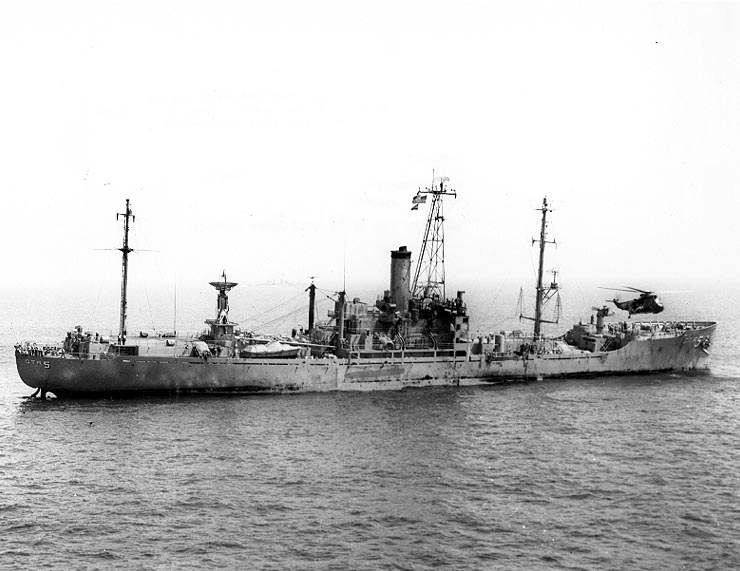
USS Liberty receives assistance from units of the Sixth Fleet, after she was attacked and seriously damaged by Israeli forces off the Sinai Peninsula on June 8, 1967. (US Navy photo)
Warplanes and torpedo boats had already killed 34 and wounded 174, when Halbardier slid over the Liberty’s napalm-glazed deck to jury-rig an antenna and get an SOS off to the Sixth Fleet. The Israelis intercepted the SOS and broke off the attack immediately. In effect, Halbardier prevented the massacre of all 294 onboard. Still, the infamy of the attack on the Liberty was two-fold.
First, the Liberty, a virtually defenseless intelligence collection platform prominently flying an American flag in international waters, came under deliberate attack by Israeli aircraft and three 60-ton Israeli torpedo boats off the coast of the Sinai on a cloudless June afternoon during the six-day Israeli-Arab war. Second, President Lyndon Johnson called back carrier aircraft dispatched to defend the Liberty lest Israel be embarrassed, the start of an unconscionable cover-up, including top Navy brass, that persists to this day.
Given all they have been through, the Liberty survivors and other veterans who joined Halbardier to celebrate his belated receipt of the Silver Star on May 27, 2009 can be forgiven for having doubted that the day of the hero’s recognition would ever come.
In the award ceremony at the Visalia (California) office of Rep. Devin Nunes, the Republican congressman pinned the Silver Star next to the Purple Heart that Halbardier found in his home mailbox three years ago. Nunes said, “The government has kept this quiet I think for too long, and I felt as my constituent he [Halbardier] needed to get recognized for the services he made to his country.”

Terry Halbardier got off an SOS message saving the Liberty from Israeli destruction
Nunes got that right. Despite the many indignities the Liberty crew has been subjected to, the mood in Visalia was pronouncedly a joyous one of Better (42 years) Late Than Never. And, it did take some time for the moment to sink in: Wow, a gutsy congressman not afraid to let the truth hang out on this delicate issue.
Treatment Accorded the Skipper
I was present that day and I could not get out of my head the contrast between this simple, uncomplicated event and the earlier rigmarole that senior Navy officers went through to pin a richly deserved Medal of Honor on another hero of that day, the Liberty’s skipper, Captain William McGonagle.
Although badly wounded by Israeli fire on June 8, 1967, McGonagle was able to keep the bombed, torpedoed, napalmed Liberty afloat and limping toward Malta, where what was left of the bodies of the 34 crewmen killed and the 174 wounded could be attended to. Do the math: yes, killed and wounded amounted to more than two-thirds of the Liberty crew of 294.
I remembered what a naval officer involved in McGonagle’s award ceremony told one of the Liberty crew: “The government is pretty jumpy about Israelthe State Department even asked the Israeli ambassador if his government had any objections to McGonagle getting the medal.”
When McGonagle received his award, the White House (the normal venue for a Medal of Honor award) was all booked up, it seems, and President Lyndon Johnson (who would have been the usual presenter) was unavailable.
So it fell to the Secretary of the Navy to sneak off to the Washington Navy Yard on the banks of the acrid Anacostia River, where he presented McGonagle with the Medal of Honor and a citation that described the attack but not the identity of the attackers.
Please don’t misunderstand. The Liberty crew is not big on ceremony. They are VERY-not-big on politicians who wink when Navy comrades are killed and wounded at sea. The Liberty survivors are big on getting the truth out about what actually happened that otherwise beautiful day in June 1967.
The award of the Silver Star to Terry Halbardier marked a significant step in the direction of truth telling. Halbardier said he accepted his Silver Star on behalf of the entire 294-man crew. He and fellow survivor Don Pageler expressed particular satisfaction at the wording of the citation, which stated explicitly — with none of the usual fudging — the identity of the attackers: “The USS Liberty was attacked by Israeli aircraft and motor torpedo boats in the East Mediterranean Sea.”
In the past, official citations, like Captain McGonagle’s, had avoided mentioning Israel by name when alluding to the attack. I think former U.S. Ambassador Edward Peck put it best in condemning this kind of approach as “obsequious, unctuous subservience to the peripheral interests of a foreign nation at the cost of the lives and morale of our own service members and their families.” Strong words for a diplomat. But right on.
Just a Guy From Texas
Were it not for Halbardier’s bravery, ingenuity, and technical expertise, the USS Liberty would surely have sunk, taking down much if not all of the crew.
You see, the first thing the Israeli aircraft bombed and strafed were the Liberty’s communications antennae and other equipment. They succeeded in destroying all the antennae that were functional. One antenna on the port side, though, had been out of commission and had escaped damage.
In receiving the Silver Star, Halbardier made light of his heroism, claiming that he was just a guy from Texas who could do a whole lot with simple stuff like baling wire. (In the infantry we called this kind of thing a “field expedient.”)
In any case, with his can-do attitude and his technical training, he figured he might be able to get that particular antenna working again. But first he would have to repair a cable that had been destroyed on deck and then connect the antenna to a transmitter.
The deck was still being strafed, but Halbardier grabbed a reel of cable, ran out onto the deck, and attached new cable to the antenna so a radioman could get an SOS out to the Sixth Fleet in the Mediterranean.
Voila. “Mayday” went out; almost immediately the Israeli aircraft and torpedo ships broke off the attack and went back to base; the Israeli government sent a quick apology to Washington for its unfortunate “mistake;” and President Johnson issued orders to everyone to make believe the Israelis were telling the truth, or at least to remain silent.
To their discredit, top Navy brass went along, and the Liberty survivors were threatened with court martial and prison if they so much as mentioned to their wives what had actually happened. They were enjoined as well from discussing it with one another.
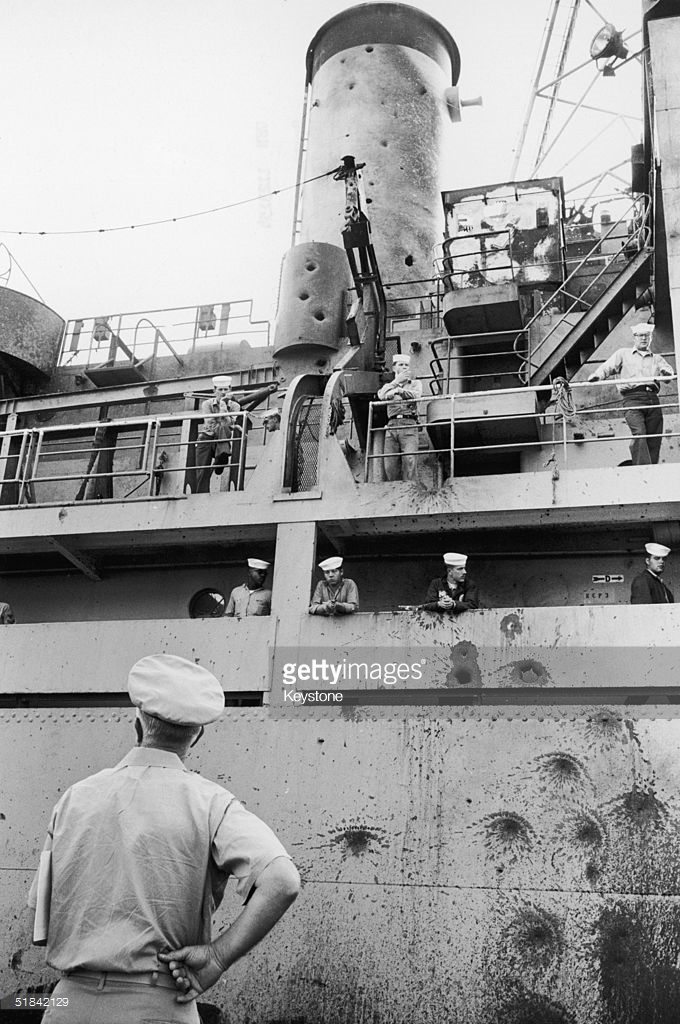
The shot-up Liberty
As Liberty crewman Don Pageler put it, “We all headed out after that, and we didn’t talk to each other.” The circumstances were ready-made for serious Post-Traumatic Stress Disorder.
The stories shared by Liberty survivors after the award ceremony, including descriptions of the macabre but necessary effort to reassemble torpedoed body parts, and the plague of survivor’s guilt, were as heart-rending as any I have heard. They are stories that should be shared more widely for those muzzled far too long.
These were the deep emotional scars to supplement the ones all over Halbardier’s body, some of which he uncovered when asked by the local press gathered there in Visalia. Typically, Halbardier made light of the shrapnel that had to be plucked out of his flesh, emphasizing that he was lucky compared to some of the other crew.
No Mistake
Despite Israeli protestations, the accumulated evidence, including intercepted voice communications, is such that no serious observer believes Israel’s “Oops” excuse of a terrible mistake. The following exchanges are excerpts of testimony from U.S. military and diplomatic officials given to Alison Weir, founder of “If Americans Knew” and author of American Media Miss the Boat:
Israeli pilot to ground control: “This is an American ship. Do you still want us to attack?”
Ground control: “Yes, follow orders.”
“But sir, it’s an American ship, I can see the flag!”
Ground control: “Never mind; hit it!”
Haviland Smith, a CIA officer stationed in Beirut during the Six-Day War, says he was told that the transcripts were “deep-sixed,” because the U.S. government did not want to embarrass Israel.
Equally telling is the fact that the National Security Agency (NSA) destroyed voice tapes seen by many intelligence analysts, showing that the Israelis knew exactly what they were doing. I asked a former CIA colleague, who was also an analyst at that time, what he remembered of those circumstances. Here is his e-mail reply:
“The chief of the analysts studying the Arab-Israeli region at the time told me about the intercepted messages and said very flatly and firmly that the pilots reported seeing the American flag and repeated their requests of confirmation of the attack order. Whole platoons of Americans saw those intercepts. If NSA now says they do not exist, then someone ordered them destroyed.”
One need hardly add at this point that the destruction of evidence without investigation is an open invitation to repetition in the future. Think the more recent torture-interrogation videotapes.
As for the legal side: the late Captain Ward Boston, unburdened himself on his accomplice role as the Navy lawyer appointed as senior counsel to Adm. Isaac Kidd, who led a one-week (!) investigation and then followed orders to pronounce the attack on the Liberty a case of “mistaken identity.” Boston signed a formal declaration on Jan. 8, 2004, in which he said he was “outraged at the efforts of the apologists for Israel in this country to claim that this attack was a case of ‘mistaken identity.’” Boston continued:
“The evidence was clear. Both Adm. Kidd and I believed with certainty that this attack was a deliberate effort to sink an American ship and murder its entire crew Not only did the Israelis attack the ship with napalm, gunfire, and missiles, Israeli torpedo boats machine-gunned three lifeboats that had been launched in an attempt by the crew to save the most seriously wounded, a war crime
“I know from personal conversations I had with Adm. Kidd that President Lyndon Johnson and Secretary of Defense Robert McNamara ordered him to conclude that the attack was a case of ‘mistaken identity’ despite overwhelming evidence to the contrary.”
W. Patrick Lang, Col., USA (ret.), who was the Defense Intelligence Agency’s top analyst for the Middle East for eight years, recounted the Israeli air attacks as follows: “The flight leader spoke to his base to report that he had the ship in view, that it was the same ship he had been briefed on, and that it was clearly marked with the U.S. flag
“The flight commander was reluctant. That was very clear. He didn’t want to do this. He asked them a couple of times, ‘Do you really want me to do this?’ I’ve remembered it ever since. It was very striking. I’ve been harboring this memory for all these years.”
Lang, of course, is not alone. So too Terry Halbardier, who told those assembled at his Silver Medal award ceremony, “I think about it [the attack on the Liberty] every day.”
Why Sink the Ship?
What we know for sure is, as the independent commission headed by former Chairman of the Joint Chiefs of Staff, Adm. Thomas Moorer put it, the attack “was a deliberate attempt to destroy an American ship and kill her entire crew.”
What we do not know for sure is why the Israelis wanted that done. Has no one dared ask the Israelis? One view is that the Israelis did not want the United States to find out they were massing troops to seize the Golan Heights from Syria and wanted to deprive the U.S. of the opportunity to argue against such a move.
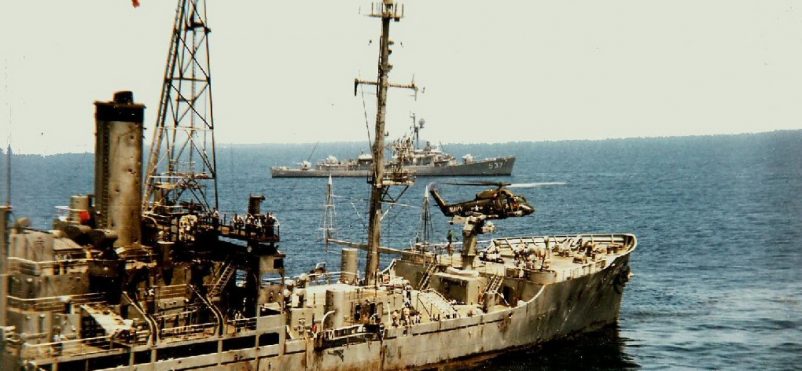
USS Liberty after the attack
James Bamford offers an alternative view in his excellent book, Body of Secrets. Bamford adduces evidence, including reporting from an Israeli journalist eyewitness and an Israeli military historian, of wholesale killing of Egyptian prisoners of war at the coastal town of El Arish in the Sinai.
The Liberty was patrolling directly opposite El Arish in international waters but within easy range to pick up intelligence on what was going on there. And the Israelis were well aware of that. But the important thing here is not to confuse what we know (the deliberate nature of the Israeli attack) with the ultimate purpose behind it, which remains open to speculation.
Also worth noting is the conventional wisdom prevalent in our Fawning Corporate Media (FCM) that Egypt forced Israel into war in June 1967. An excellent, authoritative source has debunked that, none other than former Israeli Prime Minister Menachem Begin! In an unguarded moment in 1982, when he was prime minister, he admitted publicly:
“In June 1967, we had a choice. The Egyptian army concentrations in the Sinai approaches do not prove that [Egyptian President] Nasser was really about to attack us. We must be honest with ourselves. We decided to attack him.”
Thus, the Israeli attack admittedly amounted to starting a war of aggression, and the occupied West Bank territories and the Golan Heights gained by the Israelis in the 1967 war remain occupied to this day. The post World War II tribunal at Nuremberg distinguished a “war of aggression” from other war crimes, terming it the “supreme international crime, differing from other war crimes only in that it contains the accumulated evil of the whole.”
Perhaps the attempt to sink the Liberty and finish off all survivors qualifies as one of those accumulated evils. Terry Halbardier summed it up this way when he was awarded his Silver Star: “There’s lots of theories but let’s just say they didn’t want us listening in to what they wanted to do.”
Getting Away With Murder
In sum, on June 8, 1967, the Israeli government learned that it could get away with murder, literally, and the crime would be covered up, so strong is the influence of the Israel Lobby in our Congress, and indeed, in the White House. And those USS Liberty veterans who survived well enough to call for an independent investigation have been hit with charges of, you guessed it, anti-Semitism.
Does all this have relevance today? Of course. Israeli Prime Minister Benjamin Netanyahu understands that there is little that Israel could do that would earn the opprobrium of the U.S. Congress or retaliation from the White House, whether it’s building illegal settlements or slaughtering civilians in Gaza. The Israelis seem convinced they remain in the catbird’s seat, largely because of the Israel Lobby’s influence with U.S. lawmakers and opinion makers.
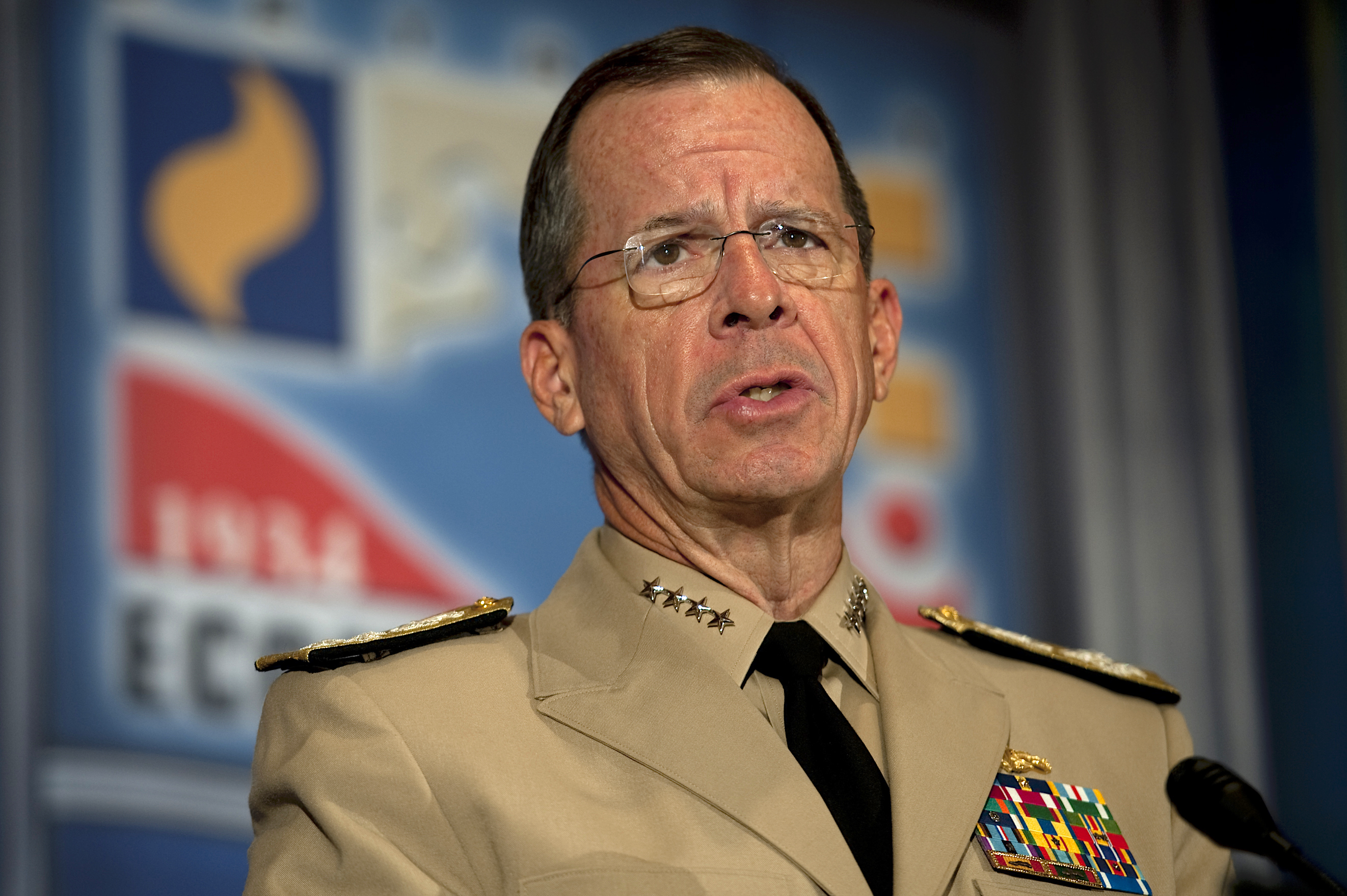
Navy Adm. Mike Mullen, (DoD Photo by Mass Communication Specialist Chad J. McNeeley)
One of the few moments when a U.S. official has had the audacity to face Israel down came from significantly a U.S. Navy admiral. In early July 2008, Chairman of the Joint Chiefs of Staff, Adm. Mike Mullen, was sent to Israel to read the riot act to then-Israeli Prime Minister Ehud Olmert, who seemed to be itching to start hostilities with Iran while President George W. Bush was in office.
We learned from the Israeli press that Mullen, fearing some form of Israeli provocation, went so far as to warn the Israelis not to even think about another incident like the attack on the USS Liberty on June 8, 1967, that the Israelis should disabuse themselves of the notion that U.S. military support would be knee-jerk automatic if Israel somehow provoked open hostilities with Iran.
This is the only occasion I am aware of in which a U.S. official of such seniority braced Israel about the Liberty incident. A gutsy move, especially with Vice President Dick Cheney and national security aide Elliott Abrams then in the White House, two hawks who might well bless, or even encourage, an Israeli provocation that would make it very difficult for Washington to avoid springing to the defense of its “ally.”
The Israelis know that Mullen knows that the attack on the Liberty was deliberate. Mullen could have raised no more neuralgic an issue to take a shot across an Israeli bow than to cite the attack on the Liberty. The Jerusalem Post reported that Mullen cautioned that a Liberty-type incident must be avoided in any future military actions in the Middle East.
Perhaps Mullen had learned something from the heroism of Terry Halbardier
Ray McGovern works with Tell the Word, the publishing arm of the ecumenical Church of the Saviour in inner-city Washington. After serving as an Army infantry/intelligence officer, he spent a 27-year career as a CIA analyst. He is co-founder of Veteran Intelligence Professionals for Sanity (VIPS).
Saudi Arabia tightens grip on Palestinians, hampers remittances to Gaza: Report
Press TV – June 8, 2019
Less than a week after Saudi authorities arrested more than 60 people, including Palestinian expatriates and Saudi nationals, on charges of supporting the Palestinian Hamas resistance movement, they have now blocked money transfers between the kingdom and the Gaza Strip.
The new step taken by the Riyadh regime against Palestinians involves official and non-official money transfers as the procedure has witnessed a marked decline over the past week and during the Eid al-Fitr holiday, which marks the end of the Muslim holy fasting month of Ramadan, Arabic-language al-Khaleej Online news website reported.
The report described residents of the besieged and impoverished Gaza Strip as the main victims of the move. Most of the bank transfers that used to be carried out normally in the past, were frozen just a few days before the start of the holiday.
Remittance transactions are taking much longer time than usual – something that used to be done in a matter of few hours.
Many Palestinians have complained of the move, and termed it as “unprecedented.” They argue that the process of transferring money between Saudi Arabia and the Gaza Strip has become extraordinarily difficult.
Abu Fuad, a resident of the Gaza Strip who refused to give his last name for fear that his family could be persecuted in the Saudi Arabian port city of Jeddah, said he has experienced difficulty receiving money from his family.
“It is three days since the remittance has been made, but I have not received anything. Financial transfers used to be done in a few hours and without any obstacles in the past. But since the week before the Eid, the procedures have become complex and most of the transfers are frozen without any obvious reason,” he said.
Abu Fuad considered the measure as a “new crackdown on the Palestinian community living in Saudi Arabia,” stressing that it would aggravate their sufferings as students rely heavily on money transferred from their families living outside the kingdom.
He called upon the Palestinian Embassy in Riyadh to intervene immediately, and try to work out a quick and practical solution to the crisis, which has negatively affected the Palestinian community in Saudi Arabia.
Over the past two years, Saudi authorities have deported more than 100 Palestinians from the kingdom, mostly on charges of supporting Hamas resistance movement financially, politically or through social networking sites.
The Riyadh regime has imposed strict control over Palestinian funds in Saudi Arabia since the end of 2017.
All remittances of Palestinian expatriates are being tightly controlled, fearing that these funds could be diverted indirectly and through other countries to Hamas.
Money transfer offices are asking the Palestinians to bring forward strong arguments for conversion, and do not allow the ceiling of one’s money transfer to exceed $3,000.
US sees Turkey’s S-400 deal as fait accompli
By M. K. BHADRAKUMAR | Indian Punchline | June 8, 2019
Three developments in quick succession in the weekend bring closer to a flashpoint the brewing discord between the US and Turkey on account of the latter’s purchase of the S-400 air defence system.
First, Russia disclosed on Friday that the delivery of the S-400 missile defense system will begin within two months. Turkey has made the advance payments and the Turkish military personnel have completed their training in Russia to operate the system. It appears that the die is cast.
Second, Washington has reacted instantaneously, as if anticipating that Turkey is sticking to its decision despite immense American pressure.
The US Acting Defence Secretary Patrick Shanahan has addressed a letter to his Turkish counterpart Hulusi Akar — and simultaneously leaked it to the media — intimating that “Turkey will not receive the F-35 if Turkey takes delivery of the S-400. You still have the option to change course on the S-400.”
Shanahan added that “Turkish F-35 students currently in training” in the US will be sent back by July 31 and no new training programme for Turkish personnel is being scheduled “as we anticipate they would be recalled in the near future.” Meanwhile, in immediate terms, “To facilitate an orderly cessation of Turkish participation in the programmatic management activities of the F-35 program, we will not plan for Turkish participation in the annual F-35 Chief Executive Officer Roundtable on June 12, 2019 and planned updates to the program’s governing programs will proceed without Turkey’s participation.”
Shanahan referred to the Russia-related Countering America’s Adversaries Through Sanctions Act (CAATSA), but concluded that the two countries should endeavour to “manage this matter in a respectful way, to preserve other aspects of our deep security cooperation.”
Third, an innocuous-sounding US State Department readout on June 6 said: “Deputy Secretary of State John J. Sullivan met today with Greek Defense Minister Evangelos Apostolakis to reaffirm the U.S. and Greek commitment to cooperation that strengthens bilateral defense and security and NATO, and to continue discussions started at the December 2018 U.S.-Greece Strategic Dialogue. Deputy Secretary Sullivan underscored the strategic importance of the Eastern Mediterranean and Balkans and highlighted Greece’s role as a pillar of stability and key partner in the region.”
Considering that Turkey’s hostile relations with Greece are even more ancient than India-Pakistan enmity, it is at once apparent that Washington is hitting back at Turkey on the geopolitical plane. Turkey’s principal motivation to procure the S-400 missile defence system is its unmatched capability to threaten aircraft up to 200 miles away—giving it so-called anti-access/area-denial (A2AD) (A2AD) potential.
The Turkish motivation is comparable to India’s (except that India has problematic relationships with two countries.) In layman’s terms, Turkey’s interest in the S-400 needs to be understood in terms of its ongoing rivalry with fellow NATO member Greece, with which it has nearly fought a war over the island of Cyprus. The S-400’s anti-access capabilities strengthen Turkey’s hand in its security competition with Greece.
Quite simply, S-400 system is peerless. The Patriot system that the US has offered Turkey as an alternative is optimised for relatively short-range (less than 40 kms) ballistic missile defence, lacking in A2AD potential.
Like any divorce, this is going to be a messy affair. Out of all the issues complicating the Turkish-American relationship — starting with the US-backed failed coup d’état attempt in July 2016 to kill President Recep Erdogan and overthrow his nationalist government — the S-400 issue has surged as the coup de grâce.
To be sure, if the US cancels the collaboration with Turkey on the development and production of F-35 fighter jets, the latter will look for alternate sources of stealth technology. The fact of the matter is that Turkey seems unperturbed that it is parting ways with the US’ program to develop the F35 fighter and buy 100 planes. But Turkey would like the US to initiate the break-up so that it is free to develop options. In the Turkish assessment, F-35 has serious deficiencies.
Equally, Turkey (like India) has already stated its ambitions to develop a domestic stealth fighter and knows that the US will never transfer such cutting edge technology. In all probability, Turkey may approach Russia. Speculation is rife.
Quite obviously, all this has very serious implications for India, which merit a separate analysis.
The Geo-Port-Politics of Gwadar and Chabahar
By Salman Rafi Sheikh – New Eastern Outlook – 08.06.2019
In a highly surprising move, Iran’s foreign minister, on an unscheduled and unannounced visit to Pakistan on Thursday (May the 23rd), announced the proposal to link Pakistan’s port of Gwadar with Iran’s Chabahar port. This announcement signals tectonic geo-political shift taking place in the region in the wake of increasing tensions between the US and Iran. The US has already successfully forced India, its chief South Asian ally, to scrap its purchase of oil from Iran, a country India was not long ago claimed to have entered into a strategic alliance with. Although the US has somehow left Chabahar out of its net of sanction, India’s decision to follow the US in its footsteps does signal its participation in the US policy of crippling Iranian economy and take Iran to the verge of massive political disruption and eventual regime change. Iran, obviously, is not unmindful of the implications of this particular decision of India.
Iran’s proposal to link Chabahar with Gawadar, despite the fact that the US sanctions don’t apply on the post, shows the deep sense of Indian betrayal prevailing in Tehran and a counter-manoeuvre to avoid isolation. Iran, obviously, does not expect India to be as robust and committed to building the rest of the port as it would have in a peaceful and sanction-less scenario. Iran, logically enough, is boosting its ties with its immediate neighbour, a country that already is deeply allied with China and aims to expand CPEC to Iran to increase regional connectivity. With Chabahar and Gwadar being linked, Iran will thus have two major regional states on its side i.e., Pakistan and China and will be far better placed in China’s extended regional connectivity programme than it is now. Zarif’s connectivity proposal itself tells everything. To quote him:
“We believe that Chabahar and Gwadar can complement each other. We can connect Chabahar and Gwadar, and then through that, connect Gwadar to our entire railroad system, from Iran to the North Corridor, through Turkmenistan and Kazakhstan, and also through Azerbaijan, Russia, and Turkey.”
As far as the US—Iran tension is concerned, unlike India, Pakistan has already said that it will not take sides in the conflict. Pakistan’s neutrality in the on-going scenario suits Tehran far more than it does for the US, that is if it does at all.
There is also no gainsaying that Tehran’s proposal to connect the two ports couldn’t have come with prior consultation with the Chinese, who are practically running the port in Pakistan. Accordingly, before coming to Pakistan, Zarif was in China where he met his Chinese counterpart and certainly discussed this proposal, leading Chinese foreign minister to “Welcome Iran” to actively take part in the joint building of the Belt and Road Initiative (BRI) through Chabahar.
China also re-affirmed its support for Iran. “China firmly opposes unilateral sanctions and the so-called ‘long-arm jurisdiction’ imposed by the United States on Iran,” Wang said, pledging to maintain the Joint Comprehensive Plan of Action and safeguard the authority of the United Nations and basic norms governing international relations.
Chinese support’s major manifestation came a few days ago when Chinese oil tanker Pacific Bravo left the Persian Gulf with 2 million barrels of Iranian light crude, ignoring the US sanctions and practically challenging the US unilateralism.
Pacific Bravo is owned by Bank of Kunlun, a financial institution that is owned by the Chinese state oil company CNPC. Bank of Kunlun has long been the financial institution at the heart of China-Iran bilateral trade—a role for which the company was sanctioned during the Obama administration. Despite already being designated, Bank of Kunlun ceased its Iran-related activities in early May when the oil waivers were revoked. But Bravo’s current moves point to a change in Chinese policy. Importantly enough, Bravo sailed from the Persian Gulf on the same day that Zarif arrived in Beijing and met Chinese foreign minister to discuss Iranian participation in the BRI (through linking Gwadar and Chabahar).
With Iran now taking this fundamental shift, what is apparent is that a major foreign policy shift in Iran has taken place whereby its leadership has come to an understanding that their relations with the US are unlikely to take a positive turn for a long time and that a necessary adjustment in the foreign policy is absolutely needed. As a matter of fact, it was only a few days ago when Iran’s supreme leader criticised Iran’s foreign policy and dropped a major hint about why changing the course of foreign policy was an utmost necessity.
Of course, its major manifestation is reorienting Iran’s relations with Pakistan via participation in the BRI. Pakistan will be least concerned about any US reaction over linking Gwadar with Chabahar, for the US sanctions do not apply to the Iranian port. But the fact that the geo-political significance of the port will undergo a significant change after a successful linkage between the two ports and that China will become a major player, the US might feel ‘compelled’ to direct its sanctions toward the port eventually.
Saudi Arabia to Execute 18-year-old for Allegedly “Sowing Sedition”

Al-Manar | June 8, 2019
Saudi Arabia is seeking the death penalty for an 18-year-old it detained in 2014 for protesting on his bicycle as a 10-year-old.
It would make him the fourth teenager to be executed this year.
Murtaja Qureiris was retrospectively arrested by Saudi police in 2014 for allegedly staging a number of protests during the country’s Arab Spring movement in 2011.
Saudi prosecutors claim that Qureiris’ alleged activities encouraged the “sowing of sedition” and made him part of “an extremist terror group,” which warranted the death penalty. Qureiris denies those charges.
How the U.S. Weaponizes “Internet Freedom”
By Julianne Tveten | American Herald Tribune | June 8, 2019
Several weeks ago, Edward Snowden took to Twitter to weigh in on the recent coup attempt in Venezuela. “Big: Venezuela’s opposition leader just launched a coup,” he wrote. “Reports coming in that the government is now blocking access to social media in response. Any interference with the right of the people to communicate freely must be condemned.”
Snowden, of course, was referring to the U.S.-backed attempt to oust the elected Venezuelan President Nicolás Maduro and install right-wing opposition party member Juan Guaidó. Yet Snowden’s concerns didn’t revolve around the damages visited upon Venezuela. Instead, as his critics observed, his focus on Internet access revealed a decidedly libertarian set of values: Sure, a potential (albeit failing) coup was in progress, hurling the Venezuelan people into the throes of imperialist upheaval—but wouldn’t someone think of the Internet access?
This time, it seemed Snowden, who was catapulted into international recognition for exposing the National Security Agency (NSA)’s surveillance abuses, was doing the U.S. government’s bidding. For decades, U.S. institutions have weaponized the arbitrary notion of “Internet freedom” for political gain. Their goal: to villainize “enemy states” in order to sustain U.S. hegemony, technologically and otherwise.
By various accounts, the notion of “Internet freedom” entered U.S. policy during the Clinton Administration, in the early stages of the Internet’s commercialization. In 1997, then-President Bill Clinton and Vice President Al Gore argued that “governments must adopt a non-regulatory, market-oriented approach to electronic commerce” and warned against those that “will impose extensive regulations on the Internet and electronic commerce.” Stating that the “private sector should lead,” their proposal envisaged the Internet, first and foremost, as a global marketplace governed by laissez-faire individualism.
Hillary Clinton cemented this concept in a 2010 speech, insisting that the United States would confront governments that implemented online “censorship,” including, but not limited to, China, Iran, and North Korea—countries, like Venezuela, that have worked to develop infrastructures and economies independent of the U.S.’s capitalist framework. Clinton also touted the role of the private sector in such an effort. Advocating for an Internet defined by “free expression” and, most important, free markets, she lauded the Global Network Initiative, an “anti-censorship” collaboration among tech firms like Microsoft, Google, Yahoo, and various NGOs.
The Clintons’ Internet-policy postures have persisted into the present day. The U.S. nonprofit and Global Network Initiative member NetBlocks, for example, regularly issues reports warning of limited Internet access throughout the world. Among its most commonly cited countries, by far, is Venezuela. Over the course of the attempted Venezuelan coup, which began in January, NetBlocks has published dozens of reports of restrictions to access of various U.S. web services, including YouTube, Google, and Bing. Instead of offering geopolitical context to explain why a country might be forced to limit access, these reports offer an alternative narrative: A beleaguered country’s temporary (if exaggerated) shutdowns of a few websites, rather than a U.S.-led coup, are the real problem.
Think tank Freedom House, which is significantly funded by the U.S. government, offers similar assessments. According to its 2018 “Freedom on the Net” report, “digital authoritarianism” is on the rise, thanks largely to China, a country that has long curbed access to—and thus constrained the market and influence of—U.S. tech platforms. Not coincidentally, Freedom House has ranked China the least “free” country for four consecutive years, with Syria, Iran, and Cuba closely trailing. Meanwhile, Freedom House, as well as NetBlocks, have been consistent sources for U.S. corporate media, including the Washington Post and the New York Times.
For all of their admonitions about censorship abroad, these “watchdogs” have done little to underscore the censorship committed by U.S. tech companies. Freedom House concedes that “Internet freedom” has declined in the United States; the reasons it provides relate to such valid and significant issues as network monopolies, the FCC’s assault on net neutrality, and the “digital divide.” Nowhere, however, does Freedom House acknowledge Google’s and U.S. social media’s inveterate silencing of left-leaning media and organizations, nor the punitive surveillance activists disproportionately face. Instead, the think tank routinely deems the U.S. Internet “free.”
This dovetails with another cause of “free Internet” acolytes: U.S. access to other countries’ data. Various countries, such as China, Russia, and Vietnam, have required storage of their data on devices within their own countries’ borders—a policy known as data localization. An assertion of sovereignty, data localization is often in direct opposition to the vision of an “open” Internet outlined by the Clintons. In other words, as it blocks foreign companies’ and governments’ access to international digital data, it wrests control of the Internet from the U.S. Right on cue, Freedom House’s 2018 report condemned China, Russia, Vietnam, and other countries’ decisions to institute data localization.
An illustrative scenario took place in 2013. In the wake of revelations that part of the NSA’s surveillance program included spying on Brazil, Brazil’s then-president Dilma Rousseff proposed a shift toward data localization. Aptly enough, former Google executive Eric Schmidt fretted not long before Rousseff’s proposal that data localization—which would corrode his company’s profits—might lead to a “balkanized Internet”:
“The real danger [from] the publicity about all of this is that other countries will begin to put very serious encryption – we use the term ‘balkanization’ in general – to essentially split the Internet and that the Internet’s going to be much more country specific. That would be a very bad thing, it would really break the way the Internet works, and I think that’s what I worry about.”
Schmidt’s concerns echo those of the Clintons. A “free” and “open” “global” Internet, they claim, is a democratic forum, the “great equalizer”; all countries will thereby be more enlightened for connecting to Google, Microsoft, Amazon, and other multibillion-dollar U.S. corporations with military contracts. This rationale permeates corporate media and think tanks, both of which characterize a “balkanized Internet” as a civilizational regression. What these proclamations omit is the fact that there are reasons some countries don’t agree with the U.S.’s digital prescriptions. The Internet doesn’t exist in a political vacuum; it’s an extension of geopolitical relations and all of the iniquities that accompany them.
These fearmongering editorials and reports will continue, invoking imperialism’s dog whistles: “censorship,” “authoritarianism,” and other affronts to putative “freedom.” Yet these are only a problem to those who would believe that the U.S.’s superpower status is some sort of good. Vulnerable countries’ efforts to defend themselves from the scourge of exploitation, in any way they see fit, aren’t a pity or a threat; they’re a liberatory necessity. No matter what the U.S. insists, there are plenty of places—digital and physical—where its capitalist metrics of “freedom” simply don’t belong.
Julianne Tveten’s work has appeared at In These Times, Fairness & Accuracy In Reporting, The Nation, Pacifica Radio and elsewhere.
‘Act of economic terrorism’: Iran says US sanctions prove call for talks was ‘deceitful & untrue’
RT | June 8, 2019
The sanctions imposed by the US against Iranian petrochemical companies prove that Mike Pompeo’s earlier promise of negotiations without preconditions was nothing but a bluff, a senior Iranian diplomat said.
On Friday, the US Treasury announced it has imposed a new wave of sanctions against Iranian energy businesses. The move is meant to stifle the revenues of the elite Islamic Revolutionary Guard Corps (IRGC), which Washington declared a terrorist organization earlier in April. This proves that US Secretary of State Mike Pompeo made an empty promise to Tehran less than a week ago, when he said he was ready to start “a conversation with no preconditions,” a spokesman for the Iranian Foreign Ministry said.
Pompeo’s words were “deceitful, untrue and merely in service of appealing to the public opinion,” Abbas Mousavi said as cited by Iran’s Mehr News Agency. He called the sanctions an act of “economic terrorism” and said Tehran will not yield to Washington’s pressure.
“All countries have a responsibility to react against the flagrant violations of the fundamental principles of international law and not to allow the international community’s achievements in multilateralism to be further ruined by the bullying and unilateral actions of the American governing body,” Mousavi said.
The Trump administration has broken the multinational agreement on Iran’s nuclear industry signed under his predecessor and ramped up economic sanctions against Tehran, re-imposing those lifted under the nuclear deal and issuing more.
In April, the US announced it will not renew waivers it previously extended to the largest buyers of Iranian crude, which previously shielded them from US sanctions against Iranian energy export. The waivers were meant to give the buyers a grace period to switch away from Iranian oil.
Russia set to air TV series that reveals US role in Chernobyl nuclear disaster
Press TV – June 8, 2019
Russia is set to air a TV series based on the Chernobyl nuclear disaster that implicates the United States as playing a role in the worst nuclear accident in history.
Currently in post-production, the series by the Russian company NTV tells the story of the 1986 explosion that ripped through reactor Number 4 at the Chernobyl Nuclear Power Plant in the then Ukrainian Soviet Socialist Republic.
The explosion led to a huge radioactive leak, which permanently affected areas in places across three quarters of Europe. Thirty workers and firemen were killed in the immediate aftermath of the explosion and rescue operations. Most of them died of severe radiation-related illnesses.
The plot revolves around a CIA agent dispatched to Pripyat — the town inhabited by Chernobyl workers — to gather intelligence on the nuclear power plant.
The series will follow KGB officers in their attempts to hunt the espionage operation.
Director Aleksey Muradov said that his version, filmed in Belarus, will show “what really happened back then.”
“There is a theory that the Americans had infiltrated the Chernobyl nuclear power plant,” he said. “Many historians do not deny that on the day of the explosion an agent of the enemy’s intelligence services was present at the station.
This is while a five-part “Chernobyl” series produced by American premium cable and satellite television network HBO has recently triggered worldwide debate as some experts have challenged its credibility.
Russia’s most popular newspaper, Komsomolskaya Pravda (KP), has dismissed the show as “a caricature and not the truth.”
“If Anglo-Saxons film something about Russians, it definitely will not correspond to the truth,” said Russian journalist Anatoly Vasserman.
Russian newspaper The Moscow Times, also wrote this week that the HBO production was biased against the Soviet Union and provided a “caricature”’ of the nation.
Cyprus signs $9bn contract with Israel to extract gas
MEMO | June 7, 2019
Cyprus will earn $ 9.3 billion over 18 years thanks to the exploitation of the Aphrodite gas field under a renegotiated contract with Dutch-British Shell, US-based Noble, and Israeli company Delek, the Energy Minister for Cyprus, announced.
George Lakkotrypis told reporters that the reworking of the production contract guaranteed Cyprus an average annual income of $ 520 million over the life of the gas field.
“We believe it is a good contract under the current circumstances as it will allow the Republic of Cyprus to earn significant commercial revenues estimated at more than $ 9 billion throughout 18 years of the well’s production.”
Under the new deal, companies will commit to a short period for gas reserves exploitation. “Based on the development and production plan we discussed, we expect the first gas quantities to be extracted by 2024-2025,” he said.
Lakkotrypis explained that “the consortium was not previously bound to a deadline.”
Aphrodite gas field is the most significant development project on the island with about $ 7.9 billion invested in related infrastructure.
In 2011, Texas-based Noble Energy made its first discovery off the southern coast of Cyprus in the Aphrodite block, which is estimated to contain about 4.5 trillion cubic feet (127 billion cubic meters) of gas that have not been marketed yet.
The discovery of a vast offshore field in nearby Egyptian waters in 2015 raised more interest in exploring similar resources in Cypriot waters.
Cyprus aims to start pumping natural gas through a pipeline to an Egyptian gas liquefaction facility.
Cyprus has continued to explore marine energy resources despite the collapse of talks between the Turkish and Cypriot sides, in 2017, to end the division that lasted for decades in the island which north is occupied by Turkey.
The new agreement has angered Turkey, which seized the northern part of the island in 1974 following a coup sponsored by Greece’s military junta.
Accordingly, Turkey sent drilling vessels into Cyprus exclusive economic zone, last month, after it announced it would begin its energy exploration work.
In February, Exxon Mobil and Qatar Petroleum discovered a vast reserve of natural gas off the coast of Cyprus, estimated at five to eight trillion cubic feet.
Italian ENI and French Total are likewise involved in oil and gas exploration activities off Cyprus.
Featured Video
John Mearsheimer: US Already lost Iran war – No off-ramp in sight
or go to
Aletho News Archives – Video-Images
Frlom the Archives
70 Neocons Petition Congress To Effectively Allow Israel To Say When The US Should Attack Iran
By Damian Lataan | January 10, 2014
Seventy senior Israeli-centric neoconservatives have written an open letter to Congress imploring them to do more to ensure Iran complies with the conditions of any agreement finally reached with the P5+1 over Iran’s nuclear program.
While the neocons are ostensibly asking Congress to ensure compliance, it is clear that their real aim is to convince members of Congress to support the bill currently passing through the Senate which calls for tighter sanctions against Iran in the event of any waywardness on Iran’s part.
The neocons are eager to see the bill currently passing through the Senate with enough support to make it veto-proof, not so much because they are concerned about Iran’s so-called nuclear weapons program – there’s still not a skerrick of hard evidence that Iran has a nuclear weapons program – but, rather, because embedded within the bill is this clause:
… if the Government of Israel is compelled to take military action in legitimate self-defense against Iran’s nuclear weapon program, the United States Government should stand with Israel and provide, in accordance with the law of the United States and the constitutional responsibility of Congress to authorize the use of military force, diplomatic, military, and economic support to the Government of Israel in its defense of its territory, people, and existence…
Essentially, the clause is an automatic trigger for the US to attack Iran at any time the Israelis choose to launch a first strike – regardless of whether President Obama is in favour or not.
Partial list… continue
Blog Roll
 Aletho News
- ‘Heinous crime’: Iran denounces Israeli assassination of 4 Iranian diplomats in Lebanon
- John Mearsheimer: U.S. Already Lost Iran War – No Off-Ramp in Sight
- UK Parliament Plans ISP Blocking and Age Verification Powers
- World cannot remain silent as US and Israel attack ‘heritage of humankind’: Iran
- Emirati billionaire rebukes US senator over call for Gulf states to join war with Iran
- Op. True Promise 4: Iran’s missile blitzkrieg dismantles US war machine in West Asia
- Aramco CEO warns ‘catastrophe’ imminent if Strait of Hormuz remains shut
- What If Iran Says No?
- Trump Threatens to ‘Hit’ Iran ‘Twenty Times Harder’ Over Strait of Hormuz Oil Flows
- Spare the hypocrisy: Baghaei slams Ursula’s support for US
- If Americans Knew
- Israel Decided the War, But Trump’s America Fights and Pays the Bill
- Conscientious Objector Group: Phone ‘Ringing Off Hook’ As Huge Mobilization Underway
- U.S. support for Israel continues to plummet, despite media’s best efforts
- Threats and missiles fly, death tolls soar in Iran, Lebanon, Gaza – Not a ceasefire Day 151
- Lebanon: Israel’s White Phosphorous Use Risks Civilian Harm
- Corporate Media Go All Out To Support The US-Israeli War On Iran
- US-Israel war on Iran is creating a steady growing number of amputees
- Israel planned this war on Iran for 40 years. Everything else is a smoke screen
- The wrong question about the war in Iran
- ‘Your Tax Dollars Being Used to Raise Your Gas Prices’: US-Israel Bomb Major Iranian Oil Depots
- No Tricks Zone
- New Study Documents A 20-Year Pause In Arctic Sea Ice Decline – Driven By Internal Variability
- Wake-up Call: Survey Shows Majority Of Germans Now Favor Postponing Climate Targets!
- Televised! Leading German Political Candidate Tells Schoolchildren CO2 Makes Sun Hotter!
- New Study: A Century Warming Of 1.1°C Is ‘Commonplace’ And ‘Not Unusual’ During This Interglacial
- New Study: ‘Internal Noise’ And Volcanic Forcing Can Trigger 10-15°C Warming Within Decades
- Glaciers Worldwide Are Suddendly Surging, Experts Blame Warming!
- Surprising Discovery: Sahara Is Greening…Billions Of Trees Where Once Thought To Be Barren
- New Research Reaffirms Clouds, Aerosols, And Surface Solar Radiation Are ‘Driving The Climate System’
- Germany: Electric Car Catches Fire At Charging Station, Sets Off Local “Inferno”, Widespread Damage
- New Study: Canada’s New Brunswick Was 1°C Warmer Than Today During The Medieval Warm Period
 Aletho News