Russia, China & India to set up alternative to SWIFT payment system to connect 3 billion people
RT | October 28, 2019
Members of the BRICS trade bloc Russia, India, and China have decided to connect their financial messaging systems to bypass the SWIFT international money transfer network.
Russia’s financial messaging system SPFS will be linked with the Chinese cross-border interbank payment system CIPS. While India does not have a domestic financial messaging system yet, it plans to combine the Central Bank of Russia’s platform with a domestic service that is in development.
The new system is expected to work as a “gateway” model when messages on payments are transcoded in accordance with a certain financial system.
According to Izvestia, the parties involved will work on a single platform, without experiencing any difficulties with transactions.
Russia began development of SPFS in 2014 amid Washington’s threats to disconnect the country from SWIFT. The first transaction on the SPFS network involving a non-bank enterprise was made in December 2017.
“We have an opportunity to connect both foreign banks and foreign legal entities to the SPFS. Today, about 400 users are participating in the system. Agreements have already been concluded with eight foreign banks and 34 legal entities,” Alla Bakina, the director of the Bank of Russia’s national payment system, was cited as saying by Vesti.
Bakina explained that traffic through the system has been growing and currently accounts for around 15 percent of all internal traffic, up from 10-11 percent last year.
The EAEU (Eurasian Economic Union) countries are currently working with the Bank of Russia on technical options for connecting to the SPFS. Iran, which has officially joined the Russia-led free-trade zone (EAEU) this month also seeks to develop a joint alternative to SWIFT. Last year, SWIFT cut off some Iranian banks from its messaging system.
SWIFT is based in Belgium, but its board includes executives from American banks with US federal law allowing the administration to act against banks and regulators across the globe.
Instead of SWIFT, a system that facilitates cross-border payments between 11,000 financial institutions in more than 200 countries worldwide, Moscow and Tehran will use their own domestically developed financial messaging systems to conduct trade.
Al-Baghdadi Raid is the US Empire “Creating Reality”
The latest attack on Syria, whatever the truth of it, is an exercise in narrative control
By Kit Knightly | OffGuardian | October 28, 2019
Apparently the United States killed Abu Bakr al-Baghdadi yesterday. US Special Forces allegedly killed the ISIS leader during a raid on a stronghold in Idlib.
As far as we know, this man was already dead. Maybe twice. He reportedly faked his death once as well.
The debate about whether or not Baghdadi was killed by US Special Forces, killed himself with a suicide vest, is still alive or died years ago has raged all day.
Trump says he died like a coward. The Russians maintain they have no data suggesting any attack was carried out at all. But that is far from conclusive.
From a domestic point of view, the purpose of the attack is fairly obvious: Donald Trump has an election coming up, and potential Presidents like nothing more than being seen to be tough. That means taking out some “bad guys”.
Of course, none of that matters.
It doesn’t matter what happened, it doesn’t matter why it happened and it doesn’t matter whether who it (allegedly) happened to was real, or alive… or otherwise.
Because, as always, the problem is not the specifics. It’s the principle and the precedent.
Let’s just assume that – for the first time in its entire existence – the Pentagon is telling the exact truth about both its actions, and the motives for those actions.
Well, then this is still unacceptable.
The United States is publicly claiming the right to carry out military strikes on foreign soil for the purpose of conducting extra-judicial executions.
This is completely illegal.
Syria is a sovereign state. Whatever the motivation for the alleged raid, carrying it out without the cooperation or permission of the legitimate government of Syria was illegal.
al-Baghdadi was (is?) not a US citizen, or an enemy combatant, and has never been convicted of any crime, in any court, by anyone. Whether or not he is alive… he as a right to be alive under the UN Charter of Human Rights.
And we’re all forgetting that.
Just a few weeks ago Trump announced the US was “pulling out” of Syria. Well, we now know what we suspected at the time, that the announcement is meaningless. This “raid” is their way of saying “just kidding!”
ISIS will still be used as they have always been used: as an excuse for the United States to occupy, attack, destabilise and control the Middle East.
Lost in this hubbub about ISIS, and Hollywood theatricals about daring night-raids on enemy compounds, the United States marched soldiers into North-Eastern Syria to “protect” oil fields.
At the end of the day THAT is really what this was about. Not hurting ISIS, or fighting terrorism, or even making Donald look cool to Rust Belt patriots… it was about an Empire acting as they would, and us letting them. It was about narrative control.
Don’t forget the famous quote from Karl Rove:
We’re an empire now, and when we act, we create our own reality. And while you’re studying that reality — judiciously, as you will — we’ll act again, creating other new realities, which you can study too, and that’s how things will sort out. We’re history’s actors . . . and you, all of you, will be left to just study what we do.”
When we argue about the specifics we let those in power control the conversation.
The US broke international law, and claim it as an achievement. They ignore borders and treaties and conventions on a whim, and we are so used to it we’re debating their motives and their effectiveness.
They proclaim loudly that they’re above the law. And, in letting them set that conversation, we agree with them. Even in our outrage.
Is the ‘Greater Albania’ Project Aimed Against Russia in the Balkans?
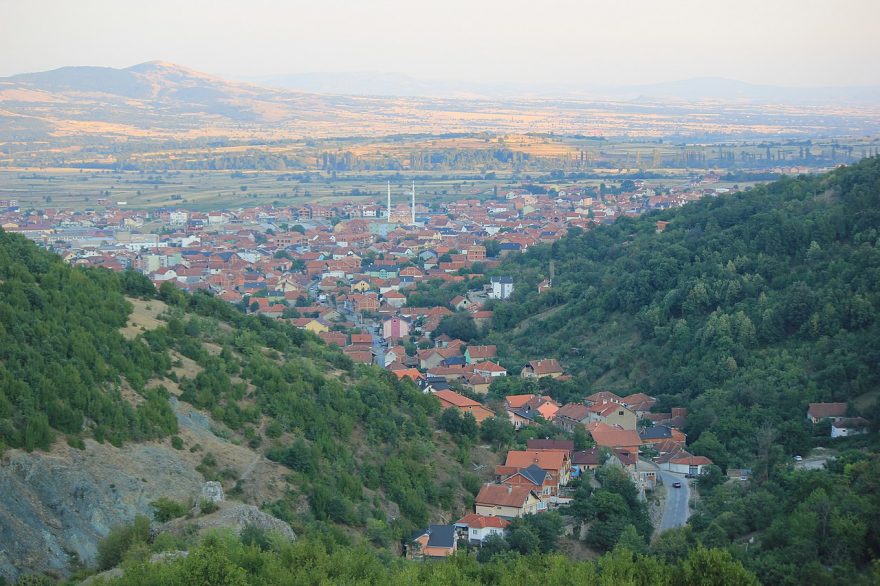
Preševo Valley, Serbia.
By Paul Antonopoulos | October 28, 2019
A project for Greater Albania – conspiracy or legitimate? According to a 2010 Gallup Balkan Monitor report, 83% of Albanians in Albania supported the idea of a Greater Albania, with 81% and 53% of Albanians in Kosovo and North Macedonia respectively supporting such an ambition.
The ultimate goal? To have Kosovo and the Preševo Valley in Serbia, southern Montenegro, Epirus in Greece and western North Macedonia into a single Greater Albanian state. Although this may not be official policy of the Albanian Republic, it is ingrained into the Albanian mythos. The very idea of a Greater Albania has roots in the 1913 Treaty of London that left roughly 40% of the Albanian population outside the newly established Albanian country. This has been something that the U.S. could weaponize against Russian influence in the Balkans.
Despite the heroics of Albanian national figure and anti-Ottoman guerrilla leader Gjergj Kastrioti, more commonly known as Skënderbej, the Albanians became loyal Ottoman subjects and were used as colonists in more restive and disloyal areas of the empire, especially those inhabited by the Serbs, Bulgarians and Greeks. They often became a majority over the initial inhabitants, like what happened in Kosovo and western North Macedonia.
Although the idea of a Greater Albania may seem like an exaggerated conspiracy, to the Serbian people this is anything but. The Serbian mythos finds itself in the 1389 Battle of Kosovo, where despite their courage, Serbian Prince Lazar Hrebeljanović was martyred and his forces routed by the Ottoman invaders. Although the Serbs achieved sovereignty over Kosovo with the downfall of the Ottoman Empire, the region had already become an Albanian majority on Ottoman orders to weaken Serbian identity to the region.
Kosovo became an autonomous region of Serbia after the establishment of socialist Yugoslavia in the aftermath of World War Two and retained its Albanian-majority. The 1990’s proved this was always a weak point of Serbia. With the U.S. sponsoring the violent destruction of Yugoslavia in the early 1990’s, the status of Kosovo was left unresolved, culminating in the terrorist-led war against the Yugoslav state (in which Serbia was the successor of) in 1999.
The terrorist ethnic-Albanian Kosovo Liberation Army (KLA), with the backing of NATO and the Albanian Republic, defeated Yugoslav forces. The United Nations and NATO assumed control of the territory, which eventually declared independence in 2008. Since then the region has become a heroin ‘smugglers paradise,’ and a hub for human trafficking, organ harvesting and arms trafficking.
It is for this reason that in an interview on Saturday, the former Serbian Chief of General Staff, General Ljubisa Dikovic, discussed the project for a Greater Albania. Dikovic believes that the area of the Balkan Peninsula cannot be peaceful because of unresolved issues like Kosovo.
“There can easily be big problems if things get out of hand. I hope that there will be enough wisdom and intelligence and that everyone will do what we do, in terms of strengthening security, cooperation and trust. I am free to say that we are in the lead because I do not see on other sides showing desire to build peace. After all, the issue of ‘Greater Albania’ is a matter of the highest security risk. We can ask why this is happening now with Albania and [North] Macedonia? It might be waiting to create a ‘Greater Albania’,” Dikovic said.
His comments come as the economic situation in Kosovo continues to deteriorate and becomes even more reliant upon foreign aid and donations from the unilateral behaving U.S., their former Ottoman masters in Turkey that had gifted lands to them hundreds of years earlier, and Germany who effectively rules the European Union.
The former military man’s comments also come as Serbia leads Exercise “Slovenian Shield 2019” with Russia. Although some Slavic tribes broke off and headed south into the Balkans sometime at around 600AD, they maintained their Slavic kinship with the Russians and shared Christian Orthodox faith, ensuring Serbia has always had a pro-Russia view. Albanian expansionism has therefore become a natural ally of the U.S. to limit Russian influence in the Balkans.
However, this begs the question then why strong efforts for Albanian independence in Greece, Montenegro and North Macedonia has been weak in comparison to those in Serbia. Greece has been a long-time loyal NATO member, with the exception of the disintegration of Yugoslavia, and therefore does not pose a threat to U.S. hegemony in the Balkans, protecting Greece from destabilization efforts via Albanian expansionism. Although Montenegro and North Macedonia also share Slavic kinship with the Serbs and Russians, as well as the Orthodox faith, they have proven to have Globalist ambitions, wanting to join NATO and the EU.
Serbia remains the only anti-EU/NATO state in the Balkans that is overwhelmingly pro-Russia. It is for this reason that Dikovic wants to renew compulsory military service, stating: “One should not gamble and think that there will be no conflict and risk. It is not only up to us, but we must have an answer to everything.”
Although the overwhelming majority of Albanians want a Greater Albania, it is unlikely to be achieved with Washington’s backing in Greece, Montenegro and North Macedonia as they do not pose a threat to U.S. hegemony in the Balkans, but rather serve it, while not encouraging Russian influence in the region. As Serbia is a pro-Russian island in a hostile region, it will continue to be targeted by Albanian expansionism with U.S. backing. Will this drive for expansionism violently spill over into the Preševo Valley? That remains to be seen.
Paul Antonopoulos is a Research Fellow at the Center for Syncretic Studies.
Trump Flip-Flops on Syria Withdrawal. Again.
By Ron Paul | October 28, 2019
President Trump is reversing his foreign policy decisions so quickly these days that it almost seems like he overturns himself before making the decision in the first place. Last week he was very clear that the US was pulling its troops out of Syria. “Bringing soldiers home,” he said. “Let someone else fight over this long-bloodstained sand.”
But then he overturned himself later in the same speech. He said: “We’ve secured the oil and therefore a small number of US troops will remain in the area where they have the oil. And we’re going to be protecting it and we’ll be deciding what we’re going to do with it in the future.”
Where does President Trump think he gets the legal or moral authority to send US troops to illegally occupy foreign territory and determine what that foreign country can or cannot do with its resources? After eight years of Obama’s disastrous “Assad must go” policy, during which the US provided weapons and training to radicals and terrorists with a half million people killed as a result, President Trump had the opportunity to finally close that dark chapter of US foreign policy so the Syrian people could rebuild their country.
Instead he sat down on Thursday with Senator Lindsey Graham, who has been wrong in every foreign policy position he’s ever taken, and decided to follow Graham’s advice to take Syria’s oil. Even though Trump himself has said many times that ISIS is 100 percent defeated, he claims we must take Syria’s oil to keep it from ISIS.
The real reason the neocons want the US military to occupy Syria’s oil fields is they are still convinced they can overthrow Assad by carving out eastern Syria for the Kurds. They don’t want to keep the oil from ISIS, they want to keep it from the Syrian government. They don’t want the oil revenue to be used to help rebuild the country because they still want to make life more unbearable for the population through sanctions so they will overthrow Assad. They don’t care how many innocent civilians die.
So instead of bringing the troops home like he promised, President Trump has allowed himself to be convinced to actually expand the US presence in eastern Syria! Instead of ending a foolish mission, he’s giving them an even more foolish mission – and sending in more troops and weapons. Instead of removing the approximately 200 troops in that region as promised, Trump is going to add more troops to equal about a thousand. He’s also sending in tanks and other armored vehicles, according to the Pentagon.
If President Trump believes following neocon advice on Syria is going to produce results different than the past eight years of following neocon advice on Syria, he’s naïve or worse. This new mission is going to cost tens of millions of dollars per month and will only serve to inspire the next generation of radicals. Trump is right that the people of the region, including Russia, Iran, Syria, and Turkey have all the incentive to keep ISIS at bay. So why does he fold like a cheap suit every time the neocons strong-arm him into another dumb foreign policy position?
Copyright © 2019 by RonPaul Institute.
“Major Revelation” from OPCW whistleblower: Jonathan Steele speaking to the BBC
By Tim Hayward | October 27, 2019
The following is a transcription of an interview given by Jonathan Steele (former Senior Middle East Correspondent for the Guardian ) to Paul Henley, on the BBC World Service programme, Weekend, on 27 October 2019.
Jonathan Steele: “I was in Brussels last week … I attended a briefing by a whistleblower from the Organisation for the Prohibition of Chemical Weapons. He was one of the inspectors who was sent out to Douma in Syria in April last year to check into the allegations by the rebels that Syrian aeroplanes had dropped two canisters of chlorine gas, killing up to 43 people. He claims he was in charge of picking up the samples in the affected areas, and in neutral areas, to check whether there were chlorine derivatives there …
Paul Henley: And?
JS: … and he found that there was no difference. So it rather suggested there was no chemical gas attack, because in the buildings where the people allegedly died there was no extra chlorinated organic chemicals than in the normal streets elsewhere. And I put this to the OPCW for comment, and they haven’t yet replied. But it rather suggests that a lot of this was propaganda…
PH: Propaganda led by?
JS: … led by the rebel side to try and bring in American planes, which in fact did happen. American, British and French planes bombed Damascus a few days after these reports. And actually this is the second whistle blower to come forward. A few months ago there was a leaked report by the person who looked into the ballistics, as to whether these cylinders had been dropped by planes, looking at the damage of the building and the damage on the side of the cylinders. And he decided, concluded, that the higher probability was that these cylinders were placed on the ground, rather than from planes.
PH: This would be a major revelation…
JS: … it would be a major revelation …
PH: … given the number of people rubbishing the idea that these could have been fake videos at the time.
JS: Well, these two scientists, I think they’re non-political – they wouldn’t have been sent to Douma, if they’d had strong political views, by the OPCW. They want to speak to the Conference of the Member States in November, next month, and give their views, and be allowed to come forward publicly with their concerns. Because they’ve tried to raise them internally and been – they say they’ve been – suppressed, their views have been suppressed.
For more on the story
Media Coverage of OPCW Whistleblower Revelations
“Unacceptable Practices at OPCW” – by José Bustani and international panel
Alberto Fernandez Wins Argentine Presidential Election
Sputnik – 28.10.2019
BUENOS AIRES – Incumbent president of Argentina, Mauricio Macri, congratulated on Sunday his rival, opposition leader Alberto Fernandez, on winning the presidential election.
With 91.21 percent of ballots counted, Fernandez has 47.83 percent of the vote, Macri has 40.66 percent.
“I want to congratulate President-elect Alberto Fernandez,” Macri said, addressing the citizens.
He added that he had invited Fernandez to a meeting on Monday.
According to Argentine legislation, the victory in the first round is secured for the candidate who will gain either more than 45 percent of the vote, or more than 40 percent with a 10 percentage points lead over the closest opponent.
Besides the presidential election Argentina held the parliamentary voting on Sunday. The Argentine voters had to elect 130 out of 257 members of the Chamber of Deputies, 24 out of 72 members of the Senate as well as four governors.
Another regional election defeat for Merkel, as German leader’s party beaten by right-wing AfD
RT | October 27, 2019
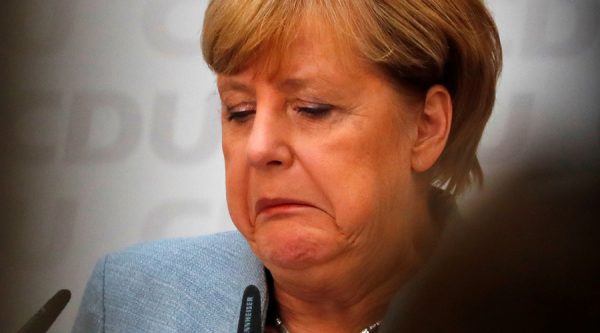
German Chancellor Angela Merkel’s conservative Christian Democrats (CDU) lost yet another regional election, coming behind both left-wing Linke and right-wing Alternative for Germany (AfD) in the eastern state of Thuringia.
It’s not the first time in 2019 that Germany’s ruling party has taken a hammering in local polls. Merkel’s CDU and its coalition partner, the left-wing Social Democrats (SPD) already saw their formerly safe lead in Saxony and Brandenburg eroded last month by the rise of the AfD.
The AfD, which surged from nothing into third place in 2017’s federal elections, took 23.8 percent of the vote in Thuringia, according to exit polls released Sunday. Merkel’s CDU took 22.5 percent. The left-wing Linke won the state, taking 29.7 percent of the vote.
At the back of the pack, the SPD took 8.5 percent, while the Greens took 5.4.
For the AfD, pipping the CDU into second place is a major coup, considering the party only managed to win 10 percent in the last election in 2014. Back then, the CDU was the overall winner, with 33.5 percent, though Linke, the SPD, and the Greens would band together to form a coalition government.
For the CDU and SPD, Sunday’s results are the worst since reunification three decades ago.
Thuringia is a small state with a population of 2.1 million that used to be part of the Eastern Bloc.
Though the CDU and SPD remain in power in the west of the country, the ruling centrists have seen their support eviscerated in the east, pointing to a culture clash of sorts between both sides of the old Cold War-era border. The east remains relatively disadvantaged compared to the west, and the AfD has courted the region’s electorate by opposing the closure of coal mines and calling for urban regeneration.
Linke too has positioned itself as a champion of the working class, promising increased social spending, a raised minimum wage, and tax increases on the wealthy.
Opposition to Merkel’s ‘open door’ immigration policies saw the AfD initially surge in popularity, after the chancellor welcomed more than a million migrants to Germany in 2015. Since then, the party has found support in the east, where public opinion against immigration is strongest.
And, while Germany’s green party enjoyed strong support in this summer’s European elections, its share of the vote remained stagnant in Thuringia, suggesting that the environmentalism currently in vogue in the west finds few fans in poorer parts of the country.
“Thuringians have voted for the Wende 2.0,” Bjoern Hoecke, the AfD’s leader in the state, said on Sunday. “This is a clear sign that a large part of Thuringia says: This can’t go on. We need renewal – this should be taken seriously.”
“Wende” is a German word meaning “turnaround,” and was used to describe the collapse of East Germany three deacdes ago. AfD leaders have repeatedly used the phrase on the campaign trail in eastern states, suggesting that the demise of Merkel’s centrism is every bit the revolution the fall of communism was.
With the center gutted and the AfD and Linke taking the most votes, there is little in common between both parties, save for a more friendly attitude to relations with Russia than Merkel’s. Both are currently enjoying more support than would have been imaginable in 2014, though every single mainstream German party has ruled out working with the AfD.
Russian MoD doubts Trump’s announcement of killing ISIS chief al-Baghdadi, rejects claims it assisted US forces in op
RT | October 27, 2019
There’s no credible data to prove a successful American raid took place against Islamic State leader Abu Bakr al-Baghdadi, Russia’s Defense Ministry said. The US coalition didn’t even carry out any airstrikes in Idlib recently.
Earlier, Trump made a rare Sunday address from the White House informing the world that al-Baghdadi was eliminated in northwest Syria in a “daring nighttime raid” with the involvement of US special forces, planes, helicopters and drones. The Islamic State (IS, formerly ISIS) leader met his end “crying and screaming” in the face of the Americans’ might, he said.
But the Russian Defense Ministry insisted that “there were legitimate questions and doubts about the very fact [of the US operation] and, especially, its success.”
Moscow pointed out that it recorded no US coalition airstrikes in the Idlib area in northwest Syria on Saturday when the raid was held.
It also rejected Trump’s claims that Russian forces opened up the airspace under its control in Syria to American planes to facilitate the operation against the IS leader.
The ministry questioned the very possibility of al-Baghdadi’s presence in Idlib as the area is held by Al-Qaeda offshoot, Jabhat al-Nusra, who have always been mortal enemies of Islamic State.
Moscow noted that Islamic State was crushed in Syria in early 2018 in a joint effort by the government in Damascus and the Russian forces, meaning that yet another report of al-Baghdadi’s demise “bears no effect on the operational situation in Syria or on the actions of the remaining terrorists in Idlib.”
French Defense Minister Florence Parly also questioned the significance of the claimed US achievement, pointing out that the raid only marked “an early retirement for a terrorist [al-Baghdadi], but not for his organization.”
Lenin ‘Judas’ Moreno – Ecuador’s Story of Betrayal and Resistance
By Joaquin Flores | Strategic Culture Foundation | October 27, 2019
On October 3rd, countless tens of thousands of Ecuadorian citizens began a general strike and occupation of public spaces, throughout the country but targeting the capital of Quito. President Lenin Moreno has made himself one of the most hated men in the history of the country in the course of his rule, and was forced to flee as a consequence, and re-establish the capital in Guayaquil. In addition, facing a larger and wider revolution all together, Moreno was forced to rescind Decree 883 – the new law which appears to have been the straw that broke the camel’s back in Ecuador.
But this is far from over, and Moreno’s continued existence as head of government threatens to see the expansion of this newly awakened movement. Internationally too – for it is Moreno who also betrayed Julian Assange, after Raphael Correa offered him protection.
Media are accurately reporting the obvious, but in limited context: Moreno enacted Decree 883, which brought an end to the popular fuel subsidies. As the story goes, this was part of an austerity agreement made with the International Monetary Fund (IMF) in return for a loan. Decree 883 threatens the country’s most vulnerable and historically marginalized cross-sections of Ecuadorian society, indigenous communities in particular. These indigenous communities, along with labor and citizen’s group, were at the forefront of these protests and the general strike, leading and organizing them. Moreno accuses his popular predecessor Correa for planning and executing the protests, with assistance from Cuba and Venezuela. The ‘random Soros guy’ from Brazil, Juan Guaido, has echoed Moreno’s accusation.
The Looming Econocide which Decree 883 Threatened
Beyond this, however, is the real story of Decree 883 and the recent history of Ecuador, and the real betrayal represented by Mr. Moreno – a visceral hatred he has earned for himself, which extends far beyond Decree 883.
Mr. Moreno baffled the public when he announced that the subsidies policy introduced in the 70’s, which if accounting in a very narrow and segregated way, appear to ‘cost’ the government some $1.3bn annually, were no longer affordable. But what macroeconomists and the public both understood, and what was particularly outrageous, was this: these subsidies, based on Ecuador’s socialized gas industry, in fact made possible all sorts of economic activity; risk taking and opportunity making, and consumption in other sectors of the economy – not possible without such a subsidy.
And so the ripple effect of Decree 883 would result in pessimism and a bearish national economy, all around. The cognitive and theoretical deficiency of believing that one can shore up nominal debts that exist under certain conditions of subsidy, by eliminating an economy enhancer like an energy subsidy, without this in turn deleteriously effecting overall GDP indices, to in turn qualify for a loan which would in all obvious reality create further balance of payment and debt problems, is itself either negligent, criminal, or both.
The real consequence would be that it would place the Ecuadorian economy further in debt, which means in further reliance on the IMF, which means further loans will be needed, which means further austerity, and ultimately privatization of the public weal. Upon such a cycle, creating permanent servitude and insolvency, the final aim on the part of the IMF cannot be simply a vicious debt cycle, (as this is ultimately unpayable) but the total private and foreign ownership of Ecuador, with some sort of mass impoverishment, even genocide of its indigenous people, as an obvious – if not wanted – consequence. At this point it becomes perhaps secondary to note that none of these ‘IMF loans’ will be used to develop the country’s physical economy – the only real signifier of wealth building for a whole society, if viewed scientifically and rationally as an organic unit with mutually interrelated symbiotic components.
There are few words to describe such aims as Decree 883 without delving into deep, profound, philosophical and theological questions about the nature of the forces of good and evil in the world. Questions which force us to ask what universal principles give meaning to our lives as human beings, and what really and fundamentally motivates those with such a blatant misanthropic agenda.
But at any rate, it is more than obvious how this move by Moreno, in the name of Decree 883, had led to the near toppling of the Ecuadorian government – leading to Moreno declaring a state of emergency.
A success so far for the people has been the apparent repeal of Decree 883, but why Moreno is so very much hated deserves our attention, as this is only the beginning. During his tenure, Moreno has gained himself the nickname among the opposition ‘Judas’: a name necessary as it distinguishes that he is ‘no Lenin’.
What Moreno has done has resulted in the largest popular uprising the country has seen in many years. After years of working to reverse the progress and stability brought by the noble and just government of Raphael Correa, Moreno brought about a condition of instability and ignobility. Within months of assuming office, he disavowed Correa who had brought him where he had arrived, and began to work under the orders of Washington to undo Correa’s social and legislative reforms that had been aimed at deepening the strength of Ecuador’s civil society, labor, and justice. Under Correa, poverty would see a 30% decline.
Despite this obvious reality, this obvious truth, Moreno doubles-down on his contempt for reason and rationality, by accusing the protestors of being agents of Correa, even of Maduro (!). This affront to the wisdom of the people of Ecuador is comparable to blaming the blood for the wound, or for blaming the wound for the accident which causes these.
The gas itself is largely owned by and for the people, through EP Petroecuador
The latest affront to dignity and fairness, in the form of yet another IMF sell-out from Moreno, came in the form of the elimination of gas subsidies for people most in need. And one cannot offer any real logic or reason for ending these subsidies, for the gas itself is largely owned by and for the people, through EP Petroecuador, the state oil firm.
But this deep-seated scorn is not simply related to contempt for his policies, but much more profoundly for his betrayal. Because we might expect such austerity from a centrist or right-wing candidate, given the history of politics in Latin America – there is something honest in this; they deliver what they campaign on. But given that Correa had essentially groomed Moreno, and Moreno in turn endorsed the policies of Correa – we encounter the crux of the matter, and how Moreno turned from Lenin to Judas.
To wit, it was Raphael Correa’s broad plan to rescue Ecuador from the predatory claws of the IMF, by fomenting a public campaign, a brilliant simulacrum strategy of sorts, borrowed from Venezuela, that an entire program of socialist revolution was underway, such that it had the effect of lowering the value of Ecuador’s bonds, owned by foreign interests. This made it so that Ecuador was able to succeed in buying back some 91% of these bonds, and made possible Ecuador’s thumbing the IMF and not taking on new debt. This was done by intelligently weaponizing Ecuador’s apparent weakness in not having its own real national currency, as this was dollarized by corrupt national leaders in 2000, using the excuse of the damage caused by Hurricane ‘El Niño’, to eliminate Ecuador’s monetary sovereignty. It had been widely believed that without a national, sovereign currency, that Ecuador could have no sovereign monetary policy – Correa proved this wrong by turning expectations and dynamics on their respective heads. While this dictum is true in the long-term, Correa used the dollarized nature of Ecuador’s currency values in a gambit to buy-back Ecuador’s bonds.
When Correa was elected president of Ecuador, it had come as the result of years of struggle by the popular forces of resistance, against all odds, and overcoming a particularly unstable and disastrous period were Ecuador had seen come and go some ten presidents in the period of just eleven years.
Correa would go on to serve for a decade, and continued to build popular support, and this had signaled the realization of an even broader dream of social and economic justice in Ecuador, but also a visionary long-term plan to integrate the Latin American economy into a single civilization-wide economic bloc.
The history of modern Ecuador is one of tragedy, hope, and never lacking in contradictions. During the time of Correa he was faced with the strongest opposition from the most intransigent and short-term thinking, narrowest in scope and vision, of the country’s billionaire class.
And it only so happened to be that this same class, who had been responsible for the years of instability and rampant poverty, were also those closest to Washington DC and New York City – placing the country at the hands of the Washington Consensus – the IMF, City Bank, JP Morgan Chase, and the rest of the “usual suspects”.
Rejecting this, in February 2007 that Correa’s economy minister Ricardo Patiño stated: “I have no intention […] of accepting what some governments in the past have accepted: that [the IMF] tell us what to do on economic policy.” “That seems unacceptable to us,” Patiño concluded.
The U.S and the IMF hated this, and hated Correa for this. Correa confused many –at first seeming to be a center-leaning social-democrat reformist. His biography and optics were misleading: young and well groomed, with waxed hair and Spanish features, he appeared very much like the kind of candidate historically installed by Ecuador’s wealthy comprador class. His credentials in governance had come about through being Ecuador’s finance minister under the prior neo-liberal government of Alfredo Palacio. And yet Correa was a man of the people and once in office quickly became allies with the Castros of Cuba and also Chavez, and then Maduro of Venezuela.
Correa understood he would be termed-out eventually, under Ecuador’s constitutional provisions, and had worked early on to groom a successor.
Again, the biography and optics were misleading: this successor was Lenin Moreno, the son of a communist teacher; Moreno inspired empathy with his soulful eyes, reminiscent of Iran’s Ahmadinejad, and being wheelchair-bound, he inspired sympathy.
The people had expected that a man who inspired such sympathy and empathy, would himself be capable of tremendous sympathy and empathy for the people in turn.
And yet the people were wrong. Instead, what lurked in the heart of Lenin Moreno was so dark, so depraved, so shallow and so selfish, that it exploded the left’s understanding of character.
It would turn out that Nietzsche’s dictum that weakness lays at the root of evil, and strength at the root of good, was true. If the apparent meekness of Moreno would allow him to inherit the world of Ecuador, then it was his cruelty and hatred, his resentment born of weakness, for those healthy and happy people, even if poor, that would threaten to destroy it.
The government of Moreno has been a betrayal so monumental and significant to the living history of Ecuador, that it has indeed earned him the name ‘Judas Moreno’, an allusion both to Judas Iscariot who betrayed Jesus Christ to the wishes of the Sanhedrin, and also to Leon ‘Judas’ Trotsky, who is believed by mainline communists internationally to have conspired to betray the Russian Revolution through his alleged conspiracy with the forces of Fascism in Europe.
And this leads us to the real heart of our investigation, for the apparent revolution that Judas Moreno has betrayed was the popular democratic, electoral ‘revolution’ of Correa. And this is why Moreno is so hated, and lacks any mandate. And this is also why his power decreases by the day, as his legitimacy in question after his first months in office, and his actions against the people – the repression, arrests, and persecutions which have heightened in the last ten days of protests against his regime, are only but the culmination of several years of the same.
Now there are dead, martyrs in this struggle, murdered by Moreno’s security forces.
Decree 883 may have been repealed, but coming about on the precipice of a broader revolution, the coming weeks and months only promise more conflicts, surprises – and we should expect yet another betrayal from Judas Moreno, and another explosion in response.
Lecturing the ‘peons’? Pelosi blames voter disenchantment on outside forces who ‘poisoned’ social media
RT | October 27, 2019
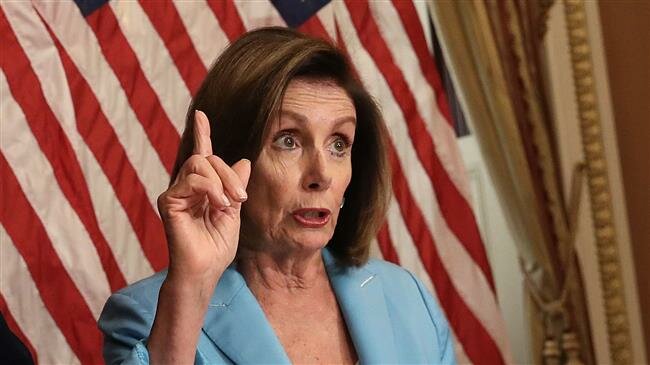
Dark forces have tainted social media and turned optimistic, hopeful, Americans into unhappy voters, Nancy Pelosi has conveniently claimed. The House Speaker’s explanation for the current political mood did not impress Twitter.
The senior Democratic lawmaker told a crowd in Iowa on Saturday that any negative or ambivalent feelings about US politics likely stems from actors “inside and outside” the country who have “poisoned” social media.
[They use social media to] undermine the mindset of what is America. America is optimistic, entrepreneurial, about the American dream and things can be better. And what they do with their poison is discourage – ‘nobody is paying attention to you, it’s no use for you to vote.’
Paraphrasing Pelosi’s rather disjointed remarks, journalist Michael Tracey noted: “So if social media makes you pessimistic, you are the victim of ‘interference’ rather than a critical thinker.”
Her comments elicited considerable internet heckling, with Twitter users accusing Pelosi of deflecting criticism of her party.
Others suggested that Pelosi was just bitter that social media users don’t take orders from her “oligarch masters” – making the platforms far harder to control than traditional news outlets.
Australian legislator uncovers Bureau of Meteorology fiddling with temperature records to hype warming
By Thomas Lifson | American Thinker | October 26, 2019
If global warming is real and a threat to the world, why do people keeping temperature records keep “adjusting” or “rectifying” the data to make it look like warming is increasing?
From Down Under, a member of the federal House of Representatives named Craig Kelly — a member of the Liberal Party, which is conservative — has caught that nation’s Bureau of Meteorology altering graphs showing the number of very hot days so as to obscure the fact that 1952 had more of them than recent years and adding a newly “discovered” hot day to a more recent year to make it appear that they are increasing.
I quote and use graphics from his Facebook account:
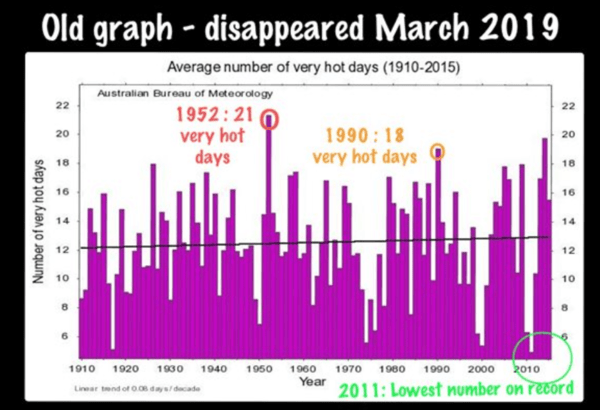
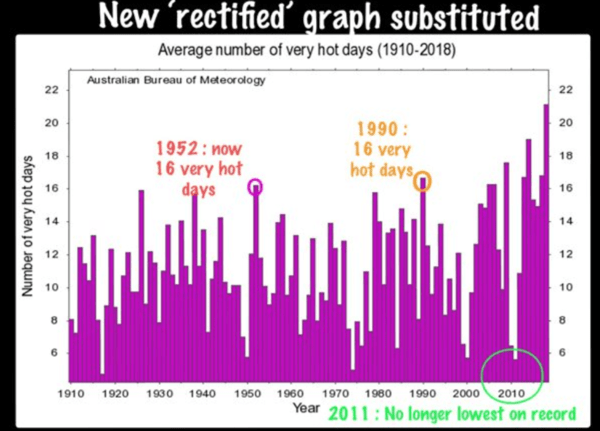
Not only did the Bureau’s graph showing the year 1952 as having the highest ‘number of very hot days’ (and the year 2011 with the lowest number) disappear down a memory hole — but a new ‘rectified’ graph has appeared in another section of their website.
And surprise, surprise — the year 1952 no longer has the highest ‘number of very hot days’. The old graph recorded 21 very hot days in 1952, while the new ‘rectified’ graph shows only 16 very hot days.
Further, for the year 2011 — which embarrassingly for Alarmists previously had the lowest ‘number of very hot days’ going back to 1910 — the Bureau has skilfully been able to find another very hot day for 2011, (I wonder where it was hiding ?) so that year no longer holds the lowest record !
As Orwell foretold in the novel 1984:
”There were the vast repositories where the corrected documents were stored, and the hidden furnaces where the original copies were destroyed. And somewhere or other, quite anonymous, there were the directing brains who co-ordinated the whole effort and laid down the lines of policy which made it necessary that this fragment of the past should be preserved, that one falsified, and the other rubbed out of existence.
Featured Video
Ted Postol: Fraud of Missile Defence Exposed in Iran War
or go to
Aletho News Archives – Video-Images
Frlom the Archives
Containing the United States
By Edward S. Herman | Z Magazine | September 2016
“Containing the United States” is, of course, a ridiculous and self-contradictory idea in the U.S. and Western ideological and propaganda system. We all know that the United States had to “contain” the Soviet Union from 1945 to 1991, and since then has had the task of containing Russia and China. Only they threaten, bully, aggress and worry countries like Poland and Vietnam. Obama has had to reassure them both of our steadfast stand against Russian and Chinese military attacks. NATO has, of course, expanded greatly over the past several decades, despite the deaths of the Soviet Union and Warsaw Pact, but only to contain the renewed Russian — and Iranian, Libyan, Syrian and other — military threats; and we have “pivoted” to Asia, supported Japanese rearmament, bolstered our own forces in that area and jousted with the Chinese in their coastal waters solely to contain China. Earlier we had been obliged to contain North Vietnam, or was it the Soviet Union in Vietnam? Or China? Or “communism”? Or maybe all of them? Or none of them, but just needing an excuse to enlarge power?
The parallel propaganda has taken many forms. One is accepting as a premise that the United States only acts defensively and has no internal forces and interests that drive it to enlarge its sphere of control. I noted in an earlier article how Paul Krugman claims that internal Russian problems may well be the explanation of Russian “aggression,” but how at the same time it never occurs to him that the huge U.S. transnational corporate interests and “defense” establishment, and the pro-Israel lobby’s activities, might possibly make for an expansionist dynamic here.2 This reflects the standard establishment perspective that we are good and only react to evil. This was the view sustaining and justifying the invasion and occupation of Iraq from 2003. That attack was taken here as not evil but a response to evil, even if involving lies and mistakes, hence not describable as “aggression.” … continue
Blog Roll
 Aletho News
- Trump press conference reveals a man who wants out of war
- When Tel Aviv decides, Washington fights
- Top official: Iran ready for a long war with US, no more diplomacy
- How Iran’s Toxic Rain Reveals US-Israel Discord
- Trump Admits He Is Destroying Iran For Israel
- Iran’s latest move in the GCC countries was a stroke of genius
- Blackmail and death threats, Zelensky embarrasses the EU, but there’s no condemnation
- Israel threatens to kill Iran’s new leadership
- Possible Scenarios for the Middle East
- The Horizon of the War. “Italy is being Dragged Into the War against Iran”
- If Americans Knew
- Lebanon: Israel’s White Phosphorous Use Risks Civilian Harm
- Corporate Media Go All Out To Support The US-Israeli War On Iran
- US-Israel war on Iran is creating a steady growing number of amputees
- Israel planned this war on Iran for 40 years. Everything else is a smoke screen
- The wrong question about the war in Iran
- ‘Your Tax Dollars Being Used to Raise Your Gas Prices’: US-Israel Bomb Major Iranian Oil Depots
- ‘Bogus Evidence’: Former Nuclear Watchdog Head Debunks US Justification for Iran War
- EXPLAINER – Dimona: What to know about Israel’s nuclear site
- Fires and toxic air in Iran (thanks, Israel) – Not a ceasefire Day 150
- At Israel’s hands, Iran is burning, Lebanon and Gaza are crumbling – Not a ceasefire Day 149
- No Tricks Zone
- Wake-up Call: Survey Shows Majority Of Germans Now Favor Postponing Climate Targets!
- Televised! Leading German Political Candidate Tells Schoolchildren CO2 Makes Sun Hotter!
- New Study: A Century Warming Of 1.1°C Is ‘Commonplace’ And ‘Not Unusual’ During This Interglacial
- New Study: ‘Internal Noise’ And Volcanic Forcing Can Trigger 10-15°C Warming Within Decades
- Glaciers Worldwide Are Suddendly Surging, Experts Blame Warming!
- Surprising Discovery: Sahara Is Greening…Billions Of Trees Where Once Thought To Be Barren
- New Research Reaffirms Clouds, Aerosols, And Surface Solar Radiation Are ‘Driving The Climate System’
- Germany: Electric Car Catches Fire At Charging Station, Sets Off Local “Inferno”, Widespread Damage
- New Study: Canada’s New Brunswick Was 1°C Warmer Than Today During The Medieval Warm Period
- Coal Power Back In Trend As Globe Tries To Keep Pace With Growing Demand For Power
 Aletho News