Protecting Society From ‘Science’
Scientific research, published in influential places, can change the world. For ill as well as for good.
By Donna Laframboise | Big Picture News | November 4, 2019
 The New York Post ran a fascinating article this weekend, titled Stanford professor who changed America with just one study was also a liar. It’s written by journalist Susannah Cahalan, and is about her new book, The Great Pretender.
I haven’t read the book yet, the Kindle edition becomes available tomorrow, but she appears to be the real deal – a journalist who discovered something disturbing, unwelcome, and contrary to her expectations, yet told the truth.
The book is about a professor from a famous university. In 1973 he published a paper in a famous journal, Science. That paper changed history. It fuelled a backlash against institutions for the mentally ill, leading to their widespread closure.
Only now, more than four decades later, are we learning that David Rosenhan, who taught psychology and law, appears to have invented a great deal of what he described in that paper. That’s called fraud. He also suppressed contrary evidence.
The study claimed to describe the profoundly negative experiences of eight individuals who faked serious illness, were admitted to mental institutions, and then had a difficult time convincing the staff they were actually sane and stable. In the New York Post, Calahan tells us she:
started to uncover serious inconsistencies between the documents I had found and the paper Rosenhan published in Science.
… I looked for the seven other pseudopatients and spent the next months of my life chasing ghosts. I hunted down rumors, pursuing one dead end after the next. I even hired a private detective, who got no further than I had.
After years of searching, I found only one pseudopatient who participated in the study and whose experience matched that of Rosenhan…
… The only other participant I discovered, Harry Lando, had a vastly different take. Lando had summed up his 19-day hospitalization at the US Public Health Service Hospital in San Francisco in one word: “positive.”
Even though he too was misdiagnosed with schizophrenia, Lando felt it was a healing environment that helped people get better.
… instead of incorporating Lando into the study, Rosenhan dropped him from it… His data – the overall positive experience of his hospitalization – didn’t match Rosenhan’s thesis that institutions are uncaring, ineffective and even harmful places, and so they were discarded.
Fake news isn’t new. It turns up in prestigious, peer-reviewed scientific journals. It gets spread far and wide by newspapers, magazines, and television news. It makes its way into textbooks and introductory college courses.
We have few defences against it, few ways to prevent society from being highjacked by ‘research’ conducted by people who have agendas as well as PhDs.
The Great Pretender is another cautionary tale. Skepticism. Always skepticism.
Sentence First, Crime Later?
By Ron Paul | November 4, 2019
Attorney General William Barr recently sent a memo to law enforcement officials announcing a new federal initiative that would use techniques and tools developed in the war on terror, such as mass surveillance, to identify potential mass shooters. Those so identified would be targets of early interventions, which would include the disregarding of Second Amendment rights, as well as the imposing of mandatory counseling and involuntary commitment.
The program would likely match data collected via mass surveillance with algorithms designed to identify those with mental problems that would lead them to commit violent crimes. So, this program would deprive Americans of respect for their rights not because they committed, or even threaten to commit, a violent act but because their tweets, texts, or Facebook posts trigger a government algorithm.
In order to enhance the government’s ability to conduct mass surveillance, Barr has been trying to force tech companies to allow the government to have a “backdoor” for accessing electronic information. This would allow the government to read all messages — even those that are encrypted, making it all but impossible to escape the government’s watchful eye.
Many mental health professionals admit that diagnosing mental health issues involves a degree of subjectivity. So how can we trust a government-designed computer algorithm to accurately identify those with mental health problems? The answer is we can’t. Barr’s program will no doubt result in many individuals who are not a threat to anyone being deprived of respect for their rights. The program will also fail in detecting future mass shooters.
Some mental health professionals argue that holding certain political beliefs is a sign of mental illness. Not surprisingly, federal agencies like the FBI agree that those expressing “anti-government extremism”— like supporting a constitutional republic instead of a welfare-warfare state — are potential threats.
A recent internal FBI memo warned that a belief in “conspiracy theories” is a sign that someone could be a domestic terrorist. “Conspiracy theorist” is an all-purpose smear used against anyone who questions the government’s official narrative on an event or issue. Tying a belief in “conspiracy theory” to terrorism is an effort to not just stigmatize but actually criminalize dissenting thoughts on matters such as foreign policy, climate change, gun control, and the Federal Reserve.
Some people support using political beliefs as a basis for labeling someone as “mentally disturbed” because they think it will mainly affect “right-wing extremists.” These people are ignoring the FBI’s history of harassing civil rights and antiwar activists, as well as the recent controversy over the FBI labeling “black identity extremists” as a threat.
A government program to monitor electronic communications to identify potential mass shooters puts all Americans at risk of losing their liberty due to their political views or a few social media posts. All those who value liberty must oppose this dangerous program.
Copyright © 2019 by RonPaul Institute.
At This Year’s J Street Conference, “Progressive” Pols Bow to Israel While Preaching Peace
By Miko Peled | MintPress News | October 30, 2019
My father, the late IDF general Matti Peled, called for a two-state solution in 1967, and as is stated in my book, The General’s Son, Journey of an Israeli in Palestine, he continued to campaign for this “solution” until the day he died. It may have been a revolutionary idea then, especially coming from a retired IDF general. Some would even call it progressive, though I personally would not go that far. It presented a path for Israel to gain legitimacy for its 1948 conquest of Palestine while placating the Palestinian people by giving them a small, powerless state that would allow them to exercise their right to self-determination.
Two decades later, when it was clear that Israel would never allow this to happen, my father called for the U.S. to halt its financial and military aid to Israel. By 1992, he called for sanctions against Israel. So when Bernie Sanders and other so-called progressives like J Street talk about a two-state solution and the possibility of using aid to pressure Israel, they are decades late and billions of dollars short. Without full support for the Boycott Divestment and Sanctions movement, BDS for short, no progress can be achieved for Palestinian rights.
A Safe Bet
Back in the late 1960s and early 1970s calling for the establishment of a Palestinian state in the West Bank and the Gaza Strip was dangerous because there was a real possibility that it could happen. Today, after five decades in which consecutive governments of Israel have worked tirelessly to integrate the West Bank with the rest of the state of Israel, a Palestinian state is no longer possible and calling for it is a safe political move. Bernie Sanders knows it, the folks at J Street know it, and all the other so-called progressives know it too. A bold, progressive move would be to call for a democratic state with equal rights for all of Palestine, from the river to the sea.
However, we mustn’t get ahead of ourselves. One has to ask, where were these progressives when the possibility of a two-state solution was feasible? This is not to say it was a just or good solution, for it did legitimize the Zionist crimes of 1948 and earlier. Setting that aside for a moment, where were these so-called progressives when the possibility of an independent Palestine emerging in the West Bank and the Gaza Strip was a real possibility? They were nowhere to be found.
While the official line of consecutive U.S. administrations was that UN Security Council resolutions 242 and 338 should be the basis of a peace agreement, neither the various administrations or other American politicians outside of the administration did a single thing to push this idea forward.
Now that is it too late, and it is clear that Israel never intended to allow the Palestinian right to self-determination to materialize, and now that we know that the “peace process” concocted by the Rabin-Peres duo was nothing more than a charade, the Bernie Sanders and J Street liberals decided to make a “bold” statement out of an old, outdated idea. But there is nothing bold about their support for Israel. There is nothing progressive about waiting five decades to support an idea that has no chance of becoming reality.
A Step in the Right Direction
The last thing that can be said about this very slow learning curve is that it is a step in the right direction. Recognizing and declaring today that the Palestinian people have been subjected to genocide, ethnic cleansing and apartheid for over seven decades is still slow, but it would signal a real step in the right direction. However, neither Sanders nor his hosts at the J Street conference are willing to go that far.
The farthest Sanders is willing to go is to say that he supports Israel and that Palestinians have been treated unfairly. Now, he is suggesting that some of the $3.8 Billion of aid money going to Israel should be diverted to resolve the ongoing humanitarian crisis in Gaza. How much? He didn’t say. So why not suggest halting aid to Israel altogether and sending those billions of dollars to the people who really need them in order to rebuild Gaza and provide medical care, water, and food.
The problem is that we have all become accustomed to believing that Palestinians should never ask for too much. Palestinians should be grateful for the scraps offered to them by white rich politicians in the United States and Israel. They should welcome the idea that Israel will “give” them a fraction of their homeland in which to build a mini-state. They should be grateful that a politician in the U.S. said publicly that they are treated unfairly. Palestinians should not be unreasonable and they should refrain from calling for anything that would bother Israel and its Zionist supporters around the world.
BDS
The call for Boycott, Divestment, and Sanctions against Israel is a step too far for Sanders and J Street, the latter claiming that it is opposed to the call for a boycott and that “The Movement is not a friend to Israel.”
Palestinians, apparently, are required to prove that they are friends of Israel before their demands can be heard, much less accepted and also to recognize the right of Israel to exist, another absurd demand regularly made of Palestinians.
The fundamental problem lies in statements such as this by J Street: “J Street believes that maintaining a strong, vibrant US-Israel relationship […] US support for Israel as a democracy and a national home for the Jewish people is an historic and crucial commitment.”
As long as the U.S. relationship with Israel is viewed as more valuable than the human rights of the Palestinian people, justice for Palestinians will remain a distant dream. Without support for BDS and their declared demands, namely: ending Israel’s military occupation of Palestinian land, equal rights and the right of refugees to return to their homes and their land, no progress can be made.
Hold the Champagne
Reading posts on Twitter while the J Street conference was taking place in Washington could give one the impression that justice for Palestinians is just around the corner. However, it is Israel that was the focus, not Palestinian human rights. The ongoing discussion of the two-state solution at the event acted as a fig leaf, shielding Israel from true criticism and allowing human rights violations in Palestine to continue unabated.
Statements like this one, made by Julian Castro, are indicative of a prevailing head in the sand, ostrich-like attitude: “We need a government in Israel that will get back on the path of the two-state solution.” No one bothered to ask if Israel was really ever on that path.
Bernie Sanders made a statement at the J Street conference that was also indicative of a desire to intentionally miss the target: “It is not anti-Semitism to say that the Netanyahu government has been racist – that’s a fact,” he said. Netanyahu is, without question, indeed a racist. Yet he is no different than any other Israeli prime minister. The issue is not a single prime minister, it is the entire Zionist settler-colonial project in Palestine which is the problem.
How Much Longer?
More than five decades had passed since my late father, one of the exalted IDF generals of the 1967 war, called for a two-state solution. A solution that favors Israel and recognizes very limited rights for Palestinians and is a poor excuse for a peace plan. A solution that ignores the crimes which my father, among others, committed in 1948. A solution, which in fact legitimizes those crimes. It is a “solution” behind which politicians who want to seem progressive can hide because it offers no solution. It is a solution popular among those who pretend to care for justice and human rights but that do not want real change. One must ask how much longer this charade will be allowed to continue.
Hamas: Iran Provided Palestinian Resistance with Weaponry & Money
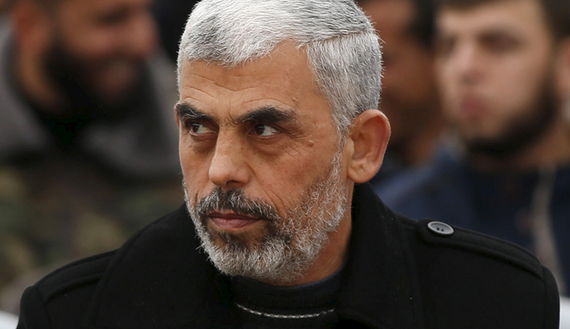
Hamas leader Yehia Sinwar in Khan Younis in the Gaza Strip January 7, 2016. REUTERS/Mohammed Salem
Al-Manar | November 4, 2019
Gaza’s Hamas leader Yahya Sinwar Monday gave Iran the greatest credit for supporting the Palestinian resistance and providing it with money, expertise and weaponry.
Sinwar stressed that the Palestinian resistance has developed anti-armored missiles, adding that it can fire missiles at Tel Aviv for six consecutive months.
Sinwar also reiterated that the Deal of the Century aims at eradicating the Palestinian cause, adding that the weekly Return Protests achieved many targets.
The UN exploits Palestinian children to further the two-state propaganda

By Ramona Wadi | MEMO | October 23, 2019
There is one thing the UN and its personnel would do well to keep in mind when pontificating about the purported peace process and to promote Israel’s security narrative: Palestinian children are not props for exploitation. At a time when the United Nations Relief and Works Agency for Palestine Refugees is facing a severe crisis due to funding shortages, as well as the misdemeanour allegations concerning its staff, the last thing the UN should be doing is exploiting Palestinian children for the sake of upholding the obsolete two-state compromise.
Earlier this month, the UN Special Coordinator for the Middle East Peace Process Nickolay Mladenov posted a photo on Twitter, of himself and UN Under-Secretary-General for Political and Peacebuilding Affairs Rosemary DiCarlo, together with a group of female refugee students attending one of UNRWA’s schools. “I hope these young girls grow up to participate in democratic elections where Palestine, Israel live side-by-side in peace and security,” he tweeted.
Just because the colonial narrative makes Israel, peace and security synonymous doesn’t mean there are no inherent contradictions in the rhetoric. The UN, a collaborator since before the inception of Israel, is, of course, aware of the discrepancies, but it prefers to enforce historical cycles of dispossession upon Palestinians, including students, framing them as a warped peace process in which Israel’s existence is paramount, even at the expense of Palestinian lives.
Mladenov’s wish for Palestinian children is not that they exercise their right to live freely in all of historic Palestine. On the contrary, he is demanding perpetual subjugation and oblivion of the Palestinian right of return, and what better way to attempt indoctrination than with the younger generations, according to the UN’s delusional standards?
But Palestinians have remembrance, and that remembrance is political. Has Mladenov deigned to listen to the Palestinian children’s refugee narratives? Are Mladenov and the UN expecting future Palestinian generations to exploit themselves for Israel’s colonial plans? How do UN officials reconcile democracy with the colonialism inherent in the two-state paradigm, which is the purported solution envisaged for Palestinians by the international community?
Taking the latter one step further, since the UN knows that the two-state hypothesis is obsolete, it stands to reason that these Palestinian children, along with many others, will be witness to further colonial appropriation by Israel. Mladenov’s legacy to this group of students will be nothing other than a promotional photo taken for UN propaganda purposes, while in the background; Palestinian families are permanently ruptured and dispossessed by Israel.
UN antics are not impressive; they are endangering the lives of Palestinians and attempting to tarnish students with acquiescence. Parroting about democratic elections while envisaging perpetual colonialism is vile, all the more when involving students in UN propaganda. So, stop the rhetoric of hope, which is an illusion when there is factual support for the elimination of Palestinian rights. Mladenov never intended Palestinian students’ voices to reach the international arena. The promotion photo speaks volumes about how the UN coerces Palestinians into silence. When the focus is Palestinian children facing perpetual refugee status, it is clear the UN could not sink any lower.
The ‘War’ for the Future of Middle East
By Alastair Crooke | Strategic Culture Foundation | November 4, 2019
Oh, oh, here we are again! In 1967, it was then the ‘threat’ of the standing Arab Armies (and the ensuing six-day war on Egypt and Syria); in 1980, it was Iran (and the ensuing Iraqi war on Iran); in 1996, it was David Wurmser with his Coping with Crumbling States (flowing on from the infamous Clean Break policy strategy paper) which at that time targeted secular-Arab nationalist states, excoriated both as “crumbling relics of the ‘evil’ USSR” and inherently hostile to Israel, too; and in the 2003 and 2006 wars, it was Saddam Hussein firstly; and then Hezbollah that threatened the safety of the West’s civilizational ‘outpost’ in the Middle East.
And here we are once more, Israel cannot safely ‘live’ in a region containing a militant Hezbollah.
Not surprisingly, the Russian Ambassador in Beirut, Alexander Zasypkin, quickly recognized this all too familiar pattern: Speaking with al-Akhbar on 9 October in Beirut (more than a week before the protests in Beirut erupted), the Ambassador dismissed the prospect of any easing of regional tensions; but rather identified the economic crisis that has been building for years in Lebanon as the ‘peg’ on which the US and its allies might sow chaos in Lebanon (and in Iraq’s parallel economic calamity), to strike at Hezbollah and the Hash’d A-Sha’abi — Israel’s and America’s adversaries in the region.
Why now? Because what happened to Aramco on 14 September has shocked both Israel and America: the former Commander of the Israeli Air Force wrote recently, “recent events are forcing Israel to recalculate its path as it navigates events. The technological abilities of Iran and its various proxies has reached a level at which they can now alter the balance of power around the world”. Not only could neither state identify the modus operandi to the strikes (even now); but worse, neither had any answer to the technological feat the strikes plainly represented. In fact, the lack of any available ‘answer’ prompted one leading western defense analyst to suggest that Saudi should buy Russian Pantsir missiles rather than American air defenses.
And worse. For Israel, the Aramco shock arrived precisely at the moment that the US began its withdrawal of its ‘comfort security blanket’ from the region – leaving Israel (and Gulf States) on their own – and now vulnerable to technology they never expected their adversaries to possess. Israelis – and particularly its PM – though always conscious to the hypothetical possibility, never thought withdrawal actually would happen, and never during the term of the Trump Administration.
This has left Israel completely knocked, and at sixes-and sevens. It has turned strategy on its head, with the former Israeli Air Force Commander (mentioned above) speculating on Israel’s uncomfortable options – going forward – and even postulating whether Israel now needed to open a channel to Iran. This latter option, of course, would be culturally abhorrent to most Israelis. They would prefer a bold, out-of-the-blue, Israeli paradigm ‘game-changer’ (i.e. such as happened in 1967) to any outreach to Iran. This is the real danger.
It is unlikely that the stirring of protests in Lebanon and Iraq are somehow a direct response to the above: but rather, more likely, they lie with old plans (including the recently leaked strategy paper for countering Iran, presented by MbS to the White House), and with the regular strategic meetings held between Mossad and the US National Security Council, under the chairmanship of John Bolton.
Whatever the specific parentage, the ‘playbook’ is quite familiar: spark a popular ‘democratic’ dissent (based on genuine grievances); craft messaging and a press campaign that polarizes the population, and which turns their anger away from generalized discontent towards targeting specific enemies (in this case Hezbollah, President Aoun and FM Gebran Bassil (whose sympathies with Hezbollah and President Assad make him a prime target, especially as heir-apparent to the leadership of the majority of Christians). The aim – as always – is to drive a wedge between Hezbollah and the Army, and between Hezbollah and the Lebanese people.
It began when, during his meeting with President Aoun in March 2019, US Secretary of State, Mike Pompeo reportedly presented an ultimatum: Contain Hezbollah or expect unprecedented consequences, including sanctions and the loss of US aid. Leaked reports suggest that Pompeo subsequently brought ally, PM Hariri into the picture of the planned disturbances when Hariri and his wife hosted Secretary Pompeo and his wife for a lunch banquet at Hariri’s ranch near Washington at the end of the Lebanese premier’s August visit to the US.
As the Lebanese demonstrations began, reports of an ‘operations room’ in Beirut managing and analyzing the protests, and of large scale funding by Gulf states proliferated; but for reasons that are not clear, the protests faltered. The Army which originally stood curiously aloof, finally engaged in clearing the streets, and returning some semblance of normality – and the Central Bank governor’s strangely alarmist forecasts of imminent financial collapse were countered by other financial experts presenting a less frightening picture.
It seems that neither in Lebanon or in Iraq will US objectives finally be achieved (i.e. Hizbullah and Hash’d A-Sha’abi emasculated). In Iraq, this may be a less certain outcome however, and the potential risks the US is running in fomenting chaos much greater, should Iraq slip into anarchy. The loss of Iraq’s 5 million barrels/day of crude would crater the market for crude – and in these economically febrile times, this might be enough to tip the global economy into recession.
But that would be ‘small beer’ compared to the risk that the US is running in tempting ‘The Fates’ over a regional war that reaches Israel.
But is there a wider message connecting these Middle East protests with those erupting across Latin America? One analyst has coined the term for this era, as an Age of Anger disgorging from “serial geysers” of discontent across the globe from Ecuador to Chile to Egypt. His theme is that neoliberalism is everywhere – literally – burning.
We have noted before, how the US sought to leverage the unique consequences arising from two World Wars, and the debt burden that they bequeathed, to award itself dollar hegemony, as well the truly exceptional ability to issue fiat credit across the globe at no cost to the US (the US simply ‘printed’ its fiat credit). US financial institutions could splurge credit around the world, at virtually no cost – and live off the rent which those investments returned. But ultimately that came at a price: The limitation – to being the global rentier – has become evident through disparities of wealth, and through the incremental impoverishment of the American middle classes that the concomitant off-shoring brought about. Well-paid jobs evaporated, even as America’s financialised banking balance sheet ballooned across the globe.
But there was perhaps another aspect to this present Age of Anger. It is TINA: ‘There is no alternative’. Not because of an absence of potentiality – but because alternatives were crushed. At the end of two World Wars, there was an understanding of the need for a different way-of-being; an end to the earlier era of servitude; a new society; a new social contract. But it was short-lived.
And – long story, short – that post-war longing for ‘fairness’ (whatever that meant) has been squeezed dry; ‘other politics or economics’ of whatever colour, has been derided as ‘fake news’ – and in the wake of the 2008 great financial crisis, all sorts of safety-nets were sacrificed, and private wealth ‘appropriated’ for the purpose of the re-building of bank balance sheets, preserving the integrity of debt, and for keeping interest rates low. People became ‘individuals’ – on their own – to sort out their own austerity. Is it then, that people now are feeling both impoverished materially by that austerity, and impoverished humanly by their new era servitude?
The Middle East may pass through today’s present crises (or not), but be aware that, in their despair in Latin America, the ‘there is no alternative’ meme is becoming reason for protestors ‘to burn the system down’. That is what happens when alternatives are foreclosed (albeit in the interests of preserving ‘us’ from system collapse).
Featured Video

Yemen joins the war – Red Sea could be blocked next – Saudi regime at risk
or go to
Aletho News Archives – Video-Images
From the Archives
A superpower and “the world’s sickest warrior state”
By Paul J. Balles | March 8, 2010
Living through five or six major wars has hardened me to what I thought were the extremes of inhuman cruelty and brutality.
Two things made those extremes almost bearable: the brutality always revealed – at least according to the media coverage – the viciousness of the enemy. It was therefore quite understandable when our “brave men and women” pulverized the enemy.
Films of Japanese torturing captive Americans somehow justified holding Japanese Americans in internment camps during World War II; and only a small percentage of Americans found the bombing of Hiroshima and Nagasaki unreasonably vengeful at best, at worst, depraved.
The media giants in America portrayed the North Koreans as barbaric beasts with their captives, quite unlike their southern counterpoints – our allies during the Korean War. No one ever felt the need to explain how the South Koreans were a civilized breed while the North Koreans were absolute savages, at least according to the official line.
In Vietnam, our warriors justifiably (or so the media made us believe) dropped napalm on the North Vietnamese who had the gall to hide in villages and tunnels to ravage our invaders. At least it was accepted practice until some rogue photojournalist filmed a young girl screaming down a Vietnamese road in flames. … continue
Blog Roll
 Aletho News
- Russian tanker approaches Cuba despite US oil blockade
- Marandi: Yemen joins the war – Red Sea could be blocked next – Saudi regime at risk
- Pro-Palestinian French member of European Parliament denied entry to Canada
- Pakistan to Host US-Iran Talks
- How Indonesia’s tilt toward the US left it stranded in the Strait of Hormuz
- US has no choice but to retreat from Iranian borders: Top commander
- Iran Retaliation Strikes Chemical Plant Near Dimona
- AWACS’ Destruction is a Major Loss for US Military – Ex-DoW Analyst
- Israel’s Iran Strategy Uses US Military & Gulf States as Its Pawns
- Iran: Trump wanted regime change, now just begging for Hormuz to open
- If Americans Knew
- Israeli police block Catholic cardinal from entering Church of the Holy Sepulchre on Palm Sunday
- Israel is assassinating journalists again, more than any other nation, anywhere, ever – Not a ceasefire Day 170
- Over 300 US service members wounded, majority have brain injuries – Not a ceasefire Day 169
- Researchers at Human Rights Watch Resign Over Blocked Report on Palestinian Refugee Return
- Jewish Groups Are Backing a War Americans Don’t Want
- Eric Fingerhut Thinks He’s the President of the Jews
- Top Jewish Philanthropists, Rabbis Urge Israeli President to Take Action Against ‘Jewish Extremists’
- Don’t Be Fooled. Zionist Leaders Have Always Wanted to Control Southern Lebanon
- Israel’s widespread use of torture is a core element of its genocide against the Palestinian people
- In Israel’s War on Iran, Many Middle East US Bases Rendered “All But Uninhabitable”
- No Tricks Zone
- German Science Blog Accuses PIK Climate Institute Of Hallucinating Climate Tipping Points
- Devastating Assessment Of Comirnaty Vaccine By Former Senior Pfizer Europe Toxicologist
- New Study: CO2 Is ‘Effectively Negligible’ As An Explanatory Climate Change Factor Since 2000
- Former Pfizer Toxicologist Dr. Helmut Sterz Tells Bundestag Hearing Pfizer Vaccine Should Have Never Been Approved
- Energy Expert: Germany’s Nuclear Phaseout Was A “500 Billion Euro Mistake”
- New Research: South Australia’s Mid-Holocene Sea Surface Temperatures Were 4°C Warmer Than Today
- Storing Green Energy To Last Germany 10 Days Would Require A 60-Million Tonne Battery
- New Studies: UK Sea Levels Were 4 Meters Higher Than Today During The Mid-Holocene
- Destructive Green New Deal: German Energy And Metal Group Warns Of Drastic Crisis
- New Study Documents A 20-Year Pause In Arctic Sea Ice Decline – Driven By Internal Variability
 Aletho News