Why Trump is Winding Up Tensions with North Korea
By Finian Cunningham | Strategic Culture Foundation | December 25, 2019
After 18 months of on-off diplomacy with North Korea, the Trump administration seems determined now to jettison the fragile talk about peace, reverting to its earlier campaign of “maximum pressure” and hostility. It’s a retrograde move risking a disastrous war.
In a visit to China this week, South Korean President Moon Jae-in and Chinese leader Xi Jinping both urged for greater momentum in the diplomatic process with North Korea, saying that renewed tensions benefit no-one. The two leaders may need to revise that assertion. Tensions greatly benefit someone – Washington.
Why Trump is winding up tensions again with Pyongyang appears to involve a two-fold calculation. It gives Washington greater leverage to extort more money from South Korea for the presence of US military forces on its territory; secondly, the Trump administration can use the tensions as cover for increasing its regional forces aimed at confronting China.
In recent weeks, the rhetoric has deteriorated sharply between Washington and Pyongyang. The Democratic People’s Republic of Korea (DPRK) has resumed references to Trump being a senile “dotard”, while the US president earlier this month at the NATO summit near London dusted off his old disparaging name for Kim Jong-un, the North Korean leader, calling him “rocket man”.
On December 7 and 15, North Korea tested rocket engines at its Sohae satellite launching site which are believed to be preparation for the imminent test-firing of an intercontinental ballistic missile (ICBM). North Korea unilaterally halted ICBM test-launches in April 2018 as a gesture for diplomacy with the US. Its last launch was on July 4, 2017, when Pyongyang mockingly called it a “gift” for America’s Independence Day.
Earlier this month, Pyongyang said it was preparing a “Christmas gift” for Washington. That was taken as referring to resumption of ICBM test launches. However, Pyongyang said it was up to the US to decide which gift it would deliver.
On the engine testing, Trump said he was “watching closely” on what North Korea did next, warning that he was prepared to use military force against Pyongyang and that Kim Jong-un had “everything to lose”.
The turning away from diplomacy may seem odd. Trump first met Kim in June 2018 in Singapore at a breakthrough summit, the first time a sitting US president met with a North Korean leader. There were two more summits, in Hanoi in February 2019, and at the Demilitarized Zone on the Korean border in June 2019. The latter occasion was a splendid photo-opportunity for Trump, being the first American president to have stepped on North Korean soil.
During this diplomatic embrace, Trump has lavished Kim with praise and thanked him for “beautiful letters”. Back in September 2017 when hostile rhetoric was flying both ways, Trump told the UN general assembly he would “totally destroy” North Korea if it threatened the US. How fickle are the ways of Trump.
What’s happened is the initial promises of engagement have gone nowhere, indicating the superficiality of Trump’s diplomacy. It seems clear now that the US president was only interested in public relations gimmickry, boasting to the American public that he had reined in North Korea’s nuclear activities.
When Trump met Kim for the third time in June 2019, they reportedly vowed to resume negotiations on denuclearization of the Korean Peninsula. North Korea had up until recently stuck to its commitment to halt ICBM testing. However, for that, Pyongyang expected reciprocation from the US side on the issue of sanctions relief, at least a partial lifting of sanctions. Kim gave Trump a deadline by the end of this year to make some concession on sanctions.
Russia and China last week proposed an easing of UN sanctions on North Korea. But Washington rebuffed that proposal, categorically saying it was a “premature” move, and that North Korea must first make irreversible steps towards complete decommissioning of its nuclear arsenal. The high-handed attitude is hardly conducive to progress.
The lack of diplomatic reciprocation from Washington over the past six months has led Pyongyang to angrily repudiate further talks. It has hit out at what it calls Trump’s renewed demeaning name-calling of Kim. There is also a palpable sense of frustration on North Korea’s part for having been used as a prop for Trump’s electioneering.
The fact that Washington has adopted an intransigent position with regard to sanctions would indicate that it never was serious about pursuing meaningful diplomacy with Pyongyang.
Admittedly, Trump did cancel large-scale US war games conducted with South Korea as a gesture towards North Korea, which views these exercises as provocative rehearsals for war. This was an easy concession to make by Trump who no doubt primarily saw the cessation of military drills as a cost-cutting opportunity for the US.
Significantly, this month US special forces along with South Korean counterparts conducted a “decapitation” exercise in which they simulated a commando raid to capture a foreign target. Furthermore, the operation was given unusual public media attention.
As the Yonhap news agency reported: “A YouTube video by the Defense Flash News shows more details of the operation, with service personnel throwing a smoke bomb, raiding an office inside the building, shooting at enemy soldiers over the course, and a fighter jet flying over the building… It is unusual for the US military to make public such materials… according to officials.”
The Trump administration appears to have run out of further use for the diplomatic track with North Korea. The PR value has been milked. The policy shift is now back to hostility. The instability that generates is beneficial for Washington in two ways.
Trump is currently trying to get South Korea to boost its financial contribution towards maintaining US forces on its territory. Trump wants Seoul to cough up an eye-watering five-fold increase in payments “for US protection” to an annual $5 billion bill. South Korea is understandably reluctant to fork out such a massive whack from its fiscal budget. Talks on the matter are stalemated, but expected to resume in January.
If US relations with North Korea were progressing through diplomacy then the lowered tensions on the peninsula would obviously not benefit Washington’s demand on South Korea for more “protection money”. Therefore, it pays Washington to ramp up the hostilities and the dangers of war as a lever for emptying Seoul’s coffers.
The other bigger strategic issue shaping US intentions with North Korea is of course Washington’s longer-term collision course with China. US officials and defense planning documents have repeatedly targeted China as the main geopolitical adversary. American forces in South Korea comprising 28,500 troops, nuclear-capable bombers, warships and its anti-missile Terminal High Altitude Area Defense (THAAD) system are not about protecting South Korea from North Korea. They are really about encircling China (and Russia). Washington hardly wants to scale back its military assets on the Korea Peninsula. It is driven by the strategic desire to expand them.
In media comments earlier this month, Pentagon chief Mark Esper made a curious slip-up when referring to withdrawing US troops from Afghanistan. He said they would be redeployed in Asia to confront China.
Esper said: “I would like to go down to a lower number [in Afghanistan] because I want to either bring those troops home, so they can refit and retrain for other missions or/and be redeployed to the Indo-Pacific to face off our greatest challenge in terms of the great power competition that’s vis-a-vis China.”
The logic of war profits and strategic conflict with China mean that Trump and the Washington establishment do not want to find a peaceful resolution with North Korea. Hence a return to the hostile wind-up of tensions.
Trump-Bidens-Russia-Ukraine: A systemic interpretation
To understand the Trump-Bidens-Russia-Ukraine fiasco clearly, we have to park the moral, constitutional and legal issues
By Padraig McGrath | December 25, 2019
On December 23rd, the Washington Post ran a piece exploring the possible motivations behind US president Donald Trump’s decision to pause US military aid to Ukraine on July 12th last year. On September 28th 2018 and February 16th respectively, President Trump had signed into law two bills from Congress which approved a combined $391 million in military aid to Ukraine, including the provision of lethal weaponry.
The question is extensively explored in the Washington Post article, as in other articles on the issue, as to whether or not Trump’s July 12th decision to withhold the military aid violated the 1974 Congressional Budget and Impoundment Control Act, which states that once Congress appropriates funds and the president signs the relevant spending bill, then it is not within the president’s legal power to withhold those funds.
The Washington Post and other media have also tentatively explored the unresolved question as to what connection, if any, Trump’s July 12th decision to withhold the funds might have had to his subsequent July 25th telephone conversation with Ukrainian President Volodydmyr Zelensky, which became central to arguments for his impeachment. Was Trump using the withholding of aid in order to pressure Zelensky into launching investigations into Hunter Biden’s Ukrainian business-interests, and those of other senior figures in the US Democratic Party? To be fair, the Washington Post article, and a surprisingly high proportion of the other media-coverage of these questions, have been soberly analytical. Refreshingly, the coverage has managed to avoid the worst excesses of liberal Trump Derangement Syndrome.
I believe that the legal debate is largely incidental to what is really happening, and that any moral debate on this issue is even more superfluous than the legal debate. However, before we set the complex legal issues aside, it should be briefly stated that they are not unimportant. Even if we understand that 99% of everybody’s motivations for getting entangled in the legal debate are politically partisan, it is at least conceivable that a person might wish to ask these questions from a non-partisan, purely legal point of view, and that purely juridical concern should not be dismissed out of hand. Regarding the Bidens’ role in this fiasco, one surprising aspect is that it took so many years for the controversy regarding Burisma Holdings to go viral, even in alt-media. The facts that not only Hunter Biden but also Devon Archer, a former John Kerry campaign manager, sat on Burisma’s board of directors, and that Burisma was extensively invested in shale-gas extraction in the vicinity of the Donbas war-zone, had been public knowledge in the Russian-speaking world ever since 2014.
However, in order to understand what is really happening at the deeper systemic level, we need to also set the endless cycle of allegations and counter-allegations aside. The petty political or financial agendas of the Bidens, or Trump, or this or that member of Congress, are incidental to the big systemic picture. Sure, all the players have their own self-interested petty motivations, but the sum of all those motivations does not amount to an explanation of why the game is being played in the first place. Politicians, and occasionally their wastrel offspring, are merely unwitting instruments of history, not agents of history. The parameters of the game are determined by a core geo-strategic logic. What vital geo-strategic interest does the United States have in Ukraine?
Back in 2014, there was certainly hope in US business circles that Ukraine could be a profitable colony, and some US companies including Monsanto have profited from their expansion into Ukraine. However, for most US commercial interests, it quickly became clear in the immediate post-coup period that Ukraine was simply too much of a self-destructive black hole to hope that it might ever become a profitable colony. Ukraine’s culture of blatant kleptocracy was simply too pervasive and ingrained for most western concerns’ money to be safe there.
So rather than the economic exploitation of Ukraine, the United States’ vital geo-strategic interest in Ukraine centrally stems from the point that the maintenance of permanent instability in Ukraine presents developmental and security-challenges to Russia. Furthermore, the maintenance of perpetual Ukrainian hostility toward Russia is useful to larger US geo-strategic interests. We need to remember Zbigniew Brzezinski’s 1997 statement that “without Ukraine, Russia ceases to be an empire.” Brzezinski had identified 3 “geo-strategic pivots” on the Eurasian land-mass which were vital to the task of protecting broader and more global US interests – Iran, Turkey and Ukraine. We have to admit that, as badly as the US foreign policy establishment miscalculated in Ukraine, they still got a piece of what they wanted. The loss of Ukraine’s potential membership was a major blow to the Eurasian Customs Union’s potential for economic reach.
Furthermore, Ukraine’s geography renders it a perfect instrument to drive an economic wedge between Germany and Russia. The trajectory of Russian-German economic integration which has developed steadily over the past 20 years was unquestionably contrary to the decaying hegemon’s interest. Ever since the late 19th century, American geo-strategists have morbidly feared the economic synthesis of Germany’s technological resources with Russia’s human resources and natural resources.
In this regard, all of the legal allegations and counter-allegations regarding Trump and the Bidens are merely incidental noise, and the attached moral arguments are even more absurd.
Here’s what’s really happening:
Trump’s role as a political outsider in Washington is, in this context, manifested in the point that he still thinks like a businessman, not like a geo-strategic planner. As Ukraine is simply too dysfunctional to be turned into a profitable US colony, Trump simply has no meaningful interest in Ukraine. Trump has most probably never bothered reading Halford Mackinder or George Kennan. His critics and political enemies will argue that, as a mere businessman, Trump doesn’t understand that the game is not about “Ukraine” – the game is about Eurasia.
The Mysterious Frank Taylor Report: The 9/11 Document that Launched US-NATO’s “War on Terrorism” in the Middle East
By Prof. Niels Harrit – Global Research – March 21, 2018
We call them ‘the 9/11 wars’ – the seemingly unending destruction of the Middle East and North Africa which has been going on for the last seventeen years. As revealed by Gen. Wesley Clark,[1] these wars were already anticipated in September 2001.
The legal foundation for the invasion of Iraq in 2003 has been challenged in several countries. The best known is the Chilcot Inquiry in the UK, which began in 2009 and concluded in a report in 2016. The inquiry was not about the legality of military action, but the British government was strongly criticised for not having provided a legal basis for the attack.
Even though the invasion of Iraq was planned[2] prior to 9/11, most observers note that the attack on Afghanistan in 2001 was a required precursor.
However, the legal basis for attacking Afghanistan has attracted almost no attention. One obstacle in addressing this has been the assumption that the key document was still classified.[3][4]
But as demonstrated below, this document was apparently declassified in 2008.
On the morning of 12 September 2001, NATO’s North Atlantic Council was summoned in Brussels. This was less than 24 hours after the events in USA. The council usually consists of the permanent ambassadors of the member states, but in an unprecedented move, the EU foreign ministers participated as well.[5]
Lord Robertson, Secretary General of NATO, wrote a draft resolution invoking Article 5 in the Washington treaty – the famous ‘musketeer clause’ – as a consequence of the terror attacks. The decision to do so had to be unanimously approved by the governments in all 19 NATO countries. This general agreement was obtained at 9.20 pm and Lord Robertson could read out the endorsements at a packed press conference:[6]
“The Council agreed that if it is determined that this attack was directed from abroad against the United States, it shall be regarded as an action covered by Article 5 of the Washington Treaty, which states that an armed attack against one or more of the Allies in Europe or North America shall be considered an attack against them all.”
There was a reservation. Article 5 would not be formally activated before “it is determined that this attack was directed from abroad”.
Apparently NATO had a suspect. But the forensic evidence was still pending, and hence also the formal invocation of Article 5.
 Formally, this evidence was provided by Frank Taylor (image on the right), a diplomat with the title of Ambassador from the US State Department. On 2 October he presented a brief to the North Atlantic Council, and Lord Robertson could subsequently conclude:[7]
“On the basis of this briefing, it has now been determined that the attack against the United States on 11 September was directed from abroad and shall therefore be regarded as an action covered by Article 5 of the Washington Treaty, which states that an armed attack on one or more of the Allies in Europe or North America shall be considered an attack against them all.”
“Today’s was classified briefing and so I cannot give you all the details. Briefings are also being given directly by the United States to the Allies in their capitals.”
Since the invocation of Article 5 had to be unanimous, Frank Taylor’s report would have been integral in the briefings announced to take place.
In Denmark – the country of the present author – there was a meeting in the Foreign Affairs Committee on 3 October 2001, where parliamentarians were briefed by the government about the proceedings in Brussels.
Parallel briefings must have been given in the 17 other NATO capitals. In each city, the resolution must have been approved, since Lord Robertson could announce NATO’s unanimous adoption of Article 5 and the launch of the war on terror on 4 October.[8] The first bombs fell in Kabul on 7 October.
Article 5 of the Washington Treaty says:[9]
“The Parties agree that an armed attack against one or more of them in Europe or North America shall be considered an attack against them all and consequently they agree that, if such an armed attack occurs, each of them, in exercise of the right of individual or collective self-defence recognised by Article 51 of the Charter of the United Nations,…..”
That is, any military action taken by NATO is confined by the restrictions in Article 51, which emphasises the right to self-defence and reads:
“Nothing in the present Charter shall impair the inherent right of individual or collective self-defence if an armed attack occurs against a Member of the United Nations,….”.[10]
That is, military action is forbidden in the absence of an armed provocation, and the legality of the attack on Afghanistan depends exclusively on the evidence presented in Frank Taylor’s report. But it was classified together with the minutes from the pertinent meetings.
However, on 19 May 2008, the US State Department declassified the dispatch which was sent in 2001 to all US representations world-wide, including the ambassadors to NATO headquarters, regarding what to think and say about the 9/11 events.
It is titled: “September 11: Working together to fight the plague of global terrorism and the case against al-qa’ida”.
The text is freely accessible here.
The document is dated 01 October 2001. But as hinted by the URL, it seems to have been distributed on 2 October five days before the invasion of Afghanistan on October 7, 20101. That is, the day Frank Taylor gave his presentation for the North Atlantic Council and the EU foreign ministers, and the day before the US ambassadors were briefing the governments in the respective NATO capitals.
The text of the dispatch begins by requesting “all addressees to brief senior host government officials on the information linking the Al-Qa’ida terrorist network, Osama bin Ladin and the Taliban regime to the September 11 terrorist attack on the World Trade Center and Pentagon and the crash of United Airlines Flight 93.”
The document appears to be a set of ‘talking points’. The recipients are instructed to use the information provided in oral presentations only and to never leave the hard copy document as a non-paper. Specifically, there is reference to “THE oral presentation”.
These instructions are followed by 28 pages of the specific text.
Tellingly, a section of this dispatch is copy-pasted into Lord Robertson’s statement on 2 October:7
“The facts are clear and compelling[…] We know that the individuals who carried out these attacks were part of the world-wide terrorist network of Al-Qaida, headed by Osama bin Laden and his key lieutenants and protected by the Taliban.”
The conclusion is inescapable – this dispatch IS the Frank Taylor report. It is the manuscript that served not only as the basis for Frank Taylor’s presentation, but also for the briefings given by US ambassadors to the various national governments. Identical presentations were given in all 18 capitals on 3 October, four days before the US-NATO invasion of Afghanistan
Is there any forensic evidence provided in this document to serve as a legal basis for the invocation of Article 5?
Nothing. There is absolutely no forensic evidence in support of the claim that the 9/11 attacks were orchestrated from Afghanistan.
Only a small part of the introductory text deals with 9/11, in the form of summary claims like the citation in Lord Robertson’s press release. The main body of the text deals with the alleged actions of Al-Qaeda and the Taliban in the nineties.
On 4 October, NATO officially went to war based on a document that provided only ‘talking points’ and no evidence to support the key claim.
We are still at war seventeen years later. Five countries have been destroyed, hundreds of thousands of people killed and millions displaced. Refugees are swarming the roads of Europe, trillions of dollars have been spent on weapons and mercenaries and our grandchildren have been shackled with endless debt.
At the opening ceremony for the new NATO headquarters on 25 May 2017, all the leaders from NATO’s member states attended the inauguration of a ‘9/11 and Article 5 Memorial’.[11]
*
Prof. Niels Harrit is a retired Associate Professor at the University of Copenhagen, Denmark.
Notes
[1] The Plan — according to U.S. General Wesley Clark (Ret.) https://www.youtube.com/watch?v=SXS3vW47mOE
[2] Bush decided to remove Saddam ‘on day one’. https://www.theguardian.com/world/2004/jan/12/usa.books
[3] The Unanswered Questions of 9/11. http://www.globalresearch.ca/the-unanswered-questions-of-911/5304061?print=1
[4] Was America Attacked by Afghanistan on September 11, 2001? https://www.globalresearch.ca/was-america-attacked-by-afghanistan-on-september-11-2001/5307151
[5] Being NATO’s Secretary General on 9/11. https://www.nato.int/docu/review/2011/11-september/Lord_Robertson/EN/ (from which you can deduce that the NATO-ambassadors eat lunch at 3 pm).
[6] Statement by the North Atlantic Council, https://www.nato.int/docu/pr/2001/p01-124e.htm
[7] Statement by NATO Secretary General, Lord Robertson. https://www.nato.int/docu/speech/2001/s011002a.htm
[8] Statement to the Press by NATO Secretary General, Lord Robertson, on the North Atlantic Council Decision On Implementation Of Article 5 of the Washington Treaty following the 11 September Attacks against the United States. https://www.nato.int/docu/speech/2001/s011004b.htm
[9] The North Atlantic Treaty. https://www.nato.int/cps/ic/natohq/official_texts_17120.htm
[10] Article 51, UN charter. http://www.un.org/en/sections/un-charter/chapter-vii/
[11] Dedication of the 9/11 and Article 5 Memorial at the new NATO Headquarters, 25 May 2017 https://www.youtube.com/watch?time_continue=3&v=augh1WqTqFs
Israel halts Jordan Valley annexation ahead of ICC probe
MEMO | December 24, 2019
Israel’s plans to annex the occupied Jordan Valley have been frozen following the International Criminal Court’s (ICC) decision to launch a full investigation into alleged war crimes in the Palestinian territories, reports Ynet News.
The first Israeli ministerial team meeting to discuss the plans for annexing the Jordan Valley, scheduled to take place last week, was cancelled last minute due to concerns that it could intensify confrontation with the ICC.
“Because of the prosecutor’s decision in the Hague, the issue of the Jordan Valley annexation will be put on a long hold,” an Israeli government source told Yedioth Ahronoth.
Israeli Prime Minister Benjamin Netanyahu said the ICC has no jurisdiction to investigate in the Palestinian Territories and yesterday branded it anti-Semitic.
On Friday, ICC Chief Prosecutor Fatou Bensouda said the preliminary examination into alleged war crimes, opened in 2015, had rendered enough information to meet all criteria for opening an investigation.
Bensouda also included in her recommendation that Israel has not only failed to stop settlement construction in the West Bank, the Jewish State also intends to annex some parts of the territory.
Before the ICC announcement, Netanyahu on Thursday pledged to secure support from the US for the annexation of the Jordan Valley and illegal settlements built in the occupied West Bank and East Jerusalem.
Approximately 70,000 Palestinians, along with some 9,500 Jewish settlers, currently live in the Jordan Valley, a large, fertile strip of land that accounts for roughly one-quarter of the West Bank’s overall territory.
Palestinians call for the Israeli occupation authorities to completely withdraw from the occupied West Bank, including the Jordan Valley, to make way for a future Palestinian state.
Israel is considering preventing the entry of officials from the ICC to the Palestinian territories, similar to steps taken by the US administration which refuses to grant entry visas for ICC employees investigating American soldiers who participated in the war in Afghanistan.
Israel allows only 55 Palestinian Christians from Gaza to enter West Bank for Christmas
MEMO | December 24, 2019
Israeli authorities have only allowed 55 Christians in the Gaza Strip to enter the West Bank and Jerusalem to celebrate Christmas, according to local news agency Ma’an.
The Orthodox Church in Gaza said among the 600 official requests that were submitted to Israel, occupation authorities agreed to grant travel permits to just three children and 52 Palestinian elders mostly over the age of 60.
This came after the Israeli Defence Ministry said in a statement on Sunday it would allow Palestinian Christians in Gaza to visit Jerusalem and the occupied West Bank “in accordance with security assessments and without regard to age”, reversing an earlier decision not to issue them permits, a move that was met with immediate backlash by Christian Palestinian leaders as well as Gisha, an Israeli rights group.
A spokesperson from the liaison office, known as Coordinator of the Government Activities in the Territories (COGAT), had told Reuters that Christians in the Gaza Strip were barred from visiting holy cities through the Erez crossing this Christmas season.
Gaza, which suffers from high unemployment and faces electricity blackouts and drinking water shortages, has only around 1,000 Christians, most of them Greek Orthodox, in a population of two million in the narrow coastal strip.
Israel claims that a number who have been granted travel permits in recent years have remained in the West Bank and have not returned to Gaza.
Israel tightly restricts movements out of the Gaza Strip.
Gaza’s Christians who plan to travel to the West Bank for Christmas or Easter have to apply to Israel in advance to obtain a temporary single-use travel permit from Israel’s COGAT.
The main attractions in Bethlehem are the 4th-century Church of the Nativity, built over a grotto where Christian tradition says Jesus was born, and the 16-metre (52-foot) Christmas tree in Manger Square.
Last year, Israel granted permits for close to 700 Gaza Christians to travel to Jerusalem, Bethlehem, Nazareth and other holy cities that draw thousands of pilgrims each holiday season.
At Easter this year, similar restrictions were imposed by Israel, 300 Christian Palestinians from Gaza were allowed to visit the West Bank and Jerusalem for Easter “only after public pressure on Israel to change its initial decision to bar them from entering”.
Guardian corrects article about Julian Assange embassy ‘escape plot’ to Russia… a year later
RT | December 24, 2019
The Guardian has corrected an article describing a “plot” to “smuggle” WikiLeaks founder Julian Assange out of London, more than a year after publication. Russia called the article “disinformation and fake news” from the outset.
Assange is currently languishing in London’s Belmarsh Prison, awaiting a hearing on his extradition to the US where he is facing espionage charges. However, in the run-up to Christmas 2017 he was still safe inside the city’s Ecuadorian embassy. At the time, Assange had become a thorn in the side of Ecuador’s new president, Lenin Moreno, and Moreno was reportedly mulling a plan to offer him a diplomatic post in Russia, shifting him out of the UK and away from the threat of extradition.
When The Guardian reported on the story in 2018, it turned up the drama. Citing anonymous sources, the newspaper described a “plot” to “smuggle” Assange out of London on Christmas Eve, speeding the fugitive publisher away in a diplomatic vehicle and onwards to refuge in Russia. Ultimately, the report claims, the plan was deemed “too risky” and called off.
Though the report painted a picture of a Kremlin-instigated cloak-and-dagger operation, Ecuador would have been well within its rights to grant Assange diplomatic status, had the UK Foreign Office signed off on it. However, plots and plans sell better than backroom diplomatic wrangling, and the paper went with the spy-movie version of events.
It even shoehorned in a paragraph on Assange’s “ties to the Kremlin,” and Special Counsel Robert Mueller’s ‘Russiagate’ investigation, for good measure.
The Russian embassy in London called the article a clear example of “disinformation and fake news by British media.”
On Sunday, the Guardian itself issued a correction. “Our report should have avoided the words ‘smuggle’ and ‘plot’ since they implied that diplomatic immunity in itself was illicit,” read a statement from the paper.
The correction was made after a complaint from Fidel Narvaez, who served as Ecuador’s London consul at the time of the alleged “plot.” The paper described Narvaez as a middleman between Assange and the Kremlin. Narvaez outright denied any discussions with Moscow.
Though The Guardian corrected its choice of words, the bulk of its story remains as is. The identity of the anonymous sources cited remain a mystery, as does the level of awareness the Russian government had about the plan at any stage in its formation.
As events transpired, Assange was bundled out of the embassy by Metropolitan Police in April, after Ecuador revoked his asylum. He has remained in prison since, with medics and UN observers sounding the alarm over his deteriorating physical and mental health, and comparing the conditions of his confinement to “torture.”
An End to the World as We Know It?
Congress and the White House compete in year-end stupidity sweepstakes

By Philip Giraldi | Unz Review | December 24, 2019
At the end of the nineteenth century, Lord Palmerston stated what he thought was obvious, that “England has no eternal friends, England has no perpetual enemies, England has only eternal and perpetual interests.” Palmerston was saying that national interests should drive the relationships with foreigners. A nation will have amicable relations most of the time with some countries and difficult relations with some others, but the bottom line should always be what is beneficial for one’s own country and people.
If Palmerston were alive today and observing the relationship of the United States of America with the rest of the world, he might well find Washington to be an exception to his rule. The U.S., to be sure, has been adept at turning adversaries into enemies and disappointing friends, and it is all done with a glib assurance that doing so will somehow bring democracy and freedom to all. Indeed, either neoliberal democracy promotion or the neoconservative version of the same have been seen as an overriding and compelling interest during the past twenty years even though the policies themselves have been disastrous and have only damaged the real interests of the American people.
The U.S. relationship with Israel is, for example, driven by a powerful and wealthy domestic lobby rather than by any common interests at all yet it is regularly falsely touted as being between two “close allies” and “best friends.” It has cost Americans hundreds of billions of dollars in subsidies for the Jewish state and Israeli influence over U.S. policy in the Middle East region has led to catastrophic military interventions in Afghanistan, Lebanon, Iraq, Syria, Mogadishu and Libya. Currently, Israel is agitating for U.S. action against the nonexistent Iranian “threat” while also unleashing its lobby in the United States to make illegal criticism of any of its war crimes, effectively curtailing freedom of speech and association for all Americans.
Far more dangerous is the continued excoriation of the Kremlin over the largely mythical Russiagate narrative. Congress has recently approved a bill that would give to Ukraine $300 million in supplementary military assistance to use against Russia. The money and authorization appear in the House of Representatives version of the national defense authorization act (NDAA) that passed last week.
The bill is a renewal of the controversial Ukraine Security Assistance Initiative that Donald Trump allegedly manipulated to bring about an investigation of Joe Biden’s son Hunter. The new version expands on the former assistance package to include coastal defense cruise missiles and anti-ship missiles as offensive weapons that are acceptable for export to Kiev. It also authorizes an additional $50 million in military assistance on top of the $250 million congress had granted in last year’s bill, “of which $100 million would be available only for lethal assistance.”
Ukraine sought the money and arms to counter Russian naval dominance in the Black Sea through its base at Sevastopol in the Crimea. One year ago the Russian navy captured three Ukrainian warships and Kiev was unable to push back against Moscow because it lacked weapons designed to attack ships. Now it will have them and presumably it will use them. How Russia will react is unknowable.
Dmytro Kuleba, Ukraine’s Deputy Prime Minister for European and Euro-Atlantic Integration, has been in Washington lobbying for the additional military assistance. He has had considerable success, particularly as there is bipartisan support in Congress for aid to Kiev and also because the Trump Departments of Defense and State as well as the National Security Council are all on board in countering the “Russian threat” in the Black Sea. President Trump signed the NDAA last week, which completed the process.
Far more ominously, Kuleba and his interlocutors in the administration and congress have been revisiting a proposal first surfaced under Bill Clinton, that Ukraine and Georgia should be admitted to the NATO alliance. Like the $300 million in military aid, there appears to be considerable bipartisan support for such a move. NATO already has a major presence on the Black Sea with Bulgaria, Romania and Turkey all members. Adding Ukraine and Georgia would completely isolate the Russian presence and Moscow would undoubtedly see it as an existential threat.
The NDAA also provides seed money to initiate the so-called Space Force, which President Trump inaugurated by describing it as “the world’s newest war-fighting domain. Amid grave threats to our national security, American superiority in space is absolutely vital. We’re leading, but we’re not leading by enough, but very shortly we’ll be leading by a lot. The Space Force will help us deter aggression and control the ultimate high ground.”
If that isn’t bad enough, the new defense budget ominously also requires the Trump administration to impose sanctions “with respect to provision of certain vessels for the construction of certain Russian energy export pipelines.” Last week the House of Representatives and Senate approved specific sanctions relating to the companies and governments that are collaborating on the construction of the Nord Stream 2 pipeline that will cross the Baltic Sea from Vyborg to Greifswald to connect Germany with Russian natural gas. President Trump has signed off on the legislation.
The United States has opposed the project ever since it was first mooted, claiming that it will make Europe “hostage” to Russian energy, will enrich the Russian government, and will also empower Russian President Vladimir Putin to be more aggressive. Engineering companies that will be providing services such as pipe-laying will be targeted by Washington as the Trump administration tries to halt the completion of the $10.5 billion project.
Now that the NDAA has been signed, the Trump administration has 60 days to identify companies, individuals and even foreign governments that have in some way provided services or assistance to the pipeline project. Sanctions would block individuals from travel to the United States and would freeze bank accounts and other tangible property that would be identified by the U.S. Treasury. One company that will definitely be targeted for sanctions is the Switzerland-based Allseas, which has been contracted with by Russia’s Gazprom to build the offshore section of pipeline. It has suspended work on the project while it examines the implications of the sanctions.
Bear in mind that Nord Stream 2 is a peaceful commercial project between two countries that have friendly relations, making the threats implicit in the U.S. reaction more than somewhat inappropriate. Increased U.S. sanctions against Russia itself are also believed to be a possibility and there has even been some suggestion that the German government and its energy ministry might be sanctioned. This has predictably resulted in pushback from Germany, normally a country that is inclined to go along with any and all American initiatives. Last week German Foreign Minister Heiko Maas asked Congress not to meddle in European energy policy, saying “We think this is unacceptable, because it is ultimately a move to influence autonomous decisions that are made in Europe. European energy policy is decided in Europe, not in the U.S.”
German Bundestag member Andreas Nick warned that “It’s an issue of national sovereignty, and it is potentially a liability for trans-Atlantic relations.” That Trump is needlessly alienating important countries like Germany that are genuine allies, unlike Israel and Saudi Arabia, over an issue that is not an actual American interest is unfortunate. It makes one think that the wheels have definitely come off the cart in Washington.
The point is that Donald Trump, Mike Pompeo, Mike Pence and Mike Esper (admittedly too many Mikes) wouldn’t know a national interest if it hit them in the face. Their politicization of policy to “win in 2020” promoting apocalyptic nonsense like war in space has also reinforced an existing tunnel vision on what Russia under Vladimir Putin is all about that is extremely dangerous. Admittedly, Team Trump throws out sanctions in all directions with reckless abandon, mostly aimed at Russia, Iran, North Korea and, the current favorite, Venezuela. No one is immune. But the escalation going from sanctions to arming the Kremlin’s enemies is both reckless and pointless. Russia will definitely strike back if it is attacked, make no mistake about that, and war could easily escalate with tragic consequences for all of us. That war is perhaps becoming thinkable is in itself deplorable, with Business Insider running a recent piece on surviving a nuclear attack. New homes in target America will likely soon come equipped with bomb shelters, just like in the 1950s.
Philip M. Giraldi, Ph.D., is Executive Director of the Council for the National Interest, a 501(c)3 tax deductible educational foundation (Federal ID Number #52-1739023) that seeks a more interests-based U.S. foreign policy in the Middle East. Website is councilforthenationalinterest.org, address is P.O. Box 2157, Purcellville VA 20134 and its email is inform@cnionline.org.
French Union Workers Agree to Halt Production at Key Oil Facility
teleSUR | December 23, 2019
French union workers from the General Confederation of Labour (CGT) voted Monday to halt production at a key oil facility that supplies Paris and the surrounding region, joining other petroleum industry shutdowns in a nationwide strike against Emmanuel Macron’s pension reforms.
“The decision has been taken to halt Grandpuits but with a slight majority. The management has asked for an hour of reflection,” a CGT union official said. Protests began on Dec. 5, when more than 1.5 million citizens joined the demonstrations.
Grandpuits was already producing at minimum capacity before the union vote due to the strike, which is blocking deliveries from the refinery, oil company Total said. While the French Association of Petroleum Industry (UFIP) said only about two percent of France’s 11,000 petrol stations had run dry.
Other oil industry shutdowns have already taken place and are planned for the near future. PetroIneos’ 210,000 barrels-per-day Lavera oil refinery halted production on Sunday after a similar vote from the CGT union workers.
While at the CIM oil terminal in northern France, which handles about 40 percent of French crude oil imports, CGT members decided to stay on strike but held off shutting down operations which would have cut deliveries of crude to refineries and jet fuel to airports.
Despite Macron’s request, the CGT, which has been at the forefront of the industrial strike against the government, has said there will be no Christmas truce. Prime Minister Edouard Philippe’s office said it would restart talks with unions on pension reform on Jan. 7.
Other sectors have also been at the forefront of the protests such as the railroad industry which over the past two weeks have halted services across the country. On Monday hundreds of striking French rail workers clashed with riot police in Paris after holding a demonstration.
The strike, which has disrupted Christmas eve travelers, has also affected other main Paris stations such as the Gare du Nord, which handles Eurostar services to London and Brussels, and the Gare de l’Est.
Unions have announced more demonstrations for Jan. 9 against the reforms.
The CGT, the Workers’ Force, the French Confederation of Management and General Confederation of Executives (CFE-CFC), Solidaires, and the United Trade-Union Federation (FSU) demand the withdrawal of the pension reform project.
The protests come amid the government’s attempts to unify the French pension into a single universal system, effectively removing 42 “special” regimes for sectors ranging from rail and energy workers to lawyers. A measure Macron’s administration argues is “crucial” to keep the system financially viable as the population ages.
Although the CGT has expressed willingness to negotiate the universal pension system, almost all Unions reject any age-related changes. A key reform would be to raise the retirement age from 62 to 64 years in 2027 to receive a full pension.
France chronology in 2019: Year of Yellow Vest rebellion
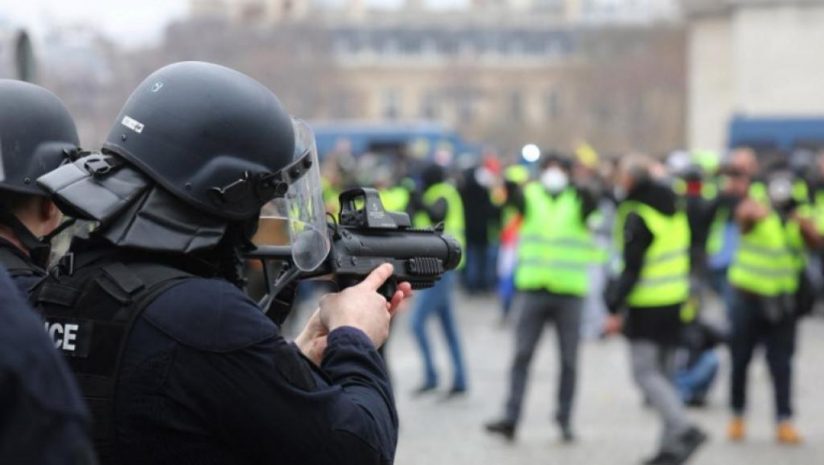
By Ramin Mazaheri | Press TV | December 23, 2019
Before I list the (often unnoticed, misunderstood or covered-up) chronological facts of France’s incredible Yellow Vest year, allow me to briefly summarize it with a personal anecdote:
In mid-April I finally was able to get out of Paris for a few days in between Saturdays and I headed to the countryside, which I adore (in any nation). After a day of decompression something hit me: the metronomic sadism of certain, massive state violence every weekend was not at all a normal state of affairs… and yet Parisians were expending all their psychic energy to convince themselves that everything was indeed “normal”.
What was “everything” from January to mid-April? Every Saturday: Eight thousand cops on the streets of Paris, entire city areas shut down, guaranteed images of violence against unarmed protesters, indiscriminate tear gassings and police brutality, the world aghast at French-style democracy, the knowledge that no way was “President Jupiter” Emmanuel Macron going to make any concessions and that for many people (like me) every Saturday meant certainly risking limb and quite possibly life.
What I realized was that during the first third of the year Parisians did their typical best to be blasé; to act as if all this was quite nothing new whatsoever; to act like getting upset over it was quite poor taste; to act typically Parisian.
That, of course, was total nonsense – pure poseur.
So what I mostly remember is how during this period was that the collective cognitive dissonance in Paris was so immense that it reached a generalized psychosis caused by mass denial.
I also realized that this denial of reality and subsequent psychosis can only be found in imperialist countries. “Our treatment of the aboriginals/those with whom we are living alongside and whom we colonized/non-Whites… is totally normal,” they insist, as they live under a shroud of silence and feigned “normality”. The unsaid reality remains unsaid by both colonized and colonizer (under penalty of social exclusion, jail, death), and the psychosis just mounts and mounts and mounts.
It is normal that this imperialist psychosis occurs in the European Union in 2019, as it is indeed a neo-imperialist project. The question the French cannot quite answer is: are they the still the colonizer, or are they now colonized?
But such questions are all of no importance to the politically regressive. Nothing to see here, even by the French who watch the nightly news – we cannot question “French exceptionalism”.
What do I know about the Yellow Vests? I contend that no “mainstream” journalist attended more Yellow Vest demonstrations than I did, at least in Paris. I would also suggest that while I did hundreds of live interviews from the demonstrations – while getting tear gassed, with rubber bullets flying around, literally in between Black Bloc and police – most journalists did zero.
This article was generated by me going back through my list of reports with Press TV in 2019 – it’s mostly headlines, quotes (mostly from interviews with Yellow Vests) and short excerpts from my reports. I pass on the highlights, and I also tie together the threads with the advantage hindsight – check the key date of March 16th to see what I mean.
If you are too busy to read it all, I suggest only reading March through May 1 – this is when the Yellow Vest demonstration was gutted via reactionary values which we can call “neo-Vichy”, with Brussels replacing Berlin as the master of France’s government.
I didn’t bother to provide a web link to the roughly 175 2-3 minute reports I made with Press TV in 2019, but I did include web links to a score of in-depth written reports I did specifically about the Vesters.
It was not at all an easy year, and I recall being quite exhausted by the summer. It wasn’t just the obvious stress caused by walking into a “near war zone” every Saturday – why on earth did the Vesters insist on marching 10-15 kilometers every Saturday? And so fast, too!
But, as they have shown, their endurance and determination is beyond remarkable. I’m glad the facts are on the record in one place, if only as an expression of admiration for them.
France Year in Review: The rise and rise of the Yellow Vests into a General Strike
2019 in France obviously has to be remembered as the year of the Yellow Vest rebellion.
It began in November 2018, and President Emmanuel Macron thought he had pacified it in December with a pittance of so-called “concessions”, but the rebellion continued.
Why, because as I wrote back then: “It’s just one protest… which has lasted 8 years”. They want you to view the Yellow Vests in isolation instead of as a historical continuum.
In early December every single person I asked agreed that they are a Yellow Vest. Biased, misleading and above all a lack of polling would attempt to hide the Yellow Vests amazing popularity the entire year. By September I was explaining Why France’s 20- and 30-somethings hate the Yellow Vests (foolishly, of course). However, no poll ever showed the Yellow Vests with an approval rating lower than 49%, and they are generally around 60% – this makes them by far the most popular political movement in France, even if not everyone joins their club. And above all: that is a simply enormous score for any protest movement, anywhere.
Many assumed the Vesters would stop protesting over Christmas because that’s what every political/social/union/labor movement had done for decades, no matter how much political momentum they had. Not the Vesters. Right then I knew that this was serious – they had different priorities.
By January it became clear that the French government was going to treat political protesters like football hooligans.
Jan 2 – Start by arresting their leaders for eating dinner
On December 20, 2019, the justice department would admit that France’s top police hierarchy were wrong to order the “disguised arrests” of key Yellow Vest leader Eric Drouet along with 42 others back on January 2nd. They were eating in a restaurant.
A “disguised arrest” is a euphemism for an arrest ordered by the Deep State: one is arrested without any true justification or reason, but simply because security agents have been ordered to do so.
Drouet immediately denied being a “leader”, because organisationally the Yellow Vests are indeed a grassroots, leaderless, “Latin anarchy-style” protest movement and not a political party. I eventually began referring to Drouet and others as “organisers”. Drouet does admit to eating nearly three times a day.
A column I wrote that week pointed out that, like the Vietcong, the Yellow Vests absolutely will not have the early demise which the Mainstream Media hopes for… because they have nowhere to go.
Jan 5 – Vesters surprisingly march after New Year’s Day
Brutal scenes as French cops refuse to let Vesters protest in front of Parliament, even though they had a permit to do so.
That is explanation for essentially all the conflicts between cops and protesters in 2019: protesters get trapped, in violation of their human right to demonstrate, hyper-armed cops use their weapons, protesters respond in a civic rage and in self-defense.
Turnout was down overall, but again, the fact that anything was organised at all was a huge, huge break with vacation-loving French culture. Of course, the media searches for any reason to insist that the Yellow Vest movement is abating, and they do so here.
Jan 12 – ‘Battle of Turnout Figures’ as France returns from vacation
The government claimed only 50,000 protesters marched, but the true figure was closer to 300,000.
Firstly, why are these numbers important? As a cop told me: this is a country of nearly 70 million people, so cops are never going to stand down unless there are 10 or 20 million people in the streets. He’s right. The people who foolishly think the cops are going to see the political light and “switch sides”, and also the people who think the Yellow Vests are just a hair’s breadth from getting Macron to resign, should re-read that.
A secondary point here is how very special and vanguard the Yellow Vests truly are for getting out on the streets: France was not anywhere close to a revolution which overcame their neo-imperial security state, but there sure were a large amount of people who were willing to try.
So numbers do matter, and that’s why the MSM’s parroting of an absurd official line (from their cozy newsroom) is so galling.
However, we should still accept that cops can actually be not reactionary. The poorly named “Union of Angry French Cops”, France’s third-largest cop union, consistently defied the Interior Ministry to give their own tally, mainly because the ministry was just outrageously low. The “Yellow Number” also made its 2nd appearance at this demo, and you can find all 3 of these crowd estimations here – the odd one out is the Interior Ministry.
The union believes the divergence is due to the fact that rural villages are constantly ignored by the government and media. The union has members actually stationed at places like rural roundabouts all day: they count the number of different people who arrive at a demonstration, and then leave, only to be replaced by new protesters.
It should be easy to see why the ministry’s figures are so absurd: why would the government routinely mobilise 80,000 policemen for what they are claimed from Valentine’s Day onwards was less than 47,000 protesters? (See January 27 note.)
Back then I couldn’t help but see the Yellow Vests as the harbinger of the bursting of the West’s “Everything Bubble” which Quantitative Easing has created. Who would have predicted that “QE Infinity” would be unveiled in September?
Jan 19 – Calm day in Paris for Act 10
It’s important to remember they weren’t all days of pitched war, but a lot certainly were until late March. Act 10 was mostly peaceful in Paris, but not elsewhere. Death toll at this point – 10 people.
Protests increase again. It has become clear the Yellow Vests are not going away, so the MSM grapples with trying to describe their class-based demands without violating their blacklist of the word “class”.
I laid it all out here: The Yellow Vests are calling for the world’s third Cultural Revolution, after China and Iran.
It’s not bias or exaggeration: They want to halt the functioning of normal society to have a serious, long, fruitful discussion about France’s role in the euro, the EU, NATO, Françafrique, the 5th Republic itself, austerity policies, foreign policy, environmental policies, housing, education, health care, pensions, etc. That link is Part 8 of an 8-part series I wrote this year to demystify the two state-sponsored Cultural Revolutions simply because the parallels between them and the Yellow Vests were so obvious.
Yellow Vests sure didn’t have state sponsorship, though. However, they did have a 60% approval rating at this time.
Jan 26 – French cops equipped with body cameras for first time
Absolutely nothing has come of this early demand aimed at reducing police brutality.
By the end of 2019 France has prosecuted just two cops for police brutality against the Yellow Vests. So how can we even know what has been recorded, when the cameras were even turned on, that is?
Jan 27 – Reactionary ‘Red Scarves’ demand Yellow Vests stop bothering the establishment
Finally, a demonstration which France’s media feels safe enough to cover!
The one and only such demonstration of this pathetic group. However, never has such a short-lived social movement received such fawning and massive political coverage. Where are the Red Scarves now – nowhere? Or rather: about to annoy the hell out of their family at Christmas.
Just prior to the movement a minister said that if 10,000 people showed up, then that would constitute a success and be a signal that the Yellow Vests have to stop: the Interior Ministry claimed 10,500 people showed up.
Many in the media would never once question the ministry’s figures on the Yellow Vest turnout despite their obvious self-interest to keep the numbers low, yet reported 10,500 despite the real-time indication over an inaccuracy which was widely obvious.
Feb 5 – Yellow Vests and unions march together for first time
Initially, a union member carrying his union insignia was as unwelcome as member of Macron’s political party. The Yellow Vests’ popularity and respect is largely based on their open rejection for not just mainstream politics and the traditional modes of French political culture, but also France’s idea that unions should lead socioeconomic protests. The Western “independent” union model, is perfectly calibrated to be “divided and conquered”, which has been the case in France since 2010, certainly; when unions “win”, the theory is that everyone else should just hope that their gains “trickle down” to the 90% of French workers who aren’t unionised.
This was the first time Vesters tolerated unions to march on the same city streets as them – the unity would be quite short-lived. I don’t blame them. In September 2019 I interviewed the head of a top farmer’s union: I gave her every chance to defend, even just mildly, the Yellow Vests, but she insisted that farmers had nothing in common with rioters.
This is exactly what a Yellow Vest told me that day: “The average union worker supports theYellow Vests, but not the union leaders, who have repeatedly betrayed us. The unions must finally end their selfishness, because everyone is against this government.”
Is it a rural-based movement, as is often said?
The only who people who say that are those who don’t understand/can’t admit that class is the single most dominant political lens.
Like all true revolutions, the nation’s “trash” had become the true political vanguard.
Feb 6 – France passes ‘anti-Yellow Vest law’ amid mass protests
The law allows police chiefs, known as prefects, to ban citizens from attending protests, a power which was previously reserved for judges. The law also gives police greater power to search citizens without warrants, and imposes fines and prison terms for any protester covering their face to avoid identification, or even of using a scarf to to avoid tear gas.
I recall earning some plaudits on the Champs-Elysées around this time. It was cold, and French riot cops were all covering their face to stay warm. I loudly told a cop that if he can cover his face against the law, then I should be able to wear my burqa, LOL. Easy for me to talk back in anger – I’m a journalist: the French protesters who did the same usually found themselves wrestled to the ground and arrested, with the wife screaming, “He didn’t do anything!” behind him.
This is another shift of power towards the executive branch and away from the judiciary and legislative branches, and especially the electorate. This process greatly accelerated under Francois Hollande with the 2-year state of emergency, the so-called “French Patriot Act”, and the repeated use of forcing through unpopular austerity-related laws by executive order. Macron would use executive orders even though he has an absolute majority in Parliament – he just wanted to avoided the bad press of open debate.
Feb 21 – Macron’s ‘Deep State’ scandal deepens with perjury charges
The Benalla affair – nobody knows about it outside of France but it’s Macron’s biggest one.
I would contend that a large reason it is not known outside of France because the constant implication is that Macron and Alexandre Benalla had a homosexual affair, or that Benalla helped cover up such an affair as Macron’s personal – and extremely law-breaking – bodyguard. The 24-year age difference between Macron and his wife helps fuel these rumours.
Regardless of these rumours, these charges came from an exasperated Parliament committee which concluded that Macron showed Benalla an “incomprehensible indulgence”. This “indulgence” was so extreme that nobody can possibly explain why a president would take such risks to protect such a person? It remains baffling.
Anyway, the problem is transparency/independence from blackmail/corruption. A Yellow Vest that week put things into perspective: “Look at the Benalla affair: there is overwhelming proof that President Emmanuel Macron’s right-hand man committed many crimes, yet he remains free, while Yellow Vests stay in jail! It is clear that there is major discrimination in the justice system by France against its very own citizens – some people have special privileges, but the Yellow Vests do not.”
Benalla served one week in jail, but only because he broke his bail – the average prison sentence for a Yellow Vest has been one year.
Feb 22 – Macron to outlaw anti-Zionism, sparking disbelief & outrage
“I’m not gay, but the Yellow Vests are anti-Semitic.” That’s not what Macron said openly of course, but the timeline worked that way.
The proposition was an attempt to slur the Yellow Vests, and to create a long-running distraction.
The resolution – not a law, but one step short of it – would be passed in December. What I found interesting was the huge amount of media coverage on it in December… after, not before, it was passed. I covered it before: it was mostly French Jews fighting against it, because it obviously unjustly makes all Jews responsible for the crimes of Israel. I’ve seen studies that half of European Jews are anti-Zionist. Of course, confusing anti-Semitism with the political, colonialist, segregationist project of Zionism is something nobody involved in politics should be dumb enough to confuse, but Macron did.
At the February 16th Yellow Vest march far-right ideologue Alain Finkielkraut was not welcomed, and called a “dirty Zionist”. This created much media uproar, despite the latter being 100% accurate. The Yellow Vests marched against anti-Semitism on February 19.
Combined with the looming Benalla scandal, anti-Semitism was a very useful distraction for Macron at the time. It was undoubtedly instrumentalised by France’s extremely powerful pro-Zionist lobby.
It gave me a chance to dust off a term I created during the Charlie Hebdo protests: 21st century France as a new “Holy Secular Empire”.
Feb 27 – Council of Europe urges France to stop rubber bullet use
Does anyone care about the Council of Europe, or any pan-European institution, really? Of course not, but it was notable that any major organisation condemned France back then.
For example, Human Rights Watch issued just a single condemnation of French police brutality in 2019 – against ecological protesters, not the Yellow Vests. Reports on Venezuela, Hong Kong, Syria – their reports are innumerable and their hypocrisy crystal-clear.
Five hundred critical injuries at this point; unions and France’s Human Rights League estimated that 10,000 rubber bullets had been fired at Yellow Vests. Most journalists in France still euphemistically calling rubber bullets “flash balls” or, even worse, “defense ball launchers”, which obviously assumes that the protester is always the aggressor.
Mar 6 – UN: ‘full investigation’ of brutality against Yellow Vests
The UN Human Rights chief properly recognised that, “The Yellow Vests have been protesting what they see as exclusion from economic rights and participation in public affairs.”
France totally ignored this, of course. The prime minister said the UN chief lacked the “full picture”, but he obviously summed up the heart of the matter.
However, ignoring condemnations of their police is what France does – French police have been condemned for police brutality over and over by the UN and top NGOs for many years.
During the labor code rollback protests in 2016 at least 4,000 protesters were arrested, with well over 1,000 people hurt by police in Paris alone, according to Amnesty International. Extrapolate those numbers nationwide. I covered all those demonstrations too – it’s why I always said that I perceived that the Yellow Vests were only 15-20% more violent than France’s “normal” violent demonstrations. Only the Yellow Vests ever graffiti-tagged the Arc de Triomphe, sure, but that was just a huge propaganda victory for the Vesters.
Mar 8 – Paris forbids Yellow Vest camp
Why wasn’t there a “French Tahrir Square”?
The Yellow Vests tried – cops weren’t even close to allowing a single sleeping bag get laid on the ground. They would have needed many thousands to establish a camp and I recall only 1-2,000 people being there.
It was a cold night back then. Would have still had to have beat back typical French police brutality, too.
Mar 12 – ‘Anti-Yellow Vest’ law adopted
Officially known as the “anti-rioters” law. This provided the “legal” basis for the oppression which would stem the tide (not turn it) of the Yellow Vests…. We got a couple good quotes from journalist/analyst George Kazolias explaining the law:
“But what really makes this law really dangerous, as one conservative member of Parliament put it last year, is that it’s a Vichy law, referring to the government that ruled France under Nazi occupation in World War II. This law gives administrative personnel judicial powers – it takes the power away from the judiciary. … So what he (Macron) has done now is to make at a local level what he has done at the national level with (unpopular laws which normalised) the state of emergency. I’m surprised not more people have tried to relate the two?”
And, now that massive repression had a new “legal” basis, the upcoming Yellow Vest march would be incredibly repressive and mark the beginning of the end of their long peak. But the day before that…
Mar 15 – Macron’s National Debate ends with universal dissatisfaction
The National Debate was 2.5 months of 10,000 local public debates. It was mainly a public relations effort by Macron to show that he is a president who does listen and who does incorporate public opinion into public policy… even though that is obviously false.
However, much of his time at these town hall meetings was Macron talking for hours and hours, like Fidel Castro. There are big differences between the two: Macron is pushing capitalism, imperialism and technocratism – Fidel pushed rejecting brutal capitalism, patriotism and morality in public policy.
At this point in his term Macron (begun May 2017) has never held a press conference. That is not a typo.
Perhaps this explains why it was “The Macron Show” for six hours a day on mainstream media. The sudden availability of Macron to the masses and journalists was a total 180 from the previous 22 months.
Rather amusingly (unless you are a minority Macronista) a key poll asked what people found positive to say about Macron regarding his method and style at the National Debate: the number one answer, at 48%, was “I didn’t find anything positive about Macron”. That was nearly double the second-most popular response.
So the National Debate had concluded, the laws were in place – the kid gloves came off. We knew it was coming – column here.
Mar 16 – Worst violence in months amid near-secret de-nationalisation machinations
This is when “Sarkozy’s restaurant” Le Fouquet’s was ransacked. (A quintessentially French place… yet they use a possessive apostrophe?)
I remember I got there early – it was already a war zone.
This is because before the demonstration could even start riot police used tear gas and water cannons to provoke the violence which would be required to justify the police tactic changes later this week.
Black Bloc was there, being useless as usual – I recall a protester at the Arc de Triomphe screaming at me, “Why don’t the cops do anything to stop Black Bloc?!” I debunked Black Bloc in a recent article: French Black Bloc’s utter uselessness… except to the French government. I repeatedly saw Yellow Vests intervene to stop looting on the Champs-Elysées; cops were filmed stealing football jerseys from the Paris Saint-Germain team shop.
A good quote from a Vester that day: “Just like at the beginning of the movement, it was the same old tactic from our government. They want the protest to degenerate as quickly as possible in order to discredit the movement. They launch round after round of tear gas, to the point where people are stepping on protesters who have fallen down! They want to scare us into staying at home, but we will never stop protesting!”
Interesting note I have in my report: “Despite 18 consecutive weekends of protests by the Yellow Vests, France’s unions have taken to the streets only rarely this year.” It’s key to remember how independent and isolated the Yellow Vests were – they fought time after time all on their own: they really are like a family.
Shockingly, Macron chose this weekend to go skiing – the photos appall the nation. On seemingly every major day of protest during his term I have noticed that Macron is never in Paris, and often out of the country. Of course, since the Yellow Vests the big establishment fear is that they will reach Elysée Palace near the Champs-Elysées. However, as I am a fellow 41-year old man… he rather acts like a scared old man.
Macron is celebrating because he has given the incredibly anti-democratic orders which will mark the beginning of the “end” of the Yellow Vests – more such orders arrive in days.
However, one final kick in the teeth: At 6:15 in the morning on Saturday March 16th Macron surprisingly called for a Parliamentary vote regarding the biggest wave of privatisation in 15 years. Only 45 of nearly 600 deputies were present, and the bill was approved. Widespread media explanation would later be required to explain why the vote was still legally-binding despite such low parliamentarian turnout. You think I’m making this up don’t you, LOL, but this is the actual chronology.
It would take a couple weeks before this de-nationalisation became a media issue. Think there weren’t monetary reasons for Macron to sic the armed forces on the Yellow Vests to begin with? De-nationalisations to benefit his friends and backers of his meteoric rise put yet another monetary motive at play.
The Yellow Vests would successfully prevent the airports of Paris from being privatised (at least so far), but Macron would sell off more than 50% of the national lottery in November. I didn’t get it: neoliberals say that any state business which doesn’t make profits must be privatised… yet the highly lucrative state gambling monopoly has to be sold off, too? It’s almost as if neoliberals rely on faith instead of facts, logic and history….
Here’s a live interview I did at the Parisian bank which was firebombed – surely the only live interview from there that day, and probably the only “mainstream” media interview which gave an objective explanation of why it happened.
Article I wrote about the March 16 protests. I started with: “Because if Saturday March 16 was a ‘war zone’, then France has been at war since 2010 – I didn’t see a single thing out of the norm for France.” Doctors and nurses treating the wounded disagreed with me over and over – they said the injuries were what they had seen in war. I never said journalists were always right….
Mar 23 – French army doesn’t deter massive Yellow Vest protests
For the first time since the Algerian War for Independence the army was used inside France against the French people. Just prior to Act 19 a French general reported on live radio that he had authorisation to open fire on protesters.
Furthermore, on March 18 the Paris police chief was fired. Part of the reason was given by Prime Minister Philippe: “Inappropriate orders were given to reduce the use of LBD [rubber bullet launchers].” Imagine if Putin had said that?
The new chief looks, and certainly acts, like he would have been quite at home in Vichy France, which is precisely why he was hired. His uniform always appears to be a couple sizes too big for him.
Protests were now officially banned in key parts of urban areas, like the Champs-Elysées. Bans in rural roundabouts would begin in early May (but I thought this was a rural-based, not class-based movement?).
Should we be surprised that Yellow Vest numbers are about to plummet?
In January there were an average of 350,000 protesters per weekend; February 240,000; after March 23rd they reached 100,000 people maybe twice and then never again.
If you are a clueless, secretly-reactionary/fake-leftist Mainstream Media journalist this is what you think in your empty head: “Oh, the numbers have only fallen because the Yellow Vests aren’t popular anymore. Yes, I will accept that promotion, thank you boss!”
So March 12-23 should be remembered as when France became a “neo-Vichy” government. Instead of Berlin, the master is Brussels.
They didn’t destroy the Yellow Vest movement, but they did scare the hell out of the average person.
Mar 28 – French cops wearing Yellow Vests to infiltrate movement
It was discovered that on March 16 cops were wearing Yellow Vests to disguise themselves.
The police union noted that there is no formal law against disguising themselves as protesters, so that should settle the matter
Good Vester quote: “We don’t know if we should fear our own government, or if we can trust it? Such video revelations are going to increase the accusations that the government is pulling the strings with secret militias inside political demonstrations. That sounds like a conspiracy, but these videos give such ideas obvious legitimacy.”
March 30 – Mayor demands city become a “ghost town”
Mayor of Bordeaux commanded citizens to not leave their homes that Yellow Vest day. The phrase “Bordeaux strong”, unlike in Boston, did not become commercially popular.
Again, Mr. and Ms. MSM Journalist – might this explain the drop in attendance? And perhaps also the unveiling of harsher tear gas, guaranteed fines for violating the ban, warrantless searches (Do the women you date even let you go through their purse?), increased arrests, the refusal to engage with Black Bloc despite the vast superiority of the professional armed forces, and on and on? This is why I didn’t get very far in the French newsrooms I worked at….
Similarly, the Yellow Vests insisted on their right to freedom of assembly and defied the bans.
Why? Let’s ask a Vester: “I worked from the age of 14 until the age of 60, and in my entire life I accepted only 1 month of unemployment insurance. And yet, in the last 4 years I have seen my pensioned lowered from 1,150 euros to 1,050 euros. My rent is 800 euros a month, so I cannot afford to live, and I will never accept this injustice.”
Several ministers resign this week, but this is hardly newsworthy with Macron.
April 4 – NGO says 3,000 homeless died in France in 2018
Macron made zero deaths due to homelessness a key campaign promise.
April 6 – Last time anyone counted over 100,000 people at a Yellow Vest demo
Thus, this article is going to start getting shorter. Yellow Vests popularity stands at 53%.
Half the country supports them, but from behind their curtains now.
April 10 – Massive rejection of Macron’s ‘National Debate’ results
The government declared that the main conclusion of the debates is that taxes should be lowered, which is what every peasant under French rule always said.
Reversing Macron’s elimination of the very popular “Wealth Tax” will not be discussed as a possible result, nor is deviating from nine years of austerity budgets: the Yellow Vests continued marching would reverse one of these.
Polls show that just 6% of France called the National Debate a success while 80% said it will not resolve the current political crisis.
April 15 – Notre Dame ravaged by fire, world mourns
In an amazing coincidence, the fire started just an hour before Macron was to reveal his personal conclusions of the 2.5 month so-called “National Debate”.
This was rather a cherry on top of a terribly bitter social sundae which had been forced down France’s gullet thus far in 2019.
Considering how catastrophic it looked on TV, I truly thought it looked pretty good when I saw it the next day.
April 20 – Constant cop violence as Yellow Vests begin 6th month
Key anniversary = higher turnout = more repression. Worst violence in weeks.
Me impersonating an MSM journalist: “Don’t you think that because of the fire at Notre Dame you should stop marching in order to promote national unity (even though this is a “secular” country)?”
French Yellow Vest quote: “The fire at Notre Dame touched everybody, but there is a big controversy over how we could raise a billion euros for a church so quickly, and why we can’t raise such an amount for poor people. There is a lot of anger, and a fire at Notre Dame is not going to change this logical reality.”
The last time the Yellow Vests touched 100,000 protesters, but only by rounding up.
April 24 – Record suicide pace for cops amid Yellow Vest demos
April 25 – Journalists help Macron ignore Yellow Vests at 1st presser
Incredibly, Macron has finally held his very first press conference.
Prior to that he and I had held the same number of press conferences since May 2017. Key difference: I am not the popularly elected president of a country. I am, however, the authoritarian and arrogant leader of “Raminia”.
Incredibly, and we can add another “incredibly” on top of the first “incredibly”: this is when Macron said the words “Yellow Vests” in public for the first time.
Less incredibly, considering the toadying, social-climbing French media class, the mainstream journalists permitted to attend the press conference (Iranian media is banned from official press conferences of the president, PM, FM, etc.) dared to ask Macron just one direct question about the Yellow Vests. The question was posed by the extremely mainstream anchorwoman Laurence Ferrari, and kudos to her: every other journalist failed.
Here was Macron’s initially nihilistic answer, via an explanation which is totally acceptable in Anglophone countries, which are also politically nihilistic; he then switches to total defiance based on technocratism: “We are a country where disagreements are expressed forcefully and where there are always protests. I totally take responsibility for having not given way – during my first two years – to those who want to set back our projects which I deeply believe are good for the country.”
Two subjects which were never mentioned by anyone were the routine police brutality, nor Macron’s raft of anti-democratic measures such as the “anti-Yellow Vest Law”.
Polls showed that 65% of France said they were unconvinced by Macron’s answers. Nearly 80% said he did not address the concerns of the Yellow Vests.
Despite a record-low approval rating of just 27%, Macron said he thinks it “would be best” to stand for re-election. No serious policy changes were announced, because the conclusion that Macron drew from the National Debate was, “Our approach over the past 2 years has been right.”
Ugh… I’m glad I’m banned from there.
May 1 – Record cop violence at huge Paris May Day demo
This was a rough one… it was certainly no celebration of International Workers’ Day.
Never saw so many cops – every 50 meters there was a phalanx of cops along the marching route. People who think Western, liberal democratic, aristocratic (bourgeois) governments don’t fear socialism – explain the measures taken on May 1, 2019?
Long story short: in order to prevent a unified demo at the end the cops used the classic tactic of “divide and conquer”. They repeatedly severed the march, allowing one part to advance to the end (where they were gassed and chased out), while cops fought pitched battles with the section that was kettled and prevented from marching freely. After several rounds of this the streets were a shambles – protesters, unarmed of course, needed to find something to protect themselves with.
This produced the MSM hoax of an alleged “hospital invasion”, which I debunked thoroughly here. Briefly: that day MSM and politicians got apoplectic that protesters – cornered by cops using tear gas, water cannons, batons and rubber bullets – tried to take refuge in a hospital. What those armchair idiots and “hotel room journalists” don’t know is that when tear gassed one moves (don’t run!) in one direction: away from the gas. The only direction left to protesters was jumping a hospital gate.
Mainstream idiots everywhere said protesters were “invading” the hospital. It took a couple days for the truth to come out – only two old, apologetic men actually made it inside the hospital, saying they had been “tear gassed all day”. The internet reactionaries who vengefully and gleefully insist that “Yellow Vests are rioters and they get what they deserve”… they really have no idea what they are talking about.
What I remember from that day is: I’m trying to give a live interview in front of the hospital – amid all the “flash balls”, flying pieces of pavement and tear gas – and the newsroom in Tehran is insisting that I remain motionless in order to “set the frame”. “How on earth are me and my cameraman supposed to stay motionless and not wind up seriously hurt! Just put me on the damn air!!!” Aggravating…
I recall only one other journalist doing a live interview during all that violence – a female journalist for Italian TV, as I recall. Kudos to her. French media? Fuggetaboutit. French public media, who are paid by French taxes? Fuggetaboutit. I’m sure RT was there, but I didn’t see them. I bet they were wearing a helmet, though – I never did once. LOL, a bit of leniency for my egotistical behavior, please: I had been “tear gassed all day”.
On December 19th the first police officer would finally be convicted for police brutality – he was filmed throwing a piece of pavement into a crowd of protesters on May 1st. Apparently his rubber bullets, tear gas, water cannon and truncheon wasn’t enough? He got a minor sentence, no prison time, his identity was not divulged, nor will the conviction even appear on his legal record.
That was the last rough one… for a while, at least. Not sure that’s a good thing.
May 5 – France bans Ramadan, citing secularism & economic stagnation
I never did write that satire… don’t know why? Would’ve been funny. Probably tired – Ramadan had just started, after all, and I had been tear gassed all year. Maybe for 2020.
Just checking to see if you are still reading!
May 8 – France began killing 45,000 Algerians on WWII V-Day
Oh, MSM journalists, where you marking the defeat of European fascism in World War II that day? Why?
France also bombed Damascus that May. Syrians booted the French out that year, thankfully.
May 9 – First major Yellow Vests victory – no to de-nationalising Paris airports
This week the Yellow Vests scored their biggest victory yet, by forcing parliamentarians to accept a referendum on Macron’s attempt to denationalise the airports of Paris.
A column here about stopping the Yellow Vests stopping of denationalisation, and why you never hear that word.
Last week I paid 9 euros to travel for about 15 minutes of travel on a privatised French highway – this is why Yellow Vests demolish tollbooths. Aren’t air tickets costly enough already?
May 11 – France bans rural protests for Yellow Vest #26
Many French media gleefully speculated that the Yellow Vest movement was finished, but 60,000 protesters turned out yet again, despite the government’s efforts to intimidate people in both urban and rural areas.
May 15 – 72196 – Macron at 2 years: 76% policy rejection
A recent poll covered 14 vital questions and sectors, ranging from economics to immigration to security and more. Respondents gave Macron a whopping 76% failure rate on society’s most important questions.
So 24% of respondents support Macron, which was his exact score in the first round of the 2017 presidential elections.
This 24% was also his true score in his victorious second round, due to the highest abstention in 40 years, and the fact that 43% of voters only voted for Macron to block the far-right’s Marine Le Pen. He only won a majority in 2 of France’s 101 departments, after all.
But Macron and his supporters have always manipulated this to claim that he has a “mandate” for his program, especially the pension junking. Yawn… stupidity is boring, but especially when repeated.
May 25 – Mass arrests as Yellow Vest demos go ‘wildcat’
Vesters had been applying for permits… and getting massively repressed. So they went “wildcat”… and got massively repressed.
Yellow Vester says “Ya Hossein!”: “We will continue no matter what the results of the (upcoming EU) vote are. There are too many people who have been hurt, blinded, and killed, and we must think of them. All we have ever asked for is not to keep starving at the end of every month, and to protect our children’s future.”
May 27 – Another loss for Macron as far-right wins EU elections again
We really should care about the EU elections… or focus on a Frexit.
The three Yellow Vest lists combined for less than 1%. Hey, it took Italy’s 5-Star Movement eight years to win power.
Incredibly, the animal rights party scored 2.2% of the vote. The only solution for such people is immediate deportation to India, preferably under a cloud of tear gas.
June 22 – Scores of Yellow Vests blockades on Act 32
The Yellow Vests realised that the French government doesn’t respond to peaceful protests with anything but repression. That’s why this week has marked a change in tactics: blockades which can affect the economy, like at ports, refineries and toll booths. Scores of blockades were reported around the country, but received scant media attention.
If a blockade falls in the woods and no one hears it, does it make a sound? (Uhhh, yeah, it’s called science: sound waves.)
By this point in the year the French media had effectively enforced a blackout on the Yellow Vests, and the Vesters knew it and were incredibly upset about it.
From June 1 until well into autumn only Iranian media reporters (in English & French (me), Spanish and Farsi) and Russian reporters were doing anything at all about the Yellow Vests. People began to question why I had to work on Saturday: “I thought the Yellow Vests are over,” they asked?
France’s media and artistic communities are increasingly being called out with disdain by Yellow Vests. The nation’s private media follows a pro-corporate, pro-austerity line, and the state media either doesn’t cover the protests or simply parrots the government’s statements without challenge. After seven months very few from France’s intellectual circles have dared to publicly defend the Yellow Vests or condemned the government’s repression, and seemingly none have personally joined the protests.
Yellow Vest quote: “So many of these types have been bought off by Macron and are happy to stay in his pocket. Pensioners, the jobless and public workers have been marching for seven months and our so-called intellectuals spit on us! We are getting beaten and gassed, and they criticise us!”
June 24 – French polling agencies ignoring Yellow Vests
Modern media runs a lot of stories based around polls but the latest poll, which gave Yellow Vests a 50% approval rating, dates from two months ago.
More than half the country believes the media has done a bad job covering the Yellow Vests, but that poll is from 3.5 months ago.
Just as there is a revolving door between Western finance ministries and the biggest private banks, there is also a revolving door between the top level of French politics and its polling agencies. Francois Hollande’s former spokesperson, Najat Vallaud-Belkacem, is now a top polling agency executive, for example.
This is a problem for governance of any ideology. The Chinese Communist Party is often called “the world’s biggest polling agency” for good reason, whereas in France their leaders believe public opinion matters once every five years.
Column here about the incredibly uncool, constant MSM claim that rock and roll is dying the Yellow Vests are dying.
Another column here which compared the West’s beloved Hong Kong protests – who are so nativist they make Marine Le Pen look like a cultural centrist – with the far, far greater violence in France.
July 3 – French ‘cyber hate’ bill targets Yellow Vests & Palestinians
July 14 – Champs-Elysées a war zone again on Bastille Day
First time the Yellow Vests protested on the Champs since March 16th.
It required a couple hours of trying to lose the cops until the Vesters finally snuck in and won the field. My producer faulted me for doing a live interview with no Yellow Vests around – uhhh, they were outrunning cops on motorcycles, they can outrun me and a cameraman.
Yellow Vest quote: “Tourists are getting tear gassed and witnessing major violence, when they are only here out of curiosity. Some people are led to believe that only bad people get tear gassed, but these tourists now know better. If the tourists had stayed a bit longer they would have been beaten, as well.”
Bastille Day… I mean, what the heck – y’all lost! Bastille Day celebrates the temporary victory of the French Revolution in 1789. In 1804 Napoleon declared himself emperor, and the house of Bourbon was firmly restored in 1815. Does anyone else’s national holiday celebrate a loss? No wonder the French are so depressed. Or at least get out there and feel bad about it in a united way, like Shia with Karbala. Bringing this up this French exceptionalism is another reason I didn’t get far in French newsrooms….
July 17 – Macron’s #2 forced out over corruption charges
On the taxpayers’ dime the minster, who only looked up to the prime minister, was having lavish dinners with jumbo lobsters and 1,000-euro bottles of wine, bought a gold-leaf hairdryer, had a 3rd chauffeur to take his kids to school, and government-subsidised housing despite a high salary.
He tried to blame his wife, a nonsense socialite journalist (thus the gold-leaf hairdryer, I assumed), and never repented – he had gotten that high up by constantly clamouring against government corruption, so it would be like saying his whole career was a lie (which it was). I recall a top France24 anchorman writing on Twitter how Lobstergate was merely “mostly about the optics”. The top mainstreamers all see things the same way, which is: the masses just don’t understand that we at the top deserve these fancy things.
For those who remember Hollande’s “the homeless are toothless” comments, this provoked similar outrage and perpetually amusing demonstration signs.
July 20 – Yellow Vests honor Black Muslim killed in police custody
Yellow Vest quote: “I didn’t suffer from police or state repression because I am White and because I don’t live in a poor area, but because I joined the Yellow Vests demonstrations I have now suffered from police violence. This issue concerns everyone.”
Nice to hear, White guy – French Muslims have decided you are cool now.
July 25 – French joblessness up 73% since 2008 crisis
Just do the math properly, and add in all of France (don’t exclude their overseas colonies, as the French MSM does): The total number of unemployed people stands at 6.2 million people, 73% higher than in September 2008.
My editors pushed back – they questioned my data. “You know the official figures show that the number of the unemployed people fell in the second quarter,” they emailed
I was glad to see they were paying attention: nobody in France tells the truth about the jobless data, so it was natural that my headline stuck out to them.
I wrote them: “The Mainstream Media is totally biased in favor of the gov’t and capitalism. They are trying to report, absurdly, that a 16,800 decrease in a nation of 65 million is a success!!!!! It is totally absurd. Just look at this Le Monde graph – unemployment is one constant, terrible rise since 2008. No honest media can portray French unemployment efforts as a positive! Again, the MSM are a bunch of (dummies) who are totally inferior to we Iranian journalists! They try to confuse everyone, but our report is good and 100% fact-based.”
The story ran. The Western MSM continues to talk about their “economic recovery”, buttressed by the same “statistics-minus-analysis” which our report rejected.
Are Iranian journalists superior? I’ve met many who aren’t, LOL. But journalists gotta push for their story….
July 27 – 72863 – Yellow Vests march for 37th week amid media silence
Not much going on – hot, marching and lots of cops around.
Aug 28 – 73133 – Amnesty slams state violence at G7 summit
Still waiting/not-waiting for Macron’s promise of an Iran-US summit “within weeks”….
A huge force was deployed to completely lock down the southwestern town of Biarritz for the G7 summit. Macron did not want to be embarrassed by the presence of Yellow Vests, whose presence would also undermine the West’s claim that their democracies are superior to those in other parts of the world, so all protests were banned.
The theme of the G7 meeting was “economic inequality”, which many Vesters found ironic – Macron stole their ethos.
Aug 31 – Yellow Vests complete summer of record mobilisation
First protest movement to not take a Christmas vacation – now the first to not take a summer vacation.
Most widely cited reason I heard from Vesters? “I can’t afford a vacation.”
Sept 6 – Paris lodging breaks €10,000 per square meter mark
The QE “Everything Bubble” obviously includes real estate.
Not just buying, but rented, too: This same month my landlord would insist that she is “Landlord of the Year” for spending a few hundred euros on minor repairs for the first time in seven years.
Sept 13 – ‘Black Friday’: Biggest train strike in France since 2007
Don’t get it twisted: all this year there had also been constant labor protests, especially with hospitals, unions and pensioners – I’ve just been focusing on the Yellow Vests here.
The Macron era has been constant protests during the spring and fall months, or basically any non-vacation period.
Sept 16 – More mass strikes in France against cutting pensions
Sept 17 – Brigitte Macron to go back to teaching
Somehow, a woman who admitted to having an affair with a minor-age student (Emmanuel Macron) is being allowed back into a school in a leadership position.
That is incomprehensible, but so is how she escaped prosecution back when Emmanuel was 15 years old. Answer: she is a chocolate heiress.
Nobody knows the exact date of when their relationship was consummated, but it is widely assumed that she is guilty of statutory rape. The mental effects on little Emmanuel I speculated upon here, in a decidedly non-tabloid/Trump-coverage fashion, which I also contrasted with the effects of similar rape on young Ike Turner.
Sept 19 – French media darling Eric Zemmour guilty of Islamophobia
After summer vacation the government and MSM began a huge wave of Islamo-distractions as a way to divert attention from the certainty that Macron was going to junk the pension system in favor of neoliberal nonsense.
As expected, the new, daily presence of far-right ideologue Eric Zemmour on France’s #2 news channel has produced a steady stream of anti-Muslim and anti-immigrant vitriol.
Sept 21 – Worst French violence in months at Yellow Vest #45
Who is dumber, Black Bloc or climate change protesters? Both were out in spades. I wrote about the day here.
LOL, when Black Bloc struck all the eco-nuts – swilling champagne, dancing to techno music, clearly quite serious – simply started marching in the other direction. Cops showed them that was not allowed in France, no matter how much fun they wanted to have.
Sept 26 – Macron turns to right on refugee crisis
But I thought he was a “centrist”? Obviously he never was on economics, but pay attention and you’ll find that to the MSM nearly all of the wealthy class are alleged “centrists”.
Islamo-distractions obviously continue.
Sept 27 – Yellow Vest force end to 9 years of austerity
A huge Yellow Vest victory!
But nobody seemed to care. Uhhhh, weren’t we all protesting austerity in Europe for the past decade? I write about the victory/non-recognition of victory here.
Macron backed down because he feared that yet another austerity budget would have provoked more social unrest – he wanted to save his powder for the pension rollback, which will save the 1% infinitely more money.
Oct 6 – Ramin Mazaheri’s birthday: your present has still not arrived
Oct 19 – Georges Abdallah, EU’s oldest political prisoner, marks 35 years
Please send my presents to the “Arab Nelson Mandela”. Read more about him here.
Oct 20 – French poverty skyrockets due to Macron’s reforms
Last year alone a shocking 500,000 people were forced into poverty. That represents a rise of almost one full percent in the national poverty rate, which is now at 15%. The total number of France’s poor people has reached a level not seen since 2010, the darkest days of the start of the Great Recession.
Oct 29 – Strikes build as Macron refuses to table pension rollback
Wildcat train strikes are grabbing headlines, while health care staff continues to strike as well. December 5th is now being promoted as the day to start a general strike.
Oct 31 – French 3Q growth ekes out 0.3% thanks to Yellow Vests
Economic growth was boosted by the 10 billion euros which the Yellow Vests forced out of the government last December. That money increased household spending, which kept France out of the negative last quarter.
Unfortunately, the increase to economic growth is only temporary because the government has refused to put more money into the everyday economy.
Also, 0.3% growth is terrible – many MSM have forgotten this.
Nov 2 – Yellow Vests protest Islamophobia on Act 51
I wrote back in April about how France’s Muslims support the Yellow Vest, contrary to MSM complaints.
Nov 7 – Financing terrorism in Syria charges stick for France’s Lafarge
But not crimes against humanity.
From 2010 to 2014 French concrete giant Lafarge paid over 13 million euros to terrorist groups like ISIL in order to keep their plant in northern Syria running. Six million tons of concrete they produced was used by terrorists for fortifications – reportedly the largest on any battlefield since World War II.
Seemingly never reported in the West – and on the day of this news as well – is the crucial leaked testimony which proved that the French Foreign Ministry knew all about Lafarge’s dealings with the terrorists, was in “permanent contact” with the company, and told Lafarge to “hold on” and “that everything would work out”.
But the problem is Islam itself, right? Wrong.
Nov 16 – Massive violence as Yellow Vests mark 1 year of revolution &repression
What appears undeniable is that the Yellow Vests have redeemed France’s claim to possess a political spirit which is revolutionary, egalitarian and unique. I break it down here.
The Yellow Vest Sacrifice Tally: The Yellow Vests were so righteous that they succeeded in attracting first-time protesters. These political innocents were often among the 11,000 arrested, the 2,000 convicted, the 1,000 imprisoned, the 5,000 seriously hurt and the 1,000 critically injured. Ya Hossein!
Yellow Vest quote: “Yes, I am proud of the Yellow Vest movement. We are trying to fix France’s many fundamental problems, and we never stopped despite all the repression. What’s shameful is that we didn’t start sooner, and that our leaders totally ignore us.”
Briefly: no chance at a peaceful protest was permitted, again. In a new twist, cops cancelled the permit at the last moment. This allowed them to trap everyone at the Place d’Italie roundabout for hours. For hours we all walked in circles like a clock’s hands, but trailed by a constant cloud of tear gas. This gave the MSM all the footage they needed to keep discrediting the movement on its anniversary.
People were enraged, trapped and tear-gassed – are we surprised petty vandalism occurred? Cops never once stepped in to stop vandalism, either – they were only concerned with not allowing people to march peacefully.
See note on December 20.
Dec 5 – French general strike begins amid huge walkouts & protests
France’s largest general strike since 1995 got off to a roaring start as 90% of public transport was shut down nationwide and workers walked off the job in massive numbers. Well over a million people marched against the radical pension rollback threatened by President Emmanuel Macron.
Dec 9 – ‘Black Monday’ as French general strike gains steam
Everyone expected four days/a weekend of shutdowns – this day proved the general strike was serious. Eighty percent of public transport would be shut down through Christmas.
We’re general striking, baby!!!!!!
Dec 11 – Macron unveils new pension plan to widespread rejection
The government only released the details a week into the strike. The delay was obviously because they they are so radically right-wing that the government feared inflaming people even further.
No nation has a universal/one-size-fits-all pension system, and for obvious reasons which I explain here. The idea that France, a “socialist” country to Anglophones, could be the very first shows just how Americanised Macron wants France to become.
Or is EU-style liberalism even worse? Considering their structures is so very much more neoliberal and anti-democratic, it’s very possible….
Today the head of France’s largest union, the “moderate” CFDT, gave Macron a very obvious out: remove the 2-year back-door hike to the retirement age and his union will accept the radical new “points” pension system. Very unfortunate he did this….
How greedy is Macron? Sarkozy already raised the retirement age by two years just nine years ago.
The unions have signed off on every major austerity reform, after all – they get a “good deal” for their members and the rest of the country can take a long walk off a short pier. Will the general strike be different? If Macron will make this deal offered by the CFDT the general strike will likely collapse. Macron has never compromised so far, unlike Hollande, but I will be surprised if doesn’t take what he can get here and run: how many years like this can France take?
Dec 17 – Day 13 shocker: Macron’s pension minister quits over corruption
LOL, you can’t make this stuff up. This was the night prior to the 3rd million-person march against the pension scheme.
The architect of the reform admitted to receiving huge salaries from private groups even after taking public office. French media detailed more than a dozen conflicts of interest between these jobs and his public post.
He quit to try and save the reform. Common sense dictates that his plan is obviously the fruit of a corrupt mind/worldview… but no chance it’ll be withdrawn by Macron.
I asked a Vester their thoughts: “His resignation gives us hope that even more ministers will soon join him! What he did was extraordinarily shameful. How can we possibly allow his ideas to govern something which affects the whole country?”
Macron has now set the record for minister resignations – nearly all due to corruption allegations – only halfway through his term.
Dec 20 – France Telecom found guilty over provoking mass worker suicides
Telecom company Orange guilty of the same charge, and was fined €75,000, the maximum. Corporate logic: what’s a €75k fine if we can make workers life so miserable they quit and we can get them off the books? All it takes is years of daily, methodical, heartless harassment. The suicides were in the 2000s, but France’s wheels of justice work slow.
Conversely, on December 16 a Yellow Vest was fined €72,519, plus one year in jail, for degrading the statue of a French general at Place d’Italie on November 16, the Yellow Vest’s birthday. “I saw red – I cracked up. The meltdown lasted 10 minutes,” he testified.
Quite a contrasting story, motive, and punishment for him and France Telecom & Orange, eh?
Dec 21 – No Xmas vacation for France’s Yellow Vests once again
Yellow Vests march instead of going vacation for the 2nd time. They continue to put the nation first.
This was also Macron’s birthday – he is a Yalda baby. Yalda is a pre-Islamic holiday celebrated in Iran which marks the darkest, coldest night of the year – the winter solstice.
Feel free to make your pagan astrological inferences about how Macron’s birthday relates to his personality here.
The rest of the year and 2020
Unions have announced a very strange strategy: remain on strike, but no nationwide protests until January 9. If you aren’t working and getting paid, why not at least enjoy some solidarity at a protest? A general strike works because it touches the profits of the 1%, so it will continue to work… but still, it’s odd.
Of course, it’s the small businessman who is less able to defray the costs of a general strike than a corporation, but what choice is left to the French public? A general strike which does not end is called “revolution”.
The General Strike will thus certainly extend into 2020. Like the Yellow Vests its support is around 60%. Polls show those who oppose it are Macronistas and old people.
Macron’s popularity plummeted, and never recovered in January 2018. That’s when his first budget came into play, and seniors saw how his neoliberalism gutted them. To avoid repeating this political mistake, his pension “deform” is a version of the two-tier system used to sow inequality among the bailed-out US auto companies in 2008: only people born after 1975 (like me) will see their pensions reduced. Macron had originally wanted it to affect everyone born after 1963, and this is being dubbed a “concession” of his by the MSM. He is creating long-term generational conflict an disunity.
After the pension reform Macron will inflict the same radical rollback to the unemployment system, which will be nearly as contentious. France accepts far lower wages than in the Anglophone world because they have good pensions, unemployment, health care, etc. However, there is a belief among France’s leadership that the French will accept losing all this, despite stagnant wages. 2019… that theory didn’t work out so well for France’s leadership.
So we can count on two things for France in 2020: more social unrest, and the courageous Yellow Vests.
Tough year, but first one that I’ve been here that there’s a political force France can be proud of. Kudos to them.
Ramin Mazaheri is the chief correspondent in Paris for Press TV and has lived in France since 2009. He has been a daily newspaper reporter in the US, and has reported from Iran, Cuba, Egypt, Tunisia, South Korea and elsewhere. He is the author of the books ‘I’ll Ruin Everything You Are: Ending Western Propaganda on Red China’ and the upcoming ‘Socialism’s Ignored Success: Iranian Islamic Socialism.’
Merry ‘Bloody Christmas’: Venezuela Uncovers Guaido’s Plot to Provoke US Intervention

© REUTERS / Manaure Quintero
By Tim Korso – Sputnik – 23.12.2019
Venezuela reported on 22 December that at least one of its servicemen was killed in an attack on a military unit by unidentified gunmen. The latter reportedly sought to rob an ammunition depot, but ultimately failed, with some of them ending up detained by Caracas’ forces.
Venezuelan Minister of Popular Power for Communication and Information Jorge Rodriguez has reported that investigators have uncovered a plot organised by a group loyal to opposition leader Juan Guaido and involving the governments of Peru and Brazil. According to Rodriguez, the plot, called “Bloody Christmas”, suggested attacks on several military units across Venezuela.
In addition to this, the minister said that the members of “Guaido’s group” were planning to shoot down a Colombian Air Force plane using missiles stolen from the Venezuelan military in a staged false-flag attack on the country’s neighbour. The plotters allegedly planned to thereby give the US a pretext to start a “war” with Venezuela.
Rodriguez stated that some of the missiles and assault weapons stolen by the plotters have been recovered, but others remain in the hands of those who are still at large. According to him, a total of 9 RPG rocket launchers were stolen, though it’s unknown how many have been returned.
Attack on Ammunition Depot
Earlier, on 23 December, Venezuelan authorities reported that one soldier was killed as a result of the assault on one of the country’s military units by unknown assailants, which sought to rob an ammunition store. After the attack was repelled, Venezuelan authorities managed to capture some of the gunmen.
An investigation has been started into the incident, but it is not immediately clear who orchestrated the attack.
Back in April 2019, Venezuela experienced an unsuccessful coup attempt organised by opposition leader and self-proclaimed interim President Juan Guaido. The latter appealed to the country’s military to stand against democratically elected President Nicolas Maduro, although only a few of them heeded the call, resulting in the coup’s failure. Guaido has since then fled abroad along with some of his supporters.
Featured Video

Yemen joins the war – Red Sea could be blocked next – Saudi regime at risk
or go to
Aletho News Archives – Video-Images
From the Archives
A superpower and “the world’s sickest warrior state”
By Paul J. Balles | March 8, 2010
Living through five or six major wars has hardened me to what I thought were the extremes of inhuman cruelty and brutality.
Two things made those extremes almost bearable: the brutality always revealed – at least according to the media coverage – the viciousness of the enemy. It was therefore quite understandable when our “brave men and women” pulverized the enemy.
Films of Japanese torturing captive Americans somehow justified holding Japanese Americans in internment camps during World War II; and only a small percentage of Americans found the bombing of Hiroshima and Nagasaki unreasonably vengeful at best, at worst, depraved.
The media giants in America portrayed the North Koreans as barbaric beasts with their captives, quite unlike their southern counterpoints – our allies during the Korean War. No one ever felt the need to explain how the South Koreans were a civilized breed while the North Koreans were absolute savages, at least according to the official line.
In Vietnam, our warriors justifiably (or so the media made us believe) dropped napalm on the North Vietnamese who had the gall to hide in villages and tunnels to ravage our invaders. At least it was accepted practice until some rogue photojournalist filmed a young girl screaming down a Vietnamese road in flames. … continue
Blog Roll
 Aletho News
- FTC Warns Visa, Mastercard, PayPal, Stripe Over Political Debanking
- Russian tanker approaches Cuba despite US oil blockade
- Marandi: Yemen joins the war – Red Sea could be blocked next – Saudi regime at risk
- Pro-Palestinian French member of European Parliament denied entry to Canada
- Pakistan to Host US-Iran Talks
- How Indonesia’s tilt toward the US left it stranded in the Strait of Hormuz
- US has no choice but to retreat from Iranian borders: Top commander
- Iran Retaliation Strikes Chemical Plant Near Dimona
- AWACS’ Destruction is a Major Loss for US Military – Ex-DoW Analyst
- Israel’s Iran Strategy Uses US Military & Gulf States as Its Pawns
- If Americans Knew
- Israeli police block Catholic cardinal from entering Church of the Holy Sepulchre on Palm Sunday
- Israel is assassinating journalists again, more than any other nation, anywhere, ever – Not a ceasefire Day 170
- Over 300 US service members wounded, majority have brain injuries – Not a ceasefire Day 169
- Researchers at Human Rights Watch Resign Over Blocked Report on Palestinian Refugee Return
- Jewish Groups Are Backing a War Americans Don’t Want
- Eric Fingerhut Thinks He’s the President of the Jews
- Top Jewish Philanthropists, Rabbis Urge Israeli President to Take Action Against ‘Jewish Extremists’
- Don’t Be Fooled. Zionist Leaders Have Always Wanted to Control Southern Lebanon
- Israel’s widespread use of torture is a core element of its genocide against the Palestinian people
- In Israel’s War on Iran, Many Middle East US Bases Rendered “All But Uninhabitable”
- No Tricks Zone
- New Study Finds Warming Saves Lives…Cold Temperatures 12 Times More Deadly Than Excess Heat
- German Science Blog Accuses PIK Climate Institute Of Hallucinating Climate Tipping Points
- Devastating Assessment Of Comirnaty Vaccine By Former Senior Pfizer Europe Toxicologist
- New Study: CO2 Is ‘Effectively Negligible’ As An Explanatory Climate Change Factor Since 2000
- Former Pfizer Toxicologist Dr. Helmut Sterz Tells Bundestag Hearing Pfizer Vaccine Should Have Never Been Approved
- Energy Expert: Germany’s Nuclear Phaseout Was A “500 Billion Euro Mistake”
- New Research: South Australia’s Mid-Holocene Sea Surface Temperatures Were 4°C Warmer Than Today
- Storing Green Energy To Last Germany 10 Days Would Require A 60-Million Tonne Battery
- New Studies: UK Sea Levels Were 4 Meters Higher Than Today During The Mid-Holocene
- Destructive Green New Deal: German Energy And Metal Group Warns Of Drastic Crisis
 Aletho News