Young Gaza Girl Fighting Cancer Alone in West Bank Hospital

10-year-old Miral Abu Amsha (L) and 5-year-old Aisha al-Lulu. (Photo: via Social Media)
The Palestine Chronicle | December 23, 2019
10-year-old Miral Abu Amsha is suffering from leukemia. Due to the hermetic Israeli siege on the Gaza Strip, the little girl was not allowed to be joined by her parents when she left Gaza seeking treatment at Najah University Hospital in Nablus, in the West Bank.
Miral’s story, one of the numerous similar tragic stories, was highlighted by the Israeli newspaper Haaretz on December 21.
The hospital’s prognosis is that Miral requires an additional four months of aggressive chemotherapy treatment in order for cancer to go into remission. However, the girl’s parents are unlikely to be with her at the hospital as their permit to leave Gaza has been rejected repeatedly by the Israeli military.
Aisha al-Lulu, a 5-year-old from the Strip, has gone to a similar experience to Miral. In January, Aisha died alone in a Jerusalem hospital, following a brain surgery that failed to save her life.
Hundreds of Gaza patients have died because they were denied permits to leave Gaza in the search of badly needed medical attention. Many of those who are allowed access to West Bank hospitals, usually children, were granted permits but denied the company of their families.
According to the World’s Health Organization (WHO), “in June (2019), 1,242 patient companion applications (52% of the total) were approved, 416 applications (17%) were denied and the remaining 733 (31%) were delayed, receiving no definitive response by the time of the patient’s appointment”.
Gaza has been under a hermetic siege since 2006 when Hamas won the democratic legislative elections held in that same year. Since then, Israel has launched several wars, killing thousands and wounding tens of thousands of Gazans.
The siege and war have also devastated Gaza’s already struggling infrastructures, leaving hospitals with limited medical supplies, and, at times, no electricity. According to a United Nations report, Gaza will be deemed uninhabitable by 2020.
Hard Evidence on Torture and Ill-Treatment Committed against Palestinian Detainees at Israeli Interrogation Centers
Addameer Prisoner Support And Human Rights Association | December 23, 2019
Since its creation, the occupying state developed and enforced laws and practices that led to both the systematic use of torture and to absolute impunity for the perpetrator of this crime. There has never been any individual or agency held accountable for the well-documented crimes of torture and ill-treatment at Israeli prisons and interrogation centers.
The occupation authorities, in particular, the Israeli intelligence agency “Shabak” resorts to torture and ill-treatment as standard operating procedure in a systematic and wide-scale approach against Palestinian detainees. Over the past three months, the intelligence agency subjected a number of detainees at Israeli interrogation centers to severe physical and psychological torture without any form of monitoring and protection.
Addameer has hard evidence on the crimes of torture and ill-treatment committed against a number of detainees held at interrogation centers since late August 2019. Addameer was banned from publishing any of the details of torture prior to this date, due to a gag order issued by the Israeli Court of First Instance in Jerusalem.
On 10 September 2019, a gag order was issued on a number of cases under interrogation at al-Mascobiyya interrogation center. Hence, preventing the public, including Addameer the legal representative, from publishing any information regarding these cases.
The gag order was issued based on a request from the Israeli intelligence agency and Israeli police and was renewed multiple times. Despite the gag order, Israeli media outlets and the Israeli intelligence agency published information to the public about some of those cases. This inconsistent enforcement of the gag order, where the Israeli sources exercised the freedom to publish, can only be understood as a means to influence public opinion.
Most importantly, the issuance of this gag order is an attempt to hide crimes committed against the detainees and prevent the public and the legal representatives from exposing the details of the crimes of torture and ill-treatment that were committed against the detainees in question throughout the past months.
Torture at Israeli interrogation centers
According to Israeli military laws, a detainee can be held in interrogation for a total period of 75 days without receiving any official charges. According to these same laws, a detainee can be banned from meeting his/her lawyer for a total period of 60 days. Those detainees, in particular, were held for extremely long periods of interrogation, and were also banned from lawyers’ visits and legal consultation.
The periods of the ban on meeting the lawyers ranged from 30 to 45 days in some cases. During the interrogations, the detainees suffered from different forms of both physical and psychological torture. The methods used against them included, but were not limited to harsh beating, sleep deprivation, solitary confinement, stress positions, the denial of basic hygiene needs, sexual harassment, threatening and intensive psychological torture including the use of family members and/or other detainees.
The threats used include threats of rape, torture, and revocation of residency. The severe torture and humiliation these detainees suffered from, led to injuries, broken bones, fainting, vomiting, bleeding from different parts of the body (nose, mouth, hands, legs[1] and genital area). In addition, the detainees also suffered from the false assessment made by doctors at the interrogation centers, whom almost in all cases stated that the detainees are qualified for interrogations denying the clear signs of torture.
A short description of some of the torture techniques:
- Positional torture (stress positions): Israeli intelligence officers forced the detainees into a number of stress positions such as the banana position,[2] the frog position, sitting on an imaginary chair, squatting and many other different positions. Almost in all of these stress positions, the detainees would lose their balance and fall on the ground, which would lead to a harsh beating by the officers and then forcing the detainee back into the stress position. Other used stress positions included standing on their toes while their hands were shackled above their heads to a wall. Another position included sitting on a chair while handcuffed to the back, where the hands were positioned on a table behind the detainee’s chair. A third position involved the detainee laying on the ground with his/her hands chained to each other with iron cuffs and positioned behind his/her back. This position also includes officers sitting on the detainee to place pressure on his/her body while beat him/her ferociously.
- Harsh beatings: Israeli occupation intelligence officers used extreme methods of beatings against the detainees using their hands, legs, knees and even their fingers. The officers hit, slapped, punched, poked (using their fingers), and kicked the detainees. These methods resulted in severe and life-threatening injuries that included broken ribs, inability to walk, brutal bruises, swelling marks on the skin, ulcer wounds… etc. The officers, who exceeded five in number in some cases used to blindfold the detainees’ eyes so they would not expect the beating or know where it is coming from. Several of those detainees appeared in their court sessions with marks on their bodies, expressing severe pain, or in some cases arrived on wheelchairs. In one of the cases, the harsh beating was committed with the intention to kill the detainee, who was in fact transferred to the hospital in serious condition after around 30 hours of severe and extreme methods of beatings. In another case, the harsh beating aimed at injuries caused by a police dog during the arrest, the interrogators intended to target those previously obtained injuries, which were mainly on the detainee’s genital area causing the wounds to re-open twice. Also, in many other cases, the method of pulling the facial hair from its roots causing injuries and swelling marks was used.
- Sleep deprivation: this technique was implemented through different methods, in some cases the detainees spent around twenty days sleeping from one to three hours a day. Even when those detainees were sent to their cells to sleep, they would be disturbed with loud and eerie sounds made by the prison guards, the voices of other detainees being harshly beaten or the sound of knocking on their cell doors. In some cases, sleep deprivation ranged from 30 to 60 continuous hours, where the detainee would not be sent to sleep at all during these hours and would be woken up if he/she falls asleep during the interrogation. Some detainees were harshly slapped on their faces to wake up, others were also splashed with water. Detainees described the slaps as extremely severe causing them to feel dizzy.
- The use of family members (emotional blackmailing): psychological torture and ill-treatment were used on the majority of these detainees, focusing on threats against their family members, and loved ones. Israeli occupation forces used the policy of collective punishment through arresting and bringing in some of the family members mostly to al-Mascobiyya interrogations center and Ofer prison. Eight family members for seven different detainees were arrested, and another ten family members were brought in for questioning. Some of these relatives were kept for a number of days while others were kept for hours. In all the cases, family members and loved ones were mainly brought in to pressure the detainees themselves. The interrogators made the detainees assume that their relatives got arrested and will be tortured as well. Relatives included fathers, mothers, brothers, daughters, wives, etc.
- Interrogation at Israeli secret prisons: at least one of the detainees Addameer has documented their cases have stated that they were taken to unknown centers. The detainee said that the interrogators at this center were all face-covered and wearing a different uniform than the known usual uniforms. It has been revealed in the past that Israel has secret prisons that are removed from maps and airbrushed aerial photographs.[3]
These detainees that were subject to torture and ill-treatment in the past months were around 50 detainees, almost half of them were subject to torture, and all of them suffered ill-treatment. The detainees included male and female detainees, they also included university students, union workers, human rights defenders, and a PLC member. Addameer’s lawyer began collecting hard evidence proving the torture and ill-treatment committed against these detainees from the very first day the lawyers were permitted to meet them.
Public International Law
Violations of Fair Trial Guarantees
Israeli military courts completely disregard the fair trial guarantees. The cases monitored in the last months are just another proof of the fact that the Israeli military court from its creation never met the minimum standards of a fair trial. The right to a fair trial is enshrined in all the Geneva Conventions and their Additional Protocols. [4] According to the Third and Fourth Geneva Conventions, depriving a protected person a fair and regular trial is a grave breach.[5] Additionally, the right to a fair trial is set forth in the International Covenant on Civil and Political Rights (ICCPR) and in several other international instruments.[6] For example, the UN Human Rights Committee in its General Comment on Article 4 of the ICCPR stated that the principle of the fair trial cannot be derogated from.[7]
The fair trial guarantees basic principles that are systematically violated at the Israeli military courts include, but are not limited to the following; trail by an independent, impartial and regularly constituted court; presumption of innocence; information on the nature and cause of the accusation (right to be informed); necessary rights and means of defense (right to counsel); the presence of the accused at the trial; and compelling accused persons to testify against themselves or to confess guilt.[8]
As mentioned before, there was a gag order effective for a period of over three months, due to this gag order the court proceedings were not open to the public, and even preventing the family members from attending the court sessions. Thus, violating the right to public proceedings.[9] Also, the majority of the detainees who were included in the gag order were also banned from lawyers’ visits and consultation. Even in the court sessions that were conducted while the lawyers’ ban was effective, detainees were denied to see his/her lawyer. The period of the lawyers’ ban orders ranged from 30 days to around 45 days in some of the cases, depriving them of their right to counsel[10] in the most sensitive period of detention.
Moreover, according to the Israeli military law, a detainee can be held without any charges for a total period of 75 days that is subject to renewals. In those cases, in particular, the military prosecution pressed lists of charges after a period of interrogations that ranged from 50 to 60 days in some of the cases. One of the detainees spent more than 100 days at al-Mascobiyya interrogation center without knowing all of the charges brought against him. Thus, violating detainee’s right to be informed[11] of the nature of the accusations brought against them without delay. In other cases, the intelligence agency published accusations against individuals to the public before presenting them with their list of charges at the court. The published statements were for a mere political motive as the actual charges pressed against the same detainees at the military court are not in line with the published accusation.
Furthermore, according to the court sessions’ protocols, detainees have shown and expressed their need for urgent medical care by emphasizing that they were tortured. Some of the detainees attended their sessions in a wheelchair and one was not able to attend a number of his sessions due to his medical situation. Still, the judge at the military court in all of the cases extended the detention periods for the detainees for the purposes of interrogations. In fact, in the past three months, Addameer’s lawyers made several appeals to the Israeli military courts of appeals on the detention periods and many petitions to the Israeli High Court on the orders that ban the detainees from meeting their lawyers. All the petitions submitted to the Israeli High Court were rejected and around 95 percent of the appeals made to the Israeli military court of appeals were also rejected. This shows how the military court and High Court are not independent, impartial and regularly constituted courts[12] as they prioritize the requests and needs of the Israeli intelligence agency without any consideration of the detainees’ rights. Most importantly, the insistence of the Israeli judges at both courts to extend the interrogation periods with the knowledge of the committed torture shows the complicity of this legal system in the committed crimes. In fact, the judges also obstructed the documentation of torture by attempting to delay the obtaining of medical reports and pictures of the bodies of those tortured detainees, rather than monitoring and preventing torture, which is their legal obligation. Only in one of the cases, the judge ordered the detention center’s doctor to document the body of the detainee by taking pictures.
Finally, almost all of those detainees were forced to give confessions under torture. The intensity of the interrogations and severity of the physical and psychological torture forced the majority of the detainees to testify against themselves, against others, and confess guilty.[13] At the Israeli military court, those confessions are used as the main tool to indict those detainees, in complete disregard of all international norms that assert on the inadmissibility of all confessions obtained under torture.
Prohibition of Torture in Public International Law
Prohibition against torture is one of the most fundamental norms of international law that cannot be derogated from. The protection against torture under all circumstances is enshrined in both Treaty[14] and Customary International Law.[15] Despite the absolute and non-derogable prohibition against torture, enshrined under article (2) of the International Convention against Torture and ratified by Israel on 3 October 1991, torture against Palestinian detainees is systematic and widespread in Israeli occupation prisons and interrogation centers. In fact, torture has been sanctioned by a series of Israeli High Court decisions. In High Court decision number 5100/94 in 1999,[16] the High Court made permissible the use of “special means of pressure” in the case of a “ticking bomb” scenario, where interrogators believe that a suspect is withholding information that could prevent an impending threat to civilian lives as stated in Article (1)34 of the Israeli Penal Code of 1972. This exception constitutes a grave legal loophole that legitimizes the torture and cruel treatment by the Israeli intelligence interrogators against Palestinian detainees and also protects interrogators who are granted impunity for their crimes.
Moreover, the Israeli High Court, in the Tbeish case number 9018/17 in 2018,[17] issued a ruling which expanded the concept of a “ticking bomb” scenario to include cases that are not imminent security threats. In this case, the judge based his ruling on previous decisions and broadened the element of immediacy not to be limited with a time frame. The Israeli occupying state alleges that the “special measures” they use with Palestinian detainees are part of their security measures. However, those practices amount to torture and ill-treatment, and even if the Israeli allegations were accurate, torture is absolutely prohibited in all circumstances including those of security-related measures. Furthermore, torture is committed in Israeli interrogation centers regardless of the classification of a “ticking bomb situation/special measures” torture is used with cases that even include the right to affiliation and organize politically.[18]
International legal standards affirm the absolute prohibition of torture under all circumstances. For example, the Council of Europe outlined guidelines on human rights and fighting terrorism which was adopted by the Committee of Ministers on 11 July 2002. The guidelines stated: “The use of torture or of inhuman or degrading treatment or punishment is absolutely prohibited, in all circumstances, and in particular during the arrest, questioning and detention of a person suspected of or convicted of terrorist activities, irrespective of the nature of the acts that the person is suspected of or for which he/she was convicted.”[19]
The United Nations Special Rapporteur on Torture, Nils Melzer, stated: “The ban on torture and ill-treatment was one of the most fundamental norms of international law and could not be justified in any circumstances.”[20] He added in the same statement speaking about the American prison at Guantanamo Bay that, “By failing to prosecute the crime of torture in CIA custody, the U.S. is in clear violation of the Convention against Torture and is sending a dangerous message of complacency and impunity of officials in the U.S. and around the world.”[21] The Israeli occupying state is an outrageous example of complicity and absolute impunity for perpetrators of the crimes of torture and ill-treatment.
Conclusion: Impunity for a war crime
This Israeli illegal occupation has violated all the legal elements of an occupation under international law. The Israeli legal system and practices are just one example of this violation that aims for suppressing and dominating the Palestinian protected population. Crimes of torture and denial of a fair trial for Palestinian detainees are not limited to one perpetrator. In fact, the agencies complicit in those crimes include the intelligence agency, military court, military prosecution, Hight Court, and even the medical staff that were involved in providing medical care and assessment for those detainees subjected to torture and ill-treatment.
According to various human rights organizations fighting against the crimes of the occupation, there are no effective domestic mechanisms of accountability for the crimes of torture, ill-treatment and the deprivation of a fair trial. In point of fact, Addameer, in the last ten years, has annually submitted tens of complaints of torture, and only one of them, a sexual harassment case, was open for investigation. However, rather than pressing a list of charges against the perpetrators, in this case, it was closed without indictment. Furthermore, according to the Public Committee Against Torture in Israel (PCATI), about 1,200 complaints of torture during Israeli interrogations have been filed since 2001. All the cases were closed without a single indictment.[22]
Finally, Addameer affirms that the Israeli occupying state with all of its agencies continues to commit war crimes and crimes against humanity. According to the Rome Statute, the denial of a fair and regular trial is a war crime (Article 8 (2)(a) (vi)). Additionally, torture is a war crime (Article 8 (2)(a) (ii)) and if committed in a systematic and wide-scale approach it also amounts to a crime against humanity (Article 7 (1)(f)).[23]
Addameer calls on the international community to hold Israel accountable for its war crime and crimes against humanity and to put an end to its sanctioned absolute impunity.
[1] The hands and legs of those detainees suffered great injuries mainly due to the cuffs used to chain them for long hours.
[2] The banana position is a position in which the detainee’s legs cuffed to the lower part of a chair (the back of the chair is positioned to the side) and his hands cuffed to each other and pressured by the interrogators to the lower part of the chair. This position would mean that the detainee’s body would form an arch. Usually, when the detainee is forced into this position, the interrogators beat the detainee harshly on the chest and stomach. Interrogators put a blanket or a pillow on the floor behind the chair, since detainees usually fall with the chair to the floor, due to the intensity the body is exposed.
[3] For further information check the written article on https://www.theguardian.com/world/2003/nov/14/israel2
[4] First Geneva Convention, Article 49; Second Geneva Convention, Article 50; Third Geneva Convention, Articles 102–108; Fourth Geneva Convention, Articles 5 and 66–75; Additional Protocol I, Article 75(4); Additional Protocol II, Article 6(2).The principle of the right to fair trial is also provided for in Article 17(2) of the Second Protocol to the Hague Convention for the Protection of Cultural Property.
[5] Third Geneva Convention, Article 130; Fourth Geneva Convention, Article 147; Additional Protocol I, Article 85(4)(e).
[6] International Covenant on Civil and Political Rights, Article 14(1) (ibid., § 2796); Convention on the Rights of the Child, Article 40(2)(b)(iii) (ibid., § 2802); European Convention on Human Rights, Article 6(1) (ibid., § 2795); American Convention on Human Rights, Article 8(1) (ibid., § 2797); African Charter on Human and Peoples’ Rights, Article 7 (ibid., § 2801).
[7] UN Human Rights Committee, General Comment No. 29 (Article 4 of the International Covenant on Civil and Political Rights) (ibid., § 2998).
[8] For further information check rule 100 of the customary international law at: https://ihl-databases.icrc.org/customary-ihl/eng/docs/v1_rul_rule100
[9] Third Geneva Convention, Article 105; Fourth Geneva Convention, Article 74; Additional Protocol I, Article 75(4)(i); ICC Statute, Article 64(7); ICTY Statute, Article 20(4); ICTR Statute, Article 19(4); International Covenant on Civil and Political Rights, Article 14(1).
[10] First Geneva Convention, Article 49; Second Geneva Convention, Article 50; Third Geneva Convention, Article 84, and Article 96; Fourth Geneva Convention, Article 72, and Article 123; Additional Protocol I, Article 75(4)(a); Additional Protocol II, Article 6(2)(a). Also, the International Covenant on Civil and Political Rights, Article 14(3).
[11] Third Geneva Convention, Article 96, and Article 105; Fourth Geneva Convention, Article 71, and Article 123; Additional Protocol I, Article 75(4)(a); Additional Protocol II, Article 6(2)(a). Also, the International Covenant on Civil and Political Rights, Article 14(3)(a); Convention on the Rights of the Child, Article 40(2)(b)(ii).
[12] Third Geneva Convention, Article 84; Additional Protocol II, Article 6(2); Additional Protocol I, Article 75(4); International Covenant on Civil and Political Rights, Article 14(1); European Convention on Human Rights, Article 6(1).
[13] Third Geneva Convention, Article 99; Additional Protocol I, Article 75(4)(f); Additional Protocol II, Article 6(2)(f); ICC Statute, Article 55(1)(a); International Covenant on Civil and Political Rights, Article 14(3)(g); Convention against Torture, Article 15.
[14] First Geneva Convention, Article 12; Second Geneva Convention, Article 12; Third Geneva Convention, Article 17; fourth paragraph (“physical or mental torture”) Article 87, Article 89 (“inhuman, brutal or dangerous” disciplinary punishment), and Article 32; Additional Protocol I, Article 75(2); Additional Protocol II, Article 4(2); ICC Statute, Article 8(2)(c)(i) and (ii); International Covenant on Civil and Political Rights, Article 7; European Convention on Human Rights, Article 3.
[15] For further details check Rule 90 at: https://ihl-databases.icrc.org/customary-ihl/eng/docs/v1_cha_chapter32_rule90
[16] HCJ 5100/94, Public Committee Against Torture in Israel et al. v. Government of Israel et al., Judgment. An English translation of the Court decision is available at: http://www.hamoked.org/files/2012/264_eng.pdf [accessed 5 December 2019].
[17] HCJ 9018/17, Firas Tbeish et al. v. The Attorney General. An English translation of the Court decision is available at: http://stoptorture.org.il/wp-content/uploads/2017/02/F.-Tbeish-Ruling-Nov.-2018.ENG_.pdf [accessed 22 December 2019].
[18] Joint report: B’Tselem and HAMOKED (2010): Impunity: Israeli military policy not to investigate the killing of Palestinians by soldiers https://www.btselem.org/download/201010_kept_in_the_dark_eng.pdf
[19] Guidelines on human rights and the fight against terrorism adopted by the Committee of Ministers on 11 July 2002 at the 804th meeting of the Ministers’ Deputies
[20] Miles, Tom. “U.N. Expert Says Torture Persists at Guantanamo Bay; U.S. Denies.” Reuters, Thomson Reuters, 13 Dec. 2017, www.reuters.com/article/us-usa-guantanamo-torture/u-n-expert-says-tortur….
[21] Ibid.
[22] Public Committee Against Torture in Israel, Torture in Israel 2019: Situation Report, it can be found here: Situation Report 2019.
[23] For further information check the Rome Statute of International Criminal Court at: https://www.ohchr.org/EN/ProfessionalInterest/Pages/InternationalCriminalCourt.aspx
License to kill for Britain’s secret service makes UK a police state
By Finian Cunningham | RT | December 23, 2019
A ruling by British judges declaring it legal for Britain’s state security service – MI5 – to shield agents or informers from prosecution for crimes committed in the line of duty is a hugely sinister development.
The ruling by the Investigatory Powers Tribunal (IPT) last week represents a formalizing of secret British government policy of affording its internal security service unlimited powers and immunity from prosecution in the execution of activities. The policy was legally contested by four British human rights groups, calling on the IPT to ban such powers.
However, the tribunal of five judges concluded it was lawful for MI5 agents to be permitted to commit crimes if, by doing so, they were acting in the public interest of national security. Two of the judges dissented. They explicitly raised concerns that the policy sets a “dangerous precedent” and “opens the door to abuse of power”.
Daniel Holder, deputy director of the Committee on the Administration of Justice (CAJ), one of the four groups protesting the existing policy, said the narrow-majority ruling shows there is deep misgivings even within the state about the sinister potential of such unlimited power for Britain’s security forces. CAJ and the other groups are to appeal the ruling in the courts.
“We are very concerned that this ruling for now permits MI5 to continue to authorize informant or agent involvement in serious crime,” said Holder in comments for this article. “This could include crimes that constitute human rights violations. There were such experiences during the Northern Ireland conflict of informant-based paramilitary collusion, with agents of the state involved in acts as serious as murder and torture.”
During that conflict (1969-98), British military intelligence are known to have been involved in systematic levels of collusion with paramilitary agents and informers as part of a counterinsurgency campaign. The outcome was hundreds of extra-judicial killings carried out with the covert consent of British state agencies. One of the most notorious was the murder of Belfast lawyer Pat Finucane in 1989. Former British Prime Minister David Cameron admitted before parliament in 2012, following the publication of a government report into the Finucane killing, that the collusion in the case represented “shocking” abuse by Britain’s military intelligence.
What the latest ruling by the five-judge tribunal demonstrates is that there is still a policy of impunity for British state agents and their informants if their criminal activities are deemed to be essential in the service of national security. That is an insidiously low bar of subjectivity which allows for a modus operandi of “any means necessary”.
The British government is arguing that for agents and informants to carry out their covert work effectively, then they must have the power to lawfully participate in criminal activities for the sake of maintaining their cover. In short, they have a license to kill. But what makes the British state policy disturbingly sinister is that it is a secret policy that is off limits to legal and public scrutiny.
Says CAJ’s Daniel Holder: “All police and security services the world over use informants. They are a vital policing tool, but they have to be used lawfully, and the question always is: where do you draw the line as to what they are allowed to do? On occasions where absolutely necessary this may involve informants being involved in crimes like conspiracies with a view to thwarting them; but the bottom line is that informants can never lawfully be ‘authorized’ to be involved in serious crimes that constitute human rights violations, such as kidnaping, killings and false imprisonment, nor can they act as agent provocateurs, all of that is illegal.”
Northern Ireland serves as a grim case study where military police powers ran amok. Independent local human rights groups, such as CAJ and Relatives for Justice, contend that the so-called secret intelligence war waged by the British state was not only unlawful, it also prolonged the conflict and exacerbated the death toll.
Many of the killings suspected to have involved British agents or informers remain unsolved. Those murders have left a poisonous legacy for the citizens of Northern Ireland to deal with.
Rather than being restrained by this nefarious episode, it seems the British authorities are more determined than ever to extend the powers of their security services to act with impunity. If such a policy cannot be scrutinized or challenged in the courts by prosecution of alleged offenders then that leaves one to conclude that Britain is not a state of law but rather one ultimately run like a police state.
If British security agencies are above the law to commit any crime deemed necessary for their function, that opens a Pandora’s Box of baleful consequences.
We only have to look at countries where police forces more openly operate with impunity to see where the lawless direction leads to. A notorious example is Brazil, where police units are estimated to kill on average 17 people every day in supposed crackdowns on organized crime. The rampant use of extra-judicial assassination is largely a result of widespread immunity afforded to police officers.
Today’s Britain may seem like a million miles away, figuratively, from somewhere like Brazil or The Philippines where police forces also wield extensive lethal violence with impunity. However, once the rule of law is discarded for state forces, there is no longer a safeguard against abuse of power. It’s a slippery slope towards systematic violence and corruption.
Earlier this year, there was a public outcry in Britain when it emerged that Eton College – one of Britain’s elite private schools and Prime Minister Boris Johnson’s alma mater – had set an exam question for entrant students asking them to justify the use of lethal force to kill rioters.
The question set by the Eton examiners read: “The year is 2040. There have been riots in the streets of London after Britain has run out of petrol because of an oil crisis in the Middle East. Protesters have attacked public buildings. Several policemen have died. Consequently, the Government has deployed the Army to curb the protests. After two days the protests have been stopped but twenty-five protesters have been killed by the Army. You are the Prime Minister. Write the script for a speech to be broadcast to the nation in which you explain why employing the Army against violent protesters was the only option available to you and one which was both necessary and moral.”
There you have it: “necessary and moral” means anything goes in the name of national security. Just like the legally approved license to kill granted to MI5.
Evidently, Britain’s ruling class is wary of civil unrest sometime in the future. It could be sparked by Brexit or economic austerity. The use of lethal force to quell public protests is an option. The ruling by British judges endorsing an existing secret government policy of impunity for MI5 shows that Britain is but a step from being a police state. If not there already.
Trump administration and Moscow shoot down bipartisan DASKA “sanctions bill from hell”
By Sarah Abed | December 23, 2019
In August of 2018, Senators Lindsey Graham (R-S.C.) and Robert Menendez (D-N.J.) first introduced what Graham referred to as a “sanctions bill from hell” targeting Russia and President Vladimir Putin and making it harder for the United States to leave NATO. Despite bipartisan grievances with Moscow the bill didn’t gain much traction.
The measure to push President Trump to take a tougher stance against Russia over alleged election interference, aggression towards Ukraine and involvement in Syria’s proxy war is titled the Defending American Security from Kremlin Aggression Act (DASKA) and would impose strict and broad penalties.
In February of this year, DASKA was reintroduced with Senator Graham stating the following, “Our goal is to change the status quo and impose meaningful sanctions and measures against Putin’s Russia,” and “He should cease and desist meddling in the U.S. electoral process, halt cyberattacks on American infrastructure, remove Russia from Ukraine, and stop efforts to create chaos in Syria.”
During a Senate Floor speech on February 7th, Senator Menendez even went as far as saying that he speculated whether President Trump “is an asset of the Russian government” and concluded his speech by saying, “this Administration’s deference to the Kremlin demands Congress be proactive in shaping U.S. foreign policy toward Russia, especially with respect to sanctions.”
Fast forward to last Wednesday when the U.S. Senate Foreign Relations Committee advanced the bill with a 17-5 vote. The next step is for the legislation to pass the full Senate and House of Representatives before it can be brought to President Donald Trump to sign into law or veto.
However, the White House has already stated their opposition to DASKA, which targets Russian banks, Russia’s cyber sector, new sovereign debt, and would impose measures on its oil and gas sectors. The bill also imposes several requirements on the State Department including generating reports investigating President Putin’s wealth, opposition figure Boris Nemtsov’s 2013 assassination and whether to designate Russia as a state sponsor of terror.
As for NATO, DASKA would ensure that without approval from a Senate supermajority the United States can not leave. This is in response to President Trump’s various comments about wanting to leave and criticism of other NATO members for not spending enough on defense.
The Trump administration and Moscow are on the same page when it comes to DASKA. Russian Foreign Minister Sergei Lavrov called DASKA “senseless” and in a 22-page letter to Congress it was referred to as “unnecessary” and in need of “significant changes”. Although the administration stated that they too want to deter and counter Russian subversion and aggression they strongly oppose the bill in its current form.
It seems rather unlikely that this bill will pass and in the very slight chance that it does these sanctions will not deter Moscow or bring about any significant change in their domestic and foreign policies.
Robert Legvold, the Marshall D. Shulman Professor Emeritus of Post-Soviet Foreign Policy at Columbia University, stated “As has been the experience since the first U.S. and EU sanctions in 2014, the effect on Russian foreign policy behavior will almost certainly be close to zero-other than perhaps encouraging initiatives that the Russian leadership believes may be disruptive in U.S. relations with its European allies.”
Although Democrats and some Republican’s such as Senator Graham sometimes manage to inadvertently bring the Russian and American heads of states together on some issues such as DASKA and President Trump’s impeachment, those moments are usually short lived. As we saw a few days ago, President Trump signed the 2020 National Defense Act with a $738 billion budget which included legislation imposing sanctions on firms laying pipe for Nord Stream 2, an $11 billion gas pipeline project meant to double gas capacity along the northern Nord Stream pipeline route from Russia to Germany, upsetting all parties involved.
Germany firmly rejected the US sanctions and referred to them as incomprehensible as they affect Berlin and other European companies as well. The imposition of sanctions against EU companies who are conducting legitimate business is rejected by the European Union as well. Russia stated that they would stick to the schedule and carry out their projects regardless of sanctions.
The current and previous White House administrations opposed this project over claims that it would embolden President Putin’s influence by increasing his political and economic sway in Europe. With the United States currently ranked as the world’s top oil and gas producer, it’s clear to see that sanctions such as these are meant to influence European allies to buy American instead of Russian oil and products.
On Friday, Allseas the Swiss-Dutch company contracted to do the work announced that it had suspended pipe-laying activities in anticipation of the enactment of the National Defense Authorization Act (NDAA). On Saturday, Allseas stated, “Completing the project is essential for European supply security. We together with the companies supporting the project will work on finishing the pipeline as soon as possible.”
Russian FM Lavrov met with President Trump at the White house earlier this month and mentioned that they covered at least a dozen substantial issues, and that both the White house and Russia are interested in dialogue. It will be interesting to see if President Trump can successfully balance his desire to expand trade ties and continue dialogue with Russia, by pushing back legislation from Congress to increase sanctions under DASKA, all while sanctioning Nord Stream 2 under the NDAA. What level of chess would that be?
Sarah Abed is an independent journalist and analyst.
Iran investing over $1.5bn on gas network in deprived region

Press TV – December 22, 2019
Iran’s Oil Ministry is investing more than $1.5 billion on completing the national gas grid in the deprived and remote regions bordering Pakistan.
Head of the National Iranian Gas Company said on Sunday that works to link up cities and towns in the southeastern province of Sistan and Baluchestan to the national gas network had made significant progress over the past months.
Hassan Montazer Torbati said expanding the gas pipeline network in the sprawling province had become the flagship project of Iran’s natural gas sector.
Sistan and Baluchestan, the second largest but one of the poorest of the 31 Iranian provinces, has become a focal point of government’s development plans over the past years.
That province has a long coastline on the Sea of Oman where Iran is seeking a massive expansion of the maritime and port infrastructure to facilitate regional trade.
The completion of the gas grid in the province would be a great boost to businesses in the port of Chabahar, Iran’s largest Ocean port which is being developed through partnership with India, the country that seeks access to markets in Afghanistan and countries in Central Asia through Sistan and Baluchestan.
Montazer Torbati said that the gas network was more than 76 percent complete in the provincial capital of Zahedan, where some 31,000 households now had access to the utility service, adding that construction of pipelines and other installations was going on simultaneously for seven other cities in the province.
He said a total of 310 factories and industrial units across the province will be linked to the gas network, including 81 that have already started using the service.
The official said that linking Chabahar to the national grid would pave the way for massive development of petrochemical industries on the Sea of Oman.
He said a 300-kilometer pipeline is under construction to link the port city to the city of Iranshahr, located to the center of Sistan and Baluchestan.
Media ignores explosives revelations about chemical weapons in Syria
By Yves Engler · December 22, 2019
The Canadian media gets a failing grade when it comes to its coverage of chemical weapons in Syria.
Among the basic principles of reporting, as taught in every journalism school, are: Constantly strive for the truth; Give voice to all sides of a story; When new information comes to light about a story you reported, a correction must be issued or a follow-up produced.
But the Canadian media has ignored explosives revelations from the Organisation for the Prohibition of Chemical Weapons. It’s a stark example of their complicity with belligerent Canadian foreign policy in Syria.
In May 2019 a member of the OPCW Fact Finding Mission in Syria, Ian Henderson, released a document claiming the management of the organization misled the public about the purported chemical attack in Douma in April 2018. It showed that the organization suppressed an assessment that contradicted the claim that a gas cylinder fell from the air. In November another OPCW whistleblower added to the Henderson revelations, saying that his conclusion that the incident was “a non chemical-related event” was twisted to imply the opposite. Last week WikiLeaks released a series of internal documents demonstrating that the team who wrote the OPCW’s report on Douma didn’t go to Syria. One memo noted that 20 OPCW inspectors felt the report released “did not reflect the views of the team members that deployed to [Syria].”
I couldn’t find a single report about the whistleblowers/leaks in any major Canadian media outlet. They also ignored explicit suppression of the leaks.
Journalist Tareq Haddad “resigned from Newsweek after my attempts to publish newsworthy revelations about the leaked OPCW letter were refused for no valid reason.” Haddad wrote a long article explaining his resignation, which detailed how an editor who previously worked at the European Council on Foreign Relations blocked it.
There is an important Canadian angle to this story. Twenty-four hours after the alleged April 7, 2018, chemical attack foreign affairs minister Chrystia Freeland put out a statement claiming, “it is clear to Canada that chemical weapons were used and that they were used by the Assad regime.” Five days later Prime Minister Justin Trudeau supported cruise missile strikes on a Syrian military base stating, “Canada supports the decision by the United States, the United Kingdom, and France to take action to degrade the Assad regime’s ability to launch chemical weapons attacks against its own people.”
Canadian officials have pushed for the organization to blame Bashar al-Assad’s government for chemical attacks since Syria joined the OPCW and had its declared chemical weapon stockpile destroyed in 2013–14. Canada’s special envoy to the OPCW, Sabine Nolke, has repeatedly accused Assad’s forces of employing chemical weapons. Instead of expressing concern over political manipulation of evidence, Nolke criticized the leak.In a statement after Henderson’s position was made public she noted, “Canada remains steadfast in its confidence in the professionalism and integrity of the FFM [Fact-Finding Mission] and its methods. However, Mr. Chair, we are unsettled with the leak of official confidential documents from the Technical Secretariat.”
Amidst efforts to blame the Syrian government for chemical weapons use, Canadian officials lauded the OPCW and plowed tens of millions of dollars into the organization. A June 2017 Global Affairs release boasted that “Canada and the United States are the largest national contributors to the JIM [OPCW-UN Joint Investigative Mechanism for Attributing Responsibility for Chemical Weapons Attacks in Syria].” The statement added that Canada “is the largest voluntary cash contributor to the organization, having provided nearly $25 million since 2012 to help destroy chemical weapons in Libya and Syria and to support special missions and contingency operations related to chemical weapons use, investigation, verification and monitoring in Syria.” Two months after the Douma incident Freeland announced a $7.5 million contribution to the OPCW in a statement heavily focused on Syria.In August Governor General Julie Payette even traveled to The Hague to push OPCW Director-General, Fernando Arias, on Syria. After a “meeting focused on OPCW activities in Syria”, Payette highlighted Canada’s “$23 million in voluntary funds for Syria-related activities.”
Ottawa backed the group that produced the (probably staged) video purporting to show chemical weapons use in Douma. The Liberals backed the White Helmets diplomatically and financially. In a release about the purported attack in Douma Freeland expressed Canada’s “admiration for … the White Helmets”, later calling them “heroes.” Representatives of the White Helmet repeatedly came to Ottawa to meet government officials and Canadian officials helped members of the group escape Syria via Israel in July 2018. Alongside tens of millions of dollars from the US, British, Dutch, German and French governments, Global Affairs announced “$12 million for groups in Syria, such as the White Helmets, that are saving lives by providing communities with emergency response services and removing explosives.”
Credited with rescuing people from bombed out buildings, the White Helmets fostered opposition to Assad and promoted western intervention. Founded by former British army officer James Le Mesurier, the White Helmets operated almost entirely in areas of Syria occupied by the Saudi Arabia–Washington backed Al Nusra/Al Qaeda insurgents and other rebels. They criticized the Syrian government and disseminated images of its purported violence while largely ignoring civilians targeted by the opposition. Their members were repeatedly photographed with Al Qaeda-linked Jihadists and reportedly enabled their executions.
The White Helmets helped establish an early warning system for airstrikes that benefited opposition insurgents. Framed as a way to save civilians, the ‘Sentry’ system tracked and validated information about potential airstrikes.
Canada funded the Hala Systems’ air warning, which was set up by former Syria focused US diplomat John Jaeger. It’s unclear how much Canadian money was put into the initiative but in September 2018 Global Affairs boasted that “Canada is the largest contributor to the ‘Sentry’ project.”
Ottawa is dedicated to a particular depiction of the Syrian war and clearly so is the dominant media. Committed to a highly simplistic account of a messy and multilayered conflict, they’ve suppressed evidence suggesting that an important international organization has doctored evidence to align with a narrative used to justify military strikes.
Journalists are supposed to seek the truth, not simply what their government says. In fact, according to what is taught in J-school, journalists have a special responsibility to question what their government claims to be true.
No journalism program in Canada teaches that governments should always be believed, especially on military and foreign affairs. But that is how the dominant media has acted in the case of Syrian chemical weapons.
A Criminal State Under investigation
“If you have the law, hammer the law. If you have the facts, hammer the facts. If you have neither the law nor the facts, hammer the table”. – Anonymous legal advice
By Gilad Atzmon | December 22, 2019
 Reports from Israeli press outlets this weekend show that the Jewish State fears the ICC’s (International Criminal Court) decision to move forward with an investigation into whether Israel committed war crimes in the Palestinian territories. Such a probe may expose current and former government officials and military personnel to prosecution on the global stage.
The ICC will investigate Israel’s policy of settling its citizens in the West Bank, its actions during the 2014 war in Gaza, and its response to Palestinian protests on Gaza’s border beginning in March of last year. The ICC will examine indiscriminate shooting by Hamas and other Palestinian groups into Israeli cities as well.
Israel plans to refuse to cooperate with the ICC, although such a move may put a long list of Israeli officials, potentially including the prime minister, defense ministers, IDF chiefs, the heads of the Shin Bet security service, and military officers as well as low-ranking soldiers, at risk of international arrest warrants if, in the absence of a state response, the ICC proceeds with the prosecution of individuals for the alleged crimes.
Israel’s reaction to the ICC’s top prosecutor Fatou Bensouda’s decision to investigate is instructive. Instead of responding ethically and showing a willingness to defend its actions, Israel is hiding behind legalistic Talmudic arguments that seek to refute the ICC’s legitimacy and deny its jurisdiction over Israel and Israeli war criminals.
Israeli Attorney General Avichai Mandelblit’s defense is based on the ICC’s supposed ‘lack of jurisdiction.’ On Saturday, Mandelblit said that Israel “is a democratic state of law, obligated and committed to respecting international law and humanitarian values. This commitment has stood strong for decades, through all the challenged and tough times Israel has faced. It is rooted in the character and values of the State of Israel and guaranteed by a strong and independent justice system… there is no place for international judicial intervention in such a situation.”
Is this really an accurate description of Israel? If Israel is ‘democratic state of law’ that adheres to a universalist value system as Mandelblit insists, why is Israel so afraid of the ICC looking into its behaviour? The reality of Israel contradicts Mandelblit’s position. We are dealing with a criminal state, an institutional ethnic cleanser that explores barbarian tactics locking millions of people in the largest open-air prisons known to man.
Just to prove how ‘ethical’ the Jewish State is not, Israeli Transportation Minister Bezalel Smotrich called on Prime Minister Benjamin Netanyahu to give the Palestinian Authority a 48-hour ultimatum to pull its petition to the ICC or see the Ramallah-based political authority “torn down.”
Blue and White Party Chairman, Benny Gantz, also attacked the ICC’s decision. Citing his decades of military service, including as the IDF’s 20th chief of staff, Gantz unequivocally stated that “the IDF is one of the most moral armies in the world.” Gantz forgot to mention that he is himself a suspected war criminal and may be charged by the ICC. In 2016 we learned that the District Court of the Hague was holding a hearing to determine whether to hear a war crimes case against Gantz relating to his command decisions during the 2014 Gaza War.
Former ‘justice’ minister, Ayelet Shaked, called the move “a political, hypocritical and predictable decision.” Shaked said the ICC “has no authority” to open the probe. She urged the government to “fight the court with all the tools at its disposal.”
PM Netanyahu called the ICC’s announcement “a dark day for truth and justice.” What, one may wonder, would Netanyahu consider a shining moment for truth and justice?
As we now see and could have anticipated, the official Israeli response in opposition to the ICC’s probe is legalistic as opposed to ethical. Israeli officials made public a legal opinion by Mandelblit arguing that the court does not have jurisdiction to conduct an investigation. Instead of attempting to refute the substance of the complaint, Israel and its officials invest in a wall-to-wall attempt to deny the court’s jurisdiction.
The rationale for Israel’s defiance is pretty obvious. Israeli decision makers are clever enough to grasp the prospective outcome of such an investigation. It would drain whatever is left of the Israeli military’s will to fight. Israeli combatants – platoons, pilots, drone operators, commanders- would know that their actions have legal consequences and as a result might be reluctant to execute military orders. The ICC may have closed the door on Israel’s military options and strategy. For a country that survives by the sword and invests in the ‘War between the Wars,’ the ICC investigation is understood as a lethal threat.
I am not holding my breath for the ICC to accomplish its job. I anticipate intensive Lobby efforts to interfere with the court’s work. However, by now we know that an attempt by Jewish power to silence opposition to Jewish power, can only be realised through the manifestation of such power. In Britain, for instance, the Israel Lobby and its stooges within politics and media exposed itself through its relentless war against Corbyn and his party. By the time Corbyn and his party were literally wiped out, every Brit knew who runs this country for real.
The Lobby is more than welcome to expose its sharp teeth and interfere with the ICC’s work. It may destroy the ICC, but Israel won’t be vindicated of its crimes against Palestinians, as these crimes are committed in the open for everyone to see.
The Trudeau Government Joins the Global Majority on Israel-Palestinian Relations
By Anthony James Hall | American Herald Tribune | December 22, 2019
The Chief Executive of B’nai Brith Canada has condemned as anti-democratic a vote in late 2019 by Canada’s Trudeau government. In one of its first major international acts, Trudeau’s minority government sided with 166 other member states of the United Nations’ General Assembly. The Jewish organization expressed “outrage” at Canada’s position on a resolution dealing critically with the subject of Israel-Palestinian relations. “This vote reflects poorly on Canada’s record as a defender of democracy and justice. It stains Canada’s reputation,” said B’nai Brith’s CEO, Michael Mostyn.
Apparently Mr. Mostyn thinks nothing of invoking the principles of democracy and justice as justification for discounting as wrong and misguided the dramatic outcome of a free and fair vote by the world’s governments. In Mr. Mostyn’s view, all that is just and democratic adheres to the position of the five dissident governments that voted against the UN Resolution. The naysayers are Israel, the USA, Australia, Micronesia and Marshall Islands.
Mr. Mostyn and many other representatives of the Israel lobby have chastised the Trudeau government for taking a step that pulls Canada into the mainstream of global opinion especially when it comes to conditions in Gaza and the Occupied Territories. The Trudeau government has planted Canada’s flag among those of 167 national delegations. The governments of all these countries agreed to place an international spotlight on the many illegal acts that violate “the permanent sovereignty of the Palestinian people.”
In giving explicit reasons for its condemnation of the now-adopted UN Resolution, B’nai Brith Canada stated that it “rejects the contention that the [Jewish] settlements [in the Occupied Territories including East Jerusalem] are the core issue of the Israel-Palestine conflict.” The UN Resolution details many of the consequences for indigenous Palestinians of the influx of 700,000 Jewish settlers into territories illegally seized through armed conquest by the Israeli Armed Forces in 1967.
The Resolution sanctioned by the government of Canada and most of the world’s other governments “deplores the detrimental impact of the Israeli settlements on Palestinian and Arab natural resources, including the destruction of orchards and crops and the seizure of water wells by Israel Settlers.” It expresses “grave concern about the widespread destruction, caused by Israel, the occupying Power, to vital infrastructure, including water pipelines, sewage networks, and electricity networks in the Occupied Palestinian Territory.”
The Resolution also lists some of the public health abominations forced on “the Gaza strip during the military operations of July and August of 2014, which, inter alia, has polluted the environment and which negatively affects the functioning of sanitation systems and water supply.” There is reference to “unexploded ordinance” as well as a “chronic energy shortage” in Gaza where “only 5% of the ground water remains potable.”
The Resolution makes specific reference to “the detrimental impact on Palestinian natural resources being caused by the unlawful construction of the wall by Israel, the Occupying power, in the Occupied Palestinian Territory, including in and around East Jerusalem, and in its grave affect as well on the economic and social conditions of the Palestinian people.”
B’nai Brith’s criticism of the Trudeau government ignores most of the explicit content outlined in the now-adopted UN Resolution. Instead of facing the facts, B’nai Brith radically misrepresents as “anti-terror measures” the broad set of changes the Israel government has imposed on the lands at issue.
The Resolution clearly identifies the actions of a government whose goal it is to favor one group by dispossessing and disempowering another. The situation on the ground in the area occupied and controlled by the Israeli government makes it absolutely clear that the real goal is to replace the indigenous Palestinian population. The international emblem of Israel’s replacement project has become the 131 illegal Jewish settlements plus the 110 illegal outposts created to prevent Palestinians from enjoying any security of habitation.
B’nai Brith Canada sometimes represents itself as a “human rights” organization engaged in benevolent philanthropy. It has exploited this image to gain federal recognition as a registered charity capable of granting tax deductions for donations. Perhaps the time has come for an objective federal assessment to see if B’nai Brith Canada has lived up to its side of the bargain. Has B’nai Brith Canada acted like a genuine charity devoted to the ideal of universal human rights or has it acted more as a partisan political lobby?
B’nai Brith Canada announced in its press release that it “remains opposed to Palestinian attempts to internationalize the issue.” How ironic. As I see it, the track record of B’nai Brith Canada is one part of a much larger body of evidence demonstrating the scale of an elaborate Israel lobby based in many countries? Doesn’t the multinational reach of this very active political lobby effectively internationalize the core issues of Israel-Palestinian relations on a 24/7 basis?
The instability of relations between Israel and the Palestinians has significant implications for the domestic and international polices of many countries. For instance, how will the Trudeau government and the Trump government deal with the contentions that have put them on different sides of the recent UN vote? Will the Trudeau government continue to move away from the legacy of ther Harper government when it comes to correcting the gross inequities permeating almost every aspect of Israel-Palestinian relations?
Anthony James Hall has been Editor In Chief of the American Herald Tribune since its inception. Between 1990 and 2018 Dr. Hall was Professor of Globalization Studies and Liberal Education at the University of Lethbridge where he is now Professor Emeritus. The focus of Dr. Hall’s teaching, research, and community service came to highlight the conditions of the colonization of Indigenous peoples in imperial globalization since 1492.
Afghan Papers Inadvertently Document WaPo’s Role in Spreading Official Lies
By Joshua Cho | FAIR | December 18, 2019
The Washington Post’s publication of the “Afghanistan Papers” (12/9/19) unveiled over 2,000 pages of unpublished notes of interviews with US officials involved in the Afghanistan War, from a project led by the Office of the Special Inspector General for Afghanistan Reconstruction (SIGAR) to investigate waste and fraud. Hailed by some as the “Pentagon Papers of Our Generation” after the Post won access to those documents under the Freedom of Information Act in a three-year legal battle, the Post’s exposé found that senior US officials failed to tell the truth about the war in Afghanistan throughout the 18-year campaign, making rosy pronouncements they knew to be false and hiding unmistakable evidence the war had become unwinnable.
The paper published direct remarks on the war by US officials who assumed that “their remarks would not be made public”:
“Every data point was altered to present the best picture possible,” Bob Crowley, an Army colonel who served as a senior counterinsurgency adviser to US military commanders in 2013 and 2014, told government interviewers. “Surveys, for instance, were totally unreliable but reinforced that everything we were doing was right and we became a self-licking ice cream cone.”
While more explicit admissions of deception on the part of US officials involved in wars are always appreciated, one question rarely discussed among the reports and opinion pieces praising the “Afghanistan Papers” is what this scoop says about the Washington Post.
If the Post is now publishing material demonstrating that US officials have been “following the same talking points for 18 years,” emphasizing how they are “making progress,” “especially” when the war is “going badly,” shouldn’t the paper acknowledge that it has been cheerleading this same line for all of those 18 years? Doesn’t it have a responsibility to examine how it served as a primary vehicle for those officials to spread these same “talking points” to spin the coverage in the desired fashion?
FAIR has been tracking the Post’s coverage of the Afghanistan War from the very beginning, when the paper—along with the rest of corporate media—was actively following the Bush administration’s “guidance” on how to cover the war. In 2001, a FAIR survey (11/2/01) of the Post’s op-ed pages for three weeks following the September 11 attacks found that
columns calling for or assuming a military response to the attacks were given a great deal of space, while opinions urging diplomatic and international law approaches as an alternative to military action were nearly nonexistent.
Eight years later, FAIR (3/1/09) found that the Post’s cheerleading coverage didn’t change much from 2001, as 7 out of 9 Post op-eds and 4 out of 5 editorials supported some kind of military escalation from the day Barack Obama was elected president (11/4/08) through March 1, 2009, as the US was debating a “surge” of additional troops in Afghanistan later that year.
Another study (Extra!, 11/1/09) of the first ten months of the Post’s opinion columns that same year found that
pro-war columns outnumbered antiwar columns by more than 10 to 1: Of 67 Post columns on US military policy in Afghanistan, 61 supported a continued war, while just six expressed antiwar views. Of the pro-war columns, 31 were for escalation and 30 for an alternative strategy.
The Post offered this lopsided coverage even though there were several polls at the time showing a majority of the US public opposed the war, because they believed that the Afghan War was “not worth fighting.”
The Post also has a history of facilitating official spin for the war. When WikiLeaks posted tens of thousands of classified intelligence documents related to the Afghanistan War, FAIR (7/30/10) found that the Post either dismissed them as not being as important as the Pentagon Papers (7/27/10), or absurdly spun the leaks as good news for the US war effort (7/27/10) because the “release could compel President Obama to explain more forcefully the war’s importance,” and because they “bolstered Obama’s decision in December to pour more troops and money into a war effort that had not received sufficient attention or resources from the Bush administration.”
The Post also buried attempts by whistleblowers and other journalists who were working to expose official lies and war crimes in Afghanistan. When US Army whistleblower Chelsea Manning was sentenced to serve 35 years in prison for sharing intelligence documents that first exposed what the “Afghanistan Papers” are now corroborating, the Post, along with other corporate outlets, largely neglected Manning’s legal trials and punishment (FAIR, 12/4/12, 6/18/14, 1/18/17, 4/1/19). The New York Times, to its credit, did give Manning space for an op-ed (6/14/19) to explain why she risked her freedom to expose matters that the US military recorded but left unreported, including hundreds of US military attacks on Afghan civilians. The Post, for its part, found room to publish frequent op-eds by the Brookings Institution’s Michael O’Hanlon (e.g., 11/16/09, 6/26/10, 6/3/11, 2/10/13, 7/12/13) spouting the same optimistic US official talking points that the Post’s “Afghanistan Papers” has now exposed as lies (FAIR, 1/3/14).
In fact, one major reason why the Afghanistan Papers are unnecessary to discern deceit from US officials is that—as Michael Parenti pointed out in The Face of Imperialism—when US officials constantly provide new and different justifications for invasions, it’s a sign that they’re being dishonest, not incompetent.
The Post (12/9/19) admits this when it mentions that the US “largely accomplished what it set out to do,” with Al Qaeda and Taliban officials “dead, captured or in hiding,” yet “veered off in directions that had little to do with Al Qaeda or 9/11.” This is consistent with FAIR’s finding (Extra!, 7/11) that corporate media largely ignored the question of whether to end the Afghanistan War after the ostensible goal of the invasion—to capture or kill the leader of the group that carried out the September 11 attack—was [allegedly] accomplished in the death of Osama bin Laden.
It shouldn’t be a surprise that the Post’s Afghanistan Papers have inadvertently exposed the Post as a subservient accomplice in disseminating US official lies; corporate media rely on official sources for free content and “scoops” to subsidize their journalism, which often spreads dishonest but convenient talking points by these same sources to retain “access” to this information, trustworthy or not (Extra!, 5/02; New York Times, 4/20/08; FAIR, 12/12/19).
Political cartoonist and journalist Ted Rall pointed out, in an account (Common Dreams, 12/11/19) of being marginalized by corporate outlets like the Post :
“The Afghanistan Papers” is a bright, shining lie by omission. Yes, our military and civilian leaders lied to us about Afghanistan. But they could never have spread their murderous BS—thousands of US soldiers and tens of thousands of Afghans killed, trillions of dollars wasted—without media organizations like the Washington Post, which served as unquestioning government stenographers.
Press outlets like the Post and New York Times weren’t merely idiots used to disseminate pro-war propaganda. They actively censored people who knew we never should have gone into Afghanistan and tried to tell American voters the truth.
It’s this mutually beneficial relationship between the need for corporate media outlets like the Post for “access” to US official sources, and US officials who need corporate media outlets to propagate their preferred spin on US foreign policy to manipulate public opinion, that explains what the Afghanistan Papers expose as the Post’s own role in deceiving the US public. It’s why the Post’s coverage and editorial board can argue that the Trump administration shouldn’t “abandon the country in haste” (even though it’s been 18 years), and rally around the US’s “forever war” in Afghanistan (FAIR, 1/31/19, 9/11/19), even as the paper investigates the official lies the continuing occupation depends on.
Of course, this is also the reason why it’s systemically impossible for corporate outlets like the Post to take the opportunity to raise more substantive and provocative questions about whether deceit is a constant and essential aspect of US foreign policy, and not merely confined to isolated military invasions of “quagmire” countries like Vietnam and Afghanistan, despite the Afghanistan Papers providing a perfect opportunity to do so. To say nothing of challenging a worldview that invokes “winnable” wars, in which predictions of increasing numbers of (enemy) human deaths are best described as “rosy.”
There’s quite a long history of US media assisting officials in fabricating moral pretexts for invasion—from fictional accounts of North Vietnamese attacks on American destroyer ships in the Gulf of Tonkin (FAIR, 8/5/17), to conflating very different Islamic groups like the Taliban and Al Qaeda, or claims that formerly US-backed dictator Saddam Hussein possessed WMDs and the intent to use them against the US (CounterPunch, 6/11/14; FAIR, 3/19/07).
Observers note that the Afghanistan Papers “only confirm what we already know” (Daily Beast, 12/14/19), or that “the shocking thing about the Post stories… is how unshocking they are” (Atlantic, 12/9/19); even the Washington Post (12/12/19) reminds us that only people who “haven’t been paying attention” to the Afghan War are “surprised” by what’s found in the Afghanistan Papers.
Perhaps instead of pursuing FOIA requests to confirm the obvious, the Post could just interrogate its own contradictory coverage of the Afghan War and stop functioning as credulous mouthpieces for the US government. But to do that would also require confronting the lie that this entire so-called “War on Terror” has any moral credibility, when the US is a leading terrorist state that consciously pursues imperial policies that inflame hatred against the US to serve corporate interests (FAIR, 3/13/19, 11/22/19).
Absent that, an exercise like the Afghanistan Papers come off more as a “please consider” note to the Pulitzer judges than as an earnest effort to use the spotlight of journalistic investigation to speak truth to power and halt the ongoing, generation-long destruction of a foreign nation.
How the Pro-War “Left” Fell for the Kurds in Syria
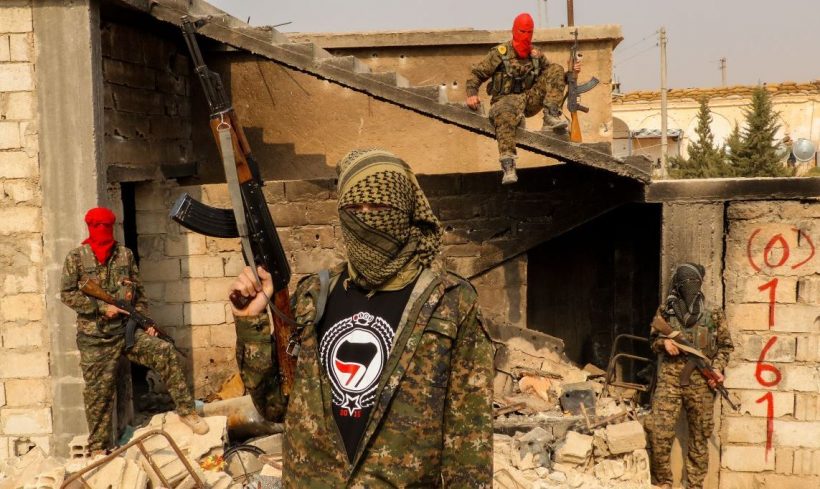
By Max Parry • Unz Review • December 22, 2019
The October decision by U.S. President Donald Trump to withdraw American troops from northeastern Syria did not only precipitate the Turkish offensive, codenamed ‘Operation Peace Spring’, into Kurdish-held territory which followed. It also sparked an outcry of hysteria from much of the so-called “left” that has been deeply divided during the 8-year long conflict over its Kurdish question. Despite the fact that the Syrian Democratic Forces (SDF) were objectively a U.S. proxy army before they were “abandoned” by Washington to face an assault by its NATO ally, the ostensibly “progressive” politics of the mostly-Kurdish militants duped many self-identified people on the left into supporting them as the best option between terrorists and a “regime.” Apparently, everyone on earth except for the Kurds and their ‘humanitarian interventionist’ supporters saw this “betrayal” coming, which speaks to the essential naiveté of such amateurish politics. However, there is a historical basis to this political tendency that should be interrogated if a lesson is to be learned by those misguided by it.
Turkey initially went all-in with the West, Israel, and Gulf states in a joint effort to depose Syrian President Bashar al-Assad by stoking the flames of the country’s Arab Spring in 2011 into a full blown uprising. With Istanbul serving as the base for the opposition, Kurdish nationalists hoping to participate were not at all pleased that the alliance had based its government-in-exile in Turkey and naturally considered Ankara’s role to be detrimental to their own interests in establishing an autonomous ethnonationalist state. Likewise, Turkish President Recep Tayyip Erdoğan did not bargain on the conflict facilitating such a scenario, with the forty year war with the Kurdistan Workers Party (PKK) in southeastern Turkey still ongoing. When the PKK-linked People’s Protection Units (YPG) militias took control of northern Syrian towns and established a self-governing territory after boycotting the opposition, it was done only after negotiations between Damascus and Kurdish leaders. The Syrian government willingly and peacefully ceded the territory to them, just as we were told that the Baathists were among their oppressors.
The Rojava front opened up when the Kurds came under attack from the most radical jihadist militants in the opposition, some of which would later merge with the Islamist insurgency in western Iraq to form ISIS. Yet we now know for a fact that the rise of Islamic State was something actually desired by the U.S.-led coalition in the hopes of bringing down Assad, as revealed in a declassified 2012 Defense Intelligence Agency report. Shortly after clarifying that the opposition is “backed by the West, Gulf countries and Turkey”, the memo states:
“If the situation unravels there is the possibility of establishing a declared or undeclared Salafist principality in eastern Syria (Hasaka and Der Zor), and this is exactly what the supporting powers to the opposition want, in order to isolate the Syrian regime, which is considered the strategic depth of the Shia expansion (Iraq and Iran).”
Meanwhile, it was the Kurds themselves who divulged Ankara’s support for Daesh, frequently retrieving Turkish-issued passports from captured ISIS fighters. Even Emmanuel Macron said as much at the recent NATO summit in London, prompting a row between France and Turkey that took a backseat to the more ‘newsworthy’ Trump tantrum over a hot mic exchange between the French President and his Canadian and British counterparts. Then there was the disclosure that the late Senator John McCain had crossed the border from Turkey into Syria in mid-2013 to meet with leaders of the short-lived Free Syrian Army (FSA), dubbed as “moderate rebels”, which just a short time later would decline after its members joined better armed, more radical groups and the ISIS caliphate was proclaimed. One of the rebel leaders pictured with McCain in his visit is widely suspected to be the eventual chosen leader of ISIS, Abu Bakr al-Baghdadi, who was allegedly killed in a U.S. raid in Idlib this October. Ironically, many of the Turkish-backed FSA militias are now assisting Ankara in its assault on the Kurds while those who supported arming them feign outrage over the US troop removal.
Henry Kissinger reportedly once remarked, “America has no permanent friends or enemies, only interests.” Given that the U.S. was at the very least still using Daesh as a strategic asset, it seems inexplicable that the Kurdish leadership could trust Washington. The SDF had only a few skirmishes with the Syrian army during the entire war— if they wanted to defeat ISIS, why not partner with Damascus and Moscow? To say nothing of the U.S.’s long history of backing their oppression, from its support of Saddam Hussein during the Iran-Iraq War in the 1980s to the arming of Turkey’s brutal crackdown against the PKK which ended with the capture of its cultish leader, Abdullah Öcalan, in 1999. Did they really think after enlisting them for its cosmetic ‘fight’ against ISIS that the U.S. would continue to side with them against Ankara? Even so, Kurdish gains against Daesh would pale in comparison to those by the Syrian army with Russian air support. More perplexing is why anyone on the left would choose to back a group being used as a cat’s paw for imperialism, regardless of whatever ideals they claim to hold.
Perhaps the U.S. would not have reneged on its implicit pledge to help with the foundation of a Kurdish state had their “Assad must go” policy been successful, but the U.S. pullout appears to be the final nail in the coffin for both Washington’s regime change plans in Syria and an independent Kurdistan. The YPG’s makeover as the SDF was done at the behest of the U.S. but this did nothing to to diminish the objections of Ankara (or many ‘leftists’ from supporting them), who insisted the YPG was already an extension and rebranding of the PKK, a group Washington itself designates as a terrorist organization. Any effort to create a buffer state in the enclave was never going to be tolerated by Turkey but it nonetheless enabled the U.S. to illegally occupy northern Syria and facilitate the ongoing looting of its oil. Unfortunately for Washington, the consequence was that it eventually pushed Ankara closer toward the Kremlin, as Turkey went from shooting down Russian jets one year to purchasing the S-400 weapon system from Moscow the next. After backing a botched coup d’etat attempt against Erdoğan in 2016, any hope of Washington bringing Turkey back into its fold would be to discard the Kurds as soon as their usefulness ran out, if it wasn’t too late to repair the damage already.
Why would the U.S. risk losing its geo-strategic alliance with Turkey? To put it simply, it’s ‘special relationship’ with Israel took greater precedence. Any way you slice it, Washington’s foray into the region has been as much about Zionism as imperialism and its backing of the Kurds is no exception. Despite the blowback, the invasion of Iraq and destruction of Libya took two enormous sources of support for the Palestinian resistance off the chessboard. It may have strengthened Iran in the process, but that is all the more reason for the U.S. to sell a regime change attempt in Tehran in the future. Regrettably for Washington, when it tried to do the same in Syria, Russia intervened and emerged as the new peace broker in the Middle East. It comes as no surprise that following the Turkish invasion of northern Syria amid the U.S. withdrawal, the Kurds have finally struck a deal with Damascus and Moscow, a welcome and inevitable development that should have occurred years ago.
One of the main reasons for the Kurds joining the SDF so willingly has the same explanation as to why Washington was prepared to put its relationship with Ankara in jeopardy by supporting them: Israel. The cozy relationship between the Zionist state and the various Kurdish groups centered at the intersection of Turkey, Iran, Iraq and Syria goes back as far as the 1960s, as Jerusalem has consistently used them to undermine its enemies. It is not by chance that their respective interests overlap to a near tee, between the founding of a Kurdish protectorate and the Zionist plan for a ‘Greater Israel’ in the Middle East which includes a balkanization of Syria. Mossad has openly provided the Kurds with training and they have learned much in the ways of the ethnic cleansing of Arabs from the Jewish state in order to carve out a Syrian Kurdistan. One can certainly have sympathy for the Kurds as the largest ethnic group in the world at 40 million people without a state, but the Israel connection runs much deeper than geopolitical interests to the very ideological basis of their militancy which calls all of their stated ideals into question.
The ties between the YPG and the PKK are undeniable, as both groups follow jailed leader Abdullah Öcalan’s teachings which merge Kurdish nationalism with the theories of ‘democratic confederalism’ from the influential Jewish-American anarchist philosopher, Murray Bookchin. While the PKK may have been initially founded as a ‘Marxist-Leninist’ organization in the early 70s, a widespread misconception is that it still follows that aim when its ideology long-ago shifted to that of a self-professed and contradictory ‘libertarian socialism’ theorized by Bookchin who was actually a zealous anti-communist. Not coincidentally, the Western anarchist icon was also an avowed Zionist who often defended Israel’s war crimes and genocide of Palestinians while demonizing its Arab state opponents as the aggressors, including Syria. Scratch an anarchist and a neo-conservative will bleed, every time.
Many on the pseudo-left who have pledged solidarity with the Kurds have attempted to base their reasoning on a historically inaccurate analogy comparing the Syrian conflict with the Spanish Civil War of the 1930s. You would think ISIS would be the obvious first choice for the fascists in the Syrian war, but journalist Robert Mackey of popular “progressive” news site The Intercept even tried to cast the Syrian government as Francisco Franco’s Nationalists in an article comparing the 1937 bombing of Guernica by the Condor Legion to the 2018 chemical attack in Douma which remains in dispute regarding its perpetrator. One wonders if Mackey will retract his absurd comparison now that dozens of inspectors from the Organization for the Prohibition of Chemical Weapons (OPCW) have dissented in emails published by WikiLeaks showing that the OPCW engaged in a cover-up with the Trump administration to pin blame for the attacks on the Syrian government instead of the opposition, but don’t hold your breath.
In this retelling of the Spanish Civil War, the Kurds are generally seen in the role of the Trotskyite Workers’ Party of Marxist Unification (POUM) and the anarchist trade union National Confederation of Labour (CNT). In the midst of the conflict between the Nazi-supported Nationalists and Soviet-backed Republicans that was a prelude to World War II, the mobilization effort of all anti-fascist forces into a unified Popular Front was obstructed by the ultra-left and intransigent POUM and CNT who were then expelled from the coalition for their sectarianism. While the government was still fighting the Francoists, the POUM and CNT then attacked the Republicans but were put down in a failed insurrection. Although this revolt did not directly cause the loyalist defeat, it nevertheless sapped the strength from the Popular Front and smoothed the path for the generalissimo’s victory.
In the years since, Trotskyists have attempted to rewrite history by alleging that a primary historical text documenting the POUM’s sabotage of the Republicans — a 1938 pamphlet by journalist Georges Soria, the Spanish correspondent for the French Communist Party newspaper L’Humanite — is a forgery. On the Marxists Internet Archive website, an ‘editor’s note’ is provided as a preface to the text citing a single quote from Soria with the claim he admitted the work in its entirety was “no more than a fabrication”, but his words are selectively cropped to give that impression. While the author did admit accusations that the POUM‘s leadership were literal agents of Franco were a sensationalized exaggeration, the source of the full quote states the following:
“On the one hand, the charge that the leaders of POUM, among them Andrés Nin, ‘were agents of the Gestapo and Franco’, was no more than a fabrication because it was impossible to adduce the slightest evidence. On the other hand, although the leaders of POUM were neither agents of Franco or agents of the Gestapo, it is true that their relentless struggle against the Popular Front played the game nolens volens (like it or not/willingly or unwillingly) of the Caudillo (General Franco).”
In other words, Soria did not say the whole work was counterfeit like the editor’s note misleadingly suggests and reiterated that the POUM’s subversion helped Franco. (The Marxists Internet Archive does not hide its pro-Trotsky bias in its FAQ section.)
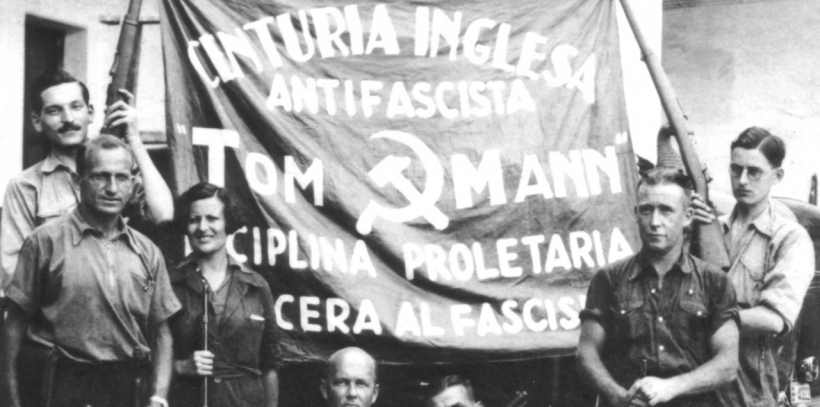
Marxist historian Eric Hobsbawm summarized the inherent contradictions of the Spanish Civil War and the role ultra-leftism played in the demise of the Republic in one of his later essays:
“Of course, the posthumous polemics about the Spanish war are legitimate, and indeed essential — but only if we separate out debate on real issues from the parti pris of political sectarianism, cold-war propaganda and pure ignorance of a forgotten past. The major question at issue in the Spanish civil war was, and remains, how social revolution and war were related on the republican side. The Spanish civil war was, or began as, both. It was a war born of the resistance of a legitimate government, with the help of a popular mobilisation, against a partially successful military coup; and, in important parts of Spain, the spontaneous transformation of the mobilisation into a social revolution. A serious war conducted by a government requires structure, discipline and a degree of centralisation. What characterises social revolutions like that of 1936 is local initiative, spontaneity, independence of, or even resistance to, higher authority — this was especially so given the unique strength of anarchism in Spain.”
Murray Bookchin also wrote at length about the Spanish Civil War but celebrated the decentralized anarchist tactics which incapacitated the Popular Front. The anarcho-syndicalist theorist championed the ‘civil war within the civil war’ as a successful example of his antithetical vision of ‘libertarian socialism’, while his emphasis on the individualist aspects of the former half of his oxymoronic and anti-statist theory often bears a striking resemblance to neoliberal talking points about self-regulating free markets. This would explain why he actually regarded right-wing libertarians to be his natural allies over the the socialist left, whom he considered ‘totalitarian’ as he told the libertarian publication Reason magazine in an interview in 1979. His reactionary demonization of the Soviet Union and dismissal of the accomplishments of all other socialist revolutions was recalled by Michael Parenti in Blackshirts and Reds:
“Left anticommunists remained studiously unimpressed by the dramatic gains won by masses of previously impoverished people under communism. Some were even scornful of such accomplishments. I recall how in Burlington Vermont, in 1971, the noted anticommunist anarchist, Murray Bookchin, derisively referred to my concern for “the poor little children who got fed under communism” (his words).”
Like the International Brigades consisting of foreign volunteers to assist the Spanish Republic in the 1930s, there is an ‘International Freedom Battalion’ currently fighting with the Kurds in Syria. Unfortunately, its live-action role playing ‘leftist’ mercenaries missed the part about the original International Brigades having been backed by the Comintern, not the U.S. military.
Meanwhile, Western media usually hostile to any semblance of radical politics have heavily promoted the Rojava federation as a feminist ‘direct democracy’ utopia, particularly giving excessive attention to the all-female Women’s Protection Units (YPJ) militia while ignoring the female regiments fighting for the secular Syrian government. As a result of the media’s exoticized portrayal of the Kurds and their endorsement by prominent misleaders on the left, from Slavoj Žižek to Noam Chomsky, many have been fooled into supporting them.
If the Spanish Civil War was a dress rehearsal for WWII, it remains to be seen if Syria proves to be a run-through for another global conflict. Then again, what has emerged from its climax is an increasingly multipolar world with the resurgence of Moscow as a deterrent to the mutually assured destruction between the U.S. and China.
Leftists today wishing to continue the legacy of those who fought for the Spanish Republic should have thrown their support behind the Syrian patriots bravely defending their country from terrorism and imperialism, not left opportunism. Thankfully, this time the good guys have prevailed while the Kurds have paid the price for betraying their fellow countrymen. Liberals shedding crocodile tears about Rojava should take comfort in the fact that they can always play the latest Call of Duty: Modern Warfare video game featuring the YPG fighting alongside the U.S. military if they need to fulfill their imperial fantasies.
Yes, that’s right, the latest installment of the popular first-person shooter franchise features a storyline inspired by the SDF. It’s too bad for them that in real life all of Syria will be returned to where it rightfully belongs under the Syrian Arab Republic.
Max Parry is an independent journalist and geopolitical analyst. His writing has appeared widely in alternative media. Max may be reached at maxrparry@live.com
Featured Video
Yemen joins the war – Red Sea could be blocked next – Saudi regime at risk
or go to
Aletho News Archives – Video-Images
From the Archives
A superpower and “the world’s sickest warrior state”
By Paul J. Balles | March 8, 2010
Living through five or six major wars has hardened me to what I thought were the extremes of inhuman cruelty and brutality.
Two things made those extremes almost bearable: the brutality always revealed – at least according to the media coverage – the viciousness of the enemy. It was therefore quite understandable when our “brave men and women” pulverized the enemy.
Films of Japanese torturing captive Americans somehow justified holding Japanese Americans in internment camps during World War II; and only a small percentage of Americans found the bombing of Hiroshima and Nagasaki unreasonably vengeful at best, at worst, depraved.
The media giants in America portrayed the North Koreans as barbaric beasts with their captives, quite unlike their southern counterpoints – our allies during the Korean War. No one ever felt the need to explain how the South Koreans were a civilized breed while the North Koreans were absolute savages, at least according to the official line.
In Vietnam, our warriors justifiably (or so the media made us believe) dropped napalm on the North Vietnamese who had the gall to hide in villages and tunnels to ravage our invaders. At least it was accepted practice until some rogue photojournalist filmed a young girl screaming down a Vietnamese road in flames. … continue
Blog Roll
 Aletho News
- America Racing to Strategic Defeat in Iran: Lt Col Daniel Davis
- FTC Warns Visa, Mastercard, PayPal, Stripe Over Political Debanking
- Russian tanker approaches Cuba despite US oil blockade
- Marandi: Yemen joins the war – Red Sea could be blocked next – Saudi regime at risk
- Pro-Palestinian French member of European Parliament denied entry to Canada
- Pakistan to Host US-Iran Talks
- How Indonesia’s tilt toward the US left it stranded in the Strait of Hormuz
- US has no choice but to retreat from Iranian borders: Top commander
- Iran Retaliation Strikes Chemical Plant Near Dimona
- AWACS’ Destruction is a Major Loss for US Military – Ex-DoW Analyst
- If Americans Knew
- Israeli police block Catholic cardinal from entering Church of the Holy Sepulchre on Palm Sunday
- Israel is assassinating journalists again, more than any other nation, anywhere, ever – Not a ceasefire Day 170
- Over 300 US service members wounded, majority have brain injuries – Not a ceasefire Day 169
- Researchers at Human Rights Watch Resign Over Blocked Report on Palestinian Refugee Return
- Jewish Groups Are Backing a War Americans Don’t Want
- Eric Fingerhut Thinks He’s the President of the Jews
- Top Jewish Philanthropists, Rabbis Urge Israeli President to Take Action Against ‘Jewish Extremists’
- Don’t Be Fooled. Zionist Leaders Have Always Wanted to Control Southern Lebanon
- Israel’s widespread use of torture is a core element of its genocide against the Palestinian people
- In Israel’s War on Iran, Many Middle East US Bases Rendered “All But Uninhabitable”
- No Tricks Zone
- New Study Finds Warming Saves Lives…Cold Temperatures 12 Times More Deadly Than Excess Heat
- German Science Blog Accuses PIK Climate Institute Of Hallucinating Climate Tipping Points
- Devastating Assessment Of Comirnaty Vaccine By Former Senior Pfizer Europe Toxicologist
- New Study: CO2 Is ‘Effectively Negligible’ As An Explanatory Climate Change Factor Since 2000
- Former Pfizer Toxicologist Dr. Helmut Sterz Tells Bundestag Hearing Pfizer Vaccine Should Have Never Been Approved
- Energy Expert: Germany’s Nuclear Phaseout Was A “500 Billion Euro Mistake”
- New Research: South Australia’s Mid-Holocene Sea Surface Temperatures Were 4°C Warmer Than Today
- Storing Green Energy To Last Germany 10 Days Would Require A 60-Million Tonne Battery
- New Studies: UK Sea Levels Were 4 Meters Higher Than Today During The Mid-Holocene
- Destructive Green New Deal: German Energy And Metal Group Warns Of Drastic Crisis
 Aletho News