Americans Beware! Russia Can Hack Your Brain, Make You Believe Joe Biden Unfit for Oval Office
By Robert Bridge | Strategic Culture Foundation | January 15, 2020
I suppose it is necessary, considering the bleak and humorless times we live in, to immediately start by acknowledging that the headline is meant as satire, what Webster defines as a form of “ridicule to expose and criticize people’s stupidity or vices, particularly in the context of contemporary politics and other topical issues.”
In other words, nyet, the Kremlin does not have a hotline to the American brain that can trigger card-carrying Democrats to enter a catatonic trance on Election Day and vote against Joe Biden, or any of the other flawless Democratic gems for that matter. By this time, especially following the release of the Mueller Report, you would think that conspiracy theories involving Russia and American democracy would have subsided; instead they’ve only escalated as the U.S. enters the hot end of the 2020 presidential election campaign.
Courtesy of Bloomberg :
“U.S. intelligence and law enforcement officials are assessing whether Russia is trying to undermine Joe Biden in its ongoing disinformation efforts with the former vice president still the front-runner in the race to challenge President Donald Trump, according to two officials familiar with the matter…
Part of the inquiry is to determine whether Russia is trying to weaken Biden by promoting controversy over his past involvement in U.S. policy toward Ukraine while his son worked for an energy company there.”
So how exactly does Russia, in a scene straight out of A Clockwork Orange, tap into the frontal lobe section of the U.S. electorate and cause them to lose all confidence in their political favorites?
“A signature trait of Russian President Vladimir Putin ‘is his ability to convince people of outright falsehoods,’ William Evanina, director of the National Counterintelligence and Security Center, said in a statement. ‘In America, [the Russians are] using social media and many other tools to inflame social divisions, promote conspiracy theories and sow distrust in our democracy and elections.’”
Yes, somehow those dastardly Russians have outsmarted the brightest and best-paid political strategists in Washington, D.C. by brandishing what amounts to some really persuasive memes over social media, and for just rubles on the dollar. The techies at Wired went so far as to call this epic assault on the fragile American cranium, “meme warfare to divide America.” By way of evidence, it cited a very creative meme that screamed, “F*CK THE ELECTIONS,” which was intended, as the ironclad argument goes, to cause a number of impressionable Americans to throw up their hands in a fit of collective exasperation and say, ‘Ok, that’s it. I’m staying at home on Election Day.’
Yes, it’s really that easy! Imagine all the money the Russians and their radical new political technologies could have saved guys like casino tycoon, Sheldon Adelson, who showered the Trump campaign with $100 million dollars.
Many of those divisive Russian messages wormed their way onto Facebook, purportedly, where God only knows how many voter brains’ turned to maggots and mush just staring at them. Yet one individual who actually recalls seeing one or two of these dangerous memes was Rob Goldman, former Vice President for Advertising on Facebook, who revealed via Twitter, another infected social media platform, some interesting information:
“Most of the coverage of Russian meddling involves their attempt to effect the outcome of the 2016 U.S. election. I have seen all of the Russian ads and I can say very definitively that swaying the election was *NOT* the main goal.”
Clearly, Goldman seems to have been under the sway of some folk Russian brainwashing technique, probably passed down from the time of Rasputin. In any case, Donald Trump himself took great satisfaction from that particular revelation, retweeting it to his millions of minions.
Incidentally, it may or may not be relevant, but Goldman retired from Facebook in October 2019 after seven years with the company.
Russia, the gift that keeps on giving
Not only have the Democrats been able to use the Russia bogeyman as their excuse for losing the White House in 2016, they are able to summon this distant nuclear power whenever they wish to curb internet freedoms, which is pretty much every day now.
Now, fun-loving memes are under attack and may soon go the way of the DoDo bird (“A small office of Russian trolls could derail 241 years of U.S. political history with a handful of dank memes and an advertising budget that would barely buy you a billboard in Brooklyn,” screamed insanely The Guardian ). At the same time, freedom of speech is getting destroyed by vapid accusations of ‘hate speech,’ which, unless used to incite violence, is a totally meaningless term used to eliminate any conversation that is undesirable to the elite.
Meanwhile, only the mainstream media these days are permitted to dabble in ‘conspiracy theories’ even as their own false narratives have contributed to the pulverization of entire nations, as was the case in Iraq, for example, which sustained a full-blown U.S. military invasion in 2003 following debunked claims that Saddam Hussein was harboring weapons of mass destruction. That was the mother of all conspiracy theories that was pushed unchallenged by the mainstream media.
So back to Joe Biden.
Do intelligent Americans really need help from Russia to prove that just maybe the former Vice President is mentally and physically unfit to stand for the White House? Probably not. From whispering sweet nothings into the ears of any female within groping distance, to sucking on his wife’s fingertips at a political rally, something just doesn’t seem altogether right upstairs with Joe Biden. So what is the real story for dragging Russia, once again, into the internal swamp pit known as Washington, D.C.?
The Bloomberg article provides a big hint: “This time around, the narrative about Biden and Ukraine is … well-publicized and being advanced by Trump, his personal attorney Rudy Giuliani and the president’s Republican allies in Congress.”
And that “narrative” has everything to do with not only the Democrats’ frozen impeachment proceedings against the U.S. leader, which promises to have major connections to Ukraine, Joe Biden and his son Hunter, and quite possibly dozens of other top Democrats. In other words, the Democrats understand that pushing ahead with impeachment could be their ultimate downfall.
Although few Americans seem to remember that back in May of 2019, Trump granted U.S. Attorney General William Barr “full and complete authority” to investigate exactly how claims that Trump was ‘conspiring with the Kremlin’ in the 2016 presidential election had originated, the Democrats certainly have not.
Their bogus ‘Russian collusion’ claim provided the rationale for a four-year-long ‘witch hunt’ that began when the Democrats, relying on the flimsy findings contained in the so-called ‘Steele dossier, managed to get approval from the FISA court to spy on the Trump campaign. Now, some top-ranking Democrats – never imagining Hillary Clinton would actually lose in 2016 – are understandably nervous as to what Barr and his assistant, federal attorney John Durham will divulge to the public in the coming months.
With so much riding on the line in 2020, is anyone surprised that Bloomberg, the news affiliate owned and operated by Democratic contender Michael Bloomberg, is now reporting “U.S. officials are warning that Russia’s election interference in 2020 could be more brazen than in the 2016 presidential race or the 2018 midterm election.”
In other words, the racist ploy used by Democrats to explain their monumental defeat in 2016 did not end with the Mueller Report. The conspiracy theory, promulgated by a media that is in effect just another branch of the Democratic National Committee, is being primed to explain not only possible criminal charges aimed at top Democrats in the coming months, but how Democrats, like Michael Bloomberg, failed once again to beat the seemingly unstoppable incumbent, Donald Trump.
How Europe betrayed Iran: By triggering JCPOA dispute mechanism, EU helps Trump finish job of killing the Iran nuclear deal
By Scott Ritter | RT | January 15, 2020
Europe could have saved the Iran nuclear agreement. Instead, it abused the rule of law by inappropriately triggering its dispute mechanism, all but ensuring the agreement’s demise.
Disingenuous diplomacy
On January 5, 2020, Tehran announced that it would no longer comply with its obligations under the Iran nuclear agreement, officially known as the Joint Comprehensive Program of Action (JCPOA). Iran’s actions are in response to the withdrawal of the US from the JCPOA, and the re-imposition of economic sanctions by the US which had been lifted when the deal came into force.
In response to the Iranian actions, the governments of France, Germany, and the UK – all parties to the deal, along with the European Union (EU) – invoked provisions within the JCPOA, known as the Dispute Resolution Mechanism (DRM), in an effort to bring Iran back into compliance.
The triggering of the DRM by the European countries, however, is a disingenuous move designed to provide diplomatic cover for the EU’s own failures when it comes to JCPOA implementation.
Moreover, given the likely outcome of this process, a convening of the UN Security Council where economic sanctions will be re-imposed on Iran by default, the Europeans have all but assured the demise of the JCPOA, with their so-called diplomacy serving as little more than a facilitator of a larger crisis between Iran and the US that, given the heightened tensions between these two nations in the aftermath of the assassination of Qassem Soleimani, precipitously increases the prospects for war.
Big powers always had an easy way out of deal
When the JCPOA was finalized in July 2015, the world was given hope that the crisis over Iran’s nuclear enrichment capability, which had been threatening to boil over into war, had been resolved, and diplomacy had prevailed over armed conflict.
The JCPOA codified a number of restrictions on Iran’s ability to enrich uranium, including the numbers and types of centrifuges that could be used, where enrichment could take place, what level of enrichment could occur, and how large of a stockpile of enriched nuclear material Iran was allowed to maintain, and an intrusive comprehensive inspection regime designed to verify Iran’s compliance.
These restrictions were designed to ease over time through a series of so-called “sunset clauses,” until all that remained was an enhanced inspection process. In short, the JCPOA legitimized Iran’s right to enrich uranium for peaceful purposes while simultaneously recognizing the concerns of some within the international community regarding the potential for Iran to abuse this enrichment capability for military purposes.
The JCPOA was, in effect, a comprehensive confidence building mechanism intended to build trust between Iran and the international community over time, consistent with the agreement’s preamble, which declared “Iran reaffirms that under no circumstances will Iran ever seek, develop or acquire any nuclear weapons.”
Prior to the implementation of the JCPOA, Iran had been subjected to stringent economic sanctions levied under the authority of the UN Security Council. In exchange for entering into the agreement, these sanctions were lifted.
However, the deal recognized that disputes could emerge regarding the implementation of the agreement, and put in place a dispute resolution mechanism which, if no satisfactory solution was found to an identified problem, would result in these sanctions being automatically re-imposed.
A key aspect of this mechanism was that if any party to the agreement used its veto in the UN Security Council to block a vote related to nonperformance on the part of any party to the agreement, then the economic sanctions would automatically be reinstated.
Washington sabotages JCPOA
For the first two-plus years of the deal’s existence, from July 2015 through to May 2018, Iran was found to be in full compliance with its commitments.
In May 2018, however, the US precipitously withdrew from the agreement, claiming that the eventual expiration of the “sunset clauses” paved the way for Iran to produce a nuclear weapon, and as such the JCPOA was little more than a facilitator of Iranian nuclear malign intent.
The US began re-imposing economic sanctions on Iran, all of which included so-called secondary sanctions which applied to any nation that violated the US sanctions. Iran rightfully viewed the re-imposition of sanctions by the US as a violation of the deal.
Furthermore, when EU companies began balking on their willingness to do business with Iran out of fear of US secondary sanctions, Iran rightfully found the EU to be in violation of the JCPOA as well.
Iran gave the remaining parties to the JCPOA six months following the US withdrawal to develop the necessary mechanisms needed to sidestep the impact of the US economic sanctions.
By November 2018, however, no such mechanisms had been implemented, and when the US targeted Iran’s economic lifeblood by sanctioning oil sales, Iran responded by invoking its rights under Article 26 and Article 36 of the JCPOA, which allows Iran to “cease performing its commitments under the JCPOA, in whole or in part”, for either the re-imposition of new nuclear-related sanctions, or “significant nonperformance” of obligations under the JCPOA, or in this case, both.
Since that time, Iran has been gradually stepping away from the restrictions imposed on it, noting each time that its measures were immediately reversible should the underlying issues be resolved in a manner that complied with the letter and intent of the JCPOA.
Europe’s cowardice
In short, Iran demanded that the EU live up to its obligations to stand up to the US economic sanctions. The EU has consistently failed to do so, resulting in Iran’s gradual backing away from its obligations, leading to the current state of affairs where all of the restrictions imposed by the JCPOA, not including international inspections, which continue unabated, have ceased to be in operation.
When it comes to levying fault for the current state of affairs, there is no “chicken or egg” causality up for debate. Blame lies squarely on both the US for withdrawing from the deal, and the EU for failing to live up to its obligations under the JCPOA regarding economic engagement with Iran.
Iran has long warned the governments of France, Germany, and the UK not to invoke the DRM, noting that the JCPOA does not permit such a move if, as is the case today, Iran is exercising its legal right in response to the illegal and unilateral actions of the US.
There is no realistic expectation that Iran will change its position in this regard. Russia and China have already indicated that Iran is fully within its rights within the JCPOA to back off its obligations regarding restrictions imposed on its nuclear program, citing US and EU non-performance.
By invoking the DRM, the Europeans have, knowingly and wittingly, initiated a process that can only have one outcome, the termination of the JCPOA. In doing so, the EU has breathed life into unfounded US allegations of Iranian nuclear weapons intent, setting up an inevitable clash between the Washington and Tehran that has the real potential of dragging the whole world down with it.
Scott Ritter is a former US Marine Corps intelligence officer. He served in the Soviet Union as an inspector implementing the INF Treaty, in General Schwarzkopf’s staff during the Gulf War, and from 1991-1998 as a UN weapons inspector.
The Labour Partly
By Gilad Atzmon | January 15, 2020
Historically, a popular coup against an opposition party is rare. In the last General Election Corbyn’s Labour provided us with just such an exceptional spectacle.
Labour managed to alienate its voters. Its leader turned his back on its strongest allies including, among others, Ken Livingstone and Chris Williamson. For some reason Corbyn’s Labour turned itself into an Orwellian authoritarian apparatus; it even dug into its members’ social media accounts picking out ‘dirt’ (human right’s concerns) in order to appease one distinctive foreign lobby.
The Brits saw it all, how dangerous the party became. Many former ardent Labour supporters angrily rejected their political home. They may never return.
The conduct of the contenders for Labour’s leadership in the last few days reveals that the Brits were spot on in humiliating their opposition party.
At the moment, Labour’s leadership candidates are, without exception, competing amongst themselves to see who goes the lowest in pledging allegiance to a Lobby associated with a foreign state that is currently under investigation by the International Criminal Court (ICC) for committing crimes against humanity.
Yesterday I discussed the topic with the Great Richie Allen (from about 20/24 min/sec) :
Leadership contender Emily Thornberry is apparently on her “hands and knees… asking for forgiveness.” And she is not the only one. The Zionist Times of Israel’s headlines yesterday revealed that the top candidates for Labour leadership have all vowed to lead the fight against anti-Semitism. “Keir Starmer backs automatic expulsion for offenders; Rebecca Long-Bailey: Corbyn bears personal responsibility for crisis; Jess Phillips suspends aide over anti-Semitic tweets.”
On BBC Radio, front runner Keir Starmer said, “We should have done more on anti-Semitism.” I wonder, what did Starmer mean by that? What is the next step after thought policing and spying on party members? Re-education centres? Indoctrination facilities? Hypnosis or maybe physiological treatment or perhaps lobotomy for those who dare to tell the truth about Israel and its Lobby?
Meanwhile, the Mail on Sunday reported that leadership contender, Jess Phillips, had on Friday suspended an aide who equated the Jewish State with the Islamic one.
Two days ago we learned that Zionist pressure on the Labour party isn’t fading away. The Board of Deputies of British Jews (BOD) published its demands of the candidates for Labour’s leadership. The ultra Zionist Jewish Chronicle wrote “The Board of Deputies has demanded each of Labour’s candidates for leader and deputy leader sign up to its 10 ‘pledges’ in order to ‘begin healing its relationship with the Jewish community’…”
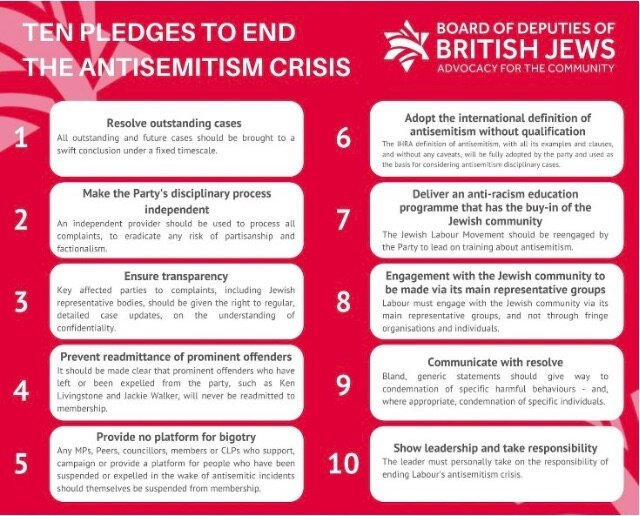
Predictably, the demands made by the BOD do not accord with Western and Christian values of pluralism and tolerance. The BOD demands that contenders ‘pledge’ to “prevent re-admittance of prominent offenders.” One may wonder what about forgiveness and compassion, are those fundamental Western values foreign to our Labour leadership candidates?
The BOD insists that leadership contenders pledge to “provide no platform for those who have been suspended or expelled for antisemitism.” What about freedom of speech and free debate? Are those also alien to Labour’s future leaders?
The new Labour leader is expected to support the bizarre idea that the Zionist Jewish Labour Movement will grant the kosher certificate for its “anti racism education program.” I thought to myself that if the Jewish Labour Movement is so good in ‘anti racism education,’ maybe, and before anything else, it should contribute towards the cleansing of racism in Israel.
The fact that a Jewish organisation such as the BOD is so bold as to publish such ludicrous demands from a British national party is no surprise. The bizarre development here is that Labour’s leadership candidates are engaged in an undignified battle to gain the BOD’s support.
I am not critical of the Jewish Lobby and its orbit of Zionist pressure groups. Those bodies clearly accomplished their mission. But it is astonishing how dysfunctional the Labour party and its leadership are. The party can’t even draw the most elementary lesson from its recent electoral disaster.
Those who follow my work know that I have predicted the unfortunate downfall of Labour and the demise of the Left in general. The Left, as I have been arguing for a while, has failed to reinstate its relevance and authenticity. It is unfortunately dead in the water.
Establishment Pundits Go Nuts Over New Russian Hacking Conspiracy

By Caitlin Johnstone | January 14, 2020
The New York Times reports that GRU operatives launched a successful “phishing attack” on the Ukrainian gas company at the heart of scandalous allegations about Joe Biden, and establishment pundits are falling all over themselves to tweet the hottest take on this exciting new Russia conspiracy.
The story itself fails the smell test on a number of fronts. It falsely claims that allegations of Biden’s corrupt dealings with Ukrainian officials as vice president have been “discredited”, and its only named source is a cybersecurity firm with foundational ties to the NSA and to Crowdstrike, which you may remember as the extremely shady Atlantic Council-tied company at the heart of the plot hole-riddled 2016 Russia hacking narrative (whose CEO is now a billionaire).
The article also of course lacks any hard evidence for its claims, and is of course completely silent on any details as to how the security firm knows that the alleged hackers were both (A) Russian and (B) tied to the Russian government. This is par for course with mass media news reporting on anything negative about Russia, where all journalistic standards have gone out the window and nobody suffers any professional consequences for even the most egregious misreporting on that nation.
And, naturally, liberal pundits are guzzling it down like Mike Pompeo left alone at the table with the gravy boat.
Thanks to editor of another establishment “news” organization for being so mindblowingly & transparently corrupt that even I can see through you.
Here our establishment errand boy warns that any true information about Joe & Hunter Biden’s corruption is Russian Disinformation https://t.co/YF3oLnScSd
— Jimmy Dore (@jimmy_dore) January 14, 2020
I don’t know if you’ve ever seen a man trying to run with an erection, but FYI it’s the most ridiculous-looking thing you can possibly ever witness. And the mad scramble of conservative Democrats to say something viral about this new angle on an entirely exhausted theme puts one in the mind of a whole platoon of men running completely tumescent at full sprint.
“I hope my fellow editors will think hard — really hard, a lot harder than they did in 2016 — before publishing any material hacked by the Russians,” tweeted editor-in-chief of The Daily Beast Noah Shachtman in response to the NYT report.
It is very revealing that the head of a major mainstream publication believes news outlets should sit on a story exposing the corruption of a leading presidential candidate–no matter how newsworthy–if it’s believed to have come from “the Russians”. How many major stories are being spiked for no other reason than a loyalty to the US government’s geopolitical agendas against noncompliant nations, exactly?
Yet sentiments identical to Shachtman’s are currently being bleated by like-minded pundits throughout the Twitterverse right now.
“Me and Oliver Darcy took at look at this a year ago… newsrooms hadn’t a lot to say about it. Not a lot of self-reflection, it seems,” tweeted CNN’s Donie O’Sullivan in response to Shachtman’s post. “Hackers could target the 2020 election. How will newsrooms respond if they release stolen data?”
“Russians working hard for President Trump’s reelection: mainstream media do not need to collaborate with the Russians again and breathlessly promote their non-newsworthy findings, as they did in 2016,” economist David Rothschild tweeted, without specifying his peculiar definition of “non-newsworthy”.
“Will the media run info from national security hacks as blockbuster stories like in 2016? That’s the million-dollar question,” tweeted Michigan Advance editor-in-chief Susan Demas.
This might be the most important news of the day. Russia could leak Burisma emails, and slip in some doctored emails, to harm Biden later on, if he is the Democratic nominee. The 2016 playbook all over again. https://t.co/w0p7pXjWgp
— Marshall Cohen (@MarshallCohen) January 13, 2020
A CNN reporter took it up even further, preemptively speculating based on literally nothing that any evidence of Biden’s corruption which emerges from the phishing campaign will have been “doctored” by Russia.
“Russia could leak Burisma emails, and slip in some doctored emails, to harm Biden later on, if he is the Democratic nominee,” tweeted CNN’s Marshall Cohen. “The 2016 playbook all over again.”
This insanity was seconded and then ratcheted up even further by MSNBC’s Malcolm Nance, whose main job seems to be to push the Overton window of Russia hysteria toward the craziest end of the spectrum.
“DNC 2.0,” Nance wrote. “To protect Trump the GRU will manufacture and insert Black propaganda, fake emails in a data base Burisma emails to implicate Biden and support Trump. They don’t care if you believe it … it’s all to get Trump to believe it. He’ll destroy America to win.”
DNC 2.0. To protect Trump the GRU will manufacture & insert Black propaganda, fake emails in a data base Burisma emails to implicate Biden & support Trump. They don’t care if you believe it … it’s all to get Trump to believe it. He’ll destroy America to win. #NoGreaterTraitor https://t.co/LgZeAwa9fK
— Malcolm Nance (@MalcolmNance) January 14, 2020
MSNBC analyst and former Obama administration official Richard Stengel, who has openly stated that he endorses the US government propagandizing its citizens, seized on the opportunity offered by this lawless feeding frenzy to advance a completely baseless Russiagate theory, because why the hell not?
“‘Russia, if you’re listening, hack Burisma.’ GRU has done same thing to this Ukrainian firm that they did to DNC,” tweeted Stengel. “If Trump asked Zelensky on a public call to investigate the Bidens, what do you suppose he asked Putin on a private call? Vlad, do me a favor.”
“More evidence that Putin fears Biden and is actively trying to help Trump,” added the Obama administration’s Michael McFaul. “Not good. All who believe in American sovereignty should denounce, Democrats and Republicans alike.”
“I’ll say it now: I don’t care WHAT the emails say. If he’s the guy, he’s got my vote. PERIOD,” tweeted popular #Resistance pundit Brooklyn Dad Defiant in what could generously be described as a very odd confession.
Here we go again, a Russian hacking playbook right out of 2016.
Russians hacked Burisma, and they’ll leak doctored emails on Biden if he’s the nominee.
I’ll say it now: I don’t care WHAT the emails say. If he’s the guy, he’s got my vote. PERIOD. https://t.co/qJhqNMecxR
— BrooklynDad_Defiant! (@mmpadellan) January 14, 2020
There is at this time no legitimate reason to believe that the GRU was involved in any kind of cyberattack on Burisma, let alone that it found anything worth publishing. At the moment the only information we’ve gleaned from this incident is more insight into the fact that the news media environment of the most powerful nation on earth is deeply, profoundly unhealthy, and so are the individuals operating within it.
These are the people who shape the dominant narrative. These are the thought leaders, who really do lead the way a very large sector of the population thinks. We need to bring more consciousness to how wildly dysfunctional this is.
2020 has been wild already. And all signs indicate that it’s only going to get a whole lot crazier.
Hear no evil, see no evil, print no evil? MSM warn journalists away from Burisma/Biden info after ‘hack’ report
By Helen Buyniski | RT | January 14, 2020
The US political and media elite have warned any journalist who might think of publishing (or even looking at) material potentially hacked from Ukrainian gas firm Burisma that they’re essentially handing 2020’s election to Russia.
Burisma Holdings – the Ukrainian company where Democratic frontrunner Joe Biden’s son Hunter served as a director – has been hacked, cybersecurity firm Area 1 announced on Tuesday. Area 1 has ties to both the NSA and Crowdstrike, the firm behind 2016’s still-unproven “Russian hacking” allegations, and has fingered “Fancy Bear” – the ‘hacking group’ at the center of those allegations – as the culprit.
No files have been released from the “hack,” but that hasn’t stopped American political and media thought leaders from issuing dire warnings to any journalists thinking of publishing or even reading them if they ever are released. To do so would be giving aid and comfort to the enemy – one step above treason – and nothing less than a capital thoughtcrime, these individuals have suggested.
Daily Beast editor Noah Shachtman put out a notice to his fellow editors warning them to steer clear of any information that could possibly have come from the hack. Since there was no confirmation of any data being copied, planted, or removed in that “hack,” editors might just want to be safe and ignore any negative information that might emerge relating to Biden. Problem solved!
According to Area 1, the Burisma “hack” echoed the setup that brought down Clinton campaign director John Podesta and the Democratic National Committee in 2016 – a phishing scheme in which executives received emails linking to fake login pages and a few hapless dupes fed their passwords to the scammers. Area 1 didn’t share what (if any) data had been accessed or stolen – they merely informed the media that “the timing of the Russian campaign mirrors the GRU hacks we saw in 2016 against the DNC and John Podesta… in what we can only assume is a repeat of Russian interference in the last election.”
As if on cue, 2016’s victim-in-chief, former Secretary of State and almost-president Hillary Clinton, leapt into the fray, lamenting that “Russians appear to be re-running their 2016 hacking playbook.” She warned the media against “playing along” by publishing any ‘hacked’ material, lest “the Russians help pick our POTUS again.”
A CNN reporter weighed in, warning “Russia could leak Burisma emails, and slip in some doctored emails, to harm Biden later on, if he is the Democratic nominee.” Russiagate true-believer Malcolm Nance predicted an oddly specific version of the same thing. And MSNBC took that conspiratorial line public, essentially warning Americans to discard any and all leaked emails, lest a few fakes (or deepfakes!) slip by.
“We are just not clear on what’s real and what’s not anymore,” an ‘expert’ lamented, sounding vaguely panicked.
News of the “hack” follows closely on the heels of anonymous US officials’ claim that “Russian disinformation operations” are targeting Biden – once the surefire Democratic frontrunner, but lately second to Bernie Sanders, Elizabeth Warren, and even Pete Buttigieg, depending on the poll. The Biden campaign seized on news of the “hack” as proof their candidate was still a force to be reckoned with, making sure to get in a dig at President Donald Trump at the same time in campaign spokesman Andrew Bates’ comment to the New York Times. “Any American president who had not repeatedly encouraged foreign interventions of this kind would immediately condemn this attack on the sovereignty of our elections,” he said, surprising anyone who didn’t realize ‘the sovereignty of our elections’ extends deep into Ukraine.
Area 1 specializes in “preemptive cybersecurity,” and asking the entire US news media to ignore any data that might potentially have come from a phishing attack on a Ukrainian energy firm fits that definition rather well. But interfering with freedom of the press in the name of preventing foreign interference means there’s no need for a Russian bogeyman anymore – the political establishment can defeat itself.
Non-commitment probe into Iran by France, Germany & UK ‘groundless,’ only increases tensions around nuclear deal – Russia
RT | January 14, 2020
The European trio’s accusation that Iran violates the key restrictions of the nuclear deal are unjustified, the Russian Foreign Ministry said urging the countries not to increase tensions that could endanger the pact.
Paris, Berlin and London officially reported Iran’s non-compliance with the 2015 agreement to the Joint Commission under the Dispute Resolution Mechanism. This step could potentially lead to the UN Security Council being forced to decide on whether or not to bring back sanctions against Tehran.
“We can’t rule out that the ill-considered actions of the European trio will lead to a new escalation around the JCPOA (Joint Comprehensive Plan of Action) and make the return to the implementation of the ‘nuclear deal’ in its initially agreed format unachievable,” Russia’s Foreign Ministry said in a statement.
Iran rolled back on its uranium enrichment constraints detailed in the international agreement earlier this month after one of its top military commanders, Qassem Soleimani, was assassinated in an American drone strike in Iraq.
Tehran’s decision to put its commitments on hold was a response to the actions of the US, which unilaterally withdrew from the deal in May 2018 and reintroduced restrictions against Iran, the ministry reminded. However, the country keeps allowing the International Atomic Energy Agency (IAEA) monitors to its nuclear sites – and “the transparency of the Iranian nuclear program has been one of the key clauses of the nuclear deal.”
Despite vocally rejecting the US campaign of “maximum pressure” on Iran, France, Germany and the UK are “either not ready or can’t afford to” work on finding effective ways of bypassing the hurdles to the deal created by Washington.
There are also “serious problems” with implementing the side of the deal on the part of the European trio, the ministry said. When all those issues are settled, “Iran would have no reason to retract from the initially agreed framework of the JCPOA.”
Iraqis must resort to resistance if US forces refuse to pull out: Senior Nujaba official
Press TV – January 14, 2020
The deputy secretary general of Iraq’s al-Nujaba Movement says the Iraqi nation must choose the path of resistance in case the parliamentary bill demanding the withdrawal of all US-led foreign military forces from the country is not implemented.
“The Iraqi people must opt for the path of resistance unless the parliament’s decision on the pullout of foreign forces is carried out,” Nasr al-Shammari said in an exclusive interview with Lebanon-based Arabic-language al-Mayadeen television news network on Tuesday.
He added that the decision to expel foreign forces from Iraq does not need a parliamentary mandate, stating that the US-led military coalition purportedly fighting the Daesh terrorist group entered Iraq at the request of Baghdad government and can be removed by a letter from the government as well.
“The decision concerning the removal of foreign forces from Iraq is the only decision taken away from sectarian fault lines. A person of sound mind cannot accept the presence of a foreign state that imposes its own authority on a sovereign country. If getting foreign forces out of Iraq is a charge, then we consider it as an honor for ourselves, our children and our grandchildren,” Shammari pointed out.
He then noted that all Iraqi resistance factions are united to end the presence of foreign troops in the country, saying, “The United States must respect the sovereignty of states and decisions of peoples, and adhere to them.”
“Iraq will not accept being ruled by any country. Any failure to implement the parliament decision on the withdrawal of foreign forces will give the green light for the start of resistance operations,” Shammari highlighted.
The Nujaba official went on to say that Popular Mobilization Units (PMU), better known by the Arabic word Hashd al-Sha’abi, have become more coherent and solid in the wake of the recent US assassination of the second-in-command of PMU, Abu Mahdi al-Muhandis.
“The death of Muhandis does not mean the end of Hashd al-Sha’abi and its role in the region,” Shammari said.
He added that Iraqi resistance groups are indebted to Lieutenant General Qassem Soleimani, the commander of the Quds Force of Iran’s Islamic Revolution Guards Corps (IRGC).
“The resistance against US forces will soon attain its goal of removing foreign troops from the Iraqi soil. The blood of martyrs will finally bring about the demise of the Zionist entity, and the end of its occupation of Arab lands,” Shammari concluded.
Baghdad moving to internationally prosecute US for crimes in Iraq
Meanwhile, a member of the Iraqi Parliamentary Human Rights Committee said the Baghdad government was preparing to prosecute the United States at international courts of law for its crimes in Iraq, noting that the offenses amount to genocide.
“The United States has been committing the most heinous war crimes since 2003 up until now. The invasion of Iraq, the Abu Ghraib prisoner abuse, the Nisour Square massacre and the emergence of Daesh (Takfiri terrorist group) besides the attack on the leaders of Hashd al-Sha’abi are all crimes classified as genocide,” Ahmed al-Kanani said in a statement on Tuesday.
Kanani added, “All the crimes that America has perpetrated against the Iraqi nation are documented, and that there are bids to prosecute Washington for its crimes against Iraqis before international courts.”
On January 5, Iraqi lawmakers unanimously approved a bill, demanding the withdrawal of all foreign military forces led by the United States from the country.
Late on January 9, Iraq’s caretaker Prime Minister Adel Abdul-Mahdi called on the United States to dispatch a delegation to Baghdad tasked with formulating a mechanism for the withdrawal of US troops from the country.
According to a statement released by the Iraqi premier’s office, Abdul-Mahdi “requested that delegates be sent to Iraq to set the mechanisms to implement the parliament’s decision for the secure withdrawal of (foreign) forces from Iraq” in a phone call with US Secretary of State Mike Pompeo.
The prime minister said Iraq rejects violation of its sovereignty, particularly the US military’s violation of Iraqi airspace in the airstrike that assassinated Lt. Gen. Soleimani, Muhandis and their companions.
Abdul-Mahdi asked Pompeo to “send delegates to Iraq to prepare a mechanism to carry out the parliament’s resolution regarding the withdrawal of foreign troops from Iraq,” the statement said.
“The prime minister said American forces had entered Iraq and drones are flying in its airspace without permission from Iraqi authorities and this was a violation of the bilateral agreements,” the statement added.
The US State Department bluntly rejected the request the following day.
Israel to build more detention facilities for Palestinians

Palestine Information Center – January 14, 2020
OCCUPIED JERUSALEM – The Israeli occupation government has approved a plan to build more detention facilities to accommodate thousands of new Palestinian prisoners.
According to Israel’s Channel 7, four prisons will be built to accommodate about 4,000 Palestinians as part of a long-term plan to be finished in 2040.
The project will also include other detention centers, police stations and courts.
The Israeli prison service has 30 prisons and detention centers, the Channel said.
There are about 5,700 Palestinian prisoners in Israeli jails, including 47 women and girls, 250 children, six lawmakers, 500 administrative detainees and 700 patients.
How an Israeli Spy-Linked Tech Firm Gained Access to the US Gov’t’s Most Classified Networks

Graphic by Claudio Cabrera
By Whitney Webb | MintPress News | January 14, 2020
If the networks of the U.S. military, the U.S. intelligence community and a slew of other U.S. federal agencies were running the software of a company with deep ties, not only to foreign companies with a history of espionage against the U.S. but also foreign military intelligence, it would — at the very least — garner substantial media attention. Yet, no media reports to date have noted that such a scenario exists on a massive scale and that the company making such software recently simulated the cancellation of the 2020 election and the declaration of martial law in the United States.
Earlier this month, MintPress News reported on the simulations for the U.S. 2020 election organized by the company Cybereason, a firm led by former members of Israel’s military intelligence Unit 8200 and advised by former top and current officials in both Israeli military intelligence and the CIA. Those simulations, attended by federal officials from the FBI, DHS and the U.S. Secret Service, ended in disaster, with the elections ultimately canceled and martial law declared due to the chaos created by a group of hackers led by Cybereason employees.
The first installment of this three part series delved deeply into Cybereason’s ties to the intelligence community of Israel and also other agencies, including the CIA, as well as the fact that Cybereason stood to gain little financially from the simulations given that their software could not have prevented the attacks waged against the U.S.’ electoral infrastructure in the exercise.
Also noted was the fact that Cybereason software could be potentially used as a backdoor by unauthorized actors, a possibility strengthened by the fact that the company’s co-founders all previously worked for firms that have a history of placing backdoors into U.S. telecommunications and electronic infrastructure as well as aggressive espionage targeting U.S. federal agencies.
The latter issue is crucial in the context of this installment of this exclusive MintPress series, as Cybereason’s main investors turned partners have integrated Cybereason’s software into their product offerings. This means that the clients of these Cybereason partner companies, the U.S. intelligence community and military among them, are now part of Cybereason’s network of more than 6 million endpoints that this private company constantly monitors using a combination of staff comprised largely of former intelligence operatives and an AI algorithm first developed by Israeli military intelligence.
Cybereason, thus far, has disclosed the following groups as lead investors in the company: Charles River Ventures (CRV), Spark Capital, Lockheed Martin and SoftBank. Charles River Ventures (CRV) was among the first to invest in Cybereason and has been frequently investing in other Israeli tech start-ups that were founded by former members of the elite Israeli military intelligence Unit 8200 over the last few years. Spark Capital, based in California, appears to have followed CRV’s interest in Cybereason since the venture capitalist who co-founded Spark and led its investment in Cybereason is a former CRV partner who still has close ties to the firm.
While CRV and Spark Capital seem like just the type of investors a company like Cybereason would attract given their clear interest in similar tech start-ups coming out of Israel’s cyber sector, Cybereason’s other lead investors — Lockheed Martin and SoftBank — deserve much more attention and scrutiny.
Cybereason widely used by US Government, thanks to Lockheed
“A match made in heaven,” trumpeted Forbes at the news of the Lockheed Martin-Cybereason partnership, first forged in 2015. The partnership involved not only Lockheed Martin becoming a major investor in the cybersecurity company but also in Lockheed Martin becoming the largest conduit providing Cybereason’s software to U.S. federal and military agencies.
Indeed, as Forbes noted at the time, not only did Lockheed invest in the company, it decided to integrate Cybereason’s software completely into its product portfolio, resulting in a “model of both using Cybereason internally, and selling it to both public and private customers.”
Cybereason CEO and former offensive hacker for Israeli military intelligence — Lior Div — said the following of the partnership:
Lockheed Martin invested in Cybereason’s protection system after they compared our solution against a dozen others from the top industry players. The US firm was so impressed with the results they got from Cybereason that they began offering it to their own customers – among them most of the top Fortune 100 companies, and the US federal government. Cybereason is now the security system recommended by LM to its customers for protection from a wide (sic) malware and hack attacks.”
Rich Mahler, then-director of Commercial Cyber Services at Lockheed Martin, told Defense Daily that the company’s decision to invest in Cybereason, internally use its software, and include the technology as part of Lockheed Martin’s cyber solutions portfolio were all “independent business decisions but were all coordinated and timed with the transaction.”
How independent each of those decisions actually was is unclear, especially given the timing of Lockheed Martin’s investment in Cybereason, whose close and troubling ties to Israeli intelligence as well as the CIA were noted in the previous installment of this investigative series. Indeed, about a year prior to their investment in the Israeli military intelligence-linked Cybereason, Lockheed Martin opened an office in Beersheba, Israel, where the IDF has its “cyberhub”. The office is focused not on the sales of armaments, but instead on technology.
Marilyn Hewson, Lockheed Martin’s CEO, said the following during her speech that inaugurated the company’s Beersheba office:
The consolidation of IDF Technical Units to new bases in the Negev Desert region is an important transformation of Israel’s information technology capability… We understand the challenges of this move. Which is why we are investing in the facilities and people that will ensure we are prepared to support for these critical projects. By locating our new office in the capital of the Negev we are well positioned to work closely with our Israeli partners and stand ready to: accelerate project execution, reduce program risk and share our technical expertise by training and developing in-country talent.”
Beersheba not only houses the IDF’s technology campus, but also the Israel National Cyber Directorate, which reports directly to Israel’s Prime Minister, as well as a high-tech corporate park that mostly houses tech companies with ties to Israel’s military intelligence apparatus. The area has been cited in several media reports as a visible indicator of the public-private merger between Israeli technology companies, many of them started by Unit 8200 alumni, and the Israeli government and its intelligence services. Lockheed Martin quickly became a key fixture in the Beersheba-based cyberhub.
Not long before Lockheed began exploring the possibility of opening an office in Beersheba, the company was hacked by individuals who used tokens tied to the company, RSA Security, whose founders have ties to Israel’s defense establishment and which is now owned by Dell, a company also deeply tied to the Israeli government and tech sector. The hack, perpetrated by still unknown actors, may have sparked Lockheed’s subsequent interest in Israel’s cybersecurity sector.
Soon after opening its Beersheba office, Lockheed Martin created its Israel subsidiary, Lockheed Martin Israel. Unlike many of the company’s other subsidiaries, this one is focused exclusively on “cybersecurity, enterprise information technology, data centers, mobile, analytics and cloud” as opposed to the manufacture and design of armaments.
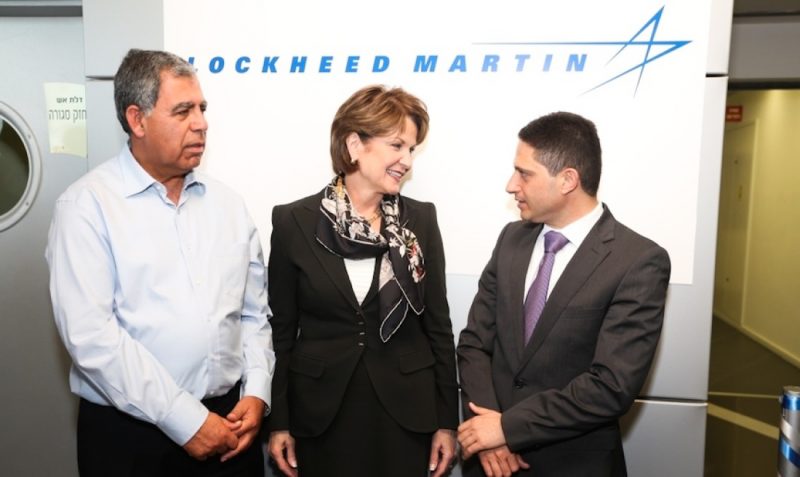
Marillyn Hewson, center, poses with Israeli gov. officials at the opening of Lockheed Martin’s facility in Beersheba. Photo | Diego Mittleberg
Haden Land, then-vice president of research and technology for Lockheed Martin, told the Wall Street Journal that the creation of the subsidiary was largely aimed at securing contracts with the IDF and that the company’s Israel subsidiary would soon be seeking partnership and investments in pursuit of that end. Land oversaw the local roll-out of the company’s Israel subsidiary while concurrently meeting with Israeli government officials. According to the Journal, Land “oversees all of Lockheed Martin’s information-systems businesses, including defense and civilian commercial units” for the United States and elsewhere.
Just a few months later, Lockheed Martin partnered and invested in Cybereason, suggesting that Lockheed’s decision to do so was aimed at securing closer ties with the IDF. This further suggests that Cybereason still maintains close ties to Israeli military intelligence, a point expounded upon in great detail in the previous installment of this series.
Thus, it appears that not only does Lockheed Martin use Cybereason’s software on its own devices and on those it manages for its private and public sector clients, but it also decided to use the company’s software in this way out of a desire to more closely collaborate with the Israeli military in matters related to technology and cybersecurity.
The cozy ties between Lockheed Martin, one of the U.S. government’s largest private contractors, and the IDF set off alarm bells, then and now, for those concerned with U.S. national security. Such concern makes it important to look at the extent of Cybereason’s use by federal and military agencies in the United States through their contracting of Lockheed Martin’s Information Technology (IT) division. This is especially important considering Israeli military intelligence’s history of using espionage, blackmail and private tech companies against the U.S. government, as detailed here.
While the exact number of U.S. federal and military agencies using Cybereason’s software is unknown, it is widespread, with Lockheed Martin’s IT division as the conduit. Indeed, Lockheed Martin was the number one IT solutions provider to the U.S. federal government up until its IT division was spun off and merged with Leidos Holdings. As a consequence, Leidos is now the largest IT provider to the U.S. government and is also directly partnered with Cybereason in the same way Lockheed Martin was. Even after its IT division was spun off, Lockheed Martin continues to use Cybereason’s software in its cybersecurity work for the Pentagon and still maintains a stake in the company.
The Leidos-Lockheed Martin IT hybrid provides a litany of services to the U.S. military and U.S. intelligence. As investigative journalist Tim Shorrock noted for The Nation, the company does “everything from analyzing signals for the NSA to tracking down suspected enemy fighters for US Special Forces in the Middle East and Africa” and, following its merger with Lockheed and consequential partnership with Cybereason, became “the largest of five corporations that together employ nearly 80 percent of the private-sector employees contracted to work for US spy and surveillance agencies.” Shorrock also notes that these private-sector contractors now dominate the mammoth U.S. surveillance apparatus, many of them working for Leidos and — by extension — using Cybereason’s software.
Leidos’ exclusive use of Cybereason software for cybersecurity is also relevant for the U.S. military since Leidos runs a number of sensitive systems for the Pentagon, including its recently inked contract to manage the entire military telecommunications infrastructure for Defense Information Systems Agency (DISA). In addition to maintaining the military telecom network, Cybereason is also directly partnered with World Wide Technologies (WWT) as of this past October. WWT manages cybersecurity for the U.S. Army, maintains DISA’s firewalls and data storage as well as the U.S. Air Force’s biometric identification system. WWT also manages contracts for NASA, itself a frequent target of Israeli government espionage, and the U.S. Navy. WWT’s partnership is similar to the Lockheed/Leidos partnership in that Cybereason’s software is now completely integrated into its portfolio, giving the company full access to the devices on all of these highly classified networks.
Many of these new partnerships with Cybereason, including its partnership with WWT, followed claims made by members of Israel’s Unit 8200 in 2017 that the popular antivirus software of Kaspersky Labs contained a backdoor for Russian intelligence, thereby compromising U.S. systems. The Wall Street Journal was the first to report on the alleged backdoor but did not mention the involvement of Unit 8200 in identifying it, a fact revealed by the New York Times a week later.
Notably, none of the evidence Unit 8200 used to blame Kaspersky has been made public and Kaspersky noted that it was actually Israeli hackers that had been discovered planting backdoors into its platform prior to the accusation levied against Kaspersky by Unit 8200. As the New York Times noted:
Investigators later discovered that the Israeli hackers had implanted multiple back doors into Kaspersky’s systems, employing sophisticated tools to steal passwords, take screenshots, and vacuum up emails and documents.”
Unit 8200’s claims ultimately led the U.S. government to abandon Kaspersky’s products entirely in 2018, allowing companies like Cybereason (with its own close ties to Unit 8200) to fill the void. Indeed, the very agencies that banned Kaspersky now use cybersecurity software that employs Cybereason’s EDR system. No flags have been raised about Cybereason’s own collaboration with the very foreign intelligence service that first pointed the finger at Kaspersky and that previously sold software with backdoors to sensitive U.S. facilities.
SoftBank, Cybereason and the Vision Fund
While its entry into the U.S. market and U.S. government networks is substantial, Cybereason’s software is also run throughout the world on a massive scale through partnerships that have seen it enter into Latin American and European markets in major ways in just the last few months. It has also seen its software become prominent in Asia following a partnership with the company Trustwave. Much of this rapid expansion followed a major injection of cash courtesy of one of the company’s biggest clients and now its largest investor, Japan’s SoftBank.
SoftBank first invested in Cybereason in 2015, the same year Lockheed Martin initially invested and partnered with the firm. It was also the year that SoftBank announced its intention to invest in Israeli tech start-ups. SoftBank first injected $50 million into Cybereason, followed by an additional $100 million in 2017 and $200 million last August. SoftBank’s investments account for most of the money raised by the company since it was founded in 2012 ($350 million out of $400 million total).

Cybereason CEO Lior Div speaks at a SoftBank event in Japan, July 21, 2017. Photo | Cybereason
Prior to investing, Softbank was a client of Cybereason, which Ken Miyauchi, president of SoftBank, noted when making the following statement after Softbank’s initial investment in Cybereason:
SoftBank works to obtain cutting edge technology and outstanding business models to lead the Information Revolution. Our deployment of the Cybereason platform internally gave us firsthand knowledge of the value it provides, and led to our decision to invest. I’m confident Cybereason and SoftBank’s new product offering will bring a new level of security to Japanese organizations.”
SoftBank — one of Japan’s largest telecommunications companies — not only began to deploy Cybereason internally but directly partnered with it after investing, much like Lockheed Martin had done around the same time. This partnership resulted in SoftBank and Cybereason creating a joint venture in Japan and Cybereason creating partnerships with other tech companies acquired by SoftBank, including the U.K.’s Arm, which specializes in making chips and management platforms for Internet of Things (IoT) devices.
SoftBank’s interest in Cybereason is significant, particularly in light of Cybereason’s interest in the 2020 U.S. election, given that SoftBank has significant ties to key allies of President Trump and even the president himself.
Indeed, SoftBank’s Masayoshi Son was among the first wave of international business leaders who sought to woo then-president-elect Trump soon after the 2016 election. Son first visited Trump Tower in December 2016 and announced, with Trump by his side in the building’s lobby, that SoftBank would invest $50 billion in the U.S. and create 50,000 jobs. Trump subsequently claimed on Twitter that Son had only decided to make this investment because Trump had won the election.
Son told reporters at the time that the investment would come from a $100 billion fund that would be created in partnership with Saudi Arabia’s sovereign wealth fund as well as other investors. “I just came to celebrate his new job. I said, ‘This is great. The US will become great again,’” Son said, according to reports.
Then, in March of 2017, Son sent top SoftBank executives to meet with senior members of Trump’s economic team and, according to the New York Times, “the SoftBank executives said that because of a lack of advanced digital investments, the competitiveness of the United States economy was at risk. And the executives made the case, quite strongly, that Mr. Son was committed to playing a major role in addressing this issue through a spate of job-creating investments.” Many of SoftBank’s investments and acquisitions in the U.S. since then have focused mainly on artificial intelligence and technology with military applications, such as “killer robot” firm Boston Dynamics, suggesting Son’s interest lies more in dominating futuristic military-industrial technologies than creating jobs for the average American.
After their initial meeting, Trump and Son met again a year later in June 2018, with Trump stating that “His [Son’s] $50 billion turned out to be $72 billion so far, he’s not finished yet.” Several media reports have claimed that Son’s moves since Trump’s election have sought to “curry favor” with the President.
Through the creation of this fund alongside the Saudis, SoftBank has since become increasingly intertwined with Saudi Crown Prince Muhammad bin Salman (MBS), a key ally of President Trump in the Middle East known for his authoritarian crackdowns on Saudi elites and dissidents alike. The ties between Saudi Arabia and SoftBank became ever tighter when MBS took the reins in the oil kingdom and after SoftBank announced the launch of the Vision Fund in 2016. SoftBank’s Vision Fund is a vehicle for investing in hi-tech companies and start-ups and its largest shareholder is the Public Investment Fund of Saudi Arabia. Notably, Son decided to launch the Vision Fund in Riyadh during President Trump’s first official visit to the Gulf Kingdom.
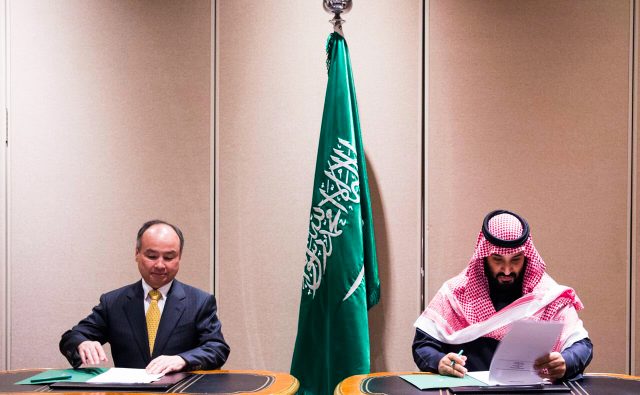
Masayoshi Son, left, signs a deal related to the Vision Fund with Bin Salman in March 2018. Photo | SPA
In addition, the Mubadala Investment Company, a government fund of the United Arab Emirates (UAE), gave $15 billion to the Vision Fund. UAE leadership also share close ties to the Trump administration and MBS in Saudi Arabia.
As a consequence, SoftBank’s Vision Fund is majority funded by two Middle Eastern authoritarian governments with close ties to the U.S. government, specifically the Trump administration. In addition, both countries have enjoyed the rapid growth and normalization of ties with the state of Israel in recent years, particularly following the rise of current Saudi Crown Prince Muhammad bin Salman and Jared Kushner’s rise to prominence in his father-in-law’s administration. Other investments in the Vision Fund have come from Apple, Qualcomm and Oracle’s Larry Ellison, all tech companies with strong ties to Israel’s government.
The Saudi and Emirati governments’ links to the Vision Fund are so obvious that even mainstream outlets like the New York Times have described them as a “front for Saudi Arabia and perhaps other countries in the Middle East.”
SoftBank also enjoys close ties to Jared Kushner, with Fortress Investment Group lending $57 million to Kushner Companies in October 2017 while it was under contract to be acquired by SoftBank. As Barron’s noted at the time:
When SoftBank Group bought Fortress Investment Group last year, the Japanese company was buying access to a corps of seasoned investors. What SoftBank also got is a financial tie to the family of President Donald Trump’s senior advisor and son-in-law, Jared Kushner.”
According to The Real Deal, Kushner Companies obtained the financing from Fortress only after its attempts to obtain funding through the EB-5 visa program for a specific real estate venture were abandoned after the U.S. Attorney and the Securities and Exchange Commission began to investigate how Kushner Companies used the EB-5 investor visa program. A key factor in the opening of that investigation was Kushner Companies’ representatives touting Jared Kushner’s position at the White House when talking to prospective investors and lenders.
SoftBank also recently came to the aid of a friend of Jared Kushner, former CEO of WeWork Adam Neumann. Neumann made shocking claims about his ties to both Kushner and Saudi Arabia’s MBS, even asserting that he had worked with both in creating Kushner’s long-awaited and controversial Middle East “peace plan” and claimed that he, Kushner and MBS would together “save the world.” Neumann previously called Kushner his “mentor.” MBS has also discussed on several occasions his close ties with Kushner and U.S. media reports have noted the frequent correspondence between the two “princelings.”
Notably, SoftBank invested in Neumann’s WeWork using money from the Saudi-dominated Vision Fund and later went on to essentially bail the company out after its IPO collapse and Neumann was pushed out. SoftBank’s founder, Masayoshi Son, had an odd yet very close relationship with Neumann, perhaps explaining why Neumann was allowed to walk with $1.7 billion after bringing WeWork to the brink of collapse. Notably, nearly half of SoftBank’s approximately $47 billion investments in the U.S. economy since Trump’s election, went to acquiring and then bailing out WeWork. It is unlikely that such a disastrous investment resulted in the level of job creation that Son had promised Trump in 2016.
Given that it is Cybereason’s top investor and shareholder by a large margin, SoftBank’s ties to the Trump administration and key allies of that administration are significant in light of Cybereason’s odd interest in 2020 U.S. election scenarios that end with the cancellation of this year’s upcoming presidential election. It goes without saying that the cancellation of the election would mean a continuation of the Trump administration until new elections would take place.
Furthermore, with Cybereason’s close and enduring ties to Israeli military intelligence now well-documented, it is worth asking if Israeli military intelligence would consider intervening in 2020 if the still-to-be-decided Democratic contender was strongly opposed to Israeli government policy, particularly Israel’s military occupation of Palestine. This is especially worth considering given revelations that sexual blackmailer and pedophile Jeffrey Epstein, who targeted prominent U.S. politicians, mostly Democrats, was in the employ of Israeli military intelligence.
Notably, Cybereason’s doomsday election scenarios involved the weaponization of deep fakes, self-driving cars and the hacking Internet of Things devices, with all of those technologies being pioneered and perfected — not by Russia, China or Iran — but by companies directly tied to Israeli intelligence, much like Cybereason itself. These companies, their technology and Cybereason’s own work creating the narrative that U.S. rival states seek to undermine the U.S. election in this way, will all be discussed in the conclusion of MintPress’ series on Cybereason and its outsized interest in the U.S. democratic process.
Whitney Webb is a MintPress News journalist based in Chile. She has contributed to several independent media outlets including Global Research, EcoWatch, the Ron Paul Institute and 21st Century Wire, among others. She has made several radio and television appearances and is the 2019 winner of the Serena Shim Award for Uncompromised Integrity in Journalism.
Iran Jet Disaster Setup
By Soraya Sepahpour-Ulrich and Finian Cunningham – Sputnik – 13.01.2020
The 19-second video published by the New York Times last week showing the moment an Iranian missile hit a passenger jet has prompted much social media skepticism.
Questions arise about the improbable timing and circumstances of recording the precise moment when the plane was hit.
The newspaper ran the splash story on January 9, the day after a Ukrainian airliner was brought down near Tehran. It was headlined: ‘Video Shows Ukrainian Plane Being Hit Over Iran’. All 176 people onboard were killed. Two days later, the Iranian military admitted that one of its air defense units had fired at the plane in the mistaken belief that it was an incoming enemy cruise missile.
“A smoking gun” was how NY Times’ journalist Christiaan Triebert described the video in a tweet. Triebert works in the visual investigations team at the paper. In the same tweet, he thanked – “a very big shout out” – to an Iranian national by the name of Nariman Gharib “who provided it [the video] to the NY Times, and the videographer, who would like to remain anonymous”.
The anonymous videographer is the person who caught the 19-second clip which shows a missile striking Flight PS752 shortly after take-off from Tehran’s Imam Khomenei airport at around 6.15 am. This person, who remains silent during the filming while smoking a cigarette (the smoke briefly wafts over the screen), is standing in the suburb of Parand looking northwest. His location was verified by the NY Times using satellite data. The rapid way the newspaper’s technical resources were marshaled raises a curious question about how a seemingly random video submission was afforded such punctilious attention.
But the big question which many people on social media are asking is: why was this “videographer” standing in a derelict industrial area outside Tehran at around six o’clock in the morning with a mobile phone camera training on a fixed angle to the darkened sky? The airliner is barely visible, yet the sky-watching person has the camera pointed and ready to film a most dramatic event, seconds before it happened. That strongly suggests, foreknowledge.
Given that something awful has just been witnessed it is all the more strange that the person holding the camera remains calm and unshaken. There is no audible expression of shock or even the slightest disquiet.
Turns out that Nariman Gharib, the guy who received the video and credited by the NY Times for submitting it, is a vociferous anti-Iranian government dissident who does not live in Iran. He ardently promotes regime change in his social media posts.
Christiaan Triebert, the NY Times’ video expert, who collaborated closely with Gharib to get the story out within hours of the incident, previously worked as a senior investigator at Bellingcat. Bellingcat calls itself an independent online investigative journalism project, but numerous critics accuse it of being a media adjunct to Western military intelligence. Bellingcat has been a big proponent of media narratives smearing the Russian and Syrian governments over the MH17 shoot-down in Ukraine in 2014 and chemical weapons attacks.
In the latest shoot-down of the airliner above Tehran, the tight liaison between a suspiciously placed anonymous videographer on the ground and an expatriate Iranian dissident who then gets the prompt and generous technical attention of the NY Times suggests a level of orchestration, not, as we are led to believe, a random happenstance submission. More sinisterly, the fateful incident was a setup.
It seems reasonable to speculate that in the early hours of January 8 a calamitous incident was contrived to happen. The shoot-down occurred only four hours after Iran attacked two US military bases in Iraq. Those attacks were in revenge for the American drone assassination on January 3 of Iran’s top military commander, Maj. General Qassem Soleimani.
Subsequently, Iranian air-defense systems were on high alert for a possible counter-strike by US forces. Several reports indicate that the Iranian defense radars were detecting warnings of incoming enemy warplanes and cruise missiles on the morning of 8 January. It does seem odd why the Iranian authorities did not cancel all commercial flights out of Tehran during that period. Perhaps because civilian airliners can normally be differentiated by radar and other signals from military objects.
However, with the electronic warfare (EW) technology that the United States has developed in recent years it is entirely feasible for enemy military radars to be “spoofed” by phantom objects. One such EW developed by the Pentagon is Miniature Air-Launched Decoy (MALD) which can create deceptive signals on enemy radar systems of incoming warheads.
What we contend therefore is this: the Americans exploited a brink-of-war scenario in which they anticipated Iranian air-defense systems to be on a hair-trigger. Add to this tension an assault by electronic warfare on Iranian military radars in which it would be technically feasible to distort a civilian airliner’s data as an offensive target. The Iranian military has claimed this was the nature of the shoot-down error. It seems plausible given the existing electronic warfare used by the Pentagon.
It’s a fair, albeit nefarious, bet that the flight paths out of Tehran were deliberately put in an extremely dangerous position by the malicious assault from American electronic warfare. A guy placed on the ground scoping the outward flight paths – times known by publicly available schedules – would be thus on hand to catch the provoked errant missile shot.
The shoot-down setup would explain why Western intelligence were so quick to confidently assert what happened, contradicting Iran’s initial claims of a technical onboard plane failure.
The disaster has gravely undermined the Iranian government, both at home and around the world. Protests have erupted in Iran denouncing the authorities and the Islamic Revolutionary Guards Corp for “lying” about the crash. Most of the 176 victims were Iranian nationals. The anger on the streets is being fueled by the public comments of Western leaders like Donald Trump, who no doubt see the clamor and recriminations as an opportunity to push harder for regime change in Iran.
Trump and Congress Double Down on Demonizing Iran
Will the national security nightmare ever end?
By Philip Giraldi • Unz Review • January 14, 2020
If one seriously seeks to understand how delusional policymakers in Washington are it is only necessary to examine the responses by the president and Congress to the assassination of Iranian Major General Qassem Soleimani. The first response came in the form of a Donald Trump largely incoherent nine-minute self-applauding speech explaining what he had done and why. It was followed by a House of Representatives War Powers non-binding resolution that was all theater and did nothing to limit the president’s unilateral ability to go to war with the Islamic Republic.
It was reported that the Trump speech had been hurriedly written by aides the night before it was given and that it existed in several competing drafts. It was full of out-and-out lies and half truths and intended to reassure the American people that the president was keeping them safe. The opening line might well be regarded as some kind of joke: “As long as I am President of the United States, Iran will never be allowed to have a nuclear weapon.” Trump has in fact done more to ensure that Iran will have a nuclear weapon than any other president through his abrupt withdrawal from the Joint Comprehensive Plan Of Action (JCPOA) and his assassination of Soleimani, which together have convinced the Iranian leadership that there is no possibility of a reasonable negotiated solution when dealing with the American president, even when he claims he wants to “talk.”
Trump then went on characteristically to eulogize our brave soldiers on far flung battlefields before lying again, saying “For far too long — all the way back to 1979, to be exact — nations have tolerated Iran’s destructive and destabilizing behavior in the Middle East and beyond. Those days are over. Iran has been the leading sponsor of terrorism, and their pursuit of nuclear weapons threatens the civilized world. We will never let that happen.” Lie one is that the “destructive and destabilizing behavior” actually has Made in U.S.A. stamped all over it. Lie two is “leading sponsor of terrorism,” an honor that belongs to Israel, Saudi Arabia and the United States, in that order. And lie three is that Iran “pursued” nuclear weapons. It has never done so.
Trump them boasted that “Last week, we took decisive action to stop a ruthless terrorist from threatening American lives. At my direction, the United States military eliminated the world’s top terrorist, Qasem Soleimani. As the head of the Quds Force, Soleimani was personally responsible for some of the absolutely worst atrocities.” Trump’s preening was again wrong on every count: Soleimani is no terrorist by any reasonable definition, nor is there any evidence that he threatened American lives. And Trump and his chorus of neocons cannot name a single “atrocity” committed by the man
The president claimed that Soleimani “… viciously wounded and murdered thousands of U.S. troops, including the planting of roadside bombs that maim and dismember their victims,” a particularly absurd charge suggesting that Trump believes that any American soldier who died in Iraq or Afghanistan did so at the hands of the Iranian Major General. By the same logic, the musical chairs series of American generals that have served in Afghanistan, Iraq and Syria have murdered hundreds of thousands of people. If Trump wants to start counting fatalities he should perhaps start with David Petraeus.
Piling Ossa on Pelion, Trump declared that Soleimani “… orchestrated the violent assault on the U.S. embassy in Baghdad. In recent days, he was planning new attacks on American targets, but we stopped him.” There is no evidence whatsoever to support either assertion and Trump then goes on to ascribe all the problems of the Middle East to Iran, ignoring the roles played by others, most notably Washington, Israel and the Saudis. He also roundly condemned the JCPOA before asserting falsely that “Three months ago, after destroying 100 percent of ISIS and its territorial caliphate, we killed the savage leader of ISIS, al-Baghdadi…” In reality, ISIS was defeated by the Syrian Army and its allies Russia and Iran, the very countries that Trump has continued to vilify even as he struts his anti-terrorist credentials. Qassem Soleimani played a major role in the destruction of ISIS.
The only good things in the Trump speech were that it was short and the president did not find it necessary to say a whole lot of good things about Israel. Interestingly, no one in the mainstream media or in the political chattering class made much effort to challenged Trump on the “facts” he cited, though there was some pushback from mostly Democratic congressmen who stated that they could not see any “imminent threat” in the evidence that the Administration produced during a classified briefing. The actual war powers concurrent resolution that passed in the House last Thursday was symptomatic of the unwillingness of the political opposition to take on the illegal and immoral wars in the Middle East themselves – it had no teeth and will not change anything.
The resolution’s subject line “Directing the President pursuant to section 5(c) of the War Powers Resolution to terminate the use of United States Armed Forces to engage in hostilities in or against Iran” actually is misleading. And the first thing the text does do is slam Iran with the same dubious “facts” employed by Trump, including that “The Government of Iran is a leading state sponsor of terrorism and engages in a range of destabilizing activities across the Middle East. Iranian General Qassem Soleimani was the lead architect of much of Iran’s destabilizing activities throughout the world.”
The resolution includes “In matters of imminent armed attacks, the executive branch should indicate to Congress why military action was necessary within a certain window of opportunity, the possible harm that missing the window would cause, and why the action was likely to prevent future disastrous attacks against the United States.” It then goes on to explain that “When the United States uses military force, the American people and members of the United States Armed Forces deserve a credible explanation regarding such use of military force…” because “The War Powers Resolution (50 U.S.C. 1541 et seq.) requires the President to consult with Congress ‘in every possible instance’ before introducing United States Armed Forces into hostilities.” It concludes with “Congress has not authorized the President to use military force against Iran.”
It would seem to be a devastating critique of the Trump Art of War but then comes the wiggle room “… Congress hereby directs the President to terminate the use of United States Armed Forces to engage in hostilities in or against Iran or any part of its government or military, unless Congress has declared war or enacted specific statutory authorization for such use of the Armed Forces; or such use of the Armed Forces is necessary and appropriate to defend against an imminent armed attack upon the United States, its territories or possessions, or its Armed Forces, consistent with the requirements of the War Powers Resolution. Nothing in this section may be construed to prevent the President from using military force against al Qaeda or associated forces…” In other words, all Trump has to do is claim “imminent threat” or that he is attacking “terrorist associated forces” and he is home free no matter what he does, particularly as the resolution itself is non-binding.
The sheer ignorance and arrogance of elites in Washington combined with a colonialist mentality that dismisses Asians and Africans as unthinking “wogs” who will do one’s bidding if they are confronted with punishment is currently on display. It was inevitable that Iraq would demand the departure of U.S. troops after thirty-four Iraqi militiamen were killed by American drone and air strikes, but many in Washington just didn’t get it. Trump threatened, in characteristic fashion, to respond with sanctions, but now Iraqi Prime Minister Adel Abdul Mahdi has made it official in a phone call to Secretary of State Mike Pompeo, demanding a plan and timetable for the removal of the American soldiers. The State Department has indicated that it is not prepared to discuss the matter.
Some pundits who should know better have predicted that the withdrawal of U.S. soldiers will not take place because Iraq somehow “needs” the United States. And besides, there will be economic consequences if Iraq does go ahead to insist on an American withdrawal. But sometimes abstractions prove to be more powerful than material incentives. The United States violated Iraqi sovereignty not once but twice and murdered 30 Iraqis in the process. Pompeo can huff and puff all he wants and Trump can mouth his illiteracies, but nothing changes the fact that the United States did things it did not have to do based on a delusional view of the Middle East and will have to pay a price. Minus a presence in Iraq, Syria will be untenable and one might hope that once the U.S. loses its ability to directly confront Iran on the ground the whole house of cards just might collapse, leading to Washington’s gradual departure from the region. That would be good for the region and also for the United States even if Israel and the Saudis, who prefer to have Americans fight and die in their wars, might object.
Philip M. Giraldi, Ph.D., is Executive Director of the Council for the National Interest, a 501(c)3 tax deductible educational foundation (Federal ID Number #52-1739023) that seeks a more interests-based U.S. foreign policy in the Middle East. Website is councilforthenationalinterest.org, address is P.O. Box 2157, Purcellville VA 20134 and its email is inform@cnionline.org.
Featured Video

Dr. Tony Martin – The Jewish Role in the African Slave Trade
or go to
Aletho News Archives – Video-Images
In Memoriam
James Petras, In Memoriam
 02.13.2026
Professor James Petras, 89, world-renowned sociologist, public intellectual, and scholar of Latin American politics and global economics, died peacefully on January 17, 2026, in Seattle, WA, surrounded by family.
A prolific scholar and activist, he devoted his life to challenging power, imperialism, and inequality. … continue
Blog Roll
 Aletho News
- Israel ready to strike Iran-backed armed groups – media
- Behind US war drums against Iran: No goals, no plan, no off-ramp
- With Ukraine blamed for cutting oil flows to Hungary, Croatia also refuses to transfer Russian oil in violation of EU law
- Friedrich Merz’s Push to End Online Anonymity Has a Troubling Subtext
- Macron: French citizens fighting for Israel cannot be labeled ‘genociders’
- US eyes Gaza security force drawn from armed gangs
- The Only Motive Behind The ‘Imminent’ U.S. War With Iran Is The Zionist Lobby
- Trump eyes 350-acre US military base housing 5,000 troops in Gaza
- Israel Pushing US Toward a Big and Damaging War With Iran – Ex-Pentagon Analyst
- Meet The Liberal Zionist And Ukraine War Supporter Advising AOC On Foreign Policy
- If Americans Knew
- The Israeli Government Installed and Maintained Security System at Epstein Apartment
- Tucker Carlson interrogated in Israel, has passport seized after interviewing US ambassador
- 6,000 Amputees in Gaza Face Impossible Recovery amid Israeli War Ultimatum
- The Lancet: Gaza death toll far higher than reported – Not a ceasefire Day 132
- Compliant aid: Who are the Israel-approved NGOs scaling up in Gaza?
- Why won’t Trump’s “Board of Peace” bring peace? – Not a ceasefire Day 131
- Help end the injustice against Shadi
- Israel’s Favorite American President
- Israel’s “Yellow Line” Is a Death Trap for Palestinians. We Drove Into It.
- Why Israel’s expanding occupation in Syria presents a critical legal test
- No Tricks Zone
- Coal Power Back In Trend As Globe Tries To Keep Pace With Growing Demand For Power
- New Study: A 4°C Warmer Beaufort Sea Had ‘No Sea Ice’ 11,700 – 8200 Years Ago
- Unfudging The Data: Dutch Meteorological Institute Reinstates Early 20th Centruy Heat Waves It Had Erased Earlier
- German Gas Crisis…Chancellor Merz Allegedly Bans Gas Debate Ahead of Elections!
- Pollen Reconstructions Show The Last Glacial’s Warming Events Were Global, 10x Greater Than Modern
- Germany’s Natural Gas Storage Level Dwindles To Just 28%… Increasingly Critical
- New Study Rebuts The Assumption That Anthropogenic CO2 Molecules Have ‘Special’ Properties
- Climate Scientist Who Predicted End Of “Heavy Frost And Snow” Now Refuses Media Inquiries
- Polar Bear Numbers Rising And Health Improving In Areas With The Most Rapid Sea Ice Decline
- One Reason Only For Germany’s Heating Gas Crisis: Its Hardcore-Dumbass Energy Policy
 Aletho News