How Was Pentagon ‘Withdrawal Letter” Leaked To Iraq? Anatomy Of A Propaganda Coup
By Tyler Durden – ZeroHedge – 01/07/2020
The inside account of how the now infamous “phony” letter announcing complete US troop withdrawal from Iraq after seventeen years details astoundingly how the “posting of the letter online unleashed a mad, behind-the-scenes scramble at the Pentagon, the White House, and on Capitol Hill, as elected officials, policymakers, military advisers and journalists sought to understand whether the letter intended to communicate what its plain language suggested.”
As different departments and levels within the Pentagon bureaucracy attempted to account for it, the story changed multiple times. In a matter of a couple hours it went from “authentic” to “phony” to part of an effort to sow “active disinformation” — and finally according to a confused press briefing by Gen. Milley and Defense Secretary Mark Esper an “unauthorized draft” and “an honest mistake”.
This after The Washington Post and a host of other major outlets “confirmed” it as “authentic” — in the words of WaPo’s Beirut Bureau chief Liz Sly.
At Monday’s Pentagon briefing itself which attempted to assess the origins of the mysterious draft letter, The Dispatch summarized the atmosphere: “Was the United States really moving to remove its remaining troops from Iraq? Nobody seemed to know.”
And ultimately no definitive answers came, other than the Pentagon and administration denying than an Iraq pullout is happening, as to just how a “draft letter” which had been making the rounds at CENTCOM came to be in the hands of the Iraqis, after which it was posted online.
As The Dispatch notes, the letter wasn’t merely announced by some Iraqi politician in Baghdad, but was released via America’s enemies:
The news was a propaganda coup for the Iranians and those in Iraq who support them. The story broke on the television channel of an Iran-backed Iraqi militia, Asaib Ahl al-Haq (AAH), after it was leaked by the Iraqi prime minister’s office, according to Liz Sly, Beirut bureau chief for the Washington Post, who noted that the leader of AAH is a U.S.-designated terrorist and his militia is responsible for the deaths of dozens of Americans.
The letter soon made its way into the American media.
Initially, there was this statement out of the Pentagon policy office in conjunction with Operation Inherent Resolve: “OIR has confirmed with us at the working level that this is active disinformation.” The Pentagon was “fairly certain that this is a fake” according to that early media statement.
But then this later at the Pentagon press briefing:
They didn’t declare the letter a fake but they couldn’t offer much of an explanation of its provenance or meaning, either. Esper pleaded ignorance. “I don’t know what that letter is,” he said. “We’re trying to find out where that’s coming from, what that is. But there has been no decision made to leave Iraq, period.” He declined to confirm its authenticity. “No, I can’t.”
Gen. Milley couldn’t verify that the letter was real, either. “I do know that it’s not signed,” he said. “But I just looked at it right there; it’s not signed.”
So even the attempts to account for what may or may not be a “draft” letter which originated within the Pentagon itself and then leaked to the Iraqis remain contradictory.
The final word from the Defense Department seems to be a shoulder shrug and that it was “an honest mistake”.
What remains is that the whole embarrassing and bizarre episode does indeed appear a “propaganda coup for the Iranians and those in Iraq who support them.”
Russia Proposes To Secure Iraqi Airspace With S-400 Air Defense
By Tyler Durden – Zero Hedge – 01/07/2020
The Ministry of Defense of the Russian Federation has offered Iraq Tuesday the option to purchase the world’s most advanced missile defense system to protect its airspace, reported RIA Novosti.
According to the report, the Iraqi Armed Forces could purchase the Russian S-400 Triumf air defense system, which RIA points out, can “ensure the country’s sovereignty and reliable airspace protection.”
“Iraq is a partner of Russia in the field of military-technical cooperation, and the Russian Federation can supply the necessary funds to ensure the sovereignty of the country and reliable protection of airspace, including the supply of S-400 missiles and other components of the air defense system, such as Buk-M3, Tor -M2 “and so on,” said Igor Korotchenko, Russian Defense Ministry’s Public Council member.
For the last several months, Iraq has considered purchasing Russian air defense and missile systems, including the S-400, however, it has been met with fierce pressure from the US.
But with a political crisis between the US and Iraq underway, thanks partly to the US assassination of Iran’s Maj. Gen. Qassem Soleimani, Russia could profit as Iraq attempts to decouple from the US.
A recent U.S. intelligence assessment indicated that at least 13 countries had expressed interest in purchasing the S-400s.
Saudi Arabia, Qatar, Algeria, Morocco, Egypt, Vietnam, and Iraq have all be in discussions with Russia to purchase the missile defense system in the last several quarters.
Meanwhile, China, India, and Turkey have already signed agreements with Russia.
The S-400s can strike stealth bombers, aircraft, cruise missiles, precision-guided projectiles, and ballistic missiles, some military experts have even said the Russian missile defense system is far superior than the US’ MIM-104 Patriot.
Imam Khamenei: Only a Slap Was Delivered, US Withdrawal from Region Inevitable
Al-Manar | January 8, 2020
Leader of the Islamic Revolution in Iran Imam Sayyed Ali Khamenei said the missiles on US bases in Iraq are only a slap in the face of Washington, stressing that the real retaliation to the assassination of IRGC’s Quds Force General Qassem Suleimani is the US withdrawal from the region.
“Last night, a slap in the face was delivered,” Imam Khamenei said, in a speech broadcast live on state television, referring to the IRGC missiles which were launched at US bases in Iraq, including Ain al-Assad base in Anbar.
“One important issue is what is our duty now?” following Suleimani’s assassination, said the Leader.
“An important incident has happened. The question of revenge is another issue. Military actions in this form are not sufficient for that issue,” he said, referring to the assassination.
“What is important is that America’s corrupt presence must come to an end in this region,” his eminence said, stressing that the US withdrawal from region is “inevitable.”
Elsewhere in his speech, Imam Khamenei praised Suleimani as courageous and devoted.
“Martyr Suleimani challenged Zionists and managed to offer support to Palestinians in Gaza,” he said, adding that the top commander played major role with Hezbollah in defending Lebanon and foiled enemies’ conspiracies in Iraq, Syria.
“Martyrdom of Suelimani revived revolution spirit in Iran.”
” As long as our enemies’ allies don’t target us we won’t hit them,” Imam Khamenei said likely referring to Gulf Arab states.
Iraqi cleric Moqtada al-Sadr says crisis over, after Trump & Iran speak
© Reuters / Alaa al-Marjani
RT | January 8, 2020
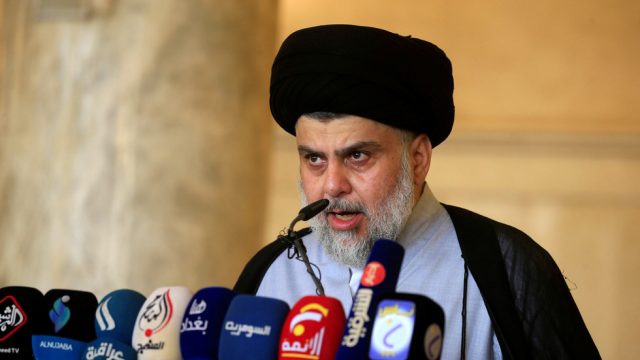
Influential Iraqi cleric Moqtada al-Sadr has declared the “crisis” between the US and Iran over, following statements from the two countries’ leaders in the wake of Tuesday’s Iranian strikes on US bases in Iraq.
Al-Sadr made his pronouncement on Wednesday after US President Donald Trump gave a relatively subdued speech praising Iran’s restraint. Rather than call for retaliation against Iran over a strike that didn’t kill any Americans, Trump merely vowed to impose even more sanctions on the Islamic Republic “until Iran changes its behavior.”
Iran’s President Hassan Rouhani in turn vowed to eventually kick all US troops “out of the region” as the “final answer” to the assassination of General Qassem Soleimani, killed in a US airstrike last week.
Shia religious leader al-Sadr also called on Iraqi militias to be “patient” and not begin any military actions, claiming that a new “strong” government capable of protecting Iraq’s sovereignty would be formed in 15 days and hold early elections. However, Iraq should still evict the foreign troops inside its borders, he said.
The Iraqi foreign ministry condemned Iran’s missile attack on the coalition bases, declaring it a “violation of Iraqi sovereignty” in a statement on Wednesday and emphasizing Iraq was an “independent state.”
“We will not allow it to become a battlefield,” the ministry added.
Iraqi PM Adel Abdul Mahdi stepped down last month after months of massive protests calling for electoral reforms. He has remained in a “caretaker” role while Iraq’s political leaders attempt to move forward. Another prominent Shia cleric, Grand Ayatollah Ali al-Sistani, warned last month that “foreign interference” in the process would not be tolerated.
Zarif: Iran informed Iraqi govt. of missile attack on US bases
Press TV – January 8, 2020
Iranian Foreign Minister says Iran informed the Iraqi government of its retaliatory attack on US bases, reaffirming Tehran’s respect for the sovereignty and territorial integrity of the Arab country.
This measure was carried out with the information passed to the Iraqi government and armed forces as confirmed by the Baghdad government, Zarif said Wednesday.
“We attach high significance to Iraq’s territorial integrity and sovereignty, and we believe security should be [provided] based on mutual respect and [safeguarding] territorial integrity of all regional countries by all,” he added.
The remarks came hours after Iran responded to the US assassination of prominent anti-terror Iranian commander Lieutenant General Qassem Soleimani and his companions, including Iraqi commander Abu Mahdi al-Muhandis, with a barrage of missiles that hit two US bases in Iraq.
In the early hours of Wednesday, Iran launched tens of missiles at two bases housing US troops in Iraq’s western Anbar Province and Kurdistan regional capital, Erbil, in revenge for the assassination of General Soleimani.
Zarif’s remarks came after Iraq’s President Barham Saleh and the speaker of the Iraqi parliament, Mohammed al-Halbusi, said the attack violated the sovereignty of the Arab country.
However, earlier on Wednesday, the spokesman for Iraqi Prime Minister Adel Abdul-Mahdi said the premier had received word from Iran that its response to the US assassination of its top general was either imminent or under way.
“Shortly after midnight on Wednesday we received a verbal message from the Islamic Republic of Iran that the Iranian response to the assassination of martyr Qassem Soleimani had started or was about to start,” Reuters quoted the spokesman as saying.
Elsewhere in his remarks, Zarif said Iran’s missile attack was a military revenge for the top commander, stressing, however, that there is no retaliation proportionate to the assassination of General Soleimani other than the expulsion of US forces from the region.
As declared by Leader of the Islamic Revolution Ayatollah Seyyed Ali Khamenei, Zarif said, the true revenge for General Soleimani’s blood is that the US folly has marked the end of its presence in the region.
“The end of the US presence in the region, which will definitely happen, will herald glad tidings for the region and the generations to come, because the US presence in the region has brought about nothing but destruction and mischief,” he noted.
A Window for Peace
By Craig Murray | January 8, 2020
There is this morning a chink of light to avoid yet more devastation in the Middle East. Iran’s missile strikes last night were calibrated to satisfy honour while avoiding damage that would trigger automatically the next round. The missiles appear to have been fitted out with very light warhead payloads indeed – their purpose was to look good in the dark going up into the night sky. There is every reason to believe the apparent lack of US casualties was deliberate.
Even more important was the Iraqi statement that “proportionate measures” had been “taken and concluded” and they did not seek “further escalation”.
I agree their response was proportionate and I would say that I regard the Iranian action so far, unlike the assassination of Soleimani by the US, legal in international law.
The entire world should congratulate Iran for its maturity in handling the illegal assassination of its General, who was on a peace mission, travelling as a civilian on a commercial flight, carrying a mediation message the US had been instrumental in instigating. If as seems possible the US actively manipulated the diplomatic process to assassinate someone on a diplomatic mission and traveling on a diplomatic passport, that is a dreadful outrage which will come back to haunt them. Life insurance rates for US diplomats no doubt just went up.
It is also worth noting the 2.8% rise in the Lockheed share price in the 24 hours immediately before the Soleimani assassination, outperforming the Dow about three times. That would bear investigation. Arms manufacturers and oil stocks have soared this last few days – and remember that nowadays the vast bulk of financial transactions are bets on the margins of movement, so vast fortunes will have been made out of all this.
The UK has been, as ever, complicit in US crimes. Our laughing called “defence” industry – when were its products last used in self-defence and not colonial adventure? – is tied in to and dependent on the US military machine. The current build-up of US troops and hardware in the Gulf has Mildenhall as a major staging post. We do not have to do this. Whether officially or on a pretext, French airspace was closed to the US military build-up and the Americans have had to fly from the UK, skirting France, around the Atlantic.
In a huge Boris Johnson slap in the face to international law, extra US bombers to attack Iran have been flown into Diego Garcia, in the Chagos Islands. You will recall that is where the UK committed genocide against the population in the 1970s to clear the way for the US military base. Last year, the UK lost a hearing before the International Court of Justice and was subsequently instructed by the UN to decolonise the islands and give them back to Mauritius by last November. The UK simply persisted in its illegal occupation and now is threatening the use of the islands as the base for yet another illegal and destabilising war.
That the UK is a permanent member of the UN security council is a disgrace which surely cannot endure much longer. What the current crisis has shown us is that under Johnson the UK has no future except as a still more compliant servant of whoever occupies the White House.
Wars are easy to start but hard to stop. Trump appears to have calmed, but we cannot rule out a stupid “last word” attack bu the USA. It is to be hoped that Iran now concentrates on using the immense political leverage it has gained to get western troops out of Iraq, which would be a tremendous result for all of us after 17 years. But we cannot rule out hotter heads in the Iranian government insisting on further attacks, or attacks from regional forces whose Tehran authorisation is uncertain. On either side this could yet blow up badly.
I am a sucker for hope, and the best outcome would be for the US and Iran to start talking directly again, and a deal to be made from this break in the logjam that is wider than, and Trump can portray as better than, “Obama’s” nuclear deal and would enable the lifting of sanctions. I am sure Trump will be tempted by the chance to go for this kind of diplomatic coup under the political cover provided him by Soleimani’s assassination. But the US is now so tied in to Saudi Arabia and Israel, and thus tied in to irrational hostility to Iran, that this must be extremely unlikely.
For those of us in Scotland, this is still more reason why Independence must be early. We cannot be tied in to a rogue state. As we march for Independence on Saturday, the potential for war in Iran gives the sharpest reminder why we must leave the UK and form our own, peaceful, law-abiding state.
Iran strikes US bases in Iraq to avenge Soleimani, vows to target Israel and all US bases in the region
Al-Manar | January 8, 2020
The Islamic Republic of Iran began its revenge for the assassination of the martyr Soleimani by launching dozens of ballistic missiles at the US base of Al-Asad in Iraq.
The Islamic Revolutionary Guards announced that the process of revenge for the assassination of the martyr Soleimani had started with the launch of dozens of ballistic missiles against the American base at Al-Asad in Iraq. In a statement, they assert that “At dawn today, in response to the terrorist operation by American forces and in retaliation for the assassination and martyrdom of Quds Force Commander of the Islamic Revolutionary Guards, Qassem Soleimani, and his companions, the aerospace forces of the the Islamic Revolutionary Guards carried out a successful operation bearing the name of the martyr Soleimani by launching dozens of ground-to-ground ballistic missiles against the air base of Ain al-Assad occupied by the US terrorist army. We will later inform the noble Iranian people and all free men of the world of the details of this process.
The Islamic Revolutionary Guards warned “The Great Satan, namely the US regime, that any wicked act, aggression or other hostile movement would face an even more painful and harsh response. […] We warn America’s allies who host US terrorist bases that any territory that is the source of hostile action against the Islamic Republic of Iran will be targeted.” The statement from the Islamic Revolutionary Guards added that “we do not in any way regard the Zionist entity as distinct from the criminal US regime.”
“We recommend that the American people recall their soldiers from the region to avoid further casualties and not to leave the lives of American soldiers threatened because of our peoples’ growing hatred of America,” the statement said.
Public relations within the Revolutionary Guards warned the United States that any response to the strikes “would light the fuse of a widespread and very painful response against the United States in the region.”
The Iranian news agency Mehr reported that “dozens of missiles from the aerospace force of the Islamic Revolutionary Guards targeted the base of Ain al-Assad”, and said that “the attack comes in reprisal for the assassination of the martyred commander Qassem Soleimani, and consisted in the launching of a certain number of ground-to-ground missiles”.
After the news was announced, the sounds of Takbir (Allahu Akbar!) rose from the top of the buildings of the capital, Tehran, expressing popular jubilation at this operation.
A security source told Agence France-Presse that on the night from Tuesday to Wednesday, at least nine rockets landed at the Ein Al-Assad Air base in western Iraq, where American soldiers are stationed. The source said the attack took place in 3 stages.
Use of Fateh missiles in a process of severe revenge
Given the distance between the base of Ain al-Assad and the place from which the Islamic Revolutionary Guard missiles were launched, Fateh ballistic missiles were used in these strikes (range up to 500 kilometers).
U.S. forces and their advisers are stationed at Ain al-Assad Air Base, which is the second largest Air Base in Iraq, after Balad base in Salah al-Din, north of Baghdad. For years, American forces have been present at several Iraqi military and Air Bases in the provinces of Anbar, Salah-al-Din, Nineveh and the capital Baghdad.
Pentagon admits strikes
The Pentagon has announced that Iran fired “more than 12 missiles” at dawn on Wednesday at the Ain al-Assad and Erbil bases used by US forces in Iraq on Wednesday, indicating that it is in currently assessing the damage and studying ways to “respond” to this strike.
Assistant to the Secretary of War for Public Affairs Jonathan Hoffman said in a statement that the department was conducting a “preliminary damage assessment” and was considering a “response” to the attack. He added that on Tuesday evening, “around 5.30pm (10.30pm GMT) on January 7, Iran fired more than 12 ballistic missiles at US and coalition forces in Iraq.” This time corresponds to the exact time martyr Soleimani was killed.
The statement added that it is clear that these missiles were launched from Iran and were aimed at at least two Iraqi military bases used by American and coalition forces in Ain al-Assad and Erbil.
The White House, for its part, said that President Trump is monitoring the situation closely and holding consultations with the National Security Council to discuss developments. White House spokesperson Stéphanie Gresham said, “We are aware of reports of attacks on US facilities in Iraq. The President has been informed and is following the situation closely and is consulting his national security team. ”
Oil prices go up and Nikkei goes down
The oil price per barrel jumped more than 4.5% on Wednesday after Iran launched ballistic missiles at two air bases used by US and coalition forces in Iraq. West Texas Intermediate barrel rose 4.53% to $ 65.54 before declining slightly.
The main Nikkei index of the Tokyo Stock Exchange lost more than 2.4% Wednesday morning. Half an hour after opening, the losses of the Nikkei index on the 225 largest companies listed on the Japanese Stock Exchange reached 2.44%, or 576.26 points, to fall to 22,999.46 points, while the losses of the Topix index, the most important, were slightly lower, reaching 2.20% or 37.90 points to reach 1687.15 points.
Sources: Al-Manar & Iranian sources.
Translation: resistancenews.org
Propagandists Ponder Plunging Popularity – #PropagandaWatch
Corbett • 01/07/2020
Podcast: Play in new window | Download | Embed
Watch this video on BitChute / Minds.com / YouTube
This week on #PropagandaWatch we look at how the propagandists are wringing their hands over the plunging popularity of their dinosaur media outlets.
SHOW NOTES:
A year of media upheaval
“The News” is a Social Construct. It is Used to Program You.
Episode 370 – The Afghanistan Papers Are Establishment Whitewash BS
FM Zarif: Iran’s Reprisal Attack in Compliance with UN Charter
Fars News Agency | January 8, 2020
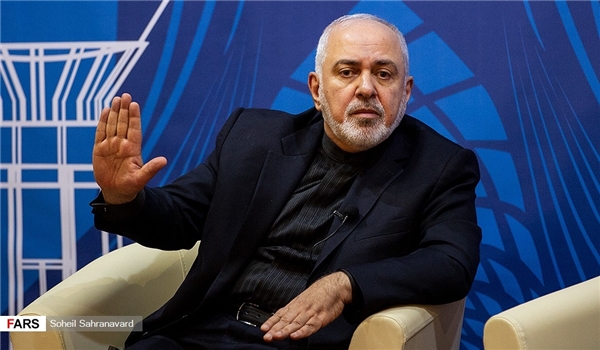
TEHRAN – Iran’s Foreign Minister Mohammad Javad Zarif said his country’s Wednesday missile attacks on Ein Al-Assad falls under the rules of the UN Charter, reminding that Iran has hit the airbase that has been used as the launchpad for assassinating Lieutenant General Qassem Soleimani.
“Iran took and concluded proportionate measures in self-defense under Article 51 of UN Charter targeting [the] base from which cowardly armed attack against our citizens and senior officials were launched,” Zarif wrote on his tweeter page on Wednesday morning.
The top diplomat said his nation “does not seek escalation or war, but will defend ourselves against any aggression”.
The IRGC Aerospace Force started heavy ballistic missile attacks on US Ein Al-Assad airbase in Southwestern Iraq near the border with Syria and a US operated airbase in Erbil in retaliation for the assassination of IRGC Qods Force Commander Lieutenant General Qassem Soleimani.
Ein Al-Assad is an airbase with a 4km runway at 188m altitude from sea levels, which is the main and the largest US airbase in Iraq.
The second IRGC reprisal attack targeted a US military base near Erbil airport in Iraqi Kurdistan Region in the second leg of “Martyr Soleimani” reprisal operation.
All flights have been cancelled at Erbil airport.
The IRGC issued a statement immediately after the attacks, declaring that it has fired tens of ground-to-ground missiles at “the airbase occupied by the terrorist and aggressive army of the United States known as Ein Al-Assad” in reprisal for the martyrdom of IRGC Qods Force Commaner Lieutenant General Qassem Soleimani.
The IRGC warned the US to avoid retaliating the Wednesday attack or else “it will face a more painful and crushing response”.
The IRGC Statement also warned “all the US allied states where the terrorist army has a base, any territory that becomes the origin of any hostile and aggressive action against the Islamic Republic of Iran in any way will be targeted”.
“We believe that the Zionist regime by no means stands aside from the criminal US regime in these crimes.”
The IRGC also called on the American nation to pressure the White House to pull their troops out of the region to avoid further damage and not allow the US rulers to endanger the lives of their military men through increasing hatred.
All Iranian underground missile towns are on alert.
The missile attack came hours before the body of General Soleimani was buried.
Lieutenant General Soleimani was martyred in a targeted assassination attack by the US drones at Baghdad International Airport early on Friday morning.
The airstrike also martyred Abu Mahdi al-Muhandis, deputy commander of Iraq’s Popular Mobilization Forces (PMF), or Hashad al-Shaabi. The two were martyred in an American airstrike that targeted their vehicle on the road to the airport.
Five Iranian and five Iraqi military personnel were martyred by missiles fired by the US drone at Baghdad International Airport.
The attack came amid tensions that started with a US attack on PMF units that killed 28 Iraqi popular forces. A day later, Iraqi people attacked the US embassy in Baghdad.
The targeted assassination attack represents a dramatic escalation by the US toward Iran after months of tensions. The tensions are rooted in Trump’s decision in May 2018 to withdraw the US from Iran’s nuclear deal with world powers, struck under his predecessor.
Iran Strikes Back! Daniel McAdams talks to RT
Ron Paul Institute | January 7, 2020
Iran fires missiles at at least two US bases in Iraq! What is next? RPI Director Daniel McAdams in an extensive interview as the dramatic events of tonight unfold of Iranian retaliation in Iraq for the US assassination of top anti-ISIS Iranian General Qassim Soleimani. Will Trump’s embrace of the neocons cost him a second term?
Iran’s fifth step in suspending nuclear commitments will not mean end to JCPOA: Araqchi

Iranian Deputy Foreign Minister for Political Affairs Abbas Araqchi
Press TV – January 7, 2020
A senior Iranian official says the country’s decision to take the fifth and final step in reducing its commitments under a landmark nuclear deal it clinched with major world powers in 2015 does not mean an end to the accord or Tehran’s withdrawal from it.
Speaking to reporters in Tehran on Tuesday, Iranian Deputy Foreign Minister for Political Affairs Abbas Araqchi said the last step means that “we have reached a reasonable balance” in the nuclear deal, officially known as the Joint Comprehensive Plan of Action (JCPOA).
“The US withdrawal from the JCPOA disrupted the balance of this international accord and now we think that we have reached a reasonable balance in the JCPOA after scaling back the nuclear commitments,” he added.
The Iranian government announced in a statement on Sunday that from now on, the country will observe no operational limitations on its nuclear industry, including with regard to the capacity and level of uranium enrichment, the amount of enriched materials as well as research and development.
“By taking the fifth step in reducing its commitment, the Islamic Republic of Iran eliminates the last key operational restriction it faced under the JCPOA, which is the limitation imposed on the number of centrifuges,” it said.
Araqchi, who is also a senior nuclear negotiator, further said the amount of enrichment would depend on the agenda of the Atomic Energy Organization of Iran (AEOI) and the country’s requirements.
He reiterated that the Islamic Republic would continue to cooperate with the International Atomic Energy Agency (IAEA) and said, “We are ready to come back to the previous process whenever the opposite sides [of the nuclear deal] will be able to meet our demands and fulfill their commitments under the JCPOA.”
“It is possible to save the JCPOA if the opposite sides want,” the Iranian diplomat added.
In response to a question about the possibility of Europe triggering the JCPOA’s “dispute resolution mechanism,” also known as the trigger mechanism, whose activation can lead to the return of the UN sanctions on Iran, Araqchi said it only would accelerate the termination of the deal.
“As Iran acted wisely after the US withdrawal from the JCPOA, the other sides are also expected to behave prudently and refrain from escalating tensions,” he added.
US President Donald Trump, a stern critic of the historic deal, unilaterally pulled Washington out of the JCPOA in May 2018, and unleashed the “toughest ever” sanctions against the Islamic Republic in defiance of global criticism in an attempt to strangle the Iranian oil trade.
In response to the US unilateral move, Tehran has so far rowed back on its nuclear commitments four times in compliance with Articles 26 and 36 of the JCPOA, but stressed that its retaliatory measures will be reversible as soon as Europe finds practical ways to shield the mutual trade from the US sanctions.
Iran’s latest nuclear announcement coincided with a major escalation of tensions with Washington after the US assassination of Lieutenant General Qassem Soleimani, the commander of the Quds Force of the Islamic Revolution Guards Corps (IRGC), in a drone strike in the Iraqi capital of Baghdad early on Friday.
Iran has criticized the three European signatories to the JCPOA — Britain, France and Germany — for failing to salvage the pact by shielding Tehran’s economy from US sanctions.
Featured Video
Dr. Tony Martin – The Jewish Role in the African Slave Trade
or go to
Aletho News Archives – Video-Images
In Memoriam
James Petras, In Memoriam
 02.13.2026
Professor James Petras, 89, world-renowned sociologist, public intellectual, and scholar of Latin American politics and global economics, died peacefully on January 17, 2026, in Seattle, WA, surrounded by family.
A prolific scholar and activist, he devoted his life to challenging power, imperialism, and inequality. … continue
Blog Roll
 Aletho News
- Travelers Take a Pass on Visiting America
- EU members divided on 20th Russia sanctions package – media
- Lawyers ask police to investigate Elbit Systems UK for alleged war crimes complicity
- Israel ready to strike Iran-backed armed groups – media
- Behind US war drums against Iran: No goals, no plan, no off-ramp
- With Ukraine blamed for cutting oil flows to Hungary, Croatia also refuses to transfer Russian oil in violation of EU law
- Friedrich Merz’s Push to End Online Anonymity Has a Troubling Subtext
- Macron: French citizens fighting for Israel cannot be labeled ‘genociders’
- US eyes Gaza security force drawn from armed gangs
- The Only Motive Behind The ‘Imminent’ U.S. War With Iran Is The Zionist Lobby
- If Americans Knew
- ‘Christians Out’: Jerusalem Church Tagged With Hate Graffiti, Police Investigating
- Israeli Settlers Kill American Teen
- ‘We returned from hell’: Palestinian journalists recount torture in Israeli prisons
- No mercy for Gaza in Ramadan – Not a ceasefire Day 133
- The Israeli Government Installed and Maintained Security System at Epstein Apartment
- Tucker Carlson interrogated in Israel, has passport seized after interviewing US ambassador
- 6,000 Amputees in Gaza Face Impossible Recovery amid Israeli War Ultimatum
- The Lancet: Gaza death toll far higher than reported – Not a ceasefire Day 132
- Compliant aid: Who are the Israel-approved NGOs scaling up in Gaza?
- Why won’t Trump’s “Board of Peace” bring peace? – Not a ceasefire Day 131
- No Tricks Zone
- New Study: Canada’s New Brunswick Was 1°C Warmer Than Today During The Medieval Warm Period
- Coal Power Back In Trend As Globe Tries To Keep Pace With Growing Demand For Power
- New Study: A 4°C Warmer Beaufort Sea Had ‘No Sea Ice’ 11,700 – 8200 Years Ago
- Unfudging The Data: Dutch Meteorological Institute Reinstates Early 20th Centruy Heat Waves It Had Erased Earlier
- German Gas Crisis…Chancellor Merz Allegedly Bans Gas Debate Ahead of Elections!
- Pollen Reconstructions Show The Last Glacial’s Warming Events Were Global, 10x Greater Than Modern
- Germany’s Natural Gas Storage Level Dwindles To Just 28%… Increasingly Critical
- New Study Rebuts The Assumption That Anthropogenic CO2 Molecules Have ‘Special’ Properties
- Climate Scientist Who Predicted End Of “Heavy Frost And Snow” Now Refuses Media Inquiries
- Polar Bear Numbers Rising And Health Improving In Areas With The Most Rapid Sea Ice Decline
 Aletho News