How Government and Media Are Prepping America for a Failed 2020 Election
Feature photo | Graphic by Claudio Cabrera for MintPress News
By Whitney Webb | MintPress News | January 28, 2020
As World War II drew to a close in Europe, British philosopher Bertrand Russell wrote that “neither a man nor a crowd nor a nation can be trusted to act humanely or to think sanely under the influence of a great fear.”
Though numerous examples in the post-World War II era have proven Russell’s point, perhaps one of the best examples was the U.S. public’s willingness to swallow lie after lie about Saddam Hussein’s Iraq due to the climate of fear that followed the September 11 attacks. Those lies, propagated by dubious intelligence, government officials and a compliant media, resulted in catastrophes – large and small, both abroad and at home.
Today, an analogous narrative is being crafted by many of the same players – both in media and government – yet it has avoided scrutiny, even from independent media.
Over the past several months and with a renewed zeal in just the last few weeks, anonymous intelligence officials, dubious “experts” and establishment media outlets have crafted a narrative about the coming “chaos” of the 2020 election, months before it takes place. Per that narrative, certain state actors will use specific technologies to target the “American mind” in order to undermine the coming presidential election. The narrative holds that those efforts will be so successful that the U.S. will never recover as a democracy.
Though these anonymous government sources and their stenographers have already named the countries who will be responsible and the technologies they will use, they also admit that no evidence yet exists to back up these claims, meaning they are — at best — pure speculation.
Headlines such as “Hackers Are Coming for the 2020 Election — And We’re Not Ready,” “Basically Every US National Security Leader Is Warning About Foreign Interference In The 2020 Election,” and “U.S. intel agencies: Russia and China plotting to interfere in 2020 election” have become increasingly common, despite no available evidence, as have warnings that the American public is defenseless against the old scourge of “fake news” and the new scourge of “deep fakes.” Some media reports have gone so far to say that actual foreign meddling isn’t even necessary as merely the fear of foreign meddling could be enough to upend the American political system beyond repair.
Historically, the goal of such fear-inducing narratives has been the trading of civil liberties for increased security, or rather, the appearance of increased security. Yet, when the need for security is felt due to a fear that is based on government-driven speculation and not on evidence, the goal of that narrative is not about protecting the public from a real, tangible threat but instead about the consolidation of power by the very groups responsible for crafting it — in this case, the intelligence community and other key players in the national security state.
However, what is particularly odd about this narrative surrounding imminent “chaos” and meddling in the upcoming 2020 election is the fact that, not only have the instruments of said meddling been named and described in detail, but their use in the election was recently simulated by a company with deep ties to both U.S. and Israeli intelligence. That simulation, organized and run by the Israeli-American company Cybereason, ended with scores of Americans dead, the cancellation of the 2020 election, the imposition of martial law and a spike in fear among the American populace.
Many of the technologies used to create that chaotic and horrific scenario in the Cybereason simulation are the very same technologies that U.S. federal officials and corporate media outlets have promoted as the core of the very toolkit that they claim will be used to undermine the coming election, such as deep fakes and hacks of critical infrastructure, consumer devices and even vehicles.
While the narrative in place has already laid the blame at the feet of U.S. rival states China, Russia and Iran, these very technologies are instead dominated by companies that are tied to the very same intelligence agencies as Cybereason, specifically Israeli military intelligence.
With intelligence agencies in the U.S. and Israel not only crafting the narrative about 2020 foreign meddling, but also dominating these technologies and simulating their use to upend the coming election, it becomes crucial to consider the motivations behind this narrative and if these intelligence agencies have ulterior motives in promoting and simulating such outcomes that would effectively end American democracy and hand almost total power to the national security state.
Media, intelligence foreshadow tech-powered doom for 2020
Even though the 2020 U.S. election is still months away, a plethora of media reports over the past six months (and even before then) have been raising concern after concern about how the U.S. election is still so vulnerable to foreign meddling that such meddling is essentially an inevitability.
Part of the reason for the recent pick-up in fear mongering appears to have been the release of a joint statement issued by key members of the Trump administration last November. That statement, authored by Attorney General Bill Barr, Defense Secretary Mark Esper, acting DHS Secretary Kevin McAleenan, acting Director of National Intelligence Joseph Maguire, FBI Director Christopher Wray, NSA Director Gen. Paul Nakasone, and Cybersecurity and Infrastructure Security Agency (CISA) Director Christopher Krebs, claimed that foreign interference in 2020 was imminent despite admitting that there is no evidence of interference having taken place:
Our adversaries want to undermine our democratic institutions, influence public sentiment and affect government policies. Russia, China, Iran, and other foreign malicious actors all will seek to interfere in the voting process or influence voter perceptions. Adversaries may try to accomplish their goals through a variety of means, including social media campaigns, directing disinformation operations or conducting disruptive or destructive cyber-attacks on state and local infrastructure.
While at this time we have no evidence of a compromise or disruption to election infrastructure that would enable adversaries to prevent voting, change vote counts or disrupt the ability to tally votes, we continue to vigilantly monitor any threats to U.S. elections (emphasis added).”
Despite the key caveat of there being no evidence at the time the statement was issued, media reports used the statement to claim that foreign interference in 2020 was imminent, such as in these reports from BuzzFeed, ABC News, and Newsweek.
In addition to the reports that have cast the involvement of state actors — namely Russia, Iran and China — as assured despite no evidence, other reports have made the claim that this allegedly imminent interference will inevitably be successful, largely due to claims that the tactics used will rely heavily on technology that the U.S. can’t hope to successfully counter. CSO Online, an online news outlets that provides news, analysis and research on security and risk management, recently warned that “fixing America’s voting and election infrastructure problems is a long-term proposition, one that won’t be fixed in time for the election in November” while the New York Times warned of imminent chaos and that “stealthier” malevolent foreign actors had already created the foundation for “an ugly campaign season marred by hacking and disinformation.” Wired claimed last year that U.S. election security “is still hurting at every level.”
In another example, Rolling Stone published an article earlier this month with the headline “Hackers Are Coming for the 2020 Election — And We’re Not Ready,” which claims that “the reality is that: “We’ve made progress since the last election — but we’re much less secure than we should be.” The article goes on to say that claim that the goal isn’t necessarily to hack voting machines or change results, but “to merely create the impression of an attack as a way to undermine our faith in the electoral process.”
It continues:
The target is the minds of the American people,” says Joshua Geltzer, a former counterterrorism director on the National Security Council. “In some ways, we’re less vulnerable than we were in 2016. In other ways, it’s more.” Nearly every expert agrees on this: The worst-case scenario, the one we need to prepare for, is a situation that causes Americans to question the bedrock of our democracy — free and fair elections.”
Well before this type of rhetoric made its way into the U.S. media, Israeli intelligence-linked tech firm Cybereason claimed, in a release on its website that “messing with a voter’s mind” would have a bigger impact than changing vote totals, even before the 2016 election. That release, published by Cybereason prior to the last presidential election, was authored by the company’s CEO, Lior Div, who used to lead offensive hacking operations against nation-states for Israeli military intelligence.
Notably, of all of these media reports, there is a clear consensus that one of the main tactics that will soon be used to meddle in the coming U.S. election will be the use of so-called “deep fakes.” Deriving its name from a combination of “deep learning” and “fake,” deep fakes involve video and audio that has been manipulated using artificial intelligence (AI) to create media that appears to be authentic, but is not. Concern about its use in the upcoming election has spurred not only a wealth of media reports on the matter but has prompted both the U.S. military and Congress to take action to limit its potential misuse.
One thing that stands out about the media narrative regarding election meddling and deep fakes is that several news organizations have published articles that state that deep fakes will be used to undermine the 2020 election, as opposed to stating that they could be used or that they are a phenomenon worthy of attention (though some reports have taken this more measured approach).
The reason for this level of confidence may owe to statements made by prominent U.S. intelligence officials last year, including those made by Dan Coats, the former Director of National Intelligence (DNI), who claimed in the 2019 Worldwide Threat Assessment for the U.S. Intelligence Community that deep fakes and other hi-tech forms of fake media would be used to disrupt the 2020 election. Coats specifically stated:
Adversaries and strategic competitors probably will attempt to use deep fakes or similar machine-learning technologies to create convincing—but false—image, audio, and video files to augment influence campaigns directed against the United States and our allies and partners.”
Since Coats made the warning, numerous media reports have promoted the concern with little scrutiny, representing just one of the numerous times in U.S. history where narratives first authored by U.S. intelligence are subsequently promoted heavily by U.S. media, even when the claim made by intelligence officials is speculative, as it is in this case. Indeed, the narratives being promoted with respect to the 2020 election involve many of the same intelligence agencies (American and Israeli) and media outlets who promoted claims that were later proven false about “weapons of mass destruction” in Iraq prior to the 2003 invasion, among other pertinent examples.
Notably, deep fakes figured prominently and was the tool most used by malevolent hackers in Cybereason’s 2020 election simulation, which saw both video and audio-only deep fakes used to spread misinformation on national and local TV channels in order to impersonate police officers and election officials and to create fake bomb threats by posing as the terror group Daesh (ISIS). Cybereason also happens to be a partner of the organization funding the most well-known creator and producer of deep fakes in the world, an organization that — much like Cybereason itself — is openly tied to Israeli intelligence.
Aside from deep fakes, other technologies weaponized in Cybereason’s election simulation have also been the subject of several media reports, such as the hacking of Internet of Things (IoT) devices and appliances and even the hacking of vehicles that have some form of internet connectivity. In the Cybereason simulation, IoT hacks were used to cut power to polling stations and disseminate disinformation while vehicles were hacked to conduct terror attacks against civilians waiting in line to vote, killing several and injuring hundreds.
Most media reports have claimed that these technologies will be part of the coming “explosion” in cyber warfare in 2020 and do not specifically link them to imminent election meddling. Others, however, have made the link to the election explicit.
Naming the culprits in advance
In addition to the apparent consensus on how foreign meddling will occur during the 2020 election, there is also agreement regarding which countries will be responsible. Again, this is largely based on statements made by U.S. national security officials. For instance, the joint statement issued last November by the DOJ, DOD, DHS, DNI, FBI, NSA, and CISA regarding 2020 election security, states that “Russia, China, Iran, and other foreign malicious actors all will seek to interfere in the voting process or influence voter perceptions” before adding “at this time we have no evidence.”
Similarly, the 2019 Worldwide Threat Assessment for the U.S. Intelligence Community, written by then-Director of National Intelligence Dan Coats, names these same three countries in relation to imminent 2020 election interference and states that their interference in the 2020 election is “almost certain.” The assessment adds the following about each nation:
- Russia: “Russia’s social media efforts will continue to focus on aggravating social and racial tensions, undermining trust in authorities, and criticizing perceived anti-Russia politicians.”
- China: “China will continue to use legal, political, and economic levers—such as the lure of Chinese markets—to shape the information environment. It is also capable of using cyber attacks against systems in the United States to censor or suppress viewpoints it deems politically sensitive.”
- Iran: “Iran, which has used social media campaigns to target audiences in both the United States and allied nations with messages aligned with Iranian interests, will continue to use online influence operations to try to advance its interests.”
Coats’ assessment was enough to spawn numerous stories on the imminent threat that these three nations pose to the 2020 election, with headlines such as “U.S. intel agencies: Russia and China plotting to interfere in 2020 election.”
The vast majority of warnings regarding future election interference have come from U.S. intelligence officials with a dubious record of trustworthiness and a history of using the media to spread propaganda and disinformation, most famously through Operation Mockingbird. Most — if not all — of the recent and numerous articles on imminent interference rely heavily on claims made by the two aforementioned government documents, documents crafted by U.S. intelligence agencies for public consumption, as well as claims made by anonymous U.S. officials.
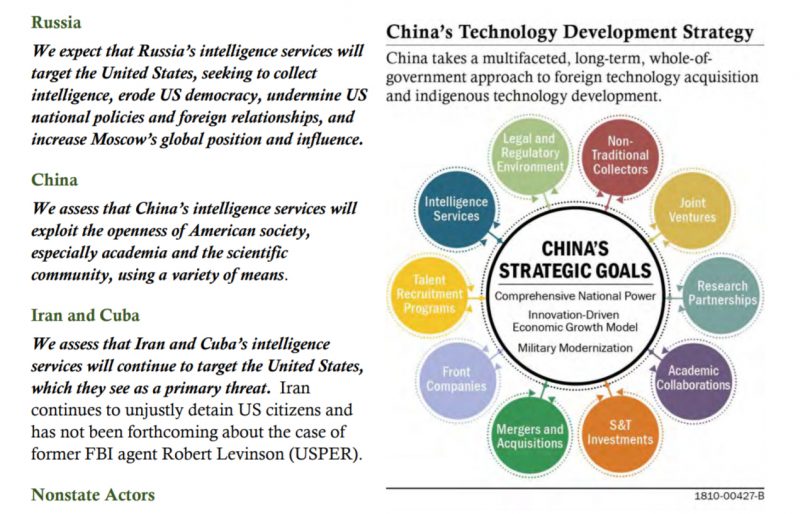
A screenshot from the 2019 National Threat Assessment lists Russia, China and Iran as primary threats to the United States
A recent New York Times article, for example, titled “Chaos Is the Point’: Russian Hackers and Trolls Grow Stealthier in 2020,” is based almost entirely on “interviews with dozens of officials and experts,” though the only government official named in the article is Shelby Pierson, the intelligence community’s election threats executive. The most quoted experts named in the article are Ben Nimmo, formerly of the hawkish, NATO-funded Atlantic Council and now with Graphika, and Laura Rosenberger, director of the neoconservative-created Alliance for Securing Democracy. The article nonetheless cites “American officials” and “current and former officials” several times to make claims about imminent election interference that paint a bleak picture of the current election season.
A recent article from The Hill relies on the acting head of DHS, Chad Wolf, as its only source, citing Wolf’s claim that “we fully expect Russia to attempt to interfere in the 2020 elections to sow public discord and undermine our democratic institutions” amid other warnings that Wolf gave about Chinese and Iranian cyber threats to U.S. elections. Other articles, including one titled “Russia, China plan to adjust their tactics to hack, influence 2020 elections” cite only Shelby Pierson of the U.S. intelligence community as its source for that headline’s claim. Another titled “Russia isn’t the only threat to 2020 elections, says U.S. intel” cites only anonymous U.S. intelligence officials, as the headline suggests.
Though Russia and China have consistently been named as the most likely election meddlers, reports have also been drumming up the likelihood that Iran will emerge as 2020’s foreign meddler of choice, especially in the months prior to and weeks after the killing of Iranian General Qassem Soleimani by the Trump administration. A recent “informal poll” conducted by the Washington Post asked hawkish think tank fellows, employees at companies like Raytheon and current and former federal officials if Iran would likely retaliate against the U.S. via cyberattack. The Post ran the results of the poll under the headline “Get ready for serious cyberattacks from Iran, experts say.”
Despite the media’s numerous warnings of imminent and “serious” cyber-retaliation from Iran, the only cyberattack attributed to the country after Soleimani’s death was the vandalism of the Federal Depository Library Program website, a rather benign act that was nevertheless blasted across headlines such as “US government website hacked with pro-Iranian messages, image of bloodied Trump.” The U.S. government is quoted in that article as saying that “At this time, there is no confirmation that this was the action of Iranian state-sponsored actors.”
Also notably absent from media reports is the fact that WikiLeaks revealed in 2017 that the CIA had stockpiled a library of “stolen” cyberattack techniques produced in other nations, including Russia and Iran. Those revelations, part of the Vault 7 release, revealed that the CIA’s UMBRAGE group was capable of “misdirect[ing] attribution [for cyberattacks actually done by the CIA] by leaving behind the ‘fingerprints’ of the groups that the attack techniques were stolen from.” In other words, the CIA was more than capable of conducting “false flag” cyber attacks and blaming them on foreign actors.
Notably, one of the viruses being blamed on Iran for cyberattacks targeting the U.S. ahead of the 2020 election — called Shamoon — was “stolen” by the CIA’s UMBRAGE and cited in the WikiLeaks release.
Conflict of interest-ridden Microsoft “defends democracy”
Last year saw the tech behemoth Microsoft join the effort to blame foreign state actors, specifically Iran, for cyberattacks against the U.S. This helped to bolster assertions that had largely originated with a handful of U.S. intelligence officials and hawkish, neoconservative-aligned think tanks as media reports on Microsoft’s related claims treated the company as an independent private sector observer.
Yet, as MintPress investigations have revealed, Microsoft has clear conflicts of interest with respect to election interference. Its “Defending Democracy” program has spawned tools like “NewsGuard” and “ElectionGuard” that it claims will help protect U.S. democracy, but — upon closer examination — instead have the opposite effect.
Last January, MintPress exposed NewsGuard’s neoconservative backers and how special interest groups were backing the program in an effort to censor independent journalism under the guise of the fight against “fake news.” Subsequent investigations revealed the risk that Microsoft’s ElectionGuard poses to U.S. voting machines, which it claims to make more secure and how the platform was developed by companies closely tied to the Pentagon’s infamous research branch DARPA and Israeli military intelligence Unit 8200.
ElecionGuard software has since been adopted by numerous voting machine manufacturers and is slated to be used in some Democratic Primary votes. Notably, the push for the adoption of ElectionGuard software has been spearheaded by the recently created Cybersecurity and Infrastructure Security Agency (CISA), which is the federal agency tasked with overseeing election security and is headed by Christopher Krebs, a former high level Microsoft executive.
In recent months, Microsoft has also been at the center of claims that Iran attempted to hack U.S. presidential campaigns ahead of 2020 as well as claims that Iran plans to target the U.S. power grid and other critical infrastructure with cyberattacks.
Last October, Microsoft penned a blog post discussing a “threat group” it named Phosphorus that they “believe originates from Iran and is linked to the Iranian government.” The post went on to claim that Phosphorus attempted to target a U.S. presidential campaign, which later media reports claimed was President Trump’s re-election campaign. Microsoft concluded that the attempt was “not technically sophisticated” and ultimately unsuccessful, but felt compelled to disclose it and link it to Iran’s government.
Though it provided no evidence for the hack or its reasons for “believing” that the attack originated from Iran, media reports treated Microsoft’s declaration as proof that Iran had begun actively meddling in the 2020 election. Headlines such as “Iranian Hackers Target Trump Campaign as 2020 Threats Mount,” “Iran-linked Hackers Target Trump 2020 Campaign, Microsoft says”, “Microsoft: Iran government-linked hacker targeted 2020 presidential campaign” and “Microsoft Says Iranians Tried To Hack U.S. Presidential Campaign,” were blasted across the front pages of American media. None of the reports scrutinized Microsoft’s claims or noted the clear conflict of interest Microsoft had in making such claims due to its efforts to see its own ElectionGuard Software adopted nationwide.
Media reports also left out the fact that Microsoft is a major government contractor for the U.S. intelligence community and the Pentagon. Notably, the Trump campaign, which Microsoft said was the target of this attack, was later identified as the only major presidential campaign using Microsoft’s “AccountGuard” software, part of its dubious “Defending Democracy” program that also spawned NewsGuard and ElectionGuard. AccountGuard claims to protect campaign-linked emails and data from hackers.
Microsoft surfaced not long after, again claiming that Iran was maliciously targeting the United States’ civilian infrastructure. This subsequent claim was first published by Wired and later covered by other outlets. Those reports cite a single person, Microsoft security researcher Ned Moran, who claimed that an Iran-backed hacking group called APT33 was targeting the U.S. “physical control systems used in electric utilities, manufacturing, and oil refineries.”
“They’re trying to deliver messages to their adversaries and trying to compel and change their adversaries’ behavior,” Moran told Wired. Moran also stated that “Microsoft hasn’t seen direct evidence of APT33 carrying out a disruptive cyberattack rather than mere espionage or reconnaissance, it’s seen incidents where the group has at least laid the groundwork for those attacks (emphasis added).”
Cybereason helps craft the narrative
While U.S. intelligence officials and media outlets alike have been largely responsible for setting the narrative that imminent meddling will be conducted by Russia, China and Iran, key components of that narrative, particularly with respect to China and Iran, have been laid by Cybereason, a company that recently ran 2020 doomsday election simulations and that has close ties to the intelligence communities of both the U.S. and Israel.
Shortly after the killing of Iranian General Qassem Soleimani earlier this month, an operation conducted in concert with Israeli intelligence, Cybereason warned that Iran could imminently retaliate with a cyber threat and quoted its own employees who explained what and how Iran would likely target in retaliation. Cybereason’s CSO Sam Curry, who actively participated in the firm’s 2020 doomsday election simulations, stated:
This means that Iran’s “forceful revenge” response is likely to be less about the flash and all about the bang. If you have connected systems that are responsible for kinetic world effects, like ICS systems and critical infrastructure around water, energy or vital services, it’s time to pay attention. Iran and the US are engaged in Cyber brinksmanship, which means that the gloves are off as Iran picks it’s targets (emphasis added).”
Cybereason also quoted visiting fellow for the National Security Institute and former advisor to the U.S. Secret Service (which participated in Cyberaeson’s election simulations), Anne Marie Zettlemoyer, who claimed that Iran could soon target Wall Street and critical U.S. infrastructure like the power grid:
An attack against the financial systems can be devastating economically and weaken the confidence and viability of markets. However, we cannot ignore the physical consequences and manifestations that can come from a cyberattack, particularly against critical infrastructure like energy and industry control systems.”
Cybereason’s claims regarding Iran’s interest in “critical infrastructure” systems likely originated with Microsoft, the claims were then parroted by the media in several reports, many of which quoted Cybereason’s Sam Curry. Curry is also a contributor to major news outlets like Forbes where he writes about Iran’s cyber warfare capabilities.
Notably, in Cybereason’s recent allegations against Iran, it states that “it’s clear that Iran has been preparing for future geopolitical conflict by gaining access to critical infrastructure and other important operations in the United States.” It backs these claims by citing an article authored by Curry for Forbes. Following Soleimani’s death, numerous media reports, including in the UK’s The Independent and ABC News, have cited Curry as an “expert” source in claiming that Iran would retaliate with cyberattacks.
Microsoft’s claims about foreign hackers and meddling — the evidence for which have never been made public but has been parroted as fact nonetheless — are frequently supported by Cybereason.
Last August, Microsoft claimed to have foiled Russian attempts at hacking two Republican-affiliated think tanks and, despite providing no evidence, Cybereason’s then-senior director of intelligence services Ross Rustici was quoted as an expert in several media reports as saying that such behavior was to be expected from Russia. In one such report, Rustici stated:
We’re very good at fighting the last war, but the Russians are very good at evolving their game. I suspect if they’re going to do a psychological operation around the elections, the way they do it will be different than what they did in 2016. How effective the defenses we’ve built for what they did in 2016 will be for those attacks is yet to be seen.”
None of the media reports quoting Rustici mentioned Cybereason’s ties to Israeli intelligence, referring to tech firms only a “Boston-based cybersecurity company” and similar variants. Cybereason’s Intelligence Group is stuffed with former and active members of U.S. and Israeli intelligence services and has released several reports about nation-state hacking with a focus on Russia and China.
Cybereason has also been at the forefront of claims that China has been engaged in aggressive cyberattacks against multinational companies that have also seen widespread coverage in U.S. media, despite the untransparent nature of the evidence for Cybereason’s claims.
In a story that received major coverage from outlets such as Fox News, Reuters, CNBC and others, Cybereason unveiled what it called “Operation Soft Cell,” an operation that stole mass troves of data from several global telecommunications companies. In each story, Cybereason is the sole source of the claim and declined to provide the name or location of any of the affected companies. The firm also claimed to have determined that the attack was likely perpetrated by someone “backed by a nation state, and is affiliated with China.” It further claimed to have debriefed and coordinated responses with U.S. intelligence.
In an article for Reuters, Cybereason stated that “this time as opposed to in the past we are sure enough to say that the attack originated in China” while Cybereason separately told CyberScoop that it had “found hacking tools such as a modified web shell and a remote access trojan that are commonly associated with, but not unique to, Chinese hackers.” Despite the incongruity, media reports laid the blame squarely on China, as seen in headlines such as “Chinese spies have been sucking up call records at multinational telecoms, researchers say.”
Prior to uncovering Operation Soft Cell, Cybereason had warned on its blogs in the months and years prior that China would imminently target U.S. companies. The revelation of Operation Soft Cell — which originated exclusively with Cybereason — has been used to build the case that China is openly engaged in cyberwarfare against its rival states, like the United States, and targeting “democracy itself.”
Best Known Deep Fake Creator is Funded by Israeli Intelligence
While the media, and even Cybereason itself, have helped lay the foundation to blame specific state actors for 2020 election meddling well ahead of the fact, it is worth revisiting Cybereason’s “Operation Blackout” election simulation and the tactics used by the “bad actors” in that scenario.
That simulation, discussed in detail in the first installment of this series, saw the weaponization of specific technologies, namely deep fakes, hacks of Internet of Things (IoT) devices and hacks of vehicles, in order to target the 2020 U.S. election, resulting in the cancellation of the election and the imposition of martial law.
Given the current narrative regarding what state actors are likely to meddle in the 2020 election — namely Russia, China and Iran — and the tactics they will allegedly use, it is important to explore the sources of the technologies weaponized per that narrative as well as in “Operation Blackout.”
Indeed, if there is any clear overlap between the creators of those technologies and the state actors being blamed in advance for their imminent use, it would certainly lend credibility to the claims promoted by U.S. intelligence, the media and companies like Microsoft and Cybereason.
Yet, upon closer examination, it becomes clear that the companies and state actors most involved in developing these technologies are the very ones claiming that Russia, China and Iran will use them to undermine the 2020 election.
Take for instance the use of deep fakes. Not only have numerous media reports focused on how deep fakes will be used to meddle in the 2020 elections, but Cybereason’s doomsday election simulation saw “bad actors” rely heavily on their use to spread disinformation and even make fake bomb threats. While much has been said of the coming election and deep fakes, remarkably few reports have bothered to look at the company best known for creating viral deep fakes.
Canny AI has garnered considerable media attention over the past few years for its persuasive deep fake videos that have frequently gone viral. In the last year alone, the tech firm’s viral deep fakes have included a controversial video of Mark Zuckerberg where the Facebook co-founder appears to be saying “Imagine this for a second: One man, with total control of billions of people’s stolen data, all their secrets, their lives, their futures,” as well as a video showing Richard Nixon giving a speech he never actually gave. More recently, Canny AI was behind the viral videos immediately prior to the 2019 U.K. general election that appeared to show Jeremy Corbyn and his rival Boris Johnson endorsing each other and another video that showed world leaders singing John Lennon’s “Imagine”:
Oddly, many of the media reports that discuss these viral videos fail to mention the role of Canny AI in creating these viral deep fakes and instead only mention the organization or artists with whom Canny AI partnered to create them. For instance, the Corbyn-Johnson videos were reported to have been produced by the group Future Advocacy and artist Bill Posters, but it was actually Canny AI that created those videos for that group. Similarly, the Nixon Speech deep fake was reported by several outlets as having been solely created by MIT’s Center for Advanced Virtuality. However, the Boston Globe noted that “the [MIT] team worked with Canny AI, an Israeli company that does Video Dialogue Replacement, and Respeecher, a Ukrainian startup specializing in speech-to-speech synthetic voice production” to create the video.
The Zuckerberg deep fake that Canny AI created led to lots of positive press for the company, with several media reports dubbing them as the company using “deep fakes for good” and that uses the controversial technology “responsibly.” The Zuckerberg deep fake has been cited as one of the main drivers behind Facebook’s new “deep fake” policy, which only bans some deep fake videos and has been criticized by U.S. lawmakers as insufficient. Notably, neither Facebook nor Facebook-owned Instagram ever took down Canny AI’s deep fake of Zuckerburg.
Given the concern over deep fakes in relation to the coming election and Canny AI standing out as the main producer of deep fakes that have gone viral over the past year, it is important to point out that Canny AI has ties to a state actor with a history of election meddling: the state of Israel.
Indeed, Canny AI is 100 percent funded by an Israeli start-up accelerator called Xcelerator, a joint venture between Tel Aviv University and Israeli intelligence agency Shin Bet (sometimes called Shabak). According to Start Up Nation Central, the Paul Singer-created organization that promotes Israeli technology start ups, Xcelerator-funded “start-ups participating in the program benefit from close mentoring from content and technology experts from the Shabak, experts from Tel Aviv University, and industry leaders. The connection to the Shabak also provides the entrepreneurs with ways to test the capabilities of their technologies and cooperation opportunities (emphasis added).”
In addition, Xcelerator is partnered not only with Israeli intelligence directly, but also with Cybereason, the very company that explored the use of deep fakes in the 2020 U.S. presidential election that saw the election cancelled and martial law declared as well as a company that itself has deep ties to Israeli intelligence. Other notable partners of Xcelerator include NEC Corp, which has intimate ties to top Cybereason investor Softbank; Check Point Technologies, which has ties to Israeli military intelligence Unit 8200; and the Israeli start-up accelerator Team8. In previous reports published by MintPress, Team8 was discussed in detail, particularly their recent hire of former director of the NSA and former head of U.S. Cyber Command Mike Rogers, and their close ties to Paul Singer’s Start Up Nation Central, which itself has deep ties to U.S. neoconservatives.
It is also worth noting that Xcelerator also backs an “anti-fake news” start-up called Cyabra, which has direct ties to Israel’s Mossad and offers its AI-driven “disinformation protection” to government agencies as well as politicians, particularly during election seasons. Two of Cyabra’s co-founders previously co-founded Psy-Group, which attempted to interfere in the 2016 U.S. election by weaponizing “fake news” and social media and later closed down its operations after U.S. government scrutiny into its activities began as part of the Mueller investigation.
Psy-Group also engaged in doxxing campaigns targeting Palesintian rights activists in the U.S. which were planned in conjunction with Ram Ben-Barak, the former deputy director of the Mossad who now advises Cyabra. Given that much of the concern ahead of the next election is related not only to deep fakes but also “fake news,” Cyabra’s rise and its clear ties to Mossad and the now defunct Psy-Group are important to note.
Furthermore, in examining the other technologies weaponized during Cybereason’s 2020 election simulation and cited in the aforementioned media narrative regarding 2020 meddling, a pattern similar to that of Canny AI emerges.
Indeed, the other technologies linked to these “bad actors” and foreign meddlers — namely hacking IoT devices and hacking vehicles — are also pioneered by companies with deep ties to Israeli military intelligence, specifically Unit 8200, and Israeli tech companies that have aggressively spied on U.S. government institutions in collusion with Israeli intelligence in the past, namely Comverse (now Verint) and Amdocs.
Hacking the Internet of Things
In Cybereason’s doomsday election simulation, another of the tactics used was the hacking of devices and appliances connected to the internet, often referred to as the Internet of Things (IoT) and which includes everything from smartphones to power grid infrastructure to city traffic lights.
While most reports on IoT hacks to date have focused on “lone wolf” or non-state-aligned actors, one company has stood out for its efforts to create a tool that would allow governments and intelligence agencies to hack these devices with ease. That company, called Toka, announced in 2018 that it planned to offer “a one-stop hacking shop for governments that require extra capability to fight terrorists and other threats to national security in the digital domain,” with “a special focus on [hacking] the so-called Internet of Things (IoT), covering tech like Amazon Echo, Nest connected home products, as well as connected fridges, thermostats and alarms.”
The Israel-based company, which raised $12.5 million within months of launching, has since been busy marketing its services to governments around the world, most recently France where it described its product portfolio as “empower[ing] governments, Intelligence, and law enforcement agencies to enhance Homeland Security with groundbreaking cyber-intelligence and operational capabilities” during an exposition in Paris last November.
Even though Toka openly markets the ability to hack private consumer devices to governments and law enforcement agencies around the world, the clear threat to privacy has gone ignored by media outlets as the company has garnered nearly no media attention since it launched nearly two years ago.
Yet, Toka is not only notable for what it offers but also for its founders and investors. Indeed, the co-founders of Toka have been described as an “all-star” team, largely because of the role of former Israeli Prime Minister and former head of Israeli military intelligence, Ehud Barak. Barak, in addition to co-founding the company, serves as its director and is also the chairman of the board of the controversial Israeli company Carbyne911, which markets software to emergency call centers in the United States. Interestingly, Cybereason’s 2020 doomsday election simulation also dealt with the hacking and weaponization of 911 call centers. Also of note is the fact that another of Carbyne911’s leadership team, former Unit 8200 commander Pinchas Buchris, is an adviser to Cybereason.
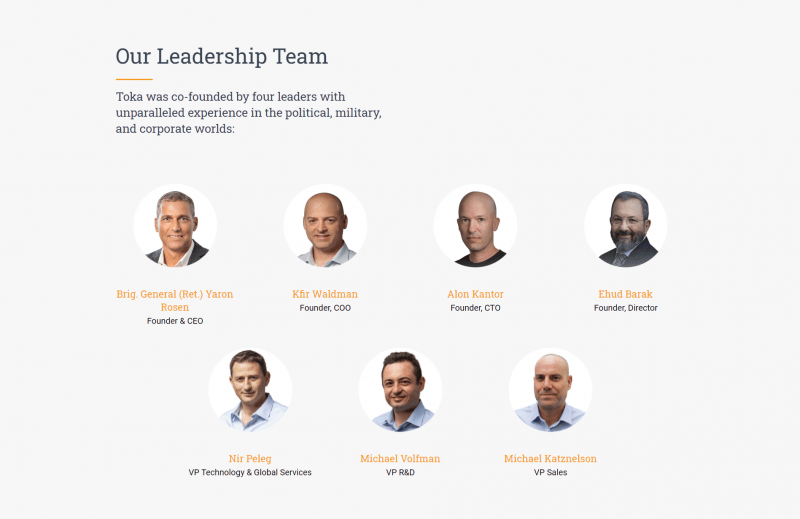
Toka’s top brass is a who’s who of former Israeli military and intelligence officials
In addition to Barak, Toka was co-founded by retired Brigadier General Yaron Rosen, former Chief of the IDF’s cyber staff, where he was “the lead architect of all [IDF] cyber activities” including those executed by Israeli military intelligence Unit 8200. Rosen, who now serves as Toka’s CEO, has stated that Toka’s technology will only be sold to countries allied with the U.S. and Israel, telling Forbes that “Russia, China and ‘other enemy countries’ would never be customers.”
Toka’s leadership and software architects are similarly tied into Israel’s national security state. Several — including the “architect” of its hacking software — previously worked for Israel’s Prime Minister’s Office and developed “offensive technologies” for Israel’s head of state and other top Toka employees and executives share numerous connections to Unit 8200, other divisions of Israeli military intelligence and Unit 8200-connected tech companies like Check Point Technologies.
Though Toka’s leadership team makes its ties to Israeli military intelligence abundantly clear, important connections also appear in examining Toka’s investors. One of the major investors in Toka is Dell technologies, one of the world’s largest technology companies that was founded by Michael Dell, a well-known pro-Israel partisan who has donated millions of dollars to the Friends of the IDF and one of the top supporters of the so-called “anti-BDS” bills that prevent publicly employed individuals or public institutions from supporting non-violent boycotts of Israel, even on humanitarian grounds. It goes without saying that a major technology company investing in a company that markets the hacking of that very technology (computers, IoT, smartphones, etc.) should be a red flag.
With a major foot in the door through its connections to Dell, whose products are used by the private and public sectors around the world, other investors in Toka again reveal its ties to Israel’s military intelligence and the same controversial Israeli tech companies that have aggressively spied on the U.S. government in the past — Amdocs and Comverse. For instance, Entrèe Capital, a venture capital fund that is one of Toka’s main investors, is managed by Aviad Eyal and Ran Achituv. The latter, who manages Entrée’s investment in Toka and sits on Toka’s board of directors, is the founder of the IDF’s satellite-based signals intelligence unit and also a former senior Vice President at both Amdocs and Comverse Infosys (Verint).
Another notable investor in Toka is the venture capital firm Andreesen Horowitz, which is advised by former Secretary of the Treasury Larry Summers, a close friend of the infamous pedophile Jeffery Epstein, whose own ties to Israeli military intelligence have been discussed in several MintPress reports. Epstein was also a close friend of Ehud Barak, co-founder and director of Toka, and invested at least $1 million in another company with close ties to Barak, Carbyne911. The remaining investors in Toka are Launch Capital, which is deeply tied to the Pritzker family — one of the wealthiest families in the U.S. with close ties to the Clintons and Obamas as well as the U.S.’ pro-Israel lobby, and Ray Rothrock, a venture capitalist who spent nearly three decades at VenRock, the Rockefeller family venture capital fund.
Unit 8200 – From Hacking Cars to Protecting Them?
Arguably the most disturbing aspect of Cybereason’s “Operation Blackout” election simulation was the hacking of vehicles that were then rammed into civilians waiting in line to vote at polling stations. In the simulation, this led to scores of dead Americans and hundreds of injuries.
As was the case with other technologies used to undermine the 2020 election in the simulation, this technology — the hacking of vehicles — is the bread and butter of an Israeli cybersecurity firm called Upstream Security that specializes in automobiles and boasts deep ties to the country’s military intelligence service.
Though vehicle hacking seemed out of left field when the 2020 election simulation took place last November, media reports about the imminent dangers of “car hacking” began to emerge just a month after the exercise took place, most of which cited a December 2019 report created by Upstream. Some of those reports have warned that car hacking could be used to undermine the coming U.S. election.
One report titled “Car Hacking Hits the Streets,” cites only Upstream’s report to claim that “In 2020, the connected-car market will reach a tipping point, with the majority of vehicles already connected to the Internet when sold in the United States, representing a large base of potential targets for attacks.” Another report, titled “New study shows just how bad vehicle hacking has gotten,” uses Upstream’s report (i.e. study) to claim that hacks of regular vehicles have exploded since 2016 and that most of the cars on U.S. roads today are vulnerable to hackers and that over 80 percent of those hacks occur remotely.
Neither report noted Upstream’s ties to Israeli military intelligence. Equally notable is the fact that both reports that covered the Upstream-written study say that only manufacturers can address the problem by partnering with a company like Upstream.

A screenshot from an Upstream promotional video
Lucky for Upstream, they have already partnered with a slew of auto manufacturers, including Hyundai, Volvo, Renault and even U.S. auto insurance giants like Nationwide, who now number among Upstream’s most important investors. The company’s original investors are Charles River Ventures, one of Cybereason’s first investors, and Israeli venture capital firm Glilot Capital.
Glilot Capital’s interest in Upstream is telling given the firm’s deep ties to Israel’s Unit 8200. Glilot was founded by two former Israeli military intelligence officers and has “a heavy focus on the cyber sector and the entrepreneurs who emerge from the elite Unit 8200,” according to the Jerusalem Post. Even the name of the firm is an homage to Unit 8200, as the unit’s main base is located in Glilot, near Herzliya.
“It’s as if Americans called a VC Fort Meade Capital [the US Army base in Maryland where the National Security Agency and the United States Cyber Command are headquartered], some VC names are meant to be symbolic, as in our case. Glilot is the home of several of the best intelligence and technology units in the IDF, it’s where we came from and it is where we find our best entrepreneurs,” Glilot Capital co-founder Arik Kleinstein told the Jerusalem Post in 2016.
Upstream is certainly the type of company that Glilot Capital is used to investing in. It was founded by two Israelis who both served in the IDF, with one of them serving in an elite intelligence unit. Upstream’s co-founders, Yoav Levy and Yonathan Appel, met while working at Check Point Technologies, the Unit 8200 alumni-founded company with deep ties to Israel’s military intelligence and military-industrial complex as well as the IoT hacking company Toka. Notably, Upstream recently partnered with the Japanese company Fujitsu, a longtime partner with Softbank — Cybereason’s main investor.
Softbank has also invested heavily in another Unit 8200-founded vehicle security start-up called Argus Cyber Security, a firm known for its numerous demonstrations showing how easy it is to hack vehicles. Argus is also backed by Nadav Zafrir, the former Unit 8200 commander who now runs Team8. Argus’ CEO Ofer Ben-Noon, a former captain in Unit 8200, told Forbes in 2014 that “Everything will be hacked in every single [car] brand. It will take time, it might be weeks, months, or a couple of years, but eventually it will happen.”
Since then, Unit 8200 alumni from Argus, Upstream and other Israeli automobile cybersecurity firms have shown media outlets around the world how much easier hacking vehicles has become in the years since Ben-Noon first made the claim. One such report from VICE includes a vehicle hacking demonstration, courtesy of a Unit 8200 alumni, and notes that “most cars today are susceptible to hacker attacks.”
Of course, Unit 8200 isn’t the only intelligence agency known to be experts at hacking vehicles. Indeed, in 2017, WikiLeaks revealed that the CIA was capable of hacking vehicles and exploring their use in committing “undetectable assassinations.”
“Bring down nations to their knees”
At the Tel Aviv Cybertech Conference in 2017, Israeli Prime Minister Benjamin Netanyahu stated the following:
Today warfare has changed dramatically…With a click of a button, you can bring down nations to their knees very rapidly if you so desire and if you’re willing to take the risks, because every system can be hacked. Our hospitals, our airplanes, our cars, our banks. The most important word here is our data banks, they can be hacked.”
Media reports and even members of the Israeli public and private sector have openly acknowledged that Israel’s intelligence apparatus — from Unit 8200 to the Mossad — remains directly linked to many of the private technology companies founded by its former members, especially in the field of cybersecurity. Though reports on the matter often praise this merging of Israel’s public and private spheres, they rarely acknowledge the documented corruption within Unit 8200, the unit’s dark past in recruiting felons and even pedophiles to join its ranks, or the danger posed by having companies directly linked to foreign intelligence being given access to the U.S. government’s most classified and sensitive systems and data.
The last omission is particularly troubling given that Israeli intelligence has not only been caught aggressively using private tech companies to spy on U.S. federal agencies and networks, but also intercepting the private communications of at least two U.S. presidents and using a notorious pedophile to sexually blackmail American politicians.
As was mentioned in the first installment of this series, Cybereason’s CEO Lior Div offers a clear example of this worrisome bridge between Israel’s public and private sector, as Div has openly stated that he views his work at Cybereason as a “continuation” of his service to Israeli military intelligence, where he led offensive cyberattacks against other nations.
Given Div’s past statements and his company’s clear ties to both Israeli and U.S. intelligence, Cybereason’s simulation of the 2020 U.S. election — which involved terrorist attacks and led to the election’s cancellation and the imposition of martial law — is highly concerning. This is particularly so considering that Cybereason’s investors have direct ties to individuals who would benefit from the election’s cancellation and also considering the clear narrative that has emerged in recent months regarding how the coming election will inevitably fall victim to tech-driven “chaos” in coming months.
The clear overlap between Cybereason’s simulation and the intelligence-driven media narrative is clear cause for concern, especially considering that the technologies that they highlight as ultimately upending the election are dominated by the very same intelligence agencies simulating and crafting that narrative.
The keyword that has been used to describe the end result of both Cybereason’s simulation and the prevailing media narrative regarding the 2020 election is “chaos,” chaos so imminent, widespread and unruly that it will shake American democracy to its core.
What has been left unsaid, however, is that a government’s solution to “chaos” is always the imposition of “order.” This means that — whatever “chaos” ultimately ensues prior to or on election day — will result in a government response that will do much more to crush freedom and undermine democracy than any act of foreign meddling has, be it real or imagined.
Whitney Webb is a MintPress News journalist based in Chile. She has contributed to several independent media outlets including Global Research, EcoWatch, the Ron Paul Institute and 21st Century Wire, among others. She has made several radio and television appearances and is the 2019 winner of the Serena Shim Award for Uncompromised Integrity in Journalism.
Hamas calls Trump’s Mideast plan ‘aggressive,’ Jerusalem proposal ‘nonsense’
RT | January 28, 2020
Hamas has brushed off US President Donald Trump’s proposal on Jerusalem as “nonsense.” The group rejected his peace plan altogether by calling his statement “aggressive,” adding that it would only spark “anger.”
“Trump’s statement is aggressive and it will spark a lot of anger,” Hamas official Sami Abu Zuhri told Reuters. The member of the Hamas movement that has a political and a militant wing particularly slammed the US leader’s proposal on the future of Jerusalem, calling it “nonsense.”
He added that the city “will always be a land for the Palestinians”, and that they would oppose Trump’s deal.
Trump’s speech contained conflicting messages, with him first declaring that Jerusalem would be Israel’s “undivided” capital, only to then say that Eastern Jerusalem will be turned into the capital of a newly formed Palestinian state if Palestinians accept his deal. He even vowed to open a US embassy there.
Thousands of Palestinians turned up on the streets in Gaza and elsewhere on Tuesday to protest Trump’s Middle East peace plan even before the US president announced it. The protesters were waving Palestinian flags as well as burned pictures of Trump and Israeli Prime Minister Benjamin Netanyahu, who attended the announcement ceremony.
The US has consistently promoted its peace plan as the “Deal of the Century” that will put an end to a decades-long conflict. Netanyahu also hailed it as a “once in a lifetime opportunity for Israel.” That never sat well with Palestinians, who even branded the proposed accord “a deal of the devil.”
Trump deal: A prize for Israel at the expense of Palestine
Press TV – January 28, 2020
Just as US President Donald Trump is taking time off his controversial impeachment trial to unveil his much hyped-up peace plan for the Israeli-Palestinian conflict, a potentially explosive situation is unfolding in Palestinian territories where there is huge resentment among the leadership and the people towards the so-called ‘deal of the century.’
Palestinians argue that one primary flaw of Trump’s deal is that despite presumably offering a recipe for peace between Israelis and Palestinians, it totally excludes and sidelines them, as one side of any mutual agreement.
Palestinians view the deal as Washington’s seal of approval for Israel’s long-desired annexation of their territories it has been illegally occupying for decades, in total disregard for UN Security Council resolutions and the opposition by the vast majority of the international community.
The timing for the unveiling of the deal has also drawn much attention as both President Trump and Israeli Prime Minister Benjamin Netanyahu are embroiled in major national scandals. The US president is in the midst of an impeachment trial, while the Israeli premier is facing three corruption indictments.
Palestinian leaders from different factions raised their voices on Monday against the US-devised deal and stressed the need for popular resistance in the face of the American scheme which Trump prepares to unveil in the presence of Israeli leaders at 17:00 GMT on Tuesday.
Palestine has already rejected the so-called peace plan as “the slap of the century.”
The scheme is reported to be hugely biased towards the Tel Aviv regime by extending Israel’s “sovereignty” over all settlements and annexing the Jordan Valley in the West Bank.
Washington released the economic portion of its initiative during a conference last June, which was boycotted by Palestinians and supporters of the Palestinian cause against Israel’s decades-occupation.
I won’t become a traitor: Abbas
Speaking at a meeting with members of the Fatah Party’s central committee on Monday, Palestinian President Mahmoud Abbas was cited in media reports as saying that Trump “wants to impose something on us that we do not want.”
Fatah officials also quoted Abbas as saying that he “did not pick up the phone” after calls from Washington.
“I said no and I will continue to say no… We are going for difficult days and we are beginning to bear the consequences of the refusal. Resistance must be escalated at all points of friction. All young people must be encouraged,” he said.
Abbas said he had received threats over his firm opposition to Trump’s deal, but that he will not back down from his stance.
“I was told I’ll pay a heavy price for my foolish behavior. I do not have much longer to live and I will not go down as a traitor. It’s either dying like martyrs or flying the Palestinian flag on the walls of Jerusalem [al-Quds],” he added.
Abbas also instructed Palestinian security forces not to interfere with protests against the US scheme, according to the reports.
US deal will be another Nakba: Hamas
Fawzi Barhoum, spokesman for the Gaza-based Hamas resistance movement, said Trump’s deal represents another Nakba for the Palestinian nation.
The Nakba Day (the Day of Catastrophe) is commemorated every year on May 15 to mark the forcible eviction of Palestinians from their motherland by Israel in 1948.
Barhoum also stressed that confronting “the disgraceful deal of the century” requires declaring public mobilization and stepping up resistance in various forms throughout Palestine.
He further urged Abbas to take important decisions towards opposing the initiative, among them ending security cooperation with Israel.
‘Arab envoys should boycott unveiling ceremony’
Abbas’ spokesman Nabil Abu Rudeineh called on all ambassadors of Arab and Muslim countries invited to the unveiling ceremony of the US plan not to attend the event, according to the Palestinian WAFA news agency.
The Palestinians consider the deal “a conspiracy aimed at undermining the rights of the Palestinian people and thwarting the establishment of the State of Palestine.”
Reports, however, suggest that Arab Persian Gulf states — which have long had secret contacts with Israel — are likely to voice general support for the contentious US scheme, but only if it does not allow Tel Aviv to immediately annex parts of the West Bank.
So far Jordan has openly opposed the deal.
Trump attempting to boost Netanyahu: Israeli MK
Ahmad Tibi, Israeli lawmaker from the Arab-majority Joint List political alliance, said that Trump was intervening in the Palestine issue in favor of scandal-hit Netanyahu, amid an election deadlock in the occupied territories, Al Mayadeen TV channel reported.
Anyone who supports Trump’s initiative is actually against Palestine, he added.
Islamic Jihad calls for new Intifada
Mohammed al-Hindi, a member of Gaza-based Islamic Jihad’s politburo, called on people to launch a new Intifada (uprising) in the occupied territories.
He further underlined the need for an emergency meeting between all Palestinian groups on how to counter the US plan.
Gazans to protest; Palestinian leaders to convene
Meanwhile, groups based in the Gaza Strip have called on Palestinians in the blockaded coastal enclave to protest against Trump’s deal in central Gaza on Tuesday.
Separately, Abbas has called for an emergency meeting of the Palestine Liberation Organization (PLO) Executive Committee and the Fatah central committee at 17:00 GMT on Tuesday, which coincides with the plan’s release.
Hamas, which governs Gaza, is also set take part in the meeting.
“We invited the Hamas movement to attend the emergency meeting of the leadership and they will take part in the meeting,” senior Palestinian official Azzam al-Ahmed said.
Why Dems, MSM Ignore FBI Whistleblower’s Revelations on the Clintons’ Links to the Uranium One Deal
By Ekaterina Blinova – Sputnik – 28.01.2020
While US lawmakers and media pundits are busy discussing Donald Trump’s impeachment process, the Clinton Foundation’s alleged misdeeds, including its supposed role in the Uranium One deal, remain neglected, says Wall Street analyst Charles Ortel, referring to a mid-January public interview with an FBI whistleblower.
On 15 January, FBI whistleblower Nate Cain told OAN’s investigative journalist Richard Pollock that he possesses classified documents implicating former Secretary of State Hillary Clinton and the Clinton Foundation with regard to the Uranium One deal. However, he added that he would never release them unless he receives approval from the appropriate federal authorities.
According to Cain, who joined the FBI in 2016, he overheard major concerns voiced by top brass FBI officials who purportedly came across damning evidence about the Clinton Foundation’s role in the Uranium One deal. The whistleblower said that having reviewed the materials, he had been sure that the Clintons would be indicted.
However, the case was apparently swept under the rug after then-FBI chief James Comey recommended no criminal charges for Hillary Clinton’s mishandling of classified emails in 2016.
Being a protected whistleblower under US law, Cain delivered 450 pages of documents concerning the deal to Inspector General Michael E. Horowitz in June 2018. However, in November, 16 FBI agents raided Cain’s Maryland home, accused him of possessing “stolen federal property” and ignored his argument about whistleblower protection, as The Daily Caller revealed on 29 November 2018.
Uranium One Case Remains Undeservingly Neglected
According to Charles Ortel, a Wall Street analyst and investigative journalist who has been looking into the Clinton Foundation’s alleged fraud for the past few years, the Uranium One issue still remains undeservedly neglected both by the American authorities and media pundits.
“It strikes me that President Trump needs to make sure that his senior team finally addresses long-unanswered questions concerning Uranium One anyway,” he underscores.
In his interview with OAN, Cain asserted that former FBI chief James Comey had been aware about the agency’s concerns with regard to the deal. One might ask how this happened that the former agency’s boss “overlooked” the supposed “damning evidence”.
“This question needs to be considered alongside questions about others who tried to inform James Comey concerning suspected mishandling by Hillary Clinton of classified information,” the Wall Street analyst notes.
He recalls that Cain wasn’t the only one whistleblower who stepped forward to shed light on the Clinton Foundation’s alleged role in the uranium deal: another one was William Campbell and his claims “to date, do not seem to have been considered carefully enough”, according to the analyst.
On 7 February 2018, Republican and Democratic staff from the Senate Committee on the Judiciary, House Committee on Oversight and Government Reform, and House Permanent Select Committee on Intelligence interviewed Campbell. However, the summary of the interview released on 8 March 2018 said that Campbell “provided no evidence” of alleged quid pro quo involving Hillary Clinton or the Clinton Foundation in arranging and approving the Uranium One deal.
“It certainly seems as if Comey was determined not to examine core issues involving mishandling – one imagines that one reason for this could be that numerous senior Obama administration officials might be implicated in potential wrongdoing, and that these officials were determined and remain determined not to let the truth out in advance of the pivotal election of 2016 and the looming one this year,” Ortel suggests.
The Wall Street analyst presumes that it was no coincidence that the Uranium One case was buried when Comey announced that he would not recommend charging Hillary Clinton over mishandling classified government emails.
“I do not believe in coincidences when it comes to this matter,” Ortel says. “More likely, President Obama’s Justice Department had made decisions to bottle up Comey’s ‘investigation’ and remained ‘all-in’ to support Hillary Clinton through the 2016 election contest.”
Whistleblowers & Double Standard Approach
The Wall Street analyst also emphasises the apparent double standard approach exercised by the FBI and DoJ towards Cain, Campbell and the unnamed whistleblower whose complaint to IG Michael K. Atkinson became the trigger for the impeachment process against Donald Trump.
According to Ortel, one can hardly “reconcile the protection given to the whistleblower who even now cannot be named (in theory) with the aggressive tactics allegedly taken by elements within the US government against Campbell and Cain”.
“It certainly seems to me that the aggressive handling of the ‘impeachment case’ by Democrats in the House and Senate and mainstream media stands in stark contrast to the lack of interest by too many in understanding what really has been going in and around the Clinton Foundation, including with Uranium One and other projects where Clinton donors, and possibly the Clinton family, may have derived personal benefits in projects where US government approvals and/or financial support were involved,” the investigative journalist concludes.
The controversy over the Uranium One deal, which envisaged a partial sale of Canadian company Uranium One to Tenex, a subsidiary of Russia’s nuclear company Rosatom which was approved by the Obama administration in 2011, erupted ahead of the 2016 elections. In his 5 May 2015 book, “Clinton Cash” American author Peter Schweitzer wrote that at the time the uranium deal was arranged, former US President Bill Clinton received thousands in speaking fees in Russia; the Clinton Foundation got substantive donations from firms interested in the deal; while then Secretary of State Hillary Clinton oversaw the Committee on Foreign Investment in the United States. However, Hillary Clinton and Obama administration officials denied the accusations, insisting that neither Russians nor the foundation’s sponsors had been involved in any wrongdoing and that at the time there was no security reason to axe the deal.
‘Nobody ever gets points for saying anything good about Russia’: Stephen Cohen says, as Rep. Schiff spreads ignorance about Putin
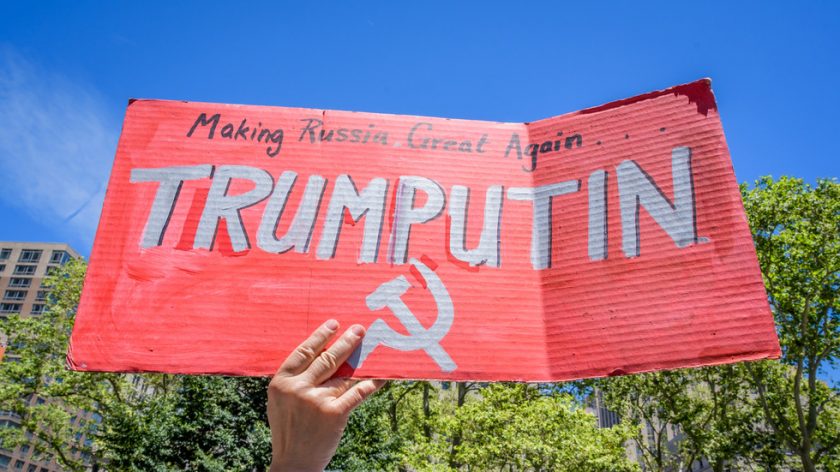
A protester against US President Donald Trump holds a placard during a rally in New York, June 2019. © Global Look Press / ZumaPress / Erik McGregor
RT | January 28, 2020
US Congress heavyweights like Adam Schiff deeply misunderstand Russia but keep on bashing Moscow because it has become “politically advantageous” in Washington, Russia researcher Stephen Cohen said.
“Being highly-critical of Russia is good politics in the United States,” Cohen, professor emeritus of Russian studies at New York University and Princeton University, told the Grayzone’s Aaron Mate in an interview, uploaded online on Monday.
“Nobody ever gets any points for saying anything good about Russia – and only rarely for advocating any kind of partnership with Russia.”
Cohen said that “politically it’s advantageous to a lot of people to bash Russia,” and even some of the “progressive” Democratic Party candidates in the 2020 presidential race employ rhetoric, which is hostile toward Moscow.
“It has become an American way of life to blame Russia when things go wrong. Of course, sometimes Russia is to blame, but not all the time. And yet that’s become part of our discourse.”
The US Democratic Party’s lead impeachment manager, Representative Adam Schiff, has invoked Russia a lot during the trial in the Senate. Democrats want to oust President Donald Trump because they believe he briefly suspended military aid to Ukraine while trying to pressure Kiev into investigating the dealings of his chief 2020 rival, former Vice President Joe Biden and his son Hunter. Sending weapons to Ukraine serves America’s “abiding interest in stemming Russian expansionism,” Schiff argued.
Cohen, however, said that shipping weapons to Kiev would effectively amount to the US turning its back on Ukrainian leader Volodymyr Zelensky’s efforts to resolve the conflict with Russia through peaceful means. Instead, he thinks Washington should focus on encouraging the neighbors to negotiate.
“If Zelensky had full American backing for his peace talks with Putin – that would help him a lot.”
Speaking on the Senate floor, Schiff accused Moscow of trying to undermine the faith in democracy and government institutions around the globe.
Cohen argued that the congressman misunderstands what Russian President Vladimir Putin actually “sees as his own historical mission,” and it is almost the opposite of what Schiff attributes to him.
According to the researcher, Putin’s chief ambition is “to rebuild Russia from the disaster into which it fell in the 1990s” after the collapse of the Soviet Union.
“The last thing Putin wants is instability. He’s trying to build economy at home and economic relations with countries abroad because he sees that as a way to modernize Russia.”
The Russia researcher said that Moscow is currently focused on ties with China, but Putin would like to have good trade relations with Europe and the US as well.
“The notion that he wants to foster discord in the very countries, with which he wants what he calls ‘modernizing trade relations’ is just ignorance on the part of Adam Schiff. Because Schiff runs his mouth a lot about Russia, we get to hear the kind of ignorance… that dominates a large segment of policy-makers in Washington.”
An Unusual Lawsuit against Iran
By Jacob G. Hornberger | FFF | January 28, 2020
The Washington Post recently published an article about a lawsuit that American citizens have brought against Iran. The plaintiffs are Iraq veterans and families of veterans who suffered horrendous injuries or deaths while serving in the U.S. armed forces in Iraq. In their lawsuit, the plaintiffs are claiming that Iran sent roadside bombs into Iraq that wreaked massive injuries or death on U.S. troops.
For example, Chris Levi’s Humvee was torn apart by a roadside bomb that cost him both his legs. Kelli Hake and her 13-year-old son are living their lives without their husband and father, who was killed by a roadside bomb in Iraq. There were thousands more like them.
It stands to reason that the plaintiffs would feel deep anger toward Iran, especially given their belief that Iran did, in fact, furnish the bombs that ended up inflicting death and injuries on U.S. soldiers serving in Iraq.
What is unusual, however, is that there appears to be absolutely no animus directed toward another regime. That regime is the U.S. government. I find the lack of ill will toward the U.S. government to be totally bizarre.
After all, let’s not forget something important: When a nation-state invades, attacks, and occupies a country and in the process intentionally wreaks death, suffering, and destruction, there is a very high probability that people are going to get extremely angry and are going to exact vengeance by doing the same thing to the invading and occupying troops.
We should keep in mind that the U.S. war on Iraq was illegal under our form of government. That’s because the U.S. Constitution, which is the higher law that we the people have imposed on the federal government, prohibits the president from waging war without a declaration of war from Congress. It is undisputed that Congress never declared war on Iraq.
The U.S. war on Iraq was also illegal under the principles set forth by the Nuremberg War Crimes Tribunal. It held that nation-states do not have the authority to invade and attack other nations.
Nonetheless, knowing that an invasion and occupation would be illegal under both the Constitution and the principles set forth at Nuremberg, the Pentagon ordered U.S. forces to invade and occupy the country, knowing full well that many of them would be killed, maimed, or injured in the process.
Did an illegal U.S. war of aggression against Iraq justify intervention by Iran to help Iraqis throw U.S. occupying forces out of the country? Of course not. Nonetheless, everyone knows — or should know — that when one nation illegally attacks and occupies another nation, there is a high likelihood that other nation-states are going to come to the assistance of the invaded and occupied country. That’s just the way the world works.
Consider, for example, when it was the Soviet Union, rather than the United States, that was the invader and occupier in Afghanistan. Guess who came to the assistance of the Afghans who were fighting to evict the Soviets from their country. That’s right — the U.S. government. It provided weaponry, including missiles, that was used to kill, maim, and injure Soviet soldiers. U.S. intervention wasn’t right, but that’s the way the world works.
What if those Soviet soldiers had sued the U.S. government for damages for the deaths and injuries caused by U.S.-supplied weaponry? There is not one court in the United States that would permit such a lawsuit to proceed. Unlike the lawsuit against Iran, a lawsuit by Soviet citizens against the U.S. government would be summarily dismissed.
If U.S. officials hadn’t ordered U.S. troops to invade and occupy Iraq, there never would have been any U.S. soldiers killed, maimed, or injured by anyone. Why shouldn’t the U.S. government be joined as a defendant in that lawsuit against Iran? If the Iranian government isn’t immune from liability, why should the U.S. government be immune from liability? Why are the plaintiffs giving their own government a pass, both legally and morally?
North Korea: Kim Jong-un’s Aunt Appears Alive After Six Years of Media Saying He Killed Her
By Alan Macleod | MintPress News | January 27, 2020
It’s well past Halloween, but people in the Democratic People’s Republic of Korea are rising from the dead (again). That is according to our media, who have for six years been claiming Kim Kyong-hui, the aunt of current ruler Kim Jong-un and daughter of the father of the nation Kim Il-sung, was dead, only for her to be spotted beside her nephew enjoying the Lunar New Year festivities in Pyongyang at the weekend.
CNN and the Daily Telegraph both reported that Kim Jong-un had her poisoned in 2014. Or perhaps she died of a stroke? Or was it a heart attack? Or was she in a permanent vegetative state? The media couldn’t decide, yet they all agreed she was definitely gone. The press appeared unsurprised by the government’s apparent ability with necromancy, covering her reappearance merely as an “isn’t this crazy” story, merely “a reminder of how weird and brutal North Korea is” (BBC). While that statement might be accurate (Kyong-hui’s husband, a top official, was executed by the state, after all), across the media, there was little self-reflection at all as to how and why they had been reporting fake news for six years.
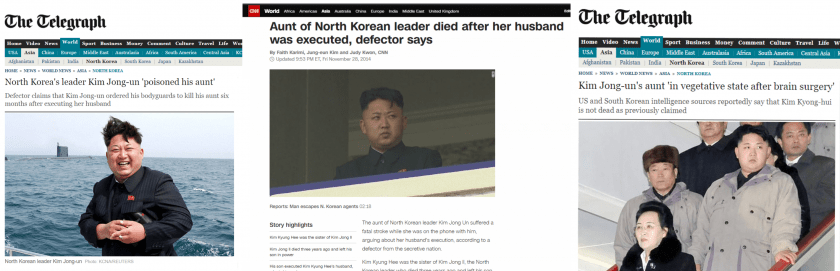
According to media, Kim Kyong-hui, has been poisoned, died of a stroke, had a heart attack or could be in a vegetative state
This is hardly the first time that the press has breathlessly reported that members of the DPRK’s elite have been killed, only for their untimely reappearance to spoil the narrative. Last year corporate media claimed that Korean negotiators were executed for failing to achieve a deal with the U.S. at the nuclear disarmament summit in Vietnam, something CNBC called part of a “massive purge to divert attention away from internal turmoil and discontent.” But barely a few days after the media deluge, the negotiating team’s leader appeared at a performance alongside Kim Jong-un.
In 2013, it was widely reported that Hyon Song-wol, a popular musician and reputed love interest of the DPRK’s supreme leader was executed in a “hail of machine gun fire while members of her orchestra looked on” (BBC). Unfortunately for this narrative, Song-wol is very much alive and singing, continuing to publicly perform to this day. And there is a cavalcade of military officials the corporate press has insisted were killed, often in comically over-the-top ways who turn up later seemingly unharmed. For example, in 2018 General Ri Yong-gil, the officer Donald Trump awkwardly saluted, was promoted to Chief of General Staff, this, despite having been “executed” in 2016 as part of a “brutal consolidation of power,” according to CNN.
Another North Korean figure rising from the dead is national soccer coach Yun Jong-su. After the country lost 7-0 to Portugal at the 2010 World Cup, media reported that he had been shot. This narrative was only dropped after a journalist ran into him at an airport. Ten years later, not only is Jong-su alive, but he is still the national team’s coach.
The problem with these stories is that they largely emanate from one source: notorious conservative South Korean daily the Chosun Ilbo, which has a long and detailed history of printing lurid fake news. Yet Western press are dependent on the Chosun Ilbo for much of their reporting. As Business Insider said while falsely reporting that Kim Kyong-hui, aunt of Kim Jong-un was dead, “the Chosun Ilbo is generally considered a reliable source.”
Other stories are based on testimonies from defectors, who are paid in cash for their stories, something that the poor, isolated and jobless dissidents themselves complain gives them a perverse incentive to exaggerate. The saying, in journalism, goes: “if it bleeds it leads,” i.e. the more shocking a story is, the more likely it is to be published, meaning that defectors who do not offer the sordid details journalists, intelligence agencies or human rights groups want, will not be paid. Defectors are not necessarily trustworthy sources either. One Korean defector who was praised for his heroic actions later admitted that he was actually on the run for a murder he confessed he committed.
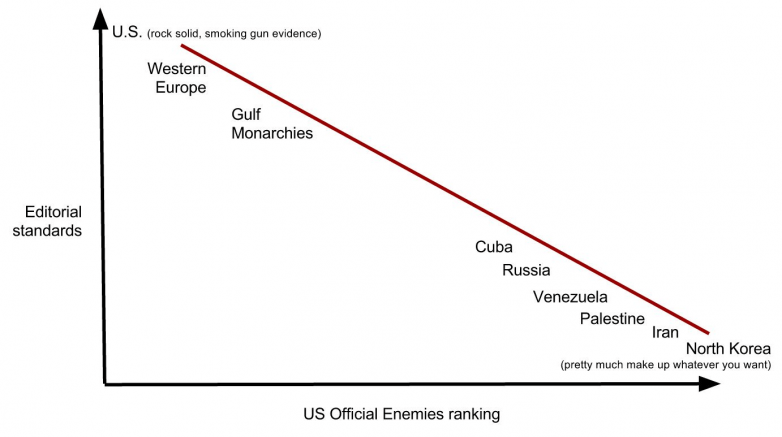
Adam Johnson’s North Korea law of journalism. Credit | FAIR
The perverse incentive also exists for media, too, who live in a hyper-competitive world driven by the need to get clicks. Careful, nuanced analysis does not pay. Added to that is the fact that the DPRK is an official enemy of the United States. The United States killed up to one quarter of the Korean race in bombing during the 1950s, using chemical weapons against them and committing other war crimes such as bombing civilian targets. Media analyst Adam Johnson put forward his theory of the “North Korea law of journalism,” where, he says, “editorial standards are inversely proportional to a country’s enemy status.” While the U.S. or friendly countries are covered favorably, the most lurid fantasies can be printed with regards to enemy states like Venezuela, Bolivia or the DPRK, as there is no penalty for being incorrect. Publishing stories claiming Donald Trump had thrown General Michael Flynn into a tank of ravenous piranhas would result in outlets being shut down, re-ranked and delisted by search engines and social media, and perhaps even journalists being arrested. But the same story run about North Korea is a money-spinner.
Thus, the same orientalist tropes are used again and again when it comes to reporting on Korea – that there is only one haircut allowed, that it has “banned sarcasm,” that there is no electricity or tall buildings in the country– are endlessly repeated by journalists reproducing imperial propaganda. As Kim Kyong-hui’s case shows, in North Korea, stories are often too bad to be true.
Alan MacLeod is a Staff Writer for MintPress News. After completing his PhD in 2017 he published two books: Bad News From Venezuela: Twenty Years of Fake News and Misreporting and Propaganda in the Information Age: Still Manufacturing Consent.
US didn’t discuss ‘deal of century’ with Moscow, Russia’s UN envoy says
RT | January 28, 2020
The US did not hold consultations with Moscow on a plan to resolve the Israeli-Palestinian conflict, Russia’s permanent representative to the United Nations Vassily Nebenzia has said.
“We were not consulted, we don’t know what this plan consists of,” he said in response to a question from a reporter.
Israeli envoy to the UN Danny Danon, meanwhile, said that his country was looking forward to the unveiling of the plan, TASS reported on Tuesday.
US President Donald Trump previously announced that the White House would unveil a plan for peace in the Middle East on Tuesday.
Cancel Culture Hits Medical Journals
By Donna Laframboise | Big Picture News | January 27, 2020
Much scientific research is now conducted by tribes. Some tribes think certain foods are good for us. Eggs, fat, coffee, dairy, whatever. Other tribes insist their own research shows the opposite.
The Journal of the American Medical Association (JAMA) has just published a shocking account of how the ‘eat red meat sparingly’ tribe tried to make research by a rival tribe disappear.
Last fall, a collection of systematic reviews were published by a prominent journal, the Annals of Internal Medicine (see here, here, here, here, and here). Online publication happened on October 1st, prior to the material appearing in the printed journal in mid-November.
After carefully reviewing scientific evidence concerning meat consumption, the PhDs and medical doctors involved formulated a clinical guideline, aka a nutritional recommendation, which was published at the same time. This was intended to help practicing doctors provide appropriate advice to their patients.
The short version is that most of these researchers (11 votes to 3), believe no reliable evidence justifies telling adults to eat less red meat and less processed meat. As this commentary explains, nutritional research is typically “shaky.” Studies that identify a link between meat consumption and a particular disease usually show tiny increases in risk.
The Annals had taken into account the feedback of peer reviewers both pro and con, and had made its call. To quote editor-in-chief Christine Laine, “the public should know we don’t have great information on diet.”
The JAMA article tells us that, as the Annals was preparing to publish this material online, the anti-meat tribe began mobilizing. An estimated 2,000 vitriolic e-mails flooded into Laine’s inbox during a half-hour period.
Members of an organization called the True Health Initiative contacted her at least twice. They complained about the wording of a press release the journal was circulating about the upcoming research. They also urged her to “preemptively retract publication of these papers” for “the sake of public understanding and public health” (read their letter here).
How did these people react when their outrageous attempts to suppress scientific results failed? Did they start behaving like grownups? Hardly. Instead, they complained to an agency of the US government, the Federal Trade Commission. You can read about that here in their own words.
The anti-meat tribe thinks a government body tasked with ensuring marketplace competition and fair business practices should be second-guessing medical journals. Arguing that the journal’s press release amounted to misleading advertising, their petition asked the Trade Commission to:
permanently prohibit [the Annals of Internal Medicine] from disseminating, or causing the dissemination of the advertisement at issue and require [the journal] to issue a public retraction and corrective statement regarding the advertisement. [bold added]
When that went nowhere, did these people finally start behaving in a civilized manner? I’m afraid not. Their next stop was the Philadelphia district attorney’s office. You know, the prosecutors and detectives tasked with keeping citizens safe from criminals. (The Annals offices are in Philadelphia.)
In their own press release, the anti-meat tribe said the Annals should be investigated for “potential reckless endangerment.” The journal, they insisted, had distributed “dangerous and misleading information.”
The entity that turned first to the Trade Commission and then to the criminal justice system calls itself the Physicians Committee for Responsible Medicine. It’s unofficial motto is: if you can’t persuade people to do what you want, find a third party who’ll compel them to do so. Just kidding. It actually sees itself as leading a “revolution” – based on the idea that plant-based diets “can prevent and even reverse diabetes, heart disease, and high blood pressure.”
This is a lobby group, an activist organization. According to its own website, only 12,000 of its 175,000 members (7%) are actually physicians.
Welcome to the polarized world of medical publishing. This is how the scientific community now behaves.
To be continued…
Fifteen Years Before Kennedy, Zionists Murdered Forrestal

By Laurent Guyénot • Unz Review • January 27, 2020
Israel as serial murderer
In the 1990s, a couple of bestsellers brought to the knowledge of a large public the fact that JFK’s assassination in 1963 solved an intense crisis over Israel’s secret nuclear program. In one of his last letters to Kennedy, quoted by Seymour Hersh in The Samson Option (1991), Prime Minister David Ben-Gurion complained: “Mr. President, my people have the right to exist […] and this existence is in danger.”[1] The nuclear option was judged vital for Israel, and JFK opposed it. A Haaretz review of Avner Cohen’s book Israel and the Bomb (1998) puts it this way:
“The murder of American President John F. Kennedy brought to an abrupt end the massive pressure being applied by the US administration on the government of Israel to discontinue the nuclear program. Cohen demonstrates at length the pressures applied by Kennedy on Ben-Gurion. […] The book implied that, had Kennedy remained alive, it is doubtful whether Israel would today have a nuclear option.”[2]
Also openly discussed by Israeli historians today are the close connections between Ben-Gurion’s network in the U.S. and what Tel-Aviv professor Robert Rockaway calls “Gangsters for Zion”, including the infamous “Murder, Incorporated”, run by Bugsy Siegel and then by Mickey Cohen, Jack Ruby’s mentor.
That Israel had the motive and the means of killing JFK does not prove that Israel did it. But I am quite certain that today, most smart Israelis assume and half-approve that Ben-Gurion ordered the elimination of JFK in order to replace him by Lyndon Johnson, whose love for Israel is also now widely celebrated, to the point that some speculate he might have been a secret Jew.
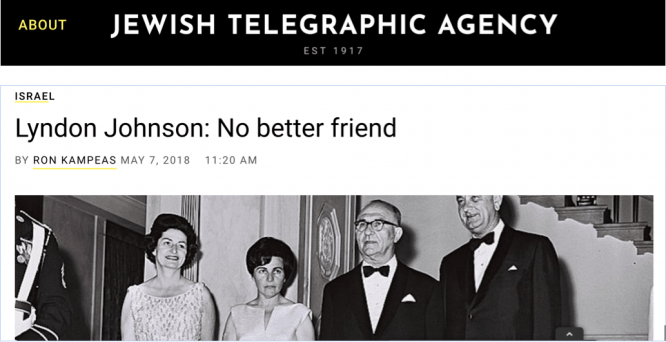

In Ben-Gurion’s mind, making Israel a nuclear state was a matter of life and death, and obliterating any obstacle was an absolute necessity. In Netanyahu’s mind today, preventing Iran—or any other enemy of Israel—from becoming a nuclear state is of the same order of necessity, and would surely justify eliminating another U.S. president in order to replace him by a more supportive Vice President. Most dedicated Zionists understand that. Andrew Adler, owner and editor in chief of The Atlanta Jewish Times, assumes that the idea “has been discussed in Israel’s most inner circle,” and, in his column of January 13, 2012, called on the Israeli Prime Minister to,
“give the go-ahead for U.S.-based Mossad agents to take out a president deemed unfriendly to Israel in order for the current Vice-President to take his place and forcefully dictate that the United States’ policy includes its helping the Jewish State obliterate its enemies. […] Order a hit on a president in order to preserve Israel’s existence.”[3]
Eliminating unsubmissive foreign leaders is part of Israel’s struggle for existence. Besides, it is entirely biblical: foreign kings are supposed to “lick the dust at [Israelis’] feet” (Isaiah 49:23), or perish, with their names “blotted out under heaven” (Deuteronomy 7:24).
On November 6, 1944, members of the Stern Gang, led by future Prime Minister Yitzhak Shamir, assassinated Lord Moyne, the British resident minister in the Middle East, for his anti-Zionist positions. The bodies of his murderers, executed in Egypt, were later exchanged for twenty Arab prisoners and buried at the “Monument of Heroes” in Jerusalem. On September 17, 1948, the same terrorist group murdered in Jerusalem Count Folke Bernadotte, a Swedish diplomat appointed as United Nations mediator in Palestine. He had just submitted his report A/648, which described “large-scale Zionist plundering and destruction of villages,” and called for the “return of the Arab refugees rooted in this land for centuries.” His assassin, Nathan Friedman-Yellin, was arrested, convicted, and then amnestied; in 1960 he was elected to the Knesset.[4]
In 1946, three months after members of the Irgun, led by future Prime Minister Menachem Begin, killed ninety-one people in the headquarter of the British Mandate’s administration (King David Hotel), the same terrorist group attempted to murder British Prime Minister Clement Attlee and Foreign Secretary Ernest Bevin, according to British Intelligence documents declassified in 2006.
These killings and more are documented by Israeli journalist Ronen Bergman in Rise and Kill First: The Secret History of Israel’s Targeted Assassinations (Random House, 2018). Bergman writes:
“At the end of 1947, a report to the British high commissioner tallied the casualties of the previous two years: 176 British Mandate personnel and civilians killed. / ‘Only these actions, these executions, caused the British to leave,’ David Shomron said, decades after he shot Tom Wilkin dead on a Jerusalem street. ‘If [Avraham] Stern had not begun the war, the State of Israel would not have come into being.’”[5]
James Forrestal’s strange death
Absent from Israel’s body count in Bergman’s book is former U.S. Secretary of Defense James Forrestal, assassinated eight months after Count Bernadotte. Forrestal had been Roosevelt’s Secretary of the Navy from April 1944. With consolidation of the armed services under Truman in 1947, he became the first Secretary of Defense. He opposed the United Nations’ vote to partition Palestine, and protested vigorously against U.S. recognition of Israel on May 15, 1948, on the ground that U.S. interests in the Middle East would be seriously jeopardized by American sponsorship of a Jewish state. For this, Forrestal received “an outpouring of slander and calumny that must surely be judged one of the most shameful intervals in American journalism,” in the words of Robert Lovett, then Under Secretary of State. Truman replaced Forrestal on March 28, 1949—shortly after his reelection—by the man who had been his main fundraiser, Louis Johnson. According to the received story, Forrestal, who was psychologically exhausted, fell into depression immediately. On April 2, 1949, he was interned against his will in the military hospital of the Navy in Bethesda, Maryland, a Washington, DC, suburb, where he was forcibly confined for seven weeks. He fell to his death from the 16th floor at 1:50 in the morning of May 22, 1949, landing on the roof of the third floor. He had a dressing-gown sash tied around his neck.
Bethesda Navy Hospital, where Forrestal met his death
National authorities and mainstream media immediately labeled his death a suicide, without any known criminal investigation. A review board was appointed on May 23, headed by Admiral Morton Willcutts, to conduct hearings of members of the hospital staff with the sole purpose of exonerating everyone of responsibility in Forrestal’s assumed suicide. The board completed its work in one week, and published a short press release four months later. But the full report, containing the transcripts of all hearings and crucial exhibits, were kept secret for 55 years, until David Martin obtained it through a Freedom of Information Act request in April 2004 (it is now available on the Princeton University Library website in pdf form, or here in HTML rendition by the anonymous Mark Hunter, who makes useful comments).
In his book and in his web articles complementing it, David Martin makes a compelling case that Forrestal was murdered, and that his murder was ordered by the Zionists, most probably with the knowledge and approval of Truman, who was then completely hostage to the Zionists. The motive? Forrestal was planning to write a book and to launch a national magazine: he had the money and the connections for it, and he had three thousand pages of personal diary to back his revelations on the corruption of American leadership and the sell-out of American foreign policy to communism under Roosevelt, and to Zionism under Truman.
I will here summarize the evidence accumulated by David Martin, and highlight the significance of this case for our understanding of Israel’s takeover of the heart, soul, and body of the United States. Unless specified otherwise, all information is from Martin’s book or articles.
From James Forrestal to John Kennedy
My own interest for this heartbreaking story stems from my interest for the Kennedy assassinations. (read my article Did Israel Kill the Kennedys?). I found the connection and similarities between the two stories highly illuminating. Everyone knows that Kennedy was assassinated, yet most Americans are still unaware of the evidence incriminating Israel. In the case of Forrestal, it is the opposite: few people suspect a murder, but once the evidence for murder has been presented, it points directly to Israel as the culprit. For this reason, Forrestal’s assassination by the Zionists becomes a precedent that makes JFK’s assassination by the same collective entity more plausible. If Israel can kill a former U.S. Defense Secretary on American soil in 1949 and get away with it with government and media complicity, then why not a sitting President fifteen years later? If the truth on Forrestal had been known by 1963, it is unlikely that Israel could have killed two Kennedys with impunity.
Forrestal was of Irish Catholic origin like the Kennedys, and was close to JFK’s father. Both James Forrestal and Joseph Kennedy are examples of American patriots of Irish stock who were alarmed by Jewish influence over American foreign policy. The entry for 27 December 1945 in Forrestal’s edited diary, says:
“Played golf with Joe Kennedy. I asked him about his conversations with Roosevelt and Neville Chamberlain from 1938 on. […] Chamberlain, he says, stated that America and the world Jews had forced England into the war.”
One major difference between the two men is that Joe Kennedy had resigned from government after Roosevelt’s entry into the war, and had kept a low profile on Israel. Moreover, unlike Forrestal, he was the head of a wealthy clan and had his own men in the press. He was a politician, whereas Forrestal was an uncompromising man. These differences explain why Forrestal was assassinated, whereas Joe had his son elected president. Yet in the end, the Kennedys suffered the Talmudic curse over three generations.
When James Forrestal, hostile to Stalin’s ambitions on Eastern Europe and to Truman’s decision to nuke Japan, was kept away from the official delegation to the Potsdam Conference in the summer 1945, he flew there privately and took with him the then 28-year-old John Kennedy, for a tour of post-war Germany. Later on, John integrated James Forrestal’s son Michael Forrestal as a member of his National Security Council. In May 1963 he made a symbolic public gesture by visiting the grave of James Forrestal on Memorial Day.

JFK visits Forrestal’s grave at Arlington cemetery
James Forrestal’s and John Kennedy’s assassinations bear one sinister thing in common: Bethesda Naval Hospital. As most readers recall, this is where Kennedy’s autopsy was tampered with after his body had been whisked away at gunpoint from Dallas Parkland Hospital, most probably by Secret Service agents on Lyndon Johnson’s order. In 1963, Lyndon Johnson could count on high-level complicity within the Navy.
It happens that Johnson, whom Billy Sole Estes claims ordered nine murders in the course of his political career,[6] makes a special appearance, although brief and poorly documented, in the story of Forrestal’s assassination. LBJ was then a newly elected congressman, on the payroll of Abraham Feinberg, former president of Americans for Haganah Incorporated and financial godfather of Israel’s atomic bomb.[7] According to the testimony of Forrestal’s assistant Marx Leva (more on him later), Johnson paid an unwanted visit to Forrestal at Bethesda Hospital. David Martin asks:
“Could LBJ have been playing something of a foot-soldier role for the orchestrators of Forrestal’s demise? Might he have been there to size up the overall situation, and at the same time contribute to ‘making his bones,’ as it were, by participating in such an important operation?” (Martin p. 20)
The official narrative
It bears repeating that no investigation was conducted into the death of James Forrestal, either by the FBI or the NCIS (Navy Criminal Investigative Service). The very day of his death, the mainstream press announced his suicide as a matter of fact. The New York Times stated in its late May 22 edition that Forrestal “jumped thirteen stories to his death,” and added the next morning:
“There were indications that Mr. Forrestal might also have tried to hang himself. The sash of his dressing-gown was still knotted and wrapped tightly around his neck when he was found, but hospital officials would not speculate as to its possible purpose.”
Later biographers did speculate that he may have tried to hang himself but failed to tie the sash securely to the radiator beneath the window. In The Man Who Kept the Secrets, Pulitzer Price winner Thomas Powers says that Forrestal died trying to hang himself “from his hospital window, but slipped and fell sixteen stories to his death.”
Forrestal left no suicide note, but the New York Times (May 23) informs its readers that:
“A book of poetry beside his bed was opened to a passage from the Greek tragedian, Sophocles, telling of the comfort of death. […] Mr. Forrestal had copied most of the Sophocles poem from the book on hospital memo paper, but he had apparently been interrupted in his efforts. His copying stopped after he had written ‘night’ of the word ‘nightingale’ in the twenty-sixth line of the poem.”
On May 24, the New York Times gave the final word to the psychiatrist in charge, who made suicide sound predictable:
“Captain George M. Raines, the Navy psychiatrist who had been treating Mr. Forrestal, said that the former Secretary ended his life in a sudden fit of despondency. He said this was ‘extremely common’ to the patient’s severe type of mental illness.”
That’s it. Never did the mainstream media hint at the possibility of foul play. The conclusion that Forrestal’s death is an obvious suicide caused by his “mental illness” was taken at face value by the authors of Forrestal’s two main biographies:
- Arnold Rogow, James Forrestal, A Study of Personality, Politics, and Policy (MacMillan Company, 1963);
- Townsend Hoopes and Douglass Brinkley, Driven Patriot, the Life and Times of James Forrestal (Alfred A. Knopf, 2003).
Rogow, whose book has been called a “psychological autopsy,” insists on linking Forrestal’s alleged mental illness to his alleged anti-Semitism, with the implication that anti-Semitism is a form of paranoia that may lead to suicide. Rogow is an expert on the subject of anti-Semitism, on which he wrote the article for The International Encyclopedia of Social Science. He is also the author The Jew in a Gentile World: An Anthology of Writings about Jews by Non-Jews.
 Hoopes and Brinkley borrow heavily from Rogow, but add valuable information based on their own interviews. They give an interesting interpretation of the morbid poem allegedly copied by Forrestal from Mark Van Dorren’s Anthology of World Poetry, titled “The Chorus from Ajax.” Taking their clue from Zionist apologist John Loftus, author of The Belarus Secret (Alfred A. Knopf, 1982), they speculate that, when reaching the word “nightingale” in the poem, Forrestal might have been overwhelmed by a sudden rush of guilt for having authorized a CIA operation with the code name of “Nightingale,” that infiltrated into the Soviet Union Ukrainian spies who had been formerly Nazi collaborators and probably killers of Jews. The word “nightingale,” Hoopes and Brinkley surmise, must have triggered Forrestal’s urge to take the poet’s admonition literally and end his life on the spot.
Was Forrestal mentally ill?
David Martin has uncovered grave inconsistencies and outright lies in the official story. First, it appears that Forrestal’s nervous breakdown has been wildly exaggerated, if not totally invented. As the story goes, Forrestal’s mental health had started deteriorating before Truman replaced him, and collapsed on March 29, just after a brief ceremony in his honor at Capitol Hill. The main source for this story is an Oral history interview of Marx Leva, Forrestal’s special assistant at that time, recorded for the Truman library in 1969. Leva says that, on that day, he found Forrestal in his Pentagon office, “almost in a coma.” He had him driven home and later met him there with Forrestal’s friend Ferdinand Eberstadt, and the two men decided that Forrestal’s state required that he urgently take some vacation. So Leva made immediate arrangement for a Marine plane to fly him to the estate of Robert Lovett in Hobe Sound, Florida that very night. “And on the way out Forrestal said three times, the only thing he said, [Eberstadt] tried to speak to him and he would say, ‘You’re a loyal fellow, Marx.’ ‘You’re a loyal fellow, Marx,’ three times.” Since Leva is Jewish, the implication is that Forrestal was obsessed by the disloyalty he attributed to many Jewish officials. For Leva, “he apparently was beyond being neurotic, I mean it was apparently paranoid”.
David Martin shows in this article (adding a new perspective to his book) that Marx Leva is lying. Forrestal’s vacation had in fact been planned in advance, and his wife was already waiting for him there. This is proven by a Jacksonville Daily Journal article dated March 28 about the ceremony when Truman pinned the Distinguished Service Medal on Forrestal’s chest that very day. The article concludes: “Forrestal is flying tomorrow to Hobe Sound, Fla., for a long rest.” This video clip of Forrestal shows him perfectly healthy and composed on March 28.
News reports and biographies insist that, during his four-day stay at Hobe Sound, Forrestal showed signs of paranoia. One rumor, made up by Daniel Yergin and repeated by Thomas Powers in The Man Who Kept the Secrets, has him running through the streets yelling, “The Russians are coming.” There is no credible source for this claim. Under Secretary of State (and future Defense Secretary) Robert Lovett, who was at Hobe Sound with Forrestal, did say in 1974 that Forrestal appeared to him as “not of sound mind,” because “he was obsessed with the idea that his phone calls were being bugged,” and complained that “they’re really after me.” I find rather strange, though, that Lovett feigns to ignore who Forrestal meant by “they”. There is nothing irrational in Forrestal’s belief that “his telephones were being bugged, [and that] his house was being watched”, as he had earlier complained to Truman’s appointments secretary, Matthew J. Connelly (who said so in a 1968 interview by the Truman Library).
There is also a rumor that Forrestal attempted suicide at Hobe Sound. It is contradicted by the Willcutts report, where Dr. George Raines, the psychiatrist in charge of Forrestal at Bethesda, is recorded stating: “So far as I know he never made a single real attempt at suicide except that one that was successful.” All of Forrestal’s doctors interviewed are unanimous that he had never attempted suicide before his fatal fall.
That is not to say that Forrestal was not psychologically strained in 1949. As Secretary of Defense, he had been subjected not only to slander and calumny by the press, but also to anonymous death threats. Robert Lovett, who shared Forrestal’s views on Israel, testified that he himself received night phone calls with death threats, and that Forrestal was more exposed than him to this kind of treatment. Having lost all protection from the government after March 28, Forrestal had reasons to fear for his life. On May 23, 1949, The Washington Post concluded an article headlined “Delusions of Persecution, Acute Anxiety, Depression Marked Forrestal’s Illness,” with the somewhat paradoxical statement:
“His fear of reprisals from pro-Zionists was said to stem from attacks by some columnists on what they said was his opposition to partition of Palestine under a UN mandate. In his last year as Defense Secretary, he received great numbers of abusive and threatening letters.”
John Loftus and Mark Aarons, the arch-Zionist authors of The Secret War against the Jews, identify Forrestal as “the principal villain, the man who nearly succeeded in preventing Israel’s birth.” They reveal that “The Zionists had tried unsuccessfully to blackmail Forrestal with tape recordings of his own deals with the Nazis” (before the war, Forrestal had been a partner of Clarence Dillon, the Jewish founder of the banking firm Dillon, Read, and Co.), but they believe that Zionist harassment at least succeeded in making him insane: “His paranoia convinced him that his every word was bugged. To his many critics, it seemed that James Forrestal’s anti-Jewish obsession had finally conquered him.”[8]
How convenient to claim that anti-Semitism may lead to suicide. When the Zionist mafia wishes you dead, fearing for your life is not a sign of mental illness, but rather of sound judgment.
We need not doubt Raines’ words to the Willcutts Review Board that, when he first saw Forrestal at Bethesda Hospital, “he was obviously exhausted physically” and showed “high blood pressure.” But here, we also have to take into account that Forrestal had been literally abducted from his vacation center at Hobe Sound. We should not be surprised when Rogow, and Hoopes and Brinkley after him, tell us that, even though he had been sedated, Forrestal “was in a state of extreme agitation during the flight from Florida,” and that:
“Forrestal’s agitation increased during the trip in a private car from the airfield to the hospital. He made several attempts to leave the car while it was in motion, and had to be forcibly restrained. Arriving at Bethesda, he declared that he did not expect to leave the hospital alive.”
As Martin mentions, there is also the very real possibility that Forrestal had been drugged at Hobe Sound, in order to make him appear insane and justify his internment.
Forrestal’s behavior at Bethesda shows nothing abnormal for a man locked up in the psychiatric division of a military hospital, on the 16th floor, for reasons he feared were not strictly medical. It has been reported by medical personnel that Forrestal often seemed restless, walking back and forth in his room late at night. Why wouldn’t he? Forrestal was even denied visits by those dearest to him. His brother Henry had tried several times to visit him, but had been rebuffed by Dr. Raines. The hospital authorities relented only after Henry threatened legal action. Forrestal was also denied the visit of his friend the Catholic priest, Monsignor Maurice Sheehy. Sheehy wrote in The Catholic Digest, January 1951, that, “The day he was admitted to the hospital, Forrestal told Dr. Raines he wish to see me,” but that Dr. Raines told him “that Jim was so confused I should wait some days before seeing him.” Raines turned away Father Sheehy on six occasions.
Despite being kept in virtual imprisonment and under forced medication, Forrestal endured remarkably well. From the hearings conducted by the Willcutts Review Boards, it appears that he was doing fine, in the days preceding his death. Willcutts himself expressed surprise at learning about his death, because he had dinner with him one day earlier (Friday the 20th), and thought he was “getting along splendidly.”
Evidence of cover-up and the fake suicide note
As mentioned earlier, the Willcutts Review Board’s mission was to exonerate every single individual of negligence. Even the brief conclusions released four months after it concluded its hearings, admits so, as reported in the New York Times October 12, 1949:
“Francis P. Matthews, Secretary of the Navy, made public today the report of an investigating board absolving all individuals of blame in the death of James Forrestal last May 22.”
Strangely enough, as Martin discovered, the report states that Forrestal’s fall was the cause of his death, but avoids any statement about the cause of the fall itself.
There is an obvious lack of interest from the Willcutts Board regarding all elements that point to murder rather than to suicide. The nurse who first entered Forrestal’s room after his death testified that there was broken glass on his bed. But the room must have been laundered before the crime scene photographs were taken, because they show the bed with nothing but a bare mattress, while another picture shows broken glass on the carpet at the foot of his bed (photos available on Mark Hunter’s site). The Willcutts Board had no interest in finding the origin of the broken glass, nor the reason it was removed from the bed.
They also failed to ask the personnel or themselves any relevant questions about the gown sash tied around Forrestal’s neck. Hoopes and Brinkley later speculated that Forrestal tied the sash to a radiator beneath the window, but that his knot “gave way.” That is contradicted by hospitalman William Eliades, who found the body of Forrestal with the sash (cord) around his neck, and declared to the Willcutts Review Board: “I looked to see whether he had tried to hang himself and whether a piece of cord had broken off. It was still in one piece except it was tied around his neck.”
But the most compelling proof that Forrestal’s death has been disguised as a suicide is the poem allegedly copied by Forrestal. Among the exhibits obtained by Martin alongside the Willcutts report is a copy of the memo sheet with the transcription of the poem (here). A comparison with any handwritten note by Forrestal makes it plain that it was not copied by Forrestal (both can be found on Mark Hunter’s webpage).

A sample of Forrestal’s handwriting and the note supposedly found in his room
As Martin comments, “One hardly needs an expert to tell him that the person who transcribed the poem is not the same person who wrote the various letters there.” Martin also notes that, from this single page, it is doubtful that the writer, whoever he was, even reached the word “nightingale”, which appears 11 verses below in the poem.
Interestingly, no one is identified in the official report as the discoverer of this handwritten note. It didn’t occur to the members of the Review Board to mention how it came into their possession, and to question about it the person who gave it to them.
In an effort to make the note a convincing proof of suicide, Rogow claims, and Hoopes and Brinkley repeat, that Apprentice Robert Wayne Harrison, Jr., the corpsman on duty to keep watch on Forrestal, checked into his room at 1:45 and saw him copying the poem. But by doing so, they both contradict Harrison’s declaration to the Willcutts Board. He said that, when he checked on him at 1:45, Forrestal was “in his bed, apparently sleeping.” Then he went to fill in the medical chart. Minutes later, a nurse heard the sound of Forrestal’s body striking the third floor roof. Harrison heard nothing but then became aware that Forrestal was missing at 1:50.
 Robert Wayne Harrison, Jr. would certainly have been a prime suspect if any criminal investigation had taken place. He was new to the job, and unknown to Forrestal until that fatal night. He had started his guard at midnight, replacing Edward Prise whose shift had started at 4 pm. Prise was well-known and apparently appreciated by Forrestal; he had been assigned to keep watch on Forrestal from the third day of Forrestal’s arrival at Bethesda. Strangely, his name is not mentioned in any contemporary news report, and it is misspelled “Price” in the report and in all biographies, although he clearly signed “Prise” in the medical chart included among the exhibits with the Willcutts report.
David Martin mentions that he received an e-mail from Prise’s daughter saying:
“We grew up hearing whispers between our parents in reference to this matter but were not allowed to ask for detail. Even up until a year prior to my father’s death in 1991 he had called me and was in fear that he was going to be questioned again about the issue.” (Martin p. 9)
We need not insist on the fact that witnesses are easily intimidated in a military environment, as was Bethesda Hospital. The pressure transpires in the transcripts of the Willcutts interviews: every nurse, corpsman or doctor said what they were expected to say, and understood their obligation never to speak otherwise. An interesting insight into this can be gained from David Martin’s interview of John Spalding, James Forrestal’s Navy Driver, then 27 years-old. When informed of the death of Forrestal by his superior, Spalding was handed a sheet of paper to sign, saying “I could never talk about anything that happened between him and me.”
Was it the communists or the Zionists?
Before David Martin, one author, writing under the pen-name Cornell Simpson, had claimed that Forrestal had been murdered. His book, The Death of James Forrestal, was published in 1966, although he claims to have written it in the mid-1950s. Simpson’s book contains much valuable and credible information. He had for example interviewed James Forrestal’s brother Henry, who was positively certain that his brother had been murdered. Henry Forrestal found the timing of the death very suspicious because he was coming to take his brother out of the hospital a few hours later that very same day. According to Simpson, another person who didn’t believe in Forrestal’s suicide was Father Maurice Sheehy. When he hurried to the hospital several hours after Forrestal’s death, he was approached discreetly by an officer who whispered to him, “Father, you know Mr. Forrestal didn’t kill himself, don’t you?”
Simpson blames the communists for Forrestal’s murder. The claim is not preposterous. Forrestal was definitely anti-communist. He had been alarmed by what he saw as communist infiltration in the Roosevelt administration (the Venona decrypts, giving evidence of 329 Soviet agents inside the U.S. government during World War II, would prove him right). After Roosevelt’s death, he was influential in the transformation of U.S. policy toward the Soviet Union, from accommodation to “containment.” Senator Joseph McCarthy, another Irish Catholic, testifies in his book The Fight for America that it was Forrestal who directly inspired his exposés of communist influence and subversion in the federal government:
“Before meeting Jim Forrestal I thought we were losing to international Communism because of incompetence and stupidity on the part of our planners. I mentioned that to Forrestal. I shall forever remember his answer. He said, ‘McCarthy, consistency has never been a mark of stupidity. If they were merely stupid they would occasionally make a mistake in our favor.’ This phrase stuck me so forcefully that I have often used it since.”
After Forrestal met his violent end, McCarthy moved up to the front line. He himself died on May 2, 1957, at the age of forty-eight, in Bethesda Hospital. Hospital officials listed the cause of death as “acute hepatic failure,” and the death certificate reads “hepatitis, acute, cause unknown.” The doctors declared that the inflammation of the liver was of a “noninfectious type”. Acute hepatitis can be caused either by infection or by poisoning, yet no autopsy was performed. Simpson comments (as quoted at length in Martin’s article James Forrestal and Joe McCarthy):
“Like Jim Forrestal, Joe McCarthy walked into the Bethesda Naval Hospital as its most controversial patient and as the one man in America most hated by the Communists. And, like Forrestal, he left in a hearse, as a man whose valiant fight against Communism was ended forever.”
M. Stanton Evans, who built on his father Medford Evans’ earlier work for his commendable Blacklisted by History: The Untold Story of Senator Joe McCarthy and His Fight Against America’s Enemies (2009), hints at the possibility that McCarthy was murdered, but does not explore the issue.

In 1953, Robert Kennedy worked as an assistant counsel to the Senate committee chaired by Senator Joseph McCarthy
The problem with Cornell Simpson’s theory is that Forrestal’s worst enemies were not the communists, but the Zionists. Although Forrestal’s anti-communism later attracted criticism from left-wing historians, it was not, then, a matter of public condemnation. Forrestal’s anti-communism was shared by most of his contemporaries, especially within the military. As long as you did not mention the high percentage of Jews among communists, being anti-communist did not make you the target of the mainstream media. The same, obviously, cannot be said of anti-Zionism. Neither the Washington Post nor the New York Times can be said to have been pro-communist at any time, but both turned strongly pro-Zionist around 1946. Arthur Hays Sulzberger, the NY Times’ director of publication since 1938, had actually denounced in 1946 the “coercive methods of the Zionists” influencing his editorial line, but eventually gave in and, since 1948, the NY Times has produced singularly unbalanced coverage of Palestine.[9]
It was his opposition to Zionism, not to communism, that attracted death threats to Forrestal. In his diary entry for February 3, 1948, Forrestal writes that he had lunch with Bernard Baruch and mentioned to him his effort at stopping the process of recognition:
“He took the line of advising me not to be active in this particular matter and that I was already identified, to a degree that was not in my own interests, with opposition to the United Nations policy on Palestine.”
Martin comments (p. 86):
“Baruch clearly did not know his man when he attempted to influence him by appealing to Forrestal’s own self-interest. He might have known more than he was telling, though, when he hinted at the danger that Forrestal faced for the courageous position he had taken.”
Jewish gangsters were traditionally anti-communists, but the Zionists could count on them to give a hand whenever needed. From 1945, Ben-Gurion’s Jewish Agency had close links to the Yiddish mafia, also known as the Mishpucka (Hebrew for “the Family”), who contributed greatly to the clandestine arms-purchasing-and-smuggling network that armed the Haganah. Leonard Slater writes in The Pledge that Teddy Kollek, who later became the longtime mayor of Jerusalem, ran the day-to-day operations and was told explicitly by Jewish gangsters from Brooklyn, “If you want anyone killed, just draw up a list and we’ll take care of it.” Yehuda Arazi, a close aide to Ben-Gurion sent by him to the U.S. to purchase heavy armaments, approached Meyer Lansky and met with members of “Murder, Incorporated.” Another Haganah emissary, Reuvin Dafni, who would become Israeli consul in Los Angeles and New York, met with Benjamin Siegelbaum, known as Bugsy Siegel. Some of those “gangsters for Zion”, writes Robert Rockaway, “did so out of ethnic loyalties,” or “saw themselves as defenders of the Jews, almost biblical-like fighters. It was part of their self-image.” Some also helped “because it was a way […] to gain acceptance in the Jewish community.”[10] Mickey Cohen, the successor of Bugsy Siegel, explains in his memoirs that from 1947, “I got so engrossed with Israel that I actually pushed aside a lot of my activities and done nothing but what was involved with this Irgun war.”[11] He was in close contact with Menachem Begin, and met with him when Begin came touring the U.S. in December 1948, a few months before Forrestal was confined to the Bethesda hospital.[12] Had Begin wanted Forrestal dead, he had only to ask.
I think it is quite self-evident that Forrestal had more to fear from the Zionists than from the communists. And so it is strange that Cornell Simpson totally ignores the Zionists as possible culprits. Neither Israel nor Zionism appears in his index. David Martin, who nevertheless recognizes the merit of Simpson’s investigation, finds the explanation for his blackout on Zionism in the fact that his book was published by Western Islands Publishers, the in-house publishing company of the John Birch Society, a Zionist front.
Three years before the Birch Society published Simpson’s book, Rogow had published the first biography of Forrestal, defending the official line about his death, and linking his supposed mental illness directly to his supposed anti-Semitism. It is very unlikely that Rogow’s book eased the suspicions of the skeptics about Forrestal’s suicide. On the contrary, Rogow’s obvious bias as a writer mainly concerned with anti-Semitism must have led many to consider his book as just another layer in the cover-up. Martin therefore speculates that the writing and publishing of Simpson’s book by the Birch Society was a way to give voice to the skepticism over Forrestal’s death, while directing that skepticism away from the most likely suspects. Blaming the communists was the easiest way to deflect suspicions from the Zionists.
It was all the easier that, from the 1930s up to the time of Forrestal’s death, the communists and the Zionists were the same people in many instances, as David Martin points out. Although communism and Zionism may seem incompatible from an ideological viewpoint, it is a matter of record that some of the Jews who acted as communist agents under Roosevelt, turned ardent Zionists under Truman. A case in point is David Niles (Neyhus), one of the few of FDR’s top advisors kept by Truman: he was identified in the Venona decrypts as a communist agent, but then played a key role as a Zionist gatekeeper under Truman. Edwin Wright, in The Great Zionist Cover-Up, names him as “the protocol officer in the White House, [who] saw to it that the State Department influence was negated while the Zionist view was presented.” David Niles’ brother Elliot, a high official of B’nai B’rith, was a Lieutenant Colonel who passed information to the Haganah while working in the Pentagon.
Did the order come from the White House?
Martin considers David Niles “the most likely coordinator of the Forrestal assassination.” He had the motives and the means. He was actually capable of passing orders on behalf of Truman, as he did when orchestrating the campaign of intimidation and corruption that obtained a two-third majority in favor of the Partition Plan at the U.N. General Assembly.[13]
There are reasons to believe that the order to eliminate Forrestal came directly from the White House. According to Truman’s appointments secretary, Matthew J. Connelly, it was Truman himself who suggested arranging for Forrestal a vacation at Hobe Sound. As for the decision to abduct him from there and intern him in Bethesda, Martin makes the following remark:
“Considering the fact that Forrestal, having been officially replaced as Defense Secretary by Johnson on March 28, was a private citizen at this point, it is certainly reasonable to assume that Forrestal’s extra-legal transportation to Florida on a military airplane and confinement and treatment in the Naval Hospital at Bethesda was not done without approval at the highest level.” (Martin p. 29)
Hoopes and Brinkley state explicitly that the decision to take Forrestal to Bethesda came from Truman, and that Forrestal’s wife was convinced by a telephone conversation with Truman.
The decision to put Forrestal on the 16th floor, which seems hardly appropriate for a patient reputed suicidal, also came from the White House. Hoopes and Brinkley quote Dr. Robert P. Nenno, a young assistant to Dr. Raines from 1952 to 1959, who believed that Raines had received instruction to put Forrestal there, and added, “I have always guessed that the order came from the White House.”
Hoopes and Brinkley justify Dr. Raines’ turning Sheehy away on six occasions by the fear that Forrestal might divulge sensitive information during confession. Such concerns obviously came from higher up. It apparently didn’t come from Navy Secretary John L. Sullivan because, as Hoopes and Brinkley tell us, when Sheehy and Henry Forrestal took their complaint to him on May 18, he expressed surprise and had the decision overruled. According to Simpson: “the priest later commented that he received the distinct impression that Dr. Raines was acting under orders.”
There is, of course, no evidence that throwing Forrestal out of the window was also ordered by the White House, but given Truman’s complete control by the Zionists, and by David Niles in particular, it is not unlikely.
Why kill him after he had been dismissed from power?
But, one may ask, why would Truman or anyone need to kill Forrestal? Once out of the Pentagon, he had no more influence on government policy.
The answer is easy. Far from being suicidal, Forrestal was a man with a plan. According to Hoopes and Brinkley,
“he had told powerful Wall Street friends […] that he was interested in starting a newspaper or a magazine modeled after The Economist of Great Britain, and they had demonstrated a willingness to help him raise the start-up funds.”
He also planned to write a book. With no more ties to the government or to the army, he was free to speak his mind on many issues. As a war hero and a very popular figure, he was sure to have a great impact. And he had plenty of embarrassing things to reveal about what he had seen during his nine years in the government.

Time cover, October 29, 1945
As Navy Secretary, he had been the central person for Pacific operations during World War II. He had inside knowledge of Roosevelt’s scheme to provoke the Japanese into attacking Pearl Harbor. According to his diary entry for April 18, 1945, he had even told Truman, that,
“I had got Admiral Hewitt back to pursue the investigation into the Pearl Harbor disaster. […] I felt I had an obligation to Congress to continue the investigation because I was not completely satisfied with the report my own Court had made.”
Forrestal was also very bitter about the way the war ended in the Pacific. Knowing the desperate situation of the Japanese, he had worked behind the scene to achieve a negotiated surrender from the Japanese. He was opposed to the demand of “unconditional surrender”, which he knew was unacceptable to the Japanese military leadership. Simpson writes, as quoted by David Martin here:
“As secretary of the navy, Forrestal had originated a plan to end the war with Japan five and a half months before V-J Day finally dawned. He had mapped this plan on the basis of massive intelligence information obtained on and prior to March 1, 1945, to the effect that the Japanese were already desperately anxious to surrender and the fact that the Japanese emperor had even asked the pope to act as peace mediator. If Roosevelt had acted on Forrestal’s plan, the war would have ground to a halt in a few days. A-bombs would never have incinerated Hiroshima and Nagasaki, thousands of Americans would not have died in the unnecessary battle of Okinawa and later bloody encounters, and the Russians would not have had a chance to muscle into the Pacific war for the last six of its 1,347 days, thus giving Washington the pretext for handing them the key to the conquest of all Asia.”
Forrestal had also much to say about the way the Zionists obtained the Partition Plan at the General Assembly of the United Nations, or about the way Truman was blackmailed and bought into supporting the recognition of Israel. He had written in his diary, February 3, 1948, about his meeting with Franklin D. Roosevelt, Jr., a strong advocate of the Jewish State:
“I thought the methods that had been used by people outside of the Executive branch of the government to bring coercion and duress on other nations in the General Assembly bordered closely onto scandal.”
Forrestal had a pretty good memory. But, in addition, he had accumulated thousands of pages of diary during his public service. According to Simpson,
“During Forrestal’s brief stay at Hobe Sound, his personal diaries, consisting of fifteen loose-leaf binders totaling three thousand pages, were hastily removed from his former office in the Pentagon and locked up in the White House where they remained for a year. […] all during the seven weeks prior to Forrestal’s death, his diaries were out of his hands and in the White House, where someone could have had ample time to study them.”
The White House later claimed that Forrestal had sent word that he wanted President Truman to take custody of these diaries, but that is very unlikely.
A small part of Forrestal’s diaries was ultimately published in a heavily censored form by Walter Millis, FDR apologist and New York Herald Tribune journalist. Simpson estimates that more than 80 percent was left out. Millis frankly admitted that he had deleted unfavorable “references to persons, by name [and] comment reflecting on the honesty or loyalty of an individual.” Millis also said that he deleted everything on the Pearl Harbor investigations. One can only guess how much censorship Millis exerted on Forrestal’s view about American support for Israel.
David Martin’s conclusion makes perfect sense:
“Forrestal’s writing and publishing plans provide the answer to the question, ‘Why would anyone bother to murder him when he had already been driven from office and disgraced by the taint of mental illness?’”
“The compelling reasons for Forrestal to want to continue living were also compelling reasons for his powerful enemies to see to it that he did not.”
“He comes across, in short, not as a prime candidate for suicide, but for assassination.” (Martin, pp. 52, 53, 87)
A parallel with Lord Northcliffe
In his blurb for Martin’s book, James Fetzer puts it this way:
“Dave Martin has established that James Forrestal was targeted for assassination by Zionist zealots who were convinced that his future influence as an editor and publisher represented an unacceptable risk.”
In this article, Martin expands on this idea by comparing Forrestal to Lord Northcliffe (Alfred Harmsworth), an influential newspaper editor whose tragic story is told by Douglas Reed in The Controversy of Zion (pp. 205-208), based on The Official History of The Times (1952). In the 1920s just like today, factual reporting from the press was the greatest obstacle to the Zionist ambitions. Lord Northcliffe owned journals and periodicals, including the two most widely read daily newspapers, and he was the majority proprietor of the most influential newspaper in the world at that time, The Times of London. He took a definite stand against the Zionist plan, and wrote, after a visit to Palestine in 1922: “In my opinion we, without sufficient thought, guaranteed Palestine as a home for the Jews despite the fact that 700,000 Arab Moslems live there and own it.” Northcliffe commissioned a series of articles attacking Balfour’s attitude towards Zionism. His editor, Wickham Steed, refused, and, when Northcliffe asked him to resign, took a series of actions to have Northcliffe declared mentally ill. Although he appeared perfectly normal to most people he met, on June 18, 1922, Northcliffe was declared unfit for the position of editor of The Times on the authority of an unknown “French nerve specialist,” removed from all control of his newspapers, and put under constraint. On July 24, 1922 the Council of the League of Nations met in London, secure from any possibility of loud public protest by Lord Northcliffe, to bestow on Britain a “mandate” to remain in Palestine and to install the Zionists there. On August 14, 1922, Northcliffe died at the age of fifty-seven, officially of “ulcerative endocarditis.” The public was, of course, kept in total ignorance of the way this highly respected public figure was taken off the scene. Douglas Reed, who was then working as a clerk in the office of The Times, and learned the full story much later, remembers that:
“Lord Northcliffe was convinced that his life was in danger and several times said this; specifically, he said he had been poisoned. If this is in itself madness, then he was mad, but in that case many victims of poisoning have died of madness, not of what was fed to them. If by any chance it was true, he was not mad. […] His belief certainly charged him with suspicion of those around him, but if by chance he had reason for it, then again it was not madness.”
Reed sees Northcliffe’s elimination as a turning point:
“After Lord Northcliffe died the possibility of editorials in The Times ‘attacking Balfour’s attitude towards Zionism’ faded. From that time the submission of the press […] grew ever more apparent and in time reached the condition which prevails today, when faithful reporting and impartial comment on this question has long been in suspense.”
The parallel with Forrestal is indeed striking, as David Martin remarks:
“Forrestal’s first love was journalism. In his youth he had worked as a reporter for three newspapers in his native upstate New York, and he had been the editor of the student newspaper at Princeton. As former president of the investment banking firm of Dillon, Read, & Co. he was a rich, powerful and well-connected man. He had plans to run his own news magazine. In short, he could have become an American Lord Northcliffe with the ability to have a great deal of influence on public opinion in the country.”
Notes
[1] Seymour Hersh, The Samson Option: Israel’s Nuclear Arsenal and American Foreign Policy, Random House, 1991, p. 141.
[2] Haaretz, February 5, 1999, quoted in Michael Collins Piper, False Flags: Template for Terror, American Free Press, 2013, pp. 54–55.
[3] Joe Sterling, “Jewish paper’s column catches Secret Service’s eye,” CNN, January 22, 2012.
[4] Alan Hart, Zionism: The Real Enemy of the Jews, vol. 2: David Becomes Goliath, Clarity Press, 2013, p. 90.
[5] Ronen Bergman, Rise and Kill First: The Secret History of Israel’s Targeted Assassinations, Random House, 2018, p. 20.
[6] William Reymond and Billie Sol Estes, JFK Le Dernier Témoin, Flammarion, 2003.
[7] Alan Hart, Zionism: The Real Enemy of the Jews, vol. 2: David Becomes Goliath, Clarity Press, 2013, p. 250.
[8] John Loftus and Mark Aarons, The Secret War against the Jews: How Western Espionage Betrayed The Jewish People, St. Martin’s Griffin, 2017 , p. 212-213.
[9] Alfred Lilienthal, What Price Israel? (1953), Infinity Publishing, 2003, pp. 95, 143.
[10] Robert Rockaway, “Gangsters for Zion. Yom Ha’atzmaut: How Jewish mobsters helped Israel gain its independence”, April 19, 2018, on tabletmag.com
[11] Mickey Cohen, In My Own Words, Prentice-Hall, 1975, pp. 91–92.
[12] Gary Wean, There’s a Fish in the Courthouse, Casitas, 1987, quoted by Michael Collins Piper, Final Judgment: The Missing Link in the JFK Assassination Conspiracy, American Free Press, 6th ed., 2005, pp. 290–297.
[13] Alfred Lilienthal, What Price Israel? (1953), Infinity Publishing, 2003, p. 50.
Iran slams Trump’s ‘delusional’ Middle East peace plan, calls on US to accept Tehran’s proposal instead
RT | January 27, 2020
Iranian Foreign Minister Mohammad Javad Zarif has blasted US President Donald Trump’s soon-to-be-revealed peace plan for the Israeli-Palestinian conflict, suggesting Iran’s referendum proposal would be a better strategy.
Trump said he will unveil his “deal of the century” for Israel and Palestine – actually prepared by his aide and son-in-law Jared Kushner – on Tuesday, but Zarif has already taken to Twitter to condemn it. He suggested that Washington should abandon its “delusional” plan and instead support a solution offered by Iran’s Supreme Leader Ayatollah Ali Khamenei.
Unlike the US plan, the details of which remain a mystery, the proposal put forward by Khamenei amounts to holding a referendum on a system of government including “Muslim, Christian and Jewish residents of Palestine as well as Palestinian refugees.” The Iranian leader also repeatedly slammed the US’ “deal of the century” by calling it “traitorous” and designed to “destroy” Palestine’s identity, as he apparently suspects the plan will greatly favor Israel.
While little is known about the deal, reports suggest that it’s unlikely to envisage statehood for Palestinians. AFP said that Palestinian President Mahmoud Abbas has already rejected the deal ahead of it being unveiled, and the Palestinian Authority considers that a two-state solution is the only way forward.
Tellingly, both Israeli Prime Minister Benjamin Netanyahu and his rival in the forthcoming snap elections, Benny Gantz, will attend the ceremony at the White House, while no Palestinian representatives will be present.
In anticipation of a strongly pro-Israeli plan, Palestinian leaders in Ramallah and Gaza have also condemned the upcoming deal and called for a “day of rage” on Tuesday. They urged Palestinians to boycott American goods, and remove all US symbols remaining in the West Bank.
Trump claimed in a press conference earlier this week that his administration had spoken “briefly” to the Palestinians, and vowed to talk to them again at some point in the future. He admitted that they might not like his proposals “at first.” However, he also maintained that his plan is “actually very positive to them.”
Washington has curtailed hundreds of millions of dollars in aid and stopped funding the UN agency that supports Palestinian refugees. Trump’s decision to move the US embassy from Tel Aviv to Jerusalem also drew the ire of the Palestinian Authority, which cut all communications with the US thereafter.
Russia stood by Iran in showdown with US
By M. K. BHADRAKUMAR | Indian Punchline | January 27, 2020
US President Donald Trump first said there were ‘no casualties’ in the Iranian missile attack on the Ain al-Asad military airbase in Iraq on January 8. “We suffered no casualties, all of our soldiers are safe, and only minimal damage was sustained at our military bases,” Trump had said.
Then a number 11 was mentioned a week later, but Trump minimised the injuries, calling them ‘headaches’. Last Friday, a fortnight after the attack, the number sharply climbed. The Pentagon spokesman told reporters that 34 US military members received concussions or other traumatic brain injuries in the missile strikes.
The true human toll of the Iranian strike is still being assessed. But what Iran achieved through the January 8 attacks may never quite be in the public domain.
The big question is whether Iran acted with Russian backing. Beyond a string of Russian statements empathising with Iran, all we have are tell-tale signs.
To be sure, satellite imagery suggests very precise hits of targets in the Ain al-Asad base. In an interview with Spiegel magazine last week, Iran’s Foreign Minister Mohammad Javad Zarif stated Iran’s objectives:
“There was no intention of causing any casualties with the missile attack… The damage we have done to the US is extensive, because with all its military might, it could not prevent the missiles from hitting its base. It shows how vulnerable the US is.”
The Iranians did succeed in displaying their formidable missile capability and its capacity to inflict lethal damage on US military establishments. But how could such high-precision hits be achieved except with missiles equipped with satellite guidance and target-tracking capabilities?
Importantly, Iran doesn’t have an independent orbital group of satellites. There are four global navigation satellite systems operational today — the US GPS/NAVSTAR, European GNSS, Russian GLONASS and Chinese BeiDou. The US and European systems are out of bounds for Iran.
But there is no embargo on Iran accessing the Russian or Chinese systems and it probably used one of them. But Tehran neither confirms nor denies.
Iran acknowledges it fired two Russian TOR-M1 anti-aircraft missiles but, interestingly, stops short of blaming them for the crash of the Boeing 737-800, flown by Ukraine International Airways. By the way, TOR-M1 is mounted on a tracked vehicle and carries a radar and each vehicle can operate independently. Did Iran’s Russian-made TOR-M1 have access to GLONASS?
Indeed, on January 7, on the eve of the Iranian missile strike, President Vladimir Putin paid an unscheduled visit to Syria to meet up with President Bashar al-Assad.
Again, on January 9, the day after the Iranian missile strike, Putin watched a big naval exercise involving multiple missile launches in the Black Sea. The Navy Times reported, “The Russian naval maneuvers come amid heightened US-Iran tensions after the US strike last week that killed Iran’s most powerful military commander.”
Advanced Russian weapon systems were on display in the maneuvers. MiG-31 interceptor jets launched Kinzhal hypersonic missiles at practice land targets while Navy ships performed several launches of Kalibr cruise missiles and other weapons. More than 30 warships and 39 aircraft, including several Tu-95 strategic bombers, took part in the exercise.
Curiously, again on January 9, in the northern Arabian Sea off Iran’s coastline, there was a rare encounter between the US destroyer USS Farragut and the Russian intelligence gathering ship RFS Ivan Hurs, which was apparently shadowing the operations of a US aircraft carrier battle group in the area.
The above events taken together signalled that Russia was closely monitoring the situation around Iran and was in full readiness to meet any emergent military conflagration in the region. No doubt, the message was addressed to Washington.
It is entirely conceivable that Russia has intelligence-sharing arrangements with Iran. In fact, Russian Foreign Minister Sergey Lavrov, a veteran diplomat, might just have lifted the veil a little bit when he disclosed on January 17 that Iran’s accidental shooting down of the Ukrainian airliner occurred at a time when Tehran was spooked by reports of advanced US stealth fighters in the area.
“There were at least six F-35 fighters in the air in the Iranian border area. This information has yet to be verified, but I’d like to underline the edginess that always accompanies such situations,” Lavrov said. Alas, Lavrov’s disclosure left a cold trail. But it most certainly hinted that Russia is reconnoitring the skies above Iran.
All this may amount to nothing much, or everything — depending on how one looks at it. Russia will not militarily intervene in a US-Iranian conflict. Indeed, such a conflict is unlikely. What Russia can do is to make the probability of a conflict even less likely by aiding Iran to defend itself, by providing it with electronic warfare tools and other high-end arms that would raise the military costs to the US, as had happened on January 8.
How far Russia’s ‘positive neutrality’, which distinctly favoured Iran in the most recent period, irritated Washington no one can tell. But there have been four instances in the past 8 days alone of US forces blocking Russian convoys in northeastern Syria — one forcing back a vehicle driven by a Russian major-general. Poking the bear? In Russian-American relations, nothing is really coincidental.
The debate over the alchemy of Russian-Iranian relations is a never-ending one. But no matter the two countries’ specific interests or national objectives and ideologies, a destruction of Iran or the emergence of a US-friendly regime in Tehran would be profoundly consequential to Russian regional strategies, given the co-relation of forces internationally.
Lavrov gave an indication of Russian priorities when he said in Delhi on January 17 while addressing an international audience (including Zarif) that Moscow backs Tehran’s bid to join Shanghai Cooperation Organisation as a full member and is hopeful it will happen.
Featured Video
No Threat Can Force Iran’s Surrender /Trita Parsi & Lt Cl Daniel Davis
or go to
Aletho News Archives – Video-Images
From the Archives
What is the Israeli Lobby in Australia Doing in Interfaith Dialogue?
By Ali Kazak | Dissident Voice | October 11, 2015
For years Israel and its lobby around the world have been trying to normalise their relations with Arabs and Muslims without solving the Palestine Question.
One of the methods they resorted to in the last few years is using human rights and community organizations such as interfaith dialogue and Multiculturalism to achieve this objective and to: isolate the Palestinians, marginalise the Palestine question, end Israel’s isolation, and prevent criticism of Israel, knowing that these organisations will be the first to stand against Israel’s violations, racial and religious discrimination.
The group responsible for this task in Australia is The Australia/Israel & Jewish Affairs Council (AIJAC); its Director of International & Community Affairs, Jeremy Jones is in charge of lobbying religious community organizations, specifically Muslims and Christians. Consequently he convened the Faith Communities for Reconciliation, founding participant in the Australian Partnership of Religious Organisations and the Australian National Dialogue of Christians, Muslims & Jews.
AIJAC is a private political propaganda group. It is recognised as the main Israeli lobby in Australia. It coordinates its activities and works intimately with the Israeli embassy in Canberra and different institutions in Israel. It is privately funded by some Jewish businessmen. It monitors closely Australian politicians, the media, ethnic and religious groups, (especially Arabs and Muslims), unions and academics on their stands towards Israel and the Palestine question. … continue
Blog Roll
 Aletho News
- The war of liberation of the Arab and Islamic peoples expands across the Gulf
- Envoy warns UN on Trump’s threat to ‘obliterate’ Iran’s civilian infrastructure
- The Larak Corridor: Iran’s Rial Gate With No US, No Israel, and No Way Around
- ‘Economic terrorism’: Steel facilities hit again in US-Israeli strike
- ‘War Crime’: Iran condemns attacks on Arak, Ardakan nuclear sites
- Two-thirds of Americans want quick end to Iran war even if goals unmet
- Trump to Give “Important Update on Iran” Wednesday in Prime-Time Speech
- Theodore Postol: Iran’s Missiles & Drones Were Underestimated
- Iran To Target Military Industrial-Tech Complex That Facilitated Gaza Genocide
- Collapsing Empire: The Resistance Disarms ‘Israel’
- If Americans Knew
- Israel wants US to bomb more of Iran’s civilian structures (113,000 is not enough) – Not a ceasefire Day 173
- Ann Coulter Rips Into Fox News for Iran War Coverage
- Joe Kent Urges Americans To Call White House and Congress To Object To Sending Troops Into Iran
- DNC Resolution to Reject AIPAC Funding Puts Democratic Leaders in the Hot Seat
- Swedish foundation to build 400 schools as over 650,000 Gaza children remain without education for 2 years
- Israeli army admits photshopping image of slain Lebanese journalist
- This is how Israel is systematically killing health workers under the cover of war in Lebanon
- Carrying life under fire: Israeli invasion of Lebanon leaves pregnant women facing deadly risks
- Champagne all around for the new death penalty (for Palestinians) law – Not a ceasefire Day 172
- Why are Palestinian books struggling to be seen on Amazon?
- No Tricks Zone
- New Study Finds Warming Saves Lives…Cold Temperatures 12 Times More Deadly Than Excess Heat
- German Science Blog Accuses PIK Climate Institute Of Hallucinating Climate Tipping Points
- Devastating Assessment Of Comirnaty Vaccine By Former Senior Pfizer Europe Toxicologist
- New Study: CO2 Is ‘Effectively Negligible’ As An Explanatory Climate Change Factor Since 2000
- Former Pfizer Toxicologist Dr. Helmut Sterz Tells Bundestag Hearing Pfizer Vaccine Should Have Never Been Approved
- Energy Expert: Germany’s Nuclear Phaseout Was A “500 Billion Euro Mistake”
- New Research: South Australia’s Mid-Holocene Sea Surface Temperatures Were 4°C Warmer Than Today
- Storing Green Energy To Last Germany 10 Days Would Require A 60-Million Tonne Battery
- New Studies: UK Sea Levels Were 4 Meters Higher Than Today During The Mid-Holocene
- Destructive Green New Deal: German Energy And Metal Group Warns Of Drastic Crisis
 Aletho News