President Trump’s ‘deal of the century’ has been published this week. Mostly, it has been examined as a purely political project – whether in terms of the domestic needs of Trump and Netanyahu, or as a maximum squeeze on Palestinians, which may, or may not, work. But there is another (implicit) dimension, lying – a little out of sight – behind these explicit politics.
It has been argued, by at least one U.S. historian, that the U.S. is no ordinary nation-state, but should be understood as a system leader, a ‘civilizational power’ – like Rome, Byzantium, and the Ottoman Empire. The ‘system leader’, historically, has always sought to embed its particular civilizational vision onto those distant ‘lands’ that serve, or abut, its empire: which is to say that the universalistic vision may be bound to one state, but is forcefully unfurled across the globe, as ‘our’ inevitable destiny.
It is not hard to see what we are talking about when it refers to America: politically it is liberal markets, liberal capitalism, individualism and laissez-faire politics – and the metaphysics of Judeo-Christianity, too, if you like. For most Americans, their victory in the Cold War spectacularly affirmed the superiority of their civilizational vision, through the defeat and implosion of communism. It was not just a political defeat for the USSR, more significantly, it represented a triumph for America’s full cultural paradigm: It was a Civilisational ‘win’.
What has this to do with what happened in the East Room of the White House this Tuesday? Well, it gives us a better vantage point to perceive something less obvious than just the explicit politics to the spectacle. Something more often ‘felt’, than explicitly considered.
That is because Jewish Zionism, as expressed by Netanyahu this week, though ostensibly secular, is not just a political construct: It is, too, as it were, an Old Testament project. Laurent Guyénot observes, that when it is asserted that Zionism is biblical, that doesn’t necessarily mean it to be religious. It can, and does, serve as key leitmotiv for secular Jews too. For secular Zionists, the Bible is on the one hand, a ‘national narrative’, but on the other, a particular civilizational vision, bound around a modern state (Israel).
Ben-Gurion was not religious; he never went to the synagogue, and ate pork for breakfast, yet he could declare: “I believe in our moral and intellectual superiority, in our capacity to serve as a model for the redemption of the human race”. Dan Kurzman, in his biography (Ben-Gurion, Prophet of Fire, 1983) writes that “[Ben Gurion] was, in a modern sense, Moses, Joshua, Isaiah, a messiah, who felt he was destined to create an exemplary Jewish state, a ‘light unto the nations’ that would help to redeem all mankind”. This is the inner Universalist vision (tied to a state). These backstage, half acknowledged, convictions – of being ‘elect’, as an example – clearly do condition political actions, (such as disregarding legal norms).
Ben-Gurion was in no way a special case. His immersion in the Bible was shared by almost every Zionist leader of his generation, and the next. And the Israel of today, is no longer as secular as it once was, but rather, is in transit back towards Yahweyism — which is to say, away from the law of a secular state founded by the Zionists, towards traditional Hebraic law as revealed in the Tanakh (the Old Testament of the Christians). Netanyahu implicitly reverts to Hebraic tradition (from secular norms), when he states flatly that as ‘leader’, he should not be removed from power. In other words, Israel is becoming more, not less, ‘biblical’.
So, back to last Tuesday, when an Israeli leader speaks of Trump having secured Israel’s destiny, he is not just resorting to flowery flattery for the US President. The emphasis on ‘destiny’ is flagging something lurking in the background: “Zionism cannot be a nationalist movement like others”, Guyénot writes, “because it resonates with the destiny of Israel as outlined in the Bible … Israel is a very special nation indeed. And everyone can see that it has no intention of being an ordinary nation. Israel is destined to be an empire”.
An ‘empire’ – as in Isaiah, which describes the messianic times as a Pax Judaica, when “all the nations” will pay tribute “to the mountain of Yahweh, to the house of the god of Jacob”; when “the Law will issue from Zion and the word of Yahweh from Jerusalem,” so that Yahweh will “judge between the nations and arbitrate between many peoples.”
Further on in the same book, we read: “The riches of the sea will flow to you, the wealth of the nations come to you” (60:5); “For the nation and kingdom that will not serve you will perish, and the nations will be utterly destroyed” (60:12); “You will suck the milk of nations, you will suck the wealth of kings” (60:16); “You will feed on the wealth of nations, you will supplant them in their glory” (61:5-6). Pretty clear: this is not just run of the mill nationalism.
Aren’t such quotes just too historically arcane? What has this to do with last Tuesday? Well, a lot. Because these notions of election, of an exceptional mission and destiny are literally believed by many Americans, as well as by Jews. The point about last Tuesday – from this implicit vantage point – is that it then becomes evident that Trump’s “deal” is not about any two-state solution. Why would Trump encourage a rival state to emerge, or for that matter anything that would impede the path towards Israel’s becoming the dominant civilisational power in the Middle East? What Tuesday was about was firstly, conditioning the Palestinians – squeezing them – to accept that they have no alternative, but to offer their fealty to the regional ‘system leader’ (Israel). And secondly, as phase two, to assimilate subordinated Sunni components, under the regional Pax Judaica umbrella.
These old prophesies may not be uppermost in the daily consciousness of many contemporaries. But they are alive, and present in the Hebraic world. And they are wholly present in one key US constituency: Trump’s Evangelical base (one in every four Americans say they are Evangelists). They see the actualisation of Israel’s destiny as an eschatological necessity: It was they who insisted on the move of the US Embassy to Jerusalem; they supported the Trump’s assertion of Israeli sovereignty over the Golan; they support the annexation of Israeli settlements; and they were behind the demand that the US scrap the JCPOA. The Evangelicals may be unlikely to switch to vote Democrat, but if enough simply sit on their hands and don’t vote Trump, it could tip ‘swing constituencies’ in the November US Presidential elections.
The Evangelicals were, of course, very happy with Tuesday’s outcome. Israel’s civilisational imperium is, they believe, now assured – at least between the west bank of the River Jordan and the sea. The actualisation of these prophesies has the effect of hastening the arrival of the Redeemer (for these Christian Zionists).
And here again, our vantage point helps to understand a wider paradigm, which centres around the term ‘Judeo-Christianity’. American leaders today increasingly refer to the US as having a Judeo-Christian culture. Might the term not seem something of an oxymoron: Wasn’t Christianity supposed to represent a fundamental break with Jewish textual law? Certainly, Saint Paul proclaimed Christianity was exactly that. The question is: does this Judeo-Christian self-labelling imply some subtle change: That some American élites are becoming unconsciously more Hebraic? In which direction is the core cultural ‘vision’ travelling? Israel originally was viewed as a recipient outpost for western Christian ‘values’ (in the days when Zionism largely was secular). Tuesday’s events suggest that the travel of values may be reversing.
But why this ‘Judeo-Christianity’ nomenclature in the first place? What is going on here? After the fall of Rome, circa 800, the leaders of the Frankish church precisely turned to the Old Testament as the basis to legitimise cultural war on Orthodox (Eastern) Christianity, which the Franks then labelled (pejoratively) as ‘Greek’ – with its clear connotation of eastern ‘paganism’ and apostasy. And they further leveraged the Old Testament in order to reign Dei Gratia: as divine sovereignty, whether as Popes or Emperors (i.e. Charlemagne), demanding the unreserved fealty and discipline of their subjects. This Frankish ‘turn’ towards a ‘Judeo-Christianity’ gave Europe its feudalism; resulted in the obliteration of the Cathars as an exemplar punishment for ill-discipline; and saw the imposition of its Civilisational model (Judeo-Christianity) on the Middle East, via militarised Crusades. West Christianity was infused with the Hebraic textual tradition, then – and again, of course, with the rise of Protestantism. East Christianity (Orthodox Christianity) never was. The two Churches were split asunder at the Great Schism (1054).
This is the point: The Israeli civilisational vision may not be exactly the same as America’s, but America’s archetypal cultural stories – Abraham commanded to sacrifice his son – come from the Hebrew Bible. In short, the American exercise of power has never been more ‘Frankish’, as it were. And the exercise of it, increasingly is justified in terms of Israeli language – viz the targeted assassination of Qasem Soleimani.
This is the principal message to Tuesday’s events: When those on the American Right (such as Steve Bannon) speak incessantly of the need to sustain America’s Judeo-Christian heritage, they almost certainly would see an Israeli project to spread its Pax Judaica right across the Middle East as a clear civilisational ‘win’ for America too. Trump may not be prepared to go to war for Israel, but others in the US Establishment view America ‘winning again’ in the wider civilisational war, as an existential issue for America.
And this latter understanding perhaps offers yet another vantage point onto today’s politics. Why are American Evangelists so hostile to Iran? Because Iran presents the greatest obstacle to Israel’s Pax Judaica hegemony; or, is it more the case that the demise or implosion of the Islamic Republic, would constitute a civilisational ‘win’ for America and Israel, almost on a par with America’s Cold War ‘win’ over Communism? Is that what the withdrawal from the JCPOA – for the Evangelists, at least – was all about? A step on the way towards America, starting to ‘win again’ – towards Judeo-Christianity maintaining ‘system leadership?
February 3, 2020
Posted by aletho |
Ethnic Cleansing, Racism, Zionism, Timeless or most popular, Wars for Israel | Israel, Middle East, Palestine, United States, Zionism |
Leave a comment
The Organization of Islamic Cooperation (OIC), which consists of more than 50 Muslim-majority countries, has asked member states not to cooperate in any way with US President Donald Trump’s peace plan for Israel and Palestine.
During a special session in Jeddah, Saudi Arabia on Monday, the OIC’s executive committee called on all member states “not to engage with [Trump’s] plan or to cooperate with the US administration in implementing it in any form.” The body also asked members to refrain from any actions that “do not adhere to the inalienable rights of Palestinians.”
OIC Secretary General Yousef Al-Othaimeen said that the organization will support any international peace effort that is in accordance with international law.
Touted as the ‘deal of the century’ by the Trump administration, the plan describes the establishment of an independent Palestinian state with its capital set up in the outskirts of East Jerusalem, currently controlled by Israel.
The plan, however, allows Israel to keep existing settlements in the occupied West Bank, which the UN considers illegal under international law. The proposed roadmap also rules out the return of all Palestinian refugees, which the Palestinian Authority (PA) and the Arab world see as one of the key requirements for lasting peace.
The plan was endorsed by US ally Israel but universally rejected by the Palestinians and the Arab League, who view the plan as heavily skewed in favor of Tel Aviv.
February 3, 2020
Posted by aletho |
Ethnic Cleansing, Racism, Zionism, Illegal Occupation, War Crimes | Human rights, Israel, United States, Zionism |
Leave a comment

Over the last few months, the Syrian Arab Army (SAA) and its Russian allies have been advancing into the heart of Idlib province – the last remaining terrorist stronghold in Syria. Not everyone is happy about the effort by Damascus to retake is own territorial areas in the north, not least of all Turkish President Recep Tayyip Erdogan, who is now threatening the SAA and its allies with military force if they continue with operations to dislodge Turkish and US-backed terrorist forces currently holed up in Idlib, and neighboring Afrin.
The stakes increased over the last 24 hours, after Turkey claimed that the SAA had killed 6 of its ‘soldiers’ and injured many others, after coming under heavy fire from the SAA. This incident comes after reports of a large Turkish military convoy which had entered Idlib via the “Kafr Loosen” crossing, supposedly to help ‘monitor a ceasefire’ from one of its numerous (and increasingly notorious) “observation posts” which are dotted conspicuously in parallel to positions held by terrorist group Hay’at Tahrir al-Sham (HTS) formerly known as Jabhat al-Nusra (al-Qaeda in Syria).
‘Al-Qaeda’s Air Force’ over Syria
The Turkish Ministry of Defense have issued a statement today claiming that its forces came under heavy artillery fire in the northern Syria, and that its forces have since retaliated by attacking ‘unspecified’ SAA targets in the area. Thus far, these reports are unconfirmed. If true, then NATO-member Turkey is now performing the function of al-Qaeda’s Air Force over Syria.
Under the Astana Peace Process, stakeholders Russia, Turkey and Iran all agreed to a designated “de-escalation zone” in Idlib in order to calm down fighting in the region and help to deal with the movement of refugees and IDP’s (internally displace persons). Unfortunately, Turkish and US-backed terrorist forces have conveniently gamed the de-escalation zones in order to attack Syrian government forces and maintain an air of destablization, which has kept the status quo of terrorist occupation in lace. Turkey is clearly on board with this alternative agenda and is supporting HTS and other terrorists factions where it can.
Strangely, Turkey is still claiming dominion over sovereign Syrian territory, now erroneously claiming that advances by the SAA in its own country are going to cause an influx of refugees into Turkey and therefore any advances by Syria to retake its own land must cease in order to “save the refugees.” Clearly, this is a well-worn ploy by now, used ad nauseum by both Turkey and the US and its coalition partners – in order to keep Syria from liberating the entirety of its country.
One of the main problems with Turkey’s story is that it’s becoming increasingly difficult to tell who, and who isn’t, part of Turkey’s ever-changing military forces. Recently, Ankara has officially absorbed the former Free Syria Army (FSA) under its military wing, but to make matters more confusing, this new Turkey-based division (comprised mainly of western and gulf-backed terrorist fighters) has been misleadingly named The Syrian National Army (SNA), presumably to represent a military wing of the Syrian opposition in exile currently based in Istanbul. As 21WIRE revealed in 2019, this new SNA has numerous ISIS and al Qaeda in its ranks.
Accusation of its terrorist deployments have also emerged in Libya, where Turkey is backing the Tripoli-based Government of National Accord and has sent mercenary ‘troops’ (former FSA terrorists, now under the SNA banner) to Libya support to help repel an offensive led by Gen. Khalifa Haftar in January.
Undoubtedly, Turkey’s increasing use of terrorist brigades is damaging its legitimacy as a NATO member.
Questions About Turkey’s Supposed ‘Retaliation’ Against SAA in Idlib
Soon after last night’s altercation, western mainstream media have reported that 13 Syrian troops were killed by Turkey, while Erdogan himself released announcements claiming his forces had killed some 30 or more Syrian Army soldiers in a retaliatory air and artillery strikes against SAA positions. However, both Syria and Russian officials have so far reported that no such Turkish response took place. Syria News reports:
“The Turkish ministry, like its president, lied to their people by adding: the Turkish forces responded to the attack and destroyed ‘enemy targets’ in Idlib, claiming that the Syrian forces carried out the attack despite being informed beforehand of the position of the Turkish forces.
(…) The Turkish madman criminally announced that his regime forces will remain on the Syrian territories and lied that they have retaliated against the Syrian Army killing 30 soldiers. Erdogan added that his fighter jets bombed Syrian posts, claims fake verified by Erdogan and his propaganda machine, no other source about any Turkish response.
The only response was the Turkish war ministry complaining to the Russian Reconciliation Center in Syria, which in turn replied they had no advanced information about Turkish troops entering Syria, not coordinated with them, and they have not recorded any Turkish retaliation and definitely no Turkish fighter jets breaching Syria’s air space.”
The ambiguity in Turkey’s reporting shows that Ankara is now struggling in the public relations war, as its international reputation continues to come under fire.
For the last few years, Syrian President Bashar al-Assad has consistently vowed that, “Every inch of Syria will be liberated.”
The question now remains: have Ankara and Washington been listening?
February 3, 2020
Posted by aletho |
Illegal Occupation | SNA, Syria, Syrian National Army, Turkey |
Leave a comment
Iran has dismissed as insufficient a Swiss-US “humanitarian” channel set up to enable medicine transfers to the country, arguing that the United States is originally banned by the International Court of Justice from subjecting Iran’s much-needed medical supplies to sanctions.
“We do not recognize any such so-called humanitarian channel,” Foreign Ministry Spokesman Abbas Mousavi told a press conference on Monday. “We do not recognize sanctions [for that matter]. Medicine and foodstuffs were never subject to sanctions in the first place so they can now create a channel [for their transfer] with much publicity,” he added.
The US returned its sanctions against Iran after leaving a historic nuclear accord with the country and others in 2018. The measures defied the agreement’s multilateral nature and the fact that it had been ratified by the United Nations Security Council.
Washington then began forcing others to toe its sanctions line. Britain, France, and Germany have stopped their transactions with the Islamic Republic, bowing under the pressure.
On Thursday, Switzerland launched the so-called Swiss Humanitarian Trade Arrangement (SHTA), claiming it was aimed at facilitating the medicine trade, reportedly using the Central Bank of Iran’s credits. Swiss officials have, however, refused to clairfy how such transactions would continue if the CBI ran out of credit with Swiss banks.
On October 3, 2018, the Hague-based International Court of Justice, the UN’s principal judicial organ, issued a ruling ordering the US to halt its unilateral sanctions on “humanitarian” supplies to Iran. The verdict came following a lawsuit lodged by Iran in July of the same year.
Mousavi said Washington is well aware that as per the ruling, it bears an obligation not to block such transactions, adding that these “conditional waivers” from the sanctions will not result in the US war crimes passing into oblivion.
The medicine supplies, he added, were bound to enter the country a year and a half ago, but their imports were blocked by US obstructionism.
The Swiss company tasked with facilitating the transactions “has been paid to do so,” he said, noting, “Our expectations far exceed such measures. And their obligations are hundreds of times more than what they are offering.”
He noted that the Islamic Republic welcomes all efforts that are aimed at reducing the pressure faced by the country, but still Switzerland’s initiation of the SHTA, falls short of the expectations.
Also on Monday, Foreign Minister Mohammad Javad Zarif dismissed the efficiency of the Swiss channel and drew attention to the ICJ ruling in this regard.
The top diplomat noted that the US keeps pursuing the policy of “maximum pressure” and denying Iran the financial channels that enable it to import medicine.
“This is a small step and we thank the Swiss government for its efforts … but this channel is not a sign of America’s goodwill at all,” he said.
Last October, New York-based Human Rights Watch (HRW) warned that the US’s harsh sanctions against Iran posed a serious threat to the Iranian people’s right to health, urging Washington to adopt swift measures aimed at facilitating trade of humanitarian goods with the Islamic Republic.
The sanctions are compromising Iranians “access to essential medicines—and has almost certainly contributed to documented shortages— ranging from a lack of critical drugs for epilepsy patients to limited chemotherapy medications for Iranians with cancer,” it said.
Though the US government has supposedly built exemptions for humanitarian imports into its sanctions regime, “broad US sanctions against Iranian banks, coupled with aggressive rhetoric from US officials, have drastically constrained Iran’s ability to finance such humanitarian imports,” the rights organization added.
A month later, an NGO said Iranian children suffering from a rare skin condition known as EB were losing their lives as US economic sanctions hampered the flow of vital medical products.
Hamid Reza Hashemi-Golayegani, the head of the NGO that helps such patients, said that at least 15 Iranian children with epidermolysis bullosa (EB) had died since the US restored the sanctions.
February 3, 2020
Posted by aletho |
Deception, Subjugation - Torture, War Crimes | Sanctions against Iran, United States |
Leave a comment
A shelling incident in Syria in which Ankara said six of its soldiers were killed may have been caused by the failure of the Turkish side to warn about the movement of their convoy, the Russian military said.
“Units of the Turkish military conducted movement within the Idlib de-escalation zone during the nighttime from February 2 to February 3 without informing the Russian side and came under fire by the Syrian government troops, which were targeting terrorists west of Saraqib,” the Russian center for Syrian reconciliation said on Monday.
The statement stressed that there are established lines of communications between Russian forces in Syria and the Turkish command. It added that Turkish aircraft did not enter the Syrian airspace after the incident, contrary to some reports in the Turkish media, which said Ankara ordered airstrikes at Syrian positions in retaliation for the shelling.
The Turkish Defense Ministry earlier reported that four soldiers were killed and nine others injured in the shelling incident. The death toll rose to six later in the day.
President Recep Tayyip Erdogan responded quickly, promising to continue retaliating heavily to any attacks against Turkish forces in Syria’s Idlib Province.
Omer Celik, spokesman for Turkey’s ruling party, rejected the words of the Russian ministry, saying it was “not correct.”
“Turkey is providing regular and instant information to Russia. It also informed them of this latest event,” he tweeted. “It is not true to say information was not shared. The mechanisms in place were utilized as always.”
Kremlin spokesman Dmitry Peskov responded to the incident by stressing that Turkish and Russian military commanders are “in a constant contact” over Idlib, reiterating the military’s remarks.
Idlib governorate is a designated “de-escalation zone” under agreements between Russia, Turkey and Iran. Ankara is expected to use its influence among anti-government fighters controlling it to prevent hostilities with Damascus troops, eventually leading to a peaceful resolution. In practice, some jihadists in Idlib continue attacks at government-held parts of Syria and on several occasions launched drone attacks on the Russian air base in Latakia, ensuring continued fighting.
The previous major incident of similar nature happened in Idlib in August 2019. Three people traveling with a Turkish military convoy were reported killed and a dozen more injured by a Syrian airstrike, infuriating Ankara. Damascus said at the time that it believed the convoy was transporting weapons and ammo to jihadist forces in Khan Sheikhoun, which has since been captured by the Syrian government forces. The incident was made more confusing by Turkey’s insistence that the people hurt in it were all civilians.
February 3, 2020
Posted by aletho |
Illegal Occupation, Militarism | Turkey |
Leave a comment
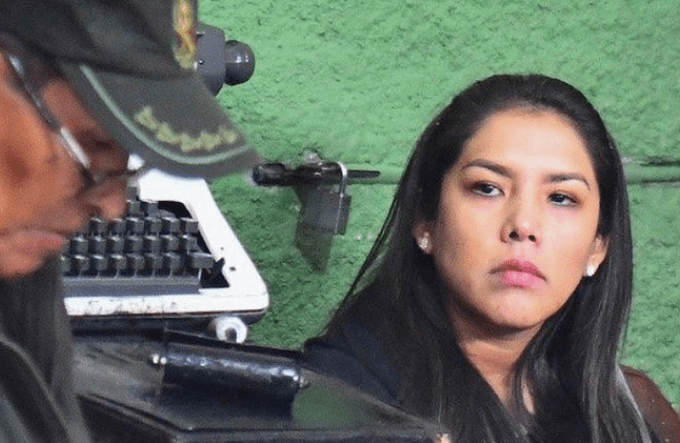
Patricia Hermosa, the former cabinet chief of ex-Bolivian President Evo Morales’ administration, has been handed a six-month preventive detention order by a Bolivian court, El Diario daily reported.
Bolivian prosecutors pushed for Hermosa to be placed in preventive detention, claiming that she was both a flight risk and could potentially obstruct the investigation. The court on Sunday agreed with prosecutors, and ordered the former cabinet chief to spend six months in preventive detention, the newspaper reported.
Hermosa was first detained in December as part of the new Bolivian government’s ongoing investigation into Morales but was initially released due to insufficient evidence. However, she was arrested once again this past week after authorities claimed to possess recordings of Hermosa’s telephone conversations with leading Bolivian officials. She is charged with sedition, terrorism and financing terrorism.
The news comes just one day after two ministers of ousted President Morales’ administration left Bolivia for Mexico. Many members of Morales’ former government have been living at the Mexican ambassador’s residence in Bolivia while waiting for their asylum requests to be processed. Morales himself is currently living in Argentina after fleeing Bolivia.
On Friday, Morales reported that Hermosa was detained by Bolivian law enforcement officials, who also seized personal documents belonging to the ex-president during the former cabinet chief’s apprehension.
February 3, 2020
Posted by aletho |
Civil Liberties | Bolivia, Latin America |
Leave a comment

By Lucas Leiroz de Almeida | February 3, 2020
The attitude of the US towards Latin peoples has been one of domination, imposition and imperialism. The core of this policy is in the American ideology itself, based on the Monroe Doctrine of the 19th Century, which, enunciating an “America for Americans”, promoted the American expansion towards other lands of the New World. Specifically in South America, external interference in national policies became even more evident with the advent of the military dictatorships of the last century, which, with the shallow excuse of avoiding a “communist threat”, promoted long decades of misery and persecution whose only end had been to preserve the subjugation of those countries to Washington’s commandments during the Cold War.
The process of redemocratization in Latin America was a flawed and vulnerable one. The transition of power witnessed by the exchange of the Armed Forces for civilian politicians represented nothing but the very interests of the same groups that had financed and supported the military’s takeover. In fact, when the American objectives bequeathed to the military were already achieved, they authorized the transition of power, pacifying national policies with the capitulation of the left, which abandoned the armed struggle in favor of the democratic pact.
Since then, outside interference in Latin America has been triggered by the cooptation of parliamentary factions, feeding gigantic networks of corruption that “fight each other” publicly, when, truly, they work for the interests of the same foreign power. This is the case of the reactionary parties and of the groups from the new left – concerned with the “identitarian” agenda of liberalism and omitted in relation to social problems and national sovereignty.
While the theater of public confrontation of these groups is functioning, the American foreign occupation works perfectly, without major challenges and threats. However, any deviation from this reality is understood as an affront and gives room for the resurgence of Washington’s interference. The most recent cases corroborating this fact are the failed attempted coup against the legitimate Bolivarian government in Caracas and the successful coup d’état carried out against Bolivian President Morales, both in the past year.
In general, American attacks on independent peoples of the South have intensified in recent years. This, most likely, is due to the fact that the period before the current one was marked by the growth of the political left, which, although subordinated to the liberal hegemony, acted with an agenda reasonably linked to social struggles, delaying, even if very little, the neoliberal plans. Now, these same countries are facing the extraordinary advance of reactionary rights, with a greater emphasis on Brazil.
A member of the BRICS, Brazil, with all its potential to achieve prestigious status in the international order, has been suffering the worst period in its recent history. The rise of Bolsonaro brings with it the worst in the country: the growth of the harmful influence of neo-Pentecostal groups – whose greatest commitment is to the interests of Washington and Tel Aviv; the paramilitary armed militias that control organized crime in the poorest regions of the country, truly acting as a mafia and; the business sector as a whole, with enormous progress in dismantling labor laws and permitting agribusiness, with the legalization of pesticides and the criminal burning of native forests for the formation of pastures for livestock. Brazil is going through one of the worst deindustrialization processes ever witnessed in history.
Argentina recently completed this cycle of reactionary ascension and is now witnessing a return of the “soft left”, with the return of the Kirchner Party. The negative legacy of Fernández. Macri’s legacy will not be wiped out so quickly and the left now in power does not seem committed to the complete break with external interests, but to the perpetuation of the liberal-parliamentary cycle.
The most striking cases, however, are the aforementioned examples of Venezuela and Bolivia, countries victimized by American imperialism. Fundamentally, one must realize how both cases reveal real occurrences of foreign invasion, even if camouflaged with a democratic appearance. Venezuela perceived the opposition’s articulations as a true case of war and managed to gain control over the situation: activated the Bolivarian National Guard, intensified security policies and ignored internal and external opposition pressure. As a result, Maduro remains in power and the coup has become an international joke. On the other hand, Morales did not have the same perspicacity and gave way too much to the opposition, falling and being forced to leave the country and hand it over to the coup d’état.
In Chile, recent political unrest is having a positive effect. The claims against neoliberal Piñera, carried out through violent protests that have already given rise to the State of Emergency, are successful and little by little the government is forced to yield to popular pressure.
Currently, the panorama of South America is terrible. With the exception of Venezuela, which is in an undeniable crisis, all countries are, in one way or another, hostages to American interests, with some under governments that make this reality more explicit – like Brazil – and others under more camouflaged regimes. There is no doubt about the fundamental point that American imperialism has never been as aggressive in South America as it has been in recent years. The reason is simple: in the face of progress in the formation of a multipolar world, the geopolitical north is becoming increasingly reactive.
Lucas Leiroz de Almeida is a research fellow in International Law at the Federal University of Rio de Janeiro.
February 3, 2020
Posted by aletho |
Economics | Latin America, United States |
Leave a comment
On Thursday night, the Jewish charity, Campaign Against Antisemitsm (CAA) declared that it would “be selecting a number of future dates on which to picket the 606 [jazz] club over its decision” to present a jazz performance by yours truly. With this threat, CAA crossed the line. This time it wasn’t just going after me or my band, this time its threat encompassed an entire community of musicians and music lovers for whom the 606 club is a preeminent venue, and none of whom have anything to do with me or my ideas.

Such threats are anathema to the values of British and western culture: the way to counter ideas with which they don’t agree is to present their own position. The tactic of gross intimidation, of menacing an entire community over the legal speech of one member are more characteristic of organised crime than of a British charity.
Yesterday I reported the CAA’s actions to the police. They took my complaint very seriously and I was interviewed for two hours. I had the strong impression that the matter was already known to the police.
During the time the police interviewed me, I received a message that the CAA is under investigation by the Charities Commission.
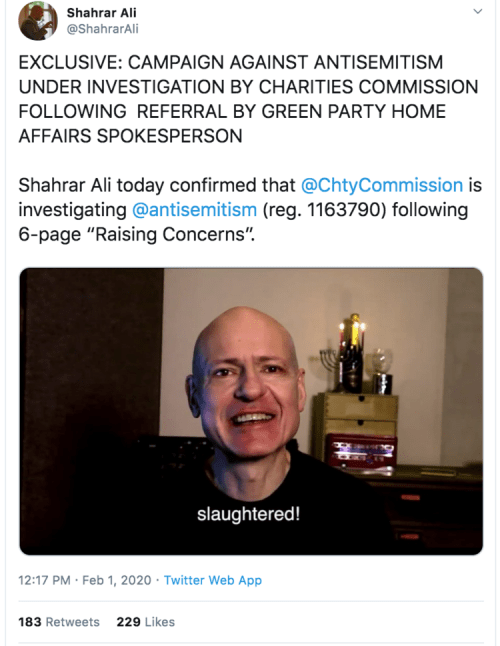
I was advised that every musician, music venue, promoter or audience member who is or has been subject to any intimidation or harassment by the CAA should contact the police immediately.
No one should be harassed, especially by a charity, and I want to believe that the threats to British politicians, artists, intellectuals, journalists, venues and ordinary people are about to come to an end. Such a development will make life safer and more comfortable for Jews and Gentiles alike.
February 2, 2020
Posted by aletho |
Full Spectrum Dominance |
Leave a comment

Viewers of my recent #PropagandaWatch episode on The CIA’s Global Propaganda Network will know all about the interesting 1977 article from the good ol’ New York Times, “Worldwide Propaganda Network Built by the CIA.”
If you haven’t watched my video yet, you should definitely do so. And then you should go read that New York Times article for yourself. (But read it at this link to avoid giving the Old Grey Presstitute your click.)
When you do read the article, you’ll see that it is an obvious limited hangout—that is, the deliberate revelation of some information in order to prevent the discovery of other, more important information. This observation tells us two things:
- That there is novel and compelling information about the CIA’s covert propaganda programs contained in the article; and
- that that novel and compelling information is not the whole story.
In order to understand the hangout the Times is attempting here, we first have to examine the article itself and the information that the article does contain.
The report concerns the so-called “Mighty Wurlitzer,” the propaganda network of “800 news and public information organizations and individuals,” including “newspapers, news services, magazines, publishing houses, broadcasting stations and other entities” that the CIA either owned outright or exerted editorial control over.
That the article is indeed a limited hangout is evident right from the start. Within the first few paragraphs of this extensive investigation, the author is quick to reassure readers that the incredibly vast, incredibly powerful CIA propaganda network that he is documenting was never actually used to forward propaganda.
“Although the C.I.A. has employed dozens of American journalists working abroad, a three-month inquiry by a team of reporters and researchers for The New York Times has determined that, with a few notable exceptions, they were not used by the agency to further its world-wide propaganda campaign.”
This claim is not just disingenuous, it’s downright ridiculous. Indeed, the remainder of the article serves as one giant rebuke of that preposterous lie. But only a tiny percentage of the population makes it more than a few paragraphs into a story, so placing such a claim up front makes sure to placate the majority of readers and convince them that this propaganda network must not be so bad after all.
The report then goes on to detail a number of media entities that the CIA owned or controlled during the period in question (primarily the 1950s and ’60s), including:
- Radio stations like Radio Free Europe, Radio Liberty, Radio Free Asia and Free Cuba Radio;
- Newspapers like The Rome Daily American, The Okinawa Morning Star, The Manila Times, The Bangkok World and The Tokyo Evening News;
- Magazines and journals like Quest, East Europe and Paris Match.
- Book publishers like Allied Pacific Printing in India and the Asia Research Centre in Hong Kong.
Perhaps more important to the CIA than its control over these media organs, however, were the journalists and editors who were willing to aid the agency in publishing its propaganda. Some were on the CIA payroll directly, others worked on contract. Names dropped in the article range from the familiar—like Tom Braden and William F. Buckley, Jr.—to the long-forgotten. Readers are left with the impression that the agency’s propaganda efforts were (emphasis on past tense) more extensive and far-reaching than anyone had imagined to that point.
The article must have been a bombshell for the relatively information-deprived New York Times readers of 1977. Given how difficult it was to discover any reliable information about the CIA and its operations in that pre-internet era, finding such a treasure trove of information in no less a publication than the USA’s “newspaper of record” must have been incredible.
This, of course, poses the question: Why, then, was this article published? Surely the details of this report had been known to journalists for some time previously. So why was the Times publishing it at that precise moment?
To answer that, we have to look at the context of what was happening in 1977. The issue of the intelligence agencies and what they were really doing under the cover of national security had been blown wide open in the Church Committee hearings of 1975. The Committee, set up after a series of revelations about US military and intelligence agency abuses of Americans’ rights, released reports on a wide variety of issues that had hitherto been under wraps, from the existence and operations of the National Security Agency to the workings of covert assassination programs (including the infamous heart attack gun).
One of the issues to arise during the committee’s hearing was that of the intelligence agencies’ relationship with the media. One journalist who was working to document these ties was Carl Bernstein, who, in October of 1977, published his own report on the subject, “The CIA and the Media,” in Rolling Stone magazine. Bernstein’s extensive article revealed a number of long-suspected links between the agency and leading publishers, including the fact that Arthur Sulzberger Sr. (then publisher of The New York Times) worked hand-in-hand with the CIA.
I’ll allow you a moment to recover from your shock.
In fact, Bernstein not only identified Sulzberger (along with Henry Luce of Time Inc., William Paley of CBS and numerous other media moguls) as working directly with the CIA, but he revealed that there were ten CIA operatives working at the New York Times in the 50s and 60s alone.
Perhaps you’re starting to see why the Times was suddenly motivated to publish a report exposing the CIA’s “worldwide propaganda network,” but conveniently omitting its own role in that network. Neither will you be surprised to learn that the Times “forgot” to note the fact that its American media brethren (Time, CBS, NBC, Reuters, Hearst Newspapers, The Saturday Evening Post, Newsweek and many others) were named by Bernstein as “organizations which cooperated with the CIA.”
In fact, the Times article goes out of its way to stress that the “Mighty Wurlitzer” was only directed abroad, not at the American public. In a section with the prominent subhead “Agency Charter Bars Propaganda in U.S.” (emphasized in italics and bold, unlike any of the article’s other sections), the report is at pains to stress that the CIA has been legislatively prohibited from propagandizing American citizens directly. It then presents a limited hangout argument that some of the agency’s foreign propaganda may have been “accidentally” relayed back to American media by “unwitting” correspondents abroad, thus propagandizing the American public (which totally wasn’t the CIA’s intention, guys!).
As Bernstein had already shown, however, the agency was actively involved with spreading propaganda to the American public via American media organs like the New York Times. For some reason, this fact was left out of the Times’ report.
In the end, the entire Times article serves as a case study in the art of the limited hangout. It shows us exactly how and why these types of “bombshell revelations” are dropped on the public in the pages of mainstream publications. These revelations—containing true and verifiable information, including information of real importance—can help to obscure other, more embarrassing facts and shift the public debate from matters of vital importance to peripheral issues.
To be sure, the article is still worth reading. It does contain true and verifiable information about the CIA’s propaganda activities. But, like all such limited hangouts, it can only be properly understood when one understands what has been left out of the story.
The propagandists never do make it easy to get to the bottom of their lies, do they?
February 2, 2020
Posted by aletho |
Deception, Mainstream Media, Warmongering, Timeless or most popular | CIA, New York Times, United States |
Leave a comment
Facebook founder and CEO Mark Zuckerberg recently received criticism from some of America’s most outspoken figures, including former Secretary of State Hillary Clinton and billionaire activist George Soros, who accused the tech billionaire of indirectly assisting Donald Trump get re-elected as a result of the platform’s policies.
Mark Zuckerberg, Facebook’s founder and chief executive, defended the platform’s principle of free expression at the Silicon Slopes Tech Summit in Utah, arguing that the company is now set to change its previous approach of not doing anything deemed “too offensive” amid increased censorship calls, CNN reported.
“Increasingly we’re getting called to censor a lot of different kinds of content that makes me really uncomfortable”, the platform’s CEO was quoted as saying.
“This is the new approach, and I think it’s going to p**s off a lot of people. But frankly, the old approach was p**sing off a lot of people too, so let’s try something different”, Zuckerberg insisted.
Despite the proposed change of direction, Facebook’s founder insisted that the company still has a responsibility to remove content related to child exploitation, violence, or terrorism from its platform.
“We’re going to take down the content that’s really harmful, but the line needs to be held at some point”, Zuckerberg reportedly stated. He also defended the use of encryption in Facebook messaging services that potentially prevents third parties from accessing communications sent between users.
Facebook’s leadership has come under increased scrutiny over the past year following its refusal to remove political ads that may contain misinformation, citing its policy of free speech and the right of users to make up their own minds about the agendas of politicians. Zuckerberg’s new approach prompted strong backlash from former US Secretary of State Hillary Clinton, who called his stance “authoritarian” and aimed at helping her 2016 presidential rival Donald Trump get re-elected by refusing to tackle alleged misinformation and propaganda.
This criticism was recently echoed by Hungarian-American hedge fund manager and activist George Soros, who urged for Mark Zuckerberg and Facebook COO Sheryl Sandberg to be removed from the company’s leadership due to the platform’s “informal” alliance with Donald Trump, which is allegedly helping him win the 2020 presidential election.
The accusations have not been directly addressed by Zuckerberg, but he recently insisted that his company’s goal for the next decade is not “to be liked, but to be understood.”
(Referals from Facebook to Aletho News, though still a fraction of one time numbers, have just recently more than doubled )
February 2, 2020
Posted by aletho |
Civil Liberties, Full Spectrum Dominance | United States |
Leave a comment

Former Mining Minister Cesar Navarro (L) and former Agriculture Minister Pedro Dorado (R), Bolivia. | Photo: Twitter/ @ATBDigital
Bolivia’s Former Mining Minister Cesar Navarro and former Agriculture Minister Pedro Dorado were arrested at the El Alto airport on Saturday when they were about to board a plane as political refugees.
For the past 82 days, these Socialists politicians remained at the Mexican embassy. Yesterday, they received a safe-conduct allowing their free departure from the country.
“The Mexican embassy transferred the asylees to the El Alto airport with the guarantee granted by the safe-conduct extended by the Bolivian government. In that sense, the asylees should be transferred to Mexico without any problem,” the Mexican diplomatic delegation tweeted.
 Even though international mediators accompanied the Socialist politicians, the Interior Ministry arrested them disrespecting the safe-conduct granted by its government.
Latin American social organizations immediately began to criticize harshly Karen Longari, the Foreign Minister appointed by the U.S.-backed, self-proclaimed president Jeanina Añez, who is ultimately responsible for the ongoing persecution against the Movement Towards Socialism (MAS) militants.
“We repudiate the arbitrary and illegal act of detention of former ministers Navarro and Damian, which violates all international standards. Solidarity!,” the Sao Paulo Forum secretary Monica Valente said.
Navarro was provisionally released a few hours after his arrest. According to his daughter, the former minister would have been beaten by paramilitary groups during his detention.
Later, Interior Minister Arturo Murillo said that Navarro and Dorado “had been arrested by mistake” and they will leave the country in the next hours. So far, however, their exact legal status is unknown.
Their detention is part of the long list of MAS supporters persecuted by the Interim government installed after the coup d’etat against Evo Morales, which took place on Nov. 10, 2019.
February 2, 2020
Posted by aletho |
Civil Liberties, Subjugation - Torture | Bolivia, Human rights, Latin America |
Leave a comment
This week brought a bunch of news about the wars in the Middle East and Central Asia. In Afghanistan, the United States and its allies have been directly involved in fighting the Taleban for over 18 years. In Syria, they’ve attempted to overthrow the government of Bashar al-Assad with the help of proxies in various forms, who are now holed up in an ever-shrinking enclave in Idlib province. And in Yemen, they’ve been backing the Saudis in their attempt to reinstall Adrabbun Mansar Hadi as president in the Yemeni capital Sanaa, now under the control of the Houthis. So, how go America’s wars?
First, Afghanistan:
A few days ago, the Special Inspector General for Afghanistan Reconstruction (SIGAR) released his latest quarterly report to the US Congress. According to an email I got from SIGAR’s office, the key points of this report include the following:
- Enemy-initiated attacks (EIA) and effective enemy-initiated attacks (EIA resulting in casualties) during the fourth quarter of 2019 exceeded same-period levels in every year since recording began in 2010.
- The month of the Afghan presidential election (September 2019) saw the highest number of EIA in any month since June 2012, and the highest number of effective enemy-initiated attacks (EEIA) since recording began in January 2010. The high level of violence continued after the presidential election; October 2019 had the second highest number of EIA in any month since July 2013.
- According to the UNODC, the overall value of opiates available for export in Afghanistan in 2018 (between $1.1 billion and $2.1 billion) was much larger than the combined value of all of the country’s licit exports ($875 million).
- As of December 18, conflicts had induced 427,043 Afghans to flee their homes in 2019 (compared to 356,297 Afghans during the same period in 2018).
- Between November 2019 and March 2020, an estimated 11.3 million Afghans – more than one-third of the country’s population – are anticipated to face acute food insecurity.
I think that gives a good enough impression. Eighteen years on, things aren’t going so well in Afghanistan.
So what about Syria?
About a week ago, government forces (the Syrian Arab Army (SAA)) launched a two-prong offensive against what were once US-proxy forces in Idlib, but might now be more accurately described as Turkish proxies. News reports suggest that casualties have been heavy on both sides, but the results from the SAA point of view have been very satisfactory. In the north, the SAA advanced a short distance south west of Aleppo, but the real progress was further to the south, where the SAA smashed through the rebel defenses and advanced rapidly to seize the town of Ma’arrat al-Numan, as shown in this map:

Since this map was produced, the SAA have advanced even further, continuing northeast up the M5 highway from Ma’arrat as far as the town of Saraqib. How much further they will go before pausing remains to be seen. But one thing is clear – bit by bit, the rebels in Idlib are being squeezed out. Once they’re gone, the war in Syria will be all but over. The attempt to topple Assad has failed.
Which brings us to Yemen.
As you may recall, in September last year the Houthis crushed a Saudi incursion into northern Yemen, capturing large numbers of prisoners and armoured vehicles. After that things quieted down for a bit, until about a week ago when Saudi-backed forces launched an offensive to the east of Saana in the province of Marib. Before long, the Houthis counter-attacked, with devastating consequences. According to one news report:
Hadi’s forces are now on the back foot. Where once they spoke about taking the Houthi-held capital Sanaa, now they discuss ways to defend Marib, a strategic oil and gas hub. … Ibrahim, a pro-government fighter in Marib province, said that some loyalist soldiers ‘betrayed’ them and withdrew from battles, causing sizeable losses amongst their troops. ‘We were planning to advance towards Sanaa, but our attempt was hindered by the withdrawal of a battalion of soldiers, which gave the Houthis a chance to attack us … This was a betrayal by the soldiers and their leaders.’
Houthi sources claim that Saudi-backed forces suffered 2,500 casualties, and that the Houthis captured 400 pieces of equipment, including tanks, armoured personal carriers, and multiple rocket launch systems. The Saudi defeat has gone just about unnoticed in the English-language media but, for anybody interested, Russian blogger Colonel Cassad has published a bunch of Houthi photographs and videos, such as the picture below, showing the results of the battle (here and here). They make for interesting viewing.

Putting this all together, what we see is the Americans and their allies losing not just one, not just two, but three wars simultaneously. It’s quite something. A few days ago, news emerged that US president Donald Trump had denounced his generals as ‘losers’ and ‘a bunch of dopes and babies’. The story was treated by pretty much everybody as yet more evidence of Trump’s unsuitability to be president. But given the news from the front this week, I have to think that Trump got it right. ‘I wouldn’t go to war with you people’, Trump allegedly told the generals. If only the president took his own advice.
February 2, 2020
Posted by aletho |
Illegal Occupation | Afghanistan, Syria, United States, Yemen |
Leave a comment


 Aletho News