Ministry: Seven new coronavirus cases detected in Gaza
Palestine Information Center – March 26, 2020
GAZA – The ministry of health has announced that seven new coronavirus cases were detected in Gaza Strip.
The ministry said in a terse statement late Wednesday that the new persons affected with the virus had mingled with the first two cases in Gaza detected last Sunday.
It pointed out that the seven new cases were all security personnel who were at the quarantine and still are there and did not leave or mix with anyone else.
The statement noted that no corona victims were reported in the besieged enclave.
The number of corona-infected cases in Gaza has thus reached nine.
After 5 years, Saudi Arabia is finally on the verge of defeat in Yemen
By Omar Ahmed | MEMO | March 26, 2020
Exactly five years ago, the US-backed, Saudi-led Arab coalition carried out its first air strikes on Yemen in an effort to reinstate the disgraced, exiled President Abdrabbuh Mansur Hadi. He is a statesman in name only who I have argued previously has neither power, authority nor legitimacy. The strikes targeted the Houthi movement, which is supported by the Yemeni armed forces, and the war, claimed the Saudis, was supposed to be over in a matter of weeks.
The war’s devastating effects have claimed over 112,000 lives and created the world’s worst humanitarian crisis. The steadfast and resilient Yemeni people have prevented the coalition from toppling the Houthi-aligned government in the capital, Sanaa.
After five years, in fact, it is fair to say that the Saudis and their mercenaries are on the verge of defeat. The Yemeni armed forces and “popular committees” which include Houthi forces are continuing their advances with their sights set firmly on the stronghold of Marib and the pro-Hadi, Islah militia which makes up the coalition-backed force on the ground.
The province of Marib is currently facing onslaughts on several main fronts: from the Nahm district of Sanaa province to the west; much of the recently-liberated Al-Jawf in the north; and from Sirwah district – a part of Marib already under Houthi control — and from the south in the Baydah province. Saudi air strikes continue in support of its mercenary ground forces although, as the years of conflict have shown, they are strategically ineffective.
The terrain, internal divisions among the mercenary forces, local distrust of Hadi and the relative ease of establishing relations in tribal areas captured by the Houthis are also reasons for their advance. Developments in missile defence systems which, according to the Yemeni armed forces, have been effective against some Saudi air strikes, coupled with more pre-emptive cross-border operations targeting Saudi military and economic interests are likely to change the direction of the war.
The Saudis know that the stakes are high in Marib, and losing it would be the end of the Saudi ground war against the Houthi-Yemeni army forces, which is why there have been fierce counterattacks, especially in Al-Jawf, which until recently had been in the hands of pro-Hadi fighters for the past five years. The province not only shares a border with Saudi Arabia, but the region is also rich in natural resources. Decades of Saudi policy, though, have ensured that Yemen has remained poor and unable to exploit its own oil reserves fully.
It is clear that the so-called Riyadh Agreement has failed to prompt a concerted effort among Saudi and UAE proxies to set aside their political differences and refocus their attention on the Houthis in the north. Clashes between the Saudi-backed Islah militia forces and those aligned with the UAE-supported separatist Southern Transitional Council (STC) are now routine, and have intensified in recent days in the southern port city of Aden.
The Sanaa-based government has made it clear that it will confront the coalition and its mercenaries in the country’s south and east. This not only implies fighting in the de-facto STC-held Aden, which was under the control of the Houthis back in 2015 before they were driven out, but also the oil-rich Shabwa province.
Having control of most of the population and the capital Sanaa; having a lot of the Yemeni military, including the Republican Guards, on their side; and with potential access and control of Yemen’s resources, the Houthi-aligned National Salvation Government (NSG) may finally get international recognition at the expense of the “legitimate” UN-recognised Yemeni government in exile under Hadi in Riyadh. At the moment, the NSG only has diplomatic relations with Iran and Syria.
Earlier this week, the Houthi-aligned Yemeni military spokesman, Brigadier General Yahya Saree, told a press conference that there have been more than 257,000 coalition air strikes over the past five years and warned that the sixth year “will be harsher and more painful”. In doing so he affirmed that Yemen is not in the same position militarily that it was at the start of the conflict.
In light of the Houthi forces’ strategic advances and superior political resolve, it is thus possible that we will see a political agreement to end the war, if not this year then next. In a promising sign, a leading member of the Supreme Political Council, Mohammed Ali Al-Houthi, tweeted that he welcomed Saudi Arabia’s decision to support a ceasefire at the behest of the UN Secretary-General due to the coronavirus pandemic.
It remains to be seen, therefore, how much longer the Saudis will continue their disastrous and illegal intervention in Yemen, especially with the oil war and looming bankruptcy as oil prices fall, not to mention domestic political crises between de facto ruler Crown Prince Mohammad Bin Salman and his rivals. The Saudis will soon find that they have neither the will nor the wealth to carry on.
That being said, the fall of Marib to the Yemeni military and its Houthi allies might be the catalyst to bring about an end to the war, but there are reports of thousands of civilians being displaced as a result of the current escalations. There is also the brutal siege of the port of Hudaydah by the coalition that needs to be addressed; the UAE occupation of Socotra; and — arguably the most worrying — the direct Saudi military presence in the eastern province of Al-Mahrah.
Earlier this month I speculated how the resistance movement in Al-Mahrah may soon turn into an armed struggle against a Saudi occupation. This materialised several days later, with the Southern National Salvation Council (SNSC) announcing a call for armed resistance against the foreign forces.
Following the coalition defeat, the future of the NSG and the alliance between the Houthi movement and Yemeni military will be tests of the stability and security of Yemen. Alliances tend only to serve a purpose against a common enemy. That’s an issue for the future, though; for now, that enemy is on the verge of defeat.
US State Dept offers $15 MILLION REWARD for help arresting Venezuela’s Maduro after indictments
RT | March 26, 2020
The US State Department is dangling millions of dollars in reward money in exchange for information that could be used to arrest Venezuelan President Nicolas Maduro, his VP, or other senior officials on drug trafficking charges.
The eye-popping reward of up to $15 million is being offered for “information related to Nicolas Maduro Moros” with regard to his alleged involvement in “international narcotics trafficking,” the State Department announced on Thursday, signaling a hard shift in its regime-change policy against the socialist nation.
Tips leading to the narcotrafficking arrest or conviction of National Constituent Assembly President Diosdado Cabello Rondon, retired generals Hugo Carvajal Barrios and Clive Alcala Cordones, or Minister for Industry and National Production Tareck Zaidan El Aissami Maddah can net as much as $10 million, the statement continued.
The rewards were unveiled on the same day as the US Justice Department unsealed indictments against the Venezuelan leaders for the same drug trafficking crimes – suggesting that Washington’s evidence isn’t as solid as Attorney General William Barr has claimed.
Indictments in Miami and New York accuse the officials of participating in a “narco-terrorism conspiracy” with Colombian guerrilla group FARC, to “flood the United States with cocaine.” But if evidence against Maduro and his compatriots is at such a premium that the State Department will pay $15 million for it, the Venezuelans are unlikely to see the inside of a US court anytime soon.
The one-two punch is a profoundly cynical move in the US’ continuing assault on sanctions-starved Venezuela, especially in the midst of the global coronavirus pandemic.
After over a year of pushing its preferred leader, Juan Guaido, accomplished nothing except wearing out the latter’s welcome in the opposition National Assembly, Washington appears to have lost patience with their golden boy’s failed coup attempts, pushing him aside to play hardball.
The last Latin American leader charged with drug trafficking by the US was Panama’s Manuel Noriega, whom Washington essentially stabbed in the back after a long and profitable partnership running drugs with the CIA, invading his country and hauling him back to Miami to stand trial on drug trafficking and money laundering charges.
Iran to US: Do not politicize ex-FBI agent’s case, avoid exploiting his family’s emotions
Press TV – March 26, 2020
Iran has warned the United States against politicization of the possible death of a former FBI agent, whom the US administration alleges has been imprisoned in the Islamic Republic, after Washington claimed on Wednesday that he has died in detention in Iran.
Speaking on Thursday, Foreign Ministry Spokesman Abbas Mousavi said if Washington has made sure about the retired agent Robert Levinson’s death, “then it can [simply] announce this matter without politicization and attempting to take advantage of the Levinson family’s emotions.”
The US has, for long, been alleging that Levinson disappeared on the southern Iranian Kish Island in 2007. Tehran has categorically denied any involvement in his disappearance.
On Wednesday, Levinson’s family cited the US government as claiming he had died in Iranian custody.
The Iranian Foreign Ministry spokesman said the Islamic Republic has, over the recent years, done its utmost to find any evidence pointing to Levinson’s exact fate.
“Based on credible evidence, the aforementioned person left the Iranian soil for an unspecified destination years ago,” Mousavi said. He also reminded that the US itself had confirmed his departure back then.
On January 19, 2016, after years of pointing the finger to Iran for his fate, the White House Press Secretary Josh Earnest announced for the first time that “we have reason to believe that he no longer is in Iran.” Back then, Earnest said he rested assured that Iran would search for Levinson.
Elsewhere in his remarks, Mousavi emphasized that Tehran’s investigation has not yielded any leads pointing to Levinson’s still being alive, and condoled with his family over his likely demise.
‘US officials knew Levinson died on rogue CIA mission’
Until last December, the administration of US President Donald Trump would claim that Levinson was in Iranian custody and ask Tehran to hand him over.
Despite recent claims by his administration that Levinson has died in such a condition, there is ample evidence pointing to the fact that US officials already knew that he had died while on an unauthorized mission for the CIA some place outside Iran.
The fact that he was on a rogue mission had been already admitted in an article by The Washington Post, which wrote on December 12, 2013 that “an American man, who disappeared in Iran more than six years ago had been working for the CIA in what US intelligence officials described as a rogue operation that led to a major shake-up in the spy agency.”
The Post, back then, described the nature of the mission by citing emails and other documents that had shown “he had gone to Iran at the direction of certain CIA analysts who had no authority to run operations overseas.”
The New York Times also carried a piece on Wednesday, in which it said that the preceding administration of Barack Obama had at one point been tipped off about intelligence showing that “the remains of an American had been buried in [Pakistan’s] Balochistan.”
“American officials assumed that the remains were Mr. Levinson’s,” the paper wrote.
‘Repercussions for CIA’
The revelations showing the nature of the CIA mission enlisting Levinson, The Post noted, prompted “a major internal investigation” within the US spy agency.
The probe eventually had its leadership “discipline 10 employees, including three veteran analysts, who were forced out of their jobs.”
‘CIA paid off family’
The Post also said that the CIA reached an extrajudicial settlement with Levinson’s family after the emergence of his dealings with the agency. The agreement saw the agency paying the family “a $2.5 million annuity and an additional $120,000, the cost of renewing Mr. Levinson’s contract.”
“Both sides wanted to avoid a lawsuit that would publicly reveal details of the arrangement,” The Post noted.
See also:
COVID-19: Two Major ‘Waves’ of Global Infection, Towards Global Contamination?

By Larry Romanoff | Global Research | March 26, 2020
The US State Department and media are heavily promoting as theology that COVID-19 is “a Chinese virus and China spread it around the world”, demanding apologies and more. One American law firm in Florida filed a class action lawsuit against the Chinese government, seeking compensation for ‘damages’. (1) I have reviewed and analysed the details available of all first and subsequent confirmed infections in all countries, including infection source, virus strain, and timeline, which data provide ample evidence that this American theology is not supported by the facts. There appears to have been two major ‘waves’ of global infection, the first around the end of January, the second a month later. (2) (3) (4)
It is true that – in the very early stages, the first wave – 22 countries had their first confirmed infections in travelers from China but, soon after this, in the second wave, 34 countries obtained their first confirmed infection in travelers from Italy, and another 16 from Iran. However, so-called “first infection” in these countries, from Chinese citizens or other travelers, proved in all but perhaps two cases to be irrelevant because these first external infections proved to have no links to the subsequent local outbreaks, and because the virus strain in many of those explosive local eruptions did not exist in China but only in the US.
What this means is that while Italy discovered its first two infections in Chinese tourists, these two were unrelated to the subsequent virus outbreak because the strain infecting Italy is different from that in China and in those two Chinese tourists. Italy, like almost all other countries, did not obtain its infection from China and indeed could not have done. The only country with Italy’s variety of the virus is the US, and thus the infection must have originated in America, not in China. Similarly, the locations near China – South Korea, Japan, Vietnam, even Taiwan Province, share an entirely different common strain. China had only a tiny pocket of that strain, and very far from Wuhan. These were not infected by China, either. I have dealt with this in an earlier article. (5)
Much was made in the American media of the “first American virus infection” being a Chinese traveler from Wuhan, but that was also irrelevant because the massive underlying epidemic waiting to break free (as it soon did) was unrelated to that Chinese citizen, the thousands of infections in Washington, California and New York clearly stemming from unidentified (and unsought) local sources.
Given the high volume of Chinese passenger traffic around the world, it isn’t surprising that some infections would have been discovered in Chinese nationals in other countries and, since the first outbreak occurred in China, it was natural to test travelers from China. Because of that focus, few countries thought to check travelers from the United States. Australia did check, the country’s Prime Minister recently stating that 80% or more of all infections in his country occurred in the US, then traveled home. (6) Similarly, Iceland confirmed that some of their coronavirus infections have been traced to Denver. (7) (8) I have a strong suspicion that if all countries review the travel history of their early infections, they will discover more US traffic in the mix, perhaps predominantly so.
If you can get people focused on asking the wrong question, you don’t care about the answers. The wrong question is whether the original virus came from a bat or a pangolin or a banana, but that’s irrelevant. It wasn’t a bat or a banana that infected the people in Wuhan, but a live person – or a person carrying a live virus in a pail. The right questions to ask relate to the identity of that person and the source of the contents of that pail, and those answers seem to lead us to the USA. Certainly, they are not to be found in China.
Let’s take a quick look at those two waves of infections that circled the globe.
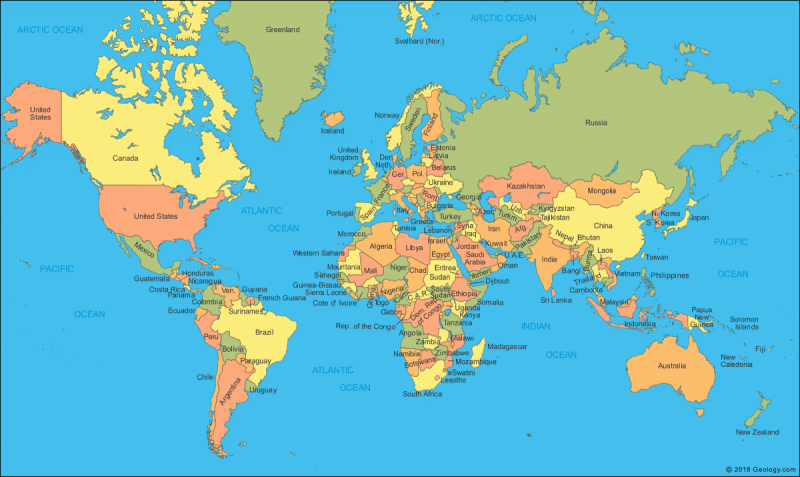
The First Wave simultaneously infected 25 nations or provinces within a few days centered around January 25. The infected areas: Macau, Hong Kong, Taiwan, Singapore, Vietnam, South Korea, Sri Lanka, the Philippines, Cambodia, Nepal, Malaysia, Australia, Thailand, Canada, the US, Germany, Italy, the UK, France, Bavaria, Spain, Belgium, Russia, Finland, and the UAE.
One month later. The Second Wave simultaneously infected 85 nations within a few days centered around February 25. The infected countries: Austria, the Netherlands, Switzerland, Portugal, Luxembourg, Monaco, San Marino, the Vatican, Liechtenstein, Malta, New Zealand, Pakistan, Afghanistan, Indonesia, Bangladesh, the Maldives, Bhutan, Andorra, Bulgaria, Belarus, Lithuania, Poland, Hungary, the Ukraine, the Czech Republic, Slovenia, Latvia, Croatia, Estonia, North Macedonia, Georgia, Romania, Bosnia & Herzegovina, Slovakia, Serbia, Moldova, Albania, Egypt, Iraq, Oman, Bahrain, Kuwait, Lebanon, Qatar, Saudi Arabia, Jordan, Palestine, Iceland, Ecuador, Armenia, Norway, Denmark, Costa Rica, Peru, Colombia, Mexico, the Dominican Republic, Paraguay, Chile, Brazil, Argentina, Nigeria, Togo, Cameroon, Senegal, Algeria, South Africa, Morocco, and Tunisia. Kosovo, Namibia, Uruguay, the Sudan, Ethiopia, Lesotho, Bolivia, Panama, the Democratic Republic of Congo, Mongolia, Burkina Faso, Brunei and Cyprus were simultaneous around one week later.
Source: Geology.com
I make no claim to being a virologist, but this is beginning to look damned peculiar. A natural virus hasn’t the ability to simultaneously infect 85 different countries on all continents of the world, with outbreaks in multiple locations in each country – and to do it without the vehicle of a seafood market full of bats and bananas.
More peculiar is that these countries were by no means all infected with the same variety of the virus, which means the simultaneous infections in these 85 countries were not from the same source. Even more peculiar is that most countries, at least the major ones, reported simultaneous outbreaks in multiple locations, and to date while some nations have been able to identify one or more of their ‘patients zero’, I am aware of no country that was able to definitively identify all their several ‘patients zero’. Considering the above information in light of the known basic facts of virus transmission, intuition suggests at least the possibility of there having been many people carrying a pail of live viruses.
It is interesting to note that high fatality rates are entirely within Italy, Iran, and China. For approximate figures, China’s fatality rate is between 3% and 4%, that of Iran at about 7% and Italy the highest at around 9%. Even more interesting is that if these countries did pass their strain of the virus to other nations, those strains abandoned their lethality when they left home. Of the 34 countries supposedly infected by Italy, for example, all exhibit very low mortality, the same being true of Chinese or Iranian infections. The natural conclusion is that these viruses prefer their ‘home populations’ and pose at best a minor threat to others.
*
Larry Romanoff is a retired management consultant and businessman. He has held senior executive positions in international consulting firms, and owned an international import-export business. He has been a visiting professor at Shanghai’s Fudan University, presenting case studies in international affairs to senior EMBA classes. Mr. Romanoff lives in Shanghai and is currently writing a series of ten books generally related to China and the West. He is a Research Associate of the Centre for Research on Globalization (CRG). He can be contacted at: 2186604556@qq.com
Notes
(2) https://www.clinicaltrialsarena.com/features/coronavirus-outbreak-the-countries-affected/
(3) https://www.clinicaltrialsarena.com/features/coronavirus-countries-with-suspected-cases/
(4) https://www.clinicaltrialsarena.com/features/
(5) https://www.globalresearch.ca/covid-usa-targeting-italy-and-south-korea/5707042
(7) https://www.denverpost.com/2020/03/13/iceland-coronavirus-traced-denver/
(8) https://icelandmonitor.mbl.is/news/news/2020/03/13/three_covid_19_cases_in_iceland_traced_to_denver/
Copyright © Larry Romanoff, Global Research, 2020
This scientist suggested a drug to treat Covid-19. ‘Fact checkers’ branded him fake news

French professor Didier Raoult, director of IHU Mediterranee Infection Institute in Marseille, pictured on February 26, 2020
By Nebojsa Malic | RT | March 26, 2020
Amid a pandemic panic over the coronavirus, evidence for a possibly effective treatment has been denounced as ‘fake news’ – even when offered by a renowned scientist with decades of experience.
Take Didier Raoult, a French microbiologist with undeniable expertise, even if some of his views are about as eccentric as his appearance. Though he may look like he just stepped out of an Alexandre Dumas novel, the director of the Mediterranean University Hospital Institute in Marseille cited not one but three different studies from China showing that the anti-malaria drug called chloroquine has been effective in treating Covid-19 patients.
That did not stop Le Monde, France’s biggest newspaper, of declaring his February 25 video as “partially false.” Raoult’s ‘sin’ was to argue that the common anti-malaria drug used widely for decades resulted in “dramatic improvements” among those afflicted by the virus.
As a result of Le Monde’s fact-check, anyone attempting to share Dr. Raoult’s videos on Facebook gets a banner saying the information therein was “partially false” as “determined by independent fact-checkers.”
The main argument put forward by those critical of the drug is that more testing is required before it can be officially approved as treatment for the coronavirus. As the US Centers for Disease Control and Prevention (CDC) puts it, “There are no currently available data from Randomized Clinical Trials… to inform clinical guidance on the use, dosing, or duration of hydroxychloroquine” treatments for Covid-19.
Which is fair enough, but last time I checked, there was a pandemic going on, with billions of people locked in their homes and all business grinding to a halt across the globe, over apocalyptic predictions of hospitals brimming with corpses due to this coronavirus.
Should any kind of treatment – especially a drug that has been used safely for decades to treat something else, with side effects meticulously documented – be so cavalierly rejected, under the circumstances? Do “experts” really think the world has the luxury of waiting for months or even years for their controlled lab studies?
As for the fact-checkers, shouldn’t they have applied the same rigor to the models used to scare everyone into hoarding toilet paper and setting off a depression orders of magnitude worse than anything the world has ever seen?
To ask these questions is to answer them, yet no one seems to bother. Nor is this sort of selective blindness endemic to France; across the Atlantic, the mainstream media raised their voices in unison against chloroquine after US President Donald Trump brought it up as a possible treatment – apparently referring to Dr. Raoult’s work.
They went so far as to widely circulate a deliberately misleading story about an Arizona couple that ate fish tank cleaner – chloroquine phosphate, clearly labeled not for human consumption – as somehow Trump’s fault. Some of them quietly amended it to specify the difference, but long after the original story – implying they took the actual medication praised by the president – literally went viral and poisoned the minds of millions.
Worse yet, as a result of this media blitz, the governor of Nevada actually banned using chloroquine to treat Covid-19 patients this week, saying there was “no consensus among experts or Nevada doctors” that the anti-malaria drug can treat coronavirus sufferers. There were no angry editorials denouncing Steve Sisolak, a Democrat, for letting people die of the coronavirus rather than have them treated with a drug endorsed by the Republican president and the media’s favorite hate object.
One would think the world paralyzed with fear of the invisible death would pounce on every possible solution, no matter how unlikely it seems. That’s what we’re shown in Hollywood disaster movies, after all. Yet when such a solution presents itself, it is dismissed and denounced as “not proven”!
We’re supposed to blindly trust apocalyptic models produced by panic-mongering political hacks, but ignore the man who says the drug brought him back from the brink of death, even though his story can be easily verified and theirs cannot.
“Preferring opinions to facts is a disease,” Dr. Raoult told the French magazine Marianne last week. Just so.
I don’t know if hydroxychloroquine works on Covid-19. Dr. Raoult seems to believe so, and he’s not alone. In the absence of better solutions – and locking billions of people in their homes indefinitely is not one – don’t we owe humanity to at least try? What do we have to lose?
In the three months or so since the coronavirus first appeared in China, there has been a lot of conflicting, confusing and outright false information about it. One thing that has consistently proven true, however, is that the biggest obstacle in effectively battling its spread and treating the afflicted has been the obtuse insistence of the political and medical establishment on blindly following their rules. If the virus is truly threatening to kill millions, as they say, they would not value procedures over saving lives. Nevertheless, they persist. It makes one wonder why.
Nebojsa Malic is a Serbian-American journalist, blogger and translator, who wrote a regular column for Antiwar.com from 2000 to 2015, and is now senior writer at RT. Follow him on Twitter @NebojsaMalic
Corporate Money Grab of 2020 Coronavirus Crisis Looks Similar to Taxpayer-Funded 2008 Bank Bailout
Sputnik – March 26, 2020
Despite a partisan struggle in the Senate which lasted days, the newly-agreed-upon coronavirus stimulus package was marked by all but universal support for corporate bailouts – the same measure that was tried to handle the 2008 financial crisis.
The Senate on Wednesday adopted the largest emergency aid package in US history, which was largely framed as a measure to protect workers’ jobs and wages.
That might not be entirely true, says Ryan Christian, the founder and editor of the alternative news outlet The Last American Vagabond.
Just another transfer of wealth?
“What is the real motivation behind this legislation?” he inquires. “Following the bail-out of 2008-2009, one of the largest transfers of wealth in US history, no one was truly held accountable, and the entities behind driving the policies that allowed that to take place were allowed to not only take the exact same actions moving forward, but to do so to an unprecedented degree to this day.
”The proposed aid package is worth $2.2 trillion and includes a $500 billion corporate bailout programme; tens of billions of dollars would be allocated out of that pot to distressed airlines and national security companies (those reportedly include Boeing).
That fund is similar to the Troubled Asset Relief Programme (TARP), which was established under the Emergency Economic Stabilisation Act of 2008 in the midst of the financial crisis. It ended up injecting $426.35 billion into troubled banks and auto companies, with a $15.3 billion profit. Damon Silvers, a member of the congressional panel that oversaw TARP’s loans, lamented that this body had played a “purely advisory role” (the lack of oversight is what many fear regarding the currently proposed bailout fund).
Although TARP’s support did help overcome the crisis, Silvers believes that it allowed banks to “bleed homeowners to rebuild their capital” and had a “terrible return for the risk that was taken with the public’s money.”
“Regardless of your opinions surrounding this coronavirus event, there are numerous agendas being both forced in, as well as covered up, using the very fear which the-powers-that-shouldn’t-be helped create,” says Ryan Christian.
“So as we continue to see this package increase by not billions, but TRILLIONS, we must begin to see the old familiar bail-out writing on the wall, before we once again awaken to find that wealth was siphoned from the dying middle class, in order to fund another decade of elitist economic adventurism at the expense of you and your family, and of course, the United States itself.”
Christian insists the public should make sure that the proposed act does not become “another PATRIOT Act-style subversion of our rights that forces every American to become even more beholden to an unaccountable power structure.”
States could fall short of what they need
Another $367 billion would be provided to small businesses to help them keep making payroll, in addition to multiple provisions designed to help them weather impending shutdowns and layoffs. And some $500 billion would be set aside for direct one-time payments to people ($1,200 per individual and $500 per child), coupled with an extra $600 per week for four months to jobless people on top of their state benefits.
Alan Gin, associate professor of economics at the University of San Diego, suggests that the $150 package for state and local governments will “probably fall well short of what is needed”.
New York Governor Cuomo, for example, gave a stinging rebuke of the bill on Wednesday, as it would only provide $3.8 billion to his state, compared with the $15 billion the pandemic stands to wipe off its budget.
“Dealing with the consequences of COVID-19 threatens to strain the budgets of state and local governments to the breaking point, which could lead to the curtailing of other services,” Alan Gin warns.
The other problem is with one-time checks: direct payments to individuals would be “the appropriate course of action if people could spend that money, but that is not the case now,” he argues. “Restaurants are closed, as are retail stores, and not many people are going to be taking vacations with that money. It would have been better if that money was directed to state and local governments instead.”
He concludes, however: “Although the proposed legislation is not perfect, it will help in trying to prevent a collapse of the US economy.” It remains to be seen at what cost.
Covid-19: Modi, Putin to coordinate efforts
By M. K. BHADRAKUMAR | Indian Punchline | March 26, 2020
Soon after Russian President Vladimir Putin’s address to the nation on Wednesday on the government’s coronavirus response and measures to be adopted to deal with the pandemic, Prime Minister Narendra Modi spoke to him on the phone. The Indian and Russian readouts (here and here) have alike highlighted that the two leaders “agreed to strengthen coordination in the coronavirus response effort” (Kremlin).
The two countries are facing similar challenges. Having done very little by way of testing, the actual figures of coronavirus patients could be higher than the official estimate in Russia and India alike.
The total number of infected people as of today touched 840 in Russia, while the Indian figure has reached 660. Importantly, the figures are dramatically rising. There was a 28% jump in Russia since Wednesday.
Putin has admitted candidly that the outbreak is worse than what he had thought previously. The head of a top Moscow hospital treating coronavirus patients told Putin on Tuesday when he visited the patients undergoing treatment that Russia needs to “prepare for the Italian scenario.”
To a degree, the relatively low number of cases so far in both India and Russia can be attributed to an early ban on entry for Chinese citizens at the time the epidemic was at full swing in that country.
But India has been ahead of Russia in denying entry to all foreigners except diplomats and members of official delegations. It was only last week that Russia imposed such restrictions. Again, India shut down international flights earlier than Russia which announced the decision only today.
Both Indian and Russian authorities were inclined to project an upbeat view on the situation, claiming that all measures have been taken to prevent a bigger outbreak. But both have acknowledged lately that there is indeed a crisis looming ahead.
On Tuesday, Moscow Mayor Sergei Sobyanin, who leads a task force on dealing with the virus, told Putin at a meeting in the Kremlin that provincial governors must receive orders to move more quickly to ready hospital beds for the gravely ill. “Otherwise, the system won’t be able to cope,” he said.
Sobyanin has ordered all Moscow citizens over 65 to stay home starting Thursday. Construction of a new hospital for coronavirus patients that is being built from scratch is going on at breakneck speed in Moscow suburbs.
Basically, Russia suffers from the same disadvantages as India to cope with a big coronavirus crisis — underfunded healthcare system, paucity of hospital beds, shortage of protective gear for medical communities, grossly insufficient network of labs to conduct / analyse coronavirus tests and so on.
But the Russian system is better adapted to handle such crises. Sobyanin signed a decree today “to temporarily suspend … from 28 March to 5 April, the work of restaurants, cafes, canteens, buffets, bars, snack bars and other catering establishments, with the exception of takeaway services without citizens visiting the premises of such enterprises, as well as order delivery.”
Shops, except pharmacies and those selling essential goods, will suspend operation during this weeklong period. Sobyanin was almost apologetic: “The restrictions introduced today are unprecedented in the modern history of Moscow and will create many inconveniences in every person’s daily life. But, believe me, they are absolutely necessary to slow down the spread of the coronavirus infection and reduce the number of cases.”
The big question is whether these measures will suffice or Putin will also opt for a “total lockdown”, as Modi ordered on Tuesday. But then, Russia is a vast country spanning 9 time zones, and the Kremlin can always ramp up measures as cases grow. The regional imbalances are simply mind-boggling — between Moscow and St. Petersburg (European Russia) on the one hand and the Caucasus, Urals, Siberia or the Russian Far East (Asiatic Russia) on the other hand.
Having said that, the crucial difference is that Russia is a developed country in most ways in the social sector, thanks to the Soviet rule, whereas India is a developing country with a much lower level of social formation.
The mammoth population of India puts additional pressure on social sectors of the economy. Again, the structure of the Russian economy is very different. It has nothing comparable, for example, to India’s “informal sector” or “migrant labour” that infinitely add to the complexity of the present crisis.
Russia was all set to join the OECD when the Ukraine crisis erupted in 2014 and the European Union imposed sanctions. In fact, at that point in time, Russia had already signed on to some of the landmark OECD standards.
However, the raison d’être of the two countries’ desire to “to strengthen coordination in the coronavirus response effort” lies in their capacity to show a third way in addressing the present crisis.
Neither Russia nor India has followed China’s Wuhan model of “suppressing” the coronavirus and moving on to resuscitate the economy.
On the other hand, their humanistic traditions also do not allow the pitiless approach that US President Donald Trump espouses.
Both Russia and India stress “social distancing” as the key. PM Modi used a powerful metaphor from Ramayana which every Indian would understand, to drive home that one’s home is one’s ultimate citadel in these extraordinary times. Putin meant much the same thing when he said, “Don’t think: ‘This can’t happen to me.’ It can happen to anyone. The most important thing is to stay home.”
Putin announced paid leave for all Russians next week due to COVID-19. He announced, amongst other relief measures for the economy, that families eligible for maternity capital will receive an extra 5,000 rubles ($44.80) per month from the government for each child under 3 years old.
Small and midsized businesses will receive a six-month tax deferral. And those who lose their jobs or take sick leave will receive payments at minimum wage until the end of the year. The allowance for the unemployed has been raised by 50 percent and brought on par with the prescribed minimum wage.
Today, the Modi government also announced a massive $22 billion package of cash transfer and food security exclusively targeting the poor.
Both Russian and Indian leaderships are acutely conscious of grim economic warnings for their countries. Both economies could shrink significantly in a worst case scenario. Nonetheless, both Putin and Modi have chosen to concentrate on socially sensitive clusters — pensioners and families with children in Russia, the teeming hundreds of millions of poor people in India.
One may say they stay true to their history as “populist” leaders. But this time around, it is far from an opprobrium.
Digital Dollars and Technocracy on Steroids – #NewWorldNextWeek
corbettreport
Welcome to the 402nd episode of New World Next Week — the video series from Corbett Report and Media Monarchy that covers some of the most important developments in open source intelligence news. This week:
Story #1: The ‘EARN IT’ Bill Is the Government’s (Open) Plan to Scan Every Message Online
https://bit.ly/2wCpMVq
S.3398 – EARN IT Act of 2020
https://bit.ly/2UzpXsw
The EARN IT Act Is the New FOSTA
https://bit.ly/2xnVqWH
Congress Must Stop the Graham-Blumenthal Anti-Security Bill
https://bit.ly/39luy78
Video: The EARN IT Act – Holding the Tech Industry Accountable in the Fight Against Online Child Sexual Exploitation
https://bit.ly/2WICs7O
Story #2: ‘Digital Dollar’ Stripped From Pelosi Plandemic Bill, Still
https://bit.ly/2vNRMF5
White House, Senate Reach Historic $2 Trillion Stimulus Deal Amid Growing Coronavirus Fears
https://cnn.it/33LW6Bd
Episode 328 – The Bitcoin Psyop
https://bit.ly/33WYUff
Story #3: Mobile Phone Industry Explores Worldwide Tracking Of Users
http://archive.is/4azLv
GSMA: Global System for Mobile Communications
https://bit.ly/2WICzjK
Police in California Plan to Use Drones to Enforce Quarantine Lockdown
https://bit.ly/33L90zz
Israel Joins Totalitarian States Using Coronavirus To Spy On Citizens
https://bit.ly/2UjUQ5f
U.S. Government, Tech Industry Discussing Ways To Harness Location Data To Combat Coronavirus
https://bit.ly/39gSPuP
EU Tries to Save Face amidst Coronavirus Debacle
By Paul Antonopoulos | March 26, 2020
The European Union’s decision to open negotiations with Northern Macedonia and Albania is a propaganda act from Brussels that attempts to reassure members of the Union that countries, even in the midst of the epidemic, want to become members of the organization. This is a cheap propaganda trick that attempts to restore confidence in the European Union at a time when it has completely failed to deal with the coronavirus pandemic that has shown weakness in the alliance.
Maurizio Massari, Italy’s ambassador to the EU, said earlier this month that “the coronavirus crisis is a test of the EU’s cohesiveness and credibility — one that can only be passed through genuine, concrete solidarity. Europe must act according to the principle of mutual defense and help those members whose security is under threat.” With nearly 60,000 people confirmed infected and over 7,500 deaths, the European Union has failed in this test as no member states came to the aid of Italy and instead looked inwardly towards their own borders. The European Union’s cohesiveness was exposed as a fantasy when days ago member state Poland closed its airspace to a Russian plane delivering aid to fellow European Union member Italy, forcing the aircraft to take an alternate route that is 1,000 kilometers longer.
Essentially the European Union that is currently the epicenter of the coronavirus pandemic has exposed why the Union is dysfunctional and without any solidarity. It has shown a huge gap between words and action. The European Union as an example of the liberal world order endlessly spoke of humanity but have proven they are inhumane. They promoted the idea of efficiency but proven they are actually ineffective. In short, the announcement to progress the European Union membership of Albania and North Macedonia is a cheap propaganda gimmick for Brussels at a time when it is under heavy scrutiny for showing a lack of solidarity and assistance to Italy, raising questions regarding the credibility of the organization. It is negotiating in a way that has never existed, utterly undefined, with a big question mark as to what will be.
According to a draft decision signed by the bloc’s 27 members, which Reuters had access to, the hope of membership for the two Western Balkans countries has often been shattered in recent years due to the scepticism expressed, primarily by the Netherlands and France, as they correctly highlight that both countries are highly corrupt. However, the start date of the negotiations is not specified and will be subsequently determined when the European Commission prepares the framework for the negotiations.
Michael Roth, Germany’s state secretary for European affairs, wrote on Twitter on March 24, “Congrats to Tirana+Skopje, it’s well deserved,” after the agreement was reached during a videoconference. This was followed by European Union Enlargement Commissioner Oliver Varhelyi also going to Twitter, saying that he is “very pleased that EU member states today reached political agreement on opening of accession talks with Albania and North Macedonia. I wholeheartedly congratulate both countries. This also sends a loud and clear message to Western Balkans: your future is in EU.”
North Macedonia is unlikely to face resistance in joining the European Union, and is already being rapidly ascended into NATO after it resolved its name issue with Greece. However, the accession is not yet guaranteed for Albania as Greece raises concerns on the rights and treatment of the Greek minority in occupied Northern Epirus in southern Albania. Approximately 200,000 Greeks of Northern Epirus face daily discrimination with Albanian authorities removing bilingual road signs that display Greek, the confiscation of property belonging to Greeks, and Albanian police even murdering a Greek in a shootout as they removed a Greek flag from a cemetery, among many other forms of discrimination. On these grounds, Greece may veto Albania’s accession, but this is likely to be a temporary measure as the Greek political establishment always eventually capitulate to the demands of Brussels and Germany. Once this issue is resolved, it is likely that Albania with North Macedonia will be accelerated into the European Union, and this will prove necessary as the bloc wants to maintain the illusion that it is not in disarray in the midst of the coronavirus pandemic.
This begs the questions though as to why Albania and North Macedonia would want to ascend into the European Union after seeing the alliance’s treatment of its own long-time member states like Italy. Albania has always been a pro-Western state, owing to the Western world its existence, its occupation of Northern Epirus, and its indirect occupation of Kosovo. It is therefore unsurprising that it wants to be further integrated into the Western world. North Macedonia since the very beginning of its foundation with the dissolution of Yugoslavia in the early 1990’s wanted to join the European Union and NATO, but was prevented from doing so because of the name dispute with Greece. With this issue resolved, it now has a clear path towards the bloc. None-the-less, both states are not even remotely close in an economic or so-called democratic sense to being candidates, but will be fast-tracked to help save face after the European Union’s debacle with the coronavirus pandemic.
Paul Antonopoulos is a Research Fellow at the Center for Syncretic Studies.
Amid COVID-19, India Buys $116M Worth Of Weapons to Israel
teleSUR | March 25, 2020
Indian Prime Minister Narendra Modi signed Thursday an arms deal with Israel worth hundreds of millions of dollars, as cases of the coronavirus infections are surging and concerns are rising over the country’s ability to face a health emergency of such magnitude.
Israel will deliver to the Indian military 16,479 Negev light machine guns, the Indian government said in a statement.
The US$116 million contract was signed as doctors and health professionals in India continue to sound alarms about the shortage of masks and protective gear, pointing out the country’s ill preparation to deal with the crisis.
The weapons contract is part of a series of arms agreements between India and Israel under Modi and Israeli Prime Minister Benjamin Netanyahu.
“The provisioning of this operationally urgent and very critically needed weapon will boost the confidence of the frontline troops and provide much-needed combat power to the Armed Forces,” India’s defense ministry said.
There have been around 536 confirmed cases of COVID-19 in India with 10 deaths reported. But like several other countries, it has barely done any tests and is now going through a spike in infections.
India’s “total lockdown” began at midnight Tuesday and will continue for 21 days.
At a time of crisis with a fatal pandemic spreading like wildfire and concerns rising over the consequences it is likely to have on economies around the world, the decision to give priority to military spending has sparked indignation among critics.
A retired professor of International Relations and Global Politics at the University of Delhi, Achin Vanaik, described the move as “extraordinary and highly condemnable, especially as it becomes clear that authorities are well aware that official stats are a gross underestimation at this point.”
“India needs every rupee to deal with the very real danger of the coronavirus pandemic spreading in a country of 1.3 billion people – living in densely populated cities and towns. As it is, compared to Europe, North America or even China and other countries in Asia, the medical system here is woefully under-equipped to deal with this emergency. This diversion of funds is deeply distressing,” Vanaik told the MEE.
Likewise, many critics are denouncing the fact that the far-right government led by Modi’s Bharatiya Janata Party (BJP) chose to spend hundreds of millions on military purchases while it has so far not announced any measure to assist those who are losing their income sources as a result of the epidemic.
“People rendered suddenly jobless are forced to rush back to villages to survive, risking the spread of the virus as they go,” leader of the Communist Party of India Kavita Krishnan told MEE.
“Why is the government of India choosing to spend massive amounts on military purchases instead of prioritizing a corona relief package, medical infrastructure, free healthcare and testing for all right now?” Krishnan asked.
Its coronavirus response provides more evidence of Israel’s racism
By Motasem A Dalloul | MEMO | March 25, 2020
The coronavirus Covid-19 has spread around the world, with 372,757 confirmed cases and 16,231 deaths according to an updating dashboard run by the World Health Organisation. The Director-General of the WHO, Dr Tedros Adhanom Ghebreyesus, has said that it is “deeply concerned both by the alarming levels of spread and severity” of the virus.
This severity has pushed many countries to put hostilities aside and work together against the virus. Strict measures have been imposed to curb its spread and protect humanity: large gatherings have been banned; schools and universities have been closed; congregational prayers in places of worship have been suspended; and some countries have even released prisoners.
In Israel, however, the response to the virus has simply emphasised its officially-sanctioned racism. For example, on 20 March, the Times of Israel reported that Internal Security Minister Gilad Erdan had decided to release 500 Israeli prisoners into house arrest in an effort to reduce the risk of a coronavirus outbreak in the country’s prisons. Erdan apparently accepted the recommendation of acting Israel Prison Service chief Asher Vaknin. Not a single one of the 5,000 Palestinian prisoners held by Israel — including 180 children, 43 women and 430 detained with neither charge nor trial —is being released, though, not even those with critical health conditions.
According to the Palestinian Prisoners’ Club (PPC), at least four Palestinian prisoners held by Israel has tested positive for coronavirus. However, the Israeli occupation authorities deny this. The PPC pointed to the restrictions imposed by Israel on reporting news from its prisons, so it is in any case unlikely to make such an admission.
Rights group Addameer noted that the Israel Prison Service has banned visits to Palestinian prisoners by family members and lawyers since the outbreak of the virus instead of providing them with hygiene and cleaning materials essential to curb its spread. No other measures appear to have been implemented to protect the prisoners.
“Palestinian prisoners in Israeli prisons and detention centres constantly suffer from clear medical negligence,” explained Addameer. The situation has not changed since the outbreak of the virus. “Despite the fact that prisons are overcrowded and rooms, cells and sections are small, and lack proper ventilation, the IPS is yet to make clear preventive procedures… The prisons lack sterilisers, cleaning materials, and medications such as antibiotics and necessary nutrition.”
Last Thursday, the Palestinian prisoners threatened to launch a hunger strike if measures to protect them against the virus are not implemented. The occupation authorities did nothing for them, prompting them to begin gradual protest action.
The second evidence of Israel’s inherent racism is the inhumane treatment of a Palestinian worker who was thought by Israelis to have contracted coronavirus when he came down with flu-like symptoms. A video on social media showed him being dumped at Israel’s Sira/Maccabim military checkpoint near the occupied West Bank city of Nablus.
The man spoke to Palestinian and Israeli journalists about the incident. He explained that he had suffered from fever and his condition developed to into a normal flu. His employer took him to Ichilov Hospital in Tel Aviv, where he was tested for the coronavirus, but before the result was known, police officers arrived, handcuffed him and took him to the checkpoint where he was dumped; he then collapsed.
While the occupation authorities ordered Israeli employees to stay at home, they decided to block thousands of Palestinian workers in their work places regardless of the measures being taken against the spread of the coronavirus. When a Palestinian worker was thought to have contracted the virus, the Israelis dealt with him with neither compassion nor mercy. Such words are not in the Israeli vocabulary when it comes to dealing with Palestinians.
Other incidents have occurred over the past few weeks, but these two suffice to illustrate Israeli racism.
To conclude, take note of the words of UN Special Rapporteur for the situation of human rights in Palestine, Michael Lynk, who voiced his concerns about Israel’s racism when he observed that the official Israeli publications to increase awareness about the disease were issued “exclusively in Hebrew”.
“This serious imbalance is apparently being addressed after protests, but it highlights the importance of ensuring equality of treatment,” stressed Lynk. “The legal duty, anchored in Article 56 of the Fourth Geneva Convention, requires that Israel, the occupying power, must ensure that all the necessary preventive means available to it are utilised to ‘combat the spread of contagious diseases and epidemics’.”
Yet again, and to the surprise of nobody, least of all the Palestinians, the Israelis are simply ignoring international laws and conventions. And, as usual, the effects could be deadly for the people of occupied Palestine.
Featured Video

Meet The Ellisons: Zionists, Technocrats, Moguls
or go to
Aletho News Archives – Video-Images
Frlom the Archives
The Doctrine of ‘Superior People’: The Bond between Israel and World Zionism
By James Petras :: 09.04.2015
Introduction
The single greatest feat of Israel and its overseas missions has not been material success, or the military conquest of millions of unarmed Palestinians, it has been ideological – the widespread acceptance in the US of a doctrine that claims ‘Jews are a superior people.’
Apart from small extremist rightwing sects who exhibit visceral anti-Semitism and denigrate everything Jewish, there are very few academics and politicians willing to question this supremacist doctrine. On the contrary, there is an incurable tendency to advance oneself by accepting and embellishing on it.
For example, in August 2015, US Vice-President Joseph Biden attributed ‘special genius’ to Jews, slavish flattery that embarrassed even New York’s liberal Jewish intellectuals.
Israel’s dominant role in formulating US Middle East policy is largely a product of its success at recruiting, socializing and motivating overseas Jews to act as an organized force to intervene in US politics and push Israel’s agenda.
What motivates American Jews, who have been raised and educated in the US to serve Israel? After all, these are individuals who have prospered, achieved high status and occupy the highest positions of prestige and responsibility. Why would they parrot the policies of Israel and follow the dictates of Israeli leaders (a foreign regime), serving its violent colonial, racist agenda?
What binds a majority of highly educated and privileged Jews to the most rabidly rightwing Israeli regime in history – a relationship they actually celebrate?
What turns comfortable, prosperous American Jews into vindictive bullies, willing and able to blackmail, threaten and punish any dissident voices among their Gentile and Jewish compatriots who have dared to criticize Israel?
What prevents many intelligent, liberal and progressive Jews from openly questioning Israel’s agenda, and especially confronting the role of Zionist zealots who serve as Tel Aviv’s fifth column against the interest of the United States?
There are numerous historical and personal factors that can and should be taken into account to understand this phenomenon.
In this essay I am going to focus on one – the ideology that ‘Jews are a superior people’. The notion that Jews, either through some genetic, biologic, cultural, historical, familial and/or upbringing, have special qualities allowing them to achieve at a uniquely higher level than the ‘inferior’ non-Jews.
We will proceed by sketching the main outline of the Jewish supremacist ideology and then advance our critique.
We will conclude by evaluating the negative consequences of this ideology and propose a democratic alternative. … continue
Blog Roll
 Aletho News
- Meet The Ellisons: Zionists, Technocrats, Moguls
- US failures in Iran reveal Russia is key to South Korea’s strategic security
- ‘All ports in Persian Gulf will be legitimate targets if Iranian ports are attacked’
- 40 Years of Endless War, Data Point by Data Point
- Department of War Using Palantir AI to Pick Targets in Iran
- American bases do not protect – they attack the peoples of the Persian Gulf
- ‘We’ve Obliterated Their Missiles’
- Syrian president vows ‘absolute support’ to disarm Hezbollah
- Ukraine attacking Russian gas pipeline to stop deliveries to Europe – Defense Ministry
- ‘Heinous crime’: Iran denounces Israeli assassination of 4 Iranian diplomats in Lebanon
- If Americans Knew
- Israeli strategic plans to “remake the Middle East” from the 1950s and since
- Honoring Gaza’s women who refused to let the world look away
- 97% of victims of war on Iran are Iranian, 98% of victims in war on Gaza are Gazans – Not a ceasefire Day 152
- Early Iran strikes cost $5.6 billion in munitions, Pentagon estimates
- Israel Decided the War, But Trump’s America Fights and Pays the Bill
- Conscientious Objector Group: Phone ‘Ringing Off Hook’ As Huge Mobilization Underway
- U.S. support for Israel continues to plummet, despite media’s best efforts
- Threats and missiles fly, death tolls soar in Iran, Lebanon, Gaza – Not a ceasefire Day 151
- Lebanon: Israel’s White Phosphorous Use Risks Civilian Harm
- Corporate Media Go All Out To Support The US-Israeli War On Iran
- No Tricks Zone
- Destructive Green New Deal: German Energy And Metal Group Warns Of Drastic Crisis
- New Study Documents A 20-Year Pause In Arctic Sea Ice Decline – Driven By Internal Variability
- Wake-up Call: Survey Shows Majority Of Germans Now Favor Postponing Climate Targets!
- Televised! Leading German Political Candidate Tells Schoolchildren CO2 Makes Sun Hotter!
- New Study: A Century Warming Of 1.1°C Is ‘Commonplace’ And ‘Not Unusual’ During This Interglacial
- New Study: ‘Internal Noise’ And Volcanic Forcing Can Trigger 10-15°C Warming Within Decades
- Glaciers Worldwide Are Suddendly Surging, Experts Blame Warming!
- Surprising Discovery: Sahara Is Greening…Billions Of Trees Where Once Thought To Be Barren
- New Research Reaffirms Clouds, Aerosols, And Surface Solar Radiation Are ‘Driving The Climate System’
- Germany: Electric Car Catches Fire At Charging Station, Sets Off Local “Inferno”, Widespread Damage
 Aletho News