‘Muzzling Freedom of Expression’: Facebook Slammed for Appointing Israeli Censor to Oversight Board
Sputnik – May 28, 2020
On 6 May Facebook revealed the first 20 members of its Oversight Board, an independent body entrusted with the final say over certain content moderation decisions for the world’s largest social media platform, the creation of which was announced in November 2018, to avoid accusations of bias over removing content deemed problematic
Facebook has been taking flack for hiring the former director-general of Israel’s justice ministry as a member of its new Oversight Board, which will be able to overturn the company’s own content moderation decisions.
Under Emi Palmor, who headed the justice ministry from 2014 until she was dismissed from her post last year, the Israeli ministry “petitioned Facebook to censor legitimate speech of human rights defenders and journalists because it was deemed politically undesirable,” insisted Palestinian civil society groups in May, writes The Electronic Intifada, an online Chicago-based publication covering the Israeli–Palestinian conflict.
The groups slammed Facebook’s choice of Palmor to the international panel that will take content moderation decisions for the world’s largest social media platform.
Palmor, they warn, could potentially “muzzle freedom of expression” on the platform, censoring human rights defenders, particularly Palestinian, Arab and Muslim.
The Palestine Digital Rights Coalition, the Palestinian Human Rights Organizations Council and the Palestinian Non-Governmental Organizations Network have been quoted as urging Facebook to “consider the grave consequences that electing Emi Palmor may have particularly on Palestinian human rights defenders and on freedom of expression online in defense of Palestinian rights.”
Palmor was employed as a top civil servant during the term in office of Ayelet Shaked as Minister of Justice.
Under Palmor’s oversight, say the groups, the ministry established a cyber unit whose efforts resulted in the removal of tens of thousands of Palestinian posts from social media platforms, with Adalah, a group advocating for the rights of Palestinians in Israel, calling into question the legality of the unit’s practices.
According to Adalah, with “no transparency or legal procedure whatsoever”, the unit directs requests to the Israeli state attorney, demanding that “Facebook and Google remove, restrict or suspend access to certain content, pages or users.”
Adalah claims the procedure leaves users no possibility to defend themselves against allegations that their posts were “illegal or warranted removal.”
The Oversight Board
On 6 May Facebook revealed the names of the first 20 members of its international Oversight Board, an independent body that will be tasked with specific content moderation decisions.
The board will govern appeals regarding content takedowns from Facebook and Instagram users, receiving cases through a content management system linked to Facebook’s own platforms.
The members – a diverse group containing lawyers, journalists, human rights advocates and other academics with expertise in digital rights, religious freedom, content moderation, internet censorship and civil rights – will discuss the case as a group before issuing a final say regarding whether the content should be allowed to stay up or not.
“We are all committed to freedom of expression within the framework of international norms of human rights,” the four co-chairs of the board – Catalina Botero-Marino, Jamal Greene, Michael W McConnell and Helle Thorning-Schmidt – wrote in a New York Times op-ed introducing themselves to the public on 6 May. “We will make decisions based on those principles and on the effects on Facebook users and society, without regard to the economic, political or reputational interests of the company.”
In November 2018, in the wake of a New York Times report that slammed Facebook for social media misuses, the company announced the establishment of an independent panel.
Helle Thorning-Schmidt, former Prime Minister of Denmark and one of the board’s four co-chairs, was quoted by CNBC as saying:
“Up until now some of the most difficult decisions about content have been made by Facebook and you could say Mark Zuckerberg… Facebook has decided to change that.”
Set to eventually comprise around 40 members, the board will begin hearing cases in the coming months.
Amid a slew of charges of bias and politically censoring content, the move is seen by many as potentially able to help Facebook avoid the accusations which it emphatically rejects.
Last December, Facebook pledged the board $130 million in funding, with the money set to cover operational costs for at least six years.
In January, however, Facebook outlined the extent to which it remained in control, in a 46-page document.
Facebook outlined the powers and limitations of the board, stating that the board’s decisions do not necessarily set precedents that the company would be called upon to adhere to in the future, and the board is limited when it comes to content it can address.
Netanyahu on Annexation Plan: Palestinians Will Offer Concession, Not ‘Israel’
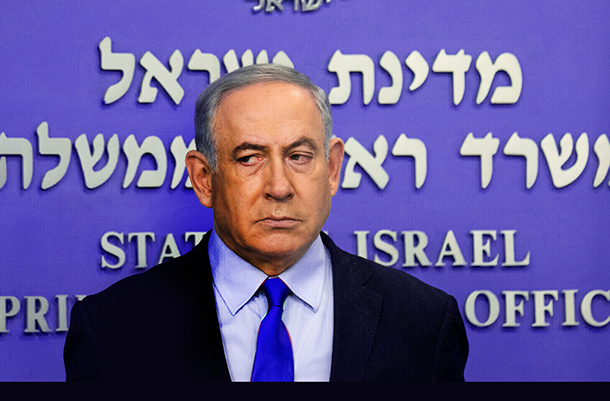
Israeli prime minister Benjamin Netanyahu holds a press conference at the Prime Ministers office in Jerusalem on March 12, 2020. Photo by Olivier Fitoussi/Flash90
Al-Manar | May 28, 2020
Benjamin Netanyahu says the Palestinians are the side who will offer concession as the Israeli PM eyes implementing the annexation plan of West Bank and Jordan Valley.
“Only if the Palestinians agree that Israel has security and control throughout the territory, they will receive their own entity that (US President Donald) Trump defines as a state,” Netanyahu told Israel Hayom in an interview.
“We are not urged to offer concessions, but the Palestinians are those who will do so,” the Israeli PM added.
Meanwhile, he said that “attempts to set free Israelis held in Gaza are underway,” but noted that he “will not release Palestinian prisoners who “have blood on their hands.”
Iran Can Supply Itself With Nuclear Fuel Without Russia’s Help – Atomic Energy Body
Sputnik – 28.05.2020
TEHRAN – Iran is capable of supplying itself with nuclear fuel even without Russia’s assistance, Iran’s Atomic Energy Organization (AEOI) spokesman, Behruz Kamalvandi, said on Thursday.
“Fuel is delivered from Russia each time we need it, without any problems. If we run out of fuel, we will be capable of producing it, without resting on any other country,” Kamalvandi told the ISNA news agency.
His comment came soon after the United States announced ending sanction waivers covering Iran’s nuclear projects.
In late April, Russia delivered a fresh batch of nuclear fuel to Iran’s Bushehr Nuclear Power Plant, necessary for efficient functioning of the reactor.
Wait, Twitter, it’s a trap! Social media platform pressured to ‘fact check’ Chinese spokesman after doing so with Trump
RT | May 28, 2020
Twitter seems to be falling further into the trap of de facto becoming a publisher. After ‘fact checking’ President Donald Trump’s tweets, it was pressured to do the same with a Chinese spokesman.
The decision of Twitter to mark some of Donald Trump’s tweets about mail-in ballots with notices implying they contained misinformation, may have been welcomed by the many critics of the US president, but some say the move was short-sighted. After all, how does Trump differ from any other public figure whose tweets may need to be ‘corrected’ with a ‘fact check’?
Apparently, in at least one case, Twitter couldn’t come up with a good answer, and instead chose to issue more notices. It dug up some March tweets by Lijian Zhao, a spokesman for the Chinese Foreign Ministry, who infamously accused the US military of possibly starting the Covid-19 epidemic by bringing the coronavirus into his country.
Twitter has been labeling what it believes to be Covid-19 misinformation on its platform since mid-May, but those particular notices were issued on purpose. At least that’s what the New York Post believes, saying it was done after they confronted Twitter about its apparent double standards in targeting Trump and not the Chinese official.
Quite a few commentators pointed out that Twitter is putting itself in a vulnerable position by getting involved in what is essentially a political quarrel – regardless of whether Trump delivers on his threat to “regulate or shut down” social media in retaliation.
Twitter’s move against Trump’s tweet is probably horrifying to fellow social media giant Facebook, whose CEO, Mark Zuckerberg, responded to it by reiterating in an interview with Fox News his long-held position that private companies shouldn’t be “the arbiter of truth.”
His counterpart at Twitter, Jack Dorsey, insists that his company is not taking on that role. “Our intention is to connect the dots of conflicting statements and show the information in dispute so people can judge for themselves,” he tweeted.
‘NATO roulette’: Norwegian port to host nuclear-powered US subs despite local objections
RT | May 28, 2020
A municipal port in Norway is set to receive nuclear-powered submarines from NATO after the only naval base in the area was sold and decommissioned – but local politicians and environmental activists aren’t on board with the plan.
When the Olavsvern base in Tromso was sold to private investors in 2009, pressure mounted from NATO to find an alternative point of arrival for reactor-driven vessels, other than Haakonsvern in Bergen, which is currently the only approved port in the country.
Now it appears a “temporary solution” to the problem has been found at Grotsund in Tromso, where the country’s Armed Forces have been told to prepare for the arrival of US submarines, Klassekampen reported.
Military spokesman Brynjar Stordal told the newspaper that the forces had been given “political instructions” to prepare for the reception and that they are working in collaboration with the municipality. “We don’t meddle with the politics,” Stordal told the newspaper.
Local politician and chairman of the board of Tromso Harbor company Jarle Heitmann said having the submarines dock there is “not a good solution” and that people would “rather not see the port used for this purpose.”
Tromso has been strong-armed into accepting the nuclear subs, believes Frode Pleym, leader of Greenpeace Norway.
“Allowing nuclear-powered submarines in Norwegian ports and waters is playing Russian roulette with people and nature. Or more appropriately in this case, NATO roulette,” he told the NRK channel.
“This is about the fact that the government and parliament do not dare to say no to the US,” he added. Pleym stressed that Tromso has appealed for Norway to sign onto the UN nuclear ban and is against hosting both nuclear-armed and nuclear-powered vessels.
Moscow was also less than enthused by the decision to allow NATO submarines to stop at Grotsund when the plan was first announced last year, with Russian foreign ministry spokeswoman Maria Zakharova saying that the move was “contrary to the historical traditions of neighborly relations and cooperation in the Arctic” and accusing Oslo of continuing to “escalate tension and increase the risk of military action.”
Unfortunately for locals who are against the plan, the Tromso municipality is bound by the Port Act, which means it has a duty to receive all types of war vessels.
Secret Nuclear Sites of DPRK? Or is Everything Visible from Above?
By Konstantin Asmolov – New Eastern Outlook – 28.05.2020
Since 2018, North Korea has continued to adhere to its moratorium on nuclear, and medium- and long-range missile tests. This has created an impression that DPRK’s missile and nuclear weapons program has been put on hold. Still, analysts have been asking whether this is actually the case and the answer tends to depend on their political bias. Naturally, those who have come to perceive Pyongyang as an Evil Empire believe that North Korea has not stopped working on such projects and is continuing to develop weapons of mass destruction. Within US expert circles, aside from holding such opinions, analysts linked with the Democratic party typically seek ways to show how politically incompetent Donald Trump is. In fact, any of their statements about successes made on the North Korean front actually imply that Donald Trump is being deceived but does not realize this.
Such ideological blinders further restrict the limited capabilities of these “Pyongyang experts”. Analyzing satellite images is essentially the only means they use to learn what is happening in the DPRK. But it is impossible to see everything from up above. Therefore, analysts end up basing their assumptions on a politicized interpretation of information, i.e. if a building can theoretically house a missile, it must be meant for that very purpose.
This, in turn, generates sensational stories about yet another secret site linked to the DPRK’s nuclear weapons program being located. Such reports are often published by Beyond Parallel, an analytic vehicle funded by the Center for Strategic and International Studies (CSIS) or 38 North, currently a project of the Henry L. Stimson Center (formerly a program of the US-Korea Institute at Johns Hopkins University’s Paul H. Nitze School of Advanced International Studies).
On August 28, 2019, Beyond Parallel wrote that their latest satellite images provided “circumstantial evidence of the construction of a new ballistic missile submarine and preliminary evidence of possible preparations for a test” in the DPRK. Photographs of Sinpo South Shipyard showed “support vessels and a crane” suggesting “possible preparations, based on past practice, to tow the missile test stand barge out to sea for an SLBM (submarine-launched ballistic missile) test flight”. And although the authors of the article stated that there was “no conclusive evidence” that the preparation was nearing completion, media outlets reported that as an evidential fact.
On September 5, 2019, experts of the UN Security Council Sanctions Committee on North Korea submitted a report stating that the Uranium enrichment facility and the Experimental Light Water Reactor (ELWR) continued their operations at North Korea’s Yongbyon Nuclear Scientific Research Center.
On September 18, 2019, the International Atomic Energy Agency (IAEA) said that a nuclear reactor at Yongbyon was shut down for a sufficient period of time to be “de-fueled and subsequently re-fueled” in its report. The document also stated that there had been “signs of use at the centrifuge enrichment facility” there although “no indications of reprocessing activities” had been detected at the radiochemical lab in the plant.
In December 2019, the 38 North website reported that Stanford University’s Center for International Security and Cooperation (CISAC) had “observed activity at the Experimental Light Water Reactor (ELWR)” in Yongbyon indicating that it might be operational. According to the article, the “construction of the ELWR began in late 2010”, and although it appeared to be externally complete in early 2013, the North Korean government “has not spoken publicly about the reactor or its status” since November 2011.
Commercial satellite images made early in 2019 showed “a narrow but steady liquid effluent likely trailing from a pipeline stemming from the Turbine-Generator Building of the ELWR”. The report said that since 2017, photographs have shown “frequent movement of vehicles, cranes and equipment around the reactor’s entrance, the emplacement of a transmission tower and electrical transmission lines in 2017”. And in early 2018, the construction of a dam and spillway were observed. The authors of the article concluded that such activity indicated that the reactor was being prepared “for start-up operation”, and this “could have significant implications for North Korea’s nuclear weapons program and would complicate any denuclearization process”. According to the report, “the stated purpose for the ELWR is electricity generation”, but “the reactor could be operated to produce weapons-grade plutonium or tritium for boosted fission or hydrogen bombs”.
On January 30, 2019, South Korea’s leading conservative newspaper the Chosun Ilbo wrote that the DPRK had supposedly “built a large tunnel in Ryanggang Province near the border with China” that appeared “to be an underground missile base”. The conclusion was based on observations of the facility and imagery showing that the tunnel had only one entrance with “two cylindrical objects measuring around 10 m in length” near it, which appeared “to be missile-launching tubes”.
In March 2020, 38 North wrote about “a previously publicly unidentified underground facility (UGF) beneath a hill in Bungang” near the Yongbyon Nuclear Scientific Research Center. The article provided a lot of details, based on satellite imagery, about its construction that had started in 2004. And, most importantly, the author made the following conclusion: “Underground structures in residential areas are not unusual and may be used for storage, civil defense or other innocuous purposes. While there is no evidence that it is related to the North Korean nuclear program, the site’s proximity may raise suspicions. Moreover, there is reason to believe there may be other underground sites in the area that may also provoke the same concerns. Therefore, any future denuclearization agreements covering the Yongbyon nuclear facility may need to take this site and any others discovered nearby into consideration when formulating verification provisions.” The report also mentioned that “no electrical lines feeding into” the UGF were observed, and “no external ventilation systems” were visible.
On March 27, 2020, the 38 North website issued a warning that “a new North Korean version of the Army Tactical Missile System (ATACMS), test-fired” in March, could be capable of carrying nuclear warheads.
On April 8, citing 38 North, South Korea’s Yonhap News Agency reported that the DPRK had “recently conducted a dummy missile ejection test at its Sinpo shipyard”. According to the article, satellite imagery from April 5 showed that “the service tower on the ejection test pad pulled back from its static position”. In addition, the photographs also depicted a “glimpse of the bow of the SINPO-class experimental ballistic missile submarine”, however, “it was mostly obscured by the environmental awning”.
Another report published by Beyond Parallel on May 5, 2020 caused quite a stir. It said that a new facility was nearing completion in the village of Sil-li (not far from Pyongyang International Airport), and that it was “almost certainly related to North Korea’s expanding ballistic missile program”. According to the article, it “could be complete and ready for operations sometime during late-2020 or early-2021”.
The author of the story, Joseph Bermudez, based his conclusions on the following information:
- “A high-bay building within the facility is large enough to accommodate an elevated Hwasong-15 intercontinental ballistic missile and, therefore, the entirety of North Korea’s known ballistic missile variants.” The building bay doors up to 8 m in height also indicate this.
- The facility has been constructed next to a UGL “whose likely size is also large enough to easily accommodate all known North Korean ballistic missiles and their associated launchers and support vehicles”.
- An “unusually large covered rail terminal” and a “new rail spur line” are probably meant “to support ballistic missile operations” at the facility. All the structures there are connected by “a 9- to 10-meter-wide surfaced road network with wide radius turns suitable for the movement of large trucks and ballistic missile launchers”.
- The facility is “relatively close to ballistic missile component manufacturing plants in the Pyongyang area” (for example, Tae-sung Machine Factory, Mangyongdae Light Electric Factory) and can, therefore, be used for “the assembly of ballistic missiles from components delivered by rail”
- “There are at least 17 air defense artillery bases and numerous military and paramilitary barracks within a 5-kilometer radius of the facility”.
Citing Joseph Bermudez’s article, ROK’s Yonhap News Agency elaborated that the Sil-li Ballistic Missile Support Facility, nearing completion, could be used to test-fire intercontinental ballistic missiles. And on May 9, it was reported that “multiple intercontinental ballistic missiles (ICBMs)” were “newly manufactured in Sain-ri, Pyongsong in North Korea”.
However, a Principal Researcher at Korea Atomic Energy Research Institute (KAERI) and the former Director General of Korea Institute of Nuclear Nonproliferation and Control (KINAC), Hwang Yong-soo was very critical of Joseph Bermudez’s conclusions comparing them to baseless rumors about the North Korean leader’s health.
Hwang Yong-soo pointed out that Bermudez leapt from “hypothesis to inferred conclusion” in his Beyond Parallel report, which was based solely on “interpreted open source satellite imagery”. He was also skeptical that “North Korea’s leaders would construct their most critical missile facility adjacent to Sunan Airport” (DPRK’s national airport). In addition, “transport of large missiles and components to and from Sil-li would be apparent via national technical means to the United States and its allies”. Hwang Yong-soo also suggested that alternative explanations for large buildings being constructed “next to an airport seem entirely logical as the purpose attributed to these buildings by CSIS”.
It is no secret that North Korea often builds underground facilities to prepare for a possible military conflict during which Pyongyang’s enemies would dominate in the skies. Hence, many of DPRK’s manufacturing and strategic complexes are located underground, but this does not mean that all of them are linked to the missile and nuclear weapons program.
Still, North Korea has surprised the rest of the world on occasion, thus western analysts tend to err on the side of caution when it comes to the DPRK. After all, underestimating one’s enemies is far more dangerous than overestimating them. Nonetheless, it is worth treating reasonable concerns in a different manner to attempts to produce cheaply sensational reports based on biased interpretations or data that is low on quality and quantity.
Konstantin Asmolov, PhD in History is a Leading Research Fellow at the Center for Korean Studies of the Institute of Far Eastern Studies of the Russian Academy of Sciences.
Saudi-led coalition conducts 47 new airstrikes on Yemen
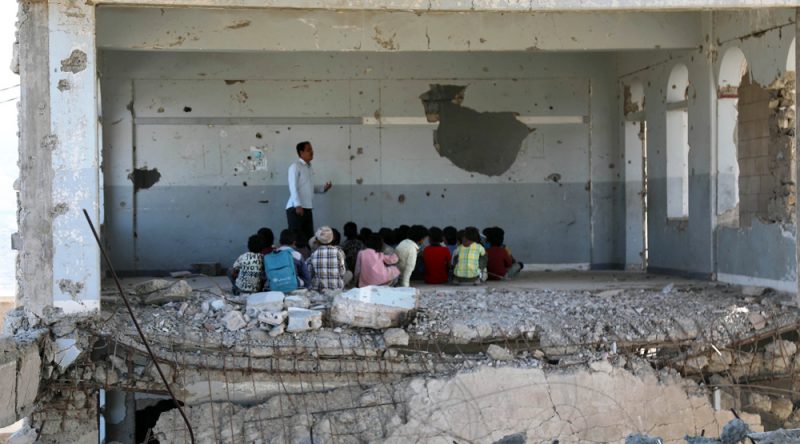
Children listen to their teacher in a destroyed classroom at a school which was heavily damaged in a Saudi-led airstrike, in Ta’izz, Yemen, on September 3, 2019. (Photo by AFP)
Press TV – May 28, 2020
Warplanes from the Saudi-led military coalition waging war on Yemen have carried out 47 airstrikes on different parts in the country, further destroying the impoverished country’s infrastructure.
Yemen’s Arabic-language al-Masirah TV cited an unnamed Yemeni military source as saying on Wednesday that the Saudi-led fighter jets had pounded localities in Yemen’s Ma’rib, Jawf, Sa’ada, and Hajjah provinces during the previous hours.
Majzar and Midghal districts in the central province of Ma’rib were struck 19 times, and Khasf Village in the Hazm district in the northern province of Jawf were pounded five times, the source said.
The airstrikes inflicted heavy damage on infrastructure in those localities.
According to the report, the Saudi-led coalition also violated a ceasefire in the western province of Hudaydah 67 times during the previous hours, killing at least one civilian.
Supported militarily by the US, the UK, and other Western countries, Saudi Arabia and a number of its regional allies launched the devastating war on Yemen in March 2015 to subdue a popular uprising that had overthrown a regime friendly to Riyadh.
The US-based Armed Conflict Location and Event Data Project (ACLED), a nonprofit conflict-research organization, estimates that the war has claimed more than 100,000 lives over the past five years.
More than half of Yemen’s hospitals and clinics have been destroyed or closed during the war by the Saudi-led coalition at a time when Yemenis are in desperate need of medical supplies to fight the COVID-19 pandemic.
At least 80 percent of the 28-million-strong population is also reliant on aid to survive in what the United Nations (UN) has called the world’s worst humanitarian crisis.
Has coronavirus pandemic really destroyed globalization?
By Paul Antonopoulos | May 28, 2020
The coronavirus pandemic has not only created contradictory information on the best ways to deal with it, on whether there are cures and vaccinations, or whether there will be a second wave, but they are also contradictory on how the world will look after we overcome the pandemic. Two supranational ideological tendencies have emerged – those who support globalization and think it will continue to function as if the pandemic never occurred, and those who think it is inevitable that coronavirus has sped up the inevitable end of a U.S.-led globalized world.
It was only on Monday that European Union foreign affairs chief Josep Borrell told a gathering of German ambassadors that “analysts have long talked about the end of an American-led system and the arrival of an Asian century. This is now happening in front of our eyes.” Although the EU supports a globalized world, it predicts that with the end of the coronavirus, the power centers of the world will shift from the West to the East.
The new head of the World Bank, Carmen Rainhart, had a slightly differing position to Borrel and told Bloomberg in an interview that: “Without being melodramatic, Covid-19 is like the last nail in the coffin of globalization. The 2008-2009 crisis gave globalization a big hit, as did Brexit, as did the U.S.-China trade war, but Covid is taking it to a new level.”
Every economist, think-tank and journalist are coming to their own conclusions, usually not based on facts and data, but rather based on their own political-economic ideology of how they believe the world should be, and not how it actually is. The governments of each country, whether they are major powers or small states, must decide what to prepare for and what future they want in the post-coronavirus world. The colossal differences between globalist and anti-globalist rhetoric are evident and emerging.
The World Economic Forum is one such example and has aggressively defended the U.S.-led globalized order. Only days ago went with the headline “Coronavirus won’t spell the end for globalization – but change is unavoidable,” where they argued “Nobody can predict the next crisis. But the most reliable and efficient insurance by far is to build a strong international cooperation network.”
Supporters of globalization argue that blocking people at borders can deprive society of talented and needed workers and that there is a better chance of responding to the challenges and threats of globalization if with collective action we can address the risk of disease and climate change, cyber-attacks, nuclear proliferation, terrorism and other problems.
In another article by the World Economic Forum from earlier this year before the coronavirus was declared a global pandemic, they argued that “Discontent with globalization is a key factor behind the temptation to advance policy goals through unilateral actions rather than by working together.” The article continues their argument by saying that “although improving international cooperation is an urgent task, it is equally important to acknowledge that there are always trade-offs between qualities such as national sovereignty, democratic legitimacy, effectiveness and speed of decision-making.”
The coronavirus pandemic has shown that in times of crisis, even the most ardent backers of globalization, like the U.S. and the EU, contract to protect their own interests first. Although the EU now regrets this course of action and is attempting to amend it, it has only confirmed in the minds of potential new EU members that multilateralism is a mythology that only serves the interests of powerful states who are not willing to reciprocate the trust in times of crisis.
So American unilateralism, that is, the use of maximum geopolitical egocentrism, as well as economic and military violence against countries that do not want to submit to Washington’s demands in any way, is part of today’s global reconfiguration. However, deglobalization will be a difficult task as countries will have to reindustrialize and reconfigure their economies and work forces.
Interestingly, even within the ranks of globalists, there are those who are arguing the end of globalization is near. This was especially galvanized after a Foreign Policy column argued on March 9 that “Globalization is headed to the ICU,” while The Economist’s May 14 issue asked whether COVID-19 had killed globalization. Time magazine hit back arguing that “Globalization is here to stay. It’s a horse that left the barn 30 years ago, when the Soviet Union fell.”
However, this is an admission from Time magazine that it does not believe that a multipolar world is emerging in the aftermath of the failed U.S.-led unipolar system that came into existence after the collapse of the Soviet Union in 1991. This is devoid of all reality as China continues to expand its economic and transportation network across the world and major regional powers have appeared around the world, such as Russia, who can defend their interests in their own neighbourhood. There is little doubt that the U.S. was on a global hegemonic decline before the emergence of the coronavirus, but the pandemic has only accelerated this inevitability, and no amount of debate by think tanks and media publications can change this fact.
Paul Antonopoulos is an independent geopolitical analyst.
Race war or bust? MSM smothers racial unity over police killing of Minneapolis man by reminding blacks & whites to hate each other
By Helen Buyniski | RT | May 27, 2020
The brutal police murder of an unarmed black man in Minneapolis united all races and political stripes in shocked outrage. So why is MSM invoking every racially-divisive incident they can to set society at each other’s throats?
Liberals and conservatives alike were horrified on Monday by a widely-circulated Facebook video showing a white police officer choking an unarmed, handcuffed black man to death by kneeling on his neck for upwards of seven minutes, ignoring his increasingly feeble cries for help until he went limp. Regardless of their race, viewers demanded the officer – Minneapolis Police Department’s Derek Chauvin – be charged with murder and cheered at the news he and three colleagues present during the Memorial Day incident had been suspended from the force.
Given the country’s oft-lamented polarization, it’s rare to see such broad agreement on something as controversial as a police killing. But the sight of George Floyd struggling to wheeze out “I can’t breathe” while Chauvin mocked the anguished cries of onlookers convinced many to put aside their ideological feuds and get outraged. Seeing the life slowly choked out of the 46-year-old for nothing more than allegedly “resisting arrest” over supposedly forging a check at a supermarket was beyond the pale.
Mainstream media’s narrative managers were determined to shatter that unity, however.
Thousands of protesters marched on Minneapolis’ third police precinct headquarters on Tuesday, carrying banners demanding justice for Floyd and his family. While a small group broke windows and sprayed graffiti en route, the riot-gear-clad cops met the entire racially-heterogeneous group as if it were an invading army, hurling stun grenades and firing rubber bullets and tear gas into the crowd. At least one woman was shot in the head.
Journalists and politicians on social media reacted to this appalling show of excessive force not by unilaterally condemning police violence – that would risk cementing the dreaded “unity” – but by contrasting the crackdown with last month’s docile police response to a “Liberate Minnesota” protest against the state’s Covid-19 lockdown. Hundreds of mostly-white protesters, many strapped with guns, had surrounded the Governor’s Residence of Democrat Tim Walz, demanding an end to the pandemic-inspired stay-at-home order.
The anti-lockdown protesters were largely left alone by the cops, liberals complained, implying police refusal to meet the flag-waving “extremists” with a hail of rubber (or real!) bullets was due to racism rather than the firepower the anti-lockdown protesters were packing.
That the divisive narrative was fundamentally flawed – the Minneapolis crowd protesting Floyd’s murder was as white as it was black – didn’t matter. Nor was it deemed necessary to point out that the unarmed Minneapolis protesters were not a threat to the riot-gear-clad cops, who’d have had to be suicidal to fire rubber bullets into a crowd of AR-15-packing wannabe-militiamen the previous month. It was too late – the spell of unity had been broken, and the conversation had degenerated into bickering over the morality of property damage and whether molotov cocktails were justified in the face of murder.
American police’s legendary itchy trigger fingers may seem incompatible with the American people’s love of firearms. However, the cops’ choice of prey is instructive: police-involved shootings are much more common in cities with strict gun-control laws: New York, Chicago, Los Angeles. The majority of US police departments – including members of the Minneapolis force – train in Israel, learning to shoot first and ask questions later while testing out their new skills on real live occupied Palestinians. This training follows them home, where too often poor black populations become the favored target. But the core psychology is that of a bully, unwilling to pick on someone their own size, armed with their own weapons.
The MSM narrative-managers poured it on thick in their effort to muddy the waters, dragging in months’ worth of racial controversies. Anything was fair game, as long as it could be used to guide conservatives and liberals, blacks and whites back to their proper positions at each other’s throats.
From the “Central Park Karen” who called the cops on a black man for asking her to put her dog on a leash, to Ahmaud Arbery, the young black man shot by a father-and-son team while jogging in Georgia, supposedly because they suspected him of a burglary, nothing was too off-topic.
The last thing the media establishment needs is for Americans to realize their country doesn’t have a race problem, so much as a class problem – and the media is on one side of the divide, encouraging those on the other side to fight among themselves for its amusement.
Helen Buyniski is an American journalist and political commentator at RT. Follow her on Twitter @velocirapture23
Did Trump Just Cancel a Potential Double-War?
The Saker • Unz Review • May 27, 2020
At this time of writing, it is too early to declare the danger over, but at least three out of five Iranian tankers have made it safely to Venezuela (confirmation from TeleSur and PressTV). Furthermore, while we should never say “never”, it appears exceedingly unlikely that the US would let three tankers pass only to then try to impede the arrival of the other two. So it ain’t over until its over, but as of right now things look way better than last week.
Besides, this is mostly a symbolic issue. While these 5 tankers will make a difference, it won’t be a huge one, especially considering the devastating consequences which the US sanctions, sabotage and subversion have inflicted on Venezuela.
Still, symbols are important, if only because they create a precedent. In fact, I would argue that the latest climbdown by Trump is no different than all his other climbdowns: Trump has had a very consistent record of threatening fire and brimstone before quietly deflating and walking away. And since he did that many times now, we have to wonder whether this strategy is effective or not?
One could argue that this strategy could be described by saying that you put the maximum pressure on the other side in the hope that the bluff will entice the adversary to fold. This could be a semi-credible argument were it not for a very simple but crucial problem: so far the other guys have never folded. In other words, Trump’s bluff has been called over and over again, and each time Trump had to quietly deflate.
Some will say that this only proves that Trump is truly a peace-loving President who, unlike his predecessors, does not want to go to war. But then, what about the cruise missile strikes on Syria? What about the murder of Soleimani?
Truth be told, the kindest thing we can say about this strategy (assuming that it is a strategy to begin with, not the evidence of a total lack of one) is that it is tantamount to yelling “fire!” in a crowded movie theater: the fact that Trump did not set any movie theater ablaze hardly justifies his yelling “fire” in such a dangerous environment. The perfect example of this kind of irresponsible behavior is the murder of General Soleimani which truly brought the US and Iran a millimeter away from a real, full-scale war.
Furthermore, while I salute Trump’s climbing down following the Iranian strikes, I also believe that in doing so he hurt the international image of the US. Why? Think about this: this is the first time ever (if I am not mistaken) that the US was the object of a major military strike coming from another state-actor and did not retaliate. In the past and until this Spring, the US always held the view that if anybody dares to mess with it this would result in very serious consequences. Thus the US upheld a world order in which some where a lot more equal than others. Specifically, “others” had to meekly accept US strikes and shut up whereas Uncle Shmuel could strike left and right and expect no retaliation.
By “accepting” the Iranian counter-strike, Trump did essentially place an “equal” sign between Iran and the US. He probably never understood that, but in the region this was understood by all.
Just as Hezbollah destroyed the myth of Israeli impunity, Iran destroyed the myth of US impunity.
Still, I will always prefer the politician who does not start a war (for whatever reason) to one who would. I also have no doubt whatsoever that Hillary would have started one, or even several, wars. But the fact that Hillary would have been even worse than Trump is hardly a reason to start fawning about Trump’s brilliant “5D chess” genius or peace-loving policies…
Trump reminds of a guy pointing a gun a people in the street only to later say “but it was a toy gun, I never meant to really shoot anybody.” This is definitely better than shooting people with a real gun, but this is hardly a sign of maturity or intelligence.
The other problem with this “strategy” (let’s assume for argument’s sake that this is a strategy of some kind): each time the “indispensable nation” and “sole hyperpower” has to climb down, it increasingly looks like a paper tiger. Not looking like such a paper tiger is probably the main reason behind Michael Ledeen’s famous words “Every ten years or so, the United States needs to pick up some small crappy little country and throw it against the wall, just to show the world we mean business.” In a strictly evil and imperialistic sense, Ledeen’s strategy makes a lot more sense than what Trump has been doing.

As Marx famously said, “History repeats itself, first as tragedy, second as farce.” The outcome of what some now call the “Battle of Macuto Bay” is a perfect example of this: if the Bay of Pigs was the “root case” then the disaster in Grenada was the tragedy and the Battle of Macuto Bay the real farce.
Humor can be a devastating weapon and anybody who has studied the late Soviet Union (in the late Brezhnev years and after) knows how the Russian people ridiculed the Soviet leaders with literally thousands of jokes.
A real imperialist would much rather be hated than ridiculed, and while Trump himself probably does not realize that he is the laughingstock of the planet, his aides and deep state bosses most definitely do and that is very, very dangerous.
Why?
Because the pressure to, once again, “pick up some small crappy little country and throw it against the wall” increases with each climbdown (see my article “Each “Click” Brings Us One Step Closer to the “Bang!” for a fuller discussion of this).
Besides, finding an even smaller and weaker country than Venezuela will be hard (maybe the Island of Saba? or Grenada again? who knows?). And potentially very dangerous.
The other problem is predictability. Any international system requires that its most powerful actors be predictable. In contrast, when a major international actors acts in what appears to be unpredictable, irrational or irresponsible manner, this puts the entire stability of the system at risk.
This, by the way, is also why it is so disastrous that the US has withdrawn from so many international organizations or treaties: the participation in international organizations and treaties indicate that the US is willing to play by the same rules as everybody else. The fact that the US is ditching so many of its former international obligations only shows that the US has gone rogue and is from now on totally unpredictable.
Finally, there are also lessons for Moscow here, the main one being that when confronted with a determined adversary, the Empire tries to bluff, but eventually folds. True, Moscow has to be much more careful than Tehran simply because the consequences of a US-Russian war would be dramatically worse than even a major conflict in the Middle-East. Yet it is also true that over the past years the Russian armed forces did have the time to prepare for such a conflict and that now Russia is ready for pretty much anything the US could try to throw at her, at least in purely military terms.
In contrast to the military posture of Russia, the political environment in Russia has changed for the worse: there is now a potentially very dangerous “hardline” opposition to Putin which I have christened the “6th column”, as opposed to the liberal and pro-western 5th column. What these two “columns” have in common is that they both will categorically oppose pretty much anything and everything Putin does. The 6th column, in particular, has a seething hatred for Putin which is even more rabid than what the liberal 5th column usually express. Check out this excellent video by Ruslan Ostashko, who prefers the term “emo-Marxists” and who very accurately describes these folks. Whether we think of them as 6th-columnists or emo-Marxists does not matter, what matters is that these folks are eager to act like a soundboard for any and all anti-Putin rumors and fakes. While Putin certainly has his flaws, and while the economic policies of the Medvedev, and now Mishustin, government are a far cry from what most Russians would want, it is also true that these two “columns” are objectively doing the bidding of the Empire, which could present a real problem if the current pandemic-induced economic crisis in Russia is not tackled more effectively by the government.
I have always said that Iran, while being much weaker than Russia, has consistently shown much more courage in its dealings with the Empire than Russia. Furthermore, Iran’s policies are primarily dictated by moral and spiritual considerations (as in the case of Iran’s principled stance on occupied Palestine) while Russian policies are much more “pragmatic” (which is really a euphemism for self-serving). But then, Iran is an Islamic Republic whereas Russia still has to develop some kind of unifying and original worldview.
Conclusion:
For all his innumerable negative character traits and other flaws, it remains true that Trump has not launched a major war (so far). Yes, he has brought the world to the brink several times, but so far he has not plunged the world into a major conflict. How much of the credit for this truly should go personally to him is very debatable (maybe cooler heads in the military prevailed, I think of folks like General Mattis who, reportedly, was the one who stopped the US from seriously attacking Syria and settled for a symbolic strike). Some Russian analysts (Andrei Sidorov) even believe that the US is in no condition to fight any war, no matter how small. Furthermore, most (all?) Russian analysts also believe that the US is fully committed to a full-spectrum information and economic war to try to economically strangle both Russia and China. I think that it would be fair to say that nobody in Russia believes that the relationship with Trump’s US can, or will, improve. The tone in China is also changing, especially since the US has now launched a major anti-China strategic PSYOP. In other words, the US is merrily continuing down its current road which leads it to a simultaneous confrontation with not one, or even two, countries, but with a list of countries which seems to grow every day. So while it is true that in this case Trump appears to have canceled two wars, we should not assume that he won’t soon start one, if only to deflect the blame for his total mismanagement of the COVID19 crisis. Should that happen, we can only hope that all the “resistance countries” and movement will provide as much support as possible to whomever the Empire attacks next.
Cuomo blames nursing homes for following his Covid-19 order that KILLED PATIENTS – after removing it from website
RT | May 27, 2020
New York Governor Andrew Cuomo has stealthily attempted to rewrite history, deleting his controversial order requiring nursing homes to admit Covid-19 patients from the state health website and blaming facilities for obeying it.
After being lambasted in the press for the March 25 executive order that forced New York elder care facilities to accept patients infected with the highly contagious virus, Cuomo attempted to blame the nursing homes for not disobeying his orders during a Wednesday press conference.
“The obligation is on the nursing home to say, ‘I can’t take a Covid-positive person,’” the governor insisted. “If they said ‘I can’t take the person,’ they can’t take the person! So that’s how it works.”
The coronavirus has cut a devastating swath through New York’s nursing homes, killing more than 5,800 people in long-term care facilities since the pandemic began – nearly a fifth of the state’s Covid-19 deaths so far, according to AP statistics compiled on Thursday. The policy ultimately sent over 4,500 recovering coronavirus patients to nursing homes, which Cuomo himself called “the optimum feeding ground for this virus.”
But the executive order itself leaves little room for disobedience, reading (in underlined text, no less), “No resident shall be denied re-admission or admission to the [Nursing Home] solely based on a confirmed or suspected diagnosis of COVID-19.” Elsewhere in the document, facilities are advised they “must comply with the expedited receipt of residents returning from hospitals” so long as they’ve been deemed medically stable – no excuses allowed. Facilities aren’t even permitted to test incoming patients.
But that same order, titled “Advisory: Hospital Discharges and Admissions to Nursing Homes,” was apparently removed from the New York healthcare website early this month, according to Fox News, which discovered its absence on Tuesday. Unfortunately for Cuomo’s revisionism, it’s still available in the Wayback Machine. The governor issued a revised directive on May 10, barring hospitals from sending patients back to nursing homes unless they tested negative for the virus. However, his communications director denied the more recent order represented a “reversal” of the old one so much as “build[ing] on” it.
By Saturday, however, Cuomo was blaming the Trump administration for the ill-advised Covid-19 mandate, declaring New York was merely “following the president’s agencies’ guidance” and “follow[ing] what the Republican Administration said to do.” While the governor’s office claimed he was referring to a March directive from the Centers for Medicare and Medicaid Services, that order merely required nursing homes to “admit any individuals that they would normally admit to their facility, including… from hospitals where a case of Covid-19 was present” and even advised setting aside a unit to quarantine patients returning from hospitals – a safety measure notably missing from Cuomo’s executive order.
The New York governor’s handling of the nursing home situation has gotten decidedly mixed reviews, with a recent poll showing just 44 percent of state voters approve of the job he’s done managing the virus in state elder care facilities – while 48 percent give him a thumbs-down. Published Wednesday, the Siena College poll reveals a predictable partisan split, with 54 percent of Democrats approving of how he’s managed the nursing home problem as opposed to 55 percent of Republicans disapproving. Independents were the most vehement in their disdain, with 61 percent viewing his response negatively.
Cuomo’s overall approval ratings have also slipped since the early days of the pandemic, when he won over Democrats by taking an oppositional stance to President Donald Trump. Approval for his handling of the outbreak in general sits at 76 percent for May, down from 84 percent last month, while his overall job approval rating has slid to 63 percent from 71 percent in April.
Featured Video
9/11 In Perspective
or go to
Aletho News Archives – Video-Images
From the Archives
Still No End in Sight of the Murder and Mayhem Wrought by the 9/11 Culprits
By Prof. Tony Hall | American Herald Tribune | July 17, 2016
The Kevin Barrett-Chomsky Dispute in Historical Perspective – Fourth part of the series titled “9/11 and the Zionist Question”
Back in 2006 all but a prescient few, such as Christopher Bollyn, perceived it as premature to try to identify and bring to justice the actual perpetrators of the 9/11 crimes. There was still some residue of confidence that responsible officials in government, law enforcement, media and the universities could and would respond in good faith to multiple revelations that great frauds had occurred in interpreting 9/11 for the public.
Accordingly, the main methodology of public intellectuals like Dr. Kevin Barrett or, for instance, Professors David Ray Griffin, Steven E. Jones, Peter Dale Scott, Graeme MacQueen, John McMurtry, Michael Keefer, Richard B. Lee, A.K. Dewdney, Nafeez Mossadeq Ahmed, and Michel Chossudovsky, was to marshal evidence demonstrating that the official narrative of 9/11 could not be true.
The marshaling of evidence was spurred on by observations coming from government insiders like Eckehardt Wertherbach, a former head of Germany’s intelligence service. In a meeting in Germany with Christopher Bollyn and Dr. Andreas von Bülow, Wertherbach pointed out that, “an attack of this magnitude and precision would have required years of planning. Such a sophisticated operation would require the fixed frame of a state intelligence organization, something not found in a loose group like the one led by the student Mohammed Atta in Hamburg.”
Andreas von Bülow was a German parliamentarian and Defense Ministry official. He confirmed this assessment in his book on the CIA and 9/11. In the text von Bülow remarked that the execution of the 9/11 plan “would have been unthinkable without backing from secret apparatuses of state and industry.” The author spoke of the “invented story of 19 Muslims working with Osama bin Laden in order the hide the truth” of the real perpetrators’ identity. … continue
Blog Roll
 Aletho News
- Kaja Kallas: an uncomfortable figure useful to the EU’s Russophobic purposes
- German state blacklists right-wing party for first time
- Romania’s stolen elections were only the start: Inside the EU’s war on democracy
- Hawaii bills would allow gov’t to quarantine people, enter property without permission, seize firearms, and suspend laws
- Epstein files may contain ‘crimes against humanity’ – UN
- UK Government Plans to Use Delegated Powers to Undermine Encryption and Expand Online Surveillance
- Epstein Files Expose Israeli Occupation of America
- The Mandelson Molecule: Exposing the Architecture of Cross-Border Political Suppression
- The U.S. Sanctions Cuban Journalist For Reporting On The U.S. Blockade
- Israeli firms transform cars into intelligence devices: Reports
- If Americans Knew
- Why won’t Trump’s “Board of Peace” bring peace? – Not a ceasefire Day 131
- Help end the injustice against Shadi
- Israel’s Favorite American President
- Israel’s “Yellow Line” Is a Death Trap for Palestinians. We Drove Into It.
- Why Israel’s expanding occupation in Syria presents a critical legal test
- Gaza is not a natural disaster. It is the victim of genocide enabled by global inaction
- Netanyahu’s plan to “end” US aid to Israel is to give even more money under a different name
- Israel ceased firing on Gaza for just 15 days of the “ceasefire” – Not a ceasefire Day 130
- In Gaza, “rats run over our faces” – Not a ceasefire Day 129
- Israel-backed border guards, GHF-linked aid – Not a ceasefire Day 128
- No Tricks Zone
- Coal Power Back In Trend As Globe Tries To Keep Pace With Growing Demand For Power
- New Study: A 4°C Warmer Beaufort Sea Had ‘No Sea Ice’ 11,700 – 8200 Years Ago
- Unfudging The Data: Dutch Meteorological Institute Reinstates Early 20th Centruy Heat Waves It Had Erased Earlier
- German Gas Crisis…Chancellor Merz Allegedly Bans Gas Debate Ahead of Elections!
- Pollen Reconstructions Show The Last Glacial’s Warming Events Were Global, 10x Greater Than Modern
- Germany’s Natural Gas Storage Level Dwindles To Just 28%… Increasingly Critical
- New Study Rebuts The Assumption That Anthropogenic CO2 Molecules Have ‘Special’ Properties
- Climate Scientist Who Predicted End Of “Heavy Frost And Snow” Now Refuses Media Inquiries
- Polar Bear Numbers Rising And Health Improving In Areas With The Most Rapid Sea Ice Decline
- One Reason Only For Germany’s Heating Gas Crisis: Its Hardcore-Dumbass Energy Policy
 Aletho News