Authors of Hydroxychloroquine Study Retract Publication in Lancet Over Unverifiable Source Data
Sputnik – June 4, 2020
Since the promotion of hydroxychloroquine by US President Donald Trump as a possible treatment for those afflicted with the coronavirus, the drug has been the subject of controversy, as top medical journals rebuked the claim and major drug trials were halted.
Three authors of an article that claimed to have discovered that taking hydroxychloroquine led to an increased fatality risk among COVID-19 patients retracted the study on Thursday over concerns that the primary source data used to support the work was unverifiable.
According to the authors, Surgisphere, a data analytics company said to be responsible for providing the raw data, refused to supply the full dataset to an independent review. The authors then acknowledged that they “can no longer vouch for the veracity of the primary data sources”.
“We always aspire to perform our research in accordance with the highest ethical and professional guidelines. We can never forget the responsibility we have as researchers to scrupulously ensure that we rely on data sources that adhere to our high standards. Based on this development, we can no longer vouch for the veracity of the primary data sources” the authors said in a co-signed retraction letter.
The authors requested that the paper be retracted and apologised “for any embarrassment or inconvenience” they may have caused.
The research was published in the British medical journal The Lancet last month and garnered widespread response after appearing to imply that antimalarial drugs endorsed by US President Donald Trump as a COVID-19 treatment, were not just ineffective but potentially deadly to users.
Conclusions of the study suggested that coronavirus patients taking chloroquine or hydroxychloroquine showed irregular heartbeats and therefore faced a higher chance of dying while undergoing treatment.
Following the publishing of the study, the World Health Organisation (WHO) – which has been defunded by the White House amid the coronavirus pandemic – initially halted their trials of the malaria drug as a coronavirus treatment, but in the wake of the new findings have resumed trials on Wednesday.
The United Kingdom and France also shut down their clinical drug trials in the wake of the report.
Accusations of politically motivated condemnation have been leveled against those responsible for the data used in the study as an attempt to discredit the treatment touted by Trump. Demand for the drug has since skyrocketed.
Despite the retraction of the the study, however, a concurrent study published by the New England Journal of Medicine on Wednesday found there is no evidence that hydroxychloroquine helps prevent those taking the drug from becoming infected with the COVID-19 coronvirus.
The Media Has Conveniently Forgotten George W. Bush’s Many Atrocities
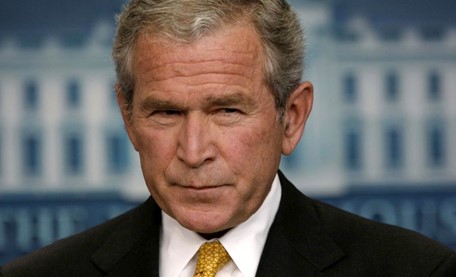
By James Bovard | Mises Wire | June 4, 2020
Former president George W. Bush has returned to the spotlight to give moral guidance to America in these troubled times. In a statement released on Tuesday, Bush announced that he was “anguished” by the “brutal suffocation” of George Floyd and declared that “lasting peace in our communities requires truly equal justice. The rule of law ultimately depends on the fairness and legitimacy of the legal system. And achieving justice for all is the duty of all.”
Bush’s declaration was greeted with thunderous applause by the usual suspects who portray him as the virtuous Republican in contrast to Trump. While the media portrays Bush’s pious piffle as a visionary triumph of principle, Americans need to vividly recall the lies and atrocities that permeated his eight years as president.
In an October 2017 speech in a “national forum on liberty” at the George W. Bush Institute in New York City, Bush bemoaned that “Our politics seems more vulnerable to conspiracy theories and outright fabrication.” Coming from Bush, this had as much credibility as former president Bill Clinton bewailing the decline of chastity.
Most media coverage of Bush nowadays either ignores the falsehoods he used to take America to war in Iraq or portrays him as a good man who received incorrect information. But Bush was lying from the get-go on Iraq and was determined to drag the nation into another Middle East war. From January 2003 onward, Bush constantly portrayed the US as an innocent victim of Saddam Hussein’s imminent aggression and repeatedly claimed that war was being “forced upon us.” That was never the case. As the Center for Public Integrity reported, Bush made “232 false statements about weapons of mass destruction in Iraq and another 28 false statements about Iraq’s links to Al Qaeda.” As the lies by which he sold the Iraq War unraveled, Bush resorted to vilifying critics as traitors in a 2006 speech to the Veterans of Foreign Wars.
Bush’s lies led to the killing of more than four thousand American troops and hundreds of thousands of Iraqi civilians. But since those folks are dead and gone anyhow, the media instead lauds Bush’s selection to be in a Kennedy Center art show displaying his borderline primitive oil paintings.
In February 2018, Bush was paid lavishly to give a pro-democracy speech in the United Arab Emirates, ruled by a notorious Arab dictatorship. He proclaimed: “Our democracy is only as good as people trust the results.” He openly fretted about Russian “meddling” in the 2016 US election.
But when he was president, Bush acted as if the United States were entitled to intervene in any foreign election he pleased. He boasted in 2005 that his administration had budgeted almost $5 billion “for programs to support democratic change around the world,” much of which was spent on tampering with foreign vote totals. When Iraq held elections in 2005, Bush approved a massive covert aid program for pro-American Iraqi parties. The Bush administration spent over $65 million to boost their favored candidate in the 2004 Ukraine election. Yet, with boundless hypocrisy, Bush proclaimed that “any (Ukrainian) election… ought to be free from any foreign influence.” US government-financed organizations helped spur coups in Venezuela in 2002 and Haiti in 2004. Both of those nations, along with Ukraine, remain political train wrecks.
In that October 2017 New York speech, Bush proclaimed: “No democracy pretends to be a tyranny.” But ravaging the Constitution was apparently part of his job description when he was president. Shortly after 9-11, Bush turned back the clock to before 1215 (when the Magna Carta was signed), formally suspending habeas corpus and claiming a prerogative to imprison indefinitely anyone he labeled a terrorist suspect. In 2002, Justice Department lawyers informed Bush that the president was entitled to violate the law during wartime—and the war on terror was expected to continue indefinitely. In 2004, Bush White House counsel Alberto Gonzales formally asserted a “commander-in-chief override power” entitling presidents to ignore the Bill of Rights.
Under Bush, the US government embraced barbaric practices which did more to destroy America’s moral credibility than all of Trump’s tweets combined. Bush’s “enhanced interrogation” regime included endless high-volume repetition of a Meow Mix cat food commercial at Guantanamo, head slapping, waterboarding, exposure to frigid temperatures, and manacling for many hours in stress positions. After the Supreme Court rebuffed some of Bush’s power grabs in 2006, he pushed through Congress a bill that retroactively legalized torture—one of the worst legislative disgraces since the Fugitive Slave Act of 1850. During his years in the White House, Bush perennially denied that he had approved torture. But in 2010, during an author tour to promote his new memoir, he bragged about approving waterboarding for terrorist suspects.
Is Bush nominating himself to be the nation’s racial healer? When he was president, Bush inflicted more financial ruin on blacks than any president since Woodrow Wilson (who brought Jim Crow barbarities to the federal government). Bush trumpeted his plans to close the gap between black and white homeownership rates and promised in 2002 to “use the mighty muscle of the federal government” to solve the problem. Bush was determined to end the bias against people who wanted to buy a home but had no money. Congress passed Bush’s American Dream Downpayment Act in 2003, authorizing federal handouts to first-time homebuyers of up to $10,000 or 6 percent of the home’s purchase price. Bush also swayed Congress to permit the Federal Housing Administration to make no–down payment loans to low-income Americans. Bush proclaimed: “Core American values of individuality, thrift, responsibility, and self-reliance are embodied in homeownership.” In Bush’s eyes, self-reliance was so wonderful that the government should subsidize it. And it didn’t matter whether recipients were creditworthy, because politicians meant well. Bush’s 2004 reelection campaign trumpeted his down payment giveaways, a shining example of “compassionate conservatism.”
Thanks in large part to his policies, minority households saw the fastest growth in homeownership leading up to the 2007 recession. The housing collapse ravaged the net worth of black and Hispanic households. “The implosion of the subprime lending market has left a scar on the finances of black Americans—one that not only has wiped out a generation of economic progress but could leave them at a financial disadvantage for decades,” the Washington Post reported in 2012. The median net worth for Hispanic households declined by 66 percent between 2005 and 2009. That devastation was aptly described in a 2017 federal appeals court dissenting opinion as “wrecking ball benevolence” (quoting a 2004 Barron’s op-ed I wrote). But almost none of the media coverage of the ex-president reminds people of the economic carnage of this Bush vote-buying binge.
It is possible to condemn police brutality and, even more importantly, the evil laws and judicial doctrines that enable police to tyrannize other Americans without any help from a demagogic ex-president who ravaged our rights, liberties, and peace. As I commented in an August 2003 USA Today op-ed, “Whether Bush and his appointees will be held personally liable for their [Iraq War] falsehoods is a grave test for American democracy.” The revival of Bush’s reputation vivifies how our political media system failed that test. As long as George Bush doesn’t turn himself in for committing war crimes, all of his talk about “achieving justice for all” is rubbish.
James Bovard is the author of ten books, including 2012’s Public Policy Hooligan, and 2006’s Attention Deficit Democracy. He has written for the New York Times, Wall Street Journal, Playboy, Washington Post, and many other publications.
Rush to trash hydroxychloroquine exposes fundamental flaws in profit-based medical ‘science’
By Helen Buyniski | RT | June 4, 2020
As the WHO and prestigious medical journal the Lancet back away from questionable data provided by healthcare analytics firm Surgisphere, ulterior motives for the rush to demonize hydroxychloroquine become clear.
The World Health Organization (WHO) sheepishly resumed testing the off-patent malaria drug hydroxychloroquine on coronavirus patients on Wednesday after pausing that arm of its ‘Solidarity’ clinical trial based on data that appeared to show the drug contributed to higher death rates among test subjects. That data, it turned out, came from a tiny US healthcare analytics firm called Surgisphere, and calling it faulty would be excessively charitable.
Not only is Surgisphere a company lacking in medical expertise – its employees included an “adult” entertainer and a science-fiction writer – but its CEO Sapan Desai co-authored two of the damning studies that used the firm’s data to smear hydroxychloroquine, already thoroughly demonized in the media thanks to its promotion by US President Donald Trump, as a killer. All data is sourced to a proprietary database supposedly containing a veritable ocean of real-time, detailed patient information yet curiously absent from existing medical literature.
The Surgisphere-tainted study appeared to show increased risk of in-hospital deaths and heart problems with no disease-fighting benefits, confirming the suspicions of medical-industry naysayers already inclined to hate the off-patent drug due to the lack of profit potential and Trump’s incessant boosterism. Italy, France, and Germany rushed to ban hydroxychloroquine, citing “an increased risk for adverse reactions with little or no benefit.”
But such a shameless character assassination performed against a potentially-lifesaving drug – especially one with a decades-long track record of safety in malaria, lupus, and arthritis patients that came highly recommended by some of the world’s most eminent disease experts, including France’s Didier Raoult – could only be accomplished with help from industry prejudice. It required ignoring numerous existing studies showing hydroxychloroquine was beneficial in treating early-stage Covid-19 patients, as well as anecdotal reports from thousands of doctors who’d successfully used it.
It also required trusting a fly-by-night company with next to no internet or media presence to make decisions that could affect the lives of millions of people. It’s not like there weren’t warning signs Surgisphere was something other than the top-notch medical analytics firm it presented itself as. The company began life as a textbook publisher in 2008 and hired most of its 11 employees two month ago, according to an investigation by the Guardian, yet it claimed ownership of a massive international database of 96,000 patients in 1,200 hospitals worldwide. One expert interviewed by the outlet said it would be difficult for even a national statistics agency to do in years what Surgisphere had supposedly done in weeks, calling the database “almost certainly a scam.” Yet no one at the Lancet or WHO thought to look a gift horse in the mouth – not when that gift drove a stake through the heart of hydroxychloroquine as Covid-19 treatment.
And while Australian researchers found flaws in the Surgisphere data just days after the May 22 publication of the Lancet study, noting that the number of Covid-19 deaths cited by the study as coming from five hospitals exceeded the entirety of Covid-19 deaths recorded in Australia at that time, the Lancet – instead of investigating just who this Surgisphere company really was, and why it had made such a glaring mistake – merely published a minor retraction related to the Australian data and put the controversy to bed.
The full-frontal assault on hydroxychloroquine was instead allowed to continue unchecked in the media, as mainstream outlets focused their energies on fluffing up remdesivir – a costly, untested drug manufactured by drug maker Gilead that has so far produced lackluster results in clinical trials – and stumping for an eventual vaccine. Hydroxychloroquine’s off-patent status meant it was a dead end as far as profits were concerned, while remdesivir and whatever vaccine is ultimately green-lighted will make a lot of people very rich. Perhaps hoping to throw their audiences off the real reason for their hydroxychloroquine hatred, several outlets hinted that Trump stood to make money off the drug (which costs about 60 cents per pill) – but even Snopes, no fan of the ‘Bad Orange Man’, had to pour cold water on that speculation.
The Lancet and New England Journal of Medicine have – belatedly – published “expressions of concern” about the Surgisphere hydroxychloroquine study, and an independent audit is being conducted. But the problem of biased health authorities selectively embracing some trial results while rejecting others is unlikely to stop there.
The Lancet study is hardly the only one to show hydroxychloroquine lacks efficacy in treating Covid-19. Multiple studies conducted by the US National Institutes of Health on hospitalized (i.e. severely-ill) coronavirus patients have yielded poor results, but even the drug’s most ardent evangelists acknowledge it doesn’t help end-stage or very sick patients. Raoult has even claimed France banned the drug’s use in all but the most severely ill patients in order to discredit it as a treatment. The US National Institutes of Health was publishing studies in its journal Virology touting chloroquine as “a potent inhibitor of SARS coronavirus infection” as far back as 2005, yet ‘coronavirus czar’ Anthony Fauci throws shade at the drug whenever he gets a chance.
As long as deadly diseases like Covid-19 are seen as profit sources first and human rights issues second (or third, or tenth…), treatments that aren’t profitable will always be marginalized in favor of costly and frequently less-effective pharmaceuticals. Drug industry profiteering has already killed hundreds of thousands – if not millions – of people in the US alone. Taking the profit motive out of healthcare can help ensure its body count stays as low as possible.
Helen Buyniski is an American journalist and political commentator at RT. Follow her on Twitter @velocirapture23
UK battery electric car strategy is ‘doomed to failure’
By Andrew Forster | Transport Xtra | June 1, 2020
The Government’s push to electrify road transport is based on naivety, the undue influence of the Committee on Climate Change, and a lack of engineering expertise within Government, an academic has said.
Professor Michael Kelly, the former chief scientific adviser to the Department for Communities and Local Government, issues the warning in a paper published by the Global Warming Policy Foundation.
He warns the Government’s ambitions for EVs and electric heating in buildings will end in damaging failure.
“When the penny drops and the progress towards all-electric UK is halted, we will be reminded of Ozymandias [two poems that describe how even the greatest men and the empires they forge are impermanent, their legacies fated to decay into oblivion – Ed].
“The rest of the world can look at Britain and choose whether to laugh or weep.”
On battery electric vehicles, he says: “Consider Dinorwig power station, the biggest hydropower energy storage plant in the UK. If all UK cars were battery powered, the nine gigawatts of energy stored behind the dam would be capable of recharging about 60,000 of them, or about 0.25 per cent of the UK fleet.”
If all vehicles have to be electric, “something of the order of 70 per cent of Britain’s entire existing electricity supply capacity will be needed”.
“When we get coded messages from the Climate Change Committee, implying that we will have to rethink the extent to which we are going to be able to travel in future, it is the implausibility of meeting that vast gulf in energy sources that is motivating them to question our lifestyles.”
Kelly points out that the Government’s net zero greenhouse gas target will also require the heating of buildings to be electrified using heat pumps. This will place huge additional demands on electricity supply, particularly in the winter.
Charging battery cars at night, when electricity demand from other sources is low, is only a “partial solution” to the problems, he says. “The current day-night variation in electricity demand is of itself too small to handle the extra load.
“Another suggestion is that we can charge cars during the day, when solar power is high. But in the absence of storage, this would mean charging them from mid-morning to mid-afternoon on sunny days. This is implausible too, and would be unreliable [even] if we could make it happen.”
Turning to local electricity supply issues, he says “we will be adding electric vehicle chargers and heat pumps to almost every home”.
“A fast EV charger for a car draws 7kW, perhaps for six hours, and a heat pump needs 3kW, potentially for much of the day. But the cabling and substations in most suburbs were sized and installed before these technologies were even thought of. So while there is sufficient headroom for electrification of a few households, the whole distribution system will need to be up- graded if demand grows.
“This work will be extraordinarily expensive, but without it there will either be regular ‘brownouts’, or drivers will have to be told where and when they can charge their batteries.”
Kelly dismisses battery storage as a major part of the solution. “The £45m battery installed by Elon Musk outside Adelaide, South Australia, can power that city for 30 minutes. If you wanted to be able to cover a week’s power outage after a major storm, it would cost around 1,300 times as much using batteries as it would with diesel generators. The idea is ludicrous.”
Turning to the raw materials needed to produce batteries, Kelly claims: “If we replace all of the UK vehicle fleet with EVs, and assuming they use the most resource-frugal next-generation batteries, we would need the following materials:
- 207,900 tonnes of cobalt – just under twice the annual global production;
- 264,600 tonnes of lithium carbonate – three-quarters of the world’s production;
- at least 7,200 tonnes of neodymium and dysprosium – nearly the entire world production of neodymium; and
- 2,362,500 tonnes of copper – more than half the world’s production in 2018.
“Put simply, we lack the ability to provide the infrastructure required to deliver electric cars and electric heating on the scale required by 2050.”
Kelly asks why we are trying to do so anyway and pins the blame on the Committee on Climate Change.
“An unelected body, the Committee displays many of the worst features of the administrative state. It has been grossly negligent in turning a blind eye to the complexity of electric vehicles and the related issue of the enforced switch to electricity for domestic heating.
“Committee members don’t have to face the consequences of their policies from voters; politicians, who do have to face the voters, hide behind the Committee in order to duck accountability.
“It is this failure of the UK’s political machinery that I believe is to blame for the situation in which we find ourselves.
“We have set out to decarbonise the economy without anyone having thought through all the engineering issues, let alone put a cost on the exercise.”
Kelly says that, with Covid-19, “it is clear that we will not be able to afford the costs of the net zero transition for decades, if ever”.
“To attempt to plough on would be madness; indeed, it would directly sabotage the UK economy, and without any measurable effect in terms of actually averting any climate change.”
“Surely now is the time for a root and branch cost-benefit review by independent engineers who have no skin in the game of electrifying the UK economy.”
Prince Charles sees ‘golden opportunity’ in Covid-19 pandemic as UK economy faces biggest recession in centuries
By Helen Buyniski | RT | June 4, 2020
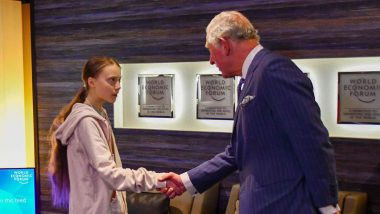 The UK’s Prince Charles has said that the coronavirus crisis represents a global “reset moment” – one which seemingly allows leaders to ram through sustainability initiatives as cash-strapped citizens have no choice but to obey.
The virus’ “unprecedented shockwaves may well make people more receptive to big visions of change,” the heir to the British throne declared on Wednesday. He made the comments during a virtual meeting of the World Economic Forum’s Covid Action Platform, announcing the unveiling of his ‘Great Reset’ initiative. Charles cited the dramatic changes wrought by the pandemic as proof that a revolutionary shift was possible, glossing over the destruction the outbreak has wrought on the lives of average Brits to outline his ideal green future.
The project’s aim is to ensure businesses “build back better” in an environmentally-friendly fashion after shutdowns enacted in response to the epidemic left the UK economy in ruins. Businesses would be wise to “think big and act now,” the prince advised, noting “we have a unique, but rapidly shrinking, window of opportunity to learn lessons and reset ourselves on a more sustainable path.”
“It is an opportunity we have never had before and may never have again.”
While details of the royal’s big plan were somewhat elusive, buried under an avalanche of buzzwords, it involves a series of industry- and issue-specific roundtables, a social media networking component and “virtual hubs” aimed at attracting young people and “fostering innovation” through “thought leadership and practical solutions.” He called for a “paradigm shift” that “inspires action at revolutionary levels and pace,” taking inspiration from the rapid transformation of industries such as mobile technology and space exploration to interweave sustainability into the financial system.
It’s not like the UK is in a position to say no, he hinted, threatening naysayers with several flavors of climate-induced doom. “We have no alternative because otherwise, unless we take the action necessary, and we build again in a greener and more sustainable and more inclusive way, then we will end up having more and more pandemics and more and more disasters from ever-accelerating global warming and climate change,” the prince proclaimed.
While Prince Charles stressed in a promotional video accompanying the big reveal that “global warming, climate change, and the devastating loss of biodiversity” are the chief threats facing humanity, the majority of Britons are likely to be more concerned with the devastating recession threatening to engulf the nation completely. The Bank of England warned last month that the UK economy could shrink by 30 percent by the end of the summer. The central bank’s dire predictions – its first official forecast since the pandemic took hold – warned that GDP could decline by 14 percent for 2020, the sharpest single-year drop in over three centuries. And while the Bank of England claimed UK families entered the crisis “in a stronger position than they were before the 2008 financial crisis,” the Office of National Statistics revealed in April that the economy was already headed south even before the lockdown was imposed in March.
By the start of May, one-fifth of British retailers had permanently closed their doors, according to the British Chamber of Commerce. It also warned that while a third of the country’s economy was “shut down,” another third was only functioning “with some difficulty.” Some two-thirds of UK businesses have sought government assistance to pay furloughed staff, but help has been slow in coming. Still, the UK is behind only Singapore and Japan in terms of the amount of money it has pledged toward helping businesses recover from the crisis, earmarking the equivalent of 8.5 percent of its GDP – about £120 billion – for emergency loans, financing, and grants. This places the needy wholly at the mercy of the government – which, if Prince Charles has anything to say about it, will wrest serious sustainability concessions out of them before they’re allowed to go forward.
The UK has suffered greatly under the pandemic, recording the second-highest number of coronavirus deaths worldwide – over 39,000 as of Thursday, according to data collected by Johns Hopkins University. Public trust in the country’s response to the virus has also been shaken dramatically, with just 51 percent of respondents to a survey conducted last month reporting they approved of London’s handling of the epidemic – an 18-point drop over the previous month. Imperial College professor Neil Ferguson, the disgraced architect of the UK lockdown policy, probably didn’t help matters earlier this week when he quietly admitted his draconian stay-at-home restrictions were no better than Sweden’s no-lockdown response in terms of saving lives.
Helen Buyniski is an American journalist and political commentator at RT. Follow her on Twitter @velocirapture23
Staggering Death Rate in 7 US States
American deaths per million equal or exceed Europe’s worst-hit nations in several locales

click to enlarge
By Donna Laframboise | Big Picture News | June 3, 2020
At first glance, the United States appears to have fared reasonably well during this pandemic. So far, 327 Americans have died of the coronavirus out of every one million in the population.
That’s according to official numbers. Which are all we have to work with at the moment. (There are solid reasons why official numbers should be viewed as provisional and inexact. See the bottom of the page here.)
If we compare its overall rate of 327 deaths per million to the hardest hit nations in Europe, America looks blessed. Belgium has experienced 820 deaths per million. Spain and the UK, 580. Italy, 555.
But peer a bit closer, and another story emerges. America’s number is low because many parts of that country have (so far) been spared a serious outbreak. In places where the virus gained a foothold in the wider community, the death rate exceeds even the worst countries in Europe:
New York state: 1,546
New Jersey: 1,327
Connecticut: 1,114
Massachusetts: 1028
Rhode Island: 691
District of Columbia: 666
Louisiana: 611
Michigan: 556
This being an election year, some people are blaming US President Donald Trump, a Republican, for the lives lost. It’s worth observing, therefore, that the governor is a Democrat in six of the seven US states is which the death per million rate equals or surpasses Italy.
Likewise, the mayor of the District of Columbia is a Democrat. Only in Massachusetts is a Republican in charge.
Two U.S. senators determined to stop Nord Stream 2 by imposing extra sanctions
By Paul Antonopoulos | June 4, 2020
The Nord Stream 2 project involves the construction of two gas pipelines with a total capacity of 55 billion cubic meters of gas per year from Russia to Germany via the Baltic Sea. The gas pipeline will run through the territorial waters or exclusive economic zones of Russia, Finland, Sweden, Denmark and Germany. However, this gas pipeline is strengthening Russia’s relations with European states, making the U.S. desperate to end the project.
As reported by Bloomberg on Wednesday, U.S. senators are planning to extend sanctions against the Nord Stream 2 project. Sanctions are expected to target insurance companies associated with the project.
Senator Ted Cruz led the charge against Moscow and said the Russian pipeline is “a critical threat to America’s national security and must not be completed.” He added that Russian President Vladimir Putin is trying to circumvent the sanctions passed by Congress last year. He of course did not explain how a Russian pipeline a continent away from the U.S. and in northern Europe could impact their security.
Cruz, a Republican, was joined by Senator Jeanne Shaheen, a New Hampshire Democrat, who said that the pipeline “threatens Ukraine, Europe’s energy independence and gives Russia an opening to exploit our allies” and that “Congress must once again take decisive action and stand in this pipeline’s path.” He, just like Cruz, did not explain exactly how the pipeline is a threat or security concern, especially against Ukraine.
The pipeline does not threaten Europe’s energy independence, and rather, as is enshrined in a free market economy that the U.S. says it ardently defends, allows Europe to have another option for gas. Although Russian gas already reaches Europe, it goes via Ukraine that is volatile and a high risk for Russia. The Director General of the Ukrainian gas transportation system Sergei Makogon said earlier this year that Ukraine “will make every effort to prevent the completion of Nord Stream 2, as this project has a clear political character and runs counter to European principles of solidarity.”
With Russian gas to Europe at risk, the Nord Stream 2 project ensures Russia’s gas can reach European markets so it can compete with gas from Qatar, the U.S. and other sources. And here is where the problem lays for Washington. It is obviously absurd to suggest that Russian gas “threatens Ukraine” or is a “critical threat to America’s national security.” The proposed sanctions, that also have backing from Republican Senators John Barrasso of Wyoming and Ron Johnson of Wisconsin, are just part of the “gas wars” initiated by the U.S. to force countries to buy American liquefied natural gas.
Last week, former U.S. Ambassador to Germany, Richard Grenell, who resigned on June 2, said that new sanctions against Nord Stream 2 could be adopted by the U.S. Congress in an operational mode. Their purpose is to prevent commissioning of the gas pipeline.
At that time, media also swept on the news that an alleged dispute broke out between U.S. President Donald Trump and long-time German Chancellor Angela Merkel because of differences of opinion on the Nord Stream 2 project. However, neither Berlin nor Washington officially confirmed this rumour. Also, at the end of last year, the U.S. adopted a defense budget providing for sanctions on companies involved in laying the gas pipeline. As a result, the Swiss company Allseas stopped work and withdrew its ships. The head of the Ministry of Energy Alexander Nowak said after that Russia is able to complete the project itself however.
The Nord Stream 2 subsidiary, Gazprom Nord Stream 2, is building the gas pipeline. The annual meeting of Gazprom’s board of directors is scheduled for June 11 and it is expected the main topic of talks to be about the impact of Western sanctions on Gazprom and response measures. This is more crucial as now Poland has joined the U.S. in anti-Nord Stream 2 sanctions.
The Polish Office of Competition and Consumer Protection initiated a new proceeding against Gazprom regarding the construction of the Nord Stream 2 gas pipeline, threatening the Russian company with a fine of €50 million. The Polish office demanded that Gazprom provide documents regarding the project, namely contracts concluded between Gazprom’s subsidiary and other companies financing the construction of the gas pipeline. These were primarily contracts for the transmission, distribution, sale, supply and storage of gas fuels. Gazprom did not provide this information, and now Poland aims to fine the company.
Despite these pressures, in which Poland has a very minor part, Russia will unlikely be deterred by threats of sanctions. Russia has already learned long ago how to operate while under sanction and will continue to pursue projects that serve their state interests and integrate Russia closer to Europe. This is especially important as the European countries are more interested in convenient gas that is not only logistically easier, but cheaper than many other alternatives.
It is for this reason that Russian Ambassador to Washington, Anatoly Antonov, said that the U.S. will not be able to stop the construction of the Nord Stream 2 gas pipeline.
Paul Antonopoulos is an independent geopolitical analyst.
WHO says hydroxychloroquine trials for Covid-19 will RESUME as doubts emerge over side-effects research
RT | June 3, 2020
The World Health Organization has said that clinical trials involving the controversial drug hydroxychloroquine will resume, following doubts about US research which had led to their suspension.
WHO chief Tedros Adhanom Ghebreyesus said Wednesday that the trials of the anti-malarial drug for possible use against the novel coronavirus would be resumed, after they’d been paused over fears of increased death rates.
The world health body said there was no reason to modify its clinical trial of the drug, adding that experts had advised the continuation of “all arms” of the so-called Solidarity trial, including that concerning hydroxychloroquine.
Last week, Italy, France and Germany banned the use of the drug to treat Covid-19 patients, citing new clinical evidence indicating that there was “an increased risk for adverse reactions with little or no benefit.”
The much-publicized study in medical journal The Lancet could not confirm any benefit from the drug against Covid-19, and also reported that taking it was associated with increased risks of in-hospital deaths. However, serious questions have been raised about the data used in that study.
The research, by US-based company Surgisphere, began to unravel in recent weeks as experts noticed red flags and questioned the credulity of its data-gathering and reporting. The Lancet journal issued an “expression of concern” over the study on Wednesday.
A Guardian investigation found that Surgisphere’s employees “have little or no data or scientific background,” with one appearing to be a sci-fi author and fantasy artist. The firm’s chief executive Sapan Desai has been named in three medical malpractice suits, the outlet said.
One WHO expert said hopefully trials of the drug will continue until there is a “definitive” answer on whether or not it works, Reuters reported.
The Next American Revolution? Anticipated Civil Unrest
“Warning shots will not be fired”
By Larry Romanoff – Global Research – November 27, 2019
Preparing For Civil War?
US authorities have for decades become increasingly prepared for mass civil disturbances resulting from government and corporate attacks on American society. We can recall that in the early 1980s the Hidden State launched its open war on the middle class by the savage FED-induced recession and the unilateral revocation of the social contract that had existed since 1946. At that time, the US government had already anticipated widespread public unrest, fully expecting mass protests and riots, and had made preparations to deal with them in the form of internment camps. In a real sense, the government had prepared for another civil war.
Like most of the “Great Transformation”, it began during Reagan’s reign with what was called “Rex 84”, an abbreviation for Readiness Exercise 1984, a plan by the US government to detain large numbers of American citizens in case of civil unrest. This master plan involved the FBI, Department of Defense, the Emergency Measures group, the Secret Service, the CIA and altogether 34 government agencies.
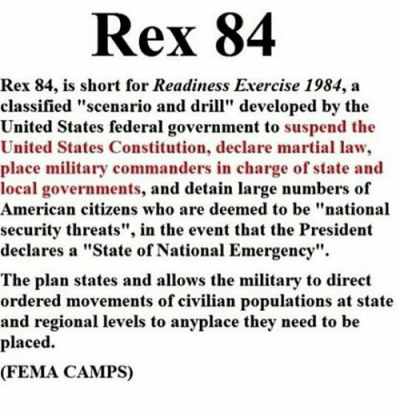
It was presented as an exercise to test military assistance in civil defense in times of national emergency, but in fact the plan was anticipating civil disturbances, major demonstrations and labor strikes that would affect continuity of government. The anticipated civil unrest from the FED-induced financial crisis that devastated the middle class was considered “subversive”, REX-84 being an authorisation for the US military to implement government-controlled movements of civilian populations at both state and regional levels, the arrest of many segments of the American population, and the imposition of martial law. (1) (2)
The Rex-84 program was created under the pretense of a possible mass exodus of illegal aliens attempting to cross into the US from Mexico, but when the program accidentally became public during the Iran-Contra Congressional hearings in 1987 it was revealed that it was in fact a secret federal government program
“to suspend the Constitution, declare martial law, assign military commanders to take over state and local governments, and detain large numbers of American citizens determined by the government to be ‘national security threats’.”
This was part of a master contingency plan for which the FBI today has a primary list of more than 100,000 Americans, and a secondary list ten times larger, who are targeted to be rounded up as subversives, including labor leaders, scholars and public figures, the incarceration designed to isolate political dissidents and to contain civil unrest.
And these are prison camps, ringed with fences, barbed wire and armed guards, not places from which escape would be likely, and they were designed to hold Americans, not Mexicans. (3)
There is no question the US government is prepared for the possibility of widespread and uncontrollable domestic disorder. This program in place and building for years was encouraged by fears of a massive public uprising in the wake of the 2008 banking fraud.
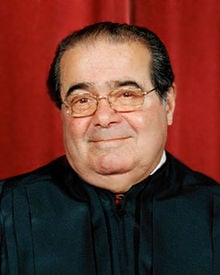 US Supreme Court Justice Antonin Scalia said some years ago that concentration camps were a likely future reality for Americans and that the Supreme Court would not do anything about the tyranny should the executive branch think it necessary. He mentioned the World War II internment of Japanese in the US and said of these camps,
“you are kidding yourself if you think the same thing will not happen again”. (4) (5)
In 2009, as the US financial crisis deepened and concern about public unrest was increasing, the US National Guard was posting job opportunities for “Internment/Resettlement Specialists” to work in “civilian internee camps” within the United States, and Halliburton [former] subsidiary KBR was seeking subcontractors to staff “emergency environment” camps located in five regions of the US. Earlier, in 2006, KBR was contracted by Homeland Security to build detention centers designed to deal with “the rapid development of unspecified “new programs” that would require large numbers of people to be interned.” (6) (7)
The US has for many years been dangerously close to a situation where, if the American people take to the streets in protest, these internments can be easily carried out. By 2004, there were more than 800 of these internment camps in the US, all empty, but all fully operational, staffed, and surrounded by full-time guards, ready to receive prisoners. I have seen photos. As well, many military bases are slated to be closed down and used as extra civilian prisons if the need arises, all intended for the internment of dissidents and others deemed “potentially harmful to the state”. Some camps can each hold 20,000 or more prisoners, a massive effort at civilian population control, and the program is still expanding. The US is very near the point today where political dissidents questioning the actions of their government will risk being rounded up and forced into these prison camps, essentially a government plan to forcibly suppress political dissent under the guise of rooting out domestic “terrorism”.
The US government defines many Americans as having become “pre-revolutionary” from their outrage at the 2008 government-approved housing collapse, with increasing concern that massive civil unrest would emerge from both the poverty-stricken lower classes and the eviscerated middle class, leading to what would become an internal civil war. This is the reason that the FBI and DHS increasingly focus their “anti-terror” apparatus on white middle-class Americans like the Occupy Wall Street protestors who were categorised as “low-level terrorists”.
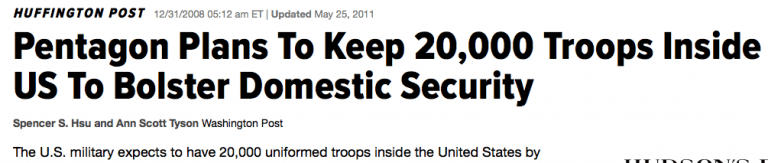
In 2008, the Washington Post reported government plans to station many tens of thousands of troops inside the country for purposes referred to as “domestic security” in the light of massive civil unrest that would follow an economic collapse or serious financial crisis, perhaps stemming from 2008.
According to the government document,
“Widespread civil violence inside the United States would force the defense establishment to reorient priorities in extremis to defend basic domestic order and human security”,
stating that the military may be needed to quell “purposeful domestic resistance”. To prepare for this quelling of resistance, the US has resorted to demonising its own citizens, a recent study funded by DHS conveniently identifying those Americans who are “suspicious of centralized federal authority” and who exhibit signs of being “reverent of individual liberty”, and re-categorising them as “extreme right-wing” terrorists. (8) (9) (10)
The program is designed to “reduce and eliminate” all domestic resistance to the US government. “Crowd control agents” will be used for this purpose, and government agencies will be involved in “gathering information on dissidents” to identify all those who have either “threatened or are creating disturbances”. The US military produced a manual on what it termed “Civil Disturbance Operations” that outlines how military assets will be used to “help local and state authorities to restore and maintain law and order” in the event of mass riots and civil unrest. Military and other law-enforcement will be tasked with “breaking up unauthorized gatherings” and restoring order by
“presenting a show of force, establishing roadblocks, breaking up crowds, employing crowd control agents, and other operations as required”.
The same government manual describes how prisoners will be processed through these internment camps, and outlines how these internees would be “re-educated” while detained in prison camps inside their own country by their own government. A leaked military document titled ‘FM 3-39.40 Internment and Resettlement Operations’, outlined a program for “re-education camps” in the US which contained plans for “political activists” to be “pacified” by various psychological officers into “sympathising” with the government and into “developing an appreciation of US policies” while detained in prison camps inside the US. The document was restricted to Department of Defense personnel but was been leaked and posted online. It outlined policies for “processing detainees into internment camps” and made clear these operations would be used for domestic civilian situations. (11) (12) The full document is available here: (13)
“Once the detainees have been processed into the internment camp, the manual explains how they will be “indoctrinated”, with a particular focus on coercing political dissidents into expressing support for U.S. policies.”
Part of the stated role of the psychological officers would be to identify political activists, political leaders, ‘malcontents’, and other agitators, and to develop and execute appropriate
“indoctrination programs to reduce or remove antagonistic attitudes”.
However, their first task would be to “pacify and acclimate detainees to accept the internment facility’s authority and regulations”.
There are also disturbing insights into the government’s intention to use brutal force to violently quell any civil political unrest. The manual includes a long list of weapons meant to be used against protesting American civilians, including anti-riot grenades. Page 20 of the manual authorises the use of “deadly force” in confronting these peaceful political “dissidents”, the murderous intent made disturbingly clear with the directive that “Warning shots will not be fired” first. Northcom itself, in a September 8, 2008 Army Times article, said the first wave of the deployment, which was put in place on October 1st at Fort Stewart and at Peterson Air Force Base in Colorado Springs, would be aimed at tackling “civil unrest and crowd control”.
In November of 2013, Forbes Magazine ran an article based on the AP newswire, detailing that DHS had been assembling a massive weapons arsenal since 2011 or 2012. (14) The AP reported that Homeland Security had been stockpiling ammunition by buying more than 1.6 billion rounds of ammunition in addition to a prior purchase of 1.5 billion rounds, for a staggering total of more than three billion rounds. This is more ammunition than the US military used collectively in all its wars in the last decade, and represents about ten shots for every man, woman and child in America. There were also confirmed purchases by various government agencies, of hundreds of millions of hollow-point rounds to be delivered to dozens of locations around the US. These bullets are so lethal they are banned for battlefield use during wars because they mushroom and fragment on impact, their only purpose being to cause the maximum possible damage to internal organs. Also purchased were large numbers of magnum rounds with the power to penetrate walls, and a frightening hundreds of millions more rounds of specialty sniper ammunition.
Even more, it was reported in early 2015 that DHS had placed orders for massive amounts of other kinds of anti-civilian weaponry termed “Less Lethal Specialty Munitions”, which were described as “an arsenal of specialized weaponry for training and deployment against crowds”. These included flash grenades, light bursts, gas and chemical grenades, riot rounds, rubber bullets, and much more. These are all heavy-duty crowd control and civilian intimidation weapons. They have no other purpose and, in the volume in which they are being purchased, it is clear the US government is expecting some very serious civil disturbances, possibly a revolution, and soon.
As recently as 2018, Forbes was reporting more of the same, that these purchases have reached an astonishing ubiquity. It isn’t only Homeland Security who is arming to the teeth. Thousands of agents at the IRS now have tactical assault rifles and heavy weaponry.
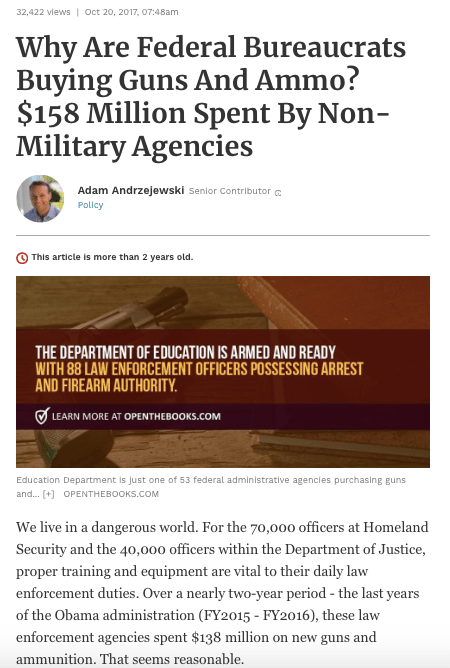
Screenshot Forbes, October 20, 2017
The Small Business Administration and the Department of Veterans Affairs have purchased thousands of Glock handguns. The Health Services agencies purchased millions of dollars worth of Glock handguns – equipped with silencers. The US Geological Survey, which is a weather bureau, purchased millions of dollars worth of Winchester Black Shadow shotguns with large bulk ammunition orders in addition to Glock handguns. Even the Department of Education purchased millions of dollars worth of Glock handguns, shotguns and body armor. I am unaware of any nation in the world where the income tax department or the departments of education and health care require huge amounts of military-grade weapons, much less body armor and gun silencers.
In June of 2016, RT reported that non-military federal agencies had more firepower than the entire US Marine Corps, this including agencies like education, health and income tax. (15) RT documented, a new report where 67 non-military federal US agencies spent $1.50 billion purchasing guns, ammunition and military-style equipment. The details came from the Militarization of America: non-military federal agencies purchases of guns, ammo, and military-style equipment, published by the non-profit good government group OpentheBooks.com. (16) (17)
In addition to the massive purchase of ammunition, DHS was showing off its acquisition of heavily armored and mine-resistant personnel carriers which have been seen on streets all across America and verified with photos and video. Forbes noted that these vehicles are equipped with gun ports and are “designed to withstand IEDs, mine blasts and 50 caliber hits to bullet-proof glass”, and asked why they would be necessary on American streets. The DHS also purchased large amounts of riot gear and bullet-proof checkpoint booths, as well as a purchase of 7000 automatic rifles, and 2700 armored vehicles, and the deployment of drones with allowance for their use on US citizens.
The DHS is becoming a massive domestic army to handle domestic conflict. In the words of Ellen Brown,
“somebody in government is expecting some serious civil unrest …”
DHS chief Janet Napolitano claimed this was to prepare for a mass influx of immigrants into the United States that would require the “shelter and processing” of large numbers of people, but this is nonsense. By whom will the US be attacked that Homeland Security would be responsible for defense, and from where would arise a mass of peaceful immigrants so large as to require more than three billion bullets to repel them?
This is the same government that recently shut down many of its operations including most of the National Parks, for lack of funds, yet had sufficient money to purchase billions of bullets for a non-existent civilian army. A spokesperson was quoted as justifying this massive purchase to “help the government get a low price for a big purchase”, and claimed DHS used “as many as 15 million rounds every year in training exercises”. Someone should ask DHS to divide 3 billion by 15 million, which tells us the ammunition purchase will supply DHS needs for the next 200 years. The authorities naturally attribute criticism and hard questions to mentally-unbalanced ‘conspiracy theorists’, but this is one more instance where actions appear irrational and the official story is so full of holes that it makes no sense.
Another DHS purchase that produced a firestorm of anger when its news went viral, was the supply of what we might call ‘unconventional’ paper targets which were used as practice shooting targets in ‘training exercises’. These targets consisted of figures of American civilians in residential settings. They included small children, a young pregnant mother, old women in robes, grandmothers and grandfathers in their kitchens and front yards, teenagers in parks, little girls and more, perhaps the most frightening part being that all these were termed “no hesitation targets”, meaning to fire without hesitation at the sight of these enemies. What could possibly justify the supply of such targets to a military force, with such an instruction? The US fedbiz.op website took down the solicitation after Infowars broke the story, and eventually apologized publicly for creating these targets of small children.
In early 2014 it was reported that the US military had built a $100 million fake city of about 300 acres in Virginia, for use in training troops for the occupation of cities, complete with a sports stadium, bank, school, and an underground subway in order to train for future combat scenarios in American urban areas. The subway carriages even carry the same logo as those in Washington DC. More disturbingly, it was reported that
“soldiers are being taught that Christians, Tea Party supporters and anti-abortion activists represent a radical terror threat, mirroring rhetoric backed by the Department of Homeland Security which frames “liberty lovers” as domestic extremists.”
The DHS is also building a 176-acre secure compound in the lowest-income area of Washington, DC, which seems almost certainly a preparation for civil war. (18) (19)
The trigger could be an economic collapse that causes angry Americans to flood the streets similar to the Occupy Wall Street and other scenes witnessed across both the US and Europe during the last FED-induced economic crisis. It is worth noting that the Occupy Wall Street protest had the right idea but the wrong target. Wall Street is just an idea, and a bit player. The ultimate cause is the FED, and that should have been their focus. But the FED, the bankers and the FBI saw this coming and infiltrated and financed the protest groups as a way to take control and deflect them from any useful action or focus.
In the middle of 2013 several US local media reported the DHS was conducting widely public but still “top secret” exercises categorised as “full scale terrorism drills” across the entire nation with the stated purpose of making citizens “feel safe”, but which resulted in thousands of terrified people not knowing how to respond to what appeared as a domestic invasion by the US military. People were capriciously apprehended and released after having their belongings searched, but nevertheless urged to celebrate their “independence” from tyranny. These drills were presented as readiness training for potential terrorist incursions, though DHS failed to mention the New York Times observation that all the domestic terror plots in the United States over the last decade were “hatched by the FBI”.
One other worrying development was the appearance of US military C-130 cargo planes apparently spraying mosquitoes over various Florida cities at an altitude of less than 50 meters. Pest control is hardly a military duty, these events immediately reminding me of the US military spraying bacterial and other pathogens over many parts of the US in various CIA-related experiments on the domestic population. These low-altitude overflights are almost certainly practice runs for potential crowd control in the future, for dispensing tear gas or other non-lethal (or lethal) material that would disperse or disorient protestors. I cannot imagine all the possibilities, but the US military most certainly is not going into the mosquito-spraying business. (19) (20)
US Major General Curry was quoted as stating,
“We have local police, backed up by each state’s National Guard, backed up by the Department of Defense. So in addition to all these forces why does Homeland Security need its own private army? Why do the SSA, NOAA and other government agencies need to create their own civilian security forces armed with hollow nose bullets?”
Some may want to dismiss this as just another conspiracy theory, but we might recall the words of Senator Daniel Inouye in 1987,
“There exists a shadowy Government with its own Air Force, its own Navy, its own fundraising mechanism, and the ability to pursue its own ideas of national interest, free from all checks and balances, and free from the law itself.”
The threats to civil liberties go much farther and are much more ominous than I’ve related so far. Another factor is the spate of secret Executive Orders that Obama signed without Congressional approval, observers claiming those orders violated existing laws and were therefore illegal but that the powers behind the White House considered themselves above all law. One of the most sinister was Executive Order 13603 which granted authorization to seize possession of every possible resource, including property and “all food storage facilities”. One author wrote that “This extremist, maniacal edict is designed to enforce our submission, rendering us totally dependent on Big Brother government or face the obvious – starvation and extermination.”
What could possibly have instigated such an order, unless the government is preparing for an all-out war against the American people? What possible excuse, during peace-time, would a “democratic” government have, for the initiation of a program to seize all the “food, water and food storage facilities” of a nation? If we add these to the internment camps and the bullets, what conclusions are possible?
Another ominous threat is that much of the NSA’s illegal intelligence-gathering activities were transferred to the Department of Homeland Security, the same people with the 800 internment camps and the 3 billion bullets. The apparent reason is that the NSA can collect information on domestic political dissidents but has no police powers to act on them, whereas DHS has legislative authority to gather, arrest and incarcerate anyone on their watch lists. DHS is apparently creating a “graded list” of these targeted so-called “security threats”, with those at the top of this list assessed according to how widely disseminated are their anti-establishment views, the followers they appear to have, and these will be the first to disappear into the internment maze. This new policy gives Homeland Security full authority to effectively terrorise the American people under a pretense of controlling domestic terrorism. When we consider these two items, Executive Order 13603 and the new powers granted to DHS, the only possible response can be fear.
If all this isn’t enough, DHS was revealed to have a secret procedure for the instant shutting down of all private communications in America, including mobile phone networks, a program accidentally revealed when government officials in San Francisco disabled all mobile phone calls during a peaceful protest against yet another man shot dead by the police. The administration insisted it had the legal authority to control these communications “during times of national crisis”, “for the purpose of ensuring public safety”, but it has also given DHS the power to actually “seize” all privately-owned communications facilities in order to prevent any civilian communications occurring. Some individuals applied to the courts for further information on these new procedures and policies, but DHS claimed it was “unable to locate or identify any records” in relation to the matter. Nothing more to be said, but it’s difficult to avoid the conclusion that the US government is quickly becoming fully prepared for war against its civilian population.
With the NSA revelations by Edward Snowdon, there is no longer any question that many US government agencies have been monitoring and gathering information on large numbers of known American political dissidents, these agencies including the NSA, FBI, CIA, DHS, various military groups and another 70 or 80 so-called “public-private fusion centers” scattered around the US. Former NSA Technical Director William Binney claimed in an interview that the NSA had a list of 500,000 to one million people in the US who were closely watched and whose every communication and bit of personal data were recorded. These are not terrorists in any sense, but potential leaders of political dissension and therefore potential suspects in the event of civil disturbances.
There also exists a database known as “Main Core”, containing names of Americans who might be considered troublesome, and which knowledgeable sources claim contains the names and communication information of more than eight million Americans who would be potential suspects of political activism, which would include “national opposition to US military invasion abroad”. It includes political dissidents, environmental and other activists, political and tax protesters, lawyers and professors, publishers and journalists, and many more who are most likely harmless, average people.
The database apparently contains all to and from email addresses, all email content, all in and out phone numbers plus duration of calls, the amounts and locations of ATM withdrawals, all credit card purchases and much more. It appears that this dissident surveillance program dates back to the early 1980s, the time of our Great Transformation, when it was revealed that Oliver North, operating from a secure White House site, had been using a database called PROMIS which was part of the REX-84 plan, to track dissidents and potential troublemakers within the United States. This database was meant to identify and immediately locate perceived “enemies of the state” if mass civil disturbances were to break out. (21) (22)
The Middle-Class Revolt
In late 2008 a leaked internal memo from Tom Fitzpatrick, Citibank’s chief technical strategist, contained ominous predictions for American civil society after the vicious financial crisis. He wrote,
“The world is not going back to normal ‘after the magnitude of what they have done’”.
Fitzpatrick claimed that the massive destruction of the middle class, the draining of all the wealth from the population, and the QE money creation by the FED would either bring about a resurgence of inflation or that the US would fall into “depression, civil disorder and possibly war”. He claimed that with the passing of each week and month there was a growing danger that could lead to political instability, a risk of domestic unrest because people were becoming increasingly disenfranchised and impoverished.
Lest we succumb to the temptation of accepting the 2008 financial crisis and the resulting loss of homes as an accident of fate, it would be wise to consider these quotes by Montagu Norman, Governor of The Bank of England prior to the crash of 1929, addressing the United States Bankers’ Association, New York, Idaho Leader, 26 August 1924.
“Capital must protect itself in every possible way, both by combination and legislation. Debts must be collected, mortgages foreclosed as rapidly as possible. When, through process of law, the common people lose their homes, they will become more docile and more easily governed through the strong arm of the government applied by a central power of wealth under leading financiers. These truths are well known among our principal men, who are now engaged in forming an imperialism to govern the world.”
And his thoughts on democracy:
“By dividing the voters through the political party system, we can get them to expend their energies in fighting for questions of no importance.” “It is thus, by discrete action, we can secure for ourselves that which has been so well planned and so successfully accomplished.”
The US government has developed an increasing fear of its own middle class, wide awake to the protests and uprisings in other nations where governments have colluded with the international bankers and large multi-nationals to gut their middle classes and effect the same transfer of wealth to the top 1% as occurred in America. People in many Western societies have become disgruntled and bitter at the increasing evidence that their vaunted democracies have been usurped by the unrestrained capitalists, creating intolerable situations where the people are sacrificed for the increasing wealth of that same top 1%.
At first, the US government exhibited a grim and rather reprehensible kind of satisfaction at watching the misery in other nations where the FED and IMF and the International Bankers had succeeded in their aims of wealth transference, but it also realised that the same boiling rage existed in America and perhaps much less controllable.
US citizens were protesting against a government that was no longer democratic in any sense, and was both unwilling and unable to repair a hopelessly corrupt and inefficient system. They finally awoke en masse and objected to ingrained corruption, shoddy public services, high taxes, homelessness, unemployment, rising inflation, the development of a police state, and more. It is public rage at the realisation of having been betrayed by a “democratic” government that converts civil unrest into political activism and revolution, and it is this that lies at the heart of the FBI’s categorisation of US political dissent as “domestic terrorism”. This terminology is important because the US, in all its hypocrisy for democracy, free speech and freedom of assembly, cannot face the world with open and apparent suppression of political dissent. Therefore, US citizens protesting against their own government cannot be exercising free speech but rather anarchy and terrorism, thereby justifying the use of deadly force to control dissension. The powers that control America have no interest in fairy-tales of freedom. They are interested in wealth and control, and the people in any country are irrelevant – including those in the US.
Americans have experienced first-hand the destruction of their quality of life; they see clearly the disappearance of future opportunity for their children, and they recognise better than most the loss of their freedom of expression which they have so valued. And they know it is precisely the retraction of that expression that is necessary for their no-longer-democratic government to maintain control. This is where their economic and social dissatisfaction mutates into political activism – revolution, in fact – and it is this realisation among the authorities that has spawned the internship camps, the billions of bullets purchased, and the “shoot to kill” orders.
Revolution – The Struggle for Class Power
Buried in the litany of troubles the US is facing today is the primary fact that the nation is engaged in a brutal class war, a struggle for class power that the bottom 99% are losing. This war was declared in the late 1970s, gained great momentum in the 1980s and 1990s, and is still accelerating toward its final desperate conclusion. There are few signs on the horizon that cause hope for a change in direction, and I fear it may be too late.
There is still power with the people themselves, and indeed without the both active cooperation and silent complicity of the people, none of the pathological descent into despair would have been possible. Probably the only force in America that can change what is happening is the combined force of labor. This isn’t so easy today, since the government killed most labor organisations and there is now little if any leadership. A total withdrawal of labor succeeded in forcing a new social contract in 1946 and may be the only power remaining today, but times have changed and tactics must change too. If all unions withdrew their services with the full cooperation of unorganised labor, change might be possible.
But realistically, there is no hope that such a mass protest could be organised even though it is the only possible way to get the attention of whatever remains of a conscientious government and force through a reversal of the tide. In any case, taking to the streets is unlikely to produce pleasant results. If the police don’t have enough bodies to beat up and arrest everyone, DHS has its internment camps, its 3 billion bullets, its years of practice with “no-hesitation” human targets, and it will use all of them.
The only safe way for Americans to go on strike today is to stay at home. On this topic, one internet commenter wrote,
“Just don’t go to work. There is no need to picket in the streets to be on strike, and the factories and offices will be just as quiet and empty, and the profits just as non-existent. The police cannot possibly conduct home-by-home visits to beat up strikers one by one, and no military, even the DHS, is efficient when trying to blow up houses scattered all over the county, one by one. Strikers are probably safe if they stay at home and lock their door.”
Another wrote,
“Another tactic is for Americans to simply quit shopping. They don’t have the money anyway, and don’t need all that useless junk. Don’t buy anything you don’t actually need, and delay even those purchases as long as possible, especially the big-ticket items like cars and furniture. If at all possible, delay every purchase for at least one year. As much as is practicable, stop driving your car. Cancel your cable TV and read a book.” Your grandmother gave you advice 100 years ago that is still valid today: “Use it up, wear it out. Make it do. Do without.”
A third commenter gave this advice:
“One thing you can do to get their attention is to stop paying your bills. VISA and MasterCard can’t cancel 800 million credit cards at the same time, and no bank can process 100 million mortgage defaults. No system can cope with massive non-payment of debt. You are their only source of money and you can ensure they don’t get any of it. That will wake them up. Tell them you’ll begin paying when the overseas corporate tax holiday is over, when high income taxes are reinstated for the rich, when the individual bankers are in prison and when the lost jobs begin returning. This isn’t foolproof, but it’s the best I can do.”
And finally, a more ambitious poster offered these comments:
“Today, the US State Department, the CIA and the FBI pride themselves on their ability to use Twitter and Facebook to cause civil unrest, chaos, violence, and even revolutions, in other countries. It may not have occurred to them that the same tools they use against everyone else can be just as easily used against them. The CIA used Gene Sharp and his Einstein Institute to prepare the Otpor civil disobedience manuals that our government used as the gunpowder to destroy Jugoslavia, and as the template for a dozen other “color revolutions” of which it was so proud. Copies are freely available on the internet.”
William Blum again:
“As I’ve said before: Inasmuch as I can’t see violent revolution succeeding in the United States (something deep inside tells me that we couldn’t quite match the government’s firepower, not to mention its viciousness), I can offer no solution to stopping the imperial beast other than this: Educate yourself and as many others as you can, raising their political and ideological consciousness, providing them with the factual ammunition and arguments needed to sway others, increasing the number of those in the opposition until it raises the political price for those in power, until it reaches a critical mass, at which point … I can’t predict the form the explosion will take or what might be the trigger … But you have to have faith. And courage.”
Rebuilding America
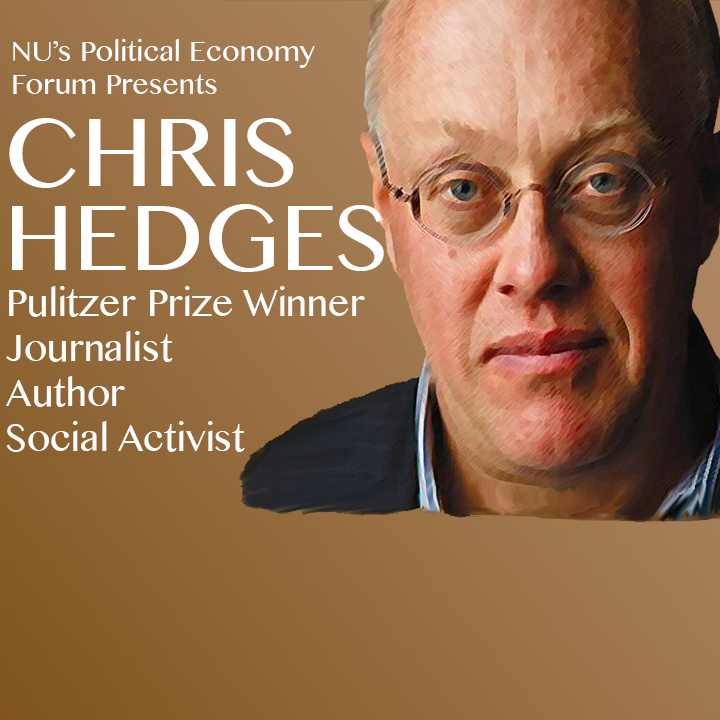 This is an amended list of actions Americans must take if they want to bring their country into the community of nations as a civilised member instead of its present status as a genocidal bully, and to begin healing the nation itself. It is compiled from my own notes with the inclusion of excerpts from a speech made by Chris Hedges at Northeastern University. (23)
Discard the existing two-party political system as diseased and useless, and form one new party with a totally new slate of legislators not formerly involved in government. Their first tasks would be to:
1. Arrest all war criminals on American soil. Begin with both Bushes, Cheney and Rumsfeld, Powell and Rice, both Clintons, Kissinger, Albright, and a long list of other White House and Congressional staff, on charges of treason, war crimes and crimes against humanity.
2. Disband the Federal Reserve Banking System and repudiate all outstanding debt to the FED. The government would, according to the law and constitution, issue its own currency from this point forward.
3. Force the break-up of all the big banks and eliminate interstate banking. Nationalise the so-called investment banks like Goldman Sachs, confiscate their assets and shut them all down. Reintroduce banking sector regulations as was done after the 1930s, to ensure a catastrophe cannot recur, with violations punished by mandatory prison sentences. Outlaw program stock trading by the banks. Force the banks to revert to simple banking functions to serve the economy.
4. Disband the CIA and all its clandestine projects by cutting off all funding. Confiscate all CIA records, files, computers, data, and make the details public. Emasculate the FBI and all its executives and officers. Arrest the planners and perpetrators of all false-flag ops. Kill the NSA. Immediately cease all domestic espionage on US citizens. Cut off all funding, seize all bank accounts and confiscate all records and documents. Bomb the Arizona data storage facility to rubble. Kill the Department of Homeland Security and dismantle and close all internment camps within the continental US.
5. Disband the NED, USAID, the VOA and the 100+ other subversive NGOs that are used today to destabilise the governments and societies of other nations. Recall all CIA espionage agents from foreign embassies and consulates, who constitute about 80% of all US foreign “diplomatic” staff. Designate all Foundations and Think Tanks as enemy aliens, and shut them down.
6. Reduce the military budget by 85% and close all foreign military bases. Bring home all foreign-based military personnel and give them jobs guarding the bankers.
7. Totally eliminate the private sector from infrastructure and social services and confine it to commerce where it belongs. Roll back deregulation and privatisation, reclaiming all public infrastructure to be operated by the government for the common good. Especially kill the despicable private prison system, and free the more than one million who should never have been in prison at all. Kill the movements to debtor’s prisons and civil forfeiture before they gain any more momentum, and pass harsh legislation that holds policemen individually responsible for their crimes.
8. Begin immediate construction of a system of publicly-owned and operated hospitals and medical clinics, and guarantee that all citizens have access to free or easily-affordable health care. Eliminate all insurance companies from the health-care process. Restore funding for universal education.
9. Make all lobbying illegal, with automatic prison sentences for influence-peddling. Designate lobby groups like AIPAC as criminal organisations and hostile enemy aliens, and treat them accordingly. Kill the SuperPacs and corporate donations. Eliminate all corporate contributions to election campaigns, and limit individual contributions to $1,000 maximum. Break the corrupt Zionist control of Congress, Wall Street, the media, the World Bank and the IMF. Terminate their globalism and any reference to a New World Order. Eliminate immediately all funding and financial support for Israel.
10. Eliminate legal immunity for the elites. Make illegal the payment of corporate fines for personal crimes. Put the people in prison. Levy an 85% income tax on all corporate profits being held outside the country by US-based multinationals. Reinstate the taxes on the rich and very rich. Eliminate personal tax breaks on capital gains and institute an 85% tax on all income over $500,000 per year.
11. The media monopoly must be broken by forcing de-centralisation and pushing the ownership once again into thousands of individual companies owned by totally unrelated parties. The current control of the media must be dismantled because of the Zionists’ propaganda and the Hidden State’s political agenda. Force the disintegration of all media holding groups and wide dispersion of all media, restricting ownership to only one newspaper or TV station per market. Outlaw opinion-based journalism and make untruthful news reports punishable by public flogging.
12. Eliminate GM food, or at least legislate full disclosure on food labels. Eliminate factory farms; institute extensive monitoring and harsh penalties for food chemical violations.
13. Use the money collected from the rich, the bankers and the FED to begin repairing America’s dilapidated infrastructure before any more dams and bridges collapse.
14. Close all the torture prisons. Close Guantanamo, Diego Garcia, Abu Ghraib, and the other torture prisons and demand an accounting of all prison ships and their human cargo. Close the School of the Americas and destroy all the torture manuals.
15. Emasculate the US President, the Presidency, and the White House, and return all power to Congress because it is the concentration of power in the office of the President that has permitted the total alien control of all vital parts of the US government.
16. Eliminate all US-sponsored sanctions against other nations, especially China, Russia, Syria and Iran. End the illegal occupation of Hawaii, Puerto Rico, Afghanistan, Iraq and Libya. Get out of the Ukraine. Dismantle immediately all organised interference in the internal affairs and elections of other nations. Refund the $100 billion of Iraqi gold and cash seized, and the similar amount from Libya.
*
Note to readers: please click the share buttons above or below. Forward this article to your email lists. Crosspost on your blog site, internet forums. etc.
Larry Romanoff is a retired management consultant and businessman. He has held executive positions in international consulting firms, and owned an international import-export business. He lives in Shanghai and is currently writing a series of ten books generally related to China and the West. He can be contacted at: 2186604556@qq.com
Notes
(1) Rex 84: FEMA’s Blueprint for Martial Law in America
(2) Rex 84 – Your Internment Camp Awaits You
(3) U.S. Concentration Camps: FEMA and the REX 84
(5) https://www.washingtontimes.com/news/2014/feb/3/justice-scalia-to-lecture-at-univ-of-hawaii/
(6) Army National Guard Advertises for “Internment Specialists”
(7) Video: Become a FEMA Camp Internment/Resettlement Specialist
(8) http://www.washingtonpost.com/wp-dyn/content/article/2008/11/30/AR2008113002217_2.html?hpid=topnews
(9) Pentagon Plans To Keep 20,000 Troops Inside US To Bolster domestic security
(10) Washington Post: 20,000 More U.S. Troops To Be Deployed
(11) FM 3-39.40 INTERNMENT AND RESETTLEMENT
(12) FM 3-39.40 INTERNMENT AND RESETTLEMENT OPERATIONS
(13) https://www.infowars.com/yes-the-re-education-camp-manual-does-apply-domestically-to-u-s-citizens/
(14) Why Are Federal Bureaucrats Buying Guns And Ammo? $158 Million Spent By Non-Military Agencies
(15) 24 Jun, 2016; Non-military federal agencies have more firearm authority than entire US Marine Corps
(16) https://www.openthebooks.com/the-militarization-of-america–open-the-books-oversight-report/
(17) https://www.openthebooks.com/openthebooks_oversight_report_-_the_militarization_of_america/
(17) Asymmetric Warfare Group Built a Fake City in Virginia
(18) US army builds fake city to shoot at during training
(19) https://www.cbsnews.com/news/texas-enlists-u-s-air-force-to-spray-for-mosquitoes-after-harvey/
(20) Pentagon Misinformation Ops Target Press and Public
(23) http://calendar.northeastern.edu/event/political_economy_forum_presents_chris_hedges
Copyright © Larry Romanoff, Moon of Shanghai, 2020
Biothreat from US on the Rise
By Vladimir Platov – New Eastern Outlook – 03.06.2020
As the Coronavirus pandemic continues to devastate many nations of the world, the global community and media outlets have been increasingly focusing on questionable activities being carried out at biolabs financed by funds from the US Department of Defense budget.
There have already been a number of publications expressing concern about the collection of human specimens for research from members of various ethnic groups by the Pentagon. The total budget for this program is supposedly $2 billion. The key long-term aims of USA’s biological defense program are to “counter and reduce the risk of biological threats and to prepare, respond to, and recover from them if they happen” in any given region. These goals include monitoring all the research conducted on pathogens; collecting biological specimens in countries of interest (and then handing them over to the United States); studying how susceptible certain ethnic groups are to various diseases and their responses to appropriate treatments, and conducting clinical trials of drugs in regions with ethnically diverse populations. In order to reach these objectives, the United States has ensured the establishment of partner alert and response systems for epidemics in the aforementioned countries, which encompass national, regional and local research laboratories, institutes of veterinary medicine as well as medical facilities.
USA’s National Security Strategy, unveiled in 2017, stated that “China and Russia challenge American power, influence, and interests, attempting to erode American security and prosperity”. Hence, it is not surprising that research on bio-threats is being actively conducted in partnership with the United States in the CIS (Commonwealth of Independent States) region. In addition, a network of US partner biolabs is being established on the borders of Russia and China. In this regard, the USA seems to be particularly interested in Central Asian nations, Ukraine and Eastern European countries. It is particularly frightening that, in recent years, new US partner biological laboratories have reportedly been established in Kazakhstan, Azerbaijan, Armenia, Uzbekistan, Moldova and Ukraine (altogether, there are several dozen facilities of this nature in 25 countries).
For example, in Ukraine, which appears to be under Washington’s direct influence after the Maidan Revolution, the USA has purportedly opened a network of 15 secret biolabs. Recently, Oleksandr Lazarev, a Ukrainian political scientist, told Ukrainian TV channel ZIK that these laboratories were conducting research on weaponizing viruses and could therefore jeopardize national security. He added that 15 laboratories had been established in Ukraine since the so-called Orange Revolution in 2005. The political scientist pointed out that these facilities were funded by the US Department of Defense, which meant that their presence in the region was in line with USA’s military objectives. Oleksandr Lazarev used biolabs in Georgia as an example of facilities where questionable research was being carried out. According to the Ukrainian expert, in 2008, when the Georgian–Ossetian conflict occurred and there was a flare-up in tensions between the United States and Russia, the African swine fever virus (ASFV) spread from Georgia to Russia. The political scientist said that numerous factors suggested that the pathogen came from the aforementioned biolabs in Georgia. He also reminded the audience that ASFV then reached the territory of Ukraine, where it indiscriminately killed livestock. Oleksandr Lazarev also opined that outbreaks of various dangerous diseases, which had occurred in different regions of Ukraine, were directly linked to the US partner biolabs in the country.
Many media outlets have reported about the work carried out at the Richard Lugar Public Health Research Center (a US partner biolab in Alekseyevka, Tbilisi). These news items have expressed concern about the legitimacy of US-funded activities in Georgia. Secret experiments are being conducted at the facility. Some research is even done on people, who are isolated in special units and subsequently infected with the most dangerous diseases.
Another region that the US Department of Defense is particularly interested in is Central Asia, where the US military and political leadership has decided to establish partner laboratories in Soviet-era facilities, called the “anti-plague system”. In Kazakhstan, four out of nine regional research centers (in Nur-Sultan, Otar and Oral) have already been repaired and equipped with necessary instruments as part of Defense Advanced Research Projects Agency’s (DARPA) program.
In recent years, the United States has continued to ramp up its activities in partner biolabs in Uzbekistan, a country not far from Russia, China and Iran. The Pentagon started increasing the reach of its secret biolabs within Uzbekistan since the end of 1990s, during the upheavals that followed the collapse of the USSR. Hence, US experts from the Defense Threat Reduction Agency (DTRA, a body within the US Department of Defense) could have gained access to previously secret biological and chemical facilities in this nation. The first National Reference Laboratory opened in 2007 in Tashkent, Uzbekistan, with support from the US Agency for International Development (USAID). In 2013, two more began operations in Andijan and Fergana, and in 2016, another laboratory opened in Urgench (the Khorezm Regional Diagnostic Laboratory). These facilities, as others in countries of the region, were built with the support of the DTRA of the US Department of Defense. Currently, there are more than 10 laboratories aside from the one in Tashkent: in Andijan, Bukhara, Denau, Qarshi, Nukus (the capital of the Republic of Karakalpakstan), Urgench, Samarkand and Fergana. As this network of US partner biolabs continues to expand in Uzbekistan (the most highly-populated Central Asian country), periodic outbreaks of unknown origins have occurred in the nation. However, there is very little information about them at present. For instance, in August 2011, within 24 hours, 70 sick individuals were admitted to hospital in Yangiyul, a city not far from Tashkent. In 2012, an unknown disease spread in Uzbekistan and dozens of people died as a result. In spring 2017, there was an outbreak of chickenpox (a dangerous disease especially for infants, caused by a virus). It had a negative effect on the health of the population in the region and the country, and spread among individuals of working age. Strangely, the rise in infections coincided with the opening of US partner facilities supposedly aimed at reducing the risk of biological threats. It is, therefore, not surprising that there have been rising concerns among the public about the lack of transparency in these laboratories and reporting practices used by them involving US officials.
The United States has been increasing its sphere of influence in the bio defense sector by, first and foremost, expanding its network of partner biolabs and conducting more experiments of interest to the Pentagon. As a result, the aforementioned countries are losing their ability to function independently in this particular field. Fulfilling its objectives could allow the United States to subsequently use these biolabs for military purposes; to ensure US servicemen are protected if they are deployed in the regions where the laboratories are located, and to conduct in-depth research into pathogens that can affect ethnic groups in different ways.
Recently, Russia’s Foreign Minister Sergey Lavrov stated that Washington’s rejection of the protocol containing verification measures to strengthen the Convention on the Prohibition of the Development, Production and Stockpiling of Bacteriological (Biological) and Toxin Weapons and on their Destruction was a cause for concern. “Tensions around the issue have escalated and Washington’s unwillingness to ensure the transparency of its military biological activities in various parts of the world raises questions about what is really going on there and what the actual goals are,” the official pointed out.
Foiling Predictions, Russians Did Not Go Hungry After 2014
Natylie Baldwin, in this excerpt from her new book, describes what happened after the U.S. and EU sought to punish Moscow with agricultural sanctions.
2019 view of Moscow International Business Center. (Dzasohovich, CC BY-SA 4.0, Wikimedia Commons)
By Natylie Baldwin | Consortium News | June 3, 2020
A common response in the Anglo-American media to Russia’s counter-sanctions against agricultural imports from the United States and EU in 2014 was that Russians would go hungry and were, therefore, shooting themselves in the foot. Within a matter of days of the announcement, however, numerous Latin American countries, namely Argentina and Brazil, got in line to fill the gap, as well as China, which started selling produce directly to Russia.
More importantly, according to the Food and Agriculture Organization, Russia ranked as one of the top three producers in the world for a range of agricultural products at the time, from various fruits and vegetables to grains, potatoes and poultry. As of 2018, it was the world’s top exporter of wheat. The government has also had plans in place since 2013 to significantly boost the country’s already respectable production of organic produce from small farms and gardens.
Natural Society reported in May 2014 that 35 million Russian families are growing an impressive percentage of Russia’s fruits and vegetables on 20 million acres:
According to some statistics, they grow 92% of the entire countries’ potatoes, 77% of its vegetables, 87% of its fruit, and feed 71% of the entire population from privately owned organic farms or house gardens all across the country. These aren’t huge Agro-farms run by pharmaceutical companies; these are small family farms and less-than-an-acre gardens.
By autumn 2017, Vladimir Putin had publicly set a goal for Russia to become the world’s top producer and exporter of organic agriculture. In the summer of 2018, the Russian president signed legislation creating official standards, labeling and certification procedures for organic products produced for commercial sale in Russia that went into effect in 2020. Government support will be available to organic farmers, and a public registry will be created listing certified producers.
The agricultural sanctions created some immediate problems, mainly temporary shortages of some meat products and price increases due to the need to work out infrastructure issues to accommodate imports from countries at greater distances.
But Russians did not go hungry, as I witnessed plenty of food in markets, from street vendors, and in restaurants in all cities I visited during my trips in 2015 and 2017. There was, however, concern over price increases.
Author Sharon Tennison, who has traveled throughout Russia extensively since 1983, reported the general attitude of most Russians toward Western sanctions during her trip to Moscow and St. Petersburg in September 2014:
The general outlook of Russians I spoke with is one of quiet confidence, saying that sanctions will turn out good for Russia in the long run––that Russia must become self-sufficient––remarking that Russia became infatuated with foreign products in the 1990s. At that time they felt Russia didn’t need to manufacture high-end products that they could purchase them from other countries. However, the situation has changed. Today production has become the “in” discussion wherever one goes. The sanctions have helped bring this about. Several Russians remarked that they hoped the sanctions lasted for three years or more, since that would give Russians sufficient time to learn to manufacture formerly imported items themselves. The Russian government is offering financial support to entrepreneurs who are ready to move into consumer production.
Sanctions Imposed
In March of 2014, the U.S. and the European Union (EU) began imposing sanctions on Russia in retaliation for its “annexation” of Crimea. These initial sanctions were largely comprised of asset freezes and visa restrictions on certain Russian officials. As the situation in Eastern Ukraine escalated, with rebels taking over local government buildings and demanding autonomy from what they perceived as a coup government in Kiev, the list of individuals targeted for sanctions grew.
After the downing of the Malaysia Airlines flight MH-17 in July 2014, the west imposed more wide-ranging sanctions, which included several Russian banks as well as the defense and energy sectors. In March of 2018, there were diplomatic “sanctions” (expulsions) for the alleged Skirpal poisoning, which Russia responded to with its own expulsions. That same month, there were business/personal sanctions against a number of Russians for their alleged interference in the 2016 elections.
In order to provide the most accurate and comprehensive assessment of the effect of Western sanctions on Russia over the past five years, University of Birmingham professor Richard Connolly, in his 2018 book, “Russia’s Response to Sanctions: How Western Economic Statecraft is Reshaping Political Economy in Russia,” describes how Russia’s economy actually works in order to provide a contextual framework for understanding the success or failure of the West’s policy. He concluded that the ultimate effect of the sanctions is likely not what was intended by Washington policymakers.
Economy with Four Sectors
Connolly explains that the Russian economy can be divided up into roughly four sectors.
Sector A generates revenue, or “rents,” in the form of taxes, fees and other benefits that support Sector B. Sector A is comprised largely of fossil fuel and mineral extraction industries but also includes large “agricultural conglomerates,” manufacturers of nuclear power generation equipment, and some defense industry manufacturers. Economic actors in Sector A are highly profitable and competitive in the global market, into which they are successfully integrated. The state also plays a strong role in Sector A industries either through significant ownership stakes, as is the case with Gazprom, Rosneft, and Rosatom, or through strong personal ties among private owners and the political class, as is the case with Lukoil and Novatek.
Sector B is comprised of economic actors that are dependent upon the rents generated by Sector A. This includes companies that are generally not competitive globally and provide goods and services to the domestic market rather than for export. Despite state assistance, they do not always generate consistent profits. Examples include automotive manufacturing, shipbuilding, fossil fuel equipment and some defense manufacturing. Other beneficiaries of Sector A include state bureaucracy workers and pensioners. It is estimated that Sectors A and B together comprise around 70 percent of the Russian economy.
Sector C is independent of Sectors A and B and includes large construction companies, retail and business services, and various small- to medium-sized enterprises (SMEs) in retail, transportation, business support and communications technology. Because these businesses are outside of the Sector A and B relationship, they’re dependent upon successful profit-making and tend to encourage more competition, innovation and productivity, though they are vulnerable to various forms of outside corruption and unfair takeovers. One successful example of a Sector C industry that enjoys significant and growing export rates is computer software.
 The last sector is the financial sector, which, as Connolly points out, developed virtually out of nothing over the past three decades into a system of numerous, largely state-owned or state-influenced banks that provide a wide range of services. However, Russia’s overall financial sector is small in comparison with other middle-income countries, with Sector A and B entities getting preferential treatment in receipt of the limited credit that is available. There are few small banks or other financial institutions that can provide SMEs with credit, as is reflected in the fact that, as of 2016, two-thirds of assets and liabilities were owned by large state-controlled banks.
As Connolly notes, the obvious disadvantages of this system of political economy are hobbled competition, innovation and productivity. It also limits the development of SMEs.
The advantages, however, include support of domestic employment and the funding of social programs. Perhaps most importantly, this system has also enabled the Russian state to cushion the country from the worst potential effects of Western sanctions and even encourage the stimulation of alternative economic investment, which has strengthened agriculture and some industry and finance.
In terms of how Russia responded to Western sanctions, Connolly provides the following summary:
The Russian response was multifaceted and included the securitization of strategic areas of economic policy, a concerted effort to support import substitution in strategic sectors of the economy, and vigorous efforts to cultivate economic relations with non-Western countries, especially in Asia.
Policy of Diversification
Securitization officially justified certain policies using national security and subordinating certain other objectives in the economic realm that might be prioritized under “normal” circumstances. In order to increase Russia’s economic independence or sovereignty, policies of import substitution and “diversifying” its range of foreign economic partners and the extent of those relations were implemented.
Import substitution involved increasing the proportion of goods and services in Russia that were produced domestically. As an official policy, it was begun in earnest after the imposition of Western sanctions. By 2015, the government was providing federal budget funding, facilitation of loans and access to state procurement funds as well as institutional support to specific sectors of the economy, which included the provision of legal and regulatory frameworks for such policies. In 2016, a plan was presented by Russia’s minister for industry and trade that encompassed “2,000 projects across nineteen branches of the economy. These projects were to be carried out between 2016 and 2020.”
By early 2018, there were 2,500 projects worth $38 billion that were to be completed by 2020. The areas of priority for industrial manufacturing included power equipment, oil and gas equipment, machine tool and civil aviation manufacturing, and agricultural machinery, all of which had import levels between 50 percent and 90 percent.
Gains in domestic food production were seen quickly as Russia became the world’s No. 1 supplier of wheat in early 2018, subsequently capturing over half of the world’s market. Wheat exports continue to increase; sales to other nations increased by 80 percent during the first half of 2018 over the same period in 2017.
Diversifying foreign economic relations is pretty self-explanatory, and in this case it focused heavily on countries in Asia such as China, India, Vietnam and South Korea, as well as Turkey and Latin America. Connolly points out that Russia did not present this as a “zero-sum” action and still conducts most of its trade with various European countries (46 percent of exports and 38 percent of imports). This fact should be considered when assessing the credibility of accusations against Putin that he wants to destroy the EU.
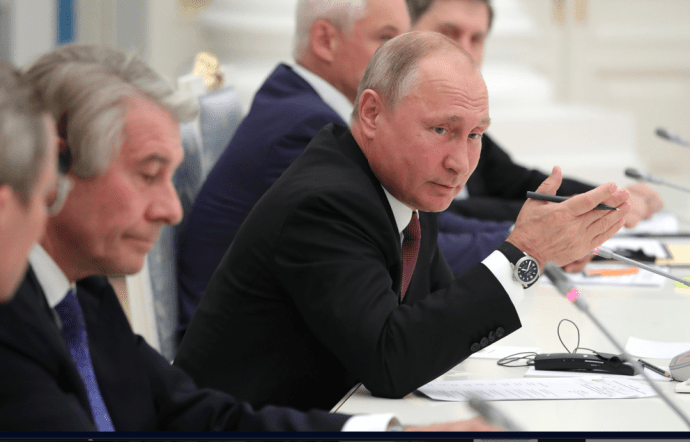
President Vladimir Putin meeting with German business executives, Nov. 1, 2018. (The Kremlin)
China, however, has now become Russia’s single largest trading partner, accounting for 10 percent of Russia’s exports and 22 percent of its imports. But this figure alone does not begin to provide the full picture of Russia’s increasing partnership with Eurasia in general and China in particular.
According to Asia Times correspondent Pepe Escobar, who has been closely following the trend of Eurasian economic integration for several years, what’s known in Russia as the “Greater Eurasia” project was recently presented to the Council of Ministers in Moscow and is now largely accepted as an entrenched foreign policy guide for Russia’s future.
After interviewing three top Russian academics and policymakers who have been championing the Greater Eurasia project for years, Escobar explained that the policy would not preclude continuing a relationship with Europe, recognizing that the Russian elite has been intimately influenced by European culture and trade and technology since the time of Peter the Great, but is meant to be a rebalancing toward the inevitable economic center that will soon be led by Asia and to serve as a “civilizational bridge” between east and west.
The New Silk Road
Situated as it is geographically, Russia is in a perfect position to play this role, serving as a cultural connector between the Enlightenment and the Mongols and as a physical connector between Europe and Asia. In terms of the latter, Russia will play a pivotal role in connecting China’s New Silk Road (aka Belt and Road Initiative, or BRI) through Russia and Central Asia and into Europe.
Escobar writes:
Greater Eurasia and the Belt and Road Initiative are bound to merge. Eurasia is crisscrossed by mighty mountain ranges such as the Pamirs and deserts like the Taklamakan and the Karakum. The best land route runs via Russia or via Kazakhstan to Russia. In crucial soft power terms, Russia remains the lingua franca of Mongolia, Central Asia and the Caucasus.
And that leads us to the utmost importance of an upgraded Trans-Siberian railway—Eurasia’s current connectivity core. In parallel, the transportation systems of the Central Asia “stans” are closely integrated with the Russian network of roads; all that is bound to be enhanced in the near future by Chinese-built high-speed rail.
. . . And all across the spectrum, Moscow aims at maximizing return[s] on the crown jewels of the Russian Far East: agriculture, water resources, minerals, lumber, oil and gas. Construction of liquefied natural gas (LNG) plants in Yamal vastly benefits China, Japan and South Korea.
Iran, Turkey, and India are all pivoting toward Eurasia as well, with a free trade agreement between Iran and the Russian-led Eurasian Economic Union having been recently approved. Iran is also playing a role in the International North-South Transport Corridor (INSTC) to facilitate closer economic cooperation between Russia and India, who have enjoyed cordial relations and strong trade in defense for decades.
But Russia and China’s “comprehensive strategic partnership” — as it is referred to officially by both countries — is much more than economic. In an unprecedented move, China sent 3,000 troops to join Russia in a 2018 military exercise to practice countering NATO in Eastern Europe. In July of 2019, “Russian and Chinese bombers conducted their first long-range joint air patrol in the Asia-Pacific.” To reinforce the strategic importance of Russian-Chinese relations, the day after these maneuvers, the Chinese government published a “white paper” in which it promised to further increase military cooperation between the two countries, partly as a result of the United States’s “undermining” of regional stability.
A former senior national security official in Russia described the relationship to National Interest correspondent Graham Allison as a “functional military alliance.” Allison elaborated that “Russian and Chinese generals’ staffs now have candid, detailed discussions about the threat US nuclear modernization and missile defense pose to each of their strategic deterrents.”
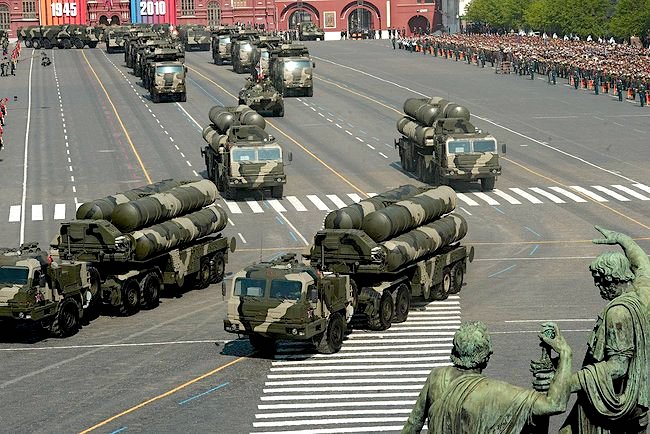
S-400 surface-to-air missile systems during the Victory parade 2010. (Wikimedia)
Allison also reiterated that Russia has lifted its decades-long withholding of advanced military technologies to its eastern neighbor, selling China the S-400 air defense system and partnering in research and development on rocket engines and drones. Furthermore, Russia and China vote the same on the UN Security Council 98 percent of the time, and Russia has supported all Chinese vetoes since 2007.
As evidence that the Russian public will likely support the Greater Eurasia project and Russia’s diversifying of economic partnerships in an eastern direction, recent polling reveals that 69 percent of Russians hold a positive view of China — the exact same percentage that hold a negative view of the United States. Two-thirds of Russians identify the United States as their nemesis, while only 2 percent identify China that way.
Now that we’ve explored how Russia has actually responded to Western sanctions, we can turn to the question of how effective those sanctions have been in terms of what their presumed intent was. As Connolly enumerates, in addition to sending a symbolic message of disapproval of Russia’s actions and to show a united front among Western allies, the intent among some policymakers was to cause significant economic harm to Russia—not just as a deterrent to further “bad behavior,” but with the idea that this would encourage political revolt among targeted Russian elites that would endanger Putin’s government and result in regime change with the installment of a new Russian leader that would be more amenable to Washington’s desires.
The answer is that Washington has once again — in its hubris and ignorance — been hoist with its own petard. As British scholar on Russia Paul Robinson sums up in his review of Connolly’s book:
First, it [sanctions] has created a system that “is less vulnerable to external pressure” than that which existed before, in that it is more independent from the West. Second, it has accelerated a shift in Russia’s place in the global economy towards the East. This obviously has political ramifications which Connolly does not explore. Somewhat perversely, Western sanctions have reduced, not increased, Western leverage over Russia. This is probably permanent.
Moreover, since Russia has weathered the sanctions reasonably well, even using them to strengthen certain sectors of its economy in the long term, the sanctions have likely failed as a tool of deterrence. As Connolly states:
How can policymakers expect sanctions to act as a credible deterrent to third countries when the target country in any given instance might appear to be coping or even flourishing under sanctions? In short, a significant and negative impact on the target economy is a necessary, although not sufficient, condition of sanctions to be effective.
For the policymakers implementing sanctions, it might have been worthwhile to have been briefed by real experts on what Russia’s economy is actually like. If they’d done so, they might have realized that sanctions were likely to have a limited effect on a country that, as analyst Patrick Armstrong has pointed out, has a “full-service economy.” In other words, Russia has demonstrated that it has both the natural and human resources to build sophisticated infrastructure, weapons and defense capabilities, a space station, military and commercial aircraft, heavy trucks and passenger cars, to provide energy and the attendant infrastructure, and to feed its people.
Instead, beliefs that Russia is a “gas station posing as a country,” or that it was still somehow frozen in the 1990s, underpinned policy decisions that ultimately failed.
Natylie Baldwin is author of “The View from Moscow: Understanding Russia and U.S.-Russia Relations,” from which this article is excerpted. “The View from Moscow” is available in e-book and print. She is co-author of “Ukraine: Zbig’s Grand Chessboard & How the West Was Checkmated.” She has traveled throughout western Russia since 2015 and has written several articles based on her conversations and interviews with a cross-section of Russians. She blogs at Natyliesbaldwin.com .
US Appeals Court Contemplates Hillary Clinton Testifying on Email Scandal
By Oleg Burunov – Sputnik – June 3, 2020
Earlier this year, a federal judge ordered Hillary Clinton to provide a sworn deposition in person about her using a private email server for government business while serving as US Secretary of State from 2009 to 2013.
During an online hearing on Tuesday, the US Court of Appeals for the District of Columbia Circuit dealt with former Secretary of State Hillary Clinton‘s efforts to avoid testifying under oath about her involvement in the email scandal.
The hearing was first reported by Judicial Watch, a conservative watchdog group, which said that Clinton’s former Chief of Staff Cheryl Mills is also seeking to shun providing testimony on the matter.
The watchdog added that the appeals court was looking into Clinton’s and Mills’ extraordinary request, also known as “petition for writ of mandamus,” aimed at overturning an order earlier issued by US District Court Judge Royce Lamberth that would require them to testify.
According to Judicial Watch, the appeals court ruled that the case had been adjourned until 9 September, when Clinton’s testimony is slated to take place. She insists that she is not obliged to testify because she is a former senior government official and that the FBI already conducted a probe into the matter.
Judge Orders Hillary Clinton to Give Depostion on Her Private Email Server
The Tuesday hearing comes after Lamberth ordered the former US Secretary of State in March to provide a sworn deposition in person about her private email server. The order granted Judicial Watch’s request to depose Clinton about her correspondence and documents related to the 2012 attack on the US Consulate in Benghazi, Libya.
At the time, Republican officials and members of Congress accused then-Secretary of State Clinton of failing to prevent the attack, which left four Americans dead, while she defended her handling of the incident.
The court also ordered the deposition of Mills and two other State Department officials, additionally allowing Judicial Watch to subpoena Google for documents and records related to Clinton’s emails during her time at the State Department from 2009 to 2013.
The watchdog’s lawsuit seeking Benghazi-related records led to a scandal in 2015 when it helped discover that Clinton had repeatedly used her own private email server, rather than a government-issued one, when she served as US Secretary of State.
The issue resurfaced amid the 2016 presidential election campaign as the FBI probed the former Secretary of State for misconduct.
Despite the use of a private server preventing her emails from being available via the Freedom of Information Act (FOIA), the FBI advised against opening a criminal case against Clinton, merely describing her actions as “extremely careless”.
The results of the probe reportedly irked President Donald Trump as he complained that alleged attempts by Clinton to hide emails from the public must be further investigated.
Featured Video

Michael von der Schulenburg: Europe’s Self-Defeating Iran War Policy
or go to
Aletho News Archives – Video-Images
Frlom the Archives
Who Rules America?
The Power Elite in the Time of Trump
By James Petras | Axis of Logic | September 6, 2017
Introduction
In the last few months, several competing political, economic and military sectors – linked to distinct ideological and ethnic groups – have clearly emerged at the centers of power.
We can identify some of the key competing and interlocking directorates of the power elite:
- Free marketers, with the ubiquitous presence of the ‘Israel First’ crowd.
- National capitalists, linked to rightwing ideologues.
- Generals, linked to the national security and the Pentagon apparatus, as well as defense industry.
- Business elites, linked to global capital.
This essay attempts to define the power wielders and evaluate their range of power and its impact. … continue
Blog Roll
 Aletho News
- Michael von der Schulenburg: Europe’s Self-Defeating Iran War Policy
- Sorry, The New Republic, Climate Change Isn’t Causing Somali Migration. Blame Civil Strife and Poverty.
- Expert Guts Claims That HPV Vaccine Reduces Cancer Risk
- No evidence Russia sabotaged Baltic cables – Finnish intel
- The Strategic Folly of a (Serious) US Ground Invasion of Iran
- US-Israeli war of aggression on Iran meant to reshape region: Omani FM
- Iran Does Not Consider Israel Party to Talks to Need Mediators With It – Ambassador
- Macron’s aircraft carrier and warplanes to the Persian Gulf is a dangerous vanity project
- Meet The Ellisons: Zionists, Technocrats, Moguls
- US failures in Iran reveal Russia is key to South Korea’s strategic security
- If Americans Knew
- Are we on the precipice of World War III?
- ‘Catastrophic,’ Says UNICEF: 1,100+ Children Killed or Wounded in Mideast Since US-Israel Launched Iran War
- The Unbelievable Madness of Our War With Iran
- World Council of Churches calls on govts to hold Israel accountable for violations of intl law
- How to end the war on Iran that costs US taxpayers $1M per minute – Not a ceasefire Day 153
- Israeli strategic plans to “remake the Middle East” from the 1950s and since
- Honoring Gaza’s women who refused to let the world look away
- 97% of victims of war on Iran are Iranian, 98% of victims in war on Gaza are Gazans – Not a ceasefire Day 152
- Early Iran strikes cost $5.6 billion in munitions, Pentagon estimates
- Israel Decided the War, But Trump’s America Fights and Pays the Bill
- No Tricks Zone
- Destructive Green New Deal: German Energy And Metal Group Warns Of Drastic Crisis
- New Study Documents A 20-Year Pause In Arctic Sea Ice Decline – Driven By Internal Variability
- Wake-up Call: Survey Shows Majority Of Germans Now Favor Postponing Climate Targets!
- Televised! Leading German Political Candidate Tells Schoolchildren CO2 Makes Sun Hotter!
- New Study: A Century Warming Of 1.1°C Is ‘Commonplace’ And ‘Not Unusual’ During This Interglacial
- New Study: ‘Internal Noise’ And Volcanic Forcing Can Trigger 10-15°C Warming Within Decades
- Glaciers Worldwide Are Suddendly Surging, Experts Blame Warming!
- Surprising Discovery: Sahara Is Greening…Billions Of Trees Where Once Thought To Be Barren
- New Research Reaffirms Clouds, Aerosols, And Surface Solar Radiation Are ‘Driving The Climate System’
- Germany: Electric Car Catches Fire At Charging Station, Sets Off Local “Inferno”, Widespread Damage
 Aletho News