An India-China reset is still possible
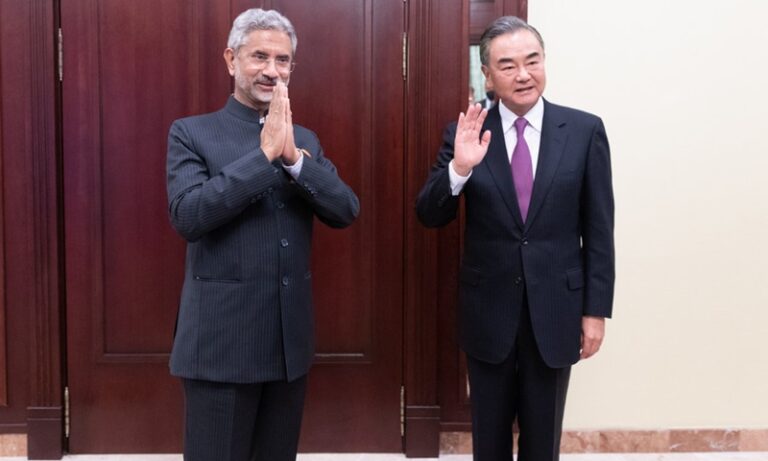
External Affairs Minister S. Jaishankar (L) and China’s State Councilor & Foreign Minister Wang Yi (R) met in Moscow, Sept 10, 2020
By M. K. BHADRAKUMAR | Indian Punchline | September 12, 2020
A joint statement wasn’t anticipated after the talks between the External Affairs Minister S. Jaishankar and China’s State Councilor and Foreign Minister Wang Yi in Moscow on September 10. In diplomatic terms, a joint statement signals that a “critical mass” developed through the 3-hour long discussion between the top diplomats.
Of course, much of the understanding reached will not be put in the public domain but it is apparent that an easing of tensions at the border and a disengagement of troops is on cards. The Chinese account assesses that the two foreign ministers have created “favourable conditions for a possible future meeting of the leaders of the two countries.”
Doesn’t this add up to a breakthrough? It does. That there isn’t going to be a war makes this a big breakthrough. So indeed, that deck is cleared for a summit meeting.
The joint statement outlined a 5-point consensus. First, the two countries reaffirmed the “series of consensus” reached by Prime Minister Narendra Modi and Chinese President Xi Jinping at their meetings in Astana (June 2017), Wuhan (April 2018) and Chennai (October 2018), which had committed the two countries to a cooperative relationship.
Second, a “quick disengagement” of border troops is envisaged, so that the two militaries will maintain a “proper distance and ease tensions.” Third, the existing agreements and protocols in bilateral boundary affairs” shall be adhered to and the two militaries shall “maintain peace and tranquillity in the border areas and avoid any action that could escalate matters.”
Fourth, the two special representatives will continue “dialogue and communication” on the boundary question and the Working Mechanism for Consultation and Coordination on China-India Border Affairs will hold meetings. Finally, once the tensions ease, new CBMs will be concluded to “maintain and enhance” peace and tranquility in the border areas.
Reading between the lines, the joint statement never once mentions the Line of Actual Control (LAC). Instead, the expression used is “border areas.” This suggests that there isn’t going to be any return to status quo ante as of early May, which has been an Indian demand.
The Indian army reportedly occupied certain “dominating heights” through the past week. But nothing has been mentioned in the joint statement in this regard. Conceivably, Indian troops’ mortal enemy in those dominating heights will be not the PLA but the harsh winter that is approaching in another 6 weeks or so. Maintaining a military presence in such inhospitable terrain entails heavy costs in life and treasure and will put an intolerable strain on our resources.
Succinctly put, what emerges from the joint statement is a mutual desire not to escalate the conflict situation and a shared opinion that a de-escalation of tensions is in mutual interest. However, there is lingering uncertainty as regards the way forward. To my mind, the creation of a buffer zone ( a demilitarised zone) at this point will be the best way to ensure peace and tranquility on the border on a durable basis.
Paradoxically, the crisis today also is an eyeopener. We peered into the abyss and didn’t like what we saw. Prime Minister Modi is a charismatic leader who can pitch high for a settlement of the boundary question. He is a strong leader who can take difficult decisions and cut the Gordian knot.
Clearly, India has shifted from the position that unless the PLA withdrew from “Indian territory”, the bilateral ties cannot be “business as usual.” In a huff, India began imposing sanctions against China. But the joint statement underscores that the two countries continue to uphold the “series of consensus” reached at the leadership level — where a key template is their common conviction that China and India are not competitive rivals or each other’s threats, but cooperation partners and each other’s developmental opportunities.
A Xinhua dispatch from Moscow giving a resume of the “full, in-depth discussion” between the two foreign ministers says, “Jaishankar said that the Indian side does not consider the development of India-China relations to be dependent on the settlement of the boundary question and India does not want to go backwards. The truth is, India-China relations have made steady progress over the years, and the Chinese and Indian leaders have met several times and reached a series of important consensus on the development of bilateral relations, he said.”
Clearly, sanctions must go. They have no place in the relationship. This rethink must be welcomed. But it is an abhorrent idea for sections of Indian opinion who are weaned on the belief that China has committed aggression by invading “Indian territory” and must be punished. The social media is full of venomous attacks on the Indian “sellout” at the Moscow talks, the “evisceration” of the LAC and so on.
However, that is primarily because the Indian narrative is seriously flawed. There is going to be a serious problem ahead for the government to “upgrade” the Indian narrative at this late stage. But the fact of the matter is that the Chinese had never accepted the LAC on the map or had delimited the LAC on the ground per the 1993 agreement.
They consistently held the view that the November 1959 claim line constituted the LAC. In the circumstances, how the disengagement and de-escalation can be worked out remains to be seen.
Looking back, the government’s move on August 5 last year to change the status of J&K and thereafter to include Aksai Chin as part of the Union Territory of Ladakh triggered a sequence of events culminating in the Chinese side changing the status quo on the ground and creating “new facts on the ground”.
India lacks the capability to challenge the Chinese action. But the country was led to believe otherwise. Per the Indian narrative, Indian armed forces have the capability to give a “bloody nose” to the PLA. So, there is bound to be a sense of disappointment today. India is paying a very high price for the strident nationalism and xenophobia that was whipped up by the ruling elite.
The Indian narrative is divorced from realities. The nation is bogged down in a raging epidemic and a deepening economic crisis. A vaccine to contain the pandemic will not be available in the market before the second half of next year. Meanwhile, the epidemic will remain as the “new normal”. A war with China will set back the country’s development by a decade. It is unthinkable.
Suffice to say, Jaishankar was given a weak hand to negotiate. And he has made a good job of it. The biggest gain is that a war has been averted and a new phase of constructive engagement of China with a sense of realism becomes possible. This is a moment of truth to rethink the entire foreign policy trajectory the government followed in the recent years.
Equally, it must be borne in mind that a replay of the “forward policy” that in 1962 plunged the country in a ruinous war was best avoided. The Mission Creep in the name of “infrastructure development” in Ladakh inevitably met with Chinese rebuff. All sorts of jingoistic notions stemming from the militarisation of India’s foreign policies in the past decade or so precluded rational thinking. The criticality of Aksai Chin region for China’s national security needed no iteration. Yet, we chose to meddle.
Fundamentally, India needs to come to terms with China’s rise and should have the composure and maturity to regard it as an inexorable historical process. Our zero sum mindset has done colossal damage. We must jettison it and refocus on constructively engaging China so as to take advantage of its meteoric rise for our country’s development, which is the number one priority today.
US ‘Pressing’ Lebanon to Sign Unfavourable Deal With Israel, Analysts Suggest
Sputnik – 11.09.2020
A number of Lebanese politicians expressed concern that the United States is pressuring Lebanon, pushing it to sign a border demarcation agreement that would jeopardise Beirut’s plans to develop gas fields on the Mediterranean shelf.
Sputnik spoke to Lebanese experts to find out whether Israel and the United States are thus trying to take advantage of Lebanon’s current economic and political weakness and force it to agree to all the conditions which are favourable to them, as well as whether Lebanon will be able to resist them.
According to US Assistant Secretary of State for Near Eastern Affairs David Schenker, the maritime border demarcation negotiations between Beirut and Tel Aviv are gradually advancing.
“I hope I will soon come back to Lebanon to sign a framework agreement with Israel,” he said during a telephone press conference with Lebanese journalists.
Schenker refused to talk about the existing obstacles to signing the agreement and the disagreements between the parties.
US Pressure
In turn, Lebanese political scientist Osama Wahby sees direct US pressure on extremely weak Lebanese political elites, which complicates the internal crisis with external issues.
“I’d like to point out that absolutely everyone is pressuring Lebanese politicians for any reason today: government formation, Beirut restoration, receiving money from the IMF and, of course, maritime border demarcation with Israel. While France is pressing Lebanon to solve domestic policy issues, the US is pressing to solve foreign affairs. They are interested in border demarcation and find it interesting for Israel. Undoubtedly, Washington will promise the government financial assistance in exchange for a good deal: they understand very well that Lebanon has no funds to rebuild Beirut after the explosion. There is a danger that Beirut will not receive any international assistance until it concedes to American and Israeli interests,” he said.
“Washington is pressuring individual movements and parties through sanctions. For example, two ministers of the current government have been sanctioned. And this is one of the key indicators of how much the United States expects Lebanon to do what it needs,” he added, speaking about US pressure on Lebanese politicians.
The Streets are Against?
However, Lebanese political scientist Riyad Isa believes that if the government is engaged in such negotiations, the Lebanese public will strongly oppose a framework agreement with Israel, and won’t allow it to be adopted.
“It’s surprising that the United States is speaking of some kind of negotiations between Israel and Lebanon, while Beirut is negotiating border demarcation exclusively with Washington. Such details will face serious consequences in Lebanon. It’s important to understand that the public doesn’t trust the current government and its actions. If they really do sign any kind of agreement with Israel, people will take to the streets. No one will recognise it [the agreement] as valid,” he said.
According to the expert, the US is ready to take advantage of any Lebanese weakness to fulfil its own desires and interests in the region. Nobody will wonder about Lebanon’s interests. If the country were in a better position, it could show some resistance, but not now.
Lebanon rejects Israeli claims to offshore block 9 in the Mediterranean, which is believed to have large hydrocarbon reserves. It is a plot of 856 sq. km, which each party considers a part of its exclusive economic zone. Beirut also shows its discontent with the land border line at 13 points, including the port of Naqoura and Adaisseh, where the Israelis have built a barrier.
Tehran slams as ‘baseless’ UN report of Iran’s arms shipments to Yemen
Press TV – September 11, 2020
Iran’s Foreign Ministry has slammed as “baseless” a report published by the United Nation’s Office of the High Commissioner for Human Rights (OHCHR) alleging Tehran has been sending arms to war-torn Yemen.
“Placing Iran’s name next to those supplying weapons to the Saudi coalition against Yemen is completely wrong,” Foreign Ministry spokesman Saeed Khatibzadeh said in a statement on Thursday.
The spokesperson said while Iran’s name has only been mentioned once in the report, “it also neglects Iran’s pivotal role and assistance in seeking to achieve a political solution to the conflict in Yemen”.
Since March 2015, Saudi Arabia has been waging a war on Yemen with the help of its regional allies and largely assisted by Western-supplied weapons which have been indiscriminately used against Yemeni civilians.
Despite numerous bids to stop arms sales, top Western arms suppliers such as the United States, Britain, Canada, France and Germany have pushed through with lethal weapons shipments to the oil-rich kingdom.
Khatibzadeh said that the OHCHR’s claim of Iran supplying weapons to Yemen amid the Saudi war comes as Western states are openly conducting their sales, “with related figures being published and available”.
“While some of these countries have periodically halted or limited arms to Riyadh due to pressure from human rights groups, the bitter reality is that the lucrative arms trade has persuaded them to ignore their international and moral obligations,” he said.
“They have forgotten that their weapons have been used to kill the Yemenis and destroy the country’s infrastructure. We are consequently seeing the largest humanitarian crisis due to the actions of the Saudi coalition and its arms suppliers,” the Foreign Ministry spokesman added.
Khatibzadeh stressed that while there is no clear evidence about Iranian arms shipments to Yemen, a Saudi-imposed blockade has even stopped Iranian humanitarian aid from reaching the country.
An estimated 100,000 people have so far lost their lives in the Saudi war.
The Saudi war has had a large impact on Yemen’s infrastructure, impairing the impoverished Arab country’s weak industrial, agricultural and medical sectors.
MSM’s attempts to spin Trump’s attacks on senseless wars as disrespect for military at large are a dismal distortion of reality
By Tony Cox | RT | September 11, 2020
The New York Times and CNN are desperate to paint Donald Trump as an enemy of the military, due to his desire not to get involved in pointless wars. But this is simply not true, and Trump has the backing of many soldiers.
Someone should tell the New York Times, CNN and other mainstream media outlets that soldiers don’t actually like getting killed or maimed for no good reason. Nor do they like generals and presidents who spill their blood in vain.
Alas, ignorance of these obvious truths probably isn’t the issue. This is likely just another case of the biggest names in news pretending to not get the point so they can take the rest of us along for a ride in their confidence game of alternative reality.
The latest example is the New York Times spinning President Donald Trump’s critique this week of Pentagon leadership and the military industrial complex as disrespect for the military at large. “Trump has lost the right and authority to be commander in chief,” the Times quoted retired US Marines General Anthony Zinni as saying. Zinni cited Trump’s alleged “despicable comments” about the nation’s war dead – reported last week by The Atlantic, citing anonymous sources – as one of the reasons Trump “must go.”
Never mind that Trump and all on-the-record administration sources denied The Atlantic’s report. The Times couldn’t resist when the pieces seemed to fit so well together for the military’s latest propaganda campaign against Trump. First the president disses the troops, calling them “losers” and “suckers,” then he has the temerity to say Pentagon leaders want to fight wars to keep defense contractors happy.
Except the pieces don’t fit. The many people who occupy so-called boots on the ground don’t have the same interests as the few people who send them to war. In fact, combat troops are given reason to hate the generals who send them to die when there’s not a legitimate national security reason for the war they’re fighting. And the US has fought a long line of wars that didn’t serve the nation’s national security interests. Even when a war is justified, the interests of top brass and front-line soldiers often clash.
Remember that great 1967 war movie, ‘The Dirty Dozen’? A group of 12 soldiers who were condemned to long prison sentences or execution in military prison for their crimes were sent on a 1944 suicide mission to kill high-ranking German officers at a heavily defended chateau far behind enemy lines. After succeeding in the mission and escaping the Germans, the lone surviving convict, played by tough-guy actor Charles Bronson, told the mission leader, “Killing generals could get to be a habit with me.”
So no, New York Times, speaking out against ill-advised wars does not equal bashing the military. And sorry, General Zinni, but generals, defense contractors and their media mouthpieces don’t get to decide who has the “right and authority” to be commander in chief. The voters decided that already, and they expressed clearly that they don’t want senseless and endless wars and foreign interventions.
The Times cited General James McConville, the Army’s chief of staff, as saying Pentagon leaders would only recommend sending troops to combat “when it’s required for national security and a last resort.” And no, it wasn’t a comedy skit. What’s the last US war or combat intervention that measured up to that standard? […]
CNN tried a similar ploy on Sunday, while trying to sell the “losers” and “suckers” story in an interview with US Veterans Affairs Secretary Robert Wilkie. Host Dana Bash said the allegations fit a “pattern of public statements” by the president because Trump called US Senator John McCain a “loser” in 2015 and said McCain shouldn’t be considered a hero for being captured in the Vietnam War. She repeatedly suggested to Wilkie, who didn’t take the bait, that Trump’s attacks on McCain, who died in 2018, showed disrespect for the troops.
Apparently, this follows the same line of propagandist thought which told us that saying there are rapists among the illegal aliens entering the US from Mexico – which is undeniably true – equals saying all Mexicans are rapists. In CNN land, a bad word about McCain is a bad word about all soldiers.
McCain was a warmonger who didn’t mind getting US troops killed or backing terrorist groups in Syria. If he had his way, many more GIs would be dead or disabled, because the intervention in Syria would have been escalated and the US might be at war with Iran. Soldiers wouldn’t want their lives wasted in such conflicts.
All wars are hard on the people who have to fight them, but senseless wars are spirit-crushing. An average of about 17 veterans commit suicide each day in the US, according to Veterans Administration data. Veterans account for 11 percent of the US adult population but more than 18 percent of suicides.
The media’s deceiving technique of trying to pretend that ruling-class chieftains and front-line grunts are in the same boat reflects a broader campaign of top-down revolution against populism. The military is just one of several pro-Trump segments of the population that must be turned against the president. Other pro-Trump segments, such as police, are demonized and attacked.
Trump has managed to keep the US out of new wars and has drawn down deployments to Iraq, Syria and Afghanistan – despite Pentagon opposition. His rival, Democrat presidential nominee Joe Biden, can be expected to rev up the war machine if he takes charge. His foreign policy adviser, Antony Blinken, lamented in a May interview with CBS News that Trump had given up US “leverage” in Syria.
Trump also has turned around the VA hospital system, ending decades of neglect that left many veterans to die on waiting lists.
Like past campaigns to oust Trump, the notion that he’s not sufficiently devoted to the troops might be a tough sell. No matter how good their words may sound, the people who promote endless wars without clear objectives aren’t true supporters of the rank and file.
Tony Cox is a US journalist who has written or edited for Bloomberg and several major daily newspapers.
Iran rejects claim of meddling in US elections, blasts US’ own intl. election meddling
Press TV – September 11, 2020
Iran’s Foreign Ministry has rejected allegations by US technology company Microsoft that Tehran seeks to meddle in Washington’s 2020 presidential elections, blasting US’ own history of interfering in other countries’ affairs.
“The United States is leading active disinformation campaigns against other countries. The US is not in a position to make such a woeful claim,” Foreign Ministry spokesman Saeed Khatibzadeh said in a statement on Friday.
“The US has interfered for decades in the elections of other countries – including Iran – and orchestrated a coup d’état which overthrew Iran’s democratically elected Prime Minster Mohammad Mossadeq,” he said.
The remarks come a day after Microsoft claimed that it had detected Russian, Chinese and Iranian efforts to target “people and organizations involved in the upcoming presidential election”.
The statement claimed that the attempts had sought to attack campaigns associated with both US President Donald Trump and his rival Democrat presidential candidate Joe Biden.
It claimed that most of the attacks had been “detected and stopped by security tools built into our products”.
Speaking on Friday, Khatibzadeh said that Tehran has no interest in the outcome of US elections.
“As we have reiterated over and over, it does not matter who is the president in the White House for Tehran. What matters is that Washington abides by international law, regulations and norms and stops interfering in other countries and honors its commitments,” he said.
Washington, which has sought to impose an overt campaign of “maximum pressure” against Iran ever since withdrawing from the Iran nuclear deal in 2018, has also sought to stifle Iranian media operating across different social media platforms in recent years.
Facebook, Twitter and Youtube have consequently cracked down on pages belonging to credible Iranian figures and media outlets, closing them or limiting their access to international audiences.
Mueller’s team WIPED over 30 cell phones before turning them over to inspector general
Obstruction of justice?
RT | September 10, 2020
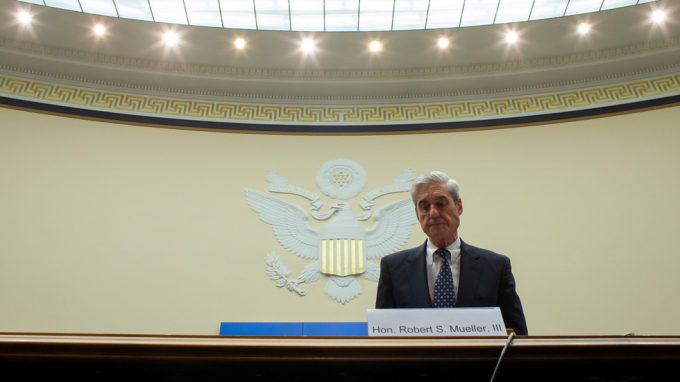
Over a dozen members of Special Counsel Robert Mueller’s Russiagate-investigating team “accidentally” wiped their phones before they could be inspected and “lost” the phone of disgraced FBI lawyer Lisa Page with anti-Trump texts.
Mueller and his team were tasked with investigating accusations of President Donald Trump’s “collusion” with Russia during the 2016 election, but found no evidence of it. In their final report they tried to insinuate that Trump was guilty of obstruction of justice, but stopped short of outright saying so.
An 87-page document, released by the Justice Department on Thursday under the Freedom of Information Act, reveals that Mueller’s investigators “accidentally” or deliberately wiped their devices when the DOJ inspector-general asked for them.
At least 12 officials, whose names are redacted, claimed to have accidentally erased all data from their phones. Five officials are mentioned by name: Andrew Weissman, James Quarles, Greg Andre, Kyle Freeny and Rush Atkinson. Their phones allegedly wiped themselves or reset after too many wrong password entries.
As many as 31 phones may have been affected, including the devices that had been “reassigned.”
Weissman was Mueller’s principal deputy. He is generally considered to have actually been in charge of the ‘Russiagate’ probe, especially after the former FBI director couldn’t recall much of anything during his July 2019 testimony before Congress.
Another discovery in the document was that the phone belonging to FBI lawyer Lisa Page got “lost” by the Mueller team, and the name of the official who had custody of it: Christopher Greer. It was eventually retrieved, but the IG report found that it had been wiped two weeks after Page had left the special counsel team.
Page was involved both in the early stages of the special counsel investigation and the original ‘Crossfire Hurricane’ probe of the Trump campaign – alongside Agent Peter Strzok, with whom she had an extramarital romantic relationship. Both were quietly removed from Mueller’s team after the discovery of text messages that disparaged Trump voters and even referred to “stopping” his election via an “insurance policy.”
US sanctions Ukrainian lawmaker who published Biden-Poroshenko tapes for ‘Russian influence’ in presidential election
RT | September 10, 2020
Ukrainian parliamentarian Andrii Derkach has been sanctioned by the US, and his publication of alleged phone calls between the Ukrainian president and the US vice president declared ‘Russian interference’ in the US election.
Derkach “has been an active Russian agent for over a decade, maintaining close connections with the Russian Intelligence Services,” the US Treasury Department declared on Thursday, sanctioning the member of parliament for “foreign interference in an attempt to undermine” the upcoming presidential elections. In addition, three alleged employees of the Internet Research Agency, also referred to as the St. Petersburg ‘troll factory,’ were placed on the sanctions list.
The move against “four Kremlin-linked officials” was hailed by the State Department as “a clear signal that the United States will not tolerate interference or influence” in the upcoming vote.
No evidence was offered for the allegation that either Derkach, or the IRA trio – identified as Artem Lifshits, Anton Andreyev and Darya Aslanova – were actually in any way connected to the Russian government.
Instead, the Treasury claimed that Derkach had “waged a covert influence campaign centered on cultivating false and unsubstantiated narratives concerning US officials.” Between May and July this year, he released “edited audio tapes and other unsupported information with the intent to discredit” US officials, they allege.
Derkach released several hours worth of audio tapes purporting to be conversations between former Ukrainian President Petro Poroshenko and former US Vice President Joe Biden from 2014-2016, including references to investigations of the gas company Burisma, which had given Biden’s son Hunter a lavishly compensated seat on its board.
Poroshenko has denounced the revelations as “fabrications” and “part of a large-scale hybrid war” by Russia, and it appears the US Treasury has taken his word at face value. There was no indication any of Derkach’s claims, the tapes, or the documents he offered to the press have been investigated; instead, the Treasury simply asserts that everything he said was “unsubstantiated.”
Similarly, Derkach’s “reliance on US platforms” is taken as proof that he “almost certainly targeted the US voting populace, prominent US persons, and members of the US government.”
The Treasury’s explanation of why Derkach was sanctioned basically claims that any effort to investigate Biden – now the Democratic presidential nominee – or his son amounts to “interference” in US elections, which was the main premise of the Democrat-led effort to impeach President Donald Trump back in September 2019.
Iran, China, Russia to partake in Caucus 2020 military drills
Press TV – September 10, 2020
Military forces from Iran, China, and Russia are scheduled to take part in joint military exercises with a number of other countries in southern Russia later this month.
China’s Defense Ministry made the announcement in a news release on Thursday and said troops from Armenia, Belarus, Myanmar, and Pakistan would also participate in the drills, code-named “Caucus 2020.”
The ministry added that the exercises, to be held from September 21 to 26, would focus on defensive tactics, encirclement, and battlefield control and command.
The drills have special significance “at this important moment when the entire world is fighting the pandemic,” the ministry said.
The United States administration has insinuated that the coronavirus was artificially developed in a Chinese lab. China has rejected that insinuation.
Iran, China, and Russia have over the past years increased their military and diplomatic cooperation to counter the United States’ hostile policies and extra-territorial presence in their regions.
Late last year, the three countries held four days of naval exercises code-named the “Marine Security Belt” to promote regional security and peace and safeguard international trade in the Sea of Oman and the Indian Ocean.
US Fails to Control Lebanon Because Hezbollah, Amal ‘Represent the Majority’ – Journalist
Sputnik – 10.09.2020
While US officials claim that their recent sanctioning of former Lebanese government ministers was designed to expose the corruption of the country’s politicians, one expert tells Sputnik that Washington’s recent action is nothing more than a continuation of a longstanding, but unsuccessful, Western campaign to control Lebanon.
US Assistant Secretary of State for Near Eastern Affairs David Schenke declared on Tuesday that political allies of Hezbollah will have to “choose between bullets and ballots,” as they stand to be held “accountable for any enabling of [Hezbollah’s] terrorist and illicit activities,” Arab News reported.
This came amid the two-day Lebanon leg of Schenke’s tour of the Middle East, which also included stops in Qatar and Kuwait.
That same day, the US Department of the Treasury’s Office of Foreign Assets Control sanctioned former Lebanese Minister of Transportation and Public Works Yusuf Finyanus and former Lebanese Minister of Finance Ali Hassan Khalil, who Washington claims “provided material support to [Hezbollah] and engaged in corruption.”
Laith Marouf, an award-winning multimedia producer as well as a media policy and law consultant with the Community Media Advocacy Center, joined Radio Sputnik’s By Any Means Necessary on Wednesday and told hosts Sean Blackmon and Jacquie Luqman that what is occurring right now is a continuation of “twenty-some” years of attempts by Washington and “imperial forces” to control Lebanon’s government.
Marouf explained that Khalil is a member of the Amal Movement, which is “allied with Hezbollah,” and Finyanus is aligned with the Christian Marada party of Suleiman Frangieh. These parties are “allied with the sovereigntist movements in Lebanon,” which virtually means they “represent the majority of the [country’s] population.”
Because of this, he asserted, the US’ attempts to gain control have been unsuccessful. “The majority of the Lebanese have lived [through] the crises,” he said, referring to a “cycle” of Western military aggression and sanctions that has occurred in the years following the Lebanese Civil War.
“There’s not going to be a change in the population demographics without a major, major war,” he argued.
4 Yemen tribes sign no aggression deal with Houthis in Marib
MEMO | September 10, 2020
Four major Yemeni tribes in the city of Marib, northeast of the capital Sanaa, signed an agreement with Houthi military leaders in Sanaa on Saturday, to spare their areas from fighting while talks continue with other tribes in the region to sign similar deals, Lebanese Al-Akhbar newspaper reported.
Until recently, the region’s tribes have supported the Saudi-led coalition which backs the internationally recognised Yemeni government.
According to reports from Yemen, with the new development, the Houthis will be able to control the city of Marib, after they seized ten of the governorate’s 14 directorates.
Local sources said the Houthis have Gained control of Al-Sadara strategic area as well as the Al-Kula region, adding that violent clashes were taking place between the Houthis backed by tribesmen, and the Yemeni government forces in the Al-Manqil area near Al-Jawba.
Israel Funds America’s Israel Lobby, While U.S. Taxpayers Pay for Endless Fraud Against Themselves
By Philip Giraldi | Strategic Culture Foundation | September 10, 2020
Imagine for a moment that there is a foreign government that receives billions of dollars a year in “aid” and other benefits from the United States taxpayer. Consider beyond that, the possibility that that government might take part of the money it receives and secretly recycle it to groups of American citizens in the United States that exist to maintain and increase that money flow while also otherwise serving other interests of the recipient country. That would mean that the United States is itself subsidizing the lobbies and groups that are inevitably working against its own interests. And it also means that U.S. citizens are acting as foreign agents, covertly giving priority to their attachment to a foreign country instead of to the nation in which they live.
I am, of course, referring to Israel. It does not require a brilliant observer to note how Israel and its allies inside the U.S. have become very skilled at milking the government in the United States at all levels for every bit of financial aid, trade concessions, military hardware and political cover that is possible to obtain. The flow of dollars, goods, and protection is never actually debated in any serious way and is often, in fact, negotiated directly by Congress or state legislatures directly with the Israeli lobbyists. This corruption and manipulation of the U.S. governmental system by people who are basically foreign agents is something like a criminal enterprise and one can only imagine the screams of outrage coming from the New York Times if there were a similar arrangement with any other country.
The latest revelation about Israel’s cheating involves subsidies that were paid covertly by Israeli government agencies to groups in the United States which in turn took direction from the Jewish state, often inter alia damaging genuine American interests. The groups involved failed to disclose the payments, which is a felony. They also failed to register under the terms of the Foreign Agents Registration Act of 1938, which mandates penalties for groups and individuals acting on behalf of foreign governments. In particular, FARA mandates that the finances and relationships of the foreign affiliated organization be open to Department of the Justice inspection. It states that “any person who acts as an agent, representative, employee, or servant, or otherwise acts at the order, request, or under the direction or control of a foreign principal.” Those who fail to disclose might be penalized by up to five years in prison and fines up to $250,000.
Israel’s various friends and proxies, uniquely, have been de facto exempt from any regulation by the U.S. government. The last serious attempt to register a major lobbying entity was made by John F. Kennedy, who sought to have the predecessor organization to today’s American Israel Public Affairs Committee (AIPAC) comply with FARA. Kennedy was killed before he could complete the process.
To be sure, the U.S. government has recently been aggressive in demanding FARA registration for other nations as well as for Americans working for foreign powers. There have been several prominent FARA cases in the news. Major Russian news agencies operating in the U.S. were compelled to register in 2017 because they were funded largely or in part by the Kremlin. Also, as part of their plea deals, the former Trump campaign chairman Paul Manafort and former National Security Advisor Michael Flynn both conceded that they had failed to comply with FARA when working as consultants with foreign governments.
A leading recipient of the Israeli government’s largesse has been the Israel Allies Foundation (IAF), which has a presence in 43 countries worldwide, though it is registered in the U.S. as a non-profit. It received a grant of $100,000 from Israel’s Strategic Affairs Ministry in 2019, part of the $6.6 million that was doled out to eleven American organizations in 2018-9. Israel Allies particularly uses Lawfare to target the non-violent Boycott, Divestment and Sanctions movement (BDS), which has a large and growing presence on university campuses. Effective lobbying by IAF in the U.S. has resulted in more than half of all states passing legislation that bans or limits the BDS activity while legislation that would criminalize organizations working against Israel has also been moving through congress. IAF has been directly involved in drafting such legislation and has more recently been pushing for new laws that would legally define criticism of Israel as anti-Semitism.
The Israeli Ministry of Strategic Affairs initially, in 2015-7, tried to give money openly to diaspora organizations but found that many American Jewish groups, to their credit, would not take it due to concerns over FARA and being accused of “dual loyalty.” So, the Ministry created an ostensibly non-government “public benefit company” cut-out to distribute the cash in a more secretive fashion. The mechanism was given the operational name Concert.
Concert’s sole purpose was to provide money to diaspora advocacy groups that would work primarily against BDS and other efforts to delegitimize the Jewish state. Concert had an independent board, but its activity of directed by the Strategic Affairs Ministry’s director-general.
Concert’s internal documents are predictably vague in describing the activities that it was funding, and one might assume that they are purposely misleading. They refer to “defensive and offensive” actions, on “corporate responsibility,” “the digital battlefield,” and regarding “amplification units” that would provide “support for organizations in a pro-Israeli network.” The intention was to improve Israel’s image due to the widespread and completely accurate perception that its human rights record is among the worst in the world. Concert was created to serve as a mechanism to be exploited where situations prevailed that “require an ‘outside the government’ discussion with the different target audiences… [and] provide a rapid and coordinated response against the attempts to tarnish the image of Israel around the world.”
Interestingly, one of the most recognizable recipients of Concert funds was Christians United for Israel (CUFI), America’s largest pro-Israel group, which received nearly $1.3 million in February 2019 to pay for several 10 week-long “pilgrimages” to the Holy Land. Each pilgrimage involved thirty “influential Christian clerics from the U.S.” who were clearly propagandized while they were in the Middle East. Other large disbursements went to predominantly Jewish student groups, presumably to provide them with both resources and necessary training to oppose campus critics of Israel.
The simple way to deal with the massive and illegal Israeli influencing operations that are being directed against the United States would be first of all to deduct every identifiable dollar that is being spent by the government of Prime Minister Benjamin Netanyahu to empower supporters in America from the $3.8 billion plus that Israel receives each year directly from the U.S. Treasury. Israel would not be concerned if the United States were to recover a paltry $10 million or so, but it would definitely send a message.
And then one might follow-up by requiring all the Israeli proxies that together make up the Israel Lobby to register under FARA. One might start with AIPAC, the Foundation for Defense of Democracies (FDD) and the Washington Institute for Near East Policy (WINEP) but there will be many, many more before the work is done. And CUFI, for sure. The fundamentalist Christian head cases that place Israel’s interests ahead of those of their own country finally need to have their bell rung.
Featured Video

“Historic Russia”: The Land Putin Will Not Give Back
or go to
Aletho News Archives – Video-Images
From the Archive
How Ukraine Tortured and Slaughtered Donbass
By Kit Klarenberg | Al Mayadeen | July 11, 2024
Almost immediately after the proxy war erupted, ISIS-tier footage of the torture and murder of Russians in Ukrainian custody emerged.
On July 6th, the New York Times published an astonishing investigation: In Ukraine, Killings of Surrendering Russians Divide an American-Led Unit. The article documents in grim detail how Chosen Company, an international volunteer battalion for Kiev, routinely executes Russian prisoners of war. It is the very first mainstream admission that this practice – a brazen breach of the Geneva Conventions, and a grave war crime – is widespread among Ukraine’s fighters, both foreign and homegrown. … continue
Blog Roll
 Aletho News
- Burnham tackles Britain’s poverty with aggression in Yemen
- Peace in Ukraine: the easy way – or the hard way
- Trump & the Rrrrussians
- US taxpayer money laundered back through Ukraine – Musk
- Before COVID, an NIH lab chief proposed making a SARS-like bat virus more infectious
- Gates, Bourla on Trial in Netherlands Accused of ‘Great Reset’ Scheme at Vaccine Injury Hearing
- BRITAIN’S WARNING: PREPARE FOR WAR
- “Historic Russia”: The Land Putin Will Not Give Back
- How the Cambridge Analytica scandal still haunts Mark Zuckerberg
- The Ongoing Cancellation Campaign Against a Dissenting Academic in Norway
- If Americans Knew
- DAILY UPDATE: Latest essential news on Palestine, Israel, & region
- Damning report shows the media must confront its failures on Gaza
- BBC senior broadcaster speaks out on Gaza coverage
- Netanyahu vows vast West Bank invasion in response to 20-minute skirmish that left 2 Israeli soldiers and 2 Palestinian fighters dead
- Tied up and tortured: Israel using US-made electroshock weapons on Palestinian detainees
- The outsourced risk: how newsrooms rely on Gaza’s freelancers without protecting them
- Gaza bakeries forced to shut as Israel blocks flour shipments
- Gaza’s breast cancer patients face a deadly wait for treatment amid Israel’s genocide
- DAILY UPDATE: Latest essential news on Palestine, Israel, & region
- The Israel Lobby’s Changing Fortunes
- No Tricks Zone
- Two New Studies Find Thwaites Glacier Melt Cannot Be Driven By Human Activity Or A Warming Ocean
- E-Cars Reduce CO2 Emissions By Only 41% Compared To Internal Combustion Engine Vehicles
- Predictions Made By Renowned Climate Professor Over Past Decades Have Been Proven To Be Poor
- New Study Suggests Large Regions Of The Pacific Ocean Have Been Cooling For The Last 80 Years
- Germany’s Green Energy Debacle: High Energy Costs Force Kahla Porzellan to Close After 182 Years!
- New Study: 50 Years Of The Most Aggressive ‘Net Zero’ Policies Can Only Affect The Global Climate By 0.03°C
- US September “Heat” Was No Record…Many Records Set Decades Ago
- Latest European Green Energy Debacle; Portugal’s Largest Flagship Solar Park Insolvent!
- Green Energy Debacle: German Expert Professor Fritz Vahrenholt Warns Of Severe Economic And Social Consequences
- Two More Paleo Reconstructions Affirm Meters-Higher Sea Levels Across Ireland, Brazil 7000-6000 Years Ago

