State Lawmakers Attack Federal Misuse of National Guard
By Brian McGlinchey | Stark Realities | April 6, 2021
Fed up after years of relentless National Guard deployments in undeclared wars, state lawmakers across the country are pushing legislation that would prohibit the use of Guard units in combat zones without a formal declaration of war by Congress.
The bills are being promoted by BringOurTroopsHome.US, a self-described organization of “right-of-center” veterans working to end American involvement in “endless wars” and restore congressional authority over war-making. The libertarian 10th Amendment Center is also backing the cause.
The proposed laws would require governors to determine the constitutionality of orders that place Guard units on federal active duty; where they’re deemed unconstitutional, the governor is required to take action to prevent the unit from being surrendered to federal control and sent into harm’s way.
The first “Defend the Guard” bill was conceived and introduced by Air Force veteran and West Virginia state legislator Pat McGeehan. While no state has enacted the law yet, interest is spreading widely, with legislators now pushing the measure in 31 states.
Conservative Veterans Taking Point
BringOurTroopsHome.US is led by Dan McKnight, a 13-year veteran of the Marine Corps Reserve, active duty Army and Idaho Army National Guard whose military service ended after he was injured in Afghanistan.
McKnight and many other veterans leading the drive against the War on Terror are from the right side of the political spectrum. That’s a sharp contrast to the typical antiwar veteran of the Vietnam era, but McKnight says vets from both wars share a common experience.
Today’s veterans “are coming home and saying the same thing (Vietnam vets did): ‘What was the point of that? What was our mission? We have no mission, we have no definition of success, we have no clear path to victory, we have no idea what victory means and we’re there without a constitutional authority to send us there’,” he says.
“Every one of us raised our hands and swore an oath to the Constitution…and when it says Congress shall be the only body to declare war, we take that to heart. And when Congress doesn’t do it, we understand bad things can happen: long, endless foreign misadventures,” says McKnight.
In a 2019 Pew Research poll, 64% of veterans said the war in Iraq wasn’t worth fighting; 58% said the same of Afghanistan. A January Concerned Veterans for America/YouGov poll found two-thirds or more of veterans support full withdrawals from both countries.
“The right-of-center veterans are now echoing the message of left-of-center veterans, and it’s hard to ignore when veterans from the entire political spectrum are saying the same thing: Enough already—if you want us to go and bleed and die and spend our lives and your treasure in a foreign land, then Congress should put their name on the line before we put our boots on the ground,” McKnight says.
That’s what the Constitution demands. In an impassioned speech at the West Virginia legislature last month, McGeehan quoted James Madison: “The Constitution supposes what the history of all governments demonstrates, that the executive is the branch of power most interested in war and most prone to it. It has accordingly, with studied care, vested the question of war in the legislature.”
Deployments’ Steep Toll
The National Guard has played a major role in America’s post-9/11 militarism: As recently as December, more than 57,000 Guard members were deployed around the world.
The federal government’s reliance on the National Guard makes state legislatures an intriguing second front in the drive to curtail the War on Terror. “Defend the Guard” laws also give state lawmakers a rare chance to influence foreign policy—and to impose consequences for the executive branch’s usurpation of war powers.
The heavy reliance on the Guard takes a toll on soldiers, families, neighborhoods and states. The intense pace of National Guard deployments was underscored at a recent Defend the Guard hearing in South Dakota: While opposing “Defend the Guard,” the state adjutant general acknowledged that, during the entire Global War on Terrorism to date, the state has had all its troops home for just 42 days.
McKnight has friends who’ve done a staggering 12 or 13 overseas National Guard deployments. Beyond the risk to life and limb, and the hardships imposed on individuals, families and marriages, he says communities also pay a price.
Guard members “are police officers, tradesmen, mechanics, schoolteachers, attorneys. (When) they have to leave that job behind, it puts a burden on the community,” says McKnight. Upon their return, Guard members are generally guaranteed the option to reclaim their jobs—but that sometimes means displacing those who filled their positions while they were away, compounding the disruptive effect.
Deployments also prevent National Guard units from responding to crises at home—their primary reason for existing. For example:
- When Hurricane Katrina devastated New Orleans and the Gulf Coast of Louisiana and Mississippi in 2005, thousands of the states’ National Guard soldiers were deployed to Iraq. Mississippi’s 223rd Engineer Battalion returned to repair hurricane damage—but was ordered to leave its equipment in Iraq for use by other units.
- In 2020, as Oregon endured some of its worst wildfires ever, half the state’s National Guard helicopters were in Afghanistan, including all its CH-47 Chinooks—dual-rotor choppers capable of carrying 26,000-pound payloads and ideal for use in firefighting. The Oregon Guard did what it could with Blackhawk helicopters that have one tenth the lifting power.
The Empire Strikes Back
When Defend the Guard measures are introduced in state legislatures, the national security establishment and its allies emerge to defend the status quo—by hook or by crook.
In South Dakota, McKnight says, “the military-industrial complex…sent a two-star general to testify…and made all kinds of threats, and insinuated the state would lose their National Guard if they passed this bill, which is simply not true.”
Weeks ago, Republican Idaho Representative Joe Palmer, who chairs the state’s Transportation & Defense Committee, seemed to resort to underhanded tactics to kill a Defend the Guard bill.
He put the measure to an initial procedural vote in the committee, and declared it to have failed by voice vote. Video of the proceedings, however, shows the result of the voice vote to be unclear at best, and McKnight says his group’s post-vote polling of members suggests the measure would have advanced had Palmer taken a recorded vote.
If Palmer didn’t already know he should play fair with veterans who are trying to prevent fellow citizen-soldiers from dying in unconstitutional wars, he may be learning that lesson now: McKnight says his group facilitated an emergency meeting of the GOP committee in Palmer’s home town, which is now considering a resolution censuring Palmer for his conduct.
“If you want to play parliamentary tricks and the price of your tricks is the blood of my brothers and sisters who (deploy) over and over again, then we’re going to take some blood of our own, and we’re going to do that the way politicians understand, and that’s with voters in the primary and the general election,” says McKnight.
Sometimes, the establishment’s machinations are done away from cameras. In a 2015 interview, West Virginia’s McGeehan said he was summoned to a meeting in the Speaker’s office with the commander of the state National Guard. The general said he’d received a call from the Pentagon, threatening that, if Defend the Guard became law, West Virginia bases would find their way onto the list of installations targeted for closure.
Liz Cheney Intervenes to Thwart Wyoming Bill
McKnight says “the most offensive opposition that we’ve faced” came from U.S. Congresswoman Liz Cheney, daughter of former vice president Dick Cheney.
“When we pushed the Defend the Guard bill in Wyoming last year, she or her staff contacted members of the Wyoming legislature and said, ‘If this passes in Wyoming, I will personally see to it that two C-130 aircraft are stripped from Wyoming and sent to Texas’,” says McKnight, who was in Cheyenne to support the bill, along with U.S. Senator Rand Paul.
Bethany Baldes, Wyoming state director of BringOurTroopsHome.US, was also on hand. She too says lawmakers told her they received calls from Cheney’s office that included threats to send new C-130 cargo planes to Texas. (Cheney’s communications director has not replied to an invitation to comment on this story.)
The measure failed, 35-22. A statement signed by a group of Wyoming senators opposing the measure seemed to turn logic on its head by claiming the bill “calls into question Wyoming’s support for our soldiers and airmen in the National Guard.”
That episode was McKnight’s second jarring encounter with Cheney, whom he describes as a “warmonger heiress of a military-industrial fortune.” Months before, he and other veterans met with Cheney in Washington to urge her to support the withdrawal of U.S. forces from Afghanistan.
“We went into Liz Cheney’s office and we asked her, ‘What conditions must be met on the ground for you to support ending the war in Afghanistan and bringing our troops home?’ And she said, ‘I don’t think I could ever support that position’.”
Pressing the issue, the veterans asked Cheney how long troops should remain. “She looked us stone-faced in the eye and said, ‘Forever. American troops will be in Afghanistan forever’,” says McKnight. “That’s when we decided it was time to step away from the swamp and work in the states, and force the states to force Congress’s hand.”
The Military Origins of Facebook

Featured image: Mark Zuckerberg walks among attendees at a VR conference in Barcelona, Spain in 2016, Source: Mark Zuckerberg’s Facebook page
BY WHITNEY WEBB |
UNLIMITED HANGOUT| APRIL 12, 2021
In mid-February, Daniel Baker, a US veteran described by the media as “anti-Trump, anti-government, anti-white supremacists, and anti-police,” was charged by a Florida grand jury with two counts of “transmitting a communication in interstate commerce containing a threat to kidnap or injure.”
The communication in question had been posted by Baker on Facebook, where he had created an event page to organize an armed counter-rally to one planned by Donald Trump supporters at the Florida capital of Tallahassee on January 6. “If you are afraid to die fighting the enemy, then stay in bed and live. Call all of your friends and Rise Up!,” Baker had written on his Facebook event page.
Baker’s case is notable as it is one of the first “precrime” arrests based entirely on social media posts—the logical conclusion of the Trump administration’s, and now Biden administration’s, push to normalize arresting individuals for online posts to prevent violent acts before they can happen. From the increasing sophistication of US intelligence/military contractor Palantir’s predictive policing programs to the formal announcement of the Justice Department’s Disruption and Early Engagement Program in 2019 to Biden’s first budget, which contains $111 million for pursuing and managing “increasing domestic terrorism caseloads,” the steady advance toward a precrime-centered “war on domestic terror” has been notable under every post-9/11 presidential administration.
This new so-called war on domestic terror has actually resulted in many of these types of posts on Facebook. And, while Facebook has long sought to portray itself as a “town square” that allows people from across the world to connect, a deeper look into its apparently military origins and continual military connections reveals that the world’s largest social network was always intended to act as a surveillance tool to identify and target domestic dissent.
Part 1 of this two-part series on Facebook and the US national-security state explores the social media network’s origins and the timing and nature of its rise as it relates to a controversial military program that was shut down the same day that Facebook launched. The program, known as LifeLog, was one of several controversial post-9/11 surveillance programs pursued by the Pentagon’s Defense Advanced Research Projects Agency (DARPA) that threatened to destroy privacy and civil liberties in the United States while also seeking to harvest data for producing “humanized” artificial intelligence (AI).
As this report will show, Facebook is not the only Silicon Valley giant whose origins coincide closely with this same series of DARPA initiatives and whose current activities are providing both the engine and the fuel for a hi-tech war on domestic dissent.
DARPA’s Data Mining for “National Security” and to “Humanize” AI
In the aftermath of the September 11 attacks, DARPA, in close collaboration with the US intelligence community (specifically the CIA), began developing a “precrime” approach to combatting terrorism known as Total Information Awareness or TIA. The purpose of TIA was to develop an “all-seeing” military-surveillance apparatus. The official logic behind TIA was that invasive surveillance of the entire US population was necessary to prevent terrorist attacks, bioterrorism events, and even naturally occurring disease outbreaks.
The architect of TIA, and the man who led it during its relatively brief existence, was John Poindexter, best known for being Ronald Reagan’s National Security Advisor during the Iran-Contra affair and for being convicted of five felonies in relation to that scandal. A less well-known activity of Iran-Contra figures like Poindexter and Oliver North was their development of the Main Core database to be used in “continuity of government” protocols. Main Core was used to compile a list of US dissidents and “potential troublemakers” to be dealt with if the COG protocols were ever invoked. These protocols could be invoked for a variety of reasons, including widespread public opposition to a US military intervention abroad, widespread internal dissent, or a vaguely defined moment of “national crisis” or “time of panic.” Americans were not informed if their name was placed on the list, and a person could be added to the list for merely having attended a protest in the past, for failing to pay taxes, or for other, “often trivial,” behaviors deemed “unfriendly” by its architects in the Reagan administration.
In light of this, it was no exaggeration when New York Times columnist William Safire remarked that, with TIA, “Poindexter is now realizing his twenty-year dream: getting the ‘data-mining’ power to snoop on every public and private act of every American.”
The TIA program met with considerable citizen outrage after it was revealed to the public in early 2003. TIA’s critics included the American Civil Liberties Union, which claimed that the surveillance effort would “kill privacy in America” because “every aspect of our lives would be catalogued,” while several mainstream media outlets warned that TIA was “fighting terror by terrifying US citizens.” As a result of the pressure, DARPA changed the program’s name to Terrorist Information Awareness to make it sound less like a national-security panopticon and more like a program aiming specifically at terrorists in the post-9/11 era.

DARPA’s IOA, oversaw Total Information Awareness during its brief existence
The TIA projects were not actually closed down, however, with most moved to the classified portfolios of the Pentagon and US intelligence community. Some became intelligence funded and guided private-sector endeavors, such as Peter Thiel’s Palantir, while others resurfaced years later under the guise of combatting the COVID-19 crisis.
Soon after TIA was initiated, a similar DARPA program was taking shape under the direction of a close friend of Poindexter’s, DARPA program manager Douglas Gage. Gage’s project, LifeLog, sought to “build a database tracking a person’s entire existence” that included an individual’s relationships and communications (phone calls, mail, etc.), their media-consumption habits, their purchases, and much more in order to build a digital record of “everything an individual says, sees, or does.” LifeLog would then take this unstructured data and organize it into “discreet episodes” or snapshots while also “mapping out relationships, memories, events and experiences.”
LifeLog, per Gage and supporters of the program, would create a permanent and searchable electronic diary of a person’s entire life, which DARPA argued could be used to create next-generation “digital assistants” and offer users a “near-perfect digital memory.” Gage insisted, even after the program was shut down, that individuals would have had “complete control of their own data-collection efforts” as they could “decide when to turn the sensors on or off and decide who will share the data.” In the years since then, analogous promises of user control have been made by the tech giants of Silicon Valley, only to be broken repeatedly for profit and to feed the government’s domestic-surveillance apparatus.
The information that LifeLog gleaned from an individual’s every interaction with technology would be combined with information obtained from a GPS transmitter that tracked and documented the person’s location, audio-visual sensors that recorded what the person saw and said, as well as biomedical monitors that gauged the person’s health. Like TIA, LifeLog was promoted by DARPA as potentially supporting “medical research and the early detection of an emerging epidemic.”
Critics in mainstream media outlets and elsewhere were quick to point out that the program would inevitably be used to build profiles on dissidents as well as suspected terrorists. Combined with TIA’s surveillance of individuals at multiple levels, LifeLog went farther by “adding physical information (like how we feel) and media data (like what we read) to this transactional data.” One critic, Lee Tien of the Electronic Frontier Foundation, warned at the time that the programs that DARPA was pursuing, including LifeLog, “have obvious, easy paths to Homeland Security deployments.”
At the time, DARPA publicly insisted that LifeLog and TIA were not connected, despite their obvious parallels, and that LifeLog would not be used for “clandestine surveillance.” However, DARPA’s own documentation on LifeLog noted that the project “will be able . . . to infer the user’s routines, habits and relationships with other people, organizations, places and objects, and to exploit these patterns to ease its task,” which acknowledged its potential use as a tool of mass surveillance.
In addition to the ability to profile potential enemies of the state, LifeLog had another goal that was arguably more important to the national-security state and its academic partners—the “humanization” and advancement of artificial intelligence. In late 2002, just months prior to announcing the existence of LifeLog, DARPA released a strategy document detailing development of artificial intelligence by feeding it with massive floods of data from various sources.
The post-9/11 military-surveillance projects—LifeLog and TIA being only two of them—offered quantities of data that had previously been unthinkable to obtain and that could potentially hold the key to achieving the hypothesized “technological singularity.” The 2002 DARPA document even discusses DARPA’s effort to create a brain-machine interface that would feed human thoughts directly into machines to advance AI by keeping it constantly awash in freshly mined data.
One of the projects outlined by DARPA, the Cognitive Computing Initiative, sought to develop sophisticated artificial intelligence through the creation of an “enduring personalized cognitive assistant,” later termed the Perceptive Assistant that Learns, or PAL. PAL, from the very beginning was tied to LifeLog, which was originally intended to result in granting an AI “assistant” human-like decision-making and comprehension abilities by spinning masses of unstructured data into narrative format.
The would-be main researchers for the LifeLog project also reflect the program’s end goal of creating humanized AI. For instance, Howard Shrobe at the MIT Artificial Intelligence Laboratory and his team at the time were set to be intimately involved in LifeLog. Shrobe had previously worked for DARPA on the “evolutionary design of complex software” before becoming associate director of the AI Lab at MIT and has devoted his lengthy career to building “cognitive-style AI.” In the years after LifeLog was cancelled, he again worked for DARPA as well as on intelligence community–related AI research projects. In addition, the AI Lab at MIT was intimately connected with the 1980s corporation and DARPA contractor called Thinking Machines, which was founded by and/or employed many of the lab’s luminaries—including Danny Hillis, Marvin Minsky, and Eric Lander—and sought to build AI supercomputers capable of human-like thought. All three of these individuals were later revealed to be close associates of and/or sponsored by the intelligence-linked pedophile Jeffrey Epstein, who also generously donated to MIT as an institution and was a leading funder of and advocate for transhumanist-related scientific research.
Soon after the LifeLog program was shuttered, critics worried that, like TIA, it would continue under a different name. For example, Lee Tien of the Electronic Frontier Foundation told VICE at the time of LifeLog’s cancellation, “It would not surprise me to learn that the government continued to fund research that pushed this area forward without calling it LifeLog.”
Along with its critics, one of the would-be researchers working on LifeLog, MIT’s David Karger, was also certain that the DARPA project would continue in a repackaged form. He told Wired that “I am sure such research will continue to be funded under some other title . . . I can’t imagine DARPA ‘dropping out’ of a such a key research area.”
The answer to these speculations appears to lie with the company that launched the exact same day that LifeLog was shuttered by the Pentagon: Facebook.
Thiel Information Awareness
After considerable controversy and criticism, in late 2003, TIA was shut down and defunded by Congress, just months after it was launched. It was only later revealed that that TIA was never actually shut down, with its various programs having been covertly divided up among the web of military and intelligence agencies that make up the US national-security state. Some of it was privatized.
The same month that TIA was pressured to change its name after growing backlash, Peter Thiel incorporated Palantir, which was, incidentally, developing the core panopticon software that TIA had hoped to wield. Soon after Palantir’s incorporation in 2003, Richard Perle, a notorious neoconservative from the Reagan and Bush administrations and an architect of the Iraq War, called TIA’s Poindexter and said he wanted to introduce him to Thiel and his associate Alex Karp, now Palantir’s CEO. According to a report in New York magazine, Poindexter “was precisely the person” whom Thiel and Karp wanted to meet, mainly because “their new company was similar in ambition to what Poindexter had tried to create at the Pentagon,” that is, TIA. During that meeting, Thiel and Karp sought “to pick the brain of the man now widely viewed as the godfather of modern surveillance.”

Peter Thiel speaks at the World Economic Forum in 2013, Source: Mirko Ries Courtesy for the World Economic Forum
Soon after Palantir’s incorporation, though the exact timing and details of the investment remain hidden from the public, the CIA’s In-Q-Tel became the company’s first backer, aside from Thiel himself, giving it an estimated $2 million. In-Q-Tel’s stake in Palantir would not be publicly reported until mid-2006.
The money was certainly useful. In addition, Alex Karp told the New York Times in October 2020, “the real value of the In-Q-Tel investment was that it gave Palantir access to the CIA analysts who were its intended clients.” A key figure in the making of In-Q-Tel investments during this period, including the investment in Palantir, was the CIA’s chief information officer, Alan Wade, who had been the intelligence community’s point man for Total Information Awareness. Wade had previously cofounded the post-9/11 Homeland Security software contractor Chiliad alongside Christine Maxwell, sister of Ghislaine Maxwell and daughter of Iran-Contra figure, intelligence operative, and media baron Robert Maxwell.
After the In-Q-Tel investment, the CIA would be Palantir’s only client until 2008. During that period, Palantir’s two top engineers—Aki Jain and Stephen Cohen—traveled to CIA headquarters at Langley, Virginia, every two weeks. Jain recalls making at least two hundred trips to CIA headquarters between 2005 and 2009. During those regular visits, CIA analysts “would test [Palantir’s software] out and offer feedback, and then Cohen and Jain would fly back to California to tweak it.” As with In-Q-Tel’s decision to invest in Palantir, the CIA’s chief information officer during this time remained one of TIA’s architects. Alan Wade played a key role in many of these meetings and subsequently in the “tweaking” of Palantir’s products.
Today, Palantir’s products are used for mass surveillance, predictive policing, and other disconcerting policies of the US national-security state. A telling example is Palantir’s sizable involvement in the new Health and Human Services–run wastewater surveillance program that is quietly spreading across the United States. As noted in a previous Unlimited Hangout report, that system is the resurrection of a TIA program called Biosurveillance. It is feeding all its data into the Palantir-managed and secretive HHS Protect data platform. The decision to turn controversial DARPA-led programs into a private ventures, however, was not limited to Thiel’s Palantir.
The Rise of Facebook
The shuttering of TIA at DARPA had an impact on several related programs, which were also dismantled in the wake of public outrage over DARPA’s post-9/11 programs. One of these programs was LifeLog. As news of the program spread through the media, many of the same vocal critics who had attacked TIA went after LifeLog with similar zeal, with Steven Aftergood of the Federation of American Scientists telling Wired at the time that “LifeLog has the potential to become something like ‘TIA cubed.’” LifeLog being viewed as something that would prove even worse than the recently cancelled TIA had a clear effect on DARPA, which had just seen both TIA and another related program cancelled after considerable backlash from the public and the press.
The firestorm of criticism of LifeLog took its program manager, Doug Gage, by surprise, and Gage has continued to assert that the program’s critics “completely mischaracterized” the goals and ambitions of the project. Despite Gage’s protests and those of LifeLog’s would-be researchers and other supporters, the project was publicly nixed on February 4, 2004. DARPA never provided an explanation for its quiet move to shutter LifeLog, with a spokesperson stating only that it was related to “a change in priorities” for the agency. On DARPA director Tony Tether’s decision to kill LifeLog, Gage later told VICE, “I think he had been burnt so badly with TIA that he didn’t want to deal with any further controversy with LifeLog. The death of LifeLog was collateral damage tied to the death of TIA.”
Fortuitously for those supporting the goals and ambitions of LifeLog, a company that turned out to be its private-sector analogue was born on the same day that LifeLog’s cancellation was announced. On February 4, 2004, what is now the world’s largest social network, Facebook, launched its website and quickly rose to the top of the social media roost, leaving other social media companies of the era in the dust.
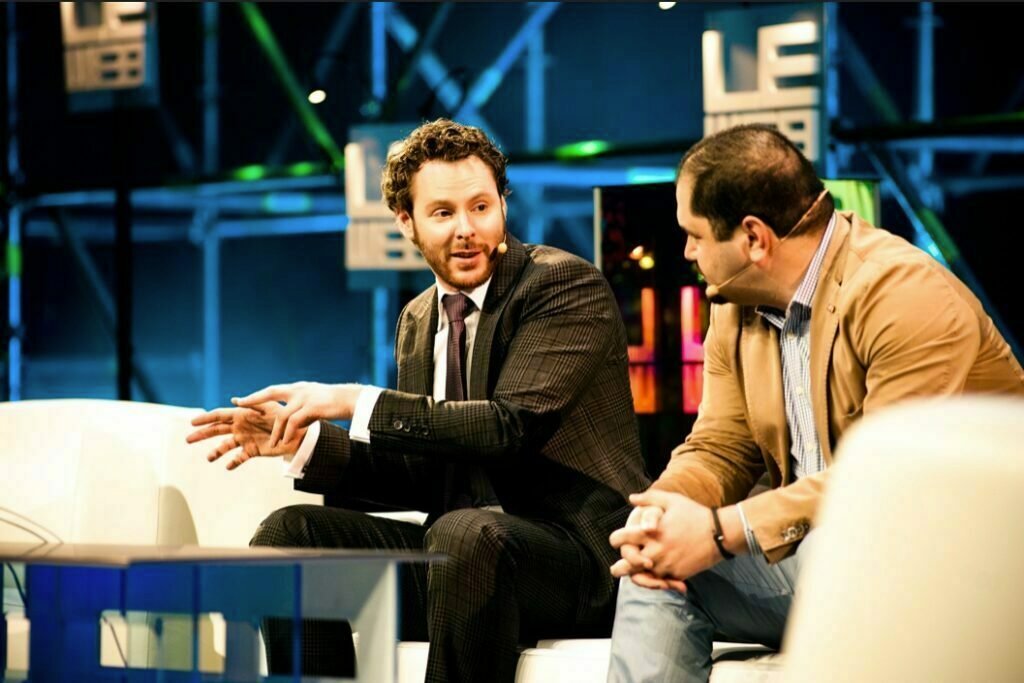
Sean Parker of Founders Fund speaks during the LeWeb conference in 2011, Source: @Kmeron for LeWeb11 @ Les Docks de Paris
A few months into Facebook’s launch, in June 2004, Facebook cofounders Mark Zuckerberg and Dustin Moskovitz brought Sean Parker onto Facebook’s executive team. Parker, previously known for cofounding Napster, later connected Facebook with its first outside investor, Peter Thiel. As discussed, Thiel, at that time, in coordination with the CIA, was actively trying to resurrect controversial DARPA programs that had been dismantled the previous year. Notably, Sean Parker, who became Facebook’s first president, also had a history with the CIA, which recruited him at the age of sixteen soon after he had been busted by the FBI for hacking corporate and military databases. Thanks to Parker, in September 2004, Thiel formally acquired $500,000 worth of Facebook shares and was added its board. Parker maintained close ties to Facebook as well as to Thiel, with Parker being hired as a managing partner of Thiel’s Founders Fund in 2006.
Thiel and Facebook cofounder Mosokvitz became involved outside of the social network long after Facebook’s rise to prominence, with Thiel’s Founder Fund becoming a significant investor in Moskovitz’s company Asana in 2012. Thiel’s longstanding symbiotic relationship with Facebook cofounders extends to his company Palantir, as the data that Facebook users make public invariably winds up in Palantir’s databases and helps drive the surveillance engine Palantir runs for a handful of US police departments, the military, and the intelligence community. In the case of the Facebook–Cambridge Analytica data scandal, Palantir was also involved in utilizing Facebook data to benefit the 2016 Donald Trump presidential campaign.
Today, as recent arrests such as that of Daniel Baker have indicated, Facebook data is slated to help power the coming “war on domestic terror,” given that information shared on the platform is being used in “precrime” capture of US citizens, domestically. In light of this, it is worth dwelling on the point that Thiel’s exertions to resurrect the main aspects of TIA as his own private company coincided with his becoming the first outside investor in what was essentially the analogue of another DARPA program deeply intertwined with TIA.
Facebook, a Front
Because of the coincidence that Facebook launched the same day that LifeLog was shut down, there has been recent speculation that Zuckerberg began and launched the project with Moskovitz, Saverin, and others through some sort of behind-the-scenes coordination with DARPA or another organ of the national-security state. While there is no direct evidence for this precise claim, the early involvement of Parker and Thiel in the project, particularly given the timing of Thiel’s other activities, reveals that the national-security state was involved in Facebook’s rise. It is debatable whether Facebook was intended from its inception to be a LifeLog analogue or if it happened to be the social media project that fit the bill after its launch. The latter seems more likely, especially considering that Thiel also invested in another early social media platform, Friendster.
An important point linking Facebook and LifeLog is the subsequent identification of Facebook with LifeLog by the latter’s DARPA architect himself. In 2015, Gage told VICE that “Facebook is the real face of pseudo-LifeLog at this point.” He tellingly added, “We have ended up providing the same kind of detailed personal information to advertisers and data brokers and without arousing the kind of opposition that LifeLog provoked.”
Users of Facebook and other large social media platforms have so far been content to allow these platforms to sell their private data so long as they publicly operate as private enterprises. Backlash only really emerged when such activities were publicly tied to the US government, and especially the US military, even though Facebook and other tech giants routinely share their users’ data with the national-security state. In practice, there is little difference between the public and private entities.
Edward Snowden, the NSA whistleblower, notably warned in 2019 that Facebook is just as untrustworthy as US intelligence, stating that “Facebook’s internal purpose, whether they state it publicly or not, is to compile perfect records of private lives to the maximum extent of their capability, and then exploit that for their own corporate enrichment. And damn the consequences.”
Snowden also stated in the same interview that “the more Google knows about you, the more Facebook knows about you, the more they are able . . . to create permanent records of private lives, the more influence and power they have over us.” This underscores how both Facebook and intelligence-linked Google have accomplished much of what LifeLog had aimed to do, but on a much larger scale than what DARPA had originally envisioned.
The reality is that most of the large Silicon Valley companies of today have been closely linked to the US national-security state establishment since their inception. Notable examples aside from Facebook and Palantir include Google and Oracle. Today these companies are more openly collaborating with the military-intelligence agencies that guided their development and/or provided early funding, as they are used to provide the data needed to fuel the newly announced war on domestic terror and its accompanying algorithms.
It is hardly a coincidence that someone like Peter Thiel, who built Palantir with the CIA and helped ensure Facebook’s rise, is also heavily involved in Big Data AI-driven “predictive policing” approaches to surveillance and law enforcement, both through Palantir and through his other investments. TIA, LifeLog, and related government and private programs and institutions launched after 9/11, were always intended to be used against the American public in a war against dissent. This was noted by their critics in 2003-4 and by those who have examined the origins of the “homeland security” pivot in the US and its connection to past CIA “counterterror” programs in Vietnam and Latin America.
Ultimately, the illusion of Facebook and related companies as being independent of the US national-security state has prevented a recognition of the reality of social media platforms and their long-intended, yet covert uses, which we are beginning to see move into the open following the events of January 6. Now, with billions of people conditioned to use Facebook and social media as part of their daily lives, the question becomes: If that illusion were to be irrevocably shattered today, would it make a difference to Facebook’s users? Or has the populace become so conditioned to surrendering their private data in exchange for dopamine-fueled social-validation loops that it no longer matters who ends up holding that data?
Part 2 of this series on Facebook will explore how the social media platform has grown into a behemoth that is much more extensive than what LifeLog’s program managers had originally envisioned. In concert with military contractors and former heads of DARPA, Facebook has spent the last several years doing two key things: (1) preparing to play a much larger role in surveillance and data mining than it currently does; and (2) advancing the development of a “humanized” AI, a major objective of LifeLog.
Whitney Webb has been a professional writer, researcher and journalist since 2016. She has written for several websites and, from 2017 to 2020, was a staff writer and senior investigative reporter for Mint Press News. She currently writes for The Last American Vagabond.
Brown University: The surveillance school
By JOHN WRENN | Brown Daily Herald | March 28, 2021
In the past several years, it has been fashionable to gawk in horror at China’s “social credit system,” an all-encompassing integration of surveillance, finance and state. Writing for The Triple Helix, Brown’s student publication focused on science and society, Priya Bhanot ’23 called China’s surveillance apparatus “Black Mirror Brought to Life.” China’s reputation for ubiquitous surveillance isn’t unjustified; a 2020 review of surveillance camera research by Comparitech found that of the world’s top 20 cities by cameras-per-capita, 18 are in China. But ubiquitous surveillance is far closer to home than Americans might think. As of 2020, Brown University has deployed one surveillance camera for approximately every 18 community members, placing it just shy of London, but ahead of every Chinese city except Taiyuan and Wuxi. In other words, Brown has about as many surveillance cameras as it does full-time faculty, of which it currently has 816!
It wasn’t always like this. In the span of two decades, Brown University quietly deployed an expansive surveillance apparatus, unbeknownst to many in the community; it’s well past time we critically examined our University’s pervasive surveillance of College Hill.
In 2000, the University only had 60 surveillance cameras, which the University mostly used to surveil parking lots and computer labs; a smattering watched Faunce’s club storage area, too. That year, Brown overhauled its fragmented VCR-based recording system into a fully-digital one, enabling Public Safety to monitor its cameras en masse from a central command center. This infrastructure investment marked a paradigm shift in Brown’s capacity for video surveillance.
By 2003, the total had increased to 105 cameras, with some now watching Faunce’s game room and the Main Green. According to The Chronicle, this proliferation of cameras into recreation spaces drew students’ first complaints about camera surveillance:
At Brown University, students have not complained about the cameras that watch over areas such as the basement of a student center. But students did object to a proposal to place cameras facing the main green of campus — to help manage crowds during commencement and other major events — says David Cardoza, card-access manager for the university’s security department.
Nevertheless, Brown continued to deploy new surveillance cameras in public spaces. By 2007, Brown had deployed 185 cameras, with 16 newly-installed cameras monitoring the Friedman Study Center in the Sciences Library. By 2011, Brown had deployed 250 cameras.
From here, the rate of installation increased drastically. In December 2013, the Campus Safety Task Force touted that Brown had deployed 430 cameras and a new array of 47 storage units for their footage. As of February 2020, the latest date for which data is publicly available, Brown University operates approximately 800 surveillance cameras. Following a spree of hateful graffiti in Hegeman Hall, the University installed its first cameras inside a dormitory. At the time of writing, the cameras remain installed.
This explosive proliferation of surveillance cameras at Brown University has progressed virtually unchecked and without community input. University Chief of Police Mark Porter suggested that the proliferation of cameras may reduce students’ fear of crime, but campus sentiment is considerably less enthusiastic about surveillance. In fall 2010, Herald editorial cartoonist Evan Donahue ’11 posted hoax letters in Keeney for a class project that announced the installation of security cameras around Keeney and Pembroke. Dylan Field ’13, a Residential Counselor in Keeney, told The Herald he was worried about the possibility of camera installation. Richard Bova, then-senior associate dean of Residential and Dining Services, categorically rejected the letter’s premise: “There has never been a plan — never will be a plan — to install cameras in any residence halls.” Of course, there eventually was such a plan.
Statements from DPS staff suggest a position of seemingly-limitless surveillance. “When you’re getting into the investigative side, you couldn’t have enough cameras,” said DPS Technical and Support Systems Manager David Cardoza to The Herald in 2008. Yet, in a 2011 interview with The Herald, Porter estimated that only about six crimes had been solved with the help of cameras. These solved crimes included the theft of a laptop from the Brown Bookstore and the truly shocking case of a thrown soda can in Faunce.
The successful use of cameras as an investigative aid in these incidents fails to justify the monetary expense of the camera system (exceeding $300,000 in 2000), much less the cost of students’ privacy. So what good are they? Speaking to The Herald in 2011, Porter instead emphasized the cameras’ purpose to deter, rather than aid in investigations: “We know that when we install them, that people will know they’re there.” This troubling justification invokes the specter of pre-crime — the almost-unfalsifiable presumption that there are agents on College Hill who would terrorize our community if not for the thin blue line of ubiquitous surveillance.
This justification warrants skepticism. A 40-year systemic review and meta-analysis published in 2019 found that passively monitored surveillance camera systems — like that adopted by Brown University — had no significant effect of crime reduction. Nor is it credible that “people will know” that cameras are there. Katie Goddard ’12 remarked to The Herald in 2011, “I haven’t noticed them”; neither had Daniel Valmas ’12, also interviewed by The Herald. Indeed, DPS makes no effort to draw attention to its surveillance cameras.
Rather, Brown University outright obscures the extent of its surveillance of College Hill. In 2008, the University declined to release its policy governing surveillance cameras to The Herald, or to provide a list of camera locations, or comment on how long recorded footage is archived for. The University’s surveillance policy, location of cameras and data retention practices remain completely opaque.
How can the Brown community engage in an informed discussion about surveillance if they are unaware of the scope of the surveillance? Until the University embraces transparency, the practice of “sousveillance” — the monitoring of people and institutions of authority by ordinary citizens — provides a means by which we students can educate ourselves and our peers. Since 2017, my friends and I have marked the locations of approximately 150 surveillance cameras on College Hill. While this is only a fraction of Brown University’s more than 800 cameras, the scope of the surveillance is staggering: It is impossible to cross (or even approach) Brown University without being surveilled. I encourage you to try.
John Wrenn MS’18 PhD’21 is a fifth-year doctoral candidate. He can be contacted at me@jswrenn.com, where he would be delighted to instruct you in the sousveillance of Brown University. Please send responses to this opinion to letters@browndailyherald.com and op-eds to opinions@browndailyherald.com.
Mission Accomplished: The Corbett Report Removed From YouTube
By James Corbett – Corbett Report – April 11, 2021
I posted Episode 398 of The Corbett Report podcast, “Science Says,” around 10 PM Japanese Standard Time on Friday, April 9th, 2021, and then went to bed. Sometime shortly after midnight, the main Corbett Report channel was removed from YouTube.
And, just like that, 14 years of work—some 1700+ videos, 569,000+ subscribers and 90 million+ video views—was erased from the digital ether. . . . Well, the GooTube portion of that digital ether, anyway.
Given that I’ve been promoting YouTube alternatives since at least 2009, and given that I have made video after video after video after video after video warning my audience that I would be banned from GooTube, and given that I even delivered a presentation last year noting that The Library of Alexandria is on Fire, it’s safe to say that this news did not catch me off guard. Learning about the banning after waking up on Saturday morning, my only thought was, “Well, that took longer than I expected.”
Indeed, it was not surprising in any sense that this was the report that led to GooTube purging my main channel. When you release a video on an account that already has two strikes for information that “contradicts the World Health Organization (WHO) or local health authorities’ medical information about COVID-19” and that video itself contains information calling those very authorities’ pronouncements into question, you better believe the thought that this might be your last YouTube upload crosses your mind when you push that publish button. Heck, the “offending” podcast even centers around an op-ed comparing COVID skeptics to terrorists and calling for the UN to mount a “counteroffensive” against them. Of course this video was going to be censored.
What’s more, this had been a particularly difficult report to post in the first place. After rendering and uploading to GooTube, the GooTube censorship copyright check flagged the 30-second clip of “Bill Nye Saves the World” embedded in my commentary on The Weaponization of Science and refused to post the video. So I had to cut the offending 30 seconds (specifically, the extremely scientific video for Rachel Bloom’s highly educational song, “My Sex Junk,” which can still be enjoyed in the audio version of the podcast), re-render the episode and re-upload it. Then, after that video processed, I performed one quick check before hitting “publish” and noted that the fancy transitions that Corbett Report video editor Broc West had used for this episode (which had worked perfectly fine in the previous two renders) were now suddenly glitching. Banging my head on the keyboard in dismay, I went back into the project, manually changed all of the transitions and rendered and uploaded the entire episode for the third time.
And in the span of those three renders, my initial excitement at the prospect that I would actually get a podcast episode rendered, uploaded and published before 5 PM on a Friday night evaporated. Venting my spleen at Broc over my bad luck, I made the obvious “joke”:
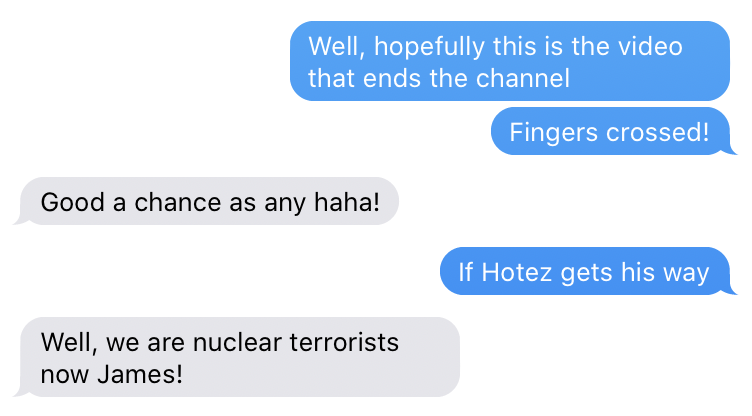
So, as you can see, this turn of events was not unexpected.
In a sense, it’s even more fitting that it was specifically a video about the philosophy of science that ended the channel. Not a documentary about the central banking system. Not an expose of false flag terrorism. Not a hard-hitting report on geopolitics or hidden history. No, a podcast about science that quotes Thomas Kuhn and highlights the growing politicization of science.
I say it’s “fitting” that such a report would be the one to do in the channel not only because I have been exploring this theme over and over in different ways since the very earliest days of The Corbett Report (since at least Episode 006 of the podcast, to be precise), but because in a sense the removal of The Corbett Report’s YouTube channel provides the ironically hilarious answer to a question that I had as a bright-eyed, bushy-tailed and naive undergrad over two decades ago.
You see, as I explained at the beginning of The Weaponization of Science video, I began my university career as an aspiring physics major. But after a semester spent in chemistry labs, applied mathematics courses and physics tutorials, I decided one day that I wanted to take my life in a completely different direction. So I dropped all my science courses for the upcoming semester and replaced them with English courses.
As one of the very, very few scientifically inclined students in the entire English department, I found that I was particularly on guard against all the eye-rollingly ignorant ways that those in the humanities attempted to add gravitas to their arguments by shoehorning inaccurate analogies about poorly understood scientific concepts (like “relativity” and “quantum mechanics”) into their lectures and papers. And so it was that I found myself approaching one professor during his office hours after he made a remark about how science was “politically determined.”
“How can science be politically determined?” I demanded of him indignantly. “If I drop this tape dispenser off your desk it’s going to fall at 9.81 m/s2 regardless of who is in political office.”
My professor, for his part, had only to prompt me to consider the inquisition’s investigation of Galileo for me to realize his point. Yes, scientists can be intimidated into proclaiming whatever the authorities—political, religious or otherwise—tell them to proclaim, even if it goes against their experimental results. The Galileo example may have been a particularly blunt one (and may or may not be apocryphal), but it hit the mark.
I never forgot that lesson. It is part of what has informed my work on the various pseudoscience fads, trends and hoaxes that have been foisted on the masses over the preceding century, from eugenics to Malthusian fearmongering to the catastrophic anthropogenic climate change myth.
Fast forward 20+ years and here I am daring to point out how the neo-inquisitionists are purging all criticism of their pseudoscientific pronouncements and . . . poof. Channel gone. Which kind of proves my point, doesn’t it?
Now, as I do not need to tell my regular audience, none of the videos are actually gone. Every single video has been backed up to LBRY. Years worth of videos are also backed up to BitChute, and, to a lesser extent, Minds and Archive.org. Every video since 2011 is downloadable directly from my servers. But if you don’t know that by this point, perhaps you’re not really ready to follow The Corbett Report into the Brave New (post-YouTube) Internet. Newsflash: this is 2021. If you’re still using YouTube to get your news, history and political information then you’ve got bigger problems than just the loss of The Corbett Report.
I’ve said it before and I’ll say it again: the “infowar” is not an analogy but a stone cold sober reality, and the fact that The Corbett Report was able to use a major enemy information platform to propagate the truth to the slumbering masses for 14 years is a major victory in and of itself.
So long, GooTube. Thanks for helping me to unlock so many minds. You will not be missed.
Ukraine claims Russia ignoring call for crunch talks to avert all-out war in Donbass, but Moscow says it never received an invite
RT | April 12, 2021
The Kremlin has denied ignoring requests from Ukrainian President Volodymyr Zelensky to hold a crisis summit after days of bloody escalations in the war-torn Donbass region, insisting it hasn’t actually been invited to take part.
On Monday morning, a government spokeswoman in Kiev claimed that an appeal for talks with Russian President Vladimir Putin had gone unacknowledged. Yulia Mendel told journalists from Reuters that “we have not received an answer yet and we very much hope that this is not a refusal of dialogue.”
However, later that day, Kremlin spokesman Dmitry Peskov said that he was unaware of the request, and had not seen any such contact from Ukrainian officials in recent days.
Mendel has since aimed to dispel any confusion, claiming that “the request for negotiations came immediately after the death of four servicemen of the Armed Forces of Ukraine – on March 26,” in an answer given to Interfax-Ukraine.
A statement posted by Zelensky to Twitter that day said, “we lost four defenders of Ukraine again. Sincere condolences.” He added that he urged all leaders of the Normandy Format, comprised of Germany, Russia, Ukraine, and France, “to do their utmost to preserve a full and comprehensive ceasefire.” It is unclear if a formal request was sent alongside the message.
Last week, Russian diplomats announced they had reached out to their US counterparts for emergency discussions over the situation in Donbass, with Peskov describing the situation on the contact line as frightening. Amid reports of increased shelling, Kiev’s forces have clashed with Moscow-backed separatist militants based in the breakaway Donetsk and Lugansk regions.
At the same time, US State Department spokesman Ned Price warned that Washington had seen credible reports of Russia amassing troops near the shared border, and issued a “call on Russia to refrain from escalatory actions.”
On Thursday, Putin’s deputy chief of staff, Dmitry Kozak, said Moscow would be forced to protect the residents of the Donbass region if the Ukrainian Army were to launch an all-out offensive. “Everything depends on what the scale of fighting will be.”
Putin has previously warned of a humanitarian crisis akin to the Srebrenica massacre of Bosnian Muslims during the breakup of Yugoslavia, remembered as one of Europe’s bloodiest post-war incidents. If this were to happen, Peskov said, “no country in the world would stand aside. And all countries, including Russia, would take measures to prevent such tragedies from happening again.”
Chile: Elderly Woman Denied Entry to Supermarket After Failing to Obtain Government Permission to Buy Food
By Paul Joseph Watson | Summit News | April 12, 2021
A video out of Chile shows an elderly woman being refused entry to a supermarket because she didn’t obtain the necessary government permission to buy groceries under the country’s lockdown rules.
The clip shows the woman, who is apparently 100-years-old, appearing to be confused as she is denied access by security guards in uniform.
“Unfortunately government measures are not intended for the most vulnerable, not everyone handles the technology, not everyone has access to the internet,” tweeted Radio Villa Francia along with the video.
In Chile, people have to apply for a “safe conduct pass” online, which only allows them to buy essential food items twice a week between the hours of 5am and 9pm.
Under the country’s ‘sanitary quarantine’, citizens must request “temporary instruments that authorize people to carry out fundamental activities and stock up on essential goods and services” in their communes.
The elderly lady’s failure to obtain the pass may have been related to her presumed inability to navigate the Internet.
The video serves as a chilling reminder as to what could be introduced in the west once vaccine passports and Chinese-style social credit score programs are implemented.
In the UK, vaccine passports won’t initially be required to enter venues like pubs, restaurants and grocery stores, but the government refused to rule it out longer term in their planning document.
In China, citizens who allow their social credit score to dip as a result of committing relatively minor infractions are denied the right to purchase things like plane and train tickets.
Rep. Thomas Massie’s Refreshing Answer Regarding Whether People Should Take Coronavirus Vaccines
By Adam Dick | Ron Paul Institute | April 12, 2021
Many American politicians, from President Joe Biden on down, are repeatedly declaring the blatantly fraudulent propaganda that experimental coronavirus vaccines are safe and everyone should take them. It is, thus, refreshing when occasionally a politician breaks through the torrent of propaganda to present a normal and more sensible response to the question of whether people should take one of the experimental coronavirus vaccines. Rep. Thomas Massie, a Republican member of the United States House of Representatives from Kentucky, did just that in a quoted statement in an article on Sunday.
In a Sunday article at Kentucky Health News by Melissa Patrick, Massie is quoted as follows regarding people taking the shots:
‘I’m leaving personal medical decisions up to the individuals and won’t be undertaking a vaccine promotion campaign,’ he said in a email. ‘It would be somewhat disingenuous for me to do so when I have no plans to receive the vaccine myself, in the absence of data showing that it’s beneficial to those who’ve already recovered from the virus.’
Asked about people who haven’t been exposed, he replied, ‘Ultimately, people should listen to their personal doctors. It would be foolish for the general public to take health advice from my cohort of politicians, who are themselves fairly unhealthy, uneducated in science or medicine, don’t think that being $30 trillion in debt is a concern, and are conditioned to say what will most benefit themselves.’
People can also do their own research regarding the experimental coronavirus vaccines, some of which are not even vaccines in the normal meaning of the term. Such research, though, can be made more difficult by the fact that big money media companies tend not to report, and major technology companies tend to suppress, information that would give people reason for caution in regard to taking the shots.
Massie is an Advisory Board member for the Ron Paul Institute for Peace and Prosperity.
Copyright © 2021 by RonPaul Institute
Russia Calls for Talks on Binding Treaty to Prohibit Weapons in Space – Lavrov
Sputnik – 11.04.2021
MOSCOW – Russia has called for talks to create a legally binding international instrument that would ban the deployment of any type of weapons in space, Russian Foreign Minister Sergey Lavrov said on the 60th anniversary of Yuri Gagarin’s historic space flight.
The anniversary of the first Soviet cosmonaut’s flight, marking the beginning of humanity’s space era, is celebrated every year in Russia as Cosmonautics Day on April 12. On the same day, the world marks the International Day of Human Space Flight.
“We consistently believe that only a guaranteed prevention of an arms race in space will make it possible to use it for creative purposes, for the benefit of the entire mankind. We call for negotiations on the development of an international legally binding instrument that would prohibit the deployment of any types of weapons there, as well as the use of force or the threat of force,” Lavrov said in a video message on the anniversary of the first manned space flight.
The minister offered to use as a basis a relevant Russian-Chinese draft treaty submitted in 2014 to the Conference on Disarmament in Geneva.
To stabilize the situation during a period when a multilateral document on non-militarization of space is being developed, Lavrov invited countries to join a Russian-promoted multilateral initiative on making a political commitment to avoid being the first entity to place weapons in orbit around Earth.
The top Russian diplomat noted that some 30 countries are full-fledged participants in the initiative.
Lavrov also emphasized that space cooperation should remain one of the most important aspects of the international agenda.
“Over the past decades, Russia, as a leader in space exploration, has provided assistance to a number of states in launching cosmonauts into orbit. At the UN Outer Space Committee, we are maintaining a consistent stance to ensure equal access of states to outer space and its conservation for future generations,” the Russian foreign minister said.
Lavrov stressed that Russia’s Yuri Gagarin, who became the first person in space, made a huge contribution to the development of humanity and demonstrated Russia’s ability to effectively resolve the most difficult tasks. His memory continues to inspire people across the world in their honorable and ambitious aspirations, Lavrov said.
On April 12, 1961, Gagarin pronounced his famous “Poyekhali!” (“Let’s Go!”) as the Vostok spacecraft lifted off the ground, taking the first human to space.
In 2011, the UN General Assembly declared April 12 the International Day of Human Space Flight.
Featured Video

America Racing to Strategic Defeat in Iran
or go to
Aletho News Archives – Video-Images
From the Archives
Should Europeans ‘Thank’ the Americans for Destroying Nord Stream?
By Robert Bridge | Strategic Culture Foundation | September 29, 2022
With an investigation continuing into the destruction of the Nord Stream gas pipeline that provided energy supplies to Europe from Russia, there appears to be just one prime suspect, and that should surprise nobody.
Following the sabotage of the Nord Stream 1 and 2 gas pipelines, former Polish Foreign Minister Radoslaw Sikorski already seemed to know the identity of the perpetrator when he tweeted out: “Thank you, USA.”
At first glance, it seemed that Sikorski was speaking sarcastically, berating Washington for carrying out an attack that will have severe repercussions for the people of Europe. After all, how could anyone see any good coming from the termination of Europe’s primary source of gas reserves with winter just around the corner? It was Sikorski’s homeland of Poland, after all, that urged its citizens to collect firewood in the face of dwindling gas reserves.
In fact, the Polish diplomat was speaking one-hundred percent literally… continue
Blog Roll
 Aletho News
- Growing insecurity, soaring prices fuel protests in north as regime bans evacuation: Sources
- Iran denies responsibility for ‘depraved’ attack on Kuwait desalination plant
- Bring The Troops Back. End This War Now!
- Can we please stop calling Israel the ‘only democracy in the Middle East’ now?
- US should start removing its troops from Germany, proposes AfD co-leader Chrupalla
- Iran Red Crescent: 600 educational centers attacked in US-Israeli ‘war crimes’
- Russian Oil Tanker Arrives in Cuba Amid U.S. Blockade
- America Racing to Strategic Defeat in Iran: Lt Col Daniel Davis
- FTC Warns Visa, Mastercard, PayPal, Stripe Over Political Debanking
- Russian tanker approaches Cuba despite US oil blockade
- If Americans Knew
- As Iran targets US military bases, will they be relocated to Israel? Not a ceasefire Day 171
- Will Trump Go Kamikaze?
- Is the University of Florida Shutting Down College Republicans over Israel Criticism?
- Jewish extremist arrested over alleged plot to firebomb Palestinian activist Nerdeen Kiswani’s home
- More than half of Palestinian child detainees have no charges
- The More Murderous Israel Gets, The More We Hear About “Antisemitism”
- Land Day and the Palestinian struggle after 30 months of genocide
- The Iran War Is About Palestine
- Israeli soldiers echo settler ideology, talk of revenge after targeting Palestinians and detaining CNN crew in the West Bank
- Israeli Policies Threaten Future of Christian Schools in Jerusalem
- No Tricks Zone
- New Study Finds Warming Saves Lives…Cold Temperatures 12 Times More Deadly Than Excess Heat
- German Science Blog Accuses PIK Climate Institute Of Hallucinating Climate Tipping Points
- Devastating Assessment Of Comirnaty Vaccine By Former Senior Pfizer Europe Toxicologist
- New Study: CO2 Is ‘Effectively Negligible’ As An Explanatory Climate Change Factor Since 2000
- Former Pfizer Toxicologist Dr. Helmut Sterz Tells Bundestag Hearing Pfizer Vaccine Should Have Never Been Approved
- Energy Expert: Germany’s Nuclear Phaseout Was A “500 Billion Euro Mistake”
- New Research: South Australia’s Mid-Holocene Sea Surface Temperatures Were 4°C Warmer Than Today
- Storing Green Energy To Last Germany 10 Days Would Require A 60-Million Tonne Battery
- New Studies: UK Sea Levels Were 4 Meters Higher Than Today During The Mid-Holocene
- Destructive Green New Deal: German Energy And Metal Group Warns Of Drastic Crisis
 Aletho News