Cuba and Color Revolution: A Cautionary Tale of the Next Phase of Forever-War
By Joaquin Flores | Strategic Culture Foundation | July 14, 2021
If one believes that the protests in Cuba can be explained within the rubric of 20th century economic systems, and then believes they can go on to extract some great truths about socialism vs. capitalism, then they are misinformed. No, this is about technocracy, color revolution, and forever-war.
The events in Cuba were caused by the staged economic collapse directed by the IMF under the advisement of the World Economic Forum, under the pretext of supply-line stoppages and economic closures to combat Covid-19. The socio-economic strife that such an imposed crisis is known to provoke, is then weaponised to destabilize ‘regimes’ so as to further the hegemonic agenda of the (admittedly divided) oligarchy ruling the global west. We saw this before in 2008 with the crash and crisis, and how this was weaponised to create a destabilization process known as the Arab Spring.
The planners involved are long-term planners, having transcended the quarter-driven constraints of the old market system. The new technocracy emerging is simply able to use Friedmanesque manipulations to keep the system afloat until the law of value is entirely transcended through automation. That was the crypto-Marxian understanding of economics promoted by Maynard Keynes.
Just as Cuba positioned itself away from socialism and towards further integration into global markets, the IMF moved openly to wind down the global market system and move towards a new type of totalitarian order which some critics have likened to communism.
Cubans are protesting against the mask-mandates and the lockdowns which have harmed people’s way of life. They are protesting the way that the government has effectively privileged those with dollar accounts who can buy from state-sanctioned dollar stores. Hence, those without families abroad sending dollars are negatively affected the most. This strikes against the whole narrative of Cuba and its gusano diaspora. Cuba produces its own vaccine, one that is not an experimental mRNA vaccine. The US would like very much to force a concession onto Cuba that it accept the mRNA vaccine. Perhaps the Cuban population of 11 million is just too high.
The fake news talking points that Cubans are protesting a lack of vaccines is a lie. We knew that trans-Atlantic talking points were a part of the Color scheme last year in Belarus when we were told that protestors rose up to oppose Lukashenko’s lackadaisical approach to the plandemic. Lukashenko in turn revealed that he refused an IMF offer of $980 million to play the lockdown deathmatch.
This is a Color Revolution
Anyone like Tom Fowdy for RT who writes that it is premature to say that the clear signs of a Color Revolution aren’t there, probably only says so because they don’t really know what those signs are.
They probably approach that question in terms of on-location forensics: identifying that a particular protest leader is actually an employee of the state department or Soros NGO in some fashion.
Yet for those who understand what the signs are, the signs of a Color Revolution are certainly there. But to understand this requires a long and broad view of the interplay between staged economic crises and the predictable turmoil they create in certain countries.
Because turmoil and protests are all but predictable even to OXFAM, once the FAO food index price surpasses about 210 (by 2012 ratios). Then, it becomes a question of which countries global lending institutions deem worthy of borrowing to subsidize against the newly inflated food price, or which countries the food production companies view in a lenient fashion.
As OXFAM wrote in 2012: “While concerns about high food prices are foremost about the spread of hunger and poverty, high food prices are also strongly correlated with political instability and have historically been a catalyst for mass protest in countries where legitimacy is already faltering. Research performed by the New England Institute for Science and Society has identified “a global food price threshold for unrest;”
Since 2007, food riots have broken out in more than 60 countries and have occurred with heightened frequency during periods of record-breaking food prices such as in 2008, when food riots erupted from Europe to the South Pacific. The FAO food price index crossed the 210 threshold, for the first time, in February 2008.”
Do we need to mention again that global economic crises are staged? Surely, there are structural problems broadly speaking, in the entire Neo-Keynesean system built in some large part from the ideas of Milton Friedman. So it should be clarified that while the timing of these economic crises are planned, they are also bound to happen. But when precisely they happen, and the point of them, would probably shock and confuse, then demoralize anyone who had a naïve understanding of global politics. You see, the point of planned economic crises is the upwards redistribution of wealth. Every firm except a handful of ‘zaibatsu’ style state-picked winners must absorb their own losses. This is corporatism 101.

Milton Friedman (July 31, 1912 – November 16, 2006) American economist and statistician who received the 1976 Nobel Memorial Prize in Economic Sciences
Each market crisis is structurally predetermined as these bubbles which define them, grow to a certain point. But it is a decision that is made to ‘pop the bubble’ at a particularly more fortuitous time as opposed to some other time – granted that it would need to be popped sooner or later. So these are both features of the structure, but also planned.
Understanding Color Revolutions requires an understanding of this phenomenon. In 2008, the massive bail-outs to banks using currency debasement, led to a geopolitical strategy on the part of the US deep state to buy up and corner the markets on perishable goods, especially those markets and firms which directed their energies towards Turkey, the Arab world, and Iran. This led to strife across the Maghreb region, Egypt, Syria, an increase of problems in occupied Iraq, and a boon to the Green movement in Iran.
The Crisis in Cuba
Further destabilization in Cuba will be a huge part in a coming global destabilization, and so it must be opposed. This is the case, even contemplating the reasonable grievances of the actual protesters, which in turn are not the same as the Sorosian demands placed in the mouths of anonymous protestors by the globalist media.
An inflation crisis has hit Cuba because of the staged political response to Covid, meant precisely to cause inflationary crises globally. The tourism industry has taken the biggest hit. Food and similar perishables are unaffordable for many without access to dollar accounts. There are state-picked favourites in the private sector (as is the case everywhere) as well as Communist Party bureaucrats who seem unaffected by the very same conditions that the protesters accuse them of bringing about. This much seems reasonable: in looking at who to blame for a problem, look to those who are making out.
The themes affecting Cuba are isolation and sovereignty, versus integration and dependence. Ever since the collapse of the USSR, which Cuba relied on for massive subsidies, Cuba has had both up and down periods as it struggles to balance between these two questions. Cuba is an island nation with just 11 million people, and so there can be no real sovereignty without the heavy price of isolation, nor can there be any integration into the globalist system without becoming a dependent state.
It’s a very tough predicament, because the Ideological State Apparatus of Cuba is its own variant of Marxism-Leninism, and this means that no matter how actually integrated and dependent Cuba is or is becoming, it must use the pages of Granma to pencil polemics declaring that Cuba is more sovereign and stable than ever before. Conversely, each undeniable period of crisis must be blamed on the very same socio-economic systems of global governance which Cuba relies upon in part for its own legitimacy.
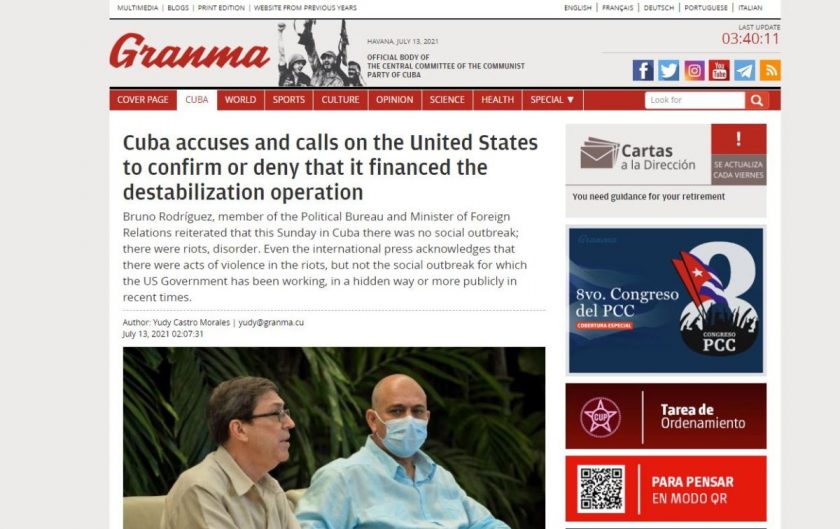
The July 13th Edition of Granma, Official Organ of the CC of the CP of Cuba
The problem then is when people really believe this state propaganda, or when people are forced to openly proclaim a public truth they know personally to be a lie. Because instead of the public understanding that Cuba has lost much of its sovereignty in its process of dollarizing so much of its economy, (and that the machinations of foreign actors, the IMF, the planned and staged collapse of the global speculative economy that Cuba is integrated in, is a large part of Cuba’s present woes) blame is laid by the public directly at the feet of a nominally sovereign state’s ruling government.
Quite the predicament. Because the government cannot really tell the truth, it must take the blame. Or do as it has done (and done so with no shame for provoking incredulity), and claim that the entire protest is a foreign provocation.
The Cuban government and its sinecure functionaries must always declare that any grassroots grievances expressed en masse are always at its core the work of foreign ‘imperialist’ intelligence operations bent on a destabilization strategy.
Yet such accusations of foreign plots are more likely to be true than not.
Another problem, and this is something where the Cuban government needs to make a fix, is the issue of dollar accounts.
Those with dollar accounts are tremendously less affected by the perishable goods inflation crisis in Cuba. But those deposits are only possible by having loved ones who have left Cuba for the US. So those who have ‘betrayed’ the revolution are the ones able to help those in Cuba. Those in Cuba living better off are not those who have been loyal to the socialism project of Cuba excepting a small layer of bureaucrats and professional snitches, but instead are the relatives of those gusanos in Florida and the rest of the US who have moved on to greener pastures.
What sort of message does that send? This greatly weakens the legitimacy of the government, because those common-folk who defend the Cuban system are left feeling like fools. When this layer joins a protest movement, the government’s days are numbered.
Cuba – Between a Rock and a Hard-Spot
Color Revolution schemes cannot work unless there are real-existing grievances shared among large segments of the population.
And yet going further, those real-existing grievances today, (while they compound longer standing ones which the Cuban government must account for), are directly caused by the IMF’s decision to bring global capitalism to a grinding halt for some period of time.
It is very difficult for a nominally sovereign government to tell a Thatcherite story of ‘TINA’ – there is no alternative. Cuba lacks alternatives except going either the path of the Khmer Rouge, or the path of laissez-faire. It has chosen some middle-path.
This really touches on a very big problem Cuba faces: its civilizational decision to place its legitimacy at the hands of international organizations related to global governance. Cuba strives to show its own citizens, and perhaps secondarily the US, that the rest of the world and especially the UN’s alphabet soup of agencies and organizations, recognize any number of successes that Cuba promotes having accomplished. To wit, at least within the rubric of those accounting systems, Cuba makes a decent case.
So a problem arises when this very same system of global governance, under the pretext of fighting Covid-19, instructs various countries to commit ritual seppuku at the altar of world health in order to preserve this status and these relationships to global trade and global governance.
And how? The western hemisphere is controlled almost entirely by the IMF and global banking systems. Cuba exists in some netherworld of ‘helpful harm’, if not through the US due to sanctions, then through the same banks in their Trans-Atlantic incarnations by way of Europe.
Since we understand that the WHO is effectively controlled by allies of the World Economic Forum like Bill Gates, which in turn is the think-tank of the IMF; and since the IMF includes in its bylaws and requirements that countries in a time of a declared global pandemic by the WHO must take the proscribed measures to combat this, then we understand what we have seen as a global phenomenon.
It’s been only a handful of leaders, several in Africa, in Haiti, and Belarus, that have openly bucked these provisions. And of these, all have been since eliminated except for Lukashenko in Belarus who no doubt enjoys some security provisions from the Russian Federation.
The Observatory of Economic Complexity (OEC) explains that in 2019, “The top exports of Cuba are Rolled Tobacco ($287M), Raw Sugar ($211M), Nickel Mattes ($134M), Hard Liquor ($97.3M), and Zinc Ore ($78.4M), exporting mostly to China ($461M), Spain ($127M), Netherlands ($65.5M), Germany ($64.7M), and Cyprus ($48.9M).
The top imports of Cuba are Poultry Meat ($286M), Wheat ($181M), Soybean Meal ($167M), Corn ($146M), and Concentrated Milk ($136M), importing mostly from Spain ($1.01B), China ($790M), Italy ($327M), Canada ($285M), and Russia ($285M).”
Hence Cuba was placed in a pincer move. It lost massively from the global plandemic and the restriction of supply lines, the tightened access to imports, the loss of tourism. The compliance of other countries to the IMF’s mandated economic implosion reduced demand for Cuba’s exports and damaged tourism as well.
But in order to maintain its own relationship with the IMF and also following the global narrative of the Socialist International (2nd International), (an EU driven social-democratic association of governments and political parties), it went along with the ‘solidarity’ driven component of woke politics seen in the ‘do-your-part’ masking and lockdowns.
But those harmed by the lockdowns were ordinary Cubans, not government officials or those with dollar accounts. And so the reaction we see today is a predictable one.
Conclusion
There can be no doubt: Cuba’s present crisis is not the direct result of its own economic mismanagement, but rather the staged demolition of finance, global trade, and supply lines using the Covid pandemic as a pretext. However, a number of social and political decisions by Cuban leaders have no doubt compounded the impact of the crisis and emboldened protesters.
What citizens in first world countries have seen as a ‘stock market rebound’ predicated by ‘too-big-too-fail’ type bailouts (socialism for the rich), are only possible so long as those moneys are held on the books but not really spent – hence the lockdowns. At least not spent in such a way as would this liquidity naturally circulate in the economy. For such velocity of moneys based on such extreme debasement of the currency, would lead to the largest inflationary crisis in the history of man on earth.
In raw-materials producing countries like Cuba, that has meant a tripled hardship. The aim of the centers of finance capital has been to do something like the Arab Spring, only more so.
At the same time, the Cuban government’s defensive and accusatory posture is poor optics and bad politics. It needs to better engage the protestors and validate some part of their grievances. Pointing the finger at Uncle Sam is tone deaf and only serves to satisfy a single demographic in Cuba.
Today, we are seeing only the start of a fresh wave of global destabilization efforts, never-ending wars. But now governments have prepared the civilian populations for these wars under the pretext of never-ending lockdowns due to a mystery illness. The right to protest, strikes, and the basic social contact needed to organize these can be revoked by instantaneous mandate as some new variant of Covid will always invariably be discovered. This is the biggest threat humanity faces since the Second World War, but in addition to destabilization campaigns, is the backdrop of a class-war gambit of the oligarchy against everyday people. Cuba needs to be understood in this light, and while it needs a better approach to managing the Covid narrative and hearing its people, foreign meddling in its affairs needs to be opposed.
US Targets Nicaraguan Presidential Election
By Roger D. Harris | Dissident Voice | July 14, 2021
Before Henry Kissinger became a Clinton pal, liberals condemned him for saying: “I don’t see why we need to stand by and watch a country go communist due to the irresponsibility of its people. The issues are much too important for the Chilean voters to be left to decide for themselves.” The 1973 US-backed coup and bloodbath in Chile followed. Now Uncle Sam has a problem in Nicaragua, where independent polls predict a landslide victory for Daniel Ortega’s leftist Sandinista slate in the November 7th presidential elections.
The US government and its sycophantic media are working to prevent Ortega’s reelection. On July 12, the US slapped visa restrictions on one hundred Nicaraguan elected legislative officials, members of the judiciary, and their families for “undermining democracy.” A month earlier, the Biden administration imposed sanctions on President Ortega’s daughter, along with a military general, the head of the central bank, and an elected legislator.
These and other recent illegal US sanctions on Nicaragua are designed to promote regime change and are based on the ridiculous charge that this poor and tiny nation is a “extraordinary and unusual threat to the US national security,” when the opposite is the case.
The NICA Act of 2018, under the Trump administration, imposed sanctions, including blocking loans from international financial institutions controlled by the US. In August 2020, the Responsive Assistance in Nicaragua (RAIN) plan was revealed, which is a multi-faceted coup strategy by which the US contracted corporations to overthrow the Nicaraguan government. RAIN calls for a “sudden, unanticipated transition” government to forestall what they admit would otherwise be a Sandinista victory in a free election. In a seamless handoff from the Trump to the Biden administration, the pending RENACER Act would further extended “targeted sanctions.”
US intervention in Nicaragua and, indeed, in all of Latin America under the 1823 Monroe Doctrine has a long history continuing to the present. Back in 1856, US citizen William Walker tried to impose himself as head of a slave state in Nicaragua, only to be assassinated four years later. In 1912, the US began an occupation of Nicaragua, forcing the country to become a US protectorate. The US was ousted in 1933 in a war led by national hero Augusto C. Sandino, after whom the present revolutionary party was named. In the 1980s, the US government proxies, the Contras, fought the new Sandinistas after they overthrew the US-backed Somoza dictatorship.
Problematic premises
In the past, most US progressives opposed the imperialism of their government. But more recently, as Jeremy Kuzmarov of CovertAction Magazine observed: “United States warmakers have become so skilled at propaganda that not only can they wage a war of aggression without arousing protest; they can also compel liberals to denounce peace activists using language reminiscent of the McCarthy era.”
A recent Open Letter to the Nicaraguan Government from U.S. Solidarity Workers 1979-1990 reflects the US imperial talking points. This US open letter, dated July 1, is joined by one from Europeans, formerly active in solidarity with Nicaragua, and one from international academics, mainly in the field of Latin American studies. (Links to all three letters may be dodgy.) All three letters, likely coordinated, use similar language to make matching critiques and demands.
While other international activists from the 1980s still prioritize non-intervention and solidarity with the Sandinista government, the concerns expressed in the open letter should be respectfully evaluated. The open letter is based on the following problematic premises:
- The open letter claims the Ortega “regime” is guilty of “crimes against humanity.”
In fact, Nicaragua is by far the most progressive country in Central America under the Sandinista government.
Unlike the Guatemalans, Hondurans, and El Salvadorians in these US client states, Nicaraguans are not fleeing to the US in search of a better life. Poverty and extreme poverty have been halved in Nicaragua, and the UN Millennium Development Goal of cutting malnutrition has been achieved. Basic healthcare and education are free, and illiteracy has been virtually eliminated, while boasting of the highest level of gender equality in the Americas. Nicaragua, which enjoys the lowest homicide rate in Central America, also has the smallest police force with the smallest budget in the region. These are not the hallmarks of a dictatorship.
- The open letter claims the 2018 coup attempt was simply a “demonstration of self-determination.” While the open letter correctly notes that the events of 2018 reflected an element of popular discontent, it renders invisible the millions of dollars and many years of US sponsored subversion in Nicaragua.
Social media campaigns of false information orchestrated by US-sponsored groups fueled viciously violent protests. According to solidarity activist Jorge Capelán: “those who kidnapped, tortured, robbed, murdered and raped citizens here in Nicaragua in April 2018 were the coup promoters. They themselves recorded everything with their cell phones. They even set fire to murdered Sandinista comrades in the street.”
Benjamin Waddell, a signatory to the open letter, admitted “it’s becoming more and more clear that the US support has helped play a role in nurturing the current [2018] uprisings.” Dan La Botz, another Ortega-must-go partisan, provided the background: “US organizations such as USAID and the National Endowment for Democracy (NED), and no doubt the CIA had for decades, of course, worked in Nicaragua as they do everywhere in the world.”
No substantive progressive alternative was offered by the opposition in 2018, according to William Robinson, another signatory to the open letter. Rather, 2018 was an attempt to achieve by violent means what could not be achieved democratically at the ballot box.
- The open letter claims the Nicaraguan government “in no way represents the values, principles and goals of the Sandinista revolution.” This stance arrogates to foreigners the role of telling the Nicaraguan people how to evaluate their revolution. The electoral process in Nicaragua makes clear that the Nicaraguans think otherwise.
After successfully overthrowing the US-backed dictator Somoza and fighting the counter-revolutionary war against the US-backed Contras, the Sandinista’s lost the 1990 election. Notably, outgoing President Ortega without hesitation obeyed the electoral mandate, the first time in Nicaragua’s history that governing power was passed peacefully to another political party. After 17 years of neoliberal austerity, Daniel Ortega won the presidential election of 2006 with a 38% plurality and went on to win in 2011 with 63% and 72.5% in 2016. Ortega’s ever increasing electoral margins suggest the majority of Nicaraguans support him as the legitimate leader of the Sandinista revolution.
Problematic proposals
Using the same loaded language as the US government, the open letter calls on the “Ortega-Murillo regime” to release political prisoners currently being held, including “pre-candidates,” members of the opposition, and “historic leaders” of the Sandinista revolution; rescind the national security law under which these individuals were arrested; and negotiate electoral reforms.
Nicaragua has passed two recent laws: the Foreign Agents Law and the Law to Defend the Rights of the People to Independence, Sovereignty, and Self-Determination for Peace. These laws, which the open letter wants rescinded, criminalize promoting foreign interference in Nicaragua’s internal affairs, seeking foreign military intervention, organizing acts of terrorism, and promoting coercive economic measures against their country. These are activities, it should be noted, that are similarly prohibited in the US’s FARA Act, after which the Nicaraguan laws were modeled.
The recent actions of the Nicaraguan government prosecuting people who break their laws is a normal function of governance. That some of the accused perpetrators may have political aspirations does not immunize those individuals from arrest for unlawful activities.
The letter from the aforementioned academics claims that among those detained are the “most prominent potential opposition presidential candidates.” In fact, none of the 17 political parties in Nicaragua have chosen their candidates, and “most of those currently under investigation do not belong to any legally registered party.” In fact, Stephen Sefton reports from Nicaragua that “no leading figure from Nicaragua’s opposition political parties has been affected by the recent series of arrests of people from organizations that supported the 2018 coup attempt.”
One of the most prominent of those arrested is NGO director Cristiana Chamorro, charged with money laundering for receiving millions of dollars from the USAID, other US government agencies, and allied foundations for regime-change purposes. In her defense, she incredulously claimed that the US State Department had audited her and found everything to their liking.
The “historic leaders” of the Sandinista revolution are just that; people who had broken with the revolution long ago and since 1994 had collaborated with the US-allied rightwing opposition and NGOs. More to the point, they are being charged with illegal collusion with foreign powers.
The open letter calls for “negotiating electoral reforms,” but electoral law in Nicaragua as in the US is determined by the legislative process and not by negotiations among various power blocks. Nicaragua has implemented some but not all reforms mandated by the Organization of American States. The fourth branch of government, the Supreme Electoral Council (CSE), oversees elections. A third of the current CSE is composed of representatives of parties other than the ruling party, even though the Sandinistas hold a super-majority in the legislature.
The right of the Nicaraguan revolution to defend itself
While acknowledging “the long and shameful history of US government intervention,” the open letter does not acknowledge the right of the Nicaraguan revolution to defend itself. On the contrary, their implied endorsement of the 2018 coup attempt is a call for regime change by non-democratic means and an implicit pass for US interference.
The open letter’s finding that “the crimes of the US government – past and present – are not the cause of, nor do they justify or excuse” the behavior of the current government in Nicaragua is a door that swings two ways. Whatever the alleged wrongdoings the Ortega government, that still does not justify the US government’s regime-change campaign. The open letter is thunderously silent on current US intervention, notably the punishing NICA and RENACER acts.
The Nicaraguan government has prioritized the needs of poor and working people and has made astounding progress on multiple fronts. That is why they are being targeted for regime change, and why the Nicaraguans have taken measures to thwart US intervention.
The Trump administration specifically targeted the so-called “Troika of Tyranny” – Cuba, Venezuela, and Nicaragua – with repressive illegal sanctions aimed at regime change. That policy of US domination did not start with Trump, nor is it ending with the new US administration.
The imperialists are clear on who they target as their enemy; some elements on the left are less clear on who is their friend and whether Nicaragua has a right to defend itself. If the signers of the open letter believe, as they claim, “in the Nicaraguan people’s right to self-determination…of a sovereign people determining their own destiny,” then the November 2021 election should be protected, free from interference by the US, its international allies, and its funded NGOs.
Roger D. Harris is with the human rights organization Task Force on the Americas founded in 1985.
UK’s arms sales to Riyadh three times higher than previously thought

Press TV – July 15, 2021
A new investigation has revealed that Britain has exported around three times as much weaponry and military equipment to Saudi Arabia, which is leading a devastating military aggression against Yemen, than previously believed.
According to a report published by British online newspaper The Independent, the British government’s official figures state that British ministers have signed off 6.7 billion pounds (9.28 US dollars) worth of arms, such as bombs, missiles, and aircraft, to the oil-rich kingdom ever since it started its bombardment campaign of neighboring Yemen back in March 2015.
However, researchers say the actual figure is likely to be close to £20 billion (over $27 billion) because the official numbers do not entail sales carried out under an obscure “open license” system.
The investigation further casts doubts on allegations of the British government about having “one of the most robust and transparent export control regimes in the world.”
The probe emphasized that Britain’s operation of the parallel and less transparent “open license” system gives a more open-ended green light to arms manufacturers to sell specific armaments to a specific country without a monetary limit.
It further noted that the United Kingdom operated an open license for bombs and air-to-surface missiles to Saudi Arabia between 2014 and August 2019.
Moreover, an open license has covered Britain’s sales of equipment and components for use in the twin-engine and multi-role Eurofighter Typhoon jets to Saudi Arabia. The warplanes have been used in Saudi airstrikes across Yemen.
The researchers also examined the accounts of companies known to be selling arms to Saudi Arabia, and discovered that the revenues of British multinational arms producer BAE Systems, for instance, totaled nearly 17 billion pounds (23.5 US dollars).
As a result, they estimate that the real value of exports is close to £20 billion ($27 billion).
“The use of open licenses also offers the government a convenient sleight of hand when it comes under pressure over arms sales to a particular country due to events such as wars, military coups, or well-publicized human rights abuses,” the report warns.
Katie Fallon of Campaign Against Arms Trade, which conducted the research, stated, “The use of Open Licenses covers up the real extent of the UK arms trade and makes it impossible to know what quantities of weapons are being sold around the world.”
“UK-made fighter jets, bombs and missiles have had a devastating impact in the ongoing bombardment of Yemen. The fact that the real total of these sales could be so much higher than previously reported emphasizes the central role that the UK government and UK-based companies have played in the war. There must be full transparency about what arms have gone over and in what quantity,” Fallon added.
“So much of the arms industry takes place in secret, and that’s how the arms dealers like it. As long as the widespread use of Open Licenses continues, the true nature and volume of the UK arms trade will remain hidden from scrutiny, and therefore from meaningful control,” Fallon pointed out.
Saudi Arabia, backed by the US and its regional allies, launched the devastating war on Yemen in March 2015, with the goal of bringing the government of former Yemeni president Abd Rabbuh Mansur Hadi back to power and crushing the popular Ansarullah resistance movement.
Yemeni armed forces and allied Popular Committees have, however, gone from strength to strength against the Saudi-led invaders, and left Riyadh and its allies bogged down in the country.
The Saudi war has left hundreds of thousands of Yemenis dead, and displaced millions more. The war has also destroyed Yemen’s infrastructure and spread famine and infectious diseases across the Arab country.
Letter Templates To Challenge Masks, Decline Testing & Vaccines

By Miri Anne Finch | Principia Scientific | July 15, 2021
Miri Anne Finch, with the UK Medical Freedon Alliance, has produced an excellent list of letter templates for people wishing to challenge mask mandates and mandatory vaccines.
She says “Let’s empower ourselves with legal ways of refusing such tyranny!”
LETTER TEMPLATES: A USER’S GUIDE
LETTERS CHALLENGING MASK MANDATES:
https://miriaf.webs.com/employer-mask-challenge
https://miriaf.webs.com/mask-risk-assessment
https://miriaf.webs.com/pub-mask-refusal
https://miriaf.webs.com/airline-mask-refusal
https://miriaf.webs.com/masks-small-business
https://miriaf.webs.com/shopping-centre-mask
https://miriaf.webs.com/leisure-centre-masks
https://miriaf.webs.com/exercise-mask-children
https://miriaf.webs.com/council-shops-mask-exemption
https://miriaf.webs.com/doctor-smear-mask
LETTERS DECLINING COVID TESTING
https://miriaf.webs.com/school-consent-coronavirus
https://miriaf.webs.com/covid-test-dangers
https://miriaf.webs.com/school-coronavirus-test
https://miriaf.webs.com/hospital-covid-test
https://miriaf.webs.com/hospital-worker-test-vaccine
LETTERS DECLINING VACCINES
North Carolina Henderson County Board of Commissioners look for new platform after YouTube censorship
By Didi Rankovic | Reclaim the Net | July 15, 2021
Once again YouTube has decided that it has the right to silence elected officials in the US in a bid to prevent them from making their policies and decisions known, particularly concerning COVID.
When North Carolina’ Henderson County Board of Commissioners met to discuss whether to spend taxpayer money to promote Covid vaccination, and decided against the idea, passing a relevant resolution, YouTube was quick to delete the video taken during the meeting.
The commissioners’ meeting and vote not to spend county dollars to push for people to get the jab was followed by citizens, vaccine skeptics, expressing their opinion on the issue by saying that they believed the inoculation project was put together by the government, the media, and pharmaceutical companies who have a “hidden agenda.”
The Google company also swiftly rejected the appeal filed by the commissioners, stating that the the content had been reviewed “carefully,” but that YouTube censors still found the video in violation of the medical misinformation policy.
Two days after this happened, the County held another vote and decided to remove YouTube as the video platform its officials use, and look for alternatives.
Vice chair Rebecca McCall and other commissioners called YouTube’s decision an act of censorship, and questioned whether such a widely used platform, even if privately owned, should be allowed to do that – or be the judge of what medical information is acceptable.
YouTube has a long list of things its users are not allowed to utter on the platform, often not even as part of a debate among scientists and doctors, as YouTube believes these things pose “a serious risk of egregious harm.”
This includes recommending Ivermectin or hydroxychloroquine for Covid treatment (even though critics of the use of these drugs speak about their inefficacy rather than potential harm), and making claims that Covid vaccines can make people ill. Contradicting local health authorities or the WHO is also prohibited, where it comes to treatment, prevention, transmission, or orders of restrictive measures such as mask wearing and social distancing.
White House admits ‘flagging problematic posts’ for Facebook, says it’s needed to fight medical ‘misinformation’
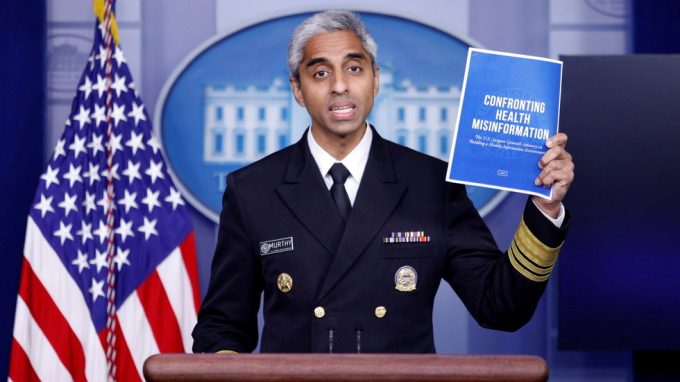
RT | July 15, 2021
As the Biden administration called “medical misinformation” a public health threat, the White House said it was working with social media to flag “problematic” posts. Critics called it an end-run around the First Amendment.
“We’re flagging problematic posts for Facebook that spread disinformation,” White House press secretary Jen Psaki told reporters on Thursday. In addition to directing the company to censor people, the government is also working to “get trusted content out there” by putting medical professionals in touch with social media influencers.
Psaki’s admission came after Surgeon General Vivek Murthy issued an advisory declaring misinformation “an imminent and insidious threat to our nation’s health.”
“Misinformation takes away our freedom to make informed decisions about our health and the health of our loved ones,” Murthy said at the White House. During just the Covid-19 pandemic, it has led to Americans refusing to wear masks, “turn down proven treatments” and choosing not to get vaccinated, which, he said, cost lives.
Murthy is a “tyrant” who wants “Big Tech to crack down on what amounts to open inquiry and free exchange of ideas,” commented journalist Jordan Schachtel, one of the notable skeptics when it comes to official pandemic narratives.
Looking at the surgeon general’s recommendations, Grabien’s Tom Elliott pointed out that the government is literally instructing private companies to “abridge the freedom of speech, and of the press, and the rights of people to peaceably assemble and petition the gov’t for redresses of grievances” – in other words, violate the First Amendment of the US Constitution.
Journalist Glenn Greenwald, who helped publish NSA whistleblower Edward Snowden’s revelations about surveillance abuse in 2013, called this union of corporate and state power “one of the classic hallmarks of fascism.”
“If you don’t find it deeply disturbing that the White House is ‘flagging’ internet content that they deem ‘problematic’ to their Facebook allies for removal, then you are definitionally an authoritarian,” said Greenwald.
“This is ‘Ministry of Truth’ level malfeasance. They’re literally admitting to colluding with [the] media to control the narrative. This is censorship,” tweeted Congressman Thomas Massie (R-Kentucky), adding that such tactics befit dictatorships and that throttling speech with which the government disagrees crosses a line.
Conservative columnist Stacey Lennox argued that censorship would actually make Americans question the White House’s narrative even more.
“If your ideas are the best, they can stand on their own. Censorship will make people question it more. Every. Single. Time,” she tweeted.
Democrats have clamored for social media to censor “misinformation” ever since the 2016 election, which resulted in the surprise victory of Republican Donald Trump over mainstream media favorite Hillary Clinton. The Trump campaign had bypassed corporate gatekeepers by reaching out to Americans directly via Twitter, Facebook, and other social media.
Four years later, under the pretext of fighting misinformation and “Russian interference,” thousands of users had been purged from the platforms, while Twitter and Facebook suppressed a newspaper for publishing a story about Joe Biden’s son Hunter and the information found on his laptop. They also cracked down on any questions about new electoral practices, such as mass mail-in voting, labeling them “misinformation.”
The Biden campaign actually demanded Facebook censor Trump himself for “misinformation,” which the platform initially refused to do.
Eventually, however, Trump was banned from all social media platforms – while he was still the sitting president – as much for allegedly “inciting violence” over the January 6 riot at the US Capitol, as for continuing to argue the 2020 election wasn’t honest.
YouTube censors Dr. Drew (again) for “medical misinformation”
By Didi Rankovic | Reclaim the Net | July 15, 2021
US physician and media personality Dr. Drew Pinsky is once again in trouble on YouTube, after one of his videos was removed for allegedly containing medical misinformation.
The video was an episode of one of Pinsky’s podcasts that featured Dr. Ram Yogendra, an anesthesiologist, and following this, he announced that YouTube handed his channel a “two week penalty.”
This is similar to what happened in February, when Pinsky told Dave Rubin of the Rubin Report that his YouTube channel had been “deplatformed” for a week, with a threat of permanent deplatforming.
He also shared at the time that he was unable to understand what the reasons behind YouTube’s actions were, but assumed they had to do with a discussion with another doctor of Covid topics such as immunity and controversies around different types of treatments of some complications brought on by the disease.
This time, Pinsky seems to have received a second strike against his channel within 90 days, leading to two weeks suspension, or, as he put it, “penalty.” A third strike within a given period would lead to the doctor’s permanent deplatforming.
This development seemed to have given Pinsky some show topic ideas, so he afterwards took to Twitter to announce an AMA session on Clubhouse, the topic being, “Big Tech vs. Free Speech: Ask Dr. Drew.”
Pinsky has a diversified presence on many platforms, including on Rumble, which he recently joined, and he urged his audience on Twitter to find links on his website to the video on other social media networks.
As for this latest example of YouTube’s censorship of his videos on the platform, Pinsky in one tweet thanked a commenter who said they listened to the whole podcast episode but were unable to determine what might have constituted for medical information – instead, it was “just talk about how discussion is being censored.”
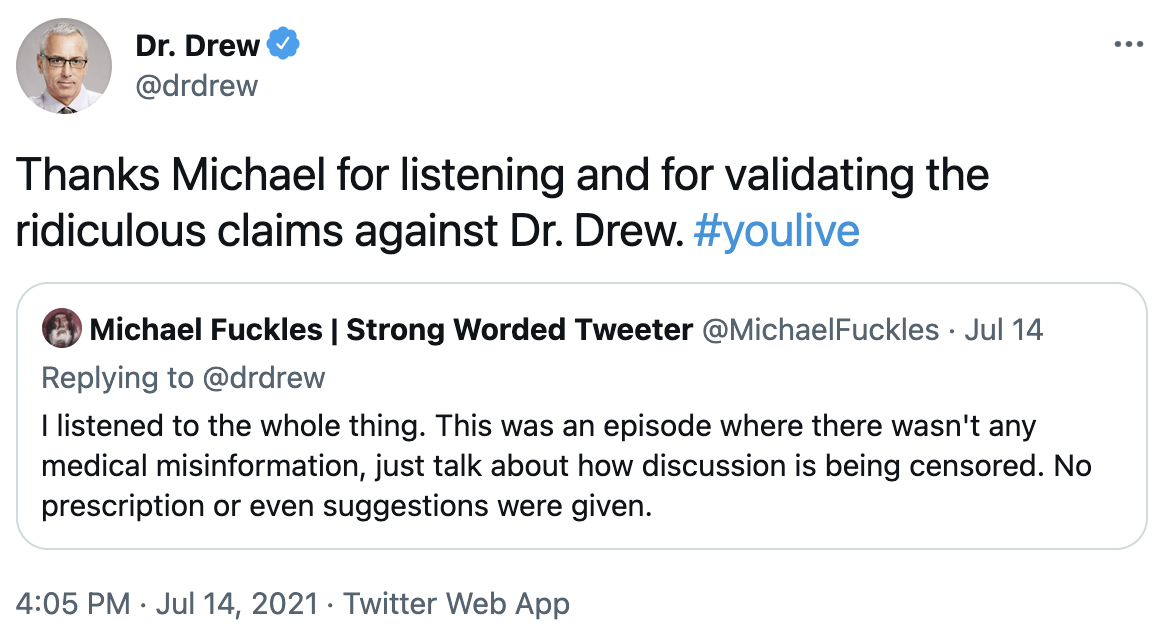
But it would be much easier for YouTube to cite medical misinformation and call it a day, than to for once go into any meaningful detail in explaining why creators are punished and deplatformed.
Biden & DNC want to censor text messages to stop ‘misinformation’ – ‘if it saves just one life’
Who needs privacy?
By Helen Buyniski | RT | July 14, 2021
The White House is tying itself in knots to silence anyone questioning the mainstream Covid-19 narrative, and, whatever you think of vaccines, its latest plans are only the first step toward making thoughtcrime a reality.
The US government is done playing “good cop” with regard to the “vaccine hesitant.” The Biden administration, which recently opted to send ‘volunteer’ vaccinators door to door in what may be the most ill-thought-out public health campaign in US history, doesn’t just want to meddle with your body anymore – its plans to control “misinformation” you may send by SMS text message indicate it’s intent on controlling your mind as well.
White House chief medical adviser Anthony Fauci is leading the crusade, blaming “Fox News or whomever” for crafting the vision of “a bunch of federal workers knocking on your door, telling you you’ve got to do something that you don’t want to do.” Fauci clarified that it wasn’t government officials, but “trusted messengers who are part of the community”. Noticeably, he didn’t address the “doing something you don’t want to do” part – a telling oversight in the minds of those who are convinced the campaign is indeed a coercive one and those who’ve been paying closer attention to who makes up the door-to-door vax packs.
While Politico insisted on Monday that these teams talked up by Biden and Psaki were merely delivering information on vaccination, not administering the jabs, a Tuesday report from a local TV network in Mecklenburg, North Carolina showed precisely the opposite, proudly announcing one man was so excited by the visit he chose to get the shot right then and there on his porch.
Who are you going to believe, then, America? The TV or your lying eyes?
And this campaign is far from a single-pronged strategy. According to Politico, the Democratic National Committee (DNC) and “Biden-allied groups” – whatever that last phrase means – have plans to “engage fact-checkers more aggressively” and “work with SMS carriers to dispel misinformation about vaccines that is sent over social media and text messages.”
Yes, you read that correctly. The White House plans to interfere with people’s ability to send text messages if it doesn’t like what they say. This is not a question of whether one supports or rejects the Covid-19 vaccine campaign, or what one thinks about vaccines at all; this is the curtain being yanked back on the police state the US has long insisted it isn’t (but that all its enemies are). It’s Washington rearing up with bared teeth, concealing its scabrous pelt in a lab coat, and hoping you don’t see the claws grasping the syringe. The US gave up its moral authority regarding freedom of the press somewhere between the Pentagon Papers and the revelations of Operation Mockingbird, but interfering with the content of individual text messages sent between innocent civilians brings the nation much deeper into the thickets of fascism than it has ever dared venture before, to a spot where it seems intent on setting up shop permanently.
Shots in the Hood ‘Strike Force’
Ultimately, the issue goes far beyond the pandemic to how much power Americans are willing to cede to a government that – based on statistics, at least – less than a quarter actually supported in the last election, a result framed as an accomplishment that speaks more to apathy. This is why the narrative managers don’t replace Fauci. When they really need credibility, they deputize trusted community members – a tactic they’ve been quite open about using, recently to middling success in Chicago’s Englewood neighborhood, where a local barber shop participated in Biden’s “Shots at the Shops” campaign to flood some of the city’s most dangerous, crime-plagued black neighborhoods with what were portrayed as clever, street-smart vaccination teams eager to save the lives of their fellow man.
That way, when whatever health campaign (or other government initiative) those barber shops (or other incursion on constitutional freedoms) have tied their credibility to suffers a hit – and the Englewood appearance wasn’t anything to write home about – it’s the trusted local institution that takes the blame. The overarching public-private partnership – that Faustian (Faucian?) pact between business and government – is one of the defining elements of fascism. But it’s become so common and normalized under Biden’s Covid-19 “Build Back Better” project that the average American thinks nothing about seeing all their local businesses getting into bed with the private equity firms such as BlackRock and Blackstone that have quietly bought up their neighborhoods during the pandemic – or as far back as the 2008 crash. After all, these groups know enough to shroud themselves in rainbows and climate-babble, and that’s all most people care about these days when vetting who they will allow to own them.
Search and Stick
More importantly, if White House spokeswoman Jen Psaki can look Americans in the eye and claim no one’s being vaccinated on the search-and-inoculate missions in North Carolina, while the next TV channel shows exactly that happening, a seed of cognitive dissonance is successfully sown that allows a person to believe two mutually exclusive “truths.” Even if we know at some basic level the government is lying to us, we don’t want to believe our trusted neighborhood fixtures are also doing so. The Biden administration’s recently declared scorched-earth campaign thus has the potential to sabotage trust in as many ways as there are trusting relationships in a community, and it doesn’t care what happens to those people as long as it gets control of the American mind at the end of the road. Families might be shredded and homes torn apart over the FBI’s recent announcement that we must snitch on our fellow man lest ill-defined “extremism” take root somewhere, but Blackstone and Vanguard turned record profits this year, and that’s what matters.
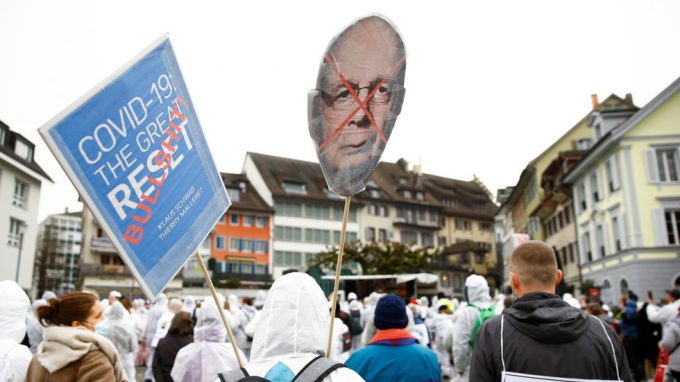
Americans seem to believe the Covid-19 pandemic is winding down – a Gallup poll early last month suggested nearly three in five Americans believe their lives are either “somewhat” or “completely” back to normal after 18 months of being put through their Pavlovian paces in what the World Economic Forum admits was the world’s largest-ever psychological experiment. But the narrative managers have only begun declaring war – not on the virus, or even so much on how we think about it, but how we think about them.
Former George W. Bush administration official John Bridgeland warned Politico on Tuesday that “lies” (not necessarily about vaccines, but that create “communities already wary of the vaccines”) are “potentially a death sentence.” Now what kind of government official would he be if he allowed some family who just wanted to be left alone with their “death sentence” to go back to their dinner? Not a very effective one, that’s for sure! Bridgeland didn’t say what kind of “lies” made people more susceptible to death by Covid-19, but no doubt he’d like to spend a long time digging through your phone to make sure you’re not harboring any.
Humanity must be primed for the next crisis, after all. Whether that’s a “climate lockdown” or a fake alien invasion, we’re being primed for another metaphysical gut punch meant to turn us against ourselves. At that point, resistance will no longer be optional, it will be a matter of survival – but your phone won’t let you text that to anybody.
Helen Buyniski is an American journalist and political commentator at RT. Follow her on Telegram
Under the cosh of Green Reason
By Edward Gifford | The Conservative Woman | July 15, 2021
INCREASINGLY ‘Green Reason’ – citing the environment – will be used as a justification for any kind of measure, no matter how illogical or absurd. Since March 2020 this type of justification has been used to prop up a whole range of bizarre Covid measures. But the actual substance of the argument – health or environment – is neither here nor there, it is the solipsistic quality that is most valued; these justifications invite silence. Quiet acquiescence is intrinsic to its power. Any dissent is not taken at its rational value but is rather shot down in a barrage of emotionally charged statements.
As yet there is no widespread, subconscious response to a Green Reason announcement as there is to Covid one: it does not create a sense of immediate personal danger; somehow the environment is more abstract than a microscopic pathogen. But we should not be surprised as the chains of reasoning are built up to such a degree that the majority will feel immediately insecure and clamour for the State to step up and protect them.
I recently came across Green Reason whilst travelling south on the ‘smart’ M1, around Sheffield. A gantry announced: ‘Speed limited to 60mph to improve air quality.’ I had never seen or heard of such a command before; looking askance at the other passengers in the car, they too looked puzzled.
Although the motorway was reasonably quiet as we pootled through this long section, compliance was absolute. The smart motorways employ a plethora of enforcement measures, speed traps at every gantry and, in addition to the usual copper loop sensors embedded in the road surface, ‘side-fire radar’ combined with automatic number plate recognition. These will ‘improve tracking and reaction operations’, according to Highways England.
A reasonable first question would be: who benefits from the supposed higher quality air?
A 10mph reduction does not seem to offer much, especially from an automotive point of view: at higher speeds internal combustion engines burn cleaner and more efficiently. A reduction in speed then seems counter-productive. Secondly, who on the motorway benefits from that marginal reduction in particulate matter in the immediate air surrounding their car? The high-quality filters on cars again negate that difference. Or perhaps instead it is for the improvement of the surrounding area? Possibly, but one imagines that re-planting the trees hewn down to build the expanded motorway could render greater benefit than a limited speed reduction scheme.
Although those reasons may in themselves render the scheme hopeless, they are beside the point. One can imagine the officials responsible for the sign laughing at how clever they have been; who would not want to improve air quality? Anyone who questions this measure cannot go far beyond the original statement, so plain, innocent and laudable, before being pigeon-holed as an ‘anti-environmentalist’. The narrative will be constructed to be unassailable.
Gas boilers, wood-burning stoves and flying (via stealth fuel duties – though of course private jets are exempted) are all coming under the cosh of Green Reason; and though measures are needed to protect the countryside, they must be considered rationally in accordance with tradition, in the cold light of day subject to debate and plebiscite.
‘Of all tyrannies, a tyranny sincerely exercised for the good of its victims may be the most oppressive. It would be better to live under robber barons than under omnipotent moral busybodies. The robber baron’s cruelty may sometimes sleep, his cupidity may at some point be satiated; but those who torment us for our own good will torment us without end for they do so with the approval of their own conscience.’ – C S Lewis
Featured Video

The Most Important Bet You’ve Never Heard Of
or go to
Aletho News Archives – Video-Images
From the Archives
Wars for Israel: A reminder of who’s giving the marching orders
By Damian Lataan | February 7, 2012
As the West prepares to march off to yet another war in the Middle East, we should perhaps remind ourselves of who is giving the West their marching orders.
In February 2003, just weeks before the US and their allies launched their attack on Iraq and her peoples, a delegation of US congressmen, together with the US Ambassador to the United Nations, John Bolton, a well known pro-Zionist and neoconservative war-hawk, were in Israel at the invitation of the Israeli government then led by Israeli Prime Minister Ariel Sharon.
Addressing the congressmen, Sharon told them ‘that Iran, Libya and Syria should be stripped of weapons of mass destruction after Iraq’. Later, Sharon told John Bolton ‘that Israel was concerned about the security threat posed by Iran, and stressed that it was important to deal with Iran even while American attention was focused on Iraq’. … continue
Blog Roll
 Aletho News
- UAE rejects report claiming it is ready to join war on Iran to reopen Hormuz
- A New Resistance Front: How Does Syria Factor into the Regional War?
- Gulf states weigh pipeline expansion plans, hoping to bypass Hormuz
- Iran sets up ‘tollbooth’ system in Strait of Hormuz
- Wave 90: IRGC strikes US-linked industrial sites in Gulf
- Iran Says US-Israeli Claims of Its Military Strength Are Wrong
- Trump’s April Fools’ Address to the nation
- The Most Important Bet You’ve Never Heard Of
- The killing of three Indonesian soldiers in Lebanon should remind Jakarta that Israel does not want peace
- Defeated and delusional: Netanyahu’s remarks reveal $80bn war failure, says analyst
- If Americans Knew
- ‘War crime’: Global condemnation as Israeli ministers celebrate death penalty law targeting Palestinian prisoners
- 7 Ways Israel Is Turning Lebanon Into Gaza
- World’s Leading Football Bodies Under Fire Over Israel Policies
- Experts warn of possible use of nukes against Iran
- Israeli invasion of Lebanon could be worse than 1982, warn European officials
- Passover: Liberation and collective punishment
- Trump says the quiet part out loud: (Israel’s) war on Iran > Americans’ health – Daily Update
- Gaza families reunite years after babies evacuated amid Israel’s war
- International Rescue Committee warns Gaza’s children face grave protection risks
- Iran’s Alleged 47-Year War on America: Debunking the 1,050 American Deaths Canard
- No Tricks Zone
- Low Intensity Tornado Wrecks Major Solar Farm, Creating A Potential Toxic Dump
- New Study Finds Warming Saves Lives…Cold Temperatures 12 Times More Deadly Than Excess Heat
- German Science Blog Accuses PIK Climate Institute Of Hallucinating Climate Tipping Points
- Devastating Assessment Of Comirnaty Vaccine By Former Senior Pfizer Europe Toxicologist
- New Study: CO2 Is ‘Effectively Negligible’ As An Explanatory Climate Change Factor Since 2000
- Former Pfizer Toxicologist Dr. Helmut Sterz Tells Bundestag Hearing Pfizer Vaccine Should Have Never Been Approved
- Energy Expert: Germany’s Nuclear Phaseout Was A “500 Billion Euro Mistake”
- New Research: South Australia’s Mid-Holocene Sea Surface Temperatures Were 4°C Warmer Than Today
- Storing Green Energy To Last Germany 10 Days Would Require A 60-Million Tonne Battery
- New Studies: UK Sea Levels Were 4 Meters Higher Than Today During The Mid-Holocene
 Aletho News