United States Bribes Cape Verde $440 Million in Exchange for Alex Saab’s Extradition
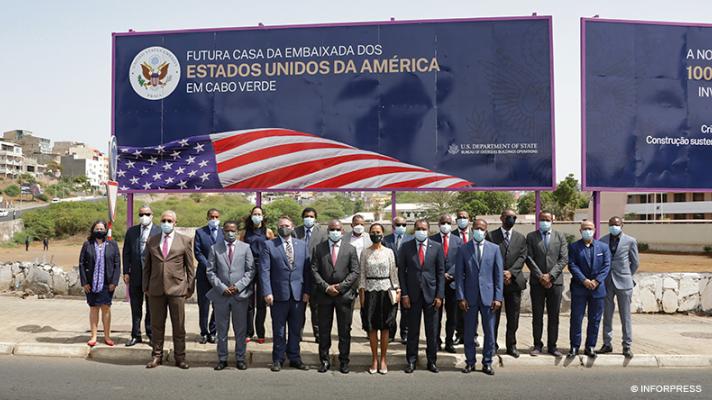
Attendees of the groundbreaking ceremony of the future headquarters of the US Embassy in Cape Verde. (Photo: Inforpress)
MISIÓN VERDAD* | July 6, 2021
On the eve of Cape Verde’s independence day, coincidentally the same day as Venezuela’s—July 5—the United States government announced an investment of $439 million to build a new US embassy facility on a 4.5-hectare area of land adjacent to the Government Palace in Praia, capital of the West African country. Of that money $100 million will go directly into the Cape Verdean economy.
The project would “pay tribute to the long-standing relations” between Praia and Washington, US Ambassador to Cape Verde Jeff Daigle said when he made the announcement on Sunday, July 4.
The disproportionately high figure for the construction of the building is striking, since it is equivalent to more than half of Cape Verde’s Gross Domestic Product (GDP) forecast for the current year.
The news outlet Justiciafuser pointed to the obvious connection between the “investment” and the case of diplomat Alex Saab, who is illegally imprisoned by the government of Cape Verde due to US political influence: “Local observers… have questioned the timing of this announcement coming as it does only days before the Cape Verde Constitutional Court is expected to decide on Alex Saab’s appeal against his extradition to the United States.”
Jeff Daigle has been charged with directing the pressure on the government of Cape Verde for Saab to be extradited to Miami, Florida, under the custody of agents of the Drug Control Administration (DEA).
“Much work remains to be completed” before the expansion of the embassy is secured, the US diplomat said. Local analysts, quoted by Justiciafuser, singled out this statement as an implication that the US is awaiting reciprocation for its investment on behalf of Cape Verde.
Alex Saab was abducted in Cape Verde while returning from Iran on a diplomatic mission, one day before Interpol issued a Red Notice to justify his arrest. The government of Venezuela has demanded his release and has denounced the violations of international law represented by Washington’s actions with the collaboration of the African country.
The Court of the Economic Community of West African States (ECOWAS) recently ruled in favor of ending the extradition process of Alex Saab, and demanded his release.
* SOMOS UN GRUPO DE INVESTIGADORES INDEPENDIENTES DEDICADOS A ANALIZAR EL PROCESO DE GUERRA CONTRA VENEZUELA Y SUS IMPLICACIONES GLOBALES. DESDE EL PRINCIPIO NUESTRO CONTENIDO HA SIDO DE LIBRE USO. DEPENDEMOS DE DONACIONES Y COLABORACIONES PARA SOSTENER ESTE PROYECTO, SI DESEAS CONTRIBUIR CON MISIÓN VERDAD PUEDES HACERLO AQUÍ
Translation by Orinoco Tribune
‘They Make Unsubstantiated Accusations’: Venezuela Calls UN Report Fallacious
Orinoco Tribune | July 6, 2021
In a communiqué, the Bolivarian Republic of Venezuela rejected the fallacious content and highlighted the biased nature of a report published about the country’s situation by the Office of the United Nations High Commissioner for Human Rights, Michelle Bachelet, on July 1, 2021.
This report is the result of a Resolution promoted by a small group of governments with serious domestic human rights violations, that conspired to satisfy the policy of “regime”-change promoted by the US against Venezuela.
Despite the attacks, Venezuela is distinguished by its harmonious constitutional system that guarantees and defends human rights. The state provides a protective shield for its people against the barbarous criminal blockade imposed and directed from Washington and the European Union, that constitutes a serious crime against humanity.
It is especially worrying that this report is based on information provided by individuals with unknown motivations, and has not been duly verified with the authorities of Venezuela, despite the extensive facilities that the Venezuelan Government has provided for the performance of the OHCHR functions within the country.
On this occasion, based on a handful of alleged complaints of human rights violations, unverified accusations are made against the Venezuelan institutions, further manipulating the false narrative constructed to artificially supplement the file currently before the International Criminal Court, with the political objective of destabilizing the democratic institutions of Venezuela.
In addition to this, the report omits mention of the 26 visits made to detention centers and headquarters of intelligence agencies during which the Office of the High Commissioner has been able to interview hundreds of prisoners, according to its own guidelines of operation. In the Office’s conclusions, delivered to the State, the people interviewed confirmed that their personal integrity was respected during their incarceration.
Venezuela has asked the Office of the High Commissioner to share information with the national authorities on the alleged cases referred to in the report, in order to carry out rigorous investigations and determine their veracity and, if applicable, the corresponding responsibilities, in full consistency with its policy of absolute respect for human rights. Similarly, the Office of the High Commissioner has been invited to accompany the investigation processes developed by local authorities.
The Bolivarian Republic of Venezuela, in order to continue intensifying due cooperation with this office, ratifies its willingness to maintain channels of communication and dialogue with the Office of the United Nations High Commissioner for Human Rights, on the basis of strict adherence to the principles of objectivity, impartiality, non-politicization, respect for sovereignty, commitment to constructive dialogue, and—as required by international law—free from geopolitical agendas at the service of hegemonic powers.
It’s Time to Say ‘No’ to US Blockade on Lebanon
By Marwa Haidar | Al-Manar | July 8, 2021
US officials have repeatedly made it clear that it will prevent Lebanon from receiving crude oil from Iran, tightening the noose on the Middle Eastern country which has been facing the harshest economic crisis in decades.
A year ago, in July 2020, former US Secretary of State Mile Pompeo said taking oil from Iran would be “unacceptable.”
“It would be sanctioned product for sure, and we’ll do everything we can to make sure that Iran cannot continue to sell crude oil anywhere, including to Hezbollah in the region…,” the ex-diplomat said in remarks on July 8, 2020.
Pompeo’s remarks were in response to Hezbollah Secretary General Sayyed Hasan Nasrallah who said at time that the Lebanese Resistance group was in discussion with the government about Iran supplying refined oil products to Lebanon in exchange for Lebanese pounds to ease pressure on the plummeting currency.
This year, and amid the increasingly severe fuel shortages that brought long queues at service stations in recent months, Sayyed Nasrallah renewed the Iranian offer to sell Lebanon oil in exchange for Lebanon pound.
Responding to Sayyed Nasrallah, US Ambassador to Lebanon Dorothy Shea said that importing fuel oil from Iran “is not a practical solution.”
“What Iran is looking for is a sort of dependent state that it can use to carry out its agenda. There are much better solutions than turning to Iran,” the US envoy said in remarks earlier last month.
Nearly a month after renewing the Iranian offer, it seems that no Lebanese official “has the courage” to press for importing fuel supplies from the Islamic Republic, with many parties and figures fearing Washington’s sanctions.
In his latest speech last week, Sayyed Nasrallah Lashed out at the US over tightening the blockade on Lebanon by preventing Lebanon from approving deals with any Eastern country, including China and Iran.
His eminence said that the US ambassador “sheds crocodile tears and deceives the Lebanese by providing some masks,” stressing that Washington has been the main supporter of the corrupts and money embezzlers in Lebanon.
Turning to Lebanese statesmen, Sayyed Nasrallah made it clear: that they have to make some sacrifices for their country and override the fear of the US sanctions.
The Hezbollah S.G. said that saving the country from the socioeconomic crisis deserves courageous decisions by several Lebanese figures and parties, hinting out that now it’s time to say ‘no’ to Washington.
In Germany, burning the Israeli flag is a problem, but killing Palestinians isn’t
By Motasem A Dalloul | MEMO | July 6, 2021
Israeli Deputy Foreign Minister Idan Roll met with the German Ambassador, Susanne Wasum-Rainer, on Monday along with visiting German parliamentarians. Roll thanked the German guests for their country’s strong support for Israel during its major military offensive against the Palestinians in Gaza from 10-21 May.
Germany’s unlimited support and cooperation make it a special friend of Israel. Among EU members it is the second-biggest supplier of weapons to the occupation state. Between 2009 and 2020, 24 per cent of Israel’s arms imports came from Germany.
When Israel treats international law, human rights, democratic principles, and liberal beliefs with contempt, Germany automatically takes its side, even when the result is the killing of innocent children and women. During the latest Israeli offensive, Germany supported Israel’s “right to defend itself” although it was killing civilians and destroying civilian buildings and infrastructure. The fact that an occupying state has no right to claim “self-defence” against the people under occupation was ignored by the Germans.
On 12 May, a German government spokesman, Steffen Seibert, refused to condemn Israel’s killing of 14 Palestinian children. He referred to the legitimate Palestinian resistance as “terrorist attacks” and that the resistance groups had to stop their action against Israel so that “people do not die”.
Seibert ignored the Israeli warplanes pounding the besieged Gaza Strip. He ignored the Israeli tanks firing indiscriminately towards densely-populated areas across Gaza. He ignored weeks of Israeli harassment and attacks on Palestinians worshipping in Al-Aqsa Mosque throughout Ramadan, and the residents of Jerusalem facing attacks by illegal settlers, which prompted the resistance groups to act. He ignored all of that.
On the same day, the deputy spokesman of the German Foreign Ministry, Christofer Burger, angered journalists when he said that the Palestinians had no right to self-defence. His claim that this right is only guaranteed by international law to sovereign states and Palestinians are not a state was palpable nonsense. All people living under occupation, collectively and individually, have the right to defend themselves and resist military occupation. Israel’s occupation of Palestine is a military occupation.
On day ten of the Israeli offensive, when the occupation state had killed 66 children, 40 women, and 16 elderly people out of 266 Palestinians killed in total, German Foreign Minister Heiko Maas insisted that, “Germany stands with Israel and its right to defend itself.” He even visited Israel to prove that his country’s support was not limited to words. “I came to Israel to show solidarity and support Israel. Israel’s security and that of the Jewish residents here are not negotiable.”
![German Foreign Minister Heiko Maas in Berlin, Germany on June 23, 2021 [Abdulhamid Hoşbaş/Anadolu Agency]](https://i2.wp.com/www.middleeastmonitor.com/wp-content/uploads/2021/06/20210623_2_48889287_66351096.jpg?resize=500%2C331&quality=85&strip=all&zoom=1&ssl=1)
German FM Heiko Maas, June 23, 2021 [Abdulhamid Hoşbaş/Anadolu Agency]
Two days earlier, German Chancellor Angela Merkel called the then Israeli Prime Minister Benjamin Netanyahu, and “sharply condemned the continued rocket attacks from Gaza on Israel and assured the prime minister of the German government’s solidarity.” She showed great interest in Israel’s security and safety of its people and condemned only the legitimate Palestinian resistance.
Germany’s verbal support for Israeli brutality and aggression against the Palestinians was backed up by officials who claimed that peaceful protests during which Palestinian flags were flown and anti-Israel slogans were chanted were “anti-Semitic”. Calls for Israel to be held accountable for its breaches of international law were described as “hate speech”.
According to Seibert, “Anyone who uses such protests to shout out their hatred of Jews is abusing the right to protest [in Germany].” He described the pro-Palestine protests which raised awareness about the ongoing Israeli crimes as “anti-Semitic rallies”, and stressed that they “will not be tolerated by our democracy.”
During a debate in the German parliament during the Israeli offensive on Gaza, Maas condemned the pro-Palestine demonstrations and called for a violent crackdown on them. “There shouldn’t be one centimetre of space for anti-Semitism on our streets. Never again.”
Germany has since banned the Hamas flag in the country in response to pro-Palestine demonstrations. “We do not want the flags of terrorist organisations to be waved on German soil,” Thorsten Frei, a lawmaker for Merkel’s CDU, told Die Welt. A ban, he added, would send “a clear signal to our Jewish citizens.”
President Frank-Walter Steinmeier told Israeli daily Haaretz that Germany believes that the International Criminal Court (ICC) has no jurisdiction to investigate Israeli war crimes in the occupied Palestinian territories because of the “absence of the Palestinian state”. Germany is not only unconcerned about Israeli crimes against the Palestinians, but also does not even want those crimes to be investigated. Palestine was, of course, granted the status of a “non-member observer state” by the UN in November 2012, a move described as “de facto recognition of the sovereign state of Palestine”.
Writing in Open Democracy, activist and sociologist Inna Michaeli said that Germans are against the entirely peaceful Boycott, Divestment and Sanctions (BDS) movement which seeks to end the Israeli occupation. Moreover, apparently, they do not like to hear anyone accusing Israel of killing children, despite this being “a description of horrendous reality — one in three Palestinians that Israel kills in Gaza are children.”
She asked rhetorically: “What should people chant when Israel is killing children? How can the victims express their rage and sorrow, how can they mourn their children who are killed again and again by Israel?”
Even the German mainstream media ignores Israeli brutality against the Palestinians. “Much of the mainstream media coverage of Nakba Day demonstrations did not even mention nor explain to the readers what the Nakba is, and its continuation in the form of ethnic cleansing and denial of Palestinians’ right to return,” Michaeli pointed out. “Berlin, with the largest Palestinian population in Europe, is home to people whose family members have been murdered by Israel in recent days. These protests are often framed as ‘anti’ Israel, but the fact that they are primarily ‘for’ Palestinian life is omitted.”
Omri Boehm is an Israeli philosophy lecturer in New York. “Whenever one attempts to raise this subject, one is immediately accused of anti-Semitism,” he noted. “It is impossible to simply state the facts. For example, that within Israel’s borders, three million Palestinians live under brutal military law without being recognised as Israeli citizens. The Germans do not want to see this.”
When pro-Palestine protesters burned an Israeli flag in Germany, Interior Minister Horst Seehofer described the act as “anti-Semitic” and said that Germany would crack down hard on anyone found to be spreading “anti-Semitic hatred” because “We will not tolerate Israeli flags burning on German soil.”
Commenting on this, Michaeli said: “Israeli flags matter, Palestinian lives do not. When people, politicians, and the media, care more about the burning of national flags than the burning of homes and neighbourhoods and the killing of entire families, they should really have a hard look at themselves.”
German support for Israel goes back to the early 1950s when reparations were paid to the state as the “heir” to the Holocaust victims who had no known surviving family. Billions of German marks and euros have been handed over in the intervening decades, helping to build Israel as a state. The fact that this is largely to the detriment of the people of occupied Palestine has, shamefully, been lost on successive German governments. Those parliamentarians who met Israeli officials earlier this week need to be educated about international laws and conventions, and the reality of Israel’s brutal military occupation which they and their colleagues in Berlin endorse so willingly.
Where the Abraham Accords are (and aren’t) going
Israel has improved its relationship with the UAE, but what about other Gulf countries?
By Giorgio Cafiero and Kristian Coates Ulrichsen | Responsible Statecraft | July 7, 2021
On June 29, Israel’s Foreign Minister Yair Lapid arrived in the United Arab Emirates, marking the first official trip by any chief Israeli diplomat to the Gulf country. Former Prime Minister Benjamin Netanyahu had wanted to visit Abu Dhabi while in office, so the timing of the visit so soon after the new Netanyahu-less government was sworn in was notable.
While Lapid was in the UAE, Israel inaugurated an embassy in Abu Dhabi and a consulate in Dubai, representing an important milestone in Emirati-Israeli relations nine months after the Abraham Accords were signed in Washington last September.
Lapid’s trip highlighted how the bilateral relationship has overcome challenges posed by the recent 11-day Gaza-Israel war. Although Emirati officialdom publicly condemned Israel’s conduct in East Jerusalem and the West Bank, and called on both Hamas and Israel to halt attacks (which notably did not single out Israel) in May, the UAE is not cooling its relations with Israel. To the contrary, Abu Dhabi is keen to find ways to build on the Abraham Accords and enhance its ties with the Israelis notwithstanding the unresolved question of Palestine.
While with Sheikh Abdullah bin Zayed Al Nahyan, the UAE’s Minister of Foreign Affairs and International Cooperation, Lapid signed an economic and commercial cooperation agreement. The two also co-authored a highly optimistic article in Abu Dhabi’s The National newspaper where they outlined their outlook for the Emirati-Israeli relationship as well as for “peace” across the greater region: “Peace isn’t an agreement you sign – it’s a way of life. The ceremonies we held this week aren’t the end of the road. They are just the beginning.” (Technically, the UAE-Israel accord is not a “peace” agreement because the UAE, which gained its independence in 1971, has never been at war with Israel.)
Beyond the rhetoric and the symbolism, what are this relationship’s substantive elements and what does this partnership truly mean in practice nine months after the accord’s signing?
Bilateral trade since September 2020 has reached around $675 million. The two countries have signed a long list of trade and cooperation agreements. Media, education, and tourism are all promising sectors that are starting to take off. It is significant that amid the global pandemic, which greatly harmed the UAE and all other Gulf Cooperation Council states’ tourism sectors, 200,000 Israeli tourists visited the UAE with most flying to Dubai.
Technology may be the area where the Emiratis have the highest hopes for this relationship. The potential benefits of formalized ties with the region’s most technologically innovative and advanced country are clear to the UAE. This is particularly true with respect to cybersecurity and to the potential acquisition of offensive cyber-capabilities by the UAE. As Sheikh Abdullah stated, the Emiratis are pleased that the Israelis will participate in Expo2020, an event to be held later this year in Dubai that will bring 192 countries together through technology, innovation, science, and art.
Nonetheless, the Emirati-Israeli trade relationship has thus far not lived up to its expectations. There has also been a degree of disappointment among those who were expecting the partnership to take off much faster following then-President Donald Trump’s announcement of the Abraham Accords.
Some anticipated deals have not taken place. For example, there was the suspension of the 50 percent sale of Beitar Jerusalem (a Jerusalem-based professional football club with an anti-Arab image) to a member of Abu Dhabi’s royal family in Abu Dhabi, Sheikh Hamad bin Khalifa Al Nahyan. In addition, an Israeli energy firm that planned to sell its share of a gas field to Mubadala Petroleum (a subsidiary of the UAE’s sovereign wealth fund, Mubadala Investment Company) missed a deadline for completing the agreement, although, according to the UAE’s side, the deal remains set to proceed. Time will tell how many and how soon major government-to-government and private sector transactions will indeed take place.
Abraham Accords, the Gulf, and Africa
Despite the political risks for any Arab state that normalizes relations with Israel, the UAE has vocally stood by the Abraham Accords, which, in the words of its ambassador to Washington, Yousef al-Otaiba, “move the region beyond a troubled legacy of hostility and strife to a more hopeful destiny of peace and prosperity.” But Abu Dhabi at this point does not appear to be leading any trend within the Gulf region toward the formalization of relations with Israel.
In Kuwait, Oman, Qatar, and Saudi Arabia, the 2002 Arab Peace Initiative remains popular and the only viable means of reaching a fair and lasting settlement between Israel and the Palestinians. This is true at the highest levels of government and among these countries’ general publics. But Tel Aviv almost certainly will not under any foreseeable circumstances agree to the API’s terms, which require Israel to return to the 1949-1967 borders and permit the Palestinians to have an independent state with East Jerusalem as its capital in exchange for opening diplomatic relations. Therefore, among GCC states, the UAE, along with Bahrain, will probably stand alone on the normalization question for some time.
As the GCC state with the most pro-Palestinian stance, Kuwait is most strongly opposed to normalization and unlikely to change its position. Oman maintains pragmatic, albeit unofficial, relations with Israel as highlighted by Lapid’s phone call with Oman’s foreign minister Badr al Busaidi on June 24, plus Netanyahu and other Israeli prime ministers’ visits to Muscat since the 1990s. But Oman remains committed to the API, as affirmed by Muscat’s chief diplomat at an Atlantic Council event held on February 11.
Qatar has a special role to play in Gaza that would be jeopardized by “abandoning” the Palestinians in exchange for normalization with Israel. Through Al Jazeera, which focuses heavily on the plight of Palestinians, and the tendency of Qatari diplomats to advocate on behalf of Palestinians in international forums, Doha’s regional and global image has much to do with its ability to take firm positions on certain international issues that contribute to the image of a pro-human rights foreign policy.
Finally, Saudi Arabia, due to its special role across the wider Islamic world, its authorship of the API, and its own internal dynamics that are fundamentally different than the smaller GCC states, will likely continue seeing normalization of relations with Israel as too risky, at least so long as King Salman remains on the throne.
Within this context, Israel will likely have its next diplomatic openings in the Islamic world not in the Persian Gulf, but instead in impoverished parts of sub-Saharan Africa where countries such as Niger, Mali, and Mauritania could have their economic interests advanced by joining the Abraham Accords. It will be important to see what actions Abu Dhabi might take to incentivize these African countries, many of which are major recipients of Emirati aid, to formalize ties with Israel. Enhanced Emirati assistance in exchange for normalization with Israel was already evident in Sudan’s decision to normalize ties with Israel, and the UAE may take a similar approach with these and other predominantly Muslim and poor African states.
NYC: Israeli-Trained NYPD Is Charging Pro Palestine Protesters with Bogus “Hate Crimes”

By Eric Striker | National Justice | July 8, 2021
The NYPD has a message for New Yorkers: don’t criticize Israel in their city.
Last May, demonstrators took to the streets of New York to protest the slaughter and ethnic cleansing of the Palestinian people.
They are now suffering selective prosecution at the hands of the ostensibly American NYPD, who are not only trained by the Israeli government, but even have an official branch in Tel Aviv.
Since June, multiple protesters have been arrested for “hate crimes” related to anti-Israel protests. The main crime appears to be public expressions of outrage at the Jewish state’s violent and genocidal policies.
In one viral video during May 20th demonstrations, a man lit a firecracker that Jews and Israeli propagandists on social media claimed was a bomb.
The footage clearly shows that nobody was hit with sparks from the firework, but a 55-year-old Jewish woman claimed to have suffered an injury and filed a police complaint. According to the New York Post she was taken to a hospital for “burns to her back” then quickly released. Police did not mention this woman’s supposed injury in their press release.
NYC has strict fireworks laws and setting them off is a class B misdemeanor, but because of the political context of the incident (the suspect was protesting against Israel) he has been hit with second-degree reckless endangerment as a hate crime.
The individual in question, 24-year-old Mohammed Othman, was also charged with first-degree gang assault as a hate crime and third-degree assault as a hate crime related to a minor skirmish with a group of Zionist counter-protesters. Multiple other Palestinian protesters are being charged for the incident but the Jews who were arrested were quickly released and driven home by the cops. The two Jewish “victims,” Amit Skornik and Snir Dayan, are trained IDF soldiers and were mutual combatants.
Hate crime enhancements, which are primarily applied in defense of privileged groups like Jews, gays, and occasionally blacks, significantly increases penalties for crimes.
But the NYPD is not stopping there.
On July 2nd, its hate crimes task force demanded the public to inform on three individuals who posted a sticker of the Israeli flag with a Swastika superimposed on it. The obvious context is the liberal view that Israel is a Nazi state, and is not aimed at any group in America.
The tweet, which declared the three “hipster” looking Arabs as hate criminals, tagged the Anti-Defamation League and Simon Wiesenthal Center, demonstrating that the investigation was politically motivated.
Hate Crimes Are Political Crimes
In an unrelated case, a young black man pulled down a rainbow homosexual flag in his neighborhood. He did not damage the business or hurt anyone, but the NYPD is nevertheless launching a city wide manhunt to find and punish the individual.
On June 16th, the NYPD announced a similar investigation over an elderly white woman who apparently made “anti-immigrant” remarks, then started shaking a pepper shaker.
Days before, they published a Wanted tweet for a mentally ill black man who “made anti-Semitic remarks” to a Jew, but did not touch him.
Many of the incidents on the NYPD’s hate crimes bulletin appear to be First Amendment protected speech or minor violations, rather than violent assaults.
The distinctive factor in all these cases is that the “hate criminals” are expressing views that go against America’s ruling political ideology.
Jewish controlled leftist groups that claim to be for civil liberties, such as the ACLU, all support hate crimes laws.
For Arab-Americans who believed they would have leeway to protest against Zionism that Black Lives Matter rioters had when protesting against whites last year, they can now see who really controls America.
Biden kneels before Israeli President’s chief of staff

President Joseph Biden kneels before Rivka Ravitz, chief of staff for Israeli President Reuven Rivlin on July 2, 2021. Ravitz is a member of the Haredi sect of Judaism. According to Israeli author Israel Shahak, Haredi teachings sometimes state that Jews are superior to non-Jews. (Kipa)
By Alison Weir | Israel-Palestine News | July 5, 2021
Israeli media are reporting that President Joe Biden knelt before Israeli President Reuven Rivlin’s chief of staff during Biden’s July 2nd White House meeting with Rivlin. Biden, to the surprise of onlookers, suddenly went down on his knees in front of Rivka Ravitz upon learning that she’s the mother of 12 children.
Ravitz, an ultra-orthodox adherent whose parents were Americans who moved to Israel, has long been close to Rivlin. According to an Israeli publication, Ravitz has been with Rivkin “at the most dramatic points in his career” since 1999 and is part of an important religious Israeli family: “At the age of 18, she married the son of the mythical Knesset member from Torah Judaism, Avraham Ravitz, and so she married politics.”
Her husband, Yitzchak Ravitz, is the former deputy mayor of the haredi Israeli settlement Beitar Illit, where the family lived for many years. Such settlements are illegal under international law. Mondoweiss reports that Beit Illit is known as a bastion of Jewish extremism, quoting from the Financial Times :
… in the settlement of Beitar Illit, south of Jerusalem… anyone interested in renting a flat is checked by a “demographics committee”… Residents say Beitar is patrolled by a self-styled “modesty police”, which bullies youngsters to toe the line… David Biton, a 19-year old trainee baker who lives with his parents in Beitar Illit, says he was beaten up by two ultra-orthodox men recently after being seen chatting to girls. “I tried to put together a group of youngsters to testify against them but everyone was too afraid,” he says.
Ravitz is a member of the religious party Degel HaTorah. Haredi Israelis, also known as ultra-orthodox, have fundamentalist, sometimes extreme views about Jews and Judaism.
Israeli author Israel Shahak quotes a 1988 article published in Israel by a highly regarded authority on the Haredim: “The Haredi world is Judeocentric. The essence of Haredi thought is the notion of an abyss separating the Jews from the Gentiles.”
In his book “jewish Fundamentalism in Israel,” Shahak writes: “The fact is that certain Jews, some of whom wield political influence, consider Jews to be superior to non-Jews and view the world as having been created only or primarily for Jews.” An article in the Israeli newspaper Ha’aretz reports that some in ultra-orthodox communities “are taught that non-Jews aren’t quite human.”

Yitzchak Ravitz (far left) attends meeting asking Israeli President Rivlin to assist Mordechai Yitzchak Samet, serving a 28-year prison term in a US federal prison for racketeering and swindles. (Yeshiva World)
In 2015 Yitzchak Ravitz helped lobby President Rivkin for his assistance in securing the release of a Haredi man, Rabbi Mordechai Samet, imprisoned in the U.S. for swindling millions of dollars from Americans.
According to the U.S. judge who sentenced Samet: “Mordechai Samet lived a life of unremitting fraud. For many years, Mordechai Samet’s life has been completely dedicated to the pursuit of crime. He defines the word ‘racketeer.’”
Samet was convicted on 33 counts of racketeering, money laundering conspiracy and other charges. A local newspaper reported that the conviction was part of “a criminal case that began suddenly one morning in March 2001 when federal agents swept into the Hasidic community of Kiryas Joel [a new town in New York] and began rounding up suspects.”
“In all, 14 men, most from Kiryas Joel, were accused of taking part in schemes that netted more than $5.5 million. Using dozens of fictitious identities, the group allegedly obtained tax refunds and business loans they didn’t deserve, among other scams.”
Biden: Commitment to Israel ‘engraved in stone’
Israeli media report that after Biden knelt, “the two presidents spoke at length about the commitment to strengthen relations between the two countries.” Biden announced [translated by Google from the Hebrew]: “My commitment to Israel is known and engraved in the rock.”
Biden has called himself a Zionist and has a long history of support for Israel, consistently voting to give the country billions of dollars of U.S. tax money. In 2014 he helped give Israel an additional quarter of a billion dollars during its 2014 onslaught against Gaza.
Also reportedly at the recent White House meeting were Deputy Secretary of State Wendy Sherman, National Security Adviser Jake Sullivan, Middle East and North America Coordinator, Bart McGrack, Senior Adviser to the Middle East and North Africa, and Julie Schweier, Adviser in charge of Israeli and Palestinian.
Alison Weir is executive director of If Americans Knew, president of the Council for the National Interest, and author of Against Our Better Judgment: The Hidden History of How the U.S. Was Used to Create Israel.
China may be building new nuclear missile silos in its western desert… but only in response to American aggression
By Tom Fowdy | RT | July 7, 2021
US reports claiming Beijing is greatly strengthening its nuclear arsenal can’t be confirmed, but it wouldn’t be surprising, given Washington’s threats against Beijing and its military build-up in the region.
Much has been said recently about an exclusive report published in the Washington Post analysing satellite imagery that purports to show China building intercontinental ballistic missiles in its northwestern province of Gansu, claiming that China is gearing up its ‘second-strike capability’ and in turn strengthening its nuclear arsenal.
The report follows a running theme in US military circles that Beijing poses a growing “nuclear threat” to the United States, with Pentagon spokesman John Supple telling CNN: “Numerous Defense Department leaders have testified and publicly spoken about China’s growing nuclear capabilities, which we expect to double or more over the next decade.”
On the other hand, pro-China voices on Twitter were quick to dismiss the report’s findings and argue that the construction sites were, in fact, wind farms. While it’s difficult to verify these claims, of course, it’s likewise important to remember that, beyond US hysteria, China’s nuclear arsenal is tiny in comparison to America’s (currently some 250 to 350 warheads versus 3,800), and it operates according to a ‘no first use’ policy (Washington’s doesn’t).
It would be unsurprising if growing military tensions between the two states and a perceived fear of encirclement by the US and its allies was pushing China to strengthen its military hand. Although it would be ridiculous to accuse China of a ‘Cold War-style’ build-up, it makes logical sense for Beijing to ramp up its capabilities.
The original Cold War between the United States and the USSR was defined for most of its history by a dramatic increase in nuclear missile capabilities on both sides, which, at its peak in the 1980s, saw Moscow accumulate almost 40,000 warheads. This dramatic stockpiling created a constant fear of global nuclear annihilation and was pushed to the brink through episodes such as the Cuban Missile Crisis, yet, ultimately, the equilibrium of ‘mutually assured destruction’ ensured that conflict between the two superpowers never broke out.
This is not comparable to the current tensions between China and the United States. While Beijing has had nuclear weapons since 1964, it has been largely reserved on its objectives of maintaining a ‘basic deterrent’ of around 300 warheads – comparable to the numbers held by the UK and France.
Its nuclear goals are not as America’s are, to uphold military hegemony over the rest of the world, but to protect its national sovereignty and territorial integrity. That, of course, includes obvious red lines such as Taiwan, and this could be part of the reason it may be increasing its numbers and ‘flexing’ its approach as tensions with the United States rise.
Washington’s bellicose language towards Beijing, and its growing militarisation around China’s periphery, including expanding its relationship with Taiwan, is increasingly aggressive. As a report from a Washington foreign policy magazine put it: “The US military is encircling China with a chain of air bases and military ports.” Faced with such threats, what nation would not seek to up its defence capabilities?
The Washington Post report is correct to frame China’s potential activities as a reaction to these developments, and to call it a ‘second-strike’ capability, though the weapons’ use to deter a Taiwan contingency is not unimaginable.
The missile silos’ location in Gansu is strategically significant. First, the province is situated deep into China’s interior, towards Xinjiang. It’s an isolated desert region that is west of the core of China’s population and away from its industrial and urban sprawl. This reduces liability for those areas in times of conflict and makes the weapons easier to hide and disguise.
Second, the location makes it far more difficult for enemy fighters to reach and disable the silos. Could US fighter jets go thousands of kilometres inland into China to conduct pre-emptive strikes on military infrastructure and not be shot down? They have clearly been carefully placed to play to China’s geographical strengths.
Thirdly, Gansu, being near Xinjiang and Tibet, may have been chosen to cater to another opponent as well as the United States. Although we are talking here about what are apparently intercontinental ballistic missiles that can travel more than 9,000km (5,600 miles), allowing them to reach the American mainland, they could also reach greater continental Eurasia and the Indian Ocean, giving options against the US’ Indo-Pacific Strategy as a whole and Beijing’s geopolitical rival in New Delhi. This did not go unnoticed in the Indian media.
In this case, one might describe China’s potential nuclear build-up, if proven, as a deliberately ambiguous effort undertaken in reaction to the shifting military environment in the region and not an effort to pursue nuclear domination or hegemony, but to tilt the balance of power in its favour and strengthen its leverage in the surrounding regions.
Ultimately, if the United States is seeking to increasingly equip its allies, strong-arm them into anti-China coalitions, pursue a growing number of military exercises in and around the Indian and Pacific Oceans, and press on all of China’s insecurities, of course, Beijing is going to react, but it will do so, as it always does, in a more subtle and less overt way.
There will be no nuclear confrontation between the United States and China, and nor does Beijing anticipate one, but the route towards some form of arms build-up has been inevitable for a long time. Don’t expect China to showcase this or publicize its true capabilities, but rather to keep its opponents guessing – and on their toes.
Tom Fowdy is a British writer and analyst of politics and international relations with a primary focus on East Asia.
A Country That Has Lost Its Way: U.S. Government and Corporations Combine to Strip Citizens of Their Rights
By Philip Giraldi | Strategic Culture Foundation | July 8, 2021
The American people have increasingly become aware that government surveillance and corporate censorship have combined to keep people ignorant and controlled. What is taking place has generated some dark humor. A friend of mine, also a former CIA officer, wrote to me recently and said tongue-in-cheek that he retains a lot of respect for the Agency because it is the only major government national security entity that does not read our mail and emails. Those jobs are the responsibility of the NSA and FBI. I responded that I would imagine that CIA does in fact read quite a lot of mail where it operates overseas but it is probably done the old-fashioned way by recruiting an underpaid mail clerk as an agent.
The whole issue of the government spying illegally on its own citizens has again made the news with the claims by conservative commentator Tucker Carlson that NSA has been spying on him, presumably because he has connections that the government regards either as subversive or, in the new reckoning, as “extremists” who are potential “domestic terrorists.” Given the reasonable assumption that anyone who voted for Donald Trump might well fall under those categories, that means that something like half the U.S. population could be under suspicion.
Mass electronic surveillance of literally trillions of phone calls and messages worldwide without a warrant in violation of the Fourth Amendment restrictions on searches without probable cause or a proper warrant issued by a judge has been the regular NSA authorized procedure at least since 9/11 and there is no reason to assume that it is no longer the practice. It basically is initiated by the agency involved (normally NSA or FBI) going to the Foreign Intelligence Surveillance Act (FISA) Court or to some other appropriate judge to get a warrant on an individual where there is some probable cause. Probable cause can consist of “someone searching the web for suspicious stuff.” The Court then gives its approval, which it does in the case of FISA 99% of the time. When that individual is then surveilled, the names of his or her contacts are also added to the investigation. And it goes on from there, expanding and growing until it includes thousands of phone numbers and email addresses, individuals who are overwhelmingly innocent of any wrongdoing.
So, it is safe to assume that many of us are right at this moment eligible for being monitored electronically by the federal government. If one combines that with the Biden Administration’s June 1st announcement of a war on “domestic terrorism,” which it clearly considers to be a function of “white supremacists,” it is easy to see where all that is going. Biden pulled no punches, describing the threat from “white supremacy” as the “most lethal threat to the homeland today,” so that would mean that the government is doing all in its power to stamp it out, whatever it takes and whatever that means.
Surveilling ordinary Americans for what they might be thinking, which is what this comes down to, would be a George Orwellian 1984 tale for our times, updated from when Winston Smith was doing mandatory daily exercises in front of his television set. He slacked off a bit and the TV instantly admonished him. He then wondered whether it was possible that he and all the other residents of Airstrip One (once called Britain) are surveilled all the time. He concluded that they were.
So, if your television set suddenly speaks to you in the next few months, it might not be Alexa. The other development that has surfaced in the past couple of weeks is the increased corporate cooperation with what the government is saying and doing. Mainstream media has certainly done its share of obfuscation, including the current near total suppression of the story that a key witness who provided false testimony against journalist Julian Assange languishing in a British prison has turned out to be a pedophile, diagnosed sociopath and serial liar. But the major player is inevitably social media, which has enormous power in the United States and also elsewhere to shape opinions and propagate false information that serves the government agenda. The media has banned numerous groups, individuals, and links to sites from its pages, a barrier to free speech and freedom of expression. And it has, for example, enthusiastically cooperated fully with the essentially fraudulent government claims of Russian interference in the two most recent U.S. elections. It is censoring or denigrating material that is at variance with official policies, including, for example, Facebook’s pop-ups that appear whenever there is any article that contests the approved version of the response to the COVID virus.
Back in June, the Biden administration said it would also be working with some of the large high-technology and social media companies to “increase information sharing” to assist in combatting radicalization. Biden announced that his Justice Department would create ways for Americans to report radicalized friends and family to the government. One senior official put it this way: “We will work to improve public awareness of federal resources to address concerning or threatening behavior before violence occurs… If you see something, say something. This involves creating contexts in which those who are family members or friends or co-workers know that there are pathways and avenues to raise concerns and seek help for those who they have perceived to be radicalizing and potentially radicalizing towards violence.”
In other words, in plain English, the Biden Administration is calling on Americans to spy on friends, neighbors and family and reporting any “extremist” views to the authorities. Well, Facebook is now fully on board with more of the same, engaged in the “hot” war against the “white supremacists/extremists/domestic terrorists.” It has blocked or shut down many former contributors and also begun posting at least two versions of warnings to users. One targets individuals who might have personally been visiting an “extremist” site while the other encourages users to snitch on friends or family who might be enticed by such material. The personalized pop-up reads as follows: “[Name of Recipient], you many have been exposed to harmful extremist content recently – Violent groups try to manipulate your anger and disappointment. You can take action now to protect yourself and others.-Get support from experts-Spot the signs, understand the dangers of extremism and hear from people who escaped violent groups.”
The snitch on friends version reads: “Are you concerned that someone you know is becoming an extremist?-We care about preventing extremism on Facebook. Others in your situation have received confidential support. How you can help. Hear stories and get advice from people who escaped violent extremist groups-Get support.”
To be sure, one has to ask how Facebook knows that one has visited an “extremist” site since they have blocked such material. Are they somehow hacking into the personal accounts of their own users? The situation is dire, no doubt about it, but it has provoked a backlash, including this post: “Become the extremist Facebook warned you about!” One also has to wonder how Facebook will deal with individuals who complain about some other groups with a demonstrated history of promoting violence, including black lives matter, that are not white supremacist related. It will almost certainly do nothing, just like the federal government’s demonstrated “racially sensitive” supine response to a year of riot, burning, looting and homicide. In truth Americans are standing at the edge of a precipice with just one more “crisis” possibly coming that will tip everyone over the edge so we wind up with a totalitarian government which works hard to keep everyone safe by doing the opposite. We are almost there, and if you doubt it just go take a look at Facebook.
Featured Video
Prof. Ted Postol: Iran Already Achieved Nuclear Deterrence Against Israel
or go to
Aletho News Archives – Video-Images
From the Archives
How the occupied mentality syndrome works
Saudi Arabia on the American chessboard – Part 3
By B. J. Sabri | American Herald Tribune | June 27, 2016
Read part 2: “The occupied mentality Syndrome“
Previously I argued whether Saudi Arabia’s repeated involvements in U.S. interventions and wars stem from free national will or in response to a specific condition. For starters, in Saudi Arabia there is no national will. In Saudi Arabia, the national will is the will of the Al Saud clan. Still, when a major Arab state allies itself with a superpower that committed unspeakable crimes against humanity in almost every Arab country, then something is wrong. This fact alone should compel us to examine the U.S.-Saudi relation for one exceptional reason. As a result of the U.S.-Saudi wars, hundreds of thousands of people in Afghanistan, Iraq, Iran, Libya, Syria, Yemen, and Somalia have lost their lives. Millions became displaced in their own homelands. And millions more rendered refugees.
Attributing the Saudi policies to the bonds of “partnership” with the U.S. is frivolous. There are no bonds between these two thugs except those of business, military deals, secret plots, and wars. Proving this point, bonds such as these have no space for the American and Saudi peoples to share significant cultural or societal exchanges. If partnership is not the reason for the Saudi contribution to the U.S. strategy of empire and imperialism, then another reason must exist.
This leads to three possibilities. … continue
Blog Roll
 Aletho News
- NIAID/NIH and USDA Fund Bioengineered Chimeric Influenza Viruses Built Using Pandemic H1N1 Components: Journal ‘Science Advances’
- Hezbollah hits Israeli warship off Lebanon’s coast, sets it aflame
- Iran slams US strikes on B1 bridge, Mahshahr petrochemical plants as ‘blatant acts of state terrorism’
- In letter to UN chief, Araghchi warns of dire consequences of US-Israeli attacks on Iran’s nuclear facilities
- Why the CIA conspiracy to invade Iran with Kurdish militias failed
- Why Are Upbeat US Claims About Mission to Rescue Pilot ‘Highly Questionable’?
- Aircraft destroyed during US ‘rescue’ of downed F-15 pilot cost more than $100 million each
- Washington University removes professor who condemned US-Israeli war on Iran
- Russia Warns of Retaliation as UK Authorizes Seizure of Vessels
- Serbia thwarts plot to bomb Russia-Hungary gas pipeline – Vucic
- If Americans Knew
- In Iran, Israel-US take aim at “reason, research, and freedom of thought” – Daily Update
- US loses planes over Iran, Israel downgrades Lebanon war goals – Daily Update
- Israel Is Blocking Palestinians from Easter at Church Where Jesus Resurrected
- Plot to assassinate Palestinian activist follows harassment campaign promoted by Zionist groups and elected officials
- Prominent New York synagogue hosts presentation on why U.S. Jews should support the ethnic cleansing of Gaza
- Tapper vs. Piker: Is the CNN Anchor Auditioning for David Ellison?
- Shouldn’t Democrats Be Able to Condemn Genocide?
- Israel-US kill negotiators, destroy civilian structures, but Iran’s military capabilities still largely intact – Daily Update
- ‘War crime’: Global condemnation as Israeli ministers celebrate death penalty law targeting Palestinian prisoners
- 7 Ways Israel Is Turning Lebanon Into Gaza
- No Tricks Zone
- An Inconvenient Tree: Uncovered In Alps… Europe Much Warmer Than Today 6000 Years Ago
- New Study Reports A 60% Slowdown In Greenland’s Ice Loss Rate In The Last Decade
- Low Intensity Tornado Wrecks Major Solar Farm, Creating A Potential Toxic Dump
- New Study Finds Warming Saves Lives…Cold Temperatures 12 Times More Deadly Than Excess Heat
- German Science Blog Accuses PIK Climate Institute Of Hallucinating Climate Tipping Points
- Devastating Assessment Of Comirnaty Vaccine By Former Senior Pfizer Europe Toxicologist
- New Study: CO2 Is ‘Effectively Negligible’ As An Explanatory Climate Change Factor Since 2000
- Former Pfizer Toxicologist Dr. Helmut Sterz Tells Bundestag Hearing Pfizer Vaccine Should Have Never Been Approved
- Energy Expert: Germany’s Nuclear Phaseout Was A “500 Billion Euro Mistake”
- New Research: South Australia’s Mid-Holocene Sea Surface Temperatures Were 4°C Warmer Than Today
 Aletho News