Russian cargo ship seized by French authorities
RT | February 26, 2022
A Russian cargo ship has been intercepted in the English Channel by French authorities on suspicion of violating EU sanctions imposed following Moscow’s military offensive in Ukraine.
The vessel, which departed from Rouen, was transporting cars to St. Petersburg when it was redirected to the port of Boulogne-sur-Mer in northern France in the early hours of Saturday morning.
The press office for the Maritime Prefecture of the Channel confirmed to the media that the ship was “strongly suspected of being linked to Russian interests targeted by the sanctions.”
According to the statement, during a routine patrol of the channel, police “came across the Russian boat, an inspection aboard was made and the boat was ordered to return to the French port” for further investigations.
The Russian embassy in France confirmed the detention of a vessel.
”On February 26 at 07:00 in the territorial waters of France near the city of Boulogne-sur-Mer, the Russian cargo ship ‘Baltic leader’ was detained. Its crew lists 19 people,” the diplomatic mission’s representative told RIA Novosti.
The embassy said it plans to send a note of protest to the French Foreign Ministry and to take measures to protect the crew.
According to media reports, the 127-meter-long vessel had permission to sail in French waters. Following Russia’s military attack on Ukraine, launched on Thursday, the US, EU, UK and others have imposed harsh economic sanctions with the aim of creating “massive and severe consequences” for Moscow.
Moscow considers the sanctions unlawful and unjustified and claims that the military action has been the only option available to protect the Donetsk and Lugansk People’s Republics and to ensure that Russia would not be threatened by the expansion of NATO in Ukraine.
How seasonality affects the spread of a new virus
Professor Sunetra Gupta explains the concept of herd immunity threshold and how seasonality affects the way a virus spreads.
Collateral Global | February 16, 2022
Transcript
Many viruses are better able to spread at particular times of the year. How does this seasonality in transmission affect the way that a new virus will spread through the population?
In order to answer this question, we need to first understand the concept of a herd immunity threshold.
Herd immunity refers to the accumulation of immune individuals in a population.
When a new virus enters a population, it muddles along for a while, and then it really starts to take off, as you can see here in this red line, which is tracking the proportion of the population infected by this new virus. And as you can see, after a while, this peaks, and the proportion infected starts to come down again.

Now why does that happen? This is because once people recover from infection, they become immune, and this means that the virus starts to run out of susceptible people to infect. The blue line here is showing you how the proportion immune is growing at the same time.
There comes a point when the proportion of the population immune is high enough that the rate of growth of infection become negative, and that’s when the virus hits peak and the infections start to decline. This occurs when the proportion of the population immune has crossed a threshold, which is known as the herd immunity threshold. That herd immunity threshold is determined by the fundamental transmissibility of the pathogen itself.
If there’s no loss of immunity, the proportion immune, this blue line, will stay above the herd immunity threshold, which means that no new epidemics can occur and the virus will die out.
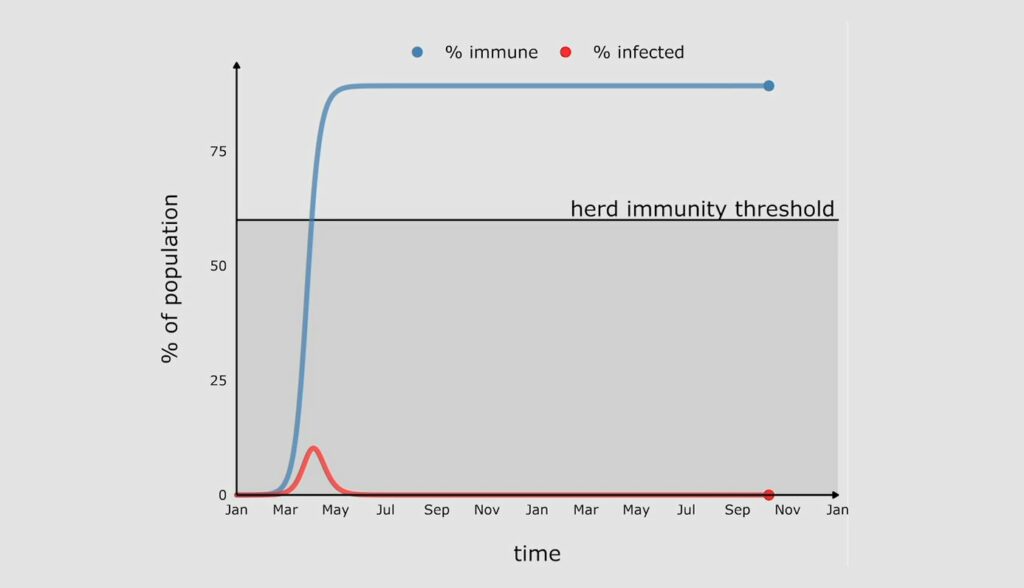
In reality the proportion immune will decline with time. For viruses like measles which give you lifelong immunity against infection, this will happen at a very slow pace. For many other viruses, like the coronaviruses, immunity against infection declines on a much shorter timescale. And as soon as it dips below the herd immunity threshold, infections will start to climb again, and we will see a second wave.

The second wave is smaller than the first wave because this time the gap between the proportion immune and the herd immunity threshold is much smaller and therefore more quickly closed.
The other thing to note about the second wave is that many infections are actually reinfections, so people who’ve lost immunity are becoming infected again. What this means is that the rates of severe disease and death are likely much lower, because people will retain the ability to resist disease even though they have lost their ability to resist infection.
Further waves will occur when the proportion immune falls below the herd immunity threshold again, but the gaps will get smaller and smaller and the waves will get smaller and smaller until they sort of flatten out at an endemic equilibrium.
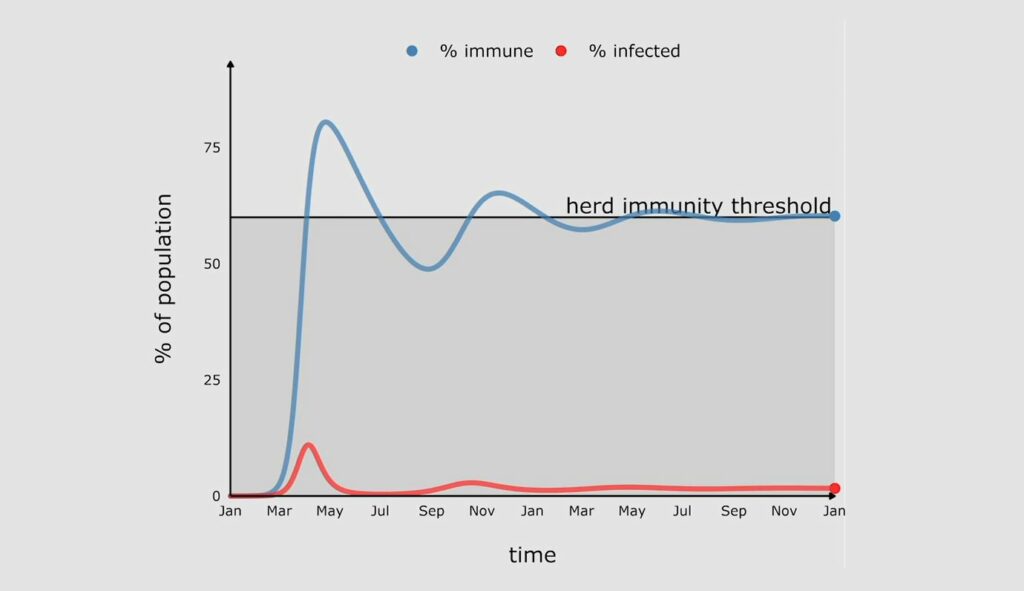
Now let’s go back to our original question. What happens if there is seasonality in transmission?
As I’ve just explained, the herd immunity threshold is strongly dependent on the transmissibility of the virus, so as the transmissibility goes up and down with seasons, so will the herd immunity threshold. And that’s what’s show here by the gradated area.

So now you see a more complex picture emerging which is the result of an interaction between waning immunity and the changes in the herd immunity threshold.
After the first peak, immunity wanes, but because the herd immunity threshold is also declining it takes longer for the blue line to dip below the herd immunity threshold. And so the next peak is delayed. Eventually this settles into a pattern which is characteristic of the seasonal respiratory viruses which we live with at endemic equilibrium.
Without seasonality it doesn’t make much of a difference at what time of the year the virus arrives. But when you have seasonality in transmission, it makes a really big difference.
A virus that arrives just before peak season will have a very big first wave, because the proportion immune will have to reach a very high herd immunity threshold before we see a decline in infections.

But if the virus arrives in a low season, the first wave could be quite small because the proportion immune only has to reach that lower herd immunity threshold before a turning point occurs.

However, as the herd immunity threshold starts to climb again, we will get a second wave in order to catch up with the new higher herd immunity threshold. And in some instances this could actually be larger than the first wave.
Of course the virus could arrive at different times of the year in different regions of the same country. What that means is lumping all these patterns together can be quite misleading.
Eventually all viruses will reach a state of endemic equilibrium, but their journey to that state from the point of introduction depends crucially on the rate at which infection blocking immunity decays for that particular virus as well as seasonality in transmission.

Sunetra Gupta is Professor of Theoretical Epidemiology in the Department of Zoology, University of Oxford and a member of Collateral Global’s Scientific Advisory Board.
Featured Video

Prof. Ted Postol: Iran Already Achieved Nuclear Deterrence Against Israel
or go to
Aletho News Archives – Video-Images
From the Archives
How the occupied mentality syndrome works
Saudi Arabia on the American chessboard – Part 3
By B. J. Sabri | American Herald Tribune | June 27, 2016
Read part 2: “The occupied mentality Syndrome“
Previously I argued whether Saudi Arabia’s repeated involvements in U.S. interventions and wars stem from free national will or in response to a specific condition. For starters, in Saudi Arabia there is no national will. In Saudi Arabia, the national will is the will of the Al Saud clan. Still, when a major Arab state allies itself with a superpower that committed unspeakable crimes against humanity in almost every Arab country, then something is wrong. This fact alone should compel us to examine the U.S.-Saudi relation for one exceptional reason. As a result of the U.S.-Saudi wars, hundreds of thousands of people in Afghanistan, Iraq, Iran, Libya, Syria, Yemen, and Somalia have lost their lives. Millions became displaced in their own homelands. And millions more rendered refugees.
Attributing the Saudi policies to the bonds of “partnership” with the U.S. is frivolous. There are no bonds between these two thugs except those of business, military deals, secret plots, and wars. Proving this point, bonds such as these have no space for the American and Saudi peoples to share significant cultural or societal exchanges. If partnership is not the reason for the Saudi contribution to the U.S. strategy of empire and imperialism, then another reason must exist.
This leads to three possibilities. … continue
Blog Roll
 Aletho News
- Hezbollah hits Israeli warship off Lebanon’s coast, sets it aflame
- Iran slams US strikes on B1 bridge, Mahshahr petrochemical plants as ‘blatant acts of state terrorism’
- In letter to UN chief, Araghchi warns of dire consequences of US-Israeli attacks on Iran’s nuclear facilities
- Why the CIA conspiracy to invade Iran with Kurdish militias failed
- Why Are Upbeat US Claims About Mission to Rescue Pilot ‘Highly Questionable’?
- Aircraft destroyed during US ‘rescue’ of downed F-15 pilot cost more than $100 million each
- Washington University removes professor who condemned US-Israeli war on Iran
- Russia Warns of Retaliation as UK Authorizes Seizure of Vessels
- Serbia thwarts plot to bomb Russia-Hungary gas pipeline – Vucic
- Al Mayadeen voices solidarity with Dr. Marandi amid death threats
- If Americans Knew
- In Iran, Israel-US take aim at “reason, research, and freedom of thought” – Daily Update
- US loses planes over Iran, Israel downgrades Lebanon war goals – Daily Update
- Israel Is Blocking Palestinians from Easter at Church Where Jesus Resurrected
- Plot to assassinate Palestinian activist follows harassment campaign promoted by Zionist groups and elected officials
- Prominent New York synagogue hosts presentation on why U.S. Jews should support the ethnic cleansing of Gaza
- Tapper vs. Piker: Is the CNN Anchor Auditioning for David Ellison?
- Shouldn’t Democrats Be Able to Condemn Genocide?
- Israel-US kill negotiators, destroy civilian structures, but Iran’s military capabilities still largely intact – Daily Update
- ‘War crime’: Global condemnation as Israeli ministers celebrate death penalty law targeting Palestinian prisoners
- 7 Ways Israel Is Turning Lebanon Into Gaza
- No Tricks Zone
- An Inconvenient Tree: Uncovered In Alps… Europe Much Warmer Than Today 6000 Years Ago
- New Study Reports A 60% Slowdown In Greenland’s Ice Loss Rate In The Last Decade
- Low Intensity Tornado Wrecks Major Solar Farm, Creating A Potential Toxic Dump
- New Study Finds Warming Saves Lives…Cold Temperatures 12 Times More Deadly Than Excess Heat
- German Science Blog Accuses PIK Climate Institute Of Hallucinating Climate Tipping Points
- Devastating Assessment Of Comirnaty Vaccine By Former Senior Pfizer Europe Toxicologist
- New Study: CO2 Is ‘Effectively Negligible’ As An Explanatory Climate Change Factor Since 2000
- Former Pfizer Toxicologist Dr. Helmut Sterz Tells Bundestag Hearing Pfizer Vaccine Should Have Never Been Approved
- Energy Expert: Germany’s Nuclear Phaseout Was A “500 Billion Euro Mistake”
- New Research: South Australia’s Mid-Holocene Sea Surface Temperatures Were 4°C Warmer Than Today
 Aletho News