Volunteers’ group targets Facebook for suppressing Palestinian content
MEMO | February 4, 2022
A Palestinian group of volunteers that monitors Facebook has raised an alarm that the social media platform was increasingly blocking and suppressing the content posted by Palestinian journalists, activists and influencers, Anadolu News Agency reports.
In a report, the volunteers’ group, Sada Social, has mentioned that Facebook had limited the reach of the accounts of the Palestinian influencers recently when they were highlighting the issues of Shaikh Jarrah neighbourhood and Gaza Strip.
According to the statistics issued by the group, Facebook had banned the users from reaching the hashtag “Al-Aqsa” in 2021, where many activists were writing about the events happening in Palestine.
“Facebook and Instagram had blocked as many as 1,500 posts in 2021. Almost 44 per cent of posts were posted by journalists and authentic media institutions,” said Iyad Refai, a social media specialist and the Director of Sada Social.
He said that access to the accounts that covered the incidents was restricted through algorithms that identify the digital content, adding that new words were added to expand the restrictive practices.
Facebook catches the words like “to support the Palestine cause” and other words like these, and then blocks the account. In addition, the restrictive practices have been expanded to the names of Palestinian factions, leaders, or martyrs, in addition to any pictures or videos related to this.
“After each violation, we contact Facebook to clarify that we have the right to tell our story. All the discussions with them are about the importance to have a clear and certain adoption of standards of the concepts about violence and hatred since Facebook policies do not follow the UN standards about violence and hatred,” said Refai.
In its annual statement, Sada Social said, in contrast to the efforts of defenders of the right to free expression and a sense of security in digital space, in 2021 there was a growing tendency to impose coercive powers on people’s practices in digital space.
Refai emphasised that, despite repeated calls to Facebook to put an end to the bias shown against the Palestinian content, there has been an increase in attacks on media platforms during the coverage of the recent war and events in Jerusalem. Palestinian news pages like Maydan Al Quds were finally pulled down last year in November.
“It is a US company and US law defines the Palestinian struggle as acts of terrorism,” he added.
According to the annual statistics released by the Sada Social, more than 390 Palestinians were detained by the Israeli forces and exposed to interrogation because of highlighting issues related to Palestine on Facebook.
A war with Russia would be unlike anything the US and NATO have ever experienced
By Scott Ritter | RT | February 4, 2022
In a recent press conference held on the occasion of a visit to Moscow by Hungarian Prime Minister Viktor Orban, Russian President Vladimir Putin spoke about continued NATO expansion, and the potential consequences if Ukraine was to join the trans-Atlantic alliance.
“Their [NATO’s] main task is to contain the development of Russia,” Putin said. “Ukraine is simply a tool to achieve this goal. They could draw us into some kind of armed conflict and force their allies in Europe to impose the very tough sanctions that are being talked about in the United States today,” he noted. “Or they could draw Ukraine into NATO, set up strike weapons systems there and encourage some people to resolve the issue of Donbass or Crimea by force, and still draw us into an armed conflict.”
Putin continued, “Let us imagine that Ukraine is a NATO member and is stuffed with weapons and there are state-of-the-art missile systems just like in Poland and Romania. Who will stop it from unleashing operations in Crimea, let alone Donbass? Let us imagine that Ukraine is a NATO member and ventures such a combat operation. Do we have to fight with the NATO bloc? Has anyone thought anything about it? It seems not.”
But these words were dismissed by White House spokesperson Jen Psaki, who likened them to a fox “screaming from the top of the hen house that he’s scared of the chickens,” adding that any Russian expression of fear over Ukraine “should not be reported as a statement of fact.”
Psaki’s comments, however, are divorced from the reality of the situation. The principal goal of the government of Ukrainian President Volodymyr Zelensky is what he terms the “de-occupation” of Crimea. While this goal has, in the past, been couched in terms of diplomacy – “[t]he synergy of our efforts must force Russia to negotiate the return of our peninsula,” Zelensky told the Crimea Platform, a Ukrainian forum focused on regaining control over Crimea – the reality is his strategy for return is a purely military one, in which Russia has been identified as a “military adversary”, and the accomplishment of which can only be achieved through NATO membership.
How Zelensky plans on accomplishing this goal using military means has not been spelled out. As an ostensibly defensive alliance, the odds are that NATO would not initiate any offensive military action to forcibly seize the Crimean Peninsula from Russia. Indeed, the terms of Ukraine’s membership, if granted, would need to include some language regarding the limits of NATO’s Article 5 – which relates to collective defense – when addressing the Crimea situation, or else a state of war would de facto exist upon Ukrainian accession.
The most likely scenario would involve Ukraine being rapidly brought under the ‘umbrella’ of NATO protection, with ‘battlegroups’ like those deployed into eastern Europe being formed on Ukrainian soil as a ‘trip-wire’ force, and modern air defenses combined with forward-deployed NATO aircraft put in place to secure Ukrainian airspace.
Once this umbrella has been established, Ukraine would feel emboldened to begin a hybrid conflict against what it terms the Russian occupation of Crimea, employing unconventional warfare capability it has acquired since 2015 at the hands of the CIA to initiate an insurgency designed specifically to “kill Russians.”
The idea that Russia would sit idly by while a guerilla war in Crimea was being implemented from Ukraine is ludicrous; if confronted with such a scenario, Russia would more than likely use its own unconventional capabilities in retaliation. Ukraine, of course, would cry foul, and NATO would be confronted with its mandatory obligation for collective defense under Article 5. In short, NATO would be at war with Russia.
This is not idle speculation. When explaining his recent decision to deploy some 3,000 US troops to Europe in response to the ongoing Ukrainian crisis, US President Joe Biden declared, “As long as he’s [Putin] acting aggressively, we are going to make sure we reassure our NATO allies in Eastern Europe that we’re there and Article 5 is a sacred obligation.”
Biden’s comments echo those made during his initial visit to NATO Headquarters, on June 15 last year. At that time, Biden sat down with NATO Secretary-General Jens Stoltenberg and emphasized America’s commitment to Article 5 of the NATO charter. “Article 5 we take as a sacred obligation,” Biden said. “I want NATO to know America is there.”
Biden’s view of NATO and Ukraine is drawn from his experience as vice president under Barack Obama. In 2015, then-Deputy Secretary of Defense Bob Work told reporters, “As President Obama has said, Ukraine should … be able to choose its own future. And we reject any talk of a sphere of influence. And speaking in Estonia this past September, the president made it clear that our commitment to our NATO allies in the face of Russian aggression is unwavering. As he said it, in this alliance there are no old members and there are no new members. There are no junior partners and there are no senior partners. There are just allies, pure and simple. And we will defend the territorial integrity of every single ally.”
Just what would this defense entail? As someone who once trained to fight the Soviet Army, I can attest that a war with Russia would be unlike anything the US military has experienced – ever. The US military is neither organized, trained, nor equipped to fight its Russian counterparts. Nor does it possess doctrine capable of supporting large-scale combined arms conflict. If the US was to be drawn into a conventional ground war with Russia, it would find itself facing defeat on a scale unprecedented in American military history. In short, it would be a rout.
Don’t take my word for it. In 2016, then-Lieutenant General H.R. McMaster, when speaking about the results of a study – the Russia New Generation Warfare – he had initiated in 2015 to examine lessons learned from the fighting in eastern Ukraine, told an audience at the Center for Strategic and International Studies in Washington that the Russians have superior artillery firepower, better combat vehicles, and have learned sophisticated use of unmanned aerial vehicles (UAVs) for tactical effect. “Should US forces find themselves in a land war with Russia,” McMaster said, “they would be in for a rude, cold awakening.”
In short, they would get their asses kicked.
America’s 20-year Middle Eastern misadventure in Afghanistan, Iraq, and Syria produced a military that was no longer capable of defeating a peer-level opponent on the battlefield. This reality was highlighted in a study conducted by the US Army’s 173rd Airborne Brigade, the central American component of NATO’s Rapid Deployment Force, in 2017. The study found that US military forces in Europe were underequipped, undermanned, and inadequately organized to confront military aggression from Russia. The lack of viable air defense and electronic warfare capability, when combined with an over-reliance on satellite communications and GPS navigation systems, would result in the piecemeal destruction of the US Army in rapid order should they face off against a Russian military that was organized, trained, and equipped to specifically defeat a US/NATO threat.
The issue isn’t just qualitative, but also quantitative – even if the US military could stand toe-to-toe with a Russian adversary (which it can’t), it simply lacks the size to survive in any sustained battle or campaign. The low-intensity conflict that the US military waged in Iraq and Afghanistan has created an organizational ethos built around the idea that every American life is precious, and that all efforts will be made to evacuate the wounded so that they can receive life-saving medical attention in as short a timeframe as possible. This concept may have been viable where the US was in control of the environment in which fights were conducted. It is, however, pure fiction in large-scale combined arms warfare. There won’t be medical evacuation helicopters flying to the rescue – even if they launched, they would be shot down. There won’t be field ambulances – even if they arrived on the scene, they would be destroyed in short order. There won’t be field hospitals – even if they were established, they would be captured by Russian mobile forces.
What there will be is death and destruction, and lots of it. One of the events which triggered McMaster’s study of Russian warfare was the destruction of a Ukrainian combined arms brigade by Russian artillery in early 2015. This, of course, would be the fate of any similar US combat formation. The superiority Russia enjoys in artillery fires is overwhelming, both in terms of the numbers of artillery systems fielded and the lethality of the munitions employed.
While the US Air Force may be able to mount a fight in the airspace above any battlefield, there will be nothing like the total air supremacy enjoyed by the American military in its operations in Iraq and Afghanistan. The airspace will be contested by a very capable Russian air force, and Russian ground troops will be operating under an air defense umbrella the likes of which neither the US nor NATO has ever faced. There will be no close air support cavalry coming to the rescue of beleaguered American troops. The forces on the ground will be on their own.
This feeling of isolation will be furthered by the reality that, because of Russia’s overwhelming superiority in electronic warfare capability, the US forces on the ground will be deaf, dumb, and blind to what is happening around them, unable to communicate, receive intelligence, and even operate as radios, electronic systems, and weapons cease to function.
Any war with Russia would find American forces slaughtered in large numbers. Back in the 1980s, we routinely trained to accept losses of 30-40 percent and continue the fight, because that was the reality of modern combat against a Soviet threat. Back then, we were able to effectively match the Soviets in terms of force size, structure, and capability – in short, we could give as good, or better, than we got.
That wouldn’t be the case in any European war against Russia. The US will lose most of its forces before they are able to close with any Russian adversary, due to deep artillery fires. Even when they close with the enemy, the advantage the US enjoyed against Iraqi and Taliban insurgents and ISIS terrorists is a thing of the past. Our tactics are no longer up to par – when there is close combat, it will be extraordinarily violent, and the US will, more times than not, come out on the losing side.
But even if the US manages to win the odd tactical engagement against peer-level infantry, it simply has no counter to the overwhelming number of tanks and armored fighting vehicles Russia will bring to bear. Even if the anti-tank weapons in the possession of US ground troops were effective against modern Russian tanks (and experience suggests they are probably not), American troops will simply be overwhelmed by the mass of combat strength the Russians will confront them with.
In the 1980s, I had the opportunity to participate in a Soviet-style attack carried out by specially trained US Army troops – the ‘OPFOR’ – at the National Training Center in Fort Irwin, California, where two Soviet-style Mechanized Infantry Regiments squared off against a US Army Mechanized Brigade. The fight began at around two in the morning. By 5:30am it was over, with the US Brigade destroyed, and the Soviets having seized their objectives. There’s something about 170 armored vehicles bearing down on your position that makes defeat all but inevitable.
This is what a war with Russia would look like. It would not be limited to Ukraine, but extend to battlefields in the Baltic states, Poland, Romania, and elsewhere. It would involve Russian strikes against NATO airfields, depots, and ports throughout the depth of Europe.
This is what will happen if the US and NATO seek to attach the “sacred obligation” of Article 5 of the NATO Charter to Ukraine. It is, in short, a suicide pact.
Scott Ritter is a former US Marine Corps intelligence officer and author of ‘SCORPION KING: America’s Suicidal Embrace of Nuclear Weapons from FDR to Trump.’
US State Department alleges Moscow prepared ‘crisis actor’ video to invade Ukraine, refuses to offer evidence
RT | February 3, 2022
The US has accused Russia of creating a propaganda video featuring crisis actors, staged fake explosions, and NATO military equipment such as Turkish drones, as a pretext for invading Ukraine in the coming days.
The claim was first published on Thursday morning by the Washington Post, which cited an unnamed US official quoting US intelligence assessments. It was then picked up by CNN and other outlets. On Thursday afternoon, State Department spokesman Ned Price said the government “made public” that intelligence, and echoed the description of the alleged video featured in the Post and CNN stories.
The video is “entirely fabricated by Russian intelligence” and is “one of a number of options the Russian government is developing as a fake pretext to initiate and potentially justify military aggression against Ukraine,” Price claimed. He added that the US is making the claim public as a way to deter Russia from its “destructive and destabilizing disinformation campaign” against Ukraine.
Pressed to show any evidence for the claim, Price said his own statement constituted evidence, and that it was “derived from information known to the US government, intelligence information that we have declassified.”
“If you doubt the credibility of the US government, of the British government, of other governments, and want to find solace in the information the Russians are putting out, that is for you to do,” Price told AP’s diplomatic correspondent Matt Lee, dismissing his line of questioning.
“Russia never does such things,” Moscow’s ambassador to the EU, Vladimir Chizhov, told RIA Novosti on Thursday, when asked about the new US allegations.
As proof of alleged Russian ‘actions’ in Ukraine, the State Department spokesman quoted the allegation anonymous US officials made to CNN in mid-January, claiming that Russia had sent a “group of operatives” trained in urban warfare to attack “Russia’s own proxy forces” in the two disputed regions of eastern Ukraine, in order to create a pretext for an “invasion.”
Moscow dismissed these claims as “unsubstantiated” hearsay. Several days later, leaders of the Donetsk militia told reporters it was British-trained Ukrainian saboteurs that were planning attacks they would then attribute to Russia as ‘false flags’.
Russia to kick out German state media after Berlin bans RT DE
RT | February 3, 2022
The Russian office of the German state broadcaster, Deutsche Welle (DW), is to be closed as part of the “first round” of a response to Berlin’s “unfriendly actions” against RT DE, the Russian Foreign Ministry said in a statement on Thursday.
The German outlet will also be barred from broadcasting in Russia via a satellite or through other means, the statement added. All staff members at DW’s Russian office are to be stripped of their press credentials, according to the foreign ministry.
Moscow has also launched a procedure which will recognize DW as a “foreign media outlet acting as a foreign agent” under Russian law.
Moscow also said it was compiling a list of German state and public entities believe t be linked to blocking RT DE in Germany and exerting pressure on the Moscow-based broadcaster. Representatives included on the list will be barred from entering Russia, the foreign ministry said, adding that it would release information about subsequent rounds of reciprocal measures “in due course”.
DW said it would challenge the decision of the Russian authorities in court and would also continue operating from the Moscow office until it receives a formal closure order. DW’s director, Peter Limbourg, denounced Moscow’s move as “absurd” and an “overreaction.” He also vowed to “significantly increase the coverage” of Russia.
The move comes a day after Germany’s top media regulator sided with a regional authority and upheld a ban on RT DE’s broadcast in Germany, citing the absence of a locally-issued license. The channel previously obtained a valid pan-European permit in Serbia but the German regulators declared that void.
RT DE now has four weeks to appeal the decision in court, which it is planning to do.
Different vaccines reveal different side effects
MHRA should release the raw data for public scrutiny
Health Advisory & Recovery Team | February 1, 2022
The MHRA Yellow Card reporting system is designed to provide a signal of possible problems with new drugs based on reports of suspected adverse reactions from qualified medical practitioners. The data collected could be of much more value if more details were published. The MHRA shares such information with the pharmaceutical industry but, despite its role being to protect the public and relying on public funding, this data is not put into the public domain.
To make the most of what information is available the reports on different vaccine types can be compared. Any side effects that are a result of the production of the spike protein itself may be similar between all vaccine types. However, if one vaccine type has a much higher rate of a particular adverse effect than other vaccine types then this is suggestive of a genuine causal relationship. Confounders such as age may account for part of these differences, which is why publishing the raw data is so important.
Data sharing
The Yellow Card scheme is administered by the MHRA, a government body funded, at least in part, by the public. The data for the scheme is collected largely by NHS staff, who are again funded by the public. However, despite public finance being crucial to the generation of Yellow Card data, the MHRA have refused to release the anonymised individual patient data from this scheme for independent analysis (FOI 21/640). The MHRA argue that release of these data would be too onerous, yet paradoxically these same data are passed on to the vaccine manufacturers for analysis as a matter of routine (FOI 21/942). All that the public can access from Yellow Card is a rudimentary summary of the total numbers of adverse events recorded for each vaccine type in particular medical categories.
The MHRA’s attitude to data sharing stands in stark contrast to the situation in the USA, where the VAERS reporting system [2] provides anonymised individual patient data, and the detailed analyses that this allows has been crucial for recognising important safety signals [3] — albeit US Regulators have been slow off the mark in making full use of the data available to them. We note that the MHRA’s refusal to share the information that they hold within the Yellow Card database would not be tolerated in the general science community where access to raw data is now a prerequisite for publication in peer reviewed journals.
Despite the intransigence of the MHRA over the issue of releasing raw data from the Yellow Card scheme to the general public, it is incumbent upon the scientific community to make the maximum use of the data released from the scheme to scrutinise the validity of the conclusions that the MHRA reach in their weekly reports. This is particularly important to achieve because, despite FOI requests to see the scientific analyses on which their conclusions are based, the MHRA have been unable to produce any such reports (FOI 21/942).
Comparing frequency of reports by vaccine type
The weekly data released from the Yellow Card scheme takes the form of the total number of doses of each of the vaccines given, the total number of reports filed for each vaccine type, and the total number of adverse reactions recorded for each of a huge range of medical conditions compiled separately for each of the vaccine types. What insights can we gain from analysis of this information?
A simple question that we can ask is whether the different vaccines elicit the same or different rates of reporting of adverse reactions or number of reactions per report. The answer is clear (Table 1). There is something about a Moderna injection that generates a higher frequency of adverse event reports with less reactions per report than an Astrazeneca vaccination, which in turn generates a higher frequency of reports and more reactions per report than a Pfizer injection. The figures involved are so huge that these differences cannot be due to chance. There is something important happening that needs to be explained.
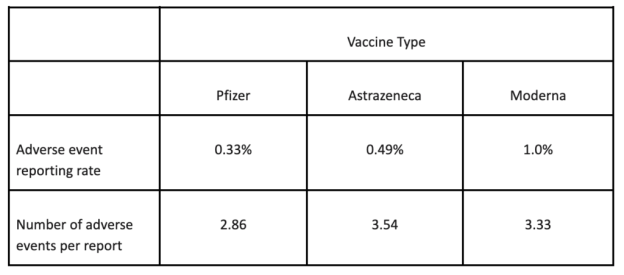
Table 1. Percentage of vaccinations resulting in a Yellow card report, and mean number of adverse events per report for three covid-19 vaccines administered in the UK
Risk of misinterpretation
Unfortunately, however, our interpretation can never be secure. The results we see could be due to the vaccines themselves. Alternatively, they could also be due to some confounding factor like the differences in age profile of the patients who were injected with different vaccine types, or to certain vaccine types being injected predominantly as boosters, or some combination of such factors. Yet distinguishing between alternative explanations is vital. If the effects we see are indeed due predominantly to vaccine type, this would have serious implications for vaccination policy and optimum choice of vaccine for minimising adverse reactions. However, analysis of confounding effects can only be achieved if the raw, anonymised individual patient data from the Yellow Card scheme are released by MHRA.
Comparing type of report by vaccine type
The second type of question that we can address using the Yellow Card data is whether choice of vaccines affects the spectrum of medical conditions recorded as adverse reactions. To answer this question, we can first sum up the number of adverse events elicited by each vaccine under the broad headings Blood & Vascular, Cardiac, Immune, Reproductive & Breast, Respiratory, Skin, Nervous System, Eye, Muscle and Other. A simple test for heterogeneity indicates that the relative frequency with which these classes of adverse reactions occur is highly dependent on the type of vaccine administered (χ2(18) = 29508, P<<0.001). Figure 1 illustrates the percentage by which the observed numbers of adverse reactions differ from the number expected if all vaccines elicited the same spectrum of adverse reactions. It is clear from the figure that departures from expectations are particularly large in the categories Blood & Vascular, Cardiac, Reproductive & Breast, and Skin; the different vaccines are eliciting quite different relative frequencies of adverse reaction in these categories.
For the categories Blood & Vascular, Cardiac, and to a lesser extent Immune and Reproductive & Breast, much higher than expected numbers of adverse reactions are elicited when the mRNA vaccines are administered, and lower than expected numbers of adverse reactions are found when the virus vectored Astrazeneca vaccine is used. Given that the same spike protein is encoded in the mRNA and virus vectored vaccines, this suggests that differences in the observed spectra of adverse reactions may be related to the mode of delivery of the spike encoding nucleic acid sequence in the vaccine. This observation for the Cardiac category is in agreement with a recent case series analysis which found that the risk of myocarditis is greater following sequential doses of mRNA vaccine than sequential doses of the adenovirus vaccine [4]. The role of the mRNA vaccine delivery system itself in eliciting adverse reactions must therefore come under scrutiny.
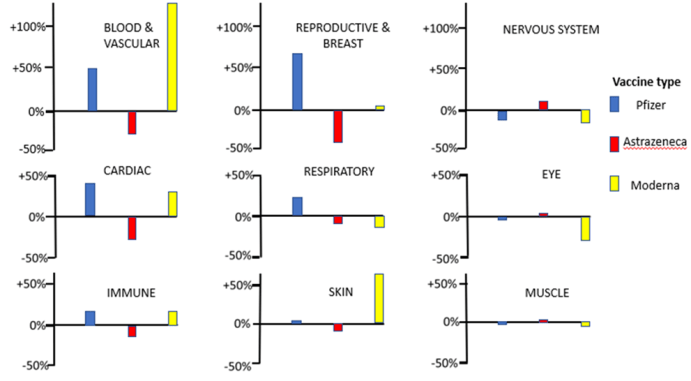
Figure 1. Percentage deviation of observed number of adverse reactions from the number expected if the spectrum of adverse events was the same for all vaccines. Data from nine different categories of adverse events are shown
While this example shows that the Yellow Card data may be helpful for generating ideas and supporting other studies, the inadequacy of the partial information currently released by the MHRA means that our interpretation of such data will always be compromised. Again, we do not possess the means to control for possible confounding factors (age and sex of individual, vaccine dose number etc.) that could contribute to the results observed. Nevertheless, in this example, the sheer size of the apparent effects of vaccine type on the spectrum of adverse effects indicates that a thorough investigation is essential. If the vaccine effect were confirmed, this would have serious real-world implications for the Covid-19 vaccination programme and the safety and health of the UK population.
Conclusion
The data we need to carry out the necessary analysis to maximise the usefulness of the Yellow Card scheme has already been collected at the public expense and is currently held by the MHRA. We call upon the MHRA immediately to release the raw, anonymised, individual patient data from the Yellow Card reporting scheme to enable rigorous scrutiny of Covid-19 vaccine adverse events by doctors, researchers and the public. This echoes the recent call by BMJ editors for immediate release of raw data from trials conducted by vaccine manufacturers [5].
2. https://www.cdc.gov/vaccinesafety/ensuringsafety/monitoring/vaers/index.html
3. https://jessicar.substack.com/p/a-report-on-myocarditis-adverse-events
4. https://www.medrxiv.org/content/10.1101/2021.12.23.21268276v1
5. Doshi P, Godlee F, Abbasi K. Covid-19 vaccines and treatments: we must have raw data, now BMJ 2022; 376 Covid-19 vaccines and treatments: we must have raw data, now | The BMJ
Am I immune to Omicron if I have already become infected with the Delta variant?
Q&A #12 with Geert Vanden Bossche | February 3, 2022
Question
“Those who became infected with the Delta variant are therefore not immune to the Omicron,” says Frank Vandenbroucke, Minister of Public Health Belgium. Is this correct? Will my T cells then not recognize the coronavirus? Or will my antibodies not protect me? Or maybe I will be infected asymptomatically and thus not get sick and then this is equivalent to “after vaccination”?
Answer
When you get infected with another variant there is always a chance that you will get sick. However, if you are in good health, the chance that SARS-CoV-2 will make you seriously ill is negligible. We owe this to our innate immunity which – especially in young people – is the first line of defense to clean up and eliminate large amounts of the virus (vacuum cleaner!). Young people, but even all healthy people who are in excellent health (e.g. no excess weight and regular exercise / sport), will often not even get sick or at best develop some vague, mild symptoms. If the first line of defense is broken, then our acquired immune system rushes to the rescue whereby our T cells ensure that the sick, virus-infected cells are eliminated. This allows us to recover from illness.
But whenever our innate immune system is exposed and eliminates the virus (with or without the help of the acquired immune system) it also immediately learns to recognize the virus better in the future. While it continues to recognize all SARS-CoV-2 variants (and even all CoVs), it now does so with more efficiency/affinity. This phenomenon is called “training” of the innate immune system. It is a form of adaptive immunity caused by epigenetic changes that effect a reprogramming of immune cells that secrete innate antibodies. That is, with subsequent exposure to the virus, there is an increasing chance that that person will develop an asymptomatic infection and actually not get sick at all, even if the virus undergoes antigenic drift (antigenic drift). If the virus undergoes an antigenic shift (i.e., severe change due to multiple mutations as in the case of Omicron), then the innate immunity will have to train again for a while before being able to withstand an infection with such a variant without giving rise to illness.
A pandemic is of course an excellent opportunity to train the innate immune system against SARS-CoV-2. However, it also means that if a variant with an antigenic shift (e.g. Omicron) dominates, more people may become ill anyway and within a short period of time the virus will be under pressure due to the induced natural antibodies, which are not able to suppress the virus at high infection pressure. Reducing the infection pressure is possible via (one-time) antiviral chemoprophylaxis. On the contrary, continued vaccination will increase the immune pressure and ensure that the vicious circle of the pandemic is maintained.
Thus, trained innate immunity to SARS-CoV-2 is not equivalent to COVID-19 vaccination but is superior because
- It is effective against all variants
- It has a sterilizing effect in contrast to vaccine antibodies
- Because of its non-varying character it does not lead to the selection of more infectious or resistant variants.
In other words, it benefits both individual and public health. It is the only way to acquire group immunity (independent of the circulating SARS-CoV-2 variant) and thus to move the pandemic into the endemic phase.
Former Pfizer VP Michael Yeadon demands apology from media over ‘lies’ asserting vaccine safety

Dr Michael Yeadon, former Pfizer vice president and co-founder of Doctors for COVID-19 Ethics
By Patrick Delaney | LifeSiteNews | February 2, 2022
After being excoriated by mainstream media outlets regarding his concern that COVID-19 gene-based vaccines could cause fertility issues in young women, Dr. Michael Yeadon is now requesting contrition on the part of media outlets as leaked data from the U.S. military indicates heavy spikes in these tragic outcomes.
“I’m not vindictive, but I want some humility and contrition from the BBC and all other media outlets that lied to their audiences,” said the former Pfizer vice president and Chief Scientist for allergy and respiratory.
Yeadon, who spent 32 years in the industry leading new medicines research and retired from the pharmaceutical giant with the most senior research position in his field, was an author of a submitted petition to the European Medicines Agency (EMA) in December 2020 that raised substantial concerns regarding a lack of sufficient testing of the experimental COVID-19 gene-based vaccines, prior to their emergency use authorizations.
With regard to the possibility of the shots endangering the fertility of women, Yeadon and his colleague, Dr. Wolfgang Wodarg, wrote, “There is no indication whether antibodies against spike proteins of SARS viruses would also act like anti-Syncytin-1 antibodies. However, if this were to be the case this would then also prevent the formation of a placenta which would result in vaccinated women essentially becoming infertile.”
Such a possibility would need to be ruled out through standard experimentation prior to imposing such substances onto the entire population, according to the doctors.
“It’s important to note that none of these gene-based agents had completed what’s called ‘reproductive toxicology,’” Yeadon wrote in his recent statement. “Over a year later, this battery of tests in animals still has not been done. So there was and still is no data package supporting safety in pregnancy or prior to conception.”
Media response to valid concerns: attacks, smears, vilifications
“As a society, we’ve practiced the precautionary principle most assiduously in relation to conception and pregnancy ever since the tragedy of thalidomide, over 60 years ago. So we had hoped that some at least in the media would take this [concern] with the seriousness it deserved,” he wrote.
“Did that happen? No. Instead, we were attacked, smeared and vilified in every medium, from Twitter to the BBC,” the British national wrote. “[M]ajor broadcasters actively lied to the public, explicitly stating that these agents were completely safe in pregnancy.”
Indeed, Reuters excoriated the doctors for making their inquiry “without providing evidence, that the vaccines could cause infertility in women,” shifting the burden of proof onto the petitioners from the regulators whose job it is to ensure proper safety trials are completed before the release of such drugs.
The article quoted an anonymous spokesman for Britain’s Department of Health & Social Care, saying, “These claims are false, dangerous and deeply irresponsible.”
Reuters later attempted to “fact-check” Yeadon as well over several concerns including the danger to fertility, to which he simply reiterated common ethical principles with regard to human experimentation: “No one in their right mind thinks giving experimental treatments to pregnant women is other than reckless. Especially when reproductive toxicity testing is incomplete.”
Of special note for Yeadon was BBC Radio talk show hostess Emma Barnett, who “directly attacked me by name on air in the most unpleasant terms,” which also led to his charging the program with slander. In response, after a bit of investigation, the program editor conceded, apologized to Yeadon, and cut their false representation of the former Pfizer scientist from their recorded podcast.
“[Barnett] also had her guest, who was from the Royal College of Obstetrics and Gynecology, repeat the lies that it was perfectly safe for young women to be injected,” Yeadon called out in his statement.
Preprint paper reveals placental-damaging antibodies increased 2.5 fold after shots
Also of note for the former executive was a preprint study published last May that appeared to attempt a rebuttal of his concern that anti-Syncytin-1 antibodies could be developed due to the shots, but instead reinforced them showing a 2.5 fold increase of the placental-damaging antibodies in days 1 to 4 after COVID-19 gene-therapy injections.
The paper, which claimed a conflict of interest in being funded by Johnson & Johnson, went on to explain that though they had observed this major increase, they did not examine its “clinical significance,” thus admitting they didn’t know if these higher levels of the antibody flagged an actual safety problem with regards to fertility and miscarriage.
At the same time, the study’s authors acknowledged data showing “spontaneous miscarriage as the most common obstetric outcome after COVID-19 mRNA vaccination.”
Based on the outcome of this study alone, Yeadon said “all of these experimental products as a class should have been completely contraindicated in women younger than menopause.”
Pfizer & Moderna ‘definitely knew’ these mRNA products would ‘accumulate in the ovaries’
An additional source of concern regarding fertility was that “the mRNA products (Pfizer and Moderna) would accumulate in ovaries,” the British national explained.
“An FOI request to the Japanese Medicines Agency revealed that product accumulation in ovaries occurred in experiments in rodents. I searched the literature based on these specific concerns and found a 2012 review [here], explicitly drawing attention to the evidence that the lipid nanoparticle formulations as a class do, in fact, accumulate in ovaries and may represent an unappreciated reproductive risk to humans. This was ‘a well-known problem’ to experts in that field,” Yeadon explained.
“I’ll say that again. The pharmaceutical industry definitely knew, in 2012, that formulating these agents in lipid nanoparticles would lead them to accumulate in the ovaries of women to whom these were given.
“No one in the industry or in leading media could claim ‘they didn’t know about these risks to successful pregnancy,’” he emphasized.
Results from the U.S. military leak confirm damage done to unborn children and fertility
“So it’s with tremendous anger and sorrow that I heard of military physicians blowing the whistle about the evidence of harms in pregnancy that their proprietary safety monitoring database had thrown out,” Yeadon said, referring to last week’s revelations during a U.S. Senate panel discussion.
“In the intervening months since journalists (including but definitely not limited to Emma Barnett) chose to downplay or downright lie about our concerns, we learned that women in the U.S. military were experiencing 3X normal rates of miscarriage,” he explained.
In fact, these data leaks, given by three “decorated high-ranking soldiers who are doctors and public health officials,” in sworn declarations under penalty of perjury, show several increases in negative impacts upon fertility, including spontaneous abortion, among this military population where enforcement of an experimental COVID gene-vaccine mandate is strictly observed.
As presented by these soldiers, the following 2021 increases only include the first 10 months of the year (January through October) and are compared with the full five-year average of figures taken from 2016 through 2020.
- Miscarriages — increase of 279%
- Female infertility – increase of 471%
- Male infertility — increase of 344%
- Congenital malformations (birth defects) – increase of 156%
And considering most children conceived after these injections had not been born before November 2021, the final figure of birth defects is likely to significantly increase as well.
Journalists, regulators and manufacturers: ‘You are way out over thin ice and deep water’
After Yeadon’s request for contrition from the BBC and other media outlets, he went on to implore readers, “please do not get injected with these inherently dangerous and ineffective experimental products. Warn anyone you know about the risks to pregnancy, now confirmed by whistleblowers from physicians in the U.S. military.
“Please also tell them there are likely to be other reproductive health consequences, even in young girls, because of accumulation [of lipid nanoparticles] in their ovaries.“
Having originally alerted the EMA of several other possible toxic outcomes due to the injections, Yeadon highlighted that he and Dr. Wodarg were sadly also right about their warning of “allergic, potentially fatal reactions to the vaccination,” citing examples from the UK of emergency interventions and tragic deaths.
“Having had two of two serious harms we warned about, prior to regulatory authorisations, come to pass,” he said. “I humbly recommend that governments and journalists everywhere recognise what you’ve done and lobby for or directly decide to immediately and completely withdraw all these experimental products from the market, before some of the other specified concerns (or issues we didn’t think of) show up in the safety monitoring systems.”
“Journalists, regulators, healthcare professionals and politicians, as well [as], of course, the manufacturers, you are way out over thin ice and deep water. I don’t know how you’re planning to get out from under this before the wider public more fully appreciates what you’ve done,” Yeadon wrote.
“One possibility is that you won’t be able to hide your complicity in the massed harms you’ve done to millions of people. In this case, I look forward to giving evidence against you in a court of law,” he concluded.
Dr. Yeadon’s full statement can be accessed here.
These 5 Studies Reveal a Disturbing Trend — Researchers Presenting Conclusions That Don’t Match the Data
By Josh Mitteldorf, Ph.D. and Madhava Setty, M.D. | The Defender | February 2, 2022
It was January 2020, the very beginning of COVID, when news articles began appearing that connected the genetics of the virus with gain-of-function research on bat coronaviruses at the Wuhan Institute of Virology.
These speculations were put to rest by an authoritative statement in the prestigious journal Nature Medicine, echoed by a summary in Science and an unusual affidavit in the Lancet signed by an impressive list of prominent scientists.
The message in the Nature Medicine article was dispositive: “Our analyses clearly show that SARS-CoV-2 is not a laboratory construct or a purposefully manipulated virus.”
But where was the support for this confident conclusion in the article itself?
The 2,200-word article in Nature Medicine (Anderson, et al) contained a lot of natural history and sociological speculation, but only one tepid argument against laboratory origin: that the virus’s spike protein was not a perfect fit to the human ACE-2 receptor.
The authors expressed confidence that any genetic engineers would certainly have computer-optimized the virus in this regard, and since the virus was not so optimized, it could not have come from a laboratory. That was the full content of their argument.
Most readers, even most scientists, take in the executive summary of an article and do not wade through the technical details. But for careful readers of the article, there was a stark disconnect between the Cliff Notes and the novel, between the article’s succinct (and specious) conclusion and its detailed scientific content.
This was the beginning of a new practice in the write-up of medical research. Recent revelations in the Fauci/Collins emails shed light on the origins of this tactic and the motives behind it.
In the past, if a company wanted, for example, to make a drug look more effective than it really was, it would choose a statistical technique that masked its downside, or it would tamper with the data.
What companies would not do, in the past, was describe the results of a statistical analysis that proves X is false, then publish it with an Abstract that claims X is true.
But this strange practice has become more common in the last two years. Academic papers are being published in which the abstract, the discussion section and even the title flatly contradict the content within.
Why is this happening? There are at least three possibilities:
- The authors cannot understand their own data.
- The authors are being impelled by the editorial staff to arrive at conclusions that match the ascendant narrative.
- The authors and editors realize the only way to get their results into publication is to avoid a censorship net that gets activated by any statement critical of vaccination efficacy or safety.
Before reaching any conclusions, let’s take a closer look at some examples of this troubling phenomenon arising in what should be the foundation of what is known: published scientific data.
In this article, we present five different published studies. Each to varying degrees exemplifies a disconnect between the data and the conclusions.
Example 1: ‘Phase I Study of High-Dose L-Methylfolate in updates Combination with Temozolomide and Bevacizumab in Recurrent IDH Wild-Type High-Grade Glioma’
This example is unrelated to the pandemic, but it typifies a common practice in the pharma-dominated world of medical research. If a remedy is cheap and out of patent, there is no one motivated to study its efficacy.
But research practice has gone well beyond neglect. In fact, investigators are skewing statistics to make cheap, effective treatments look ineffective if they are in competition with expensive pharma products.
This is ridiculously easy to do — all it requires is incompetence. Using the wrong statistical test, using a weak test when a stronger one applies — or just about any mistake in parsing the data — is far more likely to make compelling data appear random than the opposite.
Is it always incompetence? Or is it more often a well-thought-out deception that uses seemingly erudite analysis to lead the undiscerning reader into believing the wrong conclusion?
In the case of this article, a simple B vitamin (L-Methylfolate) was shown to double the life expectancy of 6 out of 14 brain cancer patients who received it, while showing no benefit (and no harm) to the other half of the patients.
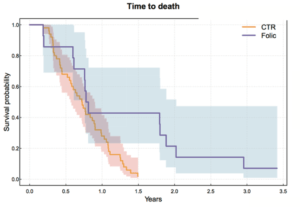
The purple jagged line extending out to the right represents 40% of patients who lived dramatically longer when treated with L-Methylfolate (LMF).
The abstract reports that “LMF-treated patients had median overall survival of 9.5 months [95% confidence interval (CI), 9.1–35.4] comparable with bevacizumab historical control 8.6 months (95% CI, 6.8–10.8).”
The increase in median survival time is just a few months and not statistically significant. But the average survival time of the folate-treated group was more than double, and the difference was statistically significant (by my calculation, not in the article).
But the average is what is more commonly reported, and most readers don’t understand the difference between average and median.
The longest surviving patient on the B vitamin was still alive at the end of the study (3.5 years) when every one of the patients treated only with traditional chemo was dead before 1.5 years.
There were three different dosages in the study, (30, 60, 90 mg) and it was not reported whether the longest-living patients were receiving the highest dosages.
This is, in fact, a hugely promising pilot study about treating a common, fatal cancer with a simple vitamin. If it were an expensive chemotherapy drug instead of a cheap vitamin, you can be sure it would have been hailed as a breakthrough.
But this study will not create much excitement, and few oncologists will even know to prescribe methylfolate for their glioma patients.
Example 2: ‘Preliminary Findings of mRNA Covid-19 Vaccine Safety in Pregnant Persons’
Earlier this year, MacLeod et al used data from a prominent Centers for Disease Control and Prevention (CDC) study to calculate that for women in their first trimester, the rate of miscarriage following administration of an mRNA COVID vaccine was an alarming 82%.
On Jan. 7, the CDC released a report designed to dispel our misgivings about vaccinating pregnant women. Its conclusions were unequivocal:
“These data support the safety of COVID-19 vaccination during pregnancy. CDC recommends COVID-19 vaccination for women who are pregnant, recently pregnant, who are trying to become pregnant now, or who might become pregnant in the future.”
The Defender reported on the numerous flaws in this study. The most egregious deficiency was the dearth of pregnant women in the study who were vaccinated early in their pregnancy (less than 2%).
The authors admit their study could not quantify the risk of vaccine exposure in the first trimester: “First trimester vaccinations are not included in analyses stratified by trimester because few exposures occurred…”
How then can they recommend COVID vaccination for women who are “recently pregnant” if their analyses excluded women in their first trimester?
This report serves a purpose. People who read it superficially will find the reported results reassuring — including front-line doctors who don’t have time to evaluate the research critically.
The CDC chose to paint over troubling safety concerns with reassuring words that are unsupported by clear science.
Example 3: ‘Public Health Scotland COVID-19 & Winter Statistical Report’
There is a section of this report comparing vaccinated and unvaccinated rates of disease, preceded by a warning to the reader not to take the data at face value.
“PLEASE READ BEFORE REVIEWING THE FOLLOWING TABLES AND FIGURES There is a large risk of misinterpretation of the data presented in this section due to the complexities of vaccination data …”
The data the authors don’t want us to misinterpret say that people who have been vaccinated with one shot or three shots are 50% more likely to contract COVID-19 compared to people who are unvaccinated.
People who receive two shots are more than twice as likely to contract COVID-19. This is according to the authors’ own method of calculating age-standardized disease rates.
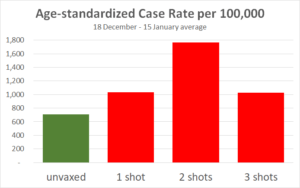
The authors emphasize it’s not about case numbers — it’s about severe outcomes, hospitalizations and deaths:
“Evidence suggests the COVID-19 vaccines are 90% effective at preventing a severe outcome of COVID-19. COVID-19 hospitalizations and deaths are strongly driven by older age, with most deaths occurring in those over 70 years old and having multiple other illnesses. But overall, you are less likely to be hospitalized if you are vaccinated with a booster.”
What data are they talking about? Here are results from their own data table:
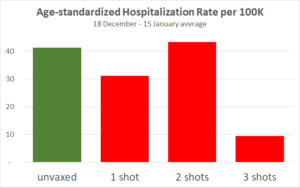
The only substantial reduction is from people who received the third shot, which has only recently been available in Scotland. But for the three-shot cohort only, vaccination effectiveness is declining over the four weeks.
This adds to previous evidence that protection from the vaccine is short-lived, and each injection provides a shorter window of protection than the previous one. Also, note the hospitalization statistics may have been gamed.
Since the publication of this article, England but not Scotland has backed off requirements for vaccination IDs.
Example 4: ‘Clinically Suspected Myocarditis Temporally Related to COVID-19 Vaccination in Adolescents and Young Adults’
Myocarditis, or inflammation of the heart, is a severe and life-shortening disease. It is virtually unknown in young people, but it is a recognized side effect of the COVID vaccines, especially in boys and young men.
This article summarizes the experience of 139 young patients (ages 12 to 20) who were hospitalized for myocarditis following vaccination.
19% of them were taken into intensive care.
Two required infusions of pressors and inotropes (potent intravenous drugs used to raise critically low blood pressure).
Every patient had an elevated Troponin I level. Troponin is an enzyme specific to cardiac myocytes. Levels above 0.4 ng/ml are strongly suggestive of heart damage. These young patients had a median Troponin I level of 8.12 ng/ml — over 20 times greater than the levels found in people suffering heart attacks.
“Conclusions: Most cases of suspected COVID-19 vaccine myocarditis occurring in persons <21 years have a mild clinical course with rapid resolution of symptoms.”
“Mild clinical course” — We suppose this refers to the 81% who did not go to the ICU or the fact that none died or required ECMO (Extracorporeal Membrane Oxygenation, a desperate means to keep the body oxygenated when a patient’s heart or lungs have completely failed).
In any case, every single person in this study was hospitalized. When does a “mild clinical course” require hospitalization for a two-day median length of stay?
“Rapid resolution of symptoms” — How would anyone know this? Myocarditis in older patients doubles the probability of death for the long term.
We don’t know what it will do to young boys in the long term, especially since every patient had some damage to their heart as evidenced by significantly abnormal troponin levels. And we don’t fully understand the mechanism by which the vaccines cause myocarditis.
Example 5: ‘Increases in COVID-19 are unrelated to levels of vaccination across 68 countries and 2947 counties in the United States’
This is the title of a paper by two statisticians from the Harvard School of Public Health, published on Sept. 30, 2021, in the European Journal of Epidemiology.
The title makes the important claim that there is no public health benefit from vaccination. COVID-19 is spreading at the same rate in different populations, unrelated to whether the population is mostly vaccinated or mostly unvaccinated.
It’s a powerful counterpoint to the ubiquitous demand that more people should undergo vaccination for the sake of their community.
The paper completely undermines the requirement of vaccination to attend meetings, concerts, theater and other public gatherings. It says there is no legitimacy to the creeping government vaccine mandates for travel.
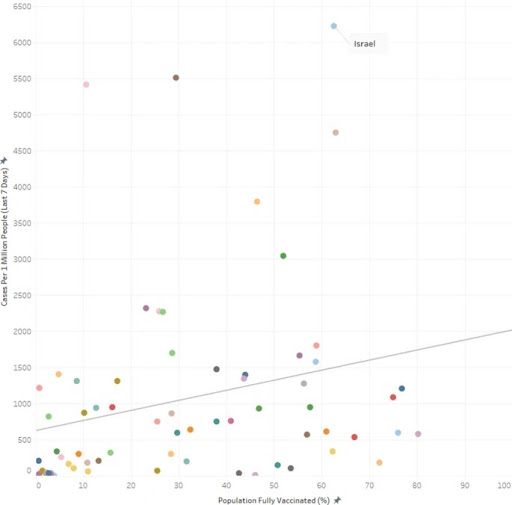
But the data in the paper don’t show that vaccination and spread of COVID-19 are “unrelated.” In fact, there is a paradoxical relationship, an insidious relationship: The more vaccinated countries had more new COVID-19 cases (during the week when the survey was conducted). The correlation is significant (p=0.04).
Still, the authors conclude by explicitly recommending propagandizing of the unvaccinated: “In summary, even as efforts should be made to encourage populations to get vaccinated it should be done so with humility and respect.”
It may sometimes be wrong to promote flawed health policy, but apparently, it’s a good thing, so long as it is done with humility and respect.
Why would these researchers take the trouble to publish data that is so damning to the vaccine narrative, and then pull punches in the title and in the conclusions?
Are we to assume that these authors who have assiduously extracted data from 68 different countries and nearly 3,000 U.S. counties were unable to notice their meticulous scatter plot unequivocally demonstrates high vaccination uptake is associated with higher (NOT lower) prevalence of COVID-19?
This seems to be a different case from the first example, where shills for the pharmaceutical industry set out to create a deceptive narrative. We think it’s probable that in this case, soft-pedaling the implications of these glaring data may not have been the authors’ choice, but rather a decision by the journal’s editors.
We know from personal experience how difficult it is to get an article through peer review at most “reputable” medical journals when the results are out of sync with the COVID narrative.
It may well be that these authors fought hard to get their subversive message into print, and in order to get past peer review, they softened the language, especially, the title.
Conclusions
The church was once the most trusted institution in Europe. Then the bishops started selling indulgences — a kind of get-out-of-hell-free pass for rich sinners.
Today the most trusted institution is science.

Sources: Gallup, Gallup, Gallup, Pew
This is true despite the fact that scientists are human, subject to error and to corruption.
Medical journals have become financially dependent on their advertisers, which are almost exclusively the pharmaceutical giants.
For several decades now, the “Church of Science” has been selling indulgences. With enough money, you could buy a scientific study that says what you want it to say.
Darell Huff’s book, “How to Lie with Statistics,” first published in 1954, remains the all-time best-seller in its field.
Recently, Gerald Posner documented the way in which the pharmaceutical industry has used its profits to affect science at every level, from medical researchers to journal editors to government regulatory agencies to the journalists who interpret science for the public.
Pressure is being placed on independent researchers by the journal editors and peer reviewers, many of whom have ties to Big Pharma. Valid studies, honestly reported, can be rejected for publication if they send a message that threatens corporate profits.
In the age of COVID, we see three reasons that an article’s conclusions might become detached from its statistical findings:
- Scientists have suddenly abandoned basic logic and reason. This is an implausible explanation because, as has been demonstrated above, these examples demonstrate diligence in gathering data. There is no reason why they would abandon diligence in arriving at reasonable conclusions.
- Shortcuts by pharmaceutical companies and their shills in academia. Rigging clinical trials the old-fashioned way is expensive and time-consuming. It’s also uncertain. Sometimes the truth rears its head even if a study is designed to conceal it. Even a study that is designed to fail might succeed when the inconvenient truths are sufficiently stubborn. How much easier it is to report the results and then tack on an abstract and a discussion section that say what you want to say, regardless of the data tables in the body of the article!
- Scientist authors are well aware of the pernicious censorship in scientific publication that has emerged in recent days. This is perhaps the most intriguing possibility. If researchers behind the study have some prestige and some influence, they still may find they have to soften their rhetoric in order to pass peer review. However, what we are witnessing today is more than a tendency to be “diplomatic” in their choice of words. What does it mean when their conclusions do not match the findings? Are they trying to tell us that they are gagged? Are they silently screaming at us to look at the data and not their interpretation of them?
The Nature Medicine article on the origins of the SARS-CoV-2 virus (reviewed first) seems to be an example of researcher corruption.
The article in the European Journal of Epidemiology (Example 5), which relates vaccination rates to COVID prevalence, is more likely an example of corruption by journal editors and peer reviewers.
In this instance, the data and conclusions are so disparate that it begs us to reconsider the cynical position that all scientists have been corrupted. Is there a better way for conscientious scientists to signal their community that they are being censored than by compiling solid data that tell a compelling story and then arriving at a nonsensical conclusion? Are they imploring us to read between the lines?
For the other four articles reviewed above, we leave it to your judgment — how do you think the conclusions came to be so disconnected from the statistical findings in these same articles?
Obviously, this blatant distortion of scientific write-ups is not a long-range strategy, but the world is moving fast, and people who count on their ability to shape scientific conclusions to their financial interests will be successful for long enough to do a great deal of mischief.
What will be the damage to the credibility of science when the dust clears?
Josh Mitteldorf, Ph.D., has a background in theoretical physics. Since the 1990s, he is best known for his contributions to the biology of aging, including many articles and two books.
Madhava Setty, M.D. is senior science editor for The Defender.
© 2022 Children’s Health Defense, Inc. This work is reproduced and distributed with the permission of Children’s Health Defense, Inc. Want to learn more from Children’s Health Defense? Sign up for free news and updates from Robert F. Kennedy, Jr. and the Children’s Health Defense. Your donation will help to support us in our efforts.
How Many Pregnant Women Have Actually Died of COVID-19?
The Daily Sceptic | February 3, 2022
There follows a guest post by a Daily Sceptic reader, who wishes to remain anonymous, who, being pregnant, was following closely the advice and studies concerning pregnant women. However, her own analysis of the reports on the deaths of pregnant women with COVID-19 suggested that the alarming statistics about Covid in pregnancy she was being provided with did not stack up.
As a pregnant woman, I have been following advice and studies that concern this group closely. Unfortunately, it is becoming increasingly difficult to find any balanced information amongst the blatant propaganda. I am so sick of being told at every turn that ICU is full of unvaccinated pregnant women. Below is an example of the stuff that gets shared online by my local maternity team.
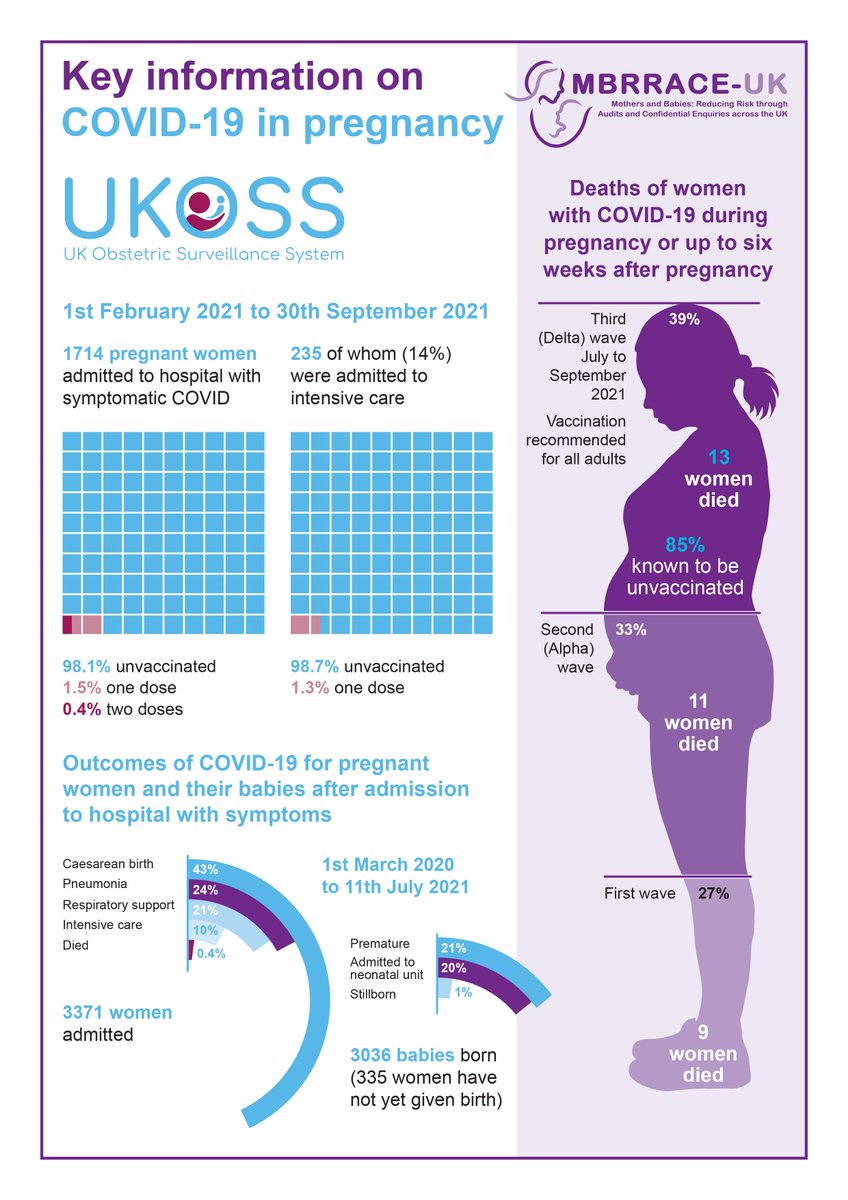
So I thought I would look at what stats MBRRACE had released lately. They have two reports that caught my eye in particular: one on maternal Covid deaths March-May 2020 (10 women) and another covering the period June 2020-March 2021 (17 women).
Despite being such a small group of people, I feel that each case is a fascinating story that paints a dramatically different picture to that portrayed by the media and the NHS. Here are some points that stood out to me from each report
March-May 2020 (10 deaths)
- None of the women who died received any actual treatment, just support.
- Three of the ten women died because they were too scared to go to hospital.
- Four women died of suicide and not being able to access help was a factor (I don’t think they were included in the ten deaths, but the insinuation is that Covid restrictions contributed to their deaths).
- Two women were murdered by their partners, with health services already knowing they were at risk (again, I don’t think they were included in the ten, but the insinuation about restrictions is there again).
- The quote “pregnancy [sic] and postpartum women do not appear to be at higher risk of severe COVID-19 than non-pregnant women” seems telling.
- Only two women were classified as having received “good care”.
June 2020-March 2021 (17 deaths)
- Three women did not even have Covid but died as a result of the side effects of restrictions.
- Four women tested positive but died of unrelated causes – two of these women received poor care because of their Covid status.
- 60% of the women who actually died from Covid were obese and a further 20% were overweight.
- 50% had pre-existing mental health conditions (personally I believe that this both prevents women from being able to speak up for themselves and creates a stigma that they are ‘difficult patients’).
- One woman died at home of a urinary tract infection because no translator was available for her telephone appointment.
- Four women died because they were too scared to go to hospital – one of these women sought no antenatal care at all and died after giving birth at home.
- One woman died after being given painkillers for backache – she was only seen remotely by a GP so he or she couldn’t see she was both heavily pregnant and had sepsis.
- Another woman died of sepsis from a miscarriage because doctors assumed she just had (asymptomatic) Covid.
- A woman died of obvious kidney/liver problems shortly after birth because again, doctors bizarrely assumed she was actually suffering from Covid following a positive routine test.
- 90% of the women who died had “care” that was not managed by the RCOG guidelines.
- One woman was not given treatment despite poor clinical indications, as she did not “look sick”.
- Three women who were very poorly and were considered for ECMO were denied this despite not having any contraindications.
- One woman died from a pulmonary embolism at home after her GP’s online triage system did not recognise either her Covid status or recent pregnancy as risk factors and didn’t give her an urgent appointment.
- Only 10% of the women received “good care”, and in 70% improvements in care may have meant they survived.
The reports are heartbreaking and I do not wish to diminish the pain that these women’s families must be suffering, but it is abundantly clear that very few of these women died from actual Covid – many appear to be victims of the restrictions and fear – and the handful that did had significant confounding factors.
Jordan Peterson Compares Climate Model Errors to Compounding Interest
By Chris Morrison | The Daily Sceptic | February 2, 2022
It’s been all Canada on Joe Rogan’s popular Spotify podcast of late. First, crinkly rockers Neil and Joni threw their guitars out of the pram when Rogan dared to broadcast a number of different opinions on Covid and vaccines. Then fellow Canadian Dr. Jordan Peterson said climate models compounded their errors, just like interest. Green activists and zealots (often known in the climate change business as ‘scientists’) clutched their responsibly sourced pearls and whined, “Lawks a-mercy, it’s outrageous!” and “Banning’s too good for them!”. The septuagenarian songsters briefly found themselves out of the headlines as the mainstream media rushed to quell a growing sceptical climate debate and rubbish a troublesome competitor.
Dr. Peterson suggested that the climate was too complex to be modelled. Such notions were said to be a “word salad of nonsense,” reported a distraught Guardian. Dr. Sarah Perkins-Kirkpatrick of the University of Canberra added Peterson had “no frickin’ idea”. Professor Michal Mann of Penn State University said Peterson’s comments – and Rogan’s “facilitation” of them – was an “almost comedic type of nihilism” that would be funny if it wasn’t so dangerous.
This of course is the same Michael Mann who produced the infamous temperature hockey stick that was at the centre of the 2010 Climategate scandal. The graph was used for a time in IPCC reports and showed a 1,000 year straight temperature line followed by a recent dramatic rise. This startling image was helped by the mysterious disappearance of the medieval warming period and subsequent little ice age. Discussion about the graph led to Mann pursuing a U.S. libel suit against the broadcaster and journalist Mark Steyn. In court filings, Mann argued that it was one thing to engage in discussion about debatable topics, but it was quite another to “attempt to discredit consistently validated scientific research through the professional and personal defamation of a Nobel Prize recipient”. He is not himself a Nobel Prize recipient, but perhaps he was referring to someone else.
Independent minded communicators like Joe Rogan and take-no-prisoner intellectuals such as Dr. Peterson command a worldwide audience and they are difficult to cancel. The battle between Neil Young and Joni Mitchell and Joe Rogan, sitting on a $100m Spotify contract, had only one free speech winner – at least for the moment. Meanwhile, the Guardian’s default position when faced with something unsettling like the ‘settled’ science of anthropogenic climate change is to declare it will not “lend” its credibility to its critics by engaging in debate. That was obviously not possible with Peterson’s remarks being plastered all over social media, although it could be argued that the Guardian reporting the vulgar abuse users posted in response is not much of a substitute for the usual lofty disdain.
Dr. Peterson attacked climate models on a number of fronts. In particular, he noted that as you stretch out the models across time “the errors increase radically”. In its way, this refers to the biggest problem that lies at the heart of the 40-year track record of climate model failures. To make a prediction, climate models are fed a guess of the increase in the global mean surface temperature that follows a doubling of atmospheric CO2. Nobody actually knows what this figure is – the science for this crucial piece of the jigsaw is missing, unsettled you may say. The estimates run from 1°C to as high as 6°C and of course the higher the estimate, the hotter the forecasts run.
As they don’t say in the climate and Covid modelling business – Garbage In, Garbage Out.
Meanwhile back in the real world, global warming has been running out of steam over the last two decades. Satellite temperatures, which have been available since 1979, provide a more accurate measurement of global warming (or cooling) than flawed and frequently massaged surface measurements.
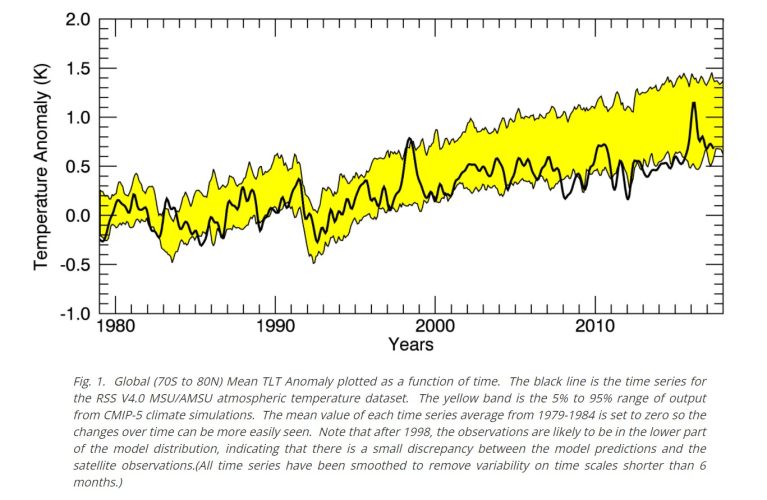
The graph above from Remote Sensing Systems demonstrates the lack of warming measured by satellites and is displayed by the black line. Forecasts from climate models, contained within the yellow area, started to diverge significantly from the late 1990s, backing Dr. Peterson’s claim that over time they magnify their own errors. As with epidemiological models, there seems little incentive to tone down the inputs – it’s difficult to make a reputation, and secure grants, by saying that few people will die. In the case of climate models, there are also 204,000,000,000,000 reasons to exaggerate – this being the £204 trillion that McKinsey recently said must be spent to achieve the political goal of global Net Zero by 2050.
The ‘pure’ science around climate change is thin on the ground in the fast-growing Earth Science university faculties, more often than not a rebranding of the old Geography departments. The real science surrounds the effect of adding CO2 to the atmosphere, where an advanced knowledge of chemistry and physics is essential. Within such academic circles, there are growing doubts about the unproven hypothesis that humans cause all or most global warming by burning fossil fuel. While CO2 has been rising recently from a geologically ultra-low base, there is little correlation between the gas and temperature movement in almost any timeframe. Again Dr. Peterson is right to note that the climate is too complex to model accurately since there are almost countless other natural factors at work in a chaotic atmosphere.
Professor William Happer of Princeton has suggested that CO2 becomes “saturated” once it reaches a certain level, since it reflects heat back to Earth only within certain bands of the infrared spectrum. Increases in CO2 beyond current levels will have little effect on future warming, or cooling. Far from being harmful, the extra CO2 is highly beneficial for plant growth and food.
Recently, a group of physics professors from the University of Massachusetts led by Kenneth Skrable examined the carbon isotope trail released by fossil fuel burning. They found the amount of CO2 released was “much too low to be the cause of global warming”. The German physicist Dr Frank Stefani looked at the effect of the Sun and geomagnetic forces on the planet and concluded that the Sun alone accounted for between 30-70% of recent planetary warming.
About two years ago, 48 Italian science professors wrote an open letter to their Government noting that the “advanced alarmist forecasts” of climate models “were not credible”. Natural variability, it was said, “explains a substantial part of global warming observed since 1850”. Catastrophic predictions “are not realistic”. The letter was signed by a number of distinguished academics including Antonino Zichichi, Emeritus Professor of Physics, a past president of the World Federation of Scientists and the discoverer of nuclear antimatter. Not that the folks who write for the Guardian would ever “lend” their credibility by talking about the climate with these 48 ‘denier’ scientists.
Relax, Wisconsin Public Radio, Climate Change Isn’t Making Human Health Worse
By H. Sterling Burnett | ClimateRealism | January 28, 2022
A story run by Wisconsin Public Radio (WPR) today claims climate change poses a threat to human health. Disease and mortality data show this is false. During the recent period of modest warming, deaths resulting from extreme heat and weather have declined sharply, and research indicates climate change is not contributing to pandemics or parasite borne diseases.
WPR’s story, titled “Wisconsin health providers say climate change is a medical issue,” features input from the climate activist group, Wisconsin Health Professionals for Climate Action. WPR writes:
“Heat waves, cold spells could harm people, along with dangerous flooding, according to Wisconsin Health News panelists. Last year, top medical journals warned that climate change, not COVID-19, was the greatest threat to public health.”
“In the Midwest, climate change is likely to bring extreme temperatures and flooding, along with more mosquito and tick diseases, according to the Centers for Disease Control and Prevention (CDCP).”
While many top medical journals and the politically controlled CDCP have claimed climate change is causing worsening health and increasing incidences of premature mortality, hard data presented in peer reviewed literature proves this is false.
Data from the U.N. Intergovernmental Panel on Climate Change and the National Oceanic and Atmospheric Administration presented in Climate at a Glance articles disprove claims that heat waves, cold spells, and incidences of flooding have increased during the recent period of modern warming.
If instances of extreme heat or cold, and flooding events aren’t increasing, or are in fact declining, they can’t be causing an increase in adverse health events, which is precisely what the data establish.
As detailed in Climate Realism, here, deaths resulting from climate related events have fallen to a historic low, having fallen by more than 99 percent over the past 100 years.
On July 1, 2021 The Lancet published what is arguably the largest study ever to examine excess mortality associated with temperature. The study’s authors, 68 scientists representing universities and research institutes in 33 countries spanning all regions of the world, came to two very clear conclusions: Cold temperatures contribute to far more deaths each year than warmer temperatures; and deaths associated with extreme temperatures, hot or cold, are declining.
This study confirms what research previously published in The Lancet, the Southern Medical Journal, and other outlets, has consistently shown: Cold is the biggest temperature related killer, not heat, and as he earth warms the number of deaths related to extreme temperatures is falling dramatically.
Also, contrary to the impression given in the WPR story, there is no evidence insect borne tropical diseases are expanding their range or sickening, or claiming the lives of greater numbers of people as the earth has warmed.
The vast body of scientific literature referenced in Chapter Seven of Climate Change Reconsideree II: Biological Impacts and Chapter Four of Climate Change Reconsidered II: Fossil Fuels fails find any link between global warming and the spread of Lyme disease, malaria, Dengue fever, West Nile virus, and other vector-borne diseases are either grossly overstated or outright false.
For example, a 2010 study in the peer-reviewed science journal Nature:
“[C]compared historical and contemporary maps of the range and incidence of malaria and found endemic/stable malaria is likely to have covered 58% of the world’s land surface around 1900 but only 30% by 2007. They report, ‘even more marked has been the decrease in prevalence within this greatly reduced range, with endemicity falling by one or more classes in over two-thirds of the current range of stable transmission.’ They write, ‘widespread claims that rising mean temperatures have already led to increases in worldwide malaria morbidity and mortality are largely at odds with observed decreasing global trends in both its endemicity and geographic extent.’”
Also, in a 2008 article in the Malaria Journal, Pasteur Institute of Paris professor Paul Reiter wrote:
“Simplistic reasoning on the future prevalence of malaria is ill-founded; malaria is not limited by climate in most temperate regions, nor in the tropics, and in nearly all cases, ‘new’ malaria at high altitudes is well below the maximum altitudinal limits for transmission, [continuing] future changes in climate may alter the prevalence and incidence of the disease, but obsessive emphasis on ‘global warming’ as a dominant parameter is indefensible; the principal determinants are linked to ecological and societal change, politics and economics.”
Despite numerous claims to the contrary, claims parroted by WPR without citing any hard evidence, human health is not being threatened by climate change. Indeed, on every health indicator: human lifespan, premature mortality, premature births, infant mortality, hospitalizations linked to extreme temperatures or weather events, hunger, and malnutrition, to name the most often discussed health indicators, humans are living better, longer, healthier, lives than ever before.
Featured Video

Chinese jet fuel and the myth of energy independence
or go to
Aletho News Archives – Video-Images
Book Review
Former Insiders Criticize Iran Policy as U.S. Hegemony
By GARETH PORTER | CounterPunch | February 27, 2013
“Going to Tehran” arguably represents the most important work on the subject of U.S.-Iran relations to be published thus far.
Flynt Leverett and Hillary Mann Leverett tackle not only U.S. policy toward Iran but the broader context of Middle East policy with a systematic analytical perspective informed by personal experience, as well as very extensive documentation.
More importantly, however, their exposé required a degree of courage that may be unparalleled in the writing of former U.S. national security officials about issues on which they worked. They have chosen not just to criticise U.S. policy toward Iran but to analyse that policy as a problem of U.S. hegemony. … continue
Blog Roll
 Aletho News
- What is fueling unrest across the EU?
- Why no power can undermine Iran’s eternal dominance over the Strait of Hormuz
- Is The War Against Iran Over?
- Iran war will leave long-term ‘scar’ on Wall Street, investors warn
- How Iran decimated US power projection in West Asia: Military lessons of 40-day war
- Iran’s report details US-Israeli war crimes in targeting schools, hospitals, livelihoods
- NATO’s Slow Fracture: How Trump’s Iran War Exposed the Instrument of Hegemony
- Chinese jet fuel and the myth of energy independence
- Ukraine Sea Drone Fired From Libya Hit Russian Tanker in Mediterranean
- IRGC: Iranian forces launched no attacks during ceasefire hours
- If Americans Knew
- DNC Shoots Down Resolutions Calling Out AIPAC and Limiting Arms to Israel
- TCN: Is Israel Blackmailing President Trump?
- Israel killed at least 303 Lebanese yesterday – who were they? Daily Update
- Amnesty: Urgent – Protect Lebanese civilians from brutal escalation in Israeli attacks
- Is The War Against Iran Over?
- Inside the Israeli army’s propaganda wing
- Hundreds of Gaza Amputees Stranded in Legal Limbo
- The gallows law: Israel moves toward executing Palestinian children
- Tucker Carlson: The Path to Peace requires ending ‘special alliance’ with Israel
- This is ceasefire? Israel’s biggest massacre yet in Lebanon, another journalist killed in Gaza – Daily Update
- No Tricks Zone
- An Inconvenient Tree: Uncovered In Alps… Europe Much Warmer Than Today 6000 Years Ago
- New Study Reports A 60% Slowdown In Greenland’s Ice Loss Rate In The Last Decade
- Low Intensity Tornado Wrecks Major Solar Farm, Creating A Potential Toxic Dump
- New Study Finds Warming Saves Lives…Cold Temperatures 12 Times More Deadly Than Excess Heat
- German Science Blog Accuses PIK Climate Institute Of Hallucinating Climate Tipping Points
- Devastating Assessment Of Comirnaty Vaccine By Former Senior Pfizer Europe Toxicologist
- New Study: CO2 Is ‘Effectively Negligible’ As An Explanatory Climate Change Factor Since 2000
- Former Pfizer Toxicologist Dr. Helmut Sterz Tells Bundestag Hearing Pfizer Vaccine Should Have Never Been Approved
- Energy Expert: Germany’s Nuclear Phaseout Was A “500 Billion Euro Mistake”
- New Research: South Australia’s Mid-Holocene Sea Surface Temperatures Were 4°C Warmer Than Today
 Aletho News